Tag: United Nations

  • 5th International Day of Yoga Celebrations kick off at the United Nations

    5th International Day of Yoga Celebrations kick off at the United Nations

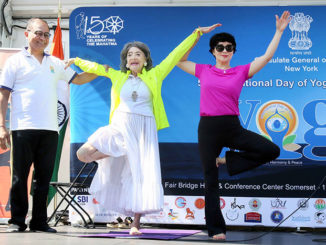
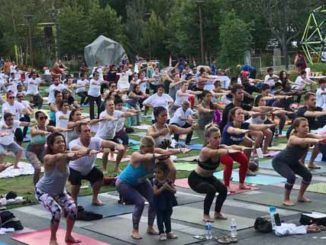
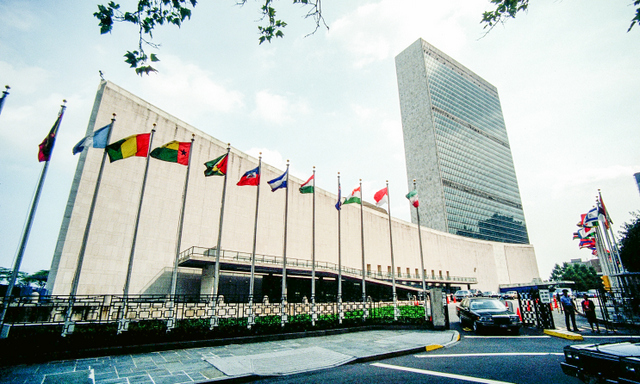
    UNITED NATIONS (TIP): 5th International Day of Yoga celebrations kicked off at the United Nations, with a laser lighting display of Yoga at the iconic United Nations building, June 19.

    After the overwhelming success of last few years’ International Day of Yoga celebrations, Permanent Mission of India to the United Nations   made it larger in the fifth edition. Instead of a single day celebration, this time it is a larger than life event.

    Ambassador Syed Akbaruddin, India’s Permanent Representative to the UN in New York said: “ UN has a special place in the remarkable growth of Yoga in our own lifetimes. It was here that the ancient practice of Yoga was transformed into an annual global observance”.

    While addressing the 69th session of UNGA on Septembe2014, Prime Minister Narendra Modi urged the world community to adopt an International Day of Yoga. On December 11, 2014, the 193 members UNGA approved the proposal by consensus to declare 21 June as “International Day of Yoga.” In its resolution, the UNGA recognized that Yoga provides a holistic approach to health and well-being and wider dissemination of information about the benefits of practicing Yoga for the health of the world population. Yoga also brings harmony in all walks of life and thus, is known for disease prevention, health promotion and management of many lifestyle-related disorders. Keeping these in mind, the Government of India has adopted IDY Logos and a Common Yoga Protocol, a booklet intended to give a brief overview about Yoga and Yogic practices in order to orient the readers towards comprehensive health for an individual and the community.

    From its maiden year IDY became hugely popular around the globe.  Yoga Day also follows different themes each year. The theme for this year’s World Yoga Day is ‘Yoga for Heart’ which highlights how beneficial yoga is towards reducing cardiovascular risk.

    On the occasion of the 5th International Day of Yoga, the Permanent Mission of India to the United Nations in New York has organized five events at the United Nations Headquarters in New York:

    EVENT ONE

    Projection of Yoga Postures

    On North Facade of UN Headquarters Building

    Wednesday 19 June 2019

    EVENT TWO

    Yoga with the Gurus

    Thursday 20 June 2019

    North Lawn, United Nations Headquarters

    The outdoor event at North Lawn of United Nations had a Yoga Session led by Yoga Gurus Swami Paramananda of (Sivananda), Kevin Tobar and his associates from Bhakti Cente and Sunaina Rekhi from India. In addition, there was musical and dance performances by” Indian Raga”.  Amina J. Mohammed, Deputy Secretary-General was the Chief Guest.

    EVENT THREE

    Panel Discussion

    Theme: Yoga for Climate Action

    Friday 21 June 2019

    ECOSOC Chamber, United Nations Headquarters

    1100-1230 Hrs

    Moderator

    Ambassador K. Nagaraj Naidu,

    Deputy Permanent Representative

    Panelists

    Gaur Gopal Das

    Lifestyle coach & motivational speaker

    Srinivasan

    Acharya, International Sivananda Yoga Vedanta Centre

    Eddie Stern

    Yoga teacher, author & lecturer

    Simon Haas

    Author, speaker & philosopher

    Kusumita Pedersen

    Professor of Religious Studies, St. Francis College, Brooklyn

    EVENT FOUR 

    PANEL DISCUSSION

    Theme – Yoga and Climate Action 

    1300 – 1500 Hrs

    ECOSOC CHAMBER

    Moderator 

    Renee Mehrra

    Panelists 

    Kyle McDonald (Institute of International Social Development, NGO with the UN)

    Renee Mehrra (Science of Spirituality, NGO with the UN, UNSRC SOS Club)

    Poonam Gupra (Laughter Yoga)

    Germany Bravo-Casas (UNSRC Yoga Club)

    Guru Dileepji (World Yoga Community)

    EVENT FIVE

    1. Exhibition on Yoga

    South Wall, Near East Lounge

    United Nations Headquarters

    On display until 21 June

    1. Exhibition on International Day of Yoga – World Photo Series

    Curved, Near East Lounge

    United Nations Headquarters

    On display from 19-21 June

  • International Day of Yoga Celebrations Planned  in Houston

    International Day of Yoga Celebrations Planned in Houston

    Manu Shah

    HOUSTON, TX (TIP): The Consulate General of India, Houston in collaboration with Friends of Yoga, is organizing several events across Texas to celebrate the 5th International Day of Yoga.

    This ancient Indian practice received unprecedented global attention four years ago when the United Nations recognized June 21st as the International Day of Yoga. An initiative of India’s Prime Minister Narendra Modi, who himself starts his morning with yoga, the first IDY in 2015 saw people turning out in huge numbers stretching and breathing mindfully at public parks, convention centers and open spaces.

    Yoga’s soaring popularity can be seen from the crowds that join in the celebration every year. From serious yoga practitioners to curious beginners, each successive IDY has been drawing bigger crowds and garnering greater interest. As with every year, this year too will feature a lineup of common yoga practices, relaxation techniques and guided meditation by well-known yoga instructors. An added attraction is an Indian Vegetarian Food Festival which will be held at select places to mark the 150th year of Mahatma Gandhi’s birth anniversary,

    Houston will celebrate IDY on Friday, June 21 on the lush green lawns of Midtown Park (2811, Travis St, Houston Texas 77006).

    The event will begin at 6:00 pm with a demonstration of some of the more difficult yoga postures (asanas) and a cultural program. After brief remarks from the Consul General of India, Dr. Anupam Ray, the guided group yoga (Asanas or Postures), Relaxation, Pranayama and Meditation will be led by different yoga experts. The event will wrap up at 7:30 pm with a color powder dance party or Holi as it is known in India. (RSVP at yogadayoftexas2019.eventbrite.com)

    Coordinator of Houston’s yoga events and a firm believer in yoga for optimum health, Sharad Amin expressed his appreciation for the cooperation from Houston’s yoga community in celebrating IDY for the past four years. Yoga is a precious gift given by Indian sages to humanity, he noted, and emphasized the importance of practicing yoga for good health every day. “Each one should teach one” the health benefits of yoga as it is key to “being and well-being,” he added.

    The Hindu Temple of The Woodlands will host the event on Saturday June 22 from 7:30 -10am at the Town Green Park. (2099 Lake Robbins Drive, The Woodlands, TX 77380). Opening remarks will be made by Consul General Dr. Anupam Ray followed by yoga practices from participating yoga studios, Surya Namaskars or the Sun Salutation practice by HTW Yoga Group and the 35-minute yoga protocol set by the Government of India led by renowned yoga instructors Sriram Sarvotam and his wife Ekaterina Jeleva. The morning will conclude with a guided meditation session.

    Yoga Teachers

    The Consulate General of India, Houston has also planned a series of events in Austin, Dallas and San Antonio.

    IDY will be observed in front of the stately State Capitol building in Austin on Saturday June 15 at 6:00 pm (1100 Congress Ave. Austin, Texas 78701), in Dallas on 22nd June, Saturday at 8:00 am at the Mahatma Gandhi Memorial Plaza (1201 Hidden Ridge Dr., Irving, Texas, 75038) and in San Antonio on 21st June, Friday at 6:00 pm at the Riverwalk Mall (San Antonio, TX – 78205).

    In addition to these main events, multiple events are being organized at churches, temples, community centers, Arya Samaj Greater Houston, Brahma Kumaris, India House, Hindu Swayamsevak Sangh Shakas (HSS), Jamatkhanas and Patanjali Yogpeeth USA Trust between 15th and 23rd June.

    Please visit the following links for more information:

    Website : http://yogadayoftexas.org/

    Facebook : https://www.facebook.com/yogadayoftexas/

    Twitter : https://twitter.com/yogadayoftexas

    The events are free and open to all. Bring your yoga mats and plan to arrive 20 minutes ahead to find a comfortable spot.

    (The events are being organized in association with The Art of Living Foundation, Arya Samaj Greater Houston, Brahma Kumaris Texas, Ekal Vidyalaya, Hindus of Greater Houston, Hindus Swayamsevak Sangh, Hindu Temple of the Woodlands, His Highness Aga Khan Council for the Southwestern United States, IMAGH, India House, IDoYoga, Isha Foundation, JK Yog, Mahatma Gandhi Memorial of North Texas, Midtown Houston, Patanjali Yogapeeth USA Trust, Pralaya Yoga, Sahaj Yoga, Sewa International, Youniversoul Fest, Vyasa USA, Yoga Studios, Yoga Friends and volunteers.)

  • Hundreds of Cities across world  will  celebrate International Day of Yoga, June 21

    Hundreds of Cities across world will celebrate International Day of Yoga, June 21

    In December 2014, the United Nations General Assembly unanimously adopted a resolution, co-sponsored by 177 countries, and declared June 21 as International Day of Yoga with a view to promoting  a healthier lifestyle.

    The first International Day of Yoga was celebrated on June 21, 2015.Since then, International Day of Yoga is observed each year in hundreds of cities across  the world.

  • Sudan on the Brink: death toll rises to 100 as bodies found in Nile, say doctors

    Sudan on the Brink: death toll rises to 100 as bodies found in Nile, say doctors

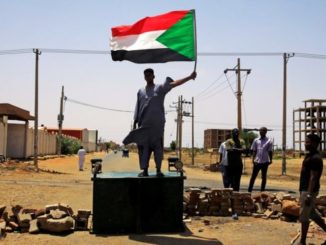
    NEW YORK (TIP):  The death toll from June 3  attack on the sit-in of Sudan’s pro-democracy protesters has risen to 100, after 40 bodies were recovered from the River Nile, according to the Central Committee of Sudan Doctors (CCSD), says a CNN report.

    Sixty people were reported to have been killed in the military crackdown in the capital Khartoum, before scores of bodies were found dumped in the river by the paramilitary Rapid Support Forces (RSF), said the CCSD, which is close to the protesters.

    The head of Sudan’s ruling military council, Lt. Gen. Abdel Fattah al-Burhan, has ordered an investigation into the deaths.

    The demonstrators have demanded that the Transitional Military Council, which has ruled the country since troops ousted longtime President Omar al-Bashir in April, make way for a civilian-led interim body.

    Eyewitnesses said that the police and RSF shot at protesters on Monday, June 3. Several videos showed security forces beating people with sticks. The internet has been blocked in places across the country by major providers.

    Monday’s attack has drawn international condemnation, including from United Nations Secretary-General António Guterres.

    After April’s coup, the military council and opposition groups agreed on a three-year transition to democracy. But on Tuesday, al-Burhan called for national elections within nine months.

    The only way to rule Sudan is through “the ballot box,” the council leader said in an address on state TV.

    In a speech broadcast on Sudan state-run TV on Wednesday, al-Burhan apologized to Sudanese people and said that “all involved in the events that lead to the disruption of the protests site will be held accountable and brought to justice.”

    He called on all people of Sudan “to turn the page of the past and reopen a new page to reach a better future of our country,” adding that the ruling council is willing to start fresh negotiations with opposition groups.

    (Source: CNN and agencies)

  • 2nd Anniversary of the India-UN Development Partnership Fund observed at the UN

    2nd Anniversary of the India-UN Development Partnership Fund observed at the UN

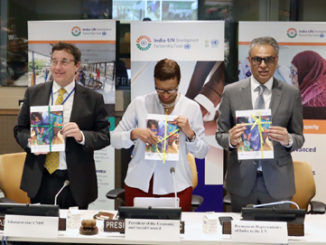
    UNITED NATIONS (TIP): The 2nd Anniversary of the India-UN Development Partnership Fund was commemorated , June 7, at the UN in an event organized by the Permanent Mission of India to the UN together with the UN Office for South-South Cooperation.

    The President of the Economic and Social Council and Permanent Representative of the Saint Vincent and the Grenadines to the United Nations, H.E. Ms. Inga Rhonda King; the Administrator of the United Nations Development Program (UNDP) Mr. Achim Steiner; the Executive Director of the United Nations Office for Project Services (UNOPS) Ms. Grete Faremo; and the Secretary-General’s Envoy on South-South Cooperation Mr Jorge Chediek took part along with Ambassadors, Stakeholders and prominent United Nations officials. The event highlighted the positive role of India-UN Development Partnership Fund in promoting sustainable development projects in partner countries in the spirit of South-South cooperation.

    The Report of the India-UN Development Partnership Fund was also launched during the commemoration.

  • Statue of Peace Leader Sri Chinmoy Dedicated at Toronto’s Vishnu Mandir

    Statue of Peace Leader Sri Chinmoy Dedicated at Toronto’s Vishnu Mandir

    By  Ashok Parulekar

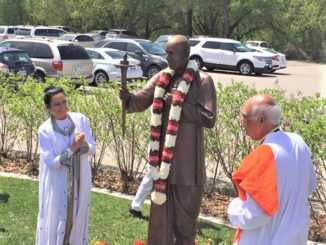
    TORONTO (TIP): Leaders of Toronto’s Vishnu Mandir dedicated a bronze statue of Dreamer of World-Peace Sri Chinmoy holding aloft the Peace Torch on Sunday, May 26  afternoon in their Peace Park dedicated to interfaith harmony.

    The life-sized likeness of the peace leader recognises a lifetime of his devoted service to fostering peace through music, art, writings, sports and silent all-faith meditation. Sri Chinmoy’s message is that each and every human being can be a peace-builder—and starting first within himself or herself. The spiritual leader led the interfaith silent Peace Meditation at the United Nations at the invitation of UN Secretary-General U Thant for 37 years. As well, he founded the global Sri Chinmoy Oneness-Home Peace Run which includes millions running for the cause of world peace.

    After showing a video on Sri Chinmoy’s life and contributions, the ceremony moved outdoors to the Peace Park where the statue is located, beginning with the ceremonial blowing of conches. Arriving Peace Runners passed the lighted Peace Torch to Dr. Budhendranauth Doobay, Chairman of the Board and Religious Advisor of the Vishnu Mandir.  “Sri Chinmoy was a great soul…Sri Chinmoy was a man of peace who has been recognized by so many people from around the world,” stated Dr. Doobay. “It is a great honour for us to welcome Sri Chinmoy in the form of this statue which will be here for all times to come.”

    Ms. Ranjana Ghose, President of the Sri Chinmoy Centres, spoke with deep insight about

    Sri Chinmoy’s peace activities and offered heartfelt gratitude to the Vishnu Mandir for this 38th peace statue dedication saying, “Sri Chinmoy’s life was an amazing success story of bringing the peace of the soul to the fore, within himself and in those with whom he interacted.  He was greatly respected by many dignitaries around the world, who cherished Sri Chinmoy for his compassionate manner of thinking and peaceful way of addressing a dynamic life.”

    Dr. Doobay then received the Torch Bearer medallion for his tireless devotion in fostering living spirituality and oneness amongst the faiths. Mr. Salil Wilson, Executive Director of the global Sri Chinmoy Oneness-Home Peace Run, presented the award. In 1987, Sri Chinmoy founded the Peace Run and, for the first time ever, the run will be covering every country in the world in the coming two years.

    Col. Gerry Nudds of the Mandir then invited illustrious representatives of many faiths to each lead participants in a prayer from their own faith. Hindu, Muslim, Christian, Buddhist, Jain and Jewish prayers added greatly to the spirit of interfaith harmony. As Sri Chinmoy wrote, “Spirituality is not merely tolerance. It is not even acceptance. It is the feeling of universal oneness…Spirituality is not mere hospitality to others’ faith in God. It is the absolute recognition and acceptance of their faith in God as one’s own.”

    A few other homes of Sri Chinmoy’s statues include the Kala Academy in Goa, India; ARMA museum in Ubud and Ngurah Rai International Airport, both in Bali, Indonesia; and Seattle’s Burke Gilman Trail.

  • UN Peacekeeping: India’s Contributions

    UN Peacekeeping: India’s Contributions

    By Asoke Kumar Mukerji

    As an “original” founder-member of the United Nations, India has not hesitated to respond to the calls of the UN to contribute troops for maintaining international peace and security. In 1950, soon after India’s independence, the 60 Parachute Field Ambulance of the Indian Army was sent to provide medical cover to U.S./R.O.K. and UN forces engaged in the Korean War. The unit served in Korea for a total of three and a half years (November 1950- May 1954), the longest single tenure by any military unit under the UN flag.

    India’s contributions to UN peacekeeping operations (UNPKOs) have been underscored by the experience and professionalism of India’s armed forces. Speaking at the September 2015 Leaders’ Summit in New York on UN Peacekeeping, Prime Minister Shri Narendra Modi had said: “The foundations of the United Nations were laid by the brave soldiers on the battlefields of the Second World War. By 1945, they included 2.5 million men of the Indian Army, the largest volunteer force in history.” India today is the largest contributor of troops to UNPKOs. More than 200,000 Indian troops have served in 49 of the 71 UNPKOs deployed so far.

    As an “original” founder-member of the United Nations, India has not hesitated to respond to the calls of the UN to contribute troops for maintaining international peace and security. In 1950, soon after India’s independence, the 60 Parachute Field Ambulance of the Indian Army was sent to provide medical cover to U.S./R.O.K. and UN forces engaged in the Korean War. The unit served in Korea for a total of three and a half years (November 1950- May 1954), the longest single tenure by any military unit under the UN flag.

    From 15 November 1956 to 19 May 1967, eleven infantry battalions from India served by rotation in the UN Emergency Force (UNEF 1) to ensure the withdrawal of France, U.K. and Israel from Egyptian territory and to sustain the peace between Israel and her Arab neighbors. 27 Indian UN peacekeepers lost their lives in this operation.

    In 1960, the Congo requested for deployment of UN peacekeepers to counter secession and re-integrate the country after Belgian rule. Between 14 July 1960 and 30 June 1964, two Indian brigades participated in ONUC UNPKO. The rules of engagement were modified to cater for use of force in defense of the mandate, in carrying out humanitarian tasks, and in countering mercenaries. 39 Indian personnel lost their lives in the operation. Captain Gurbachan Singh Salaria became the only UN peacekeeper to receive the Param Vir Chakra, India’s highest military award, for laying down his life in defense of the UN mandate in the Congo.

    India’s participation in the initial UNPKOs resulted in a growing pool of Indian military officers seconded to the UN whose professionalism and experience have contributed to UN peacekeeping doctrine. The contribution of Major-General

    I.J. Rikhye, appointed as the first Military Adviser to the UN Secretary General between 1960-1967, was seminal in this context. The three core principles of effective UN peacekeeping were identified based on the experience of UNPKOs on the ground. These are deployment with the consent of the parties, impartiality in operations, and non-use of force except in self-defense and defense of the mandate.

    Subsequent contributions to UN peacekeeping doctrine by Indian military officers have built on this, both at UN Headquarters (where two Indian Generals have served as Military Advisers in recent years) and in the field (where 15 Indian Generals have acted as Force Commanders with distinction).

    The end of the Cold War resulted in a mushrooming of crises. More than 20 new UNPKOs were deployed between 1989-1994 alone. India’s contributions to these new operations rose significantly. Three broad areas have emerged where India’s contributions have made a difference.

    The first area is in making use of UN peacekeeping across the world to ensure a political transition to peace. Such UNPKOs include UNPROFOR in the former Yugoslavia, whose first Force Commander was India’s Lt. General Satish Nambiar; UNTAC in Cambodia; ONUSAL in El Salvador; ONUMOZ in Mozambique; UNOSOM in Somalia; UNAVEM in Angola; UNAMSIL in Sierra Leone; UNMEE in Ethiopia-Eritrea; and UNMIT in East Timor.

    The second area is in augmenting peacebuilding activities by encouraging and mentoring the strengthening of national governance institutions. UNTAG saw Indian peacekeepers assist in the creation of the institutions of an independent Namibia. India became the first country to demonstrate the effectiveness of women as UN peacekeepers in peacebuilding with the deployment of the first all-female formed police unit (FFPU) to the UNPKO in Liberia (UNMIL) in 2007. When UNMIL was wound up in February 2018, President Sirleaf of Liberia commented: “The contribution you have made in inspiring Liberian women, imparting in them the spirit of professionalism and encouraging them to join operations that protect the nation, for that we will always be grateful.”

    The third area is in leading the ground level response to new challenges, while the UN Security Council remains ineffective in implementing its decisions, due to reasons set out unanimously by world leaders at the 2005 UN World Summit which mandated reforms of the Security Council. The protection of civilians caught in intra- state conflicts is one issue where India’s UN peacekeepers have made a positive difference, especially in complex UNPKOs like MONUSCO in the Democratic Republic of Congo and UNMISS in South Sudan. Going beyond the call of duty, Indian UN peacekeepers have volunteered medical services, including veterinary support, and engineering services, in these UNPKOs, which has contributed to sustaining the livelihood of conflict-impacted local communities.

    The challenges faced by India’s troops contributed to UNPKOs today include terrorist threats to the UN by non-state actors. In UNDOF, deployed on the Golan Heights of Syria, Indian UN military officers were the first to confront such challenges by the Jabhat al-Nusra terrorist group which took UN peacekeepers hostage in 2014.

    A bigger challenge for troop-contributing countries like India is the denial by the permanent members of the Security Council to participate in “decisions of the Security Council” concerning the deployment of her troops, as provided for in Article 44 of the UN Charter.

    3802 troops from UN member-states have given their lives defending the UN Charter between 1948-2018. The highest number (164) are from India. India has launched a virtual wall of remembrance for her peacekeepers. The UN General Assembly has approved constructing a Memorial to all fallen UN peacekeepers. As Prime Minister Shri Narendra Modi has emphasized: “It would be most fitting if the proposed memorial wall to the fallen peacekeepers is created quickly.”

    (The author, a retired diplomat,  is a Former Permanent Representative of India to the United Nations)

  • UN Human Rights Day observed  at the UN HQ

    UN Human Rights Day observed at the UN HQ

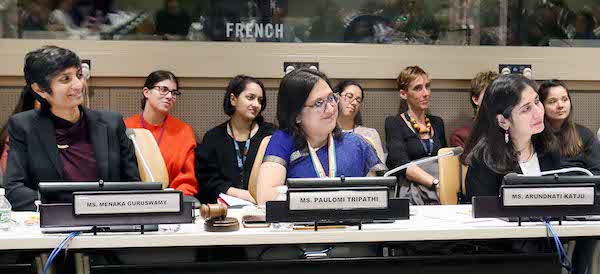
    UNITED NATIONS(TIP): United Nations Human Rights Day was observed at the UN Headquarters in New York, December 10.

    A panel discussion on “Equality, Dignity and Justice for All” was the highlight of the celebrations. The panelists  included Dr Menaka Guruswamy and Attorney Arundhati Katzu. Both Guruswamy and Katzu represented Navtej Singh Johar and other lead petitioners spearheading the quest for justice before the Supreme Court of India.

    Paulomi Tripathi, First Secretary  at the Indian Mission moderated the discussion.

    Ambassador Syed Akbaruddin delivers his opening remarks on the occasion of Human Rights Day celebration at the United Nations.
    Photos / Jay Mandal-On Assignment

    Ambassador Syed Akbaruddin, Permanent Representative of India to the United Nations inaugurated.

  • Diwali Stamp The “Power of One” Awards presented

    Diwali Stamp The “Power of One” Awards presented

    UNITED NATIONS(TIP): The “Power of One” Award , established by Diwali Foundation, USA, Inc. chaired by Ranju Batra, in 2017  is to celebrate and highlight the vital and important work done across the world in a peaceful manner, especially at the United Nations.

    To be eligible for the Award, , one has to be a former Permanent Representative or former high level member of UN Secretariat, or soon to be former, who has toiled selflessly to “help to form a more perfect, peaceful and secure world for all”.

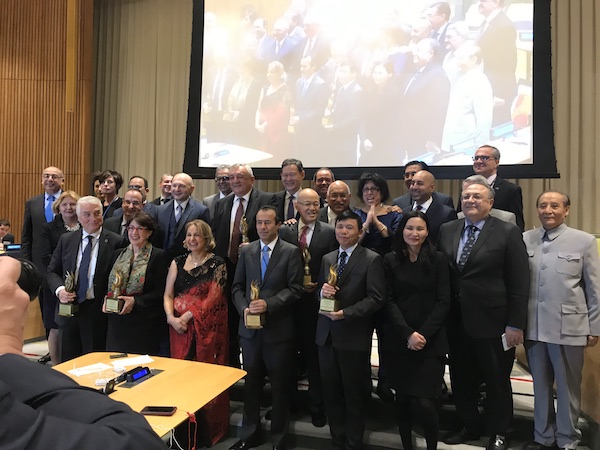
    The recipients for the 2018 “Power of One”  Award included H.E. Catherine Boura, former Permanent Representative of Greece to the United Nations; H.E. Mohamed Khalid Khiari, Permanent Representative of Tunisia to the United Nations till December 2018; H.E. Andrej Logar, former Permanent Representative of Slovenia to the United Nations ; H.E. Agshin Mehdiyev, Former Permanent Representative of Azerbaijan; H.E. Nguyen Phuong Nga, former Permanent Representative of Viet Nam  to the United Nations; and H.E. Virachai Plasai, former Permanent Representative of Thailand to the United Nations.

    The Awards were presented by Ranju Batra, Chair of Diwali Foundation, USA, Inc. at the United Nations , December 11, 2018 in the presence of a large number of diplomats, community members and media.

    The event was co-hosted by the Permanent Missions of Belarus, Georgia and India.

    The 2018 Power of One awards were co-sponsored by the Permanent Missions of Albania, Algeria, Armenia, Azerbaijan, Cyprus, Greece, France, Kazakhstan, Kyrgyztan, Kuwait, Malaysia, Malta, Morocco, Oman, Republic of Korea, Romania, Slovakia, Slovenia, Sri Lanka, Tajikistan, Thailand, Tunisia, Turkmenistan, Ukraine, Uzbekistan, Viet Nam, Permanent Observer of State of Palestine, and NY Office of International Atomic Energy agency.

    Those who addressed the gathering included India’s PR Syed Akbaruddin, Georgia’s PR Kaha Imnadze, Algeria’s PR Sabri Boukadoum, Kazakhstan’s PR Kairat Umarov, Sri Lanka’s PR Amrith Rohan Perera, Ranju Batra, Chair of Diwali Foundation, USA, Inc., and Ravi Batra, Chair, National Advisory Council South Asian Affairs.


  • UN Day celebrated with the theme “traditions of peace and non-violence”

    UN Day celebrated with the theme “traditions of peace and non-violence”

    East Meets West Concert with Sarod Maestro Amjad Ali Khan, Bangash brothers and The Refugee Orchestra Project Enthrall

    I.S. Saluja

    UNITED NATIONS(TIP): UN Day  was celebrated at United Nations General Assembly Hall with a Concert, Oct 24. UN Day marks the anniversary of the coming into force in 1945 of the UN Charter.The dayhas been celebrated as United Nations Day since 1948.

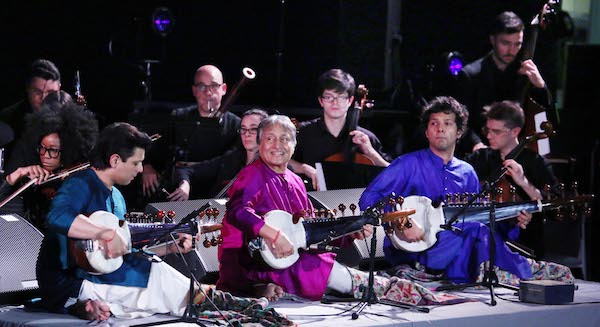
    Sarod Maestro Amjad Ali Khan, his  sons, Amaan Ali Bangash and Ayaan Ali Bangash, and the Refugee Orchestra Project, with Lidiya Yankovskaya, conductor and Artistic Director, enthralled the audience with a memorable musical performance.

    The theme of the Concert was “traditions of peace and non-violence”.

    The program , meticulously crafted  by Permanent Mission of India to the United Nations, hosts to the UN Day Concert, could not have offered a better fare.

    Much before the time for the program to begin, the UNGA Hall was packed . Under Secretary-General for Global Communications Ms. Alison Smale welcomed the gathering and made introductory remarks.

    United Nations Secretary General Mr. António Guterres speaking on UN Day at UNGA Hall, 24th Oct 2018
    Photo / Mohammed Jaffer-SnapsIndia

    UNGA  Secretary General  Mr. Antonio Guterres in his brief remarks wished all a happy UN day and spoke of aspirations and hopes of people across the world. He said there are  discriminations , human rights violations, women’s rights issues- and many more issues which need to be dealt with. He called upon the world to continue efforts to resolve the issues and urged people never to give up. “ Don’t give up”.

    He recalled his recent visit to India where, he said, “I had the opportunity to pay respects to world’s greatest leader-Mahatma Gandhi”. He referred to Mahatma Gandhi’s message of peace and non-violence which he said, was the theme of UN Day celebrations this year.

    India’s Permanent Representative to the United Nations, Ambassador Syed Akbaruddin speaking on the occasion
    Photo / Mohammed Jaffer-SnapsIndia

    The Secretary General thanked Ambassador Syed  Akbaruddin, India’s Permanent Representative to the United Nations  for supporting the concert.

    He extended a word of welcome to performers.

    A video message of President of the United Nations General Assembly Ms. Maria Fernanda Espinosa Garces was played. In her message, the UNGA President said it was a day of celebration. Recalling  the great message of Mahatma Gandhi, she spoke of a need to prefer  dialogue over conflict. She spoke of empowerment of people of the whole world. “ Let us celebrate the Day with hope”, she said.

    She thanked the Permanent Mission of India ( PMI) for supporting the  celebration.

    India’s Permanent Representative to the United Nations,  Ambassador  Syed Akbaruddin.said, ”Every year on Oct 24 we celebrate in this common hall the coming in to being of the United Nations”. He said the UN Day concert is a celebration of common values of humanity.He spoke of the desire  of the people of the world for liberty and equality . He then quoted Rabindra Nath Tagore.

    “Where the mind is without fear and the head held high;

    Where knowledge is free;

    Where the world has not been broken up into fragments by narrow domestic walls;

    Where words come out from the depth of truth;

    Where tireless striving stretches its arms towards perfection;

    Where the clear stream of reason has not lost its way into the dreary desert sand of dead habit;

    Where the mind is led forward by Thee into ever-widening thought and action;

    Into that heaven of freedom, my Father, let my country awake.”

    A view of the gathering
    Photo / Mohammed Jaffer-SnapsIndia

    Speaking about the Concert, Mr. Akbaruddin said, “Music uplifts. Music gives courage and hope. Music of India is indicative of our tradition”.

    The Ambassador described Ustad Amjad Ali Khan as a charismatic musician with a long musical heritage . He welcomed the performers who included, besides Ustad Amjad Ali Khan, his two sons, Amaan Ali Bangash, Ayaan Ali Bangash, and The Refugee Orchestra Project, conducted by Lidiya Yankovskaya.

    In his remarks, Ustad Amjad Ali Khan recalled the concert on October 2, 2018, to mark the 150thbirth anniversary of Mahatma Gandhi, in New Delhi where he had performed, and said it was a pleasure and honor to be associated with the celebrations. He referred to the presence at the concert of President  of India, Ramnath Kovind , and of Narendra Modi, Prime Minister of India.

    Speaking about music, the maestro said, “music is universal and unifying”.

    As part of tribute to Mahatma Gandhi, Ustad Amjad Ali Khan and his sons played the favorite bhajans of Mahatma Gandhi, which included, Vaisnav Jan… and a Ram Dhun which was very dear to Gandhi.

    A Panoramic view of the performers at the concert, with Lidiya Yankovskaya (back to camera) conducting the Orchestra.
    Photo / Mohammed Jaffer-SnapsIndia

    Next came Samaagam-a confluence of the East and the  West. It was a Sarod concerto.  The Refugee Orchestra Project conducted by Lidiya Yankovskaya and the Sarod maestro Ustad Amjad Ali Khan with his sons and the table player cast a magic spell. Their music sent the audience in to a trance. The 90-minute concert was an experience to be savored and treasured.


  • The UN Shudders as ‘Trump Week’ Closes in

    The UN Shudders as ‘Trump Week’ Closes in

    NEW YORK(TIP): A year after his bombastic debut at the United Nations as president of the United States, Donald Trump returns on Monday, Sept. 24, to lead a US effort to spur global action to stem the narcotics and opioid plagues. Could the US be asking the UN for help this time?

    The morning meeting on drugs on Monday, in which Secretary-General António Guterres is also scheduled to speak, may be a soft landing in New York for Trump. On Tuesday morning, Sept. 25, he will address the opening session of the 73rd General Assembly, the centerpiece of his visit and his opportunity to vent about his enemies, his friends and the organizations he disparages. The audience will be politely hunkered down.

    On Wednesday, Sept. 26, however, diplomats and commentators expect a potentially explosive scene in the Security Council when Trump will take the Council president’s chair, coincidentally held by the US for September. He could turn the occasion into a sustained attack on Iran and a defense of his decision to withdraw from an internationally backed nuclear deal with the Iranians.

    On Sept. 4, Nikki Haley, Trump’s loyal ambassador and accomplice at the UN, told reporters in a televised briefing there that the Sept. 26 Council meeting would be solely about Iran. She acknowledged that under Council rules the meeting would give the Iranians the right to speak in their defense.

    A personal confrontation between Trump and an Iranian official, possibly President Hassan Rouhani, and tense arguments with Europeans and other supporters of the Iranian deal apparently caused a scramble in the White House to change how to define the Council meeting. The scramble seems to confirm recent reports that high-ranking officials close to the president have been working behind the scenes to curb his worst instincts for his compulsive behavior and combative language — especially weeks before the US midterm elections.

    The description of the Council meeting has been broadened to circumvent a direct Iranian role. “In addition to addressing Iran’s destabilizing aggression and sponsorship of terrorism, the President will address a broader range of issues given the challenges facing the world at this time,” the US mission at the UN says. “During the Security Council meeting, the President will address the proliferation of weapons of mass destruction, including chemical, biological, and nuclear weapons and ballistic missiles.”

    That change doesn’t guarantee there won’t be arguments over the 2015 Iran nuclear agreement, formally titled the Joint Comprehensive Plan of Action, which took five years to negotiate as the best hope for curtailing nuclear-weapons development by Iran. The deal is supported by all four other permanent Council members — Britain, China, France and Russia– and the European Union well as Japan. The US has also reimposed sanctions on Iran unilaterally, ignoring Council resolutions.

    If Trump expects to change opinions on his Iran policy, which is strongly opposed by many critics among member nations and officials of the UN, he is likely to meet a stone wall from the agreement’s supporters, who are struggling to save the deal. Even President Vladimir Putin of Russia expressed his opposition to Trump’s policy publicly after meeting Trump in Helsinki on July 16.

    The Reuters news agency reported recently that Russia’s Deputy Foreign Minister Sergei Ryabkov said early in September that Washington was “mistaken” if it thinks it can change any minds. He predicted that “the Americans won’t have an easy walk at this meeting.”

    In addition, European firms that stop doing business with Iran because of reimposed US sanctions could be sanctioned by the European Union, a special adviser to the bloc’s top diplomat warned in August.

    It would not be an overstatement to say that Trump’s reputation for erratic pronouncements, his often-voiced contempt for international institutions and bullying will make his presence a focus of much attention at UN headquarters. The UN has never known an American president quite like Trump.

    Sacha Sergio Llorentty Soliz, the ambassador of Bolivia to the UN, a  current Security Council member from a country frequently critical of the US, said in an interview with PassBlue that he didn’t want to speculate how Trump could be received, “But for us, regardless of what he says, what we’ve seen in the last year and a half is a complete disregard of international law, multilateralism and the use of the UN as a lemon so to speak: they squeeze it, get as much as they can and throw it away.”

    Stephen Schlesinger, who wrote the classic history of the founding of the UN, “Act of Creation,” and a leading analyst of the organization’s story over seven decades since, is not optimistic about Trump’s visit.

    “Trump’s appearance at the UN is going to be a bizarre and troubling spectacle for the organization — perhaps somewhat like Hugo Chavez’s strange and erratic performance at the UN when he claimed he smelled sulfur in the room in reference to George W. Bush,” Schlesinger said in an email exchange.

    “By now, most member nations of the UN know that Donald Trump, the leader of the most powerful nation on earth, is a troubled man with a disordered mind,” he added. “He is a proven liar, a compulsive braggart and a thoroughly unpredictable chief executive. These are not the traits normally associated with the individual who runs one of the greatest democracies on the planet.”

    “It is clear that Trump intends to focus all of his energies in his UN appearances on condemning Iran, using the presidency of the Security Council as his base of attack,” Schlesinger added. “He openly plans to step into a hornet’s nest of opposition from practically all the members of the Council.”

    On US policies and actions in the Middle East — which Secretary-General Guterres has said disqualify the Trump administration from being an impartial mediator — Trump has aligned the US squarely behind the Israeli government of Prime Minister Benjamin Netanyahu, including on Iran. The US has also cut off most aid to Palestinians and closed their office in Washington. These actions are being criticized from within the American Jewish population by the liberal pro-Israeli, pro-peace group J Street, which also opposed the recognition of Jerusalem as Israel’s capital and the relocation of the US Embassy there, moves overwhelmingly rejected by UN member nations in a vote in the General Assembly last December.

    Media reports and polls testing what effect Trump foreign policies may have on his mostly conservative, largely rural voting base in the US are suggesting that voters in agricultural states, while mainly supportive of the president’s tough-guy approach, are concerned about loss of income from corn, soybeans and pork exports as Trump’s self-imposed tariff wars begin to backfire on them. The impact, or not, of this issue will be tested in the midterm American elections in early November, when members of Congress are up for election. He needs distractions.

    “Most of all Trump’s address to the UN is about appealing to his conservative voter base,” Schlesinger wrote. “He will assert that his policies have reversed all of the weak-kneed actions of the Obama Administration; that he has rebuilt the US military; that he has re-established US primacy and prestige around the globe. But, for the UN, his delusional avows of ‘winning’ around the globe, most UN delegates will privately shake their heads at his nonsensical claims and just try to figure out how best to get through the next two years of his term without suffering too much further damage to themselves and to the UN.”

    On the domestic American scene generally, there is increasing alarm about a very different issue: the opioid crisis that is killing more people every year. This is where Trump’s sideline event on Sept. 24 on drugs and crime fits into his UN headquarters agenda, and where the US is asking — indeed demanding — the world’s help.

    The grandly titled “Global Call to Action on the World Drug Problem,” the subject of the US event, has 33 co-sponsors from mostly Asian, African and Latin American nations, a number of which vote reliably with the US at the UN. The document they are promoting essentially if subtly accuses other countries and UN convention-monitoring bodies and drug agencies of not doing enough to stop the manufacture and transfer of drugs.

    No mention is made in the call to action about the consumer market in the US that feeds much of the illicit manufacture and export abroad; there is only a glancing reference to reducing demand everywhere.

    The demand the US will make at the UN echoes a three-pronged US national program unveiled by the White House in March, calling for improvements in education and prevention, treatment and recovery and law enforcement and interdiction, including across borders. Early this year, the US Department of Justice unveiled its first indictments against Chinese makers of Fentanyl, a powerful narcotic painkiller that, when abused, leads to addiction.

    At the Sept. 24 UN meeting called by the Trump administration, according to the draft program circulated among UN diplomatic missions, there will be a few speeches and a group photograph: good for the Trump base. In the 45 minutes scheduled for the morning event, the US will commit, at least on paper, to global cooperation after more than a year of insulting, belittling and threatening international institutions. As of this writing, 113 nations have backed the Trump event, including Mexico but not Canada.

    As Trump Week approaches, the 193 member nations of the UN and organization officials have no illusions about the US president’s unpredictably, irrationality and capacity to offend — changing his mind and his targets, at will. Last year, Kim Jong Un, the abusive dictator of North Korea, was “little rocket man” on a suicide mission and in peril of having his country wiped off the face of the earth. This year, Kim is an honorable man and trustworthy buddy, with a second summit being planned. (Kim is not scheduled to speak at the UN General Assembly.)

    The US State Department just announced that Secretary of State Mike Pompeo intends to lead a UN Security Council meeting on North Korea on Sept. 27, to reinforce UN sanctions.

    Repeating his America First mantra to the world in the General Assembly in 2017, Trump extended his fierce defense of national sovereignty for all counties but not to ones he did not like, freely threatening them. He left some government leaders and diplomats in the audience gasping.

    This year, when Trump is again reported to speak about sovereignty, the audience in the General Assembly will be on guard, more so because when Trump arrives in New York, he will be leaving behind a White House in administrative shambles, rocked by scandals and shadowed by an unprecedented investigation into possible acceptance of Russian aid in securing a win in the 2016 presidential election.

    He could choose to air his litany of grievances with the rest of the world, but he wouldn’t find much sympathy.

    (Source: Passblue.com)


  • Pakistan regurgitating failed approach on Kashmir, says India in the United Nations

    Pakistan regurgitating failed approach on Kashmir, says India in the United Nations

    UNITED NATIONS(TIP): Pakistan’s new government must not indulge in “polemics” but work to build a South Asian region free of terror and violence, India said after Pakistan raked up the Kashmir issue at the United Nations Security Council (UNSC).

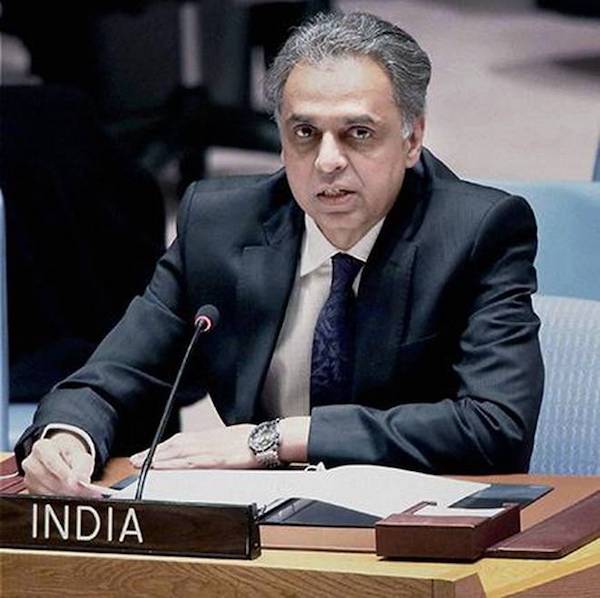
    Permanent Representative of India to the United Nations Syed Akbaruddin’s remarks came during the UNSC debate on Mediation and Settlement of Disputes.

    “I take this opportunity to remind — Pakistan — the one isolated delegation that made unwarranted references to an integral part of India, that pacific settlement requires pacific intent in thinking and pacific content in action,” Mr. Akbaruddin said at the debate on Wednesday.

    Pakistan’s Ambassador Maleeha Lodhi raked up the Kashmir issue during the debate, drawing a sharp reaction from Mr. Akbaruddin. He said Pakistan was “regurgitating a failed approach, which has long been rejected, is neither reflective of pacific intent nor a display of pacific content”.

    In a reference to the government in Pakistan under newly-elected Prime Minister Imran Khan, he said, “We hope that the new government of Pakistan will, rather than indulge in polemics, work constructively to build a safe, stable, secure and developed South Asian region, free of terror and violence.”

    ‘Resolutions remain unimplemented’

    In her remarks, Ms. Lodhi said the “Jammu and Kashmir dispute remains a long-standing issue” on the agenda of the Council. She said through its various resolutions, the Security Council has provided that the final disposition of the State of Jammu and Kashmir will be made in accordance with the will of the people “expressed through the democratic method of a free and impartial plebiscite” conducted under the auspices of the United Nations.

    She said the Security Council also instituted several mechanisms, including the U.N. Commission on India and Pakistan (UNCIP), the deployment of the U.N. Military Observer Group in India and Pakistan (UNMOGIP) and the appointment of U.N. representatives.

    “Sadly, these resolutions remain unimplemented to date. The international community cannot succeed in its efforts to strengthen conflict prevention and promote pacific dispute settlement if the Security Council’s own resolutions are held in abeyance, by some. What is, at stake is both the Council’s credibility as well as the objective of durable peace in our region. We must not fail these tests,” she said.

    U.N. and other actors concerned

     Mr. Akbaruddin said as recognized by the U.N. Charter, pacific settlement of disputes could be through a variety of mechanisms, and today, there were numerous actors and many forms of pacific settlement that may be better suited to address different issues.

    “Instead of putting the United Nations at the center of mediation efforts and exhorting States to support them, perhaps, the international community should lend encouragement to those most motivated and having the capacity to do so to settle these, as appropriate,” he said.

    “Of course, there could be many forms of division of tasks of pacific settlement of disputes between the United Nations and other actors concerned that can undoubtedly be devised. It is important, however, not to charge the United Nations with responsibilities that it maybe ill-suited to perform. Mediation, in every circumstance, is one such task, it is not geared to fulfil,” he said.

    Mediation, on the face of it, was based on the interest, consent and commitment by all parties for a peaceful settlement. He stressed that the issue was not whether mediation was a useful tool for peaceful settlement. “Where acceptable to all parties, it is, in a manner of speaking, settled international law,” he said.

    Mediation issue

    Mr. Akbaruddin said the questions to be addressed were whether the apparatus of the United Nations, as currently constituted, could perform many of the basic functions required for effective mediation and were the mechanisms at the disposal of the United Nations coherent and flexible to guide dynamic negotiations with an effective strategy.

    He pointed out that the United Nations, and in particular the Security Council, did not come to mediation unencumbered. The problems of the United Nations apparatus as a mediator were ingrained in the nature of inter-governmental organizations.

    “Inter-governmental organizations are hindered by complex decision-making procedures. Add to it the specificities of the U.N. Charter, that is premised on cooperation amongst the permanent members. That cooperation is clearly not evident. Where it does manifest, it invariably takes the form of the lowest common denominator,” he said.

    Further, policy-making within an international organization added another layer of bargaining and trade-offs, he said, adding that it required a time-consuming and uncertain process of consultation and coordination among a multiplicity of actors.

    “Such tortuous decision-making process, imbued with political trade-offs, saps the United Nations of necessary dynamism and flexibility in pursuing mediation. Once the U.N. authorized entities agree on a mediating proposal or framework, it cannot easily be modified in response to changing circumstances. Modification requires renegotiation,” he said.

    (Source: PTI)

  • Indian-Origin Satya Tripathi becomes Assistant Secretary-General of UN Environment Body

    Indian-Origin Satya Tripathi becomes Assistant Secretary-General of UN Environment Body

    UNITED NATIONS(TIP): Indian-origin UN official Satya S Tripathi joined the long list of Indians with the United Nations. He has been appointed as Assistant Secretary-General and Head of the New York Office of the United Nations Environment Programme (UNEP) by UN Secretary General Antonio Guterres.

    Tripathi, who will succeed Elliott Harris of Trinidad and Tobago, has since 2017 served as senior adviser on the 2030 Agenda for Sustainable Development at UNEP.

    A development economist and lawyer with over 35 years of experience, Tripathi has worked for the United Nations since 1998 in Europe, Asia and Africa on strategic assignments in sustainable development, human rights, democratic governance and legal affairs, spokesman for the Secretary-General Stephane Dujarric told reporters at United Nations.

    Tripathi was previously the Director and Executive Head of the United Nations Office for Reducing Emissions from Deforestation and Forest Degradation in Developing Countries Coordination in Indonesia, as well as for the United Nations Recovery Coordinator for the $7 billion post-tsunami and post-conflict recovery efforts in Aceh and Nias.

    He participated as Chair of the Committees on Laws and Treaties for the United Nations-mediated Cyprus unification talks in 2004.

    Earlier in his career he acted as a Senior Distinguished Fellow on Natural Resources Governance with the World Agro-forestry Centre and on the World Economic Forum’s Global Advisory Council on Forests.

     Tripathi holds honors in bachelor’s and master’s degrees in commerce; and bachelor’s and master’s degrees in law from Berhampur University, India.

  • Yoga is so very apt for the United Nations: UN Deputy Secretary-General Amina Mohammed

    Yoga is so very apt for the United Nations: UN Deputy Secretary-General Amina Mohammed

    UNITED NATIONS(TIP): Yoga is “very apt” for the United Nations and in today’s complex world where stress and delusion are prevalent, the ancient Indian physical and mental practice plays a central role for wellness and peace of the mind and body, UN Deputy Secretary-General Amina Mohammed said.

    “Today’s world is incredibly complex. We are challenged by an erosion of our core values and in many walks of life stress is given, delusion prevails especially amongst our youth…Yoga, deriving from the Sanskrit word of unity, is so very apt for the United Nations,” Mohammed said in her address yesterday during the commemoration of the 4th International Day of Yoga here.

    UN Ambassadors, diplomats, spiritual leaders, members of civil society, yoga enthusiasts, children and people from all walks of life participated in a flagship Yoga Day event organized by India’s Permanent Mission to the UN. They enthusiastically participated in the two-hour long yoga session with the theme of ‘Yoga for peace’, performing different yoga asanas and exercises on colorful yoga mats spread across the expansive North Lawn in the UN Headquarters.

    Amina Mohammed, UN Deputy Secretary-General speaking at International Day of Yoga
    Photos/ Mohammed Jaffer-SnapsIndia

    Voicing her deep appreciation to India for organizing the Yoga Day event, Mohammed underscored the importance of yoga in the overall well-being of individuals and even in various aspects of the world body’s functioning.

    “In the UN, our three pillars are stressed and therefore require us to be even more resolute in our service to humanity. Therefore, physical and mental health must be at the core of our attention to ourselves. And this is where yoga can play a central role,” she said, referring to the three founding pillars of the UN system – peace and security, human rights and development.

    She said balance in life is essential to living a long and healthy life and has deep meaning and a commitment to humanity and oneness with nature.

    “Key elements of the body, mind and spirit woven into our human being allows us to know peace and tranquility, giving a space in our minds for reflection which in turn allows us to be so much more productive and serving the values that we stand for,” she said.

    Mohammed noted that her appreciation of yoga has deepened over the years and given the manifold mental and physical benefits on yoga, she wished she had been exposed to the practice much earlier in her life.

    Syed Akbaruddin UN Ambassador speaking at International Day of Yoga Day

    India’s Permanent Representative to the UN Ambassador Syed Akbaruddin said the growing popularity of yoga over the years and its global embrace is based on the simple fact that “yoga works” for people across societies, age, gender, ethnicity and profession, by contributing to personal, physical and mental well-being and promoting individual and societal peace and harmony.

    “Yoga which began in its home in India is now the common heritage of mankind, a lasting tradition that continues to be of great practical relevance in modern times and in times where we are beset with stress and conflict,” he said in his address on the occasion.

    Akbaruddin, who joined those gathered in performing yoga exercises and asanas, said yoga has become even more relevant as the world is recognizing the critical importance of moving towards more sustainable lifestyles, in tune with surroundings and more in harmony with nature.

    Several events have been planned by India’s Permanent Mission to the UN at the world body’s headquarters to commemorate the fourth Yoga Day. An exhibition on yoga was inaugurated in the UN building on June 18 and will run through June 22. As in past years, yoga postures were projected through lasers on the North Facade of the UN Headquarters Building.

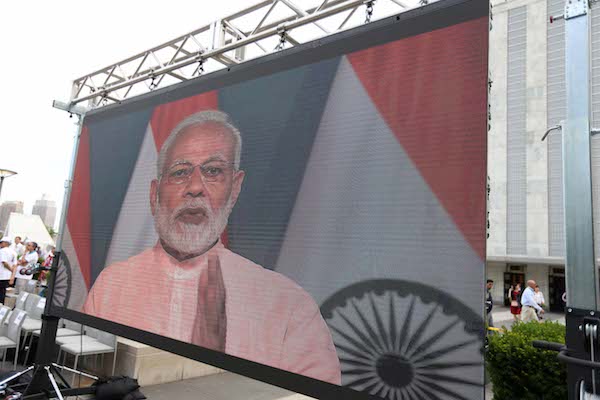
    A video message by Prime Minister Narendra Modi on the occasion of Yoga Day was played at the beginning of the event, which included yoga performance by students from India led by yoga expert Nisha Pushpavanam, Yoga on Mallakhamb, yoga demonstration by yoga gurus of New York Kevin Tobar, Iraimer Ruiz, Atthena Breitton, Lauren Baptiste and Zachary Jackson. This was followed by songs by the Chinmoy Centre, a yoga session by Swami Parmananda of Sivananda and a talk on yoga by H. R. Nagendra, Yoga therapist, academic, writer and Founder Chancellor of Swami Vivekananda Yoga Anusandhana Samsthana (S-VYASA) Deemed University, Bengaluru.

     (Source: PTI)

  • India Hosts UN Peacekeeping Day celebration at the UN on June 1, 2018

    India Hosts UN Peacekeeping Day celebration at the UN on June 1, 2018

    Ambassador Maleeha Lodhi, Pakistan’s Representative greeted by Ambassador Tanmay Lala, Dy Permanent Representative to the UN as she and her Military Attache join the celebration of UN Peacekeeping Day at the UN. Also, in the Pic, Col Sanjeev Kapoor. (right) to the United Nations.
    Photo /Jay Mandal/On Assignment
    UN Secretary-General António Guterres delivers his statement during UN Peacekeeping day event at the UN, hosted by Indian Mission to the UN. in NY.
    Photo /Jay Mandal/On Assignment
  • United Nations Hails Jaipur Foot

    United Nations Hails Jaipur Foot

    NEW YORK (TIP):  India’s longstanding innovation, the Jaipur Foot project, is being hailed as an “excellent” example of South-South cooperation and multi-stake holder collaboration as it has helped over 1.7 million persons with disabilities gain mobility in 34 countries.

    India’s Permanent Mission to the UN along with the Jaipur based Bhagwan Mahaveer Viklang Sahayata Samiti (BMVSS) organized a panel discussion here Tuesday, May 15, on the Jaipur Foot’s 50-year journey of helping people with disabilities across the world. Following the panel discussion, an exhibition on Jaipur Foot was also inaugurated in the UN Secretariat Building. The exhibition which would be there till May 18 displays the Jaipur Foot making the beneficiaries.

    In India, a longstanding innovation has been the ‘Jaipur Foot’, popularized by Bhagwan Mahaveer Viklang Sahayata Samiti (BMVSS) and the organization has worked with over 1.7 million persons with disabilities in 34 countries across the world, India’s Permanent Representative to the UN Ambassador Syed Akbaruddin said at the discussion.

    “The organization has now worked for half a century for this noble cause. While the technology behind such innovations has continued to improve, the ‘Jaipur Foot’ has provided much needed assistance to those who are among the most affected and those who have very limited resources to seek the kind of assistance that is needed by them. They truly are working to ensure no one is left behind,” Akbaruddin said.

    Jagdish Dharamchand Koonjul, Permanent Representative of Mauritius to the UN, said that his country is proud to be associated with the work of Jaipur Foot in Mauritius and in the Indian Ocean Region.

    “In 2014, the Jaipur Foot Project, which represents an excellent template for South-South cooperation and South-North cooperation was launched in Mauritius to service the countries in the region,” he said.

    Koonjul stressed that the Jaipur Foot Project is a fine example of multi-stakeholder partnerships involving governments, civil society and the private sector to realize the Sustainable Development Goals in Mauritius.

    “Besides ensuring the transfer of much needed technology in the field, the project has fostered a strong partnership with local and international organizations and in the development of capacity building programs in education, health, social and economic integration and rehabilitation,” he said.

    Koonjul told the audience at the panel discussion that in the Indian Ocean region, Jaipur Foot Mauritius has provided prosthesis free of cost to 1200 persons. In 2015, a 15-month old boy from Seychelles, Brendon became the youngest beneficiary of the Jaipur Foot.

    “We are proud of the journey covered by Jaipur Foot in Mauritius by giving a much-needed boost to the self-esteem of people and improving the quality of life of the differently abled persons. Jaipur Foot has empowered them to lead an independent and productive life,” he said.

    Bharatiya Janata Party (BJP) National Vice President Vinay Sahasrabuddhe said that in today’s changing global circumstances, India is playing a very crucial and leading role, including in the rehabilitation of the different-abled people.

    “Jaipur Foot has become a symbol of Indian society’s ability to empathize. Indian society definitely provides several avenues for the cultivation of more empathic and sensitivity-oriented initiatives and Jaipur Foot is one of them,” Sahasrabuddhe said.

    He said that it is a “great honor” for India to be taking a lead and initiative and to be seen as a nation that is working for the rescue and rehabilitation of those who are different-abled.

    Founder and Chief Patron of BMVSS Devendra Raj Mehta said Jaipur Foot is the “epitome of frugal” or Gandhian engineering, which involves doing the maximum with the minimum.

     He said that while the Jaipur Foot costs $ 70, a similar western prosthetic costs $ 15,000.

    Mehta said that the BMVSS in association with the ministry of external affairs will hold on the site fitment camps in Vietnam, Myanmar, Iraq, Nepal and Bangladesh in the coming months. These camps will ensure that 5000 persons get mobility and dignity. He said that now a Jaipur hand is being developed in association with a US university

    Prem Bhandari, the chairman of the Jaipur Foot USA, said that the Jaipur Foot USA took the initiative of creating awareness by holding a seminar on disability with the association of India’s permanent mission in the United Nations. He said the Indian Americans are helping in popularizing the low-cost Jaipur Foot in the United States.

    An Indian businessman based in Houston Rajiv Daga and his wife Neeta Daga donated Rs 1.35 crore to the Jaipur Foot. During the seminar in the United Nation, a Nigerian citizen John Mattes, who is a handicap was shown walking on the Jaipur Foot. John was flown at the initiative of the Jaipur foot to Jaipur where he was provided the Jaipur Foot within two days. Now he is able to walk.

  • Sadhguru calls for concerted action by all to save world’s water bodies

    Sadhguru calls for concerted action by all to save world’s water bodies

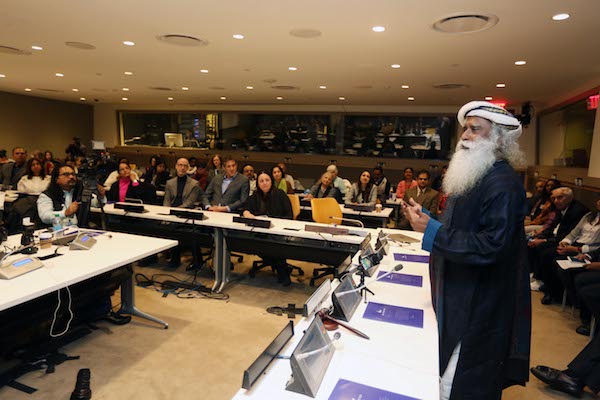
    UNITED NATIONS (TIP): Renowned spiritual leader Sadhguru Jaggi Vasudev has welcomed the United Nations’ initiative to launch a new decade to focus action on management of water resources, saying such effort is critical towards helping in the survival of future generations and calling for concerted action by all to save the world’s water bodies.

    Sadhguru, speaking at a special event on Water, Sanitation and Women’s Empowerment during the current session of Commission on the Status of Women here, on March 21, said it is “appropriate” that at this moment the UN has taken the step to launch the 10 year action plan. “It is most vital and it’s important that we make this into a success (for) the survival of this generation,” he said.

    Concerned about the slow progress in implementing international agreed goals on water and sanitation, the United Nations General Assembly will launch a new decade to focus action on sustainable development and the management of water resources at an all-day event at the UN Headquarters on World Water Day, commemorated today.

    The Decade, which will run from 2018-2028, calls for a greater focus on the sustainable development and integrated management of water resources for the achievement of social, economic and environmental objectives and on the implementation and promotion of related programs and projects, as well as on the furtherance of cooperation and partnership at all levels in order to help to achieve internationally agreed water-related goals and targets, including those contained in the 2030 Agenda for Sustainable Development.

    Sadhguru, founder of the Isha Foundation, said if concerted action to save water bodies is taken now, then in 15-25 years communities can bring back the rivers of this world by at least 20 per cent. However, if action is delayed, it will take 100-150 years to have the same impact. “If we don’t act now, the recovery will take much, much longer…We are rapidly moving to a place where turning around will be very difficult,” he said, referring to the dire water situation across Asia and Africa.

    With rivers in India having depleted by 60 per cent and across the world by about 35 per cent, Sadhguru called on people and communities to join hands for efforts towards water conservation, including through overhauling irrigation systems and putting enabling government policies in place.

    He said given that agriculture in India consumes 80 per cent of the country’s water, emphasis should be given on creating more vegetation.

    “Agriculture has become an aggressive process…One of the immediate corrective steps we can take is to increase vegetation. Without vegetation there is no way we can hold water in the soil. We don’t have enough vegetation for the number of people that we have right now,” he said.

    He stressed that through his work, his focus is to bring back as much vegetation as possible, particularly around water bodies.

    He pointed out that women are the first and most to suffer when water becomes scarce, as it impacts several aspects of their daily routines, including access to toilets. Underlining the “very significant role” role women can play in efforts towards water conservation, Sadhguru said women are “natural conservationists” as in families, conservation, whether economical or physical, is done by women. “Women can play a pivotal role in water resources management, agriculture and allied industries if they are empowered to take more economic decisions.”

    Sadhguru had launched a nationwide campaign ‘Rally for Rivers’ in India, traveling across 16 states in 30 days with the message of rejuvenating India’s rivers by maintaining a minimum of one-kilometer tree cover on riversides.

    (Source: PTI)

  • No secret detention, torture camps in Lanka: President to Tamils

    No secret detention, torture camps in Lanka: President to Tamils

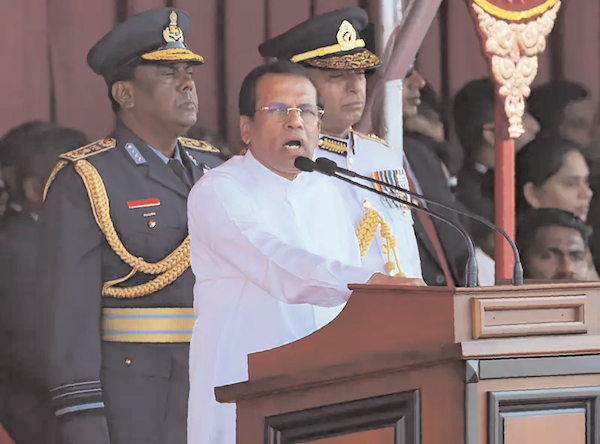
    COLOMBO (TIP): Sri Lankan President Maithripala Sirisena on Monday assured the minority Tamil community that his government was not running any secret detention and torture camps in the country.

    Sirisena said he was concerned about the people who are still missing years after the end of nearly three-decade-long brutal civil war.

    “I have several times met the relatives of the disappeared persons. I am concerned about the problem of their missing relatives,” Sirisena said while campaigning in the Tamil dominated Jaffna city for the February 10 local council election.

    “They have told me that the missing people are being held by the government in secret detention camps. I made inquiries and I tell them on behalf of the government that there are no such camps run by the government,” he said.

    Sirisena said his government had addressed the concerns of the Tamils by returning to them their land that had been held for military purposes since the mid 1980s.

    The Tamil and international rights groups had blamed the former Mahinda Rajapaksa government of running secret detention and torture camps.

    The relatives of the missing persons have regularly held public demonstrations, demanding urgent government attention to their concerns.

    The government has set up an Office of Missing Persons (OMP) which is yet to become operational.

    The OMP was one of the accountability mechanisms advocated in UN Human Rights Council resolutions on Sri Lanka since 2013.

    The UN panel called for the establishment of independent international court to probe alleged war crimes committed by both the Liberation Tigers of Tamil Eelam (LTTE) and the government troops during the last stages of the civil war which ended in 2009.

    According to the government estimates, around 20,000 people are still missing due to various conflicts including the 30-year-long separatist war with Lankan Tamils in the north and east which claimed the lives of at least 100,000 people.

    The LTTE, which led the separatist war for a separate Tamil homeland, was finally crushed by the Lankan military in 2009 with the death of its supremo Velupillai Prabhakaran.

    (PTI)

  • Priorities for the United Nations in 2018

    Priorities for the United Nations in 2018

    By Asoke Mukeji
    The author, who was India’s Permanent Representative to the United Nations in New York from April 2013 to December 2015, takes a close look at the issues before the United Nations, and lists the priorities for the World Body in 2018. The three priorities, according to him, are “Completion of process of reforming the UNSC”; “accelerated implementation of the socio-economic goals of Agenda 2030”; and “reforming the Human Rights Council to uphold fundamental human rights and freedoms”.

    As the United Nations (UN) approaches its 75th anniversary in 2020, the world it represents has changed beyond recognition. From its original 51 founding members, the UN General Assembly (UNGA) today has 193-member countries. While the three “pillars” of the UN continue to be global governance in the political, socio-economic, and human rights areas, there is growing restiveness among the majority of the UNGA member states for reforming the UN to reflect ground realities.

    The UNGA’s new assertiveness in influencing decisions on UN functioning was on display during the November 2017 vote in the UNGA on electing judges to the International Court of Justice (ICJ). The unscripted situation, in which India’s candidature enjoyed majority support among the countries in the UNGA, was offset by the power play in the UN Security Council (UNSC), orchestrated by the solidarity of its five permanent members, which prevailed on several other non-permanent members to consistently back the candidate of the United Kingdom. This deadlock was finally resolved through mature diplomacy, with the United Kingdom deciding to concede the election in view of the overwhelming preference of the UNGA. India remained the sole candidate for the fifth ICJ seat, which it duly won, being the only name left on the ballot. This outcome has been greeted in many countries as a harbinger of reforming the UNSC itself by the UNGA.

    The issue of “UN reforms”, articulated by the UN Secretary General Antonio Guterres and endorsed by President Donald Trump of the United States at their joint meeting in New York in September 2016, has received prominence. However, these are reforms of the UN Secretariat, and reflect the interests of the main financial contributors to the UN budget. The intention is to get more “value” for money, with a parallel attempt to ensure that the interests of financial contributors are reflected in the key managerial positions of the Secretariat.

    Member states of the UN represented in the UNGA, on the other hand, are acutely conscious that the UN faces a larger test of its credibility related to its decision-making process and the priorities it gives to its negotiated agendas. In these areas, the impetus for UN reform has to come from the UNGA, and not the UN Secretariat.

    The linkage and inter-dependence between peace and development has been woven into the UN Charter since 1945. The perception that the world needs to “sustain” the peace arrived at after the end of the Second World War by “securing” the peace, created the two main organs of the UN under the UNGA. Realpolitik determined that one organ, the United Nations Security Council (UNSC), mandated by the UN Charter with the “primary responsibility” for maintaining international peace and security, operated on non-democratic principles. This was essentially due to the privilege given by Article 27.3 of the UN Charter to the five permanent members (China, France, Russia, the United Kingdom and the United States of America) to veto any decision of the UNSC without giving any reason or accountability. The other organ, the Economic and Social Council or ECOSOC, responsible for global socio-economic development, was imbued by the democratic principle of one-country one-vote, and adherence to the UNGA’s process of taking decisions by majority voting.

    Due to this dichotomy, the focus of UN reform in the UNGA has been on the UNSC. The emergence of new challenges and threats to international peace and security in the 21st century has been accompanied by the mushrooming of crises across all the continents of the world. These include Europe (Ukraine and Cyprus), Asia (Syria, North Korea, Yemen, Iraq and Afghanistan), Africa (South Sudan, the Democratic Republic of Congo, Central African Republic, and Mali) and Latin America (Haiti and until recently Colombia). The UNSC has been singularly ineffective in resolving these crises, often looking to the UN peacekeeping operations it mandates to perform the role of preventive diplomacy.

    The first priority of the UNGA in 2018, therefore, must be to complete the process of reforming the UNSC. The mandate for this reform was given to the UNGA by world leaders at the 2005 UN Summit thirteen years ago. The Summit had declared that “early reform” of the UNSC was needed to “enhance its effectiveness and the legitimacy and implementation of its decisions.”

    How can the UNGA implement this objective in 2018? The UNGA has made incremental progress in implementing its mandate for UNSC reform. It has already agreed on five key areas for UNSC reforms, as well as on inter-governmental negotiations to conclude these reforms. In September 2015, the UNGA unanimously agreed to consider a text submitted by 122 countries (including permanent members France and the UK) containing proposals on each of the five areas, which would be integrated into a UNGA resolution.

    Before 14 September 2018, when the 72nd Session of the UNGA ends, a minimum of 129 members of the UNGA must table and adopt a resolution amending the UN Charter to reform the UNSC. This will set the timetable for implementing the reforms holding elections to the new seats of the UNSC in 2019, enabling a reformed UNSC to begin operating by 2020, when the UN marks its 75th anniversary.

    The opposition to any such attempt will continue to come from the five permanent members of the UNSC. However, in the UNGA these five countries do not have the veto. A two-thirds majority is needed to adopt such a UNGA resolution. This will set the stage for applying the moral power of the UNGA, based on its broad-based interest in reforming the UNSC, to prevail over the status-quo position of the five permanent members. In this context, introducing a multi-stakeholder campaign, including global thought and business leaders, in favor of a UNGA resolution on reforming the UNSC would accelerate the acceptance of such a resolution by the permanent members. Such an approach paid dividends in the UNGA’s success in September 2015 on agreeing on the ambitious UN socio-economic development objectives contained in Agenda 2030 on Sustainable Development. A multi-stakeholder approach is also built into the UN’s implementation of the Tunis Agenda for a digital global society.

    A second major priority for UNGA member states in 2018 will be to accelerate implementation of the socio-economic goals of Agenda 2030. The overarching goal of this Agenda is the eradication of poverty by 2030. While individual members of the UNGA have agreed to focus on their national socio-economic programs to achieve the targets of the 17 Sustainable Development Goals at the core of Agenda 2030, the time has come for the UNGA to focus attention on two critical “means of implementation” which have been agreed to by all countries to catalyze this process.

    These two areas are financing for development and the application of technologies for development. The way forward has been identified by the Addis Ababa Financing for Development Conference of July 2015, and the UNGA High-Level Review of the Tunis Agenda for a World Information Society in December 2015. At its High-Level Political Forum meeting in July 2018, the ECOSOC and the UNGA will have an opportunity to convene a dedicated forum to assess how global commitments on these two areas are being implemented on the ground in individual member states of the UNGA. This effort must be driven by member states, to ensure that the UN is responsive to their aspirations on the ground.

    A third priority for the UNGA in 2018 is in the area of human rights. Already, calls have been made by the United States for reforming the HRC. These calls should be addressed within the UNGA framework. The UNGA has demonstrated its ability to address concerns expressed by some countries at the profile of countries represented in the HRC. For example, in 2015, Pakistan was unable to get re-elected to the HRC, as was Russia in 2016.

    Reforming the HRC needs to go beyond the representation of countries, and address the ability of the HRC to uphold fundamental human rights and freedoms, as set out in the UN Charter. The UNGA in 2018 must address the actual work being done in the HRC, especially in its Universal Peer Review or UPR process. This process is critical to ensure adherence to the UN Charter’s human rights standards. The fact that the HRC devotes only three hours to the UPR of each of the 193 members of the UNGA is one such issue, since this limited time applied uniformly to all countries being reviewed does not allow either the country being reviewed or the countries reviewing the scope for a focused interactive discussion. Making such reforms in the HRC will enable it to become the main body under the UNGA for human rights issues. This, in turn, will mean that any concern on human rights issues by UN member states should be raised in the HRC, and not in the UNSC, which has been the practice for more than two decades now, resulting in “perilous interventions” in the words of a distinguished Indian envoy to the UN.

    While these three priorities should engage the UN in 2018, the fact that the world is impacted by violent conflict and degrading poverty will ensure that “securing” the peace will have to precede “sustaining” the peace. The experience of multilateral diplomacy over the past seven decades has shown that to sustain peace, the focus has to be on resolving disputes peacefully, as set out in Chapter Six of the UN Charter. Any optimism about the success of the UN to become “fit for purpose” must be based on the convergence of the efforts of the UN Secretary General and the UNGA for preventive diplomacy, giving primacy to the diplomacy of peace over the diplomacy of war.

    (Asoke Mukerji is a former Ambassador and Permanent Representative of India to the United Nations in New York. He can be reached at  1955pram@gmail.com)


  • Indian Origin British Sculptor Anish Kapoor Awards $1 Million ‘Jewish Nobel’ Prize to Refugees

    Indian Origin British Sculptor Anish Kapoor Awards $1 Million ‘Jewish Nobel’ Prize to Refugees

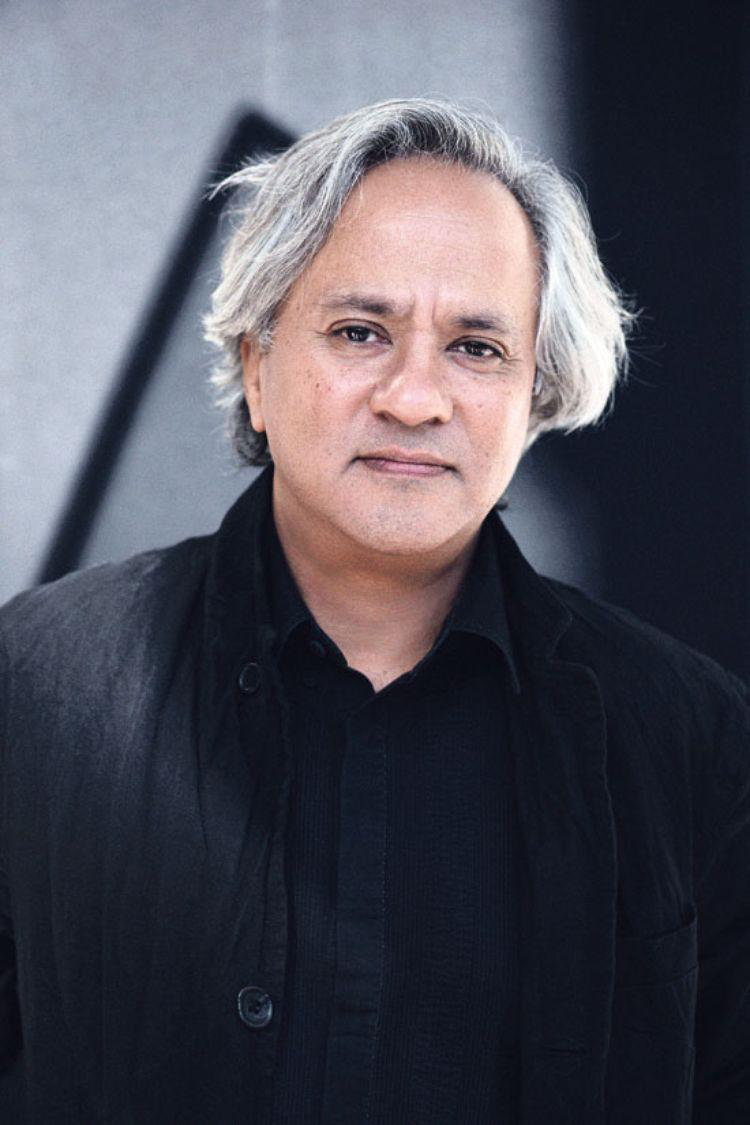
    Anish Kapoor dubbed the Jewish Nobel – last year, for his commitment to Jewish values

    LONDON (TIP):  British-Indian sculptor Anish Kapoor donated $1 million to five charities working with refugees worldwide on Jan 17, in a bid to alleviate a record-breaking global displacement crisis.

    Kapoor, who was born to an Indian father and Iraqi Jewish mother, won the Genesis Prize – dubbed the Jewish Nobel – last year, for his commitment to Jewish values.

    “Like many Jews, I do not have to go far back in my family history to find people who were refugees,” he said in a statement.

    “Directing Genesis Prize funds to this cause is a way of helping people who, like my forebears not too long before them, are fleeing persecution.”

    The United Nations (U.N.) says the world is witnessing the highest levels of displacement on record, with more than 65 million people forced to flee their homes, surpassing numbers after the Second World War more than 70 years ago.

    U.N. efforts to agree a voluntary pact on safe, orderly and regular migration suffered a setback in December when the United States quit the negotiations.

    “In recent months, awareness of the plight faced by tens of millions of refugees and displaced persons worldwide has fallen significantly while the refugee crisis continues unabated,” said Kapoor, a longtime social activist.

    Kapoor, who lived in Israel briefly before settling in Britain in the 1970s, won the Turner Prize in 1991 and created a Holocaust memorial for London’s Liberal Jewish Synagogue.

    Winners of the Genesis Prize, which is granted by the Israeli government, award $1 million to charities of their choice, with the aim of inspiring the next generation of Jews.

    One of Kapoor’s grantees is the International Rescue Committee, which is working with refugees in Uganda – home to more than 1 million people who have fled war in South Sudan – and with stateless Rohingya in Myanmar.

    He is also providing food for refugees in Greece and France and medical care for Syrian refugees.

    Previous winners include former New York City Mayor Michael Bloomberg and the actor Michael Douglas. The 2018 winner, the Oscar-winning actress Natalie Portman, plans to focus her award funds on promoting women’s equality.

    (Source: NDTV)


  • What to watch in 2018

    What to watch in 2018

    As the new year begins, here are the smartest predictions of what’s coming in politics, tech and business in 2018.

                                                         By Erica Pandey

    The Big picture: In many ways 2018 will mirror 2017. The world’s largest economies will continue to grow in sync, the #MeToo movement will continue to topple men who behave badly from positions of power, and the North Korean nuclear threat will keep fueling international tensions. But new trends may emerge if the Democrats take the House in the midterm elections or media companies find a solution to the “fake news” epidemic.
    At home

    Democrats will take back the House “by an eyelash” in the 2018 midterm elections, the Financial Times’ Courtney Weaver predicts. It’s typical for the party of the president to lose seats in the midterms, and the Republican Party could “lose big” given Trump’s sub-50 approval rating. A Democrat majority in the House would also mean impeachment proceedings against Trump could gain ground in the new year.

    Abroad

    Trump’s approach to China is about to change for several reasons, per Sinocism’s Bill Bishop: the administration’s National Security Strategy very clearly reframed the U.S. government’s view of China in a confrontational way, the president believes China is still not doing enough on North Korea, and the administration’s “America First” trade contingent is ascendant. Several trade actions are in the planning stages and they will likely hit soon.

    Uneasy tension around the North Korean nuclear threat will continue — or escalate. Trump tweeted on Dec. 28 that there won’t be a “friendly solution” to the issue of North Korea if China violates UN sanctions against the rogue regime. And Admiral Mike Mullen, a former chairman of the Joint Chiefs, said on ABC’s This Week that the U.S. is closer “than ever before” to a nuclear confrontation with North Korea.

    UK Prime Minister Theresa May will keep her job, per the Financial Times’ Sebastian Payne. “Sealing a Brexit divorce deal has ensured short-term job security,” Payne writes.

    Zimbabwe won’t hold free and fair elections in 2018 despite the end to Robert Mugabe’s 37-year rule, FT’s David Pilling predicts. And Al Jazeera’s Barnaby Phillips writes, “Emmerson Mnangagwa will surely prove a more capable manager of Zimbabwe’s economy than Mugabe, but there are plenty of reasons to fear he’ll be just as ruthless and undemocratic.”

    The global economy

    Synchronized growth will continue. This year, for the first time since the Great Recession, the world’s leading economies grew in sync. And that growth will hold into 2018, Goldman Sachs research economists predict. They’re forecasting 4.0% GDP growth for the new year, up from a 3.7% projection for 2017.

    Emerging markets will grow as well. Average GDP growth for emerging markets will reach 5%, up from 4.7% in 2017, per the Financial Times’ James Kynge. “This will mostly be because Russia and Brazil, which have stumbled, will bounce back,” Kynge writes.

    In tech

    Big Tech will get stronger. “Silicon Valley got raked over the coals in 2017 about sexism, security and its influence on national affairs. But it hasn’t really grappled with the bigger problem: There’s too much power in the hands of too few … Expect to see tech giants flogging their “social good” efforts in the year ahead, but our trust won’t be restored by watching them act like benevolent dictators,” per the Washington Post’s Gregory Fowler.

    Bitcoin will keep dominating headlines with its dramatic crashes and booms. Goldman Sachs became the first major Wall Street institution to launch a trading desk for the cryptocurrency in 2017, and, as more institutions venture into the crypto world, prices will rise accordingly, CNBC’s Eric Jackson predicts.

    Augmented reality will rise in prominence, Axios’ Alayna Treene reports. “In the next few years, we’re going to see AR develop significantly and start to break through to the mainstream. Once that happens, it will effect almost every aspect of daily life — from entertainment and work to education and transportation.”

    In media

    Transparency will become “the antidote to fake news,” Frontline’s Raney Aronson-Rath tells Nieman Lab. Per Aronson-Rath, “We’ve seen Facebook make moves towards differentiating between verified and unverified stories. Twitter and Google, too. But the problem is massive, and these are just first steps.”

    The #MeToo movement will continue toppling powerful men who behave badly in media and every other industry. Here’s a list of the 82 men accused of sexual harassment and assault in 2017.

    (Source: Axios)

  • Support for terror outfits must be forced to stop: India at United Nations

    Support for terror outfits must be forced to stop: India at United Nations

    UNITED NATIONS (TIP): Supporters of terror organisations like Taliban, Haqqani network and Lashkare- Taiba must be forced to stop and all safe havens must end, India has told the UN Security Council, expressing concern over the collapse of security situation in Afghanistan.

    Terrorists continue to attack the most vulnerable, including the sick in hospitals, children in schools, devotees in mosques and even mourners at funerals. Terrorist groups have gained territory, Deputy Permanent Representative of India to UN, Tanmaya Lal, said during an open debate of the Security Council on Afghanistan.

    “The support for terrorist organisations like the Taliban, the Haqqani Network, Daesh, Al Qaeda and its designated affiliates such as Lashkare- Taiba and Jaish-e-Mohammed from outside Afghanistan, must be forced to stop,” Lal said.

    “All safe havens and sanctuaries available to such groups outside Afghan borders must end. The Security Council has an important responsibility in this regard in our collective interest,” Lal said. “The continued resilience shown by the Afghan people and security personnel has been exemplary but hopes of a better future still appear distant.

    Our regular consultations and the work done by the Council have not been enough to more effectively reverse the situation on the ground,” he added.

    Lal said it had been painfully clear since long that the security situation in Afghanistan had implications not only for the region but the entire world.

    “While new threats emerge from the Daesh, the Security Council cannot even decide whether to designate the new leaders of Taliban or to freeze the assets of the slain leader of the group more than a year after the issue was brought to its attention,” Lal said.

    In his address to the Security Council Afghan Ambassador to the UN Mahmoud Saikal said Afghanistan’s patience on indiscriminate shelling from across the border by Pakistan should not be tested.

    “Under the pretext of receiving fire from our side, Pakistan’s violations across the Durand Line, including indiscriminate artillery shelling, have continued unabated throughout 2017, resulting in the loss of innocent lives and destruction of villages,” he said.

    The proposal of Afghanistan for engagement and operational coordination towards addressing these concerns had not seen any response, he told the UN Security Council.

    “At the same time, Afghanistan has the will and the capacity to defend its territory and our patience should not be tested,” Saikal said.

    Afghanistan believed that confidence building measures could be successful only when violations of this nature came to a complete halt, he said. “In a similar vein, we are also in communication on the imperative of addressing terrorists’ regional safe havens and hope to see positive developments on this front soon,” he said, adding that Afghanistan looked forward to the upcoming trilateral meeting in Beijing next week between the Foreign Ministers of Afghanistan, Pakistan, and China. Source: PTI

  • UN General Assembly rejects Trump’s decision to recognize Jerusalem as Israel’s capital

    UN General Assembly rejects Trump’s decision to recognize Jerusalem as Israel’s capital

    India votes to challenge US decision

    Israel calls preposterous vote against Jerusalem at UN General Assembly

    UNITED NATIONS (TIP) India joined 127 other countries, on December 20 to vote in the UN General Assembly in favor of a resolution opposing the recent decision of US President Donald Trump to recognize Jerusalem as Israel’s capital. Nine countries voted against the resolution, while 35 countries abstained.

    India’s decision to vote against American recognition of Jerusalem as the Israeli capital comes a day after Trump warned countries against opposing the US position. India did not speak on the floor of the Assembly in New York, but after Trump recognized the holy city of Jerusalem as the capital of Israel, it had said that its Palestine position was independent and consistent.

    The countries that joined the US in voting against the resolution were Honduras, Israel, Marshall Islands, Micronesia, Nauru, Palau and Togo. Among major nations who abstained voting were Australia, Bhutan, Canada, Columbia, Hungry, Mexico, Panama, the Philippines, Poland and Uganda.

    Israel rejected as “preposterous” the vote by 127 countries, including India, at the UNGA that opposed Donald Trump’s recognition of Jerusalem as Israeli capital.

  • Religious freedom conditions continued to deteriorate in India, says US Report

    Religious freedom conditions continued to deteriorate in India, says US Report

    WASHINGTON (TIP): The United States Commission on International Religious Freedom (USCIRF), that researches and monitors international religious freedom issues, in its latest report slammed ruling BJP and Hindu nationalist groups for perpetrating violence against religious minority communities.

    USCIRF’s 2017 annual report which was released on Aug 15, pointed out that “In 2016, religious tolerance and religious freedom conditions continued to deteriorate in India.”

    “Hindu nationalist groups—such as the Rashtriya Swayamsevak Sangh (RSS), Sangh Parrikar, and Vishal Hindu Perished (VHP)—and their sympathizers perpetrated numerous incidents of intimidation, harassment, and violence against religious minority communities and Hindu Dalits. These violations were most frequent and severe in 10 of

    India’s 29 states. National and state laws that restrict religious

    conversion, cow slaughter, and the foreign funding of nongovernmental organizations (NGOs) and a constitutional provision deeming Sikhs, Buddhists, and Jains to be Hindus helped create the conditions enabling these violations.”

    The report criticized the ruling party as well. “While Prime Minister Narendra Modi spoke publicly about the importance of communal tolerance and religious freedom, members of the ruling party have ties to Hindu nationalist groups implicated in religious freedom violations, used religiously divisive language to inflame tensions, and called for additional laws that would restrict religious freedom. These issues, combined with longstanding problems of police and judicial bias and inadequacies, have created a pervasive climate of impunity in which religious minorities feel increasingly insecure and have no recourse when religiously motivated crimes occur”, it said. Based on these concerns, in 2017 USCIRF again places India on its Tier 2, where it has been since 2009.

    USCIRF suggested following recommendations to the US government:

    • Integrate concern for religious freedom into bilateral contacts with India, including the framework of future Strategic Dialogues, at both the federal and provincial levels, and encourage the strengthening of the capacity of state and central police to implement effective measures to prohibit and punish cases of religious violence and protect victims and witnesses;
    • Increase the U.S. Embassy’s attention to issues of religious freedom and related human rights, including through visits by the ambassador and other officials to areas where communal and religiously motivated violence has occurred or is likely to occur, and through meetings with religious communities, local governmental leaders, and police
    • Press the Indian government to allow USCIRF to visit the country, and urge the Indian government to invite the United Nations Special Rapporteur on freedom of religion or belief to visit India
    • Urge India to boost training on human rights and religious freedom standards and practices for the police and judiciary, particularly in states and areas with a history or likelihood of religious and communal violence;
    • Urge the central Indian government to press states that have adopted anti-conversion laws to repeal or amend them to conform with internationally recognized human rights standards; and
    • Urge the Indian government to publicly rebuke government officials and religious leaders who make derogatory statements about religious communities.


  • Germany urges ‘restraint’ from North Korea, Trump

    Germany urges ‘restraint’ from North Korea, Trump

    BELIN (TIP): Germany on August 9 urged North Korea and the United States to show “restraint” after apocalyptic threats from President Donald Trump and Pyongyang in their mounting war of words.

    “We are watching the increasing rhetorical escalation regarding the Korean Peninsula with the greatest concern,” foreign ministry spokesman Martin Schaefer told reporters. “That is why we call on all sides to use restraint.” Schaefer said Berlin was convinced a “military option” could not be “the answer in the quest for a nuclear weapon-free Southeast Asia”.

    He urged the international community to “thoroughly implement” the latest round of sanctions against North Korea approved by the United Nations Security Council.

    And he backed a call by US Secretary of State Rex Tillerson to resume talks with Pyongyang if it halts ballistic missile tests.

    “We must all continue our diplomatic efforts — it is the only way to ensure that the threat of the illegal North Korean nuclear weapons programme can be contained,” he said. (AFP)