UNITED NATIONS (TIP): India has contributed an additional million dollars to a UN partnership fund launched to support sustainable development projects across the developing world.
The India-UN Development Partnership Fund was set up last month as a partnership between India and the United Nations Office for South-South Cooperation (UNOSSC). India had made an initial contribution of a million dollars when the fund was created and the amount was allocated for the implementation of a project benefiting seven Small Island Developing States in the South Pacific.
India yesterday enlarged its support to sustainable development through the multilateral system by making a supplemental contribution of one million dollars to the fund.
UNITED NATIONS (TIP): Myanmar should let the UN fact-finding mission probe the alleged human rights violations by the country’s military and security forces, US Ambassador to the UN Nikki Haley has said, underlining that the international community cannot overlook the situation there.
Myanmar said late last month that it would not grant visas to members of a commission appointed by the UN Human Rights Council to investigate human rights violations by the country’s state security forces, including the recent abuses in Rakhine State.
The US mission to the UN said violence in Rakhine State against ethnic and religious communities continues to claim lives and there are allegations of sexual violence against women and children.
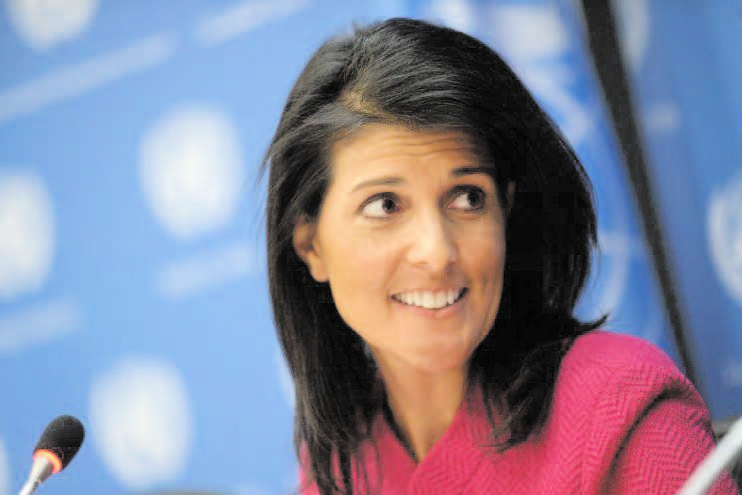
“No one should face discrimination or violence because of their ethnic background or religious beliefs. It is important that the Myanmar government allow this fact-finding mission to do its job,” Indian-origin Haley said in a statement here.
She said the international community cannot overlook what is happening in Myanmar and “we must stand together and call on the government to fully cooperate with this fact-finding mission”.
“The total number of victims will be unknown unless the fact-finding mission is allowed to proceed,” the UN mission said.
Geneva director at global rights group Human Rights Watch John Fisher said denying visas to the members of the fact-finding mission would be “a slap in the face” to victims who suffered grave human rights violations by Myanmar’s state security forces.
“Does Aung San Suu Kyi’s government really want to be included in a very small and ignominious club of countries that reject Human Rights Council decisions? North Korea, Eritrea, Syria, and Burundi are human rights pariah states that obstructed the work of independent, international investigations into alleged rights abuses, and it would be a travesty for a democratically elected, National League for Democracy-led government in Myanmar to do the same,” Fisher said. The rights group said the Myanmar government should immediately announce they will issue visas to the fact-finding mission and fully cooperate with its investigation.
“Otherwise, the governments that pushed to set up this fact-finding mission need to stand up for it and impose a political consequence on Myanmar for blocking its work,” Fisher added.
The UN estimates that more than 90,000 Rohingya have been forced to flee their homes in northern Rakhine State since last October. (PTI)
CRANS-MONTANA (TIP): Talks to reunify the divided island of Cyprus collapsed in the early hours of July 7, UN Secretary General Antonio Guterres said after a stormy final session.
“I’m very sorry to tell you that despite the very strong commitment and engagement of all the delegations and different parties … the conference on Cyprus was closed without an agreement being reached,” he told a news conference.
The collapse marked a dramatic culmination of more than two years of a process thought to be the most promising since the island was split more than 40 years ago.
Guterres had flown in on Thursday to press Greek Cypriot President Nicos Anastasiades and Turkish Cypriot leader Mustafa Akinci to seal a deal reuniting the east Mediterranean island, while U.S. Vice President Mike Pence had phoned to urge them to “seize this historic opportunity”.
Diplomatic efforts to reunite Cyprus have failed since the island was riven in a 1974 Turkish army invasion triggered by a coup by Greek Cypriots seeking union with Greece.
The week of talks in the Swiss Alps, hailed by the United Nations as “the best chance” for a deal, ground to a halt as the two sides failed to overcome final obstacles.
Diplomats said Turkey had appeared to be offering little to Greek Cypriots wanting a full withdrawal of Turkish troops from the island, although the Greek Cypriots had indicated readiness to make concessions on Turkish Cypriot demands for a rotating presidency, the other key issue.
Guterres finally called a halt at 2am after a session marred by yelling and drama, a source close to the negotiations said.
“Unfortunately… an agreement was not possible, and the conference was closed without the possibility to bring a solution to this dramatic and longlasting problem,” Guterres said.
“That doesn’t mean that other initiatives cannot be developed in order to address the Cyprus problem,” he added.
He declined to elaborate on what exactly had caused the talks to collapse, but said there was still a wide gap between the two delegations on a number of questions. Greek Cypriots, who are due to launch a gas drill off the island in coming weeks that Turkey opposes, pointed the finger of blame at the Turkish Cypriot side.
Nicos Christodoulides, spokesman for the Greek Cypriot government, said Turkey had refused to relinquish its intervention rights on Cyprus or the presence of troops on the island.
“Tonight’s development is in no way positive, but it is not the end of the road either,” he said. Guterres, who began his role in January by announcing a “surge of diplomacy for peace”, is known for his energy and drive.
But he appeared tired and downcast as he announced the collapse of the talks to a handful of journalists at an impromptu news conference that lasted only three and a half minutes.
Diplomats say that Cyprus should be much simpler to resolve than many other situations where the United Nations hopes for peace, such as the bloody and complex wars in Syria, Yemen, Ukraine, South Sudan, Libya, or the Korean peninsula.
Success in the Cyprus talks would have given Guterres a high profile at the G20 talks in Hamburg, where he is due on Friday, and where he will meet US President Donald Trump, who has promised to cut the US share of UN funding (Reuters)
NEW YORK (TIP): ITV Gold program director Ashok Vyas was honored with Bharat Gaurav Samman at an awards event at Delegates Dining Room, United Nations in New York on June 9.
The Bharat Gaurav awards are presented to people from around the world who have achieved a landmark in their profession or in community work which has benefited India. The awards have been instituted by Jaipur based organization named Sanskriti Yuva Sanstha, an NGO which works across the world profiling the rise of Indian culture through various social programs. Its president is Pt Suresh Mishra.
At the June 9 ceremony in New York, other honorees included Jain guru Lokesh Muni, TV Asia chief HR Shah, Sulabh International fame Bindeshwari Pathak, filmmaker Madhur Bhandarkar, and socialite and philanthropist Meera Gandhi.
On December 11 in 2014, the United Nations General Assembly declared June 21st as the International Day of Yoga. The declaration came after the call for the adoption of June 21st as International Day of Yoga by Indian Prime Minister, Narendra Modi during his address to the UN General Assembly on September 27, 2014 wherein he stated: “Yoga is a invaluable gift of India’s ancient tradition. It embodies unity of mind and body; thought and action; restraint and fulfillment; harmony between man and nature; a holistic approach to health and well-being. It is not about exercise but to discover the sense of oneness with yourself, the world and the nature. ” In suggesting June 21, which is the Summer Solstice, as the International Day of Yoga, Narendra Modi had said that, “the date is the longest day of the year in the Northern Hemisphere and has special significance in many parts of the world. ” The first IYD was celebrated on June 21, 2015 at the United Nations, as also across the world. This 21 June will see the third edition of IDY at the United Nations, which is organized by the Permanent Mission of India.
Here are excerpts from the interview.
How you are going to celebrate International Day of Yoga here? We saw a decline in the enthusiasm in people last year. What could be the reason?
Let’s just go by facts. When the event was first organized in 2015, people were invited for only one day and the number was about 350 to 400.Last year if you had a look, more than 1000 people participated and there were two events. One was yoga demonstration in the UN premises in an open space and there were more than 1000 people from more than 130 countries. Also in addition, we started a new element of trying to express what yoga means at an intellectual level. So, we also had it at an economic and social platform where Sadguru talked about his own approach to yoga. This was called ‘Conversations with yoga masters’ and that attracted nearly 500 people. So, if you see both these events combined, this was much larger than the first year and let me add another thing. For the first time the UN building was decorated with yoga asanas projected on it. It has never happened before. So, if you look at how we progressed from one year to another – in terms of enthusiasm it was much more. Let me assure you, this year we will have something more. Last year the images were projected on the lateral side of UN building.This year, if you have seen Diwali images on the UN, it will be like that and we have requested Indian actor Anupam Kher to come and switch on the light. This will start on 18th June – 3 days before International Day of Yoga.
On 20th June, we plan to have a larger assembly of people coming for the yoga demonstration. This will be in the evening at 6 pm and every year we get different yoga masters. This year we are getting Swami Chidanand Saraswati and Sadhvi Vagwati from Rishikesh who are also associated with Hindu Jain Temple in Pittsburg. They will be leading the yoga on 20th June. On each of these days the UN building will lit up with yoga mudras to indicate to the world that the UN is celebrating the International Day of Yoga.
Finally, on the 21st, we will again have a conversation on ‘Yoga for Health’ because as you know the Prime Minister focused on yoga and its benefits in terms of health. So, this year we are having a very interesting combination of different people who have done very well. For example, we are working with WHO (World Health Organization). They will have a conversation on ‘Yoga for Health.’ So, we are having people from other walks of life who have benefitted from yoga. For example, we are having a leading yoga practitioner from Corporate America. His name is Mr Stanten Caber. He is the CEO of Bluechip Marketing Worldwide. It’s a Fortune 500 company. He is coming to say how he has used yoga to improve efficiency in business. So, we are moving from purely physical activities to intellectual to business to health. Let me assure you, there is no lack in terms of our interest and enthusiasm and activism for yoga.
The Prime Minister told me, this should be celebrated with higher interest every year than the last year. I can assure you, as far as we’re concerned, the effort and degree of interest will only keep increasing because yoga itself has become very popular. I went to a school in Bronx. For the students, yoga is India. That is their perception about India. We had a very interesting discussion with 7th 8th grade children and for them climate, environment, yoga – all are interlinked.
So, it will only be on an increase. Is there any special effort from your side to attract people from mainstream?
Yes. We have opened links. Anybody who is interested can register. We’ll provide them the opportunity to come. We have also tagged various yoga organizations to bring in people. So, come on 20th and see how much we’ve progressed compared to last year. There is no limitation on anyone who wants to come.
It’s an open event. You just have to register. It’s a simple online registration. It’s available on our Facebook page and our website. You have to click the link and give your details so that our security people have that information and can give you the entry pass.
How many people do you expect?
Certainly, we expect more people than last year. Last year, it was more than a thousand. This year we expect 1500 to 2000. The place can hold 2500 people. We need support from all organizations to enable us to get the numbers. Yoga is India’s offering but now it has gone global.
When will the registrations close?
48 hours before the event. The earlier people register, the better it is. Already several hundred have registered.
Anything else you want to share?
We are also working with Sahaja Yoga – another organization – on an exhibition at the UN premises. This will be again a first time exhibition on yoga. We will start it on June 19th and it will continue for the week.
An unrelated question, with your permission.What is the status of India’s bid for permanent seat in the Security Council?
The process began in 1995 when I was here. So, I know the evolution of the process. India’s aspiration to be in the Security Council is a reflection of India regaining its place in terms of where we desire to be in the comity of nations. This is an aspirational goal. We worked with certain belief that it will happen. The issue is when it would happen and it’s only a matter of time. The globe today is passing through some uncertainties. International organizations and the UN in particular are in a stressful situation because there is turbulence and uncertainty in interstate relations. That means the status Quo is no longer tenable. For a country like us, we feel that the status Quo needs to reflect the changed realities. How we work through this turbulence to reach the goal may take some time.
Nobody knows the time specifics. But a country of a billion can’t be kept out of any high table. We are in the era today of democratic governance. It may happen in a year or two years or more. The important thing is we reach the goal. India is now looked at very differently by the world.
It is not the same India that it was in the nineties. They lookat us with a different approach – as a more confident country. As the economy grows, we’ll bring many more things to the table. So, while we work on this we also need to strengthen our economy, our own growth patterns. As we keep growing, it’s only a matter of time. That will be reflected in international organizations.
The world is in a constant “turbulence” which means a permanent seat for India could be indefinitely delayed?
You have to reach a solution at some stage. Global order to survive requires some sort of stability at the end of turbulence. Otherwise what do you have? You have outdated institutions, you have turbulence. If you do not have reform then you have dysfunctional outcomes. We hope the countries work together to reform. A system or order will come out. We will get what we are aspiring for.
What is your call on India-Pakistan relations and the increasing hostility from Pakistan?
I’m not an optimist but a realist. As a realist, we can engage the world as it is now. The world sees India very differently than our neighbor. India has its growth story with an aspiration to live a good life. I do not want to say about others but the world does not see them that way. It is for them to decide what they want. They want to be an aspirational society or a society which is differently structured. It’s their call. As far as we are concerned, we are ready to engage with everyone but for that you need a conducive atmosphere. Unfortunately, Pakistan is not giving that atmosphere. If they give, we’ll certainly try to improve the tie. It is a call for them.
NEW YORK (TIP): The celebration of the 2017 International Day of Yoga will be held in the evening of Tuesday 20 June 2017 at 1800 hrs at the North Lawns, United Nations (UN Secretariat Building, entrance from 46th Street, 1st Avenue), New York.
The event is being organized by the Permanent Mission of India to the United Nations in association with the Department of Public Information, United Nations.
This will be the third celebration of the International Day of Yoga at the UN. The UN General Assembly Resolution A/Res/69/131, which was adopted by acclamation in December 2014 with a record number of 177 co-sponsoring member states, established the International Day of Yoga for observance by the United Nations on 21 June each year.
The idea for declaring an International Day of Yoga at the United Nations was formally proposed by the Hon’ble Prime Minister of India, Shri Narendra Modi, in his maiden address to the 69th UNGA on 27 September 2014. The Hon’ble Prime Minister had indicated that 21 June, one of the two solstices, which marks the longest day in the northern hemisphere, has special significance in many parts of the world, and could be considered for adoption as the International Day of Yoga by the United Nations each year. Prime Minister Modi had said “Yoga embodies unity of mind and body; thought and action; restraint and fulfillment; harmony between man and nature; a holistic approach to health and well being.”
For more information on the program, please contact the Permanent Mission of India to the United Nations at E-mail:
idypminy@gmail.com or visit
https://www.pminewyork.org/idvi
For visitors who do not hold UN Ground Pass, UN Security will issue name-specific entry passes for which registration is a must (link given in the invitation). Entry to the venue is from the 46th Street, 1st Avenue entrance. In addition to the UN Security access pass, a government-issued photo identification (which matches with the name given for UN Security pass) is required to enter the premises.
Yoga is an ancient physical, mental and spiritual practice that originated in India. The word ‘yoga’ derives from Sanskrit and means to join or to unite, symbolizing the union of body and consciousness. Today it is practiced in various forms around the world and continues to grow in popularity.
Recognizing its universal appeal, on 11 December 2014, the United Nations proclaimed 21 June as the International Day of Yoga by resolution 69/131. The International Day of Yoga aims to raise awareness worldwide of the many benefits of practicing yoga.
Yoga is more than just burning your calories and toning your muscles. It is a mind body workout where you have strengthening and stretching poses along with deep breathing techniques to relax your mind and body There are more than 100 different forms of yoga. Some are fast paced and intense. Others are gentle and relaxing. Yoga is an invaluable gift of ancient Indian tradition. It embodies unity of mind and body; thought and action; restraint and fulfilment; harmony between man and nature and a holistic approach to health and well-being. The word yoga literally means union. Through yoga you can explore profoundly the very mechanics of life.
International Day of Yoga at Times Square, New York
The fact is that yoga is a way of life. While all the other exercises take care of your physical conditions, yoga helps you to control your mind and body. There are various yoga postures or asanas that help you to keep your body fit and healthy. Pranayama or breathing exercise helps you to rejuvenate your mind and soul. It is said you should begin your day with pranayama and it helps you to think better and stay calm and peaceful. Sedentary lifestyles, unhealthy diet and stress – all these lead to various diseases. Yoga teaches you to control all these through exercises.
Launching a particular date for practicing yoga all across the world and celebrating as yoga day was initiated by the Indian Prime Minister, Mr. Narendra Modi. In a yoga day essay for students, it is important to mention that international day of yoga which is also called as the world yoga day is celebrated on the 21st of June. The declaration was done after the call by the Indian Prime Minister to the United Nations General Assembly on 27th of September in 2014 during his address to the UN General Assembly.
International Day of Yoga at the Queens Museum in 2016.
The celebration of the event international day of yoga is supported by various global leaders. More than 170 countries including USA, China, Canada took part in this event which was celebrated for the first time on the 21st of Jan 2015. It was celebrated on international level by organizing the activities like yoga training campus, yoga competitions and so many activities to enhance your awareness about the innumerable benefits that you can derive by practicing yoga on a daily basis. This event is celebrated to create the awareness of the wholesome effects of yoga among the public all over the world.
Thus it can be concluded as; meditation or ‘dhyana’ teaches you how to discipline your mind. Through a systematic practice of yoga, you can overcome your negative thinking which in turn gives you confidence and enhances your mental power. This increases self-awareness and helps you to increase your attention and concentration; hence yoga is suitable for children also.
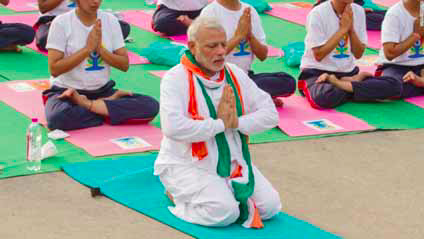
The first International Day of Yoga was observed world over on 21 June 2015. … 35,985 people, including Narendra Modi and a large number of dignitaries from 84 nations, performed 21 yoga asanas (postures) for 35 minutes at Rajpath in New Delhi.
The declaration of international day of yoga is a great moment for India. It took less than three months to be declared as the world yoga day by the United Nations general assembly. Indian Prime Minister, Narendra Modi had called for it on 27th of September in 2014 which was finally declared on 11th of December in 2014. It was first ever in the history that the initiative of any country has been proposed and implemented in the UN body within 90 days. This resolution has been adopted under the global health and foreign policy by the general assembly in order to provide a holistic approach to you for your health and well-being.
International Day of Yoga at the United Nations in 2016
Official name of this day is UN International Yoga Day and also called as Yoga Day. It is a worldwide event celebrated by all countries through practicing yoga, meditation, debates, meetings, discussions, variety of cultural performances, etc.
Indian Prime Minister, Mr. Narendra Modi has put his views for adopting a day especially for yoga while addressing to the United Nations General Assembly. He asked the world leaders for adopting international yoga day to deal with the declining health because of negative climate changes. Especially, he suggested 21st of June for adopting the international day of yoga as this day is the longest day in northern hemisphere regions as well as of great significance in many parts of the world.
Yoga is a Hindu spiritual and ascetic discipline, a part of which, including breath control, simple meditation, and the adoption of specific bodily postures, is widely practiced for health and relaxation.
The Myriad Benefits of Yoga are:
Yoga is very necessary and beneficial for you if it is practiced on a daily basis in the morning. It is a combined workout of the mind and body which enhances your brain functions, reduces stress and rejuvenates your body and soul.
Yoga is beneficial for the mental, physical and emotional development of children. In this world of fierce competition, yoga helps to reduce stress and tension.
It helps you to gain flexibility, manage stress, improves posture, memory and concentration.
Apart from these benefits, yoga also helps in flexibility of spine, induces relaxation and strengthens lower back.
Thus on a final note, yoga helps you to achieve the perfect harmony between your mind, body and soul. It drives away all negativity from your system and promotes in the achievement of a healthy and a happy life.
“This is a direct infringement of the fundamental right of the people as to what to consume, and this order may even have usurped the State rights in deciding vital issues that impact its citizens. The federal structure that stood the test of time since Independence may also be in the crosshairs. The socio-economic consequences from nutrition to the poor and backward in the society who rely on cheap meat as a staple food, and to the small farmers and traders who rely on these animals for their livelihood are yet to be seen”, says the author.
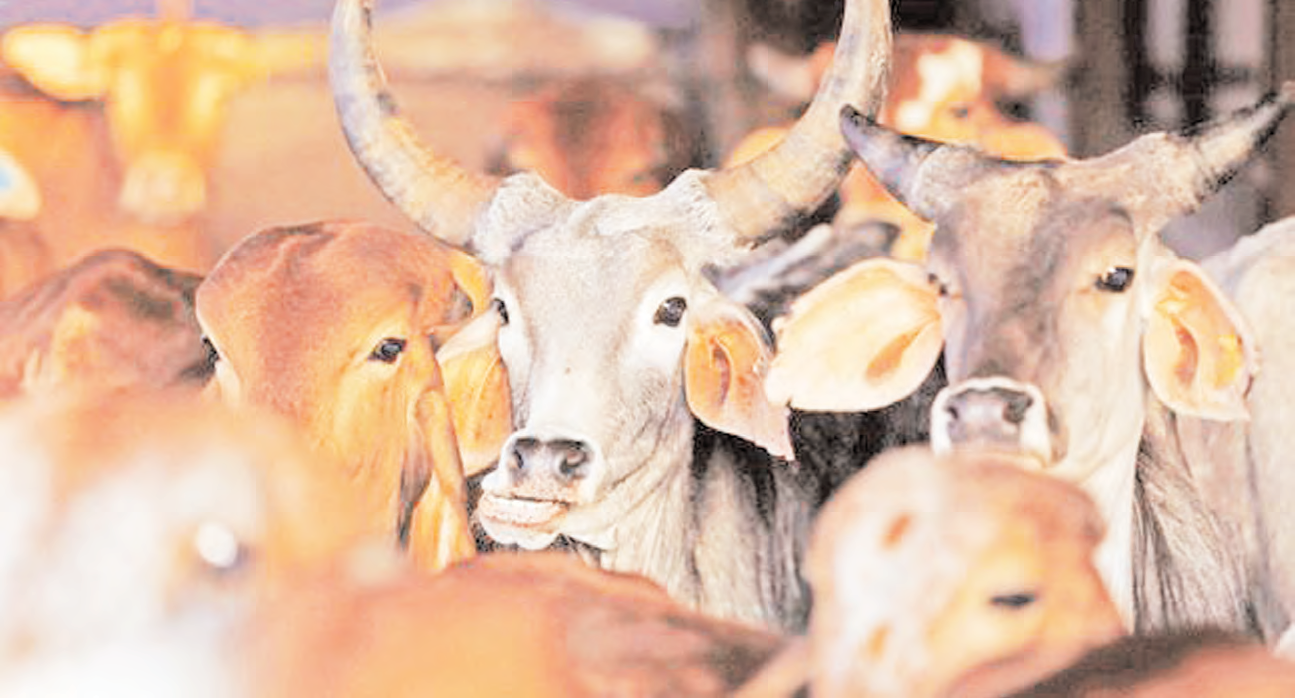
The long anticipated cow slaughter ban across India under the BJP rule is already here! Most observers were expecting a legislative move probably after the 2019 election when BJP could muster majorities at both houses of the parliament. However, the Modi Sarkar found an ingenious way to test these waters under the guise of the ‘Prevention of Cruelty to Animals Act’ that was enacted in 1960 to prevent the infliction of unnecessary pain or suffering on animals.
It is indeed a sinister move by the Environmental Ministry issuing new rules to regulate these animal markets with an eye towards limiting or stopping cow slaughter across the nation. The new rule states that animal markets can no longer be used to sell or purchase cattle for the purposes of slaughtering. The regulations apply to bulls, cows, buffaloes and camels. The reactions from the southern states were quick and predictable and the Chief Minister of Kerala, Pinarai Vijayan, took the lead in saying that “Malayali diet need not be decided by Delhi (read Union Government) or Nagpur (read RSS headquarters). Nobody can change our diet,” he said. Student organizations belonging to the Left front as well as Congress in Kerala protested the ban by organizing ‘beef fests’ across the state.
However, some of the youngsters who belong to the Youth Congress wing of the Congress Party went to the extreme in slaughtering a bull in the open and thereby eliciting strong condemnation from the national leadership in addition to receiving walking papers from the Party’s State leadership. It is regrettable that their stupefied action did cast a shadow on the merit of their arguments in defense of the constitutional protection from the onslaught of religious fundamentalism and may have negatively impacted on the seriousness of the issue at hand.
Nevertheless, what is most shocking to many of us who are living abroad is the overt and loud reaction to the slaughter of a bull in the open in comparison to the low-key responses to the ongoing lynching of human beings by the self-appointed vigilantes of cow protection. The medieval barbarism by these outlaws was on full display in 2015 when they falsely accused and then dragged Mr. Mohammed Akhlaq from his home in Dadri, U.P. to the street and lynched him before the gathering public.
On 1 April 2017, Pehlu Khan and at least four others were injured when a mob attacked them while transporting cows that were legally bought in the market. Khan in his fifties later succumbed to his injuries suffered at the hands of these vigilantes. In March 2016, two Muslim cattle traders were found hanged to death in Jharkhand’s Latehar district. Mazlum Ansari and teenager Imteyaz Khan were heading to an animal fair in a nearby district when they were allegedly lynched and hanged by a mob.
According to the report in The Indian Express, a 20-year old truck driver from Saharanpur was lynched by a village mob in Himachal Pradesh allegedly for carrying cattle from Uttar Pradesh.
Mustin Abbas, a 27-year-old father of four, was traveling back home after buying bulls from Haryana was allegedly fired upon by Gau Raksha Dal members on April 5, 2016. A month later, a probe into his murder was ordered, according to ‘The Wire.’ In an incident that went viral on the social media, on 11 July 2016 Dalit youths were beaten up outside Mota Samadhiyala village, when they were skinning a dead cow brought from Bediya village.
The victims included Vashram Sarvaiya, His brother Ramesh, and their cousins Ashok and Bechar, all residents of Mota Samadhiyala. Later the members of Gau Rakshak Dal took them to nearby Una town and again thrashed them with sticks and iron rods after tying them to a vehicle.
They were paraded half-naked on the road in full display of public view. These are few of the ongoing instances cruel justice meted out to the human beings and the country and its leadership remained largely silent.
With the issuance of this new order, the Gau Rakshak Dal will be further emboldened and will have the license to terrorize farmers and traders across the land.
If the issue is indeed borne out of cruelty to animals, why this ban only applies to cattle, camels, and buffaloes but not extended to other species like sheep, goats, and chickens. India exports about 4 Billion dollars worth of beef every year, and it looks simply duplicitous on the part of the Government to close its eyes to the so-called ‘cruelty’ by these big slaughterhouses, many of them owned and operated by the cronies of those are close to power centers.
This order may effectively cut the flow of red meat to consumers in those states where beef is consumed. All animal markets will be strictly regulated and will be brought under the control of the bureaucrats. As per the new rules, your butcher cannot buy any cattle from the market, and a declaration will have to be signed stating that ‘I promise not to resell the cattle for slaughter.’ In short, the center has made it near impossible to buy or sell cattle for meat or animal markets.
By circumventing the legislative process in this instance, BJP is busy at work promoting its saffron agenda by imposing a uniform diet code on the people of India. The reason they have rushed it through as a directive may have dual purposes. The first and foremost will be to sow the seeds of division and intolerance well before the upcoming 2019 campaign, a vital environment to profit from.
Also, this is a direct infringement of the fundamental right of the people as to what to consume, and this order may even have usurped the State rights in deciding vital issues that impact its citizens. The federal structure that stood the test of time since Independence may also be in the crosshairs. The socio-economic consequences from nutrition to the poor and backward in the society who rely on cheap meat as a staple food, and to the small farmers and traders who rely on these animals for their livelihood are yet to be seen!
However, let us not be under any illusion that all these developments are taking place in a vacuum.
But rather, it is part of a calculated plan being implemented by the Modi-Shah power structure to impose a majoritarian view and rule on the country thereby undoing the progress achieved post independence under the Nehruvian vision: respect for the minority religions and its traditions and equal protection under the law. The regressive forces that were in control of the nation in collusion with colonial powers are back indeed, and they are back with a vengeance!
Mahatma Gandhi, who was a great advocate of Ahimsa said once: “How can I force anyone not to slaughter cows unless he is himself so disposed? It is not as if there were only Hindus in the Indian Union. There are Muslims, Parsis, Christians and other religious groups here.” Will we hear such sane voices of enlightenment ever from the heartland of India again!
(The author is a former Chief Technology Officer of the United Nations and Chairman of the Indian National Overseas Congress, USA. He can be reached at gta777@gmail.com)
The cascading events, generally are layered and rarely, as now, erupt into a crescendo from an approaching constitutional crisis.
Initially, let me disclose that I am a registered Democrat, and seeing how Hillary’s team, including, DNC, illegally mistreated Sen. Bernie Sanders, and how Huma profited by quitting as Hillary’s deputy chief of staff and was immediately rehired as a “special government employee” and simultaneously got paid to work for the Clinton Foundation and Teneo Holdings – unethical and corrupt – I voted for Donald J. Trump to shake up the Establishment who, like Marie Antoinette, wanted Americans to “eat cake” when they couldn’t afford to “buy bread.” No hardworking American can get such a sweet Huma-Deal, soaked in conflicts of interests and influence peddling, without being shamed and maybe, going to jail. Leave aside Bill’s famous Tarmac Meeting with AG Lynch, forcing her recusal, and causing Comey to act as he did in 2016, where he, Comey cut Hillary a huge break by not indicting her for her planned-private email server, her housekeeper printing classified emails for Hillary’s review, and with full access to Bill to know all confidential matters without any “pillow talk” or an “audit trail” – due to password-sharing by Hillary to her housekeeper (and perhaps, Bill and Huma, etc.). General Petraeus ought get a presidential pardon from President Trump.
I also admit that I didn’t like Preet Bharara being “fired,” after he was re-hired, as that hurt everyday New Yorkers from getting a government Lincoln decreed, while making those in power feel above-the-law again.
Now, I turn to the issues at hand. Here is what we know, based upon the fast and furious reportage by The Washington Post, of Watergate fame, The New York Times and CNN, etc.
President Trump likes General Flynn; even, after terminating him for lying to the Vice President. Perhaps, he likes Flynn too much. We know that Obama administration was told about Flynn-Russia contacts by our Special Allies in Europe. We know Obama warned then-president-elect Trump about Flynn. Yet, Trump as president appointed Flynn NSA, only, to fire him 18 days after he knew Flynn lied to the Vice President, with a termination oddly soaked with Flynn-love. The bizarre Comey-termination, after a prior failed Loyalty-Pledge Request, was immediately followed by the incredulous Lavrov-Kislyak Oval Office visit with American Media barred, and POTUS later admitting to NBC’s Lester Holt that he, DJT, was thinking of the Russia Investigation when he fired Comey, hence, admitting his invisible state-of-mind worthy of self-immolation.
If I was personal counsel to Donald J. Trump, not White House Counsel to the Office of the President of the United States, which requires the fiduciary duties protect the Office of the President and not necessarily the man who is president, I would want to know the answer to one critical bifurcated question, to wit: “Donald, did you create or approve of a plan, during your presidential campaign, that a “reachout” to Russia ought occur because you want to: (1) “restart” US-Russia relations so as to defuse the ever-warming resurgence of the Cold War, as a matter of future US policy to cause Crimea’s return to Ukraine, NATO to refocus on defeating Terror, and Russian nuclear-armed submarines, ships and planes to join United States and NATO to enforce global peace and security? Or, (2) win the 2016 election with help from a foreign power, that is hostile to the United States, in violation of American democracy and rule of law and become the Manchurian President – remote-controlled by Russia?
If Donald’s answer is YES to (1) and NO to (2), then he is like Nixon in 1968 delivering his famous China Speech at the Council on Foreign Relations, later to open up the world to China in 1971 and switch Taiwan’s United Nations Security Council seat from ROC to PRC. It’s all legal, even as history judges China the winner over Nixon, as China, instead of being a counterbalance to the then-Soviets, pulled a Veto along with Russia in 2013 in UNSC after Syria’s chemical war crimes.
If Donald’s answer if NO to (1) and YES to (2), then he is in worse shape than Nixon’s Watergate Cover-Up, as here, it would be Trump’s Crime with Trump’s Cover-Up.
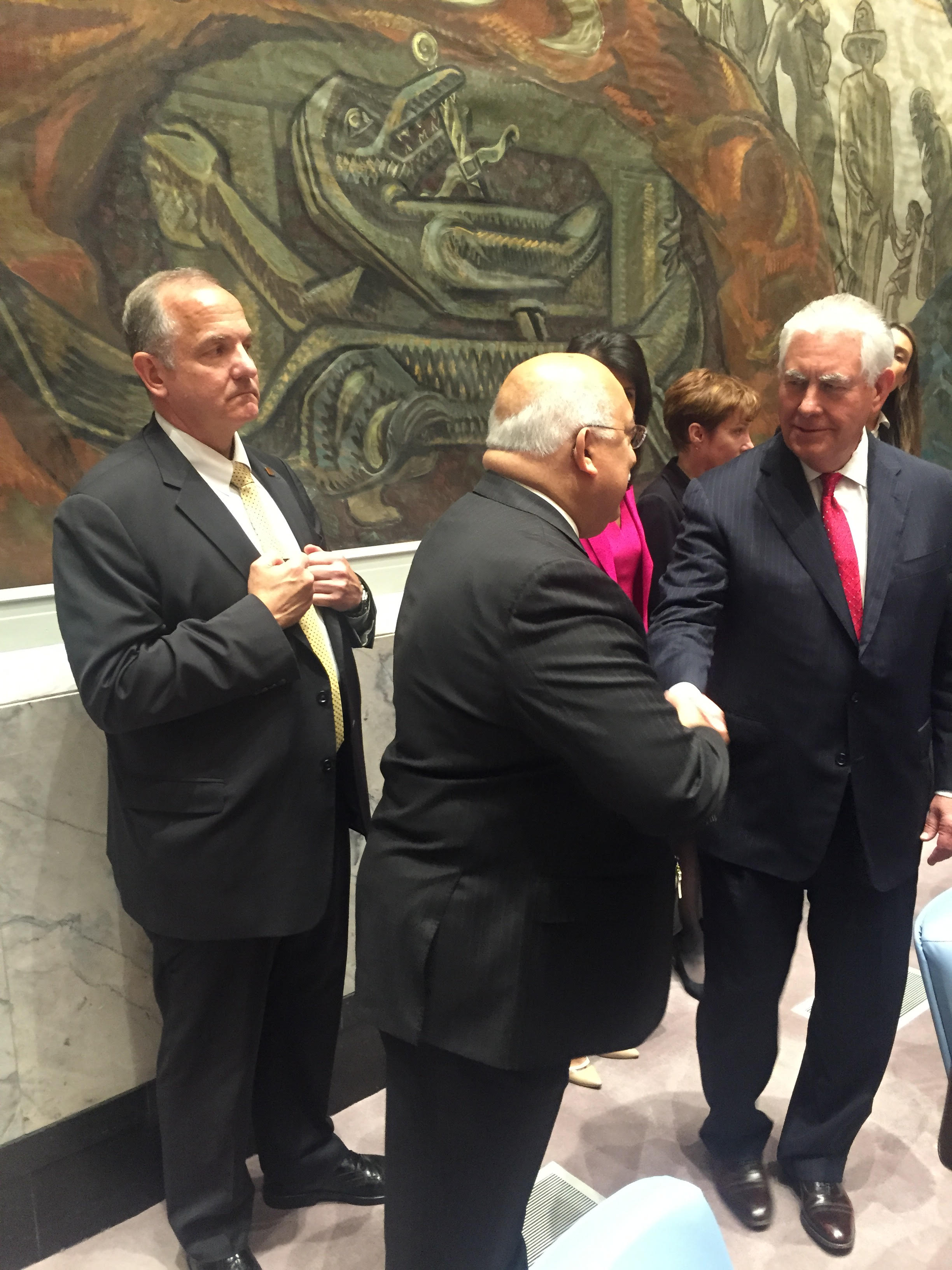
Assuming DJT’s answers are YES and NO, not NO and YES, then I would advise him to cut loose everybody as President Reagan did in the Iran-Contra Affair, and let everybody, especially those who sought to make individual side profits from such Russian engagements to face the music, Congressional and Special Counsel Robert Mueller. For saving the Trump Presidency may be valuable to America and everyday Americans. Just look at what he has accomplished in his First foreign trip with the mature and uniquely capable Rex Tillerson by his side in Riyadh, Saudi Arabia. Just a few years ago, Saudi Arabia was so sick of our non-action against Syria, that after winning the coveted UN Security Council seat, Amb. Abdallah Y. Al-Mouallimi made history by declining the seat and Riyadh considered setting up an alternate multilateral system of government, given the void of American leadership in face of heart wrenching suffering caused by Syria and ISIS.
However, there is a unique weakness that President Trump faces, that neither Nixon nor Reagan faced, in this early onset of the Impeachment Season: Both Houses of Congress are in Republican control. This is not so much a strength for the disruptive president, as it is a weakness. The Republicans want more than anything to retain both Houses in the 2018 Mid-Term elections. So, after getting the Tax Cut, they prefer to cause Impeachment to start out of righteous indignation, as then they get the normal-Establishment Mike Pence to be president – assuming he is not tainted and already-resigned by knowing about Flynn as Chair of Trump Transition Committee (for how could Flynn have lied to the Vice President in 2017, when Mike Pence already knew about Flynn-Russia and Flynn-Turkey in 2016) – well, then Speaker Paul Ryan is President. So, Mr. President, “beware the Ides of March” as “Brutus” lurks. Julius Caesar Act 1 Scene 2.
(Ravi Batra, an eminent NY attorney, is a former NYS Commissioner, Joint Commission on Public Ethics; Chair, National Advisory Council South Asian Affairs)
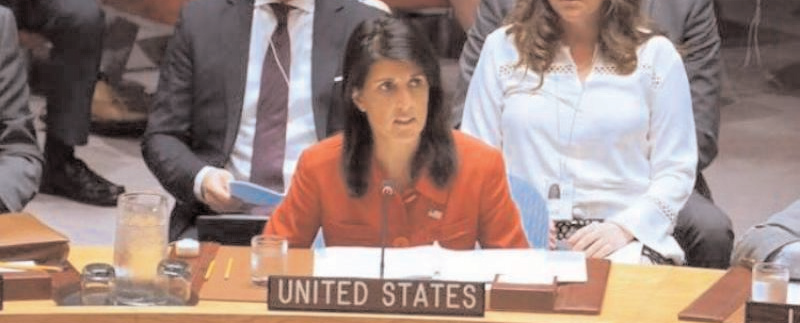
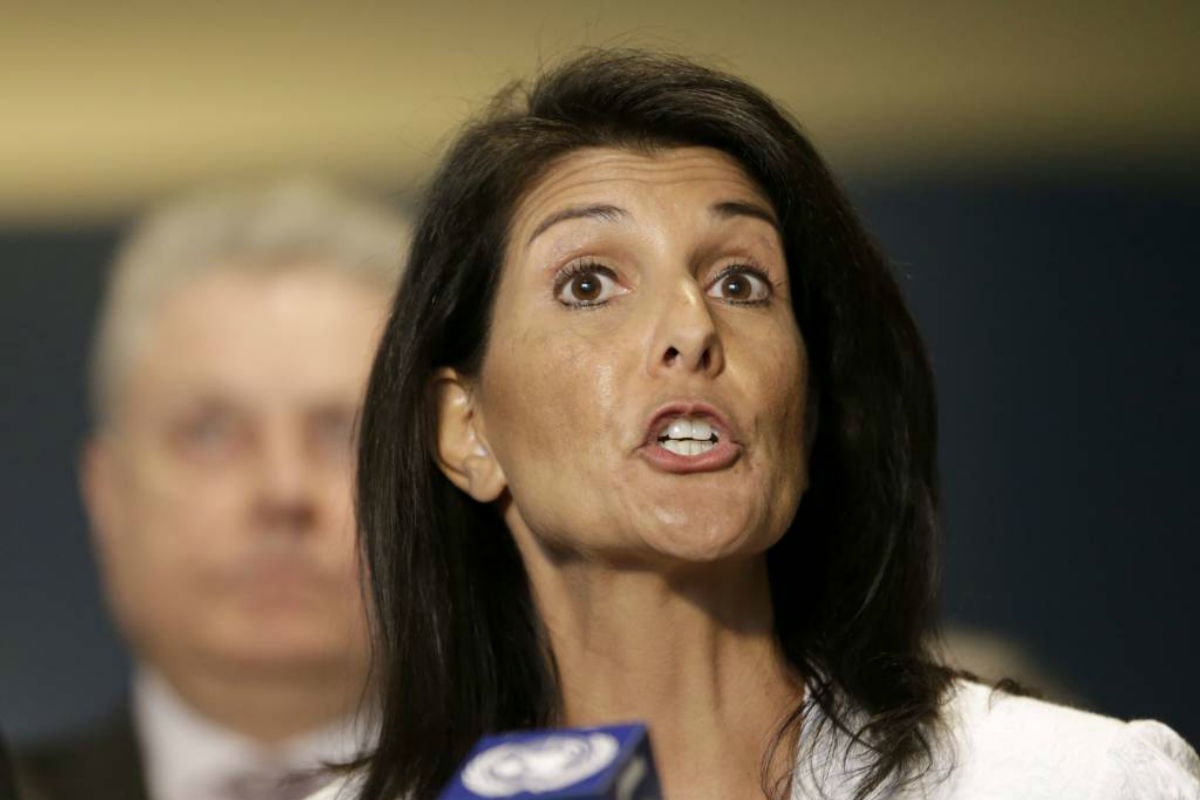
UNITED NATIONS: US Ambassador Nikki Haley accused North Korea on Tuesday of intimidating the entire international community with its nuclear program, military ability and cyberattacks, and said any country that doesn’t implement UN sanctions is supporting Pyongyang’s actions.
“No one is immune to the threat of North Korea,” she told reporters before emergency closed-door consultations by the UN Security Council on the North’s weekend ballistic missile launch, which experts said demonstrated a significant technological jump with the rocket flying higher and for a longer period of time.
“We’re not going to continue to just say go ahead and test as often as you want,” Haley said, flanked by the South Korean and Japanese ambassadors. “This is a true threat to every country in the world. … We’re going to make sure we put the pressure on them economically, diplomatically, politically and internationally.” Haley said the US and China have been working on “a unified plan” on how to approach North Korea that would include stronger implementation of existing sanctions and tougher new sanctions.
She indicated Washington and Beijing had agreed they would take action if a new test looked to be long range and leaning toward an intercontinental ballistic missile that could reach the United States.
The latest launch appeared to fulfill both criteria, Haley said, “so I believe that China will stay true to that, and that we’ll come together on how we’re going to do that.”
The Security Council, which has imposed six rounds of sanctions on the North, discussed possible further action at Tuesday’s meeting. Haley previously indicated that new sanctions could target oil, a critical import for North Korea mainly from China, and she said Tuesday the US also wants sanctions on organizations and businesses in third countries that are helping Pyongyang.
Uruguayan Ambassador Elbio Rosselli, the current council president, said after the meeting that members are united in condemning the latest missile launch as “a serious threat to international peace.” He said the council is exploring many different avenues to proceed and “clearly sanctions are a way to go,” but also diplomacy.
Council diplomats, speaking on condition of anonymity because the consultations were private, said China never mentioned working with the US on a new sanctions resolution, and both China and Russia said they support a negotiated solution through dialogue.
Haley was asked about comments by Russian President Vladimir Putin in Beijing on Monday who called North Korea’s nuclear and missile tests “unacceptable” but also said the United States should stop intimidating Pyongyang.
“We need to return to dialogue with the Democratic People’s Republic of Korea, stop intimidating it and find ways to solve these problems peacefully,” Putin was quoted as saying, using North Korea’s official name. “Is it possible or not? I think it is possible.”
Haley answered Putin and others who have made similar comments about the United States: “What about North Korea intimidating us? They’re intimidating the entire international community. They’re trying to strengthen their muscle with no cause. There is no reason for North Korea to be having these actions outside of the fact they just choose to do so.”
Haley noted that this weekend’s missile came within 60 miles of Russia’s border and said Russia is “all wrong.” “It is actually North Korea trying to intimidate the international community,” Haley said, “and Russia itself should be concerned because that ballistic missile test was a signal to South Korea for their new elections, it was a signal to
Russia in how close it got, it was a signal to Japan being in the region, and it was a signal to us.”
The US ambassador said Russia has the same decision to make as the rest of the international community: “You either support North Korea or you don’t, but you have to choose. You have to pick a side.”
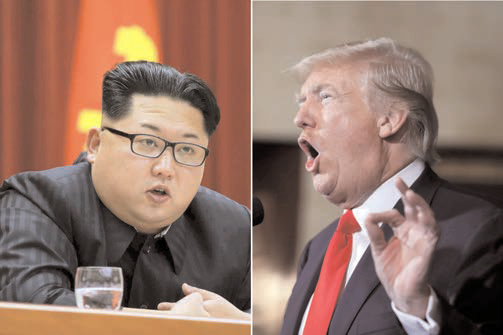
She said North Korean leader Kim Jong Un is “paranoid” and thinks that the United States is trying to promote regime change and that there are people trying to assassinate him.
“We’re not trying to do any of those things,” she said. “What we are saying is that for peace on the Korean peninsula, he has to stop his testing. He has to stop any nuclear programs that he has. The US, we are willing to talk — but not until we see a total stop of the nuclear process and any tests there.”
Haley said the Security Council is going to send a strong and unified message to North Korea that “the international community wants to support you but as long as you test, and as long as you continue your nuclear program, you are on an island by yourself.” (AP)
UNITED NATIONS: US Ambassador Nikki Haley accused North Korea on Tuesday of intimidating the entire international community with its nuclear program, military ability and cyberattacks, and said any country that doesn’t implement UN sanctions is supporting Pyongyang’s actions.
“No one is immune to the threat of North Korea,” she told reporters before emergency closed-door consultations by the UN Security Council on the North’s weekend ballistic missile launch, which experts said demonstrated a significant technological jump with the rocket flying higher and for a longer period of time.
“We’re not going to continue to just say go ahead and test as often as you want,” Haley said, flanked by the South Korean and Japanese ambassadors. “This is a true threat to every country in the world. … We’re going to make sure we put the pressure on them economically, diplomatically, politically and internationally.”
Haley said the US and China have been working on “a unified plan” on how to approach North Korea that would include stronger implementation of existing sanctions and tougher new sanctions.
She indicated Washington and Beijing had agreed they would take action if a new test looked to be long range and leaning toward an intercontinental ballistic missile that could reach the United States.
The latest launch appeared to fulfill both criteria, Haley said, “so I believe that China will stay true to that, and that we’ll come together on how we’re going to do that.” The Security Council, which has imposed six rounds of sanctions on the North, discussed possible further action at Tuesday’s meeting. Haley previously indicated that new sanctions could target oil, a critical import for North Korea mainly from China, and she said Tuesday the US also wants sanctions on organizations and businesses in third countries that are helping Pyongyang.
Uruguayan Ambassador Elbio Rosselli, the current council president, said after the meeting that members are united in condemning the latest missile launch as “a serious threat to international peace.” He said the council is exploring many different avenues to proceed and “clearly sanctions are a way to go,” but also diplomacy.
Council diplomats, speaking on condition of anonymity because the consultations were private, said China never mentioned working with the US on a new sanctions resolution, and both China and Russia said they support a negotiated solution through dialogue.
Haley was asked about comments by Russian President Vladimir Putin in Beijing on Monday who called North Korea’s nuclear and missile tests “unacceptable” but also said the United States should stop intimidating Pyongyang.
“We need to return to dialogue with the Democratic People’s Republic of Korea, stop intimidating it and find ways to solve these problems peacefully,” Putin was quoted as saying, using North Korea’s official name. “Is it possible or not? I think it is possible.”
Haley answered Putin and others who have made similar comments about the United States: “What about North Korea intimidating us? They’re intimidating the entire international community. They’re trying to strengthen their muscle with no cause. There is no reason for North Korea to be having these actions outside of the fact they just choose to do so.”
Haley noted that this weekend’s missile came within 60 miles of Russia’s border and said Russia is “all wrong.” “It is actually North Korea trying to intimidate the international community,” Haley said, “and Russia itself should be concerned because that ballistic missile test was a signal to South Korea for their new elections, it was a signal to Russia in how close it got, it was a signal to Japan being in the region, and it was a signal to us.”
The US ambassador said Russia has the same decision to make as the rest of the international community: “You either support North Korea or you don’t, but you have to choose. You have to pick a side.”
She said North Korean leader Kim Jong Un is “paranoid” and thinks that the United States is trying to promote regime change and that there are people trying to assassinate him. “We’re not trying to do any of those things,” she said. “What we are saying is that for peace on the Korean peninsula, he has to stop his testing. He has to stop any nuclear programs that he has. The US, we are willing to talk — but not until we see a total stop of the nuclear process and any tests there.”
Haley said the Security Council is going to send a strong and unified message to North Korea that “the international community wants to support you but as long as you test, and as long as you continue your nuclear program, you are on an island by yourself.” (AP)
Buddha’s message of compassion timeless, says UN chief
UNITED NATIONS (TIP): UN chief Antonio Guterres on Thursday, May 11, called on the global community to draw inspiration from the journey of Lord Buddha and embrace his message of compassion on the occasion of ‘Vesak Day’. Vesak marks the birth, enlightenment and death of Gautama Buddha.
“Born a sheltered prince, Shakyamuni (Buddha) went out into the world to confront and overcome human suffering. This message of compassion is timeless,” the UN chief said. The UN Secretary-General also emphasized that in the current interconnected world, there can be “no peace as long as others are in peril, no security as long as others suffer deprivation [and] no sustainable future until all members of our human family enjoy their human rights”. He called on the people of the world to celebrate the wisdom of Buddha by taking action for others with a strong spirit of solidarity.
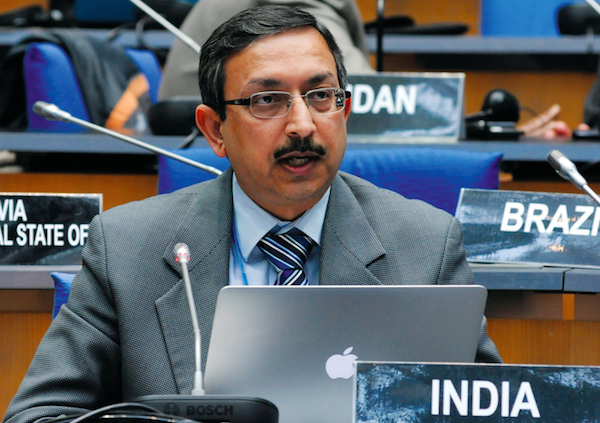
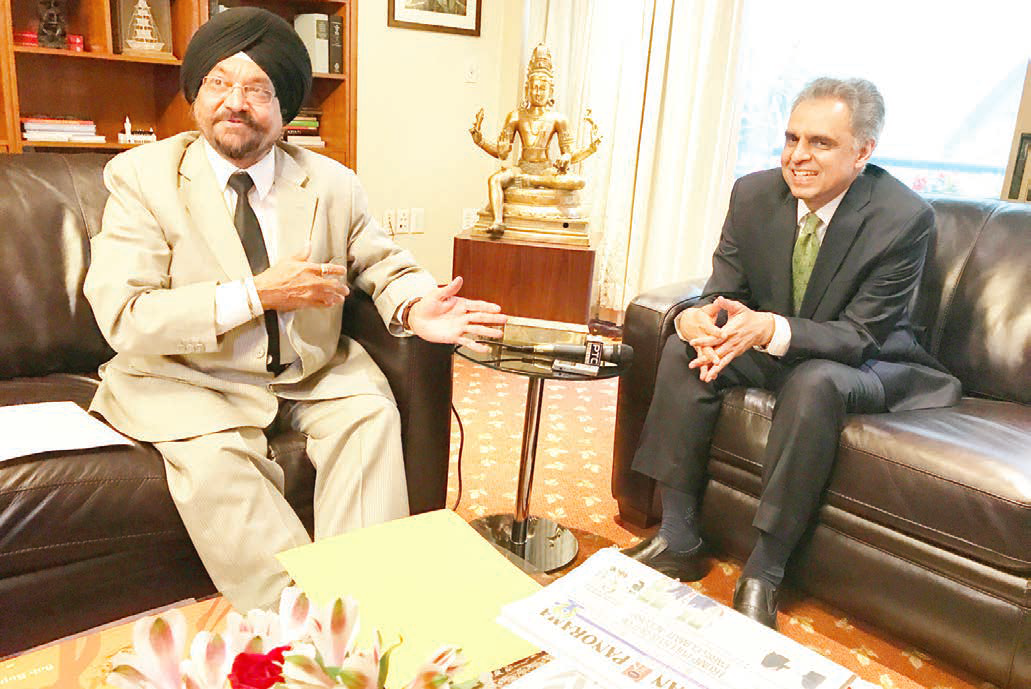
On the occasion, a special commemorative event was held yesterday at the General Assembly attended by UN ambassadors, diplomats and Buddhist monks. The event included sermons and a Buddhist musical interlude by a group of children from Sri Lanka. India’s Permanent Representative to the UN Ambassador Syed Akbaruddin told the gathering that Buddha’s key messages of truth, non-violence, peace and harmony continue to resonate across the world two and half millennia after his death.
“The modern world continues to be beset with great human suffering, deepening inequalities violent conflicts and environmental degradation. The teachings of Buddha which essentially is a reaffirmation of a sustainable lifestyle, harmony with inner self and with nature, hold great promise for achievement of global sustainable development goals and to unite the world to fight climate change,” Akbaruddin said.
Prime Minister Narendra Modi is also visiting Sri Lanka to attend the ‘Vesak Day’ celebrations in Colombo. In 1999, the UN General Assembly adopted a resolution in which it recognized the International Day to acknowledge the contribution that Buddhism, one of the oldest religions in the world, has made for over two and a half millennia and continues to make to the spirituality of humanity. ( PTI)
Actress Priyanka Chopra will attend a UNICEF’s gala fundraising event to highlight the challenges faced by children affected by violence here this week.
The May 6, inaugural event plans to bring together some of the biggest names from across the globe to leverage their support to enhance care and protection of children affected due to violence, abuse, neglect and exploitation.
Priyanka, 34, served as a UNICEF national Ambassador in India for nearly ten years and was recently appointed a UNICEF Goodwill Ambassador.
“The visit of UNICEF’s Goodwill Ambassador Priyanka Chopra to South Africa will highlight the challenges faced by children affected by violence. Her visit is providing UNICEF with a unique opportunity to profile our mandate and values that guide our daily work for every child in South Africa,” a statement from UNICEF read.
It will also feature a fashion show by the country’s most renowned Indian-origin designer Gavin Rajah.
There will be a live auction as well, funds raised from which will go towards the child protection programmes of UNICEF South Africa.
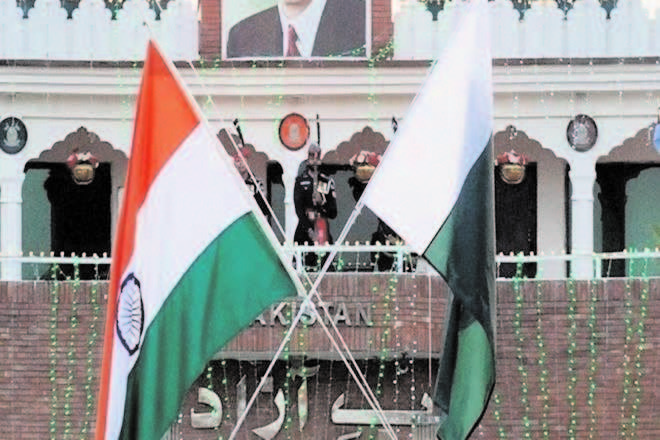
UNITED NATIONS (TIP): India has strongly objected to Pakistan raising the Kashmir issue at a UN General Assembly session here, asserting that it is a bilateral matter which should not be brought up in the UN forum.
Minister in Pakistan’s permanent mission to the UN Masood Anwar raised the Kashmir issue in his statement to the UN General Assembly session of the committee on information on April 25.
He said Pakistan appreciates the efforts by the UN’s department of public information in arranging coverage of events related to the International Day of Solidarity with the Palestinian people.
“We would urge you to do the same for the people of Kashmir who continue to suffer under foreign occupation,” Anwar said. As soon as these remarks were made, minister in India’s Permanent mission to the UN S Srinivas Prasad interrupted Anwar’s speech and strongly raised objections to the mention of Kashmir by the Pakistani delegate. “It is a bilateral issue which should not be brought here,” Prasad told the chair of the session.
Pakistan’s ambassador to the UN Maleeha Lodhi, also present during the session, was heard prodding Anwar to “carry on” speaking even as Prasad raised his objections with the session’s chair.
Later, before delivering India’s statement at the session, Prasad said the Kashmir issue was totally unrelated to the forum.
“Before I begin my statement, I would like to thank the chair for its deft handling and not allowing the elaboration of a subject which is totally unrelated to this forum as was tried by a member state,” Prasad said.
The committee on information is a subsidiary body of the General Assembly established to deal with questions relating to public information. It is responsible for overseeing the work of the department of public information and for providing it with guidance on policies, programmes and activities of the department. (PTI)
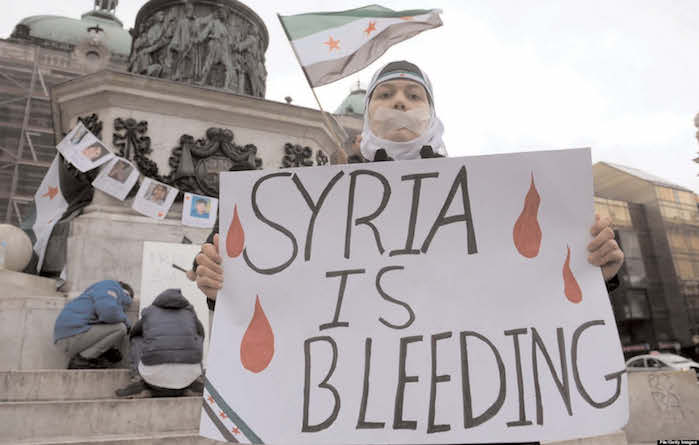
GENEVA (TIP): The UN’s Syria envoy said today that he will hold talks with Russian officials next week but without the US present after previous plans for a trilateral meeting were “postponed”.
UN peace mediator Staffan de Mistura said his meeting with Russia’s deputy foreign minister Gennady Gatilov is set for Monday in Geneva.”The trilateral meeting is not off the table, it is simply being postponed”, de Mistura told reporters.
Asked why US President Donald Trump’s representatives decided to skip the meeting, de Mistura said: “you should ask them, frankly.”
Syrian regime supporter Moscow and opposition-backer Washington had been the key foreign powers shaping the UN’s Syria peace process.
De Mistura has previously asked for more clarity from Trump’s administration on its vision for the Syria talks.
US officials have in recent weeks voiced commitment to support a negotiated solution to the conflict.
Monday’s sitdown with Gatilov “will be a very intense bilateral meeting”, de Mistura said. He also restated his desire to convene a sixth round of UN-backed talks involving Syrian rivals next month. The previous rounds have failed to produce concrete results. (AFP)
NEW YORK (TIP): Nikki Haley, the tough-talking and blunt U.S. Ambassador to the UN, was heckled during an annual summit on women here as she spoke about President Donald Trump and Russia.
The Indian American envoy was speaking April 5 at the ‘Women In The World’ summit, a premier annual gathering of influential women leaders, politicians and activists organized by media personality Tina Brown in association with the New York Times.
As she was answering questions during the session titled ‘Trump’s Diplomat: Nikki Haley’ moderated by MSNBC anchor Greta Van Susteren, Haley was booed and heckled on several occasions. At one point, someone in the audience shouted,”what about refugees” while another asked, “when is the next panel.”
During the nearly 22-minute session, a woman in the audience shouted, “when is the next panel,” to which the 45-year-old smiled and exclaimed “wow” as the audience tried to shush the heckler.
She was heckled again when asked how America deals with some of the world leaders who are dictators.
“You call them out when they do something wrong and you work with them when you can find ways to work with them,” Haley said.
As some members of the audience shouted at her remarks, Haley said, “we have to express America’s values. We are always the moral conscience of the world,” to which someone from the audience shouted, “what about the refugees,” cutting off Haley. Haley went silent. Van Susteren paused, and then said, “Moving on.”
At the end of the day’s program, Brown commended Haley for attending the event even as she got a “boisterous reception” and for remaining gracious as she was heckled.
“We often complain and sneer and say Republicans never want to come on any kind of forum except Fox News or places where they can be asked questions that are soft,” Brown said, adding that Haley did not put on any pre-conditions and sat very “graciously” while the audience heckled.
“She didn’t get agitated about it, and she’s in the middle of a lot of world crises. So, I feel that we should really applaud the fact that she did come.”
Van Susteren asked Haley why the world has not heard much from Trump about Russia, a question that drew a thunderous applause from the audience.
Haley said, “First keep in mind that I work for the Trump administration,” a response that generated boos and heckles from the audience and prompted Van Susteren to ask the audience to “hold on, hold on. We got to get people fix these problems.” Haley added that she has “hit Russia over the head more times than I can count. It’s because if they do something wrong we are going to call them out on it. If they want to help us defeat terrorism, fine.”
“But the things they have done with Crimea and Ukraine, the things they have done with how they have covered up for (Syrian President Bashar) Assad, we are not going to give them a pass on.”
Haley said she has had conversations with Trump “where he very much sees Russia as a problem and I think if you look at his actions, everybody wants to hear his words but look at his actions. The two things that Russia does not want to see the U.S. do is strengthen the military and expand energy and the president has done both of those.” She gave out a smile as her comments again drew prolonged boos from the audience.
On the chemical weapons attack on a Syrian town, Haley said Russia blamed it on a container of chemical weapons that ISIS had.
“There is no ounce of proof. They just make things up,” she said.
United Nations: An Indian software engineer has won the top prize at a global challenge for an open-source tool that enables users to interactively view UN General Assembly resolutions and gain a deeper understanding of the voting patterns of member states.
Abdulqadir Rashik, also an entrepreneur, won the ‘Unite Ideas #UNGAViz Textual Analysis and Visualisation Challenge’ for his ‘Global Policy’, an open-source tool that enables users to search and interactively view General Assembly resolutions to gain a deeper understanding of the voting patterns and decisions made by United Nations Member States.
Mr Rashik’s prototype will be made public and shared with United Nations bodies and member states. He will also receive recognition from the Department of State and the Office of Information and Communications Technology.
Mr Rashik is a frequent contributor to Unite Ideas challenges and he previously won the top prize in the #LinksSDGs challenge for his ‘Links to Sustainable Cities’, an interactive visualisation that identifies and maps the links between various Sustainable Development Goals.
The world body said the project was the first collaboration between the UN Office of Information and Communications Technology (OICT) and the US Department of State.
The UNGAViz challenged developers worldwide to create an open-source tool capable of providing greater visibility into Member State voting patterns, as well as greater public transparency about their voting choices.
Solutions were judged not only on their technical merits, but also on their potential to support policymakers dealing with humanitarian challenges, peace and security issues, and other international matters, sometimes under extreme time pressure.
A State Department official Andrew Hyde said the UN General Assembly has drafted and passed thousands of resolutions affecting people in every corner of the world since its establishment in 1946.
“In support of transparency and accountability, we believe that everybody, from the general public to policymakers to diplomats, should have easy and timely access to this vast body of knowledge,” he said.
The first runner-up position was awarded to Maximiliano Lopez, an information technology consultant from Argentina, and the second runner-up was Thomas Fournaise, an information technology manager from France.
The Chief of the Global Services Division in the Office of Information and Communications Technology Salem Avan said the global network of talented open-source developers responded with insightful and practical solutions that can be easily implemented and made available to United Nations offices and Member States.
UNGAViz is the sixth challenge issued by Unite Ideas, a big data crowd-sourcing platform developed by the Office of Information and Communications Technology to facilitate collaboration among academia, civil society and UN offices, and to mobilise data scientists and software developers around the world to help tackle the complex issues faced by the Organisation and its member states through the creation of open-source technology solutions.
To date, academia, the general public and private companies have responded to the Unite Ideas challenges with more than 50 open-source solutions, many of which will be used by the United Nations or shared with member states.
NEW YORK(TIP): Asserting that she has “no regrets” in her job, US Ambassador to the UN Nikki Haley said her Indian parents raised her to give her best to whatever job she does.
“No, there is no regrets,” Haley said at a session at the Women In The World summit when asked if she has any regrets in her job.
“I am the daughter of Indian parents where my mom always said, ‘whatever you do, be great at it and make sure people remember you for it’ and so my focus is just to try and do the jobs as best as I can,” she said here.
Haley was speaking yesterday at the ‘Women In The World’ summit, a premier annual gathering of influential women leaders, politicians and activists organized by media personality Tina Brown in association with the New York Times.
Haley speaks proudly about her Indian heritage, often bringing it up during her speeches and interactions. Earlier this week, while addressing reporters at the UN headquarters, Haley brought up her Indian heritage when she asked about her qualities of being able to speak freely and openly.
“Every position that I have ever had, people have assumed that I’m looking towards something bigger when in reality I’m the daughter of Indian parents who said to me ‘whatever you do be great at it and make sure people remember you for it’. That is all I am trying to do. That is all I have ever known how to be is to try and just do my job to the best of my ability and if that comes out blunt and if that comes out strong – I’m one of two brothers and a sister – my parents raised us all to be strong,” she said.
When asked at the women summit if she liked her new job as Washington’s envoy to the world body, she said she does.
“I do like the job because you can move the ball. It’s not just about talking, you can actually negotiate, you can actually change things,” she said.
Haley said she has a “lot of” interaction with President Donald Trump, “I talked to him this morning” adding that she visits Washington at least once a week for the National Security Council meetings.
UNITED NATIONS (TIP): When you can go to the United Nations to hear a talk about meditation, you know something has changed in the world.
On Friday, March 10, 2017, Dr. Kunwarjit Singh Duggal, guest of the United Nations Salus Well-Being Network, spoke to a packed audience in the Secretariat Conf. Room 8 on “Cultivating Inner Peace for Outer Peace.” He began: “My main message here is to talk about peace. How do we achieve peace? . . . In order to take peace to the next level, we have to find peace within ourselves first before we can go on helping the rest of society.”
By his own admission, Dr. Duggal is quite passionate about meditation as an intervention for many of life’s challenges, whether worldly or personal – a universal paradigm.
His topic on Friday, particularly timely today,detailed the latest scientific research on theproven benefits of meditation. Noting the many different types of meditation, he talked about several significant studies, most focused on peace, stress and anxiety.
He quoted one randomized controlled study in which people were asked to meditate each morning for 21 days straight for a short duration of time. The researchers measured cortisol (the stress hormone) levels before and after 21 days and found a significant decrease in every participant. Notable studies also found that for patients undergoing orthopedic rehabilitation those who meditated benefitted twice as much as those who were treated only with therapeutic exercise.
One telling example was an experiment done in a troubled San Francisco school district in whichtwo 15-minute periods of quiet time wereinstitutedfor students. The results were improved test scores, attendance, psychological state and enhanced concentration. These students also reported increased calmness and decreased anger. By increasing the calmness in these students, their corresponding troubled geographical regions noted decreased crime rates and improved safety.
Dr. Duggal then presented the meditation technique practiced in Science of Spirituality, Jyoti meditation, after which everyone had a chance to meditate for a short period.
The afternoon concluded with a lively question and answer session.
Dr. Duggal was at the United Nations representing the Science of Spirituality,(NGO), a worldwide, spiritual organization dedicated to transforming lives through meditation. His father, Sant Rajinder Singh Ji Maharaj, head of Science of Spirituality, spoke at the UN last May on “Meditation as Medication for the Soul.”
Dr. Duggal is a Board-Certified Physical Medicine and Rehabilitation Specialist and Assistant Professor at Rush University Meditation Center in Chicago. He lectures extensively on meditation as an effective intervention for physical and emotional medical disorders.
For more information about Science of Spirituality: www.sos.org.
NEW YORK (TIP); Aishwaryaa Rajinikanth Dhanush, famous filmmaker, UN Ambassador for Gender Equality and daughter of Super Star Rajinikanth presented a Bharathanatyam performance at the United Nations on the International Day for Women, March 8. The nattuvangam was provided by her dance guru noted Bharatanatyam dancer Meenakshi Chittaranjan. Last year the UN Woman named Aishwaryaa as Goodwill Ambassador for Gender Equality.
It was the first time a celebrity dancer from Tamil Nadu performed at the world body in the presence of diplomats and invitees. The event was organized by the Permanent Mission of India to the United Nations.
Aishwaryaa R Dhanush, is an Indian film director and a start up entrepreneur. She is the daughter of the Indian Superstar Rajinikanth who is one of Asia’s best known actors. She is married to Dhanushwho is today one among the most talented and successful Pan-Indian actors. She is a mother of two boys.
Aishwaryaa completed her schooling at The Ashram in Chennai. She acquired a diploma in law from Chennai.
She directed her first feature film “3” in 2011 featuring her husband Dhanush. The film was successful critically and commercially and it catapulted Aishwaryaa as a leading young director. The film was famous for the song “why this kolaveri” which became a worldwide Viral phenomenon. She was invited to several prestigious film festivals and panels post the release. Aishwaryaa’s second feature film “Vai raja Vai ” an ensemble cast venture released in 2015 was also equally successful.
Aishwaryaa is a multi-talented person. She is trained Bharatnatyam dancer, a voracious reader and writes very well. She launched her company Ten Entertainment recently, which is a digital medium to promote short film content
Aishwaryaa is keenly interested in the cause of women and has associated herself with various welfare activities. She strongly propagates the cause that every girl child in India should have the fundamental right to Education and to be independent. She is a perfect example of how an Indian woman juggles various roles. Her future plans include directing feature films and developing and extending her company Ten Entertainment in various digital media spheres.
Across the world, too many women and girls spend too many hours on household responsibilities – typically more than double the time spent by men and boys. They look after younger siblings, older family members, deal with illness in the family and manage the house. In many cases this unequal division of labor is at the expense of women’s and girls’ learning, of paid work, sports, or engagement in civic or community leadership. This shapes the norms of relative disadvantage and advantage, of where women and men are positioned in the economy, of what they are skilled to do and where they will work.
This is the unchanging world of unrewarded work, a globally familiar scene of withered futures, where girls and their mothers sustain the family with free labor, with lives whose trajectories are very different from the men of the household.
We want to construct a different world of work for women. As they grow up, girls must be exposed to a broad range of careers, and encouraged to make choices that lead beyond the traditional service and care options to jobs in industry, art, public service, modern agriculture and science.
We have to start change at home and in the earliest days of school, so that there are no places in a child’s environment where they learn that girls must be less, have less, and dream smaller than boys.
This will take adjustments in parenting, curricula, educational settings, and channels for everyday stereotypes like TV, advertising and entertainment; it will take determined steps to protect young girls from harmful cultural practices like early marriage, and from all forms of violence.
Women and girls must be ready to be part of the digital revolution. Currently only 18 per cent of undergraduate computer science degrees are held by women. We must see a significant shift in girls all over the world taking STEM subjects, if women are to compete successfully for high-paying ‘new collar’ jobs. Currently just 25 per cent of the digital industries’ workforce are women.
Achieving equality in the workplace will require an expansion of decent work and employment opportunities, involving governments’ targeted efforts to promote women’s participation in economic life, the support of important collectives like trade unions, and the voices of women themselves in framing solutions to overcome current barriers to women’s participation, as examined by the UN Secretary-General’s High-level Panel on Women’s Economic Empowerment. The stakes are high: advancing women’s equality could boost global GDP by USD 12 trillion by 2025.
It also requires a determined focus on removing the discrimination women face on multiple and intersecting fronts over and above their gender: sexual orientation, disability, older age, and race. Wage inequality follows these: the average gender wage gap is 23 per cent but this rises to 40 per cent for African American women in the United States. In the European Union, elderly women are 37 per cent more likely to live in poverty than elderly men.
In roles where women are already over-represented but poorly paid, and with little or no social protection, we must make those industries work better for women. For example, a robust care economy that responds to the needs of women and gainfully employs them; equal terms and conditions for women’s paid work and unpaid work; and support for women entrepreneurs, including their access to finance and markets. Women in the informal sector also need their contributions to be acknowledged and protected. This calls for enabling macroeconomic policies that contribute to inclusive growth and significantly accelerate progress for the 770 million people living in extreme poverty.
Addressing the injustices will take resolve and flexibility from both public and private sector employers. Incentives will be needed to recruit and retain female workers; like expanded maternity benefits for women that also support their re-entry into work, adoption of the Women’s Empowerment Principles, and direct representation at decision-making levels. Accompanying this, important changes in the provision of benefits for new fathers are needed, along with the cultural shifts that make uptake of paternity and parental leave a viable choice, and thus a real shared benefit for the family.
In this complexity there are simple, big changes that must be made: for men to parent, for women to participate and for girls to be free to grow up equal to boys. Adjustments must happen on all sides if we are to increase the number of people able to engage in decent work, to keep this pool inclusive, and to realize the benefits that will come to all from the equal world envisaged in our Agenda 2030 for Sustainable Development.
(Message of Executive Director, UN Women Phumzile Mlambo-Ngcuka)
International Model/Actor – Prakash Patil was nominated as Mr. USA from USA at United Nations Pageant World finals and brought home the winning title the “MR. United Nations 2016”. The Pageant was held in Knutsford Court Hotel, Kingston, Jamaica, with contestants participating from many different countries across the world.
The United Nations Pageant has been conceptualized as a prestigious international event, bringing together representatives of a wide range of communities and cultures from all over the Globe; from the world’s most culturally diverse state, the delegates aim to share common values and foster international friendship and understanding. The pageant’s principal objective is to identify and showcase the world’s best tourism cause ambassadors; those who have the skills, talents and personalities best suited to promote their respective countries in furtherance of tourism, international goodwill and cultural harmony. Apart from a strong emphasis on goodwill tourism protection programs and destinations promotion.
Prakash was judged on different rounds namely High Fashion Wear, National Costume, Evening wear, Sportswear and Interview (Question and Answer) and charity work. During Interview round Prakash articulated with excellent social and conversational skills. He expressed himself clearly, diplomatically, and projected a pleasant personality, and approachable at all times. At National costume, he wore outstanding Shervani (Sponsored by Vasavi Collections) a national symbols/heritage of his country. Prakash dignified spirit, energy, creativity and the own personal interpretation with sense of style. In Fashion Wear round Prakash had enlightening costume (Sponsored by Designer Mischka Velesco), his fashion & style on the runway was memorizing. He won Best High Fashion Award.
He is very well-renowned and commercially successful model as compared to other Indian Models in USA. He has accomplished so much in such a short span of time.
Prakash had worked on main stream American Modeling runway such as Mercedes Benz Fashion Week, Couture New York Fashion Week, NYC Fashion Week, IIFA preview runway, Brooklyn Fashion Week and had been show stopper for high scale designers. Prakash has been featured in top notch magazines like Floss magazine, Moetic Magazine, Alize La Vie Magazine, Vicissitude Magazine, Black Tie International Magazine, globalfashionwire.com etc.
The recent title of Mr. United Nations has undoubtedly added another feather in his already decorated cap, which gives a moment of pride, not just to Prakash but to each and every one of us. Patil stands out from other models; because he has expanded his brand into other forms of entertainment, is professional under any and all circumstances; has incredible talent, class, and poise. Prakash is known not only for being attractive but also for knowing how to work all the angles. In addition, his talent, skill, looks; accomplishments, personal traits, and overall brand make him commercially more marketable and most successful amongst his Indian Model Peers in the USA.
As an Actor Prakash played a lead role in music video album for famous Bollywood singers Shreya Ghoshal and Pankaj Kumar which has more than 164,0000 views on youtube. Patil played a unique role as actor in films like The Other Side of New York, Spices of Liberty, They always Win and currently Brand ambassador for Lejubon Ties.
The humble and soft-spoken Prakash gives all the credit of his success to his parents who live in India and Special thanks to Mr. Leon Williams (CEO & President of United Nations Pageants). After winning the most coveted title of Mr. United Nations, Prakash adds, “I wish to thank everyone for giving me such a great opportunity to showcase my talent across the globe. It is a great moment of glory as I am honored at such a prestigious event in front of such illustrious guests. I look forward to using this opportunity to achieve greater heights and giving back to those who have showered their love on me and believed in me. I will utilize my achievements for the welfare of people in the world and towards world peace.”
WASHINGTON (TIP): President Donald Trump on Feb 2 warned Israel that constructing new settlements “may not be helpful” to Middle East peace efforts, striking a tougher line with Israeli Prime Minister Benjamin Netanyahu’s government.
Trump has been perceived as sympathetic to the settlements, which are considered illegal by most of the international community. Shortly before taking office, he vigorously criticized the Obama administration for not vetoing a United Nations Security Council measure condemning settlements.
But in a statement Thursday, the White House said, “While we don’t believe the existence of settlements is an impediment to peace, the construction of new settlements or the expansion of existing settlements beyond their current borders may not be helpful in achieving that goal.”
The White House said the administration “has not taken an official position on settlement activity” and the president would discuss the issue with Netanyahu when he travels to Washington later this month. The two leaders are scheduled to meet at the White House on Feb. 15.
The US statement came hours after Netanyahu vowed to establish the first new West Bank settlement in over two decades “as soon as possible,” promising to make up for the court-ordered demolition of an illegal settler outpost. It was his latest step to expand Israeli settlement construction in the wake of Trump’s inauguration.
Netanyahu repeatedly clashed with President Barack Obama during the Democrat’s eight years in office, and Trump has vowed to be a better partner for Israel. Following the U.N. vote, Trump tweeted, “Stay strong Israel, January 20th is fast approaching!” _ referring to the date of his inauguration.
Trump has already appeared to slow his promises to move the US Embassy in Israel from Tel Aviv to Jerusalem – a promise often made by presidential candidates, but never carried out in office because of fears the move would inflame tensions in the region.
Newly sworn-in Secretary of State Rex Tillerson spoke by phone Thursday with Netanyahu.
The prime minister’s vow to establish new West Bank settlements came as Israeli security forces were completing the evacuation of Amona, where they broke into a synagogue to remove dozens of Israeli protesters who had barricaded themselves inside. Netanyahu’s pro-settler government had unsuccessfully tried to block the evacuation of Amona, but Israel’s Supreme Court rejected all appeals after determining the outpost was built illegally two decades ago on private Palestinian land.
Speaking at a ceremony in the West Bank settlement of Ariel, Netanyahu expressed “great pain” over the removal of Amona. (AP)
Pakistan has neglected to resolve trans-border water issues and delayed presenting the cases of dispute with India to the Water Commission related to the Indus Waters Treaty, a United Nation Development Programme (UNDP) report said on Tuesday.
The report titled “Development Advocate Pakistan”, released in Pakistan, said, “Pakistan’s negligence in conducting a sound analysis of trans-boundary water issues and delays in presenting the cases of dispute with India to the Indus Water Commission or the World Bank on the issues related to the Indus Waters Treaty have caused the issues to linger on and remain unaddressed.”
“Pakistan has gone as far as calling the treaty an inefficient forum for resolving water issues, elevating the water issue to a “core issue” and including it in the composite dialogue. But India has refused to include the issue in the composite dialogue because it is not ready to discard the treaty,” the report said.
“The treaty permitted India to create storage on the western rivers of 1.25, 1.60 and 0.75 million acre feet (MAF) for general, power and flood storages, respectively, amounting to a total permissible storage of 3.6 MAF,” it added.
The report also claims that the 40-year-old Indus Water Treaty between India and Pakistan has been an outstanding example of conflict resolution but scarcity of water in the basin states since the early 1990s has brought the agreement under strain and its “survival appears weak”.
“The treaty fails to address two issues: the division of shortages in dry years between India and Pakistan, when flows are almost half as compared to wet years, and the cumulative impact of storages on the flows of the River Chenab into Pakistan,” the UNDP report said.
Wular Barrage and Kishenganga project on the Jhelum and Neelum rivers present a similar problem whereby water storage during the Rabi season is critical as flows are almost one-fifth of the Kharif season, according the report.
Last week, Pakistan Prime Minister Nawaz Sharif met the World Bank Chief Executive Officer Kristalina Georgieva and raised the Indus Water Treaty dispute.
Sharif expressed hope that a Court of Arbitration would solve the Indus Water Treaty dispute with India. New Delhi has requested the World Bank to appoint a ‘neutral expert’ to resolve the water-sharing disagreement.
Award-winning Hollywood film producer and Wimbledon tennis player, Ashok Amritraj has been appointed the United Nations in India Goodwill Ambassador for the Sustainable Development Goals (SDGs). Chairman and CEO of the Hyde Park Entertainment Group, Mr. Amritraj is the first Ambassador for the UN in India.
An internationally-renowned iconic filmmaker, Ashok Amritraj has made over 100 films during the span of his 30-year extraordinary career garnering global acclaim as well as worldwide revenues in excess of $2 billion. He has been a pioneering force in bridging India and Hollywood through film and media.
Accepting the honor, Mr. Amritraj said “I look forward to working with the United Nations in India to amplify awareness about the SDGs. It is a tremendous opportunity that brings together my personal desire to serve the country of my birth, and my passion to leverage the power of the media for the creation of diverse, socially-relevant content”.
Welcoming Mr. Amritraj to the UN Family, Yuri Afanasiev, UN Resident Coordinator said, “We look forward to working with Mr. Amritraj as a powerful advocate for the SDGs, and to his support in showcasing innovations and cutting-edge solutions to development challenges that are being generated in India”.
A passionate believer in the power of the media to effect social change, Mr. Amritraj produced and hosted the acclaimed series, ‘Chance of a Lifetime’ in partnership with the UNHQ in which young filmmakers from Asia competed to create original, short stories highlighting issues related to water, HIV/AIDS, gender equality, migration and education. The winners were feted at the Cannes Film Festival.
Signup to our Newsletter!
Don’t miss out on all the happenings around the world