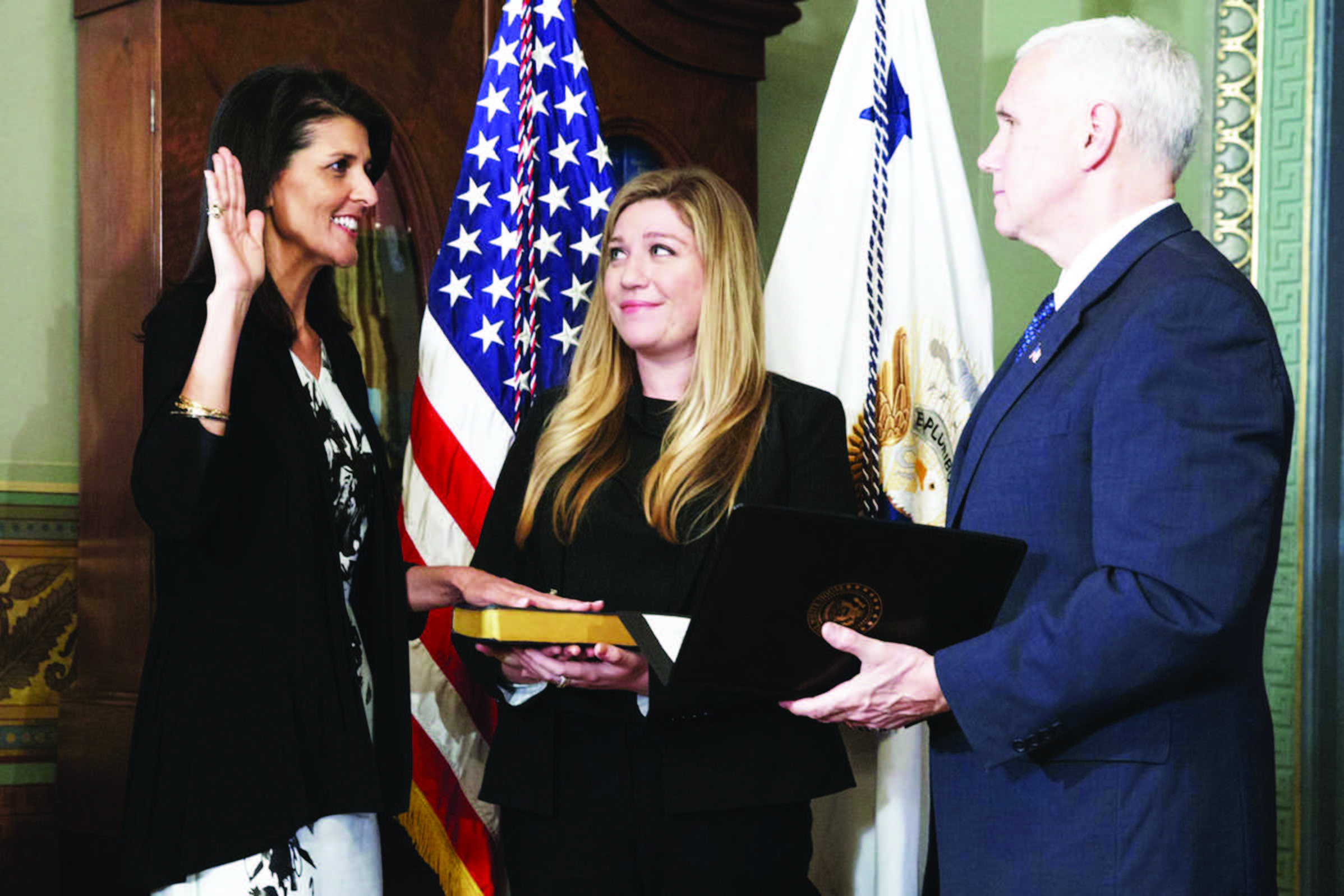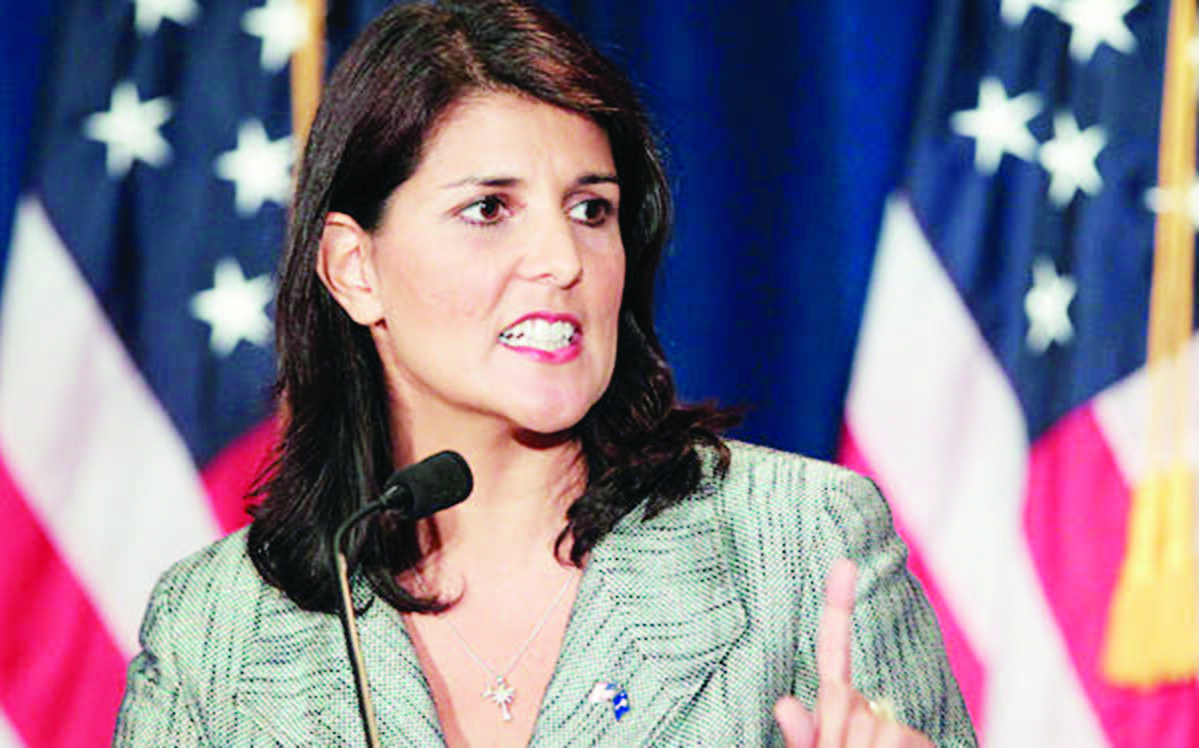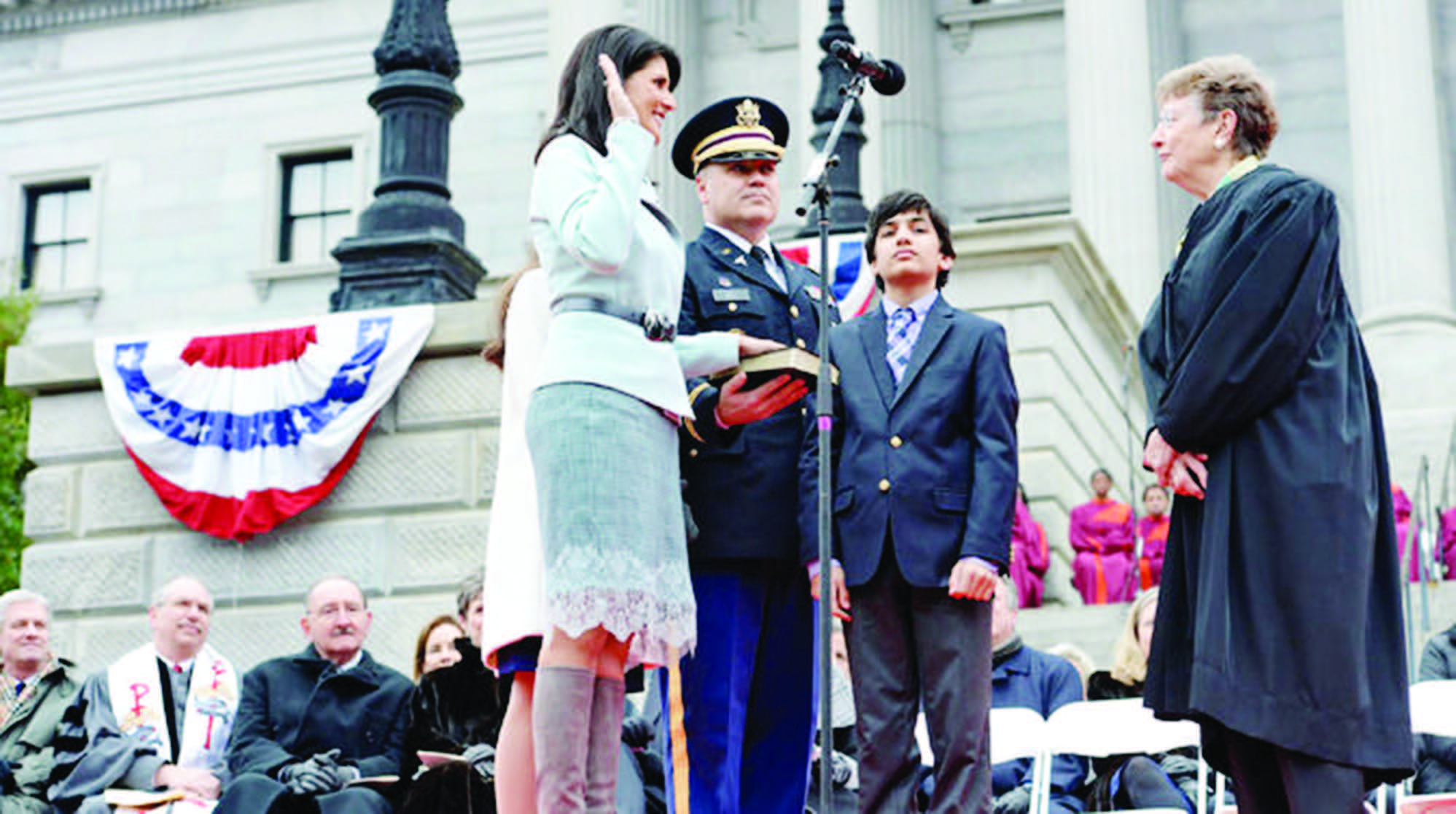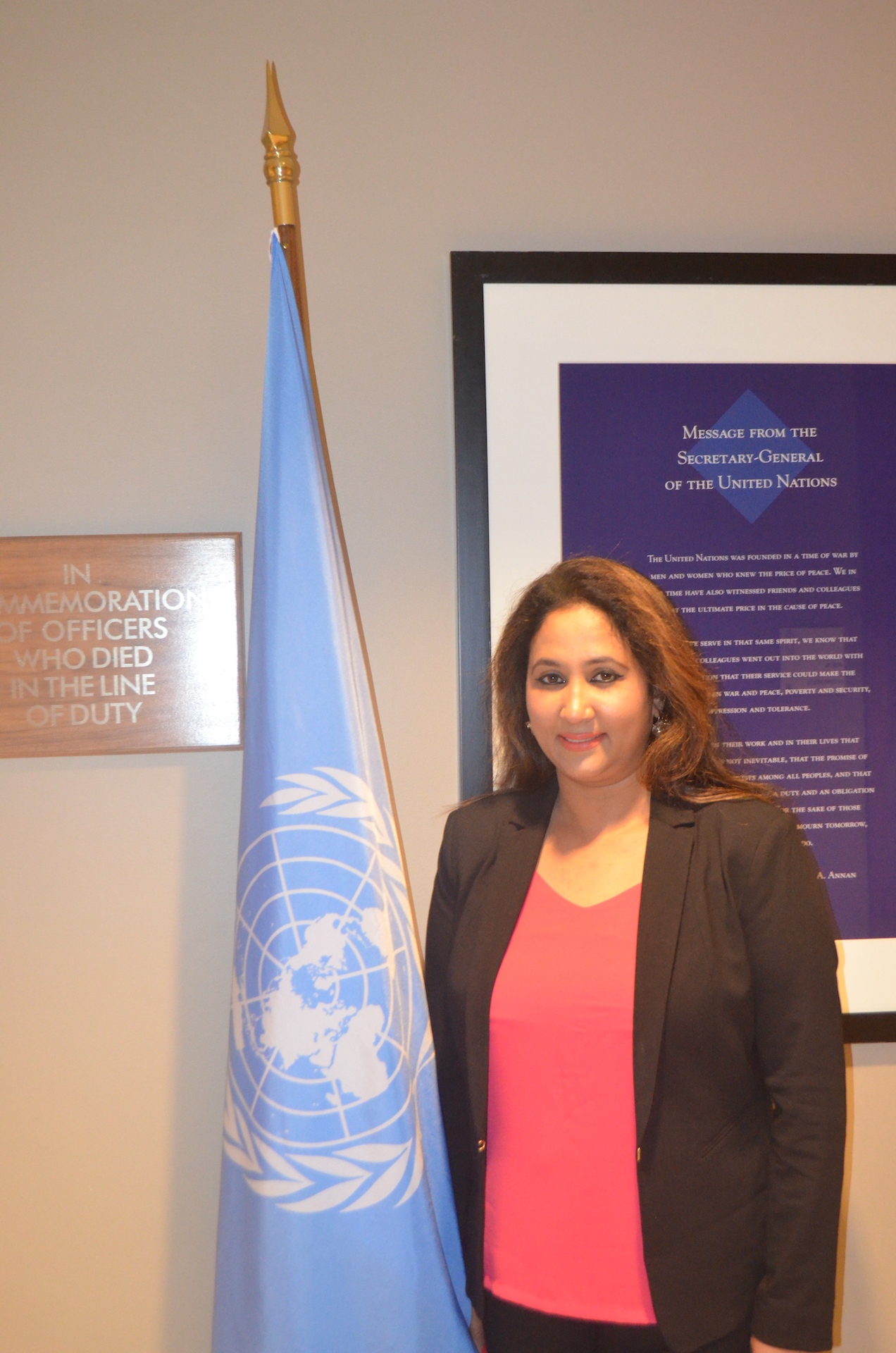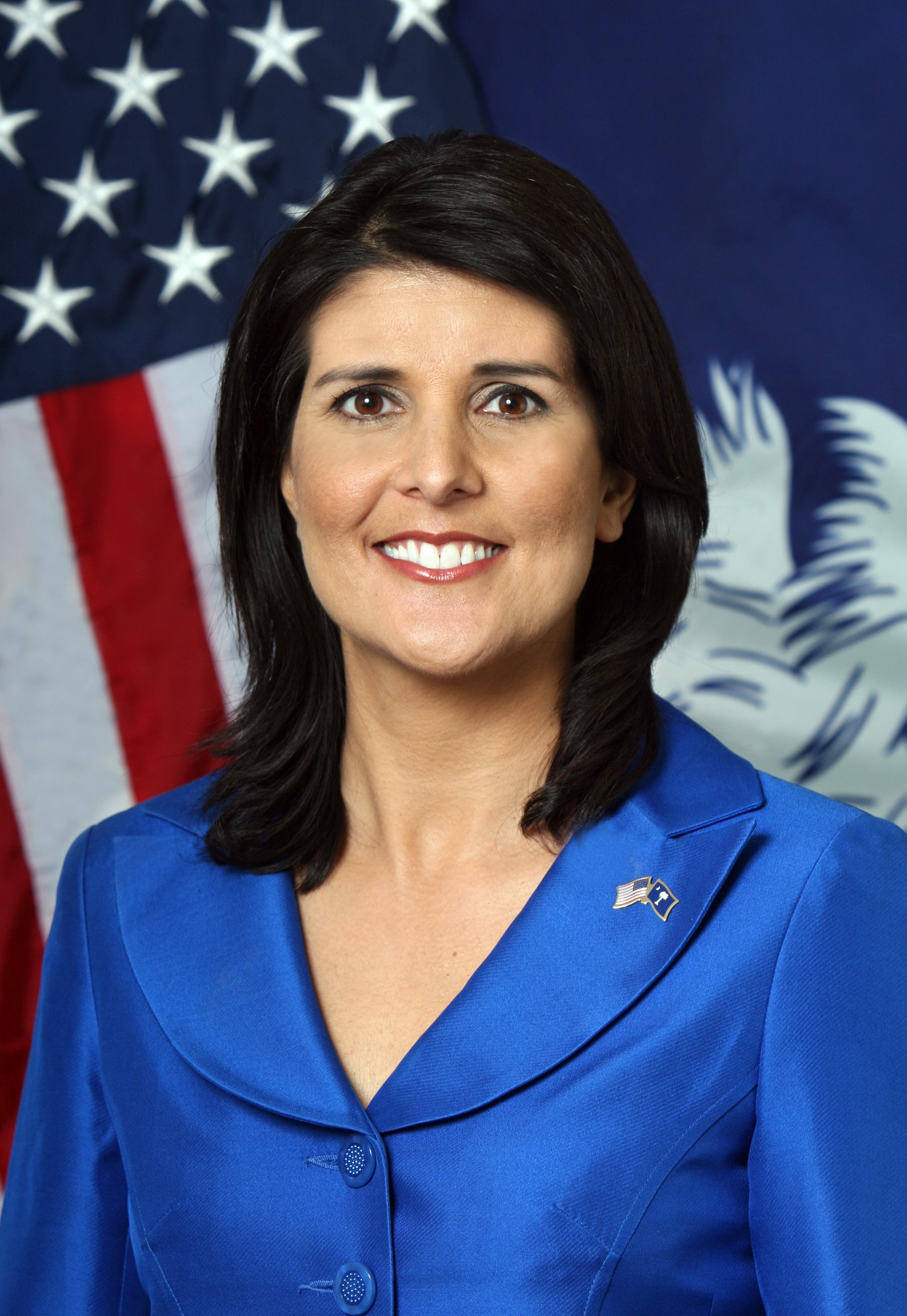
On January 25, Former South Carolina Gov. Nikki Haley was sworn in as US ambassador to the United Nations. Vice President Mike Pence swore in Haley who served as the 116th Governor of South Carolina from January 2011 to January 2017. The South Carolina-born daughter of Indian immigrants became the state’s first female and first minority governor.
The U.S. Senate officially confirmed Haley as the next ambassador to the United Nations Tuesday evening (January 24) in a 96-4 vote. The Senate voted overwhelmingly in favor of confirmation, with just four senators – Independent Bernie Sanders of Vermont and Democrats Chris Coons of Delaware and Tom Udall and Martin Heinrich of New Mexico – voting against her. Haley resigned as South Carolina’s Republican governor following the vote. She was succeeded by Lt. Gov. Henry McMaster.
After officially resigning, Haley addressed a crowd in the Capitol lobby.
“There’s lots of work to do, but we have the right person to do it,” she said, referring to McMaster. “It’s an absolute privilege and honor to turn over the reins to you.”
Trump’s pick came as a surprise to many as Haley loudly criticized Trump during the GOP primary and endorsed one of his rivals, Florida Sen. Marco Rubio.
NEW YORK (TIP): Indian-American South Carolina Governor Nikki Haley would appear before a Congressional panel for her confirmation hearing for the post of US Ambassador to the UN on January 18, an official has said.
If confirmed, Haley, 44, the daughter of Indian immigrants, would be the first-ever Indian-American to serve on a Cabinet rank position in any presidential administration in the US.
Senator Bob Corker, chairman of the Senate Foreign Relations Committee, said in a statement that the nomination hearing to consider Haley to be US Ambassador to the United Nations will be held on January 18.
Haley, who will replace Samantha Power at the UN if confirmed, has already created history by becoming the first women Indian-American Governor of a US State.
The year 1984 may have been a tumultuous year for the Punjabi community in general and Sikh community. It may not be easy for anyone to put behind the dastardly and tragic events that rocked not only Punjab but also the Punjabi community elsewhere. As the community was drowning in gloom, two overseas Punjabis -Alexi Singh Grewal and Kulbir Singh Bhaura – provided the silver lining by telling the world how enterprising the community was. Not only they entered the history annals as first overseas Indians to win Olympic medals but they also set a new trend in motion that has been kept afloat by enterprising overseas Indian community ever since.
At the overall overseas Indian community has done exceedingly well in the world of sports, including Olympic games, Commonwealth games and cricket.
Their heroic deeds scripted a new chapter describing it as the launch of “Brand India”. Before 2016 ended, yet another overseas Indian – Rajeev Ram – kept the “Brand India” flame alive by winning an Olympic medal, a Silver in Rio Olympic games.
Contribution by overseas Indian community cannot by undermined for it has won cockles of many a heart in the contemporary sports world. In December when a field hockey team from Canada went to play in the 2016 Junior World Cup Hockey Tournament in Lucknow, 11 of its 16 members were of Indian origin.
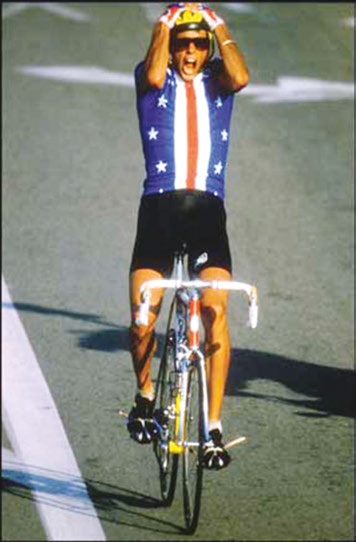
Alexi Singh Grewal became the first American to win an Olympic gold medal in cycling, at the 1984 Games in Los Angeles. Photo: Todd Buchanan
These players -Brandon Pereira, Harbir Sidhu,Parmeet Gill, Rohan Chopra, Rajan Kahlon, Kabir Aujla, Balraj Panesar (captain), Ganga Singh, Gavin Bains, Arshjit Sidhu and Iqwwinder Gill – need to be complemented as they self-financed their participation in the prestigious Lucknow tournament.
And the Australian team, too, had one player of Indian origin, Kiran Arunasalam. It is after a long time that any player of Indian origin is playing for Australia in hockey.
At the overall overseas Indian community has done exceedingly well in the world of sports, including Olympic games, Commonwealth games and cricket.
You name any sport in which the overseas Indian community has not won laurels for the countries of its present abode. Needless to say, that 17 countries, including Canada, the US, Australia, Malaysia, England, Kenya, Uganda and Hong Kong, have been represented by overseas Indians in Olympic games.
Kulbir Bhaura, who represented Great Britain in field hockey, is the only overseas Indian to have two Olympic medals to his credit, a bronze in Los Angeles and a gold in Seoul.
Then there is Shiv Jagday, a former Indian Universities colour holder; he had the distinction of working as National Coach of Field Hockey Canada. He also coached the US national team besides being on the panel of the select FIH coaches. His son Ronnie Jagday also played for Canada in Sydney Olympic games. One must not forget the contribution of Malkiat Singh Saund who was one of the best forwards of the 1972 Munich Olympic games. Malkiat represented Uganda. Now he is settled in England.
Sutinder had the distinction of leading England in one match in the Mumbai World Cup Hockey Tournament in 1981-82. He played for England and Great Britain for a number of years.
If Australia is a world power in field hockey, it is all because of efforts of Pearce brothers who immigrated to Australia from India and represented their new country of abode in Olympic games.
Hardial Singh Kular, besides playing for Kenya, also rose to be the Vice-President of the International Hockey Federation (FIH). He was one of many Indian expatriates who represented Kenya in 60s and 70s of the last centenary.
He stands tall with Alexi Grewal, the first overseas Indian, to win an individual Olympic gold medal. In the 1984 Olympic games, he won the road race event in cycling in style. His father, a Sikh, had migrated to the US.
Interestingly, Alexi Grewal’s individual gold, though for the US, came 24 years before Abhinav Bindra won the country’s first ever-individual gold medal in Olympic games.
The latest from the overseas Indian community to get on to the Olympic medallist list is tennis player Rajeev Ram who won a silver medal in mixed doubles in the 2016 Olympic games in Rio.
While the overseas Indians have done the country and the overseas Indian community proud, the Indian government is yet to reciprocate. Though it started organizing #PravasiBharatiyaDivas (PBD) where outstanding members of the overseas Indian community are felicitated, sportsmen and women are yet to get their due.
Besides Alexi Singh Grewal, Kulbir Singh Bhaura and Rajeev Ram, there are a large number of other sportsmen and women, who have done the overseas community and India proud.
Rajeev Ram has to his credit a silver medal. In partnership with Venus Williams,
Rajeev Ram, finished runners-up in mixed doubles event in Tennis. Thirty-two- year-old Rajeev is first generation American. His parents moved to States in 1981 and Rajeev was born in 1984.
Rajeev won his first major Tennis title in Chennai in 2009. Rated as one of the top doubles players in tennis, silver in Olympics has been his highest achievement. In the semi-finals, Rajeev and Venus had defeated Sania Mirza and Rohan Bopanna.
After Rajeev Ram, another athlete of Indian origin doing well for a country other than India is shutter Rajiv Ousef. Born in Indians dominated Hounslow area in England, Rajiv has already qualified for quarterfinals of men’s singles in Rio. On his way to last eight Rajiv have beaten Tommy Sugiarto of Indonesia, Sasaki Sho of Japan and Koukel Petr of Czech. At 30, this has been perhaps best ever performance by him in a major sporting event. He had won a silver medal in the 2010 Commonwealth games in New Delhi.
Cricket is a game that every person of Indian origin follows. Monty Panesar scripted a new chapter when he became the first turban-wearing player to represent a country other than India in Test cricket. Monty played for England. Ravi Bopara followed him.
Since I have been following the overseas community closely, I wrote the following piece in The Tribune in November 2010 talking about emerging “Icons” of the Indian community. My piece was re-read by many as the President-elect, Donald Trump, named Nikki Haley, as the US Ambassador to the United Nations,
My piece read:
“What do Nikki Haley Randhawa, Bobby Jindal and Arjan Bhullar have in common?They all belong to the second-generation Punjabi Diaspora of North America.
While Randhawa and Jindal share the rare distinction of being the first Indian Americans to be Governors in the US, Bhullar has become the first Indo-Canadian to win a gold medal for his adopted homeland in the just- concluded Commonwealth Games in New Delhi.
They all are now icons of successful second generation young overseas Punjabis — 20-40 age group– who have brought laurels to the motherland of their parents after scripting extraordinary success stories in their chosen fields.
Interestingly, both Randhawa and Jindal are almost of the same age group — both succeeding in their race for gubernatorial posts even before they turned 40.
Though Piyush Subhas Chandra Amrit Bobby Jindal created history in 2008 by getting elected as Governor of Louisiana at the age of 37, Nimrata Nikki Haley Randhawa, will be almost 39 when she assumes charge as Governor of Carolina in the New Year.
Similarities are not only limited to the age group but also extend to other areas. Parents of both Jindal and Randhawa migrated to the US in the early 70s. And fathers of both Jindal and Randhawa were university teachers before they decided to leave India for good.
While the Jindals belonged to the Malerkotla area in Punjab, Rancheria’s family moved from Amritsar to the United States.
Mothers of both Jindal and Randhawa have the same first name — Raj. If similarities can be taken a step further, “A” is the initial of their fathers’ first name, Amar Jindal and Ajit Randhawa. Both belonged to the middle-class families before getting lured by the greener pastures of the US.
Interestingly, Jindal married Supriya Jolly, also an Indian-American, Randhawa married an American, Michael Haley.
Like their parents, both Bobby and Nikki charted out their own ways to success and glory with their sheer hard work, determination and commitment.
Bhullar has been on a different turf. Born in a family of wrestlers — his father Avtar Singh Bhullar was a known wrestler of his times who contested against Asian games champion Kartar Singh – in Vancouver in British Columbia, Arjan had to choose between soccer and wrestling in his school days. Now while pursuing higher studies at Simon Fraser University in British Columbia, he is focused on wrestling and wants to make it to the podium at the 2012 Olympic games in London.
Never before any Indo-Canadian had won a gold medal for his or her adopted homeland in any international meet of the level of Commonwealth Games, Pan American games or the Olympic Games.”
Now coming to many other sports personalities who also deserve appreciation and honour for flying the Indian flag flying overseas.
Hockey Olympian Avtar Singh Sohal played for Kenya in 1960, 1964, 1968 and 1972 Olympics, captaining Kenya in the last three editions of the Olympic games. He went to 1984 Olympics as Chief Coach of Kenya Besides Avtar also played for Kenya in the inaugural 1971 World Cup as Captain. In the second World Cup (1973) in Amsterdam, he went as Assistant Coach. Avtar is also the FIH Coach and also a member of the FIH Development and Coaching Committee. No one in the history of Olympic hockey has captained a national team for three consecutive times. In India, Pargat Singh has the distinction of leading India in two Olympic games.
Avtar Singh was in Rio Olympic games on his own to watch the hockey competition and other events.
Naaz Shah belongs to select band of Indian women hockey players who played for India in the Olympic games. When India was represented in women’s hockey competition in the Moscow Olympics, she was a member of the team. She was also a member of the gold medal winning Indian team in the 1982 Asian Games. Now settled in Hamilton, NZ she continues to be passionate about hockey.
Four of her trainees represented New Zealand in the New Delhi Junior World Cup Hockey Tournament. In the 2016 Junior World Cup Hockey Tournament in Lucknow, another batch of her trainees also represented New Zealand. Naaz also went to Rio as a Volunteer where she had the distinction of becoming flag-bearer of Indian hockey team in one of its pool matches. Now she has been a coaching youngster, both boys and girls in Hamilton where she works as a teacher. While she won laurels for India, her contribution to hockey and sports have remained unrecognised.
Let us talk about the World’s richest league, NBA. It is in this league that members of the overseas Indian community have made dents.
Gursimran “Sim” Bhullar, Canada born Punjabi boy, has the distinction of becoming the first ever player of Indian origin to play in NBA. Though Satnam Singh Bhamara and Palpreet Singh, both Punjab born basketball players have been subsequently drafted into NBA, they too have brought good name to Indian sports worldwide.
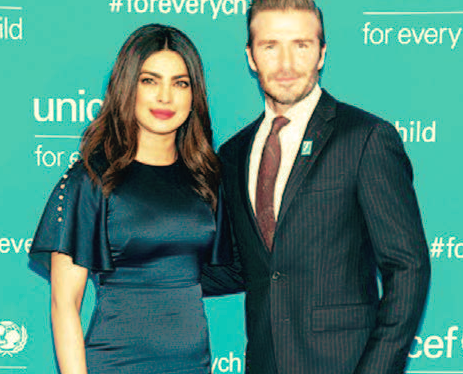
NEW YORK (TIP): Priyanka Chopra was appointed as UNICEF global Goodwill Ambassador at UNICEF’s 70th Anniversary celebration at the United Nations headquarters in New York, December 11. The ‘#Quantico’ actress celebrated her appointment alongside Ambassadors David Beckham and Orlando Bloom. The actress has served with the United Nations International Children’s Emergency Fund in India, where she has been a longtime girls’ rights advocate.
The ‘Quantico’ actress poses with David Beckham at the United Nations headquarters in New York
“My involvement with UNICEF began almost 10 years ago in India. Today, I stand here humbled, enriched and committed, because of it. Thank you, UNICEF, for the amazing journey so far as well as this huge honor. Along this decade old journey, with UNICEF, I have been on many field trips to villages and centers across India. On those trips, I spent time with numerous young girls and their families and experienced firsthand the transformative power of empowering young girls with opportunities that are rightfully theirs”, said Priyanka.
The actress also took to Twitter to express her joy. She wrote, “Can’t believe it’s been 10 years! Honored to now serve as UNICEF Global Goodwill Ambassador along with this amazing group For Every Child.”
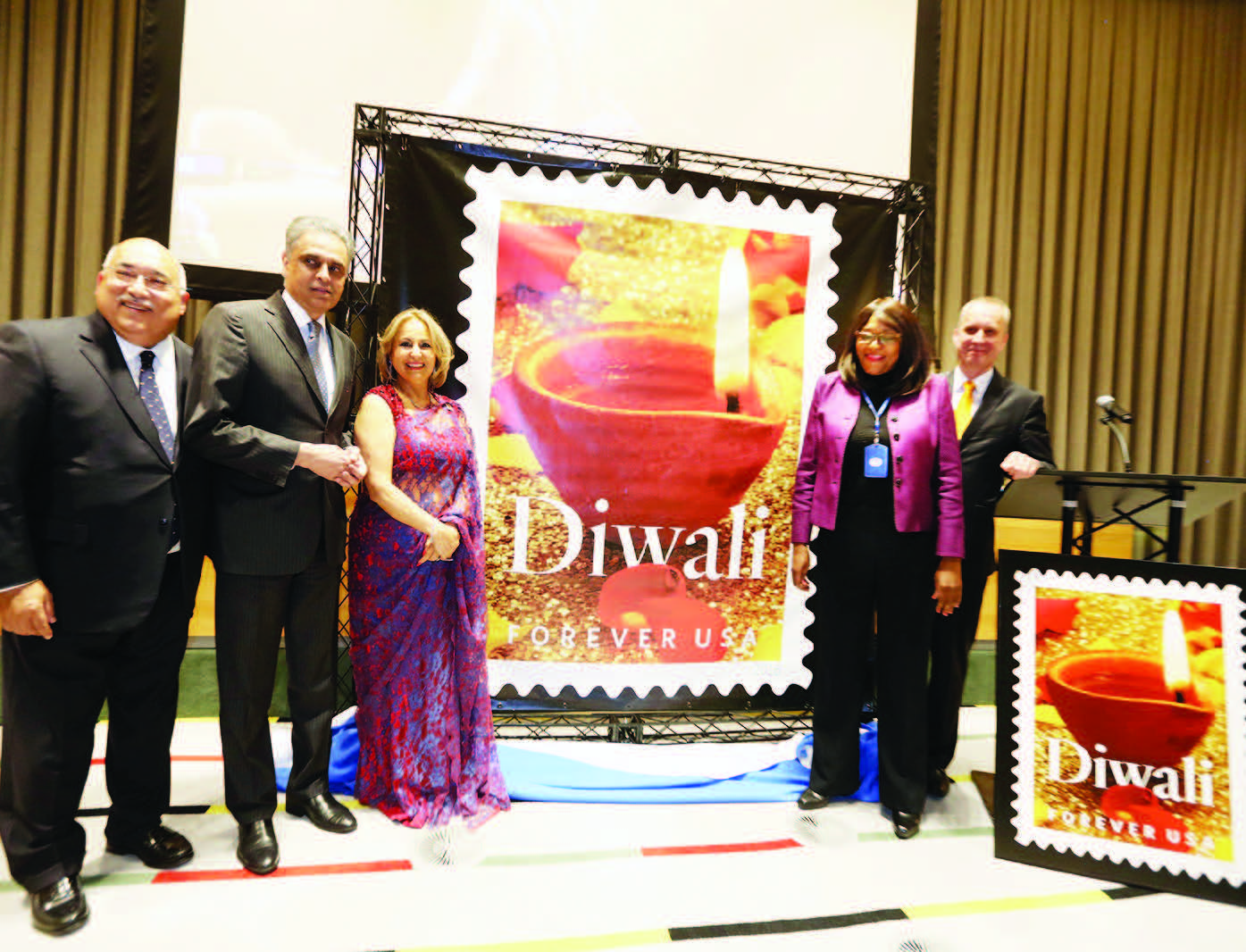
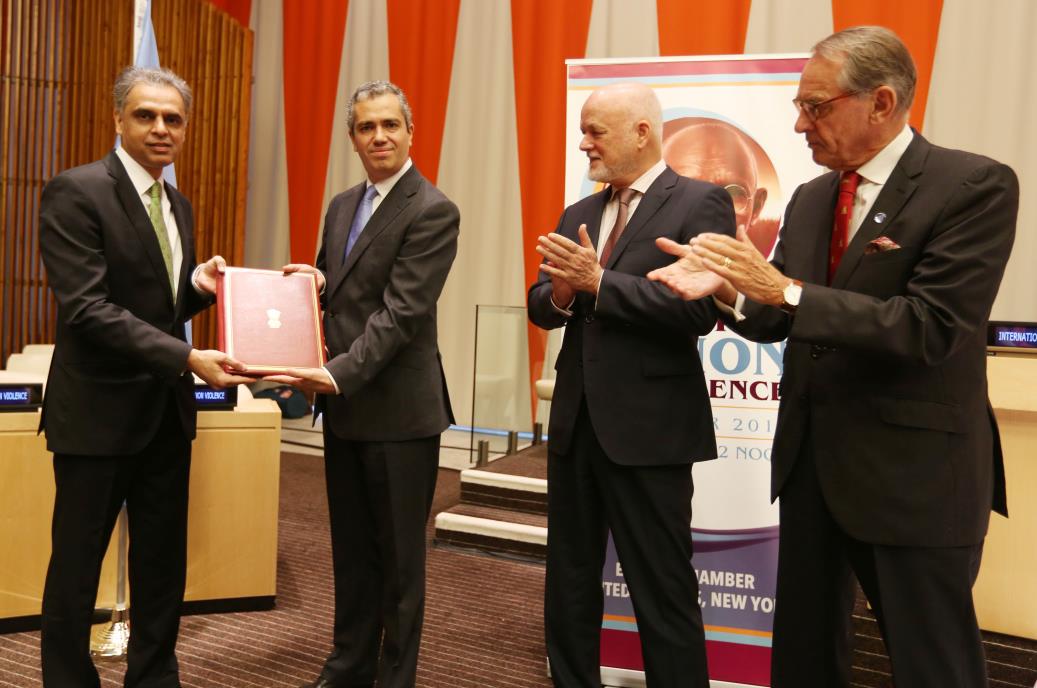
UNITED NATIONS (TIP): Over 20 countries, including two UN Security Council permanent members- France and the UK– have supported a dedication ceremony hosted by India to commemorate the release of a Diwali postage stamp by the US.
India’s Permanent Representative to the UN Syed Akbaruddin said at the event, December 5, that the Diwali Forever Stamp is a “shining tribute to the celebration of multi-culturalism”. Noting that Diwali was commemorated for the first time this year at the United Nations, Mr Akbaruddin said the celebration of Diwali at the world body is a reaffirmation of the foundational objectives of the UN Charter and its purposes and principles, which stand as a force for universal good.
“Though celebrated by different communities for different reasons, the essence of the (Diwali) celebration is the triumph of good over evil, light over darkness. Philosophically, the fight is not only external but also within oneself,” he said.
India’s Permanent Representative to the United Nations, Ambassador Syed Akbaruddin said the celebration of Diwali at the world body is a reaffirmation of the foundational objectives of the UN Charter and its purposes and principles, which stand as a force for universal good.
The event lauded the efforts of Ranju Batra, Chair of the Diwali stamp project who spearheaded efforts for years to get the commemorative stamp issued, reaching out to the Indian-American community members and influential lawmakers, garnering support for the stamp.
Ranju Batra, Chair of the Diwali stamp project who spearheaded efforts for 7 years to get the commemorative stamp issued said: “Today’s celebration is not of a religion or of a nation but it is of the spirit of harmonious inclusiveness and cultural understanding that all religions deserve.”
“The tens of thousands of paper petitions (for the Diwali stamp) were signed not only by Hindus, Sikhs, Jains and Buddhists but also by Christians, Jews, Muslims and every other faith and culture,” Ms Batra said, expressing gratitude for the support she got in her journey to get the stamp issued.
Capping seven-year long efforts by the Indian-American community and influential US lawmakers, the US Postal Service (USPS) had issued the commemorative Diwali stamp to mark the festival of lights.
Over 170,000 Diwali stamps have been sold, making history by becoming the number one best-selling stamp in USPS history.
“Today’s celebration is not of a religion or of a nation but it is of the spirit of harmonious inclusiveness and cultural understanding that all religions deserve,” she said.
Air India team led by its Regional Manager Vandana Sharma (4th from the right) with Diwali Stamp and Batras. Also seen are Regional Finance Manager Sangeeta Singh (5th from right), and District Manager Mohan Kothekar(extreme right). In a rare gesture of good will for the Diwali project, Air India promoted the sale of Stamp in a big way by gifting 10 return tickets to India for the raffle.
Earlier, 20 nations had come together to support a special stamp dedication ceremony co-hosted by the Permanent Missions of India and Belarus.
Eminent Indian-American attorney Ravi Batra said the event has being supported and celebrated by 23 nations, of which “12 are Christian, one Jewish, six Muslim… 23 nations spread across the world are celebrating not only the Diwali stamp but celebrating hope itself”.
The 23 nations that supported the event include Armenia, Austria, Cyprus, France, Georgia, Honduras, Kuwait, Nepal, Sri Lanka, Tunisia, Ukraine, the UK and Vietnam.
The Diwali Forever Stamp was formally launched by the USPS on October 5 at the Indian Consulate, New York in the presence of a large number of Indian Americans, some, like Shiv Dass from New York and Sante Chary from Dallas, TX who had initiated efforts long ago to have the Diwali stamp issued. Another person who made an effort at getting the Diwali stamp issued but failed for lack of political support for the project, the Indiaspora founder MR Rangaswami flew in from California to see his one time dream being realized, albeit by someone else.
Congresswoman Carolyn Maloney who played a pivotal role in having the stamp issued, as also Congresswoman Grace Meng who had co-sponsored the House Resolution with Carolyn Maloney were present. Ravi and Ranju Batra praised Congresswoman profusely for her support. It was said again and again that Diwali stamp could not have been issued without the strong political support provided by lawmakers, led by Carolyn Maloney.
Congresswoman Carolyn Maloney’s absence from the UN event was rather intriguing. More intriguing was absence of any reference to her contribution in getting the Diwali Stamp issued. Reminds me of Shakespeare.
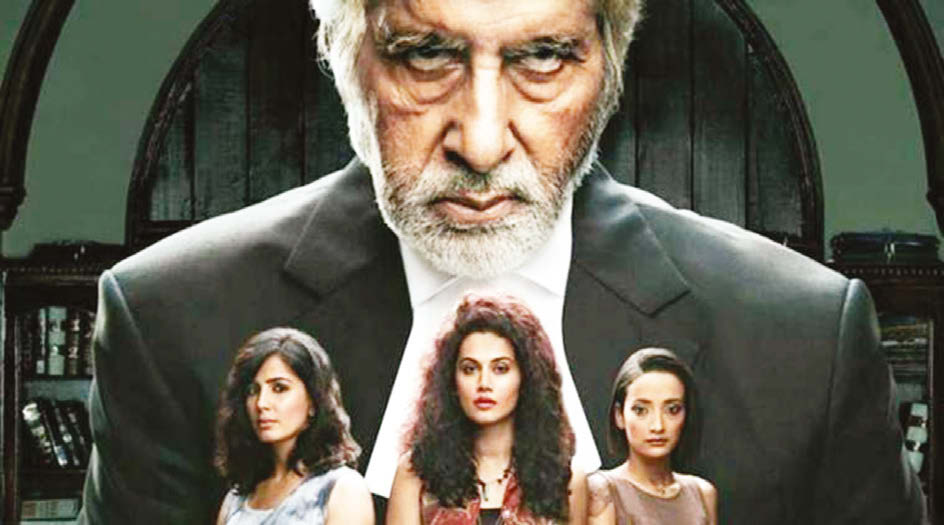
NEW YORK (TIP): Amitabh Bachchan-starrer PINK, which dealt with crime against women, has been invited for a special screening at the United Nations headquarters in New York.
The 73-year-old Bollywood actor, who plays a lawyer in the film, announced the news on Twitter, saying, “‘PINK’ invited for a special screening of the film at UN Headquarters, in New York… by Assistant Secretary General… honoured!”
The courtroom drama reflects on the plight of women in today’s world and the blatant discrimination they face.
Directed by Aniruddha Roy Chowdhury, the film also starred Taapsee Pannu, Andrea Tariang and Kirti Kulhari in lead roles.
It released on September 16 in India. The film was widely appreciated by the audience and the critics alike.
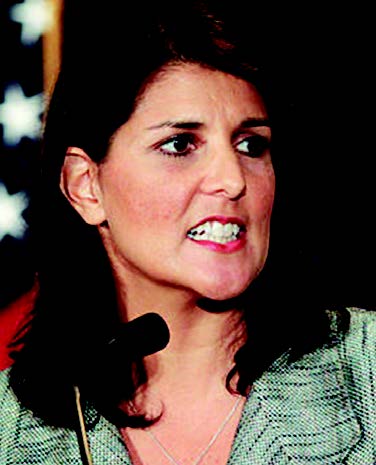
NEW YORK (TIP): South Carolina’s Governor of Indian origin Nikki Haley has been chosen by President elect Donald Trump to be the US ambassador to the United Nations, the transition team announced Wednesday, November 23. She would be the first woman and minority representative to join Trump administration and the first ever Indian-American Cabinet rank official in any administration. Haley had a face-to-face meeting with Trump at Trump Tower in New York last week.
Accepting the offer Haley said in a statement that the US “faces enormous challenges” both at home and internationally. She cited a “sense of duty” in accepting Trump’s offer.
“When the President believes you have a major contribution to make to the welfare of our nation, and to our nation’s standing in the world, that is a calling that is important to heed,” Haley said. “The second is a satisfaction with all that we have achieved in our state in the last six years and the knowledge that we are on a very strong footing.”
Haley will keep serving as governor until the Senate confirms her nomination.
“We still have much to do in South Carolina, and my commitment to the people of our State will always remain unbreakable, both while I continue to hold this office, and thereafter,” she said in a statement.
The Indian American community hailed president-elect Donald Trump’s selection of South Carolina Governor Nikki Haley to be the next US Ambassador to the UN and expressed the hope that she will do a great job in her new position. Nikki Haley (born Nimrata “Nikki” Randhawa; January 20, 1972) is a Republican who has served as the 116th Governor of South Carolina since 2011. Prior to becoming governor, she represented Lexington County in the South Carolina House of Representatives from 2005 to 2011.
Haley is the first woman to serve as Governor of South Carolina; at the age of 44, she is the youngest current governor in the United States. She is the second Asian-American of Indian descent to serve as governor in the United States, after Bobby Jindal of Louisiana. As governor, she also serves as chair, ex-officio, of the board of trustees of the University of South Carolina during her term in office.
Born in Bamberg, the daughter of Indian immigrants, Haley’s first job was keeping the books for her family’s clothing store -at the age of 13. She is a proud graduate of Clemson University where she earned a degree in accounting.
Haley and her husband, Michael, a Captain in the Army National Guard and combat veteran who was deployed to Afghanistan’s Helmand Province, attend Mt. Horeb United Methodist Church in Lexington. The Haleys have two children, Rena, 18, and Naline, 15.
NEW YORK (TIP): The Indian American community hailed president-elect Donald Trump’s selection of South Carolina Governor Nikki Haley to be the next US Ambassador to the UN and expressed the hope that she will do a great job in her new position.
Rajiv Khanna, President, India-America Chamber of Commerce, told TIP that Trump has to be commended for such decision. ” I am very happy to hear that an Indian-American has been selected to be the U.S. ambassador to the UN. I hope this would give her the foreign policy credentials, which would enable her to run for President some day. President elect Trump has to be commended for being a president to all people and picking the best persons for his administration, including those who have not supported him in the election.”
Former Louisiana governor Bobby Jindal, who ran against Trump in the GOP primaries, tweeted: ‘Congrats to my friend @NikkiHaley! She has done an outstanding job leading South Carolina and will represent us well at the UN.’
Assistant Secretary of State for South and Central Asia Nisha Desai Biswal tweeted: ‘Impressive pick for UN Ambassador…Congrats to Gov. @nikkihaley, first Indian American nominated for this important position.
US Ambassador to India Richard Verma tweeted: ‘Congratulations Gov. Haley on your nomination to be the next US Amb to @UN. Proud moment for Indian-American community! @nikkihaley @USUN’
Sampat Shivangi, an old-time Republican leader, told Times of India that Trump’s decision a “masterstroke” which Trump’s decision a “masterstroke” which would not only bring the Indian-American community closer to the Republican Party, but also strengthen India-US relationship.
“Haley’s appointment — her Indian and Sikh heritage — is a clear indication of inclusivity for the incoming administration. The President-elect is uniting the party and getting competent leaders with proven track record to serve in his administration,” Times of India quoted Puneet Ahluwalia, who was advisor to the Trump Campaign on Asia Pacific Islanders committee.
Sanjay Puri, Chairman of US India Political Action Committee (USINPAC) congratulated Nikki Haley on her nomination, remarking, “USINPAC has been working with the Trump transition team to make sure that qualified Indian Americans have the opportunity to serve in the Trump administration. Gov. Haley has done a tremendous work as South Carolina’s first female and Indian American Governor and she will surely succeed as the top diplomat at the United Nations.”
(TIP Bureau)
Nikki Haley, Governor of South Carolina, now nominated US Ambassador to the United Nations
On November 23, a day before Thanksgiving, American Sikhs received a gift to be proud of – the nomination of Nikki Haley to become US Ambassador to the UN. She and her Sikh parents represent a migrant success story – a story where anyone can live the American Dream.
The American Sikh story starts in April 1899. It took 57 years for the first Sikh to become a Congressman- Dalip Singh Saund was elected in 1956 and served till 1963.
Now, 60 years later President-elect Donald J. Trump has nominated Nikki Haley, a person of Sikh heritage, to be the US Ambassador to the UN and member of his cabinet. Nikki -birth name Nimrata ‘Nikki’ Randhawa – unlike most other US politicians of Indian-heritage, including Saund, has risen through the ranks of the Republican Party. Now she becomes the first politician of South Asian, Indian, and Sikh heritage to become a member of the Cabinet. Nikki Haley’s parents – Ajit Singh Randhawa and Raj Kaur Randhawa -were from Amritsar district. Nikki was born and grew up in Bamberg, South Carolina, with its back-drop of racism and American race politics not far away.
Straddling cultures: Despite converting to Christianity, Nikki opted for Sikh marriage ceremonies
Unlike Bobby Jindal, a former Republican Governor, Nikki is proud of her Indian roots and her parent’s Sikh faith. She married Michael Haley in 1996 whom she met as a fellow student and converted to Christianity but still settled on two marriage ceremonies – a Sikh and Methodist.
Nikki Haley quickly learned the skills of successful political leadership and in reconciling competing economic and political interests. As a conservative, her policies focused on cutting taxes, reducing public debt and big government and creating jobs through promoting growth and encouraging inward investment.
Nikki Haley, is deeply rooted in her Punjabi tradition. She is seen here with her husband Michael in Punjabi attire at Jalandhar, Punjab, India on November 14, 2014
In June 2015, she received international praise for banning the Confederate flag from all South Carolina’s government offices and grounds after the Charleston Massacre which ended in the killing of nine African-American children. Her critics called her opportunistic asked why it took her so long to understand the symbolism of bigotry inherent in the Confederate flag. She was also highly pro-active in selling South Carolina to global markets. In her first visit to India and ancestral homeland of Punjab, not only did she paid obeisance at the Darbar Sahib, Amritsar, but also discussed possibilities of mutual trade and investment opportunities. She was chosen last January to provide the Republican response to Barack Obama’s last State of the Union address and soon began to be touted as a potential Presidential candidate. Maybe her appointment as US Ambassador to UN will make that a reality in future – maybe in 2020 or 2024.
The Haley family: Nikki, Naline, Michael, Rena
However, nobody should be in doubt about the tremendous challenges she is likely to face. Trump was her third choice as the President nominee for the GoP. In fact, she strongly distanced herself from Trump and his politics of bigotry and division, although previously she had aligned herself with the Tea Party which was equally bigoted. Added to this, she has no foreign policy or diplomatic experience. As the argument goes, it is one thing to be marketing your state but entirely another to be an ambassador to the world given its multitude of complexities. It will indeed be a challenge for her, on the one hand, to deal with demands of President Trump and whoever is nominated as Secretary of State, as there is a high probability that neither will have foreign policy experience.
In the UN, one thing is for certain. Sikh advocacy groups, especially those who have developed a populist anti-India and anti-Punjab narrative and harbor separatist sentiments from the comfort of their US homes, will be tempted to appropriate her or mock her if she shows indifference. It will be interesting to see if she allows herself to be distracted by the tension between her emotional link to her parental religion or ethnicity and her upbringing as an American first. These are interesting times and let us hope that, not only Nikki Haley lives up to the meaning of her Sikh name and the important Sikh value of humility but also that sections of the US Sikh community also show the same behavior towards her and give her a fair chance to build a record of success. This will be the least of her concerns as she prepares for the challenges ahead.
(The author is a Visiting Professor in Global Studies at UC Santa Barbara. He can be reached at thandi@global.ucsb.edu)
UNITED NATIONS: Madhu Saran, a leading social entrepreneur from Chennai was named ‘Women Entrepreneurship Day Global Ambassador of India’ by Wendy Diamond, Founder Women’s Entrepreneurship Day (WED) at a glittering function held in the United Nations headquarters on Friday, November 18.
Women’s Entrepreneurship Day WED carries throughout the year in support of women in business globally and ignites women leaders, innovators, and entrepreneurs to initiate startups, drive economic expansion, and advance communities worldwide.
WED is celebrated in 144 countries and 110 universities/colleges internationally reaching over 1.4 million people. New York State Governor Andrew Cuomo and New York City Mayor Bill
de Blasio have proclaimed Women’s Entrepreneurship Day an official day.
According to the Global Poverty Project, women make up half the world’s population and yet represent a staggering 70 percent of the world’s poor. Gender inequality affects women everywhere, not just in developing countries. In the US, equal pay for equal work is still a dream even in Hollywood. Nurturing the self-confidence of girls and young women is a must. It is these considerations that motivated entrepreneur Wendy Diamond to launch Women’s Entrepreneur Day (WED).
After volunteering in Honduras with the Adelante Foundation, which provides micro credit to low-income women, Diamond decided to form an international event that would celebrate and advance the work of female business owners, entrepreneurs and change makers. The goal is to empower the 4 billion women on the planet and bring hope to 250 million girls living in poverty. From the immediate success of WED, it’s clear that the global movement to empower women entrepreneurs, innovators and job creators was waiting to be activated.
WED was first held at the United Nations in 2014 and, incredibly, observed in 144 countries right from the start, opening a bounty of impact community service ideas across the world. The third annual International Women’s Entrepreneurship Day at the UN, led by serious discussions about critical issues affecting women and men worldwide.
“Women worldwide have historically been underpaid, undervalued, underrepresented, underfunded – and underestimated…and still are,” says Diamond. “Women-owned businesses are set to increase by 90 percent in the next five years. We need to change the status quo because lifting women creates economic opportunity and vitality locally and globally,” said Diamond.
According to WED report, Women perform 66 percent of the world’s work, yet earn only 10 percent of the world’s income. At the same time, they account for 85 percent of consumer purchases and control $20 trillion in worldwide spending.
“Our mission is to empower the 4 billion women across the globe to be catalysts of change and uplift the 250 million girls living in poverty globally. We are committed to gathering a think tank of inspiring women leaders who can amplify our message of expanding women in business in communities around the world,” said Diamond.
Distinguished speakers for WED 2016 at the United Nations include Amir Dossal, founder and chairman of Global Partnership Forum, Amrith Rohan Perera, Ambassador of Sri Lanka to the UN, Crown Princess Katherine of Serbia, Cristina Gollach, UN Under-Secretary General for Communications, Ambassador Lizzie Flores; Dr. Shefali Tsabary (World-Renowned Clinical Psychologist); Monique Giggy (Director Singularity University Accelerator) and Randi Zukerberg, founder of Zuckerberg Media.
Ms. Saran made her space printed in India and abroad over 16 years of business experience which includes software, construction, beauty industry, media and social Services. Ms. Saran is the spirit behind the success of strategy and directions as Managing Director of her companies. She combines her conviction that education is the most effective transformation tool and her unshakable belief in scalable and sustainable practices for social inclusion to champion the cause of academic – industry linkage.
She leads the seamless integration of the firm’s strategy, people and customers with the intent to build a world – class organization committed to professional skill development, employability and inclusion. Her dream come true company is RIVER – The Power of Women is social service companies which focus only onto women’s.
She is dedicating her time on to rural female and young rural girls onto their education, employability and molding the right females to become an entrepreneur in current industry. She holds a master degree from Madras University and has received several prestigious awards from many industries including from Government of India.
Welcoming President-elect’s choice of Nikki Haley, New York based eminent attorney Ravi Batra, said in a statement released to The Indian Panorama, Wednesday, November 23, “President elect Donald J. Trump’s nomination of Governor Nikki Haley to be our ambassador to the United Nations and to sit at the Horse Shoe table of the Security Council, a cabinet level position, has taken my breath away as I celebrate the highest milestone for the Indian American community and the inherent trust that America has in her citizens’ love of America and our cherished Constitution. A trust that we hold dear and honor with our every act to protect these United States from enemies foreign and domestic.
Just a little over 100 years ago, they used to be “NINA” signs – which meant No Irish need apply. The same sign was used for no Italians need apply, and then no Indians need apply. But because of America’s ability to continue its unique path of greatness is why every human being on earth wishes to live in America and be an American citizen. Indian Americans, like every other community that landed on the shores, leaving aside our original sin of slavery, has worked hard and honestly while embracing the American dream that rewards hard work, true grit as John Wayne personified, and love of nation and the human family.
With the appointment of Governor Nikki Haley, America, acknowledged as the world’s sole superpower, POTUS45 declares that America will no longer act insecure and engage in John Boltonesque war lust or arrogance, and in its place use Charm and Respect as its preferred diplomatic arsenal.
Trump’s Nikki Haley’s appointment, signals that the United States unilaterally declares the end of the rebirth of the Cold War, which in recent years was on a constant simmer to boil over into World War III – such that 40 million Russian citizens were doing weekly anti-nuclear drills.
I now have hope that the Trump presidency will abstain from the discredited “counterbalance” tactic, the Cocaine of Statecraft, a universally discredited tool of statecraft that has brought us the worst conflicts and un-ending wars and perilous interventions, and use Charm and Respect to work wonders that no Insult ever could or did.
A bright new dawn welcomes 193 nations of earth, who are members of the United Nations. Every capital of every nation can now step back, breathe in a long breath of relief, and refocus on finding means and methods of working with your neighbor states to not only enhance peace and security of their nation and the world, but honor Abraham Lincoln’s Gettysburg covenant: to be a government “for” the people.
While hope may spring eternal, President-elect Trump has announced that it is Spring time in November 2016. As a Democrat, having voted for him to be president of these United States rather than the legally-fatigued Hillary and Bill Clinton, who I knew personally, I am duty-bound to aid and assist the Trump presidency make America greater than it has ever been. To complete Trump’s Confident America Policy (Philippines’ noisy Duterte are you listening?), appointing Gov. Mitt Romney as our secretary of state will give America a head-to-toe body armor of Charm and Respect. The world just got safer and less mean.”
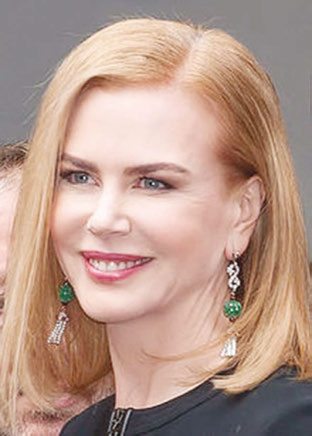
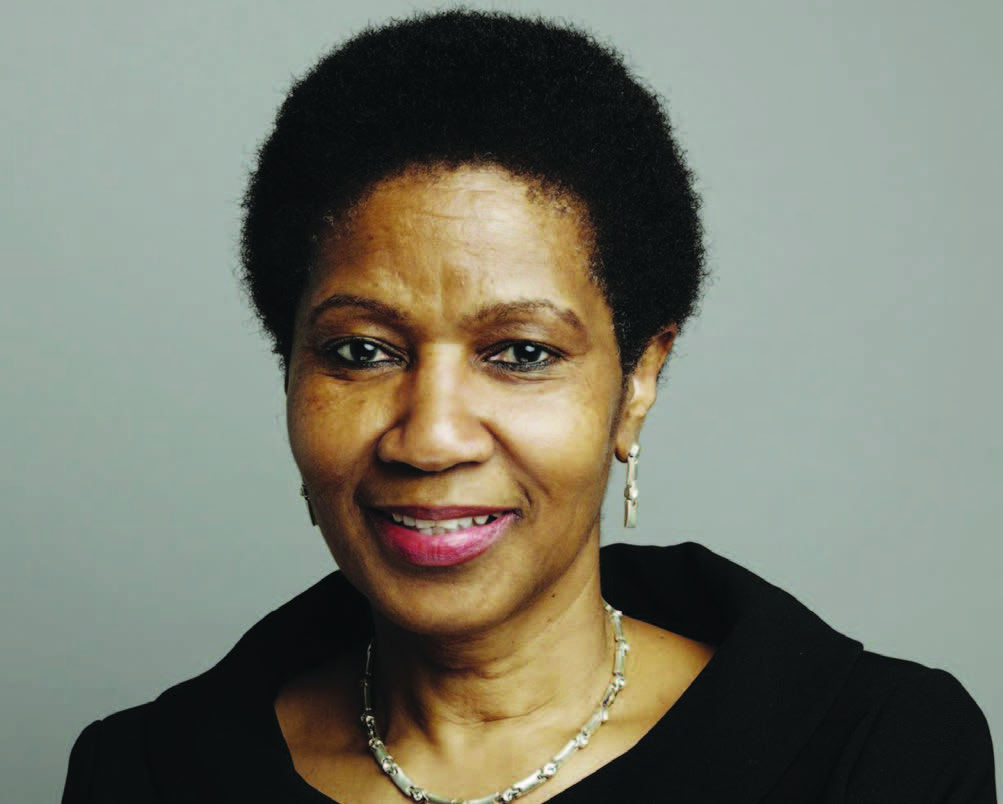
NEW YORK (TIP): Celebrating 20 years of vital work to end violence against women and girls, the UN Trust Fund to End Violence against Women (UN Trust Fund) hosted its fund-raising gala last night, showcasing a range of innovative interventions that are working to end the pandemic globally. Co-hosted by UN Women Executive Director Phumzile Mlambo-Ngcuka and Oscar-winning actress and UN Women Goodwill Ambassador Nicole Kidman, the packed high-profile event brought together gender rights activists, UN officials and the private sector, spotlighting beneficiaries and their life-changing work across the world.
“Tonight we celebrate the essential work done by the UN Trust Fund, paying tribute to our grantees, whose success stories embody the resilience of women and girls in the face of violence,” said Phumzile Mlambo-Ngcuka, UN Women Executive Director. “We know that these vital investments in initiatives to end violence have high returns and have already made a difference to millions of women and girls. But there is a great deal more to do to scale up prevention and increase appropriate services, and that needs more funding so that we can bend the curve down and bring the scourge of violence against women to an end,” she added.
Violence against women and girls is now part of the public discourse much more than ever before, along with significant progress in legislation and grassroots efforts to address the issue. Yet, it continues to be a gross human rights violation of pandemic proportions. Today, one in three women worldwide have experienced physical or sexual violence-mostly by an intimate partner. The UN Trust Fund to End Violence against Women is the only global grant-making mechanism dedicated to eradicating all forms of violence against women and girls. Managed by UN Women, on behalf of the UN system, during the last 20 years, more than 400 organizations have been supported by the UN Trust Fund with results that indicate sustained resources and dedicated work can lead to the prevention and elimination of violence against women and girls. Focusing on prevention of violence, implementation of laws and policies, and improving access to vital services for survivors, the UN Trust Fund has spent the past 20 years focused exclusively on funding life-changing programs for millions of women and girls.
“I am here because I support the UN Trust Fund and I applaud and celebrate its 20 years of making a difference,” said Nicole Kidman, UN Women Goodwill Ambassador. “When I became UN Women’s Goodwill Ambassador 10 years ago, my first mission took me to Kosovo, where I met with women and girls who had survived violence. That was when I first understood what the work of the UN Trust Fund means. I saw first-hand the real difference it makes in lives of women and girls: They found shelter for themselves and their children. They received counseling to overcome the horrific trauma of rape during the war that had ravaged the Balkans. They were supported to make a living and stand on their own. It was a life-changing experience for me and one that has inspired me ever since. This is why, as UN Women’s Goodwill Ambassador, I see my role as that of an advocate to end violence against women and girls.”
During the event, Mrs. Ban Soon-taek, Patron of the UN Women for Peace Association, a key supporter of the UN Trust Fund, was presented with the UN Trust Fund’s Orange Heart, for her outstanding efforts to end violence against women and girls.
Moderated by NBC journalist Richard Lui, with an Honorary Host Committee comprised of actors and actresses Sir Patrick Stewart, Danai Gurira, Ruth Wilson, Gillian Anderson, and Kelly LeBrock as well as luminaries such as Kweku Mandela, the event brought together 300 people at the Loeb Boathouse in New York’s Central Park, who heard moving stories of impact and change from beneficiaries of UN Trust Fund-supported projects.
Stories of change underlined the high-profile event. Award-winning journalist Ann Curry interviewed seventeen-year-old Aiturgan Dzholdoshbekova from?Kyrgyzstan, who recounted how a local UN Trust Fund-supported project to prevent bride-kidnapping became a beacon of light and hope for her, and transformed her life.
“We are very happy to be in a school free from violence. We were able to change the situation of girls in our families and in our schools,” said Dzholdoshbekova. “The boys have started to understand the issue and are advocating [with us]. The school has become a safe space where we can be happy, educate and develop ourselves,” she adds.
Tommy Clark, the Founder and CEO of South African NGO Grassroots Soccer and a grantee of the UN Trust Fund, was also interviewed by Ann Curry live onstage and spoke about an?innovative sports-based intervention?to empower girls and prevent HIV and gender-based violence.
Renowned theatre actress Nehassaiu deGannes narrated the inspirational stories of two other beneficiaries-a?woman in Gambia?who will no longer subject her daughter to Female Genital Mutilation, a harmful traditional practice that affects at least 200 million girls today; the other a girl in?Cambodia?who feels safer at her work in a factory.
The gala also saw the official launch of ?the Orange Label, the result of a partnership between the UN Trust Fund and the UK-based prestigious London College of Fashion, which aims to adorn a variety of products and engage small and large scale companies around the world. Designed by students of the college, the Orange Label will be used as a brand for cause-related marketing initiatives to benefit UN Trust Fund supported programs. Through the fashion and associated industries, the Label will connect the private sector and UN Trust Fund supported programs in joint efforts to prevent and end the pandemic of violence against women and girls.
The evening concluded with a high-powered rendition of the song?Rise, performed by Jayna Brown, a young musician who was recently a semi-finalist on the hit TV show,?America’s Got Talent. ?Guests rose to showcase their support and commitment to enable the UN Trust Fund to continue their life-changing work.
Donations to the UN Trust Fund can be made by text, or via the website. Background information: The UN Trust Fund to End Violence against Women
The UN Trust Fund is the only global grant-making mechanism dedicated to eradicating all forms of violence against women and girls globally. Supporting over 400 organizations over the past 20 years, UN Trust Fund grantees show that with sustained resources and dedicated work, violence against women and girls can be prevented and eliminated. Focusing on prevention of violence, implementation of laws and policies and improving access to vital services for survivors, the UN Trust Fund has spent the past 20 years funding life-changing programs for millions of women and girls. The UN Trust Fund is managed by UN Women on behalf of the UN system.
Website: http://untf.unwomen.org/en UN Women is the UN organization dedicated to gender equality and the empowerment of women. A global champion for women and girls, UN Women was established to accelerate progress on meeting their needs worldwide. For more information, visit www.unwomen.org. UN Women, 220 East 42nd Street, New York, NY 10017, New York. Tel: +1 646 781-4400. Fax: +1 646 781-4496.
UNITED NATIONS (United States) (TIP): Maria Sharapova will once again be a UN goodwill ambassador when her doping ban expires in April and she returns to international tennis competition, a UN statement said on Nov 10.
The United Nations had suspended Sharapova’s role as goodwill ambassador in March after she failed a drug test, putting a hold on a nine-year partnership with the UN Development Programme.
“UNDP was glad to learn that Maria Sharapova can return to the sport she loves sooner than expected and we will lift the suspension of her role as our goodwill ambassador once the reduced ban expires in April 2017,” said a UNDP spokesperson.
“We understand that Ms. Sharapova will be focused on resuming her tennis career and we look forward to discussing her role and engagement with UNDP at an appropriate date.”
Last month, the Russian star’s 24-month ban for testing positive for meldonium was cut to 15 months by the Lausanne-based Court of Arbitration for Sport.
Sharapova, 29, had admitted using meldonium for 10 years to help treat illnesses, a heart issue and a magnesium deficiency.
As a goodwill ambassador, Sharapova has been active in helping recovery efforts after the 1986 Chernobyl disaster.
The tennis sensation has made visits to Belarus and donated $100,000 to support youth projects in rural areas that suffer from the after-affects of the Chernobyl nuclear accident.
Sharapova’s family fled the city of Gomel in Belarus in 1987 after the Chernobyl disaster, moving to Siberia where the tennis star was born.
The family lived in Nyagan, Siberia for two years and then moved to Sochi on the Black Sea where Sharapova took her first tennis lessons. (AP)
NEW DELHI (TIP): In the wake of heightened tensions, Pakistan is likely to skip the largest global anti-tobacco conference to be held in India next week. The seventh Conference of Parties (COP) to the WHO Framework Convention on Tobacco Control (FCTC) will be attended by delegates from 180 countries.
According to the organisers, Pakistan expressed regret at pulling out of the meeting after invitations were sent to all the member nations and parties.
“As of now, the information we have is that they (Pakistan) will not be able to attend. Of course, if a party like Pakistan says that they cannot participate, we don’t go further and ask why,” said Guangyuan Liu of the FCTC.
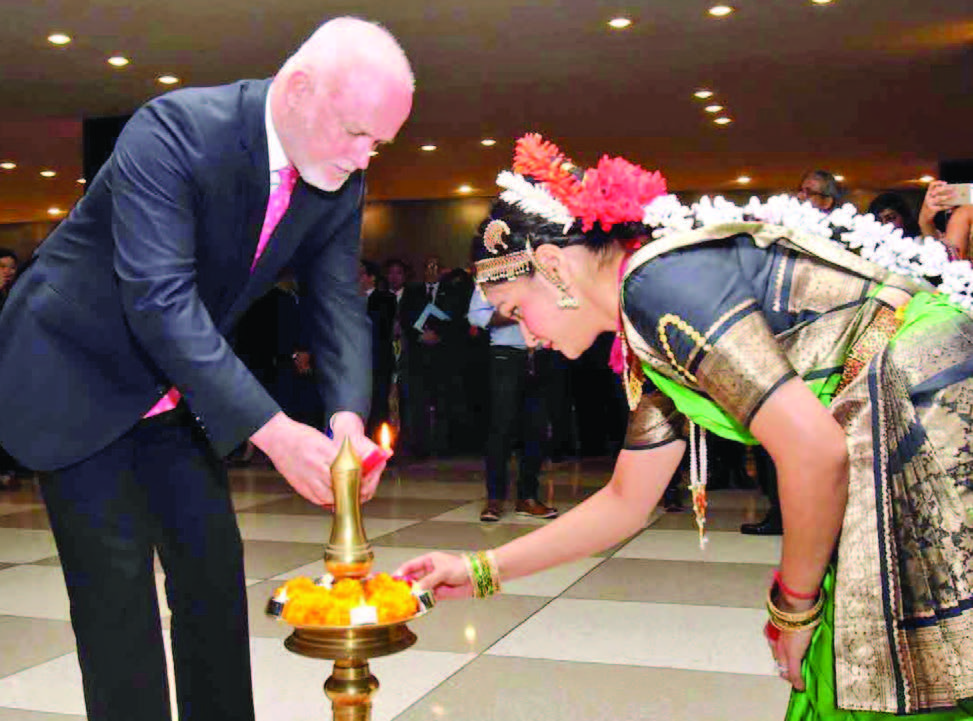
UNITED NATIONS (TIP): Diwali was commemorated for the first time at the United Nations from October 29-31. The UN Secretariat building was lit up especially on the Indian festival of lights. UN General Assembly President Peter Thomson lit the traditional lamp at a ceremony on Oct 31 to celebrate Diwali at the UN Secretariat. The Diwali celebrations included Indian dance and music performances.
The facade of the UN headquarters was lit in bright hues and the words ‘Happy Diwali’, along with the image of a traditional ‘diya’, projected onto the building. It was for the first time that the Indian festival of lights is celebrated at the world body after the UN General Assembly adopted a resolution in December 2014 that acknowledged the “significance of Diwali”.
“Lighting up. @UN lights up for #Diwali for 1st time,” India’s Ambassador to the UN Syed Akbaruddin tweeted. “Happy Diwali! @UN celebrates Diwali for 1st time. Thank you @UN_PGA for this initiative,” Akbaruddin said in another tweet, thanking General Assembly President Peter Thomson for the initiative.
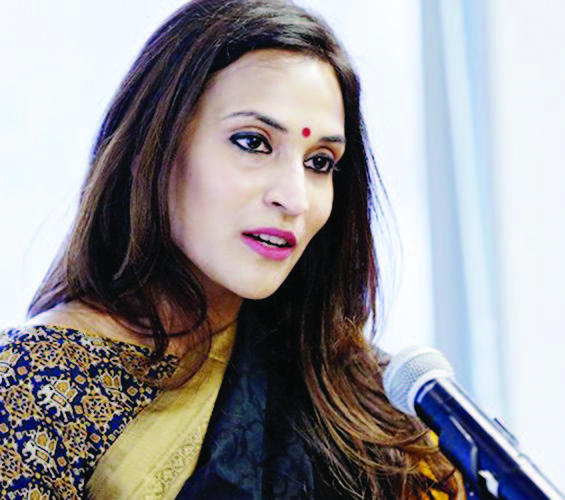
NEW YORK CITY (TIP): Aishwaryaa Rajinikanth Dhanush, UN Women’s Advocate for Gender Equality and Women’s Empowerment in India, strongly believes that to bring gender equality in the society we have to first understand what equality means. She spoke of this equality beginning from home where a girl is given the same status and opportunities as a boy. The film director, classical dancer and writer, who was appointed UN Women’s Advocate in August this year, was delivering a speech at UN Women’s Headquarter in NYC on October 27. America Tamil Sangam and UN Women jointly organized the event. In his welcome speech America Tamil Sangam President Prakash Swamy described how extremely talented Aishwaryaa maintains her simple, down to earth approach despite being daughter of India’s biggest star Rajinikanth and wife of another superstar Dhanush. He also highlighted Aishwaryaa’s social awareness and urge to help people in distress that had made her ideal for the advocate’s job.
“As a first step in our march towards equality, we would need to understand what equality means. Now I understand that this has been debated and continues to be debated by philosophers, politicians ad nauseam”, said Aishwaryaa. “And I understand we are yet to fully understand what equality means.” She also admitted that the present situation is grim but it has a solution too. “While an understanding of what is equality is important, but to wait or to make half-hearted attempts until we fully understand, would result in future generations looking back at us and wondering what sort of society did we live in! And we should be conscious of what sort of legacy are we likely to leave behind.”
UN Women Deputy Executive Director Lakshmi Puri briefed the audience about the transformations UN wants to bring to society with their vision for the 2030 Agenda and Planet 50-50 by 2030. International Women’s Day celebration on 8 March 2016 was aimed to mobilize people around the world to call for a Planet 50-50 by 2030. UN Women is organizing a series of diverse, high-profile events in over 40 countries, where ordinary citizens, activists, musicians, athletes, students, security personnel, scholars and stock exchange officials will be among those who commit to “Stepping It Up for Gender Equality. “One woman can represent 500 women better than 500 men can represent one woman.” Said Puri. UN Women Executive Director, Phumzile Mlambo-Ngcuka also delivered a brief speech where she expressed hope thatAishwaryaa with her genuine commitmentto the causewill be a true game changer to make this planet equal for men and women.
UNITED NATIONS (TIP): UN Women today inaugurated its Geneva Liaison Office, which will provide strategic support and boost efforts for gender equality and the empowerment of women and girls worldwide. Serving as a gateway to development stakeholders, Geneva is host to over 40 United Nations (UN) entities, more than 400 non-governmental organizations, some 35 international organizations, as well as renowned academic institutions, several of which support the promotion of women’s rights and gender equality. A large number of intergovernmental processes with direct impact on the women’s empowerment agenda, from human rights to humanitarian aid, trade and migration, are also held in Geneva.
The establishment of the Geneva Liaison Office will allow UN Women to broaden and strengthen crucial partnerships with the broad range of stakeholders based there, to deepen gender perspectives in their work and contribute to the gender-responsive implementation of the 2030 Agenda for Sustainable Development, and to enhance coordination with key players in the UN system.
As a sign of the strong collaborative spirit, the Geneva Liaison Office inauguration will be presided by Ambassador Valentin Zellweger, Head of the Permanent Mission of Switzerland to the UN in Geneva; Michael Møller, Director-General of the UN Office at Geneva, and Phumzile Mlambo-Ngcuka, Executive Director of UN Women.
“Switzerland is fully committed to the realization of gender equality as there is no sustainable development and peace without addressing the needs of both women and men and fulfilling their human rights. We support the establishment of UN Women’s liaison office in Geneva as this is the place where UN, other international organizations, private sector, civil society and academics work together and make a difference for gender equality and empowerment of women in such key domains as health, migration, humanitarian affairs, economics, labour and human rights,” said Ambassador Valentin Zellweger, Head of the Permanent Mission of Switzerland to the UN in Geneva.
“Our strengthened presence in Geneva through the new UN Women Liaison office will strategically amplify our global voice for women and girls and accelerate the delivery of results. As the new Liaison Office takes shape, we will build concerted action among our partners to put the empowerment of women at the top of the global agenda and keep it there,” added UN Women’s Executive Director Phumzile Mlambo-Ngcuka.
Some of the immediate priorities of the office, located within the Palais des Nations, include influencing Geneva-based intergovernmental processes, strengthening UN coordination and accountability for gender equality and expanding the base of partners who support gender equality through their work.
“This liaison office is the logical result of an ever-deepening collaboration with UN Women in recent years,” said Michael Møller, Director General of the United Nations Office at Geneva, who has made gender equality a personal priority and launched the Geneva initiative Gender Champions. “By strengthening the gender dimension, we can promote and achieve equal opportunities for women and girls everywhere, and contribute to the achievement of the Sustainable Development Goals,” he added.
UN Women’s work to spearhead action on women’s economic empowerment, in the run-up to the final report of the High-Level Panel created by the UN Secretary General Ban Ki-moon, will also benefit from the closer engagement with key partners based in Geneva.
With the inauguration of this office, UN Women can count on 89 country offices around the world, liaison offices in Belgium, Denmark, Japan, UAE (soon to become operational) and now, Switzerland, to remove barriers to equal opportunities for women and girls and to support efforts to ensure that laws and commitments on gender equality and women’s empowerment are fully implemented.
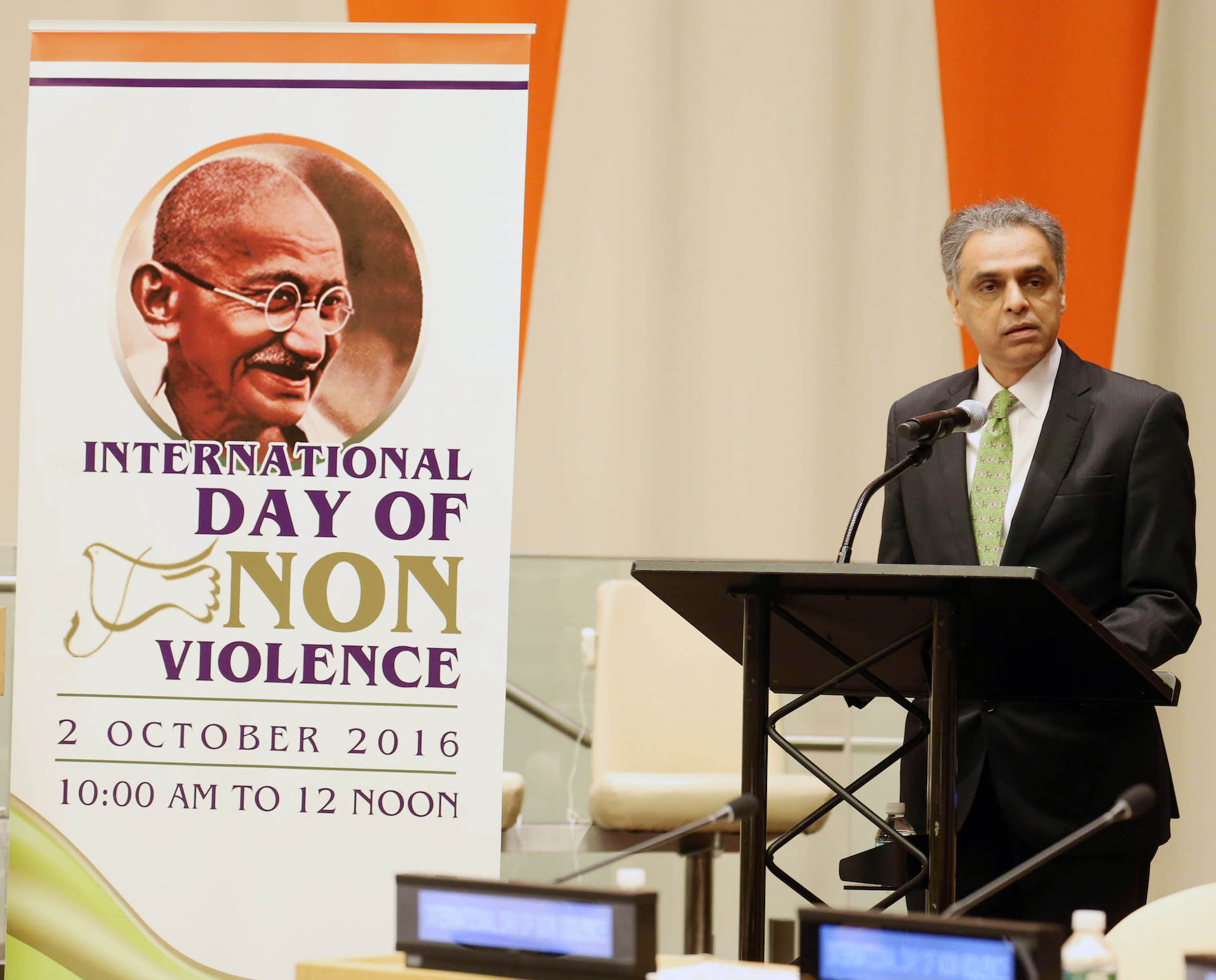
UNITED NATIONS (TIP): The birth anniversary of Mahatma Gandhi and Non-Violence Day was observed, October 2, with a program that included, besides India’s ratification of the Paris Agreement, performance by renowned classical music singer Sudha Raghunathan as well as the unveiling of a commemorative UN postage stamp of Indian music legend M.S. Subbulakshmi.
Sudha Raghunathan, India’s leading Carnatic Music singer performing on the occasion
Photo / Mohammed Jaffer-SnapsindiaIndia deposited its Instrument of Ratification to the Paris Agreement under the convention on Climate Change today, coinciding with the International Day of Non Violence. The day also commemorates the Birth Anniversary of Mahatma Gandhi who epitomized a lifestyle with the smallest carbon footprint. With this India became the 62nd country to ratify the Agreement taking the cumulative emission of the countries that have ratified the Agreement so far to 51.89 percent.
This significant contribution towards the early entry into force of the Paris Agreement underlines Prime Minister Narendra Modi’s commitment to global cause of environmental protection and climate justice and reaffirms India’s responsive leadership in addressing the impact of climate change.
The speakers included UN Deputy Secretary-General Jan Eliasson, General Assembly President Peter Thomson, and Professor Barry L. Gan, India’s Ambassador to the UN Syed Akbraruddin, Director of Center of Non-Violence, St. Bonaventure University, New York.
The event was followed by a Carnatic Music concert by Sudha Raghunathan. The MC of the event was Manjunath Chennerrappa Head of Chancery of the Permanent Mission of India to the UN.
UN Secretary General Ban Ki-moon stressed the link between non-violence, peace and nature as he observed the International Day of Non Violence. “Every year on the International Day of Non-Violence, we re-commit ourselves to the cause of peace, as exemplified by the life of Mahatma Gandhi who was born on this day 147 years ago,” Ban said. The UN General Assembly, through a resolution in 2007, designated 2 October as the International Day of Non-Violence to coincide with the birthday of Gandhi, who led the country’s independence movement and pioneered the philosophy and strategy of non-violence.
UN Postal Administration unveiled the commemorative stamp of M.S. Subbulakshmi, Indian music legend on the 50th anniversary of her performance at the UN in 1966, during an event on the International Day of Non-Violence at the UN Headquarters on 2nd October 2016. The first copy is presented to musician Sudha Raghunathan (extreme left). Ambassador Akbaruddin is seen extreme right.
UN Photo/Evan Schneider
“We know that a culture of non-violence begins with respect for others, but it does not end there. To nurture peace, we must respect nature. I am pleased this year’s International Day of Non-Violence puts the focus on sustainability and the environment,” Mr. Ban said.
“In all he did, Gandhi honored our obligation to all living things. He reminded us that ‘Earth provides enough to satisfy everyone’s needs, but not everyone’s greed.’ Gandhi also challenged us to ‘be the change we wish to see in the world,’” the Secretary-General noted. India’s commitment is reflected in a momentous way, the UN chief said, as its government is depositing its instrument of ratification for the Paris Agreement on climate change.
There is no better way to commemorate Gandhi and his legacy for people and planet, he said, urging all countries to complete their domestic processes for ratification and also strive in all activities to achieve progress through non-violence. The Day is annually observed worldwide with commemorative events.
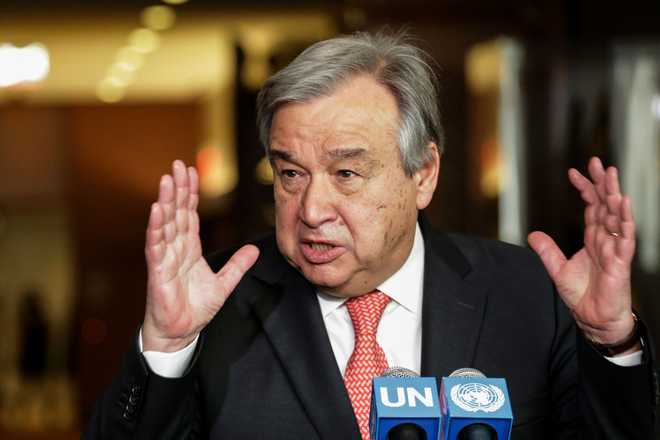
UNITED NATIONS (TIP): The United Nations Security Council on Thursday unanimously nominated former Portuguese Prime Minister Antonio Guterres to be the next Secretary-General, recommending that the 193-member General Assembly appoint him for five years from Jan. 1, 2017.
The General Assembly is likely to meet next week to approve the appointment of Guterres, 67, who would replace Ban Ki-moon, 72, of South Korea. Ban will step down at the end of 2016 after serving two terms.
Ban, speaking during a visit to Rome, described Guterres as a “super choice” as his successor.
“I am sure he will carry the torch on the full range of key challenges, from strengthening peace operations to achieving sustainable development, upholding human rights and easing humanitarian suffering,” Ban told reporters.
Guterres was prime minister of Portugal from 1995 to 2002 and served as United Nations High Commissioner for Refugees from 2005 to 2015. Guterres is due to speak to reporters in Lisbon later on Thursday.
“He has great United Nations credentials … and being High Commissioner for Refugees means traveling the world and seeing some of the most gruesome conflicts we have to deal with and then of course he is a high-level politician,” said Russian UN Ambassador Vitaly Churkin, president of the council for October.
“He is a person who talks to everybody, listens to everybody, speaks his mind, a very outgoing, open person so I think it was a great choice and I’m glad that we rallied around Mr. Guterres,” Churkin told reporters.
The council met behind closed doors on Thursday to adopt a two-paragraph resolution recommending to the General Assembly that Guterres be appointed.
“Antonio Guterres has shown … that he is the strongest candidate, he has a vision and a moral authority and integrity that put him at the top of the league table,” British UN Ambassador Matthew Rycroft told reporters.
French UN Ambassador Francois Delattre said Guterres was “the right leader able to bring the nations and the community of nations together”.
United Nations, Oct 2 (PTI) India today ratified the landmark Paris climate deal, giving a significant push for the deal to enter into force by the end of this year.
Permanent Representative to the UN Ambassador Syed Akbaruddin (@AkbaruddinIndia – Twitter) handed over India’s Instrument of Ratification to the Paris Agreement under the convention on Climate Change today, coinciding with the International Day of Non Violence.
The day also commemorates the Birth Anniversary of Mahatma Gandhi who epitomized a lifestyle with the smallest carbon footprint.
With this India, the worlds third largest emitter of greenhouse gases, became the 62nd country to ratify the Agreement taking the cumulative emission of the countries that have ratified the Agreement so far to 51.89%.
This significant contribution towards the early entry into force of the Paris Agreement underlines Prime Minister Shri Narendra Modi’s commitment to global cause of environmental protection and climate justice and reaffirms India’s responsive leadership in addressing the impact of climate change.
UN Secretary-General Ban Ki-moon lauded India’s “climate leadership”, saying India’s ratification of the Paris Climate Change agreement moves the world an “important step closer” toward achieving the goal of entering the landmark deal into force this year.
In his message for the International Day of Non-violence, marked every year on Gandhis birth anniversary, Ban said there is no better way to commemorate Gandhi and his legacy for people and the planet than with India submitting its instrument of ratification to the Paris Agreement on Climate Change.
“I warmly congratulate India for its climate leadership, and for building on the strong momentum we see from all corners of the globe for the agreement to enter into force as quickly as possible this year. Indias ratification of the agreement moves the world an important step closer toward achieving that goal,” Ban said in the message.
He called on all countries to complete their domestic processes for ratification and also strive in all activities to achieve progress through non-violence.
The UN chief said the commitment to sustainable living that Gandhi emphasised on is reflected in a “momentous way” as India is depositing its instrument of ratification to the Paris Agreement on Climate Change.
“India keeps its promise. On Gandhijis birth anniversary, we deposit the instrument of ratification of Paris Agreement on climate change,” External Affairs Ministry spokesperson Vikas Swarup tweeted.
Syed Akbaruddin had on Friday said that India had played a “key role” in the negotiations and finalisation of the Paris agreement as Prime Minister Narendra Modi has a “personal commitment” to the climate deal.
WASHINGTON (TIP): The Obama administration on Sept 28 affirmed its support to New Delhi on the issue of cross-border terrorism ahead of India’s surgical strike inside Pakistan occupied Kashmir, while putting Islamabad on notice for its failure to act against UN-designated terrorists and entities.
US National Security Advisor Susan Rice spoke to her Indian counterpart Ajit Doval to offer condolences to families of the Uri attack victims and express support for India on the issue of terrorism, White House National Security Council spokesman Ned Price said in a read-out on the call. The call was initiated by Washington and took place before the Indian strike beyond the Line of Control.
Although the statement did not explicitly pin the Uri attack on Pakistan, there was a broad censure of Islamabad for continuing to harbor proscribe terrorists and terrorist outfits, with a pledge that Washington would “deepen collaboration on counter-terrorism matters including on UN terrorist designations.”
“Highlighting the danger that cross-border terrorism poses to the region, Ambassador Rice reiterated our expectation that Pakistan take effective action to combat and delegitimize United Nations-designated terrorist individuals and entities, including Lashkar-e-Tayyiba, Jaish-e-Muhammad, and their affiliates,” the statement said, in an unequivocal recognition of the Indian position that state-backed terrorist proxies have a free run in Pakistan. India has blamed Jaish operatives for the Uri attack, and has more recently identified the attackers and the camps in Pakistan-occupied Kashmir they came from.
The US statement came amid recrimination from some Indian commentators that the Obama administration was hedging on backing India fully and was not putting pressure on Pakistan after the Uri attack. Although Secretary of State John Kerry gave Pakistan’s Prime Minister Nawaz Sharif an earful at the UN General Assembly last week, some analysts and retired Indian officials selectively highlighted pabulum in the statement to suggest that New Delhi had taken false comfort about US support, and everything was hunky-dory in Islamabad’s ties with Washington.
The US statement on the Rice-Doval call leaves no doubt where Washington stands on the latest developments in the region, with none of the comforting crumbs that lower level US officials throw out for Pakistanis to feast on, such as recognizing Pakistan’s progress in the war on terror, commiserating with its claim that it is a victim etc.
“There are no nuances here. The message to Pakistan is very clear,” a senior Indian diplomat said, as New Delhi stepped up international pressure on Islamabad.
In fact, the Rice-Doval phone conversation, coming after New Delhi’s call to torpedo the SAARC meet, virtually endorses India’s decision to scupper the summit, without the salutary advice that the State Department invariably essays about the need for dialogue. (PTI)
UNITED NATIONS: Indian Minister for External Affairs Sushma Swaraj, speaking at the 71st United Nations General Assembly, said on Monday that it was time to identify nations who nurture, peddle and export terrorism and isolate them if they don’t join the global fight against terrorism.
“In our midst, there are nations that still speak the language of terrorism, that nurture it, peddle it, and export it,” said Swaraj in a veiled reference to Pakistan.
The harsh India rhetoric at the UNGA comes after the attack on an Indian army base in India-held Kashmir earlier this month. The attack killed 18 Indian army personnel. India immediately blamed Pakistan for the attack.
The Indian minister added it had become the calling card of such nations to shelter terrorists, and urged the United Nations (UN) to hold such nations to account.
“These nations, in which UN declared terrorists roam freely, lead processions and deliver their poisonous sermons of hate with impunity, are as culpable as the very terrorists they harbour,” said Swaraj.
She also said that “such countries should have no place in the comity of nations”.
Swaraj referred to the speech of Prime Minister Nawaz Sharif at the UNGA, and said the allegations levelled against India were “baseless”.
“Prime Minister of Pakistan used this podium to make baseless allegations about human rights violations in my country.”
The Indian foreign minister stated that Pakistan should introspect and see the abuses being carried out in Balochistan.
She also added that the “brutality against the Baloch people represents the worst form of state oppression”.
It is pertinent to mention that the brutal and heavy-handed tactics used by Indian security forces in India-held Kashmir has led to the deaths of more than 100 people, hundreds have been blinded by ‘non-lethal pellet guns’ and over a thousand people have been injured.
Swaraj claimed that India had no preconditions for talks with Pakistan and said India wants to resolve issues not on the basis of conditions, but on the basis of friendship.
She further alleged that India did not receive the appropriate response from Pakistan and instead got a reply in the form of “Pathankot, Bahadur Ali, and Uri”.
“Bahadur Ali is a terrorist in our custody, whose confession is a living proof of Pakistan’s complicity in cross-border terror,” claimed the foreign minister.
Referring to Kashmir, she ‘advised’ Pakistan to abandon the dream of having control of India-held Kashmir.
“My firm advice to Pakistan is: abandon this dream. Let me state unequivocally that Jammu and Kashmir is an integral part of India and will always remain so,” Swaraj said.
‘India not serious about resolving Kashmir issue’
Chief of Army Staff General Raheel Sharif, while addressing a US CENTCOM conference in Germany, said India is not serious about resolving the issue of Kashmir.
“Pakistan has suffered the most by terrorism losing lives more than any other country in the world,” said the army chief.
General Raheel added that terrorists could move across borders because of no effective border management systems in place and it is exploited by anti-Pakistan intelligence agencies such as RAW.
External Affairs Minister Sushma Swaraj on Monday demanded isolation for the supporters of terrorism.
While addressing the 71st session of UN General Assembly In New York, Swaraj Said ” We all have to come together to fight the scourge of terrorism, if some country is not willing then it must be isolated”
” We need to identify who gives shelter to the terrorists? How are they able to carry out such activities?. We need to uproot terrorism,”she added.
Here is what all she said at the session:
We should adopt Comprehensive Convention on International Terrorism to develop norms to prosecute terrorists: EAM Swaraj at UNGA
Those who seed extr’t ideologies, reap a bitter harvest. This germ of evil has grown into a hydra-headed monster: EAM Sushma Swaraj
Kashmir is an integral part of India, and will be always. Aap (Pak)sapna dekhna chor dijiye: EAM Sushma Swaraj to Pakistan
Kashmir is an integral part of India and will remain an integral part of India: EAM Sushma Swaraj
Humne sharton ke hisaab pe nahi, mitrta ka haath badhaya. Par hume kya mila? Pathankot? Uri? Bahadur Ali?: EAM Swaraj
Bahadur Ali is a living example of Pakistan’s cross border terrorism: EAM Sushma Swaraj
Jinke apne ghar sheeshe ke hon unko doosre pe patthar nahi phenkna chahiye, kya ho raha hai Balochistan mein?: EAM Swaraj
Aatankwaadiyon ko paalna kuch deshon ka shaunk ban gaya hai: EAM Sushma Swaraj in New York
I am very thankful to the UN for its tremendous support for International Yoga day: EAM Sushma Swaraj
Sanitation is also a big issue, and we have started ‘Swacch Bharat Abhiyan’ under which 4 lakh toilets are built in 2 lakh schools: EAM
A year has passed since I stood at this hallowed podium to address members of the international community,so much has changed since then:EAM
Today the biggest challenge all of us face is the poverty prevalent in all corners of the world: EAM Sushma Swaraj
NEW YORK (TIP): September 21 was a day of protests in front of the United Nations. The most important, from the point of view of Indian American community were the protests against Pakistan, organized by Balochis and Indian Americans.
There was another organized by the Bangladeshi BNP against Sheikh Hasina. Yet another was a protest organized against the Chinese government by the practitioners of Falun Dafa who alleged persecution of “100 million people” at the hands of the Chinese regime. Yet another, a little distance away on 2ndAvenue, was a protest against Iranian regime.
We are presenting here the stories in brief in pictures. However, the protests against Pakistan by the Balochis and the Indian Americans are more detailed.
BALOCHIS AND INDIAN AMERICANS PROTEST AGAINST PAKISTAN
Several Baloch and Indian activists held large-scale demonstrations outside the UN headquarters here while Pakistan Prime Minister Nawaz Sharif addressed the UN General Assembly as they were joined by other groups demanding that it stop “exporting” terror into India.
The protestors converged across the street from the world body’s headquarters to condemn atrocities and human rights violations by Pakistan just as Mr. Sharif was addressing the General Debate of the General Assembly.
The crowd shouted slogans of ‘Free Balochistan’, ‘Down Down Pakistan’, ‘Save World from Pakistan Terror’ as they waved banners and placards that read ‘US Government stop giving funds to Pakistan’, ‘Kashmiri Hindus are Humans, Wake up to their sufferings’, ‘Remove Pakistan from the UN’, ‘Stop Atrocities in Pakistan-occupied Kashmir’ and ‘Killing Fields of Pakistan -Sindh and Balochistan’.
“Pakistan is a terror state and does not want the people of Balochistan to live in peace,” Ahmar Musti Khan, founder of the American Friends of Balochistan told Press Trust of India.
He said Pakistan and its leaders are committing crimes against the residents of Kashmir, demanding that the country stop “exporting terror and let its neighbors live in peace”.
He added the Pakistani leadership should respect the right to self-determination of the Baloch people.
Mr. Khan said the Baloch people are “indebted” to Prime Minister Narendra Modi “for speaking out for Balochistan’s right and the right of the Baloch people to be the masters of our own destiny”.
He slammed the Pakistani army for its brutalities against “innocent Balochis”, saying “the Pakistan Army is ISIS in uniform”.
The Baloch National Movement (BNM) condemned the Pakistani atrocities and the ‘ongoing military operations’ in Sindh and Balochistan.
“Baloch and Sindhi people appeal to the freedom loving citizens of America and the world to support our demands for freedom, peace, and justice. We, the victims of Pakistani state aggression and crimes against humanity, want to tell the world that ‘Pakistan is a nuclear-armed terrorist state’ and must be stopped,” the group said.
Condemning the “barbaric” terror attack on the Uri camp in Kashmir and Pathankot air base, BNM said such attacks are part of Pakistan’s policy of “aggression, employing terrorist methods and outfits to escalate war in the region”.
It said the Baloch people are grateful for the support extended by the Indian Prime Minister at “such a critical juncture when our nation is struggling to be free from the illegal military occupation of Pakistan since 1948”.
Jayesh Patel, the former President of the Overseas Friends of BJP, said Pakistan should stop terrorism against India, saying countless innocent lives have been lost due to attacks in Kashmir, mostly recently on the army base in Uri that killed 18 soldiers.
“The families of our soldiers are the worst sufferers,” he said.
In February this year, shortly after the attack in Pampore, Jammu and Kashmir, a diplomat belonging to a ‘friendly’ country delicately asked an unusual question. His Foreign Ministry headquarters were asking if they should send a message condemning the terrorist attack in which three Army men, two Central Reserve Police Force personnel and a civilian had been killed in a siege which bore resemblance to the Pathankot attack a month before. The problem, he explained, was that the Indian government itself was making no statements on the incident, and he wasn’t sure if statements of support were welcome or not. A few days after the Pampore incident on February 20, the Ministry of External Affairs had sought to play it down, saying only that the matter was “still being investigated”. Eventually, the Pampore incident, despite the obvious strains of evidence linking it to Pakistan-based groups that officials on the ground pointed to, was buried. At the time, the Indian and Pakistani National Security Advisers (NSAs) were still talking to each other “regularly”, said the government, and a Pakistani investigation team was coming to Pathankot airbase to survey evidence.
It is only now, after the Uri tragedy of September 18, that India has brought up the number of attacks and attempted infiltrations across the Line of Control (LoC) this year. “Seventeen such attempts have been interdicted at or around the LoC, resulting in the elimination of 31 terrorists and preventing their intended acts of terrorism,” Foreign Secretary S. Jaishankar told Pakistan High Commissioner Abdul Basit when he summoned him on Wednesday. In fact, there have also been more than 20 attacks on security force installations in Jammu and Kashmir in the past two years, including the Pampore attack; another 15 were foiled.
The incident with the diplomat only serves as a small indicator of how confusing the government’s moves on Pakistan have been, even to close watchers and friendly governments. In fact, India’s moves on Pakistan in the past few years have been a series of such missteps, misperceptions and a complete misunderstanding of the Pakistani responses to them.
Missing the signs
To begin with, the on-again, off-again dialogue process that began with Prime Minister Narendra Modi’s grand gesture of inviting his Pakistani counterpart Nawaz Sharif to his swearing-in ceremony is perplexing. When the government called off talks between the Foreign Secretaries over the Pakistan High Commissioner’s talks a few months later with the Hurriyat leadership, it played the move as the drawing of a “redline”. But in a turnaround in March this year, that redline was erased, and the government posed no objection to the High Commissioner meeting the Hurriyat a few days before the Foreign Secretary-level talks in Delhi. What the government failed to notice between those two dates in 2014 and 2016 was a hardening of the Pakistani military’s position on the India policy. Another missed sign was the clear targeting of NSA Ajit Doval, India’s main interlocutor with Pakistan, by the military establishment’s propaganda wing, as the mastermind of terror attacks in Pakistan.
As a result, when Mr. Modi met Mr. Sharif in Paris and suggested restarting talks beginning with NSA Doval and the newly appointed Pakistani NSA Gen. Nasser Khan Janjua, it was far from a match made in heaven. For his part, Mr. Doval was viewed with deep suspicion by Pakistan. Indian government officials drew false comfort as they viewed Gen. Janjua as a “military man” with the ear of Pakistan Army Chief Gen. Raheel Sharif. But they should have asked more closely about Gen. Janjua’s nebulous role in the Pakistani power structure, as he seemed to only be deputed for relations with India: when Prime Minister Sharif went to Saudi Arabia, Gen. Sharif to Afghanistan, and Foreign Affairs Adviser Sartaj Aziz to the U.S., Gen. Janjua was nowhere in the picture.
Neither war-war nor jaw-jaw
Yet the government pressed on with the initiative with Pakistan, and both External Affairs Minister Sushma Swaraj and Mr. Modi have paid visits to Pakistan. They both gave the same message: this time they would not allow terrorism to derail talks between the two countries. “We want to ensure we are not provoked by saboteurs who want to stop the dialogue process,” Ms. Swaraj told Parliament about the government’s new plans with Pakistan. Yet provoked they were, and the government took another turn, calling off the Foreign Secretary-level dialogue process shortly after the Pathankot attack in January. NSA talks, however, persisted and led to the curious precedent that saw Pakistani intelligence operatives get access to look at the very base India accused their groups of attacking. Through every attack from Pakistan, the government has flipped and flopped, explaining itself unconvincingly to even its well-wishers.
There is enough evidence to show that Ms. Swaraj’s instincts were correct. Nothing upsets the elements of the Pakistani establishment that carry out terror attacks against India more than a consistent dialogue process, and in the past too, it is when India and Pakistan have come closest to a breakthrough that their attack is the hardest. The last few years, however, have seen neither what Winston Churchill famously called jaw-jaw (talks), nor has there been an outright war-war, and it’s that situation of disorder that empowers those destructive elements the most.
Not setting the agenda
Equally confusing are the steps the government has taken on the international stage. At the G20, ASEAN and East Asian summits, and every possible international forum, Prime Minister Modi has made statements about Pakistan’s link to the violence in Kashmir. Yet the government rejoiced this week when UN Secretary General Ban Ki-moon omitted any references to Kashmir, saying this reaffirms India’s traditional position that it is a bilateral, not international, issue. The damage is twofold: not only does this allow Pakistan to set the agenda for India at international fora as Mr. Sharif’s speech calling Kashmir an “intifada” did, it also gives rise to ambiguities on the status of Kashmir that other countries draw upon.
Meeting Mr. Sharif this week, U.S. Secretary of State John Kerry, for example, expressed “strong concern with recent violence in Kashmir – particularly the Army base attack”, and then added the “need for all sides to reduce tensions”, as if there was some equivalent responsibility for both India and Pakistan. Similarly, France issued a statement condemning the Uri attack, but also called for a resolution of the Kashmir dispute, drawing a link between the two that India would like to avoid.
Finally, there is an inconsistency between the government’s rhetoric and the actions it is prepared to take in the wake of an attack. Initial indications after the Uri attack suggest the government and the armed forces are not in favor of a “knee-jerk” air strike or cross-border raids at this point. It is counterproductive to issue statements on “befitting punishment” to Pakistan or exchanging a tooth for a full set of dentures if the plan is to exhaust diplomatic options first.
The truth is, the world understands India is the victim, and Pakistan the perpetrator of terror. While the government keeps producing evidence of each attack it traces to the Jaish-e-Mohammed and the Lashkar-e-Taiba, as it has done post-Uri as well, the obvious evidence should be the original case against them: that JeM leader Masood Azhar was exchanged for hostages during the IC-814 hijack in 1999, and Hafiz Saeed has been identified by at least three people involved in the 26/11 Mumbai attacks of 2008 as its mastermind, and is wanted not just by India but the UN as well. If that’s not enough for Pakistan, nothing will ever be, and the fact that both terrorists roam freely and run flourishing empires within the country should be enough to show Pakistan’s complicity. But until India builds a coherence in its own strategy, and unity in focus and purpose, it will continue to face such challenges from across the border, as well as comforting but empty words of solidarity from the rest of the world.
(The author is a columnist and can be reached at suhasini.h@thehindu.co.in)
Signup to our Newsletter!
Don’t miss out on all the happenings around the world