Tag: United Nations

  • A.R. Rahman enthrals audience, honoring M.S. Subbulakshmi at 70th Independence Day celebrations at UN

    A.R. Rahman enthrals audience, honoring M.S. Subbulakshmi at 70th Independence Day celebrations at UN

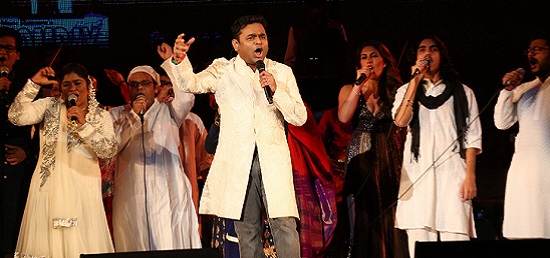
    United Nations — August 15, 2016: A.R. Rahman enthralled a packed audience at the iconic United Nations General Assembly Hall with his renditions of Indian Carnatic legend M. S. Subbulakshmi’s music, Sufi songs and the foot-tapping ‘Jai Ho’ at a concert to celebrate India’s 70th Independence Day on August 15th, 2016.

    The musical concert, organized by India’s Permanent Mission to the UN with the support of Sankara Nethralaya, an India-based not-for-profit organization, on India’s 70th Independence Day, was a tribute by Rahman to Subbulakshmi on the occasion of her birth centenary. Through the nearly three-hour long concert, Rahman and his troupe performed Subbulakshmi’s music and compositions.

    Oscar-winning composer Rahman (49), made history by becoming the only second Indian artist after Subbulakshmi, who had performed at the United Nations 50 years ago. The audience of ambassadors, diplomats and Indian-Americans welcomed Rahman with a thunderous applause and loud cheers as he stepped on stage, dressed in traditional Indian attire.

    The world body’s iconic General Assembly hall, from where world leaders address the globe, reverberated with Rahman’s enchanting music. Through his performance, Rahman paid homage to Subbulakshmi, the first musician ever to be awarded India’s highest civilian honor Bharat Ratna. The concert coincides with the completion of 50 years of Subbulakshmi’s performance in the UN General Assembly hall with the support of Chennai-based Sankara Nethralaya, a not-for-profit eye institution.

    The concert honoring Subbulakshmi at the UN aims to “perpetuate the memory of not only one of the greatest musicians India had ever produced but that of a greatest soul who lived a life of philanthropy and goodwill for all humanity”, Sankara Nethralaya’s Chairman Emeritus S S Badrinath said.

    Rahman, known to be a man of few words, said in the beginning of the concert that he had a long speech prepared but decided against delivering it, letting his music do the talking for him. In his homage to Subbulakshmi, Rahman said she had performed at the UN a year before he was born. “For us, she is a case study” of how a person with humble beginnings can conquer and rise above the caste and class system and become an “ultimate icon” for every aspiring singer.


    Her life was the inspiration behind Rahman’s Sunshine Orchestra, which was started about a few years ago and teaches eastern and western classical music to underprivileged children, he said. “Today these children have pushed their boundaries and are almost ready for the world,” he said. “It is one of my duties to come here and celebrate her,” he said, adding that he considers the music legend “God of my culture”.

    The concert was a way of celebrating M S Subbulakshmi’s performance at the UN General Assembly hall on 23 October 1966. The first ever musician to be awarded India’s highest civilian honor the Bharat Ratna, Subbulakshmi was invited by the then UN Secretary General late U Thant to perform at the General Assembly, becoming the first Indian to perform there. “It feels really, really good. I think 1966 was just one year before I was born. It’s been 50 years. So, (it was) coming back in a special way to celebrate one of my city’s icons, one of India’s icons- MS Subbulakshmiji,” Rahman was quoted to have said.

    A highlight of the concert was performances by students of Sunshine Orchestra, an initiative by the A.R. Rahman Foundation, that teaches music to underprivileged youngsters. “From today, you are privileged, you are not underprivileged anymore,” Rahman said as a word of encouragement to the students as they geared to perform on the UN stage.

    Rahman’s two sisters also performed on stage along with noted singers Javed Ali and renowned percussionist Sivamani. Rahman, sitting amid his musical instruments on one side of the UN stage, rendered one soulful number after another as his troupe gave mesmerising performances of Subbulakshmi’s Carnatic music. “Music has given me everything, this is a small thing in return,” Rahman said about the special backup.

    To loud cheers and applause, Rahman also performed some of his most popular songs including from movies such as ’Dil Se’ and ‘Bombay’ as well as a rendition of ‘Vande Mataram’ Towards the end of the concert, Rahman and his group performed Sufi songs, including ‘Khwaja Mere Khwaja’, ‘Kun Faya Kun’ and ‘Maula, Maula.’

    The grand finale was the foot-tapping song ‘Jai Ho’ from the movie Slumdog Millionaire, for which Rahman had won Oscars and several prestigious global awards. As Rahman and his troupe began the song, several people in the audience broke into a dance.

    A Photo Exhibition about M S Subbulakshmi’s life and times is also being held from August 15-19, 2016 at the United Nations. It depicts various facets and moment’s and provides a rare insight to the music legend’s achievements. United Nations Postal Administration issued a stamp to mark the birth centenary of Dr. M.S. Subbulakshmi.

    India’s Minister of State for External Affairs M J Akbar addressed the audience, and said, “Music is at the soul of the nation, that is India.” Akbar lauded the significance of music in India’s freedom struggle as well as its role as a unifying power. “Our journey towards freedom is represented by two songs — ‘Vande Mataram and Jann Gann Mann’,” Akbar said. He said that while other countries first formed a nation and then created an anthem, India “created anthems first and then formed a nation”. “Music is the most powerful expression of the soul of India because it inspires that spark of divinity that lives in every human soul,” he said, describing musicians as “ambassadors of God. Every morning in India begins with music. Every morning in every corner in India begins with the music of the Azaan, followed by the music of the Hanuman temple, followed by the music of the Gurudwara and then by the music of Church bells,” he said amid a huge round of applause, adding that one should “thank destiny for making us Indians”.

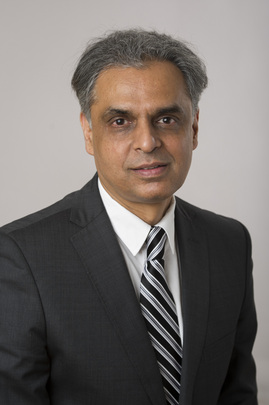
    India’s Permanent Representative to the UN Ambassador Syed Akbaruddin noted that the UN is observing its 70th anniversary as India’s celebrates its 70th independence day.

    “We hope this event will reinforce the belief that diverse cultural traditions reflecting each others values remain relevant to global thinking and the UN,” he said. Subbulakshmi is among the best musicians India has given to the world, Akbaruddin said.  “Remembering a legend. Photo exhibition @UN in memory of MS Subbulakshmi August 15-19,” he said in a tweet.

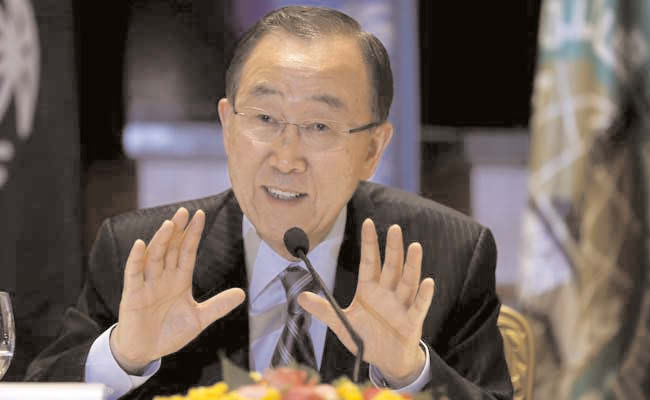
    The UN takes inspiration from various contributions made by India to the world, including the legacy of Mahatma Gandhi’s non-violent teachings and the harmony of Yoga, the world body’s Secretary-General Ban Ki-moon said. The video message was played during the concert at the UN on Monday.

    In his message to India on its 70th Independence Day, Ban said the occasion also celebrates India’s partnership with the UN. India is a founding member of the UN, Ban said and expressed his gratitude to the country for its significant contributions to the world body’s peacekeeping operations. “We are also celebrating India’s strong partnership with the UN,” he said in his message, which he began with a ‘Namaste’.

    Closing the concert, Rahman made an appeal for peace saying killing one another will not solve the world’s problems. “…We still kill each other. In my lifetime I want to see a world where people do not fight and kill each other but find better methods to solving conflicts. Let us hope in our lifetime we see this change.”

  • Kalpita’s charity dance show to help the blind

    Kalpita’s charity dance show to help the blind

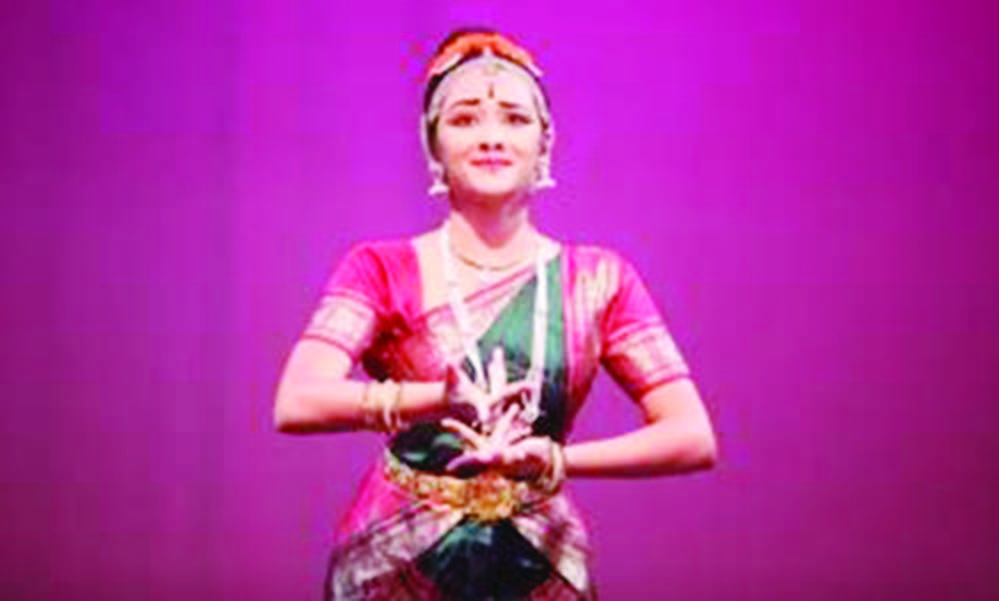
    NEW YORK (TIP): Kalpita Chakote, a rising senior at George W. Hewlett High School, New York help raise over $7,000 to prevent blindness and restore eyesight by giving a charity dance performance in Port Washington last week.

    Kalpita is the daughter of Dr. Vajinath Chakote, president of AAPI- QLI and a leading Indian-American physician of Long Island and Jyoti Chakote.

    The combined Bharatanatyam and Bollywood dance performance at Jeanne Rimsky Theater drew loud appreciation from discerning audience that include Tom Suozzi, former Nassau County Executive and Democratic Party Congressional candidate.

    Kalpita, a student of Guru Satya Pradeep, Artistic Director of Nritya Saagaram Dance Academy, commenced her program with Pushpanjali, a traditional welcome and prayer in praise of Lord Ganesha and exhibited various rhythmic patterns.

    She followed it up with an item on Ardhanareeswara and explained the merger of Lord Shiva and Goddess Parvathi in Ragamalika. She danced to the Hindustani number Deva Devam Bhaje, a famous Annamacharya keertan on Lord Ram and ended the segment with a Thillana – a joyful conclusion of the recital. All the four were choreographed by Satya Pradeep.

    The second half saw her on an upbeat mood by dancing the famous Bollywood song “1, 2, 3, 4 Get on the dance floor” from the movie Chennai Express. She performed Gunday’s Jiya, Chennai Express’ Titli and Goliyon Ki Rasleela Ram-Leela’s Ram Chahe Leela. She also danced to the famous numbers – Bajirao Mastani’s Pinga and Devdas’ Dola re dola. These dances were choreographed by Guru Archana Phillip. She ended the performance with Drake’s One Dance, Dhoom-3’s Dhoom machale and Calvin Harris’s this is what you came for choreographed by Guru Nikhil Sadhnani.

    A student of Bharatanatyam since she was six and trained by guru Satya Pradeep, she did her debut performance (Arangetram) a solo two and half hour performance at the age 12. She had performed in prestigious locations such as the United Nations, the Metropolitan Museum of Art and America Tamil Sangam.

    She is good at Bollywood dance as well. Under the tutelage of gurus Archana Phillip and Nikhil Sadhnani, she was able to excel in the dance form and performed Bollywood dances at several fundraisers including for St. Jude’s Children’s Hospital and Himalayan Development Foundation. She plays flute in her school’s advanced band Wind Ensemble and at New York State School Association. Kalpita swims competitively and excels in the 100 yard butterfly.

    Kalpita’s charity dance 1“Dancing is my way of expressing my emotions and relating to others. I am happy that our team collected more than $7,000 to help restore eye sight and prevent blindness,” she said

    “I have a severe astigmatism, irregularities in the curvature of my eyes. It has made me extremely nearsighted. It used to affect me when I danced. Before I had contact lenses and I danced without my glasses. I couldn’t see anything on stage. I was looking at complete darkness. I just had to trust that someone would catch me if I were too close to the edge of the stage. Sometimes my jewelry fell off, and I couldn’t see where it was. I just had to ignore it and hope that I wouldn’t step on it.

    I am lucky because those situations were isolated events. I do not have to relive those moments. However, not being able to see and hoping nothing goes wrong are aspects of some people’s daily lives. They don’t have eye care. I stumbled upon Seva Foundation whose mission to restore eyesight and prevent blindness, I wanted to help because I knew what they faced.”

    Seva Foundation is a global non-profit eye care organization that helps and strengthens communities by restoring eye sight and preventing blindness. The organization has helped four million blind regain eye sight in more than 20 countries, she said.

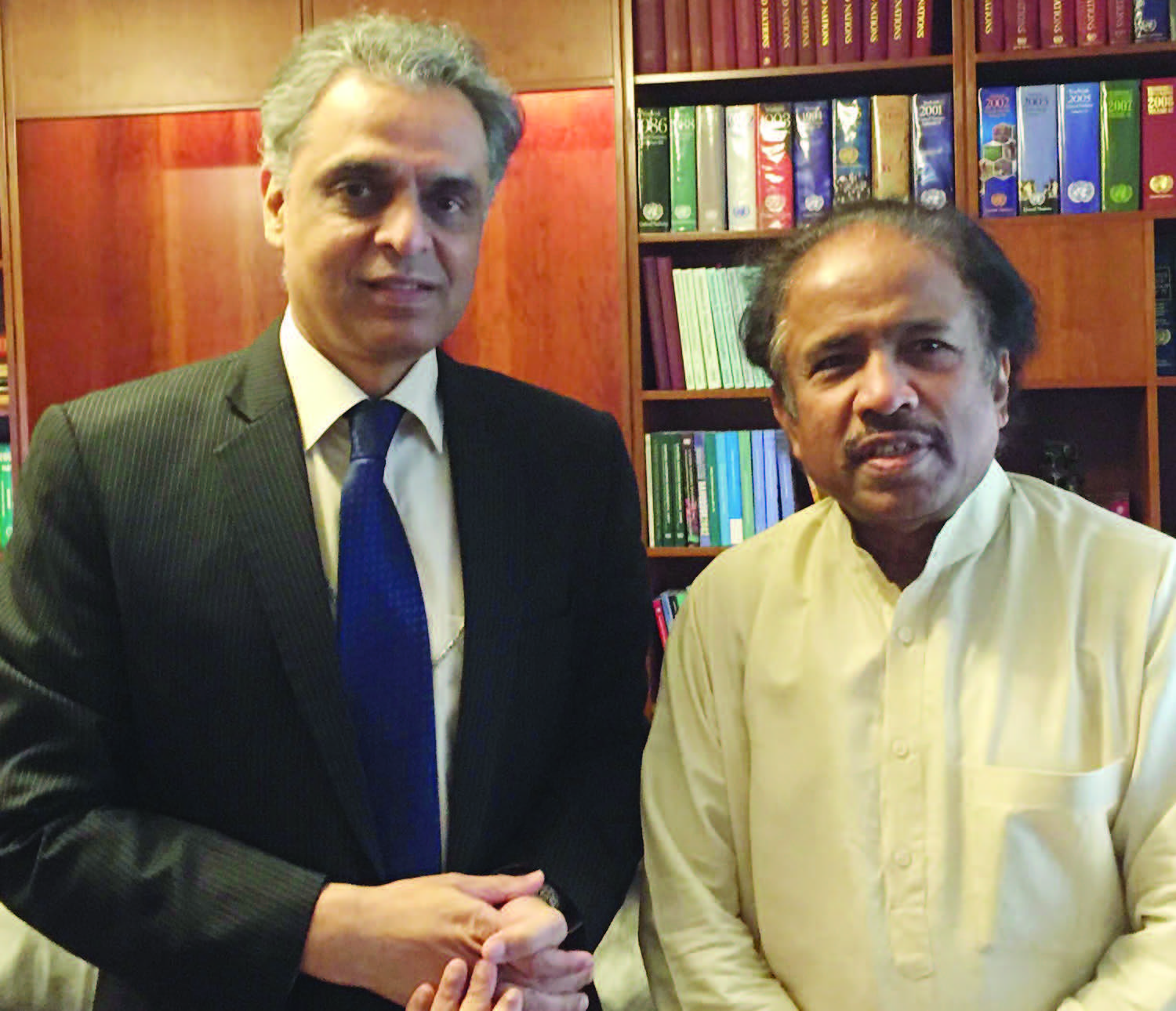
  • Violin maestro and Padma Bhushan awardee Dr L Subramaniam calls on Ambassador Syed Akbaruddin

    Violin maestro and Padma Bhushan awardee Dr L Subramaniam calls on Ambassador Syed Akbaruddin

    Violin maestro and Padma Bhushan awardee Dr L Subramaniam called on India’s Permanent Representative to the United Nations Ambassador Syed Akbaruddin at the Indian Mission in Manhattan New York on Tuesday, July 12 and discussed matters of common interest.

  • In a never-before sharp rebuttal at UN, India says Pakistan “extols virtues of terrorists”

    In a never-before sharp rebuttal at UN, India says Pakistan “extols virtues of terrorists”

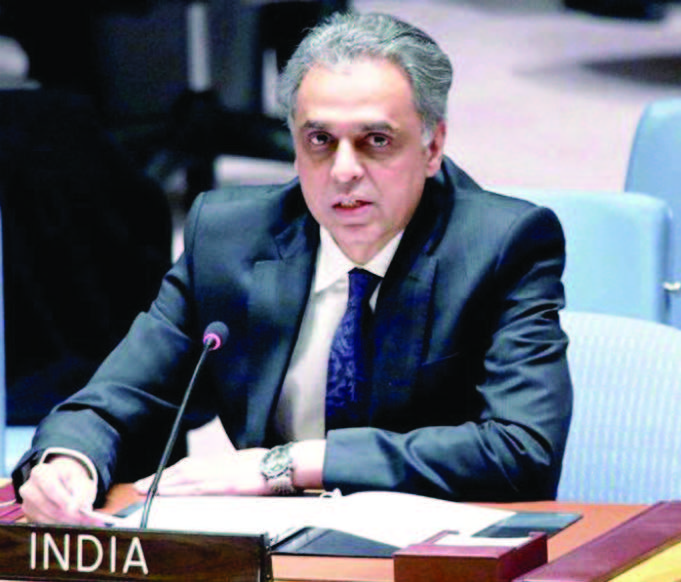
    UNITED NATIONS (TIP): India’s Ambassador to the UN Syed Akbaruddin responded sharply to the remarks made by Pakistan’s envoy Maleeha Lodhi on Kashmir and Wani’s killing during a debate on human rights in the 193-member UN General Assembly here on Wednesday, July 13.

    Strongly hitting back at Pakistan for raising in the United Nations the issue Indian Ambassador has said Pakistan “extols” the “virtues” of terrorists and uses terrorism as a state policy towards the “misguided end” of coveting the territory of others.

    Earlier, in her statement, Pakistan’s envoy Ms. Lodhi, besides raising the Kashmir issue, also mentioned the “extra-judicial” killing of Wani, whom she described as a “Kashmiri leader”, by Indian forces.

    Ms. Lodhi, who has regularly raised the issue of Kashmir at various U.N. fora, termed Wani’s killing as the “most chilling recent example” of “human rights violations” by Indian forces in Kashmir.

    Alleging that the denial of self-determination to Kashmiri people had led to arbitrary detentions, summary executions and other “atrocious” violations, she said, “Its most chilling recent example is the extra-judicial killing last week of a Kashmiri leader, Burhan Wani, shot to death by Indian forces along with dozens of other innocent Kashmiris.”

    In his statement, which sources here termed as perhaps the hardest-hitting against Pakistan in recent times, Mr. Akbaruddin said it is regrettable that Pakistan attempted to “misuse” the U.N. platform.

    “Regrettably, earlier today we have seen an attempt at misuse of this U.N. platform. The attempt came from Pakistan; a country that covets the territory of others; a country that uses terrorism as state policy towards that misguided end; a country that extols the virtues of terrorists and that provides sanctuary to U.N.-designated terrorists; and a country that masquerades its efforts as support for human rights and self-determination,” he said.

    “The international community has long seen through such designs. Cynical attempts, like the one this morning therefore, find no resonance in this forum or elsewhere in the United Nations,” he noted.

    Ambassador Akbaruddin asserted that Pakistan’s “track record” failed to convince the international community that it should gain membership of the Human Rights Council in this very session of the UNGA.

    “We remain strongly committed to the promotion and protection of all human rights for all through pursuit of dialogue and cooperation,” he added.

    Over 30 people have been killed and more than 250 injured in clashes between protesters and security personnel after Wani’s killing last week.

    The U.N. has expressed concern over the tensed situation in Kashmir, with U.N. Secretary General Ban Ki-moon calling on all parties to exercise “maximum restraint to avoid further violence and hopes that all concerns would be addressed through peaceful means.”

  • Twitter Blocks ‘HafizSaeedLive’ Account

    Twitter Blocks ‘HafizSaeedLive’ Account

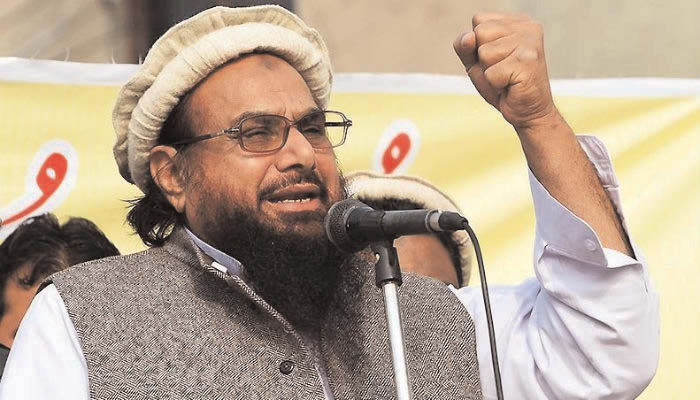
    Twitter on Thursday, July 14, has blocked the account of Jamaat-ud-Dawa (JuD) chief and 2008 Mumbai terror attacks mastermind Hafiz Saeed.

    The micro-blogging site apparently on its own took the action against the JuD chief.

    The Twitter handle ‘HafizSaeedLive’ had frequent updates from the JuD chief.

    The Twitter account had Saeed’s picture and claims to be a philanthropic organization also tweeted in Hindi on the JNU backlash back in February.

    However, there is another Twitter account @HSaeedOfficial which has a similar picture and claims to be the same organization.

    The United Nations declared JuD a terrorist organization in December 2008 as also Saeed who was also individually designated by the United Nations under UNSCR 1267 in December 2008.

    Pakistan has said that there is no case against Saeed and that he is free to move in the country as a Pakistani national.

    India has repeatedly demanded Pakistan to hand over Saeed for questioning over his role in the 2008 Mumbai attacks that claimed 166 lives.

    JuD was banned in 2002 by Pakistan but later a court lifted the ban due to lack of evidence on the group’s involvement in militancy.

    The group is banned by the US, the EU, India and Russia as a terror organisation.

    In June 2014, the US declared JuD a subsidiary of terror group Lashkar-e-Toiba.

  • Indian Gets UN Honour For Corporate Sustainability Initiative

    Indian Gets UN Honour For Corporate Sustainability Initiative

    UNITED NATIONS:  An Indian social entrepreneur has been named among 10 “champions and pioneers” by UN Chief Ban Ki-moon under the world’s largest corporate sustainability initiative that calls on companies to align with universal principles of human rights, environment and anti-corruption.

    Zubaida Bai, the founder of ‘ayzh’, a for-profit social venture providing health and livelihood solutions to impoverished women worldwide, was named among the 10 ‘2016 Global Compact SDG Pioneers’, an initiative launched by UN to search for “entrepreneurs” who can play a pivotal role.

    The UN Global Compact, the world’s largest corporate sustainability initiative, supports companies to do business responsibly by aligning their strategies and operations with ten principles of human rights, labour, environment and anti-corruption; and to take strategic actions to advance broader societal goals, such as the UN Sustainable Development Goals (SDGs), with an emphasis on collaboration and innovation.

    Mr Ban announced the 10 pioneers at the Global Compact Leaders Summit in the city this week.

    Congratulating the honorees, Mr Ban said that he counts on their “strong commitment and engagement” to help businesses seize the opportunities of the SDG era.

    “All of you are leaders in the campaign for a world without poverty, a thriving planet, a vibrant and inclusive global economy and a life of dignity for all.”

    “This is the vision of the Sustainable Development Goals, agreed upon by the Member States of the UN in September last year,” he said at the summit.

    The Leaders Summit aims to jump-start business action everywhere on the SDGs.

    To that end, the Global Compact unveiled a multi-year strategy to drive business awareness and activity that supports the achievement of the goals by 2030.

    Noting that trillions of dollars will be invested in infrastructure in the coming years, he said that the Paris Agreement and the SDGs give the private sector an unprecedented opportunity to create clean-energy, climate- resilient, sustainable economies.

    “We are at a decisive moment in the shift to sustainable and inclusive markets,” continued the Secretary-General, noting that the first step in this regard would be to mobilise the global business community as never before.

    “All businesses, everywhere, can and should play a role in improving our world. That starts with integrity – doing business right,” he said.

  • COLOMBIA, FARC REBELS SIGN HISTORIC CEASEFIRE

    COLOMBIA, FARC REBELS SIGN HISTORIC CEASEFIRE

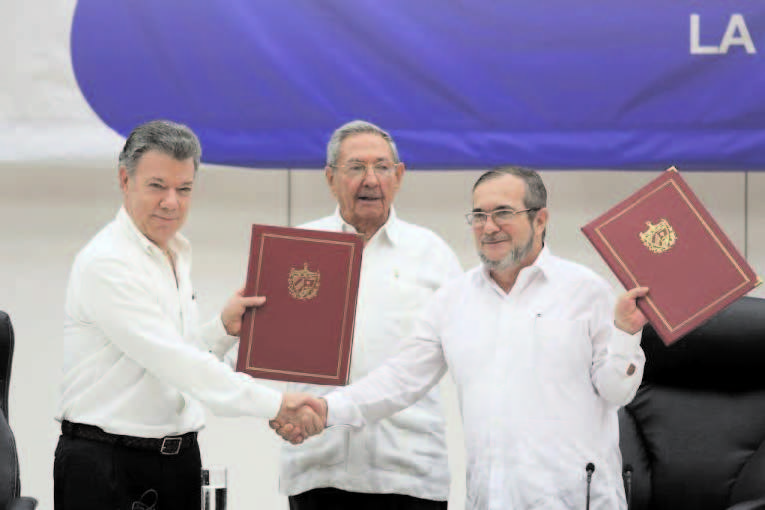
    HAVANA/BOGOTO (TIP):The Colombian government and FARC rebels signed a ceasefire and disarmament agreement on June 23, one of the last steps toward ending a half-century conflict that has killed hundreds of thousands of people.

    The deal puts a definitive end to fighting in Latin America’s longest civil war, which has torn the country apart with shootings and bombardments in its coca-rich jungles and hills.

    President Juan Manuel Santos and FARC leader Timoleon Jimenez shook hands and smiled after negotiators signed the deal at a ceremony in Cuba.

    The deal establishes “a bilateral ceasefire and end to hostilities and the definitive laying down of arms,” according to the text.

    “This is a historic day for our country,” Santos said in a speech to assembled leaders including UN Secretary General Ban Ki-moon.

    “After more than 50 years of confrontations, deaths, attacks and pain, we have put a final end to the armed conflict with the FARC.”

    Disarmament will begin after the signing of a full final peace agreement, expected within weeks.

    “Let this be the last day of the war,” Jimenez said.Thursday’s agreements “leave us on the verge of completing a final accord relatively soon,” he added.

    The final deal “will allow us to return at last to legal political activity through peaceful and democratic means.”

    In the Colombian capital of Bogota, crowds gathered to watch the announcement on a big screen.

    One man, Camilo Gonzalez, was moved to tears.

    “It has been a tragic journey. Millions of victims, people displaced, fighting, broken dreams,” he said.

    “But I think now we have reached a moment of hope.”

    Under the agreement, the Revolutionary Armed Forces of Colombia (FARC) must hand over its weapons to United Nations monitors within six months.

    The FARC’s members — an estimated 7,000 or so — will gather in “normalization zones” for a demobilization process.The sides also agreed to government action against “criminal organizations” blamed for fueling the conflict.

    The United States congratulated Colombia. “We will stand ready to help the Colombian people as they work toward a just and lasting peace,” said US National Security Advisor Susan Rice.

    The European Union’s foreign representative Federica Mogherini in a statement called it a “a turning point in the Colombian peace process.”

    “Now all efforts must be devoted to reaching a final comprehensive agreement that will pave the way to durable peace in the country” and justice for victims, she said.

    The Colombian conflict started in the 1960s as a rural uprising for land rights that spawned the communist FARC.

    The conflict has drawn in various leftist rebel groups, right-wing paramilitaries and drug gangs over the decades.

    It has left 260,000 people dead, 45,000 missing and nearly seven million displaced, according to official figures.

    Human rights groups say atrocities have been committed on all sides. Many families are still searching for missing loved ones.

    Thursday’s deal resolves one of the final points in peace talks between the government and the FARC, the country’s largest rebel group.

    However, the means of implementing the final peace deal remain to be settled after three-and-a-half years of negotiations.The two sides said they would wait for the courts to rule on whether a referendum can be held to endorse the accord, and would accept the court’s decision.

    Although peace with the FARC would virtually end the conflict, other armed groups are still operating in Colombia.

    A bid to hold peace talks between the government and the second-biggest rebel group, the leftist National Liberation Army (ELN), has stumbled because of its alleged kidnappings.

    “The activity of the ELN above all and the criminal gangs means that we cannot yet talk of a complete end to the armed conflict,” said Kyle Johnson, Colombia analyst for the International Crisis Group.

    (AFP)

  • International Day of Yoga celebrated at the UN

    International Day of Yoga celebrated at the UN

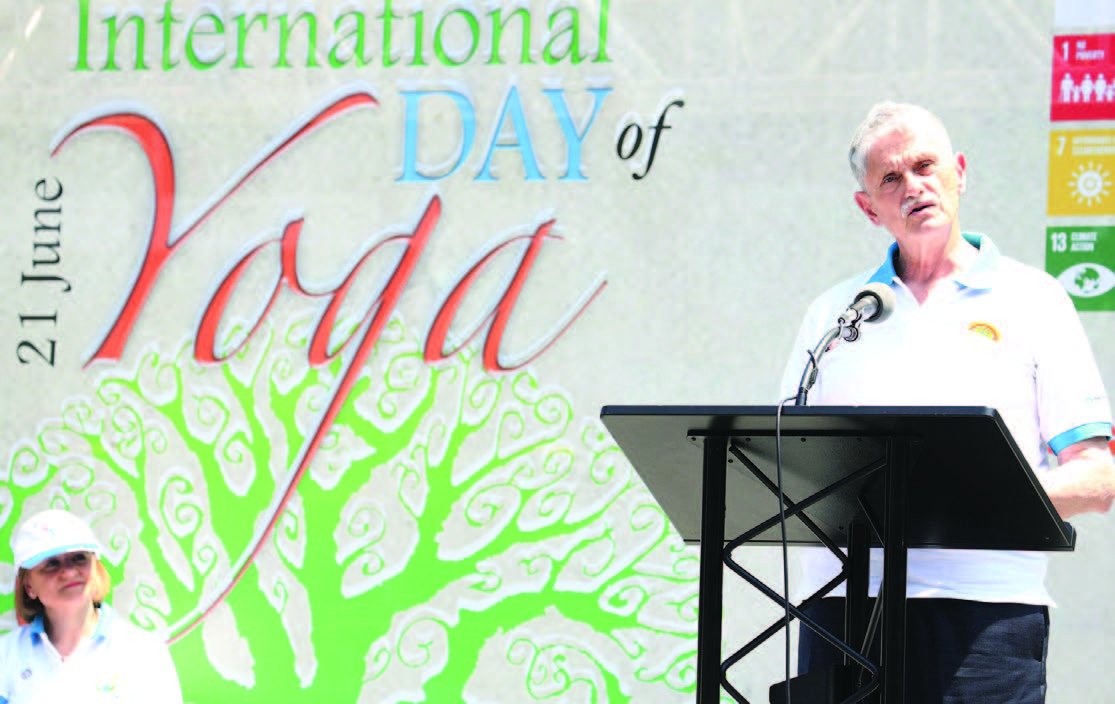
    UNITED NATIONS (TIP): The Second International Day of Yoga was celebrated at the United Nations June 21, 2016. Speaking on the occasion, India’s Permanent Representative to the United Nations, Ambassador Syed Akbaruddin said the celebration of IDY at the UN “has a special resonance” since it was here that the summer solstice was chosen for the IDY. He felt pleased to state that a record number of nationalities-135- were represented at the Yoga Day celebrations. He extended a hearty welcome to all.

    United Nations Secretary General Ban ki-Moon in his message said, “This year’s observance of the International Day of Yoga highlights the important role healthy living plays in the realization of the Sustainable Development Goals, adopted last year by all 193 United Nations Member States.”

    Sadhguru teaching Yoga at the International Yoga Day celebrated on 21st June 2016 | Photos / Mohammed Jaffer-SnapsIndia
    Sadhguru teaching Yoga at the International Yoga Day celebrated on 21st June 2016 | Photos / Mohammed Jaffer-SnapsIndia

    In his Video message PM Narendra Modi described Yoga as “invaluable gift of ancient India”.

    The External Affairs Minister Sushma Swaraj said, “We all are participants in this great celebration of health and spirituality”.

    Mogens Lykketoft, President of the 70th session of the United Nations General Assembly described Yoga as a union of mental, physical and spiritual faculties.

    Ms. Cristina Gallach, UN Under-Secretary-General for Communications and Public Information and the Yoga Guru Sadhguru also spoke on the occasion. Sadhguru gave lessons in Yoga.

    A large number of diplomats participated. India's PR to the UN, Ambassador Syed Akbaruddin is seen here doing Yoga with fellow diplomats
    A large number of diplomats participated. India’s PR to the UN, Ambassador Syed Akbaruddin is seen here doing Yoga with fellow diplomats
  • After CEA, Swamy hits out at another bureaucrat

    After CEA, Swamy hits out at another bureaucrat

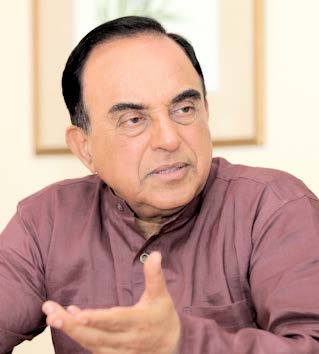
    NEW DELHI (TIP): BJP MP Subramanian Swamy on June 23 appeared to target Economic Affairs Secretary, Shaktikanta Das, which prompted Finance Minister Arun Jaitley to call it an “unfair and false” attack. Hurling veiled charges at Das, Swamy, in a morning post on his Twitter handle, said there is a “property deal case pending against him (Das) for assisting PC (Congress leader P Chidambaram) swallow Mahabalipuram prime locations”.

    The Rajya Sabha member demanded that Das, an IAS officer of the 1980 batch, be repatriated to Tamil Nadu, his home cadre.

    Jaitley, who is on a five-day official trip to China, tweeted: “An unfair and false attack on a disciplined civil servant in the finance ministry”.

    The finance minister had earlier stated that political leaders should refrain from taking on officers restrained by their office compulsions.

    Das is the latest among the senior bureaucrats and technocrats Swamy has targeted of late, which is turning out to be an embarrassment to the BJP.

    On Wednesday, Swamy took on Chief Economic Advisor Arvind Subramanian, demanding that he be sacked for taking an anti-India position on the Intellectual Property Rights issue at the United Nations. He had also charged Subramanian with encouraging the Congress party to take a stiff stand on the GST Bill, which is still pending in Parliament.

    Jaitley had defended Subramanian saying the CEA enjoyed “full confidence” of the government and his advices on several occasions had been of “great value”. When asked to comment on Jaitley and the BJP not endorsing his views on Subramanian, Swamy said, “Let him (Jaitley) say what he wants… I have nothing to do with what Jaitley says. I can talk to the party President or the Prime Minister.” “Will talk to them when required, right now it’s not needed as I have said what I had to say,” he insisted.

    An unrepentant Swamy added to his Wednesday’s rant against the CEA and said he was willing to “suspend” his attack on Subramanian provided the government still considers him
    “patriotic” despite his “anti-India stand”.

  • UN Women announces American actor and singer Anne Hathaway as Goodwill Ambassador

    UN Women announces American actor and singer Anne Hathaway as Goodwill Ambassador

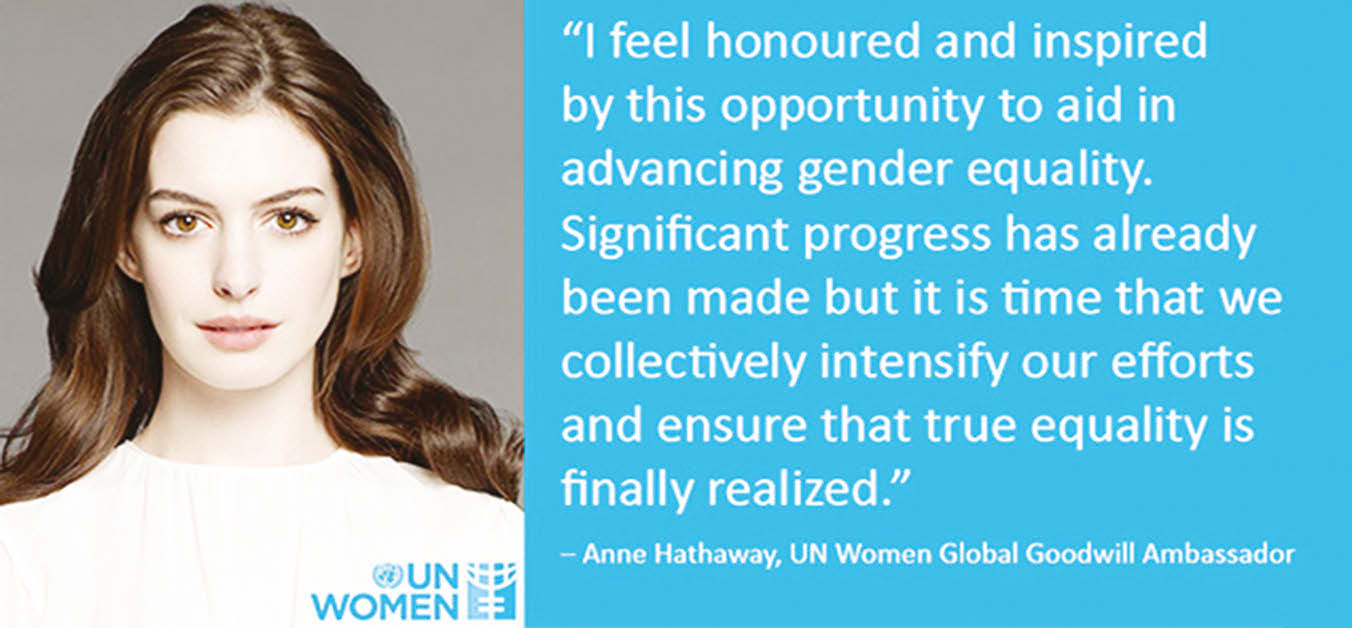
    NEW YORK (TIP): UN Women, the United Nations organization dedicated to gender equality and the empowerment of women, on June 15, announced the appointment of American award-winning actor Anne Hathaway as Global Goodwill Ambassador. A long-standing supporter of women’s and girls’ rights, Ms. Hathaway will put the spotlight on the issue of the unequal burden of care work in the home as one of the key barriers to gender equality, working internationally to advance the adoption and implementation of policies that will bring measurable change. These include affordable childcare services and shared parental leave at both government and corporate levels.

    “The appointment of Anne is timely because this year UN Women is driving hard to foster more positive mindsets and practical arrangements around workplaces that build and support equality for women,” stated Phumzile Mlambo-Ngcuka, UN Under-Secretary-General and UN Women Executive Director. “The ‘motherhood penalty’-which means that when they become mothers, women’s pay and opportunities at work suffer-is a particularly insidious demonstration of gender inequality in the workplace. For too long it has been difficult or impossible to view raising a child as being truly an equal responsibility for both parents.

    “Stereotypes that make it hard for fathers to take time away from work to care for a child are outdated leftovers from the ‘male breadwinner’ model and have no place in today’s mixed workforce. Well-implemented parental leave is just one way for employers to demonstrate that they understand the value of their staff-both male and female,” added Ms. Mlambo-Ngcuka. “To make the case for how this will increase opportunities for women we needed an advocate who had the intellect and passion to tackle this complex issue. Within moments of meeting Anne I realized that we had found our woman. We are truly honored to have her onboard.”

    Childcare services and parental leave are two ways for employers and governments to demonstrate that they understand the value of their people. Just as they hinder women’s equal participation in the workforce, rigid gender roles keep men stuck in harmful cultural stasis. Consumed by a culture of overwork that penalizes them for taking time off for family-care responsibilities, men too face dire consequences from our failure to value care. Failing to involve men in the conversation about care as a core component of gender equality only calcifies harmfully rigid social norms about gender overall.

    When it comes to equality, Ms. Hathaway is a committed voice for change. She previously served as an advocate for Nike Foundation and travelled to Kenya and Ethiopia to raise awareness on child marriage. In 2013, Ms. Hathaway provided the narration on ‘Girl Rising,’ a CNN documentary film, which focused on the power of female education as it followed seven girls around the world who sought to overcome obstacles and follow their dreams.

    “I feel honored and inspired by this opportunity to aid in advancing gender equality. Significant progress has already been made but it is time that we collectively intensify our efforts and ensure that true equality is finally realized,” said Ms. Hathaway.

    Women’s economic empowerment is one of UN Women’s core strategic pillars, and a priority focus under Ms. Mlambo-Ngcuka’s leadership.

  • Sustainable Development Goals can accelerate action towards achieving gender equality: Lakshmi Puri

    Sustainable Development Goals can accelerate action towards achieving gender equality: Lakshmi Puri

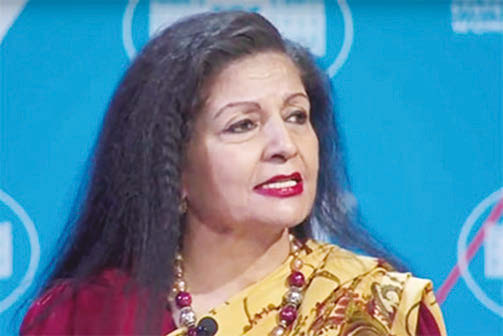
    WASHINGTON (TIP): UN Women Deputy Executive Director Lakshmi Puri spoke at the first-ever United State of Women Summit on 14 June 2016. Convened by President of the United States Barack Obama and First Lady Michelle Obama, the Summit gathered inspirational speakers and aimed to discuss key gender equality issues, including women’s economic empowerment and violence against women.

    Ms. Puri took part in the second plenary, on economic empowerment. The only high-level United Nations official attending the White House Summit, she spoke about how the Sustainable Development Goals can accelerate action towards achieving gender equality, and the importance of engaging youth and men and boys in the work to achieve gender equality.

    In her speech at the summit, Ms. Puri said: “Promising to ‘leave no one behind’, the 2030 Agenda and its 17 Sustainable Development Goals address a fundamental environmental, economic and social issues and position the achievement of gender equality and women’s empowerment as a precondition and necessary outcome of sustainable development”.

    Read More

  • Ambassador of India to the United Nations to Visit the Hunter’s Point Community Middle School in Queens

    Ambassador of India to the United Nations to Visit the Hunter’s Point Community Middle School in Queens

    NEW YORK CITY (TIP): Ambassador of India to the UN Syed Akbaruddin @AkbaruddinIndia will visit the Hunter’s Point Community Middle School in the Long Island City section of Queens on Friday, June 17th to speak with a seventh grade NYC Junior Ambassadors classroom about his role in New York City and with the United Nations. The time of the visit will be 11am.

    NYC Junior Ambassadors is a program of the Mayor’s Office for International Affairs and is an exciting initiative focused on engaging 7th graders in all five boroughs of New York City to see themselves as global citizens through a connection with the United Nations. Through this unique program nearly 275 students have received curated tours of the United Nations New York campus. This year 11 students at the Hunters Point Community Middle School visited the United Nations as part of the program and the visit of Ambassador Akbaruddin to their classroom constitutes the second part of this program. The class is incorporating the United Nations into their curriculum through learning about the United Nations Sustainable Development Goals (SDGs).

    More about NYC Junior Ambassadors can be found at http://www1.nyc.gov/site/international/pro grams/nyc-junior-ambassadors.page About the Mayor’s Office for International Affairs: The New York City Mayor’s Office for International Affairs works to foster positive relations and encourage collaboration between the international community and New York City’s agencies and local neighborhoods. New York City is home to the largest diplomatic community in the world -193 Permanent Missions, 114 Consulates and the headquarters of the United Nations.

  • South Korea sends military vessels to repel Chinese boats

    South Korea sends military vessels to repel Chinese boats

    SEOUL (TIP): South Korean military vessels have begun an operation to repel Chinese fishing boats illegally harvesting prized blue crabs from an area near Seoul’s disputed sea boundary with North Korea.

    South Korea’s Defense Ministry said on Friday that four naval and marine boats are in neutral waters around Ganghwa island for an operation approved by the United Nations Command that governs the zone.

    The operation comes days after South Korean fishermen towed away two Chinese fishing boats catching crabs south of the sea boundary with North Korea and handed them over to local South Korean authorities. North Korea said in response that South Korean fishing and naval vessels had invaded their territory.

    Seoul has called for Beijing to employ tougher measures against Chinese boats illegally fishing in South Korea-controlled waters.

    (AP)

  • Minister for Health and Family Welfare, JP Nadda in New York

    Minister for Health and Family Welfare, JP Nadda in New York

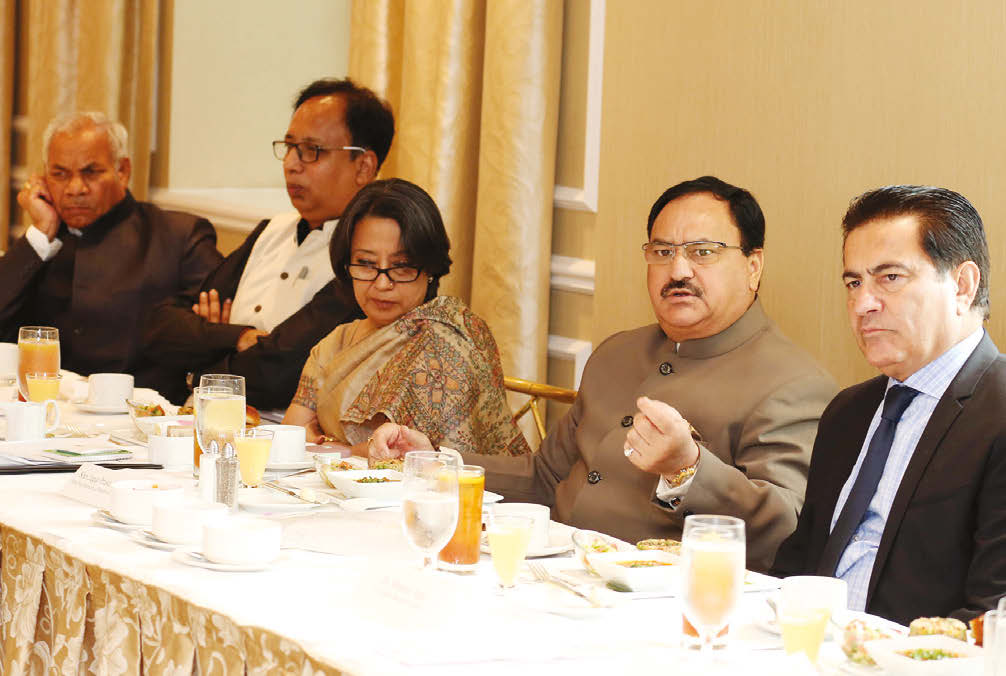
    NEW YORK (TIP): India’s Minister for Health and Family Welfare, JP Nadda attended a high level Conference on HIV /Aids at the United Nations on 8th June.

    Minister JP Nadda addressing the conference, June 8
    Minister JP Nadda addressing the conference, June 8

    Mr. Nadda also attended   a USIBC luncheon meeting on June 9. He spoke at length on pharmaceutical industry and health issues.

    Seen in the picture are Consulate General of India NY Riva Ganguly Das to the left and USIBC President Mukesh Aghi at right.

  • Feminine Divinity, Symbolism of Shakti and Women’s Empowerment in Contemporary India

    Feminine Divinity, Symbolism of Shakti and Women’s Empowerment in Contemporary India

    Since 1947, India has been somewhat isolated globally because it stands alone and is not part of any of the usual groups or clubs. India is not a white or western country, it is not an Islamic country, it is not an Arabic country, it is not a communist country and it is certainly not a military dictatorship. It was part of non-aligned movement which did not have any natural commonality in its members. India still remains isolated because it stands alone on many international fora owing to India’s unique ancient history. India was described as a “functioning anarchy” by a former US ambassador to India John Kenneth Galbraith. Break-up or disintegration of India has been ritually predicted and invoked by so many western analysts and thinkers. Numerous international conspiracies have been hatched since 1947 to materialize support for further partition of India. Some have even refused to accept the nation-hood or statehood of India in a geo-political sense. Others have erroneously credited the British colonial empire for bestowing the sense of nationhood on India as a unique colonial contribution.

    As India changes its direction and gathers some self-confidence, there has been resurgence of talk in the mainstream media and academia for the last two years about the threats facing the so-called “Idea of India”. The terms like “Idea of India” and “Intolerance” have been utilized as code-words or proxy to pillory Hindu traditions and Indian Renaissance. There seems to be an obvious nexus between Indian mainstream media and the western mainstream media in an exercise in bashing India, Indian tradition and Indian growth trajectory. Isolated incidents have been magnified. Indeed, the naysayers and the “Nattering Nabobs of Negativism” have predicted impending doom for India. Heinous crimes against women, though very unfortunate, have been given so much prominence in the media as if they were normative occurrence in India without taking into consideration the positive aspects of Indian society and Indian traditions. The movie “India’s Daughter” by Leslee Udwin was a prime example of this India bashing exercise. The western protagonists and their Indian acolytes, owing to an inherent Hindu-phobic and anti-India bias, have failed to take into consideration the frequency of such crimes in US or UK or elsewhere in the world presenting a very sensational and distorted picture of India. Powerful international and local forces are at work to portray our Hindu tradition as sexist, anti-women, misogynist and anti-feminist. India’s leftists, liberals, card-carrying communists, caste-ists, Islamists and feminists have built up a de facto “alliance of convenience” and a political “coalition of the willing” in conjunction with the western NGOs that funnel monies to these local groups. There is a method to this madness. Alliance of Indian feminists, nay, Femi-nazis with their western sponsors poses a real national security threat to the fabric of the Indian nation. Women are the real fabric of the nation. A nation can be defeated only if its women are subjugated by fraud, deception or brute force. While pillorying Indian (read Hindu) society as patriarchal, misogynist and anti-women, these groups fail to appreciate the plurality and the extreme diversity of Indian traditions with still prevalent matriarchal subcultures in the contemporary Indian society, e.g.; the Nairs in Kerala, some sections in Kinnaur, Himachal Pradesh and the Khasis in Meghalaya. People in Kinnaur, HP follow a matriarchal system; they also practice polyandry following the historical example of the Pandavas from Mahabharata times.

    Ancient India and Concept of Devi, the Divine Femininity:

    In this article we will recapitulate the venerable place, honor and respect given to women in the ancient Hindu tradition. We will also review the historical vicissitudes of the status of women in ancient, medieval, colonial eras and in modern India. We also delineate and emphasize those foreign factors that adversely influenced the status of women in the Indian society and subjugated them in the colonial era that lasted approximately one thousand years. We also discuss the very uniquely Hindu concepts of Devi (female divinity), Shakti and the veneration of Shakti as the ultimate mother and its symbolic use in women’s empowerment in the contemporary Indian society. Female divinity is unique to Hinduism. The word Devi in Sanskrit means the illuminated or the illustrious one. Like the holy trinity of Brahma, Vishnu and Mahesh or Shiva, there is divine female trinity of Saraswati, Lakshmi and Uma, all three equally holy, divine and worthy of worship in their own right. Woman always comes first in various Hindu traditions, be they Vaishnava, Shaiva, Tantra, Vama-marga, Vedanta etc. That is why we have expressions like Sita-Ram, Radhey-Shyam and Gauri-Shankar. It is never Ram-Sita, Shyam-Radha, Narayan-Laxami or Shankar-Gauri. Shakti comes first, and Shiva comes afterwards. Hindu Males always follow, venerate and vow to protect the females, as the divine mother who gives birth, as loving daughter to be given away as kanyadanam during marriage (the ultimate danam a Hindu male can do for the perpetuation of human race), as sister to be protected or as wives to be cherished as ardhangini. The concept of mother-goddess is so deeply enshrined in Hinduism that per Bhagwat Purana there are seven mothers: the one who gives birth (biological mother), wife of your teacher (gurupatni), wife of priest (brahmani), queen (rajpatni), cow (dhenu or gaumata), one who raises you (foster-mother or dhatri) and earth (Prithavi). There is a saying: mata prithavi, putroham prithivyam!

    All Hindu rituals are conducted primarily by women, men have to sit quietly and follow the women. Woman is the leader; man is the follower and the participant. A Hindu man is incomplete without his wife during religious rituals and yajanas just as even Rama was incomplete without Sita during the ashwamedha yajana!  He had to have a statue of Sita sit by his left side while performing the yajana. During the festival of Navaratras, the Devi, the feminine divinity, the Goddess is worshipped in her nine different forms! These nine different forms are Durga, the invincible mother, Bhadrakali, the mother of fortune and wealth, Amba, the universal mother, Annapoorna that feeds the world by providing Anna, Sarvamangala that brings peace and joy to the world, Bhairavi, the divine mother that brings good to good people & evil to bad people, Chandika, the fierce one, Saraswati, the goddess of learning & beauty, Bhavani, the Goddess of mercy, and Mookambika, the Goddess of Shiva and Shakti. The symbolism that woman comes first and the man just follows her becomes apparent when one watches the contemporary Hindi TV serials be it Kum Kum Bhagya, Pavitra Rishta, Suhasini or Woh Rahane Waali Mahlon ki! The female lead character always epitomizes the Hindu woman as Shakti, as a warrior princess or Durga who fights for her rights, defeats the evil and always protects the good but in that arduous, long-drawn journey, she also sacrifices her personal needs while nurturing others in her family!

    Let us make no mistake. There are enormous cross-cultural differences in the gender roles and gender behaviors in Indian society versus western societies. However, in Hindu context the women have traditionally exercised tremendous political power through their fertility, i.e. progeny unlike the West where women exercise their power and autonomy using their sexuality and art of seduction. Indian society has historically emphasized dignity and honor of women instead of a pseudo-equality and gender role substitutability. The concept of the divine mother as the originator of the srishti is so unique to Hinduism only. Invoking divine qualities in the mother Goddess gives a unique and special status to Hindu women who have attained motherhood and in no way diminishes them for exercising their fertility unlike so in Western societies. In fact, the suffix or the title Sreemati in Sanskrit literally means the lady who possesses wealth and prosperity!

    A famous quote from Manu Smriti, that has been demonized by the leftist cabal as anti-women, states:

    यत्र नार्यस्तु पूज्यन्ते रमन्ते तत्र देवता: ।

    यत्रैतास्तु न पूज्यन्ते सर्वास्तत्राफला: क्रिया: ।।

    Yatra Naryastu Pujyante Ramante Tatra Devata


    Yatraitaastu Na Pujyante Sarvaastatrafalaah Kriyaah

    Meaning: “Where Women Are Honored, Divinity Blossoms There; And Where They Are Dishonored, All Action Remains Unfruitful.”

    That is the essence of and epitome of the exalted status given to women in ancient Indian culture and Hindu tradition.

    Concept of Shakti in Hindu Tradition:

    Shaktism is the worship of the Supreme being as the Divine mother in the form of Shakti or Devi. Etymologically, the word Shakti in Sanskrit is derived from the “shak” dhatu or root which literally means “CAN DO”! Shakti literally means one who “CAN DO”! Shakti is the eternal supreme power. Shaktiman is the one who has Shakti, who is endowed with Shakti, i.e. energy! Shakti is the one who can accomplish victory over evil by the virtue of her creative energy force. In Hindu traditions, woman is the vessel of Shakti. The identification with Shakti stipulates woman as a fountainhead of both creative and destructive power. Each Hindu God has his Shakti, Brahma has Saraswati, Vishnu has Lakshmi and Shiva has Gauri or Parvati. Each is incomplete without his Shakti. Unlike Hinduism, in Christianity the myth has been created that Jesus was celibate and his historically acknowledged wife Mary Magdalene was a fallen woman. A prostitute who had merely become his disciple! In Islam, the woman has just one-fourth the value of a man in testamentary capacity! Shakti, the supreme energy force, is the personification of God in all the Indic traditions including Hinduism, Sikhism, Jainism and Buddhism. The Tibetan New Year Losar is essentially a celebration of Shakti. Even the 10th Sikh Guru, Govind Singh worshipped goddess Durga and named his fighting sword Chandi as a symbolism of Shakti.

    There are four Adi Shaktipeethas in Shakti tradition. Fifty-one Shaktipeethas are located all over the entire Indian subcontinent. In ancient Indian history and literature (carried through oral traditions), there are honorable mentions of women as Shakti, a divine feminine energy force or Urja. Examples are Mahishasur Mardini or Kali, Chandi, Durga a warrior goddess. There are other examples of women warriors in ancient Indian history. Kekayi, the youngest wife of King Dashratha obtained those infamous three boons from him by saving his life in the battlefield. Naturally, the question arises as to what Kekayi was doing in the battlefield except for combat!

    In tantric tradition, the woman is considered of higher status than the man. Tantra stipulates that mortal women are “life-itself” and Goddess-like because they embody the principle of Shakti. The institution of Bhairavi in Tantra and Vamamarga tradition does not suggest exploitation or anti-women attitude of Indian society. Bhairavi in Tantra tradition epitomizes the powerful feminine achievement by embarking a journey of supreme spirituality, sublime sensuality and symbiotic sexuality with her Bhairava who just follows her and is by her side, every step of the way, in her raising the kundalini energy! And yes, Bhairavi is not ashamed of her symbiotic sexuality because it is the ultimate life-force and she is the protagonist, she is the leader (and not the cheer-leader), she is initiator! Bhairavi, in that particular tradition, is neither repressed nor oppressed nor exploited!

  • Muhammad Ali: Indomitable Hero Within and Without

    Muhammad Ali: Indomitable Hero Within and Without

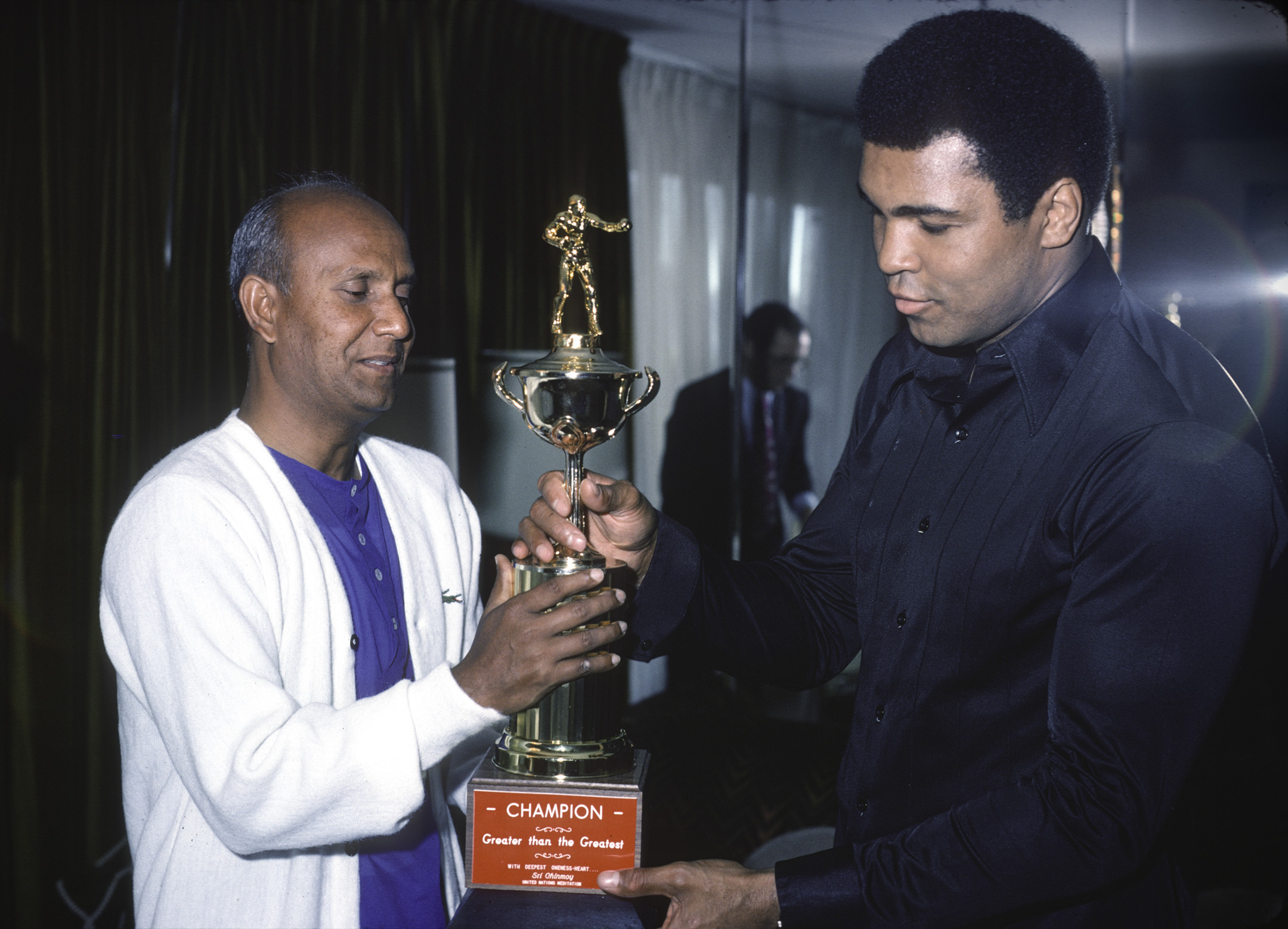
    For decades Muhammad Ali and spiritual leader Sri Chinmoy established a close friendship based on their shared love of God and dedication to fitness and sports.

    During their meeting on the morning of Ali’s title defense fight with Earnie Shavers, September 29th, 1977, they spent an hour together in shared silent prayer. A photo of the two men serenely meditating was placed side by side a photo of Ali powerfully vanquishing Shavers on the front page of The New York Times the following morning.

    Sri Chinmoy, who led the twice-weekly peace meditation at the United Nations for 37 years, told the world’s most beloved athlete Ali, “You are changing the face and fate of mankind. Your very name encourages and inspires. As soon as people hear ‘Muhammad Ali,’ they are inspired. They get tremendous joy. They get such dynamism to be brave and face ignorance…Your heart of oneness with all humanity makes you the greatest.”

    Ali replied to Sri Chinmoy, “My goal is to be like you one day—to be peaceful and out of this sport working for humanity and for God…I want to do something to bring people together, to work for God and to help people.”

    This week members of the Sri Chinmoy Centers worldwide and friends are paying tribute to the memory of Muhammad Ali by performing three songs composed by their teacher about the immortal boxer. The songs were first performed during meetings of Sri Chinmoy with Muhammad Ali and are entitled Greater than the Greatest, Muhammad Ali – Champion Ali, and Indomitable Hero Supreme. They speak of the physical and spiritual greatness of one of the most universally loved figures of our age.

    Many years later, on June 12th, 2003, Sri Chinmoy met again with Muhammad Ali and also his wife, Lonnie, at The Oneness-Family School in Washington, DC. There Sri Chinmoy honored both husband and wife by lifting them together overhead in his signature Lifting Up the World with a Oneness-Heart program. The spiritual luminary said to the beloved boxer, Brother, you were the greatest. You are the greatest. You forever will remain the greatest!”

    Delighted by the honor, Muhammad Ali embraced Sri Chinmoy and sweetly exclaimed, “Brother, you are a great man! Brother, you are a very strong man!”

  • Discussion on the “International Law on Peace and Justice” at the UN Headquarters

    Discussion on the “International Law on Peace and Justice” at the UN Headquarters

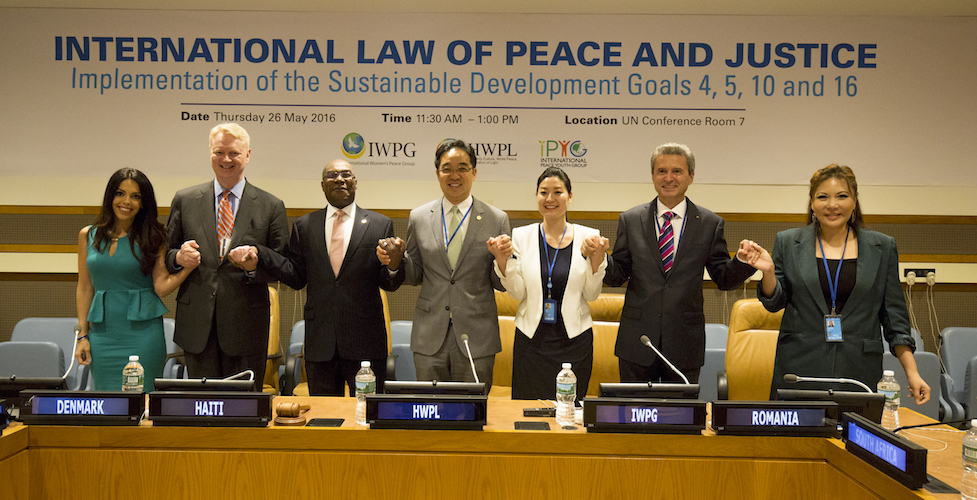
    NEW YORK, NY (TIP): On Thursday May 26th, Ambassadors of Denmark, Haiti, Romania and South Africa and representatives from 15 other Permanent Missions gathered at the United Nations Headquarters to discuss the issues of “International Law on Peace and Justice.” Hosted by Heavenly Culture, World Peace, Restoration of Light (HWPL), an international peace organization, the session drew much attention as it was held in line with the global peace walks held across 52 nations with 300,000 people, celebrating the 3rd Annual Commemoration of the Declaration of World Peace.

    The ambassadors in attendance shared effective national practices to achieve the UN Sustainable Development Goals (SDGs) on quality education, gender equality, reduced inequalities, peace and justice. On the other hand, HWPL introduced the Declaration of Peace and Cessation of War (DPCW) as an effective means of achieving the UN SDGs.

    The Declaration of Peace and Cessation of War was drafted by the HWPL International Law Peace Committee that consists of renowned experts in the field of international law. On March 14th this year, it was then presented to the public with the aim of maintaining international peace and security, leaving an invaluable inheritance of a world free of wars to successive generations.

    The Declaration respects and builds on the principles of the Charter of the United Nations as well as other international instruments such as the Universal Declaration of Human Rights.

    Mr. Man Hee Lee, the Chairman of HWPL, provided guidance in drafting the Declaration. In his commemorative address at the peace walk in Seoul, South Korea, he said “the eyes of the world are focused on us here today … What we must leave as a legacy for our future generations is peace. Is there anything more valuable than such a legacy? No amount of material wealth can compare to peace. But this peace cannot be achieved by one person. Everyone must become a messenger of peace and work together to achieve peace.”

    This year’s peace walks highlighted the global peace advocacy movement, the Legislate Peace Campaign, recently launched to bring all wars to an end by establishing an enforceable law compatible with the “Declaration of Peace and Cessation of War.” This campaign calls on global citizens to unite as one to voice their demand for peace through adding their signatures.

    In New York, women and youth groups as well as peace organizations gathered and signed their support for the Declaration at the Dag Hammarskjold Plaza across the UN Headquarters.

    As of May 25, HWPL reported that not only over 500,000 signatures were collected from 154 countries in less than two months, but also many heads of state have written official letters of support.

    Since the Declaration of World Peace was first proclaimed on May 25 2013, HWPL has worked on its international law initiative to draft an instrument for all States to adopt that ultimately promotes a culture of peace and ceases all wars. This Declaration not only encapsulates and supports all UN SDGs but also serves as a foundation for future works of peace.

  • Modi in US | Highlights from India-US joint statement after Modi-Obama meet

    Modi in US | Highlights from India-US joint statement after Modi-Obama meet

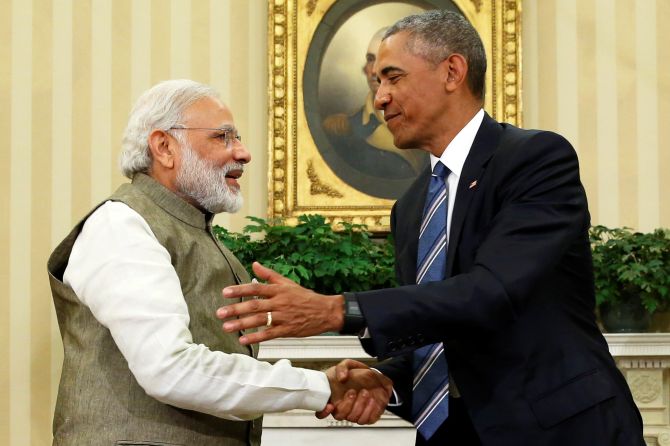
    New Delhi: Support for India becoming a member of the exclusive Nuclear Suppliers Group, agreement on building six nuclear power plants in Andhra Pradesh, backing for India’s stand on terrorism vis-a-vis Pakistan and financial assistance for India’s clean energy initiatives are some of the key takeaways in an exhaustive India-US joint statement released in Washington on Tuesday.

    The document, issued at the end of talks between US President Barack Obama and Prime Minister Narendra Modi, who is on his fourth visit to the US in less than two years, also lays out a road map for broad-ranging India-US collaboration in areas such as defence, trade and cyber security.

    According to the statement, India and the US “pledged to pursue new opportunities to bolster economic growth and sustainable development, promote peace and security at home and around the world, strengthen inclusive, democratic governance and respect for universal human rights, and provide global leadership on issues of shared interest”.

    Obama and Modi noted the “increasing convergence” in the strategic perspectives of India and the US and “emphasized the need to remain closely invested in each other’s security and prosperity”, the statement said.

    On India’s entry into exclusive non-proliferation groups and regimes, the statement said India and the US “looked forward” to India’s imminent admission into the Missile Technology Control Regime.

    “President Obama welcomed India’s application to join the Nuclear Suppliers Group (NSG)… The United States called on NSG participating governments to support India’s application when it comes up at the NSG plenary later this month,” it said.

    In the area of nuclear power production, Obama and Modi welcomed the start of preparatory work for six reactors to be built by Westinghouse Electric Co. in Andhra Pradesh. India and the US Export-Import Bank are to work together on a financing package for the project, the statement said.

    “Once completed, the project would be among the largest of its kind, fulfilling the promise of the US-India civil nuclear agreement and demonstrating a shared commitment to meet India’s growing energy needs while reducing reliance on fossil fuels… the two sides will work toward finalizing the contractual arrangements by June 2017,” the statement said.

    Acknowledging India’s role in the accord agreed to at the Paris climate change talks in November, it said the US was committed to supporting India’s renewable energy programme and was working to spur greater investment in the area. Together, the two countries announced the creation of a $20 million US-India Clean Energy Finance (USICEF) initiative, equally supported by the US and India, which is expected to mobilize up to $400 million to provide clean and renewable electricity to up to 1 million households by 2020.

    The statement also said that Modi and Obama “resolved that the United States and India should look to each other as priority partners in the Asia-Pacific and the Indian Ocean region”.

    In maritime security, India and the US called for ensuring the freedom of navigation and overflight and exploitation of resources as per international law, including the United Nations Convention on the Law of the Sea, and settlement of territorial disputes by peaceful means. This oblique reference is aimed at China which is locked in maritime disputes with its smaller South East Asian neighbours in the South China Sea. China claims the entire South China Sea as its exclusive domain and has imposed flight restrictions and embargoed maritime routes through the disputed area.

    In the area of defence cooperation, which “can be an anchor of stability”, the statement said the US “hereby recognizes India as a major defence partner”. The joint statement said India and the US would “explore agreements which would facilitate further expansion of bilateral defence cooperation in practical ways. In this regard, they welcomed the finalization of the text of the Logistics Exchange Memorandum of Agreement,” which would allow the two countries to provide logistics support, refuelling and berthing facilities for each other’s warships and aircraft.

    The US will “continue to work toward facilitating technology sharing with India to a level commensurate with that of its closest allies and partners. The leaders reached an understanding under which India would receive licence-free access to a wide range of dual-use technologies in conjunction with steps that India has committed to take to advance its export control objectives,” the statement said.

    In a boost for Modi’s Make in India programme, the US would support the Indian initiative to develop defence industries through the export of goods and technologies consistent with US law.

    In the area of cyber security, Obama and Modi said they would deepen cooperation and were committed to enhancing cyber collaboration on critical infrastructure, cyber crime, and malicious cyber activity by state and non-state actors.

    On terrorism, Obama and Modi condemned “the recent terrorist incidents from Paris to Pathankot, from Brussels to Kabul” and “resolved to redouble their efforts, bilaterally and with other like-minded countries, to bring to justice the perpetrators of terrorism anywhere in the world and the infrastructure that supports them”.

    The two countries pledged to work together to combat terrorist threats from extremist groups such as Al Qaida, Da’esh/ISIL (Islamic State), the Pakistan based Jaish-e Mohammad and Lashkar-e-Taiba, besides Indian gangster Dawood Ibrahim and his group and their affiliates “including through deepened collaboration on UN terrorist designations”.

    The two countries have finalised an arrangement to facilitate the sharing of terrorist-screening information and “called for Pakistan to bring the perpetrators of the 2008 Mumbai and 2016 Pathankot terrorist attacks to justice”, the statement said.

    To boost trade, India and the US resolved to “break down barriers to the movement of goods and services, and support deeper integration into global supply chains, thereby creating jobs and generating prosperity in both economies”, the statement said.

    The two leaders agreed to facilitate the freer movement of people of both countries. The US also welcomed India’s interest in joining the Asia Pacific Economic Cooperation forum.

  • Human Rights Abuses: a recurring alarm on Modi’s travels abroad

    Human Rights Abuses: a recurring alarm on Modi’s travels abroad

    As Prime Minister Modi arrives on his fourth visit to the U.S. in the last two years, U.S. lawmakers have sharply criticized India’s human rights record. In a speech in New Delhi, U.S. Senator Benjamin L. Cardin (D-MD), the ranking minority-party member of the Senate Foreign Relations Committee, called on India to “do better” to address issues of violence against women, government corruption, extra-judicial killings, human trafficking and outdated anti-conversion laws that are still in use. “A country must respond to these challenges,” he said.


    History teaches us that ultra-nationalism is a sentiment of superiority and aggression towards others or other countries. It is intrinsically connected to war and imperialism. Therefore, India as a pluralistic nation will be treading on dangerous waters with the ongoing nationalist campaign, and the Prime Minister has a great responsibility to set the right tone for the country.


    Modi faced similar criticisms and faced protest demonstrations from one group or another every time he has touched down on the American soil. However, these strident criticisms from prominent lawmakers on the eve of Modi’s address to a joint session of Congress reveals a deep-seated reservation by many in Washington of a leader who once was denied entry into the country based on his human rights record.

    At a Congressional hearing held a week ago in Washington, Bob Corker (Chairman of the Foreign Relations Committee R-Tenn.) and Timothy M. Kaine (D-VA) questioned State Department officials on India’s human rights issues, including its crackdown on nongovernmental organizations receiving foreign funding such as Greenpeace and Ford Foundation, rising intolerance and India’s recent decision to deny visas to the members of the U.S. Commission on International Religious Freedom who were planning to travel to India.

    Undoubtedly, the Indian American Community as a whole would like to see the bi-lateral relations between the U.S. and India strengthened and the progress achieved in the last decade or so to be consolidated between these two democracies. However, a strategic alliance is a partnership that would require trust and confidence in each other for a long term value creating relationship. There is no doubt that both of these nations need each other in the new world order, and the question is whether these two countries are at a point where they are ready to move forward with such a commitment.

    Therefore, it is pertinent to analyze the visit of the Prime Minister from that vantage point. If the objective of the collaborative relationship is to achieve success for both nations, how can one advance that notion while justifying the denial of visas to a U.S. government body that monitors the core tenets of both of these democracies: freedom and justice? The appropriate action ought to be in assisting each other to achieve these goals and together building a stronger relationship.

    For those who are advocating more reliable protection of religious freedom got a boost recently when Congress upgraded the ‘Frank Wolf International Religious Freedom Act’ giving Administration and the State Department new political tools in monitoring and creating watch lists. The legislation has also upgraded the office to Ambassador-at-large, who will be directly reporting to the Secretary of State. It includes a provision as well directing the President to focus sanctions on individuals who carry out or order religious restrictions. The impact of these rules will eventually be felt across the board while nations draft agreements ranging from Trade to environment and Defense purchases.

    President Obama’s speech in New Delhi, to great discomfiture of Modi, was a parting shot directed at his government to modify its behavior as regards respecting the pluralistic legacy of the modern India. He listed the relevant articles in the Indian Constitution to make his case. Despite the public posture, one could detect a chasm between these two leaders who seem to think and view things from different perspectives.

    I have been told that at a recent dinner party in Washington, a former official was standing in line to greet President Obama. While shaking hands, the official congratulated the President for the bold statement he made in New Delhi. Obama first smiled and let go his hands and ready to greet the next guest, but on second thought, leaned forward, tapped his shoulder and said ‘I meant every word of it.’ That says a volume of the thinking in Washington, especially with this White House.

    However, U.S. is dealing with a different India today that has gained stature as a growing economic power and a global player that has to be respected and may even be courted. For the U.S, the changing dynamics in Asia necessitates new alliances and reliable partnerships. A rising China has created new challenges for the U.S. in that part of the world and past agreements like the Indo-US civil nuclear deal point to a strategy of exploring ways to sustain their global engagement capability. Also, a 4 million strong Indian immigrant community in U.S. has become vocal supporters of close collaboration between these two countries, often lobbying with their Senators and Congressmen.

    Despite all these natural advantages, India seemed to have put in a lot of effort in convincing the U.S. authorities for this ‘state visit’ and the upcoming appearance before the joint session of Congress. There are unconfirmed reports of a quid-pro-quo as regards major defense purchases preceded by a veiled warning of India taking its defense purchases elsewhere if the same level of respect is not accorded to Modi as it was with Dr. Manmohan Singh, his predecessor. It is widely known that the sound of money garners a lot of mileage in Washington just as in any other capital around the world. Apparently, Modi is getting his requital by gaining an opportunity to bloviate before those who once denied him a simple entry visa to the country.

    However, if India has to gain genuine respect and be able to operate from a position of strength and moral clarity, it has to start dealing with some of the issues the lawmakers have raised. Last two years have witnessed growing intolerance in the country with attacks on places of worship of minorities, the murder of secular advocates and harassment of liberal thinkers. People are afraid that even their dietary habits like eating beef could cost them their lives. The HRD ministry has been converted to become a vehicle to promote the ‘Hindutva’ ideology across campuses by shutting down Dalit student organizations and applying sedition charges on students for mere sloganeering.

    BJP and its followers seemed to believe that they have a monopoly in defining what constitutes nationalism, and it has become a cause of confusion and conflict in many university campuses. History teaches us that ultra-nationalism is a sentiment of superiority and aggression towards others or other countries. It is intrinsically connected to war and imperialism. Therefore, India as a pluralistic nation will be treading on dangerous waters with the ongoing nationalist campaign, and the Prime Minister has a great responsibility to set the right tone for the country.

    Indian Diaspora in U.S. is much more a diverse community representing different regions, languages, cultures and faiths than what it is given credit for. According to latest statistics, 51% of the Diaspora consists of Hindus and the rest includes Muslims, Sikhs, Christians, Buddhists and other faiths. Indian Diaspora is primarily taking the shape of Hindu Diaspora due to the cultural identity, and most of the Indians including those who belong to other religions accept it as a practical matter. However, Rashtriya Swayamsevak Sangh (RSS branches outside of India) is becoming increasingly assertive in demanding unflinching patriotism and preservation of Hindu culture and continuing with their efforts to present a monolithic view of the Indian Diaspora to the American public. It is alleged that many of the Diaspora organizations are raising money under the cover of ‘charity’ and ‘development’ to support RSS and its affiliates to wage violence against religious minorities in India.

    There is little doubt that the RSS cadre is playing a prominent role in many of Modi’s visits around the globe, particularly wherever there is a significant Indian community. It is only laudable that the Diaspora is enthusiastic and heartwarming towards any visit of a Prime Minister from their motherland. However, when that community is used as political pawns by turning them into a weapon against those who want to express their grievances; it not only defeats the purpose and good will but rather pits one group against the other and imports the same level of polarization and divisions to the country of their adoption. The recent attempt by Sangh organizations to reserve all 25 grounds on the Capitol Hill on the day of Modi’s visit to address the joint session of Congress is a case in point. That ‘clever’ and calculated maneuver made it almost impossible for any other group to gather near the venue and air their dissenting point of view that is protected under the U.S. Constitution. It is quite obvious to any independent observer that the objective of such action is to stifle criticism and banish any dissent which is contrary to the spirit of democracy, and it is quite appalling to see it happening right here in U.S.

    It is time for the Prime Minister to be more assertive in addressing these concerns at home and abroad and speak out forcefully when human rights violations occur in India. Unless he can align the actions of the radical elements of his party in line with his lofty pronouncements abroad, the human rights issue will continue to cast a shadow on his trips abroad, especially to U.S. Alfred Whitney Griswold who once said the following: “Books won’t stay banned. They won’t burn. Ideas won’t go to jail. In the long run of history, the censor, and the inquisitor have always lost. The only weapon against bad ideas is better ideas”. Let freedom reign!

    (The author is a former Chief Technology Officer of the United Nations and Chairman of the Indian National Overseas Congress, USA)

  • Indian American Journalist to receive Rotary International Life Time Achievement Award

    Indian American Journalist to receive Rotary International Life Time Achievement Award

    CHENNAI (TIP): Rotary International will confer its highest award of Life Time Achievement to Dr Prakash M Swamy, a senior Indian-American journalist and former United Nations Correspondent at a gala investiture to be held in Chennai on June 11.

    The award will be presented by Dr A Surya Prakash, Chairman of Prasar Bharti in New Delhi. He will also bestow the Young Journalist Award to 20-year-old J. Vedhavalli Jagadeeshan, News Anchor, Puthiya Thalaimurai TV Channel in Chennai.

    Dr. Swamy served as a member of the historic Madison Square Garden Committee to welcome Prime Minister Shri Narendra Modi to New York and worked hard to make the event a global success. He was the United Nations Correspondent in New York for over a decade and former Judge of Emmy Awards panel in New York. He is also the current President of America Tamil Sangam. He has been a journalist for the past 35 plus years.

    The previous recipients of the Life Time Achievement Award of the Rotary Club of Madras North include Yashwant Sinha, Former Union Minister and senior BJP leader; Sakthi Kanta Das IAS, Secretary, Ministry of Finance, Government of India; Prof. P. Vanangamudi, Vice Chancellor of Tamil Nadu Dr. Ambedkar Law University and TM Veeraraghavan Senior Correspondent of CNN IBN in New Delhi among others.

    Ravi Sundaram President of the Club said Rotary Club of Madras North was chartered in 1969 and is one of the oldest clubs in Chennai. The Club donated land to the Government of Tamil Nadu to establish a school in Napalayam near Chennai. Over the last 35 years, the Club has contributed to the infrastructure of the school and has established the school as a premier institution in the area, he said.

  • Humanicy in collaboration with United Nations Organizes a Charity Football Match

    Humanicy in collaboration with United Nations Organizes a Charity Football Match

    NEW YORK (TIP): “Humanicy”, with United Nations in association with All Stars FootballClub (ASFC) team, Skill India and Sports Authority of India are initiating a Football match between “MEMBERS OF PARLIAMENT vs ALL STARS FOOTBALL CLUB” on Saturday, 11th June, 2016 at Jawaharlal Nehru Stadium, New Delhi. The 50% of the proceeds received from sale of Tickets would be donated to “Skill India” and or “Swatchh Bharat Abhiyan” and promoting Football in India.

    Shri Rajiv Pratap Rudy, Minister of State- Skill Development & Entrepreneurship (Independent Charge) & Parliamentary Affairs and Secretary (Administration) -Constitution Club of India and Shri Prasoon Banerjee, MP- Howrah, Arjun Awardee – Football have endorsed this programme have decided to Mentor this Football Match. Humanicy is also inviting Prime Minister Shri Narendra Modi and Mr Ban Ki-Moon, Secretary-General of the United Nations to attend and grace this occasion.

    Speaking to Journalists, Producer and DirectorBunty Walia, the Team’s Chief Co-ordinator stated that “Abhishek Bacchan, Ranbeer Kapoor and various Film Stars of ASFC team are participating in this event. Supporting a good cause has always been the main motto of ASFC”.

    Dr Raj Bhayani, CMD of Pranira International Private Limited and Shri Bhasker Prakash, Managing Director of Adhunik Art Gallery Private Limited who are members of Managing Committee for supporting PM’s various Abhiyans emphasized that, “It’s a non-political programme where Members of Parliament from all parties are participating and all are eager to work for Prime Minister’s various initiatives on Swatch Bharat and Skill India Abhiyans”. Dr Raj Bhayani and Shri Bhasker Prakash have been instrumental in bringing everyone together to implement the plan.

    Adv Arvind Rajpoot, this Events chief co-ordinator between all MP’s and Film Stars stated that “it was a humungous task to co-ordinate between film stars and MP’s. But finally we made it. We are also trying to rope in Sachin Tendulkar in his role as an MP to match Filmstars”. HUMANICY Trustee, Mr Suneet Singh, is co-ordinating between Government and UN Humanicy confirmed that “Danial Craig’ is coming to see this match”.

    The MP’s side team are also equally loaded with Stars. Actor MP Manoj Tiwari has confirmed to play from MP’s side and so has MP Babul Supriyo. The match will be a star-studded and politician studded night which shall be followed by Gala Dinner of all Who’s Who on 11th June, 2016 at a leading 5 star hotel.

    A formal press conference shall be held soon towards last week of May, 2016 and Ticket bookings shall start on 1st June, 2016

  • TWO YEARS OF MODI GOVERNMENT

    TWO YEARS OF MODI GOVERNMENT

    On May 26, two years back, President Pranab Mukherjee administered the oath of office to Prime Minister Narendra Modi and his Cabinet. The lavish ceremony was attended by Premiers of SAARC nations, several Chief Ministers, Opposition leaders, besides a host of celebrities, corporate honchos and religious heads.

    For the first time in 30 years, the BJP came to power with an absolute majority and the swearing-in ceremony gave a hint that Team Modi was ready with a game-changing plan for the country. Two years into governance, we look back at the Centre’s performance.

    HITS

    Yemen evacuation

    This was one of the biggest evacuations during the times of war, since the Gulf War I. MoS Gen. (Retd) V.K. Singh personally oversaw the operation. The External Affairs Minister headed by Sushma Swaraj earned laurels for helping the Indians living abroad, be it for rescuing Kerala nurses from war-torn Libya or bringing back differently-abled Geeta from Pakistan.

    Jan Dhan Yojana

    Anyone can now open an account in a bank, thanks to this financial inclusion scheme. Barely a fortnight after the launch, the yojana entered the Guiness Book of World Records for the maximum number of accounts opened in a week. The scheme is a big boost in moving towards direct subsidy transfer.

    LPG subsidy reforms

    Initially started as a ‘Give It Up’ campaign, the Petroleum and Natural Gas Ministry headed by Dharmendra Pradhan barred LPG subsidy to customers who earn more than Rs. 10 lakh per annum. The amount saved was used to give over five lakh new LPG connections to those who still use firewoods or kerosene stoves for cooking.

    TWO YEARS OF MODI GOVERNMENT1Swachh Bharat Mission

    A pet project of Mr. Modi, sanitation ministry’s Swachh Bharat mission got wide public support, especially on social media after celebrities joined the Clean India challenge. Not just stopping with cleaning the locality, the government has taken initiatives such as building more toilets, waste management and waste segregation. Real success, will however happen, when manual scavenging is completely eradicated.

    India-Bangladesh land boundary pact

    When India is facing boundary disputes with every neighbour, this agreement gives optimism that issues can be amicably solved over diplomacy. The people living in the enclaves that were recently annexed to India even exercised their franchise in the recently concluded West Bengal Assembly elections.

    Bankruptcy code

    At a time when bankers were grappling with huge rise in non-performing assets and government eyeing to create more entrepreneurs, the amendment of existing bankruptcy laws was necessary. With the support from Congress, the law was passed in Rajya Sabha during the Budget Session where the ruling party was short of numbers.

    Real Estate regulation

    Apart from making the process transparent and keeping checks and balances in the form of a Real Estate Regulatory Authority, the law drafted by Housing Ministry headed by M. Venkaiah Naidu gave confidence to home-buyers. When housing sector contributes to nine per cent of GDP, this law, if effectively implemented by the States, is a game-changer in the housing sector.

    Yoga Day

    India’s lobbying got success when the United Nations declared June 21 as International Yoga Day. The mass yoga performance at Rajpath, which was led by Mr. Modi himself, set the record of most number of people participating in such an event.

    Mann Ki Baat

    A first such initiative in India where a top leader addresses millions, that too periodically. The programme even featured U.S. President Barack Obama during his visit to India.

    Digital India

    This flagship programme of Ravi Shankar Prasad’s Communications Ministry aiming to create a knowledge economy and good governance is travelling in the right path. Every minister and every ministry is now on Twitter. A slew of e-governance measures like digital locker and feedbacks through mygov.in are some notable initiatives.

    MISSES

    Pathankot attack

    The attack at IAF air base, just few hours from the National Capital, is the first of its kind after the 26/11 Mumbai attacks. There were differences of opinion over the way in which the encounter was handled, Home Minister Rajnath Singh was kept out of key meetings at the time of attacks and to make things worse, there was confusion over the number if terrorists sneaked in to carry out the attack. The attack raised questions on the security-level at India’s military bases.

    Masood Azhar

    India’s efforts to add the name of Masood Azhar, the chief of JeM, in the UN list of proscribed terrorists failed as China raised objections to it. This is a major setback to India as Azhar is believed to be behind the Pathankot attack.

    India-Pak relations

    Much to the hype of Pakistan Prime Minister Nawaz Sharif attending the swearing-in ceremony or the saree diplomacy, both governments couldn’t re-start the dialogue process nor has the firing across the Line of Control came down. Mr. Modi’s surprise stop-over at Lahore too failed to cut the ice.

    India-Nepal relations

    Anti-India protests flared up in Nepal after trade movements through the border were not allowed for many days. Nepal called it ‘India’s blockade’ as it followed protests by Madhesis. All of these happened within a year of the Himalayan quake, when Nepal thanked India’s help in rescue and rehabilitation. Also, India couldn’t keep away Nepal from moving closer to China.

    TWO YEARS OF MODI GOVERNMENT2Dissidence in Central Universities

    Smriti Irani and the Union Ministry of Human Resource and Development was in news for all wrong reasons. The suicide of a Dalit Research Scholar at Hyderabad Central University, sedition charges against students of Jawaharlal Nehru University, the FTII students’ strike, decision of not to support off-campus centres of Aligarh Muslim University, closing down Ambedkar-Periyar Study circle in IIT-Madras, the list goes on. And some avoidable controversies such as competition for schoolchildren on Christmas or scrapping German being taught at CBSE schools.

    Blackmoney

    Bringing back money stashed in off-shore accounts was one of BJP’s poll promises. The government gave a three-month window for compliance, but only 644 declarations were made. Finance Minister Arun Jaitley once said the bulk of blackmoney is within India, but little has been done to contain the feeders of parallel economy – higher education, real estate and mining.

    GST Bill/Land ordinance

    The government is unable to pass the GST Bill in Rajya Sabha for the past two years. Touted as the biggest tax reform in Independent India, the government is unable to bring consensus. Same is the fate of land bill. Though the Centre took the ordinance route to clear the bill, it was re-promulgated twice and lapsed on August 31, 2015.

    Uttarakhand fiasco

    The pre-mature imposition of President’s Rule in Uttarakhand, and victory of Harish Rawat in the Supreme Court-monitored floor test, is not only an embarrassment to the ruling government but also to the BJP, whose attempt to gain from dissidence in Uttarakhand Congress misfired.

    Silence on fringe right-wing groups

    Law and order could be a State subject. Murders of rationalists and attacks on minority community by fringe right-wing elements may not be limited to the BJP-ruled states. But the Centre as well as the Prime Minister’s refrains from condemning or making comments against such attacks didn’t go well with the public.

    Women’s Bill

    The bill seeking one-third representation for women in Parliament and State Assemblies is an almost-forgotten topic now. Cleared in Rajya Sabha in 2010, the Bill is pending in the lower House, in which the BJP front enjoys comfortable majority.

  • MALLIKA SHERAWAT GOES CONSERVATIVE

    MALLIKA SHERAWAT GOES CONSERVATIVE

    Mallika Sherawat is known for her sartorial choices and turned quite a few heads at Cannes recently. With this being her eighth appearance, she did make a conservative entry this year, where many termed it as boring. However, the 39-year-old actor got the frown from the fashion police at the amfAR gala.

    MALLIKA SHERAWATNot one to play safe with her choice of clothes, Mallika has reportedly stated that one needs to be very careful while walking the red carpet. Not bothered about criticism, the actress added that it’s all about being comfortable in what you wear. She also lauded her designers in painstakingly dressing her up for the international festival.

    Mallika, who is also part of the United Nations’ Impossible Ch oices Campaign was at the Cannes for her Chinese collaboration film, ‘Time Raiders’.

  • UN envoy says no new Syria talks in next few weeks: diplomats

    UN envoy says no new Syria talks in next few weeks: diplomats

    UNITED STATES (TIP): The UN envoy for Syria told the Security Council on Thursday that he has no plans to convene a new round of peace talks in the next two or three weeks, diplomats said.

    Staffan de Mistura told a closed session of the council that more progress was needed to strengthen a ceasefire and deliver humanitarian aid before talks can resume.(AFP)

  • India in Global Economy

    India in Global Economy

    Dr. Subramanian Swamy who was elected to the Rajya Sabha recently by the BJP gave an enlightening talk in the Capital on “India in Global Economy”. The program was organized by the Delhi Study Group (a socio-political-cultural NGO) led by President Vijay Jolly, Ex. Delhi MLA who in his welcome speech praised the fiscal policies of Prime Minister Modi during its 24 months of NDA rule in India. Dr. Swamy is a politician (a 6 time Member of Parliament) and economist and now again a Rajya Sabha MP. He was the President of the Janata Party until he merged on with Bharatiya Janata Party (BJP). He has served as a member of the Planning Commission of India and was a Cabinet Minister in the short-lived Chandra Shekhar government. Dr. Swamy attended Hindu College, University of Delhi, from where he earned his Masters Honours degree in Mathematics. He then took his master’s degree in Statistics from the Indian? Statistical Institute, Kolkata. He then went to study at Harvard University, where he received a PhD in Economics in 1965. In 1963, while he was a doctoral student at Harvard, he worked at the United Nations Secretariat in New York as an Assistant Economic Affairs Officer. He subsequently worked as a resident tutor at Lowell House at Harvard university.? His knowledge, expertise and experience in the economic, legal and educational fields along with his oratory skills have endeared him to audiences.? He often makes free, frank, fearless remarks and supports it with evidence without flaws. “India in Global Economy ” was the topic of the day. The program was attended by diplomats, journalists, bureaucrats and people from various walks of Life. He spoke eloquently as always. “India is the third largest GDP in the World and the second largest in population-the second largest GDP Country is China and the first largest is the United States. ” Dr. Swamy went on to elaborate “There are 2 ways for India to participate in the global economy.

    One way is the way the Chinese have-they have skilled, cheap labor so they took semi-processed goods from east Asia and added value to it, processed it and sold it to Europe and America. Earlier the East Asian countries like Taiwan, North Korea, Japan etc. used to directly export to the United states and Europe but their laborbecame expensive so they were looking for a “labor cheap country” and China was ready. So if we look at it China has a deficit with east Asia and a huge profit with Europe and America. That is how China’s economic growth has propelled.? One of India’s biggest strength is our Agriculture. Even today our agricultural products are the cheapest in the world. Rice, wheat, fruits, vegetables are all very cheap compared to international market prices. Why don’t we export all this? because of lack of infrastructure. We need to have good packaging and see that agricultural produce is packed hygienically then the transportation, freight and all this has to be very efficiently done. We lack infrastructure for all this. We produce in one acre of land? only 1/6th that of Japan -1 Indian cow produces only 200 liters of milk per year but 1 Israeli cow produces 1000 liters of milk per year. The plus with India is that India can do agriculture all 12 months of the year. America, Europe, China all have snowfall 5 months of the year but this country is god-gifted where we can produce all 12 months and grow 3 crops a Year.?120 million hectares are agricultural land – the largest in the world and on top of that we have the labor force which is young. 50% of our population is below the age of 20. But what is going to transform India is not more capital or more labor but the real thing we need in our country- and that is the lesson of economics- is innovation and how to overcome obstacles. So if one were to say what is the truth about India -it is this enormous potential and this enormous legacy that we were one of the most developed countries once upon a time. The average income of people from India abroad is more than the average American/ Japanese/South Korean and so on, because our professionals take to work “like ducks to water” and they are most sought after today. Google, Microsoft etc. now have Indian as their heads. So this huge human potential needs to be exploited and exploited and utilizedefficiently.” Sound economic perceptions and advice?perhaps- is anyone listening?


    (Sheila Chaman specializes in Media, Communication and Social service)