Tag: United Nations

  • INDIA VOTES AGAINST UN DRAFT RESOLUTIONS ON NPT

    INDIA VOTES AGAINST UN DRAFT RESOLUTIONS ON NPT

    UNITED NATIONS (TIP): India has voted against the provisions of draft resolutions that would have required it to accede to the Nuclear Non-Proliferation Treaty (NPT), saying there is “no question” of it joining the treaty as a nonnuclear weapon state. Deeply concerned about the growing dangers of nuclear and other mass destruction weapons caused by proliferation networks, the First Committee of the 193-member UN General Assembly that deals with disarmament and international security issues approved a draft resolution yesterday urging all member states that had not yet done so to sign and ratify the Comprehensive Nuclear-Test-Ban Treaty.

    Prior to approval of that draft as a whole, votes were polled on provisions, including on operative paragraph, by which the Assembly would call on all those countries that have not joined the Nuclear Non-Proliferation Treaty (NPT) to accede to it as non-nuclear weapon states. The provision was retained by a recorded vote of 164 in favour, with Democratic People’s Republic of Korea, India and Israel voting against it. In its explanation of vote, India said it cannot accept the call to accede to NPT as a non-nuclearweapon state. “India’s position on the NPT is well-known.

    There is no question of India joining the NPT as a non-nuclear weapon state. Nuclear weapons are an integral part of India’s national security and will remain so, pending non- discriminatory and global nuclear disarmament,” it said. The Committee then took four recorded votes on a resolution ‘Towards a nuclear weapon-free world: accelerating the implementation of nuclear disarmament commitments’. The text was approved as a whole by a vote of 166 in favour to seven against, with Korea, France, India, Israel, Russian Federation, the UK and the US opposing it.

    By another provision in the resolution, the Assembly would stress the fundamental role of NPT in achieving nuclear disarmament and nonproliferation and urge India, Israel and Pakistan to promptly accede to the Treaty as non-nuclearweapon states and place all their nuclear facilities under IAEA safeguards. The provision was retained by a recorded vote of 163 in favour with India, Israel, the US and Pakistan voting against. In its explanation of vote, India said it remains committed to the goal of complete elimination of nuclear arms.

    “We are concerned about the threat to humanity posed by the continued existence of nuclear weapons and their possible use or threat of use. India also shares the view that nuclear disarmament and nuclear non-proliferation are mutually reinforcing. We continue to support a time-bound programme for global, verifiable and non-discriminatory nuclear disarmament,” it said.

  • NEED FOR A LONG-TERM PLAN NOW

    NEED FOR A LONG-TERM PLAN NOW

    It can be considered the biggest strategic failure of Indian diplomacy that even after more than six decades, India has not found a way to neutralize the malevolence of a neighbor one-eighth its size”, says the London based author.

    Pakistan has a way of making its presence felt in India’s foreign policy and national security matrix that, much to New Delhi’s chagrin tends to steal India’s diplomatic thunder. At a time when Prime Minister Modi was trying to project himself as a global statesman with a successful visit to Japan, a visit to Gujarat and then Delhi by the Chinese President, and a ‘rock-star’ reception in the US, Pakistan decided it must get some attention.

    So the Pakistani Army did what it does best. It escalated tensions along the border in an attempt to ratchet up pressure on India. It started with unprovoked mortar shelling on forward Indian positions along the Line of Control (LoC) and over the next few days, the firing spread to the international border and intensified.

    Accusing India of “deliberate and unprovoked violations of the ceasefire agreement and cross-border firing,” Pakistan promptly shot off a letter to the UN Secretary General asking for an intervention by the United Nations Military Observer Group in India and Pakistan, a body for which India sees little role after the signing of the 1972 Simla Pact.

    The UN decided to ignore Pakistani shenanigans and has merely reiterated that India and Pakistan need to resolve all differences through dialogue to find a long-term solution to the dispute. Pakistan is facing multiple crises. Its global isolation is increasing by the day. US forces are withdrawing from Afghanistan starting December 2014 and Beijing is increasingly dissatisfied with Islamabad’s attempts at controlling the flow of Islamist extremists into its restless Xinjiang province.

    Tensions are rising also on Pakistan’s borders with Iran where Pakistani Sunni extremists are targeting Iranian border posts, forcing Iranian policymakers to suggest that if Pakistani authorities “cannot control the common border, they should tell us so that we ourselves can take action.” And the new government in Afghanistan under Ashraf Ghani is likely to go even further in developing close ties with New Delhi.

    Domestically, the Kashmir issue is once again becoming a political football with Bilawal Bhutto Zardari bombastically declaring that Pakistan People’s Party (PPP) would get back entire Kashmir from India. Imran Khan is breathing down Nawaz Sharif’s neck and the Pakistan Army’s struggle against domestic Taliban seems to be going nowhere. All this is happening at a time when there is renewed confidence in India about its future as a major global player under the Modi government and when the world is ready to look at the Indian story afresh.

    No wonder, the Pakistani security establishment is nervous about its growing irrelevance – and what better way to come into global prominence once again than to try to create a crisis in Kashmir! Despite the election season in India in the last fortnight, the Modi government’s reaction has been creditable so far. Rahul Gandhi came out of hibernation to attack the Prime Minister for ceasefire violations by Pakistan. The government, however, ignored the opposition’s many taunts and confidently made clear to Pakistan that Indian forces would “make the costs of this adventurism unaffordable.”

    This gave the Indian military much-needed operational space to carve out a response which was swift, sharp and effective. Together, the Indian government and the nation’s military have underlined the costs of Pakistan’s dangerous escalatory tactics by massive targeted attacks on Pakistani Ranger posts along the border. Now the Modi government needs a long-term plan to handle Pakistan. It can be considered the biggest strategic failure of Indian diplomacy that even after more than six decades, India has not found a way to neutralize the malevolence of a neighbor one-eighth its size.

    Business-as-usual has never been an option for India, and yet India’s Pakistan policy in recent years has struggled to move beyond cultural exchanges and cross-border trade. Pakistan has continued to train its guns at India and drain India’s diplomatic capital and military strength, while India has continued to debate whether Pakistani musicians should be allowed to enter India. This disconnect between Pakistan’s clear strategic priority and India’s magnificently shortsighted approach will continue to exact its toll on India unless Delhi makes it a priority to think outside the box on Pakistan.

    Pakistan has a revisionist agenda and would like to change the status quo in Kashmir while India would like the very opposite. India hopes that the negotiations with Pakistan would ratify the existing territorial status quo in Kashmir. At its foundation, these are irreconcilable differences and no confidencebuilding measure is likely to alter this situation. India’s premise largely has been that the peace process will persuade Pakistan to cease supporting and sending extremists into India and start building good neighborly ties. Pakistan, in contrast, has viewed the process as a means to nudge India to make progress on Kashmir, a euphemism for Indian concessions. The debate in India on Pakistan has long ceased to be substantive.

    The choice that India has is not between talking and sulking. Pakistan has continued to manage the façade of talks with India even as its support for separatism and extremism in India continues unabated. India should also continue to talk (there is nothing to lose in having a low-level diplomatic engagement after all) even as it needs to unleash other arrows in its quiver to manage Pakistan. Smart policy for India means not being stuck between the talking/not talking binary.

    It’s not talking that matters but under whose terms and after years of ceding the initiative to Pakistan, it is now for India to dictate the terms for negotiations. If Pakistan manages to put its own house in order and refrain from using terrorism as a policy instrument against India, then India should certainly show some magnanimity. Indian policy makers had long forgotten poet Dinkar’s immortal lines: kshama shobhti us bhujang ko, jiske paas garal hai, uska kya jo dantheen, vishrahit vineet saral hai. (When a serpent that has venom, teeth and strength forgives, there is grace and magnanimity in its forgiveness.

    But when a serpent that has no venom and no bite claims to forgive, it sounds like hypocrisy and amounts to hiding its defeat with noble words.) Modi has done well to remind Pakistan that India can impose serious costs in response to Pakistan’s irrational behavior and he should now build on that. Pakistan’s India obsession is not about Kashmir. The very manner in which Pakistan defines its identity makes it almost impossible that India will ever be able to find a modus vivendi with Islamabad. New Delhi should be ready to face this hard reality. The Modi government has made a good start and now it should follow through with a long-term strategy vis-à-vis its immediate neighbor.

    (The author teaches at King’s College London in the Department of Defence Studies. He is also an associate with the King’s Centre for Science and Security Studies and an affiliate with the King’s India Institute. His current research is focused on Asia-Pacific security and defence issues).

  • Ranju and Ravi Batra greet PM Modi at the United Nations

    Ranju and Ravi Batra greet PM Modi at the United Nations

    As Indian-Americans and friends of India and Indians, Ravi & Ranju Batra welcome India’s PM Modi to New York and UN on 9/27/14, after he had visited the 9/11 Memorial and just walked off the UNGA podium. Batras have continued the tradition of welcoming every PM of India, including, the last PM Manmohan Singh.

  • What Modi did not say on Oct 2

    What Modi did not say on Oct 2

    In the cleanliness drive Gandhi’s real message of communal harmony was missing

    “That communal harmony was his (Gandhi’s) foremost concern was emphasized again in 1921 and repeated on March 24, 1947, at a prayer meeting in Rajghat thus: “I would say that Hindus and Muslims are the two eyes of mother India – just as the trouble in one eye affects the other too, similarly the whole of India suffers when either a Hindu or a Muslim suffers”, says the author

    The Modi government has, by a not-so-clever sleight of hand, converted the most important day in India, October 2, Gandhi’s birthday, into a cleanliness day. Of course this was buttressed by a repeat of Gandhi’s exhortation of “cleanliness is next to godliness”. No one can be against spreading awareness about cleanliness. But when an attempt, and not so subtle one, is made by the RSSdominated Modi government to sidetrack the real message of Gandhi, one cannot ignore this mischievous move.

    Days before Modi was to do the cleaning act at the Valmiki quarters in New Delhi, the whole area was checked for security (right, no objection to the security angle). But what was hypocritical was the fact that the whole area was cleaned by the sanitation staff regularly for days earlier. Have we not seen in newspapers how ministers, in order to show their extra loyalty, had empty bottles thrown by the sanitary staff without any embarrassment and then made a mockery of the cleanliness drive by removing them while getting themselves photographed? My objection is not to the observance of the cleanliness day – do it by all means provided it is on another day. But I do have a serious objection to converting Gandhi’s birthday as the cleanliness day, as if that is the most important message of Mahatma Gandhi.

    If one watched TV channels, it was Modi and his cohorts waving the broom. Gandhi’s real message of communal harmony was totally missing. Gandhi’s stature of being the tallest Indian was reduced to a small mention and the whole focus was on Modi holding a broom. If the Modi government denies this, will it explain why it never mentioned the real message of Gandhi which he consistently emphasized? Let me reproduce the pledge which Mahatma Gandhi wanted Indians to take in 1919: “With God as a witness we Hindus and Mohamedans declare that we shall behave towards one another as children of the same parents, that we shall have no differences, that the sorrows of each will be the sorrows of the other and that each shall help the other in removing them. We shall respect each other’s religion and religious feelings, and shall not stand in the way of our respective religious practices.

    We shall always refrain from violence to each other in the name of religion.” That communal harmony was his foremost concern was emphasized again in 1921 and repeated on March 24, 1947, at a prayer meeting in Rajghat thus: “I would say that Hindus and Muslims are the two eyes of mother India – just as the trouble in one eye affects the other too, similarly the whole of India suffers when either a Hindu or a Muslim suffers.” Gandhi’s emphasis against communalism was again shown in the letter he wrote in Harijan in January 1948 in Gujarati (emphasis mine) where he specifically said: “I think it is proper to address a few words to the people of Gujarat. (Modi as a Gujarati should have in all propriety and claiming to be spreading the message of Gandhi reminded the nation of what Gandhi wrote in 1948) Delhi has always been the Capital.

    It would be the limit of foolishness to regard it as belonging only to the Hindus or the Sikhs. All Hindus, Muslims, Sikhs, Parsis, Christians and Jews who people this country from Kanyakumari to Kashmir and from Karachi to Dibrugarh in Assam and who have lovingly and in a spirit of service adopted it as their dear motherland, have an equal right to it. No one can say that it has a place only for the majority and the minority should be dishonoured” (emphasis mine). Modi went to pay homage at Rajghat on the 2nd October 2014 morning.

    Surprisingly, no one told him about this solemn pledge taken by Gandhi. But then Modi could not have taken this pledge with a clear conscience, considering the B.J.P. is shame-facedly busy in congratulating and felicitating party workers accused of violent crimes against Muslims in Muzaffarnagar (U.P.) even when they are being prosecuted in a court of law. Such open demonstration in favor of the accused is a clear case of contempt of the court.

    Also, how can Modi spread the message of Hindu-Muslim harmony when his mentor, RSS chief Bhagwat, was provided the services of Doordarshan to spread communal poison against the Muslims by falsely bringing up the question of Bangladeshi immigrants in Assam and West Bengal, Bihar and creating panic by a canard that it had the potential to endanger the life of Hindu society there – very mischievously ignoring the fact that hundreds of Muslims were killed in the recent flare-ups in Assam, Bodoland? Modi’s claim to be secular is unacceptable in the context of his silence at the crude thinking of some of the BJP diehards who are planning to celebrate the birthday of Hemu, employed as a General in the army of Afghan ruler Sher Shah – he vainly chose to describe himself as King Vikramaditya and challenged the King. Akbar’s army was defeated.

    The diehard in the RSS are so perverse that they are claiming it as a very big battle of a Hindu king against the great Akbar who has been praised in the U.N. Human Development Report 2004 for his pronouncements on religious tolerance such as “no one should be interfered with on account of religion, and any one is allowed to go over to a religion that pleases him”. Modi in his radio speech has rightly referred reverentially to Swami Vivekanand as one of the greatest Indians. But will Modi tell his RSS followers to remember and follow Swami Vivekanand, who believed in total Hindu-Muslim unity and profusely praised Islam?

    In a letter to his friend Mohammed Sarfraz Hussain (June 10, 1898 ) Vivekanand wrote without any hesitation: “Therefore I am firmly persuaded that without the help of practical Islam, theories of Vedantism, however fine and wonderful they maybe, are entirely valueless to the vast mass of mankind. For our own motherland a junction of the two great systems Hinduism and Islam – Vedanta brain and Islam body – is the only hope……” There thus can be no real progress in India which does not include the minorities such as Muslims and Christians as equal stakeholders. This is the real message which Modi should have spoken of on Gandhi’s birthday if he meant to pay a genuine respectful tribute to Mahatma Gandhi.

    (The author is an Indian lawyer and a former Chief Justice of the Delhi High Court. He was a member of United Nations Sub-Commission on the Promotion and Protection of Human Rights.)

  • Shinzo Abe becomes first Japanese PM to visit Sri Lanka in 24 years

    Shinzo Abe becomes first Japanese PM to visit Sri Lanka in 24 years

    COLOMBO (TIP): Shinzo Abe on October 12 became the first Japanese prime minister to visit Sri Lanka in 24 years, on the second leg of a South Asian tour that sought to assert Tokyo’s interest in a region where it has ceded influence to China. Abe was greeted by Sri Lankan President Mahinda Rajapaksa at Colombo’s international airport, where a new passenger terminal will be built with the help of a $330 million Japanese development loan.

    The two leaders struck “a new partnership between maritime countries” that reflects Japan’s interest in keeping open shipping lanes that supply oil and liquefied natural gas from the Middle East to feed its energydependent economy. “The president and I shared the view on building friendly ties and partnership between the two maritime countries,” Abe said after the meeting. Asian great-power diplomacy has stirred into life since the rise to power of Indian nationalist Narendra Modi, who announced his intent to play an active role on the world stage by inviting regional leaders to his inauguration in May.

    Abe comes to India’s backyard after hosting Modi for summit talks that yielded a Japanese pledge to invest $34 billion in India and launched a “special, strategic global partnership” to deepen security cooperation. The Japanese premier pre-empts Chinese President Xi Jinping, who travels to India and Sri Lanka later this month. “They (the Japanese) are aware that we are beholden to China’s influence in many ways, so they would like to counter that,” Nanda Godaga, a retired Sri Lankan diplomat who follows Japanese foreign policy, said before Abe’s visit.

    China has financed the construction of a $500 million port terminal for Colombo as part of efforts to build a ’21st-century maritime silk road’, but Tokyo plays down any notion that Asia’s two largest economies are entering a geopolitical contest. “We are not going to become a big superpower … we have a lot of investment in China,” Abe’s spokesman, Kenko Sone, told a briefing in the Bangladeshi capital Dhaka on Sunday morning. “We have some difficulties with them but we prefer to solve those issues through discussions.” In Bangladesh on Saturday, Abe followed up on commitments for Japanese business to invest 600 billion yen ($5.7 billion) in infrastructure projects, and won Dhaka’s support for Tokyo’s bid for a temporary seat on the United Nations Security Council.

  • Fund to fight Ebola has $100,000 in bank: UN chief

    Fund to fight Ebola has $100,000 in bank: UN chief

    UNITED NATIONS (TIP): Secretary general Ban Kimoon said that a trust fund he launched to provide fast and flexible funding for the fight against Ebola has only $100,000 in the bank. UN spokesman Stephane Dujarric said the trust fund is part of a nearly $1 billion U.N. appeal for humanitarian needs in Liberia, Sierra Leone and Guinea, the three countries hardest-hit by the deadly virus.

    Secretary-General Ban urged the international community to respond to the appeal immediately, which he said will enable the United Nations “to get ahead of the curve and meet our target of reducing the rate of transmission by Dec. 1.” The World Health Organization said Thursday that the Ebola death toll will reach more than 4,500 this week, from among 9,000 people infected by the deadly disease. It has projected that there could be between 5,000 and 10,000 new cases a week in early December without urgent action.

    Dujarric said donors may choose to give directly to a UN agency or a specific country, or they may channel their contribution through the trust fund which will allow the UN to allocate the funds where they are most urgently required at the time. The secretary-general said the trust fund had received about $20 million, but the United Nations later clarified that the $20 million has been pledged, and only $100,000 has actually been received. As of Thursday, Dujarric said the wider $1 billion UN appeal had received $376 million in pledges, about 38% of the amount sought. “Ebola is a huge and urgent global problem that demands a huge and urgent global response,” Ban told reporters.

    He said dozens of countries “are showing their solidarity,” singling out the US, Britain, France, Canada, Germany, Poland, Japan, South Korea, Cuba and China. But he said it’s time that countries that have “the capacity” — which he didn’t identify — provide support. The secretary general said he liked the idea of greater public support for the fight against Ebola, including the possibility of a fundraising concert promoted by someone like U2 singer Bono.

  • Venezuela, New Zealand win UN security council seats but Turkey rebuffed

    Venezuela, New Zealand win UN security council seats but Turkey rebuffed

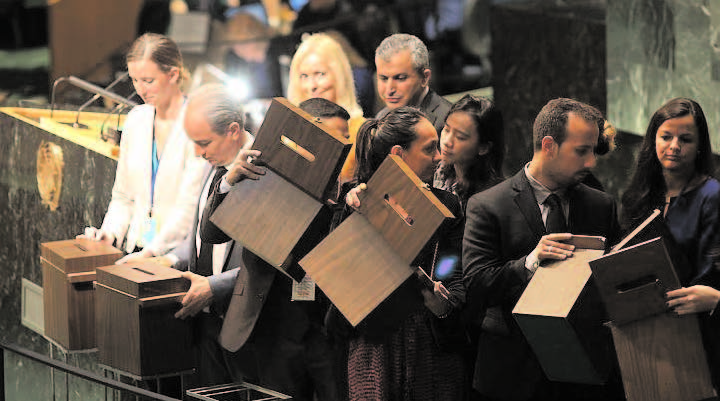
    UNITED NATIONS (TIP): Angola, Malaysia, New Zealand, Spain and Venezuela won coveted seats at the UN security council on October 16, but Turkey suffered a humbling defeat in its bid to join the world’s “top table.” The five countries garnered the required two-thirds support from the 193 countries of the UN General Assembly during three rounds of voting that ended with Turkey picking up only 60 votes.

    Turkey had been competing against New Zealand and Spain for two seats and had dispatched Foreign Minister Mevlut Cavusoglu on a high-profile mission to New York this week to lobby for votes. Angola, Malaysia and Venezuela were virtually assured to win election as their candidacies had been put forward by their region and they ran unopposed on their slates. After New Zealand’s resounding victory in the first ballot, Foreign Minister Murray McCully called the outcome a “strong vote of confidence” in his country, capping a 10-year campaign for the ultimate diplomatic prize.

    “To receive the success that we have had this morning means a lot to us and we will work very hard to make sure we give good service on the council,” McCully told reporters at UN headquarters. Venezuela won 181 votes despite criticism from rights groups and the United States over its support for Iran, Syria and other hardline regimes that are at loggerheads with the West. Venezuela’s President Nicolas Maduro called the vote “a victory, a world record of support, love and confidence. One hundred eight-one countries have said here we are, we support you.””We should feel happiness and joy in our hearts that Venezuela is beloved country in the world,” he added, speaking in Caracas. “To those birds of ill omen who say Venezuela is isolated in the world — who is isolated? The country that received 181 votes?” US Ambassador Samantha Power urged Venezuela to work cooperatively on the council.

    “Unfortunately, Venezuela’s conduct at the UN has run counter to the spirit of the UN Charter and its violations of human rights at home are at odds with the Charter’s letter,” she said. Rights groups have pointed to Venezuela’s record on the UN Human Rights Council as a cause for worry and diplomats have also expressed concern about its stance on the war in Syria. Over the three rounds of voting, Turkey saw its support dwindle from 109 votes to 73 and finally 60, surprising many who saw the regional player as a strong contender.

    Angola won 190 votes, Malaysia picked up 187, New Zealand 145 and Spain 132. The elections came at a busy time for the council, which is grappling with crises on many fronts, from the jihadist offensive in Iraq and Syria, to the Ebola outbreak in West Africa. Russia’s actions in eastern Ukraine, conflicts in Syria, South Sudan and Central African Republic and the faltering Israeli-Palestinian peace process are also at the top of the council’s agenda. A seat at the Security Council raises a country’s profile several notches, boosts influence and provides knockoff benefits in bilateral ties.

    The five elected countries to the 15- member council will join the five permanent powers — Britain, China, France, Russia and the United States — for a two-year term. Five other countries elected last year are mid-way into their term. These are Chad, Chile, Jordan, Lithuania and Nigeria. As the most powerful body of the United Nations, the security council can impose sanctions on countries and individuals, refer suspects for war crimes prosecution, endorse peace accords and authorize the use of force. It also oversees 16 peacekeeping missions in the world, with a budget of close to $8 billion. The five elected countries will replace Argentina, Australia, Luxembourg, Rwanda and South Korea, and begin their stint on January 1.

  • Nobel Peace Prize for Indian Subcontinent: Kailash of India and Malala of Pakistan share the coveted prize

    Nobel Peace Prize for Indian Subcontinent: Kailash of India and Malala of Pakistan share the coveted prize

    LONDON (TIP): History was made on October 10 when an Indian and a Pakistani jointly shared the Nobel Peace Prize for 2014. India’s Kailash Satyarthi and Pakistan’s Malala Yousafzai were awarded the Nobel Peace Prize for “showing great personal courage” and their struggle against the suppression of children and young people and for the right of all children to education. Malala is the youngest to be awarded the globally prestigious annual prize.

    The committee said Kailash Satyarthi maintained Mahatma Gandhi’s tradition and headed various forms of protests and demonstrations, all peaceful, focusing on the grave exploitation of children for financial gain. He has also contributed to the development of important international conventions on children’s rights”. “Children must go to school and not be financially exploited. In the poor countries of the world, 60% of the present population is under 25 years of age.

    It is a prerequisite for peaceful global development that the rights of children and young people be respected. In conflict-ridden areas in particular, the violation of children leads to the continuation of violence from generation to generation,” the committee said. Talking about Malala, it said “Despite her youth, Malala has already fought for several years for the right of girls to education, and has shown by example that children and young people, too, can contribute to improving their own situations. This she has done under the most dangerous circumstances. Through her heroic struggle she has become a leading spokesperson for girls’ right to education”.

    Who is Kailash Satyarthi?

    Satyarthi is an Indian child rights activist born in Vidisha, about 50km from Bhopal. He studied engineering at the Govt Engineering College, Vidisha and gave up his career as an electrical engineer over three decades ago to start Bachpan Bachao Andolan, or Save the Childhood Movement. Today, the non-profit organization Bachpan Bachao Andolan he founded is leading the movement to eliminate child trafficking and child labour in India. The organisation has been working towards rescuing trafficked children for over 30 years.

    It receives information from a large network of volunteers. “My philosophy is that I am a friend of the children. I don’t think anyone should see them as pitiable subjects or charity. That is old people’s rhetoric. People often relate childish behaviour to stupidity or foolishness. This mindset needs to change. I want to level the playing field where I can learn from the children. Something I can learn from children is transparency. They are innocent, straightforward, and have no biases.

    I relate children to simplicity and I think that my friendship with children has a much deeper meaning than others,” he said. Satyarthi, 60, admires Mahatma Gandhi and has likewise headed various forms of peaceful protests “focusing on the grave exploitation of children for financial gain,” the Nobel committee said. While announcing the historic Nobel peace prize to an Indian and a Pakistani jointly, the Nobel Committee said, “The Nobel Committee regards it as an important point for a Hindu and a Muslim, an Indian and a Pakistani, to join in a common struggle for education and against extremism.”

    ‘Honour to children in slavery’

    “It’s an honour to all those children who are still suffering in slavery, bonded labour and trafficking,” Satyarthi said after he shared the prestigious award with Pakistani teenager Malala. “It’s an honour to all my fellow Indians. I am thankful to all those who have been supporting my striving for more than the last 30 years,” said Satyarthi. “A lot of credit goes to the Indians who fight to keep democracy so alive and so vibrant, where I was able to keep my fight on,” said Satyarthi. “Something which was born in India has gone globally and now we have the global movement against child labour. After receiving this award I feel that people will give more attention to the cause of children in the world.”

    Malala Yousafzay: An idol to the world, outcast at home

    Malala Yousafzay, who won the Nobel Peace Prize on Friday, is hailed around the world as a champion of women’s rights who stood up bravely against the Taliban to defend her beliefs. But in her deeply conservative homeland, many view her with suspicion as an outcast or even as a western creation aimed at damaging Pakistan’s image abroad. Malala, now aged 17, became globally known in 2012 when Taliban gunmen almost killed her for her passionate advocacy of women’s right to education.

    She has since become a symbol of defiance in the fight against militants operating in Pashtun tribal areas in northwest Pakistan – a region where women are expected to keep their opinions to themselves and stay at home. “The terrorists thought that they would change our aims and stop our ambitions but nothing changed in my life except this: Weakness, fear and hopelessness died. Strength, power and courage was born,” she told the United Nations last year. “I do not even hate the Talib who shot me. Even if there is a gun in my hand and he stands in front of me.

    I would not shoot him,” she said in a speech which captivated the world. Malala has also won the European Union’s human rights award and was one of the favourites to win the Nobel Prize last year. Now based in Britain, she is unable to return to her homeland because of Taliban threats to kill her and her family members. The current Taliban chief, Mullah Fazlullah, was the one who ordered the 2012 attack against her. Yousafzai has enrolled in a school in Birmingham and become a global campaigner for women’s right to education and other human rights issues, taking up issues such as the situation in Syria and Nigieria.

    In her native Swat valley, however, many people view Malala – backed by a supportive family and a doting father who inspired her to keep up with her campaign – with a mixture of suspicion, fear and jealousy. At the time of her Nobel nomination last year, social media sites were brimming with insulting messages. “We hate Malala Yousafzai, a CIA agent,” said one Facebook page.

    She was a young student in the Swati town of Mingora in Pakistan’s northwestern Khyber Pakhtunkhwa province when she became interested in women’s rights. At the time, the Taliban were in power in the strategic valley after they took control over the region and imposed strict Islamic rules, including their opposition to women’s education. She wrote an anonymous blog describing her life under the Taliban controlled the region.

    In October 2012, after the Taliban were pushed out of Swat by the Pakistani army, she was shot in the head on her way to school by a Taliban gunman. She survived after being airlifted to Britain for treatment and recovered from her lifethreatening wounds. “The wise saying, ‘The pen is mightier than sword’ was true. The extremists are afraid of books and pens,” she told the United Nations. “The power of education frightens them. They are afraid of women. The power of the voice of women frightens them.”

  • 5 AFGHAN MEN HANGED FOR GANG RAPE

    5 AFGHAN MEN HANGED FOR GANG RAPE

    KABUL (TIP): Five Afghan men were hanged on Wednesday for the gang rape of four women despite the United Nations and human rights groups criticising the trial and calling for new president Ashraf Ghani to stay the executions.

    The brutal attack in Paghman, outside Kabul, provoked a national outcry with many Afghans demanding the men be hanged, and then-president Hamid Karzai signed their death sentences shortly before leaving office last week.

    “Five men in connection to the Paghman incident and one other big criminal were executed this afternoon,” Rahmatullah Nazari, the deputy attorney general, said.

    There was no immediate comment from the office of President Ghani, who faced strong public pressure to not stay the executions after he came to power on August 29 “The court’s verdict has been implemented and all the convicts have been executed — five from the Paghman case, plus Habib Istalifi, who was head of a notorious kidnapping gang,” the attorney general’s chief of staff Atta Mohammad Noori said.

    The men were executed in Pul-e-Charkhi prison near Kabul. Franz-Michael Mellbin, the EU ambassador in Kabul, strongly criticised the hangings, and questioned Ghani’s failure to intervene.

    “Today’s executions cast a dark shadow over the new Afghan government’s will to uphold basic human rights,” Mellbin said on Twitter soon after the news broke.

    In August the armed gang members, wearing police uniforms, stopped a convoy of cars returning to Kabul at night from a wedding in Paghman, a scenic spot popular with day-trippers.

    The attackers tied up men in the group before raping at least four of the women and stealing valuables from their victims.

    But the court process raised major concerns, with the trial lasting only a few hours, allegations of the suspects confessing under torture, and Karzai calling for the men to be hanged even before the case was heard.

    In a statement before the executions, the UN High Commission for Human Rights
    “called on President Ghani to refer the cases back to the courts given the very serious due process concerns”.

    Amnesty said the trial had been rushed, giving lawyers little time to prepare the defence. It was only nine days between the arrests and the handing down of death sentences by the primary court.

    The trial was “marred by inconsistencies, un-investigated torture claims and political interference”, Amnesty said.

    “(Karzai) himself said that he urged the Supreme Court to hand down death sentences.” The accused were found guilty and sentenced at a nationally-televised trial, which attracted noisy rallies outside the courtroom calling for the death penalties.

    Applause erupted inside the courtroom when Kabul police chief Zahir Zahir also called for the men to be hanged.

  • UN member states owe world body about $3.5 billion

    UN member states owe world body about $3.5 billion

    UNITED NATIONS (TIP): The UN management chief says member states owe the world body about USD 3.5 billion for its regular operating budget and far-flung peacekeeping operations.

    Yukio Takasu told reporters after briefing the General Assembly’s budget committee on Thursday that “as a whole the financial situation of the United Nations is very sound and generally good except the regular budget.”

    Unpaid assessments for the regular budget total just over USD 950 million, including about USD 800 million owed by the United States, USD 77 million by Brazil and USD 28 million by Venezuela, he said.

    Member states owe about USD 2.6 billion to the separate peacekeeping budget, Takasu said.

    France owes USD 356 million, the United States USD 337 million and Italy around USD 250 million, he said.

  • Clashes break out in Central African Republic capital

    Clashes break out in Central African Republic capital

    BANGUI, Central African Republic: Clashes in Central African Republic’s capital have resulted in ”many casualties,” the International Committee for the Red Cross said Thursday, marking the most significant violence in the city since a United Nations force took over peacekeeping last month. A crash following an attack on a convoy killed one UN peacekeeper and injured at least seven others, Vannina Maestracci, associate spokeswoman for the UN secretary-general, said in New York. It was the first death of a peacekeeper since the UN took over peacekeeping duties from an African Union force. The violence complicated relief efforts. Doctors Without Borders said its staff was staying home Thursday because of the dangers, and the ICRC said its workers ”were subjected to direct threats” as they tried to recover bodies. ”It’s truly regrettable that such actions can jeopardize any attempt to help the wounded,” said Antoine Mbao Bogo, the national president of the Central African Red Cross. His organization provided an initial tally of 12 deaths, but staffers did not have access to all neighborhoods. The violence began Tuesday when a former fighter with a mostly Muslim Seleka rebel coalition was killed by anti-Balaka Christian militias who mutilated his body before burning it, witnesses said. The man had been accused of launching two grenades, one in an anti-Balaka stronghold in the north of the city, prompting the anti-Balaka fighters to chase after him. ”He was chased by anti-Balaka fighters who caught him, killed him and burned his body,” Bangui resident Wilfried Maitre said. Reprisal attacks ensued, with Muslim fighters killing two people, including the driver of a taxi, witnesses said. Other taxi drivers then staged a protest, raising tensions. Later on Wednesday, anti-Balaka fighters paraded through the streets, showing off their weapons and shooting into the air, said Pieterjan Wouda of Doctors Without Borders. ”That’s something we haven’t seen in a long time,” he said. Heavy weapons could be heard Thursday morning, Wouda said, adding that Doctors Without Borders staff would be staying home because it was not safe to move around. The mostly Muslim Seleka rebel coalition toppled the president of a decade last year, installing its chief, Michel Djotodia, as the country’s new leader. Widespread human rights abuses combined with escalating violence in the capital in December and January led to Djotodia’s resignation. The country is currently headed by transitional President Catherine Samba- Panza. At least 5,000 people have died over nine months of sectarian violence in the country. The International Crisis Group warned last month that the transition was at risk of falling apart. ”The main armed groups are in disarray, lack clear leadership, seek to expand their areas of control and pursue banditry as much as politics,” the group warned.

  • Featured: He CAME, he SPOKE, he CONQUERED

    Featured: He CAME, he SPOKE, he CONQUERED

    NEW YORK (TIP): Yes, it is Narendra Modi, Prime Minister of India. All Indian Americans are familiar with that name, for good or for bad, mostly for good, though.

    Modi was in New York from September 26 to 29th afternoon, before he left for Washington to enjoy the hospitality of US President Barack Obama in the evening and a bilateral talk the next day, before flying back to India.

    Much before he arrived in the US, Indian Americans had set out to give him a hero’s welcome. A trusted friend of Modi, Dr. Bharat Barai, was tasked with arranging a massive community reception to Modi which he did, with the help and cooperation of a devoted band of people. It was a colossal effort to have around 20,000 people come to Madison Square Garden to give a rousing reception to Modi, an icon for many, particularly from his community and place, Gujarat, a state which he governed with appreciable growth for around 12 years.

    And why not! Modi was coming as Prime Minister of India to a country which had denied him a Visa since 2005 for his alleged role in not preventing killings of people from a particular community in Gujarat when he was the chief minister of that state in 2002. His admirers here gloated that US had no option but to welcome him now that he was coming to the United Nations as India’s Prime Minister, whose party had got a massive support of the people of India and was catapulted in to power, with total command over government, without having to depend on allies’ support as was the case when Atal Behari Vajpayee formed a BJP led government in 1999 which lasted its full term of 5 years, to 2004.

    So, here was a man who represented a democratic country -the largest democracy in the world- with 1.25 billion people. How could the US ignore Modi whose country was poised to become an Asian giant and the second largest economic power in the world by 2050? No way! So, Obama invited Modi over to the White House for a private dinner. It was another matter that the invited dignitary was fasting on account of Hindu festival of Navratras and he would not eat. By the way, Modi has been observing Navratra fasts for the past 40 years, insiders said.

    So, Prime Minister Narendra Modi arrived on September 26. He was given a rousing welcome at the JFK airport in New York. My good friends, Narain Kataria, Arish Sahani and Jagdish Sewhani arranged to have a large number of people gather at the airport to give a warm welcome to Modi. So, we had the chant of “Modi, Modi” which surely pleased the man, given to showmanship, which explains his admiration for film actors, like Amitabh Bachchan, and of course, some others.

    And while in New York, Prime Minister of India, Narendra Modi left no one in doubt that he was a better performer than any in the world. A perfect juggler, a consummate magician, a pied piper of India.

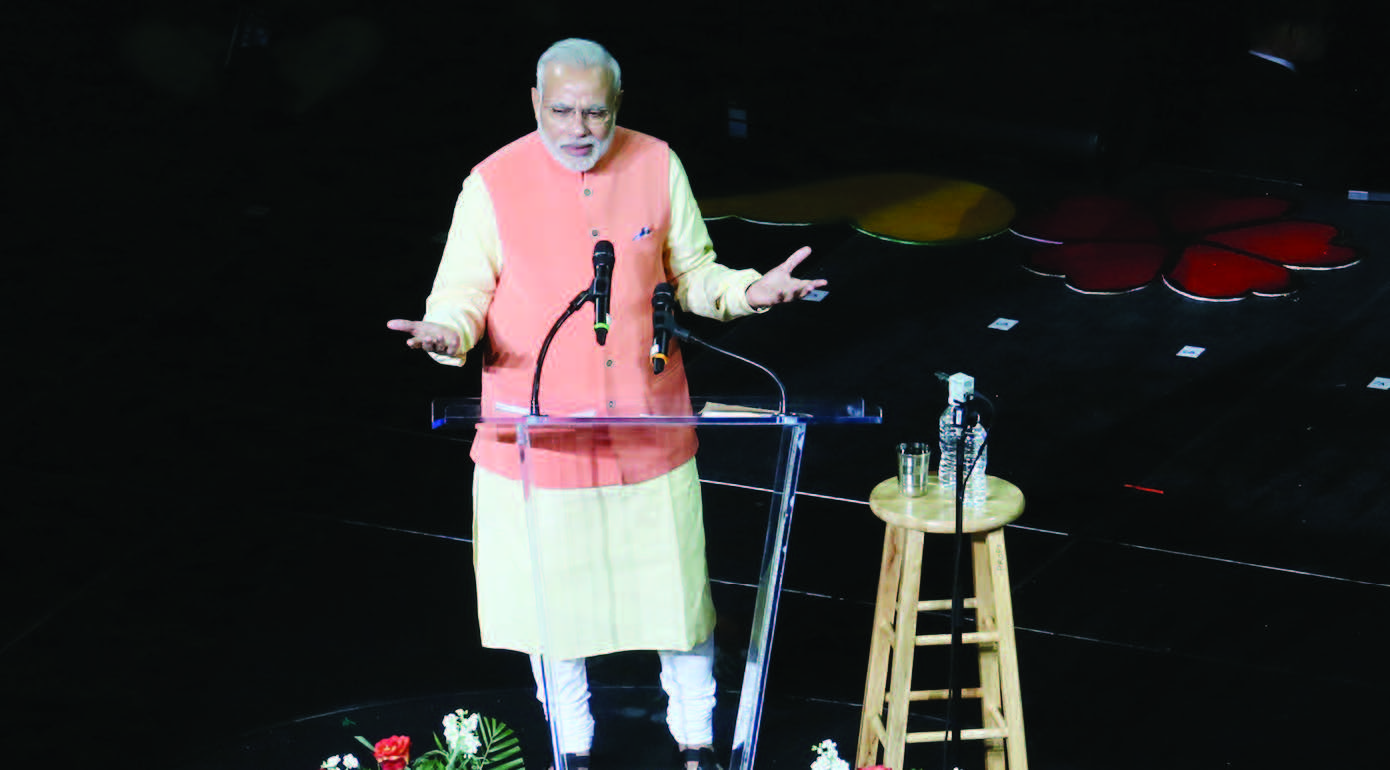
    I found many acknowledging Modi’s felicity of expression which allowed him to connect with people immediately. He speaks in the language and diction that people at all levels commonly understand. He relies on simple words and home truths to deliver his ideas home. Again, he has mastered the art of delivery. His body language is extremely expressive and impressive. During the more than 90 minutes speech he delivered at the Madison Square Garden on September 28th, not a soul could have looked at the watch. Not one could have yawned, out of boredom. None would have thought of anything but what Modi was saying. The eyes of all remained fixed on the man in the center of the arena. Such was the grip of the man. And whatever he said seemed to come straight out of his heart. He pumped into his speech his heart, his mind and his vocal cords-delivering the “very best”.

    Now see what he said. First, India can and will achieve the greatness that it once had. Second, we have a huge human resource capital in the form of a young India, with 60% of population under the age of 35. No other country in the world has such human resource. Third, we have brains. Example, our scientists succeeded in the Mars mission in the first attempt itself, a feat which even US could not perform. Modi took pride in mentioning that India’s Mars mission cost peanuts when compared with the money spent by countries like USA on similar missions.

    Yes, we can. But how can we do it? He did offer Namo Mantra for that. He spoke of the defects in the system in the country and said the system that stood in the way of quick progression had to be demolished. He spoke of the futile, cumbersome and irrelevant laws which needed to be consigned to dust bin. He spoke of the massive investment required for development. And he invited Indian Americans as also the whole world to come and invest in India. Also, he gave a call to “make in India”.

    Modi was particularly appreciative of the Sikhs, in his speech. He spoke of the great sacrifices the Sikh Gurus had made. He also recalled the sacrifices of the Sikhs in the freedom struggle of India. He spoke of the brave Sikh soldiers in the Indian armed forces and said the nation is proud of the Sikhs who have always stood by their motherland, come what may.

    Modi simply created a vision. He came up with ideas that won attention and admiration of many. He wove dreams that all would love to own. He assured the gathering of around 20,000 at the famous Madison Square Garden which somebody christened as “Modison” Square Garden that India was on a fast track to development. Then he made some announcements to please the locals, too. He told them he was taking care to ensure there is no harassment at the airports in India of Indian Americans visiting India. He also said he knew of problems with getting visas. He said there will be no delays any more in obtaining a visa. Also, he said the clubbing together of OCI and PIO was being worked out and soon the problems arising out of OIC/PIO will be over. He also announced visa on arrival for US nationals on the pattern of some 9 countries whose citizens are entitled to get tourist visa on arrival in India. Surely, the local crowd was pleased.

    The magician Modi wielded his wand for more than 90 minutes and left the gathering charmed and captivated. Yes, he came, he spoke , he conquered the hearts of Indian Americans who had come from far and near to have his darshan and hear him speak. But before he left, the gathering burst in to Modi chant, just as it had when he had arrived. And, believe me, Modi must have enjoyed the chant. The “Modi” chant must have been music to his years.

    During the course of his stay in New York from 26th September to 29th September afternoon, Modi attended a large number of events, met a number of people from all walks of life which included world leaders, his counterparts from neighboring countries Sri Lanka and Nepal, US lawmakers and officials, captains of business and industry, community leaders, religious leaders and eminent people- both Indian Americans and others, and discussed a variety of issues.

    We bring our readers here a few pictures of Modi’s New York visit. All pictures have been provided by The Indian Panorama special photo journalist Mohammed Jaffer.

    Modi pays homage to victims of 9:11 at the 9:11 memorial at ground zero on September 27th 2014.

    Prime Minister Modi speaking at Global Citizens Festival at Central Park in NYC on 27th September, 2014

    Modi addresses the 69th United Nations General Assembly. He called for a relentless fight against terrorism and the Security Council

    Madison Square Garden on September 28

  • MALINI SHAH | a multifaceted personality

    MALINI SHAH | a multifaceted personality

    Malini Shah is a community leader who is currently President of her diamonds company, Difference Inc. She is also the Founder of Nritya Kala Kendra which was founded in 1992. It is an organization that promotes India’s Art and Culture through classes,workshops, and lectures, visiting artist programs, children’s Day at the Indian Consulate, Asian Heritage programs, and Indian Educational programs in schools. She is currently on the Advisory Committee of the Queens Museum of Art, Community and Cultural Liaison for Council Member Paul Vallone, and has also served as the chairperson for Assemblyman Nick Perry,Women’s Group Bill de Blasio for Mayor, Vice chair Queens South Asians for Bill de Blasio for Mayor , Chair Indian Americans for Melinda Katz for Queens Borough President. She enjoys being a consultant to various organizations in the USA and other countries,where she visits and holds workshops. Today she has extended her proficiency to many schools within the country with the resolve of integrating cultural education along with academic skills. Malini received Bachelor’s in Arts and Child Education from The Teachers Training Institute in India. She has spent over 30 years teaching in schools, one of which includes “Modern School, one of the most prestigious schools of India, situated in Delhi. She has conducted various lectures in rural areas for the India International Rural Cultural Center, and at various Universities in the United States of America. Also, she has contributed vastly to educational film documentaries. NKK undertakes numerous educational and informative programs all around the country and abroad through programs such as the recent Internationals Children’s Day by the Turkish Women’s League of America & Ataturk School 2014, Asian Heritage Month Queens Borough Community College 2014, the incredibly successful “Year of India “2012-2013 at Queens College, New American Program at the Queens Library, DC 37and NYC Council’s Asian American Heritage Programs, Cultural Educational Programs in schools, annual Children’s day at the NY Indian Consulate, ‘Meeting God’ exhibition at the Museum of Natural History, India Columbia Day at the Queens Museum of Art, Culture Day at Barnard College and Columbia university, Tropical Carnival, Queens Festival, Caribbean American Information Day, A Salute to Diversity at York College, United Nations Staff day International Concert, Harmony Day, workshops at Pace University, Orphan International United , Borough of Manhattan community College events, Annual Rockaway Multicultural Family Fest, World Vision 2000 Global Youth Conference in DC, A Rainbow Community Business Development Arts & Culture Exposition, Brooklyn Botanical Gardens Celebrating Cultures Events, Sacred Arts conference at Cathedral of St. John the Devine. As a Cultural Ambassador she has traveled extensively abroad for festivals sponsored by the India Tourism Development, Air India, and ICCR (Indian Council for Cultural Relations) to countries which include Kula Lumpur, Athens, Bangkok, Singapore, New York ,Caribbean. She has had the privilege to travel as part of the Indian delegation of the Indian Council for Cultural Relations headed by the former Vice President of India, Mr. Shankar Dayal Sharma. When you work so devotedly, recognition must follow. Malini has received many prestigious awards such as ‘Jewel of India’ Award, “Positive Indo-Image Award”, An Exclusive “Distinguished Leadership in the Arts and Culture Award” from Assemblyman Nick Perry .City Council Citations, “Certificate of Recognition” from Kate Murray Supervisor Town of Hempstead, for outstanding community service and significant contribution to the community (SAWA) 2013,Citation from New York City Council member Peter Koo for recognition and honor for years of service to the Community, “Outstanding Mother Award” by C.A.P.S.C., Hind Rattan Award for Outstanding Services, London, Achievement and Contribution . She is also the recipient of “Exceptional Woman Award” from South Asian American Women’s Alliance. Her autobiography appeared in the “Who’s who in India” and Best of New York. Her autobiography appeared in the “Who’s who in India” and Best of New York.

  • US open to new Gaza resolution if it helps truce

    US open to new Gaza resolution if it helps truce

    UNITED NATIONS (TIP): The United States is open to a new UN resolution on Gaza but only if it contributes to sustaining the Israeli-Palestinian ceasefire, the US envoy to the United Nations said. Ambassador Samantha Power said that a resolution must “do no harm” to the ceasefire that has been holding in recent days and Israeli- Palestinian talks that are scheduled to resume in Cairo, and should “play a positive role in supporting a durable solution.” “Nothing underscores the urgency of securing … a negotiated two-state solution like the crisis in Gaza and the heartbreak that so many people on both sides suffered throughout that crisis,” she said.

    Hanan Ashrawi, a senior figure in the Palestine Liberation Organization, told a news conference here Tuesday that the Palestinians are demanding a commitment to the 1967 borders and a deadline for the end of Israel’s occupation, adding when pressed that “within three years, the occupation should end.”She also criticised the failed US peace initiative by US secretary of state John Kerry, saying it allowed Israel “to persist in policies” that she characterized as unilateral and abusive.Power defended Kerry’s mission and stressed that negotiations are the only way to achieve a two-state solution where Israel and Palestine live side by side in peace.

  • UN says $600 million needed to tackle Ebola as deaths top 1,900

    UN says $600 million needed to tackle Ebola as deaths top 1,900

    WASHINGTON/CONAKRY (TIP): The United Nations said $600 million in supplies would be needed to fight West Africa’s Ebola outbreak, as the death toll from the worst ever epidemic of the virus topped 1,900 and Guinea warned it had penetrated a new part of the country. The pace of the infection has accelerated, and there were close to 400 deaths in the past week, officials said on Wednesday.

    It was first detected deep in the forests of southeastern Guinea in March. The hemorrhagic fever has spread to Liberia, Sierra Leone, Guinea, Nigeria, and Senegal, and has killed more people than all outbreaks since Ebola was first uncovered in 1976.

    There are no approved Ebola vaccines or treatments. An experimental Ebola vaccine that Canada said it would give to the World Health Organization for use in Africa was as of Wednesday still in the lab that developed it as officials are puzzled over how to transport it. Ottawa said on Aug. 12 that it would donate between 800 and 1,000 doses of the vaccine, being held at Canada’s National Microbiology Laboratory in Winnipeg.

    “We are now working with the WHO to address complex regulatory, logistical and ethical issues so that the vaccine can be safely and ethically deployed as rapidly as possible,” Health Canada spokesman Sean Upton said in a statement. “For example, the logistics surrounding the safe delivery of the vaccine are complicated.” Upton said one of the challenges was keeping the vaccine cool enough to remain potent.

    Human safety trials are due to begin this week on a vaccine from GlaxoSmithKline Plc and later this year on one from NewLink Genetics Corp. The US Department of Health and Human Services said on Tuesday a federal contract worth up to $42.3 million would help accelerate testing of an experimental Ebola virus treatment being developed by privately held Mapp Biopharmaceutical Inc. Dr David Nabarro, senior UN Coordinator for Ebola, said the cost of getting the supplies needed by West Africa countries to control the crisis would amount to $600 million. That was higher than an estimate of $490 million by the WHO last week.

    Moving workers and supplies around the region has been made difficult by restrictions by some countries on air travel and landing rights as they try to control Ebola’s spread. “We are working intensively with those governments to encourage them to commit to the movement of people and planes and at the same time deal with anxieties about the possibility of infection,” Nabarro said.

    He said the president of Ghana has agreed to allow an airbridge, or route, through the country to affected regions to move people and supplies. Ivory Coast, which closed its borders with Liberia and Guinea last month, said on Tuesday it would open humanitarian and economic corridors to its two western neighbors.

    Epidemic gains, evacuation eyed for doctor Dr. Margaret Chan, director-general of the World Health Organization (WHO) told a press conference in Washington, “This Ebola epidemic is the longest, the most severe and the most complex we’ve ever seen.” Chan said there were more than 3,500 cases across Guinea, Liberia and Sierra Leone.

    In Liberia, Dr Rick Sacra, a 51-yearold Boston physician infected with Ebola could be medically evacuated as soon as Thursday, according to staff at the hospital where he worked. Two other Americans recovered from the virus after being taken to the United States for treatment last month. Amid shortages of equipment and trained staff, more than 120 healthcare workers have died in West Africa in the Ebola outbreak.

    The Liberian government has begun offering a $1,000 bonus to any healthcare workers who agreed to work in Ebola treatment facilities. Guinea, the first country to detect the virus, previously said it was containing the outbreak but announced that nine new cases had been found in the prefecture of Kerouane, some 750 km (470 miles) southeast of the capital Conakry.

  • ONAM- the biggest festival of Kerala

    ONAM- the biggest festival of Kerala

    Onam is celebrated in the beginning of the month of Chingam, the first month of Malayalam Calendar (Kollavarsham). There are actually four days of Onam. The most important day of Onam (known as Thiru Onam) is the second day. Festivities actually commence around 10 days before this day (on Atham), with the preparation of floral arrangements (pookalam) on the ground in front of homes. This year Thiru Onam is on September 7. (Atham was on August 29).

    ONAM is like a Dream!

    Kerala is known for its enchanting beauty. The swaying palms, the sky kissing hills, the sun-bleached plains, the lush paddy fields, the placid lakes, the shimmering lagoons, all make it a veritable paradise on earth. I often hear the phrase ‘God’s on country’ as Kerala is often characterized. We are all too familiar with the legend behind the festival. For the sake of the young people, let me briefly state two versions of the story. Maveli, the king Mahabali, the legendary king who was unjustly pushed down into the Nether world by Vamana, the fifth ‘avatar’ of Vishnu.


    25
    Thiruvathira is a popular folk dance performed by women at Onam


    It is said that, there was perfect equality, peace and happiness in his kingdom. No one dared to lie or cheat. However, gods grew envy at his acts of benevolence and growing popularity. After the banishment, Mahabali was given the special privilege to visit his subjects once a year. Historians give a different twist to the legend. According to them, Mahabli, who was a Buddhist, defeated by Hindu kings from Narmada (currently Maharashtra) in the North.

    Subsequently, they conquered the land and sent him into exile in Ezahm which is currently known as Sri Lanka. It was believed that permission was granted to Mahabali to come and visit his subjects during the period when they traditionally celebrated Sravanolsavam. Therefore, for Keralites, it may be a symbolic description of the Aryan invasion and the imposition of its culture on the native Dravidian populace of Kerala.


    26
    Snake boat races are popular attractions during Onam celebrations. The most famous snake boat race that’s held during Onam celebrations is the Aranmula carnival, along the Pampa River


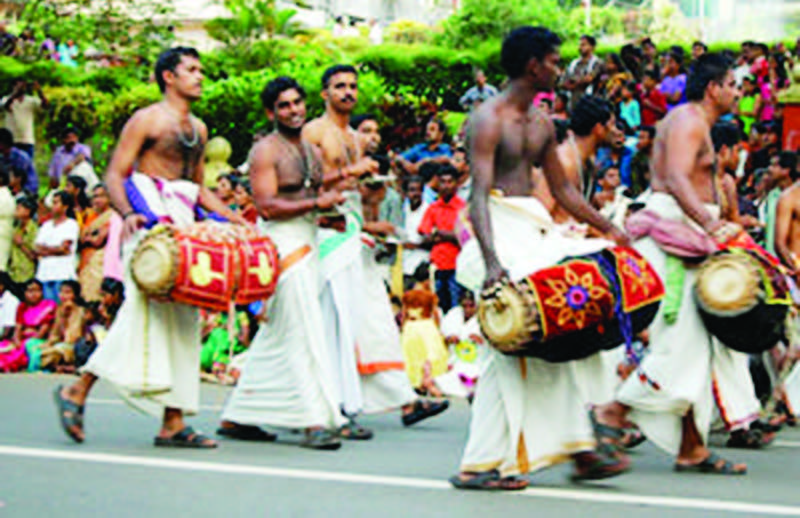
    Regardless, Onam is a grand harvest festival which is celebrated with flowers, sumptuous feasts, and swings under mango trees. Onam represents the spirit of Kerala transcending the people of Kerala the world over to an enchanting mood of thanksgiving, idyllic pleasure and music and dance. People irrespective of religion celebrate Onam with traditional gaiety and fervor. It is stated that where there is a Keralite there will be Onam.

    Now the celebration is extended to the Diaspora, Mahabali needs to travel around the globe to visit all his subjects. Onam embodies the message of basic goodness of man who is selfless in his deeds towards fellow man. It is also about a dream; it is a dream about peace and tranquility in the world. It is dream about economic well-being and resource sharing; it is a dream about love and brotherhood, it is a dream about high ethics and morals; and it is a dream about human justice and preservation of nature.

    Great men in history dreamed before they embarked on a course to achieve them. Mahatma Gandhi had a dream. He set out to gain freedom for the 300 million Indians from the colonial rule and slavery. He mobilized and motivated the masses through non-violent protests which eventually gained the long cherished independence. Fulfilling own dream was fraught with dangers. He paid the ultimate price with his own life to preserve what he dreamed about.

    Jawaharlal Nehru had a dream which was set out in the preamble of the Indian constitution: to setup a secular republic with equal rights for everyone with freedom to think and speak and freedom to worship; to build a democratic society which fights fascism and communism; to promote equal opportunity and justice for the common man and independence in International relations. Today, that dream is being challenged by the forces of communalism which would like turn India on a path towards Hindutva.

    It is quite a surprise to see that this divisive philosophy are tacitly endorsed by some in our own community who enjoy the secular freedom in this country yet, want to deny the same freedom to others who live in India The great Martin Luther King who emulated the non-violent method which Gandhi has pioneered had a dream of his own. He had a dream to deliver his people from the slavery and second-class status – We are all too familiar with his ‘I have a dream’ speech. – ‘I have a dream that one day this nation will rise up and live out the true meaning of its creed. We hold these truths to be self-evident that all men are created equal ‘With the voting rights acts in 1964, his dreams were come to fruition.

    Yes, there are continuing challenges faced by the black community at the social level which may require further attention. America as a nation had a dream as well. When the pilgrims took the boat and landed on the Plymouth seeking religious freedom, their dream was to develop the most democratic, secular and prosperous society based on capitalism. They seemed to have accomplished that by making America a superpower, second to none, economically and militarily.

    Yet there are great challenges ahead of this nation as it is falling victim to a valueless culture which could eat away the core of the principles on which this nation was founded. Yes, there are challenges; however, we all need to dream as individuals, as a society and as a nation. For many of us the dream of prosperity is only half of the puzzle. We might have accomplished them. We may be still missing that spiritual and moral dimension which made Kerala once a land of prosperity, justice and brotherhood.


    27
    A colorful float that’s part of the Onam Pulikkali festivities


    All of us should have clear goals in life. This is a non-optional component of a spiritually healthy life. You can see from many of these examples I have elicited, there Is a close connection between dreams or in other words, goalorientation and motivation and fulfillment? The lack of those dreams is a big reason why so many of us are unmotivated in our tasks. It is said that performance is equal to motivation and ability. The component motivation requires expectancy and that is where the dream fits in. If it is motivating, it has to be making progress and accomplishing something.

    This week as we celebrate Onam, let us once again become nostalgic. Let Onam transcends our thoughts and process. Above all, it remains a dream. Attainable or not it symbolizes human yearnings; which keep the dreams alive. It motivates us to go on. Bible says, without vision, people perish; keep dreaming and let the spirit of Onam burn within us forever. Happy Onam to everyone

    (The author is a former Chief Technology Officer, United Nations)

  • UN security council meets on Ukraine crisis

    UN security council meets on Ukraine crisis

    UNITED NATIONS (TIP): The UN security council met on August 29 in an emergency session on the growing crisis in Ukraine with some members expressing outrage. UN undersecretary-general of Political Affairs Jeffrey Feltman told council members, as the meeting began, that the latest developments mark a ” dangerous escalation in the conflict,” but that the international body had no way of verifying the latest ”deeply alarming reports.” The emergency security council meeting came hours after a top Ukrainian official said two columns of Russian tanks and military vehicles fired missiles from Russia at a Ukraine border post, then rolled into the country.

    That opened a new front in the war in eastern Ukraine between pro-Russia separatists and the new government of President Petro Poroshenko. Statements from Nato, Poroshenko, the separatists, the United States and the president of the security council left no doubt that Russia had invaded Ukraine. A top Nato official said at least 1,000 Russian troops have entered Ukraine with sophisticated equipment and have been in direct ”contact” with Ukrainian soldiers, resulting in casualties.

    The new southeastern front raised fears that the separatists are seeking to create a land link between Russia and Crimea, which Russia annexed in March. US ambassador Samantha Power told the council. ”Every single one has sent a straightforward, unified message: `Russia, stop this conflict. Russia is not listening.”’ ”Russia has come before the council to say everything but the truth,” Power said. ”We will continue working with G-7 partners to rachet up consequences on Russia,” Power said, and France also threatened that sanctions will be increased if the escalation continues.Prior to the meeting, Russian ambassador to the UN Vitaly Churkin told reporters ”You’re at a loss,” offering no further comment. UK ambassador Mark Lyall Grant told reporters: ”Russia will be asked to explain why Russia has its troops inside Ukraine. It’s very clear that Russian regular troops are now in Ukraine.”

  • Global Citizen Forum Launches New York Chapter

    Global Citizen Forum Launches New York Chapter

    NEW YORK (TIP): The Global Citizen Forum, New York branch was launched here on August 23. Addressing prominent members of the Indian-American community and representatives of some American think-tanks at the launch, at the UN New York Millennium Hotel, the founder and chairman of the GCF, Indian industrialist Bhupendra Kumar Modi said that the world today is not defined by countries, but by cities and metropolises, thereby heralding a big change in the world order.

    Modi talked about laying the foundation of a new world order under India’s leadership, and promoting understanding between India, China and the U.S., under the leadership of India’s Prime Minister Narendra Modi. The world has changed rapidly in the past decade, and so have the people of India, Modi, said. “There is not a single city in the world where there is no ‘Little India,” he said, noting how the Diaspora has made its presence in every part of the world.


    15
    Bhishma Agnihotri, former Ambassador at Large, Government of India, in his keynote address congratulated B.K. Modi for taking the age old Indian message of “Vasudhaiva Kutumbakam”- the whole world is a family – to every nook and corner of the world. He also said India had now an opportunity to be the world leader under Prime Minister Narendra Modi.


    It was with this growing change in mind that Modi founded the GCF in January 2013 to create a world without boundaries. Modi, lived in New York City from 1999 to 2004, before moving to California and then to Singapore and is currently based in New Delhi. Modi is also the chairman of Spice Global, an Indian conglomerate headquartered in Singapore as well as the council and chairman of Asia Crime Prevention Foundation’s India chapter. He was appointed by the United Nations as the coordinator for the Indian subcontinent for the Millennium World Peace Summit. Modi became a citizen of Singapore in 2012 and ranks 23rd in the Forbes list of Singapore’s richest people.


    16
    A view of the gathering at the launch of Global Citizen Forum in New York on August 23, 2014.


    On Feb. 17, 2004, the U.S. House of Representatives issued a proclamation in appreciation of Modi’s efforts to promote deeper understanding between the two countries and congratulated him on his innovations and humanitarian efforts worldwide. Author of many books, including “One God, Hinduism – The Universal Truth” and “Performance – A Manager’s Challenge and Whispers of Peace”, Modi is essentially a man of ideas and vision. On the idea of establishing the forum, Modi said, one of the main reasons was to make sure that humanity remains the number one priority of people around the world.

    “Over the years one has seen a change in the business and spiritual leadership”, Modi said, adding that what is lacking is political change. “One first needs to be a global citizen and then a citizen of his or her respective country he said. “How many take the world as a family,” he questioned. Elaborating on the concept of ‘one world,” Modi told the gathering that India, under the leadership of Narendra Modi, could be the answer to bring the world closer. Narendra Modi has taken Indian psyche, and is bringing changes according to that and is seen as a man of wisdom and has thus raised hopes for a global change, Modi said.

    The philosophy of a global India, Modi said, is based on Gautama Buddha’s teachings, which expounded the virtues of compassion and giving. “When you give [something] to somebody, you receive more happiness than the man who receives it,” Modi said. While striving for being a global citizen, one should not forget the “poorest people” in the world, and should find ways in connecting with them, he warned. “Wisdom to see world as one, courage to go to any part of the world and live there, and compassion”are the three main qualities of a global citizen, he said. A film on Gautam Buddha was screened.

    It depicted Buddha’s disillusionment with princely life and his search for enlightenment. The Creative Producer of the film which is telecast in episodes on a TV channel in India, Ms. Ridwana was also present on the occasion and spoke with the media about the making of the film. Some more notable guests at the event included Bhishma Agnihotri, former Ambassador at Large, Government of India, who was the keynote speaker, and Swami Chidananda Saraswati, president and spiritual head of the Parmarth Niketan Ashram in Rishikesh, India, and co-founder of the Global Interfaith WASH Alliance (GIWA) at the UNICEF Headquarters at the United Nations.

  • Flight restrictions hamper Ebola response: UN

    Flight restrictions hamper Ebola response: UN

    UNITED NATIONS (TIP): The UN warned on Monday that restrictions on flights to and from Ebola-hit West African countries could hamper the international community’s ability to fight and reverse the current outbreak of the deadly virus disease. “The United Nations system is focused on tackling the serious outbreak of Ebola virus disease in West Africa.

    However, there have been challenges with air transportation into and out of the countries affected,” Xinhua quoted UN spokesperson Stephane Dujarric as saying at a daily briefing. “The current limitations on flights into and out of affected countries, and the restrictions placed on aircraft originating from these countries transiting through airports in neighbouring countries, though understandable, are not warranted.”

    He stressed that the measure is not an optimal measure for controlling the import of Ebola virus disease, because it “does not reflect what is known about the way in which the virus passes between people”. “Three considerations are important to keep in mind for the public at large: Ebola is not spread through air borne contact; transmission is unlikely to occur through water or food; a person infected with the Ebola virus is not contagious until symptoms appear; Ebola is spread through direct contact with the blood or body fluids of a person who is sick with the virus,” Dujarric said.

    According to the spokesperson, protocols can be well established to safeguard against contagion, namely, Ebola affected individuals displaying symptoms of the infection can be identified before boarding airplanes and prevented from travelling. As an additional safeguard, detection on arrival can trigger, if necessary, protocols for isolation of the patient and infection verification, Dujarric said. “The current trend of limitations on flights is having adverse effects on efforts to control the disease,” he added. “Current flight limitations are hampering the movement of international experts involved in the control efforts.”Dujarric insisted the flight restrictions hinder the capacities of aid organisations to deploy their personnel in support of the crisis response and mitigation.

    “The ability of programmes involved in controlling the outbreak to transport essential equipment and materials to the region is also being severely hampered,” he said. “The flight limitations contribute to the economic and diplomatic isolation of the affected countries and further compound the stigmatisation already experienced by their citizens.”

  • US mobilizes allies to widen assault on ISIS

    US mobilizes allies to widen assault on ISIS

    WASHINGTON (TIP): The United States has begun to mobilize a broad coalition of allies behind potential American military action in Syria and is moving toward expanded airstrikes in northern Iraq, administration officials said on August 26. President Obama, the officials said, was broadening his campaign against the Sunni militants of the Islamic State in Iraq and Syria and nearing a decision to authorize airstrikes and airdrops of food and water around the northern Iraqi town of Amerli, home to members of Iraq’s Turkmen minority.

    The town of 12,000 has been under siege for more than two months by the militants. “Rooting out a cancer like ISIL won’t be easy, and it won’t be quick,” Obama said in a speech on Tuesday to the American Legion in Charlotte, NC, using an alternative name for ISIS. He said that the United States was building a coalition to “take the fight to these barbaric terrorists,” and that the militants would be “no match” for a united international community.

    Administration officials characterized the dangers facing the Turkmen, who are Shiite Muslims considered infidels by ISIS, as similar to the threat faced by thousands of Yazidis, who were driven to Mount Sinjar in Iraq after attacks by the militants.

    The United Nations special representative for Iraq, Nickolay Mladenov, said in a statement three days ago that the situation in Amerli “demands immediate action to prevent the possible massacre of its citizens.” As Obama considered new strikes, the White House began its diplomatic campaign to enlist allies and neighbors in the region to increase their support for Syria’s moderate opposition and, in some cases, to provide support for possible American military operations.

    The countries likely to be enlisted include Australia, Britain, Jordan, Qatar, Saudi Arabia, Turkey and the United Arab Emirates, officials said. The officials, who asked not to be named discussing sensitive internal deliberations, said they expected that Britain and Australia would be willing to join the United States in an air campaign. The officials said they also wanted help from Turkey, which has military bases that could be used to support an effort in Syria.

    Turkey is a transit route for foreign fighters, including those from the United States and Europe who have traveled to Syria to join ISIS. Administration officials said they are now asking officials in Ankara to help tighten the border. The administration is also seeking intelligence and surveillance help from Jordan as well as financial help from Saudi Arabia, which bankrolls groups in Syria that are fighting President Bashar al-Assad.

    On Monday the Pentagon began surveillance flights over Syria in an effort to collect information on possible ISIS targets as a precursor to airstrikes, a senior official said. The Syrian Observatory for Human Rights, an organization that monitors the humanitarian consequences of the conflict in Syria, reported that “non-Syrian spy planes” on Monday carried out surveillance of ISIS positions in the eastern province of Deir Ezzor.

    Although America’s allies in the region have plenty of reasons to support an intensified effort against ISIS, analysts said, the United States will have to navigate tensions among them. “One of the problems is that different countries have different clients among the fighting groups in Syria,” said Robert S. Ford, a former American ambassador to Syria. “To get them all to work together, the best thing would be for them to pick one client and funnel all the funds through that client. You’ve got to pick one command structure.”

  • Afghan presidential candidates pull out of audit

    Afghan presidential candidates pull out of audit

    KABUL, AFGHANISTAN (TIP): Afghanistan’s troubled presidential election was rocked by more turmoil on August 27 as both candidates vying to succeed Hamed Karzai pulled their observers out of a ballot audit meant to determine the winner of a June runoff. First, Abdullah Abdullah, a former foreign minister, pulled his monitors from the audit to protest the process that his team claims is fraught with fraud. Then, the United Nations, which is helping supervise the US-brokered audit, asked the other candidate, former finance minister Ashraf Ghani Ahmadzai, to also pull out his observers in the interest of fairness.

    The UN team said the audit then proceeded without both candidates’ teams. It was not immediately clear if the pullout meant the two candidates would reject the audit results — and thereby also the final result of the election. That could have dangerous repercussions in a country still struggling to overcome ethnic and religious divides and battling a resurgent Taliban insurgency. The US brokered the audit of the eight million ballots from the presidential runoff as a way to end what had been a debilitating impasse over election results. But the audit itself has proceeded in fits and starts this summer as both sides argued over every ballot.

    Abdullah came in first during the first round of voting in April but preliminary results from the June runoff showed Ahmadzai in the lead. That sparked accusations of rampant fraud from the Abdullah camp. Ahmadzai’s camp also alleged voting irregularities and both sides agreed to the audit after a visit by US secretary of state John Kerry in July. It was decided the process would be led by the UN and Afghanistan’s Independent Election Commission, and observed by monitors from each candidate’s campaign team.

  • UN chief condemns American journalist’s killing

    UN chief condemns American journalist’s killing

    UNITED NATIONS (TIP):
    UN secretary general Ban Ki- moon on August 20 strongly condemned the killing of American journalist James Foley by extremist Islamist militants, calling it “an abominable crime”. “The secretary-general condemns in the strongest terms the horrific murder of journalist James Foley, an abominable crime that underscores the campaign of terror the Islamic State of Iraq and the Levant (ISIL) (now called Islamic State) continues to wage against the people of Iraq and Syria,” Xiinhua quoted a statement issued here by Ban’s spokesperson as saying.

    “The perpetrators of this and other such horrific crimes must be brought to justice,” Ban stressed. The UN chief also extended his deepest condolences to the family, friends and colleagues of Foley. A video released by the IS militants Tuesday purported to show the beheading of Foley and contained threats to kill the other in retaliation against the recent US intervention in Iraq.

    A masked fighter was shown beheading a man kneeling in an orange jumpsuit said to be Foley, a 40-year-old freelance journalist who disappeared in northwest Syria in 2012. Earlier on August 20, the White House said that the video showing the beheading of Foley had been authenticated by the US intelligence community.

  • UN chief urges meeting on nuclear-free Mideast

    UN chief urges meeting on nuclear-free Mideast

    UNITED NATIONS (TIP):
    Secretary-General Ban Kimoon warned that the failure to hold a conference on establishing a nuclear-weapons-free-zone in the Middle East this year could jeopardize the success of next year’s review of the landmark 1970 agreement aimed at stopping the spread of nuclear arms.

    Ban urged all parties to finalize arrangements for a Mideast conference to be held as soon as possible this year, in a report to the U.N. General Assembly circulated Thursday. At the 2010 conference to review the Nuclear Nonproliferation Treaty, the 189 member nations that are party to the NPT called for convening a meeting in 2012 “on the establishment of a Middle East zone free of nuclear weapons and all other weapons of mass destruction.” It was scheduled to take place in Finland in late 2012, but the United States announced it would be delayed, apparently to save Israel, which is widely believed to possess a nuclear arsenal, though it has never confirmed having nuclear weapons.

    The final preparatory conference for the 2015 review of the NPT ended in May without agreement on final recommendations, and one of the two key issues was the failure to hold a conference on a Mideast weapons-free zone. One recommendation called for convening the conference this year. Iran, Israel and Arab states have taken part in several informal meetings, most recently in Geneva on June 24- 25, attended by veteran Finnish diplomat Jaakko Laajava, who is serving as facilitator of the proposed Mideast conference to discuss the arrangements and outcomes of a conference.

    these extended consultations, there continue to be differences among the parties on several important aspects of the conference, including on its agenda, and hence agreement on the modalities for the conference has not yet been reached,” the secretarygeneral said. Ban said he “remains concerned” that a failure to convene the Mideast weapons-free-zone conference before the 2015 NPT review conference “may frustrate the ability of states to conduct a successful review of the operation of the (NPT) treaty and could undermine the treaty process and related nonproliferation and disarmament objectives.”

  • Commemorative Event hosted by India at the United Nations to mark the contribution of Indian soldiers in the First World War

    Commemorative Event hosted by India at the United Nations to mark the contribution of Indian soldiers in the First World War

    UNITED NATIONS (TIP):
    The Permanent Mission of India to the United Nations organized a Special Commemorative Event to highlight the sacrifices of Indian soldiers who lost their lives in the First World War. Ten other Missions to the United Nations including the Missions of Belgium, Egypt, France, Greece, Iraq, Jamaica, Kenya, Nigeria, South Africa and Tanzania joined as co hosts of the special event.

    The immense sacrifices and widespread destruction caused by the War resulted in the decision of the participants in the Paris Peace Conference of 1919 to establish the world’s first intergovernmental organization, the League of Nations. As a signatory of the Treaty of Versailles, India became a founder – member of the League of Nations, the precursor of today’s United Nations. The Event featured an audio visual presentation of the various War Memorials in Europe, West Asia and Africa where Indian soldiers are commemorated.

    On the occasion, the UN Secretary General H.E. Ban ki Moon and the President of the UN General Assembly H.E. John Ashe jointly released a publication “Indian War Memorials of the First World War”, which was conceived and edited by the Permanent Representative of India to the United Nations, Ambassador Asoke K Mukerji. Speaking on the occasion, Mr. Ban kimoon, UN Secretary General reminded the distinguished audience to “never forget the roll call of carnage” of the First World War.

    Quoting excerpts from an Indian Garhwali solider, the UNSG recounted the sacrifices of more than 60000 Indian soldiers who had given their lives, and stated “history often ignores such sacrifices”. Full text of his remarks at Ambassador John Ashe, President of the 68th UN General Assembly in his remarks highlighted the key lessons from the First World War, which had impacted on people across the world, primarily that of loss, and termed the war as being a “great tragedy”.

    Ambassadors of over 60 countries, senior UN officials, and members of civil society attended the Event, which was followed by a Photo Exhibition of the First World War Memorials attended by Mr. Jan Eliasson, Deputy Secretary-General of the United Nations.

    The Event was organized on the eve of the hundredth anniversary of Mahatma Gandhi’s historic letter of 14 August 1914 to the British Government in which Gandhiji had stated that India’s assistance to the War effort was guided by the idea “to share the responsibilities of membership of this great Empire, if we would share its privileges.”

  • MESSAGE

    MESSAGE

    On the occasion of the 68th Independence Day of India, I congratulate the Indian community based in US and convey my greetings and best wishes to the readers of The Indian Panorama.It is an important occasion for us to remember those who sacrificed their lives for the Indian freedom take stock of our accomplishments and shortfalls and implement our vision of a peaceful and prosperous nation keen to play its role on the world stage.


    18
    Dnyaneshwar M. Mulay Consul General of India, New York

    In the last 67 years, India has indeed come a long way and made its mark on the contemporary world. With its regular elections since 1952 and successful transfers of power, it has established an unmatched legacy as the largest democracy of the world. By achieving self-sufficiency in food production, increasing standard of living of people, providing health and education and creating social and economic infrastructure, the country has made great strides.

    In our ever complex and increasingly challenging global environment, India with its strong heritage and equally strong capabilities has been playing an important role on the world stage. Whether it is peace keeping operations of the UN or technical assistance under its development partnership program (ITEC), India has never hesitated in assuming her responsibilities towards both international and regional partners.

    In this endeavour, it has also been proactively cooperative with the major countries of the world and built strategic partnerships both at bilateral and multilateral levels. Vis-a-vis US, our relations are improving by leaps and bounds. Numerous joint working groups such as on nuclear cooperation, space cooperation, cyber security, counter-terrorism, science & technology, health and education are engaged in improving bilateral partnership.

    Our trade relations have crossed $ 100 billion mark, mutual investment continues to grow rapidly, presence of Indian diaspora is creating new imprint and hundred thousand odd Indian students are laying the foundation of stronger relationship for the future. The Indian diaspora needs a special mention on this occasion.

    Overcoming formidable multiple challenges, over 4 million people of Indian origin have already created a strong impression in the US. Their contributions in the fields of economic, culture, education, health and medical services, media and IT industry have been commendable. On this auspicious occasion, let us take a pledge to build a stronger partnership between India and US and also participate proactively in building a brighter future for our motherland, India.


    17
    Ashoke K Mukerji Permanent Representative of India to the United Nations


    20


    16
    NEW JERSEY GENERAL ASSEMBLY UPENDRA J. CHIVUKULA

    Iwould like to congratulate The Indian Panorama for bringing a special issue of The Indian Panorama on the occasion of the India’s 67th Independence Day. As an Indian American State Legislator in New jersey, I want to join you in recognizing the contributions of nearly 25 million nonresident Indians around the world and in particular, the growing impact the Indian Diaspora is having in North America on this occasion. I am quite hopeful that India under Prime Minister Modi’s leadership will rise to greater heights.

    India has a great opportunity to be a world leader through its participation in promoting democratic principles. I take great pride of my heritage and my gratitude to mother India for giving the opportunity to get a decent education. I am also very happy that Indian economy has come a long way in economic development and its geo-political importance. As a New Jersey legislator, I am constantly looking for opportunities to promote trade between New Jersey and India. I would like to thank you for publishing articles on NRI issues, including NRIs’ contribution to India and various countries of their adoption.


    15
    NAVIN C. MEHTA. MD. FACS. FICS. PC. NEW YORK

    It gives me great pleasure to know that region’s premier newspaper The Indian Panorama is bringing out an illustrated special issue to mark the 67th anniversary of India’s Independence. It is a thoughtful and appropriate attempt to focus on India’s struggles for freedom and subsequent struggle to strengthen roots of democracy and achieve the rightful place in comity of nations.

    From an impoverished nation, where enough food grains were not available when India got her freedom in 1947, in 67 years she has grown in to a country which is self sufficient in food and aspires to compete with the developed world, projected to be one of the three major economic powers in the next few years. The 1.2 billion Indians are a strong work force, of which more than 35% are young. It is this human capital which combined with material wealth can put India in to number one position in the world.

    I might just as well congratulate my Indian American friends for their singular contribution to this country and to their home country. They have built bridges between the to great democracies of the world, with the result that India and US enjoy a unique strategic partnership. The untiring effort of the Indian American community to preserve and promote the rich cultural heritage in an altogether different cultural milieu is indeed laudable and the institutions and individuals, including media which are involved in this gigantic task deserve to be remembered and appreciated on this occasion. I wish all Indian Americans a happy Independence Day and congratulate The Indian Panorama for bring out a commemorative issue.


    14
    Ashok Kumar Garg Chief Executive, US Operations Bank of Baroda, New York

    Iam delighted to know that ‘The Indian Panorama’ is bringing out a special issue on the occasion of India’s Independence Day on 15th August 2014. On behalf of Bank of Baroda, I extend warm greetings to one and all Indians in America. The Independence gained 67 years ago from the British Empire did more than just establish a new nation.

    It endeavored to bring freedom and opportunity to the common man; to the peasants and workers of India; to fight and end poverty and ignorance and disease; to build up a prosperous, democratic and progressive nation, and to create social, economic and political institutions which will ensure justice and fullness of life to every man and woman. Indo – US bilateral relationship is now poised to achieve great heights of mutual benefit to both the nations.

    The Indian diaspora in USA has become an integral part of the multi cultural identity of this great country and continue to uphold and preserve the ethical values, tradition and the principles of democracy. Bank of Baroda is honored to join in the Indian Independence Day celebrations and exhort all, to come together in combining with the spirit of America to achieve dreams and aspirations of the citizens of both countries.

    In this great land of opportunities, where ideas are accepted and allowed to fructify, let us pledge to make other’s life comfortable. I once again convey the greetings and best wishes from Bank of Baroda to the readers of Indian Panorama on this auspicious and happy occasion.


    12
    Pramoda Kumar Pattanaik Chief Executive Bank of India, US Operation

    It gives me great pleasure to know that region’s premier newspaper “The Indian Panorama “is bringing out an illustrated special issue to mark the 67th anniversary of India’s Independence. It is a thoughtful and appropriate attempt to remember the supreme sacrifice to achieve freedom and subsequent struggle to strengthen the roots of democracy and achieve the rightful place in comity of nations.

    In the last 67 years after independence, it has come a long way surpassing many hurdles, challenges and crisis and now forging ahead to compete with the developed world, projected to be one of the three major economic powers in the next few years. With more than 1.2 billion of people, it is now the largest democracy in the world. Rich demographic dividend in the form of younger population will now be our prime trigger for growth.

    Coupled with this, India’s bourgeoning middle class, tech savvy, skilled, educated and English speaking youths are adding to its strength to make it a force to reckon with. We, at Bank of India, are contributing our bit to accelerate the process of India becoming an economic superpower. I wish all Indian Americans a happy Independence Day and congratulate “The Indian Panorama” for bring out a commemorative issue.


    13
    Saleem Iqbal President & CEO HAB BANK, New York

    On behalf of HAB BANK, I would like to extend our Independence Day greetings to Indian American community in the tri-state area. As we celebrate India’s Independence sixty eights years ago, we can take pride in our achievements as a community in the U.S. despite the challenges that lie ahead. We have, in a short span of time, been able to establish ourselves as a vibrant community engaged at so many levels, culturally and economically, and determined to pursue our American dream of achieving success in our adopted homeland.

    HAB BANK, since is inception in 1983 as a New York State chartered bank, has played a vital role in nurturing communities through its network of branches in New York, New Jersey, and California. We are proud to be the first bank in the U.S. solely focused on meeting and serving the banking needs of South Asian community.

    We take this opportunity to express our gratitude to Indian American community for their unwavering support since our inception. We are honored to join in celebrating India’s Independence Day celebration and reaffirm our Bank’s commitment to South Asian community in the U.S.