Tag: United Nations

  • Jobs key for world’s 49 poorest countries: UN

    Jobs key for world’s 49 poorest countries: UN

    UNITED NATIONS (TIP): The population in the world’s 49 poorest countries is projected to double to 1.7 billion by 2050 and job creation will be crucial to prevent increasing poverty, social unrest and mass international emigration, according to a new report launched on November 20. The Least Developed Countries Report 2013 urges these countries to take action to upgrade infrastructure, greatly expand credit, improve education and spur domestic firms and entrepreneurs to create new jobs. According to the report by the UN Conference on Trade and Development, strongly increasing investment and improving services such as transportation and electricity supply will increase the value and variety of the goods and services produced by these impoverished countries which is vital to helping these 49 impoverished countries create a total of 16 million new jobs needed every year.

    The report notes that job creation was disappointing even during the “boom” years from 2002 to 2008 when the economies of the least developed countries or LDCs, averaged an economic growth rate of 8% per year. From 2000 to 2012, employment growth in the LDCs averaged 2.9 percent per year, it said. “The growth we have seen in LDCs in the last couple of decades is a jobless growth,” Mussie Delelegn, head of UNCTAD’s New York office told a news conference launching the report.

    “Consequently what we see is the bulging demographic trends, we see persistent poverty … accelerated urbanization and rising inequalities.” The report said LDCs face “a stark demographic challenge:” The population of 858 million in 2011 is projected to double to 1.7 billion by 2050, and the population aged 15 to 24 is expected to soar from 168 million in 2010 to 300 million by 2050.

  • UN TRUST FUND TO END VIOLENCE AGAINST WOMEN ANNOUNCES OVER USD 8 MILLION IN GRANTS IN 18 COUNTRIES AND TERRITORIES

    UN TRUST FUND TO END VIOLENCE AGAINST WOMEN ANNOUNCES OVER USD 8 MILLION IN GRANTS IN 18 COUNTRIES AND TERRITORIES

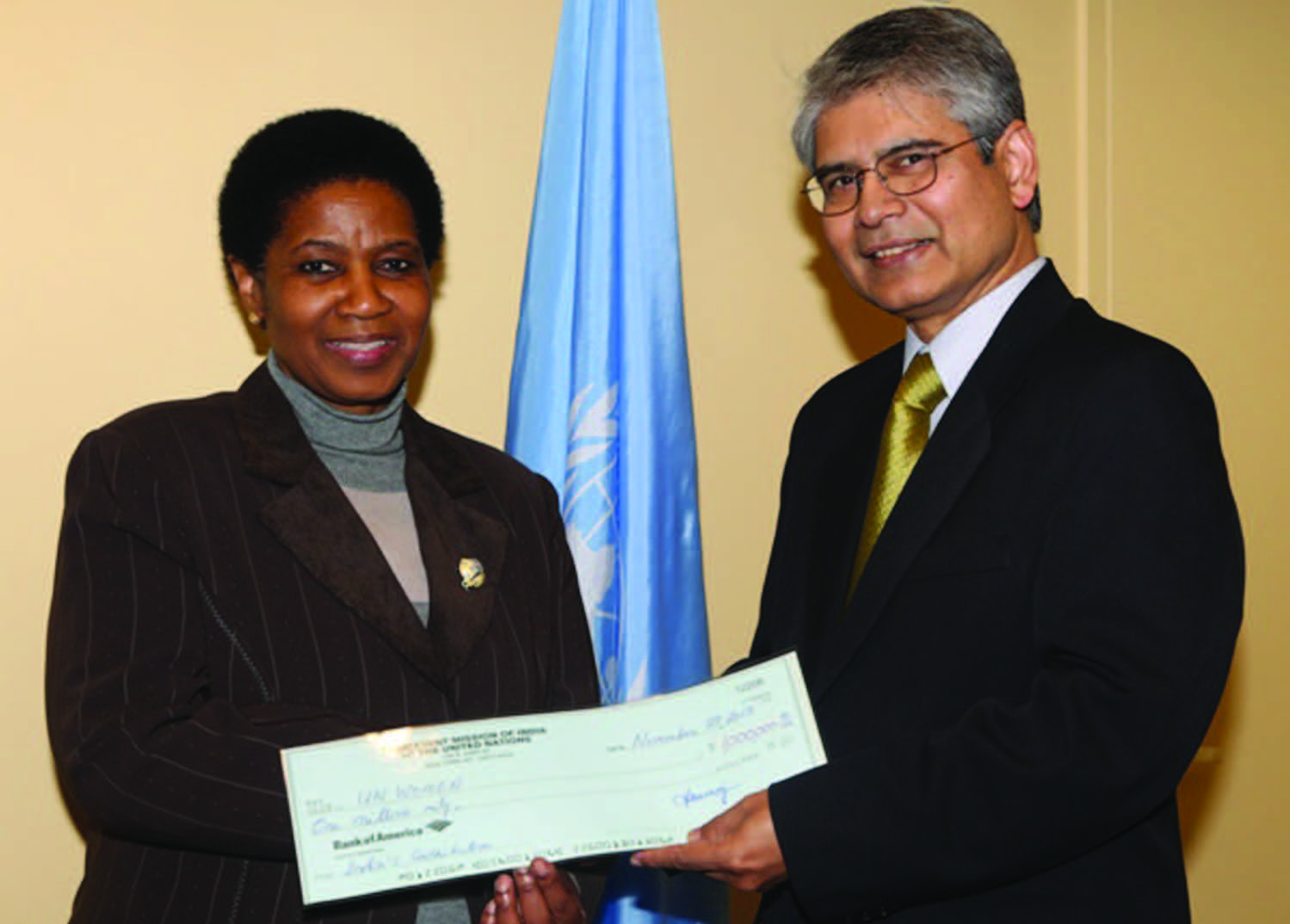
    NEW YORK (TIP): The United Nations Trust Fund to End Violence against Women (UN Trust Fund) announced, November 22, USD 8 million in grants to 17 initiatives in 18 countries and territories. First-time grant recipients include organizations from Antigua and Barbuda, Mauritania, Myanmar and Kosovo (under UNSCR 1244). These new grants are expected to reach 2.3 million beneficiaries between 2014 and 2017.

    “Violence against women and girls can be systematically addressed, and, with persistence, eliminated. The UN Trust Fund to End Violence against Women is dedicated to doing just this,” said Ms. Phumzile Mlambo-Ngcuka, Executive Director of UN Women. “Working with partners across the world, the Fund supports concrete action toward a world free of violence. The support of governments, corporations, foundations and individuals is crucial in achieving this goal.” Violence against women and girls continues to be one of the most pervasive human rights violations in the world, affecting as many as one in three women and girls during their lifetime.

    It severely impacts survivors and comes at tremendous emotional and economic costs for families and societies. “The sheer scale of prevailing violence against women and girls is an abomination as well as an obstacle to inclusive development,” said Ms. Lilianne Ploumen, Netherlands Minister for Foreign Trade and Development Cooperation, one of the UNTF’s multi-year donors. “There is urgent need for action to live up to the commitments made in Resolutions and at the Commission of the Status of Women. The Netherlands will continue to support the UN Trust Fund to End Violence against Women and encourages others to do so as well.”

    The grants announced today will support initiatives that respond to three priority areas of the UN Trust Fund: prevention, expanded access to services, and strengthened implementation of national laws, policies and action plans on violence against women and girls. Additionally, this year, funds will be used to address violence against adolescent and young girls, including through engaging school girls in Bangladesh and Viet Nam and developing the capacities of young girl leaders in the Ukraine.

    Other new UN Trust Fund grantees spearheading pioneering approaches include:

    o In South Africa, Grassroot Soccer will upscale and expand its innovative SKILLS Plus sports-based intervention to foster girls’ empowerment, expand girls’ awareness of sexual and reproductive rights and increase girls’ access to medical, legal and psychosocial services;

    o Medical Services in the Pacific will operate mobile clinics in seven rural market locations across Fiji, providing 18,000 women with improved access to sexual and reproductive healthcare, sexual assault counseling and referral services.

    o The Danish Refugee Council will empower displaced women through the provision of legal aid to survivors of violence by creating mobile legal clinics to serve communities hosting high concentrations of returnees and internally displaced persons in Afghanistan and refugee and asylumseekers in Tajikistan.

    The new grants are made possible with generous support from the Governments of Australia, Austria, Germany, Iceland, Ireland, Italy, Japan, Kazakhstan, Liechtenstein, the Netherlands and South Africa. The Fund is also grateful for the vital support of its partners in the private and non-profit sectors: the Saban Foundation; the United Nations Federal Credit Union, UN Women National Committees (Austria, Iceland, Japan, Singapore and the United Kingdom) and Zonta International.

    Administered by UN Women on behalf of the UN System, the UN Trust Fund has supported 368 initiatives in 132 countries and territories, delivering a total of USD 95 million since its establishment by the General Assembly in 1996. On 25 November, the International Day for the Elimination of Violence against Women, the Fund will also launch its next grant cycle with a global call for proposals to support country-level programs to end violence against women and girls in 2014. UN Women is the UN organization dedicated to gender equality and the empowerment of women.

    A global champion for women and girls, UN Women was established to accelerate progress on meeting their needs worldwide. For more information, visit www.unwomen.org. UN Women, 220 East 42nd Street, New York, NY 10017, New York. Tel: +1 646 781-4400. Fax: +1 646 781-4496.

  • Jobs key for world’s 49 poorest countries: UN

    Jobs key for world’s 49 poorest countries: UN

    UNITED NATIONS (TIP): The population in the world’s 49 poorest countries is projected to double to 1.7 billion by 2050 and job creation will be crucial to prevent increasing poverty, social unrest and mass international emigration, according to a new report launched on November 20. The Least Developed Countries Report 2013 urges these countries to take action to upgrade infrastructure, greatly expand credit, improve education and spur domestic firms and entrepreneurs to create new jobs.

    According to the report by the UN Conference on Trade and Development, strongly increasing investment and improving services such as transportation and electricity supply will increase the value and variety of the goods and services produced by these impoverished countries which is vital to helping these 49 impoverished countries create a total of 16 million new jobs needed every year.

    The report notes that job creation was disappointing even during the “boom” years from 2002 to 2008 when the economies of the least developed countries or LDCs, averaged an economic growth rate of 8% per year. From 2000 to 2012, employment growth in the LDCs averaged 2.9 percent per year, it said. “The growth we have seen in LDCs in the last couple of decades is a jobless growth,” Mussie Delelegn, head of UNCTAD’s New York office told a news conference launching the report.

    “Consequently what we see is the bulging demographic trends, we see persistent poverty … accelerated urbanization and rising inequalities.” The report said LDCs face “a stark demographic challenge:” The population of 858 million in 2011 is projected to double to 1.7 billion by 2050, and the population aged 15 to 24 is expected to soar from 168 million in 2010 to 300 million by 2050.

  • Sri Lanka rights abuse allegations divide Commonwealth

    Sri Lanka rights abuse allegations divide Commonwealth

    COLOMBO (TIP):THE heads of government of the 53 nations of the Commonwealth come together every two years for a summit. This time, several have decided to stay away, to boycott the gathering in Sri Lanka. The prime ministers of Canada, India and Mauritius say they cannot take part. Their basic complaint: Sri Lanka’s President, Mahinda Rajapaksa, should not have been allowed to host the Commonwealth and then take over for the next two years as chairperson of an organisation committed to values of democracy and human rights which he is accused of flouting. Other leaders are still coming, despite pressure on them to join the boycott.

    So Britain’s Prime Minister, David Cameron, has flown in from neighbouring India, although his counterpart, India’s Manmohan Singh, has pulled out. Mr Cameron says it’s better to engage and ask tough questions rather than risk making the Commonwealth irrelevant as an organisation. The case against Sri Lanka’s government stems partly from allegations against the security forces of war crimes, including the killing of civilians, rape and sexual violence against women, particularly during the final months in 2009 of a civil war against Tamil separatists. Critics also say there is considerable evidence of abuses both then and more recently, including the abduction or “disappearance” of opponents and the murder of journalists. The government in Colombo rejects all these allegations, a denial repeated to me in a BBC interview by the country’s minister of mass media and information, as Commonwealth leaders arrived in the country.

    Test of will

    “We wanted zero civilian casualties,” said the minister, Keheliya Rambukwella, who is the government’s spokesman. He added that it was well documented that the Tamil Tigers or LTTE, whom he called “terrorists”, “used civilians as human shields”. The minister also rejected demands from Britain’s prime minister. David Cameron is calling for an end to the intimidation of journalists and human rights defenders, action to stamp out torture, demilitarisation of the north and reconciliation between communities. Mr Cameron says there needs to be a thorough investigation into alleged war crimes, and that if it does not happen rapidly, then an international independent investigation will be needed.

    The Sri Lankan government accuses him of colonialism, of trying to dictate to a sovereign nation and of abusing his invitation to come to Colombo to discuss the issues on the formal agenda of this summit. But that agenda includes debate over what should replace the United Nations Millennium Development Goals when they expire in 2015. That may allow any leader in the room to raise a whole host of human rights concerns, precisely because they are central to many people’s belief that you cannot eradicate poverty without at the same time upholding rights, including the freedom to make political choices and freedom of speech. Some people ask whether or not anyone would notice if the Commonwealth disappeared.

    Supporters argue its achievements are often ignored. They point to a strong set of rules on democracy and elections: Commonwealth observer missions often play a significant role in limiting or preventing ballot-rigging. Military takeovers are punished. Thirty years ago many Commonwealth countries were ruled by men in uniform. Not any more. The Commonwealth is also much more than a club of political leaders. Its grassroots organisations, bringing together civil society groups around the globe, or professional associations exchanging best practice, or promoting trade are often more effective than gatherings of the political elite.

    Small states also value the collective political weight they can sometimes exert via the Commonwealth in a world where their voices might otherwise be drowned out. Critics, on the other hand, assemble lists of Commonwealth failings. Many have to do with promises made by leaders and then broken. Other charges involve rules which are not rigorously enforced. The current controversy over the decision to meet in Colombo is seized on by the critics as further evidence the Commonwealth is all too flexible when it comes to sticking to its principles. This year’s new Commonwealth Charter commits leaders to uphold these principles.

    So this summit will be seen by many as a test of the Commonwealth’s real commitment to values and a test of its collective will.

  • Sri Lanka rights abuse allegations divide Commonwealth

    Sri Lanka rights abuse allegations divide Commonwealth

    COLOMBO (TIP):THE heads of government of the 53 nations of the Commonwealth come together every two years for a summit. This time, several have decided to stay away, to boycott the gathering in Sri Lanka. The prime ministers of Canada, India and Mauritius say they cannot take part. Their basic complaint: Sri Lanka’s President, Mahinda Rajapaksa, should not have been allowed to host the Commonwealth and then take over for the next two years as chairperson of an organisation committed to values of democracy and human rights which he is accused of flouting. Other leaders are still coming, despite pressure on them to join the boycott. So Britain’s Prime Minister, David Cameron, has flown in from neighbouring India, although his counterpart, India’s Manmohan Singh, has pulled out. Mr Cameron says it’s better to engage and ask tough questions rather than risk making the Commonwealth irrelevant as an organisation. The case against Sri Lanka’s government stems partly from allegations against the security forces of war crimes, including the killing of civilians, rape and sexual violence against women, particularly during the final months in 2009 of a civil war against Tamil separatists. Critics also say there is considerable evidence of abuses both then and more recently, including the abduction or “disappearance” of opponents and the murder of journalists. The government in Colombo rejects all these allegations, a denial repeated to me in a BBC interview by the country’s minister of mass media and information, as Commonwealth leaders arrived in the country.

    Test of will
    “We wanted zero civilian casualties,” said the minister, Keheliya Rambukwella, who is the government’s spokesman. He added that it was well documented that the Tamil Tigers or LTTE, whom he called “terrorists”, “used civilians as human shields”. The minister also rejected demands from Britain’s prime minister. David Cameron is calling for an end to the intimidation of journalists and human rights defenders, action to stamp out torture, demilitarisation of the north and reconciliation between communities. Mr Cameron says there needs to be a thorough investigation into alleged war crimes, and that if it does not happen rapidly, then an international independent investigation will be needed. The Sri Lankan government accuses him of colonialism, of trying to dictate to a sovereign nation and of abusing his invitation to come to Colombo to discuss the issues on the formal agenda of this summit. But that agenda includes debate over what should replace the United Nations Millennium Development Goals when they expire in 2015. That may allow any leader in the room to raise a whole host of human rights concerns, precisely because they are central to many people’s belief that you cannot eradicate poverty without at the same time upholding rights, including the freedom to make political choices and freedom of speech. Some people ask whether or not anyone would notice if the Commonwealth disappeared.

    Supporters argue its achievements are often ignored. They point to a strong set of rules on democracy and elections: Commonwealth observer missions often play a significant role in limiting or preventing ballot-rigging. Military takeovers are punished. Thirty years ago many Commonwealth countries were ruled by men in uniform. Not any more. The Commonwealth is also much more than a club of political leaders. Its grassroots organisations, bringing together civil society groups around the globe, or professional associations exchanging best practice, or promoting trade are often more effective than gatherings of the political elite. Small states also value the collective political weight they can sometimes exert via the Commonwealth in a world where their voices might otherwise be drowned out. Critics, on the other hand, assemble lists of Commonwealth failings. Many have to do with promises made by leaders and then broken. Other charges involve rules which are not rigorously enforced. The current controversy over the decision to meet in Colombo is seized on by the critics as further evidence the Commonwealth is all too flexible when it comes to sticking to its principles. This year’s new Commonwealth Charter commits leaders to uphold these principles. So this summit will be seen by many as a test of the Commonwealth’s real commitment to values and a test of its collective will.

  • Sikhs in Thousands Attend ‘Justice Rally’ in Geneva

    Sikhs in Thousands Attend ‘Justice Rally’ in Geneva

    ‘Sikh Genocide Petition’ Submitted to UN

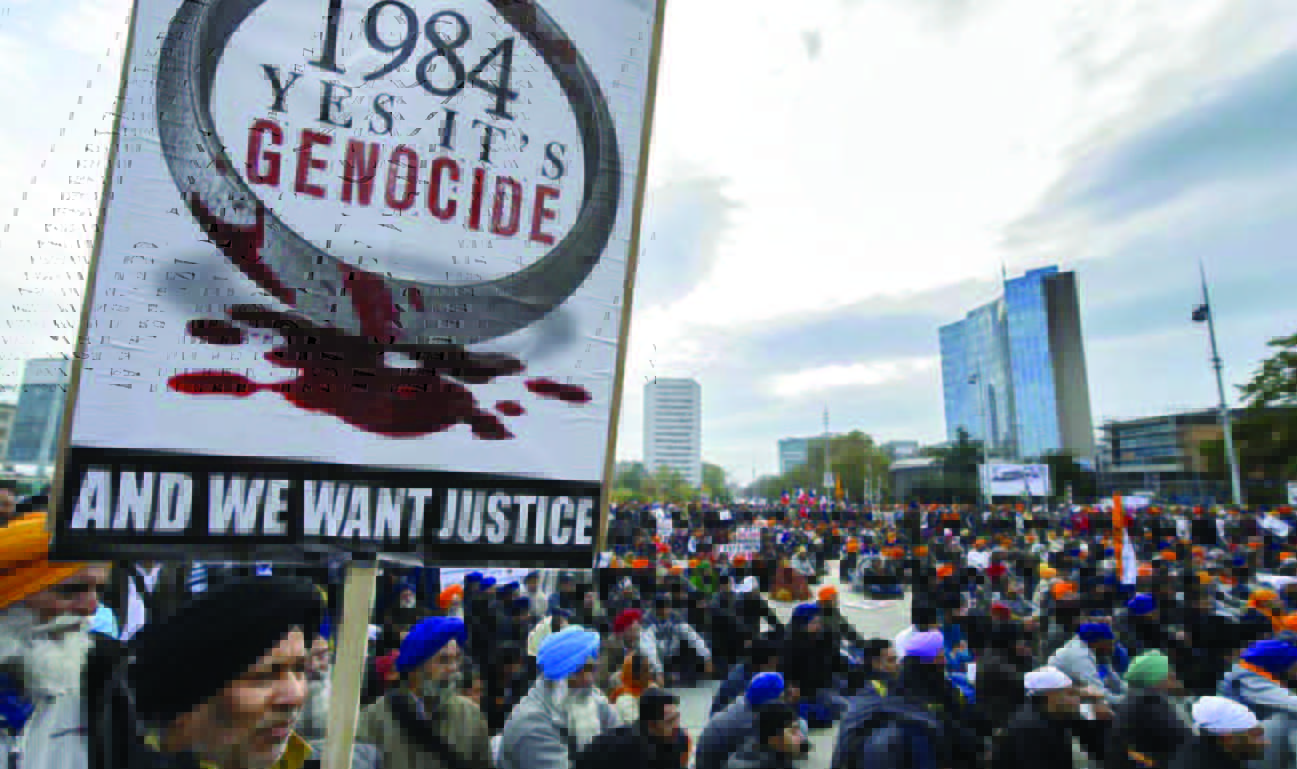
    GENEVA (TIP): The Justice Rally held in front of the UN office in Geneva was attended by thousands of Sikhs from across Europe, the US and Canada. The rally was organized by Sikhs for Justice (SFJ) Movement Against Atrocities and Repressions (MAR) with the support of Gurudwara management committees from across Europe. November 01 rally before UN was one of the biggest rallies ever held before UN in Geneva. SFJ coordinators Avtar Singh Pannun of New York and Sukhwinder Singh Thana worked tirelessly past several weeks to organize the rally and toured the UK and Europe to gather support from the local Sikh community. Doctor Bakhshish Singh Sandhu, SFJ Coordinator also traveled to Geneva to attend the rally. According to SFJ coordinators, the rally before UN woke the world community that organized killing of Sikhs during November 1984 was Genocide and not riots. A delegation comprising of representatives of SFJ, MAR, AISSF and European gurudwaras personally filed the “Sikh Genocide Petition” in the United Nations Human Rights Council. The delegation included SFJ legal advisor Gurpatwant Singh Pannun, SFJ Coordinator Avtar Singh Pannun, Harminder Singh Khalsa of MAR, Doctor Karj Singh Dharamsinghwala of AISSF, Jatinder Singh Grewal of SFJ and Jasbir Singh Delhi.


    img17
    SFJ legal advisor Gurpatwant Singh Pannun and SFJ Coordinator Avtar Singh Pannun display the petition submitted to UN Office in Geneva

    Jasbir Singh Delhi a resident of California, who is main witness against Congress leader Tytler also traveled across Europe to gather community support for the Genocide petition and rally before UN. According to Jasbir Singh Delhi, the victims of November 1984 have approached United Nations for justice because all the attempts to obtain justice in India have failed and organizers of November 1984 are rewarded by India instead of being prosecuted. Addressing the rally, SFJ Coordinator, Avtar Singh Pannun stated that for past 29 years Sikh community has been demanding justice for India’s crimes of November 1984. Now we have approached the UN and global community for recognition of November 1984 Sikh Genocide. According to Sukhwinder Singh Thana, SFJ Coordinator, Sikh community have come together in demanding justice and UN intervention on the issue of November 1984 Sikh Genocide. Doctor Bakhshish Singh Sandhu of SFJ stated that filing petition before the UN on the issue of November 1984 is just the first step in seeking justice and recognition for Sikh Genocide. With the help and support of Sikh community worldwide, we will have to take the matter to all international forums. Tejinder Kaur from Surrey, Canada, traveled all the way to Geneva for submission of the petition and to participate in the rally. She also addressed the rally, saying: “I was just 13 years old when this massacre took place and daughter of a senior Indian government official. That was the moment in my life, to discover my identity as a Sikh.” SFJ legal adviser Gurpatwant Singh Pannun, who had been touring various European countries for the last few weeks, claimed that this signature campaign has once again focused the Sikh Diaspora on the issue of demanding justice for the victims of the November 1984 killings.

  • The Obama Doctrine

    The Obama Doctrine

    Is the US president veering toward isolationism? Or will he proudly carry the banner of exceptionalism?

    The recent Obama-Putin tiff over American exceptionalism reignited an ongoing debate over the Obama Doctrine: Is the president veering toward isolationism? Or will he proudly carry the banner of exceptionalism? The debate is narrower than it may seem. There is considerable common ground between the two positions, as was expressed clearly by Hans Morgenthau, the founder of the now dominant no-sentimentality “realist” school of international relations. Throughout his work, Morgenthau describes America as unique among all powers past and present in that it has a “transcendent purpose” that it “must defend and promote” throughout the world: “the establishment of equality in freedom.” The competing concepts “exceptionalism” and “isolationism” both accept this doctrine and its various elaborations but differ with regard to its application. One extreme was vigorously defended by President Obama in his Sept. 10 address to the nation: “What makes America different,” he declared, “what makes us exceptional,” is that we are dedicated to act, “with humility, but with resolve,” when we detect violations somewhere. “For nearly seven decades the United States has been the anchor of global security,” a role that “has meant more than forging international agreements; it has meant enforcing them.”

    The competing doctrine, isolationism, holds that we can no longer afford to carry out the noble mission of racing to put out the fires lit by others. It takes seriously a cautionary note sounded 20 years ago by the New York Times columnist Thomas Friedman that “granting idealism a near exclusive hold on our foreign policy” may lead us to neglect our own interests in our devotion to the needs of others. Between these extremes, the debate over foreign policy rages. At the fringes, some observers reject the shared assumptions, bringing up the historical record: for example, the fact that “for nearly seven decades” the United States has led the world in aggression and subversion – overthrowing elected governments and imposing vicious dictatorships, supporting horrendous crimes, undermining international agreements and leaving trails of blood, destruction and misery. To these misguided creatures, Morgenthau provided an answer. A serious scholar, he recognized that America has consistently violated its “transcendent purpose.” But to bring up this objection, he explains, is to commit “the error of atheism, which denies the validity of religion on similar grounds.” It is the transcendent purpose of America that is “reality”; the actual historical record is merely “the abuse of reality.”

    In short, “American exceptionalism” and “isolationism” are generally understood to be tactical variants of a secular religion, with a grip that is quite extraordinary, going beyond normal religious orthodoxy in that it can barely even be perceived. Since no alternative is thinkable, this faith is adopted reflexively. Others express the doctrine more crudely. One of President Reagan’s U.N. ambassadors, Jeane Kirkpatrick, devised a new method to deflect criticism of state crimes. Those unwilling to dismiss them as mere “blunders” or “innocent naivete” can be charged with “moral equivalence” – of claiming that the U.S. is no different from Nazi Germany, or whoever the current demon may be. The device has since been widely used to protect power from scrutiny. Even serious scholarship conforms. Thus in the current issue of the journal Diplomatic History, scholar Jeffrey A. Engel reflects on the significance of history for policy makers. Engel cites Vietnam, where, “depending on one’s political persuasion,” the lesson is either “avoidance of the quicksand of escalating intervention [isolationism] or the need to provide military commanders free rein to operate devoid of political pressure” – as we carried out our mission to bring stability, equality and freedom by destroying three countries and leaving millions of corpses.

    The Vietnam death toll continues to mount into the present because of the chemical warfare that President Kennedy initiated there – even as he escalated American support for a murderous dictatorship to all-out attack, the worst case of aggression during Obama’s “seven decades.” Another “political persuasion” is imaginable: the outrage Americans adopt when Russia invades Afghanistan or Saddam Hussein invades Kuwait. But the secular religion bars us from seeing ourselves through a similar lens. One mechanism of self-protection is to lament the consequences of our failure to act. Thus New York Times columnist David Brooks, ruminating on the drift of Syria to “Rwanda-like” horror, concludes that the deeper issue is the Sunni-Shiite violence tearing the region asunder. That violence is a testimony to the failure “of the recent American strategy of lightfootprint withdrawal” and the loss of what former Foreign Service officer Gary Grappo calls the “moderating influence of American forces.” Those still deluded by “abuse of reality” – that is, fact – might recall that the Sunni- Shiite violence resulted from the worst crime of aggression of the new millennium, the U.S. invasion of Iraq. And those burdened with richer memories might recall that the Nuremberg Trials sentenced Nazi criminals to hanging because, according to the Tribunal’s judgment, aggression is “the supreme international crime differing only from other war crimes in that it contains within itself the accumulated evil of the whole.”

    The same lament is the topic of a celebrated study by Samantha Power, the new U.S. ambassador to the United Nations. In “A Problem from Hell: America in the Age of Genocide,” Power writes about the crimes of others and our inadequate response. She devotes a sentence to one of the few cases during the seven decades that might truly rank as genocide: the Indonesian invasion of East Timor in 1975. Tragically, the United States “looked away,” Power reports. Daniel Patrick Moynihan, her predecessor as U.N. ambassador at the time of the invasion, saw the matter differently. In his book “A Dangerous Place,” he described with great pride how he rendered the U.N. “utterly ineffective in whatever measures it undertook” to end the aggression, because “the United States wished things to turn out as they did.” And indeed, far from looking away, Washington gave a green light to the Indonesian invaders and immediately provided them with lethal military equipment. The U.S. prevented the U.N. Security Council from acting and continued to lend firm support to the aggressors and their genocidal actions, including the atrocities of 1999, until President Clinton called a halt – as could have happened anytime during the previous 25 years. But that is mere abuse of reality. It is all too easy to continue, but also pointless. Brooks is right to insist that we should go beyond the terrible events before our eyes and reflect about the deeper processes and their lessons. Among these, no task is more urgent than to free ourselves from the religious doctrines that consign the actual events of history to oblivion and thereby reinforce our basis for further “abuses of reality.”

  • Sikhs For Justice to present 1984 Genocide Petition to UNHR Commission on November 1

    Sikhs For Justice to present 1984 Genocide Petition to UNHR Commission on November 1

    NEW YORK (TIP): The Sikhs For Justice, a Human Rights Organization based in New York has claimed that on the occasion of 29th anniversary of 1984 anti-Sikh riots in Delhi, a petition signed by around a million Sikhs throughout world, will be filed with the United Nations in Geneva on November 1 2013. The Sikh Genocide Petition will be handed to Navi Pillay, UN human rights chief by a delegation of rights group “Sikhs for Justice” (SFJ), All India Sikh Students Federation (AISSF) and Gurudwara representatives from Europe and North America. Titled “1984 Yes its Genocide”, the petition will be filed with UNHCR under 1503 procedure of the United Nations. SFJ legal adviser Gurpatwant Singh Pannun said, “Under 1503 procedure, UNHCR refers these petitions to the sub-commission on Promotion and Protection of Human Rights which examines complaints regarding gross human rights violations and impunity, as in the case of November 1984 Sikh genocide.”

    The petition requests the United Nations to investigate the systematic, intentional and deliberate killing of Sikhs carried out throughout India during the first week of November 1984 and recognize the killings as “genocide” under UN Convention on Genocide. The complaint invokes UN Convention against Genocide which declares any intentional and deliberate attack on any religious minority to be a “crime” liable to be prosecuted and punished. The evidence of November 1984 killing of Sikhs clearly shows that Sikhs were deliberately attacked in a planned manner throughout India on behest of ruling Congress party. Justifying the UN intervention on the issue of Sikh Genocide, All India Sikh Students Federation President Karnail Singh Peermohamd who spearheaded the campaign for getting signatures on the petition in India and managed to get a few lakh signatures from Punjab and other states, said that they were constrained to move the UN after failing to get justice in India. “The justice delivery system of our country has failed the hapless victims of largest massacre of people after 1947 and till date the perpetrators of the mass murders are roaming free and rather enjoying power,” he said.

    “We have been knocking at every door here to get justice but the establishment failed all attempts to allow justice to the victims,” he added. Meanwhile attorney Pannun said, “Rights group will present to the UN evidence and documents regarding use of local administration and government resources by the Congress leaders to organize genocidal attacks on Sikhs during November 1984.” “A Justice Rally will also be held outside UN in Geneva on November 1 to remind the world that even after 29 years, organizers and perpetrators of November 1984 have not been convicted by the Government of India. More than 10,000 Sikhs from across Europe and North America are expected to attend the Justice Rally in Geneva,” Pannun and Peermohammad said.

  • US-India Relations Hit a Rough Patch

    US-India Relations Hit a Rough Patch

    The author feels that there are a number of vital issues which are unlikely to be settled within the tenures of either Obama or Singh, leaving a lingering note of ambivalence in the US-India relationship even as it deepens outside of the high politics.

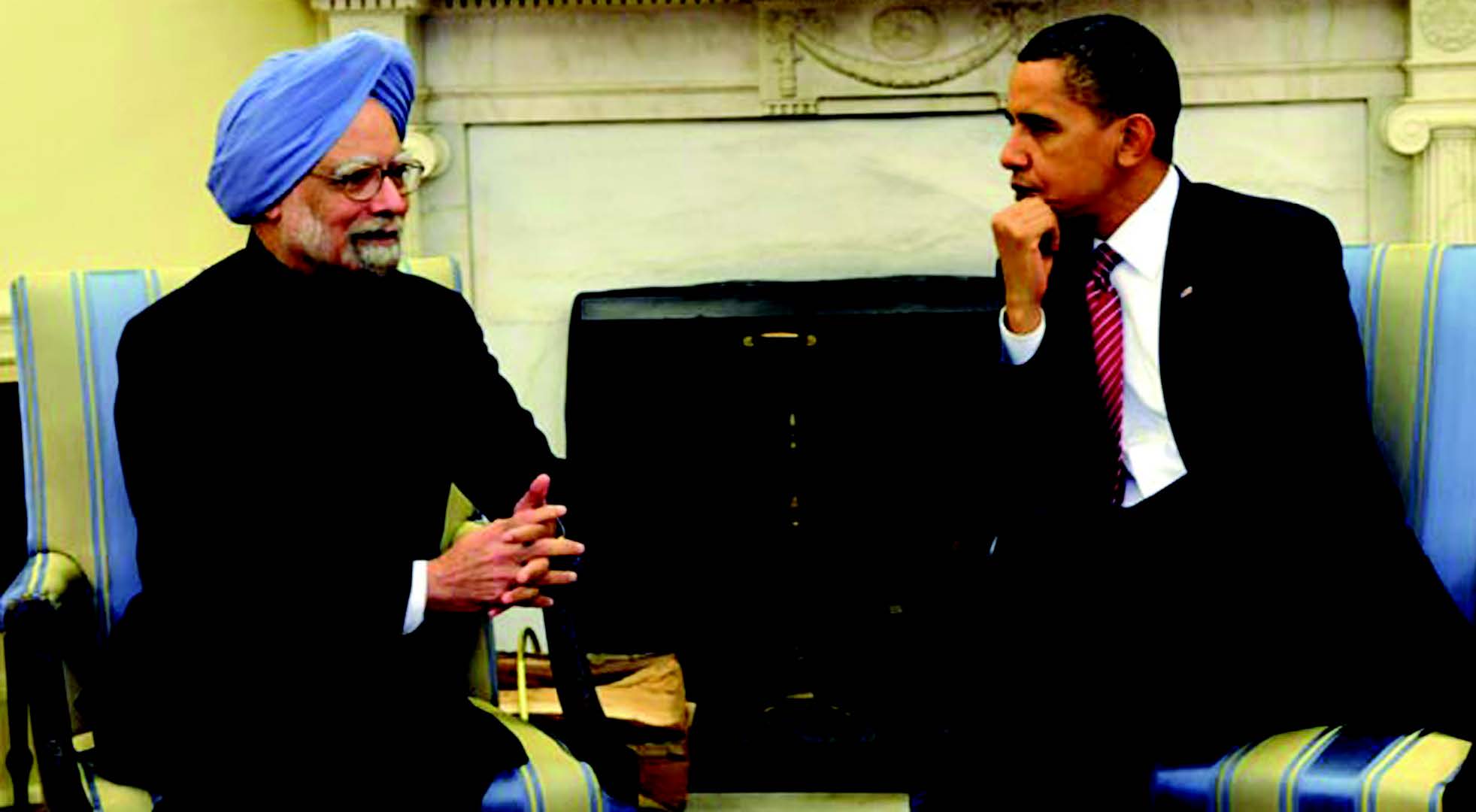
    When Indian Prime Minister Manmohan Singh visited Washington last month for the first time in four years, the mood was distinctly subdued. India’s once-stratospheric growth rate is stubbornly depressed. The Indian government is low on political capital and stuck in risk-averse mode until next year’s general elections, with a huge question mark over Singh’s personal future. Most Indians anyway focused on Singh’s New York meeting with his Pakistani counterpart Nawaz Sharif – underwhelming, as it turned out, and marred by a perceived slur – rather than his meetings with President Obama. More generally, the promise of USIndia relations remains far below the levels anticipated only a few years ago.

    Why the stasis?
    There are any number of reasons. Indian journalist Indrani Bagchi suggests that ‘there remains a strong lobby within this government starting with [ruling Congress Party chairwoman] Sonia Gandhi and [Defense Minister] AK Antony downwards, which retains an instinctive aversion to America’. That same government’s slow rate of economic reform irks American companies who want to invest in India. In particular, a strict nuclear liability law limits those companies’ ability to exploit a landmark civil nuclear cooperation agreement initiated by the Bush administration in 2005. Also, India’s Byzantine procurement rules madden the American defense companies eager to sell into what is one of the few growing arms markets in the world. A sense prevails that the low-hanging fruit in the bilateral relationship was picked some years ago. But one less-noticed problem is that the limited bandwidth of US foreign policy is presently occupied by issues in which India is either wary of US policy or simply apathetic.

    The Middle East
    In his speech to the United Nations General Assembly on 24 September, President Obama noted that ‘in the near term, America’s diplomatic efforts will focus on two particular issues: Iran’s pursuit of nuclear weapons and the Arab-Israeli conflict’. India has much to gain from a rapprochement between Iran and the United States, not least the ability to once again freely import Iranian oil. India was circumventing international sanctions by paying for a diminished flow of Iranian oil in rupees, but the new Iranian government is insisting that India can only pay for half this way. India is a bystander rather than active participant in the broader dispute, watching from the sidelines as the P5+1 bloc, which includes Russia and China, participates in negotiations. On Syria, India is sympathetic to the regime of President Bashar al-Assad. It views the issue through the lens of the Afghan jihad in the 1980s, which Indians see as indelibly associated with the subsequent uprising in Kashmir and the growth of anti- Indian militancy. When the Indian Government summoned the Syrian Ambassador in Delhi last month, it was not because of Syrian policies but because the ambassador had alleged that Indian jihadists were fighting with the rebels. The ambassador stated, tellingly, that ‘he was always deeply appreciative of India’s position on Syria’.

    India unsurprisingly opposes efforts to arm the Syrian rebels, tends to see the armed opposition as irredeemably compromised by jihadists and reflexively opposes US proposals for military action, particularly outside the ambit of the UN Security Council. India has already had to abandon several oil fields in Syria and, in September 2013, India’s foreign secretary even referred to an existing Indian line of credit to the Syrian government. Yet, despite these equities, India has no leverage over the parties to the conflict. In May, an Iranian suggestion of greater Indian involvement went nowhere. There is little that Singh would usefully have been able to say to Obama on the subject. At a broader level, the more the Middle East distracts from US attention to Asia- Pacific – including the so-called ‘pivot’ of American military forces eastwards – the less high-level attention India receives in Washington. India was not mentioned once in Obama’s UN address (to compare: China was mentioned once, Iran 26 times, and Syria 20).

    Afghanistan
    India’s attitude to US policy in Afghanistan is even more conflicted. India is ostensibly supportive of US policy, and has formally signed on to an Afghan-led peace process. But Indian officials and strategists scarcely disguise their discomfort towards what they see as undue American haste in withdrawing troops, an overeagerness to accommodate the Taliban as part of political reconciliation, and a continued indulgence of Pakistan despite its support for Afghan insurgents. India felt that its views were vindicated by the June debacle over the opening of a Taliban office in Doha, which deviated from the agreed protocol, handed a propaganda victory to the Taliban, and angered the Afghan government. Indian national security reporter Praveen Swami summed up many Indians’ views in complaining that the US was ‘subcontracting the task of keeping the peace in Afghanistan to the ISI’, Pakistan’s premier intelligence service.

    In recent months, Indians have taken offence at statements by James Dobbins, the US Special Representative for Afghanistan and Pakistan, echoing earlier Indian anger at the late Richard Holbrooke, and have chafed at what they see as a Western equivalence between Indian and Pakistani policy in Afghanistan. For their part, US and British officials have grown increasingly frustrated with India’s approach to the issue, arguing that India offers no plausible alternative to the policy of reconciliation given the long-term weakness of the Afghan state. Yet it is in Obama’s interests to assuage Indian concerns, emphasize that reconciliation with the Taliban will be constrained by the established ‘red lines’, that the US will not abandon counterterrorism efforts in Afghanistan after 2014, and that India’s role in Afghanistan is not only welcome, but also necessary to the strengthening of the Afghan state. India rebuffed Afghan President Hamid Karzai’s request for arms earlier this year, wary of provoking Pakistan. But one area that deserves more discussion is greater direct cooperation between India and the NATO-led coalition in Afghanistan to train and equip Afghan National Security Forces (ANSF).

    According to one report, Obama asked Singh last week for an ‘increased effort’ in Afghanistan, although it’s unclear whether this included an implied or explicit training dimension. India, entirely reasonably, sees a potential eastward flow of militants from Afghanistan and Pakistan as a major security threat, particularly with violent trends in Kashmir worsening this year. India would therefore be particularly receptive to a US commitment to monitor and disrupt militant movement in the years after 2014. In truth, it will be difficult to make progress on these issues until Washington settles its own internal debates over what its posture in Afghanistan will be after 2014 (for example, how many (if any) troops will remain in a training capacity?), which in turn will depend on the peace process itself, President Karzai’s domestic political calculations in the face of presidential elections next year, the integrity of that election, and trends in Afghanistan.

    Where next?
    The level of US-India tension should not be exaggerated. It is telling that recent revelations over US intelligence collection against Indian diplomatic targets have, unlike in the case of Brazil, had negligible impact on the relationship. Indian officials chose to brush the issue under the carpet, presumably hoping that the issue had little domestic salience and perhaps even tacitly acknowledging that the NSA’s activities against Indian internet traffic were indirectly beneficial to Indian policy objectives. Twenty years ago, the Indian response may have been very different. It is these changes in tone that convey strategic shifts as much as any large policy initiative. And although the two countries differ on the contentious big-picture issues outlined above, this has not prevented the relationship from advancing on other tracks. In September, US Deputy Secretary of Defense Ashton Carter visited India to push ahead with the bilateral Defense Trade Initiative (DTI), which Carter co-chairs with India’s National Security Advisor, Shivshankar Menon.

    Carter reiterated his suggestion, dating from last year, that US and Indian firms cooperate to produce military equipment – including helicopters, nextgeneration anti-tank missiles, mine systems, and naval guns – for both countries’ use. India has been bafflingly slow and reticent to respond to these overtures, despite the possibility of much-needed technology transfer to Indian industry (though many analysts are skeptical as to its capacity for technology absorption). The negotiations nevertheless reflect the US perception that the defense strand of its relationship with India are a priority. The road ahead is rocky. Over the next eighteen months, the US-India relationship will be severely buffeted by US policy towards Afghanistan. As the American drawdown accelerates, one possibility is that the US intensifies diplomatic efforts to peel away moderate factions within the Afghan Taliban, Whether that amounts to anything or not (and few are optimistic) the process is certain to involve at least a period of deeper USPakistan consultations, at the expense of India. Later this month, for instance, a fourth Afghanistan-Pakistan-UK trilateral summit will take place in London.

    India has quietly seethed at the previous three, viewing them as a coordinated effort to reduce Indian influence. Yet, for the United States at least, the centre of gravity of the US-India relationship is not Afghanistan, but China. The Middle East’s fast-moving and highly visible crises have briefly distracted from a slow-moving background trend: the political and economic rise of China. Yet this remains where Indian and American strategic interests are most collectively at stake, if not necessarily congruent. Following India’s most recent crisis with China, involving deep Chinese incursions into disputed territory a few months ago, New Delhi’s instinctive response was not to make a prominent feint towards Washington – something that might have been the natural response of other states eager to balance against Beijing – but to engage China more intensively, including on the border dispute itself. Indeed, Singh will make a trip to Beijing next month, with indications that he may sign an upgraded border agreement. Nothing better underscores how India’s internal debate over the desired scope of its relationship with the United States is unsettled, on-going, and erratic. More generally, much of India’s press and strategic community have accepted the popular narrative that American leadership, as well as American power, is in decline, and that US reliability is therefore in question. These issues are unlikely to be settled within the tenures of either Obama or Singh, leaving a lingering note of ambivalence in the USIndia relationship even as it deepens outside of the high politics.

  • ‘International Day of Non- Violence’ commemorated at the United Nations

    ‘International Day of Non- Violence’ commemorated at the United Nations

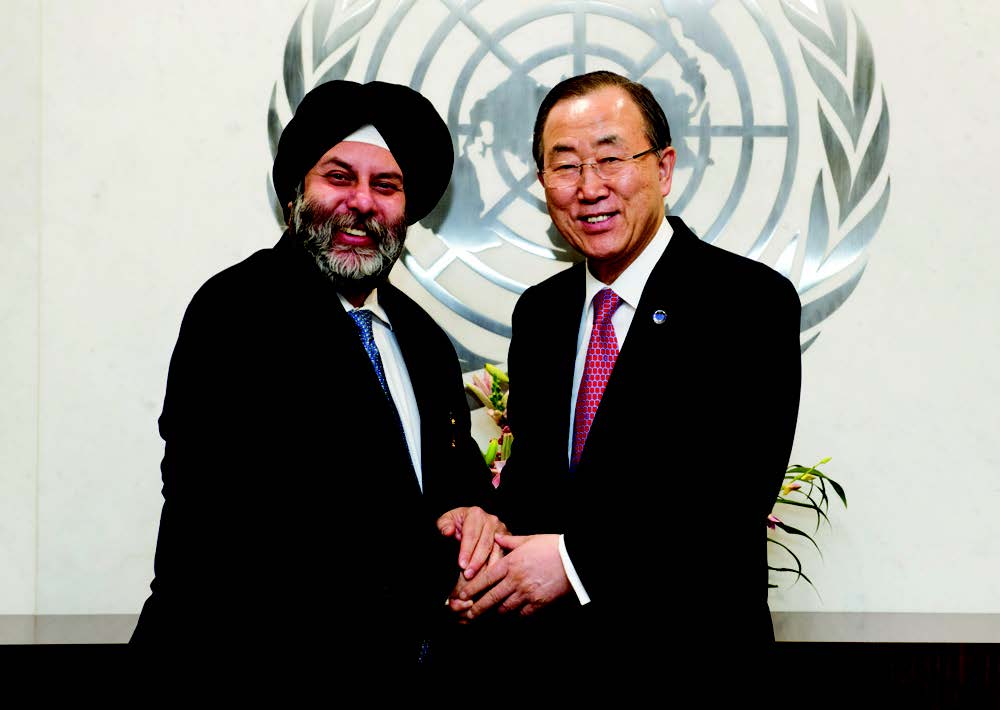
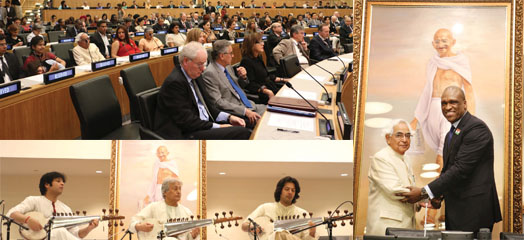
    UNITED NATIONS (TIP): The Permanent Mission of India to United Nations, New York hosted a special event on October 2 at the United Nations to commemorate the “International Day of Non Violence”. UN Secretary General (UNSG) H.E. Mr. Ban ki-moon and President of the 68th UN General Assembly (PGA) H.E. Ambassador John Ashe graced the event and delivered the key note and presidential address respectively. Other speakers on the distinguished panel included the Permanent Representative of South Africa to UN, H.E. Ambassador Kingsley Mamabolo, and featured interventions by the Permanent Representative of Argentina, H.E. Ambassador María Cristina Perceval, the Permanent Representative of Czech Republic, H.E. Ambassador Edita Hrda, and Permanent Representative of Norway H.E. Ambassador Geir O. Pedersen.


    img8

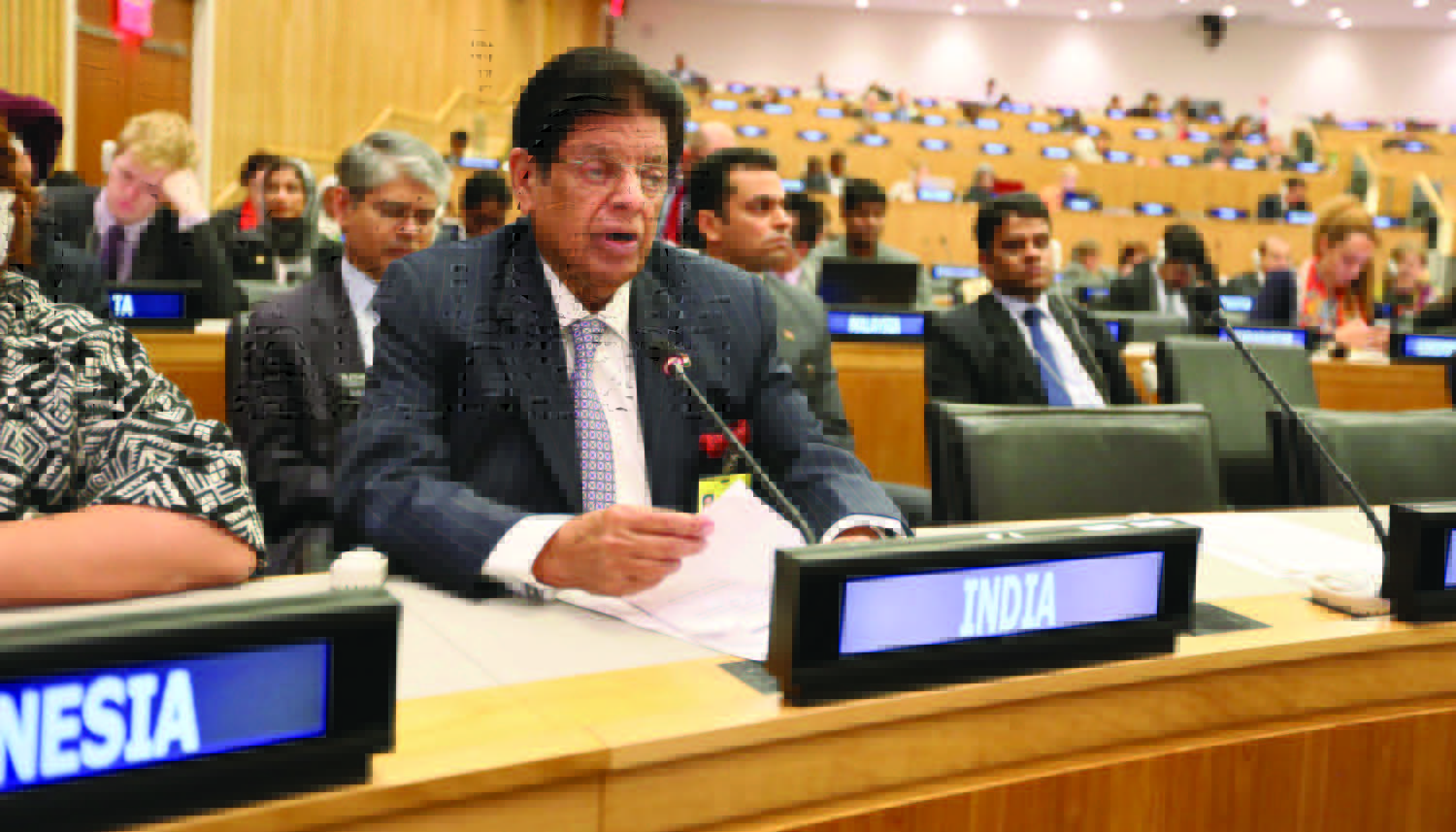
    The event had a packed audience of 450 plus, which included 65 Permanent Representatives of UN Member states, in addition to members of the media and several other dignitaries including Ambassador Vijay Nambiar, the Special Adviser on Myanmar to U.N. Secretary-General and other senior UN officials. Ambassador Asoke K Mukerji, Permanent Representative of India to UN, welcomed the distinguished gathering and underscored the increasing relevance of Gandhian ideals by stating ‘that the path of non-violence and dialogue is the surest path to sustainable peace, sustainable development and indeed, sustainable reforms. It is through such an approach that we would be best equipped to deal with the challenges of change, whether political, social, economic or environmental, and find solutions on the basis of the strength of dialogue.’ Delivering the key note address UN Secretary General called on member states to ‘draw strength from the courage of individuals like Mahatma Gandhi’ and quoting him said : “I object to violence because when it appears to do good, the good is only temporary; the evil it does is permanent” . UNSG emphasized that it was from this ideology that the UN has “insisted throughout the war in Syria that all concerned must work for a political solution” and reiterated that “whatever one’s sympathies or convictions, violence is a poor means to an unsatisfactory end.” In his Presidential Address, Ambassador John Ashe, President of the 68th UN General Assembly, stated that as the General Assembly embarks upon setting the post 2015 development agenda, it was important that “laying the groundwork for this new agenda, is laying the groundwork for a non-violent world – one that values peace and well-being for all”.

    In the subsequent statements by the Ambassadors of South Africa, Czech, Argentina and Norway, the need for the world to resort to ‘non violent’ pathways as the only available solution to conflicts around the world, was emphasized as a common resonating theme. Ambassador John Ashe, President of the 68th UN General Assembly was also presented with a life size portrait of Mahatma Gandhi by renowned artist, Dr. R.D. Pareek, who had flown in from Mumbai to present his painting to the PGA. In addition, a ‘special edition book’ on the life of Mahatma Gandhi was presented to the UN Secretary General for his personal collection by the Permanent Representative of India to UN, Ambassador Asoke K Mukerji. The Special Event also featured an exclusive Sarod recital by Ustad Amjad Ali Khan, his sons Amaan and Ayaan and accompanying artists. The performance included special renditions of tunes of ‘Vaishnav Jan to Tene Kahiye’ and ‘Raghupati Raghav Rajaram’ to mark the occasion and drew a standing ovation from the packed audience at the UN. It may be recalled that the UN General Assembly had adopted resolution 61/271 with a record number of 143 co sponsors in June 2007, whereby it declared October 2, the birthday of Mahatma Gandhi, as “International Day of Non Violence” and invited all member states, NGOs and individuals, including the United Nations to organize events to commemorate this day.

  • Security Council Reform discussed at the Ministerial Meeting of the G4 Countries

    Security Council Reform discussed at the Ministerial Meeting of the G4 Countries

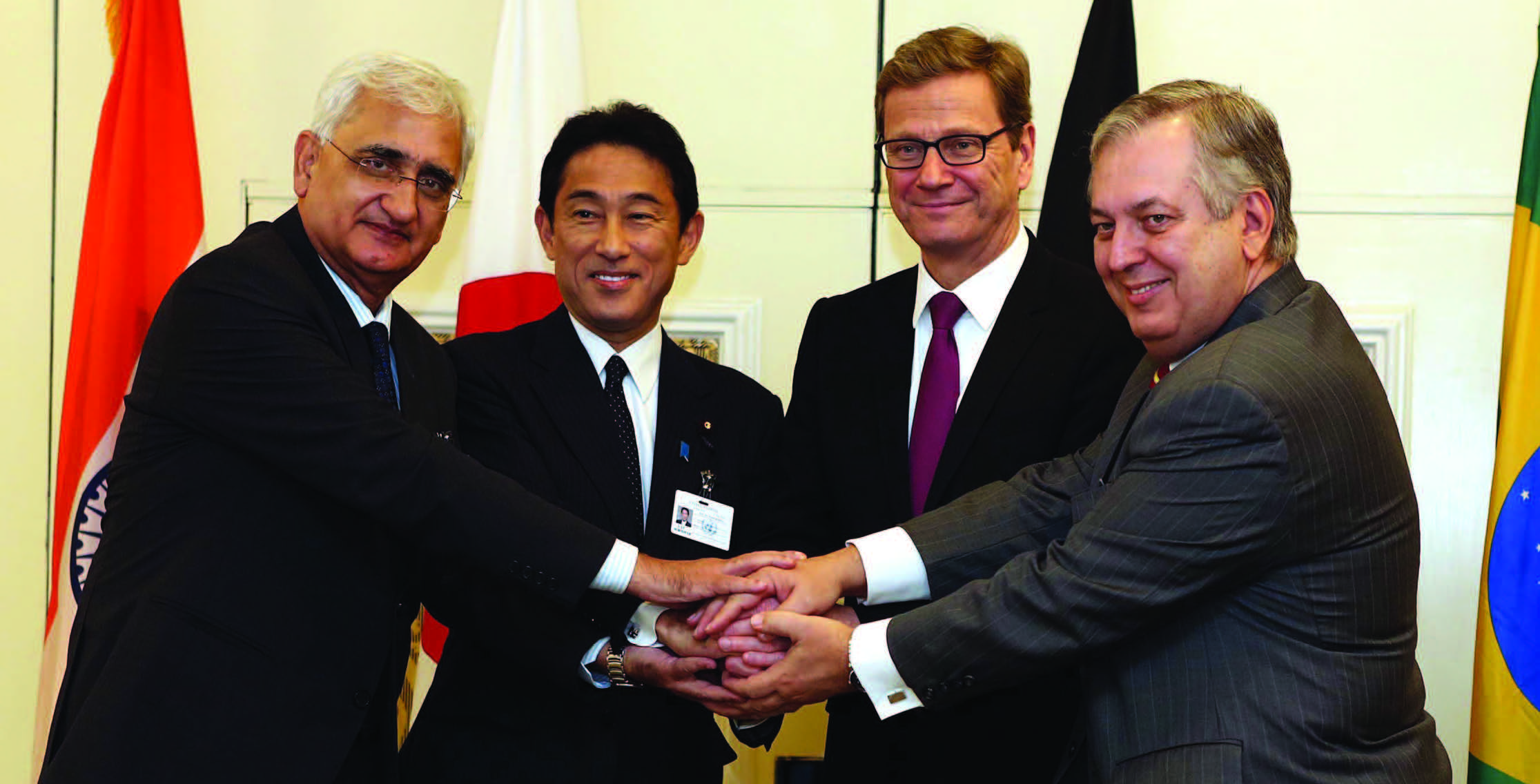
    NEW YORK (TIP): The Minister of External Relations of Brazil, the Federal Minister for Foreign Affairs of Germany, the Minister of External Affairs of India and the Minister for Foreign Affairs of Japan met in New York on 26 September 2013, in the margins of the opening of the 68th Session of the United Nations General Assembly, to exchange views on Security Council reform. The Ministers underscored that, almost 70 years after the creation of the United Nations, reform of the Security Council is long overdue. They agreed that difficulties of the Security Council in dealing with international challenges, including current ones, have further highlighted the need for U.N. Security Council reform in order to better reflect geopolitical realities of the 21st century and make the Council more broadly representative, efficient and transparent and thus to further enhance its effectiveness and the legitimacy and?implementation of its decisions.

    The Ministers recalled that almost 10 years ago, in the Outcome Document of the 2005 World Summit, international leaders committed themselves to an early reform of the Security Council. The Ministers stressed the need to intensify efforts to translate, at the latest by 2015, the existing agreement into concrete outcomes. Recalling previous G4 joint statements, the Ministers reiterated their common vision of a reformed Security Council, taking into consideration the contributions made by countries to the maintenance of international peace and security and other purposes of the organization, as well as the need for increased representation of developing countries in both categories, in order to better reflect today’s geopolitical realities. The G4 countries reiterated their commitments as aspiring new permanent members of the UN Security Council, as well as their support for each other’s candidatures. They also reaffirmed their view of the importance of developing countries, in particular Africa, to be represented in both the permanent and nonpermanent categories of an enlarged Council.

    In this context, the Ministers emphasized the importance to enhance dialogue and outreach with African countries on Security Council reform and commended the initiative of the Government of Japan in having convened the first Japan-Africa Summit Meeting on U.N. Security Council Reform in June. In addition, the Ministers noted with appreciation the directive of CARICOM Heads of State and Government in February 2013 calling for ‘greater urgency in achieving lasting Security Council Reform’ and the initiative of CARICOM to reinvigorate the Intergovernmental Negotiation process. The Ministers recognized the need for greater involvement of civil society, the media and academia on the discussions about the reform of the Security Council and in this context, they welcomed the Brazilian initiative of hosting a seminar, in April this year, to broaden the debate on the urgency and inevitability of the reform of the United Nations Security Council. The Ministers also discussed the outcome of the ninth round of the intergovernmental negotiations on Security Council reform. The Ministers emphasized the important role the Chairman of the intergovernmental negotiations, H.E. Ambassador Zahir Tanin, has played in the negotiations, notably reflected in his letter dated 25 July 2012 to the President of the General Assembly, and welcomed anew his recommendations therein.

    In this context, the Ministers reiterated that, given the overwhelming support by member states for an expansion of the Security Council in both categories of membership, permanent and non-permanent, this should be a key parameter in the negotiation process among member states. They called for the drafting of a concise working document as the basis for further negotiations, in line with the recommendations of the Chairman. The Ministers welcomed the decision by the General Assembly to immediately continue the process of intergovernmental negotiations in the informal plenary of the 68th Session, building on the progress achieved and the recommendations made by the Chairman. The Ministers underlined the need to achieve concrete progress in the 68th Session of the UN General Assembly and, in this context, expressed their commitment to continue to work in close cooperation and in a spirit of flexibility with other Member States and Groups of Member States, in particular Africa, in genuine text-based negotiations. The Ministers expressed gratitude for the efforts made by the President of the 67th General Assembly, H.E.Mr. Vuk Jeremic and the Chairman of the Intergovernmental Negotiations, H.E. Ambassador Zahir Tanin. They looked forward to working closely with H.E. Mr. John Ashe, the President of the 68th General Assembly, and the Chair of the Intergovernmental Negotiations in order to bring about the urgently needed reform of the Security Council.

  • Obama may meet with Iranian president

    Obama may meet with Iranian president

    WASHINGTON (TIP): The White House said on September 19it was possible that President Barack Obama would meet with Iranian President Hassan Rouhani in New York next week if Tehran signaled it was serious about giving up its nuclear programme. Obama and Rouhani will be in New York to attend the United Nations General Assembly, and speculation has grown that the two leaders might have an encounter of some type. White House spokesman Jay Carney has deflected questions all week about whether the two leaders would meet during the U.N. gathering. On Thursday, he acknowledged a change in tone between Iran and the West since Rouhani took office and said a meeting was possible, though one was not scheduled. “It’s possible, but it has always been possible,” Carney said. “The extended hand has been there from the moment the president was sworn in.”

    When Obama first ran for president in 2008, he said he would hold direct negotiations with Iran under certain conditions. Carney said Obama still holds that position. Rouhani said in a television interview broadcast on Thursday that his country did not seek war. He said Iran would never develop nuclear weapons and that he had complete authority to negotiate with Western powers. Carney told reporters that Rouhani delivered some positive-sounding rhetoric in an NBC News interview but “actions are more important than words.” The United States and its western allies believe Iran is working towards developing a nuclear weapons. Iran says its nuclear program is peaceful and aimed at power production. Carney reiterated that Obama would be willing to have bilateral negotiations provided the Iranians were serious about addressing the international community’s insistence that Tehran give up its nuclear weapons program. “That is the position we hold today,” Carney said.

  • Recast Security Council

    Recast Security Council

    It needs to become more relevant
    The 68th session of the United Nations General Assembly (UNGA) comes at a time when the world is looking at the UN for answers to many complex issues. The relevance of the United Nations has been dependent on various factors, not the least being the way the superpowers cooperate with it. For a while it seemed that the world body has become somewhat ineffectual, but recent events, including the crisis in Syria, have again pitched it centre stage. There has been a growing voice for reforms at the premium world body. Among them, perhaps, the most important one is that of expansion of the UN Security Council, which India has long supported, along with Brazil, Germany and Japan.

    These nations have earned the right to be on the Security Council, and it is indeed important for Prime Minister Manmohan Singh to stress on UN reforms. The Prime Minister is also likely to appeal to the international community to jointly combat the menace of terrorism, both in his interaction with world leaders as well as his forthcoming address to the UNGA. The world needs to put up a united effort to combat terrorist activities, and the UN can play a unique, proactive role in coordinating and effectively tackling terror. Nations that face terror need information that can help them thwart the designs of the perpetrators of such activities. More coordination is needed for curtailing the illicit arms trade and the illegal movement of funds. India has advocated a zero- tolerance approach on terror but it needs more push. India has a powerful voice in the United Nations; the world listens when the Prime Minister speaks. This UNGA meeting with its ‘Post-2015 Development Agenda: Setting the Stage’ focus is exactly what the developing countries need, and the Prime Minister will surely utilize the occasion to garner as much support for India as he can. It is time for the UN to undertake necessary reforms and adapt to a changing world. India must support the world body in this Endeavour.

  • PM Manmohan Singh to address United Nations General Assembly on September 28

    PM Manmohan Singh to address United Nations General Assembly on September 28

    NEW DELHI (TIP): India’s Prime Minister, Dr. Manmohan Singh, will address the 68th session of the United Nations General Assembly on September 28. During his visit to US, he will meet with President Obama in Washington on September 27. He is also likely to have a meeting with Pakistan Prime Minister Nawaz Sharif in New York, on the sidelines of United Nations General Assembly meeting. The UNGA, with the theme “Post-2015 Development Agenda: Setting the Stage!”- will be attended by nearly 193 member countries and is scheduled from September 17 to October 2. Dr Singh will address during the high-level meeting segment which will be from September 24 to October 1, Additional Secretary Navtej Singh Sarna (International Organizations) in Ministry of External Affairs said. Mr. Sarna also said the External Affairs Minister Salman Khurshid will hold bilateral talks with ministers of China, Egypt, Libya, Germany and UAE among others apart from attending ministerial meeting at the UN. Mr. Khurshid will also take part in G-77, NAM ministerial, BRICS, IBSA and G-4 meetings of Foreign Ministers.

  • Decade of IBSA fund celebrated

    Decade of IBSA fund celebrated

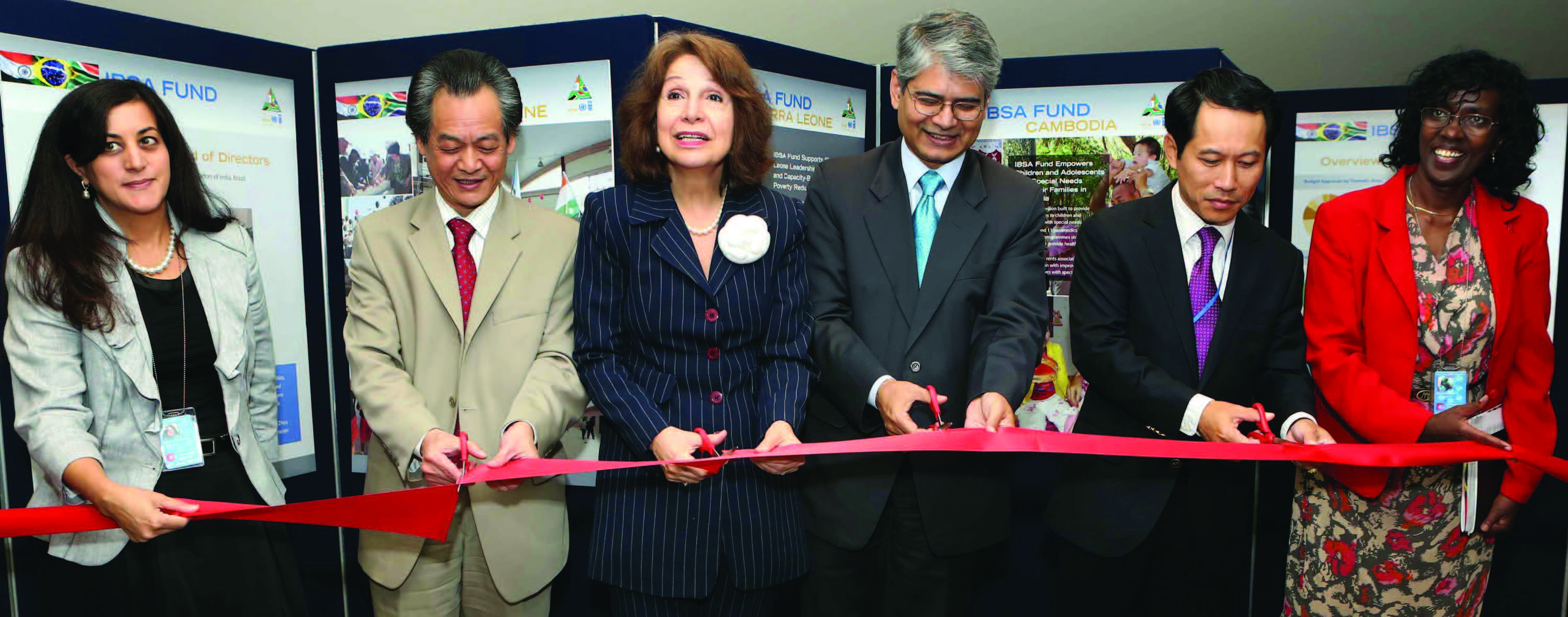
    NEW YORK, NY (TIP): The Permanent Mission of India to the United Nations (UN) in New York along with the Permanent Missions of Brazil and South Africa, and UN Office for South South Cooperation celebrated 10 years of the establishment of the India, Brazil, and South Africa (IBSA) fund on September 12. The day also marked as International Day for South South cooperation by the UN. The Event titled “IBSA Fund: A Flagship Initiative in South South Cooperation” was attended by permanent representatives of India, Brazil and South Africa. “It was exactly ten years ago in 2003, when India, Brazil and South Africa announced at the United Nations General Assembly, their decision to establish a Trust Fund in partnership with the UNDP, with one singular aim: to contributing to, in our own ways, eradicating poverty and alleviating hunger,” said ambassador Asoke K. Mukerji, Permanent Representative of India to the United Nations.


    img16
    Ambassadors releasing the IBSA publication. India’s Permanent Representative to the United Nations, Ambassador Asoke Mukerji is on extreme left.

    He added “What subsequently became operational with a mere $ 3 million initial corpus has today metamorphosed into a fund with accumulated and invested operating capital of more than $ 26 million, with 14 success stories implemented, and several others ongoing. These are spread all across the spectrum of the developing world, as examples of best practices in our common fight against “the greatest global challenge” of poverty eradication.” IBSA fund has been actively funding projects in Burundi, Cambodia, Cape Verde, Guinea-Bissau, Sierra Leone, Palestine, Viet NAM, Cape Verde, Haiti supporting a wide range of projects. The themes that the Fund has explored include promoting food security, addressing HIV/AIDS, extending access to safe drinking water, capacity building, building of hospitals for children with special needs- all with the singular aim of contributing to the achievement of the Millennium Development Goals in partnership with UNDP. The event was attended by Ambassadors of some select countries – Palestine, Burundi, Vietnam and Cambodia- which are being benefited from IBSA projects. “South South cooperation via this project is very important for my country especially in the fight against HIV/AIDS.

    The fund has helped build a facility for testing HIV and also to spread awareness about the disease especially in rural areas,” said Anesie Ndayishimiye, first counselor, permanent mission of Burundi to the United Nations, adding, “The percentage of population who have HIV is growing in rural region which was not affected as much as the urban region.” Ambassador Mukerji also addressed the issue of “increased burden sharing when such calls are placed upon the so called ‘rising South’”. The IBSA Trust Fund operates through a demand driven approach. Governments of other developing countries request support by this fund, the board of directors at IBSA fund review the proposal before releasing the funds. He said that, “The Fund is an exercise in solidarity which is initiated only at the explicit request of a developing partner, and not imposed from above.” And that the initiative is “in keeping with our (India’s) commitment on South South Cooperation in which we (India) have already invested billions of dollars since our independence,” he said. The event was followed by the inauguration of an IBSA Exhibition at the UN headquarters, which featured panels on projects completed under the IBSA Fund.

  • International Raise the cost for Pakistan army’s proxy war order be damned

    International Raise the cost for Pakistan army’s proxy war order be damned

    The West’s attempt to ride roughshod over the United Nations Security Council with a hastily drafted proposal to authorize the use of force in Syria sets the stage for its second military intervention in West Asia and North Africa in as many years. The resolution, drafted by the United Kingdom and backed by the United States and France, seeks two things from the Council: one, a condemnation of President Bashar al-Assad for using chemical weapons on his people and two, its blessings to deploy “all necessary measures” to protect Syrians. If the first asks the U.N. for a leap of faith on a premature claim, the second requires it to turn a blind eye to history.

    While acknowledging there exists no “smoking gun” to establish Mr. Assad’s culpability, the West has tried its best to impede the working of the U.N.’s team in Syria investigating claims if chemical weapons were used at all. The charade now unfolding before the UNSC reflects the West’s desperation to have its way with a military intervention that has few takers. If the Arab League, including key members and U.S. allies like Egypt, has expressed its reluctance to support the imminent assault, public opinion in the U.S., Britain and France too is overwhelmingly opposed to a new war. After the disastrous 2011 NATO bombing of Libya, which began with the objective of protecting civilians but ended up being a full-blown attack on the Muammar Qadhafi regime, the Security Council is rightly wary of the Anglo-American plans for a “limited” intervention in Syria. Expecting the world to believe a military attack will destroy Mr. Assad’s chemical weapons arsenal without inflicting unacceptable civilian casualties is silly.

    If anything, a targeted attack is not so much a guarantee of minimal damage, but an attempt to fulfill President Barack Obama’s vain promise to punish the Assad regime if it used chemical weapons. After proffering sketchy evidence in support of this grave allegation, the President is now being forced to walk his talk by the liberal interventionists who populate his administration and by a trigger-happy British Prime Minister. One senior U.S. official let slip that the planned assault will be “just muscular enough not to get mocked,” revealing how this issue is now entirely about American “credibility,” as opposed to the humanitarian tragedy in Syria. The Council’s likely rejection of the draft resolution will be portrayed as Russian and Chinese intransigence. The fact remains, however, that influential powers like India, Brazil and South Africa too are against military intervention pending a complete investigation of WMD claims. The West’s failure to act through the U.N. not only betrays the Syrian people but also reflects its contempt for the international order.

  • Sri Lankan minister criticizes UN human rights chief

    Sri Lankan minister criticizes UN human rights chief

    COLOMBO (TIP): A Sri Lankan cabinet minister has questioned the impartiality of visiting United Nations human rights chief Navi Pillay, accusing her of supporting ethnic Tamil separatists because of her own Tamil background. Pillay is a South African of Indian Tamil origin. She is visiting Sri Lanka to review its progress in investigating alleged abuses during a civil war between government troops and Tamil rebels. Housing minister Wimal Weerawansa said Pillay would prepare an “extremist and unjust report” that is unfair to Sri Lanka because of her ethnicity. He accused Pillay of holding secret meetings with activist groups outside her official schedule. Pillay’s spokesman said she is conducting her mission as she would in any country. Pillay is to present her findings to the UN Human Rights Council next month.

  • The Good Samaritans

    The Good Samaritans

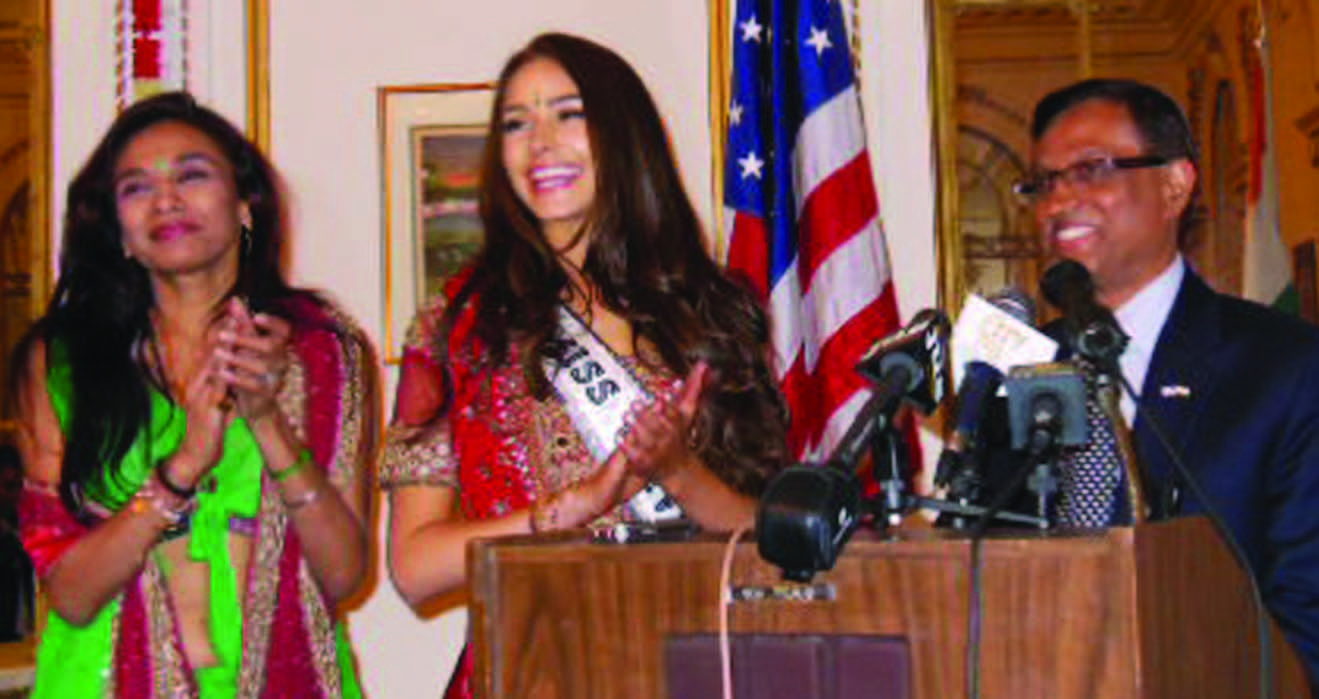
    NEW YORK, NY (TIP): Consul General of India, Ambassador Dnyaneshwar M. Mulay announced, August 21, the Sanjana Jon Tour to India with Olivia Culpo, the current Miss Universe from the 27th of September to the 6th of October. Mr. Mulay emphasized on the importance of cultural ambassadors and cultural tours to build closer ties between the two countries and globally The tour will be to the capital New Delhi, Mumbai, Agra and several key cities in India to promote and propagate “Celebrate the Girl Child”, Women Empowerment and AIDS Awareness. Actress Manisha Koirala joined and supported the initiative.

    The focus would be to eradicate female feticide especially in states like Punjab, Haryana, Rajasthan where the incidence is very high. The awareness tour initiated by Sanjana Jon in 2004 with the then Miss Universe Jennifer Hawkins has grown monumentally as an amazing positive movement and currently is the 6th Sanjana Jon Tour to India with Miss Universe for charity. The Tour has been supported by Salman Khan to highlight the different causes and several other celebrities like Sohail Khan, Sajid- Wajid Khan, Suhasini-ManiRatnam, Venkatesh, Padmabhushan Padmashri Dr KJ Yesudas, Padmashri Shobana, Usha Uthup, to name a few.

    “This time the tour will effectively reach out to the masses and try to bring more creative constructive support on the whole by creating “Community of Love n Light” a movement to ‘Share n Care’,” said Sanjana. Sanjana Jon started her career working with her brother Anand Jon in New York and they created a jewelry line together which was highly appreciated by Iman, David Bowie, Barbara Hershey while supporting AMFAR. Then they worked on the mens collection which was highlighted by Bruce Springsteen, Backstreet Boys, Prince, Collective Soul, Matchbox 20 to name a few. Her acclaimed debut was at Cannes for the Film Festival was supported by Prince Albert of Monaco, Princess Sorayya, Princess Sara Al Saud, Princess Olivia de Borbon and more. This led to the New York Fashion Week debut and Vancouver Fashion Week where she won International Rising Star award. Fashion with heart has been propagated by her where at every show or event she supports a charity or cause.

    Sanjana Jon has been a socially motivated person since her school and college days with her brother Anand Jon used to provide food and clothing to the underprivileged kids and read for the blind students. A special sanctuary was set for more than a 100 tigers in Florida and special campaign was organized with Anand Jon & Michelle Rodriegez to save tigers and animals globally. Paws for style where celebs walked with their pets was again highlighted and supported by Sanjana and Anand Jon to create love for animals. She has been creating awareness about various issues such as AIDS Awareness and HIV testing , Save the Girl Child ,Human and Animal Rights by involving celebrities like Bollywood stars, more than 10 Miss Universe over the years. She tied up with United Nations and held a press conference in the New York headquarters. In India, she worked with CARE International in hopes of a united front to combat the increasing pandemic of AIDS. Fashion to Sanjana is not the end but the means to the end which is to make the world a better place filled with love and light.

    The Sanjana Jon AIDS Awareness Tour toured most major Indian cities. She has also organized events to fight for Truth and Justice against racism with various models and celebrities and initiated several promotional campaigns in NY and LA against racism. She organized protests against racism in Bombay and Delhi and put together a show for Save the Girl Child against female infanticide with 16 celebrity siblings including Salman Khan, Sohail Khan, Sushmita Sen, Riya and Raima Sen, Sajid and Wajid Khan. Recently, she organized a Sanjana Jon Creative Tihar show and project in Tihar with inmates- for the inmates, by the inmates and of the inmates and tried to create a constructive creative training program to make the inmates a more resourceful progressive part of the community. Currently working on Pride of India Show by Sanjana Jon an attempt to break the Guinness Book of Work Records with more than 500 models in a show also promoting and highlighting traditional and cultural wear of every state in India and with celebrities representing the pride of every state and highlighting and propagating the Celebration of the Girl Child and in support of Global Human Rights. Winner of innumerable awards including Karamveer Puraskar, Paramveer Award, Indira Gandhi Award, Rajiv Gandhi Excellence awards to name a few, Sanjana has miles to go and not sleep.

  • UN Women Executive Director Phumzile Mlambo-Ngcuka sworn in

    UN Women Executive Director Phumzile Mlambo-Ngcuka sworn in

    UNITED NATIONS (TIP): Ms. Phumzile Mlambo-Ngcuka took the oath of office as the Executive Director of UN Women during a ceremony on August 19 at UN Headquarters, presided over by Secretary-General Ban Ki-moon. She is the second Executive Director of the organization created in 2010 to lead the UN’s work on advancing gender equality and women’s empowerment. Ms. Mlambo-Ngcuka’s appointment was announced by the Secretary-General on 10 July 2013. A South African national, Ms. Mlambo-Ngcuka brings to her new position a wealth of experience.

    She was the first woman to hold the position of Deputy President of South Africa from 2005 to 2008. She became a Member of Parliament in 1994, chairing the Public Service Portfolio Committee. She was Deputy Minister in the Department of Trade and Industry (1996-1999), Minister of Minerals and Energy (1999-2005) and briefly served as acting Minister of Arts, Culture, Science and Technology in 2004. Mlambo-Ngcuka was Young Women’s Coordinator for the World Young Women’s Christian Organization in Geneva (1984 – 1986) and served as the first President of the Natal Organization of Women, an affiliate of the United Democratic Front, when it was formed in December 1983. She established the Umlambo Foundation in 2008 to provide support to schools in impoverished areas in South Africa through mentorship and coaching for teachers and in Malawi through school improvements with local partners. She holds a Master’s degree in Philosophy in Educational Planning and Policy from the University of Cape Town (2003) and a BA in Education from the University of Lesotho (1980).

  • Consulate General of India Celebrates the 66th Anniversary of India’s Independence

    Consulate General of India Celebrates the 66th Anniversary of India’s Independence

    NEW YORK, NY (TIP): The Consul General of India in New York Ambassador Dnyaneshwar Mulay hosted on August 15, a Reception at the Consulate to celebrate the 66th anniversary of India’s Independence. About 250 guests that included prominent members of the Indian-American community and local dignitaries attended the celebrations.


    img149

    Former US Ambassador to India, Frank Wisner, Ambassador Asoke Mukerji, Permanent Representative of India to the United Nations, Ambassador Manjeev Singh Puri, Deputy Permanent Representative of India to the United Nations also graced the occasion. Warmly greeting and welcoming the guests, Ambassador Mulay underlined the important contribution of the Indian Diaspora worldwide towards growth and development of India.


    img150

    He said that the vibrant Indian community in the US has been contributing immensely to the friendship between India and the US. He also outlined the efforts that the Consulate has been taking towards improving its services, particularly streamlining various Consular procedures and expanding the outreach activities in various states under its jurisdiction.


    img151

    During the function Ambassador Mulay recognized the significant contribution by the Indian community towards US$5 million endowment to India Studies Chair at the Stony Brooks University making it the largest gift ever made to a US public university for India Studies. Mr. Nirmal Mattoo and Mr. SN Sridhar were felicitated as major contributors to the endowment. Ambassador Mulay, along with the dignitaries cut the cake in celebration of the joyous occasion. Earlier, in the morning, Ambassador Mulay rang the opening bell at the Nasdaq, an annual ritual to mark India’s Independence Day

  • India, the Land Columbus Set out to Find

    India, the Land Columbus Set out to Find

    What is it about India, that its tryst with destiny is still on-going? Why does India keep moving forward despite the doers and the naysayers, the empire builders and the colonized? The answer, I submit, lies in the glorious amalgam of history and hope, glory and defeat, education and renunciation, family and loneliness, accomplishment and worthlessness, ego and doubt, government and the governed, “East” and “West,” nuclear energy and organic linen; in short, India is a living contradiction – old and young, religious and secular, Eastern and Western, proud and humble, poor and rich, stranger and friend. On India’s Independence Day, one cannot but thank the British empire for all of its managerial excellence and vision, for it is they who did what no maharaja was able to do short of Ashoka the Great: create a Greater India, a unified India.


    img145

    That there was a Great Partition, with untold stories of misery and heroism, courage and slaughter, so that a few “Royals,” domestic and foreign, could uproot so much humanity for mapmakers’ joy rather than compel sovereign governments to give equal protection to the governed, remains an irksome lesson for would-be nation-makers. Arab Spring’s lessons are both forward-looking, as they are rear-view looking, and given the world being conquered, as a whole, by the unstoppable digital binary code, the great denominator, the world has indeed gone “flat,” and time “instantaneous”: lost are the curves of the globe and the hands of time on the alter of digital transparency – more controlled by multinational corporations than by analogue sovereign governments desperately seeking to harness the binary code to defend against “enemies, foreign and domestic.” What is to become of India, one may ask. Beware, I say to all who thought that China would counter-balance the Soviets.

    Like China’s core greatness lay sub-rosa unseen by the likes of Henry Kissinger, so, I fear is true of India, albeit, mercifully, only in part. In part, I say, because India’s investment in democracy’s warts is full-throttle and every citizen, poor and rich alike, sees themselves as the master of the public trust. Just ask The New York Times’ columnist Thomas Friedman as to why he is so in love with India, and why India, a Hindu-majority nation, effortlessly and confidently rests its position in the comity of nations in the gentle, strong and erudite hands of Salman Khurshid.


    img147

    It is as if Ashoka the Great, Akbar the Great, Guru Nanak, and Mother Teresa, not just Gandhi, Jinnah and Nehru, wrought this continuing tryst with destiny. For us in the United States, where each of the 50 states are a laboratory of policy for the nation to embrace or reject, India, I submit, given its diverse religious content and in the main peaceful co-existence, economic growth that defies the weight of regulations, may well be a laboratory to the world – for there, East and West, greed and charity, ambition and detachment live in substantial harmony. Since Secretary John Kerry is working overtime to seize the moment decreed by destiny, as he races to the Middle East to jumpstart the cob-webbed peace process between Israel and Palestine, no matter the profit of the status quoers, and harder yet, to re-order the Afgan-Subcontinent equation, each of the affected nations and citizenry, in the exercise of their enlightened selfinterest, owe a good faith response – for destiny awaits, in an infinite variety of shades and colors, the outstretched-hand’s state of loneliness or girth, given the many amalgamated hands reaching for the same sweet spot of history. Moreover, the dynamic of Israel’s meddlesome Thomas Dewey-like preference in last year’s presidential elections when Barack Obama won the “imperial term” in a resounding Harry Truman-like fashion, presents the Middle East a better shot than ever before.

    However, multi-lateral frustration infecting the Afgan- Subcontinent recalibrated process requires a critical mass of trilateral leadership, which ignores the interlopers’ inflammatory excesses, so as to bring the blessings of liberty and prosperity to their populace, unhappily aware of their common ancestry and uncommon present. For them I recall the example of the European Union’s birth, when jealous pride of many a nation, that claimed the world as its own, was overcome – surely those in the sub-continent can bequeath to their childrens’ children a gentle neighborhood where all are free to worship as they see fit and prosper per individual effort, as they have the benefit of cross-pride “across the border.” It may well be that the United Nations, created with the ink of World War II victory and a subsequent switcheroo a la ROC with PRC, needs the reforms that many have pushed for, including, Prime Minister Manmohan Singh, and his then-Permanent Representative Hardeep Singh Puri, after winning an unprecedented near-unanimous electoral victory to a rotational seat on the Security Council.

    It may well be that the “bubbling” South China Sea needs to bubble less, even as it starts the Kabuki dance of a future theater of avoid-able war and remilitarization. India’s attention, then, must be Eastward, Upward, and Westward. As an American, I can only hope that the land Columbus set out to find, India, and the nation he caused to be born, the United States, find in each other a common soul, aided by the rule of law and abetted by a democratic republic, such that Jefferson’s Declaration of Independence, “When in the Course of human events, it becomes necessary for one people to dissolve the political bands which have connected them with another, and to assume among the powers of the earth, the separate and equal station to which the Laws of Nature and of Nature’s God entitle them, a decent respect to the opinions of mankind requires that they should declare the causes which impel them to the separation. We hold these truths to be self-evident, that all men are created equal, that they are endowed by their Creator with certain unalienable Rights, that among these are Life, Liberty and the pursuit of Happiness.–

    That to secure these rights, Governments are instituted among Men, deriving their just powers from the consent of the governed, — That whenever any Form of Government becomes destructive of these ends, it is the Right of the People to alter or to abolish it, and to institute new Government, laying its foundation on such principles and organizing its powers in such form, as to them shall seem most likely to effect their Safety and Happiness. …” and Jawaharlal Nehru’s “Tryst with Destiny” speech loudly resonates to this day: “Long years ago we made a tryst with destiny, and now the time comes when we shall redeem our pledge, not wholly or in full measure, but very substantially. At the stroke of the midnight hour, when the world sleeps, India will awake to life and freedom. A moment comes, which comes but rarely in history, when we step out from the old to the new, when an age ends, and when the soul of a nation, long suppressed, finds utterance. It is fitting that at this solemn moment we take the pledge of dedication to the service of India and her people and to the still larger cause of humanity. At the dawn of history India started on her unending quest, and trackless centuries are filled with her striving and the grandeur of her success and her failures.

    Through good and ill fortune alike she has never lost sight of that quest or forgotten the ideals which gave her strength. We end today a period of ill fortune and India discovers herself again. The achievement we celebrate today is but a step, an opening of opportunity, to the greater triumphs and achievements that await us. Are we brave enough and wise enough to grasp this opportunity and accept the challenge of the future?” The world is better that Columbus lived, dreamed and strove. For we are here, dear Cristoforo Columbo, to prove you were never map-lost.

  • Yuva Hindi Sansthan’s Hindi summer program Concludes in Pennsylvania

    Yuva Hindi Sansthan’s Hindi summer program Concludes in Pennsylvania

    HATFIELD, PA (TIP): Yuva Hindi Sansthan, a New Jersey based educational organization concluded a two-week summer Hindi program in Hatfield, PA on August 16. The program designed under the strict guidelines of STARTALK, a United States funded Foreign Language initiative, targeted 60 elementary and Middle School students, most of whom, born and raised in USA, belonged to Indian American families. Dr. Devyani Khobragade, Deputy Consul- General of India in New York, who attended the camp as the chief guest on August 16, the concluding day of the program, distributed completion certificates to students. She extended her support to such efforts for promoting Hindi. Dr. Khobragade said that the Government of India was making all efforts to introduce Hindi as a working language of the United Nations. She assured that her office was willing to help Hindi programs.

    Upendra Chivukula, New Jersey Assemblyman was also present on the occasion. He congratulated Yuva Hindi Sansthan for its consistent effort to teach Hindi to youngsters. Chivukula said that US administration fully realized the importance of teaching American kids one more language other than English. “United States recognized Hindi as a critical language for American students and businesses which were an encouraging step for the Indian American community”, he said. “The participating 8 to 12 years old students were placed in five different classes where our team of STARTALK trained teachers engaged them in performances based activities on topics related with ‘A trip to India’. “We used a variety of real life activities to make sure children were comfortably conversing in Hindi in meaningful and unrehearsed fashion”, said Rashmi Sudhir, who served as the lead instructor at the camp.

    “It was an intensive program for which all instructors prepared for months planning their lessons”, said Rashmi. “A typical day at the camp started with a 30 minute Yoga session followed by classroom instructions for three hours before breaking for lunch. The students were immersed in a variety of activities in art, culture and technology classes during the post-lunch period of the day which continued until 4.30 pm.We screened interesting Hindi movies during the lunch hour while students enjoyed authentic Indian meal. Each and every minute of the camp was designed for learning Hindi and experiencing the product and practices of Indian culture”, said Rashmi. “The program was hosted by North Penn School District which provided classrooms, gym, cafeteria, computer labs and auditorium for facilitating the two week long activities during the program”, said Ashok Ojha, program director, YHS STARTALK Hindi 2013 program.

    “The school district fully cooperated with us for managing the camp style program while a number of parents volunteered their time to support the program.” The campers were taken on a field trip during the camp to Philly Museum of Art where they learned about various ancient mythological characters, statues and icons, instructed by well known art historian from University of Pennsylvania Dr. Pushkar Sohoni, who also took them around the UPenn library where they walked around the aisles displaying tens of thousands of books in Indian language.

  • MOVERS & SHAKERS

    MOVERS & SHAKERS

    Famous Indian nuclear physicist Homi Jehangir Bhabha was born on 30 October 1909 in Mumbai. Bhabha played a key role in the development of the Indian atomic energy program. Widely referred to as the father of India’s nuclear weapons program, Bhabha had his education at the Elphinstone College and the Royal Institute of Science before obtaining his doctorate from the University of Cambridge in 1934.

    He was influenced greatly by the legendary Paul Dirac. Bhabha was a research scientist at the Cavendish Laboratories at Cambridge. When he was stranded in India as a result of the Second World War, he set up the Cosmic Ray Research Unit at the Indian Institute of Science, Bangalore under Nobel Laureate C. V. Raman in 1939. Dr. Bhabha is credited with establishing the Tata Institute of Fundamental Research(TIFR) with the help of eminent industrialist J. R. D. Tata.

    After India won independence from the British, Bhabha established the Atomic Energy Commission of India in 1948. He represented India in various international forums including the United Nations and his tenure represented a high in terms of the progress of India’s atomic energy programme. The climax of this programme came on May 18, 1974 when India exploded a nuclear device at Pokhran, Rajasthan joining a select club of nations.

    Ratan Tata
    Ratan Tata is one of the most well-known and respected Indian businessman. He served as the Chairman of the Tata Group from 1991 till 2012. As a Mumbaibased conglomerate, he is also a member of the prominent Tata family of Indian industrialists and philanthropists. Ratan Tata was born on December 28, 1937 in Mumbai. When he was a child his parents separated and he was brought up by his grandmother Lady Navajbai.

    He went to Campion School in Bombay, Bishop Cotton School in Shimla and finished his schooling from Cathedral and John Connon School in Mumbai. He graduated with a degree in Architecture and Structural Engineering from Cornell University in 1962 and also did the Advanced Management Program from Harvard Business School in 1975. He is also a member of the Alpha Sigma Phi fraternity of Yale University, United States. In 1962, Ratan Tata began his career in the Tata group.

    At first he used to work on the shop floor of Tata Steel, shoveling limestone and handling blast furnace. In 1991, JRD Tata stepped down as the chairman of Tata Industries and named Ratan Tata as his successor. Under Ratan’s stewardship, Tata Tea attained Tetley, Tata motors attained Jaguar Land Rover and Tata Steel attained Corus. These triumphs turned Tata from a large India-centric company into a global business with 65% revenues from abroad. He also contributed in the development of Indica and Nano.

    Ratan Tata has also served in various organizations in India and abroad. He is a member of the Prime Minister’s Council on Trade and Industry and he is also on the board of governors of the East-West Center, which is the advisory board of RAND’s Center for Asia Pacific Policy. He also serves on the program board of the Bill & Melinda Gates Foundation’s India AIDS initiative. He was awarded the Padma Bhushan by the Government of India in January 2000.

    He serves on the boards of several leading organizations, both in the public as well as the private sector in India. He is a member of the International Investment Council set up by the President of South Africa and serves on the programme board of the Bill & Melinda Gates Foundation’s India AIDS initiative. Ratan Tata is credited for leading Tatas’ successful bid for Corus, an Anglo-Dutch steel and aluminum producer, which was acquired for an estimated £6.7 billion by Tata Sons.

    N.R. Narayanamurthy
    N.R. Narayana Murthy, the founder of Infosys Technologies is one of the most famous personalities in India’s I-T sector. Born on August 20, 1946, he obtained a degree in electrical engineering from the National Institute of Engineering under University of Mysore in 1967 and went on to do his Masters from IIT Kanpur in 1969. He joined Patni Computer Systems in Pune. While at Pune, he met his wife Sudha Murty.

    In 1981, he founded Infosys alongwith with six otherpeople. He served as president of the National Association of Software and Service Companies, India from 1992 to 1994. Murthy was the CEO of Infosys for twenty years, and was succeeded by Nandan Nilekani in March 2002. He functioned as the Executive Chairman of the Board and Chief Mentor from 2002 to 2006.

    Dhirubhai Ambani
    Dhirajlal Hirachand Ambani was born on 28 December 1932, at Chorwad, Junagadh in Gujarat, When he was 16 years old, he moved to Aden,Yemen. Initially, Dhirubhai worked as a dispatch clerk with A. Besse & Co. Married to Kokilaben. Dhirubhai also worked in Dubai for sometime. He returned to India and founded the Reliance Commercial Corporation with an initial capital of Rs 15000.

    Dhirubhai set up the business in partnership with Champaklal Damani from whom he parted ways in 1965. Dhirubhai started his first textile mill at Naroda, near Ahmedabad in 1966 and started the brand “Vimal”. Dhirubhai Ambani is credited with having started the equity cult in India.With the passage of time, Dhirubhai diversified into petrochemicals and sectors like telecommunications, information technology, energy, power, retail, textiles, infrastructure services, capital markets, and logistics.

    Lakshmi Nivas Mittal
    Lakshmi Nivas Mittal was born on June 15, 1950 in Sadulpur, Rajasthan, India and is presently the CEO & Chairman of Arcelor Mittal. Lakshmi Nivas Mittal was listed in the Forbes List of Billionaires in 2006 as the the richest Indian and the fifth richest man in the world with an estimated wealth around of $25.0 billion and is the richest man in the United Kingdom. Young Lakshmi Nivas Mittal spent his first years in Sadulpur, before his father moved to Kolkata. Lakshmi graduated from St. Xavier’s College, Calcutta. He founded Mittal Steel in 1976, which soon became a global steel producer with operations on 14 countries. His success mantra lies in the identification, acquisition and turnaround of many loss making steel companies all across the world.

    Dr. A.P.J. Abdul Kalam
    Dr. A.P.J. Abdul Kalam, former President of India, graduated in aeronautical engineering from the Madras Institute of Technology in 1958 and joined the Defense Research and Development Organization (DRDO). In 1962, Kalam joined the Indian Space Research Organization (ISRO). In 1982, he rejoined DRDO as the Chief Executive of Integrated Guided Missile Development Programme (IGMDP). Dr. Kalam is credited with the development and operationalization of India’s Agni and Prithvi missiles.

    He worked as the Scientific Adviser to the Defence Minister and Secretary, Department of Defence Research & Development from 1992 to 1999. During this period, the Pokhran-II nuclear tests were conducted. Dr. Kalam held the office of the Principal Scientific Advisor to the Government of India from November 1999 to November 2001. Dr. Kalam has received a host of awards both in India and abroad. He was awarded the Padma Bhushan in 1981, Padma Vibhushan 1990 and the Bharat Ratna in 1997.

    He is of the view that we should work wholeheartedly to make India a developed nation by 2020. Besides being a bachelor, Kalam is a strict disciplinarian, a complete vegetarian and teetotaler. Among the many firsts to his credit, he became India’s first President to undertake an undersea journey when he boarded the INS Sindhurakshak, a submarine, from Visakhapatnam. He also became the first president to undertake a sortie in a fighter aircraft, a Sukhoi-30 MKI.

    Khushwant Singh
    One of the most prominent novelists and journalists of India, Khushwant Singh was born on 2 February 1915 in Hadali, presently in Pakistan. He writes a weekly column, “With Malice towards One and All”, published in several leading newspapers all over the country. He graduated from Government College, Lahore before studying law at King’s College, London. He has been the editor of Yojana, The Illustrated Weekly of India, The National Herald and the Hindustan Times.

    He also served as a member of the Rajya Sabha. Though he was awarded the Padma Bhushan in 1974, he returned it in 1984 to protest the siege of the Golden Temple by the Indian Army. He was awarded the Padma Vibhushan in 2007. Some of his notable works include: The Sikhs; Train to Pakistan; The Sikhs Today; Ranjit Singh: The Maharajah of the Punjab; Delhi: A Novel; Sex, Scotch and Scholarship: Selected Writings; Not a Nice Man to Know: The Best of Khushwant Singh; Paradise and Other Stories; Death at My Doorstep; The Illustrated History of the Sikhs etc.

    Amartya Sen
    Nobel Prize winner Amartya Sen was born on 3 November 1933 in Santiniketan, West Bengal. Besides being a worldrenowned economist, Amartya Sen is also a philosopher. He served as a Master at the Trinity College at Cambridge University, the first Asian academic to head an Oxbridge college. Currently the Lamont University Professor at Harvard University, Amartya Sen traces his roots to an illustrious lineage. His father, Ashutosh Sen, taught chemistry at the Dhaka University.

    Amartya completed his high-school education from Dhaka in Bangladesh in 1941. After his family migrated to India in 1947, Sen studied at the Presidency College, Kolkata and at the Delhi School of Economics before moving over to the United Kingdom to complete his higher studies. He earned his doctorate from the Trinity College, Cambridge in 1959. He has taught at various reputed Universities including the University of Calcutta, Jadavpur University, Oxford, London School of Economics, Harvard and many others. His works helped to develop the theory of social choice.

    In 1981, he published his famous work Poverty and Famines: An Essay on Entitlement and Deprivation, where he showed that famine occurs not only due to shortage of food, but from inequalities in the mechanisms for distributing food. He had personally witnessed the Bengal famine of 1943. He has done valuable work in the field of development economics, which has had a tremendous influence on the formulation of the United Nations Development Programme’s Human Development Report.

    Sabeer Bhatia
    Sabeer Bhatia-co-founder of Hotmail, is one among select group of people who have made it big in America’s Silicon Valley. Born in Chandigarh, Sabeer Bhatia did his schooling from St. Joseph’s Boys’ High School, Bangalore. He graduated from Caltech and went to Stanford to pursue his MS in Electrical Engineering. Sabeer attended many lectures by famous like Steve Jobs and was determined to make it big. After completing his Masters, he joined Apple computers. He left Apple soon after.

    He teamed up with his partner to create a web-based e-mail system Microsoft bought Hotmail on December 30th, 1997, for a reported sum of $400M. After the success of Hotmail, Bhatia in April 1999, he started another venture, Arzoo Inc, which however had to be shut down. In 2006, Arzoo was relaunched. Bhatia has won many awards. Among the notable ones include the “Entrepreneur of the Year” awarded by the venture capital firm Draper Fisher Jurvetson in 1997, the “TR100” award, presented by MIT to 100 young innovators expected to have the greatest impact on technology in the next few years. Besides, he was named by TIME magazine as one of the “People to Watch” in International Business in 2002.

    Indra Nooyi
    Indra Nooyi is the president and chief executive officer of PepsiCo and is the highest-ranking Indian-born woman in corporate America. She helped to start PepsiCo’s fast-food chains in 1997. After a Bachelor’s degree from Madras Christian College and a Post Graduate Diploma in Management from the Indian Institute of Management Kolkata, she moved on to the Yale School of Management.

    She started her career with The Boston Consulting Group (BCG), moving on to companies like Motorola and Asea Brown Boveri.She serves on the board of directors of several organizations. In August 2006, she succeeded Steve Reinemund as chief executive officer of PepsiCo. She has been named the Most Powerful Woman in Business in 2006 by Fortune Magazine. Her name was included in the Wall Street Journal’s list of 50 women to watch in 2005.

    Kiran Bedi
    The first woman to join the coveted Indian Police Service (IPS) in 1972, Kiran Bedi was born on 9 June 1949 in Amritsar, Punjab. Recently appointed as Director General of India’s Bureau of Police Research and Development, Kiran Bedi has had an illustrious career, earning widespread adulation for her no-nonsense attitude and devotion to work. She served as Police Advisor in the United Nations peacekeeping department and was honored with the UN medal for outstanding service. She earned the nickname ‘Crane Bedi’ for towing away the then Indian PM Indira Gandhi’s car for parking violation.

    Kiran Bedi graduated in English before securing a Master’s degree in Political Science from Punjab University, Chandigarh. This gutsy police officer went on to secure an LL.B degree in 1988 from Delhi University and a Ph.D. from the Indian Institute of Technology, New Delhi, even while she was in service. She was good at sports too, having been an all- India and all-Asian tennis champion.

    She has served creditably in a host of appointments ranging from Deputy Inspector General of Police, Mizoram, Advisor to the Lieutanent Governor of Chandigarh, Director General of Narcotics Control Bureau and many others.

    Rakesh Sharma
    The first Indian to fly into space, Rakesh Sharma was born on January 13, 1949 in Patiala, Punjab. He was a squadron leader with the Indian Air Force, when he flew into space in 1984 as part of a joint programme between the Indian Space Research Organisation (ISRO) and the Soviet Intercosmos space program.

    He spent eight days in space on board the Salyut 7 space station. He joined two other Soviet cosmonauts aboard the Soyuz T- 11 spacecraft which blasted off on April 2, 1984. He was awarded the Hero of Soviet Union award on his return from space. The Government of India honoured him with the Ashok Chakra. He retired with the rank of Wing Commander. He joined the Hindustan Aeronautics Limited in 1987 and served as Chief Test Pilot in the HAL Nashik Division until 1992, before moving on to Bangalore to work as the Chief Test Pilot of HAL. He retired from test flying in 2001.

    Dr. Verghese Kurien
    The “father of the white revolution” in India, Dr. Verghese Kurien is acknowledged worldwide as the brain behind the success of the largest dairy development programme in the world by the name of Operation Flood. Also known as the “Milkman of India”, he was the chairman of the Gujarat Co-operative Milk Marketing Federation Ltd. (GCMMF) and his name became synonymous with the Amul brand. Born on November 26, 1921 in Kozhikode, Kerala, he graduated in Physics from Loyola College, Madras in 1940 and pursued a B.E.(Mechanical) course from the Madras University. He was instrumental in the success story of AMUL.

  • INDIA’S RELATIONS WITH NEIGHBOURING COUNTRIES

    INDIA’S RELATIONS WITH NEIGHBOURING COUNTRIES

    India has formal diplomatic relations with most nations; it is the world’s second most populous country, the world’s most-populous democracy and one of the fastest growing major economies. With the world’s seventh largest military expenditure, ninth largest economy by nominal rates and third largest by purchasing power parity, India is a regional power, a nascent great power and a potential superpower. India’s growing international influence gives it a prominent voice in global affairs.

    The Economist magazine argues, however, that underinvestment in diplomacy and a lack of strategic vision have minimised India’s influence in the world. India is a newly industrialised country, it has a long history of collaboration with several countries and is considered one of the leaders of the developing world along with China, Brazil, Russia and South Africa (the BRICS countries). India was one of the founding members of several international organisations, most notably the United Nations, the Asian Development Bank, G20 industrial nations and the founder of the Nonaligned movement.

    India has also played an important and influential role in other international organisations like East Asia Summit, World Trade Organisation, International Monetary Fund (IMF), G8+5 and IBSA Dialogue Forum. Regionally, India is a part of SAARC and BIMSTEC. India has taken part in several UN peacekeeping missions and in 2007, it was the secondlargest troop contributor to the United Nations. India is currently seeking a permanent seat in the UN Security Council, along with the G4 nations.

    Relations with PakistanDespite historical, cultural and ethnic links between them, relations between India and Pakistan have been plagued by years of mistrust and suspicion ever since the partition of India in 1947. The principal source of contention between India and its western neighbor has been the Kashmir conflict. After an invasion by Pashtun tribesmen and Pakistani paramilitary forces, the Hindu Maharaja of the Dogra Kingdom of Jammu and Kashmir, Hari Singh, and its Muslim Prime Minister, Sheikh Abdullah, signed an Instrument of Accession with New Delhi.

    The First Kashmir War started after the Indian Army entered Srinagar, the capital of the state, to secure the area from the invading forces. The war ended in December 1948 with the Line of Control dividing the erstwhile princely state into territories administered by Pakistan (northern and western areas) and India (southern, central and northeastern areas). Pakistan contested the legality of the Instrument of Accession since the Dogra Kingdom has signed a standstill agreement with it.

    The Indo-Pakistani War of 1965 started following the failure of Pakistan’s Operation Gibraltar, which was designed to infiltrate forces into Jammu and Kashmir to precipitate an insurgency against rule by India. The five-week war caused thousands of casualties on both sides. It ended in a United Nations (UN) mandated ceasefire and the subsequent issuance of the Tashkent Declaration. India and Pakistan went to war again in 1971, this time the conflict being over East Pakistan.

    The large-scale atrocities committed there by the Pakistan army led to millions of Bengali refugees pouring over into India. India, along with the Mukti Bahini, defeated Pakistan and the Pakistani forces surrendered on the eastern front. The war resulted in the creation of Bangladesh. In 1998, India carried out the Pokhran-II nuclear tests which was followed by Pakistan’s Chagai-I tests. Following the Lahore Declaration in February 1999, relations briefly improved. A few months later however,Pakistani paramilitary forces and Pakistani Army, infiltrated in large numbers into the Kargil district of Indian Kashmir.

    This initiated the Kargil conflict after India moved in thousands of troops to successfully flush out the infiltrators. Although the conflict did not result in a full-scale war between India and Pakistan, relations between the two reached all-time low which worsened even further following the involvement of Pakistan-based terrorists in the hijacking of the Indian Airlines IC814 plane in December 1999. Attempts to normalise relations, such as the Agra summit held in July 2001, failed.

    An attack on the Indian Parliament in December 2001, which was blamed on Pakistan, which had condemned the attack[105] caused a military standoff between the two countries which lasted for nearly a year raising fears of a nuclear conflict. However, a peace process, initiated in 2003, led to improved relations in the following years. Since the initiation of the peace process, several confidence-buildingmeasures (CBMs) between India and Pakistan have taken shape. The Samjhauta Express and Delhi–Lahore Bus service are two of these successful measures which have played a crucial role in expanding people-to-people contact between the two countries.

    [106] The initiation of Srinagar–Muzaffarabad Bus service in 2005 and opening of a historic trade route across the Line of Control in 2008 further reflects increasing eagerness between the two sides to improve relations. Although bilateral trade between India and Pakistan was a modest US$1.7 billion in March 2007, it is expected to cross US$10 billion by 2010. After the Kashmir earthquake in 2005, India sent aid to affected areas in Pakistani Kashmir & Punjab as well as Indian Kashmir.

    The 2008 Mumbai attacks seriously undermined the relations between the two countries. India alleged Pakistan of harboring militants on their soil, while Pakistan vehemently denies such claims. Relations are currently hampered since India has sent a list of 40 alleged fugitive in various terror strikes to Pakistan, expecting them to be handed over to India. Pakistan, on the other hand, has declared that it has no intentions whatsoever of carrying out their extradition. The August 2013 attack by the Pak army on the LoC killed five Indian army men,which further strained the relations between the two nations.

    China Despite lingering suspicions remaining from the 1962 Sino-Indian War and continuing boundary disputes over Aksai Chin and Arunachal Pradesh, Sino-Indian relations have improved gradually since 1988. Both countries have sought to reduce tensions along the frontier, expand trade and cultural ties, and normalise relations. A series of high-level visits between the two nations have helped improve relations. In December 1996, PRC President Jiang Zemin visited India during a tour of South Asia.

    While in New Delhi, he signed with the Indian Prime Minister a series of confidence-building measures for the disputed borders. Sino-Indian relations suffered a brief setback in May 1998 when the Indian Defence minister justified the country’s nuclear tests by citing potential threats from the PRC. However, in June 1999, during the Kargil crisis, then-External Affairs Minister Jaswant Singh visited Beijing and stated that India did not consider China a threat. By 2001, relations between India and the PRC were on the mend, and the two sides handled the move from Tibet to India of the 17th Karmapa in January 2000 with delicacy and tact.

    In 2003, India formally recognised Tibet as a part of China, and China recognised Sikkim as a formal part of India in 2004. Since 2004, the economic rise of both China and India has also helped forge closer relations between the two. Sino-Indian trade reached US$36 billion in 2007, making China the single largest trading partner of India. The increasing economic reliance between India and China has also bought the two nations closer politically, with both India and China eager to resolve their boundary dispute.

    They have also collaborated on several issues ranging from WTO’s Doha round in 2008 to regional free trade agreement. Similar to Indo-US nuclear deal, India and China have also agreed to cooperate in the field of civilian nuclear energy. However, China’s economic interests have clashed with those of India. Both the countries are the largest Asian investors in Africa and have competed for control over its large natural resources. India and China agreed to take bilateral trade up to US$100 billion on a recent visit by Wen Jiabao to India.