Tag: US-India relationship

  • Modi holds first bilateral meeting with President Biden; discusses Indo-Pacific, climate and COVID

    Modi holds first bilateral meeting with President Biden; discusses Indo-Pacific, climate and COVID

    US – India relationship is destined to be “stronger, closer and tighter”, says Bide

    TIP Special Correspondent

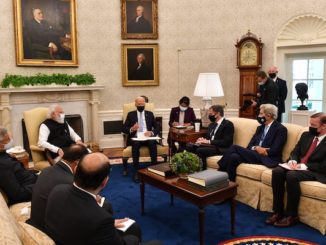
    WASHINGTON, DC (TIP): Prime Minister Narendra Modi on Friday, September 24, described as “outstanding” his first bilateral meeting with US President Joe Biden who said the Indo-US relationship is destined to be “stronger, closer and tighter” as the two leaders discussed a wide range of issues, including combating COVID-19, climate change, trade and the Indo-Pacific. President Biden, who welcomed Prime Minister Modi in the Oval Office of the White House said that today they are starting a new chapter in US-India relationship.

    Observing that he has long believed that the US, India relationship can help them solve global challenges, Biden in his opening remarks before a battery of India and American media said they are now “are launching a new chapter in history of India US ties, taking on some of the toughest challenges we face together.”

    And this starts with a shared commitment to end COVID-19, he said. Prime Minister Modi, who is visiting the US for the 7th time after assuming office in 2014, described Friday’s bilateral meeting with Biden that lasted more than 60 minutes as “important” as they’re meeting at the start of the third decade of this century.

    “Your leadership will certainly play an important role in how this decade is shaped. The seeds have been sown for an even stronger friendship between India and the US,” Prime Minister Modi told Biden.

    “Had an outstanding meeting with @POTUS @JoeBiden. His leadership on critical global issues is commendable. We discussed how India and USA will further scale-up cooperation in different spheres and work together to overcome key challenges like COVID-19 and climate change,” Modi tweeted after the meeting. Biden said the relationship between India and the US, the largest democracies in the world, is “destined to be stronger, closer and tighter.” “I’ve long believed that the US-India relationship can help us solve a lot of global challenges. In fact, back in 2006, I had said that by 2020 India and the US will be among the closest nations in the world,” Biden told Modi. “Today, we’re launching a new chapter in the history of US-India ties, taking on some of the toughest challenges we face together, starting with a shared commitment,” he said.

    Biden said he and Prime Minister Modi would talk about what more they can do to fight COVID-19, take on the climate challenge that the world face, and ensure stability in the Indo-Pacific, including with their quiet partners.

    India, the US and several other world powers have been talking about the need to ensure a free, open and thriving Indo-Pacific in the backdrop of China’s rising military maneuvering in the region.

    “Of course, our partnership is more than just what we do. It’s about who we are in our shared responsibility to uphold democratic values, our joint commitment to diversity, and it’s about family ties, including four million Indian-Americans make the United States, stronger every single day,” he said.

    Noting that the world would celebrate Mahatma Gandhi’s birthday next week, Biden said, “We’re all reminded that his message of non-violence, respect, tolerance, matters today maybe more than ever had.”

    On this, Modi said, “Gandhi Ji spoke about trusteeship, a concept which is very important for our planet in the times to come.” Noting that trade will be an important factor in the Indo-US ties in the coming decade, the Prime Minister said that there is much to be done in the area.

    Modi said this decade will be shaped by talent and people-to-people linkages. “I am glad the Indian diaspora is making an active contribution towards the US’ progress.” He said that technology is becoming a driving force. “We have to utilize our talents to leverage technology for greater global good.”

    Modi recalled his interactions with Biden in 2014 and 2016, saying “that time you had shared your vision for ties between India and US. I am glad to see you are working to realize this vision.”

    He said that each of the subjects mentioned by the president are crucial for the India-US friendship. “His efforts on COVID-19, mitigating climate change and the Quad are noteworthy,” Modi added.

    “This morning I’m hosting Indian Prime Minister Narendra Modi at the White House for a bilateral meeting. I look forward to strengthening the deep ties between our two nations, working to uphold a free and open Indo-Pacific, and tackling everything from COVID-19 to climate change,” President Biden had tweeted minutes before the meeting. While the two leaders have met earlier when Biden was the Vice President of the country, this is for the first time that Biden is meeting Modi after he became the 46th president of the US in January.

    Both Biden and Prime Minister Modi have spoken over the phone multiple times and have attended a few virtual summits, including that of the Quad in March hosted by the US president. The last telephone conversation between them took place on April 26.

    Spokesperson of the Ministry of External Affairs Arindam Bagchi said that India US relationship is a partnership of trust. “Globally we will make a difference!” he tweeted.

    “Vibrant discussions between” Modi and Biden. “Joseph Biden on global, regional & bilateral issues. An expansive agenda including defense, security, health, education, trade, IT, economic, Science and Technology energy and People to People ties,” Bagchi said. The Prime Minister also signed the visitor book in the Roosevelt Room of the White House. “Registering the spirit of India United States friendship in ink,” the spokesperson tweeted. The Indian delegation included S Jaishankar, Minister of External Affairs; Ajit Doval, National Security Advisor; Harsh Vardhan Shringla, Foreign Secretary and Taranjit Singh Sandhu, India’s Ambassador to the United States.

    The American delegation included Antony Blinken, Secretary of State; Jake Sullivan, National Security Advisor; John Kerry, Special Presidential Envoy for Climate; Kurt Campbell, Deputy Assistant to the President and Coordinator for Indo-Pacific Affairs; Donald Lu, Assistant Secretary of State for South and Central Asian Affairs and Sumona Guha, Special Assistant to the President & Senior Director for South Asia at National Security Council.

    Visit www.theindianpanorama.news for more stories on PM Modi’s US visit


  • Ambassador Sandhu Discusses India-Pennsylvania Relationship with Governor Tom Wolf

    Ambassador Sandhu Discusses India-Pennsylvania Relationship with Governor Tom Wolf

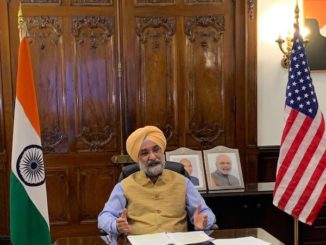
    WASHINGTON (TIP): Ambassador of India to the United States Taranjit Singh Sandhu and Pennsylvania Governor Tom Wolf discussed important areas of the vibrant India-Pennsylvania relationship, encompassing economic and people-to-people ties during a conversation Aug 7.

    Ambassador Sandhu and Governor Wolf discussed the ever-increasing trade and investment complementarities in the India-US relationship and cooperation in the fields of education and healthcare. Ambassador shared with the Governor the latest developments in the Indian healthcare and education sectors, including recent reform initiatives taken by India.

    Both noted the important contributions, especially in economy, of over 200,000 members of the Indian diaspora in Pennsylvania, including those of nearly 10,000 Indian students in Pennsylvania’s higher education institutions. Ambassador highlighted the new opportunities available for investments in India’s higher education sector under the New Education Policy recently announced in India.

    The total trade between India and Pennsylvania has grown to $3.21 billion (2019). Today over 18 Indian companies, with investments of $540 million, are supporting 3,000 jobs in Pennsylvania. Many Pennsylvania based US companies spread across Food Processing, Agriculture, IT, and Chemicals sectors are present in India. Some notable investments include Hershey’s, Kraft Heinz, Unisys, Air Products & Chemicals, FMC among others.

    Indian entrepreneurs and professionals have a significant presence in Pennsylvania in the IT and telecommunications, life sciences and manufacturing sectors. Indian high skilled talent adds to the competitive edge of the U.S. economy.

    Ambassador Sandhu and Governor Wolf agreed to work together to further enhance the India-Pennsylvania relationship.

    (Based on a Press Release)


  • US maintains ‘tremendous cooperation’ with India on Chinese border aggression: Amb Juster

    US maintains ‘tremendous cooperation’ with India on Chinese border aggression: Amb Juster

    WASHINGTON (TIP): The Trump administration has maintained close contact and “tremendous cooperation” with India on the latest Chinese border aggression, America’s top envoy in New Delhi has said, asserting that the last six months have been unprecedented in terms of the bilateral relationship.

    The troops of India and China have been locked in a standoff in several areas along the Line of Actual Control (LAC) in eastern Ladakh since May 5. The situation deteriorated last month following the Galwan Valley clashes that left 20 Indian Army personnel dead.

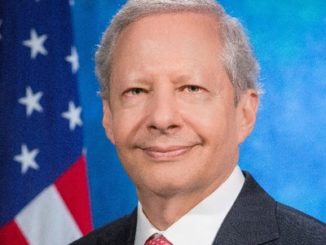
    “For now, (we are) watching the issues on the Northern border of India in which China has raised disputes throughout the Western sector, but also in the central and East. Throughout all of this, we’ve had very close contact with our Indian counterparts and quite frankly, tremendous cooperation,” US Ambassador to India Ken Juster said on Wednesday in his address to the virtual India Ideas’ Summit organized by the US India Business Council.

    The ambassador’s remarks came two days after US Defense Secretary Mark Esper described the Chinese military’s aggressive activities in the region as “destabilizing”.

    Esper also said the US was “very closely” monitoring the situation between India and China along the Line of Actual Control.

    “We have seen post the (India) visit of the President several further conversations between the President and the Prime Minister. The Secretary (of State) has spoken on numerous occasions with (External Affairs) Minister Jaishankar. I think it’s really solidified their relationship,” Juster said.

    Deputy Secretary of State Stephen Biegun had spoken not just with Foreign Secretary Harshvardhan Shringla but also with a range of counterparts in the Indo Pacific region, he said.

    Juster said there had been a host of ministerial-level interactions between the two countries, including the one between Commerce Minister Piyush Goyal and US Trade Representative Robert Lighthizer and Commerce Secretary Wilbur Ross.

    “The two countries also had a strategic energy partnership meeting. It is showing the breadth and the depth of the issues that the two countries work on together,” he said, adding: “I think because of the intensity of the last six months, we’ve really had a new level of comfort in dealing with each other, a degree of trust and respect to get things done.”

    “I remember, issues we had and repatriation flights, where we had to get cooperation, not just from the Home Ministry and the Ministry of External Affairs but also at the local levels with state officials and with police officers. It shows the importance of these individual relationships” he said.

    Through all of this and the intensity of the last six months and the range of emotions from an incredibly successful presidential visit to dealing with lockdown and all the urgent issues that came out of that, “we’ve really transformed a strategic partnership into a comprehensive global strategic partnership,” Juster said.

    “As Prime Minister Narendra Modi has said recently, what may be the most important partnership of the 21st century. So that’s really what I think the last six months have done to solidify this relationship,” the top American diplomat said. (Source: PTI)

  • US regards India as the  “Closest Ally” & will be ready to support its war on terrorism

    US regards India as the “Closest Ally” & will be ready to support its war on terrorism

    It is for India to take advantage of a sea of  US goodwill

    By Ven Parameswaran

    The US has recommended that India must get rid of Jaish-e-Mohammed and Lashkar-e-Taiba thru surgical strikes.  It is implied that once India decides, both the U.S. and India would jointly formulate military strategy and execute it.

    Pakistan sponsored Jaish-e-Mohammed, a terrorist organization,  killed 41 Indian para  military personnel  on February 14th.  Immediately upon hearing the news, a  chain of successive events took place in Washington D.C.  The Secretary of State and the National Security Adviser issued statements of strongest support to India.  This was followed by discussion on the situation  in the U.S. Senate and the U.S. House of Representatives.  All important and leading senators and congressmen/women condemned Pakistan and extended political support to India.  The Chief of the US Central Command, General Joseph Votel  gave his assessment to  the Congress and offered support to India.

    The US has recommended that India must get rid of Jaish-e-Mohammed and Lashkar-e-Taiba thru surgical strikes.  It is implied that once India decides, both the U.S. and India would jointly formulate military strategy and execute it. Indian Ambassador Shringla said: “The designation of India as a Major Defense Partner was also codified into law by the US Congress in the National Defense Authorization Act of 2017, thanks to the unstinted  support of the members of the India Caucus.”

    President Trump has been demanding  that Pakistan dismantle all terror cells and organizations inside Pakistan.  He is the first US President  to cancel military aid to Pakistan.   Prime Minister Imran Khan of Pakistan  has been wanting to meet President Trump to seek support for loans from the I.M.F. President Trump has told him that unless he gets rid of all terror outfits and terrorists from Pakistan, he would not support Pakistan’s request.

    Pakistan was defeated by India in three conventional wars.  India defeated Pakistan in its third war and Pakistan lost East Pakistan. Since then, Pakistan has been using the homegrown terrorist organizations, such as Jaish-e-Mohammed; Lashkar-e-Taiba; and others as proxy to fight India.  This resulted in attacks on the Indian Parliament, , New Delhi shopping mall, and the City of Mumbai that killed 165 Indians and foreigners.

    Pakistan is controlled by its military and the I.S.I.,  its intelligence agency.  The military has selected its Prime Minister and therefore the Parliament is a joke.  Because India so far has not retaliated, Pakistan has taken advantage and continues to use the terrorists to attack India.

    India’s new Ambassador to the U.S.A., Harsh Vardhan Shringla  after presenting his credentials to President Trump was given the most enthusiastic reception at the Capitol Hill.   This was attended by more senators and congressmen/women than ever before.   The grand reception given to Ambassador Shringla is a reflection of India-US relations, with India now  branded as “CLOSEST  ALLY”.    The chain of events in Washington after Pakistan’s attack in Kashmir reinforces President Trump’s new policy towards South Asia.  India should be pleased because the “CLOSEST ALLY” status has bipartisan support. It is time for India to take full advantage of the US support and  draw up a plan to end the scourge of terrorism from inside Pakistan.

    (The author,  in  the U.S. for 65 years, lives in Scarsdale, N.Y. He  is a Senior Adviser to Imagindia Institute, New Delhi, a think tank. He can be reached at vpwaren@gmail.com)

  • OPPORTUNITY FOR USA AND INDIA TO BECOME CLOSE ALLIES

    OPPORTUNITY FOR USA AND INDIA TO BECOME CLOSE ALLIES

    “A true strategic partnership offers tremendous benefits to both nations.  India gains an opportunity to become a real global power, and the US gains a mammoth regional ally and counterweight to China, with the potential for greater cooperation on issues of global security.  Establishing a lasting US-India partnership would be a game-changing success for President Trump and Prime Minister Modi.” 

    Trump administration’s decision in July to grant India Tier 1 Strategic Trade Authorization status, a designation given only to close allies has created a golden opportunity for India and the US to become close allies.    Will the US be bolder and seek to transform the US-India relationship into a robust strategic partnership?

    TWO PLUS TWO MEETING IN NEW DELHI

    Secretary of State Pompeo and Secretary of Defense Mattis can begin executing an ambitious strategic partnership with India when they meet with Prime Minister Modi in New Delhi in September for the Two plus Two meeting.    Will the Government of India and the Indian media discuss this seriously before September?

    President Trump has started creating a new world order.  Make America Great and America First call for revolutionary changes in US foreign policy and trade relations.   Trade deficit is the largest with China.  Trump seems to be ready to do serious business with India.   India has a comparative advantage over China because the wages are substantially lower in India.  If India is able to replace China as the source of American imports of consumer and industrial goods, the US will gain.

    Will India be prepared to liberalize its economy and embark on using capitalistic tools as China did with America’s help?  Will India be prepared to privatize all its public sector corporations and release the assets for building a modern India?   Will India adopt new policies to attract large scale foreign private investments?

    INDIA’S RELIANCE ON RUSSIA FOR MILITARY HARDWARE

    Modern wars are won by using sophisticated technology.    Though Russia has been a reliable supplier of military hardware, we know no country can compete with the US and Israel on latest technology and sophisticated weapons systems.    While India has purchased weapons systems from the US to the tune of $15 billion since 2008, its use of Russian equipment poses interoperability problems and raises concerns about compromising sensitive technology.

    India’s decision to procure S-400 Russian air-defense systems is particularly troubling, since those typically involve substantial service and training components.  The presence of Russian personnel at the heart of India’s air defenses, even if only temporary, could hold up future US-India defense deals.  If the S-400 sale cannot be canceled, the best scenario would be to persuade India to limit the scope of Russian support services and turn to another country with a strong record of using and improving Russian defense equipment—namely Israel.

    JOINT MILITARY EXERCISES

    Meanwhile, the Trump administration can broaden US-India defense cooperation by increasing the number of joint military exercises and expanding the annual Malabar war games. The members of the Quadrilateral Security Dialogue, an informal dialogue initiated in 2007 by Japan’s Prime Minister Shinzo Abe among the US., Japan, Australia and India, should also be formalized and meet more regularly.

    MODI CALLED THE U.S.A. AN INDISPENSABLE PARTNER DURING HIS 2017 VISIT

    Close alliance with India would provide the US with a valuable, democratically committed to thwarting China’s intensifying efforts to dominate the region.  Already India has been keen to enhance its relationship with America.  Prime Minister Narendra Modi called the USA an “indispensable partner” during his 2017 visit to Washington.  As India scholar Ashley Telis put it, Modi’s “daring decision to collaborate wholeheartedly” with America shows he recognizes that the “the US holds the most important keys for India’s long-term success.”   Greatly concerned about China’s economic and diplomatic expansionism in the Indo-Pacific, India has turned to the USA for support. Pakistan’s increasingly anti-American and pro-Chinese policies have also brought the USA and India into a closer embrace.

    INDIA’S DEPENDENCE ON IRAN FOR OIL

    The resumption of US sanctions on Iranian oil exports Nov.4 will pose a challenge.  India has no affection for the Islamic Republic, but after China it is the second-largest importer of Iranian oil, bought at a substantial discount.  As the US rightly seeks to block Iranian oil exports, it must be adroit in persuading India to join.  Washington needs to grant India a temporary waiver from the sanctions and help New Delhi find acceptable alternative energy sources, perhaps by persuading Gulf allies to sell oil to India at prices comparable to Iran’s.

    TRADE TENSIONS NEED TO BE RESOLVED

    India has made a formal complaint with the WTO over US tariffs on steel and aluminum, and it is preparing to impose retaliatory tariffs up to 70% on key agricultural exports. Additional rounds of tariffs are reportedly under consideration.  Given that India sells $48.6 billion in goods and services to the US, its largest export market, a good way to proceed would be to grant India a waiver on the newly imposed tariffs and work on negotiating a comprehensive bilateral trade deal.

    CHALLENGES TO CLOSE PARTNERSHIP

    India’s reliance on Russia, India’s dependency on Iran for oil, and US-India trade tensions are challenges that will require policy makers to negotiate hard and make difficult compromises.   A true strategic partnership offers tremendous benefits to both nations. India gains an opportunity to become a real global power, and the US gains a mammoth regional ally and counterweight to China, with the potential for greater cooperation on issues of global security.  Establishing a lasting US-India partnership would be a game-changing success for President Trump and Prime Minister Modi.   I must recall the warm hug and embrace between Trump and Modi at the White House in 2017 and its far-reaching consequences.

    (The author, a 64-year resident in the USA, is Chairman, Asian American Republican Committee (30thanniversary). Email: vpwaren@gmail.com)

  • Deferment of Indo-US 2+2: Turbulence in ties or inconvenient scheduling?

    Deferment of Indo-US 2+2: Turbulence in ties or inconvenient scheduling?

    It was a strange way to announce the postponement of the first-ever simultaneous meeting of the Indian and American defense and external affairs ministers. US Secretary of State Mike Pompeo broke the news to Foreign Minister Sushma Swaraj after UN Permanent Representative (UNPR) Nikki Haley touched down in New Delhi to soothe feathers ruffled by a burgeoning trade dispute and attempts to circumscribe New Delhi’s freedom to buy oil and weapons from Iran and Russia, respectively. The first postponement in April was understandable — Trump had recently fired his Secretary of State and his replacement was going through confirmation hearings before the US Congress. The latest deferment lends itself to many interpretations and — since Pompeo did not elaborate — to negative inferences about the state of play of US-India relations.

    Nothing much could be deduced from the public statements by Nikki Haley who largely made boiler plate announcements that no one can find fault with. The 2+2 format, borrowed from the Japanese diplomatic blue book, is supposed to speed up strategic and security partnerships. But in actual practice the focus is narrower: all the 2+2 formats currently in vogue are aimed at containing China or Russia or both. And PM Modi crossed a Rubicon by parleying with Presidents of both these countries in settings that lend themselves to elaborate deal making and clearing of the air.

    The US would have rightly sensed that India will be hard placed to accommodate its security and defense requirements after it asked India for a complete ban on Iranian oil by November 4 and threatened its contracts for Russian military hardware. Both directives are anathema to India because of its long-standing policy of not putting all its energy and military eggs in a single basket. Trade disputes and Indian immigration woes are the other irritants. In this stalemate, both sides need sustained, creative and energetic diplomacy that gives India the freedom to pick its partners. The nature of Indo-US ties does not lend itself to permanent estrangement. But the moot question is whether a distracted and depleted US diplomacy is up to the task.

  • Crucial ‘2+2’ Dialogue Postponed: Strain in India-US Ties?

    Crucial ‘2+2’ Dialogue Postponed: Strain in India-US Ties?

    PM Narendra Modi knows why US deferred talks with India: Nikki Haley

    WASHINGTON(TIP): US abruptly postponed the crucial ‘2+2’ dialogue with India scheduled on July 6, for the second time in a row. US Ambassador to UN Nikki Haley, in Delhi, however said there’s a good reason to delay talks and PM Modi knows about it. But questions are being asked if India-US ties are facing a rough weather and are cracks emerging in India-US relationship?

    US Ambassador to United Nations, Nikki Haley, has said that Prime Minister Narendra Modi knows the reason for the Donald Trump administration cancelling 2+2 dialogue which was scheduled to be held in Washington on July 6 and 7.

    Speaking to NDTV, Haley said that the talks were cancelled for reasons that had nothing to do with India, adding that the world would soon be informed about the same. She added that Prime Minister Modi is aware of the “exact reason”, which is a “very good” one.

    Dismissing reports of differences between the two countries of rescheduling of the talks, Haley said that the relationship between India and US has “never been stronger”. Her remarks come a day after the US conveyed to India that it had postponed the 2+2 dialogue scheduled to be held in Washington next week, due to “unavoidable reasons”.

    Earlier, Haley had said that the US wants to take bilateral ties with India to the next level, adding that US President Donald Trump shares Prime Minister Narendra Modi’s vision of nations pursuing growth “free and fearless in their choices” in the Indo-Pacific region.

    Responding to a question, she also talked about the contentious issue of immigration amid an uproar over detention of scores of people in the US, including Indians, for illegally entering the country. America is a country of immigrants, but it cannot allow illegal immigration in the wake of the challenge of terrorism, Haley said.

    India and the US enjoy a natural friendship that is based on their shared values and interests, the 46-year-old Indian American said. “The Trump Administration seeks to take the US-India relationship to the next level; to build a strategic partnership rooted in our common values and directed toward our common interests,” she said.

    Haley said India was a state with advanced nuclear technologies widely accepted around the world because it is a democracy and continues to be a responsible leader. Noting that in the last couple of years, India has joined three major nonproliferation groupings, she said the US also fully supports India’s membership bid for the Nuclear Suppliers Group. “India continues to demonstrate it is a responsible steward of its nuclear technology,” she said.

    (With inputs from PTI)