Tag: US-India Strategic Partnership Forum (USISPF)

  • U.S.-India Bilateral Trade Projected to Grow to $238 billion by 2025, says Trade Report

    U.S.-India Bilateral Trade Projected to Grow to $238 billion by 2025, says Trade Report

    Washington (TIP)

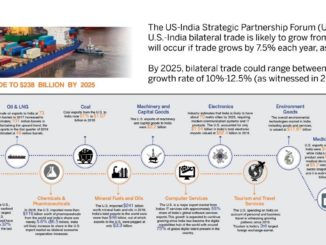
    The US-India Strategic Partnership Forum (USISPF) estimates that U.S.-India bilateral trade is likely to grow from $143 billion to $238 billion by 2025. This growth will occur if trade grows by 7.5% each year, as has been the trend for the last 7 years.

    The estimate also projects that, by 2025, bilateral trade could range between $283 billion to $327 billion, at an annual average growth rate of 10%-12.5% (as witnessed in 2017 and 2018). The assessment underscores pathways for growth and economic opportunity in our bilateral ties by highlighting current trends. Sectors such as defense trade, commercial aircrafts, oil and LNG, coal, machinery and electronics are areas of potential growth in U.S. investments and commerce into India. Similarly, Indian industry has an opportunity to promote the automotive, pharmaceuticals, seafood, IT and travel services to the U.S. market.

    The assessment was launched at USISPF’s second annual leadership summit, amid overwhelming bipartisan support for U.S.-India ties. U.S. Cabinet officials in attendance included: Nancy Pelosi, Speaker of the United States House of Representatives; Rick Perry, United States Secretary of Energy; Wilbur Ross, U.S. Commerce Secretary; Jeffrey Gerrish, Deputy United States Trade Representative for Asia, Europe, the Middle East, and Industrial Competitiveness; U.S. Senator Dan Sullivan (R-AK); and India’s Ambassador to the United States, Harsh Shringla. During the summit, speakers highlighted areas of bilateral cooperation, including: trade and investment; strategic energy ties; manufacturing, and the U.S.-India innovation partnership.

    Speaking at the summit, USISPF Chair, John Chambers said, “Prime Minister Modi’s
    re-election is the start of a new era for India and US-India relations. It is my honor to be in Washington, D.C. today to commemorate the second annual USISPF leadership summit, where conversations with political and business leaders from both countries focused on India’s projected growth in the coming months and years. While India’s ambition to become a $5 trillion economy by 2025 is certainly welcome for businesses, government, and individual citizens in the U.S. and India, it is essential that we level the playing field and stay away from protectionism. I am confident that we can achieve $327 billion in bilateral trade by 2025 if we grow at 13% every year. I challenge the government and industry to work together to advance this objective.”

    USISPF President and CEO Mukesh Aghi said, “In collaboration with government and industry leaders, we are making tremendous strides in moving the needle on our commercial priorities. Next week, the Atlantic Council and the Forum will release a report with recommendations to both governments on how to advance the bilateral trade relationship. We will also release recommendations on growing U.S-India cooperation in high-technology manufacturing sectors, such as aerospace and medical devices.”

  • India, US need a full-scale relationship: former US Ambassador to India Richard Verma

    India, US need a full-scale relationship: former US Ambassador to India Richard Verma

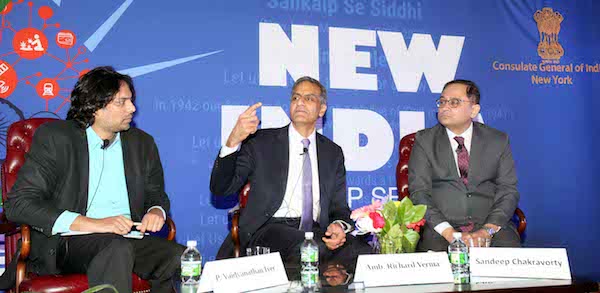
    NEW YORK CITY, NY(TIP):  India and the US need a “full scale relationship” that encompasses defense, strategic and economic ties, former US Ambassador to India Richard Verma said stressing that the two countries cannot be “fighting every day on trade” while cooperating on defense. They need to fire on all cylinders to achieve their ambitious relationship.

    “We need a full-scale relationship, not just the defense relationship, not just the strategic relationship. We need to focus on the economic side too. We somehow need to navigate America First with Make in India,” Verma said, speaking at the third New India Lecture at Indian Consulate, April 23.

    Verma said Washington and New Delhi want an “ambitious relationship” and to become natural allies for that they need to be “firing on all cylinders”, including economic and military.

    “We can’t be fighting every day on trade, cooperating on defense and think we are just going to have a great relationship. We need to be firing on all cylinders, that means economic, that means military,” he said. He further stressed that the US needs to take its defense relationship with India to the next level. “That means we ought to be providing India with the most advanced technology, we ought to make sure that if India is in trouble they have the means to win, if they are challenged,” he said.

    Verma spoke at length on a wide range of topics pertaining to India-US relations, including H1B work visas, immigration as well as geo-political issues relating to China and Pakistan.

    Verma, Vice Chairman and Partner at the Asia Group and a board member of the US-India Strategic Partnership Forum (USISPF), said the India-US relationship has been a “slightly underperforming” one for decades. “We have got some history that weighs us down. We still have some trust issues and neither side wants to be in an alliance,” he said in his address on ‘US-India: Natural Allies — Absent the Alliance.’

    Responding to a question on concerns among Indian workers over H1B visas, Verma said last year about 1.1 million visas were issued to Indian nationals to come to the US in every category and out of these, about 50,000-60,000 were H1B visas. “A very small percentage of the visa pool is for H1 B visas,” he said.

    Verma, who had served as the US Ambassador to India from 2014 to 2017, said he had conveyed to Indian CEOs and software companies that they have to be aware of the “political realities” in the US. While they should pay their employees in the US competitive wages, they also need to be “sensitive” towards people’s fear of losing jobs in an era of globalization.

    “If your consultants are coming here and advising about downsizing or scaling back and then that operation or function ends up in India, people are not going to be necessarily happy,” he said.

    “You have to understand the political realities that people are facing here, fear about globalization. I think we are getting to a better understanding. I hope we don’t run into a huge fight on H1B,” he said.

    Verma, who has previously served as the Assistant Secretary of State for Legislative Affairs, noted that “some reforms are probably necessary”, adding that the H1B visas are an important but “small part” of the overall people-to-people relationship between India and the US.

    “I think US-India trade relationship is one relationship where you can get distinct wins on both sides,” he said.

    Highlighting the critical role of the diaspora in strengthening relations between India and the US, Verma said “we have to increase our people-to-people connections and we should be celebrating and standing up for the immigrants who come into this country and not looking at ways to shrink the pool of people coming here.”

    On the trajectory of India-US relations under the Trump administration, Verma said looking at Washington’s all other bilateral relations, the one with India is “still on a pretty good trajectory.”

    While things have been moving along on the strategic side, on the economic side there are some growing pains. However, he said he is “more concerned about how we treat people who may not necessarily look like and sound like the rest of middle America and that’s the part I keep the most eye out for in this environment.”

    Recalling the journey of his parents from India to the US, Verma said that immigrants and immigration have played a hugely important role in America. “It is not just one group of immigrants or immigrants who look a certain way but immigrants from all over the world and it’s really important that we stand up for that group of people.”

    On ties with Pakistan, Verma said the US has made the message quite clear to Pakistani leaders that “this continuing support and facilitation” of terrorist groups along the border to create a “perpetual state of conflict” with India is “not sustainable.

    “It’s not in their interest, and it’s not the way to have that goal of a functioning normal state in the international system,” he said.

    He stressed that the US can’t lose the connections to all the people and moderate voices in Pakistan that want peace with India and a better future for their children.

    “It’s a very difficult situation but we have to get there with a variety of economic and political tools,” he said.

    Responding to a question on relations with China, Verma said India and the US have remarkably similar situations with regard to China, including economic inter-dependencies, trade and commercial activities.

    “But we also have security concerns. We have concerns about what China is doing in the international systems, we have concerns about their failure to adhere to rules and norms, we have concerns about the Belt and Road Initiative and what they are doing in the South China Seas,” he said.

    Verma stressed on the need to be able to balance some of these concerns.

    “No one wants to see a conflict with China. But we also have to be able to stand up for our basic values,” he added.

    He further noted that in India-China and US-China relations, there is a lot of dialogue at all levels.

    However, “it is a very difficult, complicated and contentious relationship but I don’t think anyone wants to see the spark that leads to an actual conflict,” he said.

    Verma emphasized that there is need for an international system that reflects India’s role in the world today. He lamented that India is not on the UN Security Council, is not a member of the Asia-Pacific Economic Cooperation and doesn’t play the kind of role that it probably should on the G-20 bloc of nations or in other international Institutions.

    “The US needs to pave the way forward for India so that it actually has the seat at the table in this century, a seat that is appropriate for a country of the size and stature of India. We have to be working very hard for that,” he said.

    Ambassador Verma, Consul General Sandeep Chakravorty, Vaidyanathan Aiyer, and Air India Regional Manager Vandana Sharma pose for a photograph with the young students from Bangalore Engineering College
    Photos- Jay Mandal/On Assignment

    A group of students from a Bangalore Engineering College, who were on way to Boston to take part in an auto engineering fair also attended the lecture.

    Ambassador Verma, Consul General Sandeep Chakravorty, Vaidyanathan Aiyer, and Air India Regional Manager Vandana Sharma posed for a photograph with the young students.

    (With inputs from PTI)