Tag: US – Pakistan Relations

  • Pakistan’s Nuclear Arsenal more worrisome than North Korea’s

    Pakistan’s Nuclear Arsenal more worrisome than North Korea’s

    Pakistan is more dangerous than North Korea as it does not have a centralized control on its nuclear weapons, making them vulnerable to theft and sale.

    By Ven Parmeswaran

    9/11 happened because Pakistan supported the Taliban and the Al Qaeda.  We discovered that Pakistan was the epicenter of global terrorism.  Almost all terrorists emanated from Pakistan and committed terrorism in the U.S.A. and Europe.  President George W Bush sent his Secretary of State, Gen. Collin Powell to Pakistan, with whom the USA had a Mutual Security Pact from 1954.  Powell met Gen. Musharraf of Pakistan and made a deal. Pakistan agreed to cooperate fully with the USA and provide all help in finding Osama bin Laden and other leaders of Al Qaeda.    

    President Obama had intelligence that Pakistan was hiding and protecting Osama Bin Laden in one of military cantonments.  In 2011, that is 10 years after 9/11, the U.S. secretly got rid of Osama Bin Laden. The Pakistani doctor who confirmed the identity of Osama Bin Laden has been held in jail by Pakistan.  Thus, Pakistan betrayed its ally, the U.S.A.  For ten years, Pakistan was trying to use Osama bin Laden’s leadership to stage terrorism in India.  The mutual trust between the USA and Pakistan was broken.  However, President Obama chose not to punish Pakistan.

    WAKE UP CALL BY PRESIDENT TRUMP

    President Trump is the first U.S. President to challenge Pakistan.  He wrote in his tweet: “The U.S. has foolishly given Pakistan more than 33 billion dollars in aid over the last 15 years, and they have given us nothing but lies, deceit, thinking of our leaders as fools.”   President Trump withdrew military aid and gave an ultimatum to Pakistan to stop supporting the Taliban in Afghanistan and to dismantle all terror organizations and terrorist sanctuaries in Pakistan.

    PAKISTAN’S ECONOMY IN SHAMBLES WITH NO FOREIGN EXCHANGE

    Mr. Imran Khan, the new Prime Minister of Pakistan has been elected with the tacit support and help of Pakistan’s military.  For his survival his first loyalty is to the military.   Pakistan is negotiating with the I.M.F. for a $12 billion loan.  The U.S. has leverage in the IMF being the largest investor.  The IMF cannot approve the loan without consent from the USA.    Pakistan has been devoting its scarce resources to keep on producing nuclear bombs.

    PAKISTAN’S NUCLEAR WEAPONS ARE VULNERABLE TO THEFT AND SALE

    Pakistan is more dangerous than North Korea as it does not have a centralized control on its nuclear weapons, making them vulnerable to theft and sale, former Senator Larry Pressler warned, describing both the nations as rogue states.    He feared that Pakistan’s nuclear weapons might be used against the US, warning of the possibility of someone buying these nuclear weapons from generals.    “The weapons could be transported to the US fairly simply.  Just as 9/11 was a very simple operation run by 20 or 30 people,” he said.  “The Pakistani nuclear bombs are not controlled.  They are subject to sale or stealing and they could be easily gotten out of Pakistan to just about anywhere in the world,” he said speaking at an event sponsored by The Hudson Institute, a top American think-tank.    The former top American Senator, however, said he does not think that Pakistan’s nuclear weapons are going to be used against India. I do not agree.   The Senator said “I think what North Korea needs is just a lot of attention and hand-holding.  Pakistan Is a different thing because you don’t really have one person in-charge.  I think Pakistan is more dangerous to the US,” he reiterated in response to a question.

    “We should declare Pakistan a terrorist state.  We should put certain sanctions on Pakistan,” he said.

    PAKISTAN’S GROWING ARSENAL WITHOUT CENTRAL CIVILIAN CONTROL IS THREAT TO GLOBAL SECURITY

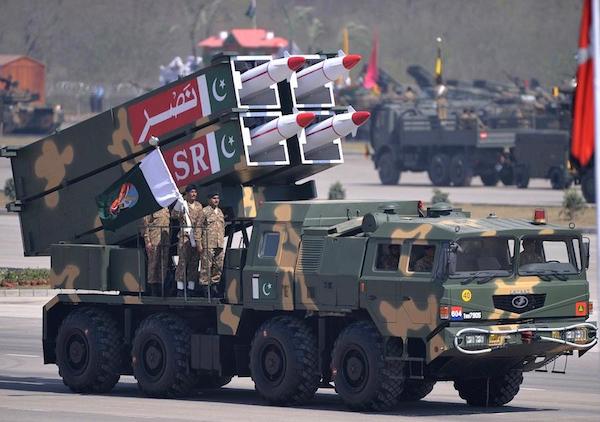
    Why does Pakistan need to keep on increasing the number of bombs?  There are thousands of nuclear weapons in the world today.  According to the latest count from the Federation of American Scientists, the 5 original nuclear powers have a combined 15,465 nuclear weapons between them, most of which are divided amongst the US and Russia. Yet, the fastest growing arsenal in the world is not included in this number.  While Pakistan has a range of 100-120 nuclear weapons in its possession—a figure that pales in comparison to the US or Russia—Islamabad has devoted a tremendous amount of its military budget to growing its arsenal and producing the associated delivery systems that are needed to launch them.

    More alarming than Pakistan’s current stockpile is the projected growth of its arsenal over the next decade.  In a wide ranging report for the Council on Foreign Relations, professor Gregory D Koblentz of George Mason University assessed that Pakistan had enough highly enriched uranium to increase its stockpile to 200 nuclear weapons by 2020 if fully utilized.  Percentage wise, this would mean that Pakistan could have as many nuclear weapons as the U.K. by 2020.  Moreover, Pakistan falls outside the purview of the Nuclear Nonproliferation Treaty.

    To guarantee the ability to rapidly expand their stockpile, the Pakistani military is investing in reprocessing plutonium in addition to enriching uranium.  In January 2015, the Institute for Science and International Security reported that the Pakistanis opened up their fourth plutonium facility at Khushab, which provides Islamabad with an additional channel to construct nuclear bomb material in a relatively short period of time.  “Its expansion appears to be part of an effort to increase the production of weapons-grade plutonium,” the ISIS report (Pakistan’s intelligence agency) reads:  “Allowing Pakistan to build a larger number of miniaturized plutonium-based nuclear weapons that can complement its existing highly enriched uranium nuclear weapons.”

    PAKISTANI NUKES A MAJOR U.S. INTELLIGENCE PRIORITY

    To say that the U.S. Intelligence community is closely monitoring the development of Pakistan’s nuclear weapons program would be an understatement.  The U.S. government is doing more than just monitoring:  they are actively preparing for a terrible catastrophe and engaging Pakistani officials in the hopes that they will stop pouring resources into the expansion of their program.  The last thing Washington wants or needs is a nuclear crisis flashpoint in a dangerous and unpredictable region filled with an alphabet soup of Islamist terrorist groups.  The US government under both George W Bush and Barack Obama has been trying to prevent such a crisis scenario from occurring.

    THE BOTTOM LINE

    Despite all the attempts from the nuclear nonproliferation community, Pakistan will continue to develop and strengthen its nuclear deterrent as long as the high brass in the Pakistani military continues to have an India-centric mindset in its defense policy. India and Pakistan have fought three wars since independence in 1947, and in each case, the Pakistanis were either the losers or forced into a stalemate before acceding to a ceasefire (1971 breakaway of East Pakistan was an especially embarrassing defeat for the Pakistanis).  Islamabad has not forgotten these cases ever since.  And for the Pakistanis, the lessons of these past conflicts are all the same: we cannot repeat history.

    PRESIDENT TRUMP’S NEW WORLD ORDER: INDIA AND THE USA HAVE SIGNED A DEAL THAT MAKES THEM CLOSEST ALLIES ON A PAR WITH THE NATO MEMBERS

    The US and the IMF have told Pakistan that it cannot use IMF loan to repay China or divert the resources to increasing its nuclear arsenal.  President Trump, unlike George W Bush or Obama, is challenging Pakistan to behave.  In effect, Trump is saying that he will not tolerate Pakistan to betray again.  Trump is also anxious to withdraw from Afghanistan and he knows Pakistan is the bottleneck.  Based on his tough negotiations and policies towards his close allies, be it Canada or Western Europe, Trump means business.  Therefore, it is to be hoped that the U.S. will not allow Pakistan to mess up with international security.   I think President Trump is giving clear messages to Pakistan’s new Prime Minister and its military/ISIS leaders.

    (Scarsdale, New York based Ven Parameswaran is Chairman, Asian American Republican Committee founded in 1988)

  • Pak trips on free run: 37-nation Financial Action Task Force to probe terror funding

    Pak trips on free run: 37-nation Financial Action Task Force to probe terror funding

    By G Parthasarathy

    Pakistan will now have to provide a detailed action plan on actions it proposes to take on curbing funding for UN-designated terrorist groups. It would then be placed on the FATF grey list, where its financial flows would be subject to intense international scrutiny. Pakistan would, thereafter, be placed on the FATF “black list” if it fails to present a credible and comprehensive action plan to the FATF by June. This would virtually end any prospect of it receiving adequate financial flows.

    The Financial Action Task Force (FATF), set up in 1989 by the G7 countries, and with headquarters in Paris, acts as an “international watchdog” on issues of money laundering and financing of terrorism. It has 37 members, including all five permanent members of the Security Council, and countries with economic influence all across the world. Two regional organizations — the Gulf Cooperation and the European Commission — are members of the FATF. Saudi Arabia and Israel are observers. India became a full member of the FATF in June 2010. The FATF is empowered to ensure that financing of UN-designated terrorist organizations is blocked. It has the power to publicly name countries not abiding by its norms, making it difficult for them to source financial flows internationally.

    Pakistan is particularly vulnerable to pressures from this task force as the Afghan Taliban, Haqqani network, LeT and JeM — all internationally designated terrorist groups — operate from its soil. Pakistan has long claimed that it has done its best to prevent terrorism emanating from its soil. It has also averred that there is no firm evidence against the LeT and the JeM, even after these groups have publicly acknowledged that they were promoting terrorism in India. Pakistan has also rejected evidence like wireless transcripts of conversations of Jaish terrorists involved in the Pathankot airport and the vast evidence available internationally of the Lashkar role in the Mumbai 26/11 attack. The Americans and their allies have focused attention primarily on Pakistan support for the Haqqani network in Afghanistan.

    Pakistan has believed that sooner, rather than later, the Americans would cut their losses and withdraw from Afghanistan, leaving the country open for a Pakistan-backed Taliban takeover. President Donald Trump, however, made it clear that he was determined that the US would not “lose” in Afghanistan. He is augmenting the US troop presence and moving fast to strengthen the Afghan armed forces, including its air force. American economic assistance to Pakistan has been placed on hold. In addition, the US has mobilized its NATO allies to take a tougher line on Pakistan. The NATO allies are also expanding their deployments in Afghanistan. More recently, the US has initiated moves to get the task force to place Pakistan on its “grey list” at its next meeting in June.

    The American effort in the FATF on Pakistan funding of terrorist groups predictably ran into problems initially. Pakistan had mobilized support from China, the Gulf Cooperation Council led by Saudi Arabia, Turkey and quite evidently Russia to counter the American-led move. Islamabad banked on Russian support, given the bonhomie that Russian foreign minister Sergei Lavrov manifested when he invited his Pakistani counterpart Khawaja Asif to Moscow on the eve of the FATF meeting. Further, despite parliamentary opposition, Pakistan declared, just over a week before the FATF meeting, that it would be deploying additional troops in Saudi Arabia. It clearly expected Saudi support in the FATF after its decision was announced. The Lavrov bonhomie led the inexperienced Khawaja Asif to proclaim hastily and prematurely that Pakistan had succeeded in prevailing over moves to place it on the FATF “grey list” involving monitoring of its international financial flows.

    The Americans responded immediately to these developments. Saudi Arabia and the GCC fell in line with American demands for the FATF to act against Pakistan. European powers like the UK, Germany and France remained steadfast in their determination to corner Pakistan. Russia quietly receded to the background. Recognizing that its support for Pakistan would leave it isolated in the FATF, where it was aspiring to become its vice-chairman at the forthcoming FATF session in June, Pakistan’s “all-weather friend” China pulled back its support for Pakistan. The only country that steadfastly continued supporting Pakistan was Turkey, whose egotistic President Recep Erdogan would certainly not win an international popularity contest today!

    Pakistan will now have to provide a detailed action plan on actions it proposes to take on curbing funding for UN-designated terrorist groups. It would then be placed on the FATF grey list, where its financial flows would be subject to intense international scrutiny. Pakistan would, thereafter, be placed on the FATF “black list” if it fails to present a credible and comprehensive action plan to the FATF by June. This would virtually end any prospect of it receiving adequate financial flows. There has been disappointment, anger and frustration in Pakistan at the FATF decision. Hardly anyone in Pakistan is prepared to publicly advise that it is time for Pakistan’s rogue army to end support on its soil to armed terrorist groups, acting against India and Afghanistan. While Pakistan recently claimed it had closed Lashkar offices, it was soon found that only the gates of these offices were closed, while routine activities continued inside.

    In these circumstances, India should urge members of the European Union and Japan to join the US and end providing concessional credits to Pakistan. Given its precarious foreign exchange position, Pakistan will inevitably have to go to the IMF for a bailout in a few months. Institutions like the IMF, World Bank and Asian Development Bank need to be persuaded to withhold providing concessional credits to Pakistan, even if it takes some token measures to claim it has acted against UN-designated terrorist outfits. India should urge that no concessional credits should be provided to Pakistan till it dismantles the infrastructure of terrorism on its soil irrevocably. China will not follow suit; but its “aid” for the China-Pakistan Economic Corridor will only increase Pakistan’s already heavy debt burden.

    The withdrawal of Chinese support in the FATF has shaken the Pakistan establishment’s belief that Chinese support to “contain India” has no limitations. China recognizes that backing Pakistan unconditionally in the FATF would not only earn it the ire of the mercurial Donald Trump but would also sully its image internationally. At the same time, this does not mean that there will be any change in China’s policies on issues like declaring Jaish chief Masood Azhar an international terrorist. Moreover, we should also clearly recognize that President Trump’s actions are primarily in response to Pakistan’s support for the Haqqani network in Afghanistan. They are not highly or significantly focused on Pakistan-sponsored terrorism on Indian soil. That is a battle that will have to be fought primarily by us.

    (The author is an Indian career diplomat. He was High Commissioner of India to Pakistan in 1998-2000)


  • US will carry on with Pak military training

    US will carry on with Pak military training

    ISLAMABAD (TIP): The US has conveyed to Pakistan that the military training component of the aid will continue despite suspension of the security assistance package, media reports said on Thursday, January 18.

    Foreign Secretary Tehmina Janjua informed the Senate’s foreign affairs committee on Wednesday that the US will continue funding the aid components that support their national interest, including the International Military Education and Training (IMET) part, Dawn reported.

    The IMET program, which focuses on military education, is meant to establish a rapport between the US military and the recipient country’s military for building alliances for the future.

    Under this program, Pakistan Army officers have been trained in the US at a cost of $52 million over the past 15 years and an allocation of another $4 million has been made for the current year.

    While the IMET would continue, the US has frozen the aid provided under the programs that are more important to Pakistan, particularly the Foreign Military Financing (FMF).

    The recipients of FMF can use the funds under this program for procurement of defense hardware produced by the US.

    Foreign Minister Khawaja Asif, while briefing the lawmakers on the current state of Pak-US relations, said the relationship was not going “very smooth” and problems were persisting. “We have to stand up to those who accuse us of harboring terrorists,” Asif remarked.

    Early this month, Trump accused Pakistan of giving nothing to the US but “lies and deceit” in return for USD 33 billion aid and said Islamabad has provided “safe haven” to terrorists.

    Lies and deceit

    Pakistan army officers have been trained in the US at a cost of $52 million over the past 15 years

    An allocation of another $4 million has been made to train Pakistan military officers for the current year

    The US will continue funding the aid components that support their national interest, including the International Military Education and Training (IMET) part.

    (With inputs from IANS)