Tag: USCIRF

  • Present imperfect: on the U.S. Commission on International Religious Freedom’s latest report and India

    Irrespective of what the U.S. Commission on International Religious Freedom says, India must review its rights record

    For the fourth consecutive year, the government has expressed outrage and rejected the recommendations of the U.S. Commission on International Religious Freedom’s (USCIRF) latest report, calling it “biased and motivated”. In its report released on Monday, the independent congressional body has called for India to be designated a “Country of Particular Concern” (CPC) for its “worsening” record on religious freedoms. The report has targeted the Indian government for “promoting and enforcing religiously discriminatory policies,” naming laws that deal with conversion, interfaith relationships, wearing the hijab and cow slaughter, as well as the Citizenship (Amendment) Act and the National Register of Citizens. All of these, it alleges, have impacted minorities including Muslims, Christians, Sikhs, Dalits, and Adivasis (indigenous peoples and Scheduled Tribes) negatively. The USCIRF has also catalogued acts of violence and the vilification of minorities and criticized the “suppression of critical voices” by intimidation that includes surveillance, demolition of property, detentions, and the targeting of NGOs through laws curtailing foreign donations. It has criticized the U.S. State Department for not having designated India as a CPC, and has called for sanctions on Indian government agencies and officials. In the only such sanction imposed on India, the U.S. had, in 2005, revoked Prime Minister Narendra Modi’s U.S. visa after a USCIRF recommendation on the 2002 Gujarat riots. In its response, the External Affairs Ministry has told the USCIRF to “desist” from such reports and to “develop a better understanding of India….”

    The government’s stern reaction is understandable, and is in line with its response to such reports over the last two decades, since the USCIRF began to publish its findings. The process the USCIRF follows is non-inclusive, and the fact that it does not study the state of religious freedoms inside the U.S., suggests a double standard. Moreover, its recommendations hold no sway within India, and are meant only for the U.S. government to deliberate on and accept or dismiss. Either way, there is little need for or utility to New Delhi’s public responses, which make it sound defensive and do not actually repair the reputational damage to India as a secular, inclusive and pluralistic democracy. Given the detailed and pointed accusations, however, the Centre may well consider an internal review of its conduct and the direction it hopes to lead India in, on issues such as religious freedoms and rights. Eventually, any government’s duty is not in achieving a perfect score in a survey run abroad, but rather in burnishing its record of delivering justice, equality and security to its citizens back home.
    (The Hindu)

  • USCIRF recommends to designate India, 14 others as ‘Country of Particular Concern’

    USCIRF recommends to designate India, 14 others as ‘Country of Particular Concern’

    WASHINGTON, D.C. (TIP): A US Congress-constituted quasi-judicial body on Monday, April 25,  recommended to the Biden Administration to designate India, China, Pakistan, Afghanistan and 11 other nations as “Country of Particular Concern” in the context of status of religious freedom. India has in the past said that the American body on international religious freedom has chosen to be guided only by its biases on a matter on which it has no locus standi.The recommendations of the US Commission for International Religious Freedom (USCIRF) are not binding on the US Government. Other countries recommended for this designation by the USCIRF in its annual report are Burma, Eritrea, Iran, Nigeria, North Korea, Russia, Saudi Arabia, Syria, Tajikistan, Turkmenistan, and Vietnam.

    The USCRF had made a similar recommendation to the US government last year which was not accepted by the Biden Administration.India has previously rejected the reports by USCIRF.

    “Our principled position remains that we see no locus standi for a foreign entity to pronounce on the state of our citizens’ constitutionally protected rights,” the ministry of external affairs had said in the past.

    “We have a robust public discourse in India and constitutionally mandated institutions that guarantee protection of religious freedom and rule of law,” the MEA had said.

    Among its recommendations last year, five countries — Afghanistan, India, Nigeria, Syria, and Vietnam – are not designated as Country of Particular Concern by the US Government.

    “In 2021, religious freedom conditions in India significantly worsened. During the year, the Indian government escalated its promotion and enforcement of policies—including those promoting a Hindu-nationalist agenda—that negatively affect Muslims, Christians, Sikhs, Dalits, and other religious minorities,” USCIRF said.”The government continued to systemize its ideological vision of a Hindu state at both the national and state levels through the use of both existing and new laws and structural changes hostile to the country’s religious minorities,” it said.

    Established by the US government in 1998 after the inaction of the International Religious Freedom Act, recommendations of USCIRF are non-binding on the state department. Traditionally, India does not recognize the view of USCIRF. For more than a decade, it has denied visas to members of the USCIRF.

  • USCIRF report on religious freedom work of ‘Hinduphobic’ people, alleges Hindu body

    USCIRF report on religious freedom work of ‘Hinduphobic’ people, alleges Hindu body

    WASHINGTON, D.C. (TIP): A Hindu body here called the USCIRF report on religious freedom a work of “Hinduphobic” commission members while Muslim and Christian groups hailed the observations made in it, demanding that the US declare India as a “country of particular concern”.

    The US Commission for International Religious Freedom (USCIRF) report recommended to the Biden Administration to designate India, China, Pakistan, Afghanistan and 11 other nations as “countries of particular concern” in the context of religious freedom. The recommendations are not binding on the US government.

    Hindu PACT, an initiative of the World Hindu Council of America, in a statement alleged that the USCIRF has been taken over by “Indophobic and Hinduphobic members”.

    The American Muslim Institution (AMI) and its associate organizations applaud the USCIRF recommendation, saying religious freedom conditions in India “significantly worsened” in 2021.

    The Federation of Indian American Christian Organizations and the Indian American Muslim Council in separate statements also applauded the USCIRF recommendation.

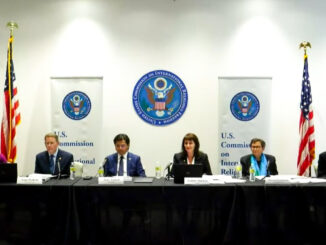
    During a special virtual congressional briefing, a day after the release of the report, USCIRF Commissioner Anurima Bhargava had alleged that Indian government officials were tolerating and engaging in religious persecution of Muslims and Christians with prolific mob violence.

    India has dismissed such allegations. Senior US government officials have told lawmakers that India has a vibrant civil society, an independent judiciary and a mature functional democracy, which has enough mechanisms to address the internal human rights concerns if any.

    HinduPACT in a statement slammed the USCIRF

    “This year’s report follows a pattern of reports that have appeared in previous years. Based on publicly available information on topics like the Citizenship Amendment Act (CAA) and Kashmir, the USCIRF report is a copy-and-paste of talking points peddled by an agglomeration of Islamist groups working with radical Islamist group Justice for All on whose platform USCIRF commissioners appear regularly,” alleged Utsav Chakrabarti, executive director of HinduPACT.

    “It is now obvious that the USCIRF has been taken over by the Indophobic and Hinduphobic members. Many of these members have attended India and Hindu bashing events. It is no surprise that their selective observations are meant to promote a political agenda and further their electoral reach in select communities,” said Ajay Shah, president of the World Hindu Council of America (VHPA).

    In a statement, Koshy George, Federation of Indian American Christian Organizations, recommended that the president and the US Administration accept the USCIRF recommendations and name India as a “country of particular concern” while it could still help protect American interests in that region for the long-term.

    “This could also go a long way in helping the Union of India remain a functioning liberal democracy with respect for all religious and linguistic minorities,” he said.

    Indian-American Muslim Council executive director Rasheed Ahmed said they commend the USCIRF for “refusing to cave into the lobbying of US-based right-wing Hindu nationalist groups and making clear that the ground reality of minorities in India is of constant harassment and violence”.”Given the damning information presented in this report, US State Department officials must now act on the recommendations made by the USCIRF by officially designating India as a CPC and by imposing targeted sanctions upon the Indian government to hold officials responsible for encouraging hate,” said Syed Afzal Ali, president of the IAMC.

    (Source: PTI)

  • Battle within US panel on religious freedom on putting India on Red List

    Battle within US panel on religious freedom on putting India on Red List

    WASHINGTON, D.C. (TIP): Behind the exchange of words on the state of human rights in each other’s countries between External Affair Minister S Jaishankar and US Secretary of State Antony Blinken is a more intense battle being fought in the corridors of United States Commission on International Religious Freedom (USCIRF) as it prepares a report to be submitted to the US State Department on April 25. Twice in past successive years, the USCIRF wanted the US State Department to treat India as a ‘Country of Particular Concern (CPC)’ which would bracket it with egregious human rights abusers such as China, Pakistan and Saudi Arabia. And, both times two different US administrations have rejected its recommendation and kept India a rung below the Red List. This time, the battle within USCIRF on the India chapter is more intense than in the past amidst insider accounts that one Commissioner has “been turned” and is understood to be insisting on several changes in the draft under preparation.

    In a letter to USCIRF, several US-based civil rights and faith groups have asked it to withstand the pressure. “It is clear that those seeking to obfuscate the reality of India’s persecution of its religious minorities are now using intense lobbying and combative communication with the goal of preventing USCIRF from recommending India’s designation as a CPC for the third straight year,” said the letter. “We have also learned that such pressure includes attempts to influence USCIRF Commissioners and officials to exclude even a mention of Prime Minister Narendra Modi,” it added. On Wednesday, April 13, Jaishankar held a press conference in Washington to rebut Blinken’s comments a day earlier. Nationalist Congress Party has criticized the Government for the two Indian Ministers present at the press conference – Jaishankar and Defense Minister Rajnath Singh – not giving an on-the-spot rebuttal. Stating that human rights issue was not a topic of discussion during the India-US 2+2 ministerial meeting, Jaishankar said people are entitled to have views about India but “we also take our views on other people’s human rights situation, including that of the US”. Blinken had said a day earlier that the US is monitoring some recent “concerning developments” in India, including a rise in human rights abuses by some government, police and prison officials.