WASHINGTON, D.C. (TIP): The Trump administration is looking at plans to strip some naturalized Americans of their citizenship, the latest in a series of efforts undertaken by President Donald Trump to crack down on immigration. A report in the New York Times cited new internal guidance issued on Tuesday, December 16, to US Citizenship and Immigration Services field offices, asking them to “supply Office of Immigration Litigation with 100-200 denaturalization cases per month” in fiscal year 2026.
While federal law provides for stripping naturalized Americans of their citizenship if they committed fraud while applying for citizenship or in a handful of other situations, the new guidance “would represent a massive escalation of denaturalization in the modern era,” said the report.
It added that such a move could impact people who had made honest mistakes on their citizenship paperwork and “sow fear among law-abiding Americans.”
The guidance is the latest in a series of measures announced by Trump in his second term in the White House as part of an intensified crackdown on immigration, both illegal and legal. The NYT report added that there are about 26 million naturalized Americans in the country, citing Census Bureau data. USCIS estimates show that more than 800,000 new citizens were sworn in last year, most of whom were born in Mexico, India, the Philippines, the Dominican Republic or Vietnam.
“It’s no secret that US Citizenship and Immigration Services’ war on fraud includes prioritizing those who’ve unlawfully obtained US citizenship — especially under the previous administration,” USCIS spokesman Matthew Tragesser said in the NYT report.
“We will pursue denaturalization proceedings for those individuals lying or misrepresenting themselves during the naturalization process. We look forward to continuing to work with the Department of Justice to restore integrity to America’s immigration system.”
Former agency officials have voiced concern over such guidelines.
“Imposing arbitrary numerical targets on denaturalization cases risks politicizing citizenship revocation,” former USCIS official Sarah Pierce said.
“And requiring monthly quotas that are 10 times higher than the total annual number of denaturalization’s in recent years turns a serious and rare tool into a blunt instrument and fuels unnecessary fear and uncertainty for the millions of naturalized Americans.”
The NYT report said the new guidance was part of a document outlining USCIS priorities for the 2026 fiscal year, which began in October and listed goals such as “provide employee feedback opportunities”, “strengthen management of high-risk cases” and “pursue denaturalization.”
The Justice Department has also said it would make denaturalization a priority this year. In a memo earlier this year, officials said they would target individuals in an array of categories beyond committing fraud in obtaining citizenship.
“Categories of eligible people include gang members, those who committed financial fraud, individuals connected to drug cartels and violent criminals,” the NYT report said.
What can a H-1B holder do if they lose their job and are ordered to appear in Immigration court?
Laid-off H-1B workers in the U.S. are usually granted a 60-day grace period to find a new employer or change their visa status. However, since mid-2025, there has been a surge in reports of Notices to Appear (NTAs) being issued well before the grace period has expired.
This has caused significant stress and uncertainty for many H-1B visa holders and their families in the U.S.
According to PEW, 400,000 H-1B visas were approved in 2024. 73% of those visas went to workers from India. A vast majority of the H-1B visas each year are renewals.
What options are available to H-1B visa holders in such situations?
To better understand the legal landscape and possible courses of action, Anjana Nagarajan-Butaney spoke with Sameer Khedekar, Founder and Managing Attorney at Vanguard Visa Law in California.
This interview has been lightly edited for clarity.
Anjana Nagarajan-Butaney
Anjana: To give us a little bit of context on why we’re even having this conversation at this point in time, can you outline the changes that have occurred in the H-1B visa process in the last few months?
Sameer: I would say it’s apparent that the changes appear to be broader than just the H-1B community. It’s the entire kind of legal visa holder community of which H-1B’s are like the highest percentage (for Indian Americans). So it kind of makes sense that we focus on them because they have the most people here.
Let me back up a little bit — In February of this year, USCIS issued a memo policy update saying that they will issue notices to appear (NTA) in immigration court to anybody who is not of lawful status in the US.
So we thought it makes sense, right? I mean if you are not in lawful status, you might end up in immigration court. That made sense to us, and we didn’t really think too much about it. They provided a bunch of examples that had nothing to do with the H-1B community.
Then in early July, we started hearing of people who had been working in H-1B jobs who were laid off or left a company for whatever reason. Whenever you leave an H-1B job, whether it’s through a layoff or even voluntarily, the company is required to notify USCIS, and the reason they’re required to notify USCIS is, if they don’t, the employee can come back and claim back wages for the period of time, even after they left. So the company kind of has to do this.
And the question is, when do they have to do it? The regulations say immediately, but immediately, like instantaneously, or most companies do it anywhere from a few days to a few months after the employment ends.
So now the other part to remember is that when an H-1B holder or any visa holder leaves their company, they get a 60-day grace period, which in the regulations is discretionary. But never since 2016 or 2017 when the grace period was implemented, has the government chosen to exercise their discretion not to give it to people.
So it’s been pretty much uniformly awarded to anybody who’s left their company. And people have used that time, the 60 days, to either find new employment and get a new H-1B transfer or change their status to H-4 or B-1/B-2 while they wait for a job and then go back to H-1B.
The B-1/B-2 to H-1B was a strategy actually almost encouraged by the Biden administration. Post covid, there were a lot of layoffs when companies started realizing they had over hired. In 2023/2024, you remember all the layoffs that happened, and many of these were H-1B holders.
So what the Biden administration said is, if you’re laid off, you have options. If you have an H-1B you have a 60-day grace period. You can also apply to change to a B-1/B-2 change in the US. And then if you find a job and you get sponsored for an H-1B, we may just kind of put you back in H-1B if you have a pending B-1/B-2. So basically, there’s a pending application that’s keeping you in a period of authorized stay. And they even had a website that kind of explained it.
So, remember I told you about the February memo by USCIS. Then in March/April, the Trump administration archived that web page. We’re like — what do they mean by that?
In June, they started issuing the NTAs to people. So you can kind of see the timeline, right? They are going after people who are laid off and trying to get them kicked out of the country, Number one. And they’re trying to do so in a way where they’re not even recognizing the grace period.
Anjana: Can you walk us through the process that happens?
Sameer: So what’s happening is somebody leaves their employer — the company withdraws H-1B. That withdrawal has USCIS almost autotrigger a notice to appear in immigration court regardless of what that person has done in the interim to maintain their status — apply for a B-1/B-2, apply for an H-4 or all the things I told you. They’re not even really looking. They’re saying — you are not in status and you have to go to immigration court.
So it turns out, they are in status — like some have applied for an H-1B transfer in that interim, some have applied for an H-4, some have applied for B-1/B-2, but the NTAs don’t reflect that at all. So we’re taking people to immigration court, and we’re getting those cases dismissed, because for those that have actually changed their status, changed their employer or applied for B-1/B-2, the courts say they’re not deportable. The courts are starting to dismiss them one by one.
Now, every judge is different, every court is different, and the result is not guaranteed. So multiply this by all the layoffs we had in May and in June — Microsoft, Intel, lots of different firms and multiply this by how many people this is happening to and you can kind of see the chaos that it’s creating.
If you’re going to leave your job or if you’re going to be laid off, you might end up in immigration court. You might get deported. For people who have been here and who is this affecting the most — it’s the people that can’t get green cards because they’re stuck in the longest backlogs. Who are they? Indian nationals. You have to connect a lot of dots to see who this is really affecting. 99% of our clients right now are Indians.
Anjana: This 60-day grace period — is it a law, or is it an executive action?
Sameer: It’s a regulation. However, the regulation does say it’s discretionary,
Usually, unless there’s some compelling reason that it shouldn’t give it to them. That’s kind of what we had all thought discretionary meant. But it seems like, in this case, the government saying discretionary is we just are deciding not to for no reason whatsoever.
What’s problematic is that the judges so far that we’ve seen are not necessarily disagreeing with USCIS. They’re not saying — this person applied for a change of employer in the grace period. Therefore, they maintain their status.
What they’re saying is they applied for the change of employer before the NTA was issued, So, this whole thing is eroding the grace period in many ways.
Anjana: What steps should a person on an H-1B visa take after being laid off or changing their job to maintain their status?
Sameer: Number one, they should be very clear as to when their employer is going to withdraw their H-1B, because that has so far been the trigger. If they were to leave their company, and they know this is happening, and they have enough time — talk to their employer about not withdrawing the H-1B until at least the grace period is done. The employer may not choose to. They are going to do what they’re going to do, but you could at least have that conversation.
Previously, people have been pretty passive about this topic because it’s kind of an awkward thing to talk about. But now I feel like there’s enough understanding and people know this is happening, so I think it’s definitely something an employee should ask. When are you going to withdraw the H-1B? Can you wait until the end of my grace period because, as you know, when you withdraw an H-1B, it’s triggering NTAs. So many companies are actually waiting for the end of the grace period to withdraw H-1Bs but it depends on the company.
Anjana: So, there is no difference from a legal point of view on whether you got laid off or you’re choosing to change jobs for a better one?
Sameer: Yeah because I had a client who is 37 ½ weeks pregnant with her second child, and she’s like —I’m going to change to H-4 because I want to stop working so I can get ready for my delivery. And so she left her job and she changed to H-4 but the H-4 process takes 6 to 8 months. So she’s in a pending H-4 application, and the company had to withdraw the H-1B and she got an NTA.
Anjana: That was my next question. How are a non-working spouse and children affected if the H-1B holder changes jobs, loses their job, or is issued an NTA?
Sameer: That’s what’s scary. How many calls have I had where the family’s been living here for 10 or 12 or 15 years; the child is a nine-year-old standing next to the mom during the zoom, watching his mom panic while I’m talking them through what is happening. The specter of families being separated because of this.
Now, what I’m finding is that everybody has done what they’ve had to do to maintain their status in some way — whether it’s changing to H-4 or having a green card pending or having an EAD. There’s something and they’ve tried to follow the law, and what I’m finding is that we generally can get their cases dismissed because of that so far.
It’s early, this has only been happening a few weeks but it seems like we’re able to get the cases dismissed. So we’re hoping that this is just going to be a huge annoyance for them, but for the most part, we can convince the courts not to deport anybody and to dismiss the case because the person has already taken steps to preserve their status or stay in the US.
The problem is there are second-order implications. Even if you get a case dismissed, you still have to go for visa stamping. You have to answer a question at the consulate — have you ever been in a removal proceeding? You have to say Yes. And what is that going to cost? Is that going to cause 221(g) delays? Is it going to cause stamping denials because the consulates are kind of their own entity —they’re not really answerable to anybody.
What about when you return to the US? Is this going to be on their record, the CBP record at the airport? Are they going to be questioned about this? Indians are in this process forever, so are they gonna have to be doing this for the rest of their lives?
Anjana: What options are available if a visa holder is unable to secure employment within the 60-day grace period?
Sameer: This is an evolving kind of area. The safest thing to do would be to leave the country because if you leave before the NTA is issued, then you can absolutely get the case dismissed. There’s nothing you can do to prevent an NTA. You can’t call somebody and say Hey, I’ve left, don’t issue the NTA. The government’s going to do what they’re going to do.
What a person has to do is to put themselves in a position where they can easily get the case dismissed if they get an NTA. So, leaving the US before the NTA is issued is the best course.
Now, people don’t receive NTAs for a few weeks after they’re issued. Follow the court. So you need to track as soon as it’s issued, not when you get it. There are notice laws that protect you to help you throw a case out if you didn’t get it on time. There’s a website where people can look up their file number to see if an NTA has been issued.
Anjana: What if you get an NTA and you don’t have a job yet?
Sameer: Your question is what should you do in the grace period? So one option is to leave, but that’s not feasible if you have kids, and so we’re starting to find that if you take some sort of action, like file to change your status to H-4. Let’s say your spouse is on an H-1B, you file to change to an H-4 online right as soon as you leave. That seems to be enough.
We’ve got some cases dismissed where somebody had applied for an H-4, or certainly if you find another job in the 60-day grace period and a company transfers to H-1B, and even if it’s pending, that seems to be enough that you have an H-1B pending. You’re in status. You’re working for that company. That seems to be enough to get a case dismissed.
I heard of one case where somebody actually filed for B-1/B-2 in the grace period, and it was pending, and they got their case dismissed. That’s the riskiest because B-1/B-2 only gives you a few months, and so how compelling is that going to be to a judge?
In some cases, it seems like the judges are just annoyed by this, and for any reason they might have to dismiss a case, they will, because they’re like — What are these cases that are coming in? We’re dealing with people who are applying for asylum, who have no status. What are these new NTAs that are coming in for people who actually have cases on file with the government and are not out of status?
It’s risky, but it seems like so far a pending B-1/B-2 may be enough to allow you to help get your case dismissed.
Anjana: And this is also true if your spouse is not working, therefore, you cannot switch to an H-4 right?
Sameer: You can’t switch an H-4 under those circumstances, and maybe B-1/B-2 is your only option then, and trying to get back in H-1B. But the problem is that they may not approve the B-1/B-2 to H-1B like they used to. In fact, we have an indication, and we have a case right now, where it seems like they don’t want to do that.
So then that would require the person to travel, and if they don’t have a visa, to re-enter, to activate the H-1B, and if they have to go get a visa stamp – that’s a delay. They have to say they were in court proceedings. So it’s going to cause a lot of confusion and chaos.
Anjana: An additional consideration is the status of an H-1B holder who is partway through the green card process. How does this affect their legal ability to remain in the U.S. or transition to a different employer at this point?
Sameer: This is what we’re really concerned about. Some people have had pending green cards for a long time now — AOS pending, working on EADs. And we’ve always kind of been like — try to maintain your H-1B if you can also. We never know what will happen, but you don’t have to, because you have the EAD.
Now, we hope everyone’s maintaining their underlying H-1B because the pending green card is not by itself a status. It’s like a period of authorized day, and it’s not guaranteed a judge will say that’s enough to stay in the US anymore. So I have a client like that. She just came to us. We’re gonna file for her dismissal in about a week or two, and we’ll see what the court says there.
Anjana: This is a point of confusion for a lot of people, the fact that once you’ve been selected for the H-1B lottery and it’s been approved, if you change your job again, you don’t have to go through the lottery again. Even though an H-1B is tied to your job, winning the lottery means that it’s kind of tied to you in a way too, right? Can you explain this?
Sameer: For the most part, that’s true. Once you’ve been picked at the lottery, and you’ve activated that H-1B, had the H-1B approved, and you’ve started an H-1B status, then you don’t have to go through the lottery again. Unless you’ve exhausted your six years of H-1B time and have been out of the US for more than a year. But for the most part, 99% of people don’t have to go through the lottery again once they’ve been selected and they’ve activated their H-1B.
Anjana: As you can imagine, many H-1B professionals right now are incredibly anxious — they have well-established families here and given the current instability in the Tech market and the political environment, what steps can they take proactively in case they are laid off or thinking about switching jobs? What can they start thinking about and preparing for in advance?
Sameer: (First) find out when the company’s going to withdraw the H-1B because that is a necessary trigger. Next, constantly check on the link to see if an NTA has been issued. Everyone has a different situation. Talk to an attorney and get advice what you could do.
Anjana: To clarify, your own personal immigration attorney, not your company’s attorney, right?
Sameer: Your company attorney is generally not going to help because their obligations are with the company. They also don’t have the bandwidth. Let’s say the company lays off 1000 H-1B holders. A company can’t talk to each person. They don’t have the time.
NTA is an immigration court procedure, and so it’s this weird kind of area that most H-1B lawyers don’t understand – most Immigration Court lawyers don’t understand H-1Bs. But you have to understand immigration court procedure if you’re a lawyer, and then you have to understand H-1B law to get a case dismissed. That’s what I would recommend.
Anjana: Are you seeing a decline in the number of people choosing to stay in the US? Is there a noticeable decrease in visa applications or approvals for H1, O1, L1 kind of visas?
Sameer: What we’ve noticed, and I think the stats kind of back this up, is that the number of student visa holders or student visa applications has decreased considerably. That’s the usual way Indian nationals make their entry into the US. That’s a pipeline. And then once they’re here, they stay. So the ones that are here, I haven’t seen them personally go back yet, but I’ve certainly felt their stress. I could feel the confusion it’s causing in their life. But I haven’t seen them go back yet.
Anjana: Can you also talk about non H-1B NTAs that you are seeing?
Sameer: So it’s not just H-1Bs that are getting NTAs now. There’s a company that had an employee on an L-1 visa. They had layoffs, and they laid off the L-1s except that you don’t have to notify USCIS about L-1s. That L1 notification triggered NTAs.
I actually talked to that company. They’re not my clients, but I know the person who runs immigration there. I told them, please stop doing that, because any notification that USCIS gets that a visa ends, they are turning that into an NTA whether or not the person has changed status or not.
Anjana: Are you seeing any immigration changes affecting families visiting on a B-1/B-2 visa?
Sameer: If you’re a U.S. citizen or green card holder and your mother or father comes to visit on B-1/B-2, and let’s say they stay for six months; they need to be here for two more months because they’re helping with the grandchild. You apply for an extension, and they’re issuing an NTA if you are still here after the B-1/B-2 period has elapsed, even if you applied for an extension and that extension hasn’t been approved.
Anjana: This could affect their ability to obtain a B-1/B-2 visa or be allowed entry into the U.S. in the future, right?
Sameer: Here’s what’s happening. Let’s say in this case, the person applied for a three-month extension. By the time the NTA arrived, it was right on schedule for the three months. And I sent my mom home because she was going to overstay the three months that I requested. But he sent her home after the NCA was issued, which is a no-no. And he’s like — you wanted me to have her stay past the three months? I’m like, this is like the rock and the hard place people are finding themselves in.
It’s worse to actually leave after an NTA is issued, because then a judge can say, we are barring you from entry for five years because you left after you’ve been called to immigration court. Even if the court hearing is way far out, which is also what’s happening because the government is firing judges, and cases are backlogged for years. So some hearings are not until 2027 or 2028.
The system is not set up to handle this kind of permutation. So what I would do in that case, depending on timing, is — if you’re in court, you can request voluntary departure, which is basically like, let me self-deport, let me leave right with your permission. And then if you do that, you don’t accrue any period of time unlawfully present. So that would be the solution. But still, you have to disclose that in the future, like you said.
I don’t know how much worse this is going to be. Is this like a blip? Is this going to continue? It’s hard to say right now.
Anjana Nagarajan-Butaney
(Anjana is a 2021 and 2022 Fellow of USC Annenberg’s Center for Health Journalism, reporting on domestic violence in the South Asian community. She also won a grant from Altavoz Labs to report on aging in 2022 and the 2024 Journalists in Aging Fellowship from the Gerontological Society of America (GSA) and the Journalists Network on Generations to report on menopause.
She has received Journalistic Excellence awards from the San Francisco Press Club and from California News Publishers Association for In-Depth Reporting. Her stories have appeared on India Currents, Palabra, San Diego Herald-Tribune, Indiaspora and American Kahani.)
WASHINGTON, D.C. (TIP): The US has received a sufficient number of petitions needed to reach a cap for the much-sought-after H-1B foreign work visas for the fiscal year 2024, a federal agency has announced.
The H-1B visa is a non-immigrant visa that allows US companies to employ foreign workers in speciality occupations that require theoretical or technical expertise. Technology companies depend on it to hire tens of thousands of employees each year from countries like India and China.
US Citizenship and Immigration Services (USCIS) in a statement on Thursday, December 14, said it has received a sufficient number of petitions needed to reach the congressionally mandated 65,000 H-1B visa regular cap and the 20,000 H-1B visa US advanced degree exemption, known as the master’s cap, for fiscal year 2024.
The US federal government’s fiscal year runs from October 1 to September 30. “We will send non-selection notices to registrants through their online accounts over the next few days,” USCIS said.
USCIS said it will continue to accept and process petitions that are otherwise exempt from the cap.
Petitions filed for current H-1B workers who have been counted previously against the cap and who still retain their cap number are exempt from the FY 2024 H-1B cap. The federal agency will continue to accept and process petitions filed to extend the amount of time a current H-1B worker may remain in the United States; change the terms of employment for current H-1B workers; allow current H-1B workers to change employers; and allow current H-1B workers to work concurrently in additional H-1B positions.
WASHINGTON, D.C. (TIP): The Biden administration has eased norms by releasing policy guidance on the eligibility criteria for those waiting for green cards to work and stay in America, days ahead of Prime Minister Narendra Modi’s visit to the US.
The guidance issued by the US Citizenship and Immigration Services (USCIS) regarding the eligibility criteria for initial and renewal applications for Employment Authorization Document (EAD) in compelling circumstances is expected to help thousands of Indian technology professionals who are in the agonizingly long wait for a Green Card or permanent residency. A Green Card, known officially as a Permanent Resident Card, is a document issued to immigrants to the US as evidence that the bearer has been granted the privilege of residing permanently. Immigration law provides for approximately 140,000 employment-based green cards to be issued each year.
However, only seven per cent of those green cards can go to individuals from a single country annually. The USCIS guidance outlines specific requirements that applicants must meet to be eligible for an initial EAD based on compelling circumstances. These include being the principal beneficiary of an approved Form I-140, being in valid non-immigrant status or authorized grace period, not having filed an adjustment of status application, and meeting certain biometrics and criminal background requirements.
Further, USCIS will exercise discretion to determine whether an applicant demonstrates compelling circumstances justifying the issuance of employment authorization.
“These measures are a significant step towards supporting individuals facing challenging situations and ensuring their ability to work lawfully in the United States,” said Ajay Bhutoria, a prominent community leader and advocate for immigrant rights. He highlighted the importance of these measures for individuals and their dependents who find themselves in challenging situations such as serious illness or disability, employer disputes or retaliation, significant harm, or disruptions to employment.
Bhutoria said the non-exhaustive list of qualifying circumstances, as provided by USCIS, offers individuals an opportunity to present evidence supporting their case.
“For instance, individuals with approved immigrant visa petitions in oversubscribed categories or chargeability areas may submit evidence like school or higher education enrollment records, mortgage records, or long-term lease records to demonstrate compelling circumstances,” he said. This provision can prove crucial in situations where families face the potential loss of their home, withdrawal of children from school, or the need to relocate to their home country due to job loss, Bhutoria added.
Foundation of India and Indian Diaspora Studies (FIIDS), which has been advocating for laid-off H1-B workers, applauded USCIS for taking such a step that would help a large number of Indian IT professionals. “I really feel proud that a sustained advocacy for more than six months started reflecting in considerations and adjustments by USCIS,” said Khanderao Kand from FIIDS.
USCIS says it is in the process of initiating law enforcement referrals for criminal prosecution
WASHINGTON, D.C. (TIP): The computerized drawing of lots devised to select successful H-1B applicants every year has resulted in abuse of the system and a sharp increase in fraudulent efforts, a federal agency said on Friday, April 28. In an unusual statement, US Citizenship and Immigration Services (USCIS) on Friday, April 28, said that based on evidence from the Financial Year 2023 and Financial Year 2024 H-1B cap seasons, it has already undertaken extensive fraud investigations, denied and revoked petitions.
USCIS said it is in the process of initiating law enforcement referrals for criminal prosecution.
“The H-1B program is an essential part of our nation’s immigration system and our economy, and the USCIS is committed to implementing the law and helping meet the ever-changing needs of the US labor market,” it said.
“We are working on an upcoming H-1B modernization rule that will propose, among other improvements, bolstering the H-1B registration process to reduce the possibility of misuse and fraud in the H-1B registration system,” it added. USCIS said during the registration period for the FY 2024 H-1B cap, it saw a significant increase in the number of registrations submitted compared to prior years.
It said there were 780,884 applications for H-1B visas in this year’s computer-generated lottery, against 4,83,927 in 2023 and 3,01,447 in 2022 and 2,74,237 in 2021.
(Source: PTI)
WASHINGTON, D.C. (TIP): In a statement on Monday, March 27, the US Citizenship and Immigration Services said it has received enough electronic registrations during the initial period to reach the fiscal year 2024 H-1B numerical allocations (H-1B cap), including the advanced degree exemption — the master’s cap.
“We have randomly selected from the registrations properly submitted to reach the cap and have notified all prospective petitioners with selected registrations that they are eligible to file an H-1B cap-subject petition for the beneficiary named in the applicable selected registration,” it said.
H-1B cap-subject petitions for the financial year 2024, including those petitions eligible for the advanced degree exemption, may be filed with the US Citizenship and Immigration Services (USCIS) from April 1, 2023, if based on a valid, selected registration. Only petitioners with selected registrations may file H-1B cap-subject petitions for 2024 fiscal and only for the beneficiary named in the applicable selected registration notice, the USCIS said.
The US Congress has set the current annual regular cap for the H-1B category at 65,000. Of this, 6,800 visas are set aside under the terms of the legislation implementing the US-Chile and U.S.-Singapore free trade agreements. Unused visas in this group become available for H-1B use for the next fiscal year’s regular H-1B cap.
(Source: PTI)
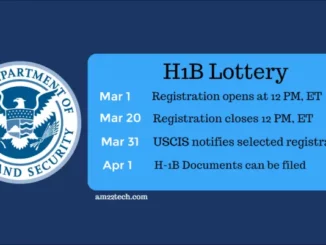
NEW YORK (TIP): U.S. Citizenship and Immigration Services (USCIS) announced that the initial registration period for the fiscal year 2023 H-1B cap will open at 12 p.m. EST on March 1 and extend to 12 p.m. EST on March 17, 2023. During this period, prospective petitioners and representatives will be able to complete and submit their registrations using the USCIS online H-1B registration system.
Prospective H-1B cap-subject petitioners or their representatives are required to use a myUSCIS online account to register each beneficiary for the selection process and pay the associated $10 H-1B registration fee for each registration. Prospective petitioners submitting their own registrations (i.e., U.S. employers and U.S. agents) will use a “registrant” account. Registrants will be able to create new accounts beginning at 12 p.m. ET on Feb. 21. Of note, the USCIS confirmation number assigned to each registrant is used solely to track registrations and cannot be used to track the case status in Case Status Online.
Moreover, representatives may add clients to their accounts at any time, but both representatives and registrants must wait until March 1 to enter beneficiary information and submit the registration with the $10 fee. Through the account, prospective petitioners will be able to prepare, edit, and store draft registrations prior to final payment and submission of each registration.
After the registration period is completed, USCIS will begin the H-1B cap selection process. Petitioners will be notified of the selected registrants via selection notifications sent to their my USCIS online accounts through March 31. An H-1B cap-subject petition, including a petition for a beneficiary who is eligible for the advanced degree exemption, may only be filed by a petitioner whose registration for the beneficiary named in the H-1B petition was selected in the H-1B registration process.
WASHINGTON, D.C. (TIP): An Indian American documented dreamer has told lawmakers that she would be forced to leave the US, where she has spent her entire life since the age of four, in eight months in the absence of any meaningful legislative reforms in immigration system that addressed the major issue of aged-out kids.Dreamers are basically undocumented immigrants who enter the US as children with parents. There are nearly 11 million undocumented immigrants, including over half a million from India, according to a policy document issued by the Biden campaign in November 2020.
“Without a change in eight months, I will be forced to leave, not only my home of 20 years but also my mom who is my only family left,” Athulya Rajakumar, a 23-year-old recent graduate of the University of Texas at Austin from the Moody College of Communication, told members of the Senate Judiciary Subcommittee on Immigration, Citizenship and Border Safety on Tuesday, March 15. Testifying before the subcommittee during a hearing on “Removing Barriers to Legal Migration,” the Indian American told the Senators that over 5,000 documented dreamers face this every year. “Erin, a nursing graduate was forced to self-deport last summer in the midst of a pandemic…a data analyst student was forced to self-deport two months ago, Summer will be forced to self-deport in four months, even though her family has legally resided here since she was a baby,” she said. An aspiring journalist shared the story of her family’s struggle through years of immigration limbo, which contributed to her brother’s tragic death. “I’m outraged by this broken system that you, your brother, and thousands of documented dreamers have had to face. We organized this hearing today because we cannot allow the inaction of Congress to continue to cause this suffering,” Senator Alex Padilla said in his remarks.
Padilla is chair of the Senate Judiciary Subcommittee on Immigration, Citizenship, and Border Safety. Barriers to legal migration routinely separate families across international borders for years, he said.
“Visa caps that keep employers from expanding their businesses and hold back the US economy, an arbitrary cut-off for legal status that forced children, visa holders, to leave the only country they’ve ever known when they age out of their parents’ visas. The gap between our country’s needs and the realities of our broken immigration system should come as no surprise,” Padilla said. “Employment-based visas allow participating immigrants to bring extraordinary skills to our workforce, start new businesses, create new jobs in rural areas, and to help address worker shortages in industries like healthcare,” he said.
“But only 1,40,000 of these individuals can obtain visas every year. Because the spouses and children who accompany them count against the total, far fewer than 70,000 visas actually go to eligible workers. Hundreds of thousands of others are left in limbo, restricted by a temporary visa, or turned away from their dreams and they’re kept from realizing their potential,” he said.
Ranking Member Senator John Cornyn said the Congressional Research Service recently estimated that without significant changes, the employment-based green card backlog could exceed 2 million by 2030.
“Indian nationals have been hit especially hard because our system’s per-country caps do not allow them to receive more than seven per cent of the available employment-based visas in any given year,” he said.
“To make matters worse due to processing inefficiencies attributable in part to USCIS’ paper-based system and to the closures of many of our consulates, we fail to issue as many as 92,000 employment-based visas in the height of the pandemic,” he said.
Rajakumar told lawmakers that she got a full-time offer from a major news corporation in Houston, a top 10 market, but the same company who saw her potential withdrew their offer the second they heard about her visa status. “But worst of all, being considered an alien, an outsider in the only place you know to call home is a different kind of pain,” she said.
Dip Patel, president of Improve the Dream, in a statement, said that Rajakumar’s moving testimony shows the urgent need to update the broken system, including the need to permanently end the problem of aging for children who are raised and educated in the United States. “For thousands of young people growing up with uncertainty, there is constant anxiety regarding one’s future in what we consider our home…We urge Congress to consider this and act fast to pass common-sense immigration reform,” he said.
During the hearing, Padilla questioned Rajakumar about her experience as a documented dreamer and how a pathway to citizenship and the enactment of America’s Children Act would impact her life. Raja kumar pointed to the fact that it would mean that she wouldn’t have to be separated from her family and the country she’s called her home for the last twenty years.
WASHINGTON, D.C. (TIP): Seeking to comprehensively overhaul the H-1B and L-1 visa programs, a bipartisan group of influential senators have introduced a legislation in the US Senate, which they argued will protect American workers and crack down on foreign outsourcing companies that exploit these popular visa programs to deprive qualified Americans of high-skilled jobs.
The H-1B visa is a non-immigrant visa that allows US companies to employ foreign workers in specialty occupations that require theoretical or technical expertise. Technology companies depend on it to hire tens of thousands of employees each year from countries like India and China. The H-1B visa programme is the most sought-after work visa among foreign professionals, including Indians. The L-1 visa is a non-immigrant visa for the purpose of work in L-1 status. It is valid for a relatively short amount of time.
The H-1B and L-1 Visa Reform Act will reduce fraud and abuse, provide protections for American workers and visa holders, and require more transparency in the recruitment of foreign workers, the senators said.
Introduced by Senate Majority Whip Dick Durbin, Chair of the Senate Judiciary Committee, and Senator Chuck Grassley, Ranking Member of the Senate Judiciary Committee, the legislation is co-sponsored by Senators Richard Blumenthal, Tommy Tuberville, Sherrod Brown, Bill Hagerty, and Bernie Sanders.
The H-1B and L-1 Visa Reform Act will require US Citizenship and Immigration Services to prioritize for the first time the annual allocation of H-1B visas. The new system would ensure that the best and brightest STEM advanced degree students educated in the United States receive preference for an H-1B visa, and also prioritize other US advanced degree holders, those being paid a high wage, and those with valuable skills. STEM stands for Science, Technology, Engineering, and Mathematics.
The legislation explicitly prohibits the replacement of American workers by H-1B or L-1 visa holders and clarifies that the working conditions of similarly employed American workers may not be adversely affected by the hiring of an H-1B worker, including H-1B workers who have been placed by another employer at the American worker’s worksite, a media release said.
“Reforming the H-1B and L-1 visa programs is a critical component to fixing America’s broken immigration system,” Durbin said. “For years, outsourcing companies have used legal loopholes to displace qualified American workers, exploit foreign workers, and facilitate the outsourcing of American jobs. Our legislation would fix these broken programs, protect workers, and put an end to these abuses,” he said. “Congress created the H-1B and L-1 visa programs to complement America’s high-skilled workforce, not replace it. Unfortunately, some companies are trying to exploit the programs by cutting American workers for cheaper labor. We need programs dedicated to putting American workers first,” Grassley said.
“When skilled foreign workers are needed to meet the demands of our labor market, we must also ensure that visa applicants who honed their skills at American colleges and universities are a priority over the importation of more foreign workers. Our bill takes steps to ensure that the programs work for Americans and skilled foreign workers alike,” he added.
According to the senators, the legislation will target outsourcing companies that import large numbers of H-1B and L-1 workers for temporary training purposes only to send the workers back to their home countries to do the same job.
Specifically, the bill would prohibit companies with more than 50 employees, of which at least half are H-1B or L-1 holders, from hiring additional H-1B employees. The bill gives the US Department of Labor enhanced authority to review, investigate, and audit employer compliance with programme requirements, as well as to penalize fraudulent or abusive conduct.
It requires the production of extensive statistical data about the H-1B and L-1 programs, including wage data, worker education levels, place of employment, and gender.
In addition, the H-1B and L-1 Visa Reform Act includes several reforms of the L-1 visa programme, including the establishment of a wage floor for L-1 workers; authority for the US Department of Homeland Security to investigate, audit, and enforce compliance with the L-1 programme requirements; assurance that intra-company transfers occur between legitimate branches of a company and do not involve “shell” facilities; and a change to the definition of “specialized knowledge” to ensure that L-1 visas are reserved only for truly key personnel, the media release said.
“This legislation will crackdown on the manipulation of existing vulnerabilities to ensure employers prioritize the American worker before considering any high-skilled foreign applicants. If we are going to get our economy back up and running, we need to do it correctly and that begins with utilizing the talent we have here at home first and foremost,” said Senator Tuberville.
US Citizenship and Immigration Services (USCIS) on Monday , February 28, announced that it has received a sufficient number of petitions needed to reach the congressionally mandated 65,000 H-1B visa regular cap and the 20,000 H-1B visa US advanced degree exemption, known as the master’s cap, for fiscal year (FY) 2022.
WASHINGTON D.C. (TIP): In a major victory for H-1B employers, a federal court has approved a settlement under which the US Citizenship and Immigration Services has agreed to qualify market research analyst as a specialty occupation for the purposes of determining H-1B visa application of a foreign professional.
Based on its prior interpretation of the Occupational Outlook Handbook — a Department of Labor’s Bureau of Labor Statistics publication profiling hundreds of occupations in the US job market — the USCIS was determining that market research analysts did not qualify as a “specialty occupation”. The settlement approved by the federal district court in the Northern District of California would now let companies request that the USCIS reopen and re-adjudicate their denied H-1B petitions. “This settlement is an important victory that will benefit hundreds of American businesses and the market research analysts they sought to employ,” said Leslie K Dellon, senior attorney (business immigration) at the American Immigration Council. “The settlement gives US businesses another chance to have their H-1B market research analyst petitions approved — this time under new guidance worked out by the parties to the lawsuit. Each H-1B petition reopened and approved will represent another opportunity for US employers and the workers they sponsored to advance their business objectives,” she said.
The class action lawsuit in this regard was filed by the American Immigration Council, American Immigration Lawyers Association, and the law firms Van Der Hout LLP, Berry Appleman & Leiden LLP (formerly Joseph & Hall P.C.), and Kuck Baxter Immigration LLC. Jeff Joseph, partner at Berry Appleman & Leiden LLP, said this settlement finally resolves an issue on which immigration lawyers have been battling the government for years.
“This settlement strikes the right balance between what the regulations actually say and how employers evaluate a candidate’s professional qualifications in the real world. It is our sincere hope that USCIS will now interpret other specialty occupations from a perspective that is in line with what actually happens in the free market,” he said.
WASHINGTON (TIP): Some foreign guest workers in the U.S. will be able to re-submit their applications for the H1-B visa, the most sought-after non-immigrant visa among Indian IT professionals, if their petition was solely rejected because it was based on the initial registration period, according to a federal agency.
According to the U.S. Citizenship and Immigration Services (USCIS), such re-submission of applications is for those whose applications have been rejected or administratively closed solely because the requested start date was after October 1, 2020.
The H-1B visa allows the U.S. companies to employ foreign workers in specialty occupations that require theoretical or technical expertise. Technology companies depend on it to hire tens of thousands of employees each year from countries such as India and China.
“If your FY 2021 petition was rejected or administratively closed solely because your petition was based on a registration submitted during the initial registration period, but you requested a start date after October 1, 2020, you may re-submit that previously filed petition, with all applicable fees,” USCIS said on Wednesday.
“Such petitions must be re-submitted before October 1, 2021. If properly resubmitted, we will consider the petition to have been filed on the original receipt date,” the USCIS said.
In 2020, USCIS implemented an electronic registration process for the H-1B cap.
Prospective petitioners seeking to file H-1B cap-subject petitions, including for beneficiaries eligible for the advanced degree exemption, must first electronically register and pay the USD 10 H-1B registration fee for each beneficiary.
“The electronic registration process has streamlined processing by reducing paperwork and data exchange and provided overall cost savings to employers seeking to file H-1B cap-subject petitions,” it said.
According to USCIS, for fiscal 2021, the number of petitions filed during the initial filing period was below the number projected as needed to reach the numerical allocations.
This discrepancy was likely related to multiple factors, including the economic, political and public health uncertainty created by the COVID-19 pandemic, as well as the fact that FY-2021 was the first year that we implemented the electronic registration process.
“Therefore, in August 2020, we selected additional registrations that were held in reserve. The filing period for registrations selected in August ended on November 16, 2020,” it said.
“Some petitioners indicated a start date after October 1, 2020. We rejected or administratively closed those petitions because they were based on registrations submitted during the initial registration period but indicated a start date after October 1, 2020. Upon reconsideration, we no longer believe that the regulations required us to reject or administratively close those petitions,” the USCIS said.
The move comes days after the powerful the U.S. Chambers of Commerce launched a massive campaign to address the acute shortage of skilled and professional workforce in America.
The demand to increase the H-1B quota, which currently is at 65,000 and another 20,000 for those who have higher studies from the U.S., is part of the America Works campaign launched by the U.S. Chambers of Commerce early this month.
WASHINGTON (TIP): A group of Indian-American frontline healthcare workers languishing in the Green Card backlog held a demonstration in front of the US Capitol urging lawmakers and the Biden administration to end the per capita country-specific quota. A Green Card, known officially as a Permanent Resident Card, is a document issued to immigrants to the US as evidence that the bearer has been granted the privilege of residing permanently in the country. Indian IT professionals, most of whom are highly skilled and come to the US mainly on the H-1B work visas, are the worst sufferers of the current immigration system which imposes a seven per cent per country quota on allotment of the coveted Green Card or permanent legal residency.
We are frontline COVID warriors, and we are here to tell how we have been shortchanged into a life of perpetual indentured servitude. Each of us has a story. We are here from all over the country asking for justice. Justice that has precluded us for decades now, Dr Raj Karnatak, an infectious disease and critical care physician and Dr Pranav Singh, a pulmonary and critical care physician, said.
Most of us are from India. We trained in the US and took oath as physicians to serve the sick and needy. Most of us are serving the rural and underserved areas. We are in a Green Card backlog due to archaic country caps that allow no country to get more than seven percent of employment-based green cards, said the two Indian American doctors’ organizers of the peaceful protest said in a joint statement.
According to them, due to decades of backlog, many high-skilled immigrants are not able to change jobs due to fear of losing the spot in the Green Card line and are indentured to one employer.
Can only work in the specialty occupation the visa is allotted for decades. Many healthcare workers could not serve in COVID-19 hot spots as the visas are tied to the job and employer, they said.
The small group of protestors said that President Joe Biden can direct United States Citizenship and Immigration Services (USCIS) to end the Green Card backlog for the frontline healthcare workers by utilizing the unused green cards in the past years.
There was an HR 1044 fairness bill that was passed in the House of Representatives by 365 votes in 2019 and its senate equivalent S386 passed the Senate in 2020.
Now it is back to House as a modified version. Representative Zoe Lofgren, initial co-sponsor of the bill HR 1044 has not shown any interest in bringing the bill to vote as a bipartisan solution to end the suffering of skilled professionals including frontline healthcare workers, they alleged.
Dr Karnatak and Dr Singh said that India is a land of more than a billion people, but the number of green cards India gets is the same as a country as small as Iceland.
Indian high-skilled workers are brought into the US on an H-1B visa. There is no country cap on the H-1B visa and due to its sheer population; Indians make 50 per cent of the H-1B workforce.
The H-1B visa, the most sought after among Indian IT professionals, is a non-immigrant visa that allows US companies to employ foreign workers in specialty occupations that require theoretical or technical expertise. The technology companies depend on it to hire tens of thousands of employees each year from countries like India and China. The discrepancy in the number of H-1B hired from India and a small number of green cards allotted to India creates an inhumane Green Card backlog. Green Card backlog is adversely affecting the professional and personal lives of high-skilled immigrants from India including the frontline healthcare workers, they said.
Frontline healthcare workers need immediate relief, they are suffering for a very long time. As frontline healthcare workers who are risking their lives in this pandemic, the least we deserve is a certainty. A certainty that if we die or get disabled, our children and spouses won’t be kicked out of the country, said the joint statement on behalf of the protestors. Last month, President Biden revoked a policy issued by his predecessor during the pandemic that blocked many Green Card applicants from entering the US.
Reopening the country to people seeking green cards, or legal permanent residence, Biden in his proclamation said that the policy of former president Donald Trump does not advance the interests of the country.
To the contrary, it harms the United States, including by preventing certain family members of United States citizens and lawful permanent residents from joining their families here, he said.
The US is currently facing a backlog of nearly 473,000 qualified family-based Green Card requests.
As a result of Trump’s ban on issuing green cards, as many as 120,000 family-based preference visas were lost. But this came as a big boon for issuing employment-based green cards, mainly those on H-1B visas.
WASHINGTON (TIP): Keeping his campaign trail promise, US President Joe Biden on the first day of his presidency, January 20, sent a comprehensive immigration Bill to Congress. The Bill proposes a major overhaul in the immigration system, including granting legal status and a path to citizenship to tens of thousands of undocumented immigrants and other groups and reduce the time that family members must wait outside the US for the green card. Called the US Citizenship Act of 2021, the legislation modernizes the immigration system and proposes to eliminate the per country cap for the employment-based green card, a move that would benefit thousands of Indian IT professionals, whose current wait period for legal permanent residency runs into several decades. “Today, President Biden sent an immigration Bill to Congress. The US Citizenship Act modernizes our immigration system. It provides hard-working people who have enriched our communities and lived here for decades an opportunity to earn citizenship,” White House Press Secretary Jen Psaki told reporters at a news conference.“The President’s priority reflected in the Bill are to responsibly manage the border, keep families together, grow our economy, address the root causes of migration from Central America and ensure that America can remain a refuge for those fleeing prosecution,” Psaki said. The Bill would stimulate America’s economy while ensuring that every worker is protected. The Bill creates an earned path to citizenship for immigrant neighbors, colleagues, parishioners, community leaders, friends, and loved ones, including “Dreamers” and the essential workers who have risked their lives to serve and protect American communities, the White House said.According to the White House, the Bill clears employment-based visa backlogs, recaptures unused visas, reduces lengthy wait times, and eliminates per-country visa caps. It makes it easier for graduates of US universities with advanced degrees in science, technology, engineering and mathematics (STEM) stay in the US, improves access to the green card for workers in lower-wage sectors, and eliminates other unnecessary hurdles for employment-based green card.
WASHINGTON (TIP): U.S. Citizenship and Immigration Services announced on December 6, 2019 a requirement for employers seeking to file H-1B cap-subject petitions, including those eligible for the advanced degree exemption, to first electronically register and pay the associated $10 H-1B registration fee before filing a petition for the fiscal year 2021 H-1B cap.
USCIS will open an initial registration period from March 1 through March 20, 2020.
During this initial registration period, prospective petitioners or their authorized representatives must electronically submit a separate registration naming each alien for whom they seek to file an H-1B cap-subject petition.
If a sufficient number of registrations are received, we will randomly select the number of registrations projected as needed to reach the H-1B numerical allocations after the initial registration period closes and no later than March 31, 2020. Prospective petitioners with selected registrations will be eligible to file a cap-subject petition only for the alien named in the registration.
Once the H-1B registration system has been implemented, and when registration is required, the agency will not consider a cap-subject petition properly filed unless it is based on a valid registration selection for the same beneficiary, and the appropriate fiscal year. Additionally, although petitioners can register multiple aliens during a single online submission, duplicate registrations for the same beneficiary in the same fiscal year will be discarded.
During the past few months, USCIS conducted usability testing for the H-1B registration system. We incorporated feedback from those sessions into redesigns of the system. After completing the current development phase, USCIS will conduct further outreach and training prior to the initial implementation of the registration system to allow the public the opportunity to familiarize themselves with the electronic registration process. USCIS will provide guidance on how to use the registration system and prepare registrations before opening the registration system for the initial registration period.
DHS intends to publish a notice in the Federal Register in the coming weeks to formally announce implementation of the H-1B registration process.
(Press Release)
WASHINGTON (TIP): U.S. Citizenship and Immigration Services announced on December 6, 2019 a requirement for employers seeking to file H-1B cap-subject petitions, including those eligible for the advanced degree exemption, to first electronically register and pay the associated $10 H-1B registration fee before filing a petition for the fiscal year 2021 H-1B cap.
USCIS will open an initial registration period from March 1 through March 20, 2020.
During this initial registration period, prospective petitioners or their authorized representatives must electronically submit a separate registration naming each alien for whom they seek to file an H-1B cap-subject petition.
If a sufficient number of registrations are received, we will randomly select the number of registrations projected as needed to reach the H-1B numerical allocations after the initial registration period closes and no later than March 31, 2020. Prospective petitioners with selected registrations will be eligible to file a cap-subject petition only for the alien named in the registration.
Once the H-1B registration system has been implemented, and when registration is required, the agency will not consider a cap-subject petition properly filed unless it is based on a valid registration selection for the same beneficiary, and the appropriate fiscal year. Additionally, although petitioners can register multiple aliens during a single online submission, duplicate registrations for the same beneficiary in the same fiscal year will be discarded.
During the past few months, USCIS conducted usability testing for the H-1B registration system. We incorporated feedback from those sessions into redesigns of the system. After completing the current development phase, USCIS will conduct further outreach and training prior to the initial implementation of the registration system to allow the public the opportunity to familiarize themselves with the electronic registration process. USCIS will provide guidance on how to use the registration system and prepare registrations before opening the registration system for the initial registration period.
DHS intends to publish a notice in the Federal Register in the coming weeks to formally announce implementation of the H-1B registration process.
The Trump administration is moving forward with its plan to end anObama-era programthat allowed spouses of H-1B visa holders to work in the United States.
WASHINGTON(TIP): In a letter sent to Sen. Chuck Grassley, a critic of the H-1B program, Lee Francis Cissna, the director of the US Citizenship and Immigration Services, signaled that the agency is going ahead with its plan to end the practice of providing Employment Authorization Documents (EAD) to H4 visa holders and an announcement will come later this summer.
Whenever that happens, tens of thousands of H-4 spouses — a vast majority of them Indian nationals — will be jobless again. The Obama-era rule allowed spouses of H-1B visa holders that are awaiting Green Card approval to apply for employment authorization.
According to USCIS data, there are currently 100,000 H-4 spouses who are benefiting from the rule.
“With regards to regulations, our plans include proposing regulatory changes to remove H-4 dependent spouses from the class of aliens eligible for employment authorization, thereby reversing the 2015 final rule that granted such eligibility,” Cissna wrote in the letter, dated April 4, addressed to Grassley, chairman of the Senate Judiciary Committee.
“We announced this intention earlier this year in the semiannual regulatory agenda of the department of homeland security (DHS),” Cissna added.
The letter stated that the withdrawal of work authorization falls in line with “the Buy American Hire American Executive” order issued by President Trump, which had directed federal agencies including USCIS to come up with drastic changes to fix what it termed as a flawed immigration system.
As with other revisions to regulations, the public will have an opportunity to provide feedback during a notice and comment period, Cissna said.
Indian nationals on H4 visas have the most to lose by the move. Some 90 percent of H4 EAD program beneficiaries have been Indian nationals.
WASHINGTON (TIP): US Citizenship and Immigration Services (USCIS) announced on Tuesday, April 10, the launch of its website E-Verify.gov that would help employers and employees in getting information on electronic employment eligibility verification.
“The user-friendly website provides information about E-Verify and Form I-9, Employment Eligibility Verification, including employee rights and employer responsibilities in the employment verification process,” the agency said in a press statement. “E-Verify.gov allows employers to enroll in E-Verify directly and permits current users to access their accounts.”
The new website is for employers, employees and the general public.
“For the past decade, E-Verify has been the cornerstone of our continued commitment to helping employers maintain a legal workforce,” said USCIS Director L. Francis Cissna. “E-Verify.gov now allows users to better understand and navigate through the employment verification process.”
The Internet-based system where about 800,000 employers are enrolled compares information in Form I-9 with records of the Department of Homeland Security and the Social Security Administration to authenticate work authorization of an individual in the US.
“On April 18, 2017, President Trump signed the Buy American and Hire American executive order to help reduce illegal immigration and preserve jobs for U.S. workers. To support these objectives, USCIS encourages all U.S. employers to verify all new hires through E-Verify,” USCIS said.
The agency said that nearly all employees are confirmed as work-authorized instantly or within 24 hours.
The new website will provide all the required information required on employment, for instance, employment eligibility, employee rights and employer responsibilities on one platform. Earlier, such information could be gathered through USCIS website, but it was not centralized.
US President Donald Trump’s executive order, “Buy American and Hire American”, set the tone for immigration policies and their implementation. This resulted in an increasingly protectionist stance and rising apprehensions about the future of people whose immigration status was short of permanent residency. Thus, there was a scare about the norm of granting extensions to H-1B visa-holders who were waiting for their Green Cards. The latest clarification from the US Citizenship and Immigration Services (USCIS) has brought a smile on the faces of the nearly five lakh Indian citizens working in the US on H-1B visas. No longer do they have to face the prospect of having to leave the US even as their applications for extension are pending. The USCIS has gone a step further saying that even if there were changes in the H-1B visa rules, these would not hurt the existing workforce.
The USCIS stance acknowledges the mutual dependence of US IT companies and the tech workers of Indian origin, who are now to be seen at all levels, including the very top, of such organizations. Indian citizens are the biggest beneficiaries of H-1B visas, but this is directly related to the need of US companies for trained IT professionals. However, over the past few years, Indian companies have cut down the number of visas they seek in this category.
IT giants like Infosys, Tata Consultancy Services and Wipro are meeting the challenges of such protectionism by hiring local professionals for their projects in the US. However, there is also a need to develop alternatives that would keep the army of IT professionals they have gainfully engaged. This would involve re-skilling them so that they can handle newer challenges, especially in artificial intelligence and machine learning. The government, while betting for the rights of Indian workers abroad, should also help to create an ecosystem that would encourage more innovation for domestic and professional workers returning from foreign shores. Only those — individuals or organizations — who adapt will survive the challenging environment that the IT workplace has become
WASHINGTON (TIP): From Monday, June 26, U.S. Citizenship and Immigration Services (USCIS) has resumed premium processing for all H-1B petitions filed for medical doctors under the Conrad 30 Waiver program, as well as interested government agency waivers. The Conrad 30 program allows certain medical doctors to stay in the United States on a temporary visa after completing their medical training to work in rural and urban areas that have shortage of physicians.
“This program improves health care access for Americans living in underserved areas, and we are pleased to resume premium processing for these petitions,” said USCIS Acting Director James McCament.
USCIS in March had announced that it has temporarily stopped the processing of premium processing of H-1B visa until further notice. USCIS plans to resume premium processing of other H-1B petitions as workloads permit. They will make additional announcements with specific details related to when they will begin accepting premium processing for those petitions.
Until then, premium processing remains temporarily suspended for all other H-1B petitions. USCIS will reject any Form I-907 filed for those petitions, and if the petitioner submitted one check combining the Form I-907 and Form I‑129 fees, USCIS will have to reject both forms.
Signup to our Newsletter!
Don’t miss out on all the happenings around the world