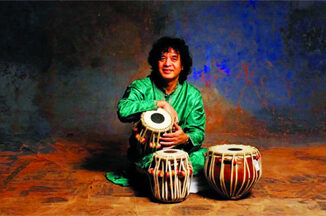
Tag: Ustad Zakir Hussain

  • Ustad Zakir Hussain: Tabla loses its vibrant voice

    Ustad Zakir Hussain: Tabla loses its vibrant voice

    The tabla fell silent as Ustad Zakir Hussain (1951-2024), one of the greatest global ambassadors of Indian classical music, passed away on Monday (December 16, 2024) after a brief illness in San Francisco, California. A maestro who transformed the modest instrument into a robust voice for universal peace and humanity, Hussain’s incredible speed, dexterity, and creativity mesmerised audiences across cultures.
    Having grown up singing odes to Mother Saraswati, verses of the holy Quran, and hymns of the Bible as a daily ritual, India’s syncretic soul echoed through Hussain’s rhythmic art. With a flair for carving stories out of percussive sound, his conversational music buzzed with a spark of spontaneity. Natural flow defined his music and personality. The Padma Vibhushan would impress the purists, enthrall the seekers of fusion, and handhold the fans of Bollywood music into his creative space with equal felicity. At the peak of his creativity genius, he bagged three Grammys in one night this February.
    Like his carefully designed free-flowing style, the versatile artist would execute complex rhythms, intricate patterns, and nuanced dynamics and then move on to items like the sound of traffic signal and deer’s walk, without putting music into brackets. In tune with technology, over the years, he experimented with frequencies to highlight the subtle shades of the instrument to establish that tabla is not just a rhythmic instrument but also a melodic one. He emerged on the scene alongside eminent tabla artists like Anindo Chatterjee, Shafaat Ahmed Khan, Kumar Bose, and Swapan Chaudhuri, but Hussain’s role in popularising tabla and providing it a global platform remains unparalleled.
    Born to Ustad Alla Rakha, the eminent accompanist of Pandit Ravi Shankar, credited with taking tabla to foreign shores, tabla chose Hussain. He grew up in Mumbai in an environment where his father believed that every instrument has its spirit. Hussain befriended the tabla at the age of three and by the time he hit teenage, the instrument had become his muse for life and perhaps an extension of his personality. After watching him play, one couldn’t see playing tabla as a chore in classical music.
    His other two brothers, Taufiq and Fazal, are also noted percussionists but Hussain took his father’s legacy to the next level by adding a touch of showmanship and expanding the riches he inherited from the Punjab gharana. A keen learner and listener, Hussain was like a responsive satellite in orbit as an accompanist, shone like a star in his solos, and reserved the adventurous streak of a meteor for creating fusion music.
    A child prodigy who gave his first professional performance at 12, Hussain was not regimented by his teacher-father. Rooted in Indian tradition, he was allowed to develop wings and explore new shores. His day would start with devotional music that would invoke Hindu deities followed by polishing Koranic verses in the neighbourhood madarsa before he would join the morning prayers at the Convent school. By 19, Hussain taught at the University of Washington before joining Ustad Ali Akbar Khan’s music college in San Francisco where he met his soulmate Antonia Minnecola.
    Another fortuitous meeting in New York led to a lifelong bond with the iconic English guitarist John McLaughlin. Their friendship led to the formation of the groundbreaking Shakti band in 1973 which included violinist L. Shankar and percussionist T. H. Vinayakram who blended Hindustani and Carnatic classical music with Western jazz influences. This year, the band where Hussain joined hands with a new set of distinguished musicians won the Grammy for Best Global Music.
    Hussain’s desire to experiment led to rewarding collaborations with Irish singer Van Morrison, American percussionist Mickey Hart, Latin Jazz percussionist Giovanni Hidalgo, and Jerry Garcia, the lead vocalist and guitarist of the Grateful Dread. He joined the Asian Underground music’s electronic surge as well in the 1990s but retained the natural acoustic quality of tabla. He shared a special bond with Santoor maestro Pandit Shiv Kumar Sharma, flautist Hari Prasad Chaurasia, and sarangi stalwart Ustad Sultan Khan. Their jugalbandis would start as melodic banter and then turn meditative. In sync with the next generation, last year, he composed the Triple Concerto for Tabla, Sitar and Flute, with Niladri Kumar and Rakesh Chaurasia, and his collaboration with Carnatic musicians extended to violinist Kala Ramnath and veena exponent Jayanthi Kumaresh.
    Fusion was never a novelty for Hussain as he had grown up listening to stories of how Amir Khusrau blended the Indian traditions of Dhrupad and Haveli sangeet with Sufi Qaul to create Khayal. As a young musician, he saw his father and colleagues contributing to Hindi film music that liberally drew from diverse musical streams. Hussain had his brush with cinema when he played tabla for Laxmikant Pyarelal’s maiden venture Parasmani. Later he composed music for Ismail Merchant’s films like Muhafiz, Aparna Sen’s Mr And Mrs Iyer, and Rahul Dholakia’s Parzania. The meaningful sound of his tabla lent layers to storytelling in international productions like Francis Ford Coppola’s Apocalypse Now and recently Dev Patel’s Monkey Man.
    Hussain also had a flair for acting from a young age. It is said Dilip Kumar recommended his name to K Asif for the role of young Salim in Mughal-e-Azam but Ustad Alla Rakha vetoed it. Later, he performed in Ismail Merchant’s Heat & Dust and Sai Paranjpye’s Saaz. However, he became a household figure when he brought classical music to the mainstream by promoting a tea brand in a commercial where he played tabla at the iconic Taj Mahal. As an article in The Hindu described, “The combination of “Wah Taj!” with the dashing young Hussain’s curly locks flying about his face as his fingers flew across the surface of his tabla — not to mention that charming smile accompanied by the resonance of his playing — ensured brand immortality.
    Fame didn’t diminish his humility and age didn’t wilt his curiosity. Music was an endless journey for Hussain. Every time someone would toss the word perfection, he would say, “I haven’t played good enough to quit.”
    Source: The Hindu

  • EXPLORE THE BLISS OF “TISRA” AT NJPAC

    By Mabel Pais

    Experience the richness, depth and joy of Indian classical music with Zakir Hussain, Sabir Khan and Debopriya Chatterjee performing at the New Jersey Performing Arts Center (NJPAC) on April 13, 2024 at 3 PM and 7:30 PM, Victoria Theater.

    Left to right: Zakir Hussain, Debopriya Chatterjee & Sabir Khan. (Photo : Courtesy njpac.org)

    ZAKIR HUSSAIN

    Zakir became the first musician from India to receive 3 Grammys at one time at the 66th Annual Grammy Awards on February 4, 2024, for Best Global Music Album, Best Global Music Performance and Best Contemporary Instrumental Album.

    ‘The London Telegraph’ calls him “the presiding genius and global ambassador for North Indian classical music.” GRAMMY® winning tabla drummer Zakir Hussain first entered the western world’s consciousness in the ‘70s with his collaborations with George Harrison, John Handy, Van Morrison and Earth, Wind & Fire. He’s lauded for his group ‘Shakti,’ which he founded with John McLaughlin and L. Shankar, and for ‘Planet Drum’ with Mickey Hart of the Grateful Dead.

    The pre-eminent classical tabla virtuoso of our time, Zakir Hussain is appreciated both in the field of percussion and in the music world at large as an international phenomenon and one of the world’s most esteemed and influential musicians. The foremost disciple of his father, the legendary Ustad Allarakha, Zakir was a child prodigy who began his professional career at the age of twelve, accompanying India’s greatest classical musicians and dancers and touring internationally with great success by the age of eighteen. His brilliant accompaniment, solo performance and genre-defying collaborations, including his pioneering work to develop a dialogue between North and South Indian musicians, have elevated the status of his instrument both in India and globally, bringing the tabla into a new dimension of renown and appreciation.

    Widely considered a chief architect of the contemporary world music movement, Zakir’s contribution has been unique, with many historic and groundbreaking collaborations, including Shakti, Remember Shakti, Masters of Percussion, Planet Drum and Global Drum Project with Mickey Hart, Tabla Beat Science, Sangam with Charles Lloyd and Eric Harland, CrossCurrents with Dave Holland and Chris Potter, in trio with Béla Fleck and Edgar Meyer, and, most recently, with Herbie Hancock.

    As an educator, he conducts many workshops and lectures each year, has been in residence at Princeton University and Stanford University, and, in 2015, was appointed Regents Lecturer at UCBerkeley. His yearly workshop in the San Francisco Bay Area, conducted for the past 30 years, has become a widely anticipated event for performers and serious students of tabla. He is the founder and president of ‘Moment Records,’ an independent record label presenting rare live concert recordings of Indian classical music and world music. Zakir was resident artistic director at SFJazz from 2013 until 2016, and was honored with SF Jazz’s Lifetime Achievement Award on January 18, 2017, in recognition of his “unparalleled contribution to the world of music”. Learn more at zakirhussain.com.

    SABIR KHAN

    Khan is known today for his mastery of sarangi. His technique of playing is a rare combination of sur and laya (note and rhythm).

    He has played in feature films including ‘Chameli,’ ‘Rog,’ ‘Dor,’ ‘Anwar’ ‘Sanwariya,’ ‘Chodon na yaar,’ ‘Jodha Akbar’ and Faisal Saif’s ‘Amma,’ – a multilingual film. Faisal Saif’s ‘Amma,’ a multilingual film. He was part of A.R. Rehman and Shreya Ghosal’s episode for ‘MTV Unplugged.’

    Khan was born in Jodhpur. He had been exposed to music when he was six years old through his grandfather Ustad Gulab Khan. Sabir Khan follows in his family’s footsteps as a tenth generation sarangi player. In addition to performing the traditional South Asian stringed instrument, he’s a composer and songwriter whose music appears in TV and film. He tours the world and recently started a record label.

    Khan performs with his father, sarangi player & vocalist Padma Bhushan Ustad Sultan Khan in concert, and also solo. He has performed alongside artists such as Ustad Zakir Hussain, Pt. Kumar Bose, and Pt. Anindo Chatterjee. He has also played with ghazal maestro Ustad Gulam Ali, Talat Aziz, Asha Bhosle and The Hazards at a terrace gig near Citi Centre. He recently played on the album of Lata Mangeshkar.

    DEBOPRIYA CHATTERJEE

    Award-winning bansuri player Debopriya Chatterjee is one of the few women flutists in the Hindustani classical tradition. She is one of a pair of the famous “Flute Sisters” along with her sister, Suchismita. She is also the lead flutist in the all-female classical music band, ‘Sakhi.’

    Debopriya has chosen ‘flute’ as her way of life. After acquiring thorough training in classical music, both Indian and Western, she is poised to present her art to connoisseurs. She accompanies her guru, Padmavibhushan Pandit Hariprasad Chaurasia on stage in India and on the global stage. For her unflinching dedication and excellence in her art, she has been bestowed with coveted awards like Ustad Bismillah Khan Yuva Puraskar from Sangeet Natak Akademi, the title of Surmani and the Sahara Excellence Award to name a few. Learn more at flutesisters.com.

    TICKETS

    Tickets for the concert can be purchased by visiting NJPAC.org, the NJPAC Box Office or calling 888.GO.NJPAC (888.466.5722).

    The New Jersey Performing Arts Center (NJPAC)

    Follow NJPAC Online:

    Website:      njpac.org or 888.GO.NJPAC (888.466.5722)

    Twitter:       @NJPAC

    Instagram:     @NJPAC

    Hashtag:      #NJPAC

    Facebook:      facebook.com/NJPAC

    YouTube:      NJPACtv

    Follow NJPAC’s Standing in Solidarity Series Online:

    Website:     njpac.org/takeastand

    Hashtag:       #NJPACTakeAStand

    Youtube:       Standing in Solidarity playlist

    (Mabel Pais writes on The Arts and Entertainment, Social Issues, Spirituality, Education, Cuisine, Health & Wellness, and Business)
