Tag: Uttarakhand

  • Uttarakhand forest funds spent on iPhones: CAG

    Dehradun (TIP)- Funds meant for compensatory afforestation in Uttarakhand were diverted to buying iPhones, kitchen appliances, building renovation, even fighting court cases, the Comptroller and Auditor General (CAG) has said in its report.
    The CAG report for the year ended 31 March 2022 covers the period 2019-22 on the “Functioning of Compensatory Afforestation Fund Management and Planning Authority” (CAMPA) in Uttarakhand and was submitted in the state assembly on Thursday. CAMPA comes under the Union environment, forest and climate change ministry.
    The report pointed out that “at the divisional level, ?13.86 crore were diverted/ expended on inadmissible activities. This included renovation of forest department buildings and purchases of iPhones and computers.
    The report does not provide a break-up. State forest minister Subodh Uniyal said, “The matter related to the functioning of CAMPA funds concerns the period between 2019-22. CAG report has raised some issues with regard to some issues like the diversion of funds. I have directed the principal secretary forest department to investigate the matter”
    The Compensatory Afforestation Fund Management and Planning Authority, helps manage funds collected from developers who convert forest land to non-forest uses. The money usually goes toward afforestation and regeneration activities.
    The report also expressed its concern at the overall low average survival percentage of plantations, at 33.51%, lower than the 60-65% mandated by Forest Research Institute (FRI), Dehradun.
    The report also said that forest land worth over 188.62 hectares was diverted for non-forest purposes (road work) in 52 cases in Uttarakhand without any permission. “ Further, the forest divisions did not take any cognizance of unauthorized use of forest land in these cases and did not book these as cases of forest offence”, it added.
    According to Forest Conservation Act guidelines, no work on forest land can be started unless the order of diversion of forest land is given by the competent authority.

  • Modi’s claim of 400 plus seats entails 100% EVM-VVPAT

    Modi’s claim of 400 plus seats entails 100% EVM-VVPAT

    “Free and fair elections are fundamental to a thriving democracy. One of the foremost indications of that effect is citizenship participation in the democratic process. It is every citizen’s right and duty to vote in the electoral process. Through that participation, they help to build a better democratic system that could effectively serve the public. However, intimidation, corruption, and threats to citizens during or before an election are against the principles of democracy, and the same also holds true for manipulating the voter lists or the voting mechanisms. There ought to be transparency in the public square where those in power are genuinely accountable to the people, and the voters should be fully appraised of what decisions are made, by whom, and why.”

    By George Abraham

    Prime Minister Modi claims that their NDA coalition will win 400 plus seats in the upcoming Parliamentary elections that will take place in India starting April 19 of this year. Is it a panacea or a realistic assessment considering nationwide political dynamics? What is the purpose of making such exaggerated claims if they are not based on accurate data? Their history is replete with fraudulent claims and unscrupulous behavior. Why then should the public believe it now? Anyway, this whole public relations campaign may also be aimed at enthusing the cadres.

    Responding to their claim, Mr. Sam Pitroda, who is also known as the father of the Telecommunication revolution in India, retorted, “BJP can win more than 400 seats in the 2024 elections if issues associated with EVMs are not fixed “. In further expressing his concerns, Mr. Pitroda cited a report by “The Citizens’ Commission on Elections,” chaired by former Supreme Court judge Madan B Lokur and said that the main recommendations of the report were to modify the current design of the VVPAT System to make it truly “voter-verified.”

    It appears that the BJP leaders are engaged in a psychological warfare where people are being conditioned to believe that Modi’s victory is inevitable. It has dual purposes: one is to demoralize the opposition and dispirit their grassroots, and the other is to set up the stage for any illicit operations that would benefit the party before a desensitized electorate. Their strategy is apparently working.

    The public generally assumes that Modi’s third term is inevitable, and to them, it is just a numbers game as far as how big a majority his party could achieve. Is the Indian electorate so naïve as to believe a narrative created by the BJP without supporting facts? However, the BJP is confident that a public that believes in the ‘Gujarat Model’ can be swayed time after time and will fall prey to their deception once again.

    An entirely different picture might emerge if one looks at the electoral map. Their carefully crafted plans may have little impact in South India. With Karnataka going back to the Congress fold, BJP’s expectations of a repeat performance are quite unlikely. The victory in Telangana by the Congress and the BJP’s lack of an alliance with TRS may also spell trouble for the BJP there. In short, the BJP’s plan of building on the 2019 election results is indeed further complicated by the setbacks in these two southern states. With 130 seats distributed among the five states and the union territory in the south, the BJP’s chances of making any substantial gains in South India will remain as elusive as ever before.

    If we look at the poll results in the Northern States, the BJP almost swept them out, creating the current brute majority in the Loka Sabha. They have won all the seats in states like Gujarat, Rajasthan, Haryana, Himachal Pradesh, Uttarakhand, Delhi, and Tripura. In addition, Madhya Pradesh, Bihar, Maharashtra, U.P., Odisha, and Chhattisgarh combined for a whopping 92% of all seats gained by the NDA coalition. It was an incredible win that even the Political pundits have had a hard time explaining since that came at the heel of a disastrous mismanagement of the COVID-19 pandemic that killed more people in India than anywhere else.

    For any sane mind, that history will be hard to replicate. At present, the Modi regime is in the throes of a mushrooming corruption scandal involving Electoral bonds. If the current allegations of pay-to-play are proven, this BJP government may be one of the most corrupt administrations in the history of an Independent India. This is the party that came to power, putting the Manmohan Singh government on the defensive as regards a number of alleged scams. Yet, they have far exceeded in excelling in corrupt ways while covering up their misdeeds from the public’s view. Thanks to the Supreme Court, the public is learning much more about the crimes and the exploitation the country has been subjected to.

    For the BJP leaders, it is imperative that they stay in power not only to perpetuate their ideology and remake India in its medieval ways but also to be in the unenviable position of power where they will never be held accountable for their misdeeds and misgovernance. It is common knowledge that the economy for the man on the main street is not working that well. Rampant inflation, increasing unemployment among the youth, and persistent poverty at the lower end of the strata have all clouded the high GDP numbers India boasts about. The economy is working for the elites and the super-rich, who already own 40% of India’s wealth. It is crony capitalism at its best, joined at the hip by the governing establishment.

    There is a limit to one who can exploit religious sentiment to win votes. The euphoria over the Ram Janmabhoomi Kshetra may be just about dissipated. Patriot games using CAA and NRC may also have found their boundaries. Therefore, despite all the bravado about winning 400 or more seats, the BJP team must be worried, and their internal polls must have indicated the same. Therefore, they dwell on propagating this narrative about the upcoming massive victory, intending to inject inertia into the minds of the opposition while adding fuel to energize their cadre.

    Considering these circumstances, one should be overly concerned about whether the country will have free and fair elections. It doesn’t matter whether the electorate is dissatisfied or opposition parties run a well-rounded campaign if the will of the people is not truly reflected in the outcome. Some countries in the world would conduct pre-determined elections, whereas India stood as a champion of democracy, transferring power when people finally spoke through the ballot boxes. The question being raised by Sam Pitroda and others touches on this susceptible issue.

    Free and fair elections are fundamental to a thriving democracy. One of the foremost indications of that effect is citizenship participation in the democratic process. It is every citizen’s right and duty to vote in the electoral process. Through that participation, they help to build a better democratic system that could effectively serve the public. However, intimidation, corruption, and threats to citizens during or before an election are against the principles of democracy, and the same also holds true for manipulating the voter lists or the voting mechanisms. There ought to be transparency in the public square where those in power are genuinely accountable to the people, and the voters should be fully appraised of what decisions are made, by whom, and why.

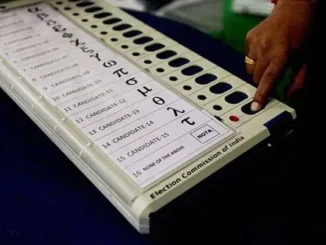
    Therefore, the Supreme Court’s query to the Election Commission on adding VVPAT to every EVM is sensible. Voter Verified Paper Audit Trail is a machine that prints a paper slip of a candidate’s name, serial number, and party’s symbol after a voter has cast their vote. It displays a paper slip for seven seconds for the voters to check if their vote is cast for the chosen candidate. The paper slip then drops down to a locked compartment, and it can be used to audit voting data in the EVMs. Whether the handpicked election commissioners by Modi Sarkar would comply with the public sentiment on this issue will be critical in saving democracy for India and its future generations.

    (The author is a former Chief Technology Officer at the United Nations. He is Vice Chair of Indian Overseas Congress. He can be reached at gta777@gmail.com)

  • Madrasa demolition sparks violence in Uttarakhand’s Haldwani, 6 dead

    Madrasa demolition sparks violence in Uttarakhand’s Haldwani, 6 dead

    Haldwani/New Delhi (TIP)- Six “rioters” were killed in violence that broke out over the demolition of an illegally built madrasa, officials said as curfew remained enforced in Uttarakhand’s Haldwani town.
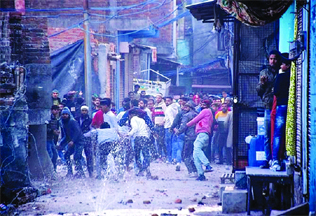
    More than 60 persons were hurt on Thursday, Feb 8, as local residents hurled stones and petrol bombs at municipal workers and the police, forcing many police personnel to seek refuge in a police station which the mob then set on fire.
    Chief Minister Pushkar Singh Dhami visited Haldwani, meeting some of the injured. He termed the violence a “planned attack”, and said the stockpiling of arms, stones and petrol bombs suggested this.
    “Women police personnel were brutally thrashed. They even tried to throw a journalist into the flames… Every rioter involved in arson and stone pelting would be identified and strictest action taken against them,” Dhami.
    Altogether, six “rioters” were killed, SP (City) Harbans Singh said. Three others were said to be in a critical condition.
    A day after the clashes, with curfew in force since 9 pm on Thursday, Haldwani’s Banbhoolpura area looked deserted. Stones were strewn on the streets and there were charred remains of torched vehicles.
    On Friday, 9, Feno further incident of violence was reported from the locality where the madrasa – which included a “structure” where prayers were held.
    Over 1,000 police personnel remained deployed in the town, close to Nainital, officials said. The demolished structures were on government land, and municipal workers and police acted after court orders, they said.
    The officials said stones were thrown at them from rooftops, where they appeared to have been stocked. Some of the alleged rioters killed in the violence had gunshot wounds.
    Curfew has been lifted from outer areas of violence-hit Haldwani in Uttarakhand, after tension prevailed in the town following the demolition of an “illegally built” madrasa and an adjoining mosque. However, curfew remains in force in Banbhoolpura area.

  • The narrative of development and populism

    The narrative of development and populism

    An easy way to make development an appealing proposition for voters is to define it narrowly in terms of visible physical infrastructure

    “Equating development to visible mega-infrastructure could, over time, become a dangerous obsession for two reasons. First, the suitability of such projects for the specific geographic location or users is often overstated without realistically assessing long-term environmental consequences and its implications on the livelihoods of present and future generations. Second, the mechanisms of financing mega-infrastructure are often on the assumption of exaggerated revenue accruals from multiplier effects and flattened costs without any time and cost over-run. The fiscal burden of such financing modes would start surfacing in the medium term, and addressing it imposes additional costs.”

    By M  Suresh Babu

    On September 14, the Prime Minister laid the foundation stone of projects worth over ₹50,700 crore in the election-bound State of Madhya Pradesh. This included a petrochemical complex and 10 new industrial projects. He emphasized that this investment would boost the State’s development. Just a few days later, on September 18, a major Opposition party announced “guarantees” for the people of Telangana ahead of the Assembly elections. These include ₹2,500 a month financial assistance to women, gas cylinders at ₹500, free travel for women in State transport buses, schemes promising an annual financial assistance of ₹15,000 for farmers, a housing scheme with a piece of land and ₹5 lakh for construction of house for homeless poor, 200 units of free electricity to each poor household, health insurance cover of up to ₹10 lakh and ₹5 lakh financial assistance to students from a poor background to pursue higher education. Both these announcements in conjunction show that ‘development and populism’ gain wide circulation before elections and that these two are pitched as poll promises with a call to evaluate the gains emanating with respect to short-term versus long-term benefits. The most common narrative is that development is the long-term ideal and populism is dubbed as myopic, with development-retarding effects.

    The development obsession

    There are no two arguments on the need to achieve higher and better development outcomes. However, there exists a need to assess its trajectory and inclusivity to understand the implications for welfare and sustainability. While the need for accelerated development is sold easily as a poll promise, the need to take stock and address unevenness in welfare gains is neither mentioned nor taken up in the post-poll time period. An easy route to make development as an appealing proposition for voters is to define it narrowly in terms of visible physical infrastructure. The advantage of such a narrow definition is that it can be easily showcased and achievements can be quantified. This in turn would give an advantage to the incumbent governments if the scale of physical infrastructure creation is high. The opposing political parties would then be left with three options: promise an even higher scale of infrastructure creation if voted to power; highlight the unsuitability of the created infrastructure and dub it as failure, and/or address welfare of some section of the population that is left out through economic populism.

    Equating development to visible mega-infrastructure could, over time, become a dangerous obsession for two reasons. First, the suitability of such projects for the specific geographic location or users is often overstated without realistically assessing long-term environmental consequences and its implications on the livelihoods of present and future generations. Second, the mechanisms of financing mega-infrastructure are often on the assumption of exaggerated revenue accruals from multiplier effects and flattened costs without any time and cost over-run. The fiscal burden of such financing modes would start surfacing in the medium term, and addressing it imposes additional costs. Two examples would clarify the above. First, during the period June 24 to July 10, 2023, over 41 landslides, 29 flash floods, and one cloud burst occurred in Himachal Pradesh amid relentless rain. One could call these as events of ‘climate crises’. But Himachal Pradesh is an active participant in the race to ‘development’ through the construction of several highway roads connecting various tourist locations, thereby making the mountain regions fragile and unleashing unplanned urbanization.

    Uttarakhand faced a big disaster in 2013. Rather than learning from it, the government went on to ‘rebuild’ the State, which was a rebranding of the State with many highway projects. The ‘Char Dham Yatra’ is hyped as road connectivity that brings millions of people as religious tourists despite the fact that most places have infrastructure for only a few thousand people. These are two of the many recent examples of projecting mega-infrastructure as development symbols, resulting in environmental disasters. The costs of such disasters are not one-time as the easy route of development selected by the policy regimes sets off a spiral of calamities. Second, to assess the fiscal burden, the story of the National Highways Authority of India (NHAI), the apex body for the construction and management of national highways in the country, is revealing. The total debt of the NHAI stood at ₹3,42,801 crore as on March, 2023, up from ₹23,797 crore in 2014. The bulk of the debt, i.e., ₹3.27 trillion, was contracted between 2017-18 and 2021-22. The NHAI’s debt servicing cost will cross ₹50,000 crore in FY28 as the money was raised through bonds in 112 tranches; the last of those will mature in 2050. Apart from debt, the NHAI also has contingent liabilities, most of which are from disputed claims that have been filed by contractors and developers. The fiscal implications of financing development lingers in the system, imposing long-term constraints. These two examples given above highlight the perils of the obsession of symbolizing mega- infrastructure as icons of development.

    Space for populism

    Populism has two dimensions — political and economic. According to Dani Rodrik, noted political economist of Harvard University, “The distinctive trait of populism is that it claims to represent and speak for ‘the people,’ which is assumed to be unified by a common interest. This common interest, the ‘popular will,’ is in turn set against the ‘enemies of the people’ — minorities and foreigners (in the case of right-wing populists) or financial elites (in the case of left-wing populists). Since they claim to represent ‘the people’ at large, populists abhor restraints on the political executive. They see limits on their exercise of power as necessarily undermining the popular will.” This is the hallmark of political populism which allows the majority to ride over the rights of the minorities. Economic populists too disfavor restraints on the conduct of economic policy, as restraints, in general, narrow their policy options. However, the economic policy environment tends to prefer rules and restraints because short-term interests might dominate when economic policy is largely shaped by political considerations. Rules and restraints serve the purpose of checking those in power from pursuing short-sighted policies. But unwavering commitment to rules and restraints may at times serve to advance the interests of narrower groups, enabling them to cement their temporary advantage for reaping long-term benefits. Thus, it emerges that while rules and restraints are vital in checking unbridled growth of political populism, a fine blend of rules with discretion is required to curtail the expansion of economic populism.

    On conventional models

    Conventional models of economic growth did not attach much importance to distribution as it was expected to be an inbuilt consequence of growth. These models assumed that the benefits of growth would percolate through the ‘trickle-down effect’, that is, growth is characterized as a ‘high tide that lifts all boats’. In this scheme of things, populist re-distributive policies do not find a place. However, cross-country growth experience shows that the benefits of growth do not trickle down that easily and some sections of the population become ‘outliers’ in the growth process. Government-led redistribution is needed to reduce the size of such outliers and spread the benefits of growth more evenly. The rationale for economic populism arises in this context.

    While economic populism imposes fiscal costs, inappropriate physical infrastructure-led development imposes additional costs, especially environmental costs. These costs might work as a binding constraint on subsequent governments. Poor resilience coupled with an injection of fragility to the environment results in a situation of costs of such ‘infrastructure led development’ remaining in the system for long. In contrast to narrowly defined and prominently visible megaprojects-led development, not all economic populism hurts. At times it might be the only way to forestall the dangerous obsession with physical infrastructure-led development.

    (The author is Professor of Economics at IIT Madras) 

  • Summer break in Uttarakhand

    Summer break in Uttarakhand

    If you are still looking for a break this summer, head to Dehradun, and check out a few options in the vicinity.
    Dehradun
    Like in our case, several hikers and holidaymakers tend to use Dehradun as the starting or transit point to explore spots that are located in the vicinity — either by self-drive or by hiring cabs here. Nestled in a valley, and once considered a quiet place to retire in, the city has witnessed unprecedented growth in the Past few years. Should you visit, be prepared for unending traffic jams, roads under construction and attractions that are teeming with people. Also, gone are the days of cooler climes.
    Summers now mean unbearable heat. But, interspersed around the city are points that are worth checking out. We recommend visiting the informative Forest Research Institute or the local Buddha Temple. Those interested in a mix of adventure and nature could head to Sahastradhara.
    Must-visit
    Head to Robber’s Cave to soak your feet in the waters of a flowing stream, while munching on chowmein or ice cream.
    Haridwar
    Distance from Dehradun: 52km (approximately)
    Good for a day trip, this temple town needs no introduction. Photographers and tourists — local and international — are known to gather every evening in the thousands at the Har Ki Pauri ghat for the renowned Ganga aarti. A walk down the many bylanes leading to the ghats can offer enriching insights into the history of the city, thought to be one of the oldest in the world. Spend some time visiting the many temples in the area, head to the Bara Bazaar to shop, or indulge in some Aloo Puri with Halwa at Mohan Ji Puri Wale.
    Must-visit
    Prakash Lok, which is located near Har Ki Pauri, is renowned for its creamy lassi.
    Rishikesh
    Distance from Dehradun: 45km (approximately)
    Head to the unofficial ‘yoga capital of the world’ that is usually packed with spiritual seekers looking to spend some time at one of the many ashrams or meditation centres that dot this town. But they aren’t the only tourists you will spot here. You are also likely to come across backpackers, who use Rishikesh as a gateway to the many treks that one can undertake in the region.
    The mighty Ganga is a force to reckon with here, and attracts adrenaline junkies looking to indulge in some white-water rafting at camping sites that have cropped up at Shivpuri, which is located upstream. Visit the Lakshman Jhula, spend some time at the Maharishi Mahesh Yogi Ashram, where the Beatles once stayed, or learn more about rudraksh beads from the local shopkeepers.
    Stay: At one of the ashrams.
    Must-visit
    The 13-storey temple on the banks of the Lakshman Jhula.
    Mussoorie
    Distance from Dehradun: 37km (approximately)
    A short drive away from Dehradun, making it ideal for a day trip, the famed hill station provides a welcome relief from the heat in the summer months. But avoid making the trip during long weekends or public holidays, when the car build-up to the place can put traffic jams on the Mumbai-Pune Expressway to shame.
    Once there, make your way to Gun Hill — which is accessible by a cable car — for views of the Doon Valley, take a walk down the Mall Road (the staple main road of most hill stations in India) to visit Gandhi Chowk or Kulri Bazaar, spend time watching a piranha at the Jawahar Aquarium, head to the beautiful Kempty Falls, or try the momos with spicy Schezwan sauce available at every nook and corner of Mussoorie.
    Must-visit
    One of the many Maggi Points on the way to Mussoorie, or Howard, the revolving restaurant, in the main market.
    Dhanaulti
    Distance from Dehradun: 59km (approximately)
    Another quick getaway, Dhanaulti offers solitude to those looking to escape the fast life. There isn’t much to do over here, except breathe fresh air, enjoy the greenery and the scenery, and enjoy some chowmein or pakoras at the local stalls or restaurants. But, should you do decide to check the place out, head to the Eco Park or Adventure Park for some relaxation.
    Must-visit
    Surkhanada Devi Temple. Reaching here involves a bit of a trek, but the devout and nature lovers are likely to find the hike well worth it.
    Chakrata
    Distance from Dehradun: 95km (approximately)
    The roads to Chakrata are bumpy, and there’s a chance of a landslide or cloudburst (we experienced one and just about managed to survive to tell the tale). But the destination is worth the journey. Surrounded by evergreen deodar trees and offering panoramic views of the Himalayan mountain ranges in the vicinity, this hill station looks like something straight out of a postcard. Do visit the tiny Chakrata market to snag a good deal on the Chakrata Ka Special Rajma (grown locally), spend some time visiting the Tiger Falls, or just relax in your room to watch the sun rise and set behind the imposing snow-capped mountains.
    Must-visit
    Deoban is a picturesque spot that is located about 16km from Chakrata. A 15-minute walk through the dense deodar forest leads you to Vyas Shikhar, where Vyasa apparently penned the Mahabharata.

  • ISRO report shows entire Joshimath may sink; town sank by 5.4 cm in last 12 days

    ISRO report shows entire Joshimath may sink; town sank by 5.4 cm in last 12 days

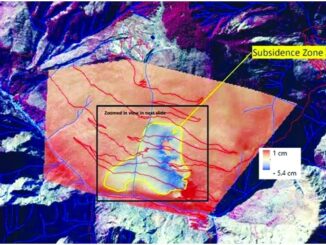
    Dehradun (TIP)- The National Remote Sensing Centre (NRSC) of the Indian Space Research Organisation (ISRO) has released satellite images of Joshimath and a preliminary report on land subsidence which shows that the entire town may sink. The pictures are taken from the Cartosat-2S satellite.

    Hyderabad-based NRSC has released the satellite images of areas that are sinking.

    In images, the entire town, including the Army’s helipad and the Narasimha temple, has been marked as sensitive zone.

    On the basis of ISRO’s preliminary report, Uttarakhand government is conducting rescue operation in danger-prone areas and the people in these areas are being shifted to safer places on priority.

    According to the report, the land subsidence was slow between April and November 2022, during which Joshimath had sunk by 8.9 cm. But between December 27, 2022 and January 8, 2023, the intensity of land subsidence increased and the town sank by 5.4 cm in these 12 days.

    The satellite images show that the Joshimath-Auli road is also going to collapse due to the land subsidence. Although scientists are still studying the cracks that appeared in the houses and roads after the land subsidence in the town, the findings in the primary report of ISRO are frightening.

    Joshimath has been declared a land-subsidence zone by the Chamoli district administration after hundred of houses developed cracks within a few days and families had to be relocated as their residences have been identified as dangerous. While the government has announced an interim relief package of Rs 1.5 lakh and working on a rehabilitation package, the demolition of two hotels began on Thursday, January 12,  but was again halted because of bad weather. The mechanical demolition was earlier stalled for a few days because of the protest of the locals and residents.

    Only hotel Malari Inn and Mount View Hotel will be demolished as their existence is dangerous for the surrounding structures, the administration said assuring that no other houses will be demolished as of now. Several expert teams have been roped in to analyse the sinking of Joshimath, while tunnelling work for NTPC hydel project is being blamed by the experts. NTPC, however, issued a statement and claimed that their tunnel is not passing under Joshimath.

  • Joshimaths in the making:  Save Karnaprayag, McLeodganj before it’s too late

    Rampant construction activity in callous disregard for the red flags and warnings flashed by geologists ever since land sinking was first noticed 50 years ago in Uttarakhand’s strategically located, ecologically fragile and landslide-sensitive zone in which Joshimath is located has come at a great cost. It has claimed a large part of the town, causing irreversible damage. Even as the authorities are trying to prevent an ominous human tragedy by evacuating the affected residents to safety, cracks have appeared in some houses at Karnaprayag, another municipality of Chamoli district, triggering fears of land subsidence there too.

    Meanwhile, the unfolding Uttarakhand disaster — sadly a manmade and preventable one — has put the spotlight on a similar hazardous situation prevailing at McLeodganj in the neighboring Himachal Pradesh. The alarm bells are ringing loud as attention is directed towards the increasing occurrences of landslides, sinking of the main McLeodganj-Dharamsala road, the recent cave-in of a market and the yet-to-be-rectified drainage system. Urgent heed must be paid to these warning signs to avoid another Joshimath.

    The Joshimath land subsidence underscores the imperativeness of preventive measures. Nature must be respected; it is only in its protection and sustainability that humans can survive. If the balance is tilted in favor of ‘development’ and ‘progress’, things cannot last for long. Hundreds of houses, hotels and roads are to be razed in Joshimath due to its foundational land subsiding and becoming incapable of carrying the weight of the buildings that have proliferated there. Declared as an unsafe zone, it will deprive around 30,000 people living in nearly 700 houses, identified as dangerous so far, of the emotional security of having a home. The government authorities are conducting a massive rescue and relief operation as the affected families are being shifted to temporary relief camps and compensated for their loss. But can there ever be enough recompense for people suffering that sinking feeling one gets when one is rendered homeless? The only way out is learning a lesson and preventing more such tragedies.

    (Tribune, India)

  • Law ministry approves increase of poll expenditure by candidates

    New Delhi (TIP)-The Union ministry of law and justice on Thursday, Jan 6,  approved raising the election expenditure ceiling by a candidate to a maximum of Rs 95 lakh in Parliamentary elections and Rs 40 lakhs in assembly elections, increasing them from the earlier limits of Rs 77 lakh and Rs 30.8 lakh.

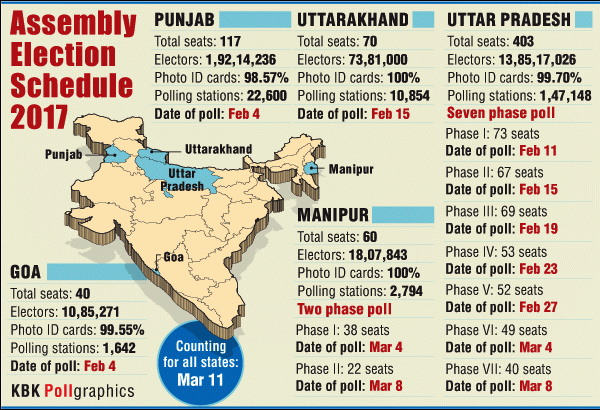
    The increase comes at a time when five states are headed for assembly polls — Uttar Pradesh, Punjab, Uttarakhand, Manipur and Goa — even as a sharply rising third wave of Covid-19 cases has raised the clamour for political rallies to be conducted virtually to avoid the spread of the infection.

    The increased budget is meant to facilitate this shift, officials familiar with the matter said on condition of anonymity.

    “In exercise of the powers conferred by subsection (3) of Section 77 read with Section 169 of the Representation of the People Act, 1951 (43 of 1951), the central government, after consulting the Election Commission of India, hereby makes the following rules further to amend the Conduct of Elections Rules, 1961, namely, the government said in a gazette notification. These rules may be called the Conduct of Elections (Amendment) Rules, 2022. (2) They shall come into force on the date of their publication in the Official Gazette,” the gazette notification said.

    In 2020, the government approved a 10% raise in the poll expenditure cap ahead of the Bihar elections to allow candidates to spend on virtual campaigning amid the pandemic. The ceiling for parliamentary constituencies was at the time raised to Rs 77 lakh, from the 2014 limit of Rs 70 lakh, and assembly polls to Rs 30.8 lakhs from Rs 28 lakh in larger states. With the revision, candidates in Uttar Pradesh, Uttarakhand and Punjab — classified among large states — will therefore be able to spend Rs 40 lakh in the upcoming polls, while those in Goa and Manipur — classified as small states — will have to adhere to a limit of Rs 28 lakh.

    The increase was cleared on the recommendation by the Election Commission, the official cited above said.

    According to EC officials, there were three considerations which officials had while recommending raising limit. “Number of electors has gone up significantly, inflation index has also gone up,” a second official said.

    The Commission anticipates virtual campaigning to also increase costs. ‘They will need to out up big screens in various places so a budget for that had to be factored in,’’ the official added, saying that this was part of the reforms that the poll panel has been pushing for. The Commission had come under the scanner in April this year as polls continued amid the peak of the second wave of the pandemic. The Madras High Court went as far as to say that EC officials were culpable for murder for conducting polls.

    Candidate expenditure includes the money spent by them on polling events, rallies, posters and other paraphernalia. The same, however, can also be borne by the political party the candidate is affiliated to.      Source HT

  • Disasters that rocked India

    Disasters that rocked India

    While India was already battling with the COVID-19 pandemic this year, climate change-induced natural disasters like floods, cyclones have also been making lives miserable for people in India and sometimes even life-threatening. A flashback at the natural disasters that hit different parts of India this year.

    Tamil Nadu floods

    The Indian Meteorological Department (IMD) had predicted heavy rainfall in parts of Tamil Nadu, and it came true from November 1. The flooding was caused by extremely heavy downpours, killing at least 41 people.

    Several red alerts were issued for many areas in Tamil Nadu, including Cuddalore, Sivaganga, Ramanathapuram, Karaikal, Tiruvallur, Chennai, Kanchipuram, Chengalpattu, Viluppuram, and Tiruvannamalai for November 10-11. Over 11,000 were displaced due to the incessant rainfall.

    Maharashtra floods

    Starting on 22 July, Maharashtra saw heavy rainfall in many of its western districts and recorded the highest rainfall in the month of July in 40 years.

    Around 251 people died and over 100 were missing due to floods and landslides in Maharashtra.

    Its neighbouring state Goa also witnessed the worst floods in decades.

    Kerala floods

    Between October 12 and 20, after heavy rains caused rivers to overflow, cutting off towns and villages, 42 people died and 217 houses were destroyed. Out of the 42 people who lost their lives in the floods, five were children.

    Kottayam and Idukki were two of the worst affected districts in the state, where days of heavy rainfall had caused deadly landslides.

    Cyclone Tauktae

    It was a powerful, deadly and damaging tropical cyclone in the Arabian Sea that became the strongest tropical cyclone to make landfall in the Indian state of Gujarat since the 1998 Gujarat cyclone and one of the strongest tropical cyclones to ever affect the west coast of India.

    Started on May 14, the storm displaced over 200,000 people in Gujarat and killed 174 people with 80 people still missing.

    Tauktae brought heavy rainfall and flash floods to areas along the coast of Kerala and Lakshadweep. There were reports of heavy rain in the states of Goa, Karnataka and Maharashtra as well.

    Cyclone Yaas

    It was a relatively strong and very damaging tropical cyclone that made landfall in Odisha and brought significant impact to West Bengal in May. Yaas formed from a tropical disturbance that the Indian Meteorological Department first monitored on May 23.

    Around 20 people across India and Bangladesh died due to the cyclone and West Bengal was one of the most impacted states in India due to Yaas, with a loss of approximately $2.76 billion, according to several media reports.

    Cyclone Gulab

    The third storm in India that impacted eastern India, was formed on September 24 in Bay of Bengal. On September 26, Gulab made landfall in India’s Andhra Pradesh, but weakened over land. The storm overall brought heavy rains and strong winds throughout India and the Middle East, killing at least 39 people.

    Over 30,000 individuals were evacuated into safety as a result of the cyclone. This number further increased to 46,075 people as the storm further moved inland.

    Assam earthquake

    On April 28, a 6.4 magnitude earthquake jolted Assam. The quake resulted in two fatalities and at least 12 people were injured. The quake struck at a depth of 34 kilometres and 140 kilometres north of Guwahati.

    The earthquake occurred as a result of oblique-slip faulting at a shallow depth just at the foothills of the Himalayas. Analysis by India’s National Centre for Seismology revealed that the earthquake involved a slip along the Kopili Fault, near the Main Frontal Thrust.

    Uttarakhand floods

    At least 54 people died in various incidents triggered by heavy rains and subsequent flash floods in Uttarakhand in October this year.

    Melting glaciers

    In February, a ferocious flash flood hurtled down a remote Himalayan valley, sweeping away homes, a hydro plant and around 200 people. Only 60 bodies have been found.

    The flash floods in Uttarakhand was due to the collapse of a hanging glacier, initial observations by scientists at the Wadia Institute of Himalayan Geology suggests. A hanging glacier is a body of ice that breaks off abruptly at the edge of a precipice or steep slope.

    Experts believe the cause was a massive chunk of a glacier — 15 football fields long and five across — breaking off high in the mountains.

    In the Himalayas, about 10,000 glaciers are receding at a rate of 30 to 60 metres (100 to 200 feet) per decade as global temperatures rise. In 2013, a flash flood in the same area killed 6,000 people.

  • Sanyukta Kisan Morcha suspends protest aftergovt agrees to most of their demands

    Sanyukta Kisan Morcha suspends protest aftergovt agrees to most of their demands

    Experts call agitation ‘enriching of democracy’, but also term victory as one ‘forced due to political compulsions’

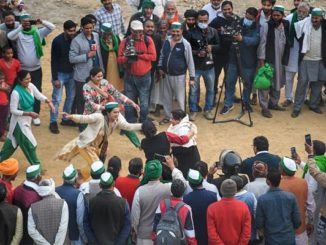
    NEW DELHI (TIP): As the leaders of the Samyukta Kisan Morcha on Thursday, December 9, formally announced the ending of their year-long agitation at the Delhi borders in the backdrop of now-repealed farm laws and the Centre’s outreach, according to some agriculture experts the story may be far from over yet. They called the farmers’ victory “reclaiming of democracy” and one that exposed “inability/limitations of RSS-BJP strategy/instrument to counter agitation/movement without any religious tinge”. However, it was also one resulting from “pure political compulsions of the ruling BJP”, they said. “Yes, it is a glorious victory, but forced due to UP/Punjab/Uttarakhand elections. The Narendra Modi Government conceded to farmers’ demands because of the fear of losing in 2022 Assembly elections,” said agriculture expert from Western UP Sudhir Panwar, who is also associated with the Samajwadi Party.

    “The compelling reasons for repeal was possibility of novel political alliance in Punjab and the growing support of farmers for political alliance of Akhilesh Yadav and Jayant Chaudhary (in Western UP),” he added.

    Also pointing to the words used by the Prime Minister while announcing the decision to rollback, Panwar called it a “clear indication of future”. “The PM said he felt sorry over his failure in convincing a small number of farmers of the benefits of new agriculture laws. It was not an apology on the manner of implementation and implications of laws. In future the BJP government can always claim that farmers are now convinced on benefits of repealed laws,” he said.

    Amid speculations of divisions among farmer groups, it seems BKU leader Rakesh Tikait, who infused life into the agitation with his emotional outbreak after the January-26 Republic Day violence, was not in favor of ending the agitation till the time there was a legal guarantee of Minimum Support Price.

    Panwar also said “farmers were divided”. While repeal was the main demand of those from Haryana and Punjab, for the rest of the country it was the legal guarantee of the MSP. “Rakesh Tikait was not as happy as farmer leaders of Punjab and Haryana. It also shows the dominant role of farmers from Punjab and Haryana in the agitation and subsidiary role of those from other regions,” he said. While there was “no real gain for farmers even after year-long agitation as issue related with electricity, burning of agriculture waste and legal guarantee of MSP handed over to committee”, the successful agitation exposed the inability/limitations of RSS-BJP strategy/instrument to counter agitation/movement without giving religious hues, Panwar said. “The BJP used all known strategies such as calling farmers anti-national, Khalistani, secessionist, anti-Hindu, etc. January 26 incidents were used to malign the image of farmer leaders and their organizations. The success of the agitation was clear records of its leaders and sustained food supply and shelters at agitation sites,” he said.

    (With inputs from Tribune, India)

  • India in history this Week-November 5 to November 11, 2021

    India in history this Week-November 5 to November 11, 2021

    05 NOVEMBER

    1556       In the second battle of Panipat, the Mughal ruler Akbar defeated Hemu.

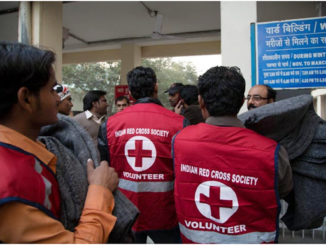
    1920       Indian Red Cross Society was established.

    1961       India’s first Prime Minister Jawaharlal Nehru visited New York.

    2001       India and Russia rejected the Taliban’s participation in the Afghan government.

    1870       The great freedom fighter Chittaranjan Das was born.

    06 NOVEMBER

    1763       The British army defeated Meerkasim and captured Patna.

    1913       Mahatma Gandhi led ‘The Great March’ against apartheid policies in South Africa.

    1998       India’s proposal for ceasefire in Siachen rejected by Pakistan

    1943       During the Second World War, Japan handed over Netaji Subhash Chandra Bose to the Andaman and Nicobar Islands.

    1962       National Defense Council was established.

    2000       Jyoti Basu stepped down after being Chief Minister of West Bengal for 23 consecutive years.

    07 NOVEMBER

    1858       Bipin Chandra Pal, the great revolutionary who fought against the British, was born on 7 November.

    1862       Bahadur Shah II, the last ruler of the Mughal Sultanate, died in Rangoon.

    1876       Bankim Chandra Chattopadhyay composed the song Vande Mataram in a village called Kantal Pada in Bengal.

    1888       Renowned scientist Chandrashekhar Venkata Raman was born.

    2006       India and ASEAN agreed to create a fund for the development of science and technology.

    2008       The famous poet Rahman Rahi of Kashmir was conferred with the Jnanpith Award.

    1711       The ship of the Dutch East India Company sank all of the 300 crew.

    1978       Indira Gandhi was re-elected to the Indian Parliament.

    08 NOVEMBER

    1661       Sikh religious teacher Har Rai died.

    2008       India’s first unmanned space mission Chandrayaan-1 reached the lunar orbit.

    2016       Prime Minister Narendra Modi announced demonetisation and 500,1000 notes were discontinued. After that, new 2000 notes were issued.

    1999       Rahul Dravid and Sachin Tendulkar set a world record by sharing 331 runs in a one-day cricket match.

    2005       Criticized the terrorist actions of Palestinian organizations in India and the repression of Israel.

    1627       The Mughal ruler Jahangir died.

    1920       India’s famous Kathak dancer Sitara Devi was born.

    09 NOVEMBER

    1236       The Mughal ruler Ruknuddin Firoz Shah was assassinated.

    1270       The great saint Namdev was born.

    1947       Junagadh state merged into India.

    1960       First Indian Air Force Chief Subroto Mukherjee died.

    2000       Uttarakhand was carved out of Uttar Pradesh and made a new state.

    10 NOVEMBER

    2001       Indian Prime Minister Atal Bihari Vajpayee addressed the United Nations General Assembly.

    2013       The famous Rajasthani language litterateur Vijaydan Detha passed away.

    1978       Rohini Khandilkar became the first woman to win the National Chess Championship.

    2008       India won the Border-Gavaskar Trophy by defeating Australia 2–0.

    2008       Giving strategic depth to India-Qatar relations, the two countries signed the Defense and Security Agreement.

    11 NOVEMBER

    1888       Freedom fighter Maulana Abul Kalam Azad was born in Saudi Arabia.

    1973       The first international postage exhibition started in New Delhi.

    1889       Freedom fighter Jamnalal Bajaj was born in 1889.

    1943       Indian nuclear scientist Anil Kakodkar was born in 1943.

  • Call off kanwar yatra, or we will, SC tells UP

    Call off kanwar yatra, or we will, SC tells UP

    New Delhi (TIP): The Supreme Court on Friday, July 16,  observed that “the Uttar Pradesh government cannot go ahead with the kanwar yatra – 100%”, asking the state to either withdraw the decision to allow the religious pilgrimage “in the interest of health of the citizenry of India”, or invite an order from the court. Citing widespread fears of a third wave of Covid-19, the bench of justices Rohinton F Nariman and BR Gavai gave the state government time till Monday to reconsider its decision of allowing the kanwar yatra due to “compelling religious reasons” and convey it to the court. The ultimatum effectively ends any chance of the yatra, which attracts around 30 million pilgrims from many northern and northwestern states to Haridwar in Uttarakhand, where they collect water from the Ganga (gangajal) and take it back home, on foot or on cycles. Many of the pilgrims are from Uttar Pradesh, which is keen to go ahead with the yatra despite fears that it could be a superspreader event, and despite warnings from public health officials. Uttarakhand has already cancelled the yatra and said it will not allow the entry of pilgrims. Uttar Pradesh was looking at ways to ship gangajal in tankers and then allow the pilgrims to collect it by walk or cycle. Both states go to polls early next year.

    “The UP government can’t go ahead with it – 100%…Either we order directly or we give you one final opportunity to reconsider your decision. Pandemic affects all of us. We are all the citizens of India. This suo motu (case initiated by the court on its own motion) has been taken up since Article 21 (right to life) applies to all of us. It is to safeguard each one of us,” the bench told senior counsel CS Vaidyanathan, who appeared for the UP government and agreed to return on Monday after a review of the decision. Vaidyanathan earlier informed the court that the state has decided to allow a symbolic yatra with a restricted number of kanwariyas (pilgrims) who will have to follow safety protocols. He said that the district administration will ensure that the number of permissions thus granted will be kept to a minimum. The UP government did not make any disclosure about a possible decision on Friday, but officials said they were in talks with kanwar associations, who may themselves call off the pilgrimage like last year.

    “The UP government has instructed the administration to establish a dialogue with kanwar associations so the right decision can be taken regarding the organisation of the yatra,” said a government spokesperson. “We are in talks with the kanwar sanghs and other states,” added Awanish Kumar Awasthi, additional chief secretary (home), Uttar Pradesh.

    For the Union government, solicitor general Tushar Mehta submitted that movement of kanwariyas for bringing gangajal from Haridwar must not be allowed in view of the pandemic. The Centre’s affidavit advocated a system to make gangajal available through tankers at designated locations for devotees to collect and perform rituals. Advocate Abhishek Atrey, representing the Uttarakhand government, told the court that Uttarakhand has completely banned any physical form of yatra.

    Source: HT

  • Trumping majoritarianism in the Hindi heartland

    Trumping majoritarianism in the Hindi heartland

    By Zoya Hasan
    While regional parties will continue to be significant in various States of the Union, the principal challenge of overcoming majoritarianism lies in the Hindi heartland, especially in U.P. Oppositional electoral alliances, notably the formation of a federal front, are important strategies in this battle but it is no less important to challenge the ideological foundations of the majoritarian project through progressive and inclusive politics.

    The landslide victory of the All India Trinamool Congress in the West Bengal Assembly elections and the pushback of the Bharatiya Janata Party (BJP) in West Bengal, Tamil Nadu and Kerala have given rise to a pervasive belief that right-wing politics can be defeated by regional assertions. Undoubtedly, regional and cultural assertion in these States acted as an effective bulwark against the BJP’s expansionary plans in southern and eastern India. The regional-cultural tropes deployed by Mamata Banerjee, for example, worked so well that at one point, Home Minister and BJP leader Amit Shah was even forced to clarify that if the BJP is elected, someone from Bengal would be the Chief Minister. This underlines the effectiveness of regional culture and politics in trumping communal politics. However, this claim needs to be tempered by the realism that it cannot work in the Hindi heartland, which is dominated by caste and communal politics, and has so far not seen any serious ideological and political challenge to politics based on these identities.

    Encompassing nine States whose official language is Hindi, namely Bihar, Chhattisgarh, Haryana, Himachal Pradesh, Jharkhand, Madhya Pradesh, Rajasthan, Uttar Pradesh (U.P.) and Uttarakhand, this region retains a central position in the electoral strategies of the BJP and its larger political imagination. The party’s stunning show in these States propelled it to power in the 2014 and 2019 parliamentary elections. Its continued political dominance in the heartland will neutralize its losses now as well as in future in States where it has been bested by regional players. I will focus here on U.P. to illustrate the limits of the regional assertion.

    Dimensions in the heartland

    The Hindi heartland is clearly different. There are at least four important dimensions of this difference. First is the absence of regional identity in States such as U.P. This is evident from the debate on States reorganization and the reorganization of Uttar Pradesh in the 1950s. The compulsions of nation-oriented identity emerged very clearly from the discussions in the States Reorganization Commission on suggestions for the division of U.P. for administrative convenience. U.P. leaders argued for a large and powerful State in the Gangetic valley as a guarantee of India’s unity.

    In this sense, U.P. was considered the backbone of India and the centerpiece of political identity in modern India. Importantly, it was supposed to provide the chief bulwark against growing regionalization and fragmentation elsewhere. Instilling a sense of regional pride, an essential part of Congress strategy in southern and coastal India, was not followed in U.P. U.P. was seen as the political heartland in contrast to Punjab and Bengal for instance, which were splintered and incorporated into two different nation states. As is well known, the bases of this post-colonial identity varied from its location in the freedom struggle to staking claim as the cultural homeland of Hindi and Hinduism. In both cases, it was centered in the idiom of the nation-state and strong central authority.

    Second, although U.P.’s cultural homogeneity remains a matter of disagreement, the idea of the heartland had great resonance among the political elite who opposed the demand for U.P.’s reorganization. The long-standing traditions of composite cultural identity and shared plural cultures began to yield place to a singular homogenized identity. The Hindi-Urdu divide, which mirrored the communal cleavage of U.P. society, played a crucial role in this process. Urdu was excluded as it was seen to symbolize Muslim cultural identity in independent India, while Hindi was boosted to promote the development of a Hindi-Hindu heritage for this region. The project of homogenization of Indian/U.P. culture as Hindu culture was quickened in later decades. Even though it would be hard to assume a direct link between Hindi dominance and communal politics of subsequent decades, it is nevertheless a fact that all political parties in the State used it as an ingredient of social and cultural differentiation and a means to consolidate political dominance.

    Role of communal politics

    Third, it is clear that communal politics and communal movements have played a key role in U.P.’s modern history which in turn have diluted other identities.

    In some respects, this process gained momentum in the wake of Partition which cast its long shadow upon political institutions and culture in U.P. and to a great extent affected the perspectives of Hindus and Muslims alike. Hindu nationalism was marginalized within the Congress party but many of its ideas were accepted in framing party policies. The State leadership was instrumental in forging a conservative consensus in the State under Chief Minister G.B. Pant who steered the affairs of the state for eight years after Independence.

    The intensification of communal politics took a new turn with the mass mobilization for the construction of a Ram temple at Ayodhya which was deftly used by the Hindu right to establish a major presence in U.P. and to facilitate the political reconstruction of U.P. through the promotion of a collective Hindu identity. The crusade for the appropriation of disputed shrines is central to the communalization of politics and short circuiting the more complex process of political expansion for the BJP.

    Importantly, this has laid the groundwork for building permanent electoral majorities through the deployment of ascriptive symbols in U.P. which, given its huge size, helps it to establish a strong base in the Hindi heartland to offset the appeal of countervailing identities elsewhere in India.

    Caste politics too

    Finally, caste politics which was expected to counter Hindutva expansion has failed to do so; in fact, caste politics has become a building block for the BJP’s expansion. The party has reached out to Dalits, actively mobilizing them and other backward castes to assimilate them into the Hindutva meta-narrative. Instead of erasing caste from electoral politics, the BJP-Rastriya Swayamsevak Sangh has sought to court fragments of castes as a way of undermining broad-based political movements and opposition to it. It has used the wider appeal of Hindu nationalism to co-opt backward castes and Dalits who are keen to align themselves to the larger narrative of Hindu nationalism.

    A reset is needed

    While regional parties will continue to be significant in various States of the Union, the principal challenge of overcoming majoritarianism lies in the Hindi heartland, especially in U.P. Oppositional electoral alliances, notably the formation of a federal front, are important strategies in this battle but it is no less important to challenge the ideological foundations of the majoritarian project through progressive and inclusive politics. This requires a reset of the basic political mindset in U.P. which can only be done by reviving the splendid heritage of the national movement in which this region played a central role and in which Gandhiji and Nehru played a heroic part. Invoking the spirit of the Bhakti movement which was the first major challenge to the religious orthodoxy of Hinduism would also help in resetting the cultural clock. This must, however, combine with much greater concern for the fundamental social and economic issues of the State, and making the struggle between communal and secular forces the central issue through public campaigns that address the problems of religious traditionalism and the cultural underpinning that this provides to the push to make India a Hindu state.

    (Zoya Hasan is Professor Emerita, Jawaharlal Nehru University)

  • Nelong Valley – The Ladakh of Uttarakhand

    Nelong Valley – The Ladakh of Uttarakhand

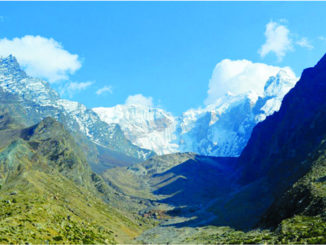
    The much talked about Nelong Valley was finally opened for the tourist in 2015 and since then it has become one of the hot spots for the adventure buffs. It bears a striking resemblance to Ladakh and features high peaks having a similar climate and landscape to that of Lahaul, Spiti Valley, and Ladakh. The cold deserted mountain area of Nelong valley looks like a replica of Tibet in terms of its geography. Since this valley falls under the Gangotri National Park, the travelers are not allowed to have an overnight stay, within the 25 km area between Bhairavghati and Nelong.

    Location of Nelong Valley

    Beautiful Nelong valley is located in the Uttarkashi district within the Gangotri National Park which is 23 km from Bhaironghati. The place is recognized as a cold desert with lush green backdrop, scarce vegetation as well as wildlife. The region is an abode to infrequent and indefinable Snow Leopard and also offers many stunning Himalayan landscapes to make your trip to Nelong valley memorable. This amazing valley is also a segment of grueling Sino Indian trade route with hand built wooden bridge which is still there from early days. This mesmerizing valley is situated at an altitude of about 11000 feet above sea level. It comes under the Gangotri National Park in Uttarkashi and is approximately 315 kilometers from Dehradun. It is just 23 kilometers from Gangotri shrine

    History

    The Word Nelong generally means the place of blue stones, and it is one of the best-unspoiled places of Uttarkashi. The beautiful Nelong valley is a cold desert like region located in Uttrakhand Himalayas close to Indo China border. During the 60s Nelong valley was a bustling trade route amid India as well as Tibet. However from the time of Indo Chinese War the region was closed for civilians as the police of both the countries were the only people who are permitted to enter it. In 2015 May government opened up the Nelong valley region for the general public.

    Best time to visit Nelong valley

    Best time to visit Nelong valley is in the months of April to June and September to October before Diwali.

    April to June- visiting Nelong Valley in summers is very much enjoyable as at this time the average temperature of the region is 25 degree Celsius. At this time snowfall also starts melting which offers amazing views of the landscape. July to September- visiting Nelong valley in monsoon is sometimes risky as there is a possibility of landslide owing to rainfall. There are many chances of road accidents, and so this is not considered as the best time to visit this place. December to March- visiting Nelong valley in winters is not comfortable enough as at this time the weather is very harsh and extreme. During these months snowfall starts and which stops the travelers and trekkers from entering the glacier area. Due to heavy rainfall during these months roads are prohibited from entering.

    How to reach

    Nelong valley welcomes visitors in the months of May till November, however owing to security reasons the place is prohibited for camping. You can reach Nelong valley from all the way through Bhairon Ghati from where you can easily hire a cab. This beautiful valley is well connected by road from Haridwar, Dehradun and Rishikesh. Every traveler should know that there is no proper accommodation and restaurants in Nelong valley. However, you can book hotels in Bhairon Ghati, Gangotri, Harsil and Dharali. However, Nelong valley do not have a flight, bus or train connectivity but is well connected with road so that you can easily hire cab or taxi or also can self drive to reach this adventurous valley.

    Reaching By Bus: The nearest bus station, which is well connected with buses to other cities is Reckong Peo Bus Stand. Harsil Bus Stand is a local bus stop with limited bus frequency.

    Reaching By Train: Nearest major railway station to reach Nelong valley is Dehradun Railway Station. There is also one local train station too but with limited railway connectivity, i.e. Harrawala Railway Station.

    Reaching By Air: Nearest major international airport to reach Nelong valley is Chandigarh Airport. There is also a small airport too with limited flight routes, i.e. Jolly Grant Airport.

    Points to remember

    Nelong valley is now open for public and is the perfect place to visit for adventure seekers and mountain lovers. This picturesque valley of Uttrakhand is a part of Gangotri National Park and is also an abode to many rare animals like snow leopard and musk deer. There are several points which you should keep in mind before planning a trip to Nelong valley:

    Nelong valley is located at a distance of about 315 km from the main city of Dehradun. First of all, you have to reach Bhairavghati which is about 100 km from Uttarkashi and then it will take a 25 km ride to reach the mesmerizing valley. Just remember that private vehicles are not permissible here; thus you have to take a forest department vehicle.

    Forest department is very much strict in terms of permission to visit Nelong valley. Only registered operators are permitted to take tourists into the valley and that too upto Nelong and beyond that you cannot go in any case.

    To enter the valley only six forest department vehicles are allowed in one day with four people each. Surely it will change in some times as government is trying up hard to promote Nelong valley tourism. Before entering you will need a permit which should be taken from the sub-divisional magistrate. You will also require a fitness certificate to enter the valley. The entry of foreigners is not allowed owing to its strategic location.

    Night stay is not permitted in the valley as you can find out accommodation options in Bhairavghati. There are numerous budget hotels which offer comfortable stay to tourist. There is also a semi-government guest house there that offers comfortable stay to its guest.

    At the time of packing for your Nelong valley trip don’t forget to pack sports shoes and woolens, alleys carry a power bank with you along with sunglasses and first aid box.

    There are many nearby attractions in Nelong valley where you can enjoy at your best. One of the best Nelong valley attractions is Padang Temple which is located at about 3500 ft and is devoted to Kaal Bhairav. Don’t miss out to seek blessings at the famous Gangotri Temple and exploring many other scenic destinations.

    You should take water, snacks and food with you as you will not find anything to eat when you are in the valley. In case you are lucky you can somehow get tea and biscuits at the camp of ITBP.

    The Nelong valley which is similar to Ladakh landscape presenting clear blue skies, deep valleys, winding roads. This tiny valley terrain is a cold desert which will relax your mind and soul for sure. Plan a trip to this beautiful destination as it is a sheer delight for adventure enthusiasts, nature lovers as well as photographers.

  • Uttarakhand glacier burst :36 dead, rescue o perations continue for 6th day at Tapovan tunnel

    Uttarakhand glacier burst :36 dead, rescue o perations continue for 6th day at Tapovan tunnel

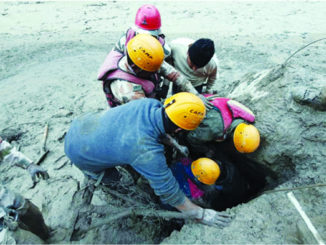
    The confirmed death toll in the Uttarakhand disaster rose to 36 with the recovery of another body in Gauchar and 169 people remain missing since Sunday, after an avalanche or a glacier break triggered a surge of water in the Alaknanda river system. The rescue operations continued at Tapovan tunnel in Chamoli district on the sixth day following the flash floods, informed the State Government on Friday.

    Drilling through the debris has become more difficult with the silt inside the tunnel drying up and getting harder.

    More than 600 Army, Indo-Tibetan Border Police (ITBP), National Disaster Response Force (NDRF), State Disaster Response Force (SDRF), and Sashastra Seema Bal (SSB) personnel are engaged in the search-and-rescue operations.

    Over 6.76 lakh Indians gave up Indian citizenship in 5 years

    Over 6.76 lakh Indians gave up Indian nationality between 2015 and 2019 and took up citizenship of other countries, Lok Sabha was informed.

    Union Minister of State for Home Nityanand Rai also said that as per information available with the Ministry of External Affairs, a total number of 1,24,99,395 Indian nationals are living in foreign countries.

    Rai said 1,41,656 Indians gave up Indian citizenship in 2015, 1,44,942 in 2016, 1,27,905 in 2017, 1,25,130 in 2018 and 1,36,441 Indians gave up Indian nationality in 2019.

  • 84.11 lakh COVID-19 cases, 1,24,985 deaths in India

    84.11 lakh COVID-19 cases, 1,24,985 deaths in India

    New Delhi (TIP): India’s COVID-19 tally crossed the 84-lakh mark after 47,638 new infections were reported in the past 24 hours, according to the Union Ministry of Health and Family Welfare’s data on Friday, November 6. The coronavirus cases in the country continue to decline further but the overall infections reached 84,11,724 including 5,20,773 active cases.

    Total cured cases reached 77,65,966 with 54,157 new discharges in the last 24 hours. Meanwhile, with 670 new deaths, the toll mounted to 1,24,985 overall.

    Maharashtra reported 1,07,358 active cases, 15,51,282 discharges and 44,804 deaths so far. While Karnataka reported 33,114 active cases, 7,94,503 discharges and 11,312 death so far due to the disease. A total of 38,729 active cases, 3,71,155 discharges and 6,769 deaths were recorded in the national capital till Thursday. According to the Indian Council of Medical Research (ICMR), a total of 11,54,29,095 samples have been tested for coronavirus till November 5, of these, 12,20,711 samples were tested yesterday. Ten State and Union Territories accounted for 78.2 per cent of total active cases in the country, according to the Health Ministry.

    80 teachers test positive for virus in Uttarakhand

    Eighty teachers tested positive for coronavirus in Uttarakhand’s Pauri district, forcing the authorities to shut over a dozen schools for five days, according to an official.

    Schools in the state had reopened for Classes X and XII on November 2 after a long gap due to the coronavirus outbreak. Over a dozen schools have been closed for five days as a safety measure after 80 teachers tested positive for COVID-19, Pauri Chief Medical Officer Madan Singh Rawat said on Friday. The teachers have been isolated for 14 days while students and others who came in their contact are being identified, Rawat said.

    The CMO said principals of the schools concerned were to be blamed as they should not have allowed the teachers to come to the school before the arrival of their test reports.

    The office of the additional director, primary education, has also been closed till Sunday after an employee tested positive for coronavirus there, he said.

  • World Cancer Day observed with Inauguration of the first Radiation Free Thermo Mammography Machine at Parmarth Niketan, Rishikesh

    World Cancer Day observed with Inauguration of the first Radiation Free Thermo Mammography Machine at Parmarth Niketan, Rishikesh

    Chief Minister of Uttarakhand, Trivendra Singh Rawat and Swami Chidanand Saraswati, President of Parmarth Niketan join Can Protect Foundation members in prayers & pledge for a Cancer Free World 

    RISHIKESH (TIP): Swami Chidanand Saraswati, President of Parmarth Niketan (Rishikesh), Founder of the Divine Shakti Foundation, was joined by Chief Minister of Uttarakhand, Trivendra Singh Rawat for a special Ganga Aarti on the occasion of World Cancer Day and the inauguration, during the world-renowned ceremony, of the first Radiation Free Thermo Mammography Machine in Northern India.

    Chief Minister Singh was pleased to hear about huge participation in the Cycle Awareness Rally that started in the morning at 6:45 am from Gandhi Maidan, Dehradun and arrived in Rishikesh at 12 pm to be blessed and welcomed by Swami Chidanand Saraswati who met and congratulated the cyclists during the Ganga Aarti for their commitment to raising awareness on these critical issues.

    Swami Saraswati and CM met with many of the women who had received free medical screenings, and check-ups done at the Parmarth Hospital earlier in the day.  Hundreds of these women joined for the Ganga Aarti and pledged to work together for a cancer free world.

    Speaking on the occasion, Swami Chidanand Saraswati said, “When we build a support system and strengthen the spirit that we are one family, addressing these issues and serving this cause in solidarity and oneness, then even if we are not able to fully end cancer we can dramatically increase survival rates. I think today we need to, as a society, celebrate and honor our cancer survivors as well as simultaneously encourage women, especially, to take their health issue on a priority, because when they are healthy, their families are healthy, thereby the nation and the world can be healthier and happier.”

    Members of Can Protect Foundation taking pledge of a plastic free life style

    The event provided a platform for women to stand in solidarity in the face of this crucial issues in women’s health for the security of India’s families and their future. According to statistics, breast cancer numbers are on the rise in India, and it is projected that by the year 2020, 76,000 Indian women will lose their lives to breast cancer.  The average age of these women is between 30 -50 years, but with early diagnosis higher survival rates can be achieved.

    Dr. Sumita Prabhakar, President of the Can Protect Foundation, said, “Our organization is so blessed to have Pujya Swamiji’s and the Hon’ble CM’s support for this cause, as well as the support of generous donors like Dr PK Dattaji who have donated the machine for the service of humanity. It is with the association of the Divine Shakti Foundation- Parmarth Niketan that we have been able to raise greater awareness on the need for pre-screenings and check-ups to help prevent breast and cervical cancer. We strongly believe that prevention and pre-screenings are the best way to create a cancer free, healthier and happier world.”

  • India and US to conduct joint military exercise ‘Yudh Abhyas 2017’

    India and US to conduct joint military exercise ‘Yudh Abhyas 2017’

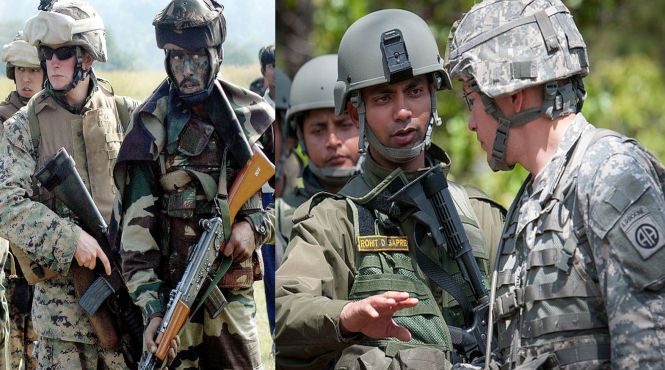
    WASHINGTON (TIP): The prestigious Indo-US Joint Military Training Exercise, Yudh Abhyas – 2017 will be held from September 14-27 at Joint Base Lewis-McChord in the US. Over 200 Indian soldiers from the Gorkha Rifles will take part in the military exercise.

    The exercise will be the thirteenth in the Yudh Abhyas series, which started in the year 2004 under US Army Pacific Partnership Program. It strengthens and broadens interoperability and cooperation between the Indian and US armies. It complements number of other exchanges and exercise between the forces.

    Over the years the two countries have decided to progressively increase the scope and content of the combined training.  Yudh Abhyas 2016 which was conducted at Chaubattia Military Station, Ranikhet, Uttarakhand, India witnessed a Brigade Headquarter based Command Post Exercise, an Infantry company carrying out Field Training Exercise and discussions on issues of mutual interest by experts of both countries. The exercise provided an ideal platform for the personnel of the two countries to share their experiences on counter insurgency and counter terrorist operations, especially in the mountainous terrain.

  • Missed the chance to act, Mr President

    Missed the chance to act, Mr President

    A seasoned parliamentarian, the now ex- President, Pranab Mukherjee, is known to weigh his words before uttering them and he must have taken extra caution about what to say in his parting speech. Yet the farewell message was a little odd for the occasion. The President was telling the government not to do something which he had not disapproved of when the occasion demanded. While Mr Mukherjee’s emphasis on “debate, discussion and dissent” and his observation that “disruptions hurt the Opposition more” were all well taken, it was his advice to the government to take the Ordinance route sparingly that has drawn maximum attention.

    As President, Mr Mukherjee gave unqualified assent to Ordinances — as many times and as often presented. Not even once did he return to the government for reconsideration any of the crucial recommendations — be it the frequent issue of Ordinances or the imposition of President’s rule. The land Ordinance was promulgated thrice. It had replaced the land Bill, which was widely dubbed “anti-farmer” and had remained stuck in the Rajya Sabha before its dilution. Again, the President happily sided with the government in approving the Ordinance that criminalized the holding of Rs 500 and Rs 1000 currency notes beyond December 31, 2016. Despite the nationwide dislocation, loss of jobs and farmer distress it caused without achieving any of the purported gains, the President did not try to satisfy himself, by asking the government or the RBI, whether sufficient arrangements were made for executing such an important policy measure.

    The unquestioned approval of President’s rule in the two Opposition-ruled states of Arunachal Pradesh and Uttarakhand also did not enhance his stature. It was finally left to the Supreme Court to right the wrong. His predecessor, K R Narayanan, had sent back Cabinet resolutions seeking President’s rule in UP and Bihar. Most of the time the President’s job is ceremonial. It is on such occasions that the worth of the Rashtrapati Bhavan occupant is judged. Pranab Mukherjee was found wanting at times. Only towards the end of his term did he talk of issues not to the government’s liking such as growing intolerance, Parliament turning dysfunctional and constitutional values. It did not add up, Mr Mukherjee.

    (Tribune, India)

  • THE GETAWAY TO MEET THE OMNIPRESENT

    THE GETAWAY TO MEET THE OMNIPRESENT

    THE GETAWAY TO MEET THE OMNIPRESENT

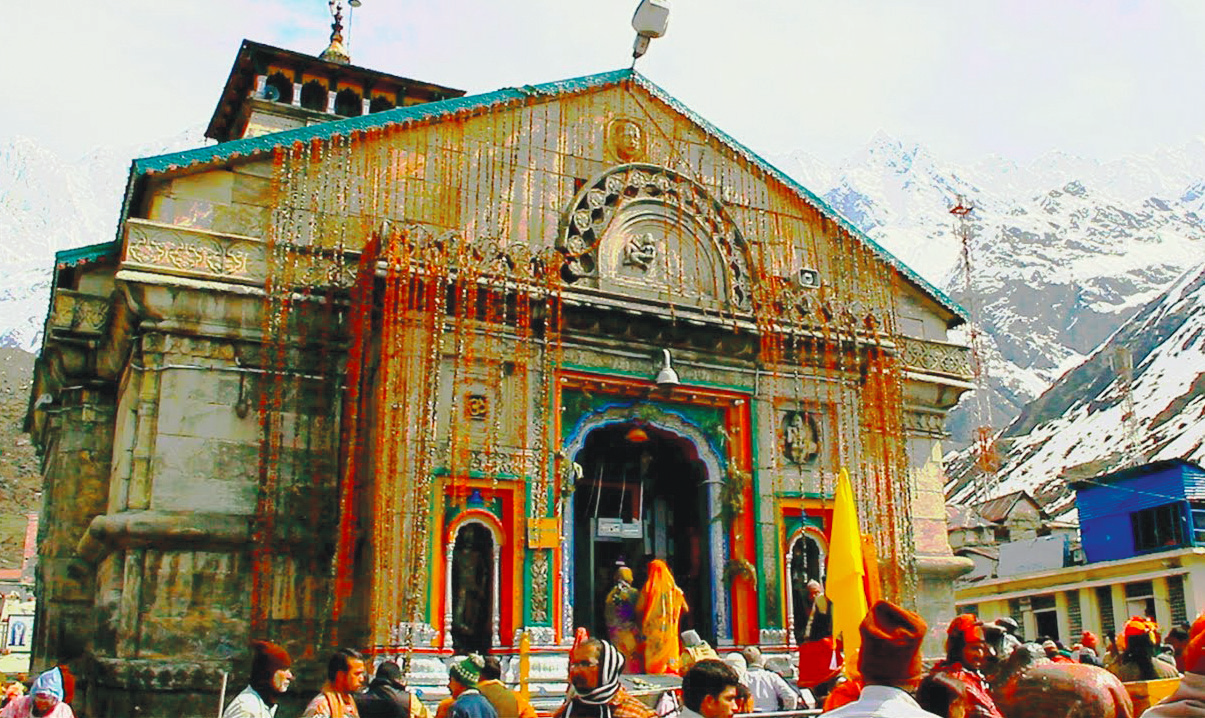
    Char Dham of Uttarakhand or ChotaChar Dham (small four abodes) is one of the most important Hindu Pilgrimages in India. It comprises of four most holy sites of Uttarakhand, namely – Badrinath, Kedarnath, Gangotri and Yamunotri. When and how these places got linked in a pilgrimage circuit together is not known. Each of the places has its own individual and legendary history. But perhaps it is the greatness and mysticism of each site that has qualified them to form a sacred pilgrimage tour.

    Till 1950s going to the four most sacred sites of Uttarakhand meant embarking on a strenuous journey on foot through the hilly trails. People, like wandering sadhus, and those who could afford to travel with an entourage, were the most likely and regular pilgrims of Chota Char Dham. After the 1962 Indo – China war, India put massive efforts in building means of better connectivity to and infrastructure at border areas. Now the roads could take one till the nearest points of the holy abodes. This encouraged people from other backgrounds (economic or social) to initiate a tour of Char Dham circuit in Himalayas.

    HISTORY OF YAMUNOTRI

    Yamunotri is where the second most holy of river of India, the River Yamuna, takes birth. Situated in the Uttarkashi district of Uttarakhand, Yamunotri Dham is the first stop in the pilgrimage. It is believed that bathing in its water cleanses all sins and protects from untimely and painful death. The shrine of Yamunotri is believed to be built in 1839 by the king of Tehri, Naresh Sudarshan Shah. Besides the Yamuna Devi (goddess), the idol of Ganga Devi too is housed in the revered temple. There are many hot water springs near the temple; Surya Kund is the most important among them. Devotees boil rice and potatoes in the kund and accept it as a Prasad of the devi.

    LEGEND

    Yamuna Goddess is believed to be Sun’s daughter and twin sister of Yama (the god of death). It is said that sage Asit Muni lived here and bathed in both Ganga and Yamuna. In his old age, when he was unable to go to Gangotri, a stream of Ganga started to flow across the steam of Yamuna.

    HISTORY OF GANGOTRI

    Gangotri Dham is dedicated to Goddess Ganga, who is said to have descended on earth to absolve the sins of human kind. The river originates at Gaumukh from the Gangotri glacier which is some 18 km from the town of Gangotri. Situated in Uttarkashi district of Uttarakhand, the original temple of Gangotri was built by by Amar Singh Thapa, a Gurkha general, in the early 19th century.

    LEGEND

    King Sagar undertook an Ashwamedha Yagna and sent his 60,000 sons along with the horse. The horse was lost; tracing the horse to the Sage Kapila’s ashram, the 60,000 sons stormed the ashram and disturbed sage who was in deep meditation. Enraged Kapila opened his fiery eyes that turned all 60,000 sons into ashes. Later, on Kapila’s advice, Anshuman (Sagar’s grandson) started praying to Goddess Ganga, requesting her to come down to earth to cleanse the ashes of his relatives and grant salvation to them. Anshuman failed in his aim; it was his grandson Bhagirath whose rigorous meditation made Ganga to come down to earth. Lord Shiva tied Ganga and distributed its water in a number of streams to save the earth from its mighty force.

    HISTORY OF KEDARNATH

    Situated in the Rudraprayag district of Uttarakhand, Kedarnath is the most remote pilgrimage spot in the yatra. It is believed that originally the temple of Kedarnath was built by Pandavas. And Adi Shankaracharya got the present structure constructed in the 8th century adjacent to the old temple site. The grey stone structure is an architectural marvel because of its imposing design and its ability to survive for so many centuries in such a harsh terrain.

    LEGEND

    Pandavas were searching for Lord Shiva to absolve themselves from their sins committed at the battlefield of Mahabharata. Lord Shiva was in no mood to forgive them so easily, so he converted himself into a bull and went to Garhwal side of Uttarakhand. On being found by the Pandavas, he dived into the ground. Different parts of the Lord came up at different parts – hump at Kedarnath, arms at Tunganath, navel at Madhya-Maheshwar, face at Rudranath and hair emerged at Kalpeshwar. Taken together, these five sites are known as Panch-kedar. Pandavas got temples made at each of the five places.

    HISTORY OF BADRINATH

    Badrinath is considered one of the most holy places in Hindu religion. One of the 108 Divya Desams, Badrinath temple is part of both Char Dham and Chota Char Dham. Adi Shankaracharya found the idol of Lord Badri in Alaknanda River and put it up in a cave near the Tapt Kund. In 16th century, a Garhwal King got the temple erected, which has been renovated many times as a result of natural calamities. Sandwiched between Nar and Narayan peaks, the beauty of Badrinath Dham is further enhanced with the glorious background of Neelkanth peak.

    LEGEND

    As per one of the legends, the indulgent lifestyle of Lord Vishnu was criticised by a sage, after which Vishnu went to meditate as an act of penance, over here. Goddess Laxmi (his wife) became a berry tree to shade him from the sun and other harsh elements of nature. Another divine tale states that Badrinath used to be the realm of Shiva. Vishnu tricked Shiva into leaving the site and established himself instead.


  • UTTARAKHAND Nestled in the lap of the Himalayas

    UTTARAKHAND Nestled in the lap of the Himalayas

    UTTARAKHAND

    Nestled in the lap of the Himalayas

    Uttarakhand is one of the most beautiful northern states of India located on the southern slope of the Himalayan range. Mighty Himalayan peaks and glaciers are on its north where it borders Tibet. Nepal is on its east, Indian state of Uttar Pradesh is on south and Himachal Pradesh lies on its west and northwest. 65% of its area is covered by dense forests that are home to Royal Bengal tiger, leopards and many other endangered animal and plant species. The glaciers of two of the most important rivers—Ganga and Yamuna— are located here.

    It has something to offer to every kind of traveller. For wildlife lovers, Jim Corbett National Park—the oldest national park of the Indian subcontinent is a must visit. Many rare Himalayan birds can also be spotted here besides Pangot and Sattal. For adventure seekers there are some of India’s best trekking trails like Valley Of Flowers, Roopkund, and Chopta-Chandrashila. It also provides immense opportunities for adventure sports, such as skiing at Auli and white water rafting at Shivpuri. Popularly known as the ‘Land of Gods’, it is home to numerous holy places like Gangotri, Yamnotri, Kedarnath, Badrinath, Rishkesh and Haridwar. Therefore, thousands of pilgrims throng the state every year. Amazing hill stations like Chakrata, Mukteshwar, Dhanaulti and Munsiyari make Uttarakhand a sought after tourist destination for leisure trips. Here’s a list of destinations in Uttarakhand that every nature lover would love to visit.

    CHAKRATA

    Having breakfast with the view of snow covered Himalayan peaks on a lazy morning while soft rays of winter sun embrace your body and soul while cool breeze kisses you is something city people always crave for. Chakrata located at a distance of 330 km from Delhi, is a tiny hamlet which is a perfect place to do so. There are two routes to drive from Delhi to Chakrata, one is via Panipat and Kurukshetra and the second one is via Loni and Saharanpur, which supposedly is more beautiful and has less traffic.

    Chakrata is a small cantonment town in Dehradun district resting at an elevation of about 7500 ft. The town gets a magnificent view of the snow covered Himalayas and is covered in deodar, Himalayan oak and rhododendron forest. Many day trips to places like Deoban, Koti, Kanasar can be done with Chakrata as base. There are some easy treks also around Chakrata that your hotel guys can arrange for you. There are not many hotels in the area so make sure to book your accommodation inadvance. Chakrata is a year round destination; the winter season is perfect to experience snow, greenery is at its best during the monsoon season and the summer season too is quite pleasant.

    AULI 

    Auli is one of the most beautiful places of Uttarakhand. Bordered by snow-covered Himalayan peaks, Auli is enveloped in dense golden oak and pine forest with green meadows and slopes ranging from a height of 2519 m to 3049 m. It is considered to be a world-class spot for skiing. GMVN winter resort here provides skiing facility, besides ski training for aspirants. Almost from everywhere in Auli, you can enjoy stunning views of the lofty mountain ranges—Nanda Devi, Mana Paravat and Kamat.

    The golden rays of sun on the snow-laden peaks fill the atmosphere with a divine glow. The 3rd highest peak of the world—Nanda Devi gleams like the crown of the region. There is an open cable-car to go up to the spot where skiing is done. Even if you do not want to ski, you have plenty of things to do. Climb up the slopes, play with snow, ride a sledge and who knows you might feel like trying skiing too. The best time to visit Auli is in between December and March.

    CORBETT

    Spread across an area of 520.8 sq km, Jim Corbett National Park is located in Nainital district of Uttarakhand. It is the oldest national park, and is named after Jim Corbett who was the main person behind this establishment. The park is divided in 5 zones—Bijrani, Jhirna, Durgadevi, Dhikala, Sitavani—and is inhabited by royal Bengal tiger, leopard, jungle cat, barking deer, hog deer, cheetal, sloth bears, otters, Himalayan goral, Indian pangolins, langur and many other wild animals.

    Many rare birds can also be spotted in the region. Gorgeous Corbett National Park is one of the favourite destinations equally for wildlife lovers and weekenders. It is just 235 km away from capital city and can be reached in couple of hours. It features splendid landscapes and offers a good amalgam of hills, rivers, forests, marshlands and grasslands. The park is open from the months of November through June. The park is kept closed in the monsoon season as the roads inside the park get washed away due to rain. After the monsoon season, repair work starts and ends only by November.

    TEHRI DAM

    A beautiful uphill drive through the hills covered in pines and small villages will take you to this dam. It is built on the Bhagirathi River in Uttarakhand and is the tallest dam in India. It is counted amongst 5 highest dams in the world, with 855 ft high rock and earth-fill embankment that makes it an engineering marvel. Its length is 1886 ft, crest width is 66 ft and base width is 3701 ft and generates 2400 MW of power. There is a viewpoint near the Bhagirathipuram bus stop from where you can have a majestic view of the entire dam. During the construction of the Tehri Dam, a huge water body was created. The tourism department has developed this 44 sq km artificial lake, as a tourist spot with arrangements of various water sports like jetski, kayaking, canoeing, boating, diving, snorkelling etc on the lake. You can also visit the botanical garden, located at New Tehri, that features a range of beautiful flowers.

    MUKTESHWAR

    Staying in middle of fruit orchards in tents and eating garden fresh meals while looking at the Himalayan peaks covered in fresh snow are a few of the many beautiful memories I have of Mukteshwar. You can walk through the dense pine forest and enjoy stunning views of the mighty mountains. Situated at an altitude of 7500 ft in the lap of Kumaon hills, Mukteshwar is an ideal nature get away from Delhi. It just takes 7 hrs from Delhi to reach Mukteshwar via Gajraula, Rampur, Haldwani and Bhowali. Summer months (March to July) are the best months to visit Mukteshwar. If you want to experience snow, visit during Jan or Feb when the whole area is covered in snow and looks stunningly beautiful. If you happen to visit this place around the month of June, the harvesting season, you’d find many fruits like peaches, plum and apricot. And if you still did not have your fill, Mukteshwar has many fruit orchards and you might get lucky to get offered the fruits just plucked from the trees by villagers.


  • BJP Victory celebrated in New York

    BJP Victory celebrated in New York

    NEW YORK (TIP): Indian American community in New York celebrated victory of BJP in U.P., Uttarakhand and other states. Community leaders of various organizations joined in congratulating Modi for landslide victory.

    “Modi magic has worked again. It is the pro-poor and pro-farmer policies of the Prime Minister which have resulted in BJP’s historic victory in Uttar Pradesh,” said Jagdish Sewhani, president of American India Public Affairs Committee. “This is also an endorsement of the demonetization policy of the Prime Minister. This shows people have full faith in him,” he added

    This is vote for Development. People are happy with performance of Prime Minister Modi, said Mr Sewhani

    Dr Shashi Shah, president AIA, Mr Gobind Munjal, Nagendra Gupta andRavi Bhooplapur also spoke at the function.

  • Manoj Sinha in contention for UP CM’s post, Rawat front runner in Uttarakhand

    Manoj Sinha in contention for UP CM’s post, Rawat front runner in Uttarakhand

    NEW DELHI (TIP): Trivendra Singh Rawat, a leader with RSS background, has emerged as the front-runner in the race for the coveted chief minister’s post in Uttarakhand. He is likely to be elected the leader of the BJP legislature party in the hill state. The swearing-in ceremony will take place in Dehradun on Saturday in the presence of Prime Minister Narendra Modi and BJP chief Amit Shah.

    BJP MLAs in Uttar Pradesh will also meet on Saturday to elect their leader and who will take over as the chief minister. Union minister M Venakaih Naidu and BJP general secretary Bhupendra Yadav will attend the legislature party meeting in Lucknow to brief the MLAs of Delhi’s choice. State BJP chief Keshav Prasad Maurya, Union minister Rajnath Singh, and Manoj Sinha are in contention. The date for the swearing-in of the chief minister of the country’s most populous state has not been decided yet.

    In Uttarakhand, Rawat faced stiff competition from former minister Prakash Pant and former MP Satpal Maharaj. Pant is MLA from Pithoragarh and Maharaj from Chaubattakal. Maharaj is a former Congress leader who joined the BJP ahead of the 2014 Lok Sabha elections while Pant was propped up by Rawat’s rival.

    “But Amit Shah’s support to Rawat seems to have tilted the balance in his favour,” a BJP source said.

    A Thakur, Rawat is close to Shah and was one of the three deputies attached to him in Uttar Pradesh during the 2014 Lok Sabha elections. As an RSS leader sent to the BJP, Rawat held the post of Sangathan Mantri (organisational secretary) of the Uttarakhand BJP between 1997 and 2002 and served as a minister in the BJP government in 2007.

    UP chief minister hopeful Keshav Prasad Maurya was admitted to the ICU at Ram Manohar Lohia Hospital here after falling ill. He had fever and high blood pressure when admitted. Doctors have placed him under observation.

    Uttar Pradesh CM to be decided on March 18

    The suspense over the new chief minister of Uttar Pradesh is expected to end at the BJP legislature party (BJPLP) meeting to be held in Lucknow on Saturday.

    The declaration of a new leader, in the presence of Union minister Venkaiah Naidu and party general secretary Bhupendra Yadav, will coincide with the party’s victory day celebration on that day. The BJP’s incumbent legislature party leader, Suresh Khanna, on Thursday confirmed the news about Saturday’s meeting of the party’s newly-elected lawmakers.

  • Assembly Elections 2017 Anti-Incumbency a dominant factor

    Assembly Elections 2017 Anti-Incumbency a dominant factor

    Exit polls find BJP ahead in UP, Goa; Cong & AAP neck-and-neck in Punjab

    NEW DELHI (TIP): Anti-incumbency appears to be a factor in deciding the fate of political parties in the fray in five States of India which have gone to polls. Results are expected on Saturday, March 11. However, exit polls, as in the past, have come up with their assessment of number of seats likely to be won by each of the parties in each of the States. The Bharatiya Janata Party could emerge as the single-largest party in three of five states, including Uttar Pradesh, which voted to elect new assemblies over the past month, exit polls showed on Thursday, March 9.

    The Congress and the Aam Aadmi Party were locked in a tight race in Punjab and the country’s principal opposition party was battling with the BJP to retain power in Manipur and Uttarakhand.

    The results, officially out on Saturday, March 11, will be seen as a referendum on Prime Minister Narendra Modi’s policies, including the shock recall of 500-and 1000-rupee banknotes – a decision that opposition parties slammed as anti-poor and turned into a poll plank.

    The five state polls are also billed as a virtual semi-final to the general elections in two years from now, and the results are likely to shape both upcoming presidential elections and policy formation. If the forecasts come true on March 11, the BJP-led central government could give a fresh impetus to politically unpalatable economic reforms, especially those in the labor sector.

    Exit polls have frequently gone wrong in the past, including in Bihar and Delhi in 2015. Analysts say states with diverse populations and complex caste, community and religious affiliations tend to throw pollsters off.

    Some of the polls predicted ranges of seats while others gave absolute numbers without mentioning any error margin.

    In UP, where the BJP is seeking to regain power after 14 years, all exit polls forecast a hung assembly. Two gave the BJP a clear advantage over its nearest rival, the Samajwadi Party-Congress alliance, while two others predicted a close fight between them.

    The Bahujan Samaj Party (BSP) was seen as a distant third in all four exit polls available for the 403-member house. In the event of the polls throwing a hung assembly in UP, post-poll re-alignments of political forces could not be ruled out.

    In a Facebook Live conversation with BBC Hindi on Thursday, UP chief minister Akhilesh Yadav was ambiguous about the possibility of the SP joining hands with the BSP to keep the BJP out of power.

    “No one will want President’s Rule in UP and that the BJP governs the state through a remote control,” he said in a cryptic reply to a query about the possibility of a post-poll arrangement with the BSP.

    The BJP was seen as surging ahead of the rivals in Goa and Uttarakhand as well.

    In Punjab, all exit polls unanimously predicted a drubbing for the ruling Shiromani Akali Dal-BJP combine. But the polls were divided on whether the Congress or the Aam Aadmi Party, which is fighting its debut assembly election in the state, will form the next government.

    Two exit polls predicted a photo-finish while two others were split between the Congress and the AAP in the 117-member assembly. The halfway mark is 59.

    In Uttarakhand, the BJP looked set to dislodge the Congress as four out of five exit polls gave a clear majority to the saffron party. One poll forecast a close fight in the 70-member legislature.

    Three exit polls suggested that the BJP could retain power in Goa. The AAP, which ran a high-voltage campaign in its debut outing in the state, was seen as failing to have had an impact in the 40-member assembly.

    But polls were split over Manipur, with one giving a majority to the BJP and the other to the ruling Congress.

    (With inputs from agencies)

  • 65% voter turnout in UP, 68% in Uttarakhand

    65% voter turnout in UP, 68% in Uttarakhand

    LUCKNOW (TIP): A voter turnout of 66% was recorded in Uttar Pradesh as 69 constituencies went to the polls in the second phase of Assembly elections. In the first phase of polls in the state, 63%of the electorate voted. In Uttarakhand, where elections to 69 seats were being held, 68% of the electorate came out to vote till 5 pm.

    Assembly Elections 2017

    Voting began at 7 am in both states on Wednesday. In Uttar Pradesh, there were reports of glitches at some electronic voting machines.

    Polling in Uttarakhand’s Karnaprayag seat was postponed to March 9 on as Bahujan Samaj Party candidate Kuldeep Singh Kanwasi’s died in a road accident on Sunday.

    Around 74.2 lakh voters will elect the next government in Uttarakhand. As many as 628 candidates are in the fray. The ruling Congress party, headed by Chief Minister Harish Rawat, is combating anti-incumbency as well as corruption charges. The Bharatiya Janata Party, on the other hand, hopes to gain from this. Recently, Prime Minister Narendra Modi had accused the Congress of turning the “dev bhoomi” into “loot bhoomi”.

    In Uttar Pradesh, the 67 constituencies that are voting today are spread across 11 districts. The ruling Samajwadi Party had won 34 of these seats in the last Assembly election. However, the BJP and the BSP have upped the stakes this time, highlighting the state’s poor law-and-order situation.