Tag: Uttarakhand

  • Poll schedule for 5 states announced, UP to vote in 7 phases; counting on March 11

    Poll schedule for 5 states announced, UP to vote in 7 phases; counting on March 11

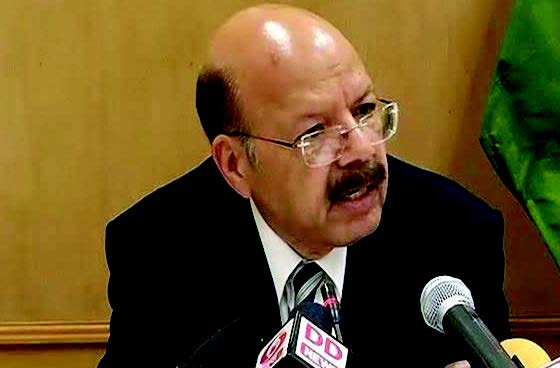
    NEW DELHI (TIP): The Election Commission on January 4 (Wednesday) announced the poll dates for Uttar Pradesh, Uttarakhand, Punjab, Manipur and Goa. Chief Election Commissioner Nasim Zaidi said that the state of Manipur will have a two-phase election and Uttar Pradesh will have a seven-phase election. Counting for all states will be held on 11 March.

    A total of 690 assembly constituencies will go to polls in these elections. Twenty three of these have been reserved from Scheduled Tribes candidates. Over 160 million voters – that’s the size of the electorate in these assembly elections. There will be 1,85,000 polling stations across five states.

    Seven-phase elections in Uttar Pradesh from February 11 to March 8; Punjab and Goa will vote on February 4 while Uttarakhand on Feb 15; results on March 11

    NEW DELHI (TIP): Assembly elections in UP, Punjab, Uttarakhand, Goa and Manipur will be held between February 4 and March 8, the results of which — to be announced on March 11 — are likely to be seen as a referendum on the demonetisation move by PM Narendra Modi.

    The terms of the legislative assembly of Goa, Manipur and Punjab are due to expire on March 18 while that of Uttarakhand expires on March 26. The legislative term of Uttar Pradesh ends on May 27. Goa has 40 assembly seats, Manipur has 60, Punjab has 117, Uttarakhand has 70 while Uttar Pradesh has 403.

    Election Commission made the much-anticipated announcement of dates on January 4 (Wednesday), setting in motion a process that will impact Indian polity in the coming months. The UP polls are already being dubbed as a “semi-final” to the 2019 general elections. These polls are significant for BJP as a good electoral harvest will boost its strength in the Rajya Sabha in the near future. The outcome will also have a bearing on the Presidential elections later this year.

    UP will have a seven phase election, with polling on February 11, 15, 19, 23, 27, March 4 and 8.

    Manipur, which continues to be under a blockade and is facing law and order problems, will have a twophase election with polling on March 4 and 8.

    Seven-phase elections in Uttar Pradesh from February 11 to March 8; Punjab and Goa will vote on February 4 while Uttarakhand on Feb 15; results on March 11Punjab and Goa will vote on February 4 while Uttarakhand on Feb 15. While the Code of Conduct has come into force with the announcement, the state-wise notification process will begin with Punjab and Goa on January 11.

    Demonetisation is likely to be a big issue in these elections, though the polling pattern will be guided by local factors, caste equations and identity politics. With the Centre propagating a less-cash economy, the extent to which money power is at play in these polls will be keenly watched. One of the new rules of these elections allows parties to use cash for campaign payments only up to Rs 20,000.

    Candidates will also have to take oath this time that they have no pending public utility bills. The SC order last week barring political parties and candidates from seeking votes in the name of religion or caste has also added to the worries of the contestants. While SP is seeking to retain power in UP and is facing a challenge from BJP and BSP, Congress is trying to beat anti-incumbency in Uttarakhand and Manipur. BJP is a part of the ruling coalition in Punjab and rules Goa. The caste-ridden politics of UP now has an added dimension with the feud in the first family of SP. CM Akhilesh Yadav is fighting over the symbol, bicycle, with his father and party patriarch Mulayam.

    SAD-BJP combine, which has ruled Punjab for two consecutive terms, has not lost hope, especially if AAP makes it a triangular contest at the expense of Congress. AAP is also making things difficult for BJP and Congress in Goa.

    BJP is still confident of retaining power. BJP is hopeful of defeating Congress in Uttarakhand while CM Harish Rawat is playing the victim card, citing the saffron party’s attempt to topple his government a few months ago. BJP is hopeful of defeating Congress in Manipur currently under Congress rule. Manipur has been facing an economic blockade on its two highways since November 1 over creation of seven new districts.

  • Poll schedule in 5 states of India after security inputs: CEC

    Poll schedule in 5 states of India after security inputs: CEC

    NEW DELHI (TIP): The Election Commission will take a call on the dates of Assembly elections in Uttar Pradesh, Punjab, Goa, Manipur and Uttarakhand, due early next year, based on the inputs provided by security forces and state law and order machinery, Chief Election Commissioner Nasim Zaidi said here, October 19.

    Zaidi said the schedule will be finalized keeping in mind the weather and examination schedule. “We are trying to assess the requirement of security forces, climate and exam schedule – all these inputs are being taken into consideration. Only then will we be able to say whether they will be staggered or multi-phase,” the CEC told mediapersons on the sidelines of an event.

    “As far as the schedule is concerned, the commission has not given a thought as yet.” On if the EC should get powers to prevent parties from making statements in states where elections have not yet been announced, Zaidi said once the model code came into force, the EC would ensure its compliance. Assembly elections are due early next year in Punjab, Uttarakhand, Uttar Pradesh, Goa and Manipur. The terms of Punjab, Goa, Manipur and Uttarakhand Assemblies end in March, while that of UP ends in May.

  • MUST-VISIT DESTINATIONS IN #UTTARAKHAND

    MUST-VISIT DESTINATIONS IN #UTTARAKHAND

    Uttarakhand is one of the most beautiful northern states of India located on the southern slope of the Himalayan range. Mighty Himalayan peaks and glaciers are on its north where it borders Tibet. Nepal is on its east, Indian state of Uttar Pradesh is on south and Himachal Pradesh lies on its west and northwest. 65%of its area is covered by dense forests that are home to Royal Bengal tiger, leopards and many other endangered animal and plant species. The glaciers of two of the most important rivers—Ganga and Yamuna—are located here.

    It has something to offer to every kind of traveller. For wildlife lovers, Jim Corbett National Park—the oldest national park of the Indian subcontinent is a must visit. Many rare Himalayan birds can also be spotted here besides Pangot and Sattal. For adventure seekers there are some of India’s best trekking trails like Valley Of Flowers, Roopkund, and Chopta-Chandrashila. It also provides immense opportunities for adventure sports, such as skiing at Auli and white water rafting at Shivpuri. Popularly known as the ‘Land of Gods’, it is home to numerous holy places like Gangotri, Yamnotri, Kedarnath, Badrinath, Rishkesh and Haridwar. Therefore, thousands of pilgrims throng the state every year. Amazing hill stations like Chakrata, Mukteshwar, Dhanaulti and Munsiyari make Uttarakhand a sought after tourist destination for leisure trips. Here’s a list of destinations in Uttarakhand that every nature lover would love to visit.

    CHAKRATA

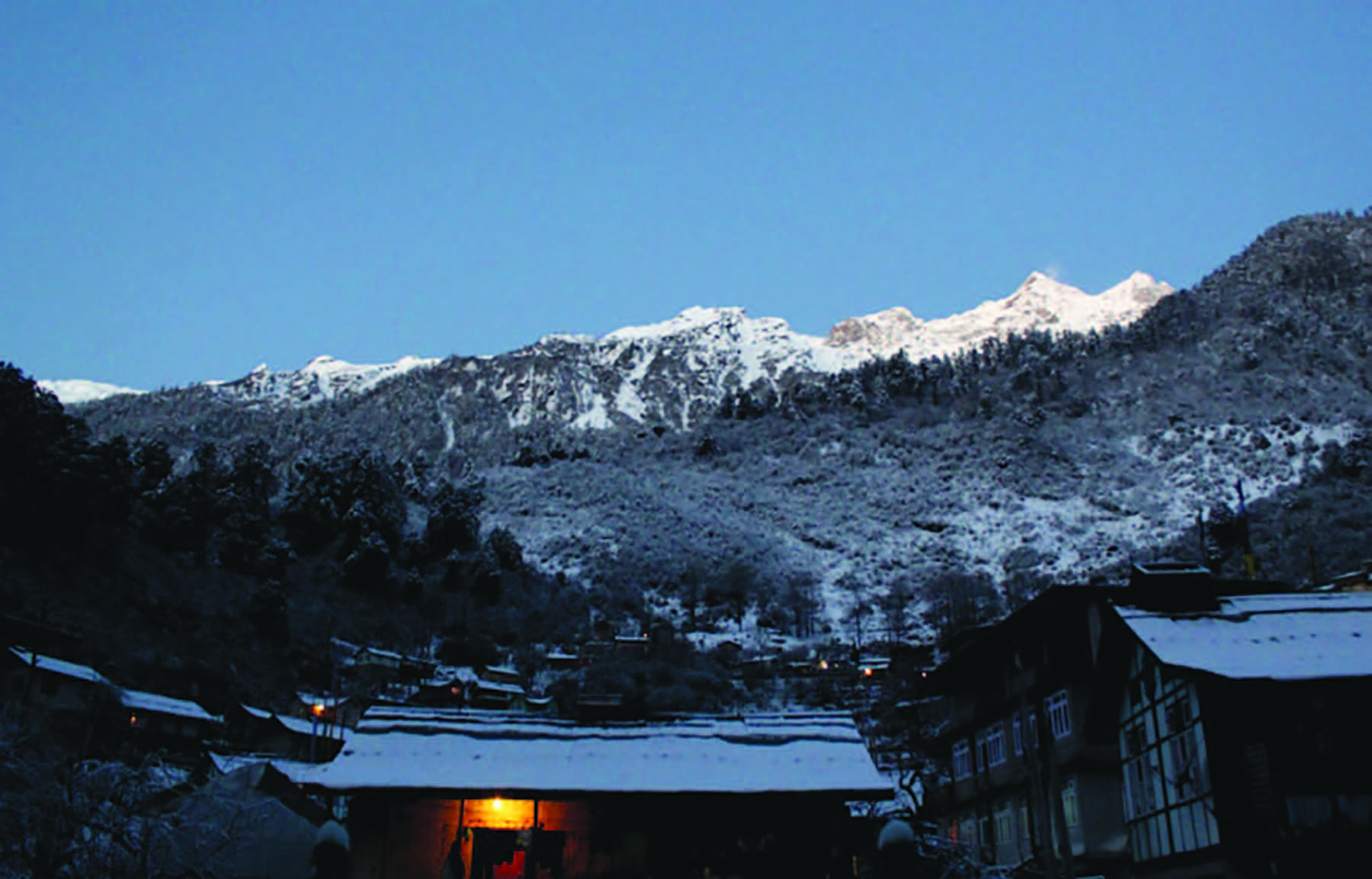
    Having breakfast with the view of snow-covered Himalayan peaks on a lazy morning while soft rays of winter sun embrace your body and soul while cool breeze kisses you is something city people always crave for. Chakrata located at a distance of 330 km from Delhi, is a tiny hamlet which is a perfect place to do so. There are two routes to drive from Delhi to Chakrata, one is via Panipat and Kurukshetra and the second one is via Loni and Saharanpur, which supposedly is more beautiful and has less traffic.

    uttarakhandChakrata is a small cantonment town in Dehradun district resting at an elevation of about 7500 ft. The town gets a magnificent view of the snow covered Himalayas and is covered in deodar, Himalayan oak and rhododendron forest. Many day trips to places like Deoban, Koti, Kanasar can be done with Chakrata as base. There are some easy treks also around Chakrata that your hotel guys can arrange for you. There are not many hotels in the area so make sure to book your accommodation in advance. Chakrata is a year round destination; the winter season is perfect to experience snow, greenery is at its best during the monsoon season and the summer season too is quite pleasant.

    AULI

    Auli is one of the most beautiful places of Uttarakhand. Bordered by snow-covered Himalayan peaks, Auli is enveloped in dense golden oak and pine forest with green meadows and slopes ranging from a height of 2519 m to 3049 m. It is considered to be a world-class spot for skiing. GMVN winter resort here provides skiing facility, besides ski training for aspirants. Almost from everywhere in Auli, you can enjoy stunning views of the lofty mountain ranges—Nanda Devi, Mana Paravat and Kamat.

    The golden rays of sun on the snow-laden peaks fill the atmosphere with a divine glow. The 3rd highest peak of the world—Nanda Devi gleams like the crown of the region. There is an open cable-car to go up to the spot where skiing is done. Even if you do not want to ski, you have plenty of things to do. Climb up the slopes, play with snow, ride a sledge and who knows you might feel like trying skiing too. The best time to visit Auli is in between December and March.

    CORBETT

    Spread across an area of 520.8 sq km, Jim Corbett National Park is located in Nainital district of Uttarakhand. It is the oldest national park, and is named after Jim Corbett who was the main person behind this establishment. The park is divided in 5 zones—Bijrani, Jhirna, Durgadevi, Dhikala, Sitavani—and is inhabited by royal Bengal tiger, leopard, jungle cat, barking deer, hog deer, cheetal, sloth bears, otters, Himalayan goral, Indian pangolins, langur and many other wild animals. Many rare birds can also be spotted in the region.

    Gorgeous Corbett National Park is one of the favourite destinations equally for wildlife lovers and weekenders. It is just 235 km away from capital city and can be reached in couple of hours. It features splendid landscapes and offers a good amalgam of hills, rivers, forests, marshlands and grasslands. The park is open from the months of November through June. The park is kept closed in the monsoon season as the roads inside the park get washed away due to rain. After the monsoon season, repair work starts and ends only by November.

    MUKTESHWAR

    Staying in middle of fruit orchards in tents and eating garden fresh meals while looking at the Himalayan peaks covered in fresh snow are a few of the many beautiful memories I have of Mukteshwar. You can walk through the dense pine forest and enjoy stunning views of the mighty mountains. Situated at an altitude of 7500 ft in the lap of Kumaon hills, Mukteshwar is an ideal nature get away from Delhi. It just takes 7 hrs from Delhi to reach Mukteshwar via Gajraula, Rampur, Haldwani and Bhowali. Summer months (March to July) are the best months to visit Mukteshwar. If you want to experience snow, visit during Jan or Feb when the whole area is covered in snow and looks stunningly beautiful. If you happen to visit this place around the month of June, the harvesting season, you’d find many fruits like peaches, plum and apricot. And if you still did not have your fill, Mukteshwar has many fruit orchards and you might get lucky to get offered the fruits just plucked from the trees by villagers. The taste of crunchy fresh peaches plucked from a road side tree of an orchard that belonged to a generous local who gladly offered us to pluck as many as we want, is still fresh in my mouth. Mukteshwar has recently got very popular among those looking for holidays in offbeat destinations and hence there is a wide range of options to stay starting from camps to budget hotels to boutique hotels.

    KAUSANI

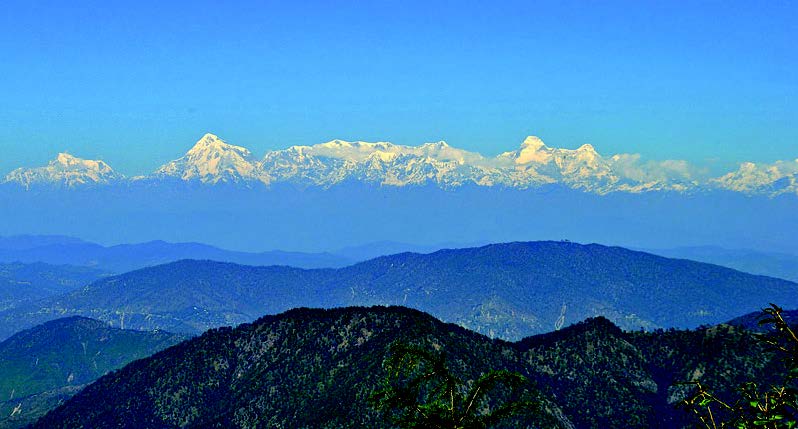
    Kausani is a quiet little town in the Kumaon region of Uttaranchal, 420 km away from Delhi. It offers breathtaking panoramic views of the snow-capped peaks of Panchchuli, Nandakot, Nanda Devi, Trishul, Nanda Gunti and Chaukhamba. If weather is favorable you might witness the best sunrise of your life here with soft golden light of morning sun creating magic over the peaks. This can be best witnessed from the GMVN guesthouse some 2 km away from the main town. There are many attractions close by of which Anasakti Ashram, Tea Estate and factory, Rudhradhari Falls and caves, and Burha Pinnath are the prominent ones.

    Gandhiji stayed at Anasakti Ashram for 2 weeks. It is also known by the name Gandhi Ashram and is just 1 km away from the main town. It is basically a simple cottage engrossed with the teachings of the Mahatma. A part of this ashram offers accommodation too. The Tea Estate and factory is only 3 km away from Kausani towards Baijnath.

  • NAINITAL: THE LAKE DISTRICT

    NAINITAL: THE LAKE DISTRICT

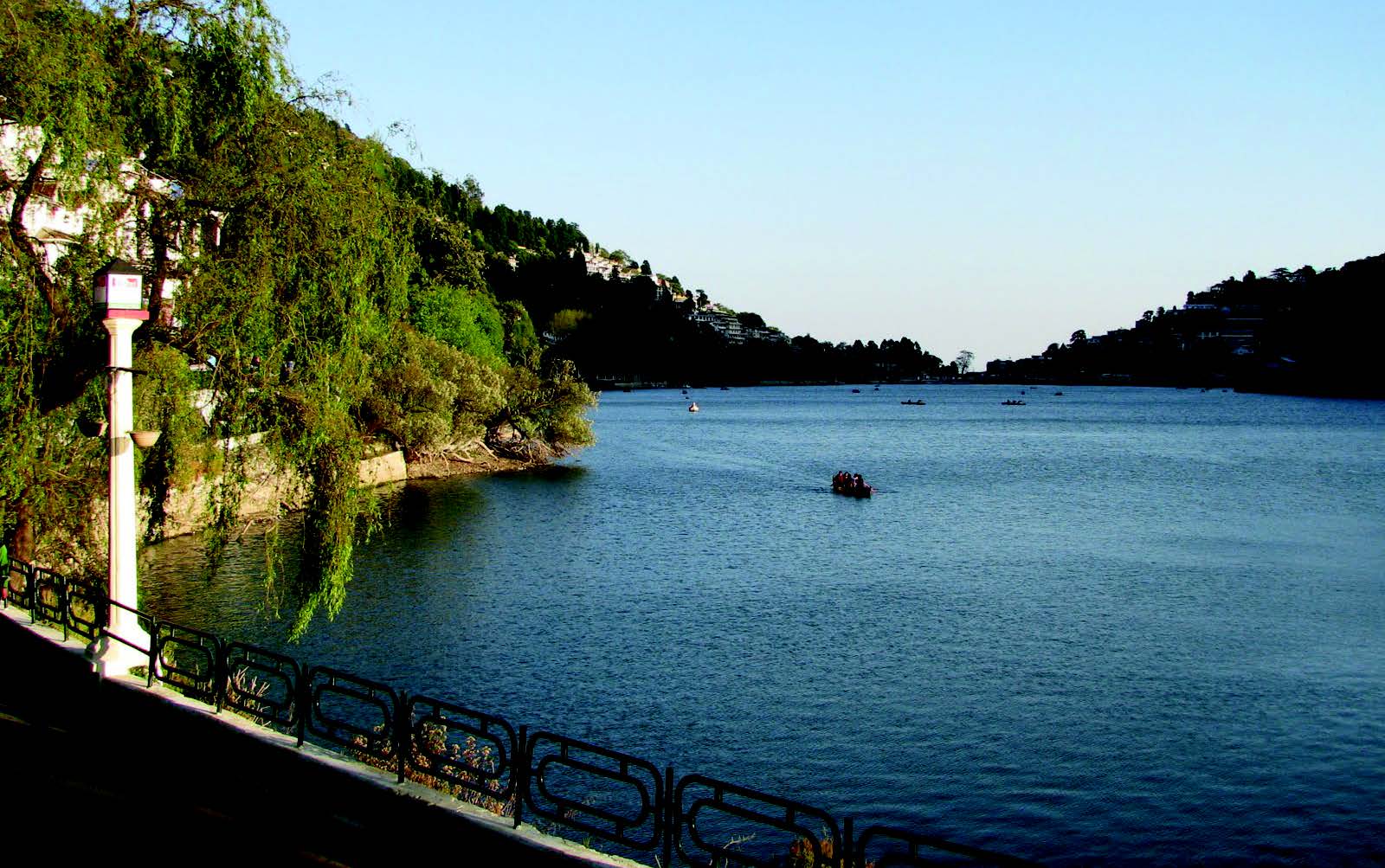
    A beautiful emerald lake surrounded by green hills, quaint old cottages and markets , and a web of walking tracks—there are plenty of picturesque places to visit in Nainital. One of the most popular hill destinations in India , Nainital is also a part of the ‘lake district’ of the Kumaon region of Uttarakhand , with lakes such as Bhimtal , Sattal and Naukuchiatal in the vicinity. Nainital’s charms include everything from boating and sailing to old temples and heritage buildings, and of course, scenic views at every other step. Here’s your guide to the hill town’s most captivating spots.

    NAINITAL-

    NAINI LAKE

    This beautiful lake lies at the heart of Nainital, with its waters reflecting the colour of the surrounding green hills. The hill station itself is divided into parts: Mallital, the northern side of the lake, and Tallital, the southern end of the lake. Boating in the lake is a favourite tourist pastime. There are rowboats and pedal boats available at various spots. For a more thrilling alternative, try sailing on the lake with a small yacht. The Nainital Boat House Club has facilities for renting yachts, guided by a boatman. A promenade circles the entire lake and is a good stretch for walking, taking in the views and the cool breeze from the lake.

    NAINA DEVI TEMPLE

    Perched on the banks of Naini Lake, this temple plays a central role in the origin myths surrounding Nainital. It is believed that after the death of his wife Sati, the Hindu god Shiva was so distraught that he began a tandava dance of cosmic destruction. In order to stop him, Sati’s body was scattered all over the earth. This was the exact spot where her eye fell, creating the lake. The temple’s open courtyard also offers scenic views and cool breeze from the lake.

    RAJ BHAWAN

    Also known as Governor’s House, this was the official residence of the Governor of North-West Province in colonial India. It is now the residence of the Uttarakhand Governor, and is one of the few Raj Bhawans open to the public. Built towards the end of the 19th century, the imposing building is spread over an area of 220 acres. Its Gothic-style architecture was inspired by the Buckingham Palace.

    The two-storey mansion contains around 113 rooms, but visitors are only allowed in its vast lawns and in the 18-hole golf course within its premises. Constructed by the British in 1924, the golf course is set around a scenic forest , and is home to several rare species of flora and fauna. Visitors can play a game of golf for a small fee or lounge in its clubhouse and restaurants.NAINITAL-2

    GURNEY HOUSE

    Located on Ayarpatta Hill, this beautiful cottage was the former residence of British hunter, conservationist, and beloved writer Jim Corbett. This British-style building was built in the 19th century by the Corbett family. Jim Corbett lived here with his sister Margaret between 1920 and 1947, following which, they left for Kenya. During his time here, Corbett famously hunted man-eating tigers in the Kumaon region, and penned several books based on his experiences. The house has been carefully preserved, and still has Corbett’s possessions, including his trophies, furniture, books, and boat. It is now a private property, but informal tours can be arranged by contacting the owners via phone or email.

    GOVIND BALLABH PANT ZOO

    Home to a variety of endangered animals and a wide variety of flora, the Pt. GB Pant High Altitude Zoo is the perfect way to explore the mountain wildlife. Lay your eyes on rare species of animals such as the Khaleej Pheasant, Siberian Tiger, Snow Leopard, Goat Antelope-Ghooral and Serao, among several others. If you are an avid bird lover, you will be more than happy to hear that this zoo is home to several high altitude birds like the Golden Pheasant, Rose Ringed Parakeet, Red Jungle fowl and Lady Amherst Pheasant. Most of these are kept according to their natural habitat, ensuring that they feel right at home. The zoo was founded in the year 1984 but it was opened to visitors in 1995.

    TIFFIN TOP

    The panoramic beauty of soft white clouds, rocky peaks, emerald jungles, and green verdant valleys from Tiffin Top can not be put into words. The place is only about 4 km from the heart of Nainital and makes for a wonderful trek. Alternately, you may go there on horseback. Tiffin Top is also known as Dorothy’s seat as it was built in the memory of an English artist name Dorothy Kellet by her family. With so much to offer, no wonder, the place is a delight for dozens of artists, photographers, and nature enthusiasts.

    SNOW VIEW

    With a towering height of 2,270 metres, this hilltop is an old tourist favourite for its beautiful views of the surrounding hills. Situated at a distance of 2.5 kilometres from the town, it is easily accessible by an aerial ropeway, which connects Snow View point with Mallital in Nainital. There’s an amusement park with bumper car ride for kids, and stalls offering tea and snacks. You can also trek from here to Naina Peak or China Peak, which is the highest peak in Nainital and also offers stunning views of snow-clad Himalayas.

    NAINITAL-3ARYABHATTA RESEARCH INSTITUTE

    This astronomical observatory is located on the Manora peak, and is the perfect place to indulge in star-gazing. The observatory has facilities for viewing celestial bodies on clear nights between 7 pm and 9 pm, through its high-powered telescopes. The institute was established in 1955, and is a major centre for astrophysical research. To book a visit, call the observatory or make a reservation through their website.

  • Jaitley’s flawed logic | Judiciary’s ‘overreach’ a necessary balance

    Jaitley’s flawed logic | Judiciary’s ‘overreach’ a necessary balance

    Finance Minister Arun Jaitley has every right to believe and tell the Opposition that the job of dispute resolution provided in the GST Bill need not be handed over to the judiciary even though judges enjoy greater credibility and acceptance than, say, politicians and bureaucrats in settling tax and other disputes. Jaitley is also justified in questioning the need for having another drought fund when two such funds already exist. But instead of arranging relief for the drought-hit, the core issue on which the Supreme Court has pulled up the Centre, he offers excuses like lack of Parliament-sanctioned money.

    Being too clever by half, the lawyer in Jaitley knows how to twist arguments. And this he does to cover up recent political, constitutional and administrative lapses. The GST failure is all too apparent. How does having judges to hear tax cases tantamount to a “surrender of legislative jurisdiction to the courts”? This is how he argues: “With the manner in which encroachment of legislative and executive authority by India’s judiciary is taking place, probably financial power and budget making is the last power that you have left. Taxation is the only power which states have.” Then he makes the final assault: “Step by step, brick by brick the edifice of India’s legislature is being destroyed.”

    Presumed judicial overreach is an issue the executive is unhappy about. But it is not as serious a threat to democracy as was the executive’s attempt, backed by the Opposition, to undermine the judiciary’s independence through the NJAC, which was rightly struck down by a Constitution Bench. Jaitley had called it “tyranny of the unelected”. On Wednesday he sought NJAC-type Opposition cooperation on GST. The Supreme Court’s Uttarakhand snub a day before perhaps still rankled him and provoked the fresh tirade. There is no judiciary vs legislature issue at work. If judges at times cross the Lakshman Rekha drawn by the Constitution, usually an executive failure or political mischief provokes it. A sturdy judiciary may at times seem like an irritant but judicial vigilance over possible executive waywardness is an imperative.

  • RISHIKESH: BEYOND YOGA AND RAFTING

    RISHIKESH: BEYOND YOGA AND RAFTING

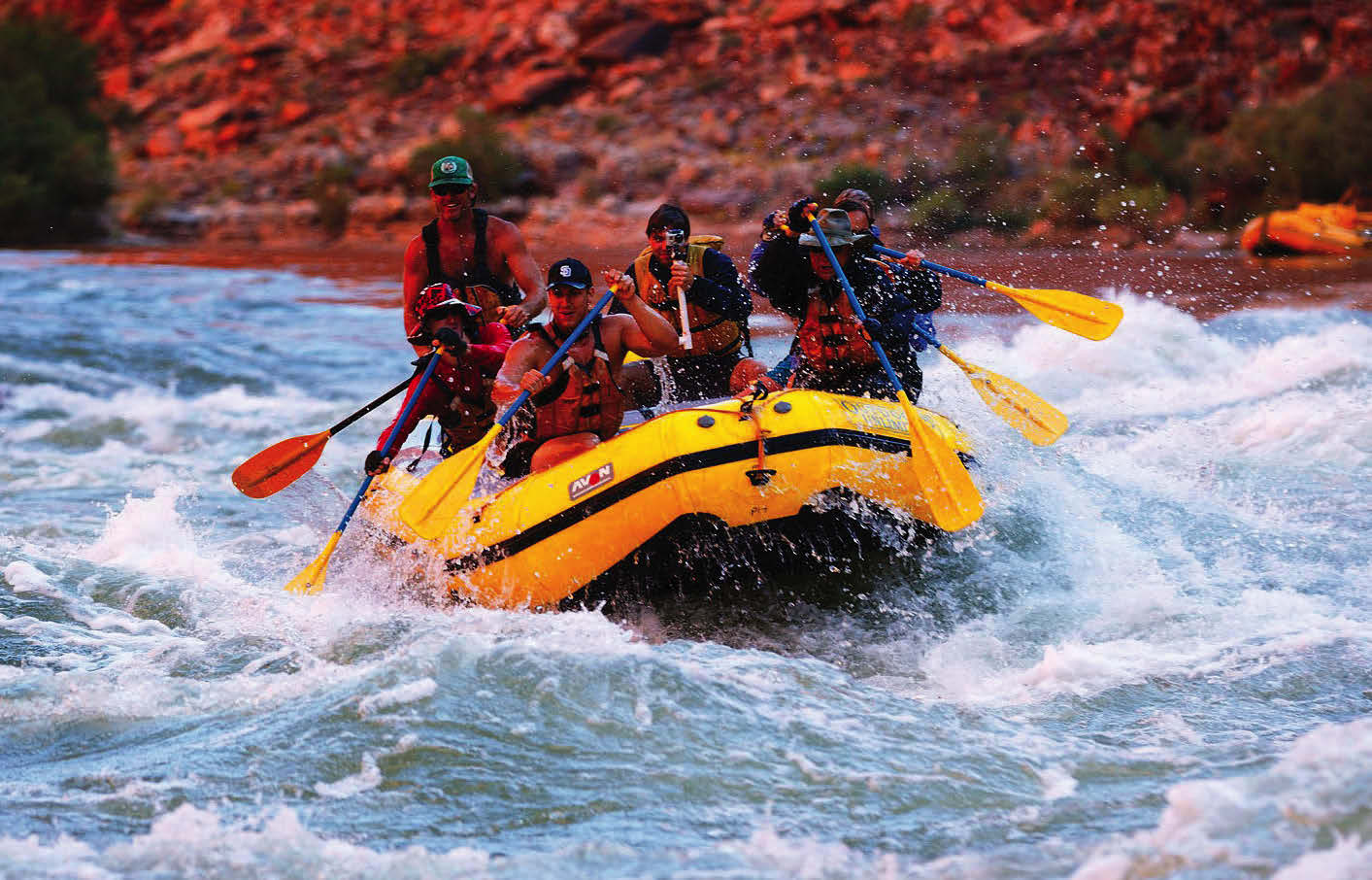
    Rishikesh, situated in the foothills of Himalayas on the banks of River Ganga in Northern India, is undoubtedly one of the best places to find quick relaxation from the mundane life. Located about 43 km away from Dehradun, Rishikesh is a hub of Yoga, meditation and spirituality. The place is frequented by many international travellers and pilgrims. Rishikesh has also become a popular destination for white water rafting, attracting tourists from both India and abroad. It is also a center for hiking, backpacking, camping, rock climbing, rappelling, kayaking and bungee jumping. No doubt, it has become one stop destination for everyone seeking peace, fun and enjoyment. Besides these, there are 5 things about Rishikesh that you never knew.

    NEERGARH FALLS

    Rishikhesh is the home to many lesser-known waterfalls and the beauty of these hidden treasures is that one has to take a trek of few Kilometres to reach the falls. If you wish to spend some quality time with your family and friends amidst nature-rich environs, you can definitely plan a waterfall trekking in Rishikesh. The trekking to Neergadh Waterfall starts 3 km away from Laxman Jhula on the Badrinath Highway. It is one of the most frequented waterfalls as it is easiest to access. Visit Neergarh Waterfall just after monsoon season and you will witness water cascading thousands of feet from the mountain top. There are small pools along the hike where a hiker can sit and enjoy the serenity of falls, while soaking the tired feet. You can also consider taking a dip into the pool of fresh water. Trekking through Neergarh waterfall and passing by shallow pool will give you a feel and touch of what the state of Uttarakhand is all about. The best thing about this adventure activity is that it does not require any special skill to trek, owning to easy path and can be undertaken by people from all age group. Vendors are also available here to sell the beverages, which will cost slightly higher but a cup of tea in hand will be a good idea to enjoy the surreal beauty of the place.

    RISHIKESH-1NEELKANTH TEMPLE

    Neelkanth temple is one of the most sacred places of worship for Hindus. It is situated on a hill above Swargashram and located at a distance of 32 km from Rishikhesh. Neelkanth temple is considered to be an apt example of complete natural hill heaven that lies adjacent to mountain ranges of Nar-Narayan. Owing to its raw beauty & religious significance, both the devotees and nature lovers visit the place round the year. The way to the temple is quite exhilarating. There are steep & narrow roads taking above the hill, which will add the extra spice of adventure amidst the beauty. There is river flowing on one side and mountain terrain is on the other side. Road is very curvy and narrow with steep slopes.

    TREKKING 

    Trekking is all about reconnecting yourself with nature and exploring the wonders of the Himalayas. For adventure enthusiasts, it is a much sought after option to escape the daily mundane life to find themselves in the lap of nature. Walking through verdant landscape, lush greenery and waterfall, and breathing in fresh air really prove to be a refreshing experience. Located in the lap of the Shivalik Himalayas, the picturesque town of Rishikhesh offers a host of scenic locales for trekkers. It gives the trekker a chance to witness the outstanding scenery of flowery green meadows, dense forests, fascinating local communities and astounding landscape of the eastern part of the Garhwal Himalayan ranges. There are all sorts of treks available near Rishikhesh, which can be categorised into easy, moderate and hard treks. Small treks can be done in the adjoining villages and waterfalls while longer treks can be taken in near-by mountains. Few famous treks which can be taken near Rishikhesh are Neer Garh waterfall trek, Kunjapuri trek, Neelkanth Temple Trek, and Jhilmil Gufa Trek. Longer treks which serve route from Rishikhesh are Gomukh (Gaumukh) Trek, Valley of flower Trek, Tungnath-Chandrasheela Trek, Deoria Taal Trek, Hemkund sahib trek, Kuari Pass Trek and Roop Kund Trek.

    DEVPRAYAG

    In Sanskrit, prayag means ‘confluence’ and Devprayag stands for ‘holy confluence’. Devprayag is the confluence of two holy rivers Alaknanda and Bhagirathi to form Ganga. According to religious scriptures, Devprayag is one of the five important holy confluences. Rivers like Bhagirathi, Alaknanda & the mythological river Saraswati (flowing underground) meet to from the River Ganga. River Bhagirathi originates from Gangotri and Alaknanda originates from Badrinath, both of which are considered sacred destinations for Hindus across the world. Devprayag is the last prayag of River Alaknanda. Religiously, the site is very sacred and holds immense significance among the Hindu followers. It is believed that Lord Rama and the King Dushratha did penance here. There is an ancient temple of Raghunathji built above the confluence with massive rocks. It is believed that the temple was built more than ten thousand years ago. There is a small water spring called Baitalshila, which is believed to have powers to cure leprosy. Devprayag is also hugely blessed with divine natural beauty and showers tourists with its serenity. The place is accessible throughout the year and can be visited anytime. Try avoiding Devprayag during monsoons, when the water level rises and there are chances of roads getting blocked due to landslides. Devprayag is a small town situated in Tehri Garhwal district in the state of Uttarakhand, located on the Rishikhesh-Badrinath highway.

    RAJAJI NATIONAL PARK

    Rajaji National Park is known for its pristine scenic beauty and rich bio-diversity. A paradise for nature lovers and wildlife enthusiasts, Rajaji National Park or Chilla Park is just 25 km away from Rishikhesh. A normal safari by jeep usually takes 3 to 4 hours to complete the 36 km stretch of safari range and costs around Rs. 1200-1500 per person. It is carried out twice in a day; at 7 am in the morning and around 2 pm in the afternoon. Rajaji National Park is home to Asian elephants, deers, birds, tigers (only few), and antelopes such as the Nilgai, langoors etc. This park is the first staging ground for the migratory birds when they cross Himalayas to enter India. The Himalayan pied kingfisher, fire tailed sunbird & great pied hornbill can be spotted here. The safari in the park is organised throughout the year, adding its touch of special essence every season. Don’t miss out on an early morning drive along the river stream which connects to Power House in Chilla. In addition there are many hotels and tourist complexes available around Rajaji National Park at Haridwar and Rishikhesh, which makes it even more convenient to visit the park.

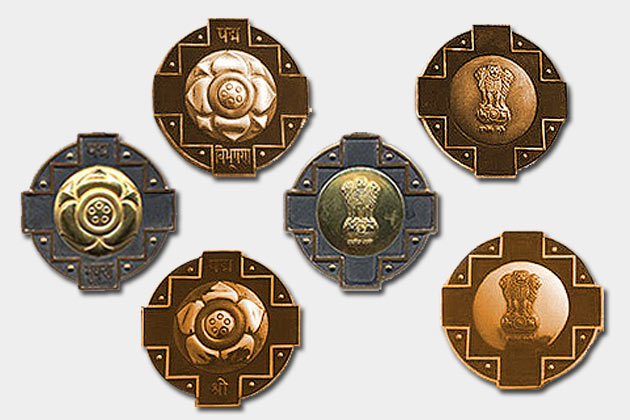
  • PADMA AWARDS 2016

    PADMA AWARDS 2016

    NEW DELHI (TIP): Former Comptroller and Auditor General of India Vinod Rai, actor Rajinikanth, spiritual guru Sri Sri Ravishankar and tennis player Sania Mirza are on the list of 112 Padma awardees whose names were announced on Monday by the government.

    The awards will be given across three categories: the Padma Vibhushan, Padma Bhushan and Padma Shri. These awards are given on Republic Day, for the over six decades now, to people who the government recognises have excelled in their fields.

    Padma Vibhushan

    1. Shri Rajinikanth    Art-Cinema    Tamil Nadu
    2. Ms. Yamini Krishnamurthi Art- Classical dance Delhi
    3. Smt. Girija Devi    Art-Classical Vocal    West Bengal
    4. Shri Ramoji Rao    Literature & Education-Journalism   Andhra Pradesh
    5. Dr. Viswanathan Shanta    Medicine- Oncology    Tamil Nadu
    6. Shri Shri Ravi Shankar    Others-Spiritualism    Karnataka
    7. Shri Jagmohan    Public Affairs    Delhi
    8. Dr.Vasudev Kalkunte Aatre    Science & Engineering    Karnataka
    9. Shri Avinash Dixit (Foreigner)    Literature & Education
    10. Late Shri Dhiru Bhai Ambani (Posthumous)    Trade & Industry    Maharashtra

    Padma Bhushan

    11. Shri Anupam Kher Art-Cinema Maharashtra
    12. Shri Udit Narayan Jha Art-Playback Singing Maharashtra
    13. Shri Ram V. Sutar Art-Sculpture Uttar Pradesh
    14. Shri Heisnam Kanhailal Art-Theatre Manipur
    15. Shri Vinod Rai Civil Service Kerala
    16. Dr. Yarlagadda Lakshmi Prasad Literature & Education Andhra Pradesh
    17. Prof. N. S. Ramanuja Tatacharya Literature & Education Maharashtra
    18. Dr. Barjinder Singh Hamdard Literature & Education – Journalism Punjab
    19. Prof. D. Nageshwar Reddy Medicine-Gastroenterology Telangana
    20. Swami Tejomayananda Other-Spiritualism Maharashtra
    21. Shri Hafeez Contractor Others-Architecture Maharashtra
    22. Shri Ravindra Chandra Bhargava Public Affairs Uttar Pradesh
    23. Dr.Venkata Rama Rao Alla Science & Engineering Andhra Pradesh
    24. Ms. Saina Nehwal Sports-Badminton Telangana
    25. Ms. Sania Mirza Sports-Tennis Telangana
    26. Ms. Indu Jain Trade & Industry Delhi
    27. Late Swami Dayanand Sarawasati (Posthumous) Others- Spiritualism Uttarakhand
    28. Shri Robert Blackwill (Foreigner) Public Affairs USA
    29. Shri Pallonji Shapoorji Mistry (NRI/PIO) Trade & Industry Ireland

    Padma Shri

    30. Smt. Prathibha Prahlad Art- Classical Dance Delhi
    31. Shri Bhikhudan Gadhvi Art- Folk Music Gujarat
    32. Shri Sribhas Chandra Supakar Art- Textile Designing Uttar Pradesh
    33. Shri Ajay Devgn Art-Cinema Maharashtra
    34. Ms. Priyanka Chopra Art-Cinema Maharashtra
    35. Pt. Tulsidas Borkar Art-Classical Music Goa
    36. Dr. Soma Ghosh Art-Classical Vocal Uttar Pradesh
    37. Shri Nila Madhab Panda Art-Film Direction and Production Delhi
    38. Shri S.S. Rajamouli Art-Film Direction and Production Karnataka
    39. Shri Madhur Bhandarkar Art-Film Direction and Production Maharashtra
    40. Prof. M. Venkatesh Kumar Art-Folk Artist Karnataka
    41. Ms. Gulabi Sapera Art-Folk Dance Rajasthan
    42. Smt. Mamta Chandrakar Art-Folk Music Chhattisgarh
    43. Ms. Malini Awasthi Art-Folk Music Uttar Pradesh
    44. Shri Jai Prakash Lekhiwal Art-Miniature Painting Delhi
    45. Shri K. Laxma Goud Art-Painting Telangana
    46. Shri Bhalchandra Dattatray Mondhe Art-Photography Madhya Pradesh
    47. Shri Naresh Chander Lal Art-Theatre & Cinema Andaman & Nicobar
    48. Shri Dhirendra Nath Bezbaruah Literature & Education Assam
    49. Shri Prahlad Chandra Tasa Literature & Education Assam
    50. Dr.Ravindra Nagar Literature & Education Delhi
    51. Shri Dahyabhai Shastri Literature & Education Gujarat
    52. Dr.Santeshivara Bhyrappa Literature & Education Karnataka
    53. Shri Haldar Nag Literature & Education Odisha
    54. Shri Kameshwaram Brahma Literature & Education – Journalism Assam
    55. Prof. Pushpesh Pant Literature & Education-Journalism Delhi
    56. Shri Jawaharlal Kaul Literature & Education-Journalism Jammu & Kashmir
    57. Shri Ashok Malik Literature &Education Delhi
    58. Dr.Mannam Gopi Chand Medicine-Cardio Thoracic Surgery Telangana
    59. Prof. Ravi Kant Medicine-Surgery Uttar Pradesh
    60. Prof. Ram Harsh Singh Medicine- Ayurveda Uttar Pradesh
    61. Prof. Shiv Narain Kureel Medicine- Paediatric Surgery Uttar Pradesh
    62. Dr.Sabya Sachi Sarkar Medicine -Radiology Uttar Pradesh
    63. Dr. Alla Gopala Krishna Gokhale Medicine-Cardiac Surgery Andhra Pradesh
    64. Prof. T.K. Lahiri Medicine-Cardio Thoracic Surgery Uttar Pradesh
    65. Dr. Praveen Chandra Medicine-Cardiology Delhi
    66. Prof. (Dr) Daljeet Singh Gambhir Medicine-Cardiology Uttar Pradesh
    67. Dr.Chandrasekar Shesadri Thoguluva Medicine- Gastroenterology Tamil Nadu
    68. Dr. (Mrs.) Anil Kumari Malhotra Medicine-Homeopathy Delhi
    69. Prof. M.V. Padma Srivastava Medicine-Neurology Delhi
    70. Dr. Sudhir V. Shah Medicine-Neurology Gujarat
    71. Dr. M. M. Joshi Medicine-Ophthalmology Karnataka
    72. Prof. (Dr) John Ebnezar Medicine-Orthopaedic Surgery Karnataka
    73. Dr. Nayudamma Yarlagadda Medicine-Paediatric Surgery Andhra Pradesh
    74. Shri Simon Oraon Other -Environment Conservation Jharkhand
    75. Shri Imitiaz Qureshi Other-Culinary Delhi
    76. Shri Piyush Pandey Others-Advertising & Communication Maharashtra
    77. Shri Subhash Palekar Others-Farming Maharashtra
    78. Shri Ravinder Kumar Sinha Others-Wildlife Conservation Bihar
    79. Dr. H.R. Nagendra Others-Yoga Karnataka
    80. Shri M. C. Mehta Public Affairs Delhi
    81. Shri M. N. Krishna Mani Public Affairs Delhi
    82. Shri Ujjwal Nikam Public Affairs Maharashtra
    83. Shri Tokheho Sema Public Affairs Nagaland
    84. Dr. Satish Kumar Science & Engineering Delhi
    85. Dr.Mylswamy Annadurai Science & Engineering Karnataka
    86. Prof. Dipankar Chatterji Science & Engineering Karnataka
    87. Prof.(Dr.) Ganapati Dadasaheb Yadav Science & Engineering Maharashtra
    88. Smt. (Prof.) Veena Tandon Science & Engineering Meghalaya
    89. Shri Onkar Nath Srivastava Science and Engineering Uttar Pradesh
    90. Ms. Sunita Krishnan Social Work Andhra Pradesh
    91. Shri Ajoy Kumar Dutta Social Work Assam
    92. Shri M. Pandit Dasa Social Work Karnataka
    93. Shri P. P. Gopinathan Nair Social Work Kerala
    94. Smt. Madeleine Herman de Blic Social Work Puducherry
    95. Shri Srinivasan Damal Kandalai Social work Tamil Nadu
    96. Shri Sudhakar Olwe Social Work Maharashtra
    97. Dr. T.V. Narayana Social Work Telangana
    98. Shri Arunachalam Murugantham Social Work Tamil Nadu
    99. Ms. Deepika Kumari Sports-Archery Jharkhand
    100. Shri Sushil Doshi Sports-commentary Madhya Pradesh
    101. Shri Mahesh Sharma Trade & Industry Delhi
    102. Shri Saurabh Srivastava Trade & Industry Delhi
    103. Sh Dilip Sanghvi Trade & Industry Maharashtra
    104. Dr. Keki Hormusji Gharda Trade & Industry Maharashtra
    105. Late Shri Prakash Chand Surana (Posthumous) Art – Classical Music Rajasthan
    106. Late Shri Saeed Jaffrey (NRI/PIO/Posthumous) Art- Cinema UK
    107. Shri Michael Postel (Foreigner) Art-Archaeology France
    108. Shri Salman Amin Sal Khan (NRI/PIO) Literature & Education USA
    109. Smt. Hui Lan Zhang (Foreigner) Others-Yoga China
    110. Shri Predrag K. Nikic (Foreigner) Others-Yoga Serbia
    111. Dr.Sundar Aditya Menon (NRI/PIO) Social Work UAE
    112. Shri Ajaypal Singh Banga (NRI/PIO) Trade & Industry USA

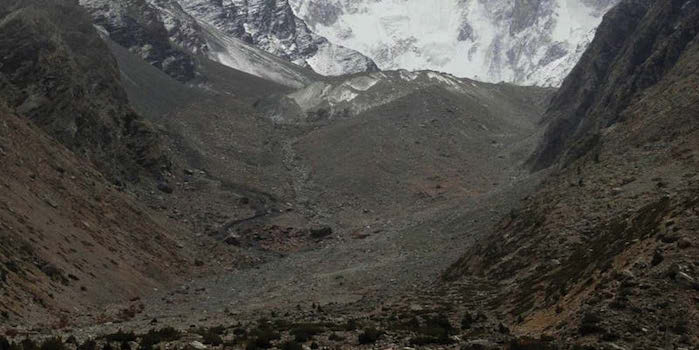
  • NELONG VALLEY: LADAKH IN UTTARAKHAND HIMALAYAS

    NELONG VALLEY: LADAKH IN UTTARAKHAND HIMALAYAS

    The spectacular Nelong Valley – a cold desert like area – tucked in the Uttarakhand Himalayas, close to the Indo-China border, was opened to tourists earlier this year after 53 years of remaining out of bounds post the 1962 War. While the state government opened it with much enthusiasm in May, it failed to promote the destination as a result less than 200 tourists visited the valley in the last six months.

    The valley, which has a similar landscape as that of Ladakh, is not only rich in natural beauty but also houses remnants of the treacherous Indo-China trade route – like a hand-built wooden bridge – that was used for centuries by the locals prior to the war.

    LADAKH IN UTTARAKHAND1About Nelong Valley

    The valley, situated at an altitude of around 11,000 feet above the sea level, falls under the Gangotri National Park in Uttarkashi district, is around 315 km from Dehradun. It is also only 23 kms away from Bhaironghati, a place just eight kms ahead of the famous Gangotri shrine.

    Entry to this restricted area perched close to the China border had remained forbidden for civilians after the 1962 war. The arid region was thrown open in May and closed for the season in November.

    Regulated tourism

    The government has put a cap on the number of vehicles entering the valley per day, which is maximum six with only four occupants in each. A permit letter from the sub-divisional magistrate is required to visit the area while entry of foreigners is banned. Though the government had opened the destination with high hopes, only 184 tourists visited the valley in six months.

    Manoj Jagudi an engineering graduate visiting the valley said, “This place is like a hidden treasure in the Himalayas but little is known about it outside the state.”

    Potential of Nelong Valley 

    Experts say the picturesque valley holds a tremendous potential to be developed into a niche tourism destination, just like the world-famed Valley of Flowers in Chamoli district of Uttarakhand that attracts thousands of tourists and nature enthusiasts every year.

    Retired senior bureaucrat SS Pangtey, considered an authority in Uttarakhand tourism, says the region is an untapped asset of natural splendor that could turn into a major attraction for domestic tourists if publicized properly.

    “It is a remote, virgin area which has a huge potential to become an adventure tourism hotspot if only the state is able to publicise it amply,” Pangtey says.

    He said regulated tourism (to prevent disturbance to local ecology) is alright “but even that will happen only when they get to know about the valley in the first place”.

    Arun Puri, an Uttarkashi-based tour operator, says that the “permit process should be simplified and a single window information system should be put in place in the state capital to facilitate tourists”.

    LADAKH IN UTTARAKHAND#Local heritage

    In the wake of the 1962 War, locals of the Rongba (Bhotiya) tribe residing in the valley were forced to shift to Bagori and Dunda villages in Uttarkashi district. Re-opening of the valley has brought much joy to them.

    “Prior to the war, trade with Tibet was the economic mainstay of the villagers in the valley. Few remnants of the trade route – the most prominent one being a narrow wooden bridge along the gorge – still remains intact. This valley could thus be highlighted as a heritage site,” said Jot Singh, a native of Nelong valley and now a farmer living in Bagori village.

    Vinod Panwar, a local from Uttarkashi, said Nelong Valley will make for an “added attraction” to tourism circuit in the region, thereby improving the local economy.

    Source: HT

  • India’s leading Ayurveda destinations

    India’s leading Ayurveda destinations

    From being the ‘science of life’, Ayurveda has become the ‘slice of life’ for many with the advent and positive growth of rejuvenation centres and Ayurvedic resorts in the country.
    People are willing to experience a ‘healthier’ side to an otherwise indulgent holiday by touring healing resorts as an escape from the mundane, hectic everyday existence. These resorts located at the outskirts of the cityscape over sprawling and pristine forests lure tourists into its peaceful and quiet edifices.

    Let’s discover and learn about some of the best Ayurveda resorts our country has:

    Somatheeram Ayurveda Resort, Kerala: Nestled on a hillock a few kilometres south of the Kovalam beach is the world’s first Ayurvedic resort Somatheeram. Spread across a wide expanse of greenery, Kerala prides in Somatheeram as a getaway destination for those in search of an Ayurvedic haven away from the cacophony of city life. Established in 1985, Somatheeram has emerged as one of the frontrunners in encouraging a culture of Ayurvedic holidays and meditation tours among travel enthusiasts. The serenity of the resort by the sea, goodness of traditional Ayurvedic therapies and a healthy diet routine help people unwind here.

    Acute health conditions of paralysis, fluctuating levels of blood pressure, arthritis, high cholesterol and breathing problems are first examined by a team of yoga experts and doctors after which a series of corresponding healing exercises and diet regime ensue.

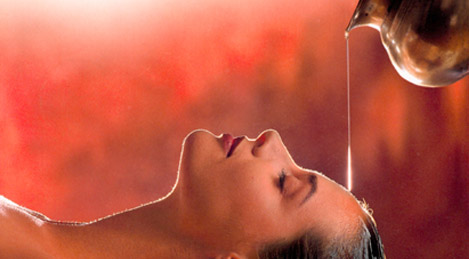
    Massage therapies: The massages here at Somatheeram serve more than a short-term purpose; the sessions are extensive and extend till days. ‘Pizhichil’ for instance is a special massage that uses a variety of herbal oils (lukewarm) and has been effective in curing diseases like paralysis and nervous disorders. Every session lasts 60-90 minutes over a span of 7-21 days. People with diabetes and obesity can go for the Ayurvedic ‘Abhyangam’ treatment which is again a type of oil massage for 45 minutes a day. ‘Nasyam’, ‘Snehapanam’ and ‘Kizhi’ are among the many treatments that have been proven medically capable of battling severe skin diseases, leukemia and sports injuries.

    Yoga classes and boat tours in the backwaters too are included in Ayurveda packages at Somatheeram.

    Where: Somatheeram Ayurveda Resort, South of Kovalam, Thiruvananthapuram. About 21 kms from International Airport at Thiruvananthapuram and about 9 kms south of the famous Kovalam beach.

    1)Ananda in the Himalayas, Uttarakhand: As the name suggests, the experience too replicates a blissful journey amid the towering and guarding Himalayas. Ananda focuses on an interesting and fruitful blend of Ayurveda and Aromatherapy with contemporary spa technology for complete wellness of the human body. Located 260 kms north of New Delhi, Ananda stands tall around Maharaja’s palace estate with the views of the Ganges on one side and the mountain peaks on the other pleasing the tourist’s eyes, mind and spirit upon waking up every morning. Yoga pavilions, landscaped gardens, terraces facing a clear sky, spas equipped with hydrotherapy services, a golf course on its Himalayan axle and Rejuvenation Cuisine are some of the many distinguishing features of the resort you can indulge in.
    Ayurveda, yoga & meditation:

    European and Thai treatments are employed in the spa boutiques here at Ananda. The Viceregal Hall is the quaint hillside garden that doubles as a refuge post an exhaustive yoga session. Marvel at the breathtaking panorama as you sip on the Himalayan tea. For couples, the Kama Suite with steam shower and exclusive massage facilities can surely add a sensual flavour to the Ayurveda tour. The Ayurvedic treatments are fashioned according to the Himalayan conditions. Use of less oil, slow and synchronised massages and regulation of a nutritious diet go into the making of customised treatments for guests under the supervision of physicians and therapists. An aftercare programme is planned for the benefit of the client at the last leg of the Ayurveda trip.

    Where: The Palace Estate, Narendra Nagar, Dist. Tehri-Garhwal, Uttarakhand

    Air: A 45-minute flight from New Delhi to Dehradun Jolly Grant airport followed by a one-hour drive.

    Train: A four-hour journey from New Delhi to Haridwar railway station followed by a one-hour drive.

    Road: The driving time between New Delhi and Narendra Nagar is approximately five and a half hours.

    1)Devaaya, The Ayurveda and Nature Cure Centre, Goa: If beaches and nightlife are the first things that come to mind upon hearing Goa, then probably it’s time to widen your horizon. As much as it is a ‘party’ destination, Goa as a city has carved an identity that appreciates art, culture and holistic living. And speaking of holistic living, the city has emerged as one of the potential tourist spots on the map of Ayurveda tourism in India. Coconut palms swinging to the rhythm of the breeze and the Mandovi River flowing alongside one of the islands in Goa complete the scenery at Devaaya Ayurveda Centre in Goa. Naturopathy becomes a way of life at this Ayurvedic paradise that brings together the essential elements of ‘Panchakarma’ treatments with yoga, meditation, music, lifestyle correction, diet planning and medicines for tourists. The centre has been designed on the science of ‘Vaastu Shastra’ that adds to the harmony of the overall rejuvenation process.

    Where: Devaaya – Ayurveda & Nature Cure Centre, Divar Island, Goa

    1)Kairali Ayurvedic Health Village, Kerala: The captivating beauty of the Western Ghats and the rich flora define the picturesque town of Palakkad in Kerala which is home to the Kairali Ayurvedic Health Resort. Ram Mohan, Vice President of the Resort is proud to declare how the Ayurveda village has travelled miles over the recent years, “Today, we have over 20 centres abroad apart from the 25 centres across India.” Ask him about the future of Ayurveda tourism in India and he has his reservations, “The Indian mindset is still not ready to embrace the culture of Ayurveda in a manner that the European market has possibly built an industry around. Patience is a virtue we have still not mastered the art of. It is believed that Ayurveda is an expensive affair but so is allopathy. If we are willing to shed a fortune on a bypass surgery then why not spend half the money on a recreational therapy that will guarantee the elimination of the ailment from its root?”, asks Ram. The system of Ayurveda he asserts is “not superficial but comes with permanent and effective results.”

    Agrees Niika Quistgard, Founder and Director Rasa Ayurveda Traditional Healing Centre for Women, Kerala and says, “People are often dissatisfied with allopathic medicines and are wary of the side-effects of drugs; natural alternatives and organic methods of healing are the preferred options. At Rasa Ayurveda we offer free consultation and treatment to women. All remedies are derived from herbal plants, a tradition that dates back to the era of our grandmothers,” adds Niika.

    The Leela, Udaipur:

    The city of lakes and palaces, The Leela’s ESPA Spa is yet another hot spot for Ayurvedic retreat. The ‘haveli’ style architecture of spas, tents done up in shades of royalty and opulence and the welcoming gardens contribute to the development of a relaxed mind and soul of the human body. Tricia Bannister, Group Spa Manager, says, “Our clientele has grown from in-house guests to both in-house and local guests requesting for a wellness experience set amidst the cultural heritage of Rajasthan.” From hot stone massages, facials, yoga and meditation, The Leela also features private yoga studio for visitors. On being asked if Ayurveda treatment is a rich man’s pastime Bannister replies, “There is a range of Ayurvedic resorts available for spa travellers, from more relaxed, to 5-star properties. Ayurveda tourism is growing dramatically in India; both for pure Ayurvedic treatments as well as Ayurvedic-inspired experiences. Travellers from all income-levels are curious to experience new wellness treatments,” adds Tricia.

    Where: The Leela Palace, Lake Pichola, Udaipur

  • Indian American billionaire to distribute 10,000 stationary bikes to generate electricity in India

    Indian American billionaire to distribute 10,000 stationary bikes to generate electricity in India

    WASHINGTON (TIP): Indian American billionaire Manoj Bhargava plans to distribute 10,000 stationary bikes to India in a concerted effort to provide electricity for millions of households.

    Manoj Bhargava, 62, plans to test the first 50 bikes in 15 or 20 small villages next year in Uttarakhand, before large-scale distribution commences.

    According to Bhargava, who accrued his colossal fortune by creating the now ubiquitous 5-Hour Energy drinks, just one hour of pedaling on one of his bikes will provide lights and basic appliances with energy for an entire day.

    “This is going to affect a few billion people,” Bhargava said, according to NDTV. The primary hurdle bearing down on the project is distribution, and how to incentivize distributors with profits.

    Ideally, if need be a village could pool its resources to buy one bike that could then be used to charge multiple batteries that could be swapped out of different homes.

    Regardless of the personal cost, Bhargava, whose family moved to the US in 1967, is set to distribute 10,000 free electric battery- equipped bikes in India next year.

    Bhargava’s Stage 2 Innovations laboratory in Farmington Hills, Mich. is responsible for several innovations that are geared specifically toward alleviating critical issues facing the world’s population.

    Several practical inventions created by engineers at Stage 2 Innovations are based on relatively simple technologies that have been around for decades, but adapted to be more compact, mobile or efficient, reported USA Today.

    He also has scientists in Michigan and Singapore delving into the graphene, which is 100 times more conductive than copper and 207 times stronger than steel by weight, according to Laptop Magazine.

  • ECUADOR GROUNDS MADE-IN-INDIA DHRUV CHOPPER, TERMINATES CONTRACT

    NEW DELHI (TIP): Ecuador has unilaterally terminated a contract with Hindustan Aeronautics Limited (HAL) after four of the seven Dhruv advanced light helicopters bought from the state-run Indian firm were involved in crashes.

    Defense minister Fernando Cordero announced the action during a news conference on Wednesday. He said two of the crashes were caused by mechanical failures. The three remaining Dhruv helicopters have been grounded.

    The development is a major setback for HAL, which has sought to market the Dhruv as a low-cost alternative to military and utility helicopters from Western nations. Work on the Dhruv began in 1984 and it first flew in 2002 after a troubled development programme.

    Four of the seven Dhruv helicopters delivered to Ecuador between 2009 and 2012 have crashed. One was assigned to transport President Rafael Correa, though he was not in the aircraft at the time.

    Ecuador earlier complained that HAL had failed to ship some parts for the helicopters, which were bought for a total of $45.2 million.

    HAL, which completed deliveries of the helicopters in 2012, has contested Ecuadorian claims that it failed to ship spares on schedule. A HAL spokesperson told leading defence publication Jane’s that maintaining the aircraft was “exclusively” the responsibility of the Ecuadorian Air Force as the 24-month warranty period for HAL to provide after-sales service support for the seven helicopters had long expired.

    Besides Ecuador, the Dhruv is also operated by the security forces of Nepal, Mauritius and the Maldives. The Dhruv has also been offered to Malaysia and Indonesia.

    More than 200 Dhruv helicopters are in service with the Indian military. They have been used extensively in relief operations after natural disasters such as the flash floods in Uttarakhand in 2013.

  • A Story of Courage and Determination | Arunima Sinha, the First Indian Amputee to Climb Mount Everest

    Ms Arunima Sinha of Lucknow (Uttar Pradesh) is the first Female Amputee of the world to climb Mount Everest. She is also the first Indian Amputee to climb Mount Everest. She reached the summit of Mount Everest on 21st May, 2013 at 10.55 hours after a hard toil of 17 hours, as a part of the Tata Group sponsored Eco Everest Expedition. She took 52 days to reach the summit.

    She was formerly a national level volleyball player. While traveling by train from Lucknow to New Delhi on 11th April, 2011, she was pushed out of the running train by the thieves wanting to snatch her bag and gold chain at about midnight. Her left leg below the knee was crushed. There were multiple injuries in her body. About 50 trains passed over her as she was lying between the two tracks in helpless condition. Next day morning she was rushed to Bareilley civil hospital with serious injuries. The doctors amputated her infected left leg below the knee to save her life. Then she was shifted to All India Institute of Medical Science, New Delhi. While she was undergoing treatment there for four months, she resolved to climb Mount Everest.

    When she was about one thousand feet away from the summit, her oxygen cylinder got almost empty. She was told to come back but she decided to take the risk of her life and marched forward and reached the summit. She placed the Indian flag on the top of the summit along with the flag of Tata Steel (sponsoring agency). Then she worshiped the photograph of Holy Trio (Swami Vivekananda, Bhagwan Shri Ramakrishna and the Holy Mother Sri Sarada Devi) and left it there for good. After the worship, she unexpectedly found an oxygen cylinder left by an Englishman, who had dropped one of the two cylinders as it was too heavy. This is how she survived and came back. She feels that she survived because of the grace of Holy Trio, therefore she has resolved to place the photos of Holy Trio on remaining six summits of the world, she has already placed the photographs on Mount Killmanaro of Africa (11 May, 2014 And Mt. Elbrus of Russia (24th July, 2014).

    She was felicitated by Dr. APJ Abdul Kalam, former President of India at Vadodra on August 10, 2013 during the international youth conference organized by Ramakrishna Mission, Vadodra. She was felicitated by Shri Narendra Modi, the then Chief Minister of Gujarat on January 11, 2014 at Mahatma Mandir, Gandhinagar in the presence of a large number of youths of India and abroad and a large number of dignitaries. She has received many prestigious awards from many reputed organizations — Salam India Award by India TV, Bharatiya Nari Shakti Award by India Today etc. The Vice-President of India Shri M. Hamid Ansari presented an ‘Amazing India Award’ instituted by Times Now channel on 6 Feb. 2014. The Governor of Rajasthan Mrs. Margret Alva presented International Vaish Federation Award .

    She has now dedicated herself to the social cause. She actively participated in Uttarakhand Relief Work. She is planning to start a Sports Academy for poor and differently abled people and is motivating thousands of youths throughout the country with her inspiring life story and the message of Swami Vivekananda. She has delivered many Motivational talks in educational institutions like IIM, Kolkata, IIM Ahmedabad, IIT, Kanpur and in international, national and regional level youth conventions organized by Ramakrishna Mission in various parts of India, and in many reputed companies. Both print media and electronic media have covered her life story in various ways and on various occasions which has inspired thousands of people throughout the country. A book on her life will be soon published by Penguin.

    She is now preparing herself for participating in Para Olympics, 2016 as a Blade Runner.

    Because of her extraordinary courage and self-confidence and inspiring speeches, she is now becoming a role model for modern youth. She is a living example of women Empowerment & Development. Her life story is at once thrilling and inspiring and practical demonstration of the power of faith.

  • US FOOD AND DRUG ADMINISTRATION BLOCKED MAGGI IMPORT IN JANUARY

    NEW DELHI (TIP): Nestle may have secured a clean chit for Maggi from the Singapore food regulator, but the US Food and Drug Administration (FDA), considered the world’s strictest regulator, had refused import of the noodles earlier this year.

    The US FDA’s website shows that in January this year, six import refusal reports were issued to Nestle India by it. The regulator rejected Nestle India’s instant noodles and chowmein, manufactured at the company’s factories in Goa (Bicholim), Uttarakhand (Pantnagar) and Punjab (Moga).

    In the report, the US FDA said,”The article appears to be misbranded in that the label or labeling fails to bear the required nutrition information.”

    This is significant because even in India regulators have raised questions about Nestle’s labeling and packaging of Maggi, while ordering a countrywide withdrawal and recall of all nine variants of the popular snack. Regulatory tests in India have found Maggi containing added monosodium glutamate (MSG). However, the company does not declare so on the pack. Similarly, Maggi samples were allegedly found containing lead in excess of the prescribed limit.

    Interestingly, after the latest recall of Maggi instant noodles in India, the US FDA has also sent samples of the product for testing.

    Apart from Nestle’s products, imports of several other India-made packaged food products including bakery items, snacks, noodles and macaroni from leading players like Haldiram, Britannia and Indo Nissin Foods, were also blocked by the US FDA in the first five months of 2015.

    In fact, data from the American regulator shows, India leads the list of rejected food products in various categories, with more than half of such items coming out of Indian facilities. Countries like Mexico and China are much bigger exporters to the US.

    However, in terms of number of snacks and bakery products rejected, India, the eighth largest supplier of food to the US, is much ahead. For instance, the US FDA rejected a total of 217 bakery products between January and May, of which 116 were from India and 17 from China.

    Most of the Indian snacks and bakery products rejected by the American regulator so far this year are from Haldiram. Some of the reasons cited include contamination, pesticide adulteration, decomposed substances, inadequate processing and insanitary conditions etc.

    In some of the orders, the regulator said the products can be “rendered injurious to health”. Several phone calls made to Haldiram to seek their response remained unanswered.

    Experts say like medicines, food safety regulation is also going to be strengthened in upcoming years. “The Indian food market is evolving and companies need to behave in a more responsible manner,” a former FSSAI official said.

  • OFF THE BEATEN TRACK – ROMANTIC GETAWAYS FOR COUPLES

    OFF THE BEATEN TRACK – ROMANTIC GETAWAYS FOR COUPLES

    Goa, Shimla, Lonavala – trying to plan a trip with your partner, but stuck with these names in your head? Go beyond the usual, and explore some beautiful locations across the country that can serve as great options for your romantic escape. From the riverside view of Majuli in Assam to the snow-capped mountains of Tawang in Arunachal Pradesh, let your wanderlust take you places.

    [quote_center]Lachen, Sikkim[/quote_center]

    Located 9,600 feet above sea level, at the confluence of Lachen and Lachung rivers, this picturesque town commands a panoramic view of the Himalayan range. The best time to visit the place is from November to June.

    On your itinerary

    • Thangu, a small village, not very far from Lachen, makes for a spectacular view.
    • Mountain treks.
    • Yumthang Valley is popularly known as the Valley of Flowers.
    • Gurudongmar Lake – one of the highest lakes in the world.

    [quote_center]Auli, Uttarakhand[/quote_center]

    Located in the Chamoli district, Auli has a generous population of coniferous and oak forests, and also offers a panoramic view of the Himalayas. With its moderate temperature during the summer months, it serves as a great vacation spot in the hot season.

    On your itinerary

    • Day hike to Gorson Meadows that provides scenic views.
    • A ride on one of the longest cable cars (Gondola) in Asia.
    • Chattrakund, a man-made lake close to Auli.

    [quote_center]Tawang, Arunachal Pradesh[/quote_center]

    This hill station is situated in the north-west part of Arunachal Pradesh. It shares its border with the Sela range in the east, Tibet in the north and Bhutan in the south-west. Away from the maddening buzz of a big city, Tawang serves as a quiet vacation spot.

    On your itinerary

    • Tawang Monastery is the largest monastery in India.
    • Jang Waterfalls are famous for its beauty.
    • Sela Pass remains covered with snow for most part of the year.
    • Tawang Handicrafts Centre promotes small-scale industries for local handicraft.

    [quote_center]Dhankar Gompa, Himachal [/quote_center]

    Dhankar Gompa is a village and also a Gompa (meditation room in urban Buddhist centres) in the district of Lahaul and Spiti in Himachal Pradesh. Gurgling rivers and crystal clear lakes dot the highlands of Lahaul, while an ancient civilisation has survived for nearly a thousand years, and has preserved its culture against the onslaught of modernity in Spiti.

    On your itinerary

    • Dhankar Monastery.
    • Dhankar Lake, which is a 1.5 km trek up from the monastery.
    • Nearby villages of Kaza, Key, Kibber and Tabo.

    [quote_center]Kovalam, Kerala[/quote_center]

    This small town in Kerala consists of three separated parts of three beaches – Hawah, Samudra and Light House. The largest among these is the Light House beach, which is a must-visit. It is close to Thiruvananthapuram.

    On your itinerary

    • Boating in the Karamana river provides spectacular views of the backwaters
    • Sunset at Edakkal.
    • Vizhinjam Rock Cut Cave temple has ancient sculptures on display.
    • Valiyathura Pier offers an amazing view of the coastline of Kovalam.

    [quote_center]Khajjiar, Himachal Pradesh[/quote_center]

    Often referred to as the ‘Mini Switzerland of India’, Khajjiar is a beautiful hill station in the Chamba district of Himachal Pradesh. It has thick deodar forests covering the slopes, and a breathtaking snow-line that rests above these woods.

    On your itinerary

    • Exciting hikes through the deodar thickets of the Dhauladhar Mountains.
    • 12th century temple dedicated to Khajji Nag that houses life-size wooden images of the Pandav brothers.
    • Several equestrian sports, paragliding and horse riding.

    [quote_center]Majuli, Assam[/quote_center]

    This is a large river island, nestled amidst the Brahmaputra in the upper region of Assam. Majuli is considered as one of Assam’s most well-kept and unexplored secrets, which leaves visitors awestruck with its natural beauty. To explore the island, travellers can either book a motorised private boat or travel like the locals in a ferry. The cultural exhibitions, exotic Assamese cuisine and the friendly local population make Majuli a picture-perfect destination to spend time with your loved ones.

    On your itinerary

    • Several Satras or monasteries like Daksinpath, Garamur and Auniati.
    • Mask-making workshops.
    • Raja Maidam, which has a vault of King Purandar Sinha. The monument was built as a tribute to the king.

    ROMANTIC GETAWAYS2[quote_center]Wayanad, Kerala[/quote_center]

    This district-town was formed by extracting areas from the Kozhikode and Kannur districts. The rugged terrain of the Western Ghats is its main attraction. It is situated at the tip of the Deccan Plateau, and shares borders with Karnataka and Tamil Nadu.

    On your itinerary

    • Neelimala, a great trekking destination, located in the southeastern part of the region.
    • Meenmutty Falls, the largest waterfall in the district.
    • Caves in Pakshipathalam.
  • Rahul treks to Kedarnath, pays respect to flood victims

    NEW DELHI (TIP): Congress vice-president Rahul Gandhi completed his trek up to the Kedarnath shrine on April 23 and said that he did so to pay his respects to the victims of the massive 2013 floods in the region.

    “I trekked in a bid to pay homage to those pilgrims who had trekked all the way to the shrine and were killed in 2013 disasters,” Rahul said after completing his 20km trek to the shrine.

    The Congress leader attempted to buttress the Uttarakhand government’s attempt to promote the Char Dhams –Badrinath, Kedarnath, Yamnotri and Gangotri – as a safe destination for tourists post 2013 deluge.

    “Pilgrims had a fear factor about safety at Kedarnath. My trek is an attempt to restore faith of pilgrims and locals,” Rahul said. Devastating flash floods in the state in 2013 killed nearly 5,000 pilgrims and dealt a blow to the tourism industry. Official figures suggest that the impact of the disaster continues to loom large over pilgrims visiting the Char Dhams – Badrinath, Kedarnath, Yamnotri and Gangotri – in Uttarakhand.

  • Govt mulls appointment of new Governors

    Govt mulls appointment of new Governors

    NEW DELHI (TIP): The Centre is mulling filling vacancies of Governors in nine states — five of them ruled by the Congress— soon as one Governor is holding the charge of four states while five others are in charge of at least two states each.

    “Since some Governors are holding additional charge of 2-3 states, new appointments are expected in the coming weeks,” official sources said.

    There are vacancies in Raj Bhavans in Assam, Himachal Pradesh, Meghalaya, Mizoram and Manipur, all ruled by the Congress. Opposition parties like JD-U, Left and TRS are in power in Bihar, Tripura and Telangana respectively.

    There is also vacancy in Punjab, ruled by the Akali Dal-BJP combine. The post of Lieutenant Governor in Puducherry is also lying vacant.

    West Bengal Governor Keshari Nath Tripathi is holding the additional charge of Bihar, Meghalaya and Mizoram while Nagaland Governor Padmanabha Acharya is in charge of the Raj Bhavans in Assam and Tripura.

    Haryana Governor Kaptan Singh Solanki has been given the additional charge of Punjab Governor and administrator of Chandigarh; Rajasthan Governor Kalyan Singh is holding the additional charge of Himachal Pradesh. Uttarakhand Governor KK Paul is in charge of the Raj Bhavan of Manipur too.

    ESL Narasimhan, who was the Governor of undivided Andhra Pradesh, continues to be the Governor of both Telangana and residuary Andhra Pradesh after the bifurcation while Lieutenant Governor of Andaman and Nicobar Islands Lt General Ajay Kumar Singh (retd) is holding the additional charge of the LG of Puducherry.

  • INVESTMENT PROPOSALS DON’T MEET PROMISES

    INVESTMENT PROPOSALS DON’T MEET PROMISES

    NEW DELHI (TIP): Investment proposals by corporates are generally associated with improving business sentiment and often linked with the possibility of job creation. The comparison of proposed investment with actual implementation and job creation in the past 23 years, however, shows that the actual delivery has fallen well short of the promise.

    Data from the department of industrial policy and promotion shows that between August 1991 and March 2014, the government received about 94,000 investment proposals. These proposals include Industrial Investment Intentions through Entrepreneurs Memorandum — IEMs (delicensed sector) and Direct Industrial Licences (licensable sector).

    Put together, these proposed the investment of more than Rs 102 lakh crore and were supposed to create 2.3 crore jobs. The data on actual implementation of these proposals shows that only Rs 5.1 lakh crore was actually invested and just 20.1 lakh jobs created. That’s less than 5% of the proposed investments and 8.9% of the promised jobs.

    A state-wise analysis of proposals shows that between August 1991 and March 2014 corporates proposed to invest Rs 15.4 lakh crore in Orissa —the highest in the country. It was followed by Gujarat and Chhattisgarh receiving over Rs 10 lakh crore of proposed investments and Maharashtra just a tad below that mark. Overall, there were 15 states, which were each supposed to get over Rs 1 lakh crore of investments in these 23 years.

    When one analyses actual investments, Haryana has been the most successful among these 15 states in converting proposals to reality as 18.9% of the proposed money actually reached the state. It is followed by Gujarat (12.6%) and Uttar Pradesh (11.4%). The states that fared the worst in this conversion are Bihar, Jharkhand, Chhattisgarh and Orissa, where less than 1% of the proposed money actually arrived.

    So, what is the investment to job creation ratio? Overall, the Rs 5 lakh crore actually invested created a little over 20 lakh jobs, which amounts to four jobs per crore of investment. There were 25 states which witnessed the actual investment of more Rs 1,000 crore. Among these states, Jammu and Kashmir witnessed the most labour intensive investments, while Gujarat had the most capital intensive ones. Every crore of rupee invested in Jammu and Kashmir created about 12 jobs, while in Gujarat a crore of investment yielded only two jobs.

    In the investment to job creation ratio, Jammu and Kashmir is followed by Goa, Uttarakhand, Kerala and Punjab, where ten or more jobs were created per crore of investment. The worst state/UTs in this list are Madhya Pradesh, Jharkhand, Daman & Diu, Uttar Pradesh and Gujarat.

  • RSS body seeks donations to fund Christmas ‘conversions’ in Aligarh

    RSS body seeks donations to fund Christmas ‘conversions’ in Aligarh

    ALIGARH (TIP): Dharam Jagran Samiti, an RSS offshoot, has distributed pamphlets in Aligarh seeking donations for converting Christians and Muslims to Hinduism. The pamphlet says it costs Rs 2 lakh to convert a Christian and Rs 5 lakh to convert a Muslim. It has set December 25 as the date for a major conversion ceremony and put down an annual target of 2 lakh conversions — 1 lakh Muslims and 1 lakh Christians. The pamphlets, carrying the letter head of the Dharam Jagran Samiti, pashchim chhetra (western UP, Braj prant, Meerut and Uttarakhand), have found their way to many houses in Aligarh.

    It proposes a fund for a grand “ghar vapsi” (homecoming) of Christians and Muslims, who are a “samasya” (problem) in the country. The letter addresses recipients as “bandhuvar” (friends) and says: “Lots of money will be required in the ‘ghar vapsi’ because the work of conversion is increasing — more workers and more people to be covered. Please contribute money so that all arrangements are in place.” Asked why are Muslims and Christians a “samasya”, Kanshinath Bansal, a key member of the Samiti, said, “Because Christianity is a samasya. Muslim (sic) is also a samasya.

    One worker needs that much money to work on a samasya every year.” This came even as Yogi Adityanath, the firebrand BJP MP from Gorakhpur, confirmed his visit on December 25 to Aligarh for an event that aims to convert 5,000 Muslims and 1,000 Christians at the local Maheshwari College. Adityanath said: “The administration and media have given it an exaggerated look. People are willingly converting themselves in ‘ghar vapsi’. The event will happen as scheduled and I will be there.” He added, “When Hindus convert to Islam or to Christianity, nobody comes in for a check.

    Why is this being done when they want to convert back to Hinduism? There are many other issues that the administration and media should concentrate on rather than this. Muslims in Agra had also written a letter asking for a mandir. The situation went out of control because of the interference of media, administration and sundry religious leaders.” The district administration, already anxious, said it is not taking any chances. J Ravinder Goud, SSP Aligarh, said, “There is no question of giving permission for the ‘ghar vapsi’ that is being planned in Maheshwari College. The issue has already flared up.

    We are not allowing it and if in case there is a violation, we will deal with the situation accordingly.” Not long ago, the Hindu outfit had taken over a small church on the outskirts of Aligarh, replacing the cross with a Shiva picture. Then, too, it had conducted a ‘ghar vapsi’ for 72 Valmikis, all of them Christians. Christian and Muslim groups reacted with anger and caution. Community leader Vincent Joel said, “Ever since the church incident in Asroi, Christians have been praying for the dawn of achche din, where the country is not divided on the basis of religion or caste. We are praying to the Lord to grant the perpetrators of such mischief some wisdom.” Muslim organizations Millat Bedari Muhim Committee and Forum for Muslim Studies and Analysis condemned the “open and public call for conversion”.

    Professor Razaullah Khan, president of both the outfits, said, “It is very disturbing to see how publicly they call for ghar vapsi. (UP) elections are slated for 2017 and now this gathering is being done to polarize society and divide votes. We should not let it happen.”

  • By-poll results shock BJP

    By-poll results shock BJP

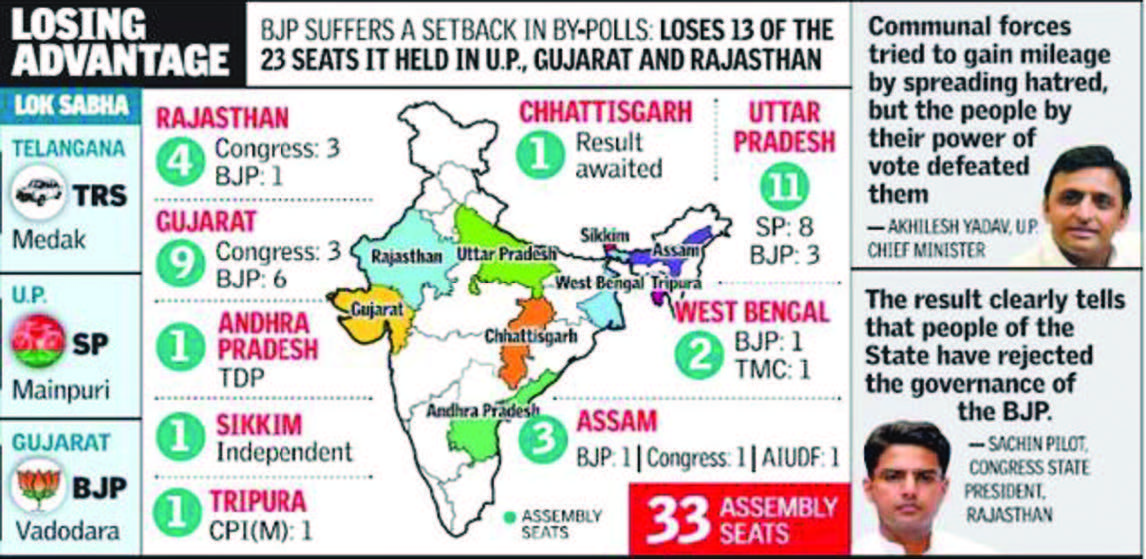
    New Delhi (TIP): The results of the Assembly byelections have come as a blow for the BJP in Uttar Pradesh, Rajasthan and Gujarat — the states it had swept in the Lok Sabha polls four months ago — losing 13 of the 24 seats held by it. Of the 32 Assembly seats across nine states for which counting of votes was held today, the BJP won 12, Congress seven and Samajwadi Party eight while TDP (Andhra), Trinamool Congress (West Bengal), AIUDF (Assam) and CPM bagged one each. One seat in Sikkim was won by an Independent.


    This is the third consecutive setback for the saffron party after its disappointing performance in Assembly byelections in Bihar, Uttarakhand, Karnataka and Madhya Pradesh in the past two months. All 11 seats in Uttar Pradesh, Gujarat (9) and Rajasthan (4) were held by the BJP and the bypolls were necessitated after the sitting MLAs were elected to the Lok Sabha. It was Uttar Pradesh — the party’s recently acquired stronghold where the BJP managed a near-total sweep in the LS elections — that delivered a humiliating blow to the saffron party as it lost seven of the 11 seats held by it, including the one held by its ally, the Apna Dal.


    The BSP’s absence in the byelections had made it a virtual straight fight between the SP and the BJP in the politically crucial state. BJP strongman Amit Shah was credited with crafting the spectacular win for his party in UP in the Lok Sabha polls. The party lost six out of 13 seats in Rajasthan and Gujarat, where it’s in power. Lost for words, BJP leaders could not even blame rival parties for playing foul in the elections. Senior BJP leader Rajiv Pratap Rudy said the results “deserve a small introspection”. “This is not a national mandate. It is a localised issue.


    Surely, it is a wake-up call for better planning in the upcoming Haryana and Maharashtra Assembly elections,” he said. Senior leader Uma Bharti dismissed questions about efficacy of the “Modi wave” saying “state leaders and workers need to introspect.” It was a significant comeback by the SP, which won eight out of 11 seats in Uttar Pradesh —and the Congress, which trounced BJP on three out of four seats in Rajasthan. “The people of the state have given a befitting reply to the communal forces and clearly expressed their desire for harmony and brotherhood,” said a beaming UP CM Akhilesh Yadav.


    Among BJP’s big losses is the Rohaniya seat, which falls within Modi’s parliamentary constituency Varanasi. The saffron party just about managed to hold to its own in Modi’s home state Gujarat, winning six out of nine seats. Rajasthan Chief Minister Vasundhara Raje was left re-faced as the Congress won three out of four seats. One of the seats — Surajgarh—was being contested by her close aide Digambar Singh who lost to Shravan Kumar of the Congress by 3270 votes.


    The BJP had swept the Lok Sabha and Assembly elections in the desert state earlier this year. High on the win, Rajasthan Congress chief Sachin Pilot advised the “BJP to take a lesson from these elections and introspect” The BJP retained Kota South, losing Surajgarh, Weir and Nasirabad to the Congress. The only silver lining for the BJP was the inroads into WB where it has won Basirhat Dakshin (South) seat.

  • RAIL BUDGET LIKELY TO FOCUS ON PASSENGER SAFETY

    RAIL BUDGET LIKELY TO FOCUS ON PASSENGER SAFETY

    NEW DELHI (TIP): On the back of two train accidents within a month of Modi government taking charge, railway minister Sadanand Gowda is likely to announce a slew of measures in his July 8 budget to enhance passenger safety. The may include installing indigenous Train Collision Avoidance System (TCAS) on more routes to enable safe running of more trains on the same track even under low visibility. As railways are facing a huge fund crunch, the plan support for the staterun transporter for special projects, can see a significant hike in the budget. An official said the budget may propose to set up a dedicated safety fund. The fund is likely to be created by imposition of a safety cess on fares.

    The budget is also expected to provide clarity on foreign direct investment in the sector as the BJP government has hinted at allowing 100% FDI in railway infrastructure (including high speed tracks, dedicated freight corridors and station development). Following Prime Minister Narendra Modi’s footsteps, Gowda is also pushing to make the railways go green. The budget is expected to announce projects related to harnessing solar energy and development of offshore wind energy, including those related to use of solar energy to power local trains and use of innovative technology to run AC coaches.

    The focus is expected to be on electrification of around 2000 km of tracks, considering that the railways have almost 38% (24,800 km) of its network electrified, carrying almost 67% of the freight traffic and 51% of the passenger traffic. The budget is likely to have many sops for northeast region, another priority area for the Modi government.

    The railways would announce to expedite the construction of 14 strategic projects — mainly in border areas — that are struck for environment clearance and paucity of funds. These projects involve laying down of 2,888 km of railway tracks in Jammu & Kashmir, Arunachal Pradesh, Assam, Himachal Pradesh, Uttarakhand, Rajasthan and Punjab. The budget could allocate more funds for faster execution of dedicated freight corridor to ensure speedier transportation of goods in important routes.

  • INDIA AND US TO HOLD TOP-LEVEL MEET TO BOLSTER MILITARY TIES

    INDIA AND US TO HOLD TOP-LEVEL MEET TO BOLSTER MILITARY TIES

    NEW DELHI (TIP): A 26-member delegation led by General Vincent K Brooks, commanding general of the US Army Pacific, will be in New Delhi on March 18-20 for the 18th meeting of the India-US executive steering group (ESG). The Indian delegation, in turn, will be led by director-general of military operations Lt-General P R Kumar during the talks.

    “The ESG will discuss measures to further crank up military-to-military ties through joint combat exercises, doctrinal and operational exchanges. The two armies are slated to conduct their annual Yudh Abhyas counterterrorism exercise at Chaubatia (Uttarakhand) in July- August this year,” said an official. The exercise, the last edition of which was held at Fort Bragg in the US last May, was to be held earlier this year but got delayed by a few months amid the diplomatic wrangling during the Devyani Khobragade episode.

    The expansive India-US defense cooperation over the last decade has seen the armed forces from the two countries conduct over 70 exercises, including the highend Malabar naval combat exercises. India has also invited Japan to join the Malabar war games in August- September this year, an offer which was extended during Japanese PM Shinzo Abe visit here in January. The US has already bagged defense deals close to $10 billion over the last decade in the lucrative Indian defense market, with the latest being the $1.01 billion one for six additional C-130J “Super Hercules” aircraft.

    The other deals on the anvil are the ones for 22 Apache attack helicopters, 15 Chinook heavy-lift helicopters, four P-8I maritime patrol aircraft and 145 M-777 ultra-light howitzers, together worth another $4 billion or so. Desperate to displace Russia as India’s largest defense supplier, the US is promising to treat India on par with its closest allies like the UK and Australia for providing cutting-edge military technology.

    Towards this end, the US has also managed to almost scuttle an almost-finalized over Rs 15,000 crore project with Israel to equip the over 380 infantry battalions of the Indian Army with third-generation, shoulder-fired antitank guided missiles (ATGMs). After the US initially created roadblocks in the transfer of technology (ToT) for its “Javelin” ATGMs, India had turned to the Israeli “Spike” ATGMs for the project. India is keen on an initial import of the tank-killing missiles followed by ToT to defense Public Sector Unit Bharat Dynamics for indigenous manufacture. But after the US recently offered a joint project to manufacture the next-generation of ATGMs, the Indian defense ministry says both the Israeli and American proposals are now being studied to select the better option.

  • UTTARAKHAND CHIEF MINISTER VIJAY BAHUGUNA RESIGNS

    UTTARAKHAND CHIEF MINISTER VIJAY BAHUGUNA RESIGNS

    DEHRADUN (TIP): Uttarakhand chief minister Vijay Bahuguna, 66, has finally paid the price for the shoddy relief and rehabilitation work carried out by his government after last year’s flash floods.

    He drove down to Dehradun Raj Bhawan on January 31 and handed over his resignation to Governor Aziz Qureshi. Union minister Harish Rawat, who claims to enjoy the backing of a majority of the Congress lawmakers in the state, is the frontrunner in the race to replace Bahuguna. Bahuguna’s removal has been on the cards for quite some time, and is being viewed as part of the organizational revamp being undertaken by the Congress leadership ahead of the national elections, due by May this year.

    The party had earlier changed the state presidents of Rajasthan and Madhya Pradesh. Bahauguna, a surprise pick for the Uttarakhand chief minister’s post after the polls held in March 2012 had thrown a hung assembly, has earned a lot of flak for his poor handling of the relief work undertaken by his government after the natural calamity that wreaked havoc in large parts of Tehri district. He got a taste of popular disaffection against his rule in October, 2012, when his son Saket suffered a humiliating defeat at the hands of the BJP in the by-election to the Tehri Lok Sabha constituency.

    Bahuguna’s leadership has since then been called into question. In the 2012 polls, the Congress won 32 seats in the 70-member assembly, and was only marginally ahead of the BJP, which won a seat less. Despite commanding the support of a majority of the MLAs, Mr Rawat, who too is 66-years-old, found the chief minister’s post eluding him. It was, instead, offered to Bahuguna, the MP from Tehri. The Congress government in the state has the backing of three BSP lawmakers and the lone Uttarakhand Kranti Dal legislator. Three independent legislators too have offered their support to the Congress government. Uttarakhand sends five members to the Lok Sabha, and the party had made a clean sweep in 2009. The BJP had drawn a blank.

  • Himachal, Uttarakhand sops to continue till 2017

    Himachal, Uttarakhand sops to continue till 2017

    NEW DELHI (TIP): The Cabinet Committee on Economic Affairs (CCEA) extended the special industrial package for Himachal Pradesh and Uttarakhand till 2017, a move that will boost industrialisation and create more employment in the two hilly states. Both the states have seen phenomenal growth in investment and industrial growth in the last 10 years due to the package.

    However, the neighbouring states like Punjab have been opposing the extension of the package on the plea that it is driving industry out of the state towards the hilly states because of special incentives. Welcoming the decision to extend the package, Commerce and Industry Minister Anand Sharma said this would generate gainful employment, especially for the rural youth. “It will also give a fillip to manufacturing and the small and medium enterprises in these two states”, he said.

    A special package for industrial development in both the states was extended by the government in 2003 as these states were lagging in industrial growth. In 2007, it was curtailed, before being restored till 2010. The capital investment subsidy was one of the major components of a special industrial package offered to the states by the union government. The objective of the policy announced in 2003 was to provide the required incentives as well as enabling environment for industrial development, improve availability of capital and increase market access to provide fillip to private investment.

  • TWO DISASTERS, DIFFERENT APPROACHES

    TWO DISASTERS, DIFFERENT APPROACHES

    Natural disasters left many dead and homeless in India in 2013 but there was a lesson to be learnt after the government averted a major crisis when tropical storm Phailin hit the country’s eastern shores in October. The government had issued warnings days in advance and evacuated thousands to reduce the number of casualties. Contrary to this, floods in the mountainous state of Uttarakhand in northern India killed hundreds of people in June. Relatives of those dead or stranded in the state were left in despair due to a lack of coordination in rescue efforts. Many of those who died were tourists travelling to the state for pilgrimage. Newspapers blamed rampant construction, mining and massive power projects in the northern Himalayan states for the flooding and termed it a man-made disaster.

  • Seemandhra employees call off strike after 66 days

    Seemandhra employees call off strike after 66 days

    HYDERABAD (TIP): In a major development that could help restore normalcy in Seemandhra, the Andhra Pradesh government employees from the region on October 17 decided to call off their indefinite strike to oppose the central government’s decision to carve out a separate Telangana. Leaders of various associations of employees agreed to temporarily call off the 66-day-long strike after talks with Chief Minister N. Kiran Kumar Reddy. State ministers Anam Ramnarayana Reddy and P. Satyanarayana announced after the talks that the employees would attend their duties from Friday. They said the associations agreed to call off their strike following some assurances given by the chief minister to address their concerns. Kiran Reddy assured employees that he would write a letter to Prime Minister Manmohan Singh on referring the Telangana resolution to state assembly. The chief minister, in his letter, would urge the prime minister to follow the Constitutional process adopted while carving out Jharkhand, Chhattisgarh and Uttarakhand, said a statement issued from the chief minister’s office.

    The employees wanted an assurance that the resolution would come before the assembly so that it could be defeated. Ramnarayana Reddy said all Seemandhra Congress leaders including the chief minister and state Congress chief were committed to defeat the resolution in the assembly. He said they would all work with the employees to keep the state united. Over 400,000 government employees of Seemandhra (Rayalaseema and coastal Andhra) were on strike since Aug 12 to oppose the decision to bifurcate the state. The strike had crippled the state administration in all 13 districts of the two regions. Over 200,000 teachers and employees of state-owned Andhra Pradesh State Road Transport Corporation (APSRTC) last week called off their strike. The chief minister had appealed to all employees to call off the strike as it has paralysed the administration and all welfare and development programmes in Seemandhra. Kiran Reddy noted that the employees participated in the strike for 66 days and did not draw Rs.2,700 crore salaries despite the hardships faced by their families. Assuring the employees that there is no change in his stand that the state should not be divided, he promised to provide them an opportunity to place their concerns before the group of ministers constituted by the union cabinet. Andhra Pradesh Non-Gazetted Officers (APNGOs) Association president P. Ashok Babu said they withdrew the strike temporarily. He warned that if a bill is tabled in parliament for formation of Telangana state, they would again go on strike. He quoted the chief minister as saying that Telangana issue would come to the assembly twice. Ashok Babu also demanded that Article 371 D be protected as it provides some safeguards to Seemandhra in recruitment of government employees.