Tag: Vappala Balachandran

  • America holds the key to ending the war in Gaza

    America holds the key to ending the war in Gaza

    The involvement of a Bedouin in violence against Israel might fly in the face of Tel Aviv’s claims that the Bedouins living in the country have been victims of Hamas

    “West Asia observers now feel that Netanyahu’s prolonged war in Gaza, aimed at keeping him in power, is going to affect Jordan adversely. David Hearst, Editor-in-Chief of the Middle East Eye, had observed on August 23 that Jordan’s “balancing act is at risk of crashing down” with the latest Israeli intrusion into the West Bank, reviving the old Zionist policy to consider Jordan as the ‘only Palestinian state’, combined with Donald Trump’s latest idea of a Jordanian-Palestinian confederation. He has stated: “The crudest version of this plan entails direct threats to the Palestinian villages and towns of the occupied West Bank to leave or be burnt out by settlers.”

    By Vappala Balachandran

    The killing of three Israeli civilians near the Allenby (King Hussein) Bridge border crossing in the occupied West Bank on September 8 by Maher Ziab Hussein al-Jazi, a former Jordanian soldier, has added a new dimension to the Israel-Hamas war by directly involving Jordan in the conflict.

    The Allenby Bridge was originally a World War I crossing point for the British forces from the East to the West Bank. It was named after Field Marshal Edmund Allenby, who had led the Palestine campaign. The recent incident has revealed different dimensions of the Israel-Jordan relationship in terms of security, diplomacy and trade.

    During the late 1980s, I was taken on a conducted tour of the Allenby Bridge, 5 km east of Jericho city in the West Bank, for the showcasing of Israel’s preventive security measures to track terrorists and drug traffickers crossing over from Jordan to Israel. We did not have diplomatic relations with Israel then. Apart from video tracking, the bridge had a facility to track border crossings on foot through a study of sand footprints by expert Bedouin trackers. I also met members of the Israel Defense Forces’ (IDF) Bedouin Tracker Unit.

    According to the IDF, on September 8, Maher Ziab drove a truck from Jordan, “exited the truck and opened fire,” killing three Israeli civilian employees. Why didn’t the IDF, with their most modern, AI-driven mass facial-recognition tools like Red Wolf, Blue Wolf and Wolf Pack, detect him while he was on the Allenby Bridge? Also, the bridge is a high-security zone in which all persons crossing get searched at least three times. That the Jordanian could travel with a weapon means that it is a serious security breach.

    The IDF had shot dead a Jordanian judge, Raed Zeiter, in 2014 on the bridge merely on the basis of suspicion, something that Israel had to publicly apologize for. Inquiries later revealed that Raed was going to his hometown, Nablus, in the West Bank. The killing had led to strong protests in Jordan and the West Bank. The Arab media had also reported that there were large-scale protests in Jordan after he was killed.

    Notably, Maher Ziab, who was shot dead by the IDF, belonged to the influential Huwaitat tribe among the Bedouins. He was a resident of the Husseiniya area in Jordan’s southern Ma’an Governorate. Huwaitat traces its origin to Fatima, daughter of the prophet Muhammad. Some of them were part of the historical ‘Great Arab Revolt’, described by Lawrence of Arabia in his ‘Seven Pillars of Wisdom’.

    The involvement of a Bedouin in violence against Israel might fly in the face of Tel Aviv’s claims that the Bedouins living within Israel have been victims of Hamas, as they were supporting the regime. It may be recalled that Kaid Farhan Elkadi, a Bedouin hostage who was found by the IDF in a Gaza tunnel on August 27, was given a rapturous welcome. However, in the wake of Elkadi’s rescue, international media outlets that visited his village in Negev found strong resentment against the Benjamin Netanyahu regime.

    Originally from Saudi Arabia, the Huwaitat had migrated to Jordan, Syria and Egypt (Sinai Peninsula), where they are found in large numbers. In 2020, Huwaitat leader Suleiman Mohammed al-Taqique al-Hwaiti had started an agitation against a new Saudi project called Neom, a planned mega-city, that could result in the displacement of 20,000 Huwaitat tribe members. This resulted in violence and brutal suppression by Saudi Arabia. If the Huwaitat decide, they could open another front against Israel.

    Diplomatically, Jordan — which has been highly critical of Netanyahu’s handling of the Gaza war — has a peace accord with Israel that was signed in 1994 by King Hussein and then Prime Minister Yitzhak Rabin in the presence of US President Bill Clinton. Annexe III deals with the details of cooperation on crime. This is under strain, as revealed by the joint statement issued by Jordan, Qatar, Palestine and Kuwait on September 3 condemning PM Netanyahu’s accusations that weapons were being smuggled to the Hamas through the Egyptian border.

    West Asia observers now feel that Netanyahu’s prolonged war in Gaza, aimed at keeping him in power, is going to affect Jordan adversely. David Hearst, Editor-in-Chief of the Middle East Eye, had observed on August 23 that Jordan’s “balancing act is at risk of crashing down” with the latest Israeli intrusion into the West Bank, reviving the old Zionist policy to consider Jordan as the ‘only Palestinian state’, combined with Donald Trump’s latest idea of a Jordanian-Palestinian confederation. He has stated: “The crudest version of this plan entails direct threats to the Palestinian villages and towns of the occupied West Bank to leave or be burnt out by settlers.”

    At the same time, prominent US Democrats like Senator Chris Van Hollen have criticized President Joe Biden’s policy on Israel on the ground that it violates American law. In March, Hollen said Netanyahu’s actions in Gaza preventing US humanitarian aid had violated Section 620I of the Foreign Assistance Act of 1961 — also known as the Humanitarian Aid Corridor Act — and stated that no arms should have been given to Israel.

    Jonathan Steele, The Guardian’s former foreign affairs correspondent, reminds us how the Secretary of State in President HW Bush’s Cabinet, James Baker, had dealt with Netanyahu in 1989 by banning him from entering the US State Department. He says that Baker was furious with Netanyahu, who was then Israel’s Deputy Foreign Minister under Prime Minister Yitzhak Shamir, for describing American policies as a ‘distortion and lies’.

    Bush and Baker had refused US assistance of $10 billion until Israel’s illegal settlements in the West Bank and Jerusalem ended. Consequently, Shamir faced a defeat in the June 1992 elections.

    Steele concludes: “US pressure on Israel has worked to bring positive change in the past. It needs to be applied to do so again.”
    (The author, a columnist, is an Indian national security intelligence specialist and former Indian police officer)

  • Israel at a crossroads after apex court verdict

    Israel at a crossroads after apex court verdict

    Israeli observers don’t feel that the court judgment would end the present domestic turmoil.

    By Vappala Balachandran

    Four developments, directly or indirectly related to the Israel-Hamas war, have taken place this week. On New Year’s Day, Israel’s Supreme Court pronounced the long-awaited judgment on the amendment passed by the parliament on July 24, 2023. In an 8-7 verdict, the court struck down the Netanyahu cabinet’s amendment to the ‘basic law’ that had removed the court’s power to declare the government’s decisions as ‘unreasonable’. This amendment had triggered 10-month-long protests and created unprecedented fissures within the Israeli society before the brutal Hamas attack of October 7, 2023.

    On January 2, Israel assassinated Saleh al-Arouri, deputy head of the political bureau of Hamas and co-founder of its military wing Izzedine Al-Qassam Brigades, in a drone attack while he was holding a meeting in Beirut. Some other high-ranking Hamas members were also killed. This made Lebanese Prime Minister Najib Mikati condemn the strike as an ‘Israeli crime’ aimed at dragging Lebanon into a “new phase of confrontations” in the present war. Al-Arouri was second only to Hamas chief Ismail Haniyeh and was the operational link with Hezbollah leader Hassan Nasrallah. Yahya Sinwar and Al-Arouri were reportedly leading the present phase of the war in Gaza.


    Israel is considering contesting South Africa’s suit at the International Court of Justice, filed on December 29, 2023, for an urgent order declaring that Israel had breached its statutory obligations under the Genocide Convention during its war in Gaza. The Netanyahu government is particularly sore with South Africa for comparing the plight of Palestinians with that of the Blacks in South Africa during the apartheid era. Israeli paper Haaretz reports that the name of American lawyer Alan Dershowitz is being considered for the hearing.

    The fourth development is the reported decision by the US authorities to reduce their naval presence in the region by the withdrawal of US aircraft carrier Gerald Ford and its task force from the West Asian seas, leaving only one carrier, Dwight D Eisenhower, there. Israeli media has attributed this setback to the ‘tense’ Biden-Netanyahu exchanges on the Gaza war, his ‘dismissive’ attitude towards the Palestinian Authority (PA) and the statements of Netanyahu’s right-wing colleagues about the future management of Gaza by excluding PA.

    The January 1 court judgment must be studied in the peculiar background of Israel not having a written Constitution, although United Nations Resolution 181 on the partition of Palestine (November 1947) and Israel’s declaration of independence (May 1948) had envisaged the drafting of a Constitution. This was not done due to many reasons. Firstly, the draft prepared by Shalom Zvi Davidowitz, an American rabbi living in Israel, contained many references to God which were opposed by the ‘secular’ lobby.

    According to historian Anita Shapira, discussions in 1949-50 did not settle anything and reached a deadlock. Hence, the first Knesset decided on a compromise resolution by Israeli politician Yizhar Harari that instead of a single document, a series of ‘basic laws’ would be written by the future Knessets. This was called the ‘Harari Resolution’. As a result, 11 ‘basic laws’ were written between 1958 and 1992. Israel is guided by these laws.

    Shapira also quoted Israel’s founding father David Ben-Gurion, a ‘lifelong’ socialist, who spoke against having a written Constitution due to a peculiar reason — that Israel did not have its ‘Aliyah’ (migration) yet. She also felt that Ben-Gurion was trying to avoid internal quarrels, especially with religious parties.

    Suzie Navot, Vice-President of Israel Democracy Institute, quoted Ben-Gurion: “Let them come, let them make Aliyah, and then we’ll see. If all of them come from America, we will have a Constitution like America’s. If all of them come from Russia, perhaps we will have a different Constitution.” She added that the religious parties felt that they already had a “Constitution, the Torah, and there was no need for another one written by human beings”.

    Israeli observers do not feel that the court judgment would end the present domestic turmoil. They quote Netanyahu’s statement (July 28, 2023) that Israel would enter ‘uncharted territory’ if the court struck down his amendment to the highly contentious ‘reasonableness’ law. When asked whether he would abide by the court ruling to strike it down, he refused to say anything. But his party Likud said it was “unfortunate that the court decided to issue a ruling at the heart of the societal disagreement in Israel when IDF soldiers from right and left are fighting and endangering their lives”.

    The Times of Israel (January 2) said the country could “plunge into a full-scale constitutional crisis”. Justice Minister Yariv Levin, the main force behind this legislation, defiantly said that the court judgment would not “stop PM Netanyahu’s coalition from responding”. He did not say how the government would respond. However, Benny Gantz, who joined the government on a wartime, emergency basis, called for the court’s decision to be respected.

    Others were more specific. While one group of Israel watchers felt that Netanyahu’s all-out war against Hamas, despite international opprobrium over civilian deaths in Gaza, was meant to revive his domestic popularity, which was badly scorched by the protests, others said that he was already in the campaign mode. The Jerusalem Post, in an op-ed written before the court verdict, said Netanyahu “has made little secret of his plan to remain in office after the war”. The latest ploy is to declare that only he could stop another Oslo process —he is the only leader who can prevent the Americans (Biden) from imposing the ‘two-state’ solution.

    As such, his campaign pitch to the ‘rightist’ lobby would be that if it votes for someone else, such as Yair Lapid, Benny Gantz, Naftali Bennett or Yossi Cohen, it will get ‘another Oslo’. His argument would be that only he can stop that from happening.

    (The author is a former Special Secretary, Cabinet Secretariat, Government of India)

  • More grave than the attack 22 years ago

    More grave than the attack 22 years ago

    This time, the delinquents managed to reach the virtual heart of Parliament while the proceedings were going on in the Lok Sabha.

    “Officially, the new building’s five-tier security is foolproof: Visitors’ entry is through the ‘reception’ near the Rail Bhavan. Also, verification of credentials is done at the security post on Raisina Road before they reach the ‘reception’. There is a stipulation that before entering, all electronic gadgets, bags and wallets must be deposited in a designated cloak room. The visitors are screened at the reception, their passes are verified again, and they are checked again near the entry gate of the new building. The visitors are then grouped into those going to the Lok Sabha or the Rajya Sabha and checked again at two gates. Before entering the respective visitors’ galleries, they are checked once more.”

    By Vappala Balachandran

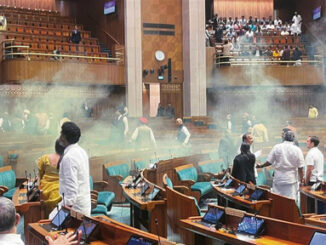
    There is an important difference between the Pakistan-sponsored terror attack on Parliament on December 13, 2001, and the intrusion into the new Parliament building by miscreants on December 13, 2023. This time, the delinquents managed to reach the virtual heart of Parliament while the proceedings were going on in the Lok Sabha. That makes the incident much more serious than the one in 2001, when terrorists could not enter the building. In 2001, the terrorists were fortuitously intercepted by an alert security officer in charge of the escort vehicle of the Vice-President, whereas on Wednesday the security staff was blissfully unaware of the intruders’ presence, putting the onus of resistance on the MPs. Remarkably, the security personnel were not spotted when the miscreants started spraying gas from canisters hidden in their shoes.

    Also, the intruders seemed to have taken advantage of the layout of the complex, jumping into the Lok Sabha hall quite easily from the visitors’ gallery. The distance between the gallery and the hall seems to have been reduced in the new building, going by what some MPs said immediately after the incident. Another important point revealed by them was that the new system of entry into the building through a single access point as against three or four entry points in the old building seemed to have burdened the security apparatus.

    That perhaps might have been the reason why the miscreants could hide the canisters in their shoes despite the much-touted five-tier security system in the new building. We can only imagine the horror that could have happened had they carried grenades instead of gas canisters. This incident was somewhat like what happened at Raj Ghat on October 2, 1986. Several VIPs, including the President, the Prime Minister and MPs had been saved, not by their security staff, but only because Karamjit Singh — an assailant who had hidden himself in tree branches despite a prior intelligence alert — possessed only a primitive muzzle-loading gun. Like in 1986, we cannot depend on providence for our VIP security.

    In 2001, according to the Supreme Court’s records, a white Ambassador car with a red beacon on top entered the Parliament complex around 11:30 am and arrived at the point where the convoy of the Vice-President was waiting near Gate No. 11. Inside the car were persons dressed in some sort of uniform. Since the escort vehicle was blocking its way, the suspect car turned away. This made the ASI in charge of the Vice-President’s escort vehicle suspicious and he told the car driver to stop.

    Instead, the driver reversed the vehicle and tried to move away. In the process, it hit the Vice-President’s car. The ASI and the Vice-President’s driver ran towards the suspect car and caught hold of the driver by the collar. Five Pakistani terrorists then got out of the car and started laying wires and detonators.

    Seeing this, the ASI fired a shot, hitting the leg of one of the terrorists. The terrorist fired back, injuring the ASI in his right thigh. This exchange of fire alerted the police and special forces in the Parliament complex and a gunbattle started. The terrorists went from gate to gate within the complex, firing at the security men, and the latter returned fire.

    Then BJP MP Ram Naik had told the media that there were three gates: Gate No. 12, through which the Vice-President — who is also the Rajya Sabha chairman — entered; Gate No. 1, from where the MPs usually came in; and Gate No. 5, from where the Prime Minister entered. He said the terrorists fired at all these three gates but could not enter the building as CRPF constable Kamlesh Kumari Yadav had closed the main entrance. According to reports, she died after being hit by 11 bullets.

    None of this happened on Wednesday. The entry of the offenders was smooth. After the incident, several complaints were made by Opposition members: the Joint Parliamentary Committee on Security has not been constituted during the 17th Lok Sabha; there is ‘political bias’ in issuing visitor passes; there is increased presence of private security guards, who have allegedly replaced official parliamentary security guards and Central police forces in the new building.

    Officially, the new building’s five-tier security is foolproof: Visitors’ entry is through the ‘reception’ near the Rail Bhavan. Also, verification of credentials is done at the security post on Raisina Road before they reach the ‘reception’. There is a stipulation that before entering, all electronic gadgets, bags and wallets must be deposited in a designated cloak room. The visitors are screened at the reception, their passes are verified again, and they are checked again near the entry gate of the new building. The visitors are then grouped into those going to the Lok Sabha or the Rajya Sabha and checked again at two gates. Before entering the respective visitors’ galleries, they are checked once more.

    None of this prevented the entry of these determined intruders. This audacious security breach, which comes weeks after Sikhs for Justice founder Gurpatwant Singh Pannun’s threat to Air India, speaks very poorly of the overall security of our sensitive institutions. Did our security managers assume that only Air India needed to be protected after that threat?

    Any student of terrorism history would know that terrorists often change tactics to cause confusion. After the 26/11 attacks in 2008, we were getting ready to face fidayeen strikes while the terrorists reverted to improvised explosive devices and killed 21 people at three places in Mumbai in July 2011.
    (The author is a former Special Secretary, Cabinet Secretariat, government of India)

  • How ‘being in news’ is an advantage to Trump

    How ‘being in news’ is an advantage to Trump

    “These developments have come as an unexpected bonanza, allowing Trump to dominate the ‘screen near you.’ If Trump is indicted, the Congressional ‘referral’ to the Justice Department would allow him to linger on the ‘screen’, making the Attorney-General’s position uncomfortable as he is expected to be non-partisan. Also, the long process, including ‘arraignment, pleading, pretrial motions and trial’, could be as ‘big a news story as a presidential election’ and might drag on.”

    By Vappala Balachandran

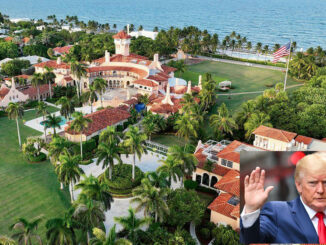
    As the November 2022 mid-term elections are approaching, there is a growing fear in America that the FBI’s search of ‘Mar-a-Lago’ (‘sea to lake’, in Spanish), former President Donald Trump’s residence, on August 8 might be to the Republican Party’s political advantage. The US National Public Radio (NPR) has said that it would result in Trump looming all over the USA like “Thanksgiving’s pumpkins.” This, together with the US House Select Committee’s public hearings to investigate into the violent attack on the Capitol on January 6, 2021, might help Trump keep the “pot boiling.” Along with the New York probe into his tax statements, these developments might “define the ambience” during the November elections when 435 seats in the House and 35 seats in the Senate will go for polling. Currently, the Democrats have only a narrow majority — 220-211 — even in the House of Representatives. In the Senate, it is 50-50. Democrats have only 48, supported by two independents against 50 of the Republicans. This wafer-thin majority is with the help of Democrat Chairman Vice-President Kamala Harris. Admittedly, Trump was legally culpable in carting away to his Florida home ‘Mar-a-Lago’ many confidential documents, including those related to some of the most secret intelligence operations. However, Trump was an unconventional President. He did not feel the need to follow any settled constitutional procedures or conventions. In a 2018 Twitter post, he had reportedly claimed that he had the right to pardon himself under Article II of the US Constitution. He had seriously thought of issuing pardon to himself and his family after the Capitol Hill riots on January 6, 2021. After the National Archives found that the papers were confidential, his lawyers said that as President, he had the “privilege’ to keep such papers.

    Certain other factors have helped Trump to claim “victimhood” and cry “political vendetta.” The August 8 FBI “search’ was unprecedented in US history. This was the first time a former US President’s residence was searched. It was also the first time that the US Justice Department (DOJ), which supervises the FBI, was undertaking such a search in its 152-year history. That helped Trump to say that it was an “assault” which “could only take place in broken Third World countries.” Soon after the “raid”, Republican Party leaders alleged political witch-hunt. They said that the DOJ was being “weaponized” to prevent Trump from running for President in 2024. They warned Biden appointee Attorney-General Merrick B Garland of “payback” if they gained majority in the Congress in the November 2022 elections. “Attorney-General Garland, preserve your documents and clear your calendar,” they said.

    Resembling our Opposition-ruled states’ derecognition of the CBI’s investigation in their states, a Florida State Republican legislator, Anthony Sabatini, urged his State Assembly to call an emergency session to legally derecognize the jurisdiction of the DOJ and arrest the FBI agents who were operating in their state.

    These incidents have emboldened Trump supporters to wrest leadership of the Republican Party from dissidents and turn him into an election mascot. In February, the Republican National Convention (RNC) had overwhelmingly censured Representatives Liz Cheney of Wyoming and Adam Kinzinger of Illinois for “crossing the line” by joining the US House Select Committee which is conducting public hearings on the January 6 incidents.

    On August 16, Liz Cheney was defeated in her Wyoming Republican primary. Trump gleefully said that it was a “wonderful result for America, and a complete rebuke of the Unselect Committee of political Hacks and Thugs.” The NPR said that more than 120 Republicans, who had supported Trump’s statement that he was “cheated” during the 2020 Presidential elections, had won the Republican primaries for different offices and would be contesting for different positions. These developments have come as an unexpected bonanza, allowing Trump to dominate the “screen near you.” If Trump is indicted, the Congressional “referral” to the Justice Department would allow him to linger on the “screen”, making the position of Attorney-General Merrick B Garland uncomfortable as he is expected to be non-partisan under the 1789 Judiciary Act. Also, the long process, including “arraignment, pleading, pretrial motions and trial”, could be as “big a news story as a presidential election” and might drag on like the different stages of the next presidential election. Such publicity might get more sympathy for Republican Party.

    Even after all these efforts, there is no guarantee that the DOJ would finally go for Trump’s prosecution. This feeling is based on the fate of former FBI Director Robert Mueller’s enquiry between 2017 and 2019 on the alleged Russian interference in the 2016 presidential elections and why he stopped short of recommending Trump’s prosecution. Mueller had told the House Judiciary Committee on July 24, 2019, that he refrained from indicting President Donald Trump on account of the longstanding Justice Department policy of abiding by the opinion of the agency’s Office of Legal Counsel (OLC) that a sitting President cannot be charged with a federal crime.

    Mueller also told the committee that he had found “multiple acts by the President that were capable of exerting undue influence over law enforcement investigations, including the Russian interference and obstruction investigations.” He added that he had indicted 34 individuals and three Russian businesses on charges ranging from computer hacking to conspiracy and financial crimes. These indictments had resulted in five sentences to prison and seven guilty pleas. Why did the Justice Department Counsel say so? The OLC is reported to have said that “the indictment or criminal prosecution of a sitting President would unconstitutionally undermine the capacity of the executive branch to perform its constitutionally assigned functions.” Media reports in 2019 had also added that there were no Supreme Court rulings on this issue. Finally, Mueller had left it to the Congress to take a decision as Trump was in office. Will the Biden administration’s Office of Legal Counsel in the Department of Justice also maintain the same stand since Trump was in office till January 20, 2021? If so, that will be Trump’s final political victory and it might set the stage for the 2024 elections.

    (The author is a Former Special Secretary, Cabinet Secretariat, government of India)

  • How to celebrate President Droupadi’s election

    How to celebrate President Droupadi’s election

    The report observes that the ‘development paradigm’ has aggravated the difficulties of the ‘marginalized’ as the benefits have been ‘disproportionately cornered by the dominant sections at the expense of the poor, who have borne most of the costs.’ In the case of the ‘tribes’, it resulted in their loss of cultural identity, destruction of their resource base and made them increasingly vulnerable to exploitation and daily violence.

    By Vappala Balachandran

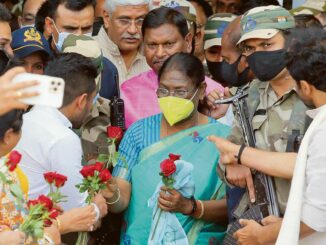
    It is very unfair to link the election of President Droupadi Murmu with the anticipated future electoral gains of the BJP, as some commentators have done. They had cried hosanna to the BJP leadership for flummoxing the Opposition by selecting the ‘first tribal’ and ‘second woman’ as the presidential candidate. This is not the way to hail the election of such a remarkable lady from a backward region who has braved personal and social difficulties to reach this high office. And, that too, at a time when India has slipped from 112 to 140 among 156 countries on the 2021 Global Gender Gap index compiled by the World Economic Forum (WEF), which conducts the annual Davos Conference. In Asia, only Pakistan and Afghanistan are behind India. The WEF attributed this slippage to inadequate political and economic woman empowerment in India.

    Those opposed to the linking of electoral factors with her selection say that the new President would not be able to make much personal contribution for solving the deep-rooted problems faced by tribals or undo the wrongs done to them over centuries. This is because of the limitations built into her high constitutional position. Also, hyperbole or symbolic steps do not result in solving such underlying problems. This is true if history is any indication. An important milestone in their journey to correct these wrongs came in 1946 when attempts were made while drafting our Constitution on the eve of Independence. On December 11, 1946, Dr Rajendra Prasad, Chairman of the Constituent Assembly, introduced Jaipal Singh Munda as the “representative of the aboriginal tribes of Chhota Nagpur”.

    In the Assembly records, Munda mentioned his religion as ‘Adibasi’ and caste as ‘nil’ as opposed to the others, including Jawaharlal Nehru, who wrote religion ‘Hindu’ and caste ‘Brahmin’. The only other representative who recorded as ‘Adibasi’ was L Sahu from Orissa. Their presence gave voice to that underprivileged section of our society in the Constitution-making body which gave special protection to them. Munda said that the dispossession of Adivasis did not begin with the arrival of the British, nor would it end with their departure. He said that “for the real rehabilitation and resettlement of the original people of India”, it was necessary that not only the British should quit, but also the others who had been exploiting and dispossessing Adivasis for thousands of years.

    However, subsequent events would prove that independent India was not able to achieve even a modicum of reforms in this direction. Whatever we had attempted was diluted by political crosscurrents generated by upper classes, leading to frustration among this section, numbering 10.43 crore (8.6 per cent of our population) and divided among 705 notified tribes.

    On the other hand, there is an increasing tendency by the government to treat such frustrations as ‘law and order’ problems during which the ‘dispossessed’ become the ‘accused’. The second milestone in their quest for justice came on January 5, 2011 when the Supreme Court (SC) sharply criticized the ‘historical injustice’ done to the tribals by the governance system and how these protections were not implemented even by a high court. This was during the SC verdict overturning an Aurangabad (Maharashtra) High Court’s acquittal of accused persons on technical grounds in which a young Bhil woman was stripped naked and beaten publicly. The SC also said: “Despite this horrible oppression on them, the tribals of India have generally (though not invariably) retained a higher level of ethics than the non-tribals in our country.” We have produced thousands of official pages on what needs to be done to improve the situation. However, no government has sincerely implemented the reforms suggested. One such good report is that of 2008, titled ‘Development Challenges in Extremist Affected Areas’. It is the result of the deliberations by a 16-member ‘expert group’ convened by D Bandopadhayay, which was constituted by the now defunct Planning Commission. The report covered not only the problems of Adivasis but also of Dalits and women in the vast landscape of land reforms, access to basic resources, forests, common property resources, harm done to them by the Special Economic Zones, mining and displacement of the poor due to big projects and how they could be rehabilitated. Development, which is insensitive to the needs of these communities, has invariably caused displacement and reduced them to a sub-human existence: “The poor have depended upon common property resources such as forests, pastures, and water sources for the satisfaction of their basic survival needs. With the increasing tendency to see all such resources as sources of profit, the poor are being deprived of whatever access they had to such resources.”

    The report found that no government had seriously studied the underlying and foundational causes leading to unrest, discontent and extremism among the tribals nor had these subjects been “the subject matter of administrative or academic discourses in India.”

    An important chapter of the report is on the ‘Political marginalization of Scheduled Castes and Scheduled Tribes’. It lists several ways in which SCs and STs are marginalized by the dominant classes, resulting in ‘tokenism’ of their political presence and leading to the suppression of their voice or empowerment. The report makes an important observation that the ‘development paradigm’ since Independence has aggravated the difficulties of the ‘marginalized’ as the benefits have been “disproportionately cornered by the dominant sections at the expense of the poor, who have borne most of the costs.” In the case of the ‘tribes’, it had resulted in their loss of cultural identity, destruction of their resource base and made them increasingly vulnerable to exploitation and daily violence.

    Chapter 5 lists several important recommendations. Among them are an effective implementation of protective legislation, land-related measures, land acquisition for development and rehabilitation of those affected, livelihood security, standardization of social services and extension of the Panchayati Raj to Scheduled Areas Act and other administrative measures. No government since 2008 has done an open audit on how far these recommendations have been implemented. Thus, the best way to celebrate the election of President Murmu is that the Centre and the states should sincerely implement these recommendations as well as those made in other such reports.

    (The author is Ex-Special Secretary, Cabinet Secretariat, Government of India)

  • Neglecting cultural czar Munshi’s efforts

    Neglecting cultural czar Munshi’s efforts

    By Vappala Balachandran

    “A massive effort of rewriting Indian history from our traditional perspective was done between 1951 and 2003. This was by the doyen of cultural renaissance, the late Dr KM Munshi, who was also a noted litterateur, educationist, historian, freedom fighter and close associate of Patel. In 1938, Munshi founded the Bharatiya Vidya Bhavan, which has done much to spread awareness of our culture.”

    On February 17, 2021, Prime Minister Narendra Modi said that the ‘injustice’ perpetrated by historians “against those who made history” was being corrected by the ‘new India’. The occasion was the Maharaj Suheldev memorial foundation stone-laying ceremony in Uttar Pradesh, which is going to the polls next month. He added that history is not just what was written by those “who enslaved the country” or who wrote it with the “mindset of slavery”. Several RSS leaders, too, had called for ‘rewriting our history’ to free us from the distorted narration that is being taught in schools. They wanted our history to “study evolution of Indian culture from 12,000 years ago.” On March 6, 2018 Reuters reported that a committee of scholars was “quietly appointed” by the government “to use evidence such as archaeological finds and DNA (tests) to prove that today’s Hindus are directly descended from the land’s first inhabitants many thousands of years ago and make the case that ancient Hindu scriptures are fact not myth.”

    Reuters interviewed nine of the 12 members who confirmed that they were tasked with “matching archaeological and other evidence with ancient Indian scriptures or establishing that Indian civilization is much older than is widely known.”

    Lack of transparency on the composition and working of this committee gave rise to needless controversies. A report on October 18, 2020 said that 32 Members of Parliament had written to the President to disband the committee which “has no South Indians, Northeast Indians, minorities, Dalits, women and experts in languages other than Sanskrit.”

    Confirmation on the committee came on September 14, 2020 when the then Culture Minister Prahlad Singh Patel said that an expert panel was set up for the “holistic study of origin and evolution of Indian culture since 12,000 years ago.” However, a reply to an RTI query on October 11, 2021 conveyed that the committee had not submitted any report to the ASI.

    The present government and its theologians seem to be embarking on this Sisyphean task, being ignorant that a massive effort of re-writing Indian history from our traditional perspective was already done between 1951 and 2003. This was by the internationally acclaimed doyen of Indian cultural renaissance, the late Dr Kanhaiyalal Maneklal Munshi, who was also a noted litterateur, educationist, historian, freedom fighter and close associate of Sardar Vallabhbhai Patel.

    In 1938, Munshi founded the Bharatiya Vidya Bhavan, which in the course of time, has done much more than government organs to spread awareness of our traditional culture at the grassroots level in India and abroad. Presently, the Bhavan has 119 centers in India, including 100 schools, seven foreign branches and 367 associated institutions.

    Munshi set up the Bhavan for “the propagation of Bharatiya Vidya (education), which in essence is Dharma in its triple aspects of Satyam, Shivam, Sundaram (truth, goodness and beauty), as his closest colleague, the late S Ramakrishnan, would say. Munshi initiated the process by retelling Krishnavatara (Lord Krishna’s lives) in eight volumes. He set up a ‘Book University’, with the first book written by Bharat Ratna C Rajagopalachari, his peer, on the Mahabharata and the Ramayana.

    Millions of Indian children have grown up reading these classics and Munshi’s fortnightly messages in Bhavan’s Journal since 1954. The journal is published even now.

    In 1951, Munshi released ‘The Vedic Age’, the first part of Bhavan’s Book University’s 11-volume series ‘The History and Culture of the Indian People’. He said that although efforts to prepare this massive history-writing had started in 1938, it could assume concrete shape only in 1944 with generous help from GD Birla and the Shri Krishnarpan Charity Trust. The last volume was released in 2003, 32 years after Munshi’s death. Each volume is nearly 1,000 pages. Some of these volumes had gone for seven to eight reprints,

    Munshi enlisted the services of renowned historian RC Majumdar, former Vice-Chancellor of Dacca University, as full-time editor to the series. Others who wrote chapters were famous archaeologist HD Sankalia and renowned Advaita scholar TMP Mahadevan, to mention a few.

    The 11-volumes series are the ‘Vedic Age’, ‘The Age of Imperial Unity’, ‘The Classical Age’, ‘Imperial Kanauj’, ‘The Struggle for Empire’, ‘The Delhi Sultanate’, ‘Mughul Empire’, ‘The Maratha Supremacy’, two volumes on ‘The British Paramountcy — Indian Renaissance’ and, finally, ‘The Struggle for Freedom’.

    Munshi felt that the central purpose of history is to investigate and unfold the values of the people which had inspired age after age their collective will. Also, “to be a history in the true sense of the word, the work must be the story of the people inhabiting a country.” He also explained the difficulties in this enormous endeavor.

    For example, in the past, “Indians laid little store by history.” Munshi felt that the works of ancient Indian authors throwing light on history ‘were few’. At the same time, the Puranas and Kavyas had not “yielded up their chronological or historical wealth.” On the other hand, observations by foreign visitors like Megasthenes, Hiuen Tsang, Al-Masudi, Manucci and Bernier, although ‘superficial’, had “immense value in reconstructing the past”. Thus, he was of the firm opinion that we cannot ignore the foreigners’ writings.

    At the same time, our history books did not explain how India resisted the Turkish, Afghan and Moghul incursions and how a “renaissance sprang up out of the impact of Indian with Persian and Turkish cultures.” In the same way, the British period read like an ‘unofficial report’ of their conquest and not how we resisted and suffered nor how we reacted to foreign influences or “of the values and organization’s we created out of the impact with the West.”

    Perhaps, one reason why our present government is ignoring this massive collection by such credible archivists is because of Munshi’s theory of cultural assimilation in his foreword to Volume 1 (‘The Vedic Age’). Also, while discussing the existing history on the Delhi Sultanate, he had said: “Gruesome stories of Muslim atrocities are narrated, but the harmony which was evolved in social and economic life between the two communities remains unnoticed.”

    (The author is Ex-Special Secretary, Cabinet Secretariat)

  • Afghans continue to be at the receiving end

    Afghans continue to be at the receiving end

    By Vappala Balachandran

    “Riedel has reminded the US that it had made ‘many mistakes’ in Afghanistan by not paying attention after the Soviets left and allowing it to descend into a ‘failed’ state, permitting the Taliban and al-Qaeda to enter that vacuum. Riedel blamed former President George W Bush for taking his ‘eye off the ball’ in Afghanistan after the 2001 US invasion and letting Osama bin Laden escape into Pakistan.”

    On July 17, Bruce Riedel, formerly of the CIA and now at Brookings, warned that the power vacuum in Afghanistan after the US troop withdrawal will adversely affect India by spawning terrorism. Similarly, The New York Times (July 15) reported Chinese fears of insecurity in the region after the killing of nine Chinese workers in a ‘Belt & Road’ hydroelectric project in Dasu, Pakistan’s Northwest, due to a suspected explosion.

    Riedel had issued a similar warning on April 27, 2021, by reminding President Joe Biden of what President Barack Obama had said in his memoir A Promised Land: “The Riedel report made one thing clear: Unless Pakistan stopped sheltering the Taliban, our efforts at long-term stability in Afghanistan were bound to fail.”

    What was this Riedel report? In February 2009, Obama chose Riedel to chair a White House Review to synthesize suggestions from heavyweights like Richard Holbrooke, special envoy to Afghanistan and Pakistan, Gen David H Petraeus, Central Command Chief, and Admiral Michael G Mullen, chairman of the Joint Chiefs of Staff, before the next NATO summit.

    In a joint press conference at the White House on March 27, 2009, Riedel and Holbrooke outlined Obama’s strategy for NATO presence in Afghanistan: “To disrupt, dismantle and defeat al-Qaeda, and to ensure that their safe havens in Afghanistan and Pakistan cannot threaten the United States anymore.”

    They added that the US exit strategy would depend on that.

    Biden’s White House address on April 14, 2021, also claimed that they had achieved the “disrupt, dismantle and defeat al-Qaeda” strategy. However, Riedel did not agree. He said that Joe Biden, who inherited “a terrible deal from Trump’s feckless negotiators” had “failed to engage with Prime Minister Imran Khan”, which was a mistake. This is because Pakistani generals “will be more hubristic and dangerous than ever”, as Pakistan is the winner “again” in Afghanistan, by outlasting two superpowers.

    Riedel reminded America that Washington DC had made ‘many mistakes’ in Afghanistan by not paying any attention after the Soviets left, allowing it to descend into a ‘failed’ state, permitting the Taliban and al-Qaeda to enter that vacuum. Riedel blamed former President George W Bush for taking his “eye off the ball” in Afghanistan after the 2001 US invasion and letting Osama bin Laden escape into Pakistan.

    In my opinion, a bigger mistake was made in 1992. This was after the failed coup d’état in the Soviet Union in August 1991 and eventual disintegration. In September that year, three Baltic states seceded and declared their independence. A limited ‘Belovezha’ accord signed on December 8, 1991, was modified by the December 21 Alma Ata Protocol in Kazakhstan, creating the Commonwealth of Independent States (CIS) by Russia, Armenia, Azerbaijan, Belarus, Kazakhstan, Kyrgyzstan, Moldova, Tajikistan, Turkmenistan, Ukraine, and Uzbekistan. Western powers, including the United States, recognized these independent countries.

    On March 9, 1992, President Mohammad Najibullah made a direct appeal to the United States through The New York Times to help him in maintaining stability in Afghanistan. This was after President Boris Yeltsin stopped all direct assistance to Afghanistan, which grounded the Afghan air force and encouraged defections, which affected the Afghan army too.

    Senior journalist Edward A Gargan reproduced Najibullah’s text of appeal to the US in The New York Times. Najibullah’s tone was premonitory: “If fundamentalism comes to Afghanistan, war will continue for many more years… Afghanistan will turn into a center of world smuggling for narcotic drugs. Afghanistan will be turned into a center for terrorism.” However, none in Washington DC listened.

    Najibullah also echoed the then Secretary of State James Baker’s statement that Islamic fundamentalism had posed a significant threat to regional stability: “You may think that the Central Asian republics are significant for the United States of America… That’s right. But I must say that the strategic and political significance of Afghanistan is much more than these republics. If Afghanistan is lost and is turned into a center of fundamentalism, you will lose the Central Asian republics.”

    During this period, even King Zahir Shah’s US-based representatives had appealed to the State Department and the CIA that the retention of Najibullah in Afghanistan was very necessary as he was the only Afghan leader who would be able to hold the country together, obstruct the jihadis from coming into power and prevent Afghanistan’s splintering. They even conveyed that Najibullah should be accepted by the US, just as it had recognized the CIS leaders, who were mostly authoritarian. Unfortunately, the rivalry between the State Department and the CIA prevented this from happening.

    Steve Coll, in his book The Ghost Wars, vividly records the clashes between the State Department and the CIA over Najibullah. Initially, the State Department’s special envoy to Afghanistan Edmund McWilliams had differed with CIA’s Station Chief Milton Bearden over Najibullah’s fate. The CIA wanted him to go, as desired by Pakistan’s ISI. Milton Bearden started resenting “interference” by the State Department over their turf.

    In Washington DC, this rift between the CIA and the State Department was carried higher by the then CIA Deputy Director Thomas Twetten and Peter Tomsen, State Department’s new special envoy to the Afghan Resistance. Robert Kimmitt, Under Secretary for Political Affairs, told The New York Times (January 3, 1991) that Secretary of State Jim Baker had wanted to “coax the rebels and the Najibullah regime into democratic elections”, but that “they (meaning CIA) are just bucking policy.”

    However, during that period, Texas Congressman Charlie Wilson, member, US House of Representatives’ Appropriations Sub-Committee for Defense, was exercising disproportionate influence over Afghan operations. It resulted in other voices being ignored.

    Wilson regretted this later. An article in The World, a public radio and podcast programme, on February 11, 2010, said that Wilson, to the end of his life, regretted that “more wasn’t done to stabilize the country” and “the moderate, pro-Royalist factions in the resistance were ruthlessly suppressed by more extreme Islamic militants on our side.”

    These ‘regrets’ of ‘mistakes’ are not going to help the hapless Afghans now who continue to be the victims of external interference.

    (Vappala Balachandran is an author and columnist)