Tag: Vice President Kamala Harris

  • PM Modi and US Vice President Kamala Harris discuss bilateral ties, Indo-Pacific

    PM Modi and US Vice President Kamala Harris discuss bilateral ties, Indo-Pacific

    September 23, 2021

    TIP Special Correspondent

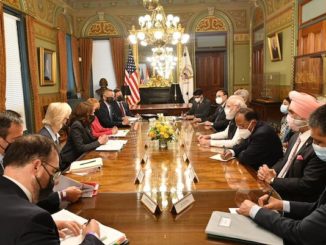
    WASHINGTON, DC (TIP): Prime Minister Narendra Modi on Thursday, September 23, described India and America as ”natural partners” as he held the first in-person meeting with Vice President Kamala Harris at the White House during which they decided to further cement the Indo-US strategic partnership and discussed global issues of common interest, including threats to democracy, Afghanistan and the Indo-Pacific.

    ”India and America are natural partners. We have similar values, similar geopolitical interests,” Modi said in a joint media appearance with Harris, the first-ever person of Indian origin to be elected as the vice-president of the United States.

    Noting that India and the US are the largest and oldest democracies, Modi said the two countries share values and their coordination and cooperation are also gradually increasing.

    This is the first meeting between the two leaders. Harris had earlier spoken with Modi over the phone in June during the COVID-19 crisis in India.

    ”You are the source of inspiration for so many people across the world. I am completely confident that our bilateral relationship will touch new heights under President Biden and your leadership,” Modi told Harris.

    The two leaders were wearing masks as they both spoke in front of a battery of pool reporters from both India and the US.

    Modi invited the 56-year-old Democratic leader and Second Gentleman Douglas Emhoff to visit India.

    ”Both President Biden and you assumed office at a time when our planet faced very tough challenges. In a short time, you have had many achievements to your credit be it COVID-19, climate change or the Quad,” Modi said.

    In a statement, the Ministry of External Affairs said the two leaders exchanged views on recent global developments, including in Afghanistan and reaffirmed their commitment towards a free, open and inclusive Indo-Pacific region.

    The two leaders discussed the COVID-19 situation in their countries, including ongoing efforts to contain the pandemic through expedited vaccination efforts, and ensuring supply of critical medicines, therapeutics and healthcare equipment, it said.

    ”As relates to the Indo-Pacific, the US stresses on maintaining a free and open Indo-Pacific,” Harris said, amidst China’s aggressive moves in the strategically vital region.

    India, the US and several other world powers have been talking about the need to ensure a free, open and thriving Indo-Pacific in the backdrop of China’s rising military maneuvering in the region.

    China claims nearly all of the disputed South China Sea, though Taiwan, the Philippines, Brunei, Malaysia and Vietnam all claim parts of it. Beijing has built artificial islands and military installations in the South China Sea.

    Harris said the world is more interconnected and more interdependent than ever before. “And the challenges that we face today have highlighted that fact. COVID-19, climate crisis and the importance of our shared belief in the Indo-Pacific region,” she said. “Both sides acknowledged the importance of collaborative action on climate change. Prime Minister spoke about India’s push for increasing renewable energy and the recently launched National Hydrogen Mission. He also emphasized the importance of lifestyle changes to promote environmental sustainability,” the statement said.

    Modi noted that he had the opportunity to speak to Harris after she assumed the Vice Presidency. ”One of our interactions happened when India was battling a very tough wave of COVID-19 infections. I recall your kind words of solidarity that time,” Modi said.

    India was confronted with the second wave of the COVID 19 pandemic. A very difficult time for India, he said. “Like a family, the sense of kinship and so warmly, you extended a helping hand, the words that you chose when you spoke to me, I will always remember that, and I’d like to thank you from the bottom of my heart,” the prime minister said.

    ”Like a true friend, you had given a message of cooperation, and were very full of sensitivity and immediately after that we found that the US government, the US corporate sector and the Indian community, all came together to help India,” he said.

    Modi said that the US Government, companies based in the USA and the Indian diaspora were very helpful when India was fighting a tough wave of COVID-19 infections.

    Both leaders acknowledged the vibrant people-to-people linkages as the bedrock of the mutually beneficial education linkages and the flow of knowledge, innovation and talent between our two countries.

    Modi said that four million people of Indian origin are acting as a bridge of friendship between the two countries.

    Harris described India as a ”very important partner” to the US and welcomed New Delhi’s announcement that it will soon resume vaccine export.

    India stopped the export of COVID-19 vaccines after the second wave of the pandemic hit the country in April this year.

    On Monday, India said that it will resume export of surplus COVID-19 vaccines in the fourth quarter of 2021 under the ”Vaccine Maitri” programme and to meet its commitment to the COVAX global pool. On the issue of the climate crisis, she told Modi that the US working together with India can have not only a profound impact on people of nations but around the world itself.

    Harris said that it is incumbent on the two nations to protect democracies in the best interests of people of the two countries.

    ”As democracies around the world are under threat, it is imperative that we defend democratic principles and institutions within our respective countries and around the world. And that we maintain what we must do to strengthen democracies at home and it is incumbent on our nations to of course protect democracies in the best interests of people of our countries,” she said.

    Their meeting comes a day ahead of the maiden bilateral meeting between Modi and President Joe Biden and the Quad Leaders’ Summit at the White House on Friday.

    Since taking office, Harris has met with or spoken to over 30 world leaders, promoting US interests on issues ranging from global health to climate change to cyber threats.

    PM Modi later tweeted:

    Narendra Modi

    @narendramodi

    Glad to have met

    @VP

    @KamalaHarris

     Her feat has inspired the entire world. We talked about multiple subjects that will further cement the India-USA friendship, which is based on shared values and cultural linkages.


    Visit www.theindianpanorama.news for more stories on PM Modi’s US visit

  • VP Harris in her first meeting with PM Modi talks about defending democracies

    VP Harris in her first meeting with PM Modi talks about defending democracies

    TIP Special Correspondent

    WASHINGTON, DC (TIP): Voicing concern over the threat to democracies around the world, Vice President Kamala Harris on Thursday, September 23, underscored the need to defend democratic principles and institutions in both India and the US.

    Harris made the remarks in a joint media appearance with Prime Minister Narendra Modi before their first in-person meeting at the White House during which they decided to further cement the Indo-US strategic partnership and discussed global issues of common interest, including the Indo-Pacific.

    “As democracies around the world are under threat, it is imperative that we defend democratic principles and institutions within our respective countries and around the world, and that we maintain what we must do to strengthen democracy at home and it is incumbent… to protect democracy in the best interest of the people of our country,” she said in her remarks as she welcomed Modi to her ceremonial office.

    “I know from personal experience and from my family of the commitment of the Indian people to democracy, and the work that needs to be done, we can begin to imagine, and then actually achieve our vision for democratic principles and institutions,” she said.

    Harris said that she looks forward to discussing how the two countries can continue to best work together to strengthen their relationship around their mutual concerns and the challenges they face, but also the opportunities that those challenges present.

    She had earlier spoken with Modi over phone on June 3.

    India, she said, is a very vital partner to the United States.

    “Throughout our history, our nations have worked together and stood together, to make our world a safer and stronger world.

    “Mr. Prime Minister, when you and I last spoke, we talked about how our world is interconnected… and the challenges that we face today highlighted that fact… with COVID-19, the climate crisis and the importance of our shared belief in a free and open Indo-Pacific region,” Harris said.

    She said that early in the COVID-19 pandemic, India was a vital source of vaccines for other countries.

    “When India experienced a surge of COVID… the United States was very proud to support India and needed its and responsibility to vaccinate its people,” she said.

    Harris welcomed India’s announcement that it will soon be able to resume vaccine export and it is of particular note and admiration that India is currently vaccinating approximately 10 million people a day.

    “The President and I believe very strongly that the United States working together with India would have not only a profound impact on the future of our respective nations but on the world itself” on climate, she said.

    “And as it relates to the Indo-Pacific, the United States, like India, feels very strongly about the pride of being a member of the Indo Pacific, but also the fragilities of the importance and the strength as well of those relationships, including maintaining a free and open Indo Pacific,” the Vice President said.

    Harris also touched upon the issue of climate change.

    “On the issue of the climate crisis, I know that India and we take this issue quite seriously. The President and she believe very strongly that the United States working together with India would have a profound impact on people of the two countries,” she added.

    Their meeting comes a day ahead of the maiden bilateral meeting between Modi and President Joe Biden and the Quad Leaders’ Summit at the White House on Friday, September 24.

    Since taking office, Harris has met with or spoken to over 30 world leaders, promoting US interests on issues ranging from global health to climate change to cyber threats.

  • President Biden Signs into Law the COVID-19 Hate Crimes Act

    President Biden Signs into Law the COVID-19 Hate Crimes Act

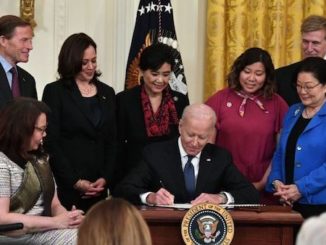
    WASHINGTON (TIP): Following overwhelming support from both chambers of Congress, President Joe Biden signed legislation Thursday, May 20, that addresses hate crimes throughout the COVID-19 pandemic, with particular emphasis on the increase in violence against Asian Americans.

    At an event in the East Room of the White House, Biden thanked lawmakers for coming together to pass the legislation. He said standing against hatred and racism, which he called “the ugly poison that has long haunted and plagued our nation,” is what brings Americans together.

    “My message to all of those who are hurting is: We see you and the Congress has said, we see you. And we are committed to stop the hatred and the bias,” he said.

    The legislation, introduced by Rep. Grace Meng, D-N.Y., and Sen. Mazie Hirono, D-Hawaii, aims to make the reporting of hate crimes more accessible at the local and state levels by boosting public outreach and ensuring reporting resources are available online in multiple languages.

    It also directs the Department of Justice to designate a point person to expedite the review of hate crimes related to COVID-19 and authorizes grants to state and local governments to conduct crime-reduction programs to prevent and respond to hate crimes.

    Vice President Kamala Harris introduced Biden ahead of the signing and reflected on the increase in violence against Asian Americans.

    “This violence — it did not come from nowhere, and none of it is new. In my life, my lived experience, I have seen how hate can pervade our communities,” she said. Harris, who is the first Asian American vice president, added, “I have seen how hate can impede our progress. And I have seen how people uniting against hate can strengthen our country.”

    Harris noted the work to combat racism doesn’t end with the signing of the bill.

    “Here’s the truth: Racism exists in America. Xenophobia exists in America, antisemitism, Islamophobia, homophobia, transphobia — it all exists. And so, the work to address injustice wherever it exists remains the work ahead,” she said.

    The signing comes two days after the House of Representatives passed the COVID-19 Hate Crimes Act by a vote of 364-62; all 62 votes against the bill were from Republicans. The Senate approved the legislation last month, with near-unanimous support; Missouri Republican Josh Hawley was the sole senator to vote against the bill.

    Senate Minority Leader Mitch McConnell, R-Ky., attended Thursday’s ceremony along with a number of Democrats, advocates, families of victims of hate crimes and others. Sen. Susan Collins, R-Maine, who helped co-author a key provision that paved the way for the bill’s passage, was also in attendance.

    Asian Americans have faced a dramatic spike in violence throughout the pandemic. The organization Stop AAPI Hate documented 6,603 hate incidents from March 2020 to March 2021, and leaders said the true number is much higher as many hate crimes go unreported. Democrats have pointed to former President Donald Trump’s frequent use of racist phrases such as “kung flu” to describe the coronavirus as a link to the increase in anti-Asian sentiment in the country.

    Stop AAPI Hate praised the legislation for investing in “community-centered solutions and provisions to mitigate anti-Asian rhetoric” but said further legislation is needed to address the “root causes of systemic racism and oppression.”

    “Because the Act centers criminal law enforcement agencies in its solutions, it will not address the overwhelming majority of incidents reported to our site which are not hate crimes, but serious hate incidents,” the coalition said in a statement after the House passage.

    Attorney General Merrick Garland called the bill signing an “important step toward protecting everyone in our country from acts of hate and intolerance.”

    “The Department of Justice is proud to play a central role in implementing this legislation,” he said in a statement following the signing. “Investigating and prosecuting hate crimes is a top priority, deeply rooted in the department’s founding. We will use the new law to enhance the aggressive measures we are taking to combat crime motivated by bigotry and discrimination.”

    (Source: MPR NEWS)