As the world prepares to merrily celebrate Christmas on December 25, with carols, candles, gifts and gatherings my kids have been so enthusiastic about, my thoughts drift, inevitably and uneasily, to people across continents who will mark this season not with joy, but with fear, deprivation and grief. When one surveys the globe today, a grim common thread binds distant lands and diverse societies: conflict. It manifests in many forms—economic, political, ethnic, ideological and military—but its consequences are uniformly cruel. Peace, despite humanity’s bitter experiences, continues to elude us.
History offers no shortage of warnings. The twentieth century alone witnessed two World Wars whose scale and savagery reshaped the world. World War I, sparked by nationalism, imperial rivalries and diplomatic failure, left nearly 20 million dead and shattered empires. Instead of ushering in lasting peace, it sowed the seeds of resentment and economic despair that gave rise to fascism and World War II. That second conflagration, the most destructive in human history, claimed over 60 million lives, devastated Europe and Asia, and culminated in the nuclear annihilation of Hiroshima and Nagasaki, grim reminders of humanity’s capacity for self-destruction.
In the aftermath of World War II, leaders vowed “never again.” Institutions such as the United Nations were created to resolve disputes through dialogue, not arms. Yet the decades that followed tell a sobering story. The Cold War divided the world into hostile blocs, bringing proxy wars in Korea, Vietnam, Afghanistan, Africa and Latin America. While nuclear deterrence prevented direct confrontation between superpowers, millions perished in regional conflicts fueled by ideological rivalry.
The end of the Cold War briefly raised hopes for a “peace dividend.” Instead, the world entered a new phase of instability. Ethnic conflicts tore apart Yugoslavia. Genocide scarred Rwanda. The Middle East remained trapped in cycles of war and retaliation. The US-led interventions in Iraq and Afghanistan, launched in the name of security and democracy, produced long wars whose human and economic costs far outweighed their gains. Terrorism emerged as a global threat, feeding on unresolved grievances and failed states.
Today, conflict has returned with alarming intensity to Europe itself, a continent that once prided itself on having learned the lessons of history. The war between Russia and Ukraine has inflicted immense suffering on ordinary people: cities reduced to rubble, millions displaced, families torn apart, and an entire generation growing up amid sirens and uncertainty. Whatever the geopolitical arguments advanced by either side, the human cost is undeniable and indefensible.
This is not an isolated tragedy. From Gaza to Sudan, from the Sahel to Myanmar, violence continues to uproot lives. Economic conflict, too, is pervasive: trade wars, sanctions, debt crises and widening inequality pit nations and classes against one another. Even societies not directly at war feel the consequences through inflation, refugee flows, energy shortages and a growing sense of global insecurity.
One might ask: how, after centuries of bloodshed, does humanity still fail to learn? Part of the answer lies in the persistence of ego, power politics and short-term thinking among leaders. War is often justified in the language of national interest, honor or security, yet it is invariably paid for by civilians. Children lose schools, the sick lose hospitals, and the poor lose whatever fragile stability they possess. Reconstruction takes decades; trauma lasts generations.
Christmas, at its core, is a celebration of peace, compassion and goodwill. The image of a child born in a manger has endured precisely because it speaks to humility and humanity, not conquest. At this moment, therefore, it is worth articulating a simple, perhaps unfashionable wish: that this Christmas brings wisdom to leaders who command armies and shape destinies.
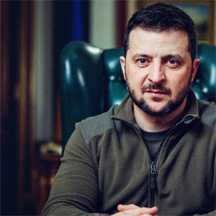
In particular, one hopes that Russia’s President Vladimir Putin and Ukraine’s President Volodymyr Zelensky pause, even briefly, to reflect not on strategy or prestige, but on their people, the soldiers in trenches, the civilians in bomb shelters, the parents who bury their children. History will not judge them by how long they fought, but by whether they found the courage to stop.
Peace, contrary to popular belief, is not weakness. It requires moral strength to shed ego, to compromise, and to accept that no victory built on ruins can truly be called a triumph. Europe learned this lesson after 1945; it must not be forgotten now.
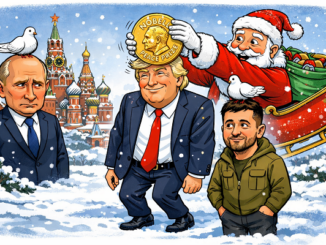
In this context, any genuine effort toward peace deserves encouragement, regardless of who undertakes it. If President Donald Trump seeks to play a role in ending the conflict, one can only wish him success. The world has seen enough failed wars and broken promises. A negotiated settlement, however imperfect, is infinitely preferable to endless bloodshed. If peace were to come to a ravaged region through such efforts, it would indeed be a gift worthy of global recognition.
One might even indulge in a Christmas metaphor: Santa Claus, bearer of goodwill, presenting the Nobel Peace Prize not as a personal accolade, but as a symbol of what humanity values most, the saving of lives. Such symbolism matters, because it reminds leaders that history honors peacemakers long after warriors are forgotten.
Ultimately, however, responsibility does not rest with leaders alone. Citizens, media and institutions must resist the idea that war is something normal. We must question narratives that glorify violence and demand accountability for decisions that destroy futures. Future generations will inherit the world we leave behind. They should not look back on us as idiotic warmongers who knew the costs of conflict yet chose it anyway.
As candles are lit this Christmas, let them illuminate not just homes, but consciences. Let the season renew our collective commitment to dialogue over destruction, empathy over enmity, and peace over pride. For without peace, no celebration—Christmas or otherwise—can ever be complete.
Merry Christmas, and may it bring the world closer to the peace it so desperately deserves!