Tag: Volodymyr Zelenskyy

  • Mark Carney’s new package to Ukraine has Canadians divided

    Mark Carney’s new package to Ukraine has Canadians divided

    By Prabhjot Singh

    TORONTO (TIP): When Canadian Prime Minister Mark Carney rolled out a new economic package for war-torn Ukraine as he and Volodymyr Zelenskyy met briefly at a Halifax-area airport, a chain of reactions, both for and against helping a nation in distress, started. The two leaders embraced as Carney welcomed Zelenskyy to Canada. Zelenskyy touched down for a brief stop on his way to Florida for planned peace talks with U.S. President Donald Trump this weekend, which he called “very important and very constructive.”

    Though the “intentions” behind aid or economic packages are seldom a subject of debate, this time the questions are being raised as the quantum of economic assistance offered looks beyond the means of the country that just managed to get its budget for 2025 ratified by the House of Commons by a couple of votes.

    Canada has been a staunch supporter of Ukraine since Russia’s full-scale invasion began in February 2022, committing $6.5 billion in military support along with humanitarian aid.

    The $2.5 billion that Canada committed to providing aid should enable the International Monetary Fund and the World Bank to lend nearly $10 billion to Ukraine to support reconstruction, the Prime Minister’s Office said in a news release. The funding will also be used to guarantee a loan of up to $322 million from the European Bank to assist Ukraine in reinforcing energy security.

    “Canada has committed new support to Ukraine, not only to help end this war, but also to help the Ukrainian people recover and rebuild,” said Carney in the statement.

    “Canada stands with Ukraine, because their cause—freedom, democracy, sovereignty—is our cause,” he said.

    The new economic package has evoked mixed reactions. While it may be a little far-fetched to link the revival of speculations that a section of the wealthy, perturbed by the rising tax slabs, including the wealth tax, plans to move out to safer tax havens, there is a certain undercurrent of discontent among average taxpayers over the government’s largesse to nations at war.

    They hold that with $2.5 billion in new “offerings” to Ukraine, it is no surprise that the federal government is looking at larger deficits. The 2024 fall statement projected a budget deficit of $42.2 billion this fiscal year. The 2025 budget pegged the deficit at $78.3 billion, with deficits exceeding $50 billion for the next five years. Ultimately, these growing deficits will transform into taxes, direct or indirect, besides accelerating rates of both inflation and unemployment.

    Some of the economic erosions may be due to conditions that have deteriorated since last year, but the bulk is from new spending. Overall, higher deficits are translating into more debt. As a result, debt servicing charges as a share of federal revenues are expected to increase from 10.5% last fiscal year to more than 13% by 2029–30.

    Nonetheless, given the increases in spending and deficits, the federal government has once again changed its fiscal anchor, which is a target that the government articulates to reassure markets, rating agencies, and the public that its finances remain responsible.

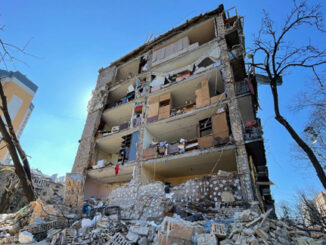
    An official communique said that since Russia’s unprovoked, unjustified, full-scale invasion, Canada has provided nearly $22 billion in multifaceted assistance for Ukraine, including over $12 billion in direct financial support—making Canada among the largest contributors to Ukraine’s recovery and reconstruction. As the Ukrainian people endure another winter of Russian aggression, Canada remains steadfast in its support for Ukraine.

    Building on Canada’s strong support for Ukraine, Mark Carney announced last weekend new measures to support a just and lasting peace. Canada has announced an additional $2.5 billion commitment for Ukraine, including financing that will enable the International Monetary Fund to lend Ukraine an additional $8.4 billion as part of an extended financing program, besides Canada’s participation in extended and expanded debt service suspension for Ukraine, for up to $1.5 billion in 2025-26.

    Canada’s new economic package also includes a loan guarantee of up to $1.3 billion in 2026 to the World Bank’s International Bank for Reconstruction and Development to support Ukraine’s reconstruction and a loan guarantee of up to $322 million in 2026 to the European Bank for Reconstruction and Development to support Ukraine’s gas imports and reinforce its energy security.

    In Halifax, Carney and Zelenskyy held a bilateral meeting to discuss the latest developments in ongoing peace talks. Mark Carney affirmed Canada’s full support for Ukraine.

    Since the beginning of 2022, Canada has committed $6.5 billion in military assistance to Ukraine. This funding will allow Canada to deliver military assistance to Ukraine through 2029.

    “The barbarism that we saw overnight—the attack on Kyiv—shows just how important it is that we stand with Ukraine during this difficult time,” Carney said.

    Zelenskyy thanked Canada for its support and called the new attacks “Russia’s answer to our peace efforts” and said it showed that Russian President Vladimir Putin “doesn’t want peace.”

    Zelenskyy also called Putin a “man of war.”

    Moscow has said the new strike was in response to Ukraine’s attacks on “civilian objects” in Russia.

  • Ready to meet Trump over Ukraine negotiations: Putin

    Ready to meet Trump over Ukraine negotiations: Putin

    MOSCOW (TIP): Russian President Vladimir Putin said on Thursday, December 20, that he was ready to compromise over Ukraine in possible talks with US President-elect Donald Trump on ending the war and had no conditions for starting talks with the Ukrainian authorities, a Reuters report says.

    Trump, a self-styled master of brokering agreements and author of the 1987 book “Trump: the Art of the Deal”, has vowed to swiftly end the conflict, but has not yet given any details on how he might achieve that.

    Putin, fielding questions on state TV during his annual question and answer session with Russians, told a reporter for a US news channel that he was ready to meet Trump, whom he said he had not spoken to for years.

    Asked what he might be able to offer Trump, Putin dismissed an assertion that Russia was in a weak position, saying that Russia had got much stronger since he ordered troops into Ukraine in 2022. “Soon, those Ukrainians who want to fight will run out, in my opinion, soon there will be no one left who wants to fight.

    We are ready, but the other side needs to be ready for both negotiations and compromises.” Putin said on Thursday that Russia had no conditions to start talks with Ukraine and was ready to negotiate with anyone, including President Volodymyr Zelenskyy. Zelenskyy, whose term has technically expired but who has delayed an election because of the war, would need to be re-elected for Moscow to consider him a legitimate signatory to any deal to ensure it was legally watertight, said Putin.

    ‘Pulled back Russia from edge of abyss’
    President Vladimir Putin said he had pulled Russia back from the edge of the abyss after the chaos which accompanied the fall of the Soviet Union, and had built the country into a sovereign power able to stand up for itself. He admitted there was inflation but said that Russian growth rates outstripped those of Britain.

  • Russia’s spring offensive is the key

    Russia’s spring offensive is the key

    About 50,000 of Russia’s newly mobilized troops are already at the front and another 2,50,000 are under training. The occupation of the Luhansk and Donetsk regions will continue, but a major Russian breakthrough is less likely.

    “The steady flow of arms and equipment through its western borders into Ukraine has greatly aided its war effort. However, President Volodymyr Zelenskyy’s desperate calls for fighter jets (about 200-odd F-16s) remain unheeded so far. The UK and Germany are providing a meagre squadron worth each of Challenger and Leopard 2 tanks and the US, while citing the extensive training and maintenance required, is expected to send about 30 M1 Abrams tanks. However, a missing element for offensive operations is air power which is unlikely to materialize anytime soon. The visit of the US President to Kyiv was highly symbolic and came with the promise of providing ammunition and air defense radars as well as further sanctions on Russia, but it fell short of Zelenskyy’s wish list of weapon systems and aircraft. The Munich security conference was in much the same vein, with the UK baulking at directly supplying fighter jets.”

    By Lt Gen Pradeep Bali (retd)

    President Vladimir Putin launched Russia’s invasion of Ukraine in the early hours of February 24, 2022, describing it as a ‘special military operation’ with the aim to ‘demilitarize and de-Nazify Ukraine’ and stop the ‘genocide’ of ethnic Russians in eastern Donbas. Moscow-backed separatists had tried to break away from Kyiv’s control by setting up the Donetsk and Luhansk People’s Republic and were opposed by groups like the Azov Regiment, rooted in far-right ideology. Putin also linked the invasion to checking NATO’s eastward expansion for gaining a ‘military foothold’ in Ukraine.

    A refreshingly honest comment about this war came from the Pontiff in Rome. Pope Francis remarked that Moscow’s invasion of Ukraine was ‘perhaps somehow provoked’ as he recalled a conversation with a head of state who had mentioned to him that NATO was “barking at the gates of Russia”. The Pope also warned against what he said was a fairy-tale perception of the conflict as a battle of good versus evil.

    There have been no serious attempts to curtail this conflict by the West by acknowledging Russian security concerns in its immediate neighborhood. However, within NATO itself there are discordant voices colored by dependence of some member countries on Russian energy exports. While direct talks between the Russian and Ukrainian Presidents have been suggested by India, among others, a few nations, including Turkey, had made offers of mediation. Apart from death and destruction, this war has led to an acute food shortage in many countries as Ukraine and Russia are major exporters of foodgrains and the conflict has disrupted supply chains. Russia is also an exporter of energy to Europe and has cut oil and gas supplies in response to sanctions, fueling inflation and increased cost of living.

    The US, UK, European Union, Japan and Australia, among others, have all backed Kyiv with military aid worth billions of dollars. Many NATO allies have been at the forefront of efforts to arm Kyiv with weaponry for repelling Russia’s forces.

    Russia’s main supporter is its neighbor and close ally, Belarus, whose territory was also used as a launch pad for the invasion and it is now providing considerable ammunition stocks for Russian forces. Many other countries, including China, India and Turkey, have avoided openly supporting either side.

    At the commencement of the invasion, Russia deployed about 2,00,000 soldiers into Ukraine from the north, east and south. After the Russian advance faltered, its troops regrouped in Ukraine’s east and Putin recast the Kremlin’s goal as ‘the liberation of Donbas’. By September, Moscow had annexed four partly occupied territories – Donetsk, Luhansk, Kherson and Zaporizhia. Meanwhile, the Ukrainian forces, aided by western arms supplies, were busy staging counterattacks. By mid-November, they had recaptured the southern city of Kherson. Since then, both sides have been locked in bloody battles for the control of territory in the Donbas.

    This year, the key determinant will be the fate of Russia’s spring offensive. About 50,000 of its newly mobilized troops are already at the front and another 2,50,000 are under training. The occupation of the Luhansk and Donetsk regions will continue, but a major Russian breakthrough is less likely. A continuation of current tactics, slow grinding of Ukrainian forces on limited fronts and a steady advance while targeting Ukrainian energy infrastructure and heavy artillery and missile barrages in the rear, will mark this war of attrition.

    Crossing over to the east side of the Dnipro River to pressure Russia’s vulnerable road and rail links into Crimea might be too demanding. But the possibility of Kyiv launching a surprise new offensive can never be ruled out.

    For the Ukrainians, the strategically valuable direction is south, to Melitopol or Berdyansk, aiming to cut the Russian mainland corridor to Crimea. That would be a major Ukrainian victory, and that is exactly why the Russians are fortifying Melitopol.

    A short and unstable ceasefire is the only other prospect. Putin has made it clear that he will not stop and Ukraine has asserted that it is fighting to recapture what has been lost, including the Crimea. This is an intense contest in political, economic, diplomatic and military domains. It is hard to escape the sense that as 2022 came to a close, an ‘iron curtain’ had once again been drawn across Europe, but this time from the West, aiming to contain Russia. Despite Russia’s sizeable budget deficit and other impacts of western sanctions, Moscow will probably have enough reserves and money to keep its war against Ukraine going. This does not mean the sanctions imposed by the West are not effective but only that it would be “naive to think that sanctions alone could end the war,” in the words of Harvard economist Kenneth Rogoff.

    The steady flow of arms and equipment through its western borders into Ukraine has greatly aided its war effort. However, President Volodymyr Zelenskyy’s desperate calls for fighter jets (about 200-odd F-16s) remain unheeded so far. The UK and Germany are providing a meagre squadron worth each of Challenger and Leopard 2 tanks and the US, while citing the extensive training and maintenance required, is expected to send about 30 M1 Abrams tanks. However, a missing element for offensive operations is air power which is unlikely to materialize anytime soon.

    The visit of the US President to Kyiv was highly symbolic and came with the promise of providing ammunition and air defense radars as well as further sanctions on Russia, but it fell short of Zelenskyy’s wish list of weapon systems and aircraft. The Munich security conference was in much the same vein, with the UK baulking at directly supplying fighter jets. As far as India is concerned, Prime Minister Modi’s advice to Putin, “Today’s era is not an era of war”, should be a pointer for Indian diplomacy to take the lead in resolving this conflict. New Delhi needs to reach out to the major players as a mediator. Its long-standing strategic ties with Russia, an ostensibly neutral stance with no ulterior motives unlike China, combined with its capabilities and capacities as the G20 president, make it ideally suited for this role. Ukraine Foreign Minister Dmytro Kuleba had stated as much in what was nothing short of a direct invitation. The Ukraine war offers our diplomacy an ideal opportunity to play the roles of a peacemaker and a dealmaker.

    (The author is a Strategic Analyst)


  • Ukraine’s Zelenskyy makes emotional appeal for EU membership

    Ukraine’s Zelenskyy makes emotional appeal for EU membership

    BRUSSELS (TIP): President Volodymyr Zelenskyy asked his Western allies February 9 for more weapons and said “a Ukraine that is winning” its war with Russia should become a member of the European Union, arguing the bloc won’t be complete without it.

    Zelenskyy made his appeal during an emotional day at EU headquarters in Brussels as he wrapped up a rare, two-day trip outside Ukraine to seek new weaponry from the West to repel the invasion that Moscow has been waging for nearly a year. As he spoke, a new offensive by Russia in eastern Ukraine was underway.

    Zelenskyy, who also visited the U.K. and France, received rapturous applause and cheers from the European Parliament and a summit of the 27 EU leaders, insisting in his speech that the fight with Russia was one for the freedom of all of Europe.

    “A Ukraine that is winning is going to be a member of the European Union,” Zelenskyy said, building his appeal around the common destiny that Ukraine and the bloc face in confronting Russia. “Europe will always be, and remain Europe as long as we … take care of the European way of life,” he said.

    EU membership talks should start later this year, Zelenskyy said, an ambitious request given the huge task ahead. Such a move would help motivate Ukrainian soldiers in their defence of the country, he said. “Of course, we need it this year,” he said, then looked at European Council head Charles Michel, and insisted, tongue-in-cheek: “When I say this year, I mean this year. Two, zero, 23.”

    EU Commission President Ursula von der Leyen, however, said “there is no rigid timeline.” In practice, membership often has taken decades to complete.

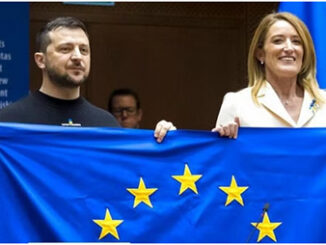
    He held up an EU flag after his address and the lawmakers stood in sombre silence as the Ukrainian national anthem and the European anthem “Ode to Joy” were played in succession.

    Before his speech, European Parliament President Roberta Metsola said allies should consider “quickly, as a next step, providing long-range systems” and fighter jets to Ukraine. The response to Russian President Vladimir Putin’s war against Ukraine “must be proportional to the threat, and the threat is existential,” she said. Metsola also told Zelenskyy that “we have your back. We were with you then, we are with you now, and we will be with you for as long as it takes.”

    A draft of the summit’s conclusions seen by The Associated Press said “the European Union will stand by Ukraine with steadfast support for as long as it takes.”

    During his time in Brussels, Zelenskyy asked Slovakia’s Prime Minister Eduard Heger to give Ukraine its Soviet-era MiG-29 fighter jets, and he replied: “We will work on” the request. Slovakia grounded its fleet of MiG-29s last year. German Chancellor Olaf Scholz said the bloc will send Zelenskyy “this signal of unity and solidarity and can show that we will continue our support for Ukraine in defending its independence and integrity.”

    Military analysts say Putin is hoping that Europe’s support for Ukraine will wane as Russia is believed to be preparing a new offensive. The Kremlin’s forces “have regained the initiative in Ukraine and have begun their next major offensive” in the eastern Luhansk region, most of which is occupied by Russia, the Institute for the Study of War, said in its latest assessment. “Russian forces are gradually beginning an offensive, but its success is not inherent or predetermined.”

    Zelenskyy used the dais of the European Parliament hoping to match Wednesday’s speech to Britain’s legislature when he thanked the nation for its unrelenting support. That same support has come from the EU. The bloc and its member states have already backed Kyiv with about 50 billion euros ($53.6 billion) in aid, provided military hardware and imposed nine packages of sanctions on the Kremlin.

    (Associated Press)

  • “We need peace”:  Zelenskyy says in his address to the joint session of  US Congress

    “We need peace”:  Zelenskyy says in his address to the joint session of  US Congress

    Says he proposed 10-point peace formula to Biden

    WASHINGTON,  D.C. (TIP): Ukrainian President Volodymyr Zelenskyy told the US Congress that he proposed a 10-point “peace formula” during his meeting with President Joe Biden, which he hoped would result in joint security guarantees for decades ahead.

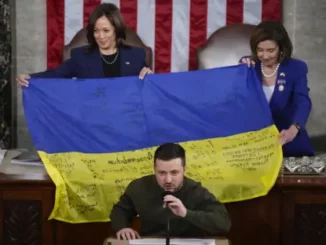
    Zelenskyy, 44, met President Biden in the Oval Office and jointly addressed a press conference at the White House on Wednesday, December 21. He was given the rare distinction of addressing a joint session of the US Congress on a day packed with back-to-back meetings. “We need peace. Ukraine has already offered proposals, which I just discussed with President Biden, our peace formula, ten points which should and must be implemented for our joint security guarantees for decades ahead. And the summit, which can be held,” Zelenskyy said in his historic address to the joint session of the Congress.

    He said that any such discussions would also depend on Russia’s willingness to negotiate and the participation of the international legal order, even as he slammed Russian President Vladimir Putin for invading Ukraine.

    “It would be naive to wait for steps towards peace from Russia which enjoys being a terrorist state. Russians are still poisoned by the Kremlin. The restriction of international legal order is our joint task,” Zelenskyy noted.

    Zelensky — wearing his trademark combat-green sweatshirt and boots — expressed hope that Congress would pass the extra USD 45 billion in aid to Ukraine to “help us to defend our values, values and independence”.

    Earlier on Wednesday, Biden welcomed Zelenskyy to the Oval Office, saying the US and Ukraine would continue to project a “united defense” as Russia wages a “brutal assault on Ukraine’s right to exist as a nation.” Zelenskyy, on his first known trip outside his country since Russia invaded in February, said he wanted to visit earlier and his visit now showed the “situation is under control, because of your support.” He said the people of Ukraine will also go through their war of independence and freedom with dignity and success.

    “We’ll celebrate Christmas. And even if there is no electricity, the light of our faith in ourselves will not be put out,” he said.

    “If Russian missiles attack us, we’ll do our best to protect ourselves. If they attack us with Iranian drones and our people will have to go to bomb shelters on Christmas Eve, Ukrainians will still sit down at the equality table and cheer up each other. And we don’t have to know everyone’s wish as we know that all of us, millions of Ukrainians, wish the same victory,” he explained.

    Zelenskyy said the battle is not only for the life, freedom and security of Ukrainians, or any other nation which Russia attempts to conquer. “This struggle will define in what world our children and grandchildren will live, and then their children and grandchildren.

    It will define whether it will be a democracy of Ukrainians and for Americans, for all,” he added.

    Zelenskyy came to the US after making a daring trip on Tuesday to the front line of the ongoing conflict, to the city of Bakhmut in Ukraine’s contested Donetsk province.

    (Source: PTI)


  • Zelenskyy urges Germany to tear down wall dividing free and unfree Europe

    Berlin (TIP): Invoking the fall of the Berlin Wall, Ukrainian President Volodymyr Zelenskyy on March 17 urged German Chancellor Olaf Scholz to tear down what he called a wall between “free and unfree” Europe and stop the war in Ukraine. Speaking to the Bundestag by video link, Zelenskyy appealed to Scholz to restore freedom to Ukraine, tapping Germany’s collective memory with reference to the historic 1948-1949 Berlin Airlift and the fall of the Berlin Wall in 1989.

    Zelenskyy described a new wall “in the middle of Europe between freedom and unfreedom”, which he said Germany had helped build, isolating Ukraine with its business ties to Russia and its previous support for the Nord Stream 2 gas pipeline.

    “And this wall is getting bigger with every bomb that falls on Ukraine, with every decision that is not taken,” he added. Germany last month halted the Nord Stream 2 Baltic Sea gas pipeline project, designed to double the flow of Russian gas directly to Germany. Recalling former U.S. president Ronald Reagan’s appeal to Mikhail Gorbachev, the last Soviet leader, to tear down the Berlin Wall, Zelenskyy told German lawmakers: “That’s what I say to you dear Chancellor Scholz: destroy this wall.” “Give Germany the leadership role that it has earned so that your descendants are proud of you. Support freedom, support Ukraine, stop this war, help us to stop this war,” he added.

    Lawmakers in the Bundestag welcomed Zelenskyy with a standing ovation and the chamber’s vice president, Katrin Goering-Eckardt, told him: “Your country has chosen democracy, and that’s what (Russian President) Vladimir Putin fears.” She said Putin was trying to deny Ukraine’s right to exist, adding: “But he has already failed with that.”  (Reuters)

  • President Joe Biden warns Russia against invasion of Ukraine

    President Joe Biden warns Russia against invasion of Ukraine

    WASHINGTON, D.C. (TIP): U.S. President Joe Biden also said he believes that Russia is preparing to take action on Ukraine, though he doesn’t think Putin has made a final decision

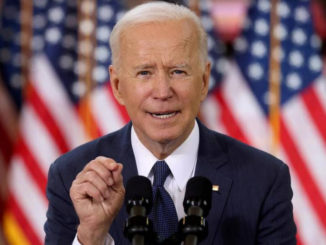
    President Joe Biden said he believes Vladimir Putin doesn’t want full blown war in Ukraine and would pay a “dear price” if he moves forward with a military incursion. Mr. Biden, speaking at a news conference on January 19 to mark his one-year anniversary in office, also said he believes that Russia is preparing to take action on Ukraine, though he doesn’t think Putin has made a final decision. He suggested that he would limit Russia’s access to the international banking system if it did further invade Ukraine.

    “I’m not so sure that he is certain what is he going to do,” Mr. Biden said. He added, “My guess is he will move in.” With critical talks approaching, the United States and Russia on Wednesday showed no sign either will relent from entrenched positions on Ukraine that have raised fears of a Russian invasion and a new war in Europe.

    Speaking in Kyiv, U.S. Secretary of State Antony Blinken accused Russia of planning to reinforce the more than 1,00,000 troops it has deployed along the Ukrainian border and suggested that number could double “on relatively short order.” Mr. Blinken did not elaborate, but Russia has sent an unspecified number of troops from the country’s far east to its ally Belarus, which also shares a border with Ukraine, for major war games next month.

    Ukraine, meanwhile, said it was prepared for the worst and would survive whatever difficulties come its way. The President urged the country not to panic.

    Mr. Blinken’s visit to the Ukrainian capital came two days before he is to meet in Geneva with Russian Foreign Minister Sergey Lavrov. That follows a series of inconclusive talks last week that failed to ease rising tensions.

    Russian military activity has been increasing in recent weeks, but the U.S. has not concluded whether President Vladimir Putin plans to invade or whether the show of force is intended to squeeze the security concessions without an actual conflict.

    In Kyiv, Mr. Blinken reiterated Washington’s demands for Russia to de-escalate the situation by removing its forces from the border area, something that Moscow has flatly refused to do. And, Mr. Blinken said he wouldn’t give Russia the written response it expects to its demands when he and Mr. Lavrov meet in Geneva.

    Meanwhile, a top Russian diplomat said Moscow would not back down from its insistence that the U.S. formally ban Ukraine from ever joining NATO and reduce its and the alliance’s military presence in Eastern Europe.

    Deputy Foreign Minister Sergei Ryabkov said Moscow had no intention of invading Ukraine but that its demands for security guarantees were non-negotiable.

    The U.S. and its allies have said the Russian demands are non-starters, that Russia knows they are, and that Mr. Putin is using them in part to create a pretext for invading Ukraine, which has strong ethnic and historical ties to Russia.

    The former Soviet republic aspires to join the alliance, though has little hope of doing so in the foreseeable future.

    Mr. Blinken urged Western nations to remain united in the face of Russian aggression. He also reassured Ukraine’s leader of NATO support while calling for Ukrainians to stand strong.

    Mr. Blinken told Ukrainian President Volodymyr Zelenskyy that the U.S. and its allies were steadfast in backing his country and its democratic aspirations against Russian attempts to incite division and discord through “relentless aggression.” “Our strength depends on preserving our unity and that includes unity within Ukraine,” he told Mr. Zelenskyy. “I think one of Moscow’s long-standing goals has been to try to sow divisions between and within our countries, and quite simply we cannot and will not let them do that.” The Mr. Biden administration had said earlier it was providing an additional $200 million in defensive military aid to Ukraine. Mr. Blinken said more assistance is coming and that it would only increase should Russia invade.

    Mr. Zelenskyy thanked Mr. Blinken for the aid, which was approved in late December but not confirmed until Wednesday. “This [military] support not only speaks to our strategic plans of Ukraine joining the alliance, but more importantly to the level of our military, our military supplies,” he said, referring to Kyiv’s desire to join NATO.

    “Your visit is very important,” Mr. Zelenskyy said. “It underlines once again your powerful support of our independence and sovereignty.” Mr. Zelenskyy released a video address to the nation on Wednesday evening, urging Ukrainians not to panic over fears of a possible invasion. But he said the country has been living with the Russian threat for many years and should always be prepared for war. “Ukraine doesn’t want a war, but must always be prepared for it,” Mr. Zelenskyy said.

    From Kyiv, Mr. Blinken plans a short trip to Berlin for talks with German and other European allies on Thursday before meeting with Lavrov.

    On Wednesday, French President Emmanuel Macron called on the European Union to draw up a plan to ease tensions with Russia. “We should build it among Europeans, then share it with our allies in the framework of NATO, and then propose it for negotiation to Russia,” he said.

    Washington and its allies have kept the door open to possible further talks on arms control and confidence-building measures to reduce the potential for hostilities.

    (Agencies)