Tag: Washington

  • 17 House Republicans vote with Democrats to extend Obamacare subsidies for 3 years

    17 House Republicans vote with Democrats to extend Obamacare subsidies for 3 years

    WASHINGTON, D.C. (TIP)- The House passed a bill on Thursday, January 8, to extend the Affordable Care Act enhanced subsidies for three years by a vote of 230-196 with 17 Republicans voting with Democrats and defying GOP leaders, Allison Pecorin of ABC News reported.

    A tangible path forward that sends legislation through the Senate to the Resolute Desk to address the expired subsidies remains in question.

    Senate Majority Leader John Thune said Thursday, January 8, that there’s “no appetite” for an extension in the upper chamber and pointed instead to ongoing bipartisan talks between senators and House members.

    “We’ve had that vote, as you know, already,” Thune said. “But we’ll see what happens from the working group, and if they can come up with something that has reforms. And we’ll go from there.

    House Minority Leader Hakeem Jeffries expressed pride in the “bipartisan coalition” created ahead of Thursday’s vote on a three-year extension of enhanced Affordable Care Act subsidies after nine Republicans crossed the aisle Wednesday night to set up passage in the House.

    “I hope today there will be more Republicans joining this leader,” said Senate Minority Leader Chuck Schumer, gesturing towards Jeffries at a news conference Thursday.

    Jeffries called the vote “an opportunity to take a meaningful step forward to lower the high cost of living for everyday Americans, particularly as it relates to health care, but it’s a battle that we will continue to wage on behalf of the American people.”

    9 Republicans vote with Democrats to set up House vote on 3-year extension of ACA subsidies
    Wednesday’s procedural vote passed by a 221-205 margin with nine Republicans voting with Democrats to pass it.

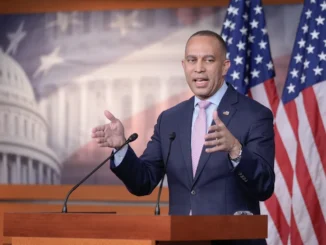
    Saul Loeb/AFP via Getty Images – PHOTO: Senate Minority Leader Chuck Schumer and US House Minority Leader Hakeem Jeffries hold a press conference on Capitol Hill in Washington, January 8, 2026.

    The subsidies, which expired at the end of 2025, were enhanced during the COVID-19 pandemic to increase the amount of financial assistance to those who were already eligible and to expand eligibility to more people.

    A bipartisan group of House members and senators met for about an hour over lunch Thursday to grapple over various health care provisions, telling reporters afterward that they’ve struck an agreement to address widespread fraud, such as phantom accounts.

    “We’re trying to see if we can get to some agreement that’s going to help them, and the sooner we can do that, the better,” New Hampshire Democratic Sen. Jeanne Shaheen told reporters as she left the meeting. “So there was agreement on addressing fraud.”

    Shaheen did not divulge details of an impending deal but said the next step will be crafting bill text in the coming days.

    Many conservatives want to add Hyde Amendment protections to ensure that an extension of the ACA tax credits won’t provide federal funds for abortion services, generating Democratic opposition to GOP proposals.

    But several moderates, including Reps. Don Bacon and Dan Meuser, conceded that the ACA already includes Hyde protections, so there is an ongoing debate among appropriators on whether that’s sufficient cover for conservatives if an extension of the subsidies does not explicitly codify those protections.

    Nevertheless, some Republicans believe a bipartisan deal is within reach.

    “Things are still being hashed out. There’s always the details — the so-called devil’s in the details, or maybe the angel’s in the details,” Meuser said, adding lawmakers hope to conclude discussions “as soon as possible.”

    “I mean, it’s certainly a sense of urgency, to say the least,” he said.

    Lawmakers did not reveal whether they scheduled another meeting but signaled that bill text could be ready soon.

    “They’re very close,” said GOP Rep. Brian Fitzpatrick, adding that the bill mirrors the language of a bill that he and Lawler and Democratic Reps. Tom Suozzi and Jared Golden introduced.

    Suozzi said it was “a very hopeful feeling when you participate in a meeting like this,” citing an even split of Democrats and Republicans at the meeting while emphasizing everyone’s commitment to “moving beyond this toxicity and trying to find some common ground.”

    The Senate last month rejected a three-year extension of the subsidies when the measure fell short of the 60-vote threshold, though four Republicans — Sens. Susan Collins of Maine, Josh Hawley of Missouri, and Lisa Murkowski and Dan Sullivan of Alaska — all crossed the aisle in support of the measure.

    An estimated 22 million of the 24 million ACA marketplace enrollees are currently receiving enhanced premium tax credits to lower their monthly premiums, and many are seeing their premiums soar in 2026.

    Rod Lamkey/AP – PHOTO: Senate Majority Leader John Thune speaks during the Senate Republican policy luncheon news conference at the Capitol, Jan. 6, 2026, in Washington.

    The nonpartisan Congressional Budget Office estimates the bill would increase the federal deficit by about $80.6 billion over the next decade.

    If the measure is enacted, the number of people with health insurance would increase by 100,000 people in 2026, 3 million in 2027, 4 million in 2028 and 1.1 million in 2029, relative to current law, the CBO reported.

    According to the CBO, the 4 million increase in 2028 would result from changes in several types of coverage: 6.2 million more people would be enrolled through ACA health insurance marketplaces; 400,000 million more people enrolled in Medicaid and the Children’s Health Insurance Program; 500,000 fewer people would purchase nongroup coverage outside the marketplaces; and 2.1 million fewer people would have employment-based coverage.

    Senate back to square one on health care after both bills fail
    President Donald Trump has publicly expressed his opposition to extending the enhanced subsidies.

    “I’d like not to be able to do it. I’d like to see us get right into this. I don’t know why we have to extend — this can be done rapidly if the Democrats would come along,” Trump said on Dec. 18 in the Oval Office.

    After Speaker Mike Johnson resisted pressure to allow a vote on the subsidies late last year, a quartet of House Republicans — Fitzpatrick, Lawler, Bresnahan and Mackenzie — banded together before the holiday break and signed on to a Democratic discharge petition to force a vote on an ACA extension, much to the chagrin of GOP leaders.

    (Source: ABC News)

  • Trump administration moves to void thousands of asylum claims

    Trump administration moves to void thousands of asylum claims

    WASHINGTON, D.C. (TIP): The Trump administration has launched a nationwide campaign to invalidate the asylum claims of thousands of people with active cases in U.S. immigration courts by arguing that they can be deported to countries other than their own, CBS News reported on Tuesday, December 30. Another report says that U.S. could deny migrants access to asylum on the grounds they present a public health risk under a newly finalized regulation drafted during the COVID-19 pandemic in President Donald Trump’s first term.
    The regulation, effective on Wednesday, December 31, allows U.S. authorities to bar asylum based on “emergency public health concerns generated by a communicable disease,” according to a copy posted in the Federal Register on Monday, December 29. Reuters said it could not immediately independently confirm the report.

  • India’s Foreign Secretary Vinay Mohan Kwatra Reviews with US Officials the India-US Global Strategic partnership

    India’s Foreign Secretary Vinay Mohan Kwatra Reviews with US Officials the India-US Global Strategic partnership

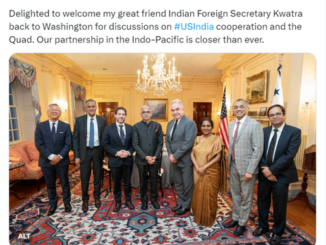
    WASHINGTON, D.C. (TIP): India’s Foreign Secretary Vinay Mohan Kwatra visited Washington DC, United States from 10-12 April 2024. During his visit, Foreign Secretary Kwatra undertook a detailed review of the progress made towards further consolidating the India-US Comprehensive Global Strategic Partnership.

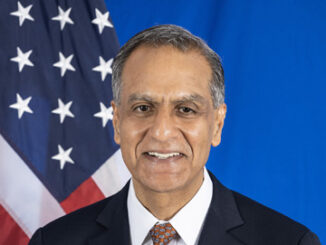
    During his visit to Washington DC, Foreign Secretary had discussions with his counterparts at the State Department Deputy Secretary Richard Verma and Deputy Secretary Kurt Campbell as well as other senior officials. He also held discussions with key counterpart officials at the National Security Council, Department of Defense, Department of Commerce and Department of Energy. These discussions spanned the entire gamut of India-US ties, growing defense and commercial ties, supply chain resilience and contemporary regional developments.

    Foreign Secretary also had meetings with representatives of leading thinktanks and chambers of commerce. The visit is in keeping with the tradition of regular high-level exchanges between the two countries and provides an opportunity to further advance our growing and future-oriented partnership.

  • Congress must do its part to urge Indian govt to correct its course, says US lawmaker

    Congress must do its part to urge Indian govt to correct its course, says US lawmaker

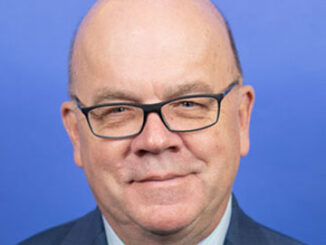
    WASHINGTON, D.C. (TIP): The US Congress must do its part to urge the Indian government to correct the course, and reconsider policies and laws, including counter-terrorism laws that are “inconsistent” with the obligations India has acquired through its ratification of key human rights treaties, an influential American lawmaker said Thursday, March 21. On April 19, multi-phase general elections will kick off in India to determine the country’s political direction for the next five years. Prime Minister Narendra Modi is seeking a third term, said Congressman James McGovern, Co-Chair of the Tom Lantos Human Rights Commission, during a hearing on human rights in India.

    “I’m one of those people who think that friends should tell each other hard truths. And India is a friend, and it is truly important to the US that India prospers. Yet there is a real risk that the tensions inherent in diverse societies could harden into dangerous conflicts and undermine India’s bright future if human rights abuses are not addressed,” McGovern said.

    “The recent communal violence between ethnic Hindu and Christian communities in Manipur state is just but one example. Congress must do its part to urge the Indian government to correct course and reconsider policies and laws, including counter-terrorism laws that are inconsistent with the obligations India has acquired through its ratification of key human rights treaties,” he said.

    In his remarks, Congressman Chris Smith, Co-Chair of the committee said that India is a country of particular concern. “I would put an H in there, huge particular concern for their egregious behavior. And Modi looks at what we do and say, they don’t care. That’s what the takeaway is by his government and by him personally. So I would encourage you to continue on,” he said.

    “…And geopolitical concerns are enhanced, I believe, and the ability for us to have credibility. When we name countries on CPC and exclude egregious violators like India, what does that say to the other countries that are on the list? They look at us as hypocrites, and that’s not good either,” Smith said.

    Carolyn Nash, Asia Advocacy Director, Amnesty International USA told lawmakers that the US government has recognized acts of transnational repression by the Government of India in Canada, which led to the assassination of an activist, as well as attempts here in the United States.

    “The scale of oppression facing human rights defenders, both in and out of India, limits the availability of information about human rights violations committed by the Indian government, information that should influence how the US and other governments engage the Modi administration and how the private sector makes choices about investment,” she alleged.

    “I can provide documentation of the government’s intensifying efforts to weaponize and codify into law intolerance and hate… Of particular concern are the expansion of the government’s abuse of vague and overbroad laws to shut down dissent, the increases in leaders’ use of hate speech and vilification of religious groups, and the recent rollout of the CAA and its discriminatory citizenship process, which could set the stage for millions to be deprived of citizenship,” Nash told the lawmakers.

    “It is up to the US lawmakers to respond to these efforts, but the situation is worsening quickly, and it would be a mistake to imagine that the US and other concerned governments are geopolitically constrained from taking action. As India prepares for elections, we urge the US government, both members of Congress and administration officials, to communicate to the government of India that the US will condemn hateful rhetoric, legal harassment of civil society, and the targeting of religious and ethnic groups,” she said.

    “The BJP party is eager to demonstrate to their base that they are delivering on supremacist promises. We know the lead up to the election will be a particularly dangerous time. We also know that Prime Minister Modi will be particularly sensitive to messages from other governments, and especially from senior leaders,” Nash said.

    Waris Husain, Legal Advisor, American Bar Association Centre for Human Rights said the Congress needs to more forcefully urge the US President to speak directly to Prime Minister Modi about these concerns.

    “It’s ultimately Prime Minister Modi who has the power to instruct his government, his party, about their toxic rhetoric and their abusive laws and policies and get them to drop this abusive form of governance. Members of Congress and President Biden need to acknowledge the scope and gravity of this situation,” he said.

    “Biden’s embrace of Modi and reluctance to criticize the government for this situation will be understood by India to mean that the worsening conduct will have no consequences, and that cannot be the situation. So my last point would merely be that doing so, failing to say anything to Prime Minister Modi about this deteriorating situation sends a terrible message that the US government cares more about him, about Modi, as a leader, than about the people of India whom Modi was elected to serve,” Husain said.
    (Source: PTI)

  • Joe Biden’s campaign freezes donation from Indian-American businessman

    Joe Biden’s campaign freezes donation from Indian-American businessman

    WASHINGTON, D.C. (TIP): The re-election campaign of US President Joe Biden and a Democratic Party committee have freezed donations from an Indian-American businessman amid allegations that he falsely claimed to be associated with the Central Intelligence Agency (CIA). A Biden campaign official stated that a $50,000 donation to the Biden Victory Fund made by Gaurav Srivastava, who claimed to be associated with the CIA, last April was put in escrow due to concerns about its source and legality, according to Politico.
    Similarly, a spokesperson from the Democratic Congressional Campaign Committee, which received nearly $290,000 last year from Srivastava, stated that the committee has set aside the funds for the “foreseeable future” as a precautionary measure. The decision to freeze the funds follows media reports questioning Srivastava’s business practices and philanthropy.

    President Joe Biden’s re-election campaign said it has raised $10 million in the 24 hours following a fiery State of the Union address, where he accused Donald Trump of threatening democracy and torpedoing a bill to tackle US immigration woes. While Srivastava, based in Los Angeles, has been active in various charitable causes, a profile by Project Brazen raised doubts about his integrity, including claims of false CIA ties.

    The Atlantic Council, a think tank dealing with international affairs, cut ties with Srivastava after struggling to verify his background, reported Politico.

    Srivastava, with his wife Sharon, donated over $1 million to the think tank for its Global Food Security Forum in Bali in November 2022. The businessman manages a charitable organization named after himself and his wife, the ‘Gaurav and Sharon Srivastava Family Foundation’.

    The foundation, started in 2015, serves communities worldwide that lack the fundamental resources available in the United States. Reports have also questioned Srivastava’s identity and employment details.

    Despite claiming to work for Architecture, Engineering, Construction, Operations, and Management (AECOM) in campaign filings, the global infrastructure firm has denied employing him in the US. Srivastava later listed himself as the chairman of Unity Resource Group, a security operations company, reported Politico.

    Connections between Srivastava and President Biden extend beyond donations.

    Unity Resources Group briefly employed a lobbying firm led by former Biden aide Ankit Desai, and Srivastava reportedly met Biden personally last year.

    Gaurav Srivastava, listing AECOM as his employer, donated $6,600 to Representative Mikie Sherrill’s campaign. He also gave $3,300 to Senator Maria Cantwell, this time listing Unity Resources Group as his employer. Democratic politicians, including Senator Mark Warner and Robert Menendez, received donations of $6,600 each from Srivastava, prompting them to redirect the funds to charities amid the controversy.

  • U.S. urges ‘immediate’ ceasefire at UN as Gaza war grinds on

    U.S. urges ‘immediate’ ceasefire at UN as Gaza war grinds on

    WASHINGTON, D.C. (TIP): The United States has circulated for the first time a draft UN resolution calling for an “immediate” ceasefire in the Israel-Hamas war, as warnings grow of famine in besieged Gaza.

    Washington had blocked previous Security Council texts using the word “immediate” but U.S. top diplomat Antony Blinken confirmed the shift in position on Wednesday, March 20.

    A new version circulated by the U.S. and seen by AFP, the agency says, stressed “the need for an immediate and durable ceasefire” to protect civilians and allow aid into the territory.

    No vote has been scheduled on the text but Blinken told Saudi media outlet Al Hadath on Wednesday, March 20, that support for the resolution would send a “strong message”.

    The U.S. secretary of state, whose diplomatic push is running alongside mediation efforts in Qatar, will land in Israel on Friday. The Qatar talks were considering a Hamas proposal for a six-week ceasefire to allow hostages to be exchanged for Palestinian prisoners held by Israel and increased aid deliveries.

    But a senior Hamas official based in Lebanon, Osama Hamdan, said Israel’s response had been “largely negative” and called it “a step backwards”.

    The U.S. and Israel are also engaged in a diplomatic tug-of-war over the southern Gaza city of Rafah, the last part of the territory still largely untouched by Israeli ground troops.

    Hundreds of thousands of Palestinians have fled to the city to escape fighting elsewhere, but Israel Prime Minister Benjamin Netanyahu has insisted a ground incursion is the only way to finally root out Hamas.

    U.S. officials said they supported Netanyahu’s goal but wanted Israel to try strategies short of a potentially catastrophic invasion of an area where around 1.5 million people are hemmed in by the Egyptian border.

  • Four, including three Indians, arrested while entering US illegally from Canada

    Four, including three Indians, arrested while entering US illegally from Canada

    WASHINGTON, D.C. (TIP): Three Indian nationals are among four people arrested in Upstate New York after they jumped off a moving freight train coming from Canada in their bid to enter the US illegally.

    US Border Patrol agents arrested the four, including a woman, on March 12. The investigation concluded that all four people were undocumented non-citizens.

    Border Patrol agents assigned to the Buffalo Station spotted four people jumping off a moving freight train on the International Railroad Bridge in the city of Buffalo.

    The men left the woman who became immobile due to an injury and were caught shortly after a foot pursuit. The injured woman received first aid from Erie County Sheriff’s deputies and U.S. Customs and Border Protection officers (CBP). After treatment, the woman was transported by ambulance to a local medical centre.

    Border Patrol agents were able to identify that the woman and two men were from India and the third man was from the Dominican Republic. The three men are being processed for removal and detained in Batavia Federal Detention Facility awaiting a deportation hearing for charges under Sections 212 and 237 of the Immigration and Nationality Act, a media release said.

    The woman remains at a local medical centre awaiting further medical treatment. This is a great example of how our Border Patrol agents, CBP officers and law enforcement partners work tirelessly to protect the Western New York area,” said Chief Patrol Agent Thomas G. Martin, US Border Patrol Buffalo Sector.

  • India-US security cooperation will become even more important in the years ahead: Richard Verma

    India-US security cooperation will become even more important in the years ahead: Richard Verma

    WASHINGTON, D.C. (TIP): India-US security cooperation will become even more important in the years ahead and the work of the two countries on emerging technologies will take on even more promise, a top American diplomat said on Thursday, March 14, reiterating the remarks of President Joe Biden that this is the defining partnership of the 21st century.

    “As both President Biden and Prime Minister Modi have said, our impact on each other is important, but what we can do for the world is even more important. Whether it’s addressing food insecurity or battling the next pandemic or connecting millions to the digital economy, there is so much we can do together,” Deputy Secretary of State for Management and Resources, Richard Verma, wrote in a blog post in his recent return from India.

    Verma is the highest-ranking Indian-American ever in the State Department. He was also the first ever Indian-American to serve as the US Ambassador to India.

    “So, where are we headed?” Verma wrote as he described in detail the significant growth in the India-US relationship over the last few decades.

    He identified defense, democracy and technology as three key areas of cooperation between the two countries.

    “Our security cooperation will become even more important in the years ahead. The threats we face are real, but building our collective capabilities, increasing sharing of information, and improving maritime domain awareness and interoperability will ensure India continues to be a provider of net security across the Indo-Pacific region and beyond,” Verma wrote. “Our work on protecting, preserving, and strengthening democracy will continue to be even more important, with the rise of authoritarian leaders and movements. This includes continuing to strengthen a global rules-based order architecture, ensuring we bridge the divide on income inequality, and battling mis and disinformation. Democracy must continue to deliver for our peoples,” he said.

    “Our work on emerging technologies will take on even more promise. New and emerging technologies offer tremendous opportunities for economic growth and development. At the same time, recent disruptive cyber attacks, carried out by criminals and nation states, demonstrate the risk that cyber vulnerabilities can pose to global peace and security,” said the top American diplomat.

    “We must work together to tackle data privacy issues, such as identity theft, by exchanging knowledge on data protection issues. Through the Digital Connectivity and Cybersecurity Partnership, the US is working closely with India to build and maintain internet infrastructure and strengthen cybersecurity protections. From semiconductors to critical minerals to space exploration and innovation in clean energy, battling climate change, and so much more, this is about economic and physical security,” Verma wrote.

  • US says it is concerned about CAA and closely monitoring its implementation

    US says it is concerned about CAA and closely monitoring its implementation

    WASHINGTON, D.C. (TIP): The United States on Thursday, March 14 said it is concerned about the notification of the Citizenship (Amendment) Act in India and is closely monitoring its implementation.

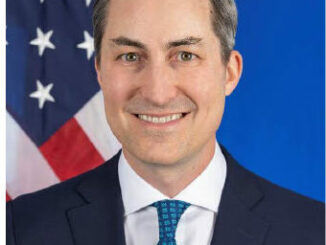
    “We are concerned about the notification of the Citizenship (Amendment) Act on March 11,” State Department Spokesperson Matthew Miller told reporters at his daily briefing.

    “We are closely monitoring how this act will be implemented. Respect for religious freedom and equal treatment under the law for all communities are fundamental democratic principles,” Miller said in response to a question.

    The Indian government implemented the Citizenship (Amendment) Act 2019 on Monday, paving the way for the grant of citizenship to undocumented non-Muslim migrants from Pakistan, Bangladesh and Afghanistan who came to India before December 31, 2014. The government also came out with a press statement to say that Indian Muslims need not worry as the CAA will not impact their citizenship and has nothing to do with the community which enjoys equal rights as their Hindu counterparts. The Indian government has maintained that the CAA is about granting citizenship and that no citizen of the country will lose citizenship.

  • US House passes bill to ban TikTok

    US House passes bill to ban TikTok

    WASHINGTON, D.C. (TIP): The US House of Representatives on Wednesday passed a bill to ban Chinese social media app Tiktok, which is very popular among kids, in the United States.

    India was the first country to ban TikTok in 2020 after it became public knowledge that the popular Chinese social media platform was being used for gathering personal data and spying on others.

    Passed by the House by 352 to 65 votes, the bill now heads to the US Senate for it to be sent to the White House for the President to sign it into law. While 197 Republican lawmakers voted for the measure and 15 against, on the Democratic side, 155 voted for the bill and 50 against. The bill, “Protecting Americans From Foreign Adversary Controlled Applications Act”, was co-authored by Indian American Congressman Raja Krishnamoorthi, a Democrat, and Congressman Mike Gallaghe from the Republican party.

    “This bill is not a ban and it is not about TikTok. It is about ByteDance…a 100 per cent owner of TikTok. ByteDance is controlled by the Chinese Communist Party. In fact the editor-in-chief of ByteDance is the secretary of the Chinese Communist Party cell embedded at the very highest ranks of the company,” Krishnamoorthi said.

    He said the bill ensures that ByteDance divests itself of the vast majority of the ownership at TikTok. “Our intention is for TikTok to continue to operate but not under the control of the CCP,” Krishnamoorthi said.

    Former vice president Mike Pence said the passage of this legislation demonstrates that appeasement to Communist China is over, allowing TikTok to continue operating in the United States while under CCP control is simply unacceptable. “The Senate must take up this legislation as soon as possible and send it to President Biden’s desk. AAF will never falter in our commitment to confronting China at home and abroad, the American government must not falter now,” he demanded.

    Former House Speaker Nancy Pelosi said the overwhelming and bipartisan passage of the bill is a strong statement of the Congress’s commitment to the security of the country and privacy of the data. “Let me be clear: this legislation is not a ban on TikTok. I join my colleagues in recognising the platform’s entertainment, educational and entrepreneurial value, especially among younger people. Instead, this legislation would strengthen TikTok: keeping Americans’ data and control of the algorithm out of the hands of a foreign adversary.

    “In doing so, we protect against surveillance and influence operations that are hallmarks of the Chinese Communist Party (CCP),” she said.

    Repressed communities in China – from the Uyghurs to Tibetans to the people of Hong Kong, and others – are telling us that their stories of their suffering are being blocked or misrepresented on TikTok, Pelosi said.

    “At the same time, the CCP is spreading propaganda to cover up its heinous abuses. We cannot allow Beijing to bury the truth of its abysmal record on human rights,” Pelosi said, and urged the Senate to bring companion legislation to a vote as quickly as possible.

    “The Senate will review the legislation when it comes over from the House,” said Senate Majority Leader Chuck Schumer. House Foreign Affairs Committee Chairman Michael McCaul said CCP-controlled TikTok is an enormous threat to US national security and young Americans’ mental health. “This past week demonstrated the Chinese Communist Party is capable of mobilising the platform’s users to a range of dangerous, destabilising actions. The Senate must pass this bill and send it to the president’s desk immediately,” he said.

    Senate Select Committee on Intelligence Chairman Mark R Warner and Vice Chairman Marco Rubio said they are united in their concern about the national security threat posed by TikTok – a platform with enormous power to influence and divide Americans whose parent company ByteDance remains legally required to do the bidding of the Chinese Communist Party.

    “We were encouraged by today’s strong bipartisan vote in the House of Representatives, and look forward to working together to get this bill passed through the Senate and signed into law,” the two Senators said.

  • US lawmakers call for addressing Green Card backlog and resolving H-1B issues at immigration summit

    US lawmakers call for addressing Green Card backlog and resolving H-1B issues at immigration summit

    WASHINGTON, D.C. (TIP): Eminent lawmakers from both the Democratic and Republican parties at an immigration summit have called for urgently addressing the Green Card backlog, an issue that is majorly impacting Indian professionals and the issues related to the H-1B visa.

    At the first-of-its-kind ‘Tech Immigration Summit’ at the US Capitol on Monday, March 11 hosted by the Foundation for India and Indian Diaspora (FIIDS), the lawmakers pushed for removing the seven per cent country quota when it comes to issuing Green Card or legal permanent residency to foreign guest workers in specialized categories. In the absence of such a move, the Green Card waiting period for Indian immigrants would be more than 20 years and over 70 years in many cases.

    A Green Card, known officially as a Permanent Resident Card, is a document issued to immigrants to the US as evidence that the bearer has been granted the privilege of residing permanently. Congressman Ro Khanna, who is also co-chair of the Congressional India Caucus, called for a rational immigration policy.

    “We know that immigrants have helped build Silicon Valley, that so many of the companies that have started, that have created so many jobs that have created so much employment have been founded by immigrants from India, from China, from Asia, the Middle East, from Europe,” he said.

    Khanna is co-sponsor and lead of the Eagle Act, which he said would get rid of the country caps so that people aren’t perpetually in status because that hurts American workers.

    “You are hurting American workers by allowing corporations to underpay folks on an H1-B, and you’re hurting the families on H1-B. And that’s why we need to move them to green cards and ultimately citizenship,” he said.

    “It will help raise wages, help American workers, and help these families. We also should be providing a Green Card to folks who are educating in the United States. It makes no sense that we’re paying for someone’s education at college or giving them STEM, and then we’re telling them that they have to go back to where they came from when American taxpayers are funding the education. I’d rather stay here, create the jobs here instead of offshoring those jobs,” Khanna said.

    “We made a lot of progress on these bills. We need to now get it again through the House. But the obstacle, as you know, has been the Senate, as is often the case,” Khanna said.

    Congressman Eric Swalwell said 40 per cent of his constituents in California were born outside of the United States.

    “If we want to take on the bigger challenges, we need the fix. If we want to cure cancer in America, we need to fix a broken immigration system. If we want to see fewer emissions when it comes to how we get our energy, we need to fix our immigration system. If we want to pay less in childcare, we need to fix our immigration system,” he said.

    The American immigration system is broken, Indian-American Congressman Shri Thanedar said.

    “We need legal immigration solidified; our businesses need that. Every time I meet CEOs of companies, they tell me how important it is to be able to find a skilled workforce. Today we are losing so many people to Australia to Canada because they’re taking advantage of our broken immigration system.

    “We need to be able to keep the skilled workforce in the US. That’s going to help our GDP, that’s going to help our businesses to grow, and that’s going to create more American jobs,” he said.

    “It’s in the best interest of the United States to continue to welcome immigrants and make it easier. I think the current system is so stressful to the employees and their families,” he said. Congressmen Rich McCormick and Raja Krishnamoorthi called for passage of the relevant legislation from the US Congress.

    Khanderao Kand from the Foundation for India and Indian Diaspora Studies (FIIDS) said technology immigrants are leading entrepreneurs in big industries.

    “From an innovation point of view, the largest innovators, patent holders are coming from the immigration background,” he said. Technology professionals, when they settle, they create jobs and wealth in the United States.

    “However, their situation, particularly the largest source of technology professionals coming from India, they are shackled by the seven per cent country quota. This policy created a huge backlog resulting in the green card processing for new applicants for more than a hundred years. They will never be able to get their green card unless technology policies are changed. That’s why we hosted this immigration summit. We addressed the issues like, seven per cent quota, EAD, OPT, various such kinds of issues,” Kand said.

    “We also discuss about the bills pending in the Congress,” he said. In addition to several US lawmakers, representations from think tanks, and an official from the Department of State, there were testimonies from the various impacted people, whether they are the pending backlog green card, or could be the documented dreamers, or the family members or the students, all of them.

    “In addition to that, technology entrepreneurs came, and they presented their thought processes. So overall, this summit has been very successful and we hope that we can make a dent in the policies both within the Congress and the administration,” Kand said.

  • Suozzi Appointed Co-Chair of Democrats for Border Security Task Force

    Suozzi Appointed Co-Chair of Democrats for Border Security Task Force

    WASHINGTON, DC (TIP): Congressman Tom Suozzi (NY-03) and Congressman Henry Cuellar (TX-28), on March 12, launched the Democrats for Border Security Task Force, a group of 26 House Democrats dedicated to addressing our country’s immigration and border crisis and countering the surge of illicit narcotics threatening communities across the country. Suozzi and Cuellar will serve as Co-Chairs of the newly formed Task Force.

    “America’s southern border and immigration system aren’t working, and it is time to fix it. This task force will advocate for commonsense, bipartisan compromise to achieve much-needed and long-overdue comprehensive immigration reform. Our approach to the immigration and border crisis is unequivocal; we will work with anybody from any wing of any party if they genuinely care about solving this problem,” said Rep. Suozzi. “Too many in politics today are focused on pointing out the problem and keep busy figuring out what tricks they have ‘up their sleeves’ to weaponize the border crisis, this task force will ‘roll up our sleeves’ to try to fix it.”

    “Cities across the country are now feeling the consequences of the humanitarian crisis at the border – something border communities have been dealing with for years,” said Rep. Cuellar, Ranking Member of the House Appropriations Subcommittee on Homeland Security. “This crisis is unsustainable, and Democrats need a forum to approach border security policy as the GOP continues to play partisan politics with the issue. The crisis at our border demands solutions today, and it is unfortunate that a bipartisan Senate bill aimed at addressing the situation was killed before we even had a chance to debate its contents. I’m proud to lead my fellow Democrats on this Task Force so we can find sensible solutions that will secure the border while respecting the rights of migrants to claim asylum.”

    The goal of the Task Force will be to provide a platform for House Democrats to contribute to ongoing discussions regarding border security and collaborate with colleagues. The Task Force will hold meetings with Administration officials, NGOs, and local officials from border communities to better inform members of the realities of the border crisis while giving House Democrats a platform to discuss sensible border security measures.


  • Biden, Trump set for November 2024 clash

    Biden, Trump set for November 2024 clash

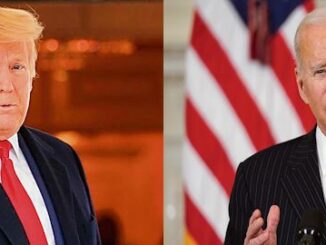
    WASHINGTON, D.C. (TIP): US President Joe Biden and his predecessor Donald Trump secured their parties’ presidential nominations with impressive wins in another round of key primaries, setting the stage for a grueling 2020 rematch between them in November.

    Biden, 81, won the Democratic presumptive nomination on Tuesday, March 12, after easily clinching the presidential primaries in Georgia, as the number of delegates in his kitty crossed the halfway mark of 3,933 pledged delegates. A total of 1,968 delegates were required to win the Democratic nomination for the November 5 presidential election.
    With wins in another round of key primaries, Donald Trump and Joe Biden have set the stage for a 2020 rematch in November.
    (Also read The Biden-Trump Rematch and the Historical Context of Presidential Rematches on Page 10)
    The last presidential rematch came in 1956 when Republican President Dwight D Eisenhower again defeated Adlai Stevenson, the Democratic opponent he had four years prior

    Four states — Georgia, Hawaii, Mississippi, Washington — one American territory and Democrats living abroad held their primaries on Tuesday. Biden would formally be declared the party’s nomination during the Democratic National Convention in Chicago in August.

    Trump, 77, reached the 1,215 delegates necessary with an allocation of delegates from Washington state. Trump will be officially nominated at the Republican National Convention in Milwaukee this July. He will lead the Republican Party in a third consecutive presidential election after clinching the nomination on Tuesday.

    Their rematch, long anticipated, but hardly clamored for, is broadly expected to mirror the 2020 campaign, though Trump will run this time under the specter of 91 felony charges.

    Trump is scheduled to become the first former American president to go on trial in a criminal case on March 25 in New York, where he faces charges he falsified business records to hide hush money payments to a porn star.

    Other charges are related to allegations that he plotted to overturn his 2020 election defeat; played a lead role in the January 6, 2021, insurrection at the US Capitol and illegally took classified documents from the White House.

  • Three Indian American women among 14 win GSV Power of Women award

    Three Indian American women among 14 win GSV Power of Women award

    WASHINGTON, D.C. (TIP): Three Indian American women — Anupama Vaid,  Bijal Shah and Shalinee Sharma- are among 14 winners of 2024 Power of Women award instituted by GSV Ventures, a multi-stage venture capital firm focused on more than $7 trillion global education and workforce skills sector.
    ‍The Power of Women award recognizes influential female leaders who are bringing about a world that provides equal access to the future through the promise of education, according to a media release.
    “As entrepreneurs and innovators in EdTech these women are achieving successful outcomes at scale in the education and skills sector,” it says. Power of Women is presented by Cambium Learning Group.
    The honorees will receive their award at the Arizona State University ASU+GSV Summit 2024, April 14-17, 2024, in San Diego.
    Indian American winners are:
    Anupama Vaid, President & Founder, ParentSquare
    Anupama (Anu) Vaid came up with the idea for ParentSquare during a sabbatical when her children were young, recognizing the need to enhance the parent experience in school communications.
    She holds a degree in Computer Engineering. Anu and her husband, Sohit, CEO of ParentSquare, started ParentSquare in 2011. They spent the first few years developing the platform based on school needs and gaining industry insights.
    The company expanded its team in 2014, securing its first round of funding and partnering with schools beyond their hometown of Santa Barbara. Since then, ParentSquare has been growing.
    They recently acquired Remind, one of the largest free services in education used in over 80% of public schools and by 60% of teachers in the US. Together they serve over 18 million student families on their paid platform.
    Bijal Shah, Interim CEO, Guild
    Bijal Shah is the Interim CEO at Guild, a Public Benefit Corporation that partners with America’s largest companies to provide employer-funded education, skilling, and career mobility to their workforces.
    In her role, Shah oversees Guild’s work with the nation’s largest employers — including Walmart, Chipotle, Discover, Hilton, Target, The Walt Disney Company, and healthcare systems like Providence Health and UCHealth — to unlock opportunities for America’s workforce.
    In the last year, more than 5 million Americans have had access to Guild’s Career Opportunity Platform to gain new skills, knowledge and support.
    For its work, Guild earned recognition as one of Time’s Most Influential Companies, received Fast Company’s 2020 World Changing Ideas Award, and has been named to CNBC’s Disruptor 50 and LinkedIn’s Top Startups.
    Prior to Guild, Shah held executive and leadership roles at Ibotta and in corporate strategy at Visa. She works with the Board of Directors of Girls, Inc. and was named one of Denver Business Journals’ 40 Under 40 recipients. Shah graduated from the University of Pennsylvania and the Massachusetts Institute of Technology-Sloan School of Management. She lives in Denver with her husband and two children.
    Shalinee Sharma, CEO, Co-Founder, Zearn
    Shalinee Sharma is a math expert and is the CEO and co-founder of Zearn, a nonprofit educational organization behind the top-rated math learning platform used by 1 in 4 elementary-school and 1 million middle-school students nationwide.
    At Zearn, Sharma and her team are committed to helping all kids believe that they are math kids. In addition to her role at Zearn, she serves on the Braven Board of Directors, is a Pahara-Aspen Fellow and serves as co-chair of the Brown University Advisory Council for the College.
    Before founding Zearn in 2012, Sharma spent more than a decade at Bain & Co. leading work for clients in various sectors including technology and education.
    She has a Master of Business Administration from Harvard Business School and a Bachelor of Arts from Brown University. A child of refugees, Sharma is passionate about universal access to an excellent education.

  • Indian-origin Cognizant CEO Ravi Kumar joins USISPF board

    Indian-origin Cognizant CEO Ravi Kumar joins USISPF board

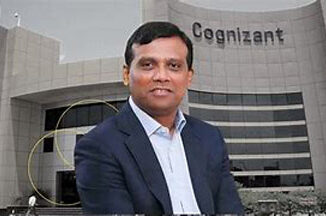
    WASHINGTON, D.C. (TIP): The US-India Strategic Partnership Forum (USISPF) has named Ravi  Kumar S, the Chief Executive Officer (CEO) of Cognizant to its Board of Directors.
    At the helm of Cognizant, Kumar sets the strategic direction of the company and has inculcated a strong client-first culture at all levels, according to a media release. Since taking over in January 2023, Kumar’s focus at Cognizant has been on ensuring sustainable growth and prioritizing long-term shareholder value.
    USISPF President and CEO, Dr Mukesh Aghi said, “Ravi is a doyen in the tech industry and is a foremost thought leader who has unparalleled insights on the dynamic and fast-changing nature of the tech sector.
    “At USISPF, our ethos is building stronger bridges between the United States and India, and the services sector, particularly IT, with the export of IT services remains, one of India’s flagship contributions to the United States tech economy.
    “In an era of a digital-first economy and digital trade, Cognizant’s work through the years exemplifies the burgeoning collaboration in the US-India technology partnership success story.
    “India’s robust tech talent remains pivotal in fortifying and expanding the tech sector within the United States. I wholeheartedly welcome Ravi to the USISPF Board and look forward to the next chapter in the US-India story.”
    Congratulating Kumar, USISPF Chairman John Chambers said, “It’s a pleasure to welcome Ravi to the USISPF Board of Directors. Ravi is an accomplished leader in IT services, and his broad experience in the industry – touching digital transformation, engineering services, data analytics, and more – puts him in the top caliber of experts supporting innovation in this space, particularly in India.
    “Cognizant’s role in strengthening the tech ties between the US and India is clear, demonstrated by the company’s integral role in India’s near $200 billion software exports for 2023. I look forward to having Ravi on our board. His partnership will undoubtedly help further the flourishing tech partnership between our two democracies.”
    Kumar said, “I am honored to join the USISPF Board of Directors. At Cognizant, I have the honor of leading an American company which is India’s second-largest employer among multinationals.
    “Seventy percent of our nearly 350,000 employees live in India, and I believe that their work is the critical cog on the tech talent wheel that will help drive economic success for both countries. This is the mission to which the USISPF has dedicated itself and I am thrilled to help author the story of our nations’ mutual success.”
    In addition to joining the Board of Directors at USISPF, Kumar is also a member of the board of directors of TransUnion and the board of directors for the US Chamber of Commerce. He is also on the board of governors of the New York Academy of Sciences.
    USISPF, an independent not-for-profit institution dedicated to strengthening the US-India partnership in Washington, DC, and in New Delhi, says it’s committed to creating the most powerful partnership between the United States and India.
    USISPF, it says is the trusted partner for businesses, non-profit organizations, the diaspora, and the governments of India and the United States.

  • Indian American executive Dhivya Suryadevara joins Optum Financial as CEO

    Indian American executive Dhivya Suryadevara joins Optum Financial as CEO

    WASHINGTON, D.C. (TIP): Dhivya Suryadevara, former Indian American chief financial officer for Stripe, a global FinTech company, has joined United Health Group as CEO of Optum Financial Services.
    “I’m excited to share that I’ve joined United Health Group (UHG) as CEO of Optum Financial Services,” the Chennai born executive wrote in a LinkedIn post.
    In her new role she is responsible for furthering its mission to revolutionize how care is financed and paid for, according to her official profile. “The Financial Services business continues to evolve from its origins in health banking and savings accounts to creating new products and services to improve financial access and support for our consumers and providers across the health system.”
    “UHG is in a unique position to transform our health system, with a mission to help people live healthier lives and help the health system work better for everyone,” Suryadevara wrote. “This is not an easy task, but UHG has the capabilities and the people to make real progress.
    “With Financial Services being one of UHG’s top strategic priorities, we see extraordinary potential to improve financial access and support for our consumers and providers across the health system,” she posted.
    “I’m incredibly honored to have the opportunity to work alongside so many people who are so fiercely determined to make health care better for everyone,” Suryadevara added.
    Prior to joining UnitedHealth Group, Suryadevara previously served as chief financial officer for Stripe, a global FinTech company that builds economic infrastructure for the internet. In addition to leading the finance organization at Stripe, Dhivya had responsibility for its Operations, Risk and Global Partnerships functions.
    Prior to Stripe, Suryadevara was at General Motors, starting as a financial analyst and rising through the ranks to become the automaker’s chief financial officer in 2018. Early in her career, Dhivya worked at UBS and PricewaterhouseCoopers. Suryadevara earned degrees from the University of Madras and the Institute of Chartered Accountants of India in 2000 as well as an MBA from the Harvard Business School.

  • India-US relationship now can be as ambitious as we choose to be: Deputy Amb Ranganathan

    India-US relationship now can be as ambitious as we choose to be: Deputy Amb Ranganathan

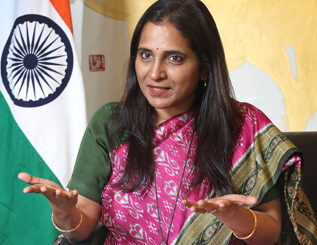
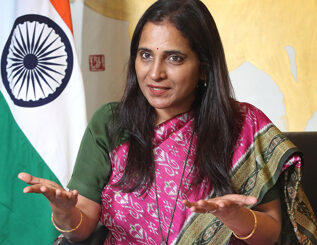
    WASHINGTON, D.C. (TIP): The relationship between the world’s two largest democracies, which have made significant progress in the last 20 years, now can be as ambitious as “we choose to be,” a top Indian diplomat has said. “When I look at the broader relationship, the India US strategic partnership, I think we have now reached a stage where we can say that the partnership has come into its own. We have achieved a lot over the past 70 years. But what we have achieved over the past 20 years has been at a different level altogether. And I would say that now we are at a stage where we can be as ambitious as we choose to be,” said India’s Deputy Ambassador to the US, Sripriya Ranganathan. The top Indian diplomat was speaking at the Stanford India Dialogue, the Leaders of Tomorrow Conference, organized by Stanford India Policy and Economics Club (SIPEC), in partnership with the Motwani Jadeja Foundation.

    “We can decide to set our goals, set our sights on targets that were unimaginable a few years ago, and we can. Not only can we be ambitious, but we can also be confident that we can make these things work, we can bring to implementation ideas that would’ve seemed outlandish even 20 years ago,” Ranganathan said at the conference.

    Standford Professor at its School of Medicine Dr Anurag Mairal, who has been instrumental in the conference, said this is the first India conference on the west coast of this size. The US-India partnership is going to be the most defining partnership of its kind for the next three decades, he said.

    Citing the example of India-US relationship in the field of space and the area of emerging and critical technologies, Ranganathan said scientists and policy from both the countries are actively engaged because “we see these as being the frontiers of the future and what will allow us to gain the leadership role in the shape of the global economy” in the next few decades.

    “We have reached the stage where we have been able to say to each other the let’s work together so that we are able to shape this world together, so that we are able to discover where the areas of overlap are, where are the areas of complementarity so that together we are able to make a difference. I think if we look back after about 10 years, we will find that there are at least 10 to 15 interesting, important and profound projects that India and the US have been able to work on and concretize so that we are able to make this fantastic platform of our collaboration,” Ranganathan said. The top Indian diplomat urged the students, in particular those from India and of Indian origin, of Stanford to stay connected with India. “I would urge you to maintain your connections with India and bring some of these learnings also back to India so that we are able to also benefit from the knowledge that you’re picking up over here,” she said.

    “The second is a bridge of collaboration. If you can join hands both on campus and beyond with your friends, with your peers in the US, professors in the US, and be able to pursue excellence in partnership with them, I think that is an area of exploration that we feel would yield us tremendous dividends going forward,” she said.

    “The third bridge is the bridge of culture. If you can in your conversations, in your interactions, share the cultural perspectives, share your stories, break down the stereotypes and spark off that interest in India. In knowing about India and experiencing India, sharing the amazing progress that India has made in the past few years with your colleagues and friends and fellow students here on campus, I think that would be an amazing contribution that you would be able to make,” Ranganathan said.

    India’s Consul General in San Francisco K Srikar Reddy told the participating students of Stanford University, many of whom were of Indian origin or from India, that after gaining knowledge at this prestigious university, most of them will prosper not only here but also go back to India and become part of this overall Indian development.

    India is expected to become a USD 7 trillion economy by 2030. Prime Minister Narendra Modi has given a call to all Indians living in India and abroad, especially the youth of the country, to make India a developed country by 2047, he said. “We are expecting India to be a USD 35 trillion economy by 2047. And we are also expecting India to overtake the US economy in 2060. It means you’ll be seeing India as a big, developed country and each one of you are going to become partners in India’s economic growth,” he said.

    Emphasizing student-centeredness, the conference was marked by candid discussions wherein speakers gave their honest opinions about India’s growth story, the development of the US-India partnership, and, most importantly, what students can do to become a part of these exciting advancements.

    Indian-American venture capitalist Asha Jadeja Motwani said the Indian diaspora is now five million strong. “It is also the highest income diaspora, as far as the US system goes. (This is) our second motherland, which has given us so much, and we are contributing back in terms of we are two per cent of the population, but we are six per cent US taxes now. So, the Indian diaspora is doing extremely well in the US,” she said. “What is its impact in the US? Again, it’s massive, especially in two fields. One is in IT in technology as in Silicon Valley, we are a huge influence here in terms of innovation. My late husband, Rajiv Motwani, who was a professor at Stanford University, was instrumental in creating the Google algorithms and in the creation of Google as a company,” she said.

  • Acclaimed professor of South Asian Literature Dr Kamal Verma passes away

    Acclaimed professor of South Asian Literature Dr Kamal Verma passes away

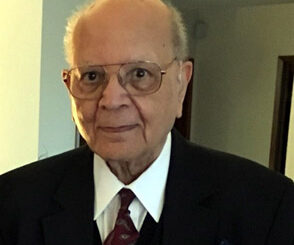
    WASHINGTON, D.C. (TIP): Dr Kamal D Verma, an acclaimed scholar of South Asian literature, died of natural causes this week here in the American capital. He would have turned 92 in April.

    Professor Verma taught for 42 years at the University of Pittsburgh at Johnstown (UPJ) in Pennsylvania. After retirement, he continued to serve as Professor Emeritus and an advisor to the University President, focusing on recruiting more diverse faculty and students from South Asia.

    He was also one of the founding members of the South Asian Review and the South Asian Literary Association — two nationally acclaimed scholarly efforts aimed to promote Indian and other South Asian writers and ideas.

    Dr Jem Spectar, President of UPJ, called Dr Verma “a brilliant scholar, an exceptional teacher and guide, a highly respected colleague, and a dear friend”.

    “His students speak of a great intellect: a professor who deepened their critical thinking, analytical, and writing skills, someone who deepened their understanding of our world, and someone whose classes prepared them for lifelong success,” Spectar said.

    Dr Verma was born in 1932 in Punjab, India. He was the eldest child in a large family, and the first member of his extended family to attend college.

    He completed his BA from DAV College, Jalandhar, in 1951, followed by a BA in teaching from Agra University in 1953 and an MA in English from Panjab University in 1958.

    In India, he became the principal of a teacher’s college in Punjab where he served until 1963, when he departed for the United States on a Ford Foundation Fellowship to obtain his Specialist in Education degree at the University of Northern Iowa. He then pursued further professional studies in literature, leading to his PhD from the University of Alberta in Edmonton, Canada.

    Dr Verma, his wife Savitri, also a teacher and head of a women’s college in India, and their five children settled in Johnstown, Pennsylvania in 1971. They were the first Indian-American family to move to the area.

    Dr Verma’s children pursued varied careers in business, medicine and law. His son Richard would go on to serve as the US Ambassador to India for President Obama, and he currently serves as the Deputy Secretary of State, the highest-ranking Indian American in the State Department ever. Richard Verma was the first ever Indian-American to be US Ambassador to India.

    Verma was in New Delhi last month where he gave a talk at the Observer Research Foundation, and noted how his father, like millions of other Indian Americans, started over from next to nothing, rebuilt in their new country, but maintained and even strengthened ties with India.

    “My father tells a great immigrant story of showing up in the United States with USD 14 and a bus ticket. He left so much behind and he took a big risk. He was brave. And he never let us forget our roots. What an amazing role model we had,” remarked Ambassador Verma.

    “These are the stories and journeys that bind our two countries together.” Prime Minister Narendra Modi, in a letter sent to Ambassador Verma this past week, wrote that Professor Kamal Verma “was a true embodiment of the grit and determination demonstrated by every Indian immigrant.

    He worked hard to give a better life to his family in a foreign country, and at the same time continued to remain true to his Indian roots…and will always be remembered in his homeland.”

    Dr Verma’s writings were widely admired and acclaimed, especially his three published books. His second book, The Indian Imagination, focused on several of the leading writers of the Indian colonial and post-colonial periods of Indian history. His last book, Understanding Mulk Raj Anand, focused on noted Indian writer Mulk Raj Anand and included a series of letters between Dr Verma and Anand over 15 years, focusing again on the ideas that inspired the colonial struggle for independence.

    He released the book in the US and India in 2017 with significant critical success. He even presented the book to Prime Minister Modi in 2018.

    During his career, Dr Verma would end up teaching thousands of students in India, Canada and the United States, and he published dozens of articles, in addition to the three books. Professor Nalini Iyer of Seattle University and the editor of the South Asian Review said: “Dr Verma was a towering figure who had an impact on so many. He paved the way for South Asian scholars and literature in the United States and cared for his family and friends at every turn. He also trained and inspired hundreds of faculty members across the globe in the field of South Asian literature and philosophy. This is a gift for which he will be long remembered.”

  • Indian – origin classical dancer, MFA student shot dead during evening walk

    Indian – origin classical dancer, MFA student shot dead during evening walk

    WASHINGTON, D.C. (TIP)- In a tragic incident, Amarnath Ghosh, a Bharatnatyam and Kuchupudi dancer from Kolkata, pursuing a Master of Fine Arts (MFA) degree at Washington University in St. Louis, Missouri, was shot dead during his evening walk in his neighborhood, Tuesday, February 27, according to media reports.
    Devoleena Bhattacharjee, a popular TV actress and friend of the deceased, has reached out to Prime Minister Narendra Modi and Minister of External Affairs S. Jaishankar for assistance in repatriating Ghosh’s body. Devoleena expressed her grief on social media, highlighting the tragic circumstances surrounding the death of her friend and appealing for support in uncovering the motive behind the murder.
    “My friend #Amarnathghosh was shot and killed in the St Louis Academy neighborhood in the US on Tuesday evening. Only child in the family, mother died three years back, father passed away during his childhood. Well, the reason, the details of the accused are not revealed yet, or perhaps no one is left in his family to fight for it except his few friends. He was from Kolkata.”
    She ended the note with her appeal: “Some friends in US are trying to claim the body but still no update about it. @IndianEmbassyUS kindly see to it if you could. At least we should know the reason of his murder. @DrSJaishankar @narendramodi”
    Ghosh was an alumnus of Kalakshetra Foundation and Kuchipudi Art Academy, Chennai. According to a GoFundMe campaign set up in his honor, he also served as faculty at the Kuchipudi Arty Academy.

    Described as an excellent dancer, he was interested in exploring his diverse ethnic background and the unity of various cultures through the compositions of Rabindranath Tagore, according to his bio on the university website. His research aimed to showcase how dance could unite people from diverse backgrounds.
    Atlanta-based Bharatnatyam dance guru Anupa Thakurta, founder and artistic director of Deeksha School of Performing Arts, who has known Ghosh since Covid times, expressed shock and anger at his tragic death.
    “We met through an online performance and immediately became friends,” she told NRI Pulse. “He had high aspirations to come to the US to perform. He had asked me multiple times to arrange for performances in the US. Considering the phenomenal artist that he was, he did make it to the US to do MFA in St. Louis, Missouri. He had a creative mind filled with splendid ideas. A very talented and humble artist and above all a very good human being.”
    “Ghosh came into this country with lots of dreams and aspirations, but this land took his life. Life is so unpredictable. Today you are here and tomorrow you are gone. This news shook me completely,” she added.
    In a heartfelt obituary, Amarnath Ghosh was remembered as more than just a dancer.
    “Amarnath was more than just a dancer; he was a visionary artist whose passion and dedication breathed life into every movement,” the obituary reads. “His performances were electrifying, captivating audiences with their raw emotion, technical precision, and sheer artistry. Whether he was portraying the agony of loss or the ecstasy of triumph, Amarnath had a rare ability to evoke deep and profound emotions, leaving spectators spellbound in his wake.”

    “At Battery Dance, we had the privilege of collaborating with Amarnath, and his presence on our stage was nothing short of transformative. His performances were a testament to his unparalleled talent and unwavering commitment to his craft, inspiring all who had the privilege of witnessing his artistry. We will forever cherish the memories of his electrifying performances and the joy he brought to our stage.”

    Indian Consulate in Chicago condoled the death of Ghosh.
    “Deep condolences to family & friends of deceased Amarnath Ghosh in StLouis, Missouri. We are following up forensic, investigation with police & providing support. @IndianEmbassyUS @MEAIndia”.
    The circumstances surrounding the incident remain unclear.

  • Bank fraud accused having Interpol Red Notice against him repatriated from US

    Bank fraud accused having Interpol Red Notice against him repatriated from US

    Rajiv Mehta, an accused in a 25-year-old alleged fraud case, where he intercepted the bank drafts which he used to encash later had been on the run since 2000

    WASHINGTON (TIP): The CBI has successfully coordinated repatriation of an alleged fraudster, facing an Interpol Red Notice, from the United States on Wednesday ending his 23-year long run from the law, officials said.

    Rajiv Mehta, an accused in a 25-year-old alleged fraud case, where he intercepted the bank drafts which he used to encash later had been on the run since 2000, they said.

    The Global Operations Centre followed his trail using Interpol channels that resulted in National Central Bureau-Washington locating him in their jurisdiction, officials said.

    “The Global Operations Centre of Central Bureau of Investigation has coordinated via Interpol channels with National Central Bureau-Washington for return to India from the US of a Red Notice subject today, that is, March 06. He was earlier geo-located by the US authorities through close follow-up through Interpol,” a CBI spokesperson said in a statement.Interpol had issued a Red Notice against Mehta on June 16, 2000, on a request from the CBI. “Red notice was circulated to all Interpol member countries for location and arrest of the accused,” the spokesperson said.

    He said the subject is wanted by the CBI in a criminal case registered in 1998 for prosecution in respect of offences of cheating, theft and criminal conspiracy involving opening of fictitious bank accounts in Central Bank of India, Greater Kailash Part-II, New Delhi, for the purpose of interception of drafts of various parties in transit and encashing them.He was declared a proclaimed offender by the court in 1999, the spokesperson said.

    “The CBI as the National Central Bureau for Interpol in India coordinates with all law enforcement agencies in India for assistance via Interpol channels,” he said.
    (Source: PTI)

  • I believe in America’: Fired-up Biden uses State of the Union to skewer GOP, his ‘predecessor’

    I believe in America’: Fired-up Biden uses State of the Union to skewer GOP, his ‘predecessor’

    The president made the case for why he deserves a second term

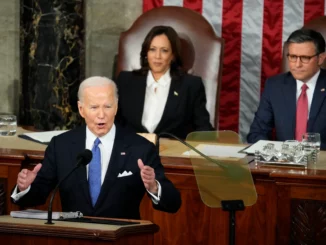
    WASHINGTON, D.C. (TIP): President Joe Biden delivered his State of the Union address at the U.S. Capitol on Thursday, March 7 night. The speech provided Biden one of his biggest audiences of the year as he made his case for a second term and contrasted his vision of the country’s future with Republicans ahead of what’s expected to be a lengthy general election fight with former President Donald Trump.

    Going into the evening, I think many viewers expected to hear something like a campaign speech from Biden, and that’s what he delivered. While he did ask Congress to pass a bipartisan immigration bill and spent time on other policy issues like abortion, housing and foreign policy, it was less a policy laundry list than most State of the Union speeches. He worked to paint himself as a brighter, more forward-thinking choice than Trump, whom he only referred to as “my predecessor.” Biden talked about his history in politics and tackled the issue of his age head on, but the end of his speech was about his hope for the future. By comparison, Alabama Sen. Katie Britt’s Republican response to the speech was bleak and painted a dark picture of the country, especially at the southern border.

    It echoed Trump’s “American carnage” inaugural address, though Britt avoided mentioning the former president by name. That’s a good preview of how the presidential race is likely to unfold: Republicans will paint Biden as a failure who has presided over a U.S. in decline, while Biden will work to focus attention on the progress he feels his administration has made and can continue to make.

  • Indian-American incumbents Ami Bera and Ro Khanna secured their seats.

    Indian-American incumbents Ami Bera and Ro Khanna secured their seats.

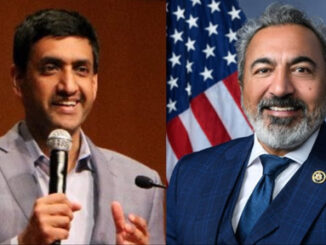
    WASHINGTON, D.C. (TIP): Ami Bera, a Democrat, secured his seventh term by advancing to the general election Ro Khanna, seeking his fifth term, won decisively against Republican Anita Chen Ash Kalra, a Democrat, emerged as the top candidate in the 25th Assembly District. It was a day of victories and defeats for Indian American candidates in the recent Super Tuesday primaries. The biggest day of this year’s primary campaign in the US approached as 15 states — plus American Samoa — voted in contests. Veteran Indian-American Congressmen Ami Bera and Ro Khanna successfully defended their positions against challengers.

    Ami Bera, a Democrat, secured his seventh term by advancing to the general election with 53.6% of the vote in California’s 6th Congressional District.
    Meanwhile, Ro Khanna, seeking his fifth term, won decisively over Republican Anita Chen in the 17th Congressional District, according to American Bazaar.

    In contrast, Indian-American engineer Rishi Kumar, a Democrat, lost his bid to run for Congress.

    With 50% of the vote counted, former San Jose Mayor Sam Liccardo was ahead with 22% of the vote, while Santa Clara County Supervisor Joe Simitian had nearly 18%. Both Liccardo and Simitian are Democrats. Kumar ended up in seventh place out of 11 candidates with 6.3% of the vote.

    This came amid Indian-American Republican challenger to former president Donald Trump, Nikki Haley, dropping out of the presidential race.

    Indian-American Republican Vin Kruttiventi advanced to the general election in Northern California’s 14th Congressional District, home to one of the largest populations of Indian-Americans in the nation, securing second place with 17.8% of the vote to incumbent Eric Swalwell with 64.5%, seeking his sixth term in the House of Representatives.

    According to reports from the Federal Election Commission, Kruttiventi, the founder and CEO of A5 Services, has invested $500,000 of his personal funds into his campaign.

    However, clinical psychologist Harmesh Kumar’s longshot bid for the vacant US Senate seat left by the late Senator Dianne Feinstein ended in disappointment.

    Additionally, Ash Kalra, a Democrat, emerged as the top candidate in the 25th Assembly District and will face fellow Democrat Lan Ngo in the general election.

    However, challenger Tara Sreekrishnan, a 30-year-old Indian-origin leader who has garnered significant endorsements for her bid, faced defeat in her race for California’s 26th district state Assembly seat.

    In other races, Democrat Darshana Patel will compete against Republican Kristie Bruce-Lane for California’s 76th district state Assembly seat, which covers a portion of San Diego.

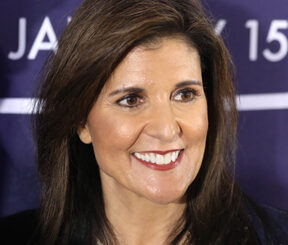
    The most prominent of all the Indian-American candidates was Nikki Haley, the former governor of South Carolina. She conceded to Donald Trump after losing every state but one — Vermont — in Super Tuesday’s primary contests.

    In January, Indian-American billionaire entrepreneur Vivek Ramaswamy suspended his bid after Trump won the Iowa caucus. He later pledged support for Trump’s presidential bid.

  • Nikki Haley picks up first two Senate endorsements ahead of Super Tuesday

    Nikki Haley picks up first two Senate endorsements ahead of Super Tuesday

    Sen. Lisa Murkowski, R-Alaska, and Sen. Susan Collins, R-Maine, are backing the GOP presidential candidate. Voters in their states head to the polls next week for Super Tuesday

    WASHINGTON, D.C. (TIP): Republican presidential candidate Nikki Haley received her first two endorsements from senators on Friday, March 1, giving her a boost before Super Tuesday as she trails former President Donald Trump in the race for the GOP nomination. Sen. Lisa Murkowski, R-Alaska, and Sen. Susan Collins, R-Maine, both backed the former South Carolina governor in separate statements.

    “I’m proud to endorse Gov. Nikki Haley,” Murkowski said in a statement released by the Haley campaign. “America needs someone with the right values, vigor, and judgment to serve as our next President—and in this race, there is no one better than her. Nikki will be a strong leader and uphold the ideals of the Republican Party while serving as a President for all Americans.”

    Collins told the Bangor Daily News that Haley “has the energy, intellect, and temperament that we need to lead our country in these very tumultuous times.” Haley’s campaign confirmed the endorsement to NBC News.

    Voters in Alaska, Maine and more than a dozen other states will cast ballots on Super Tuesday, when 865 Republican delegates will be up for grabs. Haley has yet to win a primary or caucus.

    On Friday, Haley expressed her gratitude to Murkowski in a news release announcing her first Senate endorsement, saying that the senator “represents the best of Alaska.”

    “As president, I will fight to make Alaskans—and all Americans—proud by restoring fiscal sanity, energy dominance, and limited government,” Haley said.

    Murkowski and Collins have long been critical of Trump, and they both voted to convict him during his second impeachment trial following the Jan. 6 attack on the Capitol.

    Haley has received only one endorsement in the House, from Rep. Ralph Norman, R-S.C. He announced his endorsement more than a year ago. Trump, meanwhile, has been endorsed by about 80 Republicans in the House and more than half of GOP senators.

  • Indian Embassy and consulate officials interact with Indian students from across US

    Indian Embassy and consulate officials interact with Indian students from across US

    WASHINGTON, D.C. (TIP): Officials of the Indian Embassy here and its consulates held a virtual interaction with Indian students from across the US, discussing various aspects of student well-being and ways to stay connected with the larger diaspora. About 150 Indian Student Association office bearers and students from 90 US universities participated in the interaction led by Charge d’Affaires, Ambassador Sripriya Ranganathan.

    It was also attended by the Consul Generals of India in Atlanta, Chicago, Houston, New York, San Francisco and Seattle. The meeting gains significance in the backdrop of some deaths of Indian and Indian-origin students at universities across the US. During the meeting, Ranganathan highlighted ways to stay connected with the Embassy/Consulates and the larger Indian diaspora.

    Students were urged to spread the word amongst fellow Indian students in the US about the guidelines issued by the Embassy and the consulates for students studying in the US, including registration on its websites, general aspects related to student safety and well-being, and emergency contact details of the Indian diplomatic missions.

    The students presented useful suggestions on synergizing the efforts of the Embassy/consulates, university authorities, diaspora organizations and other stakeholders.
    (Source: PTI)

  • Leading Indian drone manufacturer enters US market

    Leading Indian drone manufacturer enters US market

    WASHINGTON, D.C. (TIP): India’s drone industry has “leapfrogged” in the last 10 years, gaining pace after the COVID-19 pandemic, the CEO of a leading Indian drone manufacturer has said as his company has showcased its products in the highly competitive US market. Indian drone manufacturing company IdeaForge, ranked fifth globally in the dual-use category of civil and defense, is entering the American drone market at a time when there is a reluctance to buy or acquire those made in China.
    Ankit Mehta, the CEO of IdeaForge, told PTI Videos in an interview that the Indian drone industry has “leapfrogged in the last 10 years with an enabling environment from the Indian government.” He said the sector gained pace after the COVID-19 pandemic.

    “I think before the pandemic, the rules and regulations around drones were fairly stringent, and they did not allow a lot of flexibility in terms of use and deployment,” Mehta said.

    “But since the pandemic, the floodgates, in a way, have opened the adoption of technology, which has become wholehearted. Now people want to deploy drones for as many use cases as possible,” he said.

    Drones had very restrictive regulations earlier, he said. “Now those regulations have become a little bit more relaxed in terms of allowing the use of drones under a regulated environment, which is conducive for operations.”

    “Therefore, we are seeing a lot of intent in terms of adopting the technology, and we are seeing a lot of regulatory support for doing that,” Mehta said.

    “We also have in India a production-linked incentive scheme for drones. We have the fact that there is a ban on import of technology from outside so that Indian companies can develop the technology and be overall in an environment where we can demonstrate the capability of what Indian companies can do in this space,” he said.

    Asserting the distinctiveness of Indian drones, he said, “I think Indian drones are very unique in the sense that they’ve been built in some of the harshest environments and the highest altitude requirements in the world.”

    “With the operations being conducted in India at 6,000 meters plus altitude due to the various regions we have in our country in the Himalayas, to operate in extremely low temperatures like minus 30 degrees Celsius and also looking at drones that can operate in deserts in Rajasthan,” he said.

    “So, we are essentially a country that has a very large number of terrain conditions and weather conditions we have to cater to when we are looking at drones. We also have a lot of use cases and applications that exist simultaneously in one place,” he said.

    Giving examples of applications around traffic management, crowd management, counterinsurgency, counter-terrorism, and border management Mehta said, “All of these challenges are quite acute, and there are a lot of challenges around not having proper land records, and many such applications are being developed in India, and they’re being used and deployed at scale.”

    Mehta is travelling to various cities in the US for product demonstrations to export different kinds of drones to the country. One of which was held in the Washington DC National Capital region here on Thursday.

    “We are seeing a lot of excitement about what we have on offer. The autonomy we offer again is very, very interesting and exciting for people, and we are currently engaging in getting as many demonstrations as we can and getting more real-world experience in the hands of the users over here. So that can localize our products better as well as give a flavor of our technology to everybody here,” Mehta told PTI.

    “For example, one of our products, Netra V 4 Pro, is a one-of-a-kind product that, in less than six kilograms, offers more than 90 minutes of flying time in the real world along with payloads. That is something that is not very common,” he said.

    “It is almost three times more than what is usually available in the market. In that sense, there is a lot of delight in when they actually see a product perform in that kind of condition, in that kind of real-world performance,” he added.

    Following one of the product demonstrations here, along with his team, Mehta said the idea is to showcase their technology over here and to look at what kind of uses the technology can put over here.

    IdeaForge, set up in 2007 by a group of Mumbai IITians , can bring the experience they are gaining in India, he said. “We have had our customers use our drones in over 420,000 missions within IdeaForge drones, flying almost every five minutes in India,” he said.

    “It’s really a rich experience that we can bring to the table here, and we see a lot of commonalities with respect to very low temperatures, very high temperatures, and some high-altitude areas over here as well,” Mehta said.

    “What we are building here to deploy at scale in India could be very, very useful in these environments as well,” he added. When asked about India purchasing armed drones from General Atomics for its armed forces at the cost of nearly USD 4 billion, Mehta said it would need sustained long-term investment from relevant sectors, including the Indian Government, to reach that level of manufacturing such drones.

    “Manpower is definitely not a debate because India does have some of the best talent. In fact, a lot of our best talent is here building a lot of these technologies,” Mehta said. Observing that the government has done a great job building the proper regulations for the drone ecosystem, Mehta said there is now a need to sustain these investments in areas like the production-linked incentive scheme.

    “We need to enhance it, and we need to give more encouragement. It is a one-of-a-kind scheme that does a lot of support to design incentives for drone companies because, in a way, it gives a lot of R and D (research and development) capital back to every company that is doing more value addition in the country,” he said.

    “A lot of upfront R and D capital needs to be allocated for this technology space, and that’s an area where some effort and support will be required for the drone ecosystem because a lot of times, incentives like the production-linked incentive are great to boost scale and to do more for players who are already achieved a certain scale,” he said.

    However, Mehta said that a lot of R and D capital for designing many subsystems in the country would be very useful for the overall benefit and development of the ecosystem.
    (Source: PTI)