Tag: Whatapp

  • South Africa’s Zuma doesn’t say if he will comply with jail

    Johannesburg (TIP): Former South African President Jacob Zuma has denounced the 15-month prison sentence he has been given by the country’s highest court and has not said if he will voluntarily comply with the order to turn himself over to the police.

    Legal experts and anti-corruption experts have widely welcomed the Constitutional Court’s ruling this week that Zuma should be imprisoned for defying a court order to testify before a judicial inquiry into widespread allegations of corruption during his presidential term from 2009 to 2018.

    Zuma criticised the ruling by Justice Sisi Kampempe as “judicially emotional and angry and not consistent with our Constitution”, in a statement issued on Thursday by the Jacob Zuma Foundation.

    Zuma gave no indication of whether he will hand himself over to South Africa’s police within five days, as the Tuesday ruling ordered, or if he will wait for police to come and get him after that period expires.

    About two hundred of Zuma’s supporters, many carrying traditional Zulu shields and sticks, arrived at Nkandla, the former president’s home in rural KwaZulu-Natal, to show their support.

    Among those welcoming the sentence for Zuma was Mac Maharaj, a veteran leader of the ruling African National Congress party who had served as Zuma’s presidential spokesman from 2011 until 2015. Maharaj said he resigned because he did not want to be associated with the corruption that he witnessed.

    “The evidence is overwhelming that under his administration corruption developed to a point where it became endemic in our system,” Maharaj told the public broadcaster, the South African Broadcasting Corporation.

    He hailed the ruling against Zuma as a watershed moment for South Africa.

    “History may find that this was the moment that constitutes the turning point in our closing the chapter in the abuse of power and corruption, and entrenching our constitutional democracy,” Maharaj said.

    Professor Lesiba Teffo, a political analyst at the University of South Africa, said Zuma had been given more than enough time to comply with the court order.

    “As the saying goes, he was given a long rope. And he reached a cul-de-sac. What has happened is a resounding judgment that I embrace in full,” said Teffo.

    (AP)

  • UK opens new post-study work visa route for international students

    London (TIP): The UK Home Office on July 1 formally opened its new post-study work visa for international students, which would offer overseas graduates from India and other destinations the option to apply for the right to stay on for job experience at the end of their university courses. The Graduate route visa, announced last year by UK Home Secretary Priti Patel, is now open for applications from this week and is expected to particularly benefit Indian students, who are known to choose their degree courses based on the prospect of work experience.

    The Graduate route is designed for international graduates who have been awarded their degree from a recognised UK university to stay on and look for work for at least two years.

    “To put it into some context, last year more than 56,000 Indian nationals were granted a student visa, that’s a 13 per cent increase on the previous year, and that is almost now a quarter of all student visas issued by the UK,” Patel told PTI.

    “When you think about those numbers, think about the totality in terms of how this route will benefit India, it’s a very, very big move. And, we will continue to work with the various academic institutions on making this route viable,” she said.

    For the new route, international graduates must have completed an eligible course at a UK higher education provider with a track record of compliance with the government’s immigration requirements.

    It is unsponsored, meaning applicants do not need a job offer to apply and crucially they can use a two-year period to stay on and look for a job. There are no minimum salary requirements or caps on numbers, allowing graduates on the route to work flexibly, switch jobs and develop their career as required.

    “As we build back better, it is vital that the UK continues to be a beacon for talented young people across the globe who want to make a difference. The new Graduate route does just that, giving the best and brightest graduates the opportunity to continue contributing to the UK’s prosperity and the freedom to kickstart their careers in the UK,” said Patel.

    A coronavirus concession on the date by which students must enter the UK to qualify for the route, if they started courses in 2020 and are unable to travel due to the pandemic, was recently extended.

    Applicants who began their studies in autumn 2020 or in spring 2021 will need to be in the UK on a student visa by September 27 this year. Students beginning their course later this year or early next year will need to be in the UK by April 6, 2022. (PTI)

    This has been welcomed by Indian student groups in the UK, concerned about India’s categorisation under the red list of countries from where travel currently remains banned, making it compulsory for Indian students to quarantine at considerably additional expense.

    “Many other countries do not offer that microcosm, foundation of diaspora community, natural heritage, all the cultural links, all the values that we share between our two countries. That puts us in a very strong position, both for Indian students coming here and securing their future opportunities in the workplace,” Patel said.

    The new route, part of the post-Brexit points-based immigration system, is pegged as part of the UK’s Global Britain message of attracting the best talent from around the world and covers all parts of the United Kingdom.

    “International students are a vital part of our society, and those who graduate from our world-leading universities should have the opportunity to stay and build meaningful careers here in the UK,” said Universities Minister Michelle Donelan.

    “That is why we are introducing this new route for international graduates, enabling British businesses to attract and retain some of the brightest, most talented graduates across the globe, and helping this nation build back better from the pandemic,” she said.

    Anne Marie Graham, Chief Executive of UK Council for International Student Affairs, said: “We know that employability is a priority for international students coming to study in the UK.

    “International students who are able to access this route will have the flexibility to apply for work in any sector or role that fits their skills profile, including self-employment without the need for employer sponsorship.”

    To apply under the new Graduate route, international students must have completed an eligible course at a recognised UK higher education provider at undergraduate or higher level. Students on the route will be able to work or look for work after their studies for a maximum period of two years, or three years for Doctoral PhD students.

    The National Indian Students and Alumni Union UK (NISAU) was among the groups that actively lobbied the UK government for such a post-study visa route.

    “Genuine Indian applicants with demonstrable skills should considerably benefit,” it added. PTI

  • Turf war over theatre commands escalates, IAF chief rejects CDS Rawat’s ‘supporting role’ view

    Turf war over theatre commands escalates, IAF chief rejects CDS Rawat’s ‘supporting role’ view

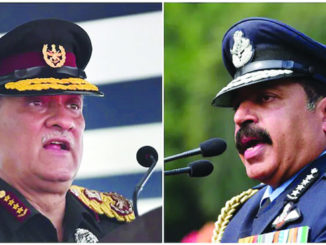
    New Delhi (TIP): The bitter turf within the armed forces over the four proposed theatre commands escalated further with the Indian Air Force (IAF) Chief Air Chief Marshal RKS Bhadauria rejecting Chief of Defence Staff (CDS) General Bipin Rawat’s views that the IAF remains a supporting arm just as artillery or engineers support the fighting forces.

    Speaking to India Today TV, Air Chief Marshal RKS Bhadauria said, “It’s not a supporting role alone. Air power has a huge role to play. In any of the integrated battle areas, it’s not an issue of support alone. A whole lot of things go into any air plan that’s made. And those are the issues that are under discussion.” “CDS was a big reform. The next biggest reform is the integrated theatre command. And it is much more complex. We’re for establishing integrated theatre command. But the issues that we have raised are in our internal discussions, and it’s to do with how we should do it. We must get it right. It’s the most important reform that has an impact on war fighting,” Air Chief Marshal RKS Bhadauria said.

    He gave his vision for the integrated theatre command. “We already have a functional system today. But when we do an integrated theatre command, we should reach the next level of ability to protect our comprehensive national power. We should be able to synergise, we should be able to put up a power that is more synergistic and has more flexibility. We cannot have more boundaries,” Air Chief Marshal RKS Bhadauria said.

    He said he would not like to share the issues under discussion but denied the IAF was putting any spanners.

    “So there are issues in terms of some of the options being discussed and those are issues we’re internally discussing. I would not like to go to the media and describe what my concerns are, what the Air Force has said or what somebody else has said. But these are all methods of deliberations, these are all issues to be deliberated upon to get it right. It’s not the issue of putting spanners. Absolutely not. If I have come to the media, it doesn’t mean we’re the ones putting spanners. Out of question,” Air Chief Marshal RKS Bhadauria said.

    He said the IAF is totally committed to the theatre command. “But we must get it right. And that’s the focus area with which we’re doing all our deliberations,” Air Chief Marshal RKS Bhadauria said.

    “I will not go into listing my concerns before the media. There is a proposal. That’s there. There are issues that need to be discussed,” he said.

    Earlier, during his interview with India Today TV, General Bipin Rawat had said, “Do not forget the IAF continues to remain a supporting arm just as artillery support or engineers support the combatant arm in the Army. They will be a supporting arm.”

    General Bipin Rawat said that the Air Force is responsible for the air defence of the entire country, but along with it, it was also mandated to provide close air support to land forces when they undertook operations.       Source: India Today

  • Bharat Biotech says completed final analysis for Covaxin, claims 77.8% efficacy

    Bharat Biotech says completed final analysis for Covaxin, claims 77.8% efficacy

    New Delhi (TIP): Hyderabad-based Bharat Biotech on Friday, July 2, said that it has completed the final Phase-3 analysis for Covaxin, its indigenous vaccine against the coronavirus disease (Covid-19). Citing pre-print data from “India’s largest efficacy trial”, the pharmaceutical claimed that an overall efficacy of 77.8% against symptomatic Covid-19 patients has been found in Covaxin.

    Elaborating on its findings from the efficacy analysis, Bharat Biotech added that Covaxin also demonstrates 93.4% effectiveness against severe symptomatic Covid-19 cases. On the other hand, Covaxin provides 65.2% protection against the B.1.617.2 (Delta) strain, currently the most predominant Covid-19 variant in India, it said.

    Against asymptomatic Covid-19 patients, Covaxin provides an efficacy of 63.6%, Bharat Biotech said at the conclusion of its Phase-3 efficacy trial.

    The Covaxin Phase-3 analysis, published on the medRxiv pre-print server, was reportedly conducted across 25 hospitals in India as trial sites. The large-scale final analysis deployed a double-blind, randomised, multi-center clinical trial, using a sponsor-supplied randomisation scheme where volunteers received two intramuscular doses of either the Covid-19 vaccine or a placebo — four weeks apart. It consisted of 25,800 volunteers from the age group of 18 to 98 years, the report said.

    The vaccine was approved for emergency use in the Indian population in January, and the Hyderabad-based company had then said it would release phase III data by March. The release was since pushed back on several occasions. It had earlier shared the data with Indian drug regulators, however, the data regarding the multiple analyses had not been released until now.

    Earlier, Bharat Biotech’s US partner Ocugen had reported similar findings regarding Covaxin, adding that adverse events reported in the study were low. Only 12.4% of the subjects experienced commonly known side-effects, it said. Both adverse events and severe adverse events reported in the vaccine group were found at similar rates to the placebo group, the company added.

    Covaxin, along with the Oxford University-Astrazeneca shot, has been used since the beginning of India’s nationwide vaccine drive against the viral disease on January 16. Russia’s Sputnik V was given emergency use authorisation (EUA) in April, while US pharmaceutical firm Moderna’s mRNA-based vaccine on Tuesday received approval to be used.                 Source: PTI

  • Pregnant women in India now eligible for COVID vaccination

    New Delhi (TIP): Pregnant women in India are now eligible to get vaccinated against Covid with the union health ministry Friday, July 2,  giving the approval based on recommendations of the National Technical Advisory Group on Immunization (NTAGI).

    The decision empowers pregnant women to make an informed choice on taking the Covid vaccination, the ministry said, adding these women can now register on CoWIN or walk-in to the nearest Covid vaccination centre to get themselves inoculated.

    The decision has been communicated to all the states and union territories to implement it under the ongoing National Covid Vaccination Program, it said in a statement.

    India’s Covid vaccination program incorporates recommendations of the foremost experts in the field of immunization, public health, disease control and information technology.

    Based on scientific and epidemiological evidence, the programme gives priority to strengthening the country’s healthcare system by protecting the professionals, health and frontline workers, manning it, as well as protecting the most vulnerable population groups, the ministry said.

    Till now, all groups except pregnant women were eligible for Covid vaccination. Now, it is expanded to even pregnant women in the world’s largest immunization drive, the statement said.

    Studies have shown that Covid infection during pregnancy may result in rapid deterioration of health of pregnant women and they are at an increased risk of severe diseases and it might affect fetus too, it said.

    Source: PTI

  • India reports 738 more Covid deaths, lowest in 86 days

    India reports 738 more Covid deaths, lowest in 86 days

    New Delhi (TIP): Cases of the coronavirus disease (Covid-19) dipped again on Saturday, July 3,  as India recorded 44,111 fresh infections, taking the country’s cumulative tally past 30.5 million, the Union health ministry’s data showed.

    And 738 related fatalities were recorded in the last 24 hours, the lowest in 86 days, according to the Union Health Ministry data, pushing India’s death toll to 401,050 so far.

    India’s active cases of Covid-19 also dropped further by 14,104 in the last 24 hours and settled at 495,533, accounting for 1.67% of total infections.

    The country’s recovery rate stood at 97.01% on Saturday, as more people were cured of the coronavirus disease and outnumbered the daily new cases for nearly two months.

    The health ministry data showed that 34,46,11,291 people have been vaccinated in the country so far, out of which 4,399,298 were vaccinated in the last 24 hours.

    Covid-19 cases in India dipped below 50,000 for the first time on June 21 and have since remained stagnant in the bracket of 30,000-50,000. The country has seen a sharp fall of Covid-19 cases in the second wave after they peaked with 414,188 fresh infections on May 6.

    However, experts have cautioned people saying they need to follow Covid appropriate norms. NITI Aayog member (health) VK Paul said close monitoring is crucial at this stage and the country “cannot lower its guard”. “As we are seeing in Europe right now, the disease transmission has started growing again, with cases having dropped to 50 per million at one point, which is now almost double… It is in our control to ensure India doesn’t see the third wave,” he said.

    Officials on Friday, July 2,  said India is vaccinating on average 5 million individuals daily since June 21. This is equivalent to inoculating the entire population of Norway every day and asserted that the process is like a “marathon and not a 100-metre race”.

    To date, 340 million people or equivalent to the entire population of the US have been vaccinated with at least one dose of the Covid-19 vaccine since the nationwide inoculation drive began on January 16, health ministry joint secretary Lav Agarwal said on Friday in a press briefing.

    Responding to the de-acceleration in the rate of inoculation, Agarwal said, “We are in a marathon and not a 100-metre sprint.”

    Even as the second wave has declined to 1/7th of its peak, officials have abstained from announcing its end. “The second wave of Covid-19 is not over yet,” Agarwal said.

  • New York to end state of emergency for Covid

    New York State Governor Andrew Cuomo has announced that the state will end the statewide disaster emergency on Thursday thanks to substantial progress made in combating the Covid-19 pandemic. New York State declared a state of emergency in early March of 2020 to contain the spread of coronavirus.

    A number of laws, rules and regulations were modified or suspended to facilitate emergency purchase, testing, treatment, cleaning and quarantine.

    “New York went from one of the worst infection rates to the lowest infection rate in the country, and it was all because of the efforts of New Yorkers who were smart, united and did what they needed to do throughout this entire pandemic,” Cuomo said on Wednesday, Xinhua reported.

    As of Wednesday, New York State had a 0.34 percent positivity rate in Covid-19 testing with 474 Covid-19 patients hospitalized and 104 people in intensive care units.

    The state reported 42,942 accumulative deaths from the pandemic on Wednesday with 71.2 percent of residents administered with at least one dose of Covid-19 vaccine.              Source: IANS

  • Making of a Democracy ; America celebrates Independence Day – the 4th of July

    Making of a Democracy ; America celebrates Independence Day – the 4th of July

    American Independence Day is annually celebrated on July 4 and is often known as the Fourth of July. It is the anniversary of the publication of the declaration of independence from Great Britain in 1776. Patriotic displays and family events are organized throughout the United States.

    Americans across the country are set to celebrate July 4 —also known as Independence Day or July 4th—this weekend with parades, barbeques and red, white and blue gear. In the nation’s capital, President Joe Biden is set to host a group of essential workers and military families on the South Lawn of the White House on Sunday, 4th of July. The National Park Service is also hosting the annual Independence Day fireworks celebration on the National Mall.

    The Fourth of Julyhas been a federal holiday in the United States since 1941, but the tradition of Independence Day celebrations goes back to the 18th century and the American Revolution. On July 2nd, 1776, the Continental Congress voted in favor of independence, and two days later delegates from the 13 colonies adopted the Declaration of Independence, a historic document drafted by Thomas Jefferson.

    A History of Independence Day

    When the initial battles in the Revolutionary War broke out in April 1775, few colonists desired complete independence from Great Britain, and those who did were considered radical.

    By the middle of the following year, however, many more colonists had come to favor independence, thanks to growing hostility against Britain and the spread of revolutionary sentiments such as those expressed in the bestselling pamphlet “Common Sense,” published by Thomas Paine in early 1776.

    On June 7, when the Continental Congress met at the Pennsylvania State House (later Independence Hall) in Philadelphia, the Virginia delegate Richard Henry Lee introduced a motion calling for the colonies’ independence.

    Amid heated debate, Congress postponed the vote on Lee’s resolution, but appointed a five-man committee—including Thomas Jefferson of Virginia, John Adams of Massachusetts, Roger Sherman of Connecticut, Benjamin Franklin of Pennsylvania and Robert R. Livingston of New York—to draft a formal statement justifying the break with Great Britain.

    On July 2nd, the Continental Congress voted in favor of Lee’s resolution for independence in a near-unanimous vote (the New York delegation abstained, but later voted affirmatively). On that day, John Adams wrote to his wife Abigail that July 2 “will be celebrated, by succeeding Generations, as the great anniversary Festival” and that the celebration should include “Pomp and Parade…Games, Sports, Guns, Bells, Bonfires and Illuminations from one End of this Continent to the other.”

    On July 4th, the Continental Congress formally adopted the Declaration of Independence, which had been written largely by Jefferson. Though the vote for actual independence took place on July 2nd, from then on, the 4th became the day that was celebrated as the birth of American independence.

    Early Fourth of July Celebrations

    In the pre-Revolutionary years, colonists had held annual celebrations of the king’s birthday, which traditionally included the ringing of bells, bonfires, processions and speechmaking. By contrast, during the summer of 1776 some colonists celebrated the birth of independence by holding mock funerals for King George III as a way of symbolizing the end of the monarchy’s hold on America and the triumph of liberty.

    Festivities including concerts, bonfires, parades and the firing of cannons and muskets usually accompanied the first public readings of the Declaration of Independence, beginning immediately after its adoption. Philadelphia held the first annual commemoration of independence on July 4, 1777, while Congress was still occupied with the ongoing war.

    George Washington issued double rations of rum to all his soldiers to mark the anniversary of independence in 1778, and in 1781, several months before the key American victory at the Battle of Yorktown, Massachusetts became the first state to make July 4th an official state holiday.

    After the Revolutionary War, Americans continued to commemorate Independence Day every year, in celebrations that allowed the new nation’s emerging political leaders to address citizens and create a feeling of unity. By the last decade of the 18th century, the two major political parties—the Federalist Party and Democratic-Republicans—that had arisen began holding separate Fourth of July celebrations in many large cities.

    Fourth of July Fireworks

    The first fireworks were used as early as 200 BC. The tradition of setting off fireworks on the 4 of July began in Philadelphia on July 4, 1777, during the first organized celebration of Independence Day. Ship’s cannon fired a 13-gun salute in honor of the 13 colonies. The Pennsylvania Evening Post reported: “at night there was a grand exhibition of fireworks (which began and concluded with thirteen rockets) on the Commons, and the city was beautifully illuminated.” That same night, the Sons of Liberty set off fireworks over Boston Common.

    Fourth of July Becomes a Federal Holiday

    The tradition of patriotic celebration became even more widespread after the War of 1812, in which the United States again faced Great Britain. In 1870, the U.S. Congress made July 4th a federal holiday; in 1941, the provision was expanded to grant a paid holiday to all federal employees.

    Over the years, the political importance of the holiday would decline, but Independence Day remained an important national holiday and a symbol of patriotism.

    Falling in mid-summer, the Fourth of July has since the late 19th century become a major focus of leisure activities and a common occasion for family get-togethers, often involving fireworks and outdoor barbecues. The most common symbol of the holiday is the American flag, and a common musical accompaniment is “The Star-Spangled Banner,” the national anthem of the United States.


    ———————–

    The Founding Fathers

    These military leaders, rebels, politicians and writers varied in personality, status and background, but all played a part in forming a new nation and hammering out the framework for the young democracy.


    Without them, there would have been no United States of America. The Founding Fathers, a group of predominantly wealthy plantation owners and businessmen, united 13 disparate colonies, fought for independence from Britain and penned a series of influential governing documents that steer the country to this day.

    All the Founding Fathers, including the first four U.S. presidents, at one point considered themselves British subjects. But they revolted against the restrictive rule of King George III—outlining their grievances in the Declaration of Independence, a powerful call for freedom and equality—and won a stunning military victory over what was then the world’s preeminent superpower.

    The Founders proved equally adept later on in peacetime. When the federal government tottered under the Articles of Confederation, prominent citizens met anew to hammer out the U.S. Constitution, overcoming major areas of disagreement between large and small states and Southern and Northern ones to form a stable political system. Showing foresight, they included a Bill of Rights, which enshrined many civil liberties into law and provided a blueprint for other emerging democracies.


    There’s no official consensus on who should be considered a Founding Father, and some historians object to the term altogether. On the whole, though, it’s applied to those leaders who initiated the Revolutionary War and framed the Constitution. Here are eight of the most influential characters in America’s origin story:

    George Washington

    Before he fought against the British, George Washington fought for the British, serving as a commander in the French and Indian War. A prosperous Virginia farmer who owned hundreds of slaves, he came to resent the various taxes and restrictions being imposed on the colonies by the British crown.

    Once the Revolutionary War broke out in 1775, he was placed in charge of the Continental Army and quickly suffered a near-disastrous defeat at the Battle of Brooklyn. More defeats followed—all in all, Washington lost more battles than he won. Nonetheless, he kept his ragtag troops together even through a freezing winter at Valley Forge and, with the help of his French allies, was able to expel the British by 1783.

    Washington then returned to Virginia intent on resuming his career as a farmer. But he was persuaded to re-enter politics as head of the Constitutional Convention in Philadelphia, believing that a stronger federal government was needed to preserve the nation. In 1789, Washington was overwhelmingly elected the first president of the United States. He is aptly known as the “Father of His Country.”

    Alexander Hamilton

    A poor, illegitimate orphan, Alexander Hamilton emigrated as a teenager from the British West Indies to New York. Rising to prominence as an aide-de-camp to Washington during the Revolutionary War, he became an impassioned supporter of a strong central government.

    After attending the Constitutional Convention in 1787, he wrote the majority of the highly persuasive Federalist Papers, which argued for the Constitution’s ratification. Washington then tapped him to serve as the first U.S. treasury secretary, a position he used to push for the creation of a national bank. Later immortalized on the $10 bill, Hamilton was killed in an 1804 duel with his bitter rival Aaron Burr, the sitting vice president.

    Benjamin Franklin

    Early America’s foremost Renaissance man, Benjamin Franklin was a skilled author, printer, scientist, inventor and diplomat despite a formal education that ended at age 10. When not designing bifocals, harnessing electricity, playing music or publishing Poor Richard’s Almanack, he worked constantly on civic projects to improve his adopted city of Philadelphia.

    In the beginning stages of the American Revolution, Franklin was appointed to the five-member committee that drafted the Declaration of Independence. He then traveled to France, where he secured French assistance for the war effort and helped negotiate the 1783 Treaty of Paris, the official end to the conflict. Just prior to his death, Franklin served as a sort of elder statesman at the Constitutional Convention.

    John Adams

    A distinguished Massachusetts lawyer, John Adams became a relatively early proponent of the revolutionary cause. Just like Franklin, he served on the committee that wrote the Declaration of Independence, journeyed overseas to secure French military aid and helped negotiate the Treaty of Paris. He chaired other key committees as well and even found time to draft the Massachusetts Constitution (which is still in use).

    After about 10 years of diplomatic service abroad, Adams returned home in 1788 and subsequently became vice president under Washington. Following Washington’s two terms, he was then elected president, serving from 1797 to 1801. In a striking coincidence, Adams and his friend-turned-rival-turned-friend Thomas Jefferson both died on the same day, July 4, 1826, the 50th anniversary of the Declaration of Independence.

    Samuel Adams

    The second cousin of John Adams, Samuel Adams was a political firebrand who drummed up immense opposition to British policies in Boston, a hotbed of the resistance. Believing that the colonists were subject to “taxation without representation,” he joined the Sons of Liberty, an underground dissident group that at times resorted to tarring and feathering British loyalists.

    Adams likely planned the 1773 Boston Tea Party, and in 1775 his attempted arrest helped spark the Battles of Lexington and Concord, the first skirmish of the Revolutionary War. Unlike many of the Founders, Adams was staunchly anti-slavery. He signed the Declaration of Independence and went on to serve as governor of Massachusetts.

    Thomas Jefferson

    Well educated and prosperous, Thomas Jefferson was a Virginia lawyer and politician who came to believe the British Parliament held no authority over the 13 colonies. In 1776, he was given the immense task of writing the Declaration of Independence, in which he famously declared that “all men are created equal” and “that they are endowed by their Creator with certain unalienable rights,” such as “life, liberty and the pursuit of happiness.” (A lifelong slaveholder, he did not extend these concepts to African-Americans.)

    As secretary of state under Washington, Jefferson clashed constantly with Hamilton over foreign policy and the role of government. He later served as vice president to John Adams prior to becoming president himself, in 1801.

    James Madison

    A close friend of Jefferson’s, James Madison likewise grew up on a Virginia plantation and served in the state legislature. At the 1787 Constitutional Convention, he proved to be perhaps the most influential delegate, developing a plan to divide the federal government into three branches—legislative, executive and judicial—each with checks on its power. This plan, which was largely adopted, earned him the moniker “Father of the Constitution.”

    Madison next co-authored the Federalist Papers and, as a U.S. congressman, became the driving force behind the Bill of Rights. He was elected president in 1808 after serving as Jefferson’s secretary of state.

    John Jay

    Not nearly as recognized as his major Founder cohorts, John Jay nonetheless played a pivotal role in the creation of the United States. A lawyer, he originally preferred reconciling with Britain rather than fighting for independence. Once war broke out, however, he wholeheartedly joined the side of the colonists, serving, among other roles, as a diplomat to Spain and linking up with Franklin and Adams to negotiate the Treaty of Paris.

    Upon returning to the United States, Jay served as secretary of foreign affairs under the Articles of Confederation and authored a few of the Federalist Papers. In 1789, he became the first chief justice of the U.S. Supreme Court, and six years later he was elected governor of New York.

    Additional Founders

    Many other figures have also been cited as Founding Fathers (or Mothers). These include John Hancock, best known for his flashy signature on the Declaration of Independence; Gouverneur Morris, who wrote much of the Constitution; Thomas Paine, the British-born author of Common Sense; Paul Revere, a Boston silversmith whose “midnight ride” warned of approaching redcoats; George Mason, who helped craft the Constitution but ultimately refused to sign it; Charles Carroll, the lone Catholic to sign the Declaration of Independence; Patrick Henry, who famously declared “Give me liberty, or give me death!”; John Marshall, a Revolutionary War veteran and longtime chief justice of the Supreme Court; and Abigail Adams, who implored her husband, John, to “remember the ladies” while shaping the new country.

    Source: History.com

    ———————————————

    Columbus discovers the land

     Americans get a day off work on October 12 to celebrate Columbus Day. It’s an annual holiday that commemorates the day on October 12, 1492, when the Italian explorer Christopher Columbus officially set foot in the Americas, and claimed the land for Spain. It has been a national holiday in the United States since 1937.

    It is commonly said that “Columbus discovered America.” It would be more accurate, perhaps, to say that he introduced the Americas to Western Europe during his four voyages to the region between 1492 and 1502. It’s also safe to say that he paved the way for the massive influx of western Europeans that would ultimately form several new nations including the United States, Canada and Mexico.

    But to say he “discovered” America is a bit of a misnomer because there were plenty of people already here when he arrived.

    European colonization

    The invasion of the North American continent and its peoples began with the Spanish in 1565 at St. Augustine, Florida. Thencame British in 1587 when the Plymouth Company established a settlement that they dubbed Roanoke in present-day Virginia. This first settlement failed mysteriously and in 1606, the London Company established a presence in what would become Jamestown, Virginia. From there, the French founded Quebec in 1608, then the Dutch started a colony in 1609 in present-day New York. While Native Americans resisted European efforts to amass land and power during this period, they struggled to do so while also fighting new diseases introduced by the Europeans and the slave trade.

    English, French, and Spanish colonies

    The history of colonial North America centersprimarily around the struggle of England, France, andSpain to gain control of the continent. Settlerscrossed the Atlantic for different reasons, and theirgovernments took different approaches to their colonizing efforts. These differences created both advantages and disadvantages that profoundly affected theNew World’s fate.

    France and Spain, for instance,were governed by autocratic sovereigns whose rulewas absolute; their colonists went to America as servants of the Crown.

    The English colonists, on theother hand, enjoyed far more freedom and were ableto govern themselves as long as they followed Englishlaw and were loyal to the king. In addition, unlikeFrance and Spain, England encouraged immigrationfrom other nations, thus boosting its colonial population.

    By 1763 the English had established dominancein North America, having defeated France and Spainin the French and Indian War. However, thoseregions that had been colonized by the French or Spanish would retain national characteristics thatlinger to this day.

    Massacre of native Indians

    In “An American Genocide, The United States and the California Catastrophe, 1846–1873”, historian Benjamin Madley recorded the numbers of killings of California Indians between 1846 and 1873. He found evidence that during this period, at least 9,400 to 16,000 California Indians were killed by non-Indians.

    African blacks brought in as slaves

    Hundreds of thousands of Africans, both free and enslaved, aided the establishment and survival of colonies in the Americas and the New World. However, many consider a significant starting point to slavery in America to be 1619, when the privateer The White Lion brought 20 African slaves ashore in the British colony of Jamestown, Virginia. The crew had seized the Africans from the Portuguese slave ship Sao Jao Bautista.

    Throughout the 17th century, European settlers in North America turned to enslaved Africans as a cheaper, more plentiful labor source than indentured servants, who were mostly poor Europeans.

    Though it is impossible to give accurate figures, some historians have estimated that 6 to 7 million enslaved people were imported to the New World during the 18th century alone, depriving the African continent of some of its healthiest and ablest men and women.

    In the 17th and 18th centuries, enslaved Africans worked mainly on the tobacco, rice and indigo plantations of the southern coast, from the Chesapeake Bay colonies of Maryland and Virginia south to Georgia.

    After the American Revolution, many colonists—particularly in the North, where slavery was relatively unimportant to the agricultural economy—began to link the oppression of enslaved Africans to their own oppression by the British, and to call for slavery’s abolition.


    —————————————

    Constitution of the United States of America

    Constitution of the United States of Americais the fundamental law of the U.S. federal system of government and a landmark document of the Western world. The oldest written national constitution in use, the Constitution defines the principal organs of government and their jurisdictions and the basic rights of citizens.

    Constitutional Convention

    The Constitution was written during the summer of 1787 in Philadelphia, Pennsylvania, by 55 delegates to a Constitutional Convention that was called ostensibly to amend the Articles of Confederation (1781–89), the country’s first written constitution. The Constitution was the product of political compromise after long and often rancorous debates over issues such as states’ rights, representation, and slavery. Delegates from small and large states disagreed over whether the number of representatives in the new federal legislature should be the same for each state—as was the case under the Articles of Confederation—or different depending on a state’s population. In addition, some delegates from Northern states sought to abolish slavery or, failing that, to make representation dependent on the size of a state’s free population. At the same time, some Southern delegates threatened to abandon the convention if their demands to keep slavery and the slave trade legal and to count slaves for representation purposes were not met. Eventually the framers resolved their disputes by adopting a proposal put forward by the Connecticut delegation. The Great Compromise, as it came to be known, created a bicameral legislature with a Senate, in which all states would be equally represented, and a House of Representatives, in which representation would be apportioned on the basis of a state’s free population plus three-fifths of its enslaved population. (The inclusion of the enslaved population was known separately as the three-fifths compromise.) A further compromise on slavery prohibited Congress from banning the importation of enslaved people until 1808 (Article I, Section 9). After all the disagreements were bridged, the new Constitution was signed by 39 delegates on September 17, 1787, and it was submitted for ratification to the 13 states on September 28.

    In 1787–88, in an effort to persuade New York to ratify the Constitution, Alexander Hamilton, John Jay, and James Madison published a series of essays on the Constitution and republican government in New York newspapers. Their work, written under the pseudonym “Publius” and collected and published in book form as The Federalist (1788), became a classic exposition and defense of the Constitution. In June 1788, after the Constitution had been ratified by nine states (as required by Article VII), Congress set March 4, 1789, as the date for the new government to commence proceedings (the first elections under the Constitution were held late in 1788). Because ratification in many states was contingent on the promised addition of a Bill of Rights, Congress proposed 12 amendments in September 1789; 10 were ratified by the states, and their adoption was certified on December 15, 1791. (One of the original 12 proposed amendments, which prohibited midterm changes in compensation for members of Congress, was ratified in 1992 as the Twenty-seventh Amendment. The last one, concerning the ratio of citizens per member of the House of Representatives, has never been adopted.)

    The authors of the Constitution were heavily influenced by the country’s experience under the Articles of Confederation, which had attempted to retain as much independence and sovereignty for the states as possible and to assign to the central government only those nationally important functions that the states could not handle individually. But the events of the years 1781 to 1787, including the national government’s inability to act during Shays’s Rebellion (1786–87) in Massachusetts, showed that the Articles were unworkable because they deprived the national government of many essential powers, including direct taxation and the ability to regulate interstate commerce. It was hoped that the new Constitution would remedy this problem.

    The framers of the Constitution were especially concerned with limiting the power of government and securing the liberty of citizens. The doctrine of legislative, executive, and judicial separation of powers, the checks and balances of each branch against the others, and the explicit guarantees of individual liberty were all designed to strike a balance between authority and liberty—the central purpose of American constitutional law.

    Civil liberties and the Bill of Rights

    The federal government is obliged by many constitutional provisions to respect the individual citizen’s basic rights. Some civil liberties were specified in the original document, notably in the provisions guaranteeing the writ of habeas corpus and trial by jury in criminal cases (Article III, Section 2) and forbidding bills of attainder and ex post facto laws (Article I, Section 9). But the most significant limitations to government’s power over the individual were added in 1791 in the Bill of Rights. The Constitution’s First Amendment guarantees the rights of conscience, such as freedom of religion, speech, and the press, and the right of peaceful assembly and petition. Other guarantees in the Bill of Rights require fair procedures for persons accused of a crime—such as protection against unreasonable search and seizure, compulsory self-incrimination, double jeopardy, and excessive bail—and guarantees of a speedy and public trial by a local, impartial jury before an impartial judge and representation by counsel. Rights of private property are also guaranteed. Although the Bill of Rights is a broad expression of individual civil liberties, the ambiguous wording of many of its provisions—such as the Second Amendment’s right “to keep and bear arms” and the Eighth Amendment’s prohibition of “cruel and unusual punishments”—has been a source of constitutional controversy and intense political debate. Further, the rights guaranteed are not absolute, and there has been considerable disagreement about the extent to which they limit governmental authority. The Bill of Rights originally protected citizens only from the national government. For example, although the Constitution prohibited the establishment of an official religion at the national level, the official state-supported religion of Massachusetts was Congregationalism until 1833. Thus, individual citizens had to look to state constitutions for protection of their rights against state governments.


    The Fourteenth Amendment

    After the American Civil War, three new constitutional amendments were adopted: the Thirteenth (1865), which abolished slavery; the Fourteenth (1868), which granted citizenship to those who had been enslaved; and the Fifteenth (1870), which guaranteed formerly enslaved men the right to vote. The Fourteenth Amendment placed an important federal limitation on the states by forbidding them to deny to any person “life, liberty, or property, without due process of law” and guaranteeing every person within a state’s jurisdiction “the equal protection of its laws.” Later interpretations by the Supreme Court in the 20th century gave these two clauses added significance. In Gitlow v. New York (1925), the due process clause was interpreted by the Supreme Court to broaden the applicability of the Bill of Rights’ protection of speech to the states, holding both levels of government to the same constitutional standard. During subsequent decades, the Supreme Court selectively applied the due process clause to protect from state infringement other rights and liberties guaranteed in the Bill of Rights, a process known as “selective incorporation.” Those rights and liberties included freedom of religion and of the press and the right to a fair trial, including the right to an impartial judge and to the assistance of counsel. Most controversial were the Supreme Court’s use of the due process clause to ground an implicit right of privacy in Roe v. Wade (1973), which led to the nationwide legalization of abortion, and its selective incorporation of the Second Amendment’s right to “keep and bear Arms” in McDonald v. Chicago (2010).

    The Supreme Court applied the equal protection clause of the Fourteenth Amendment in its landmark decision in Brown v. Board of Education of Topeka (1954), in which it ruled that racial segregation in public schools was unconstitutional. In the 1960s and ’70s the equal protection clause was used by the Supreme Court to extend protections to other areas, including zoning laws, voting rights, and gender discrimination. The broad interpretation of this clause has also caused considerable controversy.


    World War I was the deadliest conflict until that point in human history, claiming tens of millions of casualties on all sides. Under President Woodrow Wilson, the United States remained neutral until 1917 and then entered the war on the side of the Allied powers (the United Kingdom, France, and Russia).

    President Woodrow Wilson sought to maintain US neutrality but was ultimately unable to keep the United States out of the war, largely because of escalating German aggression. On May 7, 1915, the Germans sunk the British ocean liner RMS Lusitania, which had over a hundred Americans on board. Wilson warned that the United States would not permit unrestricted submarine warfare or any further violations of international law.

    In January 1917, the Germans resumed submarine warfare. A few days after this announcement, the Wilson administration obtained a copy of the Zimmermann Telegram, which urged Mexico to join the war effort on the side of Germany and pledged that in the event of a German victory, the territories of Arizona, Texas, and New Mexico would be stripped from the United States and returned to Mexico. The publication of the Zimmermann Telegram and the escalation of German submarine attacks on US merchant vessels led the US Congress to declare war on Germany on April 6, 1917.

    More than 1.3 million men and twenty thousand women enlisted in the armed forces.  Though some Americans opposed US entry into the war, many believed they had a civic duty to support the war effort. US government propaganda sought to mobilize the American citizenry through appeals to patriotism and civic duty, and by linking US democracy with support for the democracies of Western Europe.

    The Selective Service Act of 1917 authorized the conscription of military manpower for the war effort so that the United States did not have to rely solely on volunteers. Because many American citizens believed it was their patriotic duty to support the war effort, the draft was well-received and rates of draft-dodging were relatively low.

    The First World War had an enormous impact on US politics, culture, and society. Advocates of female suffrage successfully linked the patriotic efforts of women in the war with voting rights. This strategy was highly effective, and in 1920, the US Congress ratified the Nineteenth Amendment, which guaranteed women the right to vote.

    Others were not so lucky. Hyper-vigilance on the home front led to spontaneous outbreaks of violence against groups whose loyalty to the United States was considered suspect. German-Americans, labor activists, suffragists, immigrants, African Americans, and socialists were subjected to threats, harassment, imprisonment, and physical violence.

    At the same time, civil liberties were sharply curtailed. The Espionage Act of 1917 and the Sedition Act of 1918 criminalized the expression of antiwar sentiment and criticism of the US government and armed forces. Voluntary associations were created to identify dissidents, and many of these worked together with the Federal Bureau of Investigation to patrol the home front and punish perceived “enemies.


    America and World War II

    When events began happening in Europe that would eventually lead to World War II, many Americans took an increasingly hard line toward getting involved. The events of World War I had fed into the United States’ natural desire of isolationism, and this was reflected by the passage of Neutrality Acts and the general hands-off approach to the events that unfolded on the world stage.

    America’s isolation from war ended on December 7, 1941, when Japan staged a surprise attack on American military installations in the Pacific. The most devastating strike came at Pearl Harbor, the Hawaiian naval base where much of the US Pacific Fleet was moored. In a two-hour attack, Japanese warplanes sank or damaged 18 warships and destroyed 164 aircraft. Over 2,400 servicemen and civilians lost their lives.

    Though stunned by the events of December 7, Americans were also resolute. On December 8, President Roosevelt asked Congress to declare war against Japan. The declaration passed with just one dissenting vote. Three days later, Germany and Italy, allied with Japan, declared war on the United States. America was now drawn into a global war. It had allies in this fight–most importantly Great Britain and the Soviet Union. But the job the nation faced in December 1941 was formidable.

    The United States faced a mammoth job in December 1941. Ill-equipped and wounded, the nation was at war with three formidable adversaries. It had to prepare to fight on two distant and very different fronts, Europe and the Pacific.America needed to quickly raise, train, and outfit a vast military force. At the same time, it had to find a way to provide material aid to its hard-pressed allies in Great Britain and the Soviet Union.

    The military history of the United States in World War II covers the war against the Axis Powers, starting with the 7 December 1941 attack on Pearl Harbor. During the first two years of World War II, the United States had maintained formal neutrality as made official in the Quarantine Speech delivered by US President Franklin D. Roosevelt in 1937, while supplying Britain, the Soviet Union, and China with war material through the Lend-Lease Act which was signed into law on 11 March 1941, as well as deploying the US military to replace the British forces stationed in Iceland.

    Following the “Greer incident” Roosevelt publicly confirmed the “shoot on sight” order on 11 September 1941, effectively declaring naval war on Germany and Italy in the Battle of the Atlantic. In the Pacific Theater, there was unofficial early US combat activity such as the Flying Tigers.

    During the war some 16,112,566 Americans served in the United States Armed Forces, with 405,399 killed and 671,278 wounded. There were also 130,201 American prisoners of war, of whom 116,129 returned home after the war.

    Key civilian advisors to President Roosevelt included Secretary of War Henry L. Stimson, who mobilized the nation’s industries and induction centers to supply the Army, commanded by General George Marshall and the Army Air Forces under General Hap Arnold. The Navy, led by Secretary of the Navy Frank Knox and Admiral Ernest King, proved more autonomous. Overall priorities were set by Roosevelt and the Joint Chiefs of Staff, chaired by William Leahy. The highest priority was the defeat of Germany in Europe, but first the war against Japan in the Pacific was more urgent after the sinking of the main battleship fleet at Pearl Harbor.

    Admiral King put Admiral Chester W. Nimitz, based in Hawaii, in charge of the Pacific War against Japan. The Imperial Japanese Navy had the advantage, taking the Philippines as well as British and Dutch possessions, and threatening Australia but in June 1942, its main carriers were sunk during the Battle of Midway, and the Americans seized the initiative.

    The Pacific War became one of island hopping, so as to move air bases closer and closer to Japan. The Army, based in Australia under General Douglas MacArthur, steadily advanced across New Guinea to the Philippines, with plans to invade the Japanese home islands in late 1945. With its merchant fleet sunk by American submarines, Japan ran short of aviation gasoline and fuel oil, as the US Navy in June 1944 captured islands within bombing range of the Japanese home islands. Strategic bombing directed by General Curtis Lemay destroyed all the major Japanese cities, as the US captured Okinawa after heavy losses in spring 1945. With the atomic bombings of Hiroshima and Nagasaki, the Soviet invasion of Manchuria, and an invasion of the home islands imminent, Japan surrendered.

    The war in Europe involved aid to Britain, her allies, and the Soviet Union, with the US supplying munitions until it could ready an invasion force. US forces were first tested to a limited degree in the North African Campaign and then employed more significantly with British Forces in Italy in 1943–45, where US forces, representing about a third of the Allied forces deployed, bogged down after Italy surrendered and the Germans took over. Finally, the main invasion of France took place in June 1944, under General Dwight D. Eisenhower. Meanwhile, the US Army Air Forces and the British Royal Air Force engaged in the area bombardment of German cities and systematically targeted German transportation links and synthetic oil plants, as it knocked out what was left of the Luftwaffe post Battle of Britain in 1944. Being invaded from all sides, it became clear that Germany would lose the war. Berlin fell to the Soviets in May 1945, and with Adolf Hitler dead, the Germans surrendered.

    The military effort was strongly supported by civilians on the home front, who provided the military personnel, the munitions, the money, and the morale to fight the war to victory. World War II cost the United States an estimated $341 billion in 1945 dollars – equivalent to 74% of America’s GDP and expenditures during the war. In 2020 dollars, the war cost over $4.9 trillion.


    Creation of NATO

    The North Atlantic Alliance was founded in the aftermath of the Second World War. Its purpose was to secure peace in Europe, to promote cooperation among its members and to guard their freedom – all of this in the context of countering the threat posed at the time by the Soviet Union. The Alliance’s founding treaty was signed in Washington in 1949 by a dozen European and North American countries. It commits the Allies to democracy, individual liberty and the rule of law, as well as to peaceful resolution of disputes. Importantly, the treaty sets out the idea of collective defense, meaning that an attack against one Ally is considered as an attack against all Allies. The North Atlantic Treaty Organization – or NATO – ensures that the security of its European member countries is inseparably linked to that of its North American member countries. The Organization also provides a unique forum for dialogue and cooperation across the Atlantic.


    ——————————–

    America’s involvement in conflicts


    Vietnam War

    The involvement of the United States in the Vietnam War began after World War II and escalated into full commitment during the Vietnam War from 1955 to 1973. The U.S. involvement in South Vietnam stemmed from a combination of factors: France’s long colonial history in French Indochina, the U.S. war with Japan in the Pacific, and both Joseph Stalin and Mao Zedong’s pledge in 1950 to support Ho Chi Minh and the Viet Minh’s guerrilla forces.

    Related to this, the U.S. was adamantly against providing any aid to France that would in any way prop up France’s struggle to maintain its pre-WWII colonial empire. However, Stalin and Mao’s offering their support to the Viet Minh in 1950, changed the battlefield dynamic and geopolitical character of the struggle to one of a global conflict against Maoist and Stalinist expansionism. It was at the time, in September 1950, that French forces began to be moderately backed by America.

    Beginning with US$10M worth of military supplies, President Harry S. Truman from that initial support provided progressively increasing amounts of financial and military assistance to French forces fighting in what was still in the minds of the Western powers French Indochina. Beginning in 1950, U.S. involvement increased from just assisting French coalition forces to providing direct military assistance to the associated states (Annam, Tonkin, Laos, and Cambodia).

    Eventually, U.S. missions were carried out at a more consistent rate by sending increasing amounts of military assistance from the United States. Their main intent was to restrict Communist expansion in Indochina as they thought it would soon lead to Communist takeovers in Thailand, Laos, Malaya, and all of what later became Vietnam. This would have resulted in a change in balance of power throughout Asia. The U.S. foreign policy establishment saw the U.S.’s national security and Western Europe’s interests being marginalized due to the rise of this Communist expansion, and thus it strived to restrict it.

    Under Truman, the support went from $10M in September 1950 to $150M by the end of 1951. The struggle passed from Truman to Eisenhower, who saw the fall of French Indochina, and in 1961 the Eisenhower administration passed the conflict to Kennedy. In May 1961, Kennedy sent 500 more military advisers, bringing American forces there to 1,400. With the budget increased and with American boot on the ground in Vietnam by at least 1961, these actions came to be questioned by other segments of the U.S. government and among the people of the United States.

    Ultimately, estimates of the number of Vietnamese soldiers and civilians killed vary from 966,000 to 3,812,000. 2017 records report that the conflict resulted in 58,318 U.S. fatalities.


    Cuba (The Spanish – American War)

    The Spanish–American War (April 21 – August 13, 1898) was an armed conflict between Spain and the United States. Hostilities began in the aftermath of the internal explosion of USS Maine in Havana Harbor in Cuba, leading to U.S. intervention in the Cuban War of Independence. The war led to the U.S. emerging predominant in the Caribbean region and resulted in U.S. acquisition of Spain’s Pacific possessions. That led to U.S. involvement in the Philippine Revolution and later to the Philippine-American War.

    The main issue was Cuban independence. Revolts had been occurring for some years in Cuba against Spanish colonial rule. The U.S. backed these revolts upon entering the Spanish–American War. There had been war scares before, as in the Virginius Affair in 1873. But in the late 1890s, American public opinion swayed in support of the rebellion due to reports of concentration camps (death estimates range from 150,000 to 400,000 people) set up to control the populace.

    The business community had just recovered from a deep depression and feared that a war would reverse the gains. Accordingly, most business interests lobbied vigorously against going to war. President William McKinley ignored the exaggerated news reporting and sought a peaceful settlement. However, after the United States Navy armored cruiser Maine mysteriously exploded and sank in Havana Harbor on February 15, 1898, political pressures from the Democratic Party pushed McKinley into a war that he had wished to avoid.

    On April 20, 1898, McKinley signed a joint Congressional resolution demanding Spanish withdrawal and authorizing the President to use military force to help Cuba gain independence. In response, Spain severed diplomatic relations with the United States on April 21. On the same day, the U.S. Navy began a blockade of Cuba. Both sides declared war; neither had allies.

    The 10-week war was fought in both the Caribbean and the Pacific. As U.S. agitators for war well knew, U.S. naval power would prove decisive, allowing expeditionary forces to disembark in Cuba against a Spanish garrison already facing nationwide Cuban insurgent attacks and further wasted by yellow fever. The invaders obtained the surrender of Santiago de Cuba and Manila despite the good performance of some Spanish infantry units, and fierce fighting for positions such as San Juan Hill. Madrid sued for peace after two Spanish squadrons were sunk in the battles of Santiago de Cuba and Manila Bay, and a third, more modern fleet was recalled home to protect the Spanish coasts.

    The result was the 1898 Treaty of Paris, negotiated on terms favorable to the U.S. which allowed it temporary control of Cuba and ceded ownership of Puerto Rico, Guam, and the Philippine islands. The cession of the Philippines involved payment of $20 million ($620 million today) to Spain by the U.S. to cover infrastructure owned by Spain.

    The defeat and loss of the Spanish Empire’s last remnants was a profound shock to Spain’s national psyche and provoked a thorough philosophical and artistic reevaluation of Spanish society known as the Generation of ’98. The United States gained several island possessions spanning the globe, which provoked rancorous debate over the wisdom of expansionism.


    Cold war

    The Cold War was a period of geopolitical tension between the United States and the Soviet Union and their respective allies, the Western Bloc and the Eastern Bloc, which began following World War II. Historians do not fully agree on its starting and ending points, but the period is generally considered to span the 1947 Truman Doctrine (12 March 1947) to the 1991 Dissolution of the Soviet Union (26 December 1991). The term “cold” is used because there was no large-scale fighting directly between the two superpowers, but they each supported major regional conflicts known as proxy wars. The conflict was based around the ideological and geopolitical struggle for global influence by these two superpowers, following their temporary alliance and victory against Nazi Germany in 1945. Aside from the nuclear arsenal development and conventional military deployment, the struggle for dominance was expressed via indirect means such as psychological warfare, propaganda campaigns, espionage, far-reaching embargoes, rivalry at sports events and technological competitions such as the Space Race.


    The Western Bloc was led by the United States as well as the other First World nations of the Western Bloc that were generally liberal democratic but tied to a network of the authoritarian states, most of which were their former colonies. The Eastern Bloc was led by the Soviet Union and its Communist Party, which had an influence across the Second World. The US government supported right-wing governments and uprisings across the world, while the Soviet government funded communist parties and revolutions around the world. As nearly all the colonial states achieved independence in the period 1945–1960, they became Third World battlefields in the Cold War.


    The first phase of the Cold War began shortly after the end of the Second World War in 1945. The United States created the NATO military alliance in 1949 in the apprehension of a Soviet attack and termed their global policy against Soviet influence containment. The Soviet Union formed the Warsaw Pact in 1955 in response to NATO. Major crises of this phase included the 1948–49 Berlin Blockade, the 1927–1950 Chinese Civil War, the 1950–1953 Korean War, the 1956 Hungarian Revolution, the 1956 Suez Crisis, the Berlin Crisis of 1961 and the 1962 Cuban Missile Crisis. The USA and the USSR competed for influence in Latin America, the Middle East, and the decolonizing states of Africa and Asia.


    Following the Cuban Missile Crisis, a new phase began that saw the Sino-Soviet split between China and the Soviet Union complicate relations within the Communist sphere, while US ally France began to demand greater autonomy of action. The USSR invaded Czechoslovakia to suppress the 1968 Prague Spring, while the US experienced internal turmoil from the civil rights movement and opposition to the Vietnam War. In the 1960s–70s, an international peace movement took root among citizens around the world. Movements against nuclear arms testing and for nuclear disarmament took place, with large anti-war protests. By the 1970s, both sides had started making allowances for peace and security, ushering in a period of détente that saw the Strategic Arms Limitation Talks and the US opening relations with the People’s Republic of China as a strategic counterweight to the USSR.


    Détente collapsed at the end of the decade with the beginning of the Soviet–Afghan War in 1979. The early 1980s was another period of elevated tension. The United States increased diplomatic, military, and economic pressures on the Soviet Union, at a time when it was already suffering from economic stagnation. In the mid-1980s, the new Soviet leader Mikhail Gorbachev introduced the liberalizing reforms of glasnost (“openness”, c. 1985) and perestroika (“reorganization”, 1987) and ended Soviet involvement in Afghanistan. Pressures for national sovereignty grew stronger in Eastern Europe, and Gorbachev refused to militarily support their governments any longer.

    In 1989, the fall of the Iron Curtain after the Pan-European Picnic and a peaceful wave of revolutions (with the exception of Romania and Afghanistan) overthrew almost all communist governments of the Eastern Bloc. The Communist Party of the Soviet Union itself lost control in the Soviet Union and was banned following an abortive coup attempt in August 1991. This in turn led to the formal dissolution of the USSR in December 1991, the declaration of independence of its constituent republics and the collapse of communist governments across much of Africa and Asia. The United States was left as the world’s only superpower.


    The Cold War and its events have left a significant legacy. It is often referred to in popular culture, especially with themes of espionage and the threat of nuclear warfare.

    ——————————

    Endless wars in the Middle East

    The Iraqi invasion of Kuwait on August 2, 1990 marked the beginning of America’s “endless wars” in the Middle East. Before that point, American combat operations in the region had been generally temporary and short-term. President George H.W. Bush wanted to continue that pattern when he responded forcefully and appropriately to Iraq’s aggression, but it did not work out that way. Four presidents since have discovered it’s hard to get home.

    Americans fought the Nazis in North Africa in World War II, but the first combat operation in the Middle East proper did not come until July 18, 1958, when President Dwight Eisenhower sent Marines ashore in Beirut, Lebanon. Operation Blue Bat was prompted by a coup, not in Lebanon but in Iraq. On July 17, 1958, the Iraqi army overthrew the most pro-Western government in the Middle East, the Hashemite monarchy that then ruled both Iraq and Jordan. King Faisal II and his family were brutally murdered.

    The normally cautious Ike panicked and sent the Marines to Beirut to prop up a Maronite Christian president facing a popular revolt against his effort to get a second and unconstitutional term in office. President Eisenhower was worried that the whole region was about to fall into the hands of the charismatic Egyptian President Gamal Abdel Nasser, hailed throughout the Arab world as an anti-colonialist who was routing the forces of Western imperialism. Nasser was a Soviet proxy, Ike believed, but he had not been behind the coup in Baghdad. In fact, Nasser was as surprised as Eisenhower.

    On the ground, the heavily armed Marines rushing ashore were met by vendors selling Coca-Cola and girls sunning in bikinis. It was a bit of a farce, but it was also extremely dangerous and could have turned into a quagmire. Fortunately, cooler heads in the American Embassy prevailed and made a deal with the opposition, and then Washington backed down. Another Maronite was selected president and the civil war ended peacefully. Only one American soldier died in combat, and after 102 days ashore the Marines left Lebanon.

    The next combat operation also involved fears of Nasserism and the Russians. Egypt and the Soviets intervened in Yemen in 1962 to support a republican coup against a monarchy. Saudi Arabia and Jordan backed the royalists against Egypt and civil war ensued. The Egyptians bombed royalist camps in Saudi Arabia, and King Faisal appealed to John F. Kennedy for help.

    JFK sent the United States Air Force to protect the Saudis in mid-1963. Operation Hard Surface lasted six months. U.S. Air Force jets flew combat air patrols along the border with Yemen. No actual combat took place, as Nasser did not want to take on the Americans and Kennedy did not want a war.

    In the years after 1964, American combat operations in the region were usually short-lived. Americans did lose troops. Thirty-four crewmen were killed on June 8, 1967 when Israel attacked the USS Liberty. Two hundred and forty-one Marines and sailors died back in Beirut on October 23, 1983, when Ronald Reagan foolishly intervened in another Lebanese civil war. Reagan then wisely pulled out of Lebanon.

    Reagan got involved in the region’s longest modern conventional war, the Iran-Iraq war in the 1980s. After Iraq attacked the USS Stark in May 1987, killing 34 sailors, the Reagan administration blamed Iran for the war. The U.S. Navy fought an undeclared naval war in the Persian Gulf for over a year against the Iranians. It ended when Iran and Iraq accepted a ceasefire. The navy largely left the Gulf, leaving only a small base in Bahrain. In 1990, that was the only American military base in the Middle East outside Turkey.

    The Iran-Iraq war cost Iraq a fortune, including tens of billions in loans from Kuwait and Saudi Arabia.

    Bush and his National Security Advisor Brent Scowcroft created a coalition to fight Iraq that included dozens of countries with major troop contributions from Britain and France in particular, as well as Egypt and Syria. Over a half-million American troops were deployed to the Gulf. More went to Israel after the war began and Saddam fired his Scuds at Israel.

    Bush tried to avoid an open-ended war. He wisely did not invade Iraq after the liberation of Kuwait, but he created a no-fly zone in northern Iraq, Operation Provide Comfort, that led to years of combat patrols over Iraq. The northern zone was extended to include another no-fly zone in the south, Operation Southern Watch, to protect Iraqi Shiites and keep the Iraqis away from Saudi Arabia and Kuwait, at least in the air. Thankfully, no Americans were shot down by the Iraqis, although tragically two American helicopters were shot down over Kurdistan on April 14, 1994 by Air Force jets, killing 26 Americans on board.

    August 1990 was a turning point for Americans. Bush did the right thing, but as ever in war there were unanticipated consequences to the use of force. President Barack Obama and his Vice President Joe Biden tried to get out of Iraq but were drawn back in by ISIS. President Donald Trump talked about leaving the endless wars, but actually put more troops on the ground, including sending them back into Saudi Arabia after Americans left the kingdom in 2005. Washington has discovered getting in is easy, getting out is seemingly impossible.

    ——————————

    The U.S. War in Afghanistan

    Afghanistan emerged as a significant U.S. foreign policy concern in 2001, when theUnited States, in response to the terrorist attacks of September 11, 2001, led a militarycampaign against Al Qaeda and the Afghan Taliban government that harbored andsupported it. In the intervening 19 years, the United States has suffered over 22,000military casualties (including around 2,400 fatalities) in Afghanistan and Congress hasappropriated approximately $144 billion for reconstruction and security forces there.

    In that time, an electedAfghan government has replaced the Taliban; improvement in most measures of human development is limited;and future prospects of gains remain mixed.The United States and its international partners are removing their military forces from Afghanistan as part of awithdrawal announced by President Biden on April 14, 2021, heralding a possible end to the nearly two-decadeU.S. military presence in the country. In a February 2020 agreement with the Taliban, the Trump Administrationhad committed to withdrawing military forces by May 2021, in return for which the Taliban committed topreventing other groups, including Al Qaeda, from using Afghan soil to recruit, train, or fundraise towardsactivities that threaten the United States or its allies. U.S. officials contend that the Taliban have not fulfilled theircommitments, as violence between the Taliban and Afghan government has increased and Taliban links with AlQaeda remain in place, according to United Nations sanctions monitors.

    Afghan government representatives were not participants in U.S.-Taliban talks, leading some observers toconclude that the United States would prioritize a military withdrawal over securing a political settlement thatpreserves some of the social, political, and humanitarian gains made since 2001. After months of delays, onSeptember 12, 2020, Afghan government and Taliban representatives officially met in Doha, Qatar, to begin theirfirst direct peace negotiations toward such a settlement, a significant moment with potentially dramaticimplications for the course of the ongoing Afghan conflict. Talks between the two sides continue but have notmade substantial progress and remain complicated by a number of factors.

    In light of the stalling of intra-Afghan talks, the United States appears to have intensified its efforts to broker anintra-Afghan agreement. The United States reportedly produced a draft peace agreement to “jumpstart”negotiations that includes a variety of options, including the establishment of an interim “transitional”government, which Afghan President Ashraf Ghani has rejected. The culmination of these efforts was to be asenior-level Afghan conference in Turkey planned for April 2021, but the Taliban refused to attend and continueto reject participating in such a meeting. Observers speculate about what kind of political arrangement, if any,could satisfy both the elected Afghan government and the Taliban, who have not specified in detail their vision forAfghanistan’s future beyond creating an “Islamic government.”

    Afghan officials have sought to downplay the impact of the U.S. military withdrawal on their own forces’capabilities, but some official U.S. assessments indicate that the withdrawal could lead to Taliban gains on thebattlefield. By many measures, the Taliban are in a stronger position now than at any point since 2001, controllingas much as half of the country. Future changes in political arrangements and/or in the securityenvironment may in turn influence U.S. policymakers’ consideration of future levels and conditions ofdevelopment assistance. It is unclear to what extent, if at all, the prospect of continued U.S. assistance toAfghanistan (which remains one of the world’s poorest countries) represents leverage over the Taliban.

    Killing of Osama bin Laden

    Osama bin Laden, the founder and first leader of the Islamist militant group al-Qaeda, was killed in Pakistan on May 2, 2011, by United States Navy SEALs of the U.S. Naval Special Warfare Development Group.

    The operation, code-named Operation Neptune Spear, was carried out in a CIA-led operation with Joint Special Operations Command, commonly known as JSOC, coordinating the Special Mission Units involved in the raid. In addition to SEAL Team Six, participating units under JSOC included the 160th Special Operations Aviation Regiment (Airborne)—also known as “Night Stalkers”—and operators from the CIA’s Special Activities Division, which recruits heavily from former JSOC Special Mission Units. The operation ended a nearly 10-year search for bin Laden, following his role in the September 11 attacks on the United States.

    The raid on bin Laden’s compound in Abbottabad, Pakistan, was launched from Afghanistan. U.S. military officials said that after the raid U.S. forces took the body of bin Laden to Afghanistan for identification, then buried it at sea within 24 hours of his death in accordance with Islamic tradition.

    Al-Qaeda confirmed the death on May 6 with posts made on militant websites, vowing to avenge the killing. Other Pakistani militant groups, including the Tehrik-i-Taliban Pakistan, vowed retaliation against the U.S. and against Pakistan for not preventing the operation.

    The raid, supported by over 90% of the American public,was welcomed by the United Nations, NATO, the European Union and a large number of governments, but was condemned by others, including two-thirds of the Pakistani public. Legal and ethical aspects of the killing, such as his not being taken alive despite being unarmed, were questioned by others, including Amnesty International. Also controversial was the decision not to release any photographic or DNA evidence of bin Laden’s death to the public.

    In the aftermath of the killing, Pakistani Prime Minister Yousaf Raza Gillani formed a commission under Senior Justice Javed Iqbal to investigate the circumstances surrounding the attack. The resulting Abbottabad Commission Report, which revealed Pakistani state military and intelligence authorities’ “collective failure” that enabled bin Laden to hide in Pakistan for nine years, was leaked to Al Jazeera on July 8, 2013.

    In an interview in 2019, Pakistani prime minister Imran Khan claimed that Pakistani intelligence led the CIA to Osama bin Laden.

    ————————-

    How 9/11 Changed America?

    Before September 11, 2001, the United States wasn’t officially engaged in any wars. Few Americans had ever heard of al-Qaeda or Osama bin Laden, and ISIS didn’t even exist.

    The US deported half the number of people it does today. American surveillance state was a fraction of its current size. And — perhaps hardest to believe — Americans   didn’t have to take offtheir shoes to go through airport security.

    America’s involvement in the War on Terror — prompted by the 9/11 terrorist attacks — resulted in a dramatic change in American nation’s attitudes and concerns about safety, vigilance and privacy.

    It ushered in a new generation of policies like the USA Patriot Act, prioritizing national security and defense, often at the expense of civil liberties.

    These changes continue to have ripple effects across the globe, particularly in the Middle East, where American-led military operations helped foment rebellions and ongoing warfare throughout the region.

    Below are four of the many dramatic impacts — nationwide and in California — resulting from the events of that one tragic day.

    Ongoing Wars

    Less than a month after 9/11, U.S. troops invaded Afghanistan in an attempt to dismantle al-Qaeda — the terrorist group that claimed responsibility for the attacks — and remove the Taliban government harboring it.  Two years later, in March 2003, the United States invaded Iraq and deposed President Saddam Hussein. Although not directly linked to the terrorist attacks, Hussein was suspected of producing weapons of mass destruction (none were ever found). The invasion was a key part of America’s newly launched War on Terror, under the leadership of President George W. Bush.

    American military involvement in Afghanistan, which continues today, has turned into the longest-running war in U.S. history. And although formal U.S. combat operations ended in late 2014, more than 8,000 U.S. troops are still there to stem the ongoing Taliban insurgency. In August 2017, President Trump announced his intention to boost troop levels in the region in response to deteriorating security conditions.

    In December 2011, remaining U.S. troops were pulled out of Iraq, leaving that nation in a far more volatile state than when military operations first began in 2003. But as the Islamic State extremist — which sprouted from the chaos of war — continues to terrorize the region, the U.S. has resumed intermittent air strikes.

    In 2002, the Bush Administration also opened the Guantanamo Bay detention center in Cuba, where it began sending suspected enemy combatants. Held indefinitely, prisoners were denied access to trials or legal representation, and were subject to brutal interrogation techniques. There were more than 650 foreign inmates at the facility by 2003.

    Critics have long pushed to shut down the Guantanamo facility, calling it a gross violation of basic human rights and a stain on America’s image abroad. And although early in his first term, Obama vowed to close it — and significantly reduced the population (there are only 41 inmates remaining) — he failed to completely shut it down. Guantanamo remainsoperational, and President Trumpvowed to begin refilling it with foreign-born prisoners.

    After 9/11, budgets for defense-related agencies skyrocketed: Homeland Security’s discretionary budget jumped from about $16 billion in 2002 to more than $43 billion in 2011. Meanwhile, the budgets of the Coast Guard, Transportation Security Administration and Border Patrol have all more than doubled since 2001.

    In the last 15 years, millions of young U.S. soldiers have been deployed overseas, thousands have been killed and many have returned home with debilitating physical and mental injuries.

    According to U.S. Substance Abuse and Mental Health Services Administration, roughly 3.1 million Americans entered military service between 2001 and 2011, and nearly 2 million were deployed to Afghanistan or Iraq. In that time, more than 6,000 American troops have been killed, and roughly 44,000 wounded. Of returning service members, more than 18 percent have post-traumatic stress disorder (PTSD) or depression, and almost 20 percent reported suffering from the effects of traumatic brain injury (TBI).

    Immigration and Deportation

    The Bush Administration created the Department of Homeland Security in 2002, a cabinet-level office that merged 22 government agencies. The Immigration and Naturalization Service and the U.S. Customs Service — both formerly part of the Department of Justice — were consolidated into the newly formed U.S. Immigration and Customs Enforcement (ICE). The agency has overseen a massive increase in deportations; they have nearly doubled since 9/11.

    According to the Department of Homeland Security’s Yearbook of Immigration Statistics, there were roughly 200,000 annual deportations a year between 1999 and 2001. While that number dropped slightly in 2002, it began to steadily climb the following year. In the first two years of the Obama Administration (2009 – 2010), deportations hit a record high: nearly 400,000 annually.  About half of those deported during that period were convicted of a criminal offense, although mostly low-level, non-violent crimes.

    The Secure Communities program, established in 2008 and officially phased out in 2014, allowed local law enforcement to check the immigration status of every person booked in a county or local jail — even if not ultimately convicted of a crime — by comparing fingerprints against federal immigration records. The program resulted in numerous instances of undocumented immigrants entering deportation proceedings after being stopped for minor infractions (like not using a turn signal while driving).

    By 2014, when Obama announced plans to phase out the program, ICE had established Secure Communities partnerships with every single law enforcement jurisdiction in the nation (all 3,181 of them).

    At airports

    Long airport lines, full body scans, the occasional pat-down (for the lucky ones). It’s all partofthe course when one fliesthese days. But not so long ago, it wasn’t unusual to show up at the airport a half-hour before a domestic flight, keep one’s shoes tied tight, and skip through the metal detector while sipping a Big Gulp, all without ever having to show an ID.

    Before the advent of color-coded security threat warnings, pat downs were rare, liquids were allowed, and the notion of having to go through full-body scanners was the stuff of science fiction. Heck, prior to 9/11, some airport security teams even allowed passengers to take box cutters aboard (the supposed weapon used by the 9/11 hijackers). Any knife with a blade up to four inches long was permitted. And cigarette lighters? No problem!

    In the wake of the terrorist attacks, airport security underwent a series of major overhauls. And a service that was once largely provided by private companies is now primarily overseen by the massive Transportation Security Administration.

    Created in the wake of the 9/11 attacks, the TSA is tasked with instituting new security procedures and managing screenings at every commercial airport checkpoint in the country (although, private contractors still operate at some airports). It marks the single largest federal start-up since the days of World War II. The agency is authorized to refer to watch lists of individuals who could pose flight safety risks.

    Although advocates argue that the changes have made air travel safer, the additional security steps have also tacked on a significant amount of travel time for the average passenger, while sometimes infringing on privacy rights and, in many instances, increasing scrutiny of minority travelers, particularly those of Middle Eastern descent.

    Big surveillance

    The U.S. intelligence state boomed in the wake of 9/11. The growth resulted in a marked increase in government oversight, primarily through a vast, clandestine network of phone and web surveillance.

    Classified documents that were leaked in 2013 by former government contractor Edward Snowden detail the expansion of a colossal surveillance state that’s seeped into the lives of millions of ordinary Americans. The exponential growth of this apparatus — armed with a $52.6 billion budget in 2013 — was brought to light when the Washington Post obtained a “black budget” report from Snowden, detailing the bureaucratic and operational landscape of the 16 spy agencies and more than 107,000 employees that now make up the U.S. intelligence community.

    Further audits reveal that the National Security Agency alone has annually scooped up as many as 56,000 emails and other communications by Americans with no connection to terrorism, and in doing so, had violated privacy laws thousands of times per year.

    Source: Kqed.org

    ————————–

    Historic achievements

    On July 16, 1969, Apollo 11 blasted off from Kennedy Space Center in Florida.  This spacecraft would take 3 American astronauts to the Moon, landing 2 on its surface and return all 3 safely to Earth, less than a decade after the first manned space flight.  The US and Americans have achieved many great things, and here is a list 10 of them.  Not all significant inventions or achievements are necessarily for humanitarian purposes, some of them are for war.  Some, like DDT and the polio vaccines saved millions of lives.

    The Internet, 1985

    Although no official opening date exists, the Internet was an American concept actually put forth by the US Government in the 1960’s, interlinking thousands of public and private computer and communication systems, going into effect in the mid-1980’s.  During the first few years, almost all Internet use was by government and academic users, with the 1990’s seeing enormous expansion in use by businesses and private individuals.  About 100 times more people use the Internet today than in 1995 and well over 90% of US classrooms have Internet access.  Al Gore did not invent the Internet, nor did he say he did, but he and others were advocates that made it happen.

    Cell Phones, 1973

    First shown to the world in 1973 by American television and radio manufacturer, Motorola, the cell phone has become a worldwide device that makes communications in most civilized places oh so easy.  It is hard to even remember what teenagers did before this invention.

    Machine Guns, 1862, 1884

    Dr. Gatling invented his hand cranked multi-barrel gun in time for limited use during the Civil War, and his guns were still in service until 1911.  Hiram Maxim, born in Maine, immigrated to England at age 41 and perfected his automatic machine gun, the first modern such weapon, which was used from then until the 1950’s.  The Maxim Gun is the basis for other machine guns that have followed.

    Panama Canal, 1914

    A project that dwarfed the problems in building the Suez Canal (or any other canal), the US accomplished what the French could not, and provided easy access between the Atlantic and Pacific.  Facing incredible engineering obstacles and especially disease, this US achievement accommodates close to 15,000 ships passing through per year and is approaching its millionth customer.  The canal and canal zone were turned over to Panama on December 31, 1999.  Modifications to accommodate much larger ships are being undertaken at this time.

    Modern Submarine, 1900

    Invented by John Holland, an Irish-American who sold his idea to the US Navy, which commissioned their first submarine, the USS Holland in 1900.  Other attempts at undersea craft go back a few hundred years, including the US Turtle and the CSS Hunley, but these were limited range hand powered craft.  In the 19th Century attempts were made at producing steam powered subs, but no practical model appeared until Holland invented a sub that ran on a gasoline internal combustion engine on the surface and on powerful electric batteries and motors under water.  Unfortunately, Holland was allowed to sell his designs to other countries and the US Navy failed at a big chance to have a monopoly on modern submarines.

    Trans-Oceanic Cable Communication, 1858

    American Cyrus West Field masterminded the massive project of laying a telegraph cable from North America to Europe, producing the first trans-Atlantic electronic communication, featuring a message between Queen Victoria (United Kingdom) and President Buchanan (US).  An improved version was completed in 1866, and later telephone and other electronic data transmission cables were laid across other oceans as well as the Atlantic.  Before this project, communication from Europe to North America took 10 days by boat, but with the cable it would take only a few minutes.

    First Nuclear Reactor, 1942

    Built in Chicago as part of the Manhattan Project, Chicago Pile-1 became the first man-made nuclear reactor with a controllable self-sustaining nuclear reaction.  This led to the production of nuclear electricity producing plants, a potential source of energy for humankind without burning fossil fuels, if only we could design and supervise enough safety measures into such plants.

    Model T Ford, 1908

    Built from 1908 to 1927 this was not the first practical car, but it was the first mass produced practical car that normal people could afford, costing as low as $260.  At one point in the 1920’s, almost half the cars in the world were Model T Fords, truly the car that put the masses behind the steering wheel.  15 million were built.

    First in Flight, 1903

    Many inventors around the world were working on controlled, powered, manned flight projects, but the Wright brothers from Ohio were the first to make it reality.  Unfortunately, they also invented the airplane crash fatality.

    Men on the Moon, 1969

    The US moon landing in 1969 and subsequent lunar forays made the US not only the first to the moon, but also the only country ever to accomplish a manned moon landing.  The Apollo program also provided some really neat photography.

    Source: Historyand Headlines

    America as the world leader

    With the world’s most powerful military, a huge economy, and a leading role in international institutions such as the UN and NATO, the USA is a superpower.

     Economic influence

    The United States of America is the world’s foremost economic and military power. It has the third largest population in the world (331,449,281) and its economy produces around one quarter of the world’s wealth – $19.485 trillion. Income in 2015 was $66,080 per capita, one of the highest in the developed world.

    The US is home to many entrepreneurs and has created many iconic products which are highly sought after around the world, for example Apple and Facebook.

    The US also provides the greatest amount of international aid. Although its percentage contribution to the UN is relatively small – 0.2% of its GDP – this represented over $30 billion. In addition, private American companies and foundations also donate billions of dollars in aid every year. The U.S. Agency for International Development – USAID is involved in 87 missions around the world, has 3500 partnerships and is allocated 1% of the federal budget.

    Military influence

    Militarily, the US remains the world’s only superpower. Although the US does not spend the most in the world on defense as a proportion of GDP (3.8%), in absolute terms it spends vastly more than any other country – $715 billion. Over one third (36%) of the total world’s defense spending is by the US alone.

    The US has the largest naval fleet in the world. The US carrier fleet dwarfs every other country in the world, particularly in terms of in size and technological hardware. The scale of the US navy allows it to have a military presence anywhere in the world.

    Cultural influence

    The USA’s cultural influence extends across the world, for example over two billion people speak some English in the world today with the majority speaking an Americanized version of the language. US TV programs, films, video games and music have a large domestic market of more than 300 million customers, in addition to their influence on the rest of the world. The USA also has a social and cultural impact on immediate neighbors such as Mexico and Canada and on North/Central America as a whole.

    The USA is a leading member of a number of important international organizations.

    G8 and G20 Group

    These groups contain most of the countries in the world with the largest economies. Summits or meetings of the leaders of the G8 countries offer the opportunity for the US and other group members to develop closer economic ties to expand trade. In addition, it allows the US another forum to discuss issues of global concern such as climate change, terrorism or conflict and poverty. In 2014, Russian membership of the G8 was suspended because of its involvement in the crisis in Ukraine.

    The G20 has similar aims to the G8 but includes an additional 12 members to reflect the growing economic importance of countries such as Brazil, India and Indonesia.

    The United Nations

    The USA is a founding member of the United Nations (UN)

    It is one of the five permanent members (P5) on the UN Security Council, alongside the UK, China, Russia and France

    It is the biggest single contributor to the UN budget, providing 22% of its total

    The USA contributes 27% of the UN peacekeeping budget

    Although the US is an important member of the UN, the relationship between the two has been strained. The US hosts the UN headquarters in New York and contributes the most of any single country to UN programs but in most years the US has failed to pay its contribution in full.

    As a permanent member of the UN Security Council, the US has the opportunity to veto any Security Council proposal put forward. Since the Security Council is the part of the UN responsible for peace making and peacekeeping as well as international sanctions, this gives the US a very influential role.

    The US has at times found decision making within the UN Security Council frustrating or time consuming.

    On occasions, the US has ignored the UN and its decision-making procedures. For example, the US did not seek UN approval when it decided to invade Iraq in 2003. The US has also consistently backed Israeli actions financially and militarily despite widespread UN and international condemnation.

    Like many other countries, the US will do what it believes is in its best interests regardless of what the UN or the rest of the world think. However, on most occasions, the US does work within the decision-making processes of the UN Security Council, e.g., leading a response to the crisis in Libya in 2011. More recently, the USA’s diplomatic efforts have led to resolving issues in Syria.

    The North Atlantic Treaty Organization

    The US has been a member of the North Atlantic Treaty Organization (NATO) since it was established in 1949. NATO is the largest and most powerful military alliance in the world. In theory, the 28-nation organization is made up of members of equal standing, where each country has one vote in decision making.

    The USA is the dominant player within NATO

    It contributes far more troops, resources and finances than any other single member of the alliance.

    Notwithstanding the power and position of pre-eminence of America, the nation has been facing on domestic front quite a few problems-the most serious being the problem of racial divide which has a 100-year-old history. The January 6, 2021 attack on the Capitol should be viewed as a manifestation of that racial divide. One hopes, a more just system will soon see an end to the divisive racial divide.

    With that hope and faith in the American people to overcome any situation, we wish readers of The Indian Panorama a Happy 4th of July.


  • Greetings to all on July 4 th -the Independence Day

    Dr. Urmilesh Arya, President National AIA
    Long Island, NY
    urmilesharya@yahoo.com

    As we celebrate American Independence on the Fourth of July every year,wethink ofJuly 4th, 1776 as a day that represents the Declaration of Independence as the birth of the United States of America. This day commemorates the adaptation of independence by delegates from 13 colonies.The Declaration was written in April 1975 and almost after 100 years, Congress declared July 4th to be a National Holiday. This was the most important secular holiday on the calendar.

    On July 4th1776, John Hancock,the president of the continental congress at that time signed the declaration in the presence CharlesThompson, the secretary of congress. The official signing event took place on Aug. 2nd 1776 when 50 men signed the document.

    As an independent country, it became free from control and influence of other person, country or entity. It became internationally recognized land and borders. It has power to levy war, make alliances with foreign nations, conduct trade and anything else that they think its right to do

    Today America means Opportunity, Freedom and power

    President Abraham Lincoln said, “Government of the people, by the people, for the people shall not perish from the earth.”

    This Independence Day of July 4th, 2021 is special, as people can celebrate it together after one year of lock down from Covid Crisis that made a loss of 6000 people in this country.

     First time after one and half year,people can meet their loved ones and hug them. Children can go back to school and life resume to normal routine. Thanks to the highly skilled scientist who generated the effective vaccine against Covid.This is the time of celebration the work of elected officials, Front line workers and the volunteer workers of the community. People are highly enthusiastic to celebrate this Independence Day on July 4th by Fireworks, Family reunion, Parade and concerts etc. Macy’s has already declared that they will sponsor the Fireworks.

    Wish you all, Happy Independence Day!

  • God bless America and the people who live here!

    Harish Thakkar, President, AIA NY. New York
    harishthakkar@gmail.com

    Those early patriots may have come from different backgrounds and different walks of life, but they were united by a belief in a simple truth that we are all created equal, that we are all endowed by our Creator with certain inalienable rights, that among these rights are life, liberty, and the pursuit of happiness. But our success is only possible because we have never treated those self-evident truths as self-executing. Generations of Americans have marched, organized, petitioned, fought, and even died to extend those rights to others, to widen the circle of opportunity for others, and to perfect this Union we love so much. The Fourth of July is a time to rejoice in this success, which has inspired all who seek to break the shackles of totalitarian rule and breathe in the life-giving air of liberty. Happy Fourth of July to all! May this day be a symbol of peace, prosperity, and happiness in your lives. God bless America and the people who live here!

  • We need to stand as one race and one nation

    Bina Sabapathy, binasabapathy@yahoo.com

    The 4th of July is a very special day remembering and honoring our military and saluting the brave hearts that collaborated the process of bringing all the revolutionaries from across the colonies to discuss and implement Independence. For some it is a special day because of holiday to spend time with their families and friends, and for others to have backyard parties or to witness beautiful fire works

    Whatever the reason to celebrate, July 4th is one of the most important dates in US History.

    As an immigrant citizen of this beautiful country, it is a very special day to me to know the history that goes behind this Independence and a proud moment to honor those five founding fathers, the visionary icons who drafted the declaration of Independence.  With all the heated arguments with Continental Congress, it was not an easy task put on the shoulders of committee of five named Thomas Jefferson of Virginia, John Adams of Massachusetts, Benjamin Franklin Roosevelt of Pennsylvania, Roger Sherman of Connecticut and Robert R. Livingston of New York. The approval of declaration of independence was very much a collaborative process. Even though the committee presented the first draft to the second Continental congress on June 28, 1776, and it was written, rewritten and with 86 edits finally approved on the dawn of July 4, 1776.

    We have come a long way, even after two centuries the event and moment that took place under the leadership of our Founding Fathers is very remarkable. The Founding Fathers who drafted the declaration of Independence believed that all men are created equal, that they are endowed by the creator with certain unalienable rights, that among these are Life, Liberty and the pursuit of Happiness. They strongly believed in unity and equality. They thought and dreamt of a beautiful and powerful united nation. To honor and respect our Founding Fathers hard work we should stand as one race and one Nation.

  • Celebrating US Independence Day 2021

    Ashook Ramsaran, President, Indian Diaspora Council International (IDC), New York

    The Indian Diaspora Council International (IDC) congratulates the people of United States of America (USA) on the 245thanniversary of the Declaration of Independence and conveys its best wishes for continuing progress in championing the cause of freedom, justice and liberty throughout the world. Despite recent setbacks due to the devastation effects of Covid-19, widespread protests to achieve racial and economic inequities, many attacks on Asians in America, and perpetuating misinformation leading to ideological disputes in some segments of society, America and its institutions remain strong and resilient as a progressive nation.

    We are grateful for the enormous sacrifices made for the hard fought independence of USA and the continuing diligence and determination to maintain and advance freedom and liberty which universally endear the USA as a beacon of hope, freedom and refuge for the persecuted and downtrodden. USA’s struggle for independence and promoting freedom exemplify the indomitable human spirit to choose and make decisions for “the pursuit of life, liberty and happiness”, and has inspired nations, racially diverse and ethnic groups and individuals to advance their own struggles for freedom. The USA strives to be introspective and adapt to changing times and recognition of past injustices to better serve the needs of its citizens with established institutions and processes for social justice.

    The celebration of USA independence is also of historic significance to the rapidly growing Indian American community who have benefited enormously from the Luce-Celler Immigration Act of 1946 signed into law on 3rd July 1946 by President Harry Truman granting naturalization rights to Filipinos and Asian Indians. The Immigration Act of 1946 also “allowed Filipino Americans and Indian Americans to naturalize and become United States citizens”. Upon becoming US citizens, the new Americans could own homes and farmland, and petition for family unification. This reversed the Naturalization Act of 1870 which had denied Asians the right to gain US citizenship.

    The 2020 election of Indian origin Kamala Harris as Vice President, and the appointments of the Vivek Murthy as US Surgeon General and Vanita Gupta as Associate Attorney General, as well as many others in prominent positions, reflect the changing demographics and the diversity of America as well as the rapid strides that Indian Americans are making in the political landscape.


  • What America’s Independence Day means to us

    Independence Day, 4th of July, means to us like Diwali and Baisakhi celebrations.

    S.L. Sethi
    sethi@jackiesinternational.com
    Canton, Mississippi
    Photo by Brian Johnson

    Readers celebrate 4th of July

    Readers of The Indian Panorama across America   have sent in their thoughts on the American Independence Day. We thank them for their valuable thoughts and take pleasure in sharing them with the larger The Indian Panorama family. Happy 4th of July!

    We enjoy friends and family company with sumptuous meals, fireworks and watch

    Parades on TV. on 4th of July while thanking Almighty God and men like Thomas Jefferson, John A dams, Benjamin Franklin, James Monroe and Richard Henry Lee for their efforts and sacrifices to free thirteen colonies from British King George III rule and slavery and then bring those thirteen colonies together as United States of America.

    We, as a family thank America’s forefathers for instituting free enterprise system and that meant—the harder we worked, the luckier we got.

    We have enjoyed every Fourth of July through 2018 while thanking the Almighty God and men who built United States of America. We thank American people who are giving and forgiving more than people in Pakistan, India and Canada. However, last two and half years led me to pause and feel that we as people of this great country are on a path of self- destruction like India did after King Asoka Dynasty, Roman Empire and British Empire.


    Unfortunately, we are trashing America and the great forefathers like Thomas Jefferson, John Adams, Benjamin Franklin, and Abraham Lincoln just because they could have made some mistakes in the process of freeing thirteen colonies from British rule and slavery yoke and then put the colonies together as a great nation-United States of America.


    In my opinion it is high time for all of us to step back and see if we can find one perfect soul on earth beside the Almighty God.


    We will continue to pray to “Almighty God to bless America, the great” and bless us with grace and sense not to trash America and the great men who built this country.


    We wish you a happy Fourth of July and God’s Mercy on each of you.


  • State Bank of India Foundation Day Celebrations

    State Bank of India Foundation Day Celebrations

    In action: Batsman in his best form
    Mr. Bansal awarding Mr. Rajat Kumar as Man of the Match.

    NEW YORK (TIP): State Bank of India, New York celebratedits 66th State Bank Foundation Day on July 1st, 2021, withgreat vigor and enthusiasm. The excitement was palpable in the various competitions and contests held over the last few days involving all the staff members of the Bank. The Cricket Tournament, Photography competition and Quiz contest were the major highlights of the celebrations. State Bank of India has a lineage from Bank of Calcutta, founded in 1806 via the Imperial Bank of India making it a 215 years old commercial bank in India. Pursuant to the provisions of the State Bank of India Act of 1955, Imperial Bank of India became State Bank of India on 1st July 1955. The Bank has become a synonymous with Indian economy and the choicest Bank for the Indian diaspora across the globe. The Bank has grown stronger since then and provides all possible Banking services to its 46 million customers. State Bank of India is 43rd among largest banks in the World and 221st in Fortune Global 500. The New York branch of the Bank has been serving its customers since 1971 through their dedicated and diligent team of staff members.

    The New York branch is now completing 50 years of existence in the financial capital of the world. On this occasion of 66th State Bank Day and 50th anniversary of SBI New York, the Bank has organized a three-match series of Cricket matches with the purpose of team building and creating bonding among its staff members. Mr. Virendra Bansal, Country Head of US Operations has been motivating and encouraging all local and India based employees to actively participate in the matches.

    With the idea of promoting Cricket in the vicinity of New York city, bank employees have been regularly playing Cricket matches with other local players. To commemorate the occasion, the Bank under the guidance of Mr. Prasanta Tripathy, CEO of New York branch, announced two teams – US Smashers led by Mr. Mayank Goyal and NY Strikers led by Mr. Ashish Kumar for the Cricket series. The 3-match series played over the weekends, saw many young cricket stars as well, was won by US Smashers 2-1. The tournament gave the much-awaited boost to local players after the pandemic and kicked-off the summers in the right spirit.

  • Indian American Attorney-General Appointed US Securities and Exchange Commission Director 

    Indian American Attorney-General Appointed US Securities and Exchange Commission Director 

    NEW YORK (TIP):Gurbir S Grewal, a prominent Indian-American and the longest-serving Sikh Attorney-General of the US state of New Jersey, is stepping down to take up a key position with the US Securities and Exchange Commission (SEC).

    Gurbir S Grewal, 48, will become SEC’s director of the enforcement division, which regulates financial markets, from July 26 after serving since January 2018 as the state’s top law enforcement officer, the SEC said in a statement on Tuesday, June 29.

    “I’m honored and delighted to welcome Attorney General Gurbir S Grewal to the SEC,” said Gary Gensler, the SEC Chairman. “He has had a distinguished career as New Jersey’s chief law enforcement officer and as a prosecutor at both the local and federal levels. He has the ideal combination of experience, values, and leadership ability to helm the Enforcement Division at this critical time. I look forward to working closely with him to protect investors and root out wrongdoing in our markets,” Gary Gensler said.

    Gurbir S Grewal is the second pick for the post since President Joe Biden took office in January.

    The commission had tapped attorney Alex Oh to lead the enforcement division in April, but she stepped down only days later for unstated “personal reasons,” the NJ.com reported.

    “The Enforcement Division has a critical role to play in finding and punishing violations of the law,” said Gurbir S Grewal.

    Gurbir S Grewal has been the state’s top law enforcement leader for more than three years, the first to hit that mark since the early 1990s, the report added.

    As the nation’s first Sikh state attorney general, Gurbir S Grewal, and his office have overhauled the rules governing police use of force in New Jersey for the first time in a generation and joined other states to sue the federal government more in three years than the Garden State had in the previous four decades, while simultaneously investigating and prosecuting a range of crimes.

    The Attorney General in New Jersey has more direct authority over local police than in any other state, NJ.com noted.

    Gurbir S Grewal graduated with a Bachelor of Science in Foreign Service from the Georgetown University School of Foreign Service in 1995. He obtained his law degree from the College of William & Mary, Marshall-Wythe School of Law in 1999.

    New Jersey Governor Murphy, a Democrat who appointed Gurbir S Grewal, in a statement said that he will miss Grewal’s leadership. “Though we’ll miss his leadership, I know he’s the right person to protect investors all across the nation.”

    “Through his efforts standing up to the Trump administration’s attacks on New Jersey and our diverse communities, instituting historic reforms in policing, and leading the fight against gun violence, Attorney General Gurbir S Grewal has been an invaluable member of our administration,” Murphy said in a statement.

    “I’m excited to get to work with the talented team of public servants to uncover and prosecute misconduct and protect investors. I thank Governor (Phil) Murphy for the opportunity to serve the people of New Jersey and all of the colleagues with whom I’ve had the pleasure to work during my career in the state.”

  • MESSAGE- Naveen Shah CPA

    Naveen Shah CPA
    President & CEO
    Navika Capital Group

    Americans have been waiting to celebrate 4th of July which they could not in 2020 under the shadow of COVID-19. Mercifully, the pandemic, though still around, is not threatening enough to prevent Americans from getting back their traditional 4th of July parades, fireworks and parties.

    I am glad to know that The Indian Panorama is bringing out a special edition in commemoration of the historic event. It was on July 4 in 1776 that the founding fathers of this great nation signed a declaration of Independence from the British rule. I am told the edition will carry a 10-page story of making of America. I congratulate the publisher/ editor Prof. Indrajit Saluja and his dedicated team for the publication’s laudable effort to educate Indian Americans on American history.

    4th of July brings to mind the trials and tribulations of our forefathers, first in wresting Independence, and then with problems of diverse nature- domestic and foreign, and notwithstanding any obstacles, making America the strongest nation in the world. I bow my head to our forefathers and wish and pray that each succeeding generation keeps their sacrifices in mind and continues to build on their achievements.

    Happy 4th of July!

  • Message – Rep. Tom Suozzi

    Rep. Tom Suozzi, New York 3rd DistrictHappy Independence Day! “E Pluribus Unum”; Out of Many, One.

    Our country is a “great experiment”. It is a chance to show that people of different backgrounds, creeds, ethnicities, endowed with certain unalienable Rights, can come together as one nation, united in freedom and democracy. Let’s celebrate our Independence and honor those who have sacrificed so much for us to maintain it.

    Happy Independence Day!


  • Message-Harry Singh Bolla

    Harry Singh Bolla

    CEO, Bolla Oil Corporation

    I am pleased to know that The Indian Panorama is bringing out a special edition to mark 4th of July. I must congratulate the Indian American publisher Prof. Indrajit S Saluja for his being thoughtful that the historic event of his country of adoption is as important and worthy of celebration as a similar event in the country of his origin. We need more Indian Americans to understand the importance of getting involved in every aspect of the life in the country that we have chosen to make our home.

    COVID-19 took a heavy toll not only on human lives but also on the lifestyle of people all across the world. Here in the US, over a period of more than a year we were forced to give up much of the fun that we are used to. But now, with pandemic receding, Americans are slowly trying to recover the good old times spirit. It is a matter of satisfaction that the traditional 4th of July parades and fireworks are returning, and Americans are ready to celebrate with enthusiasm the historic day of Independence.

    I extend to readers of The Indian Panorama my greetings on the occasion of the 246th Independence Day of America.

    God Bless America!

  • MESSAGE-VK Raju

    VK Raju, MD, FRCS, FACS

    President and Founder, Eye Foundation of America

    Morgantown, VAThe collective effort of Americans to overcome the monstrous COVID-19 has yielded results, and this 4th of July, Americans do not feel as unsafe as in 2020 to get out and get together to celebrate the Independence Day of the United States of America.

    I am from the medical fraternity, and I think I should feel proud that my fraternity deserves all praise for leading the fight against the pandemic and making it possible for Americans to feel safe to celebrate 4th of July this year.

    In the US, nearly 600 front-line health care workers appear to have died of COVID-19, according to Lost on the Frontline, a project launched by The Guardian and KHN that aims to count, verify and memorialize every health care worker who dies during the pandemic.

    The tally includes doctors, nurses and paramedics, as well as crucial health care support staff such as hospital janitors, administrators and nursing home workers, who have put their own lives at risk during the pandemic to help care for others.

    I salute my fraternity.

    I congratulate The Indian Panorama for bringing out a special edition on the occasion of the American Independence Day.

    I take this opportunity to greet my fellow Americans on the historic day of 4th of July.

    God Bless America!

  • ZEE5 launches in the U.S., ushers in a new era of South Asian Entertainment

    ZEE5 launches in the U.S., ushers in a new era of South Asian Entertainment

    • ~ Platform unveiled at a mega event with Priyanka Chopra Jonas as a special guest ~
    • ~ ZEE5 subscribers can stream the largest selection of Originals and Movies across Indian languages, including upcoming Blockbuster film RRR, and Library Titles from Zee Network channels along with Pakistani and Bangladeshi shows ~
    • ~ Existing library of 130,000 hours of content; Announced 50+ Theatrical releases and 40+ Originals this year ~

    MUMBAI /NEW YORK (TIP): ZEE5, the world’s largest streaming service for South Asian content, launched on June 22 in the U.S., opening up a world of multicultural entertainment for the South Asian diaspora and mainstream audiences across the United States.

    “The launch of ZEE5 in the U.S. is a very significant moment for us,” said Amit Goenka, President, Digital Businesses & Platforms, ZEE Entertainment. “We’ve had a long association of over two decades with this market, bringing our viewers here the best of Indian entertainment through our channels. With ZEE5, we now look to offer both these audiences and the younger demographic access to a much wider choice of premium content with our Originals, digital premieres and more, on any screen of their choice and with a completely personalized viewing experience.”

    ZEE5’s launch announcement was made by Archana Anand, Chief Business Officer, ZEE5 Global, at a mega event attended by media and consumers from the U.S. and across the globe. She was joined by a special guest for the event, Actor, Producer, Activist and Entrepreneur Priyanka Chopra Jonas.

    Priyanka Chopra Jonas, Actor, Producer, Activist and Entrepreneur.

    Priyanka Chopra Jonas also joined Archana in unveiling ZEE5’s upcoming content slate and its new global brand campaign “Welcome to South Asia: Stories from our world.” The campaign spotlights stories from South Asia, where even ordinary stories are extraordinary, therefore leading to the narrative “if this is our reality, imagine our stories.”

    The multiple announcements were interspersed with conversations between Archana Anand and Priyanka Chopra Jonas with the latter commenting on how streaming services have changed the landscape of content viewing, and on the hunger among South Asian communities to watch their own hyperlocal content and see themselves being represented to international audiences, and how streaming services were key in providing such a platform to help people feel represented.

    Congratulating ZEE5, Priyanka Chopra Jonas said, “Wishing all the best to my friends at ZEE5 on their new launch. I have really enjoyed celebrating and spotlighting all the incredible talent from South Asia today. I look forward to watching these storytellers entertain new audiences around the world and will be cheering them on from the side lines.”

    Archana Anand, Chief Business Officer, ZEE5 Global, added, “Bringing ZEE5 into the U.S. is so much more than just providing the South Asian diaspora here with a mega entertainment platform through which they can access a vast library of stories. It is a powerful bridge between them, their culture, and their languages. It is also a real-time connect between them and their families as they get to watch the same content across the ocean. And it is a platform through which their stories get showcased on an international stage. With this and the rich library of shows we have; I am confident that we will become the preferred destination for South Asian content and woo both TV and Streaming loyalists across all age groups across both South Asian and mainstream audiences in the shortest possible time.”

    As part of the launch, the streamer announced an incredible line-up of Originals and other blockbusters, across languages to release on the platform in the coming months:

    The upcoming magnum opus RRR from “Baahubali” filmmaker S.S. Rajamouli, starring N.T. Rama Rao Jr., Ram Charan, and Bollywood superstars Ajay Devgn and Alia Bhatt, in all South Indian languages.

    Sunil Grover starrer Sunflower and Akshaye Khanna’s OTT debut State of Siege: Temple Attack.

    New seasons of ZEE5 Originals Abhay 3, Rangbaaz 3, The Test Case S2, and Code-M S2.

    Returning seasons of recently acquired TVF Originals Pitchers, Tripling, Humorously Yours, Aam Aadmi Family, and Engineering Girls available exclusively on ZEE5.

    Pankaj Tripathi’s Kaagaz and Arjun Rampal’s Nailpolish.

    Amitabh Bachchan starrer, the much-awaited film Jhund made by Nagraj Manjule.

    Tamil Releases Handcuff, Blood Money, and Vinodhiya Chiththam.

    Telugu releases Losers 2, Lol Salaam, Oka Chinna Family, and Net along with Shoot-out at Alair starring Prakash Raj.

    Bangla releases: Ladies & Gentlemen, a 10-episode Bangla web-series directed by globally renowned director Mostafa Sarwar Farooki.

    Pakistani releases: Asim Abbasi directed original series Churails, Mehreen Jabbar’s directorial venture Ek Jhoothi Love Story and Dhoop ki Deewar starring Sajal Aly and Ahad Raza Mir.

    An Existing Treasure Trove of Stories

    ZEE5 provides viewers with an unparalleled library of 130,000 hours of stories from India, Pakistan and Bangladesh, spread across:

    1600+ best-loved TV shows from Zee channels like Zee TV, Zee Telugu, Zee Tamil, Zee Bangla, and others

    3500+ movies including some of the biggest Bollywood blockbusters

    200+ Originals with some of the biggest Bollywood stars

    600+ Music, health, and lifestyle videos to be added soon and more.

    This content is available in Hindi, Bengali, Malayalam, Tamil, Telugu, Kannada, Marathi, Oriya, Bhojpuri, Gujarati, Punjabi, as well as Malay, Thai, Bahasa, Arabic, Urdu, and Bangla (Bangladeshi) with key titles dubbed and/or subtitled in English.

    For Hindi speaking audiences, ZEE5 offers a range of content across formats including best loved dramas Kundali Bhagya, Kumkum Bhagya, and Bhabi Ji Ghar Par Hai!.

    The library also includes blockbuster films like Radhe: Your Most Wanted Bhai, Uri: The Surgical Strike, Kedarnath, Simmba, and Dream Girl amongst others.

    For its Telugu speaking audiences, ZEE5 brings the newly released Sita on the Road and other blockbuster movies like Naa Peru Surya Na Illu India, Aravinda Sametha Veera Raghava, and Srimanthudu and shows like Krishna Tulasi, Mithai Kottu Chittemma, and more.

    For Tamil speaking audiences, ZEE5’s vast library includes much loved shows like Sembaruthi, Rockstar, Pudhu Arthangal, and Thirumathi Hitler among many other popular titles.

    The Bengali community across the U.S. can now stream their favourite shows like Mithai, Kori Khela, and Rani Rashmoni, among others. ZEE5’s hit Original Bangladeshi productions, Contract, Jodi Kintu Tobuo, and Mainkar Chipay are also a must-watch.

    Viewers can also watch a bouquet of Pakistani shows like Gauhar-E-Nayab, Teri Berukhi, and Mere Humdum Mere Dost, among others.

    Seamless Access anywhere at a hugely affordable price:

    Users can download the ZEE5 app from Google Play Store / iOS App Store, on Roku devices, Samsung Smart TVs, Apple TVs, Android TVs, and Amazon Fire Stick. ZEE5 is also available on www.ZEE5.com.

    ZEE5 will be available at a highly affordable price of $6.99 for a monthly pack, and an annual pack heavily discounted from $84 to a very attractive $49.99 as an introductory offer. The platform also announced a special discount for the student community with the monthly pack priced at $4.99 instead of $6.99.

    Canada: Calling out Canada as another focus market, ZEE5 also announced that it was available for Canadian audiences and that it would also be launching its campaign in Canada, thereby kicking off its marketing in the country. ZEE5 sees much potential in the country, given that it has a tremendous amount of content across languages like Hindi, Punjabi, Tamil, and Telugu, perfect for key diaspora audiences within the Canadian landscape.

    Archana also called out a key strategic partnership that the streaming platform had locked in with NAAIS (North American Association of Indian Students), that will help ZEE5 build strong connects with a much younger audience.

    As a registered non-profit, NAAIS today aims to connect, educate, and mobilize over 850,000 students and young professionals of Indian origin in the U.S. Over the next few months, ZEE5 will be exclusively partnering with NAAIS and work closely with Sudhanshu Kaushik, executive director of NAAIS across multiple initiatives, including student outreach programs across universities and colleges in the U.S. and numerous philanthropic endeavours, including COVID-19 relief efforts.

    ZEE5 will also be partnering with MassMutual in the U.S. to reach the latter’s extensive South Asian customer database and jointly serve the South Asian community. ZEE5 and MassMutual share common goals to cater to the South Asian community with the tools and resources they both have to offer.

    About ZEE5 Global

    ZEE5 is the digital entertainment destination launched by Zee Entertainment Enterprises Limited (ZEEL), a global Media and Entertainment powerhouse. The platform launched across 190+ countries in October 2018 and has content across 18 languages: Hindi, English, Bengali, Malayalam, Tamil, Telugu, Kannada, Marathi, Oriya, Bhojpuri, Gujarati, Punjabi, including six international languages Malay, Thai, Bahasa, Urdu, Bangla and Arabic. ZEE5 is home to 130,000+ hours of On Demand Content. The platform brings together the best of Originals, Movies and TV Shows, Music, Cineplays and Health and Lifestyle content all in one single destination. ZEE5 offers key features like 15 navigational languages, content download option, seamless video playback and Voice Search.

    Users can download the ZEE5 app from Google Play Store / iOS App Store, on Roku devices, Samsung Smart TVs, Apple TVs, Android TVs, and Amazon Fire Stick. ZEE5 is also available on www.ZEE5.com.

    ZEE5 Global Twitter: https://twitter.com/ZEE5Global

    ZEE5 Global LinkedIn: https://www.linkedin.com/company/zee5global/

    ZEE5 US Facebook: https://www.facebook.com/ZEE5/?brand_redir=753452881530458

    ZEE5 US Twitter: https://twitter.com/ZEE5USA

    ZEE5 US Instagram: https://www.instagram.com/ZEE5.USA/

    (Press release)

  • MAYOR DE BLASIO AND CHANCELLOR PORTER ANNOUNCE RECORD NUMBER OF 3-K FOR ALL OFFERS

    MAYOR DE BLASIO AND CHANCELLOR PORTER ANNOUNCE RECORD NUMBER OF 3-K FOR ALL OFFERS

    33,000 families receive 3-K for All offers as program expands across all 32 community school districts

    NEW YORK CITY (TIP): Mayor Bill de Blasio and Schools Chancellor Meisha Porter, on June 30, announced 33,131 families are receiving offers to free, full-day, high-quality 3-K for All across all 32 community school districts following an historic expansion of the program – up from 17,455 in 2020 and 9,518 in 2019. “By expanding 3-K to every district across our city, we’re bringing a record number of families access to a free, high-quality, early education for their child. As we build a recovery for us all, 3-K and Pre-K will continue to lead the way in supporting New York City’s children and working families,” said Mayor Bill de Blasio.

    “Access to free, high-quality early education has transformed the lives of so many families across New York City, and today a record 33,000 children are receiving offers to a 3-K for All program,” said Schools Chancellor Meisha Porter. “Our expansion to every district this fall will provide even more students with a strong start in school and life, and we’re conducting outreach over the summer to encourage additional families to sign up!”

    Across the city, 92 percent of families who applied to 3-K for All received an offer and a record 76 percent of families received an offer to one of their top three program choices. A total of 33,208 families across all 32 community school districts applied to 3-K for All, demonstrating high demand as the City works towards universal access by September 2023.

    As announced this spring, 3-K for All will be available in every community school district in the 2021-22 school year, and families can continue to enroll. Offers were made to as many families as possible in the twenty new districts. There is a 3-K seat for every three-year-old in districts 4, 5, 6, 7, 8, 9, 16, 19, 23, 27, 31, and 32.

    3-K for All is the nation’s most ambitious effort to provide universal, free, full-day, high-quality early childhood education for every three-year-old child and builds on the success of Pre-K for All. High-quality 3-K helps to make sure children are prepared for kindergarten and have a strong start in school and life.

    Like Pre-K for All, 3-K for All relies on the partnership of community-based organizations, including Head Start programs, childcare agencies, and family childcare providers. The timing of the fall 2021-22 expansion aligns with the culmination of the City’s historic commitment to achieve pay parity for certified early childhood education teachers by October 2021, a goal which is on track to be met. Achieving a pathway to pay parity between early childhood educators in community-based organizations and those working in district schools completes the promise made by the Mayor and City Council to the provider community during summer 2019, as part of agreements with District Council 37, the Day Care Council of New York, and the Head Start Sponsoring Board Council, as well as a commitment to non-represented teachers. Certified teachers saw phased-in wage increases beginning in October 2019. Non-certified teachers and support staff have also seen increases in compensation.

  • FIA ships essential medical equipment to India ahead of likely 3rd wave of pandemic

    FIA ships essential medical equipment to India ahead of likely 3rd wave of pandemic

    KEASBEY, NJ (TIP): The Federation of Indian Associations of the tri-state area of New York, New Jersey and Connecticut (FIA-NY NJ CT) has once again proved its commitment to serve its motherland India in times of need. The federation recently shipped nine containers of Oximeters, Rescuation bags, medical cargo, and two shipments of 350 ventilators and its supplies via Air India donated by the City of New York, to India as the country prepares for a likely third wave of the Covid-19 pandemic.

    The cargo, which comprises •300  – Hamilton  T1  Ventilators•3000 -Ventilator circuits•3000 – Ventilator Filters•3000 – Ventilator Flow Sensors•3000 – Ventilator Expiratory Valves60 – Ventilator Battery Calibrator with cords•50 – Philips Trilogy 100 Portable Ventilators•310,176 – Pulse Oximeters•1000Sunmed Rescuation Bags was compiled at the warehouse, packaged, labeled and shipped with the help of a partnered transporter and freight forwarders all of which was coordinated and executed by FIA and sponsored by FIA donors. The cargo is headed to Delhi and Mumbai. FIA had arranged for a see-off at the warehouse in Keasbey, NJ to allow for the sponsors and donors to personally see the packaging and loading of the cargo into the containers from the warehouse.

    Besides the executive and board members of FIA, in attendance was Deputy Consul General of New York Shatrughna Sinha who took inventory of the shipment. He praised the efforts of FIA in taking charge of the cargo and handling the logistics for its timely shipment and thanked the City of New York, Maersk Air India and all the sponsors for their contributions.

    Parveen Bansal, general secretary and executive committee member of FIA Tristate who was appointed to lead the logistical efforts, said, “It is a privilege to be part of such an unprecedented relief effort and to serve our motherland”.

    Prabir Roy, the senior-most FIA board member in attendance, said, “The successful engagement of FIA in seeing this medical cargo through has turned the page in its history and made a statement with its work in service of the motherland.”

    FIA Chairman Ankur Vaidya applauded the efforts of the City of New York, Hon. Mayor Bill De Blasio and his team, Jennifer Geiling from the Mayor’s office, Consul General-New York Randhir Jaiswal, DCG Shatrughna Sinha and the India team including Diwakar Mittal from NITI Aayog, Prime Minister’s Office, Red Cross India, besides sponsors including FIA President Anil Bansal, Kenny Desai, Board Member Prabir Roy, Executive Committee member Mahesh Dubal, Board Member Anand Patel. He also expressed his gratitude towards executive members Haresh Shah, Saurin Parikh and Alok Kumar.

    Why the assistance

    India battled a disastrous second wave of Covid-19 in the months of April and May. While the situation has eased for now, health experts have already warned of a possible third wave of the pandemic in the country in coming weeks. Several lives were lost during the second wave because of shortage of medical equipment. FIA hopes to help the Indian government with its efforts to ensure adequate availability of essential medical equipment ahead of the third wave.

    (Based on a press release)

  • IAF Honors Community leaders at Indian American Night

    IAF Honors Community leaders at Indian American Night

    Dance performers.

    LONG ISLAND, NY (TIP): Indian American Forum under the leadership of Founding Member Dr. Bobby K. Kalotee and Chairwoman Indu Jaiswal brought the community together to celebrate “Back to Life – Indian American Night”, both In-person and Zoom.

    Chaired by Beena Kothari & Co-chaired by Flora Parekh, the event honored distinguished community leaders who made a significant stride through these unprecedented times.

    In the presence of Nassau County Executive Hon. Laura Curran, several distinguished community leaders, students and achievers were honored by Special Citations – namely Mukesh Modi, Beena Kothari, Dr. Jag Kalra, Deepa Goyal, Priya Suri, Ankur Sahani, Anika Tolat and Hardev Singh. Nassau County executive Hon. Laura Curra shared valuable county resources and information as we move along post difficult times.

    Beautifully Emceed by Royal International Miss Rhea Manjrekar & Royal International Miss Teen Simran Kohli, Graceful young Bollywood dancers, choreographed by Shilpa Mithaiwala & individual performers Varinder Khaas, Singers Gaurav & Kulbhooshan, added colors to the programs rocking the floor with DJ Parminder. Mouth-watering dinner boxes by Sheetal from Rajbhog were served.

    Several community leaders and IAF Board Members graced the event – to name a few Mohinder Taneja, Jasbir (Jay) Singh, Vijay Goswami, Anu Gulati, Bina Sabapathy, Sunil Modi, Pinky Jaggi, Dr. Urmilesh Arya, Indu Gajwani, Suhag Mehta, and many more. The event was generously covered by several print and TV media. Additional information can be found at www.indianamericanforum.org.

    (Press Release)

  • 43rd IALI gala honorsCommunity Builders

    43rd IALI gala honorsCommunity Builders


    The Awardees.
    IALI President Shashi Malik addresses the gathering

    GARDEN CITY, NY (TIP): North America based one of the oldest and biggest nonprofit organizations, the India Association of Long Island (IALI), organized the annual 43rd gala event and proudly dedicated this year’s gala ceremony to honor the teachers of the American society.

    The esteemed attendees along with Nassau County Executive Laura Curran, Deputy Consulate General of India in New York Shatrughna Sinha, New York State Senator Brian Benjamin, New York State Congresswoman Janifer Rajkumar, Acting Police Commissioner of Suffolk County Stuart K. Cameron, Friends for Good Health Founder Chairman Dr. Bobby K. Kalotee, Chairman & Co-Founder of The South Asian Times Kamlesh C. Mehta, Nassau County Human Rights Commissioner Zahid Syed, IDP USA president Deepak Bansal, others attended the event.

    IALI secretary Kuljeet Ahluwalia started the event and a known Indo-American businessman and vice president of IALI Jasbir Jay Singh played the role of Master of ceremonies MC. In her opening remarks, IALI President welcomed all the attendees and presented the remarkable year-long activities of the organization under her leadership.

    Addressing the media IALI President Shashi Malik mentioned that IALI dedicated this year’s Gala to honor the builders of our society, The Teachers. I am happy our selection committee selected the remarkable teachers, who have been honored today.

    In today’s gala event eleven teachers were honored in which six of them are teaching the students of the Indo-American community in special classes run by IALI. Knitting and crochet class teacher Chander Kanta, Indian Classical music and harmonium teacher Perry Walia, Punjabi Class teacher JapNeet, Meditation teacher Rajeev Dixit, Hindi Class teacher Sadhvi Ji, and Kids Computer class teacher Shveta were the honorees.

    The five other honorees were the First African-American Female Superintendent of the East Ramapo Central School District in Spring Valley, New York, Dr. Deborah L. Wortham. Before IALI honor, Dr. Wortham was also awarded as a public figure in the top 100 Most Influential Educators in New York State 2020. Social Studies teacher with 19 years of service Ilora Majumder-Afzal was second who was honored today evening. Ms. Ilora currently serves as a high school educator in New York City. The third honoree of the evening was Jenine Joslin for her 14 years of service as a teacher. Ms. Joslin’s dedicated services as a babysitter, camp counselor, camp director, and now in the classroom helped a lot of the students to grow.

    The fourth awardee was New York City educator Shakila Mumtaz-Roman. She was born and raised in Queens NY into a family of mixed heritage: Guatemalan and Pakistani. She has serviced students in grades K-12 as a general educator, a Spanish teacher, an ENL teacher, as Language Department Chair; She led local, national, and international trips with students to open their minds and build their experiences.

    The fifth honoree of the evening was Music teacher Vincent Guerra. Mr. Guerra is currently teaching the students of Locust Valley Central School District Middle and High School. He has been appointed as a band director with the School District. During his 25 years with the Locust Valley Central School District, Mr. Guerra has helped to facilitate the many band programs within the music department. Addressing the gathering, Nassau County Executive Laura Curran praised the services and dedication of IALI towards the American Society. Ms. Laura also applauds the IALI’s decision to honor the society builders. Deputy Consulate General of India in New York Shatrughna Sinha also applauded the help of IALI and other Indo- American organizations for their financial and logistic help towards the Indian people during the pandemic. Mr. Sinha also thanked the IALI for the 43 years of promotion and prosperity of Indian culture and heritage by different humanitarian services in the United States of America.

    On the occasion, Indo-American Community leader Mohinder Singh Taneja was also honored for his community work, dedication, and tireless services towards Indo-American society.

    IALI thanks all the volunteers, supporters, and sponsors; especially grand sponsors of the event, John Paladini and Tahir Ahmed of King of Queens Auto Services Corp. and Dr. Jay Sarkar, for their generous donation support to make this gala event successful.

    (Press release)

  • Insurmountable odds

    Insurmountable odds

    By Prabhu Dayal

    It’s a well-known fact that Pakistan is the nerve center of terrorism. Jamat-ud-Dawah, Lashkar-e-Taiba, Jaish-e-Mohammed and Hizbul Mujahideen carry out their terrorist operations against India from Pakistan’s territory. Moreover, many terrorist organizations like the Taliban, Haqqani network, al Qaeda and Islamic State carry out attacks in Afghanistan and have safe sanctuaries inside Pakistani territory. Pakistan has been claiming that these organizations are based in Afghanistan, have sufficient funds of their own and that Pakistan is not financing or helping them. However, the US is aware that the ISI, the Pakistan army’s intelligence wing, is financing and helping the leaders of these organizations.

    Abraham Lincoln had once said, “You can fool some of the people all of the time, and all of the people some of the time, but you cannot fool all of the people all of the time.”

    This is a simple lesson that Pakistan refuses to learn while relentlessly trying to hoodwink the international community. Therefore, one is heartened by the fact that following its recent meeting on June 20-25, the Financial Action Task Force (FATF) sent across a stern message that it had not been fooled by Pakistan’s jiggery-pokery.

    The FATF is an intergovernmental organization founded in 1989 at the initiative of the G7 to develop policies to combat money laundering and, in 2001, its mandate was expanded to include terror financing. The FATF maintains two different lists which are informally called the ‘blacklist’ and the ‘grey list’. The blacklist comprises “countries or jurisdictions with such serious strategic deficiencies against which the FATF calls on its members and non-members to apply counter-measures”. The grey list includes those countries for which “FATF calls on its members to apply enhanced due diligence measures proportionate to the risks arising from the deficiencies associated with the country”.

    Pakistan was added to the grey list in October 2012 but managed to come out of it in February 2015. It was added to the grey list for the second time in June 2018.  Leading the change FATF works with the International Monetary Fund (IMF) and the World Bank which take into account its findings and recommendations. For example, the IMF puts conditions for bail-out packages based on the fulfilment of FATF-related compliances. Thus, the naming and shaming by the FATF has costs, which Pakistan has found out. Pakistan’s economy is already in shambles, and the FATF grey-listing adds to its woes. Therefore, Pakistan is desperately trying to wriggle its way out of the ‘grey list’. When Pakistan was put on the ‘grey list’ in 2018, a 27-point ‘Combating the Financing of Terrorism’ (CFT) action plan was given to it that aimed at putting meaningful curbs on terror financing. Since then, Pakistan has been attempting to convince the FATF that it is complying with the action plan in order to exit the grey list. At its plenary meeting between October 21-23, 2020, the FATF had voted to continue keeping Pakistan on the ‘grey list’ for its failure to substantially deliver on six of the 27 action points. Then, at its next meeting on 22-25 February 2021, the FATF noted that Pakistan had largely addressed 24 out of the 27 action points. Now, at the recent meeting between June 20-25, the FATF has stated that “Pakistan has completed 26 of the 27 action items listed in its 2018 action plan.” No doubt, Pakistan thinks that its efforts are yielding some success. Pakistan’s Foreign Minister Shah Mahmood Qureshi said there was “no room” to keep the country on the FATF’s ‘grey list’ since it has implemented 26 out of the 27 points of the action handed out by the global body against money laundering and terror financing. However, the FATF has not let Pakistan off the hook because it wants the country “to address as soon as possible the remaining CFT item by demonstrating that terror financing investigations and prosecutions target senior leaders and commanders of UN-designated terrorist groups.”

    There are eight UN-designated terror groups that were named by FATF in the past – the Afghan Taliban, Haqqani Network, Lashkar-e-Taiba (LeT), Jaish-e-Mohammed (JeM), Jamaat-ud-Dawah (JuD), Falah-e-Insaniyat Foundation, al Qaeda and Islamic State. Pakistan has failed to convince the FATF that it is serious about taking action against these terror groups. Moreover, the FATF has given Pakistan a new six-point action plan that primarily focuses on combating money laundering. Thus, Pakistan will continue to find itself between a rock and a hard place. On the one hand, the FATF is unrelenting in its insistence that Pakistan should come clean, completely break its ties with all terrorist organizations and put meaningful curbs on them. On the other hand, the Imran Khan government is unable to break these ties because Pakistan’s deep state is hand in glove with terrorism and uses it as an instrument of state policy.

    It’s a well-known fact that Pakistan is the nerve center of terrorism. Jamat-ud-Dawah, Lashkar-e-Taiba, Jaish-e-Mohammed and Hizbul Mujahideen carry out their terrorist operations against India from Pakistan’s territory. Moreover, many terrorist organizations like the Taliban, Haqqani network, al Qaeda and Islamic State carry out attacks in Afghanistan and have safe sanctuaries inside Pakistani territory. Pakistan has been claiming that these organizations are based in Afghanistan, have sufficient funds of their own and that Pakistan is not financing or helping them. However, the US is aware that the ISI, the Pakistan army’s intelligence wing, is financing and helping the leaders of these organizations.

    It may be recalled that Pakistan had hired a top US lobbyist firm to push its case with the Trump administration and to also get bailed out of the grey list. In pursuit of its gameplan to hoodwink the FATF, Pakistan had also hurriedly pushed through three legislations — the Anti-Terrorism (Amendment) Bill, 2020, the Anti-Money Laundering (Second Amendment) Bill and the Islamabad Capital Territory (ICT) Waqf Properties Bill — by calling a special session of the Parliament in September. However, it was apparent that these were merely in the nature of window-dressing, for there was no let-up in the terrorist attacks being abetted from Pakistani soil against India or Afghanistan. Clearly, the FATF is not so gullible to be taken in by Pakistan’s stratagems. India bears the brunt of Pakistan’s use of terrorism and sees the FATF as an important body that can put pressure on it to dismantle the infrastructure that supports cross-border attacks. India has also furnished evidence to show how Pakistan continues to be a safe haven for UN-designated terrorists such as Dawood Ibrahim, Masood Azhar, Hafiz Saeed and Zakir ur Rahman Lakhvi. The FATF’s decision to keep Pakistan on the grey list has been a vindication of India’s stand.

    (First published in millennium post)