Tag: World News

  • Embassy of India in Romania Celebrates the 77th Republic Day of India with Great Enthusiasm

    Embassy of India in Romania Celebrates the 77th Republic Day of India with Great Enthusiasm

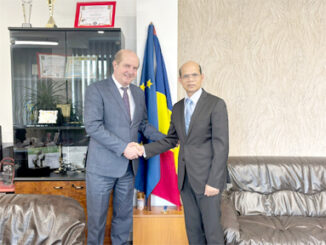
    BUCHAREST (TIP): The Embassy of India in Bucharest marked the 77th Republic Day of India with great pride, patriotic fervor, and enthusiastic community participation across Romania, celebrating the enduring spirit of India’s democracy, unity, and progress.

    Flag hoisting ceremony at Embassy of India in Bucharest. Ambassador Dr. Manoj Kumar Mohapatra unfurls the Indian National Flag. Looking on is Mrs. Mohapatra.

    As part of the celebrations, Dr. Manoj Kumar Mohapatra, Ambassador of India to Romania, joined the vibrant Indian community in Cluj-Napoca on 25 January, where the Tricolor was proudly displayed in striking Indian colors brought by members of the diaspora. The occasion was honored by the presence of H.E. Mr. Emil Boc, Mayor of Cluj-Napoca, and H.E. Ms. Maria Forna, Prefect of Cluj County, reflecting the strong friendship, goodwill, and growing people-to-people ties between India and Romania.

    Members of the Indian community and friends of India attended the ceremony.

    The event, which was held for the first time in Cluj, showcased the enthusiasm and unity of the Indian community and highlighted the warmth with which India is regarded in Romania.

    H.E. Ms. Ana Cristina Tinca, State Secretary graced the event as the Chief Guest.

    At the Embassy of India in Bucharest on 26 January, Ambassador Dr. Mohapatra unfurled the National Flag and read out the Message of the Hon’ble President of India, which highlighted India’s remarkable socio-economic transformation, democratic resilience, and the nation’s inspiring journey towards becoming a “Viksit Bharat” (Developed India). Members of the Indian community, friends of India, and Embassy officials attended the ceremony with deep patriotic spirit. The celebrations were further enriched by cultural performances presented by members of the Indian diaspora, reflecting India’s rich cultural diversity and national pride.

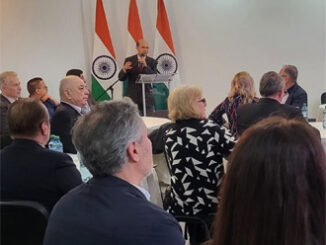
    Republic Day Reception on 26 January in Bucharest.

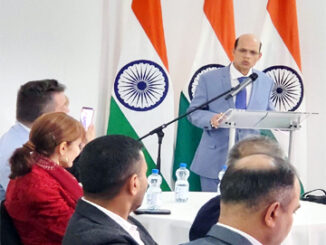
    To commemorate the occasion, the Embassy hosted a National Day Reception on the evening of 26 January, attended by members of the diplomatic corps, Indian diaspora, Romanian friends of India, and distinguished guests. H.E. Ms. Ana Cristina Tinca, State Secretary in the Ministry of Foreign Affairs, and Mr. Petre-Florin Manole, Minister of Labor, Family, Youth and Social Solidarity, graced the event, adding special significance to the celebration. In his address, Ambassador Dr. Mohapatra highlighted the growing and dynamic India–Romania partnership, underlining expanding cooperation in trade, technology, education, innovation, culture, and people-to-people exchanges. He reaffirmed India’s strong commitment to further strengthening bilateral relations and deepening engagement with Romania in the years ahead.

    Glimpses of Cultural performances during the Republic Day reception.

    The evening featured captivating cultural performances set to Indian patriotic songs, which deeply resonated with the audience and beautifully reflected India’s rich cultural heritage, unity in diversity, and national pride.

    The celebrations held from Cluj-Napoca to Bucharest, underscored the strong bonds of friendship between India and Romania, and highlighted the vibrant and positive role played by the Indian community in fostering cultural understanding, goodwill, and enduring bilateral ties. Events are also being organized in Timișoara, Romania, and Chișinău, Moldova, to commemorate India’s 77th Republic Day. These celebrations are expected to highlight the deepening bonds of friendship and cooperation between India and our valued partners in Eastern Europe.

    (Based on a press release issued by the Embassy of India in Bucharest)

  • Ambassador Mohapatra Strengthens India–Romania Partnerships Through Engagements in Cluj-Napoca Across Industry, Academia, and Community

    Ambassador Mohapatra Strengthens India–Romania Partnerships Through Engagements in Cluj-Napoca Across Industry, Academia, and Community

    BUCHAREST (TIP): Dr. Manoj Kumar Mohapatra, Ambassador of the Republic of India to Romania, embarked on a dynamic series of engagements in Cluj-Napoca, Romania’s vibrant innovation hub, to further solidify bilateral cooperation. These interactions spanned industry, higher education, cultural exchange, and community building, reflecting India’s strategic vision for multifaceted partnerships with Romania amid shared goals of economic resilience, technological advancement, and people-to-people connectivity.

    Ambassador joins Indo-Romanian Forum at Babeș-Bolyai University.

    A highlight was Ambassador Mohapatra’s participation in the Indo-Romanian Forum “Bridging Minds, Markets, and Innovation,” organized by Babeș-Bolyai University (UBB) via UBB Tech Transfer and the Indian Cultural Centre. The forum convened Indian business leaders thriving in Cluj-Napoca-spanning IT, pharma, and startups-with academics from diverse faculties. Participants brainstormed synergies in AI, innovation commercialization, and industry and university collaboration. paving the way for Romanian universities to partner with the industries for internships, job recruitment, and joint research etc, while catalyzing business-academia ecosystems.

    Ambassador visits Emerson Romania for supply chain discussions.

    Reinforcing academic bridges, the Ambassador visited the prestigious Technical University of Cluj-Napoca (UTCN), engaging with Rector Prof. Dr. Vasile Țopa and senior officials overseeing international affairs. Dialogues delved into expanding collaborative research, faculty exchanges, and dual-degree programs, with a focus on student mobility.

    Ambassador meets Brahma Kumaris representatives in Cluj-Napoca.

    Emphasis was placed on drawing Indian talent to UTCN’s acclaimed engineering and IT curricula, potentially through scholarships and joint workshops. This builds on existing ties, positioning Romania as a gateway for Indian students to Europe’s technical ecosystem.

    Ambassador meets UTCN leadership on academic cooperation.

    Ambassador Mohapatra toured Emerson’s state-of-the-art facilities in Romania, a key player in automation and engineering solutions. In productive discussions with company executives, he explored avenues for global supply chain integration, joint industrial ventures, and leveraging Romania’s skilled workforce alongside India’s manufacturing prowess. The facility tour illuminated cutting-edge production lines, underscoring operational excellence and the pivotal role of advanced engineering in fostering resilient, cross-border supply chains. Such collaborations hold immense potential for sectors like renewable energy and digital infrastructure, aligning with India’s “Make in India” initiative and Romania’s industrial ambitions.

    Ambassador celebrates India’s 77th Republic Day in Cluj with Mayor Emil Boc and Prefect Maria Forna.

    On the cultural front, the Ambassador met with Brahma Kumaris representatives, joined by Ms. Teodora Suhan and Ms. Ioana Goga. Conversations emphasized spiritual dialogue, ethical leadership, and grassroots initiatives to nurture values-based understanding, fortifying the human foundation of India–Romania relations. Culminating the visit, Ambassador Mohapatra celebrated India’s 77th Republic Day with the local Indian community, graced by Mayor Mr. Emil Boc and Prefect Ms. Maria Forna. Joyful performances of classical dance, music, and patriotic tributes celebrated India’s democratic ethos, strengthening diaspora integration and societal bonds.

    Ambassador celebrates India’s 77th Republic Day in Cluj with Indian community.

    These initiatives exemplify the accelerating trajectory of India–Romania relations, anchored in democratic solidarity, burgeoning trade (nearing €1 billion annually), academic excellence, and cultural vibrancy. They signal India’s resolve to forge sustainable frameworks that propel mutual prosperity, innovation, and a shared role in global affairs.

    (Based on a press release issued by the Embassy of India in Bucharest)

  • Ukraine will reciprocate if Russia halts attacks on energy sectors, says Zelensky

    Ukraine will reciprocate if Russia halts attacks on energy sectors, says Zelensky

    Kyiv (TIP)- Ukrainian President Volodymyr Zelenskyy on Friday said that his country is ready to cease strikes on Russian energy infrastructure if Moscow also adheres to such a halt proposed by US President Donald Trump.
    During a conversation with journalists reported by Ukrainian media outlets, Zelenskyy said that the topic of an energy truce between Kyiv and Moscow was raised during trilateral peace talks in the Emirati capital Abu Dhabi on Jan. 23-24 by the American side and is a personal initiative of US President Donald Trump.
    “If Russia heard the signal from the American side the same way we heard it, then we will definitely have some result and will be able to evaluate it,” Zelenskyy told reporters, according to state news agency Ukrinform.
    Noting there was no direct dialogue or agreements between Russia and Ukraine on the topic, Zelenskyy said that his country would “maintain a mirror attitude towards such steps.”
    “If Russia does not attack our energy (infrastructure) … we will not attack their energy (infrastructure). I think this is the answer that the mediator of the negotiations, namely the United States of America, was counting on,” Zelenskyy added, expressing Ukraine’s readiness for de-escalation steps.
    The Ukrainian president’s remarks come as Trump said during a Cabinet meeting on Thursday that he “personally asked” Russian President Vladimir Putin not to fire on Kyiv and various Ukrainian cities amid “extreme cold” weather conditions.
    Zelenskyy thanked his US counterpart in a later statement on the US social media company X, saying the topic was discussed in the UAE and that they “expect the agreements to be implemented.”

  • Trump says ‘very dangerous’ for UK to do business with China

    Trump says ‘very dangerous’ for UK to do business with China

    Washington (TIP)- US President Donald Trump said it was “very dangerous” for the UK to do business with China, as Prime Minister Sir Keir Starmer arrived in Shanghai on the third day of his visit to the country.
    The US president was reacting to agreements aimed at increasing business and investment between the UK and China, announced after Sir Keir met Chinese President Xi Jinping.
    Speaking at the premiere of a documentary about his wife Melania on Thursday, Trump went on to refer to Xi as a “friend” of his and said he knew the Chinese president “very well”.
    UK business minister Sir Chris Bryant said Trump was “wrong” and it would be “bonkers frankly for the UK to ignore the presence of China on the world stage”.
    “Of course, we enter into our relationship with China with our eyes wide open,” he added.
    The business minister also pointed out that Trump is due to visit China himself in April.
    In response to Trump’s remarks, Downing Street indicated that Washington had been aware of this trip and its objectives in advance.
    Arriving at the premiere of the Melania film on Thursday, the US president was asked by a reporter: “What do you think about the UK going into business with China?”
    Beyond his brief comments, Trump did not say anything further about the UK’s engagement with China, pivoting instead to Canada and delivering a similar warning.
    He said it was “even more dangerous, I think, for Canada”.
    “Canada is not doing well. They’re doing very poorly, and you can’t look at China as the answer,” he added.
    Earlier this week, the US president threatened to impose tariffs on Canada if it went through with economic deals struck with China on a recent visit to Beijing by its Prime Minister Mark Carney.
    The comments come after Sir Keir said the UK’s relationship with China was in a “good, strong place” following his talks with Xi at the Great Hall of the People on Thursday.
    Sir Keir said on Friday that the “very good meetings” with Xi had provided “just the level of engagement that we hoped for”.
    “We warmly engaged and made some real progress, actually, because the UK has got a huge amount to offer,” he told a meeting of the UK-China Business Forum at the Bank of China in Beijing.
    So far several things have come out of Sir Keir’s trip including an agreement on visa-free travel and lower whisky tariffs, as well as a £10.9bn investment by AstraZeneca to build manufacturing facilities in China.
    An agreement aimed at tackling organised crime and illegal immigration will see the UK and China share intelligence to identify the supply routes of people smugglers.
    The UK government says the inflatable dinghies used in small boat crossings often contain parts sourced in China.
    Other deals include an agreement to co-operate on reducing red tape for UK exporters and collaborate on health challenges such as antimicrobial resistance.
    The US was the UK’s largest single country trading partner in 2025, while China was the fourth largest, according to the Department for Business and Trade.
    The chair of the British Chamber of Commerce in China, Chris Torrens, praised Sir Keir’s visit to Beijing as “successful”. Torrens told the BBC it made “sense for the UK to be looking to China, it’s one of its larger trading partners”.

  • Myanmar military air strikes killed at least 170 civilians during voting period: UN

    At least 170 civilians were killed in more than 400 military air strikes in Myanmar during its recent two-month election period, the United Nations said on Friday, highlighting deepening violence amid a widely criticised vote under junta rule.
    The UN rights office said “credible sources” had verified that 170 civilians lost their lives in some 408 military aerial attacks reported by open sources during the voting period between December 2025 and January 2026,” and cautioned that the actual figure was likely higher due to communication blackouts and fear among witnesses.
    James Rodehaver, head of the UN rights office’s Myanmar team, speaking from Bangkok to reporters in Geneva, said verification covered the period from the start of the election campaign through the three phases of voting. “Because of the way communications are cut off and because of, frankly, the fear of individuals in some of these locations to speak to us, it sometimes takes a lot longer to get that information,” he said.
    The brutal tally of civilian deaths comes as Myanmar holds elections that were widely dismissed by democracy watchdogs as a rebranding of military rule, five years after the 2021 coup ousted Aung San Suu Kyi’s government. Critics argue the vote lacked legitimacy, pointing to the exclusion of opposition candidates, repression, and widespread insecurity across the country.
    UN rights chief Volker Türk said the “profound and widespread despair inflicted on the people of Myanmar” since the coup ”has only deepened with the recent election staged by the military.” He noted that many citizens voted, or chose not to vote, out of fear, a situation he said was starkly at odds with their internationally guaranteed civil and political rights.
    The rights office also highlighted that the election was held in just 263 of 330 townships and mostly in urban centres under military control, leaving conflict areas and large segments of the population especially displaced groups and minorities such as the Rohingya effectively excluded from the process.
    Five years of military rule, the UN said, have been marked by repression of dissent, mass arbitrary arrests, forced conscription, extensive surveillance, and shrinking civic space, with the latest election appearing to entrench military dominance rather than restore civilian governance.

  • Spanish PM tells SpaceX’s Musk ‘Mars can wait, humanity can’t’ in defence of migrant move

    Spain’s Prime Minister Pedro Sanchez has defended his government’s plan to grant legal status to undocumented residents in an exchange with billionaire Elon Musk on social media platform X, telling him, “Mars can wait”.
    The plan approved on Jan 27 by Mr Sanchez’s leftist government could regularise around 500,000 undocumented workers, in a break with harsher policies seen elsewhere in Europe.
    Mr Musk posted a link on X – which he owns – to a post by a man named Mr Ian Miles Cheong, who called the plan “electoral engineering”, along with the comment, “Wow”.
    “The logic is simple: legalise half a million people, fast-track them to citizenship (which takes as little as two years for many), and you’ve effectively imported a massive, loyal voting bloc that’s indebted to the left,” Mr Cheong wrote in the post which has had nearly 12 million views.
    Mr Sanchez hit back at Mr Musk, responding to the billionaire’s post on X late on Jan 29 with the message: “Mars can wait. Humanity can’t”.
    Mr Musk’s aerospace company SpaceX is developing the mammoth Starship – the world’s largest and most powerful rocket – as part of his vision to take humans to Mars.

  • Son of Norway crown princess to stand trial for rape

    In the biggest scandal to rock Norway’s monarchy, the son of Crown Princess Mette-Marit goes on trial next week accused of raping four women, as well as drug and assault offences.
    Marius Borg Hoiby, Mette-Marit’s 29-year-old son from a relationship before she married Crown Prince Haakon, has been charged with a total of 38 counts, some of which date back to 2018.
    He faces up to 16 years in prison if the Oslo district court finds him guilty. The trial, scheduled to last until 19 March, is expected to attract intense media coverage.
    “When it comes to the Norwegian royal family, it is without a doubt the biggest scandal” in its 120-year history, Trond Noren Isaksen, a historian and expert on Norway’s monarchy, told AFP. “There have been controversies surrounding the choice of spouses, about renovations of the palace and these kinds of things, but never any real scandals involving criminal offences, let alone so many,” he said.

  • Won’t budge over defence capabilities: Iran on N-talks

    Won’t budge over defence capabilities: Iran on N-talks

    Istanbul (TIP)- Iran is prepared for the resumption of talks with the United States, but they should be fair and not include Iran’s defence capabilities, Iran’s chief diplomat said on Friday, Jan 30, as regional powers work to prevent military conflict between the two foes.
    US President Donald Trump said on Thursday he planned to speak with Iran, even as the US sent another warship to West Asia and the Pentagon chief said the military would be ready to carry out whatever the president decided. A US Navy destroyer has docked at the Israeli port of Eilat, an Israeli news outlet reported.
    One of the main demands by the US to resume talks with Iran is curbing its missile programme, a senior Iranian official said last week. Iran rejects that demand.
    “If negotiations are fair and equitable, Iran is ready to participate in such talks,” Foreign Minister Abbas Araqchi said in a press conference with his Turkish counterpart in Istanbul.
    Araqchi said no talks between Tehran and Washington were currently arranged. In response to US threats of military action, Araqchi said Tehran was ready for either negotiations or warfare.
    In an earlier development, European Union foreign ministers agreed to designate Iran’s Islamic Revolutionary Guard Corps (IRGC) as a terrorist organisation, placing the powerful military force in the same category as Islamic State and al Qaeda, in what marks a symbolic shift in Europe’s stance on Iran’s leadership.
    Iran says Europe to ‘suffer consequences of foolish act’ after Guards terror listing
    Iran’s judiciary chief Gholamhossein Mohseni Ejei warned on Friday that European countries would face consequences after the EU listed the Islamic Revolutionary Guard Corps as a terrorist organisation.
    “There is no doubt that the hostile action of the Europeans, who labelled the Revolutionary Guards as a terrorist organisation, will not go unanswered,” Ejei was quoted by state television as saying, adding that “they will suffer the consequences of their foolish act,” without elaborating.

  • Israel reopening Gaza’s border crossing with Egypt on Sunday after long closure

    Israel reopening Gaza’s border crossing with Egypt on Sunday after long closure

    JERUSALEM (TIP)- Israel said on Friday, Jan 30, that it will reopen the pedestrian border crossing between the Gaza Strip and Egypt over the weekend, marking an important step forward for U.S. President Donald Trump’s Gaza ceasefire plan. COGAT, the Israeli military body in charge of coordinating aid to Gaza, said in a statement that starting on Sunday a “limited movement of people only” would be allowed through the Rafah crossing, Gaza’s main gateway to the outside world. The announcement followed statements from Israeli Prime Minister Benjamin Netanyahu and Ali Shaath, newly appointed to head the Palestinian administrative committee governing Gaza’s daily affairs, that it would likely open soon.
    While COGAT said the passage will open in both directions on Sunday, Shaath said the first day will be a trial for operations and that travel both ways will start Monday.
    Israel as of Friday agreed to allow up to 150 people to leave each day — 50 medical patients with two family members, an official familiar with the situation told The Associated Press, speaking on condition of anonymity because they were discussing diplomatic talks. Up to 50 people who fled during the war can return daily, the source said.
    Roughly 20,000 sick and wounded Palestinians need treatment outside Gaza, according to the territory’s health ministry. Gaza’s health system was decimated in the war, rendering advanced surgical procedures out of reach. COGAT said both Israel and Egypt will vet individuals for exit and entry through the crossing, which will be supervised by European Union border patrol agents. In addition to screenings at the crossing, Palestinians leaving and returning will be screened by Israel in the adjacent corridor, which remains under Israeli military control. The crossing has been under a near complete closure since Israel seized it in May 2024, saying the step was part of a strategy to halt cross-border arms smuggling by Hamas. It was briefly opened for the evacuation of medical patients during a short-lived ceasefire in early 2025.
    Israel had resisted reopening the crossing, but the recovery of the remains of the last hostage in Gaza on Monday cleared the way to move forward. A day later, Netanyahu said the crossing would soon open in a limited and controlled fashion.
    Thousands of Palestinians inside Gaza are trying to leave the war-battered territory, while tens of thousands who fled the territory during the heaviest fighting say they want to return home. The reopening is one of the first steps in the second phase of last year’s U.S.-brokered ceasefire agreement, which includes challenging issues ranging from demilitarizing Gaza to putting in place an alternative government to oversee rebuilding the mostly destroyed enclave.

  • Canadian Energy Minister says he is pleased to work with India

    Canadian Energy Minister says he is pleased to work with India

    By Prabhjot Singh

    TORONTO (TIP): “As Prime Minister Carney says, we are in the midst of a rupture, not a transition. That means we must move quickly to deepen and enhance partnerships in every corner of the globe and use the natural advantages and resources we have to build Canada Strong.

    “As one of the largest and fastest-growing economies in the world, India is looking to us as a potential supplier of energy and minerals. I am pleased to work with India to build partnerships that advance bilateral trade and investment, global energy security, and the clean energy transition and generate revenue in Canada that we can use to pay for the public services we rely on. This is what being an energy superpower looks like,” says Tim Hodgson, Canadian Minister of Energy and Natural Resources, at the conclusion of his trip to India, where he attended India Energy Week and met with leaders of major Indian energy companies and his Indian counterparts to discuss opportunities to deepen bilateral trade and investment.

    He is the third Canadian minister, after Anita Indira Anand and Maninder Singh Sidhu, to visit India during the past few months. Canadian Prime Minister Mark Carney is also expected to visit India in the coming months.

    As Canada diversifies trade and attracts new investment to build the strongest economy in the G7, he says, “We are prioritizing broad engagement to maximize opportunities for our industries. That includes building new and enhanced relationships with Asian markets seeking long-term, reliable collaboration in energy and critical minerals.

    “As one of the world’s largest economies, India is expected to have the largest growth in global energy demand from now through to 2030—offering a significant opportunity for Canada to supply Indian partners and customers with world-class, low-cost, low-carbon Canadian resources,” he said.

    During India Energy Week, Minister Hodgson relaunched the Canada-India Ministerial Energy Dialogue (CIMED) alongside Hardeep Singh Puri, India’s Minister of Petroleum and Natural Gas, and endorsed the CIMED Action Plan. These initiatives mark a crucial first step for Canada toward a long-term, collaborative bilateral relationship with India that will serve as an important channel for sustained discussions on advancing Canada–India energy projects, potential long-term supply agreements, joint ventures, business-to-business deals, and targeted investments.

    Minister Hodgson also met Piyush Goyal, India’s Minister of Mines, in New Delhi following his participation in India Energy Week. The two ministers agreed to formalize Canada and India’s cooperation on critical minerals in the coming weeks, including a high-level Indian government and industry delegation coming to the Prospectors & Developers Association of Canada Convention in Toronto in March 2026.

    There is strong alignment between India’s ambitions and Canada’s push to begin building major energy and natural resource projects again, including LNG and recent investments under the G7 Critical Minerals Production Alliance. Rebuilding Canada’s relationship with India is key to achieving the Prime Minister’s goal of doubling exports to non-U.S. markets by 2035.

    Canada has what the world wants, from conventional and clean energy to critical minerals, and we are leveraging these strengths to build partnerships with major global players—creating economic opportunities at home to foster our position as an energy superpower worldwide. Recognizing the opportunities for enhanced economic cooperation, Canada’s participation in India Energy Week continues positive momentum and bilateral engagement with India toward more reliable supply chains and strategic stability, for the benefit of both countries.

    (Prabhjot Singh is a Toronto-based Senior Journalist. He can be reached at prabhjot416@gmail.com)

  • India, Canada revive Ministerial Energy Dialogue

    India, Canada revive Ministerial Energy Dialogue

    By Prabhjot Singh

    NEW DELHI/TORONTO (TIP): Energy ministers of India and Canada have reaffirmed the immense importance that energy security and diversity of supply have in the safety, well-being, and economic vitality of both countries. They held a bilateral meeting last week and launched the renewed Canada-India Ministerial Energy Dialogue.

    Indian Minister of Petroleum and Natural Gas of India, Hardeep Singh Puri, and Canadian Minister of Energy and Natural Resources, Timothy Hodgson, participated in India Energy Week 2026 (IEW’26) in Goa, marking the first high-level participation of a Canadian Cabinet Minister at IEW.

    The Goa meeting was a follow-up to the direction provided by the prime ministers of the two countries during their interaction on the sidelines of the G7 Summit, held in June 2025 in Kananaskis, where they underscored the importance of restarting senior ministerial as well as working-level engagements.

    Natural Resources Canada and India’s Ministry of Petroleum and Natural Gas recognized the complementary nature of their energy sectors and the mutual value to be gained from sustained engagement on energy matters.

    Canada has stated its goal of becoming an energy superpower in clean and conventional energy, with export diversification as a priority, while India, as the epicenter of the global energy landscape, offers a natural and symbiotic partnership grounded in scale, stability, and long-term opportunity.

    Canada has current and emerging liquefied natural gas (LNG) projects, is increasing production and exports of crude oil to markets in Asia via the Trans Mountain Expansion (TMX) Pipeline, and is advancing liquefied petroleum gas (LPG) exports to Asia via the west coast of Canada. At the same time, India, being the world’s third largest oil consumer, fourth largest LNG importer, third largest LPG consumer, and having the fourth largest refining capacity, is projected to remain at the center of the global energy landscape, accounting for over one-third of the growth in global energy demand over the next two decades, the largest contribution by any country.

    Even efforts are underway in India to substantially scale up domestic oil production, significantly expand refining capacity, and increase the use of natural gas in the energy mix. Thus, India and Canada have significant potential to emerge as strong collaborators in the area of energy fuels. In this context, the ministers affirm to deepen bilateral energy trade, including the supply of Canadian LNG, LPG, and crude oil to India and the supply of refined petroleum products from India to Canada.

    The ministers recognize the importance of joint commercial and investment partnerships in each other’s energy sector. Canada is acting quickly to build energy projects and supply products to international markets, with Asia as a priority region. In 2025, the Government of Canada launched the Major Projects Office and announced the acceleration of several energy and resource projects and strategies, representing more than $116 billion in investments.

    India is also investing heavily in its own energy supply and prosperity. India highlighted the various policy reforms undertaken, including the huge investment opportunity of US$ 500 billion in the overall value chain of the energy sector. Recognizing this, the ministers agreed to deepen long-term partnerships aimed at facilitating increased reciprocal investment in the Canadian and Indian energy sectors.

    The ministers also recognized the importance of climate-related objectives. This includes efforts to reduce emissions in conventional energy value chains, including through carbon capture utilization and storage, and support for the development and deployment of cleaner technologies as energy demand grows. Recognizing that there exists a huge potential for cooperation in clean energy value chains, the ministers noted the opportunities for collaboration in renewable energy, including hydrogen, biofuels, and sustainable aviation fuel; battery storage; critical minerals; clean technologies; electricity systems; energy supply chain resilience; and the application of artificial intelligence in the energy sector.

    The ministers noted the ongoing collaborative efforts to advance the global energy transition via the global development and deployment of biofuels through the Global Biofuels Alliance (GBA), where Canada is an observer.

    Building on the deliberations, both sides affirm:
    The importance of energy security and diverse energy supply chains. Canada, as a safe, secure, and reliable supplier, and India, as a major consumer, can act in partnership to deepen trade and ensure stable and secure energy supplies. Canada and India will collaborate to promote and strengthen cooperation across trade in the energy sector, including services.
    Their commitment to continued government-to-government dialogue and cooperation, such as through the Canada-India Ministerial Energy Dialogue, and regular and ongoing expert collaboration.
    The intention is to work in partnership to support meaningful business-to-business, or business-to-government, collaboration across the value chain.
    Their mutual intent is to continue supporting work through bilateral and multilateral mechanisms, as well as with industry partners, to support climate objectives for the benefit of the global community.

    (Prabhjot Singh is a Toronto-based Senior Journalist. He can be reached at prabhjot416@gmail.com)

  • Extortions and transnational crime worry the Indian community in general, and Sikhs in particular

    Extortions and transnational crime worry the Indian community in general, and Sikhs in particular

    By Prabhjot Singh

    TORONTO (TIP): The fear of extortion continues to escalate as the local, provincial and federal agencies continue to grope in the dark without finding any substantial solutions to the problems that have been spreading their tentacles to communities across Canada, especially those with a significant Indian immigrant population.

    The worst hit are the affluent members of the Indian community in general and the Sikhs in particular.

    Extortions, which have been a rising concern for years, continue to rock meetings of city councils, provincial assemblies, and the national Parliament, the House of Commons.

    The problem has been in the public domain that after a series of town hall meetings, debates and deliberations, those allegedly behind the rattling crime have started spreading the terror by making the shocking videos of their actions viral. The other day, a video of a man shooting up a Brampton home while brandishing two pistols allegedly went viral. It sent shock waves among members of the Indian community.

    A recent report in a major tabloid of Toronto said that extortion was a “story of people being threatened with violence, like the shooting, or arson to the business or home, if they do not pay up. While the shootings and other acts of violence are carried out by hired local thugs, the money is often wired to organized crime groups in India. While the notoriously vicious and violent Bishnoi gang in India has claimed responsibility for some of these extortion rackets, there are other groups and copycat outfits involved.

    “In the Brampton incident earlier this month, the shooting was recorded by an accomplice of the gunman and then sent to the homeowner the next day with a demand for $500,000. While Brampton and the surrounding area are a hotspot for this activity, it’s also been a problem in Winnipeg, Edmonton, and British Columbia’s Lower Mainland,” the report said.

    After the Brampton City Council and Mayor urged the Federal Government to declare it a national crisis. Now, the city council of Surrey in BC, headed by Mayor Brenda Loc, passed a unanimous motion calling for a national state of emergency and for strong action by the federal government after 35 extortion incidents since the beginning of the year.

    “Surrey is facing a serious and growing crisis of organized extortion, intimidation, and targeted shootings,” Locke said. “Residents and business owners are living in constant fear. Public safety is at risk, and the social and economic impact is real.”

    She wants additional police resources, suggesting a joint federal-provincial-municipal task force and expedited deportation of “non-citizens charged or convicted of extortion, firearms offences, or participation in extortion-related criminal activity.”

    On return from his India visit, British Columbia Premier David Eby went after the head of a police anti-extortion task force. After his interaction with Indian media in Mumbai, where he found himself in a piquant situation when asked repeatedly about the Hardeep Singh Nijjar case, Eby said that the head of the anti-extortion needed to step aside if he could not demonstrate a sense of urgency in the fight. His remarks about RCMP Assistant Commissioner John Brewer come a day after Brewer repeatedly declined to characterize a wave of extortion-related shootings in the Lower Mainland as a crisis.

    Soon after, the premier said that Brewer’s comments “cut at public confidence” and he needed to clarify himself. “If Mr. Brewer does not feel that urgency, does not feel this is a crisis, perhaps he’s not the right person to head up this task force,” Eby said, maintaining that “the reason we established this task force … was to respond to a crisis. We need them to bring that urgency to this job and to do it quickly and effectively for the people of Surrey and the people south of the Fraser,” the premier continued. “That is what they expect, that is what they demand, and that is what I expect.”

    A few days earlier, Brewer, in an update on the work of the B.C. extortion task force, held that it was “actively hunting” suspects in 32 files across the Lower Mainland. But he would not describe the situation as a crisis after being pressed to do so in a news conference. Police were “actively hunting” those who were extorting businesses and individuals in B.C. John Brewer urged residents not to take matters into their own hands. This statement came as a sequel to yet another shooting in Surrey, which was believed to be linked to extortion.

    There have been instances when victims reportedly retorted and fired back at the extortionists. Interestingly, Brewer apologized for not using the term “crisis” in his news conference and said the opportunity to provide an update had instead called the RCMP’s commitment into question and impacted public confidence.

    The issue has been rocking the House of Commons, which resumed its sitting after the holiday break on Monday.

    Conservative Deputy Leader Tim Uppal said that Canadians were living in fear in their own neighborhoods as extortion runs rampant right across the country. In British Columbia alone, extortion has increased by nearly 500%, yet the Liberals continue to ignore this crisis, so much so that the Surrey city council desperately passed a unanimous motion to ask the government to take some action. Canadians do not need more empty announcements or more meetings and town halls. Canadians need action. Why was the government ignoring the safety of Canadians? When will the Liberals finally work with us to bring in mandatory minimum sentences for extortion to help protect Canadians? he asked.

    Responding to Tim Uppal, Minister of Justice and Attorney-General Sean Fraser admitted that extortion was a real and pressing problem in this country and that members had an opportunity to do something about it. Laws are being debated in Parliament right now that would make it harder for people charged with extortion-related offences to be released on bail, that would result in deeper and longer sentences for people who are convicted of extortion, and that would give new tools to law enforcement, who are asking the House to pass the strong borders act on lawful access so they can investigate, charge, and prosecute criminals. The thing that these different measures have in common is that the Conservative Party of Canada has been obstructing them for months. I ask them to get with the program, support these important bills, and bring extortion to an end in Canada.

    Conservative MP Harb Gill from Windsor West, while joining the debate, said that as a former police officer, “I know a crisis when I see one. Extortion is out of control. Businesses and families are being threatened, shot at, and shaken down daily, yet the Liberals deny there is a crisis. They are dragging their feet. Some municipalities are even asking for a state of emergency to be declared. When will the government stop its hug-a-thug policy, work with Conservatives, restore mandatory minimums, and repeal the catch-and-release laws? For crying out loud, do something about this crisis.

    Ruby Sahota, Secretary of State, Combatting Crime, intervened to say that in this country, we have life in prison for extortion and mandatory minimum sentences when extortion is committed by organized criminals or with a firearm.” We are taking this issue very seriously. That is why I have crisscrossed the country, finding out what is needed and where the gaps are. Everywhere I have gone, police and law enforcement agencies have asked for lawful access. That was the second measure that we brought to Parliament, but the Conservatives have been obstructing it every step of the way. What do they have against catching extortionists?

    Another Conservative MP, Amarjeet Gill from Brampton West, held that extortion was “exploding and terrorizing communities across Canada, such as Brampton and Surrey. Homes and businesses are being threatened and shot at. Families are living in fear. Some residents have recently fled the country. Their families are in fear for their lives. This crime surge cannot become the new normal. Canadians are paying the price, but Canadians deserve safety, not excuses. When will the Liberal government take real action to stop extortion, crack down on organized crime, and keep Canadians safe?

    Veteran Affairs Minister Jill McKnight said that the rise in “extortion-related threats, shootings, and intimidation across Ontario and the Lower Mainland is a grave concern. I know how much fear it is causing for families, businesses, and our communities. Our government is advancing expanded legislative powers so that law enforcement has the tools it needs to effectively combat extortion and organized criminal networks. Political opponents in Surrey put aside their differences to act with quick urgency. I am asking their Conservative counterparts to stop obstructing necessary legislation and work with us to provide practical solutions. Our communities need to feel safe at home,” he said.

    (If space permits, please carry the full introduction of Prabhjot. If not, please print the following)

    (Prabhjot Singh is a Toronto-based Senior Journalist. He can be reached at prabhjot416@gmail.com)

  • Embassy of India and Global Logitech Host Successful AI Pre-Event in Brașov

    Embassy of India and Global Logitech Host Successful AI Pre-Event in Brașov

    BUCHAREST (TIP): The Embassy of India in Bucharest, in collaboration with Global Logitech, an innovative Indian company based in Brașov, organized a dynamic pre-event on 14 January 2026 at the prestigious University of Transylvania in Brașov, Romania. This forum served as an inspiring prelude to the upcoming AI Summit in India, scheduled for February 2026.

    The event gathered leading innovators, policymakers, industry experts, and academicians from Romania and beyond to delve into cutting-edge advancements in artificial intelligence. Discussions centered on ethical AI deployment, robust digital infrastructure, and sustainable innovation, highlighting AI’s transformative role in driving economic growth and societal progress. Key highlights included keynote addresses, insightful panel discussions, and hands-on interactive workshops that sparked collaborative ideas.

    Costin Badici of GlobalLogic addressed participants during the AI Impact Summit pre-event.

    A standout moment featured Mr. Costin Badici, who delivered a compelling presentation on “AI for All,” illuminating the future applications of AI for humankind’s benefit, from enhancing everyday accessibility to solving global challenges.

    Dr. Manoj Mohapatra, Ambassador of India to Romania, inaugurated the proceedings. He underscored India’s pioneering role in AI through flagship initiatives like the India AI Mission, which aims to democratize technology for inclusive development. “This partnership with Global Logitech exemplifies the deepening India-Romania ties in emerging technologies,” the Ambassador remarked. “As we prepare for the AI Summit in India, gatherings like this lay the groundwork for groundbreaking joint ventures that will forge a brighter, tech-driven future for both nations.”

    The participants at the pre-event of AI Impact Summit during the speech of the Ambassador.

    Global Logitech representatives reaffirmed their dedication to bridging Indo-Romanian tech ecosystems. They announced promising opportunities for research and development (R&D) partnerships, talent exchange programs, and co-innovation hubs. Over 100 participants, including startups, university researchers, and government officials, engaged in lively exchanges on critical topics such as AI for smart cities, healthcare diagnostics, and cybersecurity resilience.

    The event culminated in a captivating showcase of Indian innovation, with live demonstrations of AI-enabled solutions developed by Global Logitech. These displays reinforced the strong technological affinities between India and Romania, blending cutting-edge expertise with shared visions for progress.

    The Embassy of India remains committed to nurturing such collaborative platforms that advance bilateral relations. It extends a warm invitation to stakeholders to join the forthcoming AI Summit in India for even deeper engagements and opportunities.
    (Based on a Press Release issued by the Embassy of India in Bucharest)

  • Ambassador Dr. Manoj Mohapatra Strengthens India-Moldova Ties During Official Visit to Chișinău

    Ambassador meets with Moldovan Education Minister Dan Perciun,

    BUCHAREST (TIP): Dr. Manoj Mohapatra, Ambassador of India to Romania and concurrently accredited to the Republic of Moldova, concluded a highly productive official visit to Chișinău from January 11 to 13, 2026. Amid a dynamic series of high-level meetings, the Ambassador fortified bilateral relations across agriculture, finance, infrastructure, environment, culture, energy, education, economy, and labor sectors. These engagements aligned seamlessly with shared Global South priorities, signaling a new chapter in India-Moldova cooperation as both nations navigate geopolitical shifts and economic opportunities in Eastern Europe.

    Ambassador meets with Moldovan Economy Minister Eugeniu Osmochescu.

    The visit commenced on a high note with a resounding cultural event at the Medical University of Chișinău. This gathering illuminated India’s rich, multifaceted heritage, from classical music to contemporary expressions, while solidifying cultural diplomacy. Key programs included structured student engagements, all designed to enhance understanding of their concerns, amplify soft power, and weave enduring people-to-people bonds.

    Ambassador meets with Moldovan Labor Minister Natalia Plugaru.

    Turning to economic and financial pillars, discussions with Secretary General Mr. Sergiu Gherciu of the Ministry of Agriculture and Food Industry, and State Secretary Mr. Ion Gumene of the Ministry of Finance, yielded a comprehensive roadmap. Highlights encompassed technology transfers for sustainable farming practices, Moldovan exports of premium plums and wines to the vast Indian market, and joint ventures tackling food security challenges.

    Ambassador meets with Moldovan Deputy PM Vladimir Bolea.

    Financial accords further enabled co-financed development projects, digital payment interoperability, and robust investment protections, positioning Moldova as a strategic gateway for India’s expanding footprint in Central European markets and fostering economic resilience.

    Ambassador meets with Moldovan Culture Minister Cristian Jardan.

    Infrastructure, energy, and environmental dialogues proved equally transformative. With Deputy Prime Minister and Minister for Infrastructure Mr. Vladimir Bolea, State Secretary for Environment Ms. Aliona Rusnac, and Minister of Energy Mr. Dorin Junghietu, commitments emerged for discussion and studies on road-rail links, smart city initiatives, and Moldova’s integration into India’s International Solar Alliance. These pacts promised renewable technology infusions, grid modernization, and Indian firm participation in Moldovan renewable projects, diversifying energy sources, combating climate vulnerabilities, and advancing shared green stewardship.

    Ambassador meets with Moldovan Energy Minister Dorin Junghietu.

    Cultural, educational, and human capital exchanges rounded out the agenda. Meetings with Minister of Culture Mr. Cristian Jardan, Minister of Education and Research Mr. Dan Perciun, and State Secretary for Labour Ms. Felicia Bechtoldt expanded scholarships and film co-productions on shared histories; frameworks for mutual degree recognition, AI-driven research hubs, and teacher exchanges; plus mobility partnership agreements, skilling academies inspired by India’s Industrial Training Institutes (ITIs), and streamlined remittances, equipping Moldovan youth for global success and nurturing future bilateral leaders.

    Ambassador meets with Moldovan Labor State Secretaries

    The economic crescendo came in talks with Minister of Economy Mr. Eugeniu Osmochescu, who endorsed ambitious trade targets through e-commerce platforms, SME linkages, tariff eliminations, and dedicated forums in IT and pharmaceuticals. The visit culminated in dynamic interactions with potential investors and business houses, where reflections on India’s robust growth story underpinned invitations for Moldovan ministerial visits and joint participation in premier Indian trade fairs.

    Ambassador meets with Moldovan Energy Minister Dorin Junghietu and the State Secretaries.

    This visit exemplifies the maturing India-Moldova strategic partnership, translating diplomatic goodwill into actionable, high-impact collaborations that promise sustained prosperity, security, and cultural enrichment for generations ahead.

    (Based on a Press Release issued by the Embassy of India in Bucharest)

  • India and Romania to host Regional Hindi Conference at Romanian American University

    India and Romania to host Regional Hindi Conference at Romanian American University

    BUCHAREST (TIP): The Embassy of India in Bucharest, in collaboration with the Romanian American University, will organize a Regional Hindi Conference on 28–29 January 2026 at the Romanian American University (RAU), Bucharest. The two-day academic and cultural event will bring together eminent Hindi scholars, academics, and experts from across Asia and Europe to deliberate on the growing global relevance of the Hindi language and its role in strengthening international cultural and academic cooperation.

    The Conference aims to provide a high-level platform for intellectual exchange and scholarly dialogue, fostering new ideas and future pathways for cooperation in the promotion and study of Hindi at regional and global levels. A delegation led by Smt. Anju Ranja, Joint Secretary, RRB-I&T, Ministry of External Affairs, Government of India, will also participate in the event, reflecting India’s strong commitment to the promotion of Hindi and cultural diplomacy in Europe and beyond.

    The Conference will feature a series of thematic panel discussions, focusing on key contemporary and strategic dimensions of Hindi and its global outreach. The major discussion topics include:

    “Hindi: Global Identity and Cultural Unity”, highlighting Hindi as a unifying cultural and linguistic force across regions;
    “Hindi Bhasha Vigyan ki Vastavik Samasyaen” (Contemporary Linguistic Challenges of Hindi), examining structural, pedagogical, and usage-related issues of the language;
    “Hindi Bhasha Sikhane ke Tarike” (Methods of Teaching Hindi), focusing on innovative and effective approaches to Hindi language instruction; and
    “Hindi, AI, and the Indian Workforce in Romania: New Frontiers of Cooperation”, exploring the intersection of Hindi, emerging technologies, and India–Romania professional and educational collaboration .

    The Opening Ceremony of the Conference will be held on 28 January 2026 at 10:00 AM in the Senate Room, while the Closing Ceremony will take place on 29 January 2026 at 7:00 PM in the Aula Magna of the Romanian American University. The Closing Ceremony will also feature cultural performances by artists from Romania and Moldova, showcasing the shared appreciation of Indian culture in the region.

    The Regional Hindi Conference is expected to serve as an important milestone in strengthening India–Romania academic and cultural cooperation, particularly in the fields of language, literature, higher education, and people-to-people exchanges.

    (Based on a Press Release issued by Embassy of India in Bucharest)

  • Xi urges ‘central role’ of UN in call with Lula

    Xi urges ‘central role’ of UN in call with Lula

    BEIJING (TIP)- Chinese President Xi Jinping called on countries to protect the “central role” of the United Nations in international affairs, urging his Brazilian counterpart on Friday to help safeguard international norms, state media reported.
    The comments come after US President Donald Trump unveiled plans for his new “Board of Peace” at the World Economic Forum.
    Although originally meant to oversee Gaza’s rebuilding, the board’s charter does not seem to limit its role to the Palestinian territory and has sparked concerns Trump wants to rival the United Nations.
    While China and Brazil have both been invited to join Trump’s new grouping, neither has confirmed participation.
    Xi told President Luiz Inacio Lula da Silva during their Friday morning phone call that in the current “tumultuous” international situation, China and Brazil “are constructive forces in maintaining world peace and stability,” according to a readout published by state broadcaster CCTV.
    “They should stand firmly on the right side of history… and jointly uphold the central role of the United Nations and international fairness and justice,” Xi said.
    European leaders have expressed doubts over Trump’s norm-busting proposal, with some viewing it as an attempt to potentially sideline or even replace the United Nations.
    While in Davos, Switzerland, Trump said that once complete, the board “can do pretty much whatever we want,” while adding that “we’ll do it in conjunction with the United Nations.”
    Beijing’s foreign ministry said on Wednesday that “no matter how the international situation changes, China firmly upholds the international system with the United Nations at its core.”
    Brazil has also expressed skepticism about the Board of Peace, saying it could represent “a revocation” of the United Nations. Lula’s special adviser Celso Amorim told Brazilian media that “we cannot consider a reform of the UN made by one country.”
    During Trump’s global tariff onslaught last year, China and Brazil sought to present their countries as staunch defenders of the multilateral trading system.
    Xi told Lula in August they could set an example of “self-reliance” for emerging powers.
    China, a permanent member of the UN Security Council, engages with the international body even as it has objected to what it terms internal interference. Advocacy groups like Human Rights Watch have accused China of seeking to undermine the United Nations by reducing contributions to the organization’s rights budgets, establishing an alternative international mediation body and blocking activists from UN events.

  • Ukraine-Russia-US hold talks in Abu Dhabi with territory as key issue

    Ukraine-Russia-US hold talks in Abu Dhabi with territory as key issue

    UAE (TIP)- Ukrainian and Russian negotiators held talks in the United Arab Emirates, with the key issue of territory dominating the agenda as the United States pushes for an agreement to end the nearly four-year war.
    The discussions in Abu Dhabi on Friday were the first direct public negotiations between Moscow and Kyiv on a plan being pushed by US President Donald Trump’s administration to end the conflict.
    “The talks commenced today in Abu Dhabi and are scheduled to continue over two days, as part of ongoing efforts to promote dialogue and identify political solutions to the crisis,” the UAE’s Ministry of Foreign Affairs said in a statement.
    Ukrainian President Volodymyr Zelenskyy said territorial disputes would be a central issue in the discussions but stressed that “the most important thing is that Russia should be ready to end this war, which it started”.
    In a statement shared on Telegram, Zelenskyy said he was in regular contact with the Ukrainian delegation, but it was too early to draw conclusions from Friday’s talks. “We’ll see how the conversation goes tomorrow and what the outcome will be,” he said.
    The discussions in the Emirati capital came a day after Zelenskyy met with Trump at the World Economic Forum in Davos, Switzerland – and hours after US envoy Steve Witkoff held late-night talks with Russian leader Vladimir Putin at the Kremlin. Reporting from the Russian capital Moscow, Al Jazeera’s Yulia Shapovalova said the talks between Putin and Witkoff lasted nearly four hours but did not resolve the main sticking points to reaching a deal – namely, territorial disputes and security guarantees.
    “Russia demands that the Ukrainian army leave the Donbas region, which is unacceptable to Ukraine,” Shapovalova explained.
    Kremlin spokesman Dmitry Peskov said on Friday that Russia’s insistence on Ukraine yielding all of Donbas – including the 20 percent of Donetsk which is still under Ukrainian control – was “a very important condition”.
    Kremlin foreign affairs adviser Yury Ushakov, who participated in Putin’s meeting with Witkoff, also said “it was reaffirmed that reaching a long-term settlement can’t be expected without solving the territorial issue”.
    Meanwhile, Russia’s state-run TASS news agency reported that the discussions in Abu Dhabi included possible buffer zones and monitoring mechanisms.
    For its part, Ukraine has demanded security guarantees from its Western allies, including the US, should a deal to end the war be signed, in order to deter Russia from invading again.
    Ukrainians have faced widespread power outages this winter as Russian attacks on the capital Kyiv and other parts of the country target energy infrastructure, leaving thousands of families struggling to stay warm in freezing temperatures.

  • EU has ‘serious doubts’ about Trump’s ‘Board of Peace’

    European leaders have serious doubts about the scope of President Donald Trump’s “Board of Peace” but are ready to work with the United States and the newly founded body in Gaza, EU chief Antonio Costa said Friday, January 23.
    “We have serious doubts about a number of elements in the charter of the Board of Peace related to its scope, its governance and its compatibility with the UN Charter,” the European Council president said after an EU leaders’ summit in Brussels.
    “We are ready to work together with the US on the implementation of the comprehensive Peace Plan for Gaza, with a Board of Peace carrying out its mission as a transitional administration”.
    The founding charter of Trump’s body for resolving international conflicts has a $1 billion price tag for permanent membership.
    Although originally meant to oversee Gaza’s rebuilding, the board’s charter does not seem to limit its role to the Palestinian territory and appears to want to rival the United Nations.
    Spanish Prime Minister Pedro Sanchez told reporters after the summit that his country had “declined” the invitation to participate in the body.
    Police seek man wanted in fatal shootings of 3 in small Australian town
    Police urged people in a small Australian town to stay indoors Friday as they looked for the man suspected of killing three people in a domestic violence-related shooting.
    Julian Ingram, 37, was out on bail after being charged with domestic violence-related crimes, and a restraining order had been issued in December to protect one of the victims in Thursday’s shooting, Sophie Quinn, who was 25 and pregnant.
    The others shot to death in the isolated town of Lake Cargelligo in New South Wales state were Quinn’s friend, John Harris, 32, and her aunt, Nerida Quinn, 50. A 19-year-old man who also was shot was hospitalized in serious but stable condition.
    Ingram had a long criminal history including domestic violence and police had checked on him multiple times while he was out on bail, state Police Assistant Commissioner Andrew Holland said.

  • Denmark PM goes to Greenland in show of support amid Trump crisis

    Denmark PM goes to Greenland in show of support amid Trump crisis

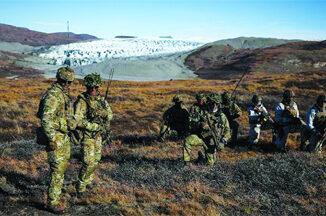
    NUUK (TIP)- Denmark’s Prime Minister Mette Frederiksen visited Greenland on Friday, January 23, in a show of support for the Arctic island that U.S. President Donald Trump wants to annex.
    Walking off her plane at the airport in Greenland’s capital Nuuk, Frederiksen was greeted by Greenlandic ?Prime Minister Jens-Frederik Nielsen. The two were seen embracing on the tarmac before driving away.
    Frederiksen flew straight to Nuuk from Brussels after meeting with NATO chief Mark Rutte earlier in the day to discuss how the military alliance can boost security in the wider Arctic region.
    Greenland is an autonomous territory of the Danish kingdom. The two governments say the island is not for sale and its sovereignty is not up for discussion, but they are open to talks on other topics, such as security and economic development.
    “We are preparing the next steps,” Frederiksen told reporters while walking alongside Nielsen in central Nuuk. “I’m first and foremost here to show our strong support for Greenland’s people as a difficult time.”
    Trump said on Thursday, Jan 22, he had secured total and permanent U.S. access to Greenland after talks with Rutte, who said allies would have to step up efforts to ward off threats from Russia and China. The U.S. military is already permitted wide access to Greenland under treaties, although Washington has scaled back its presence there since the Cold War to a single small base.
    The island’s future ?has prompted a crisis in transatlantic relations after Trump demanded Greenland become U.S. territory, refused to rule out military force to obtain it and announced new tariffs on European countries that objected.
    The crisis subsided after he lifted the threat to use force on Wednesday and withdrew the proposed tariffs on Thursday.
    “We agree that NATO must increase its engagement in the Arctic. Defence and security in the Arctic is a matter for the entire alliance,” Frederiksen said in ?a social media post, along with a photo of herself and ?Rutte in Brussels.
    Rutte said he was working with the Danish leader ?to enhance deterrence and defence. Denmark’s foreign minister said on Friday that diplomats from Denmark and the United States had met in Washington on Thursday, establishing a plan for how to proceed.
    “We will not communicate when those (future) meetings are, because what is needed now is to take the drama out of this… we need a calm process,” Foreign Minister Lars Lokke Rasmussen said.
    A source familiar with the matter said Rutte and Trump had ?agreed on further talks between the U.S., Denmark and Greenland on updating a 1951 agreement that governs U.S. military access and presence on ?the Arctic island.

  • Toll in Iran’s protest crackdown reaches at least 5,002 dead as Trump says US ‘armada’ approaching

    Toll in Iran’s protest crackdown reaches at least 5,002 dead as Trump says US ‘armada’ approaching

    DUBAI, United Arab Emirates (TIP)– The toll in Iran’s bloody crackdown on nationwide protests has reached at least 5,002 people killed, activists said Friday, January 23, warning many more were feared dead as the most comprehensive internet blackout in the country’s history crossed the two-week mark.
    The challenge in getting information out of Iran persists due to authorities cutting off access to the internet on Jan. 8, even as tensions rise between the United States and Iran as an American aircraft carrier group moves closer to the Middle East — a force U.S. President Donald Trump likened to an “armada” in comments to journalists late Thursday.
    The U.S.-based Human Rights Activists News Agency offered the death toll, saying 4,716 were demonstrators, 203 were government-affiliated, 43 were children and 40 were civilians not taking part in the protests. It added that more than 26,800 people had been detained in a widening arrest campaign by authorities.
    The group’s figures have been accurate in previous unrest in Iran and rely on a network of activists in Iran to verify deaths. That death toll exceeds that of any other round of protest or unrest in Iran in decades, and recalls the chaos surrounding Iran’s 1979 Islamic Revolution.
    Iran’s government offered its first death toll Wednesday, saying 3,117 people were killed. It added that 2,427 of the dead in the demonstrations that began Dec. 28 were civilians and security forces, with the rest being “terrorists.” Iran’s theocracy in the past has undercounted or not reported fatalities from unrest.
    The Associated Press has been unable to independently assess the death toll, in part due to authorities cutting access to the internet and blocking international calls into the country. Iran also reportedly has limited journalists’ ability locally to report on the aftermath, instead repeatedly airing claims on state television that refer to demonstrators as “rioters” motivated by America and Israel, without offering evidence to support the allegation.
    The new toll comes as tensions remain high over Trump laying down two red lines over the protests — the killing of peaceful demonstrators and Tehran conducting mass executions. Iran’s attorney general and others have called some of those being held “mohareb” — or “enemies of God.” That charge carries the death penalty. It had been used along with others to carry out mass executions in 1988 that reportedly killed at least 5,000 people.
    The U.S. military meanwhile has moved more military assets toward the Mideast, including the aircraft carrier USS Abraham Lincoln and associated warships traveling with it from the South China Sea.
    A U.S. Navy official, who spoke on condition of anonymity to discuss military movements, said Thursday that the Lincoln strike group is currently in the Indian Ocean. Trump said Thursday aboard Air Force One that the U.S. is moving the ships toward Iran “just in case” he wants to take action.
    “We have a massive fleet heading in that direction and maybe we won’t have to use it,” Trump said.
    Trump also mentioned the multiple rounds of talks American officials had with Iran over its nuclear program prior to Israel launching a 12-day war against the Islamic Republic in June, which saw U.S. warplanes bomb Iranian nuclear sites. He threatened Iran with military action that would make earlier U.S. strikes against its uranium enrichment sites “look like peanuts.”
    “They should have made a deal before we hit them,” Trump added.
    The United Kingdom’s Defense Ministry separately said its joint Eurofighter Typhoon fighter jet squadron with Qatar, 12 Squadron, “deployed to the (Persian) Gulf for defensive purposes noting regional tensions.”

  • Global UN Leader Siddharth Chatterjee to Deliver Keynote at House of Lords Commemoration of International Day for a World Without Childhood Blindness

    Global UN Leader Siddharth Chatterjee to Deliver Keynote at House of Lords Commemoration of International Day for a World Without Childhood Blindness

    LONDON (TIP): The House of Lords will host a landmark global commemoration of the International Day for a World Without Childhood Blindness on January 31, 2026, marking 49 years of transformative, on-ground impact by the Eye Foundation of America (EFA) for children since 1977—largely across India and Africa.

    Adding exceptional global gravitas to the occasion, Siddharth Chatterjee, United Nations Resident Coordinator in China, will join the commemoration and deliver a high-level keynote address, underscoring childhood blindness as a critical, solvable development challenge at the intersection of health, education, equity, and economic productivity.

    Hosted at the House of Lords, the event brings together senior leaders from the United Nations system, global philanthropy, Rotary and Lions leadership, diplomats, policymakers, clinicians, CSR heads, and youth champions—united by a shared commitment to end preventable childhood blindness worldwide.

    Mr. Chatterjee’s address will highlight the urgency of integrated public health action, scalable partnerships, and outcomes-driven investment—calling for governments, multilaterals, and the private sector to accelerate proven models that protect sight early in life. His participation reflects the growing global consensus that vision is foundational to learning, human capital formation, and inclusive growth.

    For nearly five decades, Eye Foundation of America has led pioneering, community-rooted programs—saving and restoring sight for millions of children through neonatal screening, pediatric eye care, capacity building, and systems strengthening. EFA’s work has demonstrated that early detection and timely intervention can change the trajectory of a child’s life—and a nation’s future.

    The January 31 commemoration also reinforces a global call to action: institutionalize childhood blindness prevention within national health systems and CSR frameworks, and rally the world toward a future where no child is needlessly blind.

    About the International Day for a World Without Childhood Blindness

    Observed on January 31, the Day mobilizes governments, multilaterals, civil society, and the private sector to advance solutions that eliminate preventable childhood blindness and secure every child’s right to sight.

    High-Level Statement

    Siddharth Chatterjee said

    “A world without childhood blindness is not an aspiration—it is an achievable global development goal. When we protect a child’s sight, we protect education, dignity, and the future of nations.”

    Distinguished Global Presence

    The commemoration at the House of Lords will also witness the presence of senior leaders and representatives from the Commonwealth Secretariat, Lions Clubs International, and Rotary International, reinforcing a powerful, cross-continental coalition committed to eliminating preventable childhood blindness worldwide.

  • International Day for a World Without Childhood Blindness to Be Commemorated at the House of Lords

    LONDON (TIP): Global leaders from health, policy, philanthropy, and youth movements will gather at the **House of Lords, London**, on **Saturday, January 31, 2026**, to commemorate the **International Day for a World Without Childhood Blindness (IDWWCB)**—a global observance dedicated to eliminating preventable childhood blindness worldwide.

    The high-level commemoration marks **49 years of service to children since January 31, 1977**, when the first eye camp was conducted, launching a movement that has since transformed millions of young lives through prevention, treatment, and long-term systems of pediatric eye care across continents.

    The event is led by the **Eye Foundation of America (EFA)** in collaboration with global partners and youth leaders, and is hosted at one of the world’s most influential legislative institutions—underscoring the importance of integrating childhood vision care into **public health policy, education systems, and global development agendas**.

    Childhood blindness remains one of the most preventable public health challenges. With over **90% of learning dependent on vision**, unaddressed eye conditions significantly impact educational outcomes, economic opportunity, and lifelong well-being. The International Day aligns with the **United Nations Sustainable Development Goals**, particularly **SDG 3 (Good Health and Well-Being)** and **SDG 4 (Quality Education)**, reinforcing vision care as a critical enabler of equity and human potential.

    The global movement was founded by **Dr. V. K. Raju**, an internationally respected ophthalmologist and humanitarian whose work spans India, Africa, the United States, and beyond. The commemoration is supported by **Lord Rami Ranger**, Member of the House of Lords and a longstanding advocate for global humanitarian causes.

    The January 31 commemoration serves as a unified call to governments, multilateral agencies, corporate leaders, and civil society to accelerate collective action toward a future where no child is blind due to avoidable causes.
    (Based on a Press Release)

  • Iran denies Trump’s claim that Tehran halted execution of 800 prisoners

    Iran’s top prosecutor has vehemently denied U.S. President Donald Trump’s claim that his intervention halted the execution of 800 people detained in the nationwide protests, dismissing the comments as “completely false.” The denial casts further doubt on the possibility of mass executions over the protests, even as officials confirm that some detainees face death penalty charges.
    Mohammad Movahedi, quoted by the news agency of Iran’s judiciary, Mizan, said, “This claim is completely false; no such number exists, nor has the judiciary made any such decision.” The strong rebuttal comes as Trump has warned that mass executions and the killing of peaceful protesters are both red lines for a possible U.S. military strike on Iran.
    Meanwhile, activists have revealed that the toll in Iran’s bloody crackdown on nationwide protests has reached a staggering 5,000 people killed, with fears that many more have lost their lives as the most comprehensive internet blackout in the country’s history crosses the two-week mark. The ongoing challenge in obtaining information from Iran persists due to authorities cutting off internet access on Jan. 8.
    As the situation in Iran remains volatile, tensions between the United States and the Islamic Republic continue to escalate. An American aircraft carrier group is moving closer to the Middle East, a force that U.S. President Donald Trump described as an “armada” in comments to journalists late Thursday, January 22.

  • BC delegation talks more business and less politics

    BC delegation talks more business and less politics

    By Prabhjot Singh

    TORONTO (TIP): A high-powered British Columbia delegation led by Premier David Eby has been concentrating on business and technological cooperation with India rather than getting trapped in politics and straying away from its main objective of ensuring the standard of living of its people is not impacted by the U.S. trade war.

    Midway on its six-day Indian sojourn, David Eby and his team members may be patting their backs at the grounds they have covered by advancing key partnerships with government and business leaders in Bengaluru, Karnataka, India’s largest innovation Center, to attract investment, foster collaboration in innovation, and build long-term relationships.

    These partnerships will help B.C.’s technology and life-sciences sectors pursue joint opportunities that leverage B.C.’s research excellence and Karnataka’s deep pools of engineering talent, entrepreneurship and global scale. In Bengaluru, a letter of intent (LOI) was signed between the Province and the state government of Karnataka. The LOI expresses mutual interest to collaborate in life sciences, biotechnology, medical technology, medical devices and digital health.

    “B.C.’s technology and life sciences businesses are second to none, and in the face of U.S. tariffs, we are strengthening our economy by deepening trade and investment relationships with diverse, reliable partners,” Kahlon said. “Bengaluru is the tech capital of India. Its rapid growth and innovation ecosystem make it an important partner for B.C.’s emerging sectors. These relationships create new opportunities for collaboration, investment and shared success.”

    After meeting with officials in Bengaluru, it was agreed to share research and collaboration between Bengaluru and B.C. companies, and foster relationships and investments between Bengaluru and B.C. In addition, a delegation from Bengaluru agreed to explore travelling to Web Summit Vancouver 2026.

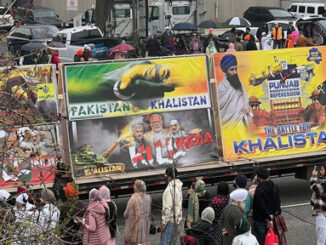
    Critics of the trade mission have been skeptical of a warming relationship with India, years after former prime minister Justin Trudeau talked in the House of Commons about credible allegations that Indian agents were linked to an extrajudicial killing of Sikh activist Hardeep Singh Nijjar on Canadian soil in 2023.

    Nijjar was a known advocate for an independent Sikh state called Khalistan. Back home, pro-Khalistan groups of Sikhs accused Eby of choosing trade interests over justice for Nijjar in a statement before he left for India. India’s government has denied ordering extrajudicial killings in Canada. Four men, all Indian nationals who arrived in Canada several years ago, have been accused of carrying out the killing of Nijjar.

    Eby expressed support for the trial process currently underway in that case, saying there was a need to ensure justice for Nijjar and for the community.

    Amid a spike in extortion-related crimes in B.C.’s Lower Mainland in the first two weeks of 2026 — with 16 reports of extortion in Surrey in the first fortnight of the New Year — Eby also said that the province’s extortion task force would provide an update to the community next week. He said there have been important developments in dealing with the rash of extortions — including deportations, an arrest in India and co-operation between Canadian and Indian law enforcement agencies. “But bluntly, we need better results. We need to see more arrests, and whatever we can do to support the police to be able to get the job done, we will do so,” he told the media in Mumbai.

    “At the same time, we can’t sit around while our standard of living is eroded and our economy is eroded by the decisions of the president of the United States,” Eby said, in reference to the U.S. trade war. “India is going to be the third largest economy in the world, and Canadians and British Columbians will only benefit from a close relationship with India, ” said David Eby at a media conference.

    The BC Government had claimed ahead of the Indian trip that B.C.-origin goods exports to India were worth $1.3 billion in 2024, while Kahlon said B.C. had “the highest share of exports to India of any province.”. David Eby and Ravi Kahlon will be in India till January 17, making stops in New Delhi and Chandigarh to meet with government and business leaders.

    The president and CEO of the Business Council of British Columbia, Laura Jones, says India is a big market that could help diversify growth in the local economy.

    Ravi Kahlon, during his meetings with business and industry leaders, strengthened partnerships in Karnataka, India’s Silicon Valley, to advance collaboration in life sciences, technology and innovation. Roundtables with B.C. and Indian companies identified opportunities for trade and investment, and the promotion of Web Summit Vancouver 2026 positioned B.C. as a global tech hub. He advanced key partnerships with government and business leaders in Bengaluru, Karnataka, India’s largest innovation Center, to attract investment, foster collaboration in innovation, and build long-term relationships.

    These partnerships will help B.C.’s technology and life-sciences sectors pursue joint opportunities that leverage B.C.’s research excellence and Karnataka’s deep pools of engineering talent, entrepreneurship and global scale. In Bengaluru, a letter of intent (LOI) was signed between the Province and the state government of Karnataka. The LOI expresses mutual interest to collaborate in life sciences, biotechnology, medical technology, medical devices and digital health.

    “B.C.’s technology and life sciences businesses are second to none, and in the face of U.S. tariffs, we are strengthening our economy by deepening trade and investment relationships with diverse, reliable partners,” Kahlon said. “Bengaluru is the tech capital of India. Its rapid growth and innovation ecosystem make it an important partner for B.C.’s emerging sectors. These relationships create new opportunities for collaboration, investment and shared success.”

    India’s scale, talent pool and fast-growing technology sector create major opportunities for joint innovation that complements B.C.’s world-class strengths in life sciences and technology. Together, B.C. and Karnataka offer highly compatible innovation ecosystems that can accelerate growth for both regions.

    “Global collaboration drives commercial success in life sciences,” said Wendy Hurlburt, president and CEO, Life Sciences BC. “Strengthening trade and investment ties with high-growth markets like India, one of the world’s largest economies, is critical to accelerating innovation, scaling our companies internationally and ensuring the long-term competitiveness of Canada’s life-sciences sector.”

    In Bengaluru, Kahlon met with Sharath Kumar Bache Gowda, chairman of Karnataka State Electronics Development Corporation Limited (KEONICS). Discussions focused on expanding economic collaboration between B.C. and Karnataka’s life sciences, technology and innovation ecosystems.

    Kahlon also held roundtables with B.C. companies doing business in India, including Telus Digital Services, Lululemon, Earth Daily Analytics and Yactraq Online, to discuss accomplishments, opportunities and challenges to operating in India, and potential supports from the Province. Kahlon also called on Indian technology companies to position B.C. as a global hub for innovation and technology, and to promote Web Summit Vancouver 2026 as a gateway for international collaboration. The discussion further strengthened ties with India’s fast-growing technology sectors, and showcased B.C.’s strengths in academic-industry leadership, government support programs and innovation ecosystems.

    It was agreed to share research and collaboration between Bengaluru and B.C. companies, and foster relationships and investments between them. In addition, a delegation from Bengaluru agreed to explore travelling to Web Summit Vancouver 2026.

    The agenda of the visit supports British Columbia’s Look West industrial and economic plan, and aligns with its trade diversification strategy, which focuses on delivering major projects more quickly, diversifying markets and growing targeted sectors, such as technology, life sciences, aerospace, marine, artificial intelligence (AI) and quantum, agriculture and construction innovation.

    B.C. is home to a thriving innovation ecosystem, including more than 12,000 tech companies and leadership in AI, quantum computing and clean technology. Information technology is B.C.’s top investment sector in India. Leading B.C. companies, such as TELUS, Lululemon and Pani Energy, operate in Bengaluru, creating more than 1,400 high-paying jobs. B.C. currently has four trade and investment offices in India, attached to Canadian missions in New Delhi, Mumbai, Bengaluru and Chandigarh.

    The “Silicon Valley of India” Bengaluru, contributes more than 43% to Karnataka’s economy and hosts more than 40% of India’s Global Capability Centres. Its economy is driven by information technology, biotechnology, aerospace and electric-vehicle manufacturing. The letter of intent commits the governments to: Life sciences and biotechnology collaboration. Facilitating collaboration in biotechnology, biopharma, medical technology, medical devices, digital health and related emerging areas through exchanges, partnerships and ecosystem linkages.

    Innovation, trade and investment linkages: Encouraging two-way trade, investment and industry development by supporting business-to-business connections and startup engagement, as well as participation in relevant innovation and technology events.

    Knowledge exchange and ecosystem engagement: Promoting knowledge-sharing through workshops, delegations, policy dialogues and institutional linkages between innovation ecosystems, research institutions, startups and industry stakeholders in both regions

    David Eby says that finding new trade partners is critical to ensure British Columbians’ standard of living doesn’t deteriorate amid the U.S. trade war.

    Eby spoke to India’s energy minister, giant conglomerates like Tata and Reliance, and oil companies like Indian Oil and Hindustan Petroleum. “I’ll have to say the big winner so far has been [B.C.’s] mining sector. The belle of the ball, really,” he told reporters. “There hasn’t been a meeting with one of these companies that hasn’t included an extensive discussion about the mining opportunities in the province, the more than 20 mines that are in various stages of development.”

    The premier added that the province’s energy sector — and ongoing attempts to expand liquefied natural gas (LNG) production — was also being received well in India. He said that every company and politician were convinced that India would continue to grow at seven or eight per cent annually, and would become the world’s third-largest economy. “That means they need dramatic and increased amounts of energy,” the premier argued. B.C. Premier David Eby is making a big sales pitch in India while trying to find new customers outside the U.S. for the province’s natural resources, especially minerals.

    “They’re doing a huge internal push to reduce reliance on imported petroleum products like oil and gas and diesel and so on,” he added. “But in the meantime, they are looking strongly to LNG as one of their major ways of reducing carbon intensity as well as reducing smog in the country.”

    Eby said that the Woodfibre LNG project in Squamish, LNG Canada Phase 2 in Kitimat and the Ksi Lisims project near Prince Rupert are among those with interest from Indian investors.

    (Prabhjot Singh is a Toronto based senior journalist. He can be reached at prabhjot416@gmail.com)

  • Indian Consulate hosts India-Canada AI Dialogue 2026 ahead of India AI Impact Summit

    Indian Consulate hosts India-Canada AI Dialogue 2026 ahead of India AI Impact Summit

    TORONTO (TIP): The Consulate General of India in Toronto hosted the ‘India-Canada AI Dialogue 2026’ in partnership with the University of Waterloo, Canada India Tech Council, and Zoho Inc, as a precursor to one of the biggest AI Summits in Global South – the ‘India AI Impact Summit 2026’.

    A Panel discussion.

    The event gathered over 600 leaders from industry, academia, and government to advance bilateral AI collaboration, focusing on responsible, ethical, and impact-driven technology ahead of the upcoming India AI Impact Summit 2026.

    Another Panel Discussion

    Honorable Evan Solomon (Minister of Artificial Intelligence and Digital Innovation, Canada) was the Keynote Speaker: The high level dialogue was addressed, among others, by Mr. Dinesh K. Patnaik (High Commissioner of India to Canada), Mr. Kapidhwaja Pratap Singh (Acting Consul General of India in Toronto), Honorable Victor Fedeli (Minister of Economic Development, Job Creation & Trade, Ontario), Prof. Vivek Goel (President & VC, University of Waterloo) and several distinguished speakers and leaders across the AI ecosystem.

    Yet another panel discussion.

    Ontario Premier Doug Ford sent a message that framed the dialogue within a broader relationship across trade, investment and research.
    “India and Canada share a deep and 1 longstanding partnership, one built on robust trade and investment, people-to-people ties and research partnerships in emerging technologies such as artificial intelligence,” said Doug Ford, Premier of Ontario, Canada.

    A view of the gathering

    Ford also addressed the consulate’s convening role in Toronto.
    “Many thanks to the Consulate General of India in Toronto for convening this important gathering and for its continued leadership in fostering collaboration between our jurisdictions,” said Ford.

    The discussions focused on ethical, inclusive AI for societal benefit, with potential partnerships in MedTech, logistics, and operations, as highlighted by Aliza Lakhani and LinkedIn users.

    Another view of the gathering.

    The event aimed to bridge the Canadian research ecosystem with India’s data scale to drive AI innovation.

    The organizers said the dialogue set out themes for continued bilateral work and that the Canadian delegation expected to travel to the New Delhi summit and co-chair a working group on science.
    (Based on a Press Release issued by the Indian Consulate General in Toronto)