

With governments coming and going and policies being constantly chopped and changed, Nepali businesses are long used to working in an environment of uncertainty. What they are not used to is operating in a climate of fear.
During the two days of the Gen Z protests on September 8 and 9 — a violent revolt that killed 76 people and toppled the K.P. Sharma Oli government — prominent business establishments were vandalized and set on fire. And that wasn’t the worst of it. Some businesspeople had to flee for their very lives from the rampaging mobs as their homes were ransacked.
With the emergence of multiple new and competing groups that want a direct say in the political process following the revolt, the Sushila Karki-led interim government has struggled to assert its control.
The new government has the singular mandate of holding nationwide elections by March 5, 2026. Yet in the current environment of political contestations, the polls are by no means certain.
Old political parties, the biggest in the dissolved lower house, are major stakeholders in Nepal’s political process. So are members of Gen Z who spearheaded the September protests. There cannot be elections unless the government, the political parties, and the Gen Z leaders can agree on a way ahead. Thankfully, formal conversation between them has now started — albeit with tentative first steps.
Besides this, the fragile security situation could be another stumbling block to timely elections.
During the protests, over 1,000 criminals escaped prisons and nearly as many weapons were looted from the police force. Most of these remain unaccounted for.
Moreover, under pressure from various protesting groups, around 200 people who had been detained in connection with random acts of arson, violence, and looting during the protests were released, further demoralizing the police and the business community.
Nepal’s businesses feel they cannot rely on the police for protection. If looters and thieves cannot be punished, what is the guarantee that the businesses will not be targeted again?
While before the protests, Nepal’s economy was expected to grow by around 5 percent this fiscal year, the World Bank now caps growth at 2.1 percent, as it reckons the Gen Z protests have deepened political and economic uncertainties.
Preliminary estimates suggest around $700 million in damage to private property, with over 15,000 jobs directly affected. The loss in confidence of the private sector, which is responsible for 85 percent of formal jobs in Nepal, will be hard to restore.
Asia
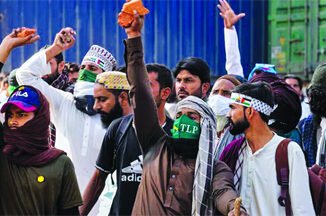
Shehbaz Sharif cabinet bans Tehreek-e-Labbaik Pakistan under terror law
Islamabad (TIP)- Pakistan Prime Minister Shehbaz Sharif’s cabinet on Thursday, Oct 23, approved the Punjab government’s decision, under the Anti-Terrorism Act (ATA), to ban the extremist Tehreek-e-Labbaik Pakistan (TLP) party, which recently staged violent protests […]
Asia
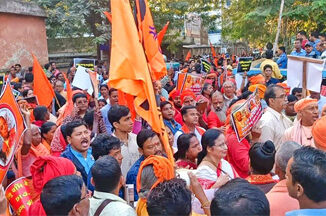
Bangladesh summons Kolkata mission head for consultations
Kolkata (TIP): Bangladesh has summoned Shikder Mohammad Ashrafur Rahman, the Acting Deputy High Commissioner in Kolkata, for urgent consultations following protests over attacks on Hindu minorities. Rahman, who is also Minister – Political Affairs, stationed […]

Asia
Security concerns: Pakistan clamps restrictions on Karachi, Lahore airspace
ISLAMABAD (TIP): Citing security concerns, Pakistan has announced the closure of specific portions of Karachi and Lahore airspace for four hours each day during May and put all airports across the country on high alert, […]
Be the first to comment