
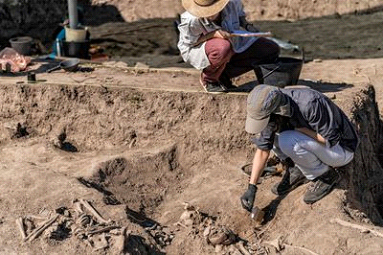

Rawalpindi (TIP)- Pakistani archaeologists have uncovered rare decorative stones and ancient coins during excavations at a UNESCO-listed site near the historic city of Taxila, offering fresh insight into the earliest urban settlement of the vast ancient civilisation.
The finds were made at the ancient Bhir Mound, where experts discovered decorative stones dating back to the 6th century BC along with coins from the 2nd century AD.
According to Dawn, officials described the discovery as the most significant at the site in the past decade.
The report said archaeologists recovered fragments of metamorphic decorative stone identified as lapis lazuli, along with rare bronze coins attributed to the Kushan dynasty, significantly advancing the material understanding of ancient Gandhara.
Aasim Dogar, deputy director of the Punjab Department of Archaeology and head of the excavation team, confirmed the preliminary assessment of the artefacts. “The decorative stones are lapis lazuli, a prized semi-precious stone, while the coins belong to the Kushan period,” Dogar said.
The excavation team sought specialised forensic support to date the metal artefacts. Dogar said detailed numismatic analysis carried out by experts from the University of Peshawar confirmed that the coins bear the image of Emperor Vasudeva, whom historians recognise as the last of the ‘great Kushan rulers’ to govern the region.
Dogar explained that the obverse side of the recovered coins depicts Vasudeva, while the reverse shows a female religious deity. He described this imagery as a defining feature of Kushan-era religious pluralism, which frequently integrated diverse theological traditions.
The artefacts were unearthed on the northern side of the site, specifically in the B-2 trench — one of 16 trenches currently under excavation. Dogar said surrounding evidence indicates that the area functioned as a residential zone.
The latest discoveries reinforce the view that Taxila reached the height of its political, cultural, and economic prominence during Kushan rule, particularly between the 1st and 3rd centuries AD. “Under emperors such as Kanishka the Great, Taxila emerged as a major administrative, commercial, and intellectual centre,” Dogar said.
He added that extensive Kushan patronage of Buddhism during this period resulted in the construction of stupas, monasteries, and large religious complexes. The era also witnessed the flourishing of Gandharan art — a unique fusion of Greek, Roman, Persian, and Indian influences — with Taxila at its centre.
Malik Tahir Suleman, a leading numismatist, told Dawn that Kushan coins are among the most important historical sources for studying ancient South and Central Asia.


Hi there very cool blog!! Man .. Beautiful .. Wonderful .. I’ll bookmark your site and take the feeds also?KI’m satisfied to seek out a lot of useful information right here in the put up, we want develop more strategies on this regard, thanks for sharing. . . . . .
Hi! I’ve been following your website for a while now and finally got the courage to go ahead and give you a shout out from Porter Texas! Just wanted to tell you keep up the good work!
I went over this web site and I believe you have a lot of fantastic info, saved to favorites (:.
Please let me know if you’re looking for a author for your site. You have some really good posts and I think I would be a good asset. If you ever want to take some of the load off, I’d love to write some content for your blog in exchange for a link back to mine. Please shoot me an email if interested. Kudos!
great points altogether, you just gained a new reader. What would you recommend in regards to your post that you made a few days ago? Any positive?
Thank you for every other informative blog. Where else may I am getting that type of information written in such a perfect approach? I have a undertaking that I am simply now running on, and I’ve been on the look out for such info.
Oh my goodness! an amazing article dude. Thanks Nonetheless I’m experiencing difficulty with ur rss . Don’t know why Unable to subscribe to it. Is there anybody getting equivalent rss problem? Anybody who knows kindly respond. Thnkx
Wow! Thank you! I continuously wanted to write on my site something like that. Can I implement a fragment of your post to my site?
Hi! This post couldn’t be written any better! Reading this post reminds me of my previous room mate! He always kept talking about this. I will forward this page to him. Fairly certain he will have a good read. Thank you for sharing!
Hello! I could have sworn I’ve been to this blog before but after browsing through some of the post I realized it’s new to me. Anyways, I’m definitely happy I found it and I’ll be book-marking and checking back frequently!
It’s actually a nice and useful piece of info. I’m glad that you shared this useful information with us. Please keep us informed like this. Thanks for sharing.
Everything is very open and very clear explanation of issues. was truly information. Your website is very useful. Thanks for sharing.
Excellent website. Lots of helpful info here. I am sending it to several pals ans additionally sharing in delicious. And of course, thanks in your effort!
Its fantastic as your other content : D, regards for posting.
I have recently started a blog, the info you provide on this website has helped me tremendously. Thank you for all of your time & work.
I believe you have remarked some very interesting points, appreciate it for the post.
An attention-grabbing dialogue is price comment. I believe that it is best to write extra on this topic, it might not be a taboo topic but usually people are not sufficient to speak on such topics. To the next. Cheers
I regard something truly special in this website.
After all, what a great site and informative posts, I will upload inbound link – bookmark this web site? Regards, Reader.
Nice read, I just passed this onto a friend who was doing a little research on that. And he actually bought me lunch as I found it for him smile So let me rephrase that: Thanks for lunch! “No one can wear a mask for very long.” by Seneca.
I think this is among the most vital information for me. And i’m glad reading your article. But want to remark on some general things, The site style is ideal, the articles is really great :D. Good job, cheers
Some really interesting points you have written.Helped me a lot, just what I was searching for :D.
This is a truly high-quality, informative, and useful blog site that provides readers with reliable information and readability.
Really Appreciate this article, can I set it up so I get an alert email whenever you make a fresh post?
Just wanna remark on few general things, The website pattern is perfect, the content material is real great. “The enemy is anybody who’s going to get you killed, no matter which side he’s on.” by Joseph Heller.
Absolutely written written content, regards for selective information.
Its superb as your other content : D, thankyou for putting up.
This really answered my problem, thank you!
Wow! This could be one particular of the most helpful blogs We’ve ever arrive across on this subject. Basically Fantastic. I’m also a specialist in this topic therefore I can understand your hard work.
Very interesting details you have remarked, regards for putting up.
Only a smiling visitant here to share the love (:, btw great pattern.
I do agree with all of the ideas you’ve presented in your post. They’re really convincing and will certainly work. Still, the posts are very short for starters. Could you please extend them a bit from next time? Thanks for the post.
I have recently started a web site, the info you offer on this website has helped me tremendously. Thanks for all of your time & work.
Terrific work! This is the type of info that should be shared around the web. Shame on Google for not positioning this post higher! Come on over and visit my web site . Thanks =)
Hello! I’m at work surfing around your blog from my new apple iphone! Just wanted to say I love reading your blog and look forward to all your posts! Carry on the superb work!
There is visibly a bunch to identify about this. I suppose you made certain good points in features also.
I am pleased that I detected this blog, exactly the right info that I was searching for! .
I’ve recently started a site, the information you provide on this website has helped me tremendously. Thank you for all of your time & work. “The man who fights for his fellow-man is a better man than the one who fights for himself.” by Clarence Darrow.
Keep functioning ,remarkable job!
I’ve been absent for some time, but now I remember why I used to love this website. Thanks , I will try and check back more frequently. How frequently you update your web site?
Saved as a favorite, I really like your blog!
That is the suitable weblog for anybody who needs to search out out about this topic. You realize a lot its virtually exhausting to argue with you (not that I actually would need…HaHa). You positively put a brand new spin on a topic thats been written about for years. Great stuff, just great!
Really nice style and design and wonderful written content, absolutely nothing else we require :D.
I was curious if you ever considered changing the structure of your website? Its very well written; I love what youve got to say. But maybe you could a little more in the way of content so people could connect with it better. Youve got an awful lot of text for only having 1 or two images. Maybe you could space it out better?
Very good written article. It will be helpful to anybody who utilizes it, as well as yours truly :). Keep up the good work – looking forward to more posts.
This is a truly high-quality, informative, and useful blog site that provides readers with informative articles and reader comfort.
This is a truly high-quality, informative, and useful blog site that provides readers with informative articles and neat layout.
I value how the writing maintains consistency in structure and tone from beginning to end.
I have recently started a blog, the info you provide on this web site has helped me greatly. Thanks for all of your time & work. “There is a time for many words, and there is also a time for sleep.” by Homer.
I really glad to find this website on bing, just what I was searching for : D as well saved to favorites.