
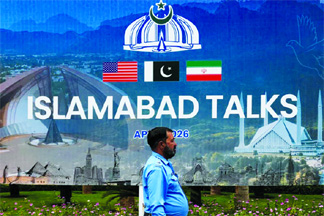

Tehran (TIP): Acknowledging the absence of a breakthrough in the latest round of negotiations with the United States, Iran on Sunday, April 12, said the talks were held in an atmosphere of “mistrust and suspicion,” with no realistic expectation of reaching a comprehensive agreement in a single session.
Foreign Ministry spokesperson Esmail Baghaei said the two sides were able to arrive at an understanding on several issues, but critical differences persisted.
“We reached understanding on a number of points, but key disagreements remained on two to three major issues, and ultimately the talks did not lead to an agreement,” he said.
Baghaei described the negotiations as the longest in the past year, stretching over 24 to 25 hours of continuous engagement—an indication of both the complexity of the issues and the intensity of the discussions.
He stressed that the context of the talks made a swift resolution unlikely. “These discussions took place after 40 days of imposed war, in an atmosphere of mistrust and suspicion,” he said, adding that under such conditions, “no one expected an agreement to be reached in a single session—and no one did.”
The remarks underscore Tehran’s attempt to frame the outcome not as a failure, but as part of a broader, incremental process shaped by deep-seated distrust and recent conflict.
While no deal emerged, the acknowledgement of limited convergence on certain issues suggests that negotiations may continue, even as fundamental differences remain unresolved.
Vance spoke to Trump ‘dozen times’ during high-stakes US-Iran talks
US Vice-President JD Vance on Sunday , April 12, said he remained in constant touch with President Donald Trump throughout the high-stakes negotiations with Iran, revealing the intensity and real-time coordination behind Washington’s diplomatic push.
Responding to a question on the frequency of his communication with Trump, Vance said the engagement was continuous during the nearly day-long talks. “We were talking to the President consistently. I don’t know the exact number—perhaps half a dozen times, maybe a dozen over the past 21 hours,” he said.
The Vice-President underscored that the negotiations were closely guided by the broader US national security establishment, with multiple senior officials looped in at every stage.
He confirmed consultations with key figures, including Admiral Cooper, Defence Secretary Pete Hegseth, Secretary of State Marco Rubio and Treasury Secretary Scott Bessent.
“We were constantly in communication with the entire national security team because we were negotiating in good faith,” Vance said, signalling a coordinated and unified US approach during the talks.Despite the intense back-and-forth, the negotiations ended without a final agreement. Vance reiterated that Washington had placed a clear proposal on the table before departing.
“We leave here with a very simple proposal—a method of understanding that is our final and best offer,” he said. “We’ll see if the Iranians accept it.”
The remarks offer a glimpse into the high-level decision-making that shaped the negotiations, even as uncertainty looms over whether Tehran will respond to what Washington has described as its final terms.
Pakistan urges US, Iran to uphold ceasefire after talks end without breakthrough
As high-stakes negotiations between the United States and Iran concluded in Islamabad without a breakthrough, Pakistan on April 12 called on both sides to continue to honour their ceasefire commitments and sustain diplomatic engagement.
In a statement at the close of the talks, Pakistan’s Foreign Minister Ishaq Dar said Islamabad remained hopeful that the negotiations, despite failing to yield an agreement, had created momentum for continued dialogue.
Dar expressed gratitude to both Washington and Tehran for responding to Prime Minister Shehbaz Sharif’s call for an immediate ceasefire and for accepting Pakistan’s invitation to hold peace talks in the capital.
The delegations—led by US Vice President JD Vance and Iranian Parliament Speaker Mohammad Bagher Ghalibaf—arrived in Islamabad a day earlier and engaged in what Dar described as “intense and constructive” negotiations lasting over 24 hours.
Dar said the talks were facilitated by Pakistan’s top military leadership, including Chief of Army Staff Asim Munir, underscoring the country’s active mediatory role in easing tensions between the two adversaries.
While acknowledging the absence of a formal agreement, the foreign minister stressed the importance of preserving the ceasefire. “It is imperative that the parties continue to uphold their commitment,” he said, warning that sustained restraint was critical for regional stability.
He added that Pakistan would continue to engage both sides in pursuit of a durable peace. “We hope the two sides carry forward this positive spirit to achieve peace and prosperity for the entire region and beyond,” Dar said.
The fragile ceasefire now hinges on continued restraint by Washington and Tehran.



Be the first to comment