
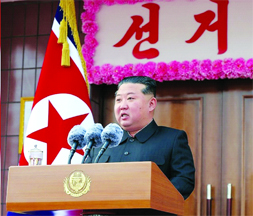

Pyongyang (TIP): North Korean leader Kim Jong Un has secured another overwhelming electoral win, with his ruling Workers’ Party of Korea and allied groups claiming 99.93 per cent of the vote in the latest parliamentary elections. The vote, held on March 15 to elect members of the 15th Supreme People’s Assembly, saw establishment-backed candidates take every seat, according to state media outlet Korean Central News Agency.
Official data indicated that 99.93 per cent backed Kim’s party, although state media cited a slightly higher figure of 99.97 per cent, with turnout reaching an extraordinary 99.99 per cent.
Authorities said only around 0.0037 per cent of registered voters were unable to cast ballots due to being abroad or at sea, while a negligible 0.00003 per cent reportedly abstained.
There were no opposition candidates on the ballot. In every constituency, voters were presented with a single, pre-approved candidate and asked to either endorse or reject them.
This means the remaining 0.07 per cent did not go to any rival party or figure, but instead reflects those who voted “no” against the official nominee.
Notably, this marks the first time in decades that North Korean state media has acknowledged such dissent in a parliamentary election — something not publicly admitted since 1957, according to reports.
Under North Korean election law, 687 representatives — including workers, farmers, intellectuals, military personnel and officials — were elected to the Supreme People’s Assembly.
However, each constituency features only one candidate, already vetted by the ruling establishment led by Kim. Voters are left with a stark choice: approve the candidate or reject them.
According to Yonhap News Agency, KCNA reported that 0.07 per cent of voters chose to vote against the candidates.
Kim assumed power in 2011 following the death of his father, Kim Jong Il, and has since remained the country’s supreme authority.
In 2019, constitutional changes further strengthened his grip, formally designating him as head of state and cementing his “monolithic” control over the government, military and state institutions.



Thanks for making this easy to understand even without a background in it.