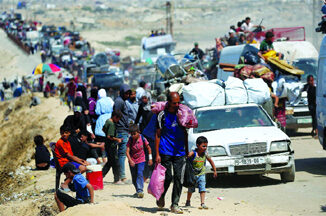
Gaza Strip (TIP): “People in Gaza are neither dead nor alive. They are walking corpses.”
This was the haunting message from a UNRWA staff on the ground this morning, ” UNRWA chief Philippe Lazzarini said in a post on X.
In the heart of a war-ravaged enclave, the situation has spiraled into a catastrophic emergency.
According to the United Nations Relief and Works Agency (UNRWA), one in every five children in Gaza City is now malnourished, with the number growing by the day.
More than 100 people, most of them children have already died from hunger.
“UNRWA’s frontline health workers are now fainting on duty. They survive on a single, meager meal a day, often just lentils, if that. “When the caretakers collapse, so does the entire system,” Lazzarini said.
Children arriving at UNRWA clinics are skeletal, listless, and dangerously close to death. Without urgent nutritional treatment, they won’t survive, he said.
“This is not a crisis. It’s a collapse,” said the UNRWA official.
“Families are no longer coping ,they are breaking. Parents are too hungry to feed their children. They can’t even follow basic medical instructions. Their very existence is under threat.”
The agency said that it has 6,000 trucks loaded with food and medical supplies waiting in Jordan and Egypt. But they remain stalled as Gaza continues its freefall into famine.
“Allow humanitarian partners to bring unrestricted & uninterrupted humanitarian assistance to Gaza,” he said.
UN Secretary-General Antonio Guterres recently condemned the “accelerating breakdown of humanitarian conditions” in Gaza.
“The last lifelines keeping people alive are collapsing,” his spokesman Stephane Dujarric said in a statement. The United Nations chief “deplores the growing reports of children and adults suffering from malnutrition.”
“The Secretary-General notes that the intensification of hostilities in recent days comes as the humanitarian system is being impeded, undermined and endangered,” Dujarric said.
“A new evacuation order in parts of Deir el-Balah — home to tens of thousands — pushes people into more desperate conditions and further displacement and restricts the United Nations’ ability to deliver life-saving aid.” (AP)
Tag: World News
-

‘They are walking corpses’: UNRWA says one in five Gaza children malnourished, over 100 died of starvation
-

Russian attacks kill five, including family, in east Ukraine
KYIV (TIP): Russian attacks killed at least five people, including three members of a displaced family, in separate attacks across Ukraine’s war-scarred east, Ukrainian authorities said Thursday.
A couple and their 36-year-old son were killed in a village in the eastern Kharkiv region late Wednesday, local officials said, while two more women were killed in the Donetsk region Thursday.
Russia has stepped up drone and missile attacks on Ukraine more than three years into its invasion, even as the warring parties meet for ceasefire talks.
Donetsk regional officials issued blurred images of one of the bloodied women killed in Kostyantynivka, where a dozen other people were wounded. Russian forces are gradually encircling the industrial hub.
A strike later on Kharkiv city wounded 37 people, including a 10-year-old girl and a 17-year-old boy and girl, the governor said.
A separate Russian drone and missile barrage wounded seven people overnight, including a child, in the central Ukrainian region of Cherkasy, emergency services said.
And in the southern port city of Odesa, a Russian drone attack wounded four people and badly damaged a famous market. Ukraine’s prime minister said some of the buildings targeted were UNESCO protected.
“Russia continues its terror and obstructs diplomacy, which is why it deserves full-scale sanctions responses, as well as our strikes on their logistics, their military bases, and their military production facilities,” President Volodymyr Zelensky wrote on social media in response.
He said Russia had launched 103 drones — mainly Iranian-designed Shahed unmanned aerial vehicles — and four missiles.
In Russia, a Ukrainian drone strike killed two women and wounded several others in the southern city of Sochi, regional authorities said.
The Russian defence ministry said its air defence systems had downed 39 Ukrainian unmanned aerial vehicles mainly over southern regions of the country. (AFP) -

Zelenskyy promises safeguards after Ukrainians protest over new anti-corruption law
KYIV (TIP): Opponents of a new law they say strips Ukraine’s anti-corruption watchdogs of their independence called for a third straight day of street protests across the country on Thursday, despite President Volodymyr Zelenskyy’s attempts to defuse the tension with promises of legislative safeguards. After meeting with the heads of Ukraine’s key anti-corruption and security agencies, Zelenskyy promised to act on their recommendations by presenting a bill to Parliament that strengthens the rule of law.
“And very importantly: all the norms for the independence of anti-corruption institutions will be in place,” Zelenskyy said in his nightly video address late Wednesday. Zelenskyy acknowledged the controversy triggered by the new corruption law, which also drew rebukes from European Union officials and international rights groups.
“It’s not falling on deaf ears,” Zelenskyy said of the complaints.
“We’ve analyzed all the concerns, all the aspects of what needs to be changed and what needs to be stepped up.”
However, he didn’t promise to revoke the law that he approved.
The legislation that was adopted this week, despite pleas for Zelenskyy to veto it, tightened government oversight of two key anti-corruption agencies. Critics said the step could significantly weaken the independence of those agencies and give Zelenskyy’s circle greater influence over investigations.
The protests haven’t called for Zelenskyy’s ouster. But the first major anti-government demonstrations since the war began come at a tough time for Ukraine in its three-year battle to thwart Russia’s invasion.
Russia’s bigger army is accelerating its efforts to pierce Ukraine’s front-line defenses and is escalating its bombardment of Ukrainian cities. Ukraine is also facing a question mark over whether the United States will provide more military aid and whether European commitments can take up the slack, with no end to the war in sight.
Delegations from Russia and Ukraine met in Istanbul for a third round of talks in as many months Wednesday. But once again the talks were brief and delivered no major breakthrough.
Zelenskyy had insisted earlier Wednesday that the new legal framework was needed to crack down harder on corruption. Fighting entrenched corruption is crucial for Ukraine’s aspirations to join the EU and maintain access to billions of dollars in Western aid in the war. “Criminal cases should not drag on for years without verdicts, and those working against Ukraine must not feel comfortable or immune from punishment,” he said.
Meanwhile, Russian planes dropped two powerful glide bombs on the center of Kharkiv, Ukraine’s second-largest city, on Thursday morning, regional Gov. Oleh Syniehubov said. At least 16 people were injured, including a 10-year-old girl who suffered an acute stress reaction, he said. The southern Ukrainian city of Odesa and Cherkasy in central Ukraine were also hit overnight, authorities said. The drone and missile strikes on the cities injured 11 people, including a 9-year-old, and damaged historic landmarks and residential buildings, officials said. (AP) -
6.6 magnitude earthquake hits South Pacific near Samoa, no damage reported
MELBOURNE (TIP): A magnitude-6.6 earthquake struck in the South Pacific near the island nation of Samoa on Friday, but caused no apparent damage. The quake occurred 440 kilometers (273 miles) southwest of the capital Apia at a depth of 314 kilometers (195 miles), the U.S. Geological Survey said.
Jarrett Malifa, a staff member at the Samoa Observer news website, said no damage or injury has been reported. Malifa said in a email Samoa Meteorological Services had confirmed there was no tsunami threat. The Pacific Tsunami Warning Center in Honolulu also assessed there was no tsunami threat.
Samoa sits on the “Ring of Fire,” an arc of seismic faults around the Pacific Ocean where earthquakes and volcanoes are common.
In 2009, two large earthquakes struck midway between Samoa and American Samoa, a U.S. territory. The earthquakes generated tsunami waves that killed at least 192 people in Samoa, American Samoa and Tonga. (AP) -

Longest Ballot Paper campaign is not leaving Pierre Poilievre alone, as Battle River-Crowfoot is all set to script history on August 18
-
108 candidates have registered so far, beating the previous record of 91

By Prabhjot Singh TORONTO (TIP): Canadian Conservative leader Pierre Poilievre is poised to enter the record books for contesting two consecutive elections with a record number of candidates on the ballot. While the number of candidates in Carleton in April was 91, it is inching towards the triple figure in River Battle-Crowfoot.
The number of candidates in an election for MP running into a three-figure mark would be historic, and Battle River-Crowfoot is all set to achieve it.
After Pierre Poilievre lost to Liberal Bruce Fanjoy by 4,513 votes in the last general elections on April 28 in Carleton, a riding that had its boundaries redrawn after the results of the 2021 Canadian census, he decided to run in a byelection in Battle River-Crowfoot in Alberta to regain a seat in the House of Commons. Conservative MP Damien Kurek, who has held the riding since 2019 and won re-election by more than 46,000 votes, quit his seat to make room for the party leader to enter the lower House of Parliament.
His defeat in Carleton did not bring an end to a protest movement, as the Longest Ballot Committee reiterated its intention to target the byelection in the Alberta riding of Battle River-Crowfoot. The group that spearheaded the Longest Ballot Paper campaign in Carleton has now set a target of getting 200 names on the ballot paper when the riding witnesses a by-election on August 18. With the deadline for filing nomination papers still 12 days away, 74 candidates of the Longest Ballot campaign have already been registered as candidates for the Battle River-Crowfoot riding. Until today, 78 candidates have filed their nominations. The Conservative leader, Pierre Poilievre, is one of them. The Liberal Party and the NDP have yet to officially register their candidates for the by-election.
The Longest Ballot Committee (LBC) is still short, however, of the group’s objective to run 200 candidates in the byelection. The movement opposes the first-past-the-post system and is calling for electoral reform. Voters in the Ottawa riding of Carleton during the April 28 general election had 91 names to choose from on their ballots as the group targeted Poilievre’s long-held seat.
The LBC came into being to protest Canada’s first-past-the-post system. It fielded over 90 candidates in Carleton. The ballots were nearly a meter long and had to be folded multiple times to fit into voting boxes. Canada does not use Electronic Voting Machines (EVMs) for polling.
The longest ballot movement is linked to the satirical Rhinoceros Party of Canada, which was founded in 1963 and has policies and plans like making “Sorry” the new official motto of Canada and a pledge to open “tax havens” in all provinces. The independent and Rhinoceros Party-aligned candidates received 817 votes on April 28, while Fanjoy’s margin of victory over Poilievre was 4,315 votes.
The LBC laid out its plan in an email sent to supporters, saying the riding of Battle River-Crowfoot “needs 200 candidates” and the group will “do our best to make a long ballot happen.” The group also called for those living in or near the riding to help collect nomination signatures for the candidates because each person needs 100 local voters’ signatures to be nominated. Pierre Poilievre wants this number to be raised.
The move mirrors the group’s targeting of the Ottawa-area Carleton riding that Poilievre lost in the April 28 election to Liberal candidate Bruce Fanjoy. Fanjoy received 50.8 per cent of the vote in the riding, while Poilievre received 45.8 per cent, coming in second for the first time since he was first elected in 2004.
It is not Pierre Poilievre alone whose name will appear on the longest ballot paper in four months after he unsuccessfully contested in Carleton. Some of the contestants from the Carlton election may also be the candidates in the Battle River-Crowfoot as well.
One name that is a constant is Tomas Szuchewycz, who served as the official agent for Longest Ballot participants in Carleton and has the same role in this byelection. It’s the agent’s job to manage the campaign’s finances and report back to Elections Canada. Pierre Poilievre has not taken the protest movement well. He assailed the move in his election campaigning. “We need to get rid of this long ballot,” he was quoted by the media as saying, thus maintaining that there’s “no justification for it.” He, instead, suggested increasing the number of signatures required to be able to run as a candidate.
-
-

Is Canada, like Punjab, also fighting a war against drugs?
TORONTO (TIP): If Punjab is waging a war against drugs, Canada, too, appears to be in an unending battle to end the menace of drug smuggling across international borders.
Interestingly, the Aam Aadmi Party government in Punjab had launched a massive campaign to rid the border state of the menace of drugs by the end of May. The Liberal Government in Canada, too, has been under constant pressure from the US President, Donald Trump, to bring to an end a massive smuggling exercise taking place across the US-Canada border for the illicit trading of fentanyl, a dreaded drug whose overdose has taken hundreds of lives in North America in general and the US in particular.
More than six weeks after the deadline, drug smuggling continues uncontrolled in Punjab. The situation is no different in Canada. Even after reinforcements and heavy investments in the Border Services, Canada is still fighting a tough battle to check drug smuggling. Various cartels, including those of Pan-American, African, and South Asian origin, have been operating with impunity.
While the US has come down heavily on both Canada and Mexico by accusing them of going slow in checking the movement of illicit fentanyl across the international borders, the Canadian government and its various agencies, including the Canadian Border Services Agency and the Royal Canadian Mounted Police, as well as the provincial police organizations, have stepped up their efforts to check the movement of drugs across the international borders.
The Canadian Minister for Public Safety, Gary Anandasangaree, says that “Our government’s top priority is the safety and security of Canadians. Illegal cannabis helps fuel transnational organized crime. This seizure demonstrates our continued commitment to fight it and keep our borders strong and secure. I applaud CBSA and RCMP officers for their commitment to securing the border.”
“This historic seizure is the result of a unified tactical plan and effective information-sharing among CBSA officers and our law enforcement partners. I am extremely proud of the level of skill, professionalism, and hard work of everyone involved in this intelligence-led operation,” says
Dominic Mallette, Regional Director General, Canada Border Services Agency, Atlantic Region.
“The RCMP continues to work closely with provincial, national, and international law enforcement partners, as well as government entities like CBSA, to ensure a coordinated response to reduce the flow of illicit drugs within and outside of Canada. Intelligence sharing and operational engagement with our partners contributes to successful action against the illegal drug trade,” says Germain Leger, Federal Policing, Royal Canadian Mounted Police.
As a result of its concerted efforts, the Canada Border Services Agency (CBSA) claims to have made its biggest ever seizure of cannabis since 2015. Its officers in Saint John, New Brunswick (NB), recently intercepted a shipment suspected to be the largest cannabis seizure on record since 2015. On May 21, 2025, border services officers at the Port of Saint John, with assistance from CBSA intelligence officers in the Greater Toronto Area and Atlantic Regions, examined a marine container destined for export to Scotland, United Kingdom.
During this examination, officers uncovered over 6,700 kilograms of suspected cannabis, valued at $49.6 M. The drugs were falsely declared on the documentation provided to the CBSA and were concealed in nearly 400 boxes inside the container.
The quantity seized in this single shipment is three times more than the total amount of cannabis seized by the CBSA across Canada in the previous year.
The cannabis and all evidence were transferred to the Royal Canadian Mounted Police (RCMP) Eastern Region Federal Policing (New Brunswick) for further investigation.
The CBSA and the RCMP have been mandated to secure Canada’s borders by collaborating on investigations to prevent illegal drug smuggling and organized crime from threatening the safety and well-being of our communities.
Although cannabis is legal in Canada, cannabis smuggling supports organized crime and helps fund other illegal activities, such as narcotics and weapons smuggling. It is often used as an exchange for other illegal drugs being imported into Canada, such as cocaine. The trade of contraband cannabis is a major threat to the safety and health of Canadians. It is a serious criminal offence, punishable with imprisonment of up to 5 years under the Customs Act and up to 14 years under the Cannabis Act.
The record seizure at the Port of Saint John was not an isolated incident of a huge seizure of cannabis, as seizures, though of smaller quantities, had been making headlines from various parts of Canada in general and some of its correctional services institutions, thus indicating a strong link between drug cartels and those under detention at correctional institutes.
On July 10, as a result of the vigilance of staff members, packages containing contraband and unauthorized items were seized at Stony Mountain Institution, a multi-level security federal institution.
The contraband and unauthorized items seized included cannabis concentrate, tobacco, nicotine patches, a cell phone, and a charger. The total estimated institutional value of these seizures is $401,450.
The police have been notified, and the institution is investigating.
The Correctional Service of Canada (CSC) uses several tools to prevent drugs from entering its institutions. These tools include ion scanners and drug-detector dogs to search buildings, personal property, inmates, and visitors.
Of late, there has been a multi-fold increase in the incidence of smuggling of contrabands, including cannabis, cocaine, and other prohibited drugs, into correctional centers.
(Prabhjot Singh is an award-winning senior journalist based in Toronto, Canada. He can be reached at prabhjot416@gmail.com) -

Now, Kapil Sharma’s new café in Surrey comes under attack
SURREY (TIP): Renowned laughter man Kapil Sharma is a worried man now. His newly set up Kap’s Café in Surrey, British Columbia, has been in the news since Wednesday, July 9 night. It was the target of a violent gun attack, as eight to nine bullets were fired, allegedly with an automatic weapon, to send shock waves not only to Kapil Sharma and his family but also to his endless stream of fans and followers. The café was recently inaugurated quietly in a soft launch attended by Kapil and his wife, Ginni Chatrath.
Since an activist of the dreaded Babbar Khalsa International, a Sikh militant organization, is said to have claimed responsibility for the incident, it may have added to the worries and problems of Kapil Sharma. Harjit Singh Laddi, a wanted militant owing allegiance to Babbar Khalsa International, along with another individual, Toofan Singh, while claiming responsibility through a video clip, wants Kapil Sharma to offer a public apology for certain derogatory comments he allegedly made against Nihang Sikhs, also known as “Guru ki Ladli Fauj” (Beloved army of the Guru), in one of his shows.
The National Investigation Agency (NIA) in India lists Harjit Singh Laddi as a wanted terrorist and BKI (Babbar Khalsa International) operative overseas.
In a video shared online, Laddi alleged that the attack was triggered by remarks Kapil Sharma allegedly made against Nihang Sikhs during one of his comedy shows. Intriguingly, the video of Harjit Singh Laddi did not explicitly mention BKI. Both Laddi and Toofan Singh want Kapil Sharma to issue a public apology, failing which “the matter could escalate further.”
The duo also claimed that repeated attempts were made to contact Kapil Sharma’s manager, which were ignored, prompting them to carry out this act to “get his attention.”
Media reports and initial inputs suggest that Harjit Singh Laddi, along with Kulbir Singh Sidhu, has been allegedly linked to multiple extortion, murder, and gang-related activities in Canada and India, including the 2024 murder of a BSP leader in Punjab’s Nangal. Both men operate under the cover of BKI and have been accused of several targeted killings and attempted assassinations.
Of late, there has been a surge in gang-linked terror attacks in various Canadian cities, including Surrey (British Columbia), Brampton (Ontario), and Calgary (Alberta). Several Sikh organizations have been accusing Indian agents of masterminding these attacks. They further amplify concerns over rising violence and cross-border terrorism. The recent attack on Kapil Sharma’s Café, however, appears to be ideological rather than driven by extortion.
Those who owned up to the firing claim the attack was not to demand money but to demand a public apology, as they felt “offended” by what they termed as “insulting comments” made by Kapil Sharma about the Nihang community. The exact content or context of those remarks remains unclear.
(Prabhjot is a senior journalist based in Brampton, Canada. He can be reached at prabhjot416@gmail.com)
-

Damien Kurek paves the way for Pierre to enter the House of Commons

By Prabhjot Singh TORONTO (TIP): Decks have been cleared for the leader of the Conservative Party, Pierre Poilievre, to return to the House of Commons. The Prime Minister, Mark Carney, has already announced that a by-election to Battle River-Crowfoot in Alberta will be held on August 18. A by-election has been necessitated as Conservative MP Damien Kurek stepped down so Conservative Party leader Pierre Poilievre could have a chance to hold a seat in Parliament.
Elections Canada has already initiated the process of holding the by-election on August 18.
It is pertinent to mention here that in Canada, dates of federal elections and related by-elections are decided by the prime minister and not Elections Canada, a statutory body that oversees the conduct of federal elections.
Since the Leader of the Opposition, Pierre Poilievre, lost in the recently concluded federal elections, Prime Minister Mark Carney, in a sporting gesture, announced that he would not delay holding a by-election to facilitate the return of the Leader of the Opposition to Parliament.
The Prime Minister could delay a by-election to a maximum of 180 days. But in this case, the by-election was declared immediately after the sitting MP Damien Kurek stepped down at the end of the preliminary session of the new House of Commons on June 17.
Meanwhile, Conservative MP Damien Kurek has announced his new role with a strategic communications company.
Kurek, who was re-elected in the riding of Battle River—Crowfoot, offered to step down on May 2 after Poilievre lost his riding of Carleton during the federal election.
Meanwhile, Conservative Leader Pierre Poilievre, while going full throttle on his electioneering, has announced that he would not accept severance pay that is available to members of Parliament who lose their seats. Poilievre lost his Carleton riding in Ottawa in the recent federal election, which he had held for 20 years.
Poilievre’s MP salary was $209,800, according to the parliamentary data, and he is also entitled to $99,900 as leader of the Official Opposition. The House of Commons rules mean Poilievre is also entitled to 50 per cent of his MP salary, which would be around $150,000.
“Former Members who are not eligible for an immediate pension may be entitled to a severance allowance equal to 50 per cent of the sessional allowance and any additional annual salary payable to Members occupying certain offices (such as that of a Minister, House Leader, Whip, or Parliamentary Secretary),” says the House of Commons website. Accept any severance fee.
Pierre Poilievre, who is all set to return to the House of Commons as the Battle River–Crowfoot in Alberta is considered the safest Conservative seat, has decided not to accept any severance pay.
-

India not on first list of countries to get a new Canadian High Commissioner
TORONTO (TIP): India did not figure in the list of countries where the new Liberal Government, headed by Mark Carney, announced the appointment of its new ambassadors and high commissioners. After a spat in bilateral relations late last year, both India and Canada had downsized their diplomatic corps.
Early this month, when Canada’s new Foreign Minister Anta Indira Anand embarked upon a tour of Japan and Malaysia, she announced a series of diplomatic appointments. The Liberal Government announced new ambassadors and high commissioners to more than 20 countries, including some in Asia and Africa, but India was missing from the list.
Late last month, when Canadian Prime Minister Mark Carney invited his Indian counterpart, Narendra Modi, to the G7 leaders’ summit in Alberta, an announcement was made that the two countries have decided to restore high commissioners in New Delhi and Ottawa.
Anita Anand, Minister of Foreign Affairs, announced the new appointments. Expectations were that India would be given a priority after the prime ministers of India and Canada met on the sidelines of the G7 Alberta summit. Both India and Canada have been without high commissioners for more than six months now. The new list interestingly carries the name of the new Canadian High Commissioner to Pakistan, Tarik Khan, a career diplomat. Also, Sri Lanka gets a new Canadian High Commissioner in Isabella Martin.
Anita Anand had announced the following diplomatic appointments:
Alexandre Bilodeau will become Ambassador Extraordinary and Plenipotentiary to the Republic of Tunisia. He will replace Lorraine Diguer. Anderson Blanc will be the new High Commissioner to the Republic of Mozambique, replacing Sara Nicholls.
Natalie Britton will, after replacing Tara Scheurwater, become the new Consul General in Istanbul (Republic of Türkiye). Sandra Choufani will be the ambassador to the Republic of Côte d’Ivoire. She will replace Anderson Blanc. Christian DesRoches will be the new ambassador to the Kingdom of Cambodia. He will replace Ping Kitnikone. Ambra Dickie will replace Vicky Singmin to become Ambassador to the Association of Southeast Asian Nations in Jakarta.
Stephen Doust has been named Ambassador to Mongolia. Mr. Doust will replace Sandra Choufani. The new ambassador to Lebanon will be Gregory Galligan.
Alison Grant will become Ambassador to the Republic of Austria and Ambassador and Permanent Representative to the International Organizations in Vienna.
Marie-Claude Harvey will become High Commissioner in the Republic of Cameroon.
Patrick Hébert will become Ambassador to the Republic of Finland.
Jean-Dominique Ieraci will become Ambassador to the Republic of Peru.
Tarik Khan will become High Commissioner in the Islamic Republic of Pakistan.
Craig Kowalik will become Ambassador to the Republic of Ecuador.
Philippe Lafortune will become Ambassador to the Republic of Korea. Jean-Paul Lemieux will become Ambassador to the Swiss Confederation.
Isabelle Martin will become High Commissioner in the Democratic Socialist Republic of Sri Lanka.
Karim Morcos will become Ambassador to the State of Qatar.
James Nickel will become Ambassador to the Socialist Republic of Vietnam.
Tara Scheurwater will become Ambassador to the State of Kuwait.
Nicolas Simard will become Ambassador to the Federal Democratic Republic of Ethiopia.
Joshua Tabah will become High Commissioner in the Republic of Kenya and Permanent Representative to the United Nations Human Settlements Programme and to the United Nations Environment Programme.
Kent Vachon will become Ambassador to the Lao People’s Democratic Republic.
-
Albanese will meet with Xi next week on a trip focused on Australia-China business ties
Australian prime minister Anthony Albanese will meet with China’s leader Xi Jinping on an upcoming trip he said Friday would focus on closer business ties.
Albanese departs Saturday for the trip that includes stops in Beijing, Shanghai and Chengdu, and meetings with Xi, Premier Li Qiang and Chairman Zhao Leji of the national people’s congress. Details on those meetings weren’t disclosed.
Albanese plans to meet business, tourism and sport representatives in Shanghai and Chengdu, his office said. He will lead a business delegation and will attend a CEO roundtable scheduled for Tuesday in Beijing.
“Certainly in areas such as green energy for example, there is a real prospect of further engagement,” Albanese told reporters in Sydney.
“We cooperate where we can and we disagree where we must and we’re able to have those honest conversations about some of the disagreements that are there,” he added.
It will be Albanese’s second visit to China since his centre-left labour party government was first elected in 2022. It was re-elected with an increased majority in May. Albanese has managed to persuade Beijing to remove a series of official and unofficial trade barriers introduced under the previous conservative government that cost Australian exporters more than 20 billion Australian dollars ($13 billion) a year. Beijing severed communications with the previous administration over issues including Australian calls for an independent inquiry into the origins of and responses to COVID-19. But Albanese wants to reduce Australia’s economic dependence on China, a free trade partner. -

Europe unveils deal for more food and fuel for Gaza as Israeli strike kills 15 waiting outside clinic
DEIR AL-BALAH (TIP)- European officials struck a new deal with Israel to allow desperately needed food and fuel into Gaza, the European Union’s foreign policy chief said Thursday as Israeli airstrike killed 10 children and five adults waiting for care outside a medical clinic.
The announcement came as prospects for a ceasefire agreement in the near term appeared to be fading as Israeli Prime Minister Benjamin Netanyahu prepared to leave Washington after meetings with President Donald Trump. Still, US officials held out hope that restarting high-level negotiations — mediated by Egypt and Qatar and including White House envoy Steve Witkoff — could bring progress.
“We’re closer than we’ve been in quite a while and we’re hopeful, but we also recognize there’s still some challenges in the way,” US Secretary of State Marco Rubio told reporters during a stop in Kuala Lumpur, Malaysia.
Deal to increase aid
July 10 agreement could result in “more crossings open, aid and food trucks entering Gaza, repair of vital infrastructure and protection of aid workers,” said Kaja Kallas, the 27-member EU’s top diplomat.
“We count on Israel to implement every measure agreed,” she said in a post on social media. Aid groups say Israeli military restrictions and recurring violence have made it difficult to deliver assistance in Gaza even after Israel eased its 2 1/2 month total blockade in May. Experts have warned that the territory is at risk of famine, 21 months into the Israel-Hamas war. Kallas said the deal would reactivate aid corridors from Jordan and Egypt and reopen community bakeries and kitchens across Gaza. She said measures would be taken to prevent the militant Hamas group from diverting aid.
Israel has long accused Hamas of stealing aid and selling it to finance militant activities. The United Nations says there is no evidence for widespread diversion.
Israeli Foreign Minister Gideon Saar acknowledged the deal while attending a conference in Vienna, saying it came “following our dialogue with the EU.” He said the deal includes “more trucks, more crossings and more routes for the humanitarian efforts.”
Neither Saar not Kallas said whetehr the aid would go through the UN-run system or an alternative, US- and Israeli-backed mechanism that has been marred by violence and controversy.
Israeli strikes kill at least 36
Israeli strikes pounded the Gaza Strip overnight, killing at least 36 Palestinians, including 15 people waiting outside a medical clinic, local hospitals and aid workers said Thursday. The Israeli military said one soldier was killed in Gaza.
Gaza’s Nasser Hospital reported a total of 21 deaths in airstrikes in the southern town of Khan Younis and the nearby coastal area of Muwasi. It said three children and their mother, as well as two other women, were among the dead. The 15 killed early Thursday outside the clinic in the central city of Deir al-Balah were waiting for nutritional supplements, according to Project Hope, an aid group that runs the humanitarian facility. -
‘Russia has conducted direct assault on Ukraine’s culture’: Ukrainian ambassador
Kyiv (TIP)- Ukrainian ambassador Oleksandr Polishchuk responded to his Russian counterpart’s letter (‘Ukraine has repressed Russian-speaking people’, July 10). The Russian ambassador’s letter was in response to one story in TOI ’s eight-part series on the price of war and fight for peace. Excerpts:
Echoing the Kremlin’s playbook, the Russian ambassador spreads sheer misinformation. Casting the aggressor as the victim is a classic product of Russia’s propaganda machine. And that is exactly why we counter these statements with facts.
In 2022, Russia launched its full-scale invasion of Ukraine – and with it, a direct assault on Ukrainian culture. As of June 2025, Ukraine’s ministry of culture and information policy reports that more than 1,400 cultural heritage sites have been damaged or destroyed by Russian forces.
Unesco has so far verified 501 of these sites, including museums, churches, libraries and monuments. At its 46th session, held in New Delhi in July 2024, the Unesco World Heritage Committee officially recognised Russia’s invasion as a direct threat to Ukraine’s cultural heritage. The committee called on Russia to refrain from any actions that may damage Ukrainian World Heritage sites – including Saint Sophia Cathedral and Kyiv-Pechersk Lavra, and the Historic Centre of Lviv, all now listed as World Heritage in Danger. -
US resumes ammo supply to Ukraine
The Trump administration has resumed sending some weapons to Ukraine, a week after the Pentagon had directed that some deliveries be paused, U.S. officials said Wednesday, July 10.
The weapons heading into Ukraine include 155 mm munitions and precision-guided rockets known as GMLRS, two officials told The Associated Press on the condition of anonymity to provide details that had not been announced publicly. It’s unclear exactly when the weapons started moving.
Defense Secretary Pete Hegseth directed the pause on some shipments last week to allow the Pentagon to assess its weapons stockpiles, in a move that caught the White House by surprise. A White House official speaking Wednesday on the condition of anonymity said there was never a “pause” in shipments, but a review to ensure U.S. military support aligns with its defense strategy. The official said the Pentagon never announced a pause.
In a press briefing with reporters last week, though, Pentagon chief spokesman Sean Parnell said he could not “go into detail about what weapons were paused and when and what we’re providing and when. Ultimately, the president and the secretary will make those decisions about what happens with those weapon systems.” -
India, Kuwait discuss important bilateral developments, matters for diaspora welfare
Kuwait (TIP)- Ambassador of India to Kuwait, Adarsh Swaika, called upon the Deputy Prime Minister and the Minister of Interior of Kuwait, Fahad Yousef Saud Al-Sabah and held discussions on diaspora and bilateral development, the Embassy of India in Kuwait shared on Thursday, July 10. In a post on X, the Embassy of India in Kuwait noted that Ambassador Adarsh Swaika apprised the Deputy PM of important issues of bilateral development between India and Kuwait.
Ambassador Swaika also conveyed matters concerning the welfare of the Indian diaspora in Kuwait during the meeting.
The Embassy wrote on X, “Amb @AdarshSwaika1 called on the Dy PM & Minister of Interior H.E Sheikh Fahad Yousef Saud Al-Sabah. Ambassador apprised him of important bilateral developments and conveyed matters concerning welfare of Indian Diaspora in Kuwait”.
Earlier on Wednesday, Ambassador Swaika had also met Aziz Al-Dehani, Assistant Foreign Minister for Consular Affairs. The Indian Embassy noted that discussions were held on various bilateral consular and labour matters.
Petroleum and Natural Gas Minister Hardeep Puri met with Tareq Sulaiman Al-Roumi, Kuwait’s Minister of Oil and Chairman of the Kuwait Petroleum Corporation, during his participation at the 9th OPEC International Seminar held in Vienna. Kuwait currently ranks as the 6th largest source of crude oil, the 4th most significant source of LPG, and stands as India’s 8th largest hydrocarbon trade partner.
The series of high-level interactions comes after the all-party delegation led by BJP MP Baijayant Panda had participated in a series of events as a part of India’s diplomatic outreach on Operation Sindoor.
Former Foreign Secretary Harsh Vardhan Shringla, part of India’s multi-party delegation to Kuwait, described the group’s engagements as wide-ranging and impactful.
“Kuwait had very strongly condemned the attack in Pahalgam. Kuwait has a very strong position when it comes to terrorism. India and Kuwait also have a joint working group on Security and counter-terrorism… Kuwait is also an influential member of the Gulf Cooperation on Terrorist Financing, and it also has significant financial and economic leverage on Pakistan. The fact that any acts of terrorism would lead to a strong response from India and therefore, will have an impact on the region and beyond is something that Kuwaiti interlocutors have internalised and taken note of”, he had observed.
Bilateral ties between the two countries see frequent Foreign Office Consulatations and a Joint Ministerial Commission. MEA highlighted that Kuwait remains a reliable supplier of crude oil and LPG energy needs of India. -

Netanyahu says Israel open to ‘permanent’ Gaza ceasefire only if territory is demilitarized
JERUSALEM (TIP)- Prime Minister Benjamin Netanyahu said Thursday, July 10, that Israel was ready to negotiate a permanent ceasefire in Gaza during a 60-day truce but only if the Palestinian territory was demilitarised. Delegations from Israel and Hamas began indirect talks in Doha on Sunday to try to agree on a temporary halt in the war, which was sparked by the militant group’s October 2023 attack.
US Middle East envoy Steve Witkoff has proposed a 60-day ceasefire in exchange for the release of half of the 20 living hostages still in Gaza, Netanyahu said on Wednesday. “At the beginning of this ceasefire, we will enter negotiations for a permanent end to the war,” he said in a video message from Washington on Thursday, July 10.
He said Israel’s “fundamental conditions” were that “Hamas lays down its weapons” and no longer has “governing or military capabilities”.
“If this can be achieved through negotiations, great. If it cannot be achieved through negotiations within 60 days, we will achieve it through other means, by using force, the force of our heroic army,” he said.
Hamas said on Wednesday it had agreed to release 10 living hostages but on Thursday it said it opposed a deal that includes a large Israeli military presence in Gaza. It also wants the free flow of aid into the territory to ease a humanitarian crisis, and “real guarantees” for a lasting peace.
The Israeli premier called Hamas “a ruthless terror organisation” and said he wanted the release of all those being held. But he added: “We will do everything in order to maximise (the number of those released) in this round, in the best way possible. Not everything is in our hands.”
US Secretary of State Marco Rubio said he was “hopeful” about the prospect of a ceasefire in Gaza, telling reporters on Thursday that negotiations were “closer” than they had been in some time.
Israel and Hamas began their latest round of talks on Sunday, with representatives seated in separate rooms within the same building.
“We’re hopeful… It appears that generally the terms have been agreed to, but obviously now you need to have talks about how you implement those terms,” Rubio said on the sidelines of a meeting of Southeast Asian countries in Malaysia.
“I think perhaps we’re closer than we’ve been in quite a while, and we’re hopeful, but we also recognise there are still some challenges in the way.”
He acknowledged that previous rounds of talks had fallen apart at similar stages. “One of the fundamental challenges is Hamas’ unwillingness to disarm, which would end this conflict immediately,” Rubio said. -

South Korea, US and Japan top military chiefs meet in Seoul
SEOUL (TIP)- The top military chiefs of South Korea, the United States and Japan met in Seoul Friday, July 11, as US President Donald Trump piles pressure on Washington’s allies over defence spending and trade. General Dan Caine, the top US military officer, held talks with his South Korean counterpart Kim Myung-soo, and Japan’s General Yoshihide Yoshida, as part of an annual meeting on regional security.
They discussed growing military ties between Moscow and Pyongyang, which has sent weapons and thousands of troops for Russia’s war in Ukraine. The talks covered “the potential transfer of military technology from Russia to the DPRK”, the three military chiefs said in a statement which used North Korea’s official name.
They called on the nuclear-armed North to “immediately cease” all such unlawful activities.
Speaking at the start of the trilateral talks, Caine said that North Korea and China are both “undergoing an unprecedented military build up with a clear and unambiguous intent to move forward with their own agendas”.
“We need to be mindful of that, we need to be able to demonstrate resolve, to be entrepreneurial and proactive in our partnerships,” he added. Separately, the three countries conducted joint air drills on Friday over South Korea’s southern island of Jeju, involving a US B-52H strategic bomber, according to the defence ministry. Washington, Seoul’s long-time security ally, stations around 28,500 troops in the South. The two countries signed a new five-year agreement in 2024 on sharing the cost of those troops. -

A look at the tensions with Cambodia that led to Thailand prime minister’s suspension
BANGKOK (TIP): Thailand’s Constitutional Court suspended Prime Minister Paetongtarn Shinawatra from office Tuesday pending an ethics investigation over a leaked phone call with a senior Cambodian leader that followed a border row that erupted on May 28. The leaked call has set off political turmoil in Thailand as Paetongtarn faces growing dissatisfaction over her handling of the conflict. Here’s what to know about the latest controversy and the dispute between the two Southeast Asian neighbors.
What was said in the leaked call
The phone call between Paetongtarn and Cambodian Senate President Hun Sen was reportedly made on June 15 and was leaked days after. Hun Sen said on his Facebook post that he recorded the conversation and had shared it with at least 80 people.
In the call, the two were heard talking through a translator discussing the tensions at the border, and about whether they should lift restrictions imposed after the deadly clash.
Paetongtarn could be heard addressing Hun Sen as uncle. He is a longtime friend of her father, Thaksin Shinawatra, a popular but divisive former Prime Minister. She urged him not to listen to a Thai regional army commander who had publicly criticized Cambodia about the border dispute, and called him “an opponent.” She also told Hun Sen to let her know what he wanted, and she would try to manage that.
Critics said she went too far in appeasing Hun Sen, and that what she said, especially her comments about the army commander, damaged Thailand’s interests and image.
Paetongtarn has apologized but said she didn’t do any damage to Thailand, arguing that her comments were a negotiating tactic.
The recent dispute was triggered in May after armed forces of Thailand and Cambodia briefly fired at each other in a relatively small contested border area that both countries claim as their own. Both sides have said they acted in self-defense. One Cambodian soldier was killed.
While the countries said afterwards they have agreed to de-escalate the situation, Cambodian and Thai authorities continue to implement or threaten measures short of armed force, keeping tensions high. (AP) -

South Korea’s leader says trade deal with US remains unclear ahead of Trump’s deadline
SEOUL (TIP): South Korean President Lee Jae Myung said that it remained unclear whether Seoul and Washington could conclude their tariff negotiations by the deadline set by US President Donald Trump for next week, noting Thursday that both nations were still working to clarify their positions and identify areas of agreement.
Speaking at his first news conference since taking office last month, Lee also reiterated his intentions to improve badly frayed ties with North Korea, though he acknowledged that mutual distrust between the Koreas is too deep to heal anytime soon.
Trump’s tariff hikes and other “America First” policies are major challenges for Lee’s month-old government, as are North Korea’s expanding nuclear program and domestic economic woes. Lee, a liberal, came to power after winning a snap presidential election caused by the ouster of conservative President Yoon Suk Yeol over his ill-fated imposition of martial law in December.
Lee said the tariff negotiations with the US have been “clearly not easy” and stressed that the countries must reach mutually beneficial outcomes.
“It’s difficult to say with certainty whether we will be able to reach a conclusion by July 8. We are now doing our best,” Lee said.
”What we need is a truly reciprocal outcome that benefits both sides and works for everyone, but so far, both sides are still trying to define exactly what they want.”
Trump’s 90-day pause in global reciprocal tariffs is set to expire on July 9, potentially exposing South Korean products to 25% tax rates.
Washington has separately been seeking higher duties on specific products such as automobiles and semiconductors, which are key exports for South Korea’s trade-dependent economy.
There are growing concerns in Seoul that Trump may also demand a broader deal requiring South Korea to pay significantly more for the 28,000 US troops stationed on the peninsula to deter North Korean threats.
Lee has consistently urged patience on tariffs, arguing that rushing to secure an early deal would not serve the national interest. His trade minister, Yeo Han-koo, was reportedly arranging a visit to Washington for possible meetings with US Trade Representative Jamieson Greer and Commerce Secretary Howard Lutnick.
On North Korea, Lee said he would seek to restore long-dormant talks with Pyongyang, whose expanding military cooperation with Russia pose major security concerns to their neighbors.
“I think we should improve relations with North Korea based on a reliable coordination and consultation between South Korea and the US,” Lee said. “But I expect that won’t be easy as mutual antagonism and distrust are too serious.”
Lee previously faced criticism that he was tilting toward North Korea and China and away from the US and Japan. But since the election, Lee has repeatedly vowed pragmatic diplomacy, saying he would bolster the alliance with the US while also seeking to repair ties with North Korea, China and Russia. Some critics say it’s too difficult to satisfy all parties.
Lee’s government has made proactive efforts to build trust with North Korea, halting frontline anti-Pyongyang propaganda broadcasts and taking steps to ban activists from flying balloons carrying propaganda leaflets across the border. (AP) -

Indonesian rescuers intensify search for 30 people missing after ferry sinks near Bali
GILIMANUK (TIP): Indonesian authorities intensified on Friday a search operation for 30 people missing after a ferry sank near the tourist island of Bali. The KMP Tunu Pratama Jaya sank almost half an hour after leaving Ketapang port in East Java late Wednesday for a trip of about 5 kilometers (3 miles) to Bali’s Gilimanuk port. The search and rescue operation was halted Thursday evening due to visibility problems and resumed on Friday morning with more than 160 rescuers including police and soldiers, said Ribut Eko Suyatno, the deputy chief of operations at the National Search and Rescue Agency.
Three helicopters and a thermal drone were deployed to conduct an aerial search over the waters of the Bali Strait, while about 20 vessels were mobilized for the sea search, Suyatno said. As weather forecasts predict high waves and rough waters around the Bali Strait on Friday, he said at least three navy ships to being deployed to replace small boats.
Videos and photos released by the agency showed rescuers looking desperately from rescue boats in the waters but no new survivors.
The agency released the names of 29 survivors and six people confirmed dead late Thursday. It didn’t release names of the missing, but according to the passenger manifest there were 30 people missing. On Friday, survivors were being treated at Bali’s Jembrana Regional Hospital, while the bodies have been handed over to the families for funerals. Distraught relatives gathered at the port office in Gilimanuk, hoping for news of missing family members.
Indonesian authorities are investigating the cause of the accident. Survivors told rescuers there appeared to be a leak in the engine room of the ferry, which was carrying 22 vehicles including 14 trucks.
Ferry tragedies occur regularly in Indonesia, an archipelago of more than 17,000 islands, with weak enforcement of safety regulations often to blame.
Fifteen people were killed after a boat capsized off Indonesia’s Sulawesi in 2023, while another ferry sank in rough seas near Bali in 2021, leaving seven dead and 11 missing.
In 2018, an overcrowded ferry sank with about 200 people on board in a deep volcanic crater lake in North Sumatra province, killing 167 people. (AP) -

‘This is not life’: Gazans reel from Israeli strike on school-turned-shelter
Gaza City (tip): Young children wandered through the charred shell of what had been a school sheltering displaced Palestinians on Thursday, after a pre-dawn Israeli strike killed 15 people there according to the civil defence agency.
Tattered clothes hung from the blackened exterior of the building in western Gaza City, as rubble still smouldered below in the morning light. Bloodstains dotted the ground strewn with the remnants of daily life. Clothing, metal chairs, tins of food and part of an electric fan lay amongst the wreckage, AFP footage showed. “This is not a life,” said Umm Yassin Abu Awda, a Gaza City resident who stood amongst mourners at the city’s Al-Shifa Hospital following the strike. “Either you strike us with a nuclear bomb and end it all, or people’s conscience needs to finally wake up.”
Contacted by AFP, the Israeli military said it “struck a key Hamas terrorist who was operating in a Hamas command and control center in Gaza City”.
“Prior to the strike, numerous steps were taken to mitigate the risk of harming civilians,” it added.
Mahmud Bassal, spokesman for Gaza’s civil defence agency, told AFP that most of the 15 killed in Thursday’s strike were women and children.
He also reported a large number of injuries in the “Israeli air strike on the Mustafa Hafez School, which shelters displaced persons, in the Al-Rimal neighbourhood”.
They were among 69 people that the agency reported killed by Israeli forces on Thursday in the Palestinian territory, where Israel has recently expanded its military operations.
Nearly all of Gaza’s population has been displaced at least once during the nearly 21-month war, which has created dire humanitarian conditions for the more than two million people living there.
Many have sought shelter in school buildings, but these have repeatedly come under Israeli attacks that the military often says target Hamas militants hiding among civilians.
Media restrictions in Gaza and difficulties in accessing many areas mean AFP is unable to independently verify the tolls and details provided by the civil defence.
At Mustafa Hafez School, a colourful mural on a wall next to the wreckage showed a smiling boy walking past a tree and a woman next to a Palestinian flag.
A small group sat on chairs in what was once the playground of the school.
Inside the building, a group of young boys surveyed the damage and climbed on upturned furniture while others sifted through the debris.
Crowds of mourners gathered at Al-Shifa Hospital, where men and women wept over the bodies of the dead.
“We have no life left. Let them just annihilate us so we can finally rest,” said one woman who lost relatives in the strike and did not give her name.
“There’s nothing left for us. My two daughters are gone — and now my niece, along with her six children and her husband, were burned to death,” she said, her voice breaking with emotion.
At least 57,130 people have been killed in Israel’s military campaign in Gaza, mostly civilians, according to the Hamas-run territory’s health ministry. The United Nations considers its figures reliable.
The war was triggered by Palestinian militant group Hamas’s October 7, 2023 attack on Israel which resulted in the deaths of 1,219 people, also mostly civilians, according to an AFP tally based on Israeli official figures. (afp) -
An oil-drilling ship capsized in the Gulf of Suez, killing at least 4 crewmen, Egypt says
CAIRO (TIP): An oil-drilling ship capsized in the Gulf of Suez, killing at least four crewmen and leaving four others missing, authorities said Wednesday. The drilling ship overturned Tuesday evening off the city of Ras Ghareb, on the African side of the Gulf of Suez, the Red Sea’s northwestern arm and a crucial shipping route, the Petroleum Ministry said in a statement.
There were 30 workers on board when the drilling ship capsized, said Amr Hanafy, governor of the Red Sea province.
Rescue teams recovered four bodies and rescued two 22 others who were taken to hospitals, he said.
He said ships from the Egyptian navy joined the search-and-rescue efforts which were still ongoing overnight for four missing crewmen.
It wasn’t immediately clear what caused the drilling ship to capsize and authorities say investigations were ongoing. Local media reported it was being tugged for excavations in another area when it overturned.
The capsizing happened in an area called Gabel el-Zeit, a prominent Egyptian oil production site around 300 kilometers (186 miles) south of the Suez Canal, the ministry said in a statement.
The capsizing didn’t disrupt vessels transiting through the canal, which links the Gulf of Suez to the Mediterranean Sea, Adm. Ossam Rabei, head of the canal authority, said.
Rabei said in a statement that 33 vessels were scheduled to transit Wednesday through the global waterway. (AP) -
Stabbing attack wounds several in Finland; suspect held
HELSINKI (TIP): Several people were stabbed and wounded on Thursday near a shopping centre in the Finnish city of Tampere, and the suspect has been arrested, police said.
“The situation no longer poses a danger to outsiders. The victims are being given first aid,” police said in a statement, adding that they were unable to immediately provide more details, including the number of victims.
Several police cars and ambulances rushed to the scene after the violence, local media reported.
Police said they were alerted to the stabbing at 4:23 pm (1323 GMT), and the area outside the Ratina shopping centre was cordoned off and police were still talking to witnesses more than an hour later. Tampere, a city of around 260,000, is located around 180 kilometers (112 miles) north of Helsinki. (AFP) -
Mexican boxer Julio César Chávez Jr. arrested by ICE for deportation, federal officials say
LOS ANGELES (TIP): Famed Mexican boxer Julio César Chávez Jr. has been arrested for overstaying his visa and lying on a green card application and will be deported to Mexico, where he faces organized crime charges, U.S. federal officials said Thursday.
The arrest came only days after the former middleweight champion lost a match against influencer-turned-boxer Jake Paul in Anaheim, California.
The Department of Homeland Security said officials determined Chávez should be arrested on June 27, a day before the fight. It was unclear why they waited to act for days after the high-profile event.
The boxer was riding a scooter when agents detained him
The 39-year-old boxer, according to his attorney Michael Goldstein, was picked up Wednesday by a large number of federal agents while he was riding a scooter in front of a home where he resides in the upscale Los Angeles neighborhood of Studio City near Hollywood.
“The current allegations are outrageous and simply another headline to terrorize the community,” Goldstein said.
Many people across Southern California are on edge as immigration arrests have ramped up, prompting protests and the federal deployment of National Guard troops and U.S. Marines to downtown Los Angeles.
Goldstein did not know where Chávez was being detained as of Thursday morning, but said he and his client were due in court Monday in connection with prior gun possession charges.
Chávez’s family issued a statement Thursday afternoon in support of him, the Los Angeles Times reported.
“We have full confidence in his innocence,” the statement said. “We firmly believe that the proper course is to allow the competent authorities to carry out their work without external pressure or speculation.”
Before his recent bout, Chavez fought once since 2021
Before his bout with Paul on Saturday, Chávez had fought just once since 2021, having fallen to innumerable lows during a lengthy boxing career conducted in the shadow of his father, Julio César Chávez, one of the most beloved athletes in Mexican history and a member of the International Boxing Hall of Fame who won championships in several weight classes. The son, who has battled drug addiction for much of his career, has been arrested repeatedly. In 2012, he was convicted of drunk driving in Los Angeles and sentenced to 13 days in jail and in January 2024 he was arrested on gun charges. (AP) -

Adanis, Indigo rule Indian aviation as government agencies are getting elbowed out

By Prabhjot Singh A lot has been said and written about air disasters in general, and the recent crash of AI 171, a flight from Ahmedabad to Gatwick (London), in particular. The flight was carrying 169 Indians, 53 Britons and seven Portuguese nationals in addition to a lone Canadian (a woman dentist).
The plane, a Boeing 787-8 Dreamliner, crashed just minutes after taking off from Ahmedabad International Airport.
Going by the Aviation Safety Network database, it was the first crash of a Boeing 787 aircraft. It is not only Air India, the national flag carrier of India, that has Boeing 787-8 Dreamliners in its fleet; Air Canada has eight Boeing 787-8 aircraft in its fleet and 32 Boeing 787-9 Dreamliners. Another Canadian carrier, WestJet, has seven Boeing 787-9 Dreamliners in its fleet.
Incidentally, the ill-fated Air India Dreamliner took off from Ahmedabad, one of the eight Indian airports maintained by Adani Airport Holdings Ltd (AAHL). Of late, the Indian aviation industry has quickly moved from the public sector to the public-private sector mode. These are not only the airports, but also the airlines that have witnessed a change in management and control. Air India was taken over by the Tata Group in 2022.
Though the civil aviation sector has witnessed phenomenal growth in India, issues related to safety have at times been compromised.
But has the growth of the aviation industry been supplemented by the trained staff, including pilots, cabin crew and ground staff? Both Indigo and Air India have been announcing their ambitious plans to expand their fleet. But are they getting a sufficient number of trained and experienced pilots to operate the new, sophisticated and technologically advanced aircraft?
The issue was highlighted in one of my latest blogs, reproduced below:
“Who is killing civilian pilots?”
The death of a promising Air India pilot earlier this month (April) has set in motion an animated debate about the health and well-being of pilots employed by national and international airlines. Did Captain Arman Singh Chaudhary have his promising career cut short due to the non-implementation of Flight Duty Time Limitations (FDTL)?
Captain Arman Singh Chaudhary, an Air India Express pilot, reportedly died of a cardiac arrest shortly after landing a Srinagar – Delhi flight earlier this month.
His death was not an isolated incident of its kind. There had been instances when pilots had died in distress while on duty. In August 2023, an IndiGo pilot, Manoj Balasubramanian, fell unconscious while on duty at Nagpur airport and passed away soon after. “He took ill at Nagpur airport and was rushed to the hospital where he unfortunately passed away,” Indigo Airlines had said in a statement on August 17, 2023.
A substantial percentage of air disasters are blamed on “human factors” or human failures. “Fatigue” or “overload” on pilots who fly more than the stipulations is equally important causes of air accidents.
“Fatigue” or long hours at the wheel used to be the major factor for devastating accidents on roads, as poorly paid truck and bus drivers would doze off while at the wheel, leading to huge losses of human lives. Now, the same “fatigue” factor has come to worry the aviation sector.
The deaths of pilots have been sending alarming signs for a long time. Intriguingly, little or no serious attention is paid to such “unnatural deaths” of an extremely scarce trained manpower. The question being asked in aviation circles is: How many pilots have lost their lives due to the non-implementation of FDTL rules as per standards of the Federal Aviation Administration (FAA) and the European Union Aviation Safety Agency (EASA)?
Pilot FDTL Rules are designed in favor of corporate airlines so that they can make more money at the expense of pilots. Since the issue has been a subject of judicial adjudication, there is a court direction that the new FDTL rules be implemented in a phased manner from July 1. The airlines, as the reports indicate, are reluctant to implement these directions as they would be forced to employ more and more pilots.
Trained and experienced individuals are an asset for any airline. Though they are highly paid but they always carry a huge responsibility on their shoulders by flying hundreds of passengers across different destinations day in and day out.
Pilots are assets as they are heavily paid. If civil aviation is considered one of the safest modes of travel or communication, it is because of the competence of pilots.
Under the present rules, a commercial pilot is not supposed to travel more than 35 hours a week. But revenue crazy airlines are expanding their operations by flouting the FDTL regulations with impunity.
The Pilots’ associations have been seeking the intervention of the courts. The corporate houses, as major airlines in India are, just want profits and profits. Their appetite for more and more revenue is not getting satiated.
While airlines want their cake to grow bigger, pilots are getting rubbed on the wrong side.. Prima facie, fatigue is killing pilots as they are overworked.
Though the Director-General of Civil Aviation has ordered an investigation into the circumstances leading to the death of a young and bright pilot, Capt. Arman Singh Chaudhary. According to reports, he wanted to report on the fateful flight. But his plea was turned down, and he was made to fly. All these things are expected to come out when the Inquiry Committee set up by the Director-General of Civil Aviation comes out with its report in its stipulated six months.
The aviation industry has its issues and problems. While the managements want more and more revenue, the deserved attention to the well-being and health of the crew and other stakeholders is compromised. This is supported by a statement made at a FAA symposium in 2016.
“It has been estimated that 4-7% of civil aviation incidents and accidents can be attributed to fatigued pilots. “In the last 16 years, fatigue has been associated with 250 fatalities in air carrier accidents.” Robert Sumwalt, NTSB vice chairman, said at an FAA symposium in July 2016.
The ball is now in the court of the Union Ministry of Civil Aviation as well as its front agency, the Director-General of Civil Aviation.
Fingers have also been raised at the growing control of the private sector not only for the operation, management and development of airports but also on sensitive issues like security and safety of air travel. Some big players already have their own security teams in operational mode at important airports that are generally under the operational, management and maintenance control of private players. The role of the state agencies, including paramilitary forces, has been marginalized.
Introduction of multiple layers of security has also been reportedly responsible for the growing incidence of “conflict of interest” between private agencies and the state paramilitary agencies. While the personnel of the State paramilitary forces are deployed at airports with proper training, the same cannot be said of the private agencies engaged by the private players given the mandate to operate, maintain and manage important airports.
Going by its website, the Adani Group (AAHL) claims that it made its maiden venture into the airports sector by emerging as the highest bidder for the operation, management, and development of six airports: Ahmedabad, Lucknow, Mangalore, Jaipur, Guwahati, and Thiruvananthapuram. It signed concession agreements with the Airports Authority of India for all six airports.
AAHL also holds a 73% stake in Mumbai International Airport Ltd, which in turn holds a 74% stake in Navi Mumbai International Airport Ltd. With eight airports in its management and development portfolio, AAHL is India’s largest airport infrastructure company, accounting for 25% of passenger footfalls and 33% of India’s air cargo traffic.
“The Adani Group is committed to offering best-in-class airport infrastructure to passengers, ensuring a seamless and secure airport experience. Through Adani Airports, it envisions redefining the city-airport relationship by building shared facilities that cater to the ever-evolving global travel, lifestyle, and work requirements,” claims the website.
Other than airports, the most important component of the aviation sector is the airlines. The government-run or public sector airlines no longer hold sway. At present, the biggest player is Indigo as it has become one of the fastest-growing low-cost carriers in the world and the largest airline in India. Its success has been attributed to its unique business model, which reduces costs. According to Wikipedia, it operates a single type of aircraft, the Airbus A320 family, in a similar seating configuration, which simplifies crew training and maintenance. The airline strikes bulk deals with Airbus, reducing unit costs. The airline targets a quick, 20-minute turnaround time to prepare the aircraft for the next flight, ensuring planes fly about 12 hours per day. Employees share multiple roles, with a check-in staff doubling as baggage handlers.
In July 2023, the Indian aviation controlling authority Directorate General of Civil Aviation, imposed a fine of ₹30 lakh (US$35,000) on IndiGo for certain systemic deficiencies concerning documentation pertaining to operations, training, and engineering procedures. In March 2025, the Income Tax Department imposed a penalty of ₹944.20 crore (US$110 million) on InterGlobe Aviation, IndiGo’s parent company, for the assessment year 2021-22.
With headquarters in Gurugram, Indigo has become the largest airline in India by passengers carried and fleet size, with a 64.1% domestic market share as of April 2025. It is the second largest Asian airline and one of the largest in the world in terms of passengers carried, with more than 31.9 million passengers carried in the fourth quarter of 2025. As of June 2025, IndiGo operates over 2,200 daily flights to 127 destinations – 91 domestic and 36 international. It operates cargo services under its subsidiary, IndiGo CarGo. Its primary hub is at the Indira Gandhi International Airport, Delhi. Its turnover is now touching 90,000 crore with a net profit after taxes past 8,000 crore.
Established as a private company by Rahul Bhatia of InterGlobe Enterprises—an Indian multinational conglomerate based in Gurugram— and Rakesh Gangwal in 2005. It took delivery of its first aircraft in July 2006 and commenced operations a month later, on August 4, 2006. The airline became the largest Indian carrier by passenger market share in December 2012. The company went public in October 2015.
Air India is the flag carrier of India with its main hub at Indira Gandhi International Airport in Delhi and secondary hubs at Kempe Gowda International Airport in Bengaluru and Chhatrapati Shivaji Maharaj International Airport, alongside several focus cities across India. Headquartered in Gurugram, Haryana, India, the airline is owned by Air India Limited, which is owned by the Tata group (74.9%) and Singapore Airlines (25.1%). As of November 2024, the airline serves 102 domestic and international destinations, operating a variety of Airbus and Boeing aircraft and is the second-largest airline in India in terms of passengers carried after Indigo. Air India became the 27th member of Star Alliance on July 11, 2014.
Of all airlines in India, Air India has one of the worst track records of air and passenger safety.
Some major air crashes involving India
June 12, 2025
Air India Flight 171
A London-bound Air India Boeing 787-8 Dreamliner crashed into a residential area in Meghani Nagar shortly after take-off from Ahmedabad, with 242 people onboard. Several casualties are feared. The flight was piloted by Capt. Sumit Sabharwal and co-pilot Clive Kunder.
August 7, 2020
Air India Express Flight 1344
During the COVID-19 pandemic, Air India Express Flight 1344 crashed while landing in heavy rain at Kozhikode airport. The repatriation flight overshot the tabletop runway, fell into a valley, and broke apart. Of the 190 on board, 21 people, including both pilots, died.
May 22, 2010
Air India Express Flight 812
Air India Express Flight 812 overshot the runway while landing at the Mangalore International Airport in Karnataka. The Boeing 737-800, coming from Dubai, plunged into a gorge beyond the tabletop runway and burst into flames, killing 158 people.
July 17, 2000
Alliance Air Flight 7412
Alliance Air Flight 7412 crashed into a densely populated residential area in Bihar’s Patna while attempting to land. The Boeing 737-200 experienced a stall at low altitude due to the reported improper handling during the final approach. Sixty people were killed, including five on the ground.
November 12, 1996
Charkhi Dadri mid-air collision
India’s deadliest air disaster claimed 349 lives when Saudia Flight 763 and Kazakhstan Airlines Flight 1907 collided mid-air near Charkhi Dadri, Haryana. A communication lapse and the Kazakh aircraft’s descent below its assigned altitude caused the crash. The tragedy led to mandatory Traffic Collision Avoidance Systems (TCAS) installation on all commercial aircraft in India.
February 14, 1990
Indian Airlines Flight 605
An Indian Airlines flight crashed while approaching Bengaluru’s HAL Airport, killing 92 of the 146 people on board. The Airbus A320, a relatively new aircraft in India at the time, descended too low and hit the ground short of the runway, skidding onto a golf course.
October 19, 1988
Indian Airlines Flight 113
An Indian Airlines Flight 113, a Boeing 737-200, crashed on its approach to Ahmedabad Airport. The flight, arriving from Mumbai, struck trees and crashed short of the runway, killing 133 of the 135 people on board.
January 1, 1978
Air India Flight 855
A Dubai-bound Air India flight, a Boeing 747, plunged into the Arabian Sea shortly after taking off from Mumbai, killing all 213 people on board. The crash took place in nighttime conditions over the sea, contributing to the crew’s spatial disorientation.
May 31, 1973
Indian Airlines Flight 440
The Indian Airlines Flight 440 crashed during its approach to Delhi’s Palam Airport. The Boeing 737-200 encountered severe weather and struck high-tension wires just short of the runway. Of the 65 people on board, 48 died. Among the dead was prominent Indian politician Mohan Kumara Mangalam. The crash underscored the need for improved weather radar at Indian airports.
(Prabhjot Singh is a senior journalist who writes with equal aplomb on sports and politics. He can be reached at prabhjot416@gmail.com)
-

Shocking’ COP30 lodging costs heap pressure on Brazil’s host city Belem
RIO DE JANEIRO (TIP): “Belem is ready,” Brazilian officials have insisted ahead of the COP30 gathering in November — but eye-watering lodging costs in the northern city have panicked many would-be attendees.
President President Luiz Inacio Lula da Silva has personally championed the symbolic choice of holding the major UN climate conference in the Amazon. And with months to go before the November 10-21 meeting, work is in full swing, AFP journalists witnessed recently. But members of national delegations, civil society, and the media have been faced with a major dilemma: how to find a room at a decent price?
“I’ve never seen anything quite like the situation unfolding in Belem. The soaring accommodation prices, which mean it will now cost thousands of dollars a night for even basic rooms,” Mariana Paoli, with the NGO Christian Aid, told AFP. The steep rates are “not just shocking, it is exclusionary,” said Paoli, a Brazilian who has attended several UN climate summits before.
“Delegates from across the Global South, particularly grassroots activists, Indigenous leaders, and civil society groups, already face immense barriers to participation… Now, they’re being priced out entirely.” In recent months, AFP has seen hotels offering rooms at $1,200 a night. On short-term rental platform Airbnb, some rates were even higher.
With a total of 50,000 people expected to attend, Claudio Angelo of the Brazilian Climate Observatory collective warned that delegations are mulling cutting back on the number of attendees.
“Everybody’s concerned because at this point, five months to the date, everybody should have hotels and no one has,” he told AFP in Bonn, Germany, where technical negotiations have been held over the past two weeks.
Brazil is no stranger to hosting major events, particularly in Rio de Janeiro. After the 2016 Olympic Games and last year’s G20 summit, Rio will host a summit of the BRICS group of emerging economies next month.
Some have speculated about a possible last-minute move to a large city, maybe Rio. COP30 chief Ana Toni, while sharing concerns over the lodging, ruled out any last-minute relocation to a larger city. “Let’s be very very clear, it’s all happening in Belem,” she told AFP in Bonn. (AFP)