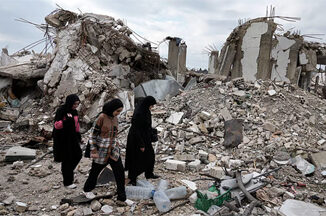
Khan Younis (TIP): Gaza’s civil defence agency said December 11 that an overnight Israeli air strike in the northern part of the Palestinian territory killed at least 22 people, including women and children. “At least 22 people were martyred in the massacre committed by the occupation military after it bombed a house belonging to the Abu al-Tarabish family near Kamal Adwan hospital in northern Gaza,” agency spokesman Mahmud Bassal told AFP.
Bassal said that an Israeli jet had fired three missiles at the house around midnight, adding the strike completely destroyed the three-storey structure.
More than 50 people were residing in the house, he said, with many still under the rubble. “Rescuers were unable to evacuate the martyrs or the wounded until this morning,” said Jaber Alian, 30, who witnessed the strike from a house near the hospital. He told AFP there were several other bombings across the northern parts of the territory during the night. The Israeli military did not immediately respond to questions about the strike on the Tarabish home.
For several weeks, the Israeli military has been engaged in a sweeping operation in northern Gaza, which it says is aimed at preventing the regrouping of Hamas militants in the area.
In another strike in central Gaza on Wednesday morning, at least seven people were killed when an Israeli warplane struck the house of the Al-Bayoumi family in Nuseirat refugee camp, Bassal said. The military, meanwhile, said two projectiles crossed from central Gaza into Israel on Wednesday, but were intercepted by the air force. The war in Gaza broke out after Hamas attacked southern Israel on October 7 last year, resulting in the deaths of 1,208 people, mostly civilians, according to an AFP tally based on official figures. (AFP)
Tag: World News
-
Gaza rescuers say at least 22 killed in overnight Israel strike
-
Iran imposes strict hijab laws; approves death penalty for offenders
Tehran (TIP): Iran introduces stricter penalties for persons defying compulsory morality laws. The 74-article law titled ‘Protection of the Family through the Promotion of the Culture of Chastity and Hijab’ imposes severe penalties including fines up to $2,380, flogging, prison sentences of up to 15 years or even death.
The law was drafted by the judiciary in May 2023 following the ‘Woman Life Freedom’ uprising in September 2022. The Guardian Council approved the bill earlier this year and was passed by the Iranian parliament on December 1. The law will be implemented from December 13 onwards with a trial period of 3 years.
Amnesty International issued a statement on December 11 noting that the new law has been adopted to crush the ongoing resistance to compulsory veiling, further diminishing the rights of women.
“The authorities are seeking to entrench the already suffocating system of repression against women and girls while making their daily lives even more intolerable,” said Diana Eltahawy, Amnesty International’s Deputy Regional Director for the Middle East and North Africa Regional Office.
Human Rights Watch published an article in October 2024 stating that the law consolidates existing measures to enforce compulsory hijab by putting in place restrictions on employment and educational opportunities for violators.
“Rather than responding to the Woman, Life, Freedom movement with fundamental reforms, the autocratic government is trying to silence women with even more repressive dress laws,” said Nahid Naghshbandi, acting Iran researcher at Human Rights Watch. “This law will only breed fierce resistance and defiance among women in and outside Iran.”
The new law defines different degrees of ‘improper dressing’ with varying penalties. Immodest clothing for women is defined as tight clothing that exposes parts of the body below the neck, above the ankles or above the forearms. Immodest clothing for men refers tight clothing that exposes any part of the body below the chest and above the knees or sleeveless shirts that expose the shoulders. (AFP) -
South Korea’s Yoon defends martial law as an act of governance, vows to ‘fight to the end’
SEOUL (TIP): South Korea’s president defended his martial law decree as an act of governance and denied rebellion charges, vowing December 12 to “fight to the end” in the face of attempts to impeach him and intensifying investigations into last week’s dramatic move.
Yoon Suk Yeol’s televised statement came hours before the main liberal opposition Democratic Party submits a new impeachment motion against Yoon to put it on a floor vote this weekend.
Yoon’s Dec. 3 martial law declaration, the first of its kind in more than 40 years in South Korea, has generated political chaos and large protests calling for his ouster. The decree brought hundreds of armed troops attempting to encircle parliament and raiding the election commission, though no major violence or injuries occurred. Martial law lasted only six hours as Yoon was forced to lift it after the National Assembly unanimously voted it down.
Yoon, a conservative, said he enacted martial law as a warning to the main liberal opposition Democratic Party, which controls parliament. He called the party “a monster” and “anti-state forces” that he said tried to use its legislative muscle to impeach top officials, undermined the government’s budget bill for next year and sympathized with North Korea.
“I will fight to the end to prevent the forces and criminal groups that have been responsible for paralyzing the country’s government and disrupting the nation’s constitutional order from threatening the future of the Republic of Korea,” Yoon said.
“The opposition is now doing a sword dance of chaos, claiming that the declaration of martial law constitutes to an act of rebellion. But was it really?” he said.
Yoon said martial law was an act of governance that cannot be the subject of investigations and doesn’t amount to rebellion. He said the deployment of nearly 300 soldiers to the National Assembly was designed to maintain order, not dissolve or paralyze it.
The Democratic Party quickly dismissed Yoon’s statement as “an expression of extreme delusion” and “a declaration of war against the people.” Kim Min-seok, head of a party task force, accused the president of attempting to incite pro-Yoon riots by far-right forces. He said the Democratic Party will focus on getting the motion impeaching Yoon passed on Saturday. If Yoon is impeached, his presidential powers would be suspended until the Constitutional Court decides whether to remove him from office or retore his powers. (AP) -
Iranian singer gives online concert without hijab, faces prosecution from judiciary
PARIS (TIP): An Iranian singer was December 12 hailed as a hero by supporters but faced prosecution from the judiciary after giving an online concert not wearing the hijab in defiance of the dress code.
Parastoo Ahmadi streamed the online concert on her YouTube channel late on Wednesday. She wears no headscarf and is bare-shouldered in a long, flowing black dress.
The concert, whose date of filming was not immediately clear with no audience present, appears to have been shot inside Iran with Ahmadi and her three-person band, all men, playing outside on a stage in the grounds of a traditional caravanserai complex.
Under rules imposed after the 1979 Islamic revolution, women must cover their hair in public and are also not allowed to sing alone in public.
Ahmadi had built a wide following among Iranians for songs posted on her Instagram page, including audio clips and videos of ballads sung indoors without a headscarf supporting the 2022-2023 mass protests against the authorities.
This appears to be the first time however that she has recorded a full concert outside as opposed to the more intimate recitals filmed indoors.
A written message on the YouTube video before the concert starts says: “I am Parastoo, the girl who cannot remain silent and refuses to stop singing for the country she loves.”
She tells viewers to “listen to my voice in this imaginary concert and dream of a free and beautiful nation”.
Without naming Ahmadi, the Mizan news agency of the Iranian judiciary said Thursday “a group led by a female singer” had performed “music without observing legal and religious standards”.
The judiciary has “intervened and taken appropriate action, with a legal case filed against the singer and the production staff,” it added.
US-based dissident campaigner Masih Alinejad hailed the concert as “historic”, saying on social media that “her voice is a weapon against tyranny, her courage a song of defiance”.
Prominent commentator Karim Sadjadpour, a fellow with the Carnegie Endowment, described the concert as an “act of extraordinary courage” that marked “another crack in the foundations of Iran’s rotting theocracy”.
The streaming of the concert took place ahead of a new law expected to come into force on Friday that rights groups have warned will drastically increase the penalties on women deemed to have flouted the dress code.
Amnesty International said in a report Tuesday that women could even face the death penalty if convicted under the “Promotion of the Culture of Chastity and Hijab” law. (AFP) -

Syria government pledges ‘rule of law’ after Assad’s overthrow
DAMASCUS (TIP): Syria’s interim government vowed on December 12 to institute the “rule of law” after years of abuses under ousted president Bashar al-Assad, as G7 powers pushed for an inclusive transition. Assad fled Syria after a lightning offensive spearheaded by the Islamist Hayat Tahrir al-Sham (HTS) group and its allies, which brought a sudden end to five decades of iron-fisted rule by his clan.
Syrians across the country and around the world erupted in celebration after enduring an era during which suspected dissidents were jailed or killed, and nearly 14 years of war that killed 500,000 people and displaced millions.
“We were living in oppression, we were unable to speak,” Ibtissam Kaab, a resident of Assad’s hometown Qardaha, told AFP.
“Whenever we wanted to speak, they threatened to harm us and our children.”
The new government’s spokesman told AFP on Thursday the country’s constitution and parliament would be suspended for the duration of a three-month transition.
“A judicial and human rights committee will be established to examine the constitution and then introduce amendments,” Obaida Arnaout told AFP.
Speaking at the state television headquarters, seized by the new rebel authorities, Arnaout said they would institute the “rule of law”.
“All those who committed crimes against the Syrian people will be judged in accordance with the law,” he added.
Cultural diversity
Asked about religious and personal freedoms, he said “we respect religious and cultural diversity in Syria,” adding that they would remain unchanged.
Leaders of the Group of Seven (G7) powers said Thursday they were ready to support the transition to an “inclusive and non-sectarian” government in Syria.
In a statement, they called for the protection of human rights, including those of women and minorities, while emphasising “the importance of holding the Assad regime accountable for its crimes.”
US Secretary of State Antony Blinken was in Jordan on Thursday to kick off a crisis tour to address the aftermath of Assad’s overthrow. He has called for an “inclusive” process to form Syria’s next government that includes protections for minorities. The State Department said he would call for a Syria that is not “a base of terrorism or posing a threat to its neighbours.”
The joy sparked by Assad’s overthrow has been accompanied by uncertainty about the future of the multi-ethnic, multi-confessional country.
Sunni Muslim HTS is rooted in Syria’s branch of Al-Qaeda and is proscribed as a terrorist organisation by many Western governments, though it has sought to moderate its rhetoric.
Assad is a member of the Alawite community, an offshoot of Shiite Islam, and long sought to present himself as the sole protector of the country’s minorities.
“Precisely because we are Islamic, we will guarantee the rights of all people and all sects in Syria,” Mohammad al-Bashir, the transitional head of government, told Italian daily Corriere della Sera in an interview published Wednesday. The Kurdish adminstration that holds swathes of Syria’s northeast said Thursday it will adopt the three-starred independence flag used by the rebels.
In a statement, it described the flag as a “symbol of this new stage, as it expresses the aspirations of the Syrian people towards freedom, dignity and national unity.”
The new rulers have also pledged justice for the victims of Assad’s rule, with HTS leader Abu Mohammed al-Jolani vowing that officials involved in torturing detainees will not be pardoned.
Jolani, now using his real name Ahmed al-Sharaa, also urged “countries to hand over any of those criminals who may have fled so they can be brought to justice.” (AFP) -

Brazil’s 2026 elections may be without Lula or Bolsonaro
BRASILIA (TIP): Brazil’s 2026 presidential election may offer a field of candidates featuring neither incumbent Luiz Inacio Lula da Silva nor far-right rival Jair Bolsonaro.
That scenario — possible, given Lula’s state of health and a ban on Bolsonaro holding public office — would present a novel situation and open the door to possible successors.
Lula, 79, is currently in hospital, recovering from emergency surgery on December 11 to relieve pressure from bleeding under his skull related to a bad fall he had in October.
Previously, Lula had treatment in 2011 for throat cancer, and last year a hip replacement operation.
The health woes undermine the robust image that the raspy-voiced leftist icon has long projected, and which galvanized voters to have him as their president between 2003 and 2010, and again since 2023.
In a CNN interview last month Lula declared himself willing to run again if no other viable left-wing candidate emerged. “I hope it won’t be necessary,” he said. An ally, Uruguay’s ex-president Jose Mujica, recently told AFP: “Lula’s nearly 80 and he has no replacement. That is Brazil’s misfortune.”
Bolsonaro’s legal woes
Bolsonaro, 69, faces challenges of a legal nature to try to regain the presidency he lost to Lula in 2022 elections.
The former army captain, who relishes being compared to his hero Donald Trump, has been barred from holding public office, or leaving Brazil, because of what police say was a failed 2022 coup plot against Lula.
Bolsonaro got his ban on public office by making unsubstantiated claims of fraud in Brazil’s electronic voting system in that year’s election.
Police say he also incited a January 8, 2023 insurrection in which thousands of supporters stormed the presidential palace, the Congress and the Supreme Court, and allege he had a decree written to invoke emergency powers to stay in charge.
Bolsonaro denies the accusations — which the attorney general is currently weighing to decide if formal charges will be laid — and has vowed to have the ban set aside so he can run again.
“I am Plan A, Plan B and also Plan C” for 2026, he told a radio program last week.
“Bolsonaro seeks inspiration from Trump… but has before him a long battle in the courts,” said Roberto Goulart, an international relations professor at Brasilia University.
Brazil’s political and justice system has thrown up surprises before.
Lula himself was barred from running for president in 2018, when he was convicted of corruption, propelling his running mate, former Sao Paulo mayor and current economy minister Fernando Haddad, to the top of the ticket.
Haddad lost to Bolsonaro. And Lula’s conviction was later overturned when the judge in charge of the case against him was found to be biased.
Heirs apparent
Lula’s ministers voice optimism about the state of the president’s health, despite his recent emergency.
“President Lula is very well…. He will certainly be our candidate in 2026,” Communication Minister Paulo Pimenta told CNN on Thursday. “The person who won’t be able to run in that election is Bolsonaro, who is ineligible and will probably be in prison before the vote happens,” Pimenta said.
According to a survey by MDA Pesquisa last month, six out 10 leftwing voters would prefer to see Lula run in 2026. If that does not happen, analysts and surveys point to Haddad, 61, as his most likely successor.
Lula’s last choice to succeed him did not end well. (AFP) -

South Asian community in the news for the wrong reasons

By Prabhjot Singh https://x.com/i/status/1866931377100243039
The vibrant South Asian Community of the Greater Toronto Area (GTA) has sometimes been hawking media headlines for the wrong reasons.
Recent disclosures by the Peel Regional Police Extortion Investigative Task Force (EITF) generally relate to members of the South Asian Community, both as victims and suspects in the growing incidence of violent crime, including extortion.
The Peel Regional Police Extortion Investigative Task Force (EITF) claimed that it has made multiple arrests and seized four firearms in connection with recent extortion-related incidents occurring in Brampton and Mississauga, targeting the South Asian business community.
Bandhuman Sekhon (27) from British Columbia, Harmanjiit Singh from Brampton, Tajinder Tatla from Brampton, Dinesh Kumar from Hamilton, and Rukhsar Achakzai from Brampton were among the recent arrests made by the EITF.
They have been arrested in connection with the incidents that include damage to property, threats of violence, and firearm-related offences. Victims of these incidents are often contacted through social media platforms, such as WhatsApp and Facebook, which allow online chat groups. In the majority of the cases, the victims, too, come from the South Asian Community.
EITF says it continues to work closely with law enforcement partners across Canada to investigate these incidents. It further says that if anyone receives a demand for money under the threat of violence, they should call the police rather than make any form of payment.
Most recently, the EITF has arrested five additional suspects, seized four firearms, and laid multiple charges. These threats have all included demands for large sums of money under the threat of violence. EITF said it arrested Bandhumaan Sekhon, a 27-year-old from British Columbia, for an incident reported in January of 2024. He was charged with the Conspiracy to Commit an Indictable Offence, Unauthorized Possession of a Prohibited Device or Ammunition, Knowledge of Unauthorized Possession of a Firearm, Careless Use of a Firearm, Weapon, Prohibited Device or Ammunition, Possession of Property Obtained by Crime, and Possess Firearm with altered Serial Number
He was held in custody for a bail hearing at the Ontario Court of Justice in Brampton and has since been released with court-imposed conditions.
EITF also revealed the arrest of Harmanjit Singh, a 25-year-old from Brampton, for an incident that occurred in May of 2024. He was charged with Extortion, Utter Threat to Cause Bodily Harm or Death, Point Firearm, Assault with a Weapon, and Obstruct Peace Officer. He was held in custody for a bail hearing at the Ontario Court of Justice in Brampton and has since been released with court-imposed conditions.
The third arrest made by EITF was of Tejinder Tatla, a 44-year-old from Brampton. He was arrested for threats that were made toward a business owner and his family members in June. A search warrant led to the seizure of 3 firearms during this investigation. He has been charged with Extortion and Unsafe Storage. He was held in custody for a bail hearing at the Ontario Court of Justice in Brampton and has since been released with court-imposed conditions.
EITF also arrested Rukhsar Achakzai, a 21-year-old from Brampton, for incidents dating back to September 2023. She was charged with Extortion and Mischief under $5000.00. She was held in custody for a bail hearing at the Ontario Court of Justice in Brampton and has since been released with court-imposed conditions. Dinesh Kumar, a 24-year-old from Hamilton, was arrested for an incident in July. He was charged with Extortion, EITF said. Dinesh Kumar was released from custody with a future court date and conditions to abide by.
The EITF claimed it investigated over 60 incidents, made 21 arrests, and laid 154 criminal charges. These investigations have also led to the seizure of 20 firearms, over 11kg of methamphetamines, over $10,000 in proceeds of crime, and the recovery of 6 stolen vehicles.
(Prabhjot Singh is a Toronto-based awarded senior journalist. He can be reached at prabhjot416@gmail.com)
-

56 die in Guinea soccer stampede
CONAKRY (TIP): A controversial refereeing decision sparked violence and a stampede at a soccer match in southeast Guinea, killing 56 people, according to a provisional toll, the government said on December 3. The fatalities occurred during the final of a tournament held in honour of Guinea’s military leader Mamady Doumbouya at a stadium in Nzerekore, one of the West African nation’s largest cities.
A witness, who had attended the match, said a disputed red card in the 82nd minute of the match kicked off the violence. “The stone throwing started and the police joined in, firing tear gas. In the rush and scramble that followed, I saw people fall to the ground, girls and children trampled underfoot. It was horrible,” Amara Conde told Reuters on phone.
The crowd rushed to leave, leading to a dangerous scrum at the exits, a police source said. A video authenticated by Reuters showed dozens of people scrambling over high walls to escape.
Ousted President Alpha Conde said the event had been badly organised at an uneasy time for the country, which is waiting for Doumbouya to hold promised elections after he seized power in a 2021 coup. “In a context where the country is already marked by tensions and restrictions, this tragedy highlights the dangers of irresponsible organisation,” Conde said in a statement.
Speaking on condition of anonymity, an official from the city’s administration said many victims were minors who got caught in the turmoil after police started firing tear gas. The official described scenes of confusion and chaos with parents retrieving bodies before they were officially counted.
Opposition group National Alliance for Change and Democracy said the authorities bore responsibility for organising tournaments to bolster political support for Doumbouya in contravention of a transition charter prior to the long awaited presidential election. — Reuters -

France’s Macron to address nation day after no-confidence vote topples government
PARIS (TIP): French President Emmanuel Macron will address the nation December 5 following the resignation of ousted Prime Minister Michel Barnier, a day after a historic no-confidence vote at the National Assembly left France without a functioning government.
Macron “took note” of Barnier’s resignation, the Elysee presidential palace said in a statement. Barnier and other ministers will be “in charge of current affairs until the appointment of a new government,” the statement said.
Macron is expected to focus on stabilizing the political crisis in his speech, though it is unclear when he will name a new prime minister to navigate the fractured parliament. The no-confidence motion passed by 331 votes in the National Assembly, forcing Barnier to step down after just three months in office—the shortest tenure of any prime minister in modern French history.
Pressure to act swiftly
Macron faces the critical task of naming a replacement capable of leading a minority government in a parliament where no party holds a majority. Yaël Braun-Pivet, president of the National Assembly and a member of Macron’s party, urged the president to move quickly.
“I recommend he decide rapidly on a new prime minister,” Braun-Pivet said Thursday on France Inter radio. “There must not be any political hesitation. We need a leader who can speak to everyone and work to pass a new budget bill.” The process may prove challenging. Macron’s administration has yet to confirm any names, though French media have reported a shortlist of centrist candidates who might appeal to both sides of the political spectrum.
Macron took more than two months to appoint Barnier after his party’s defeat in June’s legislative elections, raising concerns about potential delays this time.
Calls for Macron to step down
The no-confidence vote has galvanized opposition leaders, with some explicitly calling for Macron’s resignation. “I believe that stability requires the departure of the President of the Republic,” said Manuel Bompard, leader of the far-left France Unbowed party, on BFM TV Wednesday night.
Far-right National Rally leader Marine Le Pen, whose party holds the most seats in the Assembly, stopped short of calling for Macron’s resignation but warned that “the pressure on the President of the Republic will get stronger and stronger.”
Macron, however, has dismissed such calls and ruled out new legislative elections. The French constitution does not call for a president to resign after his government was ousted by the National Assembly.
“I was elected to serve until 2027, and I will fulfill that mandate,” he told reporters earlier this week.
The constitution also says that new legislative elections cannot be held until at least July, creating a potential stalemate for policymakers.
Economic uncertainty
The political instability has heightened concerns about France’s economy, particularly its debt, which could rise to 7% of GDP next year without significant reforms. Analysts say that Barnier’s government downfall could push up French interest rates, digging the debt even further.
Rating agency Moody’s warned late Wednesday that the government’s fall “reduces the likelihood of consolidating public finances” and worsens the political gridlock.
Macron’s speech, scheduled for 8 p.m. local time, is expected to address these economic challenges while setting a course for the future government. (AP) -
Syrian rebels annex Hama in southward push
Amman (TIP) : Syrian rebels captured the key city of Hama on December 5, bringing the insurgents a major victory after a lightning advance across northern Syria and dealing a new blow to President Bashar al-Assad and his Russian and Iranian allies.
The Syrian army said it was redeploying outside the city “to preserve civilians lives and prevent urban combat” after what it called intense clashes.
Rebels said they were preparing to keep marching south towards Homs, Syria’s great crossroads city that links the capital Damascus to the north and coast. “Your time has come,” said a rebel operations room in an online post, calling on city residents to rise up in revolution. -
Congo govt says it’s ‘on alert’ over mystery flu-like disease that killed dozens
KINSHASA (TIP): Public health officials in Africa urged caution December 5 as Congo’s health minister said the government was on alert over a mystery flu-like disease that in recent weeks killed dozens of people. Jean Kaseya, the head of Africa Centers for Disease Control and Prevention, told reporters that more details about the disease should be known in the next 48 hours as experts receive results from laboratory samples of infected people.
“First diagnostics are leading us to think it is a respiratory disease,” Kaseya said. “But we need to wait for the laboratory results.” He added that there are many things that are still unknown about the disease — including whether it is infectious and how it is transmitted.
Authorities in Congo have so far confirmed 71 deaths, including 27 people who died in hospitals and 44 in the community in the southern Kwango province, health minister Roger Kamba said.
“The Congolese government is on general alert regarding this disease,” Kamba said, without providing more details.
Of the victims at the hospitals, 10 died due to lack of blood transfusion and 17 as a result of respiratory problems, he said. The deaths were recorded between Nov. 10 and Nov. 25 in the Panzi health zone of Kwango province. There were around 380 cases, almost half of which were children under the age of five, according to the minister.
The Africa CDC recorded slightly different numbers, with 376 cases and 79 deaths. The discrepancy was caused by problems with surveillance and case definition, Kaseya said.
Authorities have said that symptoms include fever, headache, cough and anemia. Epidemiological experts are in the region to take samples and investigate the disease, the minister said. The Panzi health zone, located around 435 miles (700 kilometers) from the capital Kinshasa, is a remote area of the Kwango province, making it hard to access.
The epidemiological experts took two days to arrive there, the minister said. Because of the lack of testing capacity, samples had to be taken to Kikwit, more than 500 km away, said Dieudonne Mwamba, the head of the National Institute for Public Health. “The health system is quite weak in our rural areas, but for certain types of care, the ministry has all the provisions, and we are waiting for the first results of the sample analysis to properly calibrate things,” Kaseya said. Mwamba said that Panzi was already a “fragile” zone, with 40% of its residents experiencing malnutrition. (AP) -
Taiwan romance novelist Chiung Yao dies in apparent suicide
Taipei, Taiwan (TIP): Taiwanese writer Chiung Yao, whose romance novels were wildly popular in the Chinese-speaking world, has died, authorities said December 4. She was 86.
The body of Chiung Yao, which was the pen name used by Chen Che, was found at her home in New Taipei City, the local fire department told AFP.
She appeared to have taken her own life, the department said. Chiung Yao was a prolific writer, publishing over 60 books in a career spanning more than five decades.
“In the drawers of every literary young girl in 1950s, 1960s, 1970s, there were a few Chiung Yao novels tucked away, hidden from the fear of being confiscated by teachers,” said Tsai Mei-tzu, a professor of Chinese literature at the National Cheng Kung University.
“Even after the 1990s, Chiung Yao’s old-fashioned romances did not fade away. The classical undertones and dramatic tension continued to sustain her empire of love stories,” she told AFP.
Chiung Yao was born in the southwestern Chinese city of Chengdu on April 20, 1938, Taiwan’s semi-official Central News Agency reported.
She fled to Taiwan with her family in 1949 after Chiang Kai-shek’s nationalist forces lost a civil war to Mao Zedong’s fighters. She began writing as a child and her first novel was published when she was 25, local media reported.
A number of her novels were turned into television series, which were a huge hit in both Taiwan and China, especially the 18th century period drama “My Fair Princess”. (AFP) -

South Korean lawmakers call for impeachment of President Yoon after back-track on martial law
Seoul (TIP): South Korean lawmakers on December 4 called for the impeachment of President Yoon Suk Yeol after he declared martial law only to reverse the move hours later, triggering the biggest political crisis in decades in Asia’s fourth-largest economy.
The surprise declaration late on Tuesday ignited a standoff with Parliament which rejected his attempt to ban political activity and censor the media, as armed troops forced their way into the National Assembly building in Seoul.
A coalition of lawmakers from Opposition parties said they planned to propose a Bill to impeach Yoon on Wednesday which should be voted within 72 hours.
“Parliament should focus on immediately suspending the President’s business to pass an impeachment Bill soonest,” Hwang Un-ha, one of the MPs in the coalition, told reporters.
Yoon’s chief of staff and senior secretaries offered to resign en masse, a presidential official said.
Yoon told the nation in a TV address that martial law was needed to defend the country from nuclear-armed North Korea and pro-North anti-state forces, and protect its free constitutional order, although he cited no specific threats.
Chaotic scenes ensued as helmeted troops climbed into the parliament building through smashed windows and military helicopters hovered overhead. Parliamentary aides sprayed fire extinguishers to push the soldiers back, and protesters scuffled with police outside.
The military said activities by parliament and political parties would be banned, and that media and publishers would be under the control of the martial law command.
But within hours of the declaration, South Korea’s Parliament, with 190 of its 300 members present, unanimously passed a motion requiring martial law be lifted, including all 18 members present from Yoon’s party. The President then rescinded the declaration. Protesters outside the National Assembly shouted and clapped. “We won!” they chanted, and one demonstrator banged on a drum.
(Reuters) -

Will neutralise hostages if Israel launches rescue ops: Hamas
Dubai (TIP): Hamas said it had information that Israel intended to carry out a hostage rescue operation similar to one conducted in Gaza’s Nuseirat camp in June and threatened to “neutralize” the captives if any such action took place, according to an internal statement seen by Reuters on December 4.
In the statement dated November 22, Hamas told its operatives not to consider what the repercussions of following the instructions might be and said it held Israel responsible for the fate of the hostages.
The statement, which a senior Hamas source told Reuters was circulated to its factions by the intelligence unit of the group’s military wing Izz el-Deen al-Qassam Brigades, did not say when any Israeli operation was expected to take place.
There was no immediate Israeli response to the statement. On Wednesday, Israeli media cited Defence Minister Israel Katz as saying pressure on Hamas was increasing and this time “we will really be able to advance a hostage deal”.
Israel’s Nuseirat rescue operation on June 9 saw Israeli forces free four hostages, who had been held by Hamas since October 2023, in a raid Palestinian officials said killed more than 200 people, making it one of the bloodiest Israeli assaults of the war.
In the Hamas statement, the group told its operatives to “tighten” the living conditions of the captives and said this should be done in accordance with instructions issued after the Nuseirat operation.
In a section titled “recommendations”, Hamas also instructed its operatives to “activate neutralization orders … as an immediate and swift response to any adventure by the enemy”. Israel launched its campaign in Gaza after Hamas-led fighters attacked Israeli communities across the border on October 7, 2023, killing 1,200 people and taking over 250 hostages, according to Israeli tallies.
Israel’s military campaign has since killed more than 44,500 Palestinians and injured many others, according to Palestinians figures. (TT) -

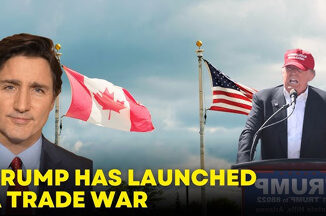
Stop ripping off or become the 51st state of US: Donald Trump tells Canadian PM

By Prabhjot Singh TORONTO (TIP): Canadian Prime Minister and members of his delegation who had a closed-door meeting with the US President-elect Donald Trump last Friday, November 29, were reportedly stunned when, during the deliberations on the 25 per cent import tariff, the host surprised everyone by suggesting that Canada should become the 51st state of the US.
According to media reports, Donald Trump said in a lighter vein that if Justin Trudeau did not like the tariff, perhaps Canada could become the 51st state and Trudeau could serve as its governor. Trudeau laughed nervously at the apparent joke, the media reports said.
Yesterday, when the House of Commons resumed its sitting, the issue of border security was raised by the Leader of Opposition, Pierre Poilievre, saying that his party had been asking the Prime Minister to wake up and regain control of the order but he continues to do the opposite. Pierre said that in 2015, the number of unprocessed asylum claims was under 10,000. Today, there were over 260,000.oration with provincial police forces to crack down on the human trafficking, illegal entry, drug production and trafficking.
These are the issues because of which the US President-elect Donald Trump had been threatening to impose 25 per cent duty on items imported from Canada and Mexico.
After talking to Donald Trump on the phone early last week, the Canadian Prime Minister accompanied by some senior functionaries of his Government, air dashed to Florida last weekend. The Canadians met Donald Trump and his team over a dinner meeting that reportedly lasted three hours. It was during this meeting that Donald Trump made that comment of suggesting Canada to become 51st state.
Media reports quoting an insider who was at the meeting said :“We are told that when Trudeau told President-elect Trump that new tariffs would kill the Canadian economy, Trump joked to him that if Canada cannot survive without ripping off the U.S. to the tune of $100 billion a year, then maybe Canada should become the 51st state and Trudeau could become its governor”.
Media reports further said that someone at the table noted that a Canadian state in the U.S. would be liberal, prompting Trump to say that the territory could be divided into two states, one liberal and one conservative. That reportedly drew more laughter.
Donald Trump’s humor-veiled bombast last weekend was somewhat reminiscent of his wish during his term of Presidency. At that time he had made public his wish to purchase Greenland.
While responding to issues raised by Pierre Poilievre, Canadian Minister Dominic LeBlanc, who was with Justin Trudeau in the meeting with Donald Trump, the previous weekend, said that the Canadian delegation had had a very cordial and constructive conversation with our American partners on Friday evening. “We talked about security at the Canada-U.S. border over the decades and the integration of Canadian police forces with their American partners. We talked, for example, about the important work that the RCMP is doing in the fight against fentanyl, which has led to drug seizures and significant arrests, often in partnership with our American allies.
Another Conservative MP, while joining the debate in the House of Commons, said that President-elect Trump just asked the Prime Minister to do something. “We have been asking for the same thing over here for nine years. We are calling for additional measures to stop gun smuggling, drug trafficking and auto theft. He never listened. Gun smuggling and auto theft are a scourge in Quebec. We have suggested enhanced surveillance at the Port of Montreal and at the border, but nothing has changed.
Dominic LeBlanc retorted back, saying “we have worked with our law enforcement. We have invested more to reverse the cuts made by the former Conservative government. If my colleague is serious about our country’s national security, I suggest that he encourage his boss to obtain the security clearance needed to access information that will help protect his political party and caucus. For example, when it comes to India’s foreign interference, it might be a good idea for the Leader of the Opposition to do that.
-

There was no foreign interference in the Conservative Leadership election: Patrick Brown

By Prabhjot Singh TORONTO (TIP): Patrick Brown, mayor of Brampton and one of the candidates in the run, says there was no foreign interference in the Conservative Leadership election in 2022.
Appearing before a Parliamentary Committee looking into allegations of foreign interference in the Canadian Conservative Leadership election in which the incumbent Leader of the official Opposition Pierre Poilievre won by 68 per cent of the first vote, Patrick Brown firmly held that foreign interference did not play a role in the 2022 election.
The Parliamentary committee had convened to investigate allegations of foreign interference in Canadian politics, focusing on the 2022 Conservative leadership race.
An earlier report from a national security committee had hinted at possible Indian involvement in influencing the leadership campaign. However, Brown, who initially refused to appear before the committee, addressed these concerns during his testimony while firmly rejecting the idea that foreign meddling impacted the final results of the race.
“I don’t believe foreign intervention affected the outcome of the Conservative leadership race,” Brown stated in his testimony on Thursday, December 5. Stressing the importance of protecting Canadian politics from foreign influence, he held that he did not want to be dragged into partisan disputes in Parliament.
When the Committee asked him early this week to give his testimony as he was a part of the leadership race, Patrick Brown took to social media to comment on the committee’s summons. He maintained that he had no new evidence to contribute to the inquiry and reiterated that the ongoing public inquiry into foreign interference was the appropriate venue for addressing such allegations.
In his testimony, he also clarified that no representatives from the Indian government contacted him or his campaign during the leadership race. Despite the claims of foreign interference, Brown maintained that his campaign faced no external pressures.
The public inquiry into foreign interference, which concluded its hearings earlier this fall, is expected to release a final report in the coming months. Brown, however, was not called as a witness during the inquiry.
Intriguingly, Patrick Brown’s leadership bid in 2022 was marred by allegations related to campaign financing, which led to his disqualification from the race under the Canada Elections Act. The Election Commission decided early this year not to continue with its investigation against Patrick Brown. Patrick Brown, however, continues to advocate for impartial investigations and transparency into the issue as it was both sensitive and important holding that Canada’s political processes must remain free from external influence. -

Conservatives make yet another move to bring down Justin Trudeau’s government

By Prabhjot Singh OTTAWA (TIP): After losing the first two battles to bring down the minority Liberal government, Conservatives, the Official Opposition Party, tabled its third successive no-confidence motion in the penultimate week sitting of the House of Commons. The House of Commons will adjourn for holiday break at the end of next week. Unmindful of the earlier failed attempts to topple Justin Trudeau’s Government and force an early election to the House of Commons, Conservative Leader Pierre Poilievre tabled his motion before the House of Commons on Thursday.
Structuring its no-confidence motion on the past criticisms, especially the quotes from the statements the NDP leader Jagmeet Singh made while tearing down the supply and confidence agreement with the Liberals.
Earlier no-confidence motions moved by Conservatives in September and October failed. The minority Liberals are likely to survive the third no-confidence motion as well as the NDP leader had already declared that his party would not play Pierre Poilievre’s game. The Liberals need the support of one of the other parties – Bloc Quebecois or NDP – in the House of Commons to continue in the saddle in the New Year. Voting on the no-confidence motion will take next week when the House of Commons resumes its sitting on Monday.
While introducing the motion on Thursday afternoon, Pierre Poilievre said he was presenting this motion in the “spirit of non-partisanship.”
The language of the motion refers to a statement the NDP Leader Jagmeet Singh made when he announced in September that his party was pulling out of the supply-and-confidence agreement with the Liberal government.
Pierre Poilievre said, “I rise today in the spirit of non-partisanship, put our differences aside and take a good idea and a good perspective no matter where it comes from.” He further commented, “Too often in this place, we refuse to accept ideas or input from other people and so I thought I would remedy that by taking the words and the message of the leader of the NDP and putting them in a Conservative motion so that all of us could vote for the very wise things that he said.”
“Whereas the NDP Leader said, ‘the Liberals are too weak, too selfish and too beholden to corporate interests to fight for people,’” the motion states in the preamble and continues to ask that: “Therefore, the House agrees with the NDP Leader and the House proclaims it has lost confidence in the Prime Minister and the Government.”
The motion further includes Singh’s comment criticizing the Liberal government for imposing binding arbitration to end the railway shutdown in August.
The minority Liberals are likely to survive the third no-confidence motion as the NDP leader had already declared that his party would not play Pierre Poilievre’s game.
As the debate on the motion started, the Conservatives held that the next federal election would be an axe Carbon tax election that would bring face-to-face the Conservatives vs the rest – the Liberals, NDP, Bloc Quebecois and Greens. Pierre Poilievre while moving the motion held that Labour Minister Steven MacKinnon’s order to impose binding arbitration on railway workers violated their right to strike. In a debate that followed the tabling of the motion, MacKinnon accused Poilievre of backing anti-union bills.
“On the other hand, Mr. Speaker, Liberals have been there for workers from day one. On this side of the House, we stand on our record, not an empty slogan,” MacKinnon said.
Since the NDP leader Jagmeet Singh was not at the debate, NDP MP Matthew Green criticized Poilievre’s stance on workers’ rights. “Despite all this cosplay we see in front of us … has this member ever once in his life visited a picket line?” he asked. To which Poilievre responded: “Yes, Mr. Speaker.”
Early this week, when the Conservative leader revealed the content of the next no-confidence motion, Jagmeet Singh reacted by saying he won’t play Conservative Leader Pierre Poilievre’s games. He maintained he was not going to vote non-confidence and trigger an election as he believed Pierre Poilievre would cut programs the NDP fought for, like dental care and pharma care.
“I am not going to be playing Pierre Poilievre’s games. I have no interest in that. We are frankly not going to allow him to cut the things that people need. I want to have dental care expanded, I want people to start to benefit from the pharma care legislation we passed,” Singh said.
Another two Conservative motions would be heard Monday, December 9 and Tuesday, December 10, with both set for a vote on Tuesday, December 10, barring changes to those plans.(Prabhjot Singh is a Toronto based award-winning senior journalist. He can be reached at prabhjot416@gmail.com)
-
Australia becomes 1st country to ban social media for under-16s
Sydney (TIP) : Australia on November 28 approved a social media ban for children aged under 16 after an emotive debate that gripped the nation, setting a benchmark for jurisdictions around the world with one of the toughest regulations targeting Big Tech.
The law forces tech giants from Instagram and Facebook owner Meta to TikTok to stop minors logging in or face fines of up to A$49.5 million ($32 million). A trial of methods to enforce it will start in January with the ban to take effect in a year.
A number of countries have already vowed to curb social media use by children through legislation, but Australia’s policy is the most stringent.
FACEBOOK AND INSTAGRAM-OWNER META SPOKESPERSON: “Naturally, we respect the laws decided by the Australian Parliament. However, we are concerned about the process which rushed the legislation through while failing to properly consider the evidence, what industry already does to ensure age-appropriate experiences, and the voices of young people.
“The task now turns to ensuring there is productive consultation on all rules associated with the Bill to ensure a technically feasible outcome that does not place an onerous burden on parents and teens and a commitment that rules will be consistently applied across all social apps used by teens.”
SUNITA BOSE, MANAGING DIRECTOR, AUSTRALIAN DIGITAL INDUSTRY GROUP, DIGI
“It’s cart before horse… We have the bill but we don’t have guidance from the Australian government around what are the right methods that a whole host of services subject to this law will need to employ.”
SARAH HANSON-YOUNG, GREENS PARTY SENATOR: “This is a rubbish Bill, it has no substance and it doesn’t even take place for another 12 months. It’s also obvious that the people who have drafted and fought for the particular elements of this Bill actually have no idea how young people engage with the internet. This is boomers trying to tell young people how the internet should work.”
“Given the potential for these laws to significantly interfere with the rights of children and young people, the Commission has serious reservations about the proposed social media ban.”
“There are arguments for and against the introduction of a social media ban for under-16s. While a ban may help to protect children and young people from online harms, it will also limit important human rights.” (Reuters) -

Will fight back: Philippine prez on VP’s murder threat
Manila (TIP): Philippine President Ferdinand Marcos vowed on November 25 to fight back against what he called reckless threats against him, speaking out after his estranged vice-president said he would be assassinated if she herself were killed.
In a strongly-worded video message addressing the nation, Marcos did not name Vice-President Sara Duterte, his presidential running mate, but said “such criminal plans should not be overlooked”.
In a dramatic twist in the fierce spat between Marcos and the powerful Duterte family, the daughter of firebrand former President Rodrigo Duterte said on Saturday she had instructed an assassin to kill Marcos, his wife and the lower house speaker, in the event that she were killed.
She was responding to a question during an online press conference about whether she feared for her safety. She did not cite any specific threat against her. -

Nations unite to address global plastic pollution crisis in Busan
Vietnam (TIP): While the outcome on the climate finance deal at COP29 in Baku was derided by the developing nations, days later, 175 countries assembled in Busan, South Korea, for the fifth session of the Intergovernmental Negotiating Committee to develop a Global Treaty on ending plastic pollution.
At the ongoing discussion that will end on December 1, participating countries would argue that plastic pollution must be addressed through reduction in plastic production and a legally binding international agreement.
Experts state that India could play a pivotal role in leading the world towards the development of a global criteria for single-use plastic ban.
In 2022, India had already issued Extended Producers Responsibility (EPR) guidelines under which manufacturers should register on a centralised portal. With these guidelines, India fixed the responsibility on manufacturers to ensure processing of their plastic packaging waste through recycling, re-use or end of life disposal.
Amit Tandon, Founder and CEO, PolyCycl Pvt Ltd said, “The Global Plastics Treaty is a rare, once-in-a-generation chance to build global collaboration to tackle plastic pollution head-on. India already boasts one of the world’s largest and most comprehensive EPR frameworks for plastic life-cycle management. With only a third of treaty member states having implemented any form of EPR, India also stands to offer a regulatory model for other nations for developing an effective and sustainable system for managing plastics.”
According to the United Nations Environment Programme, single-use plastics represent 36 per cent of the plastic production in the world.
In 2022, India banned 19 single use plastic items like plastic bags, cutlery, straws, food packaging, disposable water bottles and plastic cups.
Atin Biswas, programme director, Solid Waste Management and Circular Economy, Centre for Science and Environment, said, “India introduced a resolution in United Nations Environment Assembly 4, aimed at ending single-use plastic product pollution. The country is positioning itself as a leader in efforts to eliminate single-use plastics at both regional and national levels.” (TNS) -

Russian strikes cut power to 1 million people in Ukraine
Kyiv (TIP): Russia unleashed its second big attack on Ukraine’s energy infrastructure this month on November 28, triggering deep power cuts across the country.
President Vladimir Putin said Moscow had struck in response to Ukraine’s strikes on Russian territory with US medium-range ATACMS missiles. He said Russia’s future targets could include “decision-making centres” in Kyiv.
Ukrainian President Volodymyr Zelenskyy accused Russia of a “despicable escalation”, saying it had used cruise missiles with cluster munitions.
Over 1 million people lost power in the immediate aftermath of the strikes, and millions more had their existing schedule of rolling power cuts intensified. Ukraine’s air force said Russia used 91 missiles and 97 drones in Thursday’s attack. It said 12 of those had hit their targets, most of which were energy and fuel facilities.
“The enemy is using a large number of missiles and drones. Their massive use in certain areas often exceeds the number of means of (air defence) cover,” the air force said in a statement.
Putin says he does not believe Trump is safe after assassination attempts’
Infrastructure facilities were damaged in nine regions, Ukraine’s Interior Ministry said.
The attack reinforced fears of long power cuts during the winter months as temperatures hover around zero.
Officials said it was the 11th major strike on the energy system since March. Russia has knocked out about half Ukraine’s available generating capacity during the war, damaged the distribution system and forced authorities to impose long blackouts.
The air force said it had shot down 79 missiles and downed 35 drones, while 62 drones were “lost”, meaning it was likely they had been disrupted by electronic warfare. (Reuters) -

Fragile Ceasefire: Israel and Lebanon trade accusations the day after ceasefire went into effect
Israel’s Netanyahu threatens ‘intense war’ if Hezbollah violates truce
JERUSALEM (TIP): Israeli Prime Minister Benjamin Netanyahu said on Thursday, November 28, during an interview with Israeli Channel 14 that he had ordered the military to be prepared for an intense war in Lebanon if the ceasefire’s framework is violated.
The Israeli military said its air force struck a facility used by Hezbollah to store mid-range rockets in southern Lebanon on Thursday, after both sides accused each other of breaching a ceasefire that aims to halt over a year of fighting.
Israel said it also opened fire on Thursday towards what it called “suspects” with vehicles arriving at several areas in the southern zone, saying it was a breach of the truce with Iran-backed armed group Hezbollah, which came into effect on Wednesday.
Hezbollah lawmaker Hassan Fadlallah in turn accused Israel of violating the deal.“The Israeli enemy is attacking those returning to the border villages,” Fadlallah told reporters, adding “there are violations today by Israel, even in this form”. The Lebanese army later accused Israel of violating the ceasefire several times on Wednesday and Thursday.
The exchange of accusations highlighted the fragility of the ceasefire, which was brokered by the United States and France to end the conflict, fought in parallel with the Gaza war. The truce lasts for 60 days in the hope of reaching a permanent cessation of hostilities. Israel’s airstrike on Thursday was the first since the truce took effect on Wednesday morning. Lebanese security sources and the Al Jadeed broadcaster said it took place near Baysariyah, north of the Litani River.
The ceasefire deal stipulates that unauthorized military facilities south of the Litani River should be dismantled, but does not mention military facilities north of the river.
Earlier, Israeli tank fire hit five towns and some agricultural fields in southern Lebanon, state media and Lebanese security sources said, saying at least two people were wounded.
All the areas lie within 2 km (1.2 miles) of the Blue Line demarcating the border between Lebanon and Israel, in an area the Israeli military has announced as a no-go zone along the border, even after the deal was agreed.
The Israeli military said in a statement it had identified several suspicious activities that posed a threat and breached conditions of the ceasefire agreement. “Any deviation from this agreement will be enforced with fire,” said Chief of the General Staff Herzi Halevi.
Later on Thursday, Israeli Prime Minister Benjamin Netanyahu said he had directed the military to be prepared for intense fighting if the ceasefire is violated.
“We are enforcing powerfully,” Netanyahu said in an interview with Israel’s Channel 14. “But if needed I gave a directive to the IDF – be prepared in case there is a violation of the framework of the ceasefire, for an intense war.” Lebanese families displaced from their homes near the southern border have tried to return to check on their properties. But Israeli troops remain stationed within Lebanese territory in towns along the border and Reuters reporters heard surveillance drones flying over parts of southern Lebanon.
The Israeli military on Thursday renewed a curfew restricting the movement of residents of southern Lebanon south of the Litani river between 5 pm. (1500 GMT) and 7 am.
The agreement, a rare diplomatic feat in a region racked by conflict, ended the deadliest confrontation between Israel and the Hezbollah militant group in years. But Israel is still fighting its other arch foe, the Palestinian militant group Hamas, in the Gaza Strip, in response to the deadly Hamas-led raid on southern Israel on Oct. 7, 2023. Israeli strikes on Lebanon have killed at least 3,961 people and injured 16,520 others since October 2023, the Lebanese health ministry said on Thursday. The figures do not differentiate between civilians and combatants.
Hezbollah strikes have killed 45 civilians in northern Israel and the Israeli-occupied Golan Heights. At least 73 Israeli soldiers have been killed in northern Israel, the Golan Heights, and in combat in southern Lebanon, according to Israeli authorities.
Under the ceasefire terms, Israeli forces can take up to 60 days to withdraw from southern Lebanon but neither side can launch offensive operations.
Netanyahu waged the offensive against Hezbollah, saying Israelis in the north of the country should be able to return after being evacuated because of rocket fire from Lebanon.
Some 60,000 people evacuated from homes in the north have still not been directed to return.
Hezbollah has said its fighters “remain fully equipped to deal with the aspirations and assaults of the Israeli enemy” and that its forces will monitor Israel’s withdrawal from Lebanon “with their hands on the trigger”. The group has been weakened by casualties and the killing of its leader Sayyed Hassan Nasrallah and other commanders by Israel.
Announcing the Lebanon accord on Tuesday, US President Joe Biden said he would now renew his push for a ceasefire agreement in Gaza and urged Israel and Hamas to seize the moment. Months of efforts to negotiate a ceasefire have yielded scant progress.
Israeli military strikes killed at least 21 Palestinians across the Gaza Strip on Thursday, medics said, as forces stepped up their bombardment of central areas and tanks pushed deeper into the north and south of the enclave.
(Agencies) -
‘It will have no consequences’: Hungary PM defies ICC arrest warrant, invites Benjamin Netanyahu
Hungary (TIP): Hungarian Prime Minister Viktor Orbán on Friday (November 22) extended an invitation to Israeli Prime Minister Benjamin Netanyahu to visit Hungary, openly defying an arrest warrant issued by the International Criminal Court (ICC). Speaking on state radio, Orbán accused the ICC of “interfering in an ongoing conflict for political purposes.”
Netanyahu responded by thanking Orbán for his “moral clarity” on the matter, stating that Hungary stood firmly “by the side of justice and truth.”
The ICC had issued arrest warrants on Thursday for Netanyahu and former Israeli Defence Minister Yoav Gallant, accusing them of using “starvation as a method of warfare.” The move was swiftly criticised by allies such as the US, Austria, and Argentina. However, Hungary went further by formally inviting Netanyahu.
Orbán described the ICC’s actions as “outrageously impudent” and “cynical,” vowing to “defy this decision, and it will have no consequences for him.”
“There is no choice here, we have to defy this decision … I will guarantee Mr Netanyahu, if he comes, that the judgment will have no effect in Hungary and that we will not follow its terms,” he said on Friday.
It is worth noting that ICC member states are obligated to enforce arrest warrants and detain suspects upon their arrival. However, the court lacks mechanisms to directly enforce its rulings.
The UK and EU have both indicated they are bound by the ICC charter and suggested that Netanyahu would be detained if he entered their territories.
“The UK will always comply with its legal obligations as set out by domestic and international law,” Downing Street stated. The EU reiterated this stance, with Foreign Policy Chief Josep Borrell emphasising that the warrants are binding.
“This decision is binding on all states, all state parties of the court, including all members of the European Union,” Borrell said.
Israel has denounced the ICC’s move, labelling it “antisemitic” in an official statement. (AP) -

Brazil’s former president Jair Bolsonaro charged with plotting coup
Brazil (TIP): Brazil’s federal police have indicted former President Jair Bolsonaro and 36 others for allegedly attempting to orchestrate a coup to keep him in power following his defeat in the 2022 elections. The findings, submitted to Brazil’s Supreme Court on Thursday which termed it a coordinated attempt to “violently dismantle the constitutional state”, will now await a decision on whether Prosecutor-General Paulo Gonet will formally press charges or dismiss the case.
Bolsonaro, a right-wing leader, has denied any attempts to cling to office after narrowly losing to his rival, leftist President Luiz Inácio Lula da Silva. Since then, he has faced multiple legal challenges.
The federal police released a brief statement confirming that the Supreme Court had approved the disclosure of all 37 names implicated “to avoid the dissemination of incorrect news.” Supreme Court Justice Alexandre de Moraes noted that the extensive 700-page document would require several days to review.
Among those indicted are prominent allies of Bolsonaro, including his 2022 running mate Gen. Walter Braga Netto, former Army commander Gen. Paulo Sérgio Nogueira de Oliveira, Valdemar Costa Neto, chairman of Bolsonaro’s Liberal Party, and longtime adviser Gen. Augusto Heleno.
The investigation, launched last year, led to the arrests on Tuesday of four military officials and a federal police officer accused of plotting to overthrow the government, including alleged plans to assassinate President Lula and other top officials.
Other ongoing inquiries involve Bolsonaro’s alleged smuggling of diamond jewellery into Brazil without proper declaration and accusations that he instructed subordinates to falsify COVID-19 vaccination records. Bolsonaro has denied involvement in these cases.
A separate probe concluded that Bolsonaro abused his authority to undermine confidence in Brazil’s voting system, leading to a judicial ruling barring him from running for office until 2030. (Reuters) -

Canada removes extra screening for passengers travelling to India days after implementation
Ottawa (TIP): The Canadian government has lifted the enhanced security measures for passengers flying to India. The office of Transport Minister Anita Anand confirmed to CBC News on Thursday that the additional measures had been “removed.”
Although the measures appeared to have been in place since at least last weekend, Anand stated on Monday that the extra security screening was being conducted for passengers travelling to India “out of an abundance of caution.”
According to reports, Air Canada in a notification informed passengers heading to Indian destinations over the weekend that due to heightened security mandates by Transport Canada, security wait times were expected to be longer than usual for their upcoming flights.
On Monday, an Air Canada spokesperson confirmed the development in an email, stating, “Transport Canada has introduced additional requirements for travellers to India, and Air Canada, like other carriers, is complying with these.” On Sunday, Toronto Pearson Airport posted on X, stating, “Departing passengers may experience longer than usual wait times at international pre-board screening at Toronto Pearson this evening. If travelling, please check with your airline and leave plenty of time to catch your flight.” It was unclear whether this was linked to the enhanced security measures that had been implemented.
The enhanced screenings, implemented by the Canadian Air Transport Security Authority (CATSA), involved comprehensive checks of both passengers and their baggage before they could enter restricted areas at airports.
These measures were reportedly introduced in response to rising diplomatic tensions between Canada and India, which escalated following allegations by the Royal Canadian Mounted Police (RCMP) linking Indian government agents to various criminal activities in Canada, including murder and extortion. Canada also expelled six Indian diplomats, leading to a reciprocal move by India. (AP)