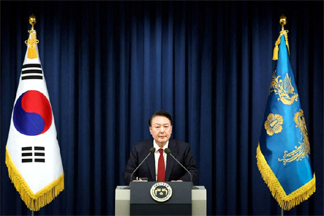
MOSCOW (TIP): Russian President Vladimir Putin said September 25 that a nuclear power supporting another country’s attack on Russia will be considered a participant in aggression under a new version of Moscow’s nuclear doctrine. Speaking at a meeting of Russia’s Security Council that considered changes in the doctrine, Putin announced that a revised version of the document says that an attack against his country by a nonnuclear power with the support of a nuclear power will be seen as their “joint attack on the Russian Federation.” Putin didn’t specify whether the modified document envisages a nuclear response to such an attack.
The change in the doctrine, which spells out condition for the use of nuclear weapons, follows Putin’s warning to the U.S. and other NATO allies that allowing Ukraine to use Western-supplied long-range weapons for strikes on Russian territory would mean that Russia and NATO are at war. Since Putin sent troops into Ukraine in 2022, he and other Kremlin voices have frequently threatened the West with Russia’s nuclear arsenal to discourage it from ramping up support for Kyiv.
The current doctrine says Moscow could use its nuclear arsenal “in response to the use of nuclear and other types of weapons of mass destruction against it and/or its allies, as well as in the event of aggression against the Russian Federation with the use of conventional weapons when the very existence of the state is in jeopardy.”
The revised version of the document spells out conditions of nuclear weapons use in greater detail, noting they could be used in case of a massive air attack involving aircraft, cruise missiles or drones, he said. (AP)
Tag: World News
-

Putin says a nuclear power supporting an attack on Russia can be considered an aggressor
-

Former Defence Minister Ishiba chosen to lead Japan’s ruling party, to swear in next week
TOKYO (TIP): Japan’s ruling party on September 27 picked former defense minister Shigeru Ishiba as leader, setting him up to become prime minister next week.
The party leadership win is a ticket to the top job because the Liberal Democratic Party’s ruling coalition currently controls the parliament.
Considered a defense policy expert, Ishiba has proposed an Asian version of the NATO military alliance and a more equal Japan-U.S. security alliance. Ishiba is a supporter of Taiwan’s democracy. He calls for an establishment of a disaster management agency in one of the world’s most disaster-prone countries.
Ishiba beat out Economic Security Minister Sanae Takaichi, a staunch conservative who was running to become the country’s first female prime minister.
A record nine lawmakers, including two women, ran in a vote decided by LDP members of parliament and about 1 million dues-paying party members. That’s only 1% of the country’s eligible voters. Outgoing Prime Minister Fumio Kishida has been dogged by party corruption scandals, and the LDP wanted a fresh leader in hopes of regaining public trust before a likely general election.
Some experts believe that party turmoil could mean that Japan will return to an era similar to the early 2000s, which saw “revolving door” leadership changes and political instability.
A succession of short-lived governments hurts Japanese prime ministers’ ability to set up long-term policy goals or develop trusted relations with other leaders.
On Tuesday, Kishida and his Cabinet ministers will resign. Ishiba, after being formally elected in a parliamentary vote, will then form a new Cabinet later in the day.
The main opposition — the liberal-leaning Constitutional Democratic Party of Japan — has struggled to build momentum, despite the LDP scandals. But experts say its newly elected leader, centrist former Prime Minister Yoshihiko Noda, is pushing a conservative shift for the party, could trigger a broader political regroupings. (AP) -
Lebanese state media says an Israeli strike killed 23 Syrian workers
BEIRUT (TIP): An Israeli airstrike in Lebanon hit a building housing Syrian workers, killing 23 of them, Lebanon’s state news agency reported September 26. It was one of the deadliest single strikes in an intensified air campaign against the militant Hezbollah group.
The strike late Wednesday came as the United States and its allies called for an “immediate” 21-day cease-fire to “provide space for diplomacy.” Israel has threatened to launch a ground invasion, and the increasingly heavy exchanges of fire could trigger an all-out war.
Lebanon’s National News Agency said the strike occurred near the ancient city of Baalbek in Lebanon’s northeastern Bekaa Valley, which runs along the Syrian border. It quoted Ali Kassas, mayor of the village of Younine, as saying that the bodies of 23 Syrian citizens were pulled from under the rubble. He said four Syrians and four Lebanese were wounded.
The Lebanese Red Cross said it recovered nine bodies, while others were recovered by the Hezbollah militant group’s paramedic service and the Lebanese Civil Defense.
Lebanon, with a population of around 6 million, hosts nearly 780,000 registered Syrian refugees and hundreds of thousands who are unregistered — the world’s highest refugee population per capita.
Israel has carried out days of heavy strikes across Lebanon, targeting what it says are Hezbollah rocket launchers and other military infrastructure. The militants have fired hundreds of rockets into Israel and on Wednesday targeted Tel Aviv for the first time with a longer-range missile that was intercepted.
Israeli Prime Minister Benjamin Netanyahu, who is traveling to the United States for the U.N. General Assembly, has not yet responded to the cease-fire proposal. But his foreign minister, Israel Katz, said Israel would continue fighting “with full force until victory.”
Hezbollah has also not yet responded to the proposal. The militant group has insisted it would only halt its strikes if there is a cease-fire in Gaza, which appears out of reach despite months of negotiations led by the United States, Egypt and Qatar.
Israeli strikes since Monday have killed more than 630 people in Lebanon, according to local health authorities, who say around a quarter were women and children. Several people have been wounded by shrapnel in Israel. Israel struck 75 sites overnight across southern and eastern Lebanon, the military said. At least 45 projectiles were fired from Lebanon early Thursday, all of which were intercepted or fell in open areas, it said. (AP) -

Zelenskyy accuses some leaders of seeking Nobel prize over real peace in Ukraine
NEW YORK (tip): Ukrainian President, Volodomyr Zelenskyy has alledged that some are attempting to broker peace with the objective of getting a nobel prize and not real peace.
“As a global initiative the peace-formula has already existed for two years. And maybe somebody wants a Nobel Prize for their political biography for frozen truce instead of real peace, but the only prizes Putin will give you in return are more suffering and disasters,’’ said Zelenskyy while addressing the UNGA on September 26 in New York.
While he didn’t name anyone while making the allegation, there are many inferences people around the world have begun to draw. This includes all leaders who have been trying to talk Ukraine and Russia into peace and also former US President Donald Trump who has promised that he would ensure an end to the conflict within days (if) of his being re-elected as President of the USA.
“When some propose alternatives, half-hearted settlement plans – so-called ‘sets of principles’ – it not only ignores the interests and suffering of Ukrainians, who are affected by the war the most, it not only ignores reality but also gives Putin the political space to continue the war and pressure the world to bring more nations under control,’’ Zelenskky said adding that any parallel or alternative attempts to seek peace are, in fact, efforts to achieve a lull instead of an end to the war.
It may be recalled that the ongoing conflict between Russia and Ukraine began on February 24, 2022. Many world leaders including Prime Minister Narendra Modi, Chinese President Xi Jingping, French President Emmanuel Macron, Brazilian President Luiz Inacio Lula da Silva amongst others are trying to urge Ukraine and Russia to end the ongoing conflict.
“When the Chinese-Brazilian duo tries to grow into a choir of voices – with someone in Europe, with someone in Africa, saying something alternative to a full and just peace, the question arises – what is the true interest? Everyone must understand – you won’t boost your power at Ukraine’s expense,’’ Zelenskyy said adding, “I want peace for my people – real peace and just peace.”
India has always reaffirmed that the end to the conflict will be through dialogue and diplomacy amongst the two nations.
PM Modi met with President Zelenskyy in New York and had reaffirmed his support for the peace process. President Zelenskyy on the other hand had said that India has been invited for the second peace summit. (AP) -
Climate activists jailed for throwing tomato soup at Van Gogh’s ‘Sunflowers’
London (TIP): Climate campaigners on September 27 hit out at stiff jail sentences given to two activists who threw soup at Vincent van Gogh’s “Sunflowers” at a London gallery, voicing fears about the right to peaceful protest.
Just Stop Oil protesters Phoebe Plummer, 23, and Anna Holland, 22, were convicted in July of criminal damage after pouring tomato soup over the screen protecting the still life masterpiece at the National Gallery in October 2022.
Plummer was jailed for two years and Holland for 20 months. Both had pleaded not guilty.
Greenpeace UK’s co-executive director, Will McCallum, called the sentence “a draconian and disproportionate punishment for a protest that caused minor damage to a picture frame”.
Sentencing the pair, Judge Christopher Hehir said the painting could have been “seriously damaged or even destroyed”.
“Soup might have seeped through the glass. You couldn’t have cared less if the painting was damaged or not,” he added. “You had no right to do what you did to ‘Sunflowers’.”
Addressing Plummer, he said “you think your beliefs entitle you to do anything.
“The suggestion that you and others like you in a democracy are political prisoners is ludicrous, offensive and idiotic. You have no remorse and you are proud.”
The gallery, located in Trafalgar Square, said the protesters caused around £10,000 ($13,420) in damage to the frame but the painting itself was protected by a screen and was unharmed.
Holland and Plummer also glued themselves to the gallery wall during their protest. “What is worth more — art or life?” Plummer had shouted.
Both are expected to serve around half of their sentences in custody.
“It’s another grim milestone in the ongoing crackdown on peaceful protest waged by the last government,” Greenpeace UK’s McCallum said.
“Protest is by its nature inconvenient and occasionally messy. These defendants do not deserve to spend years behind bars for standing up for a liveable planet.”
Speaking before the sentencing, Holland said: “We do not expect justice from a broken system that has been corrupted by its dependence on fossil fuels. Prison sentences, no matter how long, will not deter us.”
Just Stop Oil wants an end to the extraction and burning of fossil fuels such as oil, coal and gas and say the greenhouse gas emissions they create are “driving us towards climate collapse… (that) spells disaster for human societies globally”. (AFP) -

Israel says strikes targeted Hezbollah HQ, source close to group says leader ‘fine’
BEIRUT (TIP): A huge Israeli strike hit Beirut’s densely populated southern suburbs on September 27, flattening buildings in an operation the Israeli military said targeted Hezbollah’s headquarters but a source close to the group said its leader was “fine”. “The Israeli strikes levelled six buildings,” the source said, requesting anonymity as they were not authorised to speak to the media.
A video obtained by AFP showed an enormous explosion and thick plumes of smoke rising from buildings in the densely populated area. The strikes triggered loud explosions that were heard across the capital.
The Israeli military said it carried out “a precise strike on the central headquarters” of Hezbollah, while leading Israeli television networks reported that the group’s leader Hassan Nasrallah was the target.
“Sayyed Nasrallah is fine,” the source close to Hezbollah said.
Meanwhile, Lebanon’s health ministry said two people were killed and 76 wounded in a huge Israeli air strike in Beirut’s densely populated southern suburbs on Friday, adding it was a preliminary toll.
“The successive Israeli enemy strikes on Haret Hreik in Beirut’s southern suburbs, in a preliminary toll, killed two people and wounded 76, including… 15 that required hospitalisation,” a ministry statement said.
An AFP photographer reported scenes of panic, with residents fleeing the southern suburbs.
Hezbollah’s Al-Manar television said the strikes created huge craters in several places.
Since last week, a series of Israeli strikes have hit the southern suburbs, targeting senior Hezbollah commanders.
Lebanese Prime Minister Najib Mikati urged the international community to “stop” Israel from waging a “genocidal war” against Lebanon.
A US official said that Washington “did not get any advance warning before Israel launched this operation”. (AFP) -

34 Iranian women stage hunger strike on Mahsa Amini’s death anniversary to protest hijab rules
Tehran (TIP) : On September 16, 2022, Mahsa Amini died while in the custody of Iran’s morality police after being arrested for not adhering to the country’s strict Islamic dress code. Her death ignited widespread outrage, and now, two years later, 34 Iranian women prisoners have begun a hunger strike, while many others are defying the hijab mandate to mark her anniversary.
In Tehran, a significant number of women are seen walking the streets without their mandatory Islamic headscarves, even after sunset. This defiance is particularly striking given the strict enforcement of Islamic dress codes since the 1979 Islamic Revolution. Women across Tehran, from affluent northern suburbs to working-class southern neighborhoods, are choosing to go unveiled, a bold move against the regime’s norms.
Despite the Iranian government’s severe crackdown on dissent, including house arrests and restrictions on Mahsa Amini’s parents, who are barred from holding memorial events, the protest movement remains resilient. Security in Saqqez, Amini’s hometown, has been intensified, with the local cemetery where she is buried being cordoned off.
Among the notable acts of defiance, 34 women inmates in Tehran’s Evin Prison have launched a hunger strike in solidarity with the broader protest movement. Prominent activists, such as Narges Mohammadi and Parivash Muslimi, are participating, hoping to draw international attention to Iran’s repressive policies.
The crackdown extends to social media, where women who post images without their hijabs face severe repercussions. One such woman, Alef, was arrested and tortured after sharing a photo of herself with her hair uncovered. Authorities have used drones and surveillance to monitor public spaces and penalize those who defy dress codes.
Despite recent promises from Iran’s reformist President Masoud Pezeshkian to ease restrictions, the ultimate authority still rests with Supreme Leader Ayatollah Ali Khamenei, who has firmly opposed any relaxation of hijab laws. However, the increasing number of women defying these regulations suggests a shift in public sentiment.
As the Women, Life, Freedom movement continues to grow, it represents a broader struggle for individual rights and freedoms in Iran. This movement, symbolized by the slogan “Jin, Jiyan, Azadi” (Woman, Life, Freedom), remains a powerful force despite ongoing repression. (NIE) -

France’s new PM warns of ‘very serious’ financial situation
PARIS (TIP): France’s budgetary situation is “very serious”, Prime Minister Michel Barnier told AFP on september 18, saying more information was needed to gauge the “precise reality” of French public finances. France was placed on a formal procedure for violating European Union budgetary rules before Barnier was picked as head of government this month by President Emmanuel Macron. And the Bank of France warned this week that a projected return to EU deficit rules by 2027 was “not realistic”.
France’s public-sector deficit is projected to reach around 5.6 percent of GDP this year and go over six percent in 2025, which compares with EU rules calling for a three-percent ceiling on deficits. “I am discovering that the country’s budgetary situation is very serious,” Barnier said in a statement to AFP. “This situation requires more than just pretty statements. It requires responsible action,” he said.
The new prime minister, who has yet to appoint a cabinet, is scheduled to submit a 2025 budget to parliament next month, in what is expected to be the first major test for the incoming administration.
Out of the question
Within days of taking office in early September, Barnier said in an interview that “French people want more justice” in terms of fiscal policy, while several politicians have reported the prime minister mentioning possible tax increases in private conversations.
Such a move would be a red rag to allies of Macron, who oversaw cuts in the corporate tax rate from 33.3 percent to 25 percent as well as tax reductions for households, including the wealthiest taxpayers.
Macron has claimed a reduction in the overall tax burden by 50 billion euros ($56 billion) since he became president in 2017.
Interior Minister Gerald Darmanin, a staunch Macron ally, said Wednesday that it was “out of the question” to join, or even back, a government that raised taxes.
But years of extra spending during the Covid pandemic combined with sluggish growth have caused the French deficit to balloon, sparking the “excessive deficit procedure” by the EU, which is designed to force a country to negotiate a plan with Brussels to get their deficit or debt levels back on track.
Finance Minister Bruno Le Maire, who is to be replaced soon, promised to bring the deficit back below three percent by 2027 but many analysts have dismissed the plan as implausible.
France’s central bank governor, Francois Villeroy de Galhau, said this week that the objective was “not realistic” unless the government was willing to risk “stopping growth in its tracks”.
Apparently backing Barnier’s approach, Villeroy de Galhau called for an “exceptional and reasonable effort asked of some major companies and wealthy taxpayers” to help a recovery in finances. France, he said, could no longer afford “unfunded” tax cuts.
But tighter fiscal policies could put Barnier on a collision course with Macron, who appointed the experienced politician — best known internationally as the EU’s former chief Brexit negotiator — in the hope that he can survive an early no-confidence vote in parliament.
‘Dreadful error to go back’
“We want a stable fiscal policy that does not undermine policies that caused unemployment to fall and our country’s attractiveness to rise,” said Jean-Rene Cazeneuve, a National Assembly deputy and Macron ally. “It would be a dreadful error to go back on this.”
Laurent Wauquiez, head of the conservative Les Republican (LR) parliamentary group on whom Barnier will depend for support, said last week that “our conviction is that in a certain number of areas we need rightist policies”. This, he said, meant “no tax rises”.
The tax question is likely to deepen budding tensions between Macron and Barnier, who is said to have been irritated that the president did not consult him about nominating Foreign Minister Stephane Sejourne to the EU Commission.
“Knowing where Michel Barnier stands on Europe and the loss of French influence, I think he’s just suffered his first humiliation,” said one LR deputy on condition of anonymity. (AFP) -
Deadly Portugal wildfires force new evacuations
LISBON (TIP): Deadly wildfires raging in Portugal have forced more people to evacuate their homes as crews battled dozens of blazes on september 18 in the nation’s north.
Stifling heat and strong winds have fanned a spate of forest fires across the north and centre of the country that have killed seven people dead since the weekend. Civil protection authorities listed 42 active fires on its website on Wednesday and said they had mobilised around 3,900 firefighters and over 1,000 vehicles. In the Gondomar municipality, just outside Porto, authorities carried out more evacuations on Tuesday night.Firefighters battling blazes in Arouca in the hard-hit Aveiro region told local media outlets the situation there was “uncontrollable”.Around 20,000 hectares (49,400 acres) of vegetation have burned in the region, south of Porto, since Monday, according to data from the European Forest Fire Information System (Effis). A total of 15 separate fires have passed the 1,000-hectare threshold since the fires began over the weekend, Effis data also showed. Authorities in Aveiro said Tuesday evening that firefighters were on the verge of bringing one group of fires that had spread across a 100-kilometre (60-mile) perimeter under control. (AFP) -

Four Namibian children die after being trapped in freezer
NAMIBIA (TIP): Four young children died after becoming trapped inside a disused freezer while playing hide and seek in northeastern Namibia, police said september 17.
The children, aged between three and six, climbed into the freezer on Monday and were locked inside, Zambezi regional police commander Andreas Shilelo told AFP.
“There was a hook on the freezer that could only be opened from the outside,” Shilelo said. “They were stuck for about an hour and a half and suffocated.”
Two of the children died inside the freezer while the other two “were found barely conscious but were declared dead when they arrived at the hospital,” the provincial police chief said.
The mother of one of the children made the gruesome discovery when she went looking for her son after he did not respond to her calls.
“When I came in, I saw paramedics attending to my daughter and another girl. They rushed them to the hospital, while the other two were loaded in police mortuary vehicles,” Aranges Shoro, the father of the children, told privately owned The Namibian newspaper. -

Taiwan, Hungary firms deny making Hezbollah pagers
BUDAPEST (TIP): A Taiwanese company and its Hungarian partner on september 18 reportedly denied making pagers that exploded while being used by Hezbollah members in Lebanon.
The New York Times, citing American and other anonymous officials, reported that Israel had inserted explosive material into a shipment of pagers from Taiwan’s Gold Apollo.
Taiwanese prosecutors launched an investigation.
Gold Apollo denied producing the devices and instead pointed the finger at its Budapest-based partner BAC Consulting KFT.
Gold Apollo head Hsu Ching-kuang said the pagers were “100 percent not” made in Taiwan.
“They are not our products from beginning to end. How can we produce products that are not ours?” Hsu told reporters in Taipei.
The company said in a separate statement that it has established a “long-term partnership” with the Hungarian company to use its trademark and the model mentioned in media reports “is produced and sold by BAC”.
But BAC Consulting CEO Cristiana Barsony-Arcidiacono told US broadcaster NBC News that her company worked with Gold Apollo but did not make pagers.
“I don’t make the pagers. I am just the intermediate. I think you got it wrong,” NBC cited Barsony-Arcidiacono as saying on the phone.
Barsony-Arcidiacono did not immediately respond to an AFP request for comment.
The explosions in Lebanon killed 12 people, including two children, and wounded up to 2,800 others. Iran-backed militant group Hezbollah has blamed Israel for the attack.
Sole employee
At BAC Consulting’s registered postal address in a Budapest suburb, a woman there told reporters that the two-storey semi-detached building belongs to a company providing virtual business addresses.
Barsony-Arcidiacono appears to be the only employee of the company founded in 2022, according to legal documents consulted by AFP, which also report an annual revenue of 210 million forints ($590,000) and profit of around 18 million forints.
On an archived version of a currently inaccessible website, the consultancy described itself as “agents of change with a network of consultants”, while Barsony-Arcidiacono touted her experience as a “strategic advisor” for international organisations.
The Times reported about 3,000 pagers were ordered from Gold Apollo, mostly its AR924 model. “Our company only provides the brand trademark authorisation and is not involved in the design or manufacturing of this product,” Gold Apollo said.
The company declined to comment further, citing ongoing investigations.
“We have assigned the case to the chief prosecutor of the national security team to actively investigate. Our office will clarify the facts of the case as soon as possible,” Taipei’s Shilin District Prosecutors Office said in a statement.
“If there is any illegality involved, it will be severely punished in accordance with the law,” the office added.
Taiwan’s economic affairs ministry said Gold Apollo’s pagers made in Taiwan only have “a receiving function” and the capacity of their built-in battery “is about that of an ordinary AA battery that is not possible to explode to cause death or injury”.
“After reviewing media reports and pictures, we think it’s very questionable that (the model used) is the company’s product,” the ministry said, adding that there is no record of the company directly exporting to Lebanon.
A source close to Hezbollah, asking not to be identified, previously told AFP that “the pagers that exploded concern a shipment recently imported by Hezbollah of 1,000 devices” which appear to have been “sabotaged at source”.
There was no immediate comment from Israel on the explosions. (AFP) -
Israeli defence minister declares start of ‘new phase’ of war
Gaza (TIP): Israel’s defense minister has declared the start of a “new phase” of the war as Israel turns its focus toward the northern front against Hezbollah militants in Lebanon.
Speaking to Israeli troops on September 18, Yoav Gallant made no mention of the mysterious explosions of electronic devices in Lebanon in recent days. But he praised the work of Israel’s army and security agencies, saying “the results are very impressive.”
He said that after months of war against Hamas militants in Gaza, “the center of gravity is shifting to the north by diverting resources and forces.” “We are at the start of a new phase in the war, it requires courage, determination and perseverance,” he said. The statement from Isarael comes an hour after hand-held radios used by the armed group Hezbollah detonated across the country killing nine people. “The new wave of walkie-talkie explosions… killed nine people and wounded more than 300,” the ministry said in a statement. Hand-held radios were purchased by Hezbollah five months ago, at around the same time as the compromised pagers, a security source has now revealed. (AP) -
Mexico becomes first country to approve popular election of judges
MEXICO CITY (TIP): Mexico became the world’s first country to allow voters to elect judges at all levels on September 11, after protesters invaded the upper house and suspended debate on the issue.
Outgoing President Andres Manuel Lopez Obrador had pushed hard for the reform and criticized the current judicial system for serving the interests of the political and economic elite.
The reform was approved with 86 votes in favor and 41 against, garnering the two-thirds majority needed to amend the constitution, in an upper chamber dominated by the ruling Morena party and its allies.
Debate on the reform had sparked mass demonstrations, diplomatic tensions and investor jitters.
Senate leader Gerardo Fernandez Norona declared a recess after demonstrators stormed the upper house and entered the chamber, chanting “The judiciary will not fall.”
Lawmakers were forced to move to a former Senate building, where they resumed their debate as demonstrators outside shouted “Mr. Senator, stop the dictator!”
Obrador, who wanted the bill approved before he is replaced by close ally Claudia Sheinbaum on October 1, said that protesters were protecting the interests of the political elite. “What most worries those who are against this reform is that they will lose their privileges, because the judiciary is at the service of the powerful, at the service of white-collar crime,” the leftist leader said at a news conference.
‘Demolition of the judiciary’
Opponents, including court employees and law students, have held a series of protests against the plan, under which even Supreme Court and other high-level judges, as well as those at the local level, would be chosen by popular vote.
Around 1,600 judges would have to stand for election in 2025 or 2027.
“This does not exist in any other country,” said Margaret Satterthwaite, United Nations special rapporteur on the independence of judges and lawyers. (AFP) -
Death toll climbs to 199 in Vietnam as typhoon’s aftermath brings flash floods and landslides
HANOI, Vietnam (TIP): Nearly 200 people have died in Vietnam in the aftermath of Typhoon Yagi and 128 are missing as flash floods and landslides take their toll, state media reported September 12. Vietnam’s VNExpress newspaper reported that 199 people have died while more than 800 have been injured.
In the capital, flood waters from the Red River receded slightly but many areas were still inundated with water neck-high in some places.
In Hanoi’s Tay Ho district, people waded through muddy brown water above their knees to make their way along one street, some still wearing their bicycle and motorcycle helmets after abandoning their vehicles along the way.
Pedestrians hiked up their shorts as high as possible to avoid being soaked by the wake caused by a delivery truck powering its way through the water.
Bakery owner Mai Anh evacuated the area with her family to shelter with her parents, but returned Thursday to check on her shop and found more than two feet (half a meter) of water still inside.
“I can’t do business with the flood like this,” she said. “The goods in my shop are all destroyed.” The flooding in Hanoi has been reportedly the worst in two decades. Residents started evacuating the area Tuesday as the flood waters rose, and power and drinking water have been cut since Wednesday. The flood waters damaged the doors to Hoang Anh Tu’s home, from which he operates a beer shop. Though he and his family were able to relocate to his parents’ house, they have had to take turns guarding the building. “It’s very difficult,” he said. “We haven’t even been able to assess the damage because the flood came so fast.” (AP) -
Israeli strike on tent camp in Gaza ‘safe zone’ kills at least 40 Palestinians
DEIR AL-BALAH (TIP): An Israeli strike on a crowded tent camp housing Palestinians displaced by the war in Gaza killed at least 40 people and wounded 60 others early September 11, Palestinian officials said. Israel said it targeted “significant” Hamas militants and disputed the death toll. It was among the deadliest strikes yet in Muwasi, a sprawl of crowded tent camps along the Gaza coast that Israel designated as a humanitarian zone for hundreds of thousands of civilians to seek shelter from the Israel-Hamas war. Gaza’s Civil Defense said its first responders recovered 40 bodies from the strike and were still looking for people. (AP)
-
Spain’s Constitutional Court to examine Catalan amnesty
MADRID (TIP): Spain’s Constitutional Court said September 11 it will examine the constitutionality of an amnesty law for Catalan separatists, raising doubts over its application to hundreds of people including secessionist leader Carles Puigdemont.
Spanish lawmakers in May narrowly approved the bill which grants an amnesty to hundreds of separatists involved in Catalonia’s botched 2017 independence bid that triggered Spain’s worst political crisis in decades.
Socialist Prime Minister Pedro Sanchez’s minority coalition government depends on Catalan separatist parties to pass legislation and any complication in the application of the law could cause them to withdraw their support. He agreed to the controversial measure in exchange for the separatist parties’ parliamentary support to secure a new term in office.
Spain’s conservative opposition has staged massive street protests against the amnesty law, which judges must decide to apply on a case-by-case basis.
The Constitutional Court, which has a conservative majority, said it had “unanimously” accepted a request from the Supreme Court to rule on the constitutionality of the law as it could violate the principle that all Spaniards are equal before the law.
The court could take months to review the amnesty law. Dozens of people have already benefited from the measure, while others are still waiting for the courts to rule on their case.
Judges have refused to apply the measure to several high-profile Catalan pro-independence figures, including Puigdemont who fled Spain shortly after the failed 2017 secession bid to avoid prosecution and currently lives in Belgium. Spain’s main opposition Popular Party (PP) and several regional governments, including one led by the Socialists, have also filed a challenge against the amnesty law with the Constitutional Court. (AFP) -

France slams Azerbaijan’s ‘arbitrary’ jailing of graffiti sprayer
PARIS (TIP): France on September 12 accused Azerbaijan of inflicting “arbitrary and discriminatory treatment” on one of its citizens, jailed for three years for spraying graffiti on the Baku metro. “Theo Clerc was sentenced on September 10 by an Azerbaijani court to three years’ detention… while his two co-defendants on exactly the same charges, with a different nationality, were sentenced only to a fine,” a foreign ministry spokesman said in a statement.
“France condemns the arbitrary and discriminatory treatment of which our fellow citizen is the victim,” he added.
Paris, a longtime supporter of Armenia and home to a sizeable Armenian diaspora, has long had frosty relations with the country’s arch-rival Azerbaijan.
That has intensified since the second war between the neighbours over the breakaway Nagorno-Karabakh region in 2020 and Baku’s seizure of control over the territory last year — leading to the exodus of more than 100,000 Armenians.
Paris this year accused Azerbaijan of interfering in its internal politics by stoking tensions in overseas territories and dependencies — including the Pacific archipelago New Caledonia, rocked by deadly unrest from mid-May.
Baku hosted a two-day congress of separatist movements from such French territories in July, at which they agreed to set up an “International Front for the Liberation of French Colonies” and accused France of racism and repression.
Paris said Thursday that citizens and dual nationals are “advised against travel to Azerbaijan unless it is imperative to do so, because of the risk of arbitrary detention and unfair court proceedings”.
Another Frenchman, Martin Ryan, is currently detained in Azerbaijan, accused of espionage, with Paris “categorically” rejecting the Azerbaijani accusations.
International focus on Azerbaijan — ruled by President Ilham Aliyev since the death of his father Heydar in 2003 — is expected to increase in the next months as the gas-rich Caspian state hosts in November the COP 29 UN climate change conference. (AFP) -

Israeli defense chief says a temporary truce with Hamas is possible; Ending the war is another story
The United States, along with mediators Egypt and Qatar, has been working for months to broker a cease-fire to end the devastating war between Israel and Hamas
TEL AVIV (TIP): Israel’s Defense Minister says the window is closing on an opportunity to reach a temporary cease-fire deal with the Hamas militant group that he believes could also bring calm to the country’s volatile northern border with Lebanon, AP reports.
Speaking to reporters, Yoav Gallant said that conditions are ripe for at least a six-week pause in fighting that would include the release of many of the hostages held in Gaza. However, he would not commit to a permanent end to the fighting, as Hamas has demanded, raising questions about the feasibility of a deal.
“Israel should achieve an agreement that will bring about a pause for six weeks and bring back hostages,” he said. After that period, he said, “we maintain the right to operate and achieve our goals — including the destruction of Hamas.”
The United States, along with mediators Egypt and Qatar, has been working for months to broker a cease-fire to end the devastating war between Israel and Hamas. A main area of disagreement has been Hamas’ demand for an end to the nearly year-old war and a full withdrawal of all Israeli troops from the Gaza Strip.
Israeli Prime Minister Benjamin Netanyahu has raised a new sticking point in recent weeks, saying that Israel must remain stationed in a strategic corridor along Gaza’s border with Egypt indefinitely.
Mr. Gallant has been quoted in Israeli media as saying that Israel could withdraw from the corridor for six weeks — to allow hostages to go free without risking Israel’s security. The two men reportedly got into a heated shouting match at a recent Cabinet meeting where ministers overwhelmingly sided with Mr. Netanyahu.
During Monday, September 9 meeting with foreign journalists, Mr. Gallant was asked about his relationship with the Prime Minister.
“As Defense Minister, my first priority is the state of Israel and those who protect her, and then everything else,” he said.
The current U.S.-led proposal calls for a three-phase plan, beginning with a six-week pause in fighting during which Hamas would release some of the roughly 70 hostages who are still believed to be alive and held by the militants.
In exchange, Israel would free dozens of Palestinian prisoners, withdraw troops from Palestinian population centers, allow displaced Gazans to return to their original place of residence and facilitate the influx of large amounts of badly needed humanitarian aid.
White House national security spokesman John Kirby said on Monday, September 9, that Hamas had sought changes to the evolving proposal, calling it the “main obstacle” to a deal. Hamas rejected Kirby’s allegations as “baseless” and again accused the U.S. of hindering an agreement by siding with Israel.
Mr. Gallant cast doubt on Hamas’ intentions and was skeptical about whether the deal’s second phase — which is to include the release of the remaining hostages and a complete halt to the fighting — could be implemented.
He said repeatedly that Israel remains committed to its “war goals” — bringing home all hostages, destroying Hamas’ military and governing capabilities, and making sure the group can never threaten Israel again. With Hamas repeatedly regrouping in areas of Gaza that Israeli troops have left, and with no plan for an alternative postwar government, it remains unclear when or if these goals can be fully achieved.
Mr. Gallant accused Hamas of intransigence in the talks and called for more international pressure on the militant group. Still, he said that after inflicting heavy damage recently on Hamas in Gaza and Hezbollah militants in Lebanon, there is an opportunity for at least the first phase of the deal.
He said he believed a truce with Hamas could also lower tensions with Hezbollah and allow displaced Israelis to return to their homes in northern Israel, near the Lebanese border.
Hezbollah began striking Israel immediately after Hamas’ Oct. 7 attack ignited the war. Israel and Hezbollah have exchanged cross-border fire daily, coming close on several occasions to a full-blown war. The fighting has forced tens of thousands of Israelis and Lebanese to flee their homes near the volatile border.
“Achieving an agreement is also a strategic opportunity that gives us a high chance to change the security situation on all fronts,” Mr. Gallant said.
It seems unlikely that Hamas would accept a partial deal in which it would give up the hostages — its most valuable bargaining chips for only a brief pause in the Israeli onslaught.
But international mediators have been working on a bridging proposal that they hope could meet the demands of all sides. President Joe Biden said last week he was “optimistic” that a deal was within reach.
At home, the Israeli government faces significant domestic pressure to reach a deal as well, particularly after the deaths of six hostages it says were killed by their Hamas captors earlier this month as troops approached the area where they were being held.
Mr. Gallant described the current situation as a “strategic junction” — where Israel can reach a deal with its adversaries or risk fighting a broader war that could draw in Hezbollah and its sponsor Iran.
Mr. Gallant said he prefers a deal, but that Israel is ready for all scenarios. “We are capable of defending ourselves and we can also retaliate if necessary,” he said. “We have the ability to hit any strategic goal in Iran.”
Israel’s offensive in Gaza has forced hundreds of thousands of people into squalid tent camps and schools-turned-shelters gutted the health system and contributed to widespread hunger. Israel has been working with international aid workers in recent weeks on a mass vaccination program to prevent a polio outbreak in the territory from spreading.
As for the dire humanitarian situation, Mr. Gallant said he has assembled an advisory group of experts to focus on five areas of need. They include improved medical care, aid deliveries, energy, water and sanitation and better communications with aid workers.
“We discuss and hold situation assessments on this issue twice a week,” he said.
(With inputs from agencies) -

Adani deal protest: Flights grounded at Kenya’s main airport as workers go on strike
NAIROBI (TIP): Hundreds of workers at Kenya’s main international airport demonstrated on Wednesday, September 11, 2024, against a planned deal between the government and the Adani Group, says an AP report.
Planes have remained grounded, with hundreds of passengers stranded at the airport.
The government has said that the build-and-operate agreement with Adani Group would see the Jomo Kenyatta International Airport renovated, and an additional runway and terminal constructed, in exchange for the group running the airport for 30 years.
Kenya Airport Workers Union, in announcing the strike, said that the deal would lead to job losses and “inferior terms and conditions of service” for those who will remain.
Flight delays, cancellations
Kenya Airways on Wednesday announced there would be flight delays and possible cancellations because of the ongoing strike at the airport, which serves Nairobi.Last week, airport workers had threatened to go on strike, but the plans were called off pending discussions with the government.
The spotting of unknown people moving around with airport officials taking notes and photographs raised concerns that the Indian firm officials were readying for the deal, local media outlets reported last week.
The High Court on Monday, September 9, temporarily halted the implementation of the deal until a case filed by the Law Society and the Kenya Human Rights Commission is heard.
-
Putin says India, China, Brazil could mediate Russia-Ukraine peace talks
Istanbul (TIP): Russian President Vladimir Putin on September 5 said that he was ready for talks with Ukraine, on the basis of an aborted deal between Moscow’s and Kyiv’s negotiators reached in Istanbul in 2022.
Speaking at a question and answer session at Russia’s Eastern Economic Forum in the city of Vladivostok, Putin said Russia was ready for talks but based on an aborted deal between Moscow’s and Kyiv’s negotiators reached in Istanbul in 2022, the terms of which were never made public.
“Are we ready to negotiate with them? We have never refused to do so, but not on the basis of some ephemeral demands, but on the basis of those documents that were agreed and actually initialled in Istanbul,” Putin said at a forum in Vladivostok. Russia has previously said that Kyiv’s incursion into the Kursk region made talks impossible.
The Kremlin has repeatedly claimed Russia and Ukraine were on the verge of a deal in the spring of 2022, shortly after Moscow launched its offensive in Ukraine.
“We managed to reach an agreement, that is the whole point. The signature of the head of the Ukrainian delegation who initialled this document testifies to this, which means that the Ukrainian side was generally satisfied with the agreements reached,” Putin said.
“It did not come into force only because they were given a command not to do so, because the elites of the United States, Europe – some European countries – wanted to achieve a strategic defeat of Russia,” Putin added.
Russian President also added that China, India and Brazil could act as mediators in the potential peace talks between Russia and Ukraine according to a report by Reuters. According to the report, the Russian president stated that a preliminary agreement reached between Russia and Ukraine in the first weeks of the war in Istanbul, which was never implemented could act as the basis for the talks. (Agencies) -

Macron names EU’s Brexit negotiator Michel Barnier as France’s new prime minister
PARIS (TIP): President Emmanuel Macron named the EU’s Brexit negotiator, Michel Barnier, as France’s new prime minister on September 5 after more than 50 days of caretaker government.
The appointment of the 73-year-old Barnier follows weeks of intense efforts by Macron and his aides to find a candidate who might be able to build loose groupings of backers in parliament and survive possible attempts by Macron’s opponents to quickly topple the new government that Barnier will now put together and lead.
A statement from Macron’s office announcing Barnier’s appointment said he’d been tasked “with forming a unifying government to serve the country and the French people.”
“This appointment comes after an unprecedented cycle of consultations during which, in accordance with his constitutional duty, the president ensured that the prime minister and the future government would meet the conditions to be as stable as possible and give themselves the chances of uniting as broadly as possible,” the statement said.
Barnier, a career politician proud of his humble roots in France’s Alpine region of Haute-Savoie, is no stranger to complex and difficult tasks: He was the European Union’s chief negotiator in the difficult talks with Britain over its Brexit departure from the bloc.
Barnier replaces Gabriel Attal, who resigned on July 16 following quick-fire legislative elections that produced a divided and hung parliament, plunging France into political turmoil.
But Macron kept Attal and his ministers on in a caretaker capacity, handling day-to-day affairs, so political instability wouldn’t overshadow the July 26-Aug. 11 Paris Olympics, when France was in the global spotlight.
In political career over more than 50 years, Barnier has served as French foreign, European affairs, environment and agriculture minister — and twice as a European commissioner.
Influential far-left leader Jean-Luc Melenchon immediately came out against Barnier’s appointment and predicted the new prime minister would not get a majority backing in the bitterly divided National Assembly.
Melenchon said the appointment flew in the face of the July 7 legislative election results that left parliament’s lower house split between three main blocs — the left, including Melenchon’s party; the center where Macron has based his support, and the far right, converging around anti-immigration leader Marine Le Pen.
“The election has been stolen,” Melenchon asserted. (AP) -

Israel military launches retaliatory strikes against Hezbollah in southern Lebanon
TEL AVIV (TIP): In response to the barrage of rockets fired at Israel, the country’s military launched attacks against Hezbollah targets in southern Lebanon on September 4.
The military said that the retaliatory strikes came after dozens of rockets were fired from Lebanese territory.
The military further said that Israeli air defences intercepted about 65 rockets. Sharing a post on X, Israel Defence Forces said, “Approx. 65 projectiles were fired from Lebanese territory crossing into northern Israel.”
“In response, the IDF is currently striking Hezbollah terrorist targets in southern Lebanon,” the post on X further said. Earlier on August 25, the IDF said that the Iran-backed group Hezbollah had fired more than 200 rockets and drones at Israel’s northern border claiming retaliation for the assassination of its senior commander, Fuad Shukr, in the Lebanese capital, Beirut. This had prompted retaliation from Israel, which bombed sites across South Lebanon.
Israel said it took out some 1,000 Hezbollah rocket launchers in a coordinated sortie of 100 Israeli fighter jets early Sunday to thwart much of the planned assault, Times of Israel had reported.
Meanwhile, not just on Lebanon, Israel also launched strikes on Northern Gaza. At least six people were killed when Israeli forces shelled a group of Palestinian civilians in the northern Gaza Strip on Wednesday, Anadolu Agency reported, citing a medical source.
The witnesses said that an artillery shell hit a group of people in the Sheikh Zayed Towers area in northern Gaza as they gathered to get an internet signal.
“The bodies of six people were transferred to the Indonesian and Kemal Adwan hospitals in northern Gaza,” the medical source said, according to Anadolu Agency. (ANI) -
A French woman whose husband is accused of inviting over 50 men to rape her testifies in court
AVIGNON (TIP): A woman who was allegedly drugged by her now ex-husband so that she could be raped while unconscious by other men testified on September 5 that her world collapsed when police uncovered the years of alleged abuse.
Speaking in a calm and clear voice, Gisèle Pélicot detailed to the court in the southern French city of Avignon the horror of discovering that her former spouse systematically filmed the suspected rapes by dozens of men — storing thousands of images that police investigators later found. “It’s unbearable,” she testified. “I have so much to say that I don’t always know where to start.”
Dominique Pélicot, now 71, and 50 other men are standing trial on charges of rape and face up to 20 years in prison. The trial started on Monday and is expected to run until December. Thursday marked the first time that Gisèle Pélicot had testified.
The Associated Press doesn’t generally identify victims of sexual crimes. But Gisèle Pélicot’s lawyer, Stéphane Babonneau, said she accepted that her name be published in the same way that she insisted that the trial be held in public.
She told the court that she hopes her testimony might help spare other women from similar ordeals. She said she pushed for the trial in open court in solidarity with other women who go unrecognized as victims of sexual crimes.
She and her husband of 50 years were living in their family home in a small town in Provence with their three children before her world was torn apart in late 2020.
But a security agent caught her husband taking photos of women’s crotches in a supermarket, leading investigators to search Dominique Pélicot’s phone and computer. They found thousands of photographs and videos of men appearing to rape Gisèle in their home while she appears to be unconscious.
Shocked, she left her husband after police showed her some of the images.
“For me, everything collapses,” she testified. “These are scenes of barbarity, of rape.”
She left with two suitcases, “all that was left for me of 50 years of life together.” Since then, she said, “I no longer have an identity. … I don’t know if I’ll ever rebuild myself.
Police investigators found communications Dominique Pélicot allegedly sent on a messaging website commonly used by criminals, in which he invited men to sexually abuse his wife. The website has been shut down.
Crude details of the alleged abuses, which investigators said began in 2011, and of the elaborate system Pélicot put into place over 10 years have emerged during the trial.
Men invited to the couple’s home had to follow certain rules — they could not talk loudly, had to remove their clothes in the kitchen, could not wear perfume nor smell of tobacco, French media reported.
They sometimes had to wait up to an hour and a half on a nearby parking lot for the drug to take full effect and render Gisèle Pélicot unconscious.
“I was sacrificed on the altar of vice,” she testified. “They regarded me like a rag doll, like a garbage bag.” (AP) -
Hamas urges US pressure on Israel as Netanyahu says ‘no deal in the making’
Hamas (TIP): Hamas called on the United States on Sept 5 to “exert real pressure” on Israel to reach a Gaza ceasefire agreement as Prime Minister Benjamin Netanyahu said there is no deal in the making.
The two sides have traded blame over stalling talks for a ceasefire and hostage exchange as Netanyahu faces pressure to seal a deal that would free remaining captives, after Israeli authorities announced on Sunday the deaths of six whose bodies were recovered from a Gaza tunnel.
“If the US administration and its President (Joe) Biden really want to reach a ceasefire and complete a prisoner exchange deal, they must abandon their blind bias towards the Zionist occupation,” Hamas’s Qatar-based lead negotiator Khalil al-Hayya said, calling on the US to “exert real pressure on Netanyahu and his government”.
But Netanyahu told US talk show Fox & Friends: “There is not a deal in the making… Unfortunately, it’s not close but we will do everything we can to get them to the point where they do make a deal and at the same time we prevent Iran from resupplying Gaza as this great terror enclave.” Netanyahu insists that Israel must retain control over the Philadelphi Corridor along the Egypt-Gaza border to prevent weapons smuggling to Hamas, whose October 7 attack on Israel started the war. Hamas is demanding complete Israeli withdrawal from the area and on Thursday said Netanyahu’s position “aims to thwart reaching an agreement”.
The Palestinian militant group says a new deal is unnecessary because they agreed months ago to a truce outlined by Biden.
“We do not need new proposals,” Hamas said in a statement.
“We warn against falling into the trap of Netanyahu.. who uses negotiations to prolong the aggression against our people,” the group said. US National Security Council spokesman John Kirby nonetheless said that Washington believes a ceasefire deal is 90 percent agreed. But he added that “nothing is negotiated until everything is negotiated, and the things that are still in play right now are very, very detailed… issues, and that’s when things get difficult.”
Louise Wateridge, spokeswoman for the UN agency for Palestinian refugees (UNRWA), warned, however, that “in the southern area it’s going to be more difficult to reach a lot of the population”, because not all children are in the designated humanitarian zones — where Israel has agreed not to strike. (AFP) -

China’s Xi promises $50 billion for Africa over next three years
BEIJING (TIP): Chinese leader Xi Jinping pledged on September 5 more than $50 billion in financing for Africa over the next three years, promising to deepen cooperation in infrastructure and trade with the continent as he addressed Beijing’s biggest summit since the Covid pandemic.
More than 50 African leaders and UN Secretary-General Antonio Guterres are attending the China-Africa forum, according to state media.
African leaders already secured a plethora of deals this week for greater cooperation in infrastructure, agriculture, mining, trade and energy.
Xi hailed ties with Africa as their “best period in history” as he addressed the leaders at the forum’s opening ceremony in Beijing’s ornate Great Hall of the People on Thursday.
“China is ready to deepen cooperation with African countries in industry, agriculture, infrastructure, trade and investment,” he said.
“Over the next three years, the Chinese government is willing to provide financial support amounting to 360 billion yuan ($50.7 billion),” Xi said.
More than half of that will be in credit, he said, with $11 billion “in various types of assistance” as well as $10 billion through encouraging Chinese firms to invest.
He also promised to help “create at least one million jobs for Africa”.
Xi pledged $141 million in grants for military assistance, saying Beijing would “provide training for 6,000 military personnel and 1,000 police and law enforcement officers from Africa”.
Guterres told the forum that growing ties between China and Africa could “drive the renewable energy revolution”.
“China’s remarkable record of development — including on eradicating poverty -– provides a wealth of experience and expertise,” he said.
Chinese foreign minister Wang Yi hailed the summit as a “complete success” at a joint news conference with his Senegalese and Congolese counterparts later on Thursday.
“When China stands shoulder to shoulder alongside (its) African strategic partners, we will inevitably play a greater role in promoting prosperity for the peoples of China and Africa, and in upholding global peace and stability,” Wang said.
Congo’s Jean-Claude Gakosso described China-Africa relations as “exceptional”.
South African President Cyril Ramaphosa lauded China’s $50 billion pledge as a “great boon” for Africa.
– Deals and pledges –
China, the world’s number two economy, is Africa’s largest trading partner and has sought to tap the continent’s vast troves of natural resources including copper, gold, lithium and rare earth minerals.
It has also furnished African countries with billions in loans that have helped build much-needed infrastructure but have sometimes stoked controversy by saddling governments with huge debts.
Analysts say that Beijing’s largesse towards Africa is being recalibrated in the face of economic trouble at home and that geopolitical concerns over a growing tussle with the United States may increasingly be driving policy.
Bilateral meetings held on the sidelines of the summit delivered a slew of pledges on greater cooperation in projects from railways to solar panels and avocados. (AFP)