RAFAH (TIP): Displaced Palestinian families in Gaza’s south have fled what they said was intensifying Israeli fire in northern areas of Rafah to seek shelter elsewhere, describing a chaotic night as the sounds of fighting drew closer and prompted the difficult decision to evacuate.
“Just carry your son and run, we don’t have anything with us,” said one man, Mohammad al-Hadad. Some who fled overnight were able to return, throwing their belongings atop vehicles or wagons pulled by donkeys and setting off.
“We do not know where we can go,” said a woman, Ghada Qudeh. “Since yesterday, we have not found food or drink.” She said her family fled after Israeli forces fired missiles at a house where they were sheltering Thursday.
Palestinians arrive in the southern Gaza town of Khan Younis after fleeing an Israeli ground and air offensive in the nearby city of Rafah on Friday, June 28, 2024.
10 children suffer amputations daily in Gaza, says UNRWA
The Israeli military said its forces were continuing to operate in Rafah but did not immediately comment on specific strikes. The military said one soldier had been killed during combat overnight in Rafah.
The people fleeing Rafah are some of the last holdouts in a city that was once filled with displaced Palestinians. However, Israel’s ground invasion since early May has driven nearly everyone who sought shelter there to leave.
The United Nations estimates 1.3 million people have been displaced out of Rafah, more than half of Gaza’s entire population, and only 65,000 remain.
International criticism is growing over the nearly nine-month Israel-Hamas war as Palestinians face severe and widespread hunger. The war has largely cut off the flow of food, medicine and basic goods to Gaza, and people there are now totally dependent on aid. The top United Nations court has concluded there is a “plausible risk of genocide” in Gaza — a charge Israel strongly denies.
Palestinians arrive in the southern Gaza town of Khan Younis after fleeing an Israeli ground and air offensive in the nearby city of Rafah on Friday, June 28, 2024.
Israel launched the war after Hamas’ Oct. 7 attack, in which militants stormed into southern Israel, killed some 1,200 people — mostly civilians — and abducted about 250.
Since then, Israeli ground offensives and bombardments have killed more than 37,700 people in Gaza, according to the territory’s Health Ministry, which does not distinguish between combatants and civilians in its count. (AP)
Tag: World News
-

‘Carry your son and run’: Gaza families describe fleeing Rafah under Israeli fire
-
Mauritania heads to polls with incumbent tipped to win
NOUAKCHOTT (TIP): Mauritanians go to the polls to decide whether to re-elect President Mohamed Ould Cheikh El Ghazouani as head of the vast desert state, seen as a rock of relative stability in the volatile Sahel.
Around 1.9 million registered voters are set to choose between seven candidates vying to lead the West African nation, which has largely withstood the tide of jihadism in the region and is set to become a gas producer. The 2019 election brought Ghazouani to power and marked the first transition between two elected presidents since independence from France in 1960 and a series of coups from 1978 to 2008.
Polling stations will open at 7 am (0700 GMT) and close at 7 pm (1900 GMT), with the first results expected on Saturday evening.
Official results are set to be announced on Sunday or Monday.
Former general Ghazouani is the overwhelming favourite to win a second term, with observers considering a first-round victory possible — given opposition divisions and the resources of the president’s camp. A possible second round vote would take place on July 14.
Campaigning was relatively peaceful, except for some scuffles on Monday in the northern town of Nouadhibou, when “one candidate’s supporters” attacked backers of another candidate, the interior ministry said. (AFP) -

Kenya’s president says he won’t sign finance bill that led protesters to storm parliament
NAIROBI (TIP): Kenyan President William Ruto said on June 26 he won’t sign into law a finance bill proposing new taxes, a day after protesters stormed parliament and several people were shot dead. It was the biggest assault on Kenya’s government in decades.
The government wanted to raise funds to pay off debt, but Kenyans said the bill caused more economic pain as millions struggle to get by. The chaos on Tuesday led the government to deploy the military, and Ruto called protesters’ actions “treasonous.”
The president now says the bill caused “widespread dissatisfaction” and he has listened to the people and “conceded.” It’s a major setback for Ruto, who came to power vowing to help Kenyans cope with rising costs but has seen much of the country unite in opposition to his latest attempt at reforms.
“It is necessary for us to have a conversation as a nation on how to do we manage the affairs of the country together,” the president said.
Kenyans faced the lingering smell of tear gas and military in the streets a day after the latest protests saw thousands storm parliament, an act of defiance that Ruto called an “existential” threat. At least 22 people were killed, a human rights group said.
Ruto acknowledged deaths, calling it an “unfortunate situation,” and offered condolences.
The capital, Nairobi, has seen protests in the past, but activists and others warned the stakes are more dangerous. Ruto on Tuesday vowed to quash unrest “at whatever cost,” even as more protests were called at State House on Thursday. Soldiers patrolled alongside police, who were accused of shooting several people dead on Tuesday.
Kenyans united beyond tribal and other divisions in a youth-led effort to keep the finance bill from becoming law. It would have raised taxes and fees on a range of daily items and services, from egg imports to bank transfers. The government wanted the revenue to pay off debt in East Africa’s economic hub.
There were no reports of violence Wednesday, but there was fear. Civil society groups have reported abductions of people involved in recent protests and expect more to come.
Many young people who helped vote Ruto into power with cheers for his promises of economic relief now object to the pain of reforms. Part of the parliament building burned Tuesday, and clashes occurred in several communities beyond the capital.
At least 22 people were killed, the Kenya National Human Rights Commission said. Commission chairperson Roseline Odede told journalists that 300 others were injured and 50 people were arrested.
The mother of a teenager who was killed, Edith Wanjiku, told journalists at a morgue that the police who shot her son should be arrested and charged with murder because her 19-year-old son had been unarmed.
“He had just completed school and was peacefully protesting,” she said.
Parliament, city hall and the supreme court were cordoned off Wednesday with tape reading “Crime Scene Do Not Enter.” Authorities said police fired over 700 blanks to disperse protesters in the Nairobi suburb of Githurai overnight. (AP) -

China’s Communist Party expels former defence minister for corruption
BEIJING (TIP): Former Chinese defense minister Li Shangfu was expelled from the ruling Communist Party and is being investigated for corruption and bribery, the official Xinhua news agency reported on June 27.
The Defense Ministry said Li had abused his authority to enrich himself by taking bribes and granting favors in violation of military and party discipline. Li was removed from office in October 2023 after disappearing from public view for almost two months.
Such charges have been leveled against numerous military leaders under the rule of President Xi Jinping, who also heads the armed forces as chairman of the Central Military Commission and has made a crackdown on corruption a hallmark of his rule since taking power more than a decade ago.
Former Chinese defense minister Li was expelled from the ruling Communist Party and is being investigated for corruption and bribery.
Insiders have claimed that he is undertaking a widespread purge of officers suspected of conspiring with foreign forces or simply being insufficiently loyal to Xi. High-ranking military officers occupy an elevated position in Chinese politics and can enjoy extensive privileges.
In its statement, the ministry gave no details of the allegations against Li, other than saying that his alleged crimes were “exceptionally pernicious” and that they posed “an enormous danger.”
Li spent most of his career as a specialist in the missile and procurement branches, and was under travel and financial sanctions from the U.S. at the time he dropped from view last September. That roughly coincided with the sudden disappearance of then-foreign minister Qin Gang and several leading officers in the rocket corps amid unproven allegations of misconduct. Li was replaced in December by Admiral Dong Jun.
China has the world’s largest standing military, its biggest navy, and a rapidly expanding nuclear arsenal, but it has not been tested in warfare in half a century. The military reports to the Communist Party, with the defense minister playing a secondary role. (AP) -

Gaza’s summer of despair: Sewage, garbage, and rising health risks amid ongoing conflict
DEIR AL-BALAH (TIP): Children in sandals trudge through water contaminated with sewage and scale growing mounds of garbage in Gaza’s crowded tent camps for displaced families. People relieve themselves in burlap-covered pits, with nowhere nearby to wash their hands.
In the stifling summer heat, Palestinians say the odor and filth surrounding them is just another inescapable reality of war — like pangs of hunger or sounds of bombing.
The territory’s ability to dispose of garbage, treat sewage and deliver clean water has been virtually decimated by eight brutal months of war between Israel and Palestine. This has made grim living conditions worse and raised health risks for hundreds of thousands of people deprived of adequate shelter, food and medicine, aid groups say.
Palestinians gather to fill water jugs near one of the strip’s few functioning desalination plants in Deir al-Balah, Gaza Strip.
Hepatitis A cases are on the rise, and doctors fear that as warmer weather arrives, an outbreak of cholera is increasingly likely without dramatic changes to living conditions. The U.N., aid groups and local officials are scrambling to build latrines, repair water lines and bring desalination plants back online.
COGAT, the Israeli military body coordinating humanitarian aid efforts, said it’s engaging in efforts to improve the “hygiene situation.” But relief can’t come soon enough.
“Flies are in our food,” said Adel Dalloul, a 21-year-old whose family settled in a beach tent camp near the central Gaza city of Nuseirat. They wound up there after fleeing the southern city of Rafah, where they landed after leaving their northern Gaza home. “If you try to sleep, flies, insects and cockroaches are all over you.”
Over a million Palestinians had been living in hastily assembled tent camps in Rafah before Israel invaded in May. Since fleeing Rafah, many have taken shelter in even more crowded and unsanitary areas across southern and central Gaza that doctors describe as breeding grounds for disease — especially as temperatures regularly reach 90 degrees Fahrenheit (32 degrees Celsius).
“The stench in Gaza is enough to make you kind of immediately nauseous,” said Sam Rose, a director at the U.N. agency for Palestinian refugees. Conditions are exacting an emotional toll, too.
Anwar al-Hurkali, who lives with his family in a tent camp in the central Gazan city of Deir al-Balah, said he can’t sleep for fear of scorpions and rodents. (AP) -

Bolivian general arrested after apparent failed coup attempt as government faces new crisis
LA PAZ, BOLIVIA (TIP): Led by a top general vowing to “restore democracy,” armored vehicles rammed the doors of Bolivia’s government palace on June 26 in what the president called a coup attempt, then quickly retreated — the latest crisis in the South American country facing a political battle and an economic crisis.
Within hours, the nation of 12 million people saw a rapidly moving scenario in which the troops seemed to take control of the government of President Luis Arce. He vowed to stand firm and named a new army commander, who immediately ordered the troops to stand down.
Soon the soldiers pulled back, along with a line of military vehicles, ending the rebellion after just three hours. Hundreds of Arce’s supporters then rushed the square outside the palace, waving Bolivian flags, singing the national anthem and cheering.
The soldiers’ retreat was followed by the arrest of army chief Gen. Juan José Zúñiga, after the attorney general opened an investigation.
Government Minister Eduardo del Castillo said that in addition to Zúñiga, former navy Vice Adm. Juan Arnez Salvador was taken into custody.
“What was this group’s goal? The goal was to overturn the democratically elected authority,” del Castillo told journalists in announcing the arrests.
Late Wednesday, Defense Minister Edmundo Novillo said “everything is now under control.” Surrounded by the new military chiefs appointed by Arce, Novillo said that Bolivia lived a “failed coup.”
The apparent coup attempt came as the country has faced months of tensions and political fights between Arce and his one-time ally, former leftist president Evo Morales, over control of the ruling party. (AP) -
WikiLeaks founder Julian Assange returns to Australia a free man after US legal battle ends
CANBERRA (TIP): WikiLeaks founder Julian Assange returned to his homeland Australia aboard a charter jet and raised a celebratory clenched fist as his supporters cheered on June 26, hours after pleading guilty to obtaining and publishing U.S. military secrets in a deal with Justice Department prosecutors that concludes a drawn-out legal saga.
Assange told Prime Minister Anthony Albanese in a phone call from the capital Canberra’s airport tarmac that Australian government intervention in the U.S. prosecution had saved his life, Assange lawyer Jennifer Robinson said.
Assange embraced his wife Stella Assange and father John Shipton who were waiting on the tarmac, but avoided media at a news conference less than than two hours after he landed.
“Julian wanted me to sincerely thank everyone. He wanted to be here. But you have to understand what he’s been through. He needs time. He needs to recuperate and this is a process.” Stella Assange told reporters.
Assange was accused of receiving and publishing hundreds of thousands of war logs and diplomatic cables that included details of U.S. military wrongdoing in Iraq and Afghanistan. His activities drew an outpouring of support from press freedom advocates, who heralded his role in bringing to light military conduct that might otherwise have been concealed from view and warned of a chilling effect on journalists. Among the files published by WikiLeaks was a video of a 2007 Apache helicopter attack by American forces in Baghdad that killed 11 people, including two Reuters journalists.
The case came to a surprise end in a most unusual setting with Assange, 52, entering his plea in a U.S. district court in Saipan, the capital of the Northern Mariana Islands. The American commonwealth in the Pacific is relatively close to Assange’s native Australia and accommodated his desire to avoid entering the continental United States.
Albanese said Assange told him during their phone call he was looking forward to playing with his sons, conceived while the father was in self-exile in the Ecuadorian Embassy in London for seven years.
“He described it as a surreal and happy moment, his landing here in our national capital, Canberra,” Albanese told reporters in Parliament House. “I had a very warm discussion with him this evening. He was very generous in his praise of the Australian government’s efforts.” (AP) -
A Palestinian was shot, beaten and tied to an Israeli army jeep. The army says he posed no threat
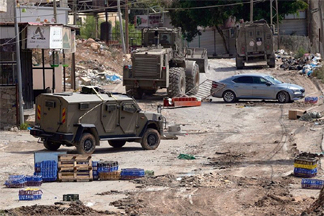
JENIN, West Bank (TIP): When Mujahid Abadi stepped outside to see if Israeli forces had entered his uncle’s neighborhood, he was shot in the arm and the foot. That was only the start of his ordeal. Hours later, beaten and bloodied, he found himself strapped to the searing hood of an Israeli military jeep driving down a road.
The army initially said Abadi was a suspected militant, but later acknowledged he had not posed a threat to Israeli forces and was caught in crossfire with militants.
Video showing the 24-year-old strapped to the jeep circulated on social media, sparking widespread condemnation, including from the United States. Many said it showed that Israeli soldiers were using him as a human shield — a charge Israel has frequently leveled at Hamas as it battles the group in Gaza.
The military said it was investigating the incident and that it did not reflect its values. But Palestinians saw it as yet another act of brutality in Israel’s crackdown on the occupied West Bank, where violence has surged since Hamas’ Oct. 7 attack triggered the war in Gaza.
Abadi, speaking to The Associated Press from a hospital bed on Tuesday, said he stepped outside his uncle’s house in the volatile West Bank city of Jenin on June 23 after he heard a commotion.
“I went outside to see what was happening, and looked towards the neighbors’ houses, where I saw the army,” he said. “When I tried to return to the house, heavy and indiscriminate gunfire was suddenly directed at me. My cousin who was near me was also hit.”
After he was shot in the arm, he hid behind his family’s car. Then he was shot again, in the foot. Unable to move, he called his father and told him he was about to die.
“I told him to try not to lose consciousness and to keep talking to me,” Raed Abadi said as he stood over his son’s hospital bed. “Suddenly, the call was disconnected.”
Raed later saw false reports on social media that a Palestinian had been killed in the raid. “I collapsed, because I was 90% sure it was my son,” he said.
Abadi was not dead, but his suffering had just begun.
After a couple of hours, Israeli soldiers found him. He says they struck his head and face and in the areas where he had been shot. Then they dragged him by his legs, lifted him by his hands and feet and threw him onto the hood of the military jeep. (AP) -

Ambitious Tory hopefuls could learn from Lady Macbeth’s fate ahead of leadership battle
London (TIP): Stefan Stern, City, University of London. Grant Shapps is running. The Tory MP has held what seems like every ministerial post possible and is famous in Westminster for his command of spreadsheets and data—in other words, for tracking the views and intentions of his fellow Tory MPs. He is ready for the battle ahead.
Priti Patel is running. The former home secretary is on good terms with Nigel Farage, leader of the Reform party. “She could plausibly present herself as the candidate who could best unify a divided right,” according to Paul Goodman, a former Conservative MP.
Kemi Badenoch is running. She is less of a fan of Farage’s, but has set out some sharp views, including on gender identity, which have further endeared her to many existing admirers on the right.
Penny Mordaunt is running. She has the profile after her striking sword-bearing role in the King’s coronation. She also has a confident manner on television, as exemplified in her appearance on the first seven-way debate of the campaign, during which, it should be noted, she said her boss, the prime minister, had been “completely wrong” to leave the D-day commemoration events rather early. She also has, it must be admitted, great hair.
Robert Jenrick is running. A new champion of tougher rules on immigration, a slimmed-down Jenrick has worked hard to establish a forceful political identity for himself.
And Suella Braverman is running. Hope—and ambition—spring eternal. And yet none of these people appear to be running for July 4. Their sights are set firmly on July 5.
Even as the Conservative Party stands poised to suffer one of its biggest ever election defeats, potential contenders to succeed Rishi Sunak as party leader are preparing for the fight to come. The body of the (seemingly) outgoing leader is not yet cold, but already thoughts are turning to the post-Sunak future.
This is business as usual at Westminster, where an old, macabre joke has it that, on hearing of the death of an elderly fellow MP, the traditional response is: “Oh dear, how sad, what was the majority?”
Future leadership contenders—Patel, Badenoch and Braverman—are positioning themselves with regard to their future relationship with Farage and the Reform Party rather than with the electorate. The current low poll rating for their own party has not dimmed their enthusiasm or energy levels.
What explains this sort of burning ambition, which seems to manifest itself as a renewable form of energy? The subject of ambition has intrigued me for many years, so much so that eventually I wrote a book about it, which is being published next month, just as Conservative ambitions are likely to collide in a fresh leadership battle.
The book’s title: Fair or Foul – the Lady Macbeth Guide to Ambition, hints at that ambivalence which, I think, many people experience with regard to personal and professional goals. On the one hand, we know that life can be extremely competitive and that the meek are very unlikely to inherit the earth. There is nothing wrong with being ambitious to achieve more and secure our future.
And yet, how do we feel when confronted by the truly, deeply ambitious—those people whose ruthlessness and determination can cause unease and even revulsion? How much time do we really want to spend around people like that? For a politician seeking popularity, and votes, these are hardly trivial questions. (AFP) -

Navigating through darkness: Ukraine’s emergency blackouts return after Russia pounds infrastructure
KYIV (TIP): During daytime, entire districts of Ukraine’s capital are disconnected from the power grid to save energy. Traffic lights stop, choking traffic, accompanied by the constant rumble of generators installed outside cafes and shops.
Ukraine, including Kyiv, is struggling to cope with a new wave of rolling blackouts after relentless Russian attacks took out half the country’s power generation capacity.
Residents and businesses of Kyiv are adapting to the absence of electricity using generators, power banks, and flashlights and even recalculating their bathroom visits. Heavy damage inflicted to the country’s power system has left millions feeling uncertain about Ukraine’s ability to meet the national electricity demand after the warm weather months are over and the weather turns cold.
“I light my apartment as our grandparents used to — with candles and small flashlights,” said Rudoy, a 40-year-old insurance agent from Israel who relocated from Tel Aviv to Kyiv in 2023 after Russia launched its full-scale invasion of Ukraine on Feb. 24, 2022.
He said that he wanted a new life despite the war — to live side-by-side with old friends and reside in a milder climate — but he hadn’t foreseen the inconveniences of living without power. Rudoy bought an apartment on the seventh floor of a newly built 25-story high rise with no gas system or water supply that’s wholly dependent on electricity.
“I have to adjust my life to the blackout schedules, otherwise it is impossible to live normally — not even to use a toilet at times,” Rudoy told The Associated Press.
A friend in a nearby district typically has power when he doesn’t, which makes his life easier. Work often gets done at a cafe that has a generator, but there’s a catch.
“Even if you find a free table at a cafe nearby, working generators are very noisy and spread diesel fumes,” he said. “That’s why not many cafes that operate during blackouts are actually good to work in.”
Ukraine is struggling to meet electricity demand as systematic attacks on its power infrastructure have intensified since March, forcing utilities to ration household supplies over the last three months. The country’s top officials repeatedly called on allied countries to provide more air defense systems to protect its power plants from Russian missiles and drones, but tangible damage had already been inflicted.
The blackouts in Kyiv are the worse since the early months of the war when Russian strikes on the country’s power grid led to major winter-time blackouts that led to authorities setting up communal heating areas and hundreds of emergency points where residents could drink tea, recharge their phones and get help. (AP) -

Historic flooding in China’s Guangdong kills nine, warnings issued for other parts of country
BEIJING (TIP): Nine people have died and six are missing after downpours caused historic flooding in rural parts of Guangdong province in southern China, while authorities warned on June 21 of more flooding ahead in other parts of the country.
Four people died and four are missing, in Meixian district in Guangdong’s Meizhou city, state broadcaster CCTV reported Thursday night. Another five are dead in Jiaoling county, which is also in Meizhou.
The heaviest rains were from Sunday into Tuesday, toppling trees and collapsing homes. A road leading to Meixian district completely collapsed during the heavy rains. The Songyuan river, which winds through Meizhou, experienced its biggest recorded flood, according to CCTV.
The estimated direct economic loss is 3.65 billion yuan ($502 million) in Jiaoling county, while in Meixian district, the loss is 1.06 billion yuan ($146 million).
Other parts of the country also face torrential rains and extreme weather in the next 24 hours, with the National Meteorological Center issuing a warning for several provinces in the south and a few individual places in the north.
Henan and Anhui provinces in central China, as well as Jiangsu province on the coast and the southern province of Guizhou, all are expecting hail and strong thunderstorms, according to the forecast. Rainfall could be as high as 50 mm to 80 mm (1.9 to 3.14 inches) in one day in Henan, Anhui and Hubei provinces, the National Meteorological Center said.
Last week, it was southern Fujian and Guangxi provinces experienced landslides and flooding amid heavy rain. One student died in Guangxi after falling into a river swollen from the downpour. (AP) -
Japan’s ‘beat poet’ Kazuko Shiraishi, pioneer of modern performance poetry, dies at 93
TOKYO (TIP): Kazuko Shiraishi, a leading name in modern Japanese “beat” poetry, known for her dramatic readings, at times with jazz music, has died. She was 93.
Shiraishi, whom American poet and translator Kenneth Rexroth dubbed “the Allen Ginsberg of Japan,” died of heart failure on June 14, Shichosha, a Tokyo publisher of her works, said on June 19.
Shiraishi shot to fame when she was just 20, freshly graduated from Waseda University in Tokyo, with her “Tamago no Furu Machi,” translated as “The Town that Rains Eggs” — a surrealist portrayal of Japan’s wartime destruction.
With her trademark long black hair and theatrical delivery, she defied historical stereotypes of the silent, non-assertive Japanese woman.
“I have never been anything like pink,” Shiraishi wrote in her poem.
It ends: “The road / where the child became a girl / and finally heads for dawn / is broken.”
Shiraishi counted Joan Miro, Salvador Dali and John Coltrane among her influences. She was a pioneer in performance poetry, featured at poetry festivals around the world. She read her works with the music of jazz greats like Sam Rivers and Buster Williams, and even a free-verse homage to the spirit of Coltrane.
Born in Vancouver, Canada, she moved back to Japan as a child. While a teen, she joined an avant-garde poetry group.
Shiraishi’s personality and poems, which were sometimes bizarre or erotic, defied Japan’s historical rule-bound forms of literature like haiku and tanka, instead taking a modern, unexplored path.
Rexroth was instrumental in getting Shiraishi’s works translated into English, including collections such as “My Floating Mother, City” in 2009 and “Seasons of Sacred Lust” in 1978.
Over the years, her work has been widely translated into dozens of languages. She was also a translator of literature, including works by Ginsberg.
In 1973, Paul Engle invited her to spend a year as a guest writer at the International Writing Program at the University of Iowa, an experience that broadened her artistic scope and helped her gain her poetic voice.
“In the poems of Kazuko Shiraishi, East and West connect and unite fortuitously,” wrote German writer Gunter Kunert. “It refutes Kipling’s dictum that East is East and West is West and never the twain shall meet. In Kazuko Shiraishi’s poems this meeting has already happened.” (AP) -

South Korea will consider supplying arms to Ukraine after Russia and North Korea sign strategic pact
SEOUL (TIP): South Korea said on June 20 that it would consider sending arms to Ukraine, a major policy change suggested after Russia and North Korea rattled the region and beyond by signing a pact to come to each other’s defense in the event of war.
The comments from a senior presidential official came hours after North Korea’s state media released the details of the agreement, which observers said could mark the strongest connection between Moscow and Pyongyang since the end of the Cold War. It comes at a time when Russia faces growing isolation over its war in Ukraine and both countries face escalating standoffs with the West.
According to the text of the deal published by the North’s official Korean Central News Agency, if either country gets invaded and is pushed into a state of war, the other must deploy “all means at its disposal without delay” to provide “military and other assistance.” But the agreement also says that such actions must be in accordance with the laws of both countries and Article 51 of the United Nations Charter, which recognizes a U.N. member state’s right to self-defense.
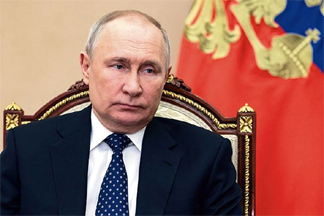
North Korean leader Kim Jong Un and Russian President Vladimir Putin signed the pact at a summit Wednesday in Pyongyang. Both described it as a major upgrade of bilateral relations, covering security, trade, investment, cultural and humanitarian ties.
The office of South Korean President Yoon Suk Yeol issued a statement condemning the agreement, calling it a threat to the South’s security and a violation of U.N. Security Council resolutions, and warned that it would have negative consequences on Seoul’s relations with Moscow.
“It’s absurd that two parties with a history of launching wars of invasion — the Korean War and the war in Ukraine — are now vowing mutual military cooperation on the premise of a preemptive attack by the international community that will never happen,” Yoon’s office said.
At the United Nations in New York, South Korean Foreign Minister Cho Tae-yul called it “deplorable” that Russia would act in violation of multiple U.N. sanctions resolutions against North Korea that Moscow voted for.
Yoon’s national security adviser, Chang Ho-jin, said Seoul would reconsider the issue of providing arms to Ukraine to help the country fight off Russia’s invasion.
South Korea, a growing arms exporter with a well-equipped military backed by the United States, has provided humanitarian aid and other support to Ukraine while joining U.S.-led economic sanctions against Moscow. But it has not directly provided arms to Kyiv, citing a longstanding policy of not supplying weapons to countries actively engaged in conflict.
Speaking to reporters in Hanoi, where he traveled right after Pyongyang, Putin said Thursday that supplying weapons to Ukraine would be “a very big mistake” on South Korea’s part. (AP) -

Earthquakes shake Japanese region, collapse two homes damaged in deadly January quake
Tokyo (TIP): Earthquakes early on June 4 again struck Japan’s north-central region of Ishikawa, still recovering from the destruction left by a powerful quake on January 1, but the latest shaking caused only minor damage.
A magnitude 5.9 temblor on the northern top of the Noto Peninsula was followed minutes later by a 4.8 and then several smaller quakes within the next two hours, the Japan Meteorological Agency said. There was no danger of a tsunami. Two houses that had been damaged in the January 1 quake collapsed in Wajiima city but no injuries or other damage was reported so far, according to the Fire and Disaster Management Agency.
JMA seismology and tsunami official Satoshi Harada said on June 4 quakes were believed to be aftershocks of the magnitude 7.6 earthquake on January 1.
Seismic activity has since slightly subsided but Harada urged people to be cautious, especially near buildings that were damaged earlier.
Shinkansen super-express trains and other train services were temporarily suspended for safety checks but most of them resumed, according to West Japan Railway Co.
The Nuclear Regulation Authority said no abnormalities were found at two nearby nuclear power plants. One of them, the Shika plant on the Noto Peninsula, had minor damage, though officials said that did not affect cooling functions of the two reactors.
Hokuriku Electric Power Co said there were no power outages.
Monday’s rattlings rekindled fear among residents who are still struggling to recover from damages from the New Year’s quake. NHK public television showed a number of people who came out of their homes and temporary shelters to see if there were additional damage.
Reconstruction comes slowly in mountainous areas on the peninsula and many damaged houses remain untouched. In Wajima, which was one of the hardest-hit areas, an inn operator told NHK that he immediately ducked under the desk at the reception when the first quake struck on Monday. Nothing fell to the floor or broke, but it reminded him of the January shakings and made him worry that a big quake like that had occurred even five months later. The January 1 quake killed 241 people. Damages still remain, and many residents remain evacuated. (AP) -
China pressuring other nations not to attend Ukraine peace talks: Zelenskyy
Singapore (TIP): President of Ukrainian Volodymyr Zelenskyy accused China of helping Russia to disrupt a Swiss-organised peace conference on the war in Ukraine, speaking at Asia’s premier security conference on June 2.
In a news conference at the Shangri-La defense forum in Singapore, Zelenskyy said that China is pressuring other countries and their leaders not to attend the upcoming talks.
“Russia, using Chinese influence in the region, using Chinese diplomats also, does everything to disrupt the peace summit,” he said, according to a simultaneous translation of his remarks. “Regrettably this is unfortunate that such a big independent powerful country as China is an instrument in hands of Putin.” In a speech earlier in the day, Zelenskyy urged top defence officials to attend the upcoming summit, saying he was disappointed at the failure of some countries to commit to joining.
Chinese Defence Minister Dong Jun spoke earlier in the day at the Shangri-La conference but he did not appear to be in the room when Zelenskyy made his appeal. — AP -
North Korea sends hundreds of more trash-carrying balloons to South Korea
Seoul (TIP): North Korea launched hundreds of more trash-carrying balloons toward the South after a similar campaign a few days earlier, according to South Korea’s military, in what Pyongyang calls retaliation for activists flying anti-North Korean leaflets across the border.
Between June 1 and June 2 morning, about 600 balloons flown from North Korea have been found in various parts of South Korea. The balloons carried cigarette butts, scraps of cloth, waste paper and vinyl, but no dangerous substances were included, South Korea’s Joint Chiefs of Staff said Sunday. The military advised people to beware of falling objects and not to touch objects suspected to be from North Korea but report them to military or police offices instead. There have been no reports of injuries or damage.
In Seoul, the city government sent text alerts saying that unidentified objects suspected to be flown from North Korea were detected in skies near the city and that the military was responding to them. The North’s balloon launches added to a recent series of provocative steps, which include its failed spy satellite launch and a barrage of short-range missiles launches that the North said was intended to demonstrate its ability to attack the South preemptively. South Korea’s military dispatched chemical rapid response and explosive clearance teams to recover the debris from some 260 North Korean balloons that were found in various parts of the country from Tuesday night to Wednesday.
The military said the balloons carried various types of trash and manure but no dangerous substances like chemical, biological or radioactive materials. Some of the balloons were found with timers that suggested they were designed to pop the bags of trash midair.
In a statement on Wednesday, Kim Yo Jong, the powerful sister of North Korean leader Kim Jong Un, confirmed that the North sent the balloons to make good on her country’s recent threat to “scatter mounds of wastepaper and filth” in South Korea in response to leafleting campaigns by South Korean activists.
She hinted that balloons could become the North’s standard response to leafletting moving forward, saying that the North would respond by “scattering rubbish dozens of times more than those being scattered to us.” South Korea’s Unification Ministry said Friday that North Korea must stop the provocations — also including its missile launches and other acts — or face unspecified “unbearable” consequences. South Korea’s military has said it has no plans to shoot down the balloons, citing concerns about causing damage or the possibility that they might contain dangerous substances. Firing at balloons near the border would also risk triggering a retaliation from the North at a time of high tensions.
“(We) decided it was best to let the balloons drop and recover them safely,” Lee Sung Joon, spokesperson of South Korea’s Joint Chiefs of Staff, said during a briefing Thursday.
North Korea is extremely sensitive about any outside attempt to undermine Kim Jong Un’s absolute control over the country’s 26 million people, most of whom have little access to foreign news. (AP) -

Mexico elects Sheinbaum as first woman president
Mexico City (TIP): Claudia Sheinbaum, a scientist with a PhD in physics, has been elected by a huge margin as Mexico’s first female president. Sheinbaum, 61, will succeed her mentor Andres Manuel Lopez Obrador, who first included her in the government in 2000 and with whom she broke away from the Party of Democratic Revolution (PRD) in 2014 to form Morena that is also headed for super majorities in both houses of the Congress.
“For the first time in the 200 years of the republic, I will become the first woman president of Mexico,” Sheinbaum told supporters, according to the Mexican media.
A successful politician in her own right, she was the Mayor of Mexico City during Obrador’s tenure as the President. The final vote in Sheinbaum’s favour is expected to be 60.7 per cent, making it the highest vote percentage by a Presidential candidate in Mexico’s democratic history.
Mexican analysts felt a glass ceiling was broken because of Mexico’s pervasive macho culture and the majority Roman Catholic population which tends to circumscribe the role of women in public life in those parts.
They noted that she was the first woman to win a general election in the entire North America — the US, Mexico or Canada.
The elections were the most violent with 38 candidates murdered amid an expansion of organised crime cartels during Obrador’s term as the President during which 1.85 lakh people suffered violent deaths. (TNS) -
ANC in talks with 5 parties for coalition govt in S Africa
Johannesburg (TIP): Top officials in South Africa’s African National Congress (ANC) have had initial talks with representatives of five other parties over a coalition or other agreement to form a government, but no decision has been made and the talks are at an early stage, the ANC said June 5.
South Africa faced an election deadlock after the long-ruling ANC lost its 30-year majority in an election last week but no party managed to overtake it. The ANC remained the biggest party. ANC spokesperson Mahlengi Bhengu-Motsiri told reporters that there had been “exploratory” talks with the main opposition Democratic Alliance, the far-left Economic Freedom Fighters and three other smaller parties.
She said the ANC had “repeatedly” reached out to the new MK Party of former President Jacob Zuma for talks, but there had been “no positive response.” Zuma is a former ANC leader. — AP -
Ukraine hits Russian oil facilities
Kyiv (TIP): In Kyiv’s ongoing effort to disrupt the Kremlin’s war machine, Ukrainian drones struck an oil refinery and a fuel depot in Russian border regions, officials in the targeted areas said on June 6.
Meanwhile, Ukrainian President Volodymyr Zelenskyy joined world leaders in France on Thursday to commemorate the D-Day invasion and seek more Western help even as his forces battled to stave off a Russian onslaught near the eastern city of Kharkiv in Europe’s biggest conflict since World War II.
Zelenskyy’s trip came a day after Russian President Vladimir Putin warned that Russia could provide long-range weapons to other countries so that they could strike Western targets. That threat came after NATO allies said they would allow Ukraine to use weapons they deliver to attack Russian territory. (PTI) -

40 killed in Israel’s ‘targeted’ strike on UN school in Gaza
CAIRO/JERUSALEM (TIP): Israel hit a Gaza school on June 6 with what it described as a targeted airstrike on up to 30 Hamas fighters inside. A Hamas official said 40 people, including women and children, were killed as they were taking shelter in the UN site.
Video footage showed Palestinians hauling away bodies after the attack, which took place at a sensitive moment in mediated talks on a ceasefire that would involve releasing hostages held by Hamas and some of the Palestinians held in Israeli jails.
The United States issued a joint statement with other countries on Thursday calling on Israel and Hamas to make whatever compromises were necessary to finalise a deal after eight months of war in the Gaza Strip.
Ismail Al-Thawabta, the director of the Hamas-run government media office, rejected Israel’s assertion that the UN school in Nuseirat, in central Gaza, had hidden a Hamas command post.
“The occupation uses … false fabricated stories to justify the brutal crime it conducted against dozens of displaced people,” Thawabta said.
Israel’s military said its fighter jets had carried out a “precise strike” and circulated satellite photos highlighting two parts of a building where it said the fighters were based. “We’re very confident in the intelligence,” military spokesperson Lt Col Peter Lerner said, accusing Hamas and Islamic Jihad fighters of deliberately using UN facilities as operational bases.
Meanwhile, the Israeli military has warned the government its policy of cutting off funds to the Palestinian Authority could push the occupied West Bank into a third “intifada”, public broadcaster Kan Radio reported on Thursday.
The warning underlined the increasingly dire state of the West Bank economy where thousands of workers have lost their jobs in Israel and public servants have been unpaid or on partial pay for months. — Reuters -
Taiwan Parliament passes ‘pro-China’ Bills, sparking protest
Taipei (TIP): Taiwan’s opposition-controlled legislature passed changes on May 25 that are seen as favouring China and diminishing the power of the island’s president, sparking protests by thousands of people.
The changes pushed by the opposition Nationalist Party and its allies would give the legislature greater power to control budgets, including defense spending that the party has blocked in what many see as a concession to China.
It remains unclear whether the package of bills will become law. The Executive Yuan, the executive branch of government headed by the premier, may veto legislation or pass it on to the president, who has to proclaim bills into law within 10 days. If the Executive Yuan or the president does not comply, the bills will not become law.
Thousands of people gathered outside the legislature to protest the changes. The legislative chamber was festooned with banners promoting both sides in the dispute, while arguments on the floor broke into shouting and pushing matches. The Nationalists, also known as the KMT, officially back unification with China, from which Taiwan separated during a civil war in 1949. —AP -
UK’s July General Election: Impact on India FTA, Indo-Pacific tilt
London (TIP): The prospect of an India-UK free trade agreement (FTA) has been kicked into the long grass after British Prime Minister Rishi Sunak surprised many this week with a snap summer poll on July 4, exactly a month after India’s election results on June 4.
While political analysts and strategic experts have expressed confidence that very little should change on the bilateral relationship front whatever the outcome in either election, the very small window that was open for a deal being clinched by the Sunak-led Tory government has now been swept away in the election wave of both countries.
The India-UK Free Trade Agreement (FTA) negotiations opened in January 2022 and are aimed at significantly enhancing bilateral trade – currently worth around 38.1 billion pounds a year.
The Opposition Labour Party, in the lead in most pre-election surveys, has committed itself to “finish the job” but the timelines will remain uncertain for some time.
“Rishi Sunak’s shock poll date announcement of July 4 has skewered any prospect of the finalisation of the long-awaited and much-anticipated FTA with India by a Conservative government,” said Rahul Roy-Chaudhury, Senior Fellow for South and Central Asian Defence, Strategy and Diplomacy at the London-based think tank International Institute for Strategic Studies (IISS).
“The Labour Party, widely expected to form the next government in the UK, has maintained steadfast support for such a deal, subject to an examination of the ‘fine print’ once it comes into office. The prospect for such a trade deal appears positive, providing an early boost to relations between the two new governments – the Labour and the widely expected third Modi government,” he said.
Dr Chietigj Bajpaee, Senior Research Fellow for South Asia, Asia-Pacific Programme at Chatham House, described the FTA as a “key watchpoint” for its broader strategic significance in terms of deepening the bilateral relationship.
There are 26 chapters in the FTA, including goods, services, investments, and intellectual property rights.
The Indian industry is demanding greater access for its skilled professionals from sectors like IT and healthcare in the UK market, besides market access for several goods at nil customs duty.
On the other hand, the UK is seeking a significant cut in import duties on goods such as scotch whiskey, electric vehicles, lamb meat, choco lates, and certain confectionary items. (PTI) -
10K asylum seekers entered UK on small boats since Jan: Govt
London (TIP): Over 10,000 asylum seekers have arrived in Britain in small boats so far this year, updated government data showed on May 24, underlining a key challenge facing Prime Minister Rishi Sunak ahead of a July 4 national election. The number of people landing on England’s southern beaches after making the dangerous Channel crossing fell by a third in 2023, but the latest numbers on a government website showed 10,170 arrived between January and May 25, up from 7,395 over the same period last year. Sunak, who announced the election date on Wednesday, said later this week that asylum seekers who come to Britain illegally would not be deported to Rwanda before the vote casting doubt on one of his Conservative Party’s flagship policies.
The plan has been bogged down by legal obstacles for more than two years, and the opposition Labour Party, which is about 20 points ahead in opinion polls and seen on track to end 14 years of Conservative rule, has promised to scrap the policy if it wins the election. — Reuters -

Iran opens registration for June presidential election after Raisi died in helicopter crash
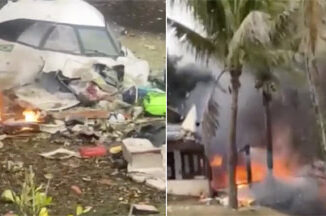
Dubai (TIP): Iran opened a five-day registration period on May 30 for hopefuls wanting to run in the June 28 presidential election to replace the late Ebrahim Raisi, who was killed in a helicopter crash earlier this month with seven others. The election comes as Iran grapples with the aftermath of the May 19 crash, as well as heightened tensions between Tehran and the United States, and protests including those over the 2022 death of Mahsa Amini that have swept the country.
While Supreme Leader Ayatollah Ali Khamenei, 85, maintains final say over all matters of state, presidents in the past have bent the Islamic Republic of Iran toward greater interaction or increased hostility with the West.
The five-day period will see those between the ages of 40 to 75 with at least a master’s degree register as potential candidates. All candidates ultimately must be approved by Iran’s 12-member Guardian Council, a panel of clerics and jurists ultimately overseen by Khamenei. That panel has never accepted a woman, for instance, nor anyone calling for radical change within the country’s governance.
Ahmad Vahidi, Iran’s interior minister, opened the registration period. The Interior Ministry, in charge of the country’s police, run Iranian elections with no substantial international observation.
“These elections, like the parliamentary elections, will be held in complete safety and health, with good competition and wide participation of all dear people,” Vahidi said.
Raisi, a protege of Khamenei, won Iran’s 2021 presidential election after the Guardian Council disqualified all of the candidates with the best chance to potentially challenge him. That vote saw the lowest turnout in Iran’s history for a presidential election. This year’s parliamentary vote saw an even-lower turnout amid widespread boycott calls.
That likely was a sign of voters’ discontent with both a hard-line cleric sanctioned by the US in part over his involvement in mass executions in 1988, and Iran’s Shiite theocracy over four decades after its 1979 Islamic Revolution.
Who will run — and potentially be accepted — remains in question. The country’s acting president, Mohammad Mokhber, a previously behind-the-scenes bureaucrat, could be a front-runner, because he’s already been seen meeting with Khamenei. Also discussed as possible aspirants are former hard-line President Mohammad Ahmadinejad and former reformist President Mohammad Khatami — but whether they’d be allowed to run is another question. The five-day registration period will close on Tuesday. The Guardian Council is expected to issue its final list of candidates within 10 days afterwards. That will allow for a shortened two-week campaign before the vote in late June.
The new president will take office while the country now enriches uranium at nearly weapons-grade levels and hampers international inspections. Iran has armed Russia in its war on Ukraine, as well as launched a drone and missile attack on Israel amid the war in Gaza. Tehran also has continued arming proxy groups in the Middle East, like Yemen’s Houthi rebels and Lebanon’s Hezbollah militia.
Meanwhile, Iran’s economy has faced years of hardship over its collapsing rial currency. Widespread protests have swept the country, most recently over Amini’s death following her arrest over allegedly not wearing her mandatory headscarf to the liking of authorities, A UN panel says the Iranian government is responsible for the “physical violence” that led to Amini’s death.
Raisi is just the second Iranian president to die in office. In 1981, a bomb blast killed President Mohammad Ali Rajai in the chaotic days after the Islamic Revolution. (AP) -

Nuclear envoys of South Korea, US, Japan condemn North Korean spy satellite launch attempt
Seoul (TIP): Nuclear envoys of South Korea, the US and Japan on May 28 strongly condemned North Korea’s latest attempt to launch a military spy satellite, casting it as a blatant violation of UN resolutions and a serious threat to peace.
Lee Jun-il, director general for Korean Peninsula policy, discussed the North’s botched space rocket launch in three-way phone talks with his US and Japanese counterparts, Jung Pak and Yukiya Hamamoto, respectively, Seoul’s foreign ministry said in a release.
The envoys “stressed that it was a blatant violation of UN Security Council resolutions banning the North from any such launches using ballistic missile technology and that its provocations pose serious threats to peace and security in the region and beyond.”
The three sides vowed to continue coordination trilaterally and with the international community to prepare for the North’s potential additional provocation, saying such acts will “only strengthen the three-way security cooperation.”
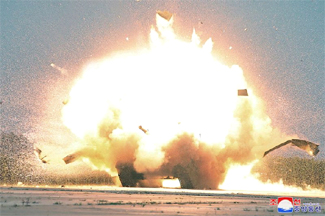
The phone talks came after the North said it launched a new rocket carrying a military reconnaissance satellite from a launching site on its northwest coast on Monday. The launch failed due to the air blast of the rocket during the first-stage flight.
It was the first launch attempt by Pyongyang after it successfully put its first military spy satellite into orbit in November last year, following the two previous botched attempts in May and August, respectively. (IANS)