Tag: World News

  • Swiss bar fire that killed 40 likely caused by champagne sparklers: Officials

    Swiss bar fire that killed 40 likely caused by champagne sparklers: Officials

    Bern (TIP)- Sparklers attached to champagne bottles and held too close to the ceiling likely sparked the deadly fire at the “Le Constellation” bar in Crans-Montana, Switzerland, during a New Year’s party, killing at least 40 people, CNN quoted officials as saying.
    The blaze reportedly spread rapidly due to a flashover, and Swiss prosecutors have opened an investigation into possible criminal responsibility. Earlier, at a press conference in Crans-Montana, Valais Cantonal Police Commander Frederic Gisler said authorities responded swiftly after a fire was reported at a bar in the area. According to Gisler, smoke was first seen coming from the bar in the centre of the Swiss ski resort at around 1:30 am. Moments later, a witness contacted the emergency call centre to report the incident. A red alert was immediately issued to mobilise firefighting services, he added. The first teams from the Crans-Montana intercommunal police and the gendarmerie reached the scene at 1:32 am, and were soon joined by additional emergency responders, CNN reported.
    “Their initial assignment was obviously to take care of the victims, to provide them emergency help,” Gisler said. He noted that firefighters managed to extinguish the blaze quickly. “Following that, the initial investigations were able to start,” he said. Reception centres were later set up to assist those affected by the incident, and a helpline was launched at 4:14 am to provide information and support to families. “All of the injured people had received care by shortly after 5 am, thanks to this widescale mobilisation,” CNN quoted Gisler as saying.
    Families of those who lost their lives in the fire at Crans-Montana are facing a painful wait, as local authorities said it could take several days to identify all of the approximately 40 victims, CNN reported.
    “Currently and in the days to come, the priority will be identifying the people who have died so that their bodies can be returned quickly to their families,” Gisler said in a press conference.
    Swiss bar fire was like ‘hell’: Survivors recount ski resort blaze
    Ringing in the new year with a night of drinking and dancing high in the Swiss Alps, Ebenezer Mehari, 17, decided to take a breather outside the packed Constellation Bar.
    As he turned to go back inside, he told NBC News at the scene Friday, “hell” erupted as a deadly fire broke out. “I heard a big boom, and everybody was screaming,” he said.
    Mehari said a thick smoke enveloped the venue and the crowd, blinding him. He fell to the ground as people rushed to escape the bar, he said, but a man pulled him away to safety. His friends were not so lucky, he says. “I have four friends who died,” he said, still struggling to process the loss. “For me, it’s not real.”
    Axel Clavier, 16, from Paris, told The Associated Press that he lost his jacket, shoes and phone while fleeing, though he was grateful to have made it out. “I am still alive and it’s just stuff,” he said. “I’m still in shock.”
    Samuel Rapp said he was at a restaurant next door when the fire broke out.
    “A lot of people were screaming and it was horrible,” Rapp told NBC News’ British broadcasting partner Sky News. “People were walking on everybody,” he said, adding that he “saw a lot of people on the floor, and I think these people were dead because someone put jackets on their faces.”

  • South Koreans now free to read North’s newspaper, once banned as seditious

    In a quiet but symbolically significant shift, South Korea has eased long-standing restrictions on access to North Korea’s official newspaper, Rodong Sinmun, reflecting a renewed effort to reduce tensions and promote understanding between the two Koreas.
    For decades, the publication known for its strong propaganda, missile coverage, and praise of North Korea’s leadership was considered so inflammatory that South Koreans were barred from reading it without special permission.
    Under the current administration of President Lee Jae Myung, however, citizens can now view the newspaper at select public libraries without prior approval, marking a departure from Cold War-era controls.
    President Lee has downplayed fears surrounding the move, suggesting that exposure to the paper would not sway public ideology but could instead help people better understand the realities of life and politics in the North.
    While opinions in Seoul remain divided, some citizens see the change as unnecessary or unsettling, while others believe few people will actively seek out a state-controlled publication in an era where print media is already declining.

  • Strengthening India-Romania Economic and Technology Partnerships

    Strengthening India-Romania Economic and Technology Partnerships

    BUCHAREST (TIP): In a key highlight last week, the Embassy hosted prominent Romanian business leaders for a special presentation on India’s rising economy, delivered by Mr. Bhuvnesh Kumar, Deputy Secretary, Department for Promotion of Industry and Internal Trade (DPIIT), Ministry of Commerce and Industry. Ambassador Manoj Kumar Mohapatra delivered the opening remarks, underscoring India’s dynamic growth trajectory, projected at over 7% GDP growth in 2025, followed by an interactive Q&A session. The event advanced discussions on trade, investment, and collaboration opportunities between the two nations.

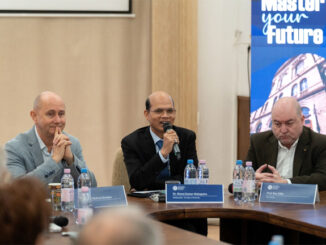
    Mr. Bhuvnesh Kumar, Deputy Secretary, Department for Promotion of Industry and Internal Trade spoke about the GDP growth of India over the years

    ICC Country Head Mr. Gheorghe Dinu, Mr. Naimish Kumar Patel from Dimar Recruitment & Immigration Services, Mr. Morten Reimers of Falcon Defense, and Ms. Adriana Radu of RIZ highlighted emerging opportunities for Romanian companies to engage with the Indian market. These partners played a pivotal role in fostering stronger India-Romania business ties.

    Ambassador conducted an interactive question-and-answer session.

    Spotlight on IT & ITES Collaboration: A Strategic Pillar of Bilateral Growth

    Complementing this initiative, the Embassy, in collaboration with the Federation of Indian Chambers of Commerce & Industry (FICCI) and the Electronics and Computer Software Export Promotion Council, successfully organized a Business-to-Business (B2B) Meeting focused on Information Technology and Communications (IT&C), including IT Enabled Services (ITES). The event brought together over more than 100 leading Indian and Romanian companies, creating a dynamic platform for interaction, knowledge exchange, and the exploration of new partnership opportunities.

    ICC Country Head Mr. Gheorghe Dinu spoke about the opportunities for Romanian companies to engage with the Indian market.

    The India-Romania IT & ITES partnership has evolved naturally from shared strengths. India’s global leadership in software exports and its vast talent pool of over 5 million IT professionals complement Romania’s highly skilled workforce of 200,000+ IT specialists and its position as one of Europe’s fastest-growing technology hubs. This synergy has already delivered tangible results.

    Mr. Naimish Kumar Patel from Dimar Recruitment & Immigration Services spoke about opportunities for Romanian companies to engage with the Indian market.

    Indian companies operating in Romania, including Tata Consultancy Services (TCS), Infosys, Wipro, and HCL Technologies, have generated over 10,000 high-quality jobs for Romanian professionals as of 2025, primarily in cities such as Bucharest, Cluj-Napoca, and Timișoara. These roles span software development, cybersecurity, cloud computing, artificial intelligence, and BPO services, contributing significantly to Romania’s economy through direct employment, skill development, and technology transfer.

    Mr. Morten Reimers of Falcon Defense spoke about opportunities for Romanian companies to engage with the Indian market.

    The B2B meeting further amplified these achievements by facilitating targeted matchmaking sessions, enabling participants to identify immediate opportunities in AI-driven solutions, digital transformation projects, and nearshoring services for EU markets.

    Ms. Adriana Radu of RIZ spoke about opportunities for Romanian companies to engage with the Indian market.

    Future Horizons: Building Momentum Towards India’s AI Summit and Localized Initiatives

    These engagements serve as important lead-up activities to the Government of India’s landmark AI Summit, scheduled for February 2026. This flagship national event will bring together global leaders, innovators, and policymakers to shape ethical AI governance, promote inclusive deployment, and advance transformative applications across sectors, closely aligning with shared India-Romania priorities in IT and ITES.

    Attendees at the B2B Meeting.

    Building on this momentum, the Embassy of India plans to organize “AI for All” Conferences in key Romanian technology hubs: Brașov on January 14, 2026, and Timișoara in the first week of February 2026. Organized in association with leading Indian companies such as Global Logitech and Wipro, these events will focus on democratizing access to AI, fostering hands-on workshops, and exploring collaborative R&D in areas including AI ethics, healthcare applications, and smart cities.

    Ambassador Dr. Manoj Kumar Mohapatra at the IT&C event held at the embassy spoke about India’s development in the industry.

    By convening local startups, universities, and industry experts, these conferences aim to accelerate technology transfer, strengthen bilateral talent pipelines, and position Romania as a co-innovation partner within India’s expanding AI ecosystem.

    FICCI highlighted their reach on a global level.

    These initiatives underscore the shared commitment of India and Romania to deepening economic and technological cooperation, leveraging India’s growth momentum and Romania’s strategic position within Europe. The Embassy remains fully committed to nurturing these partnerships to ensure sustained and mutually beneficial prosperity.

    (Based on a Press Release issued by the Embassy of India in Bucharest)


  • Seminar on Ayurveda & Holistic Healing and Celebration of World Meditation Day organized in Bucharest

    Seminar on Ayurveda & Holistic Healing and Celebration of World Meditation Day organized in Bucharest

    BUCHAREST (TIP): Embassy of India in collaboration with Indo-Moldova Business and Cultural Organisation (IMBCO) and Jiva Yoga, successfully organized a Seminar on Ayurveda and Holistic Healing on 20 December in Chisinau, highlighting the timeless wisdom of India’s traditional system of medicine.

    Dr. Kapil Bharadwaj spoke about the relevance of Ayurveda in modern lifestyles.

    The seminar was conducted by renowned Ayurvedic expert Dr. Kapil Bharadwaj, who provided an insightful overview of Ayurvedic principles and therapeutic practices. During the interactive session, Dr. Bharadwaj explained the foundational concepts of Ayurveda, emphasizing the balance of mind, body, and spirit as the key to overall well-being. He elaborated on various Ayurvedic treatment methods and offered a comprehensive understanding of Panchakarma therapies, underlining their role in detoxification, rejuvenation, and preventive healthcare.

    The event was well received by the participants.

    Dr. Bharadwaj also highlighted how Ayurveda contributes to maintaining both physical and mental health by addressing the root causes of ailments rather than merely treating symptoms. The seminar shed light on the relevance of Ayurveda in modern lifestyles, particularly in managing stress, improving immunity, and promoting long-term wellness through natural and holistic approaches. The event witnessed enthusiastic participation, with visitors showing keen interest in natural healing systems and preventive care.

    Group picture : Seminar on Ayurveda and Holistic Healing.

    Participants appreciated the practical insights shared during the seminar and gained valuable knowledge about adopting Ayurvedic practices for a healthier and more balanced life. The seminar reaffirmed the growing global interest in Ayurveda as a holistic and sustainable healthcare system and marked another successful initiative by Indian Embassy, IMBCO and Jiva Yoga in promoting traditional knowledge and wellness practices.

    Celebrations of World Mediation Day.

    In another event, Embassy of India, in collaboration with the Brahma Kumaris, organized a special meditation session to mark World Meditation Day. The event was attended by Friends of India and members of the Indian diaspora. The session highlighted the importance of meditation for inner peace, mental well-being, and harmonious living. Participants actively engaged in the guided meditation and later shared their personal experiences and insights, reflecting on the positive impact of meditation on daily life.

    Participants shared their personal experiences and insights about meditation.

    The Embassy appreciated the valuable contribution of the Brahma Kumaris in promoting mindfulness and well-being and thanked all participants for their enthusiastic participation.

    (Based on a press release issued by the Embassy of India in Bucharest)

  • Ambassador Dr. Manoj Kumar Mohapatra Visits Romanian Municipalities to Explore Cooperation Opportunities

    Ambassador Dr. Manoj Kumar Mohapatra Visits Romanian Municipalities to Explore Cooperation Opportunities

    BUCHAREST (TIP): Dr. Manoj Kumar Mohapatra, Ambassador of India to Romania, undertook visits to the Romanian municipalities of Caracal, Râmnicu Vâlcea and the commune of Dobrosloveni, with a view to exploring opportunities for cooperation in economic, educational, cultural and people-to-people domains.

    Ambassador met Mayor of Dobrosloveni, Mr. Gheorghe Tudorașcu

    In Caracal, Ambassador Mohapatra met with the city’s leadership, including Mayor Mr. Ion Doldurea and Deputy Mayor Ms. Lari Pătran, to discuss prospects for foreign investment. The Mayor highlighted Caracal’s strategic advantages, including the availability of a skilled workforce, strong road connectivity through the express road linking to the A1 motorway, proximity to Craiova Airport, and rail freight transport potential. The Ambassador was also taken on a tour of the city’s prominent cultural landmarks, including the “Ion Hagiescu Miriște” Museum of Ethnography and Urban History and the National Theatre. The local administration reiterated its openness to dialogue and cooperation aimed at sustainable development.

    Ambassador Mohapatra and Mayor of Dobrosloveni, Mr. Gheorghe Tudorașcu spoke about future collaboration opportunities for foreign investment and long-term economic cooperation.

    The Ambassador also visited the commune of Dobrosloveni, where he was received by Mayor Mr. Gheorghe Tudorașcu and representatives of the local administration. Discussions focused on opportunities for foreign investment and long-term economic cooperation for the sustainable development of the community. A symbolic highlight of the visit was the planting of a tree at the cultural site Casa Malvei in Romula, signifying the deepening roots of friendship and cooperation between India and Dobrosloveni, while also promoting the Prime Minister Shri Narendra Modi’s campaign “Ek Ped Maa Ke Naam”. Further discussions were held at the Dobrosloveni Cultural Center in a warm and friendly atmosphere.

    Ambassador Dr Manoj Kumar Mohapatra and Mayor of Dobrosloveni, Mr. Gheorghe Tudorașcu planting a tree at the cultural site Casa Malvei in Romula.

    In Râmnicu Vâlcea, Ambassador held a meeting at the City Hall with Mayor Mr. Mircia Gutău. The discussions focused on strengthening collaboration between Indian institutions and entities in Râmnicu Vâlcea in areas such as economic cooperation, investment, education and wellness tourism, and cultural exchanges. The meeting, attended by Deputy Mayors Ms. Carmen Preda and Mr. Eusebiu Vețeleanu, as well as Public Administrator Ms. Andreea Iordache, took place in a cordial and constructive atmosphere. At the conclusion of the meeting, Ambassador Mohapatra proposed convening a follow-up interaction with Indian business leaders in Bucharest in January 2026, expressing optimism about establishing mutually beneficial partnerships.

    Discussion with Mayor of Ramnicu Valcea Mr. Mircia Gutău.

    During interactions with the local community, Ambassador Mohapatra noted the shared cultural values between India and Romania, particularly hospitality, traditional dance, and the joy of sharing meals together, underscoring the strong people-to-people connect between the two cultures. The Ambassador also extended invitations to the Mayors to lead business delegations to India at mutually convenient dates.

    Ambassador Mohapatra with Mr. Mircia Gutău, Mayor of Ramnicu Valcea , and others.

    The visits reflected India’s commitment to strengthening engagement with Romanian local administrations and promoting decentralized cooperation, investment partnerships, and cultural exchanges, thereby further deepening the India–Romania bilateral relationship.

    (Based on a press release issued by the Embassy of India in Bucharest)

  • Three scientists of Indian descent among 80 appointed to Order of Canada

    Three scientists of Indian descent are among 80 appointed to Order of Canada
    By Prabhjot Singh

    OTTAWA (TIP): When Canada talks about taking “brains” or top “scientists” under its refabricated program, it probably refers to the likes of thoracic surgeon Shaf Keshavjee, inventor and electrical engineer Praveen Jain, and professor of public health Chandrakant Padamashi Shah, who have over the years not only made a name in their respective fields but have also contributed immensely to the country they opted to make their home.

    They figure in the list of 80 appointed to the Order of Canada by the Governor General, Mary Simon, on the last day of the last year. Also in the list is the top Canadian sprinter, Andre de Grasse, winner of seven Olympic medals.

    Mary Simon made these new appointments to the Order of Canada that include 6 Companions, 15 Officers, and 59 Members. Six appointments are promotions within the Order, and another represents an honorary appointment.

    The Order of Canada is the cornerstone of the Canadian Honours System. Since its creation in 1967, more than 8,250 people from all sectors of society have been appointed to the Order. The contributions of these trailblazers are varied, yet they have all enriched the lives of others and made a difference to this country.

    “The Order of Canada fosters a sense of pride and cohesion in our country. Every appointment celebrates not only the talent, expertise, and dedication of individuals but also the countless lives they have touched through their work, vision, and contributions. Their commitment extends beyond borders, inspiring progress in our communities, our country, and around the world. I offer my heartfelt congratulations to each new appointee on this well‑deserved recognition,” says Mary Simon while making the appointments.

    The Order of Canada is one of the country’s highest honors. It recognizes people across all sectors of society who have made extraordinary and sustained contributions to our nation. Its motto, Desiderantes Meliorem Patriam, translates to “They desire a better country.”

    A member or an officer of the Order of Canada can be promoted to a higher level if he or she demonstrates further exceptional achievement. Nominations for a promotion can be considered a minimum of five years after the last appointment.

    Thoracic surgeon Shaf Keshavjee

    Thoracic surgeon Shaf Keshavjee is a world-renowned lung transplant specialist whose groundbreaking work has transformed transplant surgery globally. He continues to expand possibilities within regenerative medicine, particularly through advancements in lung preservation during critical transplant procedures. He also excels as an educator and hospital administrator, shaping the future of health care through innovation and leadership. Currently, he is the Surgeon-in-Chief of the Sprott Department of Surgery, the Director of the Toronto Lung Transplant Program and Latner Thoracic Research Laboratories at UHN, and a Professor of Thoracic Surgery at the University of Toronto.

    Furthermore, he is a member of the Order of Ontario and has been awarded two Queen Elizabeth II Diamond Jubilee Medals. In 2020, he received the prestigious Governor General of Canada’s Innovation Award. Other notable recognitions include UHN’s Inventor of the Year Award, Canada’s Top 40 Under 40, and the Lifetime Achievement Award from the Canadian Society of Transplantation.

    Keshavjee was 12 when he moved to Toronto from Kenya with his mother and his businessman father. The young Shaf was drawn to the sciences at North Toronto Collegiate. “I always knew I wanted to be a surgeon,” he recalls. “Not just a doctor, but a surgeon.”

    As a dedicated student, he hardly faced any problems getting into medical school at the University of Toronto. Though transplant surgery was never a consideration until the afternoon of November 7, 1983, when he was driving over a bridge on Mount Pleasant Avenue and heard on the radio that surgeon Dr Joel Cooper and his team had conducted the world’s first successful single lung surgery at Toronto General Hospital (TGH).

    “I thought, wow, that’s cool,” media quoted him saying about his early days.

    The risky procedure had been tried 44 times before without success. Three of those failures had been in Toronto. Most patients did not survive for more than two weeks

    Three years later, Keshavjee was on hand when history was made the second time at TGH. He was a surgery resident when he scrubbed into the operating room to witness the world’s first successful double lung transplant surgery on November 26, 1986. That day, Keshavjee stayed mostly on the sidelines, watching the “giants” of thoracic surgery in action. On the operating table lay Canadian Ann Harrison, whose lungs had been virtually destroyed by emphysema.

    Doctors told her that without surgery, she could just survive for a few months. Intriguingly, they also told her that even with the surgery, she may not be able to make it beyond the surgery table. She did and lived on for another 14 years.

    “By this time, all the other organs had been transplanted, but the lungs hadn’t,” says Keshavjee. “The first kidney and heart transplants were done in the ‘50s.”

    He completed his medical training at the University of Toronto in 1985 and specialized in general surgery, cardiac surgery, and thoracic surgery. He participated in the world’s first successful double lung transplant at Toronto General Hospital in 1986. Dr Keshavjee completed fellowships at Harvard University and the University of London. During his master’s studies, Dr. Keshavjee developed a lung preservation solution for donor lungs that has now been translated into clinical use around the world. Since then, he has led the development and translation of many innovations to the clinic, including the Ex Vivo Lung

    Inventor and electrical engineer Praveen Jain

    Another appointee to the Order of Canada is Praveen Jain, a leading inventor in electrical energy processing who has advanced efficient power generation, transmission, and use through electronics. A Queen’s University professor and founder of its Centre for Energy and Power Electronics Research, he has shaped the field while mentoring more than 100 trainees, earning recognition as an outstanding educator and innovator.

    For the past 24 years, Praveen Jain has been actively involved in the research and development of high-frequency power conversion technologies. He is considered one of the leading authorities in the world in the practical applications of power electronics.

    Jain has a natural ability to envision simple solutions to complex technical problems and then transfer these solutions into new designs. This ability has made him a tremendous asset to both academe and industry, to which he has successfully transferred technology from the university laboratory.

    His work has resulted in 25 patents and over 200 publications. His designs have been successfully applied to telecom power supplies, induction melting, computers, and space systems throughout the world.

    At Queen’s University, where he is a professor of electrical and computer engineering and Canada research chair in power electronics, Jain was able to attract millions of dollars in funding to conduct research and develop Canada’s first high-frequency power electronics laboratory. He has also supervised and guided over 50 graduate students, postdoctoral fellows, and power electronics engineers in academic and industrial research.

    He has received many awards and honors for his work, including a prestigious Tier 1 Canada Research Chair in Power Electronics at Queen’s University, an Innovation Award from the Canada Foundation for Innovation, and an Ontario Distinguished Researcher Award from the Ontario Innovation Trust. He has also been named a Fellow of the Institute of Electrical and Electronics Engineers (IEEE).

    Public health professor Chandrakant Padamashi Shah

    The third appointee of Indian descent, Chandrakant Padamashi Shah, Professor Emeritus at the University of Toronto’s Dalla Lana School of Public Health, transformed public health education nationwide and championed Indigenous health throughout his career. He reshaped Canada’s citizenship exam and established the country’s first endowed Indigenous health chair, leaving a profound legacy of inclusion, scholarship, and systemic reform.

    “The ninth of fifteen children in a small town in Maharashtra, India, Chandrakant Shah managed to attend medical school through diligent study, sometimes under an oil lamp. Like many others of his age, he went abroad for better opportunities, finally arriving in Canada, where he joined the School of Public Health at the University of Toronto. In Canada, he was immediately struck by the inequities in health and social services for the poor and the Aboriginal populations.

    Through the University of Toronto, he became involved with the Sioux Lookout Zone Program in Northwestern Ontario by volunteering his pediatric services to the remote and isolated First Nations communities. This sparsely populated region became his second home for a number of years. Throughout his professorship at the university, he worked tirelessly to draw attention to existing inequalities and to rectify them. In addition, he made important contributions to the teaching of public health in Canada and wrote the first comprehensive textbook on the subject that is now in its sixth edition. He retired in 2001 and was invited to work as a primary care physician at Anishnawbe Health Toronto (AHT), an Aboriginal community health center.

    (Prabhjot Singh, is a Toronto-based senior journalist. He can be reached at Prabhjot416@gmail.com)

  • Looking ahead: Challenges galore for those seeking immigration

    Looking ahead: Challenges galore for those seeking immigration

    By Prabhjot Singh

    TORONTO (TIP): “Poaching the best and ignoring the rest” appears to be the new immigration mantra of the developed and flourishing West that it wants to portray and implement in 2026. Conveying a strong message to the nations overflowing with manpower resources, both raw and skilled, the elite group of nations—most sought after by prospective immigrants—has been gradually barricading the borders to minimize the “infiltration.” To cap it, member nations of this group have set in motion both legal and inhumane deportation processes to get rid of what they call “dead wood,” as most of their ageing sections of society have met their requirements of the workforce.

    When the new Liberal government, led by Mark Carney, assumed office in April this year and presented its maiden budget in November, it clearly indicated that it would “look for the best of brains” to head new groups of scientific research. Bowing to the pressures, the Liberal government not only scaled down immigration levels but also introduced drastic cuts to the intake of international students. This major shift in the immigration rigmarole spells doom for hundreds of thousands of youngsters who want or aspire to make one of the developed Western nations their new home. Those with no skills find the immigration doors closed for them for now.

    Donald Trump, soon after starting his second term in office in January of the outgoing year, started sending through full loads of US Air Force aircraft, bereft of basic passenger facilities, with immigration seekers without proper documents to the countries of their origin, including India. And the process has been continuing unabated since then. Hundreds of thousands have already been sent home unceremoniously. Aircraft loads of “unwanted immigrants” are even now leaving the shores of various North American ports for destinations in South Asia, Africa, and other parts of the world regularly. Incidentally, those being deported exclude the brain doctors, engineers, and scientists.

    It is not only the closure of a channel that was taking a lot of loads off the governments of developing nations, but it has now started rebuilding the pressure on shrinking job opportunities and resources in these immigration feeder nations. While their best talent would be leaving the shores of the country, they would be left with numbers that they would find extremely difficult to adjust to under the tightening global economic norms.

    The brain drain would continue unabated, thus putting additional pressure on these fund- and resource-starved nations. Producing a doctor with six to eight years in a government medical institution in India costs the state a minimum of Rs 20 lakh. The same is the case with an engineer or IT specialist groomed at a government institution; the money spent by the state is no less than that of a doctor. And once these young, bright doctors, engineers, and IT experts step out of their institutions, the developed nations are out poaching for them. Instead of repaying the society that spent on their training and grooming, they leave their homelands, lured by green pastures overseas.

    The result is obvious. Their home turfs suffer from a shortage of doctors, engineers, technocrats, and other professionals. A simple case to illustrate this dilemma is the acute shortage of mental health officers in the country. Despite directions from the Apex Court that each district in the country must have a mental hospital, not even 20 per cent of districts in the country have such a facility. There is an acute shortage of super specialists in a country like India. Many medical colleges fake figures to show specialists and super specialists on their faculties, while in fact their services are requisitioned mostly from the private sector at the time of inspections.

    It is not health care. Other areas, especially information technology, science and research, engineering, and related areas, would continue to be impacted by the changed immigration policies of Western nations.

    Other than these technical or scientific “brains,” countries like India are also facing an acute shortage of middle-rung officers in their defense forces. One foremost reason is that pay packages are perhaps not as attractive as their counterparts’ pass-outs from IITs. Then some of the perks associated with jobs in the defense sector have been spiked so much that their added attractions have vanished in recent years. Even a lifetime career in the defense forces is not guaranteed under the Agnipath Yojana. Intriguingly, some of the able-bodied youth, looking for green pastures overseas and shirking jobs in uniform at home, were forced to join the armed forces overseas, as it happened in the case of Russia.

    There is an urgent need for a fresh look at the immigration policies of the nations abundant with manpower or human resources. A country like India needs to regulate its brain drain as well as the outflow of its raw human resources. It also comes with a need to audit the education and healthcare infrastructure in the country. India, for example, can market both its education and health care potentials as a retort to the Western world.

    Otherwise, developing economies would continue to lose the best to the West and keep the rest for their own use.

    (Prabhjot Singh is a Toronto based senior journalist. He writes on sports, politics and culture. He can be reached at prabhjot416@gmail.com)

  • Canadian Minister for Identity and Culture Greets Tamil Community on their Heritage Month

    Canadian Minister for Identity and Culture Greets Tamil Community on their Heritage Month

    By Prabhjot Singh

    OTTAWA (TIP): On January 1, 2026, Marc Miller, Minister of Canadian Identity and Culture, issued a formal statement to mark the beginning of Tamil Heritage Month. Canada’s rich diversity is reflected in the number of communities that dot its territory making it a true multiethnic and multicultural society. These communities add to the rich cultural heritage of Canada as they celebrate their festivals and hold their cultural events from time to time.

    Starting with the New Year, it is Tamil community that celebrates its Heritage month. To mark the celebrations, Marc Miller, Minister of Canadian Identity and Culture and Minister responsible for Official Languages, congratulated the community and its leaders.

    In a statement, he said “As Tamil Heritage Month begins today, I join all Canadians in wishing a wonderful month to Tamil communities across the country.

    “Home to one of the largest Tamil diasporas outside Asia, Canada has been a welcoming destination since 1983 for communities fleeing violence and instability. Through their resilience, determination, and commitment, Canadians of Tamil origin have helped build vibrant communities and strengthen our country’s cultural mosaic.

    “The contributions of the Tamil diaspora are felt in all areas: the arts, education, entrepreneurship, science, and beyond. Carried by one of the oldest languages still spoken today, Tamil heritage is a living legacy, rich in knowledge, traditions, and creativity, which continues to enrich our national heritage and shape our collective future.

    “As we celebrate this richness, we recognize that racism and discrimination remain a reality for too many racialized people in Canada. Our government is committed to building a society where everyone can live, express themselves, and celebrate their culture in safety. That is why the Government of Canada launched Changing Systems, Transforming Lives: Canada’s Anti-Racism Strategy 2024–2028 in 2024 and developed the first-ever Canada’s Action Plan on Combatting Hate to fight racism, celebrate our diversity, and give communities the resources they need to prevent and stand against hate and intolerance.

    “Throughout January, I invite all Canadians to discover the diversity and vitality of Tamil communities and their cultures across the country. I also wish a happy Thai Pongal (Lohri for Punjabis) celebrated in mid-January, to all people of Tamil origin here in Canada and around the world,” he added.

    Tamil community is well represented in local, provincial and federal politics. The Canadian Minister for Public Safety, Gary Anandasangaree, is of the Tamil descent.

    (Prabhjot Singh is a Toronto based senior journalist. He writes on sports, politics and culture. He can be reached at prabhjot416@gmail.com)

  • Thai army accuses Cambodia of violating truce with over 250 drones

    Thai army accuses Cambodia of violating truce with over 250 drones

    Bangkok (TIP)- Thailand’s army accused Cambodia on Monday of violating a newly signed ceasefire agreement, reached after weeks of deadly border clashes, by flying more than 250 drones over its territory.
    The Southeast Asian neighbours agreed to the “immediate” ceasefire on Saturday, pledging to end renewed border clashes that killed dozens of people and displaced more than a million this month.
    But the fresh allegation from Bangkok and its threat to reconsider releasing Cambodian soldiers held by Thailand left a sustained truce in doubt, even as their foreign ministers wrapped up two days of talks hosted by China.
    The Thai army said on Monday, Dec 29, “more than 250 unmanned aerial vehicles (UAVs) were detected flying from the Cambodian side, intruding into Thailand’s sovereign territory” on Sunday night, according to a statement.
    “Such actions constitute provocation and a violation of measures aimed at reducing tensions, which are inconsistent with the Joint Statement agreed” during a bilateral border committee meeting on Saturday, it said.
    The reignited fighting this month spread to nearly every border province on both sides, shattering an earlier truce for which US President Donald Trump took credit.
    Under the truce pact signed on Saturday, Cambodia and Thailand agreed to cease fire, freeze troop movements and cooperate on demining efforts and combatting cybercrime.
    They also agreed to allow civilians living in border areas to return home as soon as possible, while Thailand was to return 18 Cambodian soldiers captured in July within 72 hours, if the ceasefire held.
    – ‘Small issue’ –
    Cambodian Foreign Minister Prak Sokhonn described the drone incident as “a small issue related to flying drones seen by both sides along the border line”.
    He said on Cambodian state television on Monday that the two sides had discussed the issue and agreed to investigate and “resolve it immediately”.
    Thai army spokesman Winthai Suvaree said in a statement the drone activity reflected “provocative actions” and a “hostile stance toward Thailand”, which could affect the security of military personnel and civilians in border areas.
    Thailand’s army “may need to reconsider its decision regarding the release of 18 Cambodian soldiers, depending on the situation and the behaviour observed”, it said.
    Several family members of soldiers held by Thailand for six months had little faith they would be released, even before Bangkok raised fresh doubts.
    Heng Socheat, the wife of a soldier, told AFP on Monday she worried the Thai military might renege on its pledge.
    “Until my husband arrives home, then I will believe them,” she said.

  • North Korea says it tested long-range cruise missiles

    North Korea says it tested long-range cruise missiles

    Seoul (TIP)- North Korea said on Monday, Dec 29, it fired long-range strategic cruise missiles into the sea to test the country’s nuclear deterrence, days after it showed apparent progress in the construction of its first nuclear-powered submarine. Sunday’s launches were the latest weapons display by North Korea ahead of its planned ruling Workers’ Party congress early next year. Keen outside attention on the congress, the first of its kind in five years, will be on whether North Korean leader Kim Jong Un will establish new priorities in relations with the US and respond to Washington’s calls to resume long-dormant talks.
    The official Korean Central News Agency reported that Kim expressed “great satisfaction” over Sunday’s launches, which occurred off the country’s west coast. It said Kim noted that testing the reliability of North Korea’s nuclear deterrence and demonstrating its might are “just a responsible exercise of the right to self-defence and war deterrence” in the face of external security threats. South Korea’s Joint Chiefs of Staff said it was aware of several cruise missile launches made from North Korea’s capital region on Sunday morning. It said South Korea maintains a readiness to repel any potential North Korean provocations through its alliance with the United States.
    UN Security Council resolutions prohibit North Korea from launches involving its huge stockpile of ballistic missiles. Its cruise missile tests are not banned, but they still pose a threat to the US and South Korea because they are highly manoeuvrable and fly at low altitudes to avoid radar detection. Analysts say North Korea would aim to use cruise missiles to strike US warships and aircraft carriers in the event of conflict.
    Last week, North Korea test-launched new anti-air missiles off its east coast and displayed photos showing a largely-completed hull of a developmental nuclear-powered submarine. North Korea implied it would arm the submarine with nuclear missiles.
    A nuclear-powered submarine is among a slew of sophisticated weapons systems that Kim has vowed to introduce to cope with what he describes as US-led security threats. Some experts say North Korea’s recent alignment with Russia — including sending thousands of troops and military equipment to support President Vladimir Putin’s war in Ukraine — may have helped it to receive crucial technologies in return.
    North Korea has focussed on weapons-testing activities to expand its nuclear arsenal since Kim’s high-stakes nuclear diplomacy with US President Donald Trump collapsed in 2019.
    But in an apparent response to Trump’s repeated outreach, Kim suggested in September that he could return to talks if the US drops “its delusional obsession with denuclearisation” of North Korea. Experts say Kim might think his enlarged nuclear arsenal would give him greater leverage to wrest concessions in potential talks with Trump.

  • Netanyahu meets Trump as Gaza ceasefire approaches crossroad

    Netanyahu meets Trump as Gaza ceasefire approaches crossroad

    Jerusalem (TIP)- Prime Minister Benjamin Netanyahu and US President Donald Trump will meet Monday to discuss the ceasefire in Gaza, whose troubled opening months are stoking concern that regional fighting could resume in the new year.
    Trump is to host Netanyahu, his most frequent foreign guest, at his Mar-a-Lago estate in Florida after hearing complaints from Arab and Muslim partners about continuing Israeli military strikes in the war-shattered and now-divided Palestinian enclave, as well as in Lebanon and Syria.
    Israel says it’s fending off fresh threats by armed Islamist groups. Chief among these is Hamas, which triggered the two-year conflict in the Gaza Strip and agreed to the truce and a full hostage release — but not to surrender weapons as demanded by Trump’s internationally endorsed 20-point peace plan. The group has said it might be willing to integrate into the military of a future Palestinian state.
    In Lebanon, Israel has been hitting Hezbollah and accusing the Beirut government of lagging in its promise to prevent the militia from rearming and regrouping at the border.
    Netanyahu’s goal in the Trump talks will be to “strengthen, preserve and safeguard the achievements of the war and thus ensure that the offensive capabilities that we denied our enemies won’t be restored,” said Guy Levy, a Netanyahu spokesman.
    Trump has been highly supportive of Israel even as it faced censure elsewhere over the Gazan carnage. When Netanyahu took the war to Iran — the sponsor of Hamas and Hezbollah — in June, US strategic bombers joined Israel’s air force in the assault on its nuclear facilities.
    But the president has shown impatience with questions of when and how his Gaza plan can move to the reconstruction and reconciliation stages, known as Phase 2.
    Israelis, meanwhile, are bracing for more war. A poll by the Israel Democracy Institute think-tank found that 71% of the public believe there will be a flare-up with Hezbollah in the coming year. Sixty-nine percent see it happening with Iran, and 53% with Hamas.
    “No one is arguing that the status quo is sustainable in the long term, nor desirable,” US Secretary of State Marco Rubio, said.
    Trump is expected soon to name fellow global leaders to a “Board of Peace” to oversee the interim administration of post-war Gaza. Formation of an International Stabilization Force, also known as ISF, consisting of troops from other countries, should soon follow.
    Yet Israeli and US officials privately acknowledge arguing over whether Israel should withdraw troops and tanks from parts of the 53% of the territory it still holds, and hand them over to the ISF, even as Hamas remains armed and defiant in the rest. It’s also unclear whether the ISF would be willing and able to confront Hamas, which is branded a terrorist group in the West.
    Another sticking point has been over Hamas’ failure to return the body of the last of the some 250 people it seized during the Oct. 7, 2023 shock invasion of southern Israel.

  • Six Islamic State militants and 3 police officers killed in clash in northwest Turkey

    Islamic State militants clashed with police in northwest Turkey on Monday, Dec 29, leaving three police officers and six militants dead, Turkey’s interior minister said. At least eight other police officers and a night guard were wounded.
    The shooting occurred in Elmali district in Yalova province, south of Istanbul, as police stormed a house where the militants were hiding. Special forces from neighboring Bursa province were dispatched to reinforce the operation. Interior Minister Ali Yerlikaya said the operation in Yalova was one out of more than 100 simultaneous raids carried out against IS suspects in 15 provinces across the country.
    The operation in Yalova was carried out with “great care” because women and children were inside the house where the militants were located, Yerlikaya said. All five women and six children were safely evacuated from the house, he said. All of the militants were Turkish nationals, the minister told reporters.
    The operation began at around 2 a.m. local time and was officially completed at 9:40 a.m, he added.
    Meanwhile, the Yalova Chief Public Prosecutor’s Office launched an investigation, assigning five prosecutors to lead the probe, Justice Minister Yilmaz Tunc said on the X social media platform.
    He said five people have been taken into custody as part of the investigation, without providing further information on the suspects.

  • TRUMP AND PUTIN SPEAK BEFORE ZELENSKIY MEETING

    Shortly before Zelenskiy and his delegation arrived at Trump’s Florida residence, Trump and Russian President Vladimir Putin spoke in a call described as “productive” by the U.S. president and “friendly” by Kremlin foreign policy aide Yuri Ushakov.
    Ushakov, in Moscow, said Putin told Trump a 60-day ceasefire proposed by the European Union and Ukraine would prolong the war. The Kremlin aide also said Ukraine needs to make a decision regarding the Donbas “without further delay.”
    Trump said he and Putin spoke for more than two hours. He said the Russian president pledged to help rebuild Ukraine, including by supplying cheap energy. “Russia wants to see Ukraine succeed,” Trump said. “It sounds a little strange.”
    As Trump praised Putin, Zelenskiy tilted his head and smiled. Trump said he would call Putin again following the meeting with Zelenskiy.
    The Kremlin expressed support for Trump’s negotiations. “The whole world appreciates President Trump and his team’s peace efforts,” Kirill Dmitriev, Putin’s special envoy, posted on X on Dec 29 after Trump’s talks with Zelenskiy.
    U.S. negotiators have also proposed shared control over the Zaporizhzhia nuclear plant. Power line repairs have begun there after another local ceasefire brokered by the International Atomic Energy Agency, the agency said. Negotiators, Trump said, have made progress on deciding the fate of the plant, which can “start up almost immediately.”

  • Trump says US and Ukraine ‘a lot closer’ on peace deal but ‘thorny issues’ remain

    Trump says US and Ukraine ‘a lot closer’ on peace deal but ‘thorny issues’ remain

    PALM BEACH (TIP)- U.S. President Donald Trump said on Sunday that he and Ukrainian President Volodymyr Zelenskiy were “getting a lot closer, maybe very close” to an agreement to end the war in Ukraine, while acknowledging that the fate of the Donbas region remains a key unresolved issue.
    The two leaders spoke at a joint news conference after meeting at Trump’s Mar-a-Lago resort in Florida on Sunday afternoon. Both leaders reported progress on two of the most contentious issues in peace talks – security guarantees for Ukraine and the division of eastern Ukraine’s Donbas region that Russia has sought to capture.
    Both Trump and Zelenskiy offered few details and did not provide a deadline for completing a peace deal, although Trump said it will be clear “in a few weeks” whether negotiations to end the war will succeed. He said a few “thorny issues” around territory must be resolved.
    Zelenskiy said an agreement on security guarantees for Ukraine has been reached. Trump was slightly more cautious, saying that they were 95% of the way to such an agreement, and that he expected European countries to “take over a big part” of that effort with U.S. backing.
    French President Emmanuel Macron, in an X post published after Trump met with Zelenskiy, said progress was made on security guarantees. Macron said countries in the so-called “Coalition of the Willing” would meet in Paris in early January to finalise their “concrete contributions.”
    Zelenskiy has said previously that he hopes to soften a U.S. proposal for Ukrainian forces to withdraw completely from Donbas, a Russian demand that would mean ceding some territory held by Ukrainian forces. While Moscow insists on getting all of Donbas, Kyiv wants the map frozen at current battle lines.
    Both Trump and Zelenskiy said on Sunday the future of the Donbas had not been settled, though the U.S. president said discussions are “moving in the right direction.” The United States, seeking a compromise, has proposed a free economic zone if Ukraine leaves the area, although it remains unclear how that zone would function in practical terms.
    “It’s unresolved, but it’s getting a lot closer. That’s a very tough issue,” Trump said.
    Nor did the leaders offer much insight into what agreements they had reached on providing security for Ukraine after the war ends, something Zelenskiy described Sunday as “the key milestone in achieving a lasting peace.”
    Russia has said any foreign troop deployment in Ukraine is unacceptable.
    Zelenskiy said any peace agreement would have to be approved by Ukraine’s parliament, or by a referendum. Trump said he would be willing to speak to parliament if that would secure the deal.

  • Mark Carney’s new package to Ukraine has Canadians divided

    Mark Carney’s new package to Ukraine has Canadians divided

    By Prabhjot Singh

    TORONTO (TIP): When Canadian Prime Minister Mark Carney rolled out a new economic package for war-torn Ukraine as he and Volodymyr Zelenskyy met briefly at a Halifax-area airport, a chain of reactions, both for and against helping a nation in distress, started. The two leaders embraced as Carney welcomed Zelenskyy to Canada. Zelenskyy touched down for a brief stop on his way to Florida for planned peace talks with U.S. President Donald Trump this weekend, which he called “very important and very constructive.”

    Though the “intentions” behind aid or economic packages are seldom a subject of debate, this time the questions are being raised as the quantum of economic assistance offered looks beyond the means of the country that just managed to get its budget for 2025 ratified by the House of Commons by a couple of votes.

    Canada has been a staunch supporter of Ukraine since Russia’s full-scale invasion began in February 2022, committing $6.5 billion in military support along with humanitarian aid.

    The $2.5 billion that Canada committed to providing aid should enable the International Monetary Fund and the World Bank to lend nearly $10 billion to Ukraine to support reconstruction, the Prime Minister’s Office said in a news release. The funding will also be used to guarantee a loan of up to $322 million from the European Bank to assist Ukraine in reinforcing energy security.

    “Canada has committed new support to Ukraine, not only to help end this war, but also to help the Ukrainian people recover and rebuild,” said Carney in the statement.

    “Canada stands with Ukraine, because their cause—freedom, democracy, sovereignty—is our cause,” he said.

    The new economic package has evoked mixed reactions. While it may be a little far-fetched to link the revival of speculations that a section of the wealthy, perturbed by the rising tax slabs, including the wealth tax, plans to move out to safer tax havens, there is a certain undercurrent of discontent among average taxpayers over the government’s largesse to nations at war.

    They hold that with $2.5 billion in new “offerings” to Ukraine, it is no surprise that the federal government is looking at larger deficits. The 2024 fall statement projected a budget deficit of $42.2 billion this fiscal year. The 2025 budget pegged the deficit at $78.3 billion, with deficits exceeding $50 billion for the next five years. Ultimately, these growing deficits will transform into taxes, direct or indirect, besides accelerating rates of both inflation and unemployment.

    Some of the economic erosions may be due to conditions that have deteriorated since last year, but the bulk is from new spending. Overall, higher deficits are translating into more debt. As a result, debt servicing charges as a share of federal revenues are expected to increase from 10.5% last fiscal year to more than 13% by 2029–30.

    Nonetheless, given the increases in spending and deficits, the federal government has once again changed its fiscal anchor, which is a target that the government articulates to reassure markets, rating agencies, and the public that its finances remain responsible.

    An official communique said that since Russia’s unprovoked, unjustified, full-scale invasion, Canada has provided nearly $22 billion in multifaceted assistance for Ukraine, including over $12 billion in direct financial support—making Canada among the largest contributors to Ukraine’s recovery and reconstruction. As the Ukrainian people endure another winter of Russian aggression, Canada remains steadfast in its support for Ukraine.

    Building on Canada’s strong support for Ukraine, Mark Carney announced last weekend new measures to support a just and lasting peace. Canada has announced an additional $2.5 billion commitment for Ukraine, including financing that will enable the International Monetary Fund to lend Ukraine an additional $8.4 billion as part of an extended financing program, besides Canada’s participation in extended and expanded debt service suspension for Ukraine, for up to $1.5 billion in 2025-26.

    Canada’s new economic package also includes a loan guarantee of up to $1.3 billion in 2026 to the World Bank’s International Bank for Reconstruction and Development to support Ukraine’s reconstruction and a loan guarantee of up to $322 million in 2026 to the European Bank for Reconstruction and Development to support Ukraine’s gas imports and reinforce its energy security.

    In Halifax, Carney and Zelenskyy held a bilateral meeting to discuss the latest developments in ongoing peace talks. Mark Carney affirmed Canada’s full support for Ukraine.

    Since the beginning of 2022, Canada has committed $6.5 billion in military assistance to Ukraine. This funding will allow Canada to deliver military assistance to Ukraine through 2029.

    “The barbarism that we saw overnight—the attack on Kyiv—shows just how important it is that we stand with Ukraine during this difficult time,” Carney said.

    Zelenskyy thanked Canada for its support and called the new attacks “Russia’s answer to our peace efforts” and said it showed that Russian President Vladimir Putin “doesn’t want peace.”

    Zelenskyy also called Putin a “man of war.”

    Moscow has said the new strike was in response to Ukraine’s attacks on “civilian objects” in Russia.

  • Mark Carney names Mark to head the US Embassy

    Mark Carney names Mark to head the US Embassy

    TORONTO (TIP): Going by the adage that you trust your own tribesmen more than others has proven true, as Prime Minister Mark Carney has placed his trust in a fellow financial expert, Mark Wiseman, to head the Canadian Embassy in the United States.

    Mark Carney, who himself has been a career banker, while announcing the appointment of Wiseman, said, “

    “Mark Wiseman brings immense experience, extensive contacts, and deep commitment at this crucial time of transformation of our relationship with the United States. As a core member of our negotiating team, he will help advance the interests of Canadian workers, businesses, and institutions, while building opportunities for both Canada and the United States.”

    It may be a mere coincidence that while the prime minister made his debut in electoral politics early this year, Mark Wiseman will be making his debut in diplomacy in the second month of the New Year.

    Once he becomes ambassador on February 15, 2026, Wiseman will be a key contributor to the government’s efforts to advance Canada-U.S. priorities, including secure borders, a strengthened trade and investment relationship, and cooperation between Canada and the United States on global challenges.

    He will replace Kirsten Hillman, who has decided to retire. Mark Carney praised her for her immense contributions as Canada’s Ambassador to the United States. In addition to deepening Canada-U.S. ties, Ambassador Hillman has resolutely defended Canadian values and interests and promoted a stronger future for Canadian workers who depend on stable trade, families who count on a safe and secure border, and businesses that must navigate new global uncertainties.

    With a career spanning three decades in law, business, and finance, Wiseman has deep experience with both countries’ economies, financial markets, and institutions. He has a strong track record of unlocking new opportunities for Canadians, including as president and chief executive officer of the Canada Pension Plan Investment Board, as chair of the Board of Directors of the Alberta Investment Management Corporation, and as a current member of the Prime Minister’s Council on Canada-U.S. Relations.

    Mark Wiseman is a Canadian business executive and investment manager, economic policy leader, and industry-leading expert in alternatives and active equity investments.

    Among his board and advisory roles with various organizations, Wiseman has most recently served as senior advisor and chairman of Lazard Canada, on the board of directors of NOVA Chemicals, as chairman of the board of Alter Domus, and as a senior advisor to the Boston Consulting Group. He also recently served as Chair of the Board of Directors of the Alberta Investment Management Corporation from 2020 to 2023. Previously, he was Senior Managing Director at BlackRock, Global Head of Active Equities, Chairman of BlackRock’s alternatives business, and Chairman of its Global Investment Committee. He also served on BlackRock’s Global Executive Committee.

    Before joining BlackRock, Wiseman was President and Chief Executive Officer (CEO) of the Canada Pension Plan Investment Board, where he first served as Senior Vice-President, Private Investment, and then as Executive Vice-President, before becoming CEO.

    Born in Niagara Falls, Ontario, Wiseman holds a Bachelor of Arts from Queen’s University as well as a law degree and a Master of Business Administration from the University of Toronto. He was a Fulbright Scholar at Yale University, where he obtained a Master of Laws. He also served as a law clerk to Justice Beverley McLachlin at the Supreme Court of Canada.

    He is a dedicated community leader who has served on the board of several nonprofit organizations, including Alpine Canada Alpin, Sinai Health System, the Capital Markets Institute, and the Dean’s Advisory Board at the University of Toronto’s Rotman School of Management. In 2012, he was awarded the Queen Elizabeth II Diamond Jubilee Medal in recognition of his service.

    (Please print here the detailed introduction of the author Prabhjot Singh )

  • The worst negative growth of population in Canada in eight decades

    The worst negative growth of population in Canada in eight decades

    By Prabhjot Singh

    TORONTO (TIP): As pleas by various cities and provinces for review of the changes made in the immigration policy have been overlooked by the federal government, Canada has experienced its worst-ever decline in its population over the last eight decades.

    Many businesses in small towns and cities are facing closure due to a lack of workforce. Recently, Canada’s leading news network, CBC, highlighted the plight of a young Indian immigrant who had been running a restaurant in Saskatchewan. The owner, who came as an international student in 2010, says that by early next year, her last two chefs, whose work permits were not renewed, will leave for India, jeopardizing her business.

    Her story is not an isolated case; the shortage of workforce, both skilled and unskilled, has put many employers in a difficult situation.

    According to Statistics Canada, the country witnessed an unprecedented drop in numbers of its population in the third quarter of this year. The total population, which had touched the 40 million mark a couple of years ago, has declined by 76000.

    When the present minority Liberal government headed by Mark Carney presented its first budget, it talked about halving international student permits in coming years. Making clear that it needs brains and not a workforce, the budget said that Ottawa was set to launch an initiative to recruit more than 1,000 top international researchers to Canada, with the budget injecting up to Can $17 billion (US $12 billion) into a suite of recruitment measures. Canada’s Finance Minister Francois Philippe Champagne was quoted as saying that Canada wants to attract the “best and the brightest.”

    Prime Minister Mark Carney had stated that he wanted to restore immigration rates to “sustainable levels” while attracting the “best talent in the world to help build our economy.”

    While the impact of the new immigration policy will take a while to reflect its impact on the Canadian economy, the Liberal government had proposed in its budget that it wants to keep new permanent residents at less than 1 per cent of the population beyond 2027, while reducing the number of temporary residents to less than 5 percent by the end of 2027.

    The latest figures by Statistics Canada indicate that the impact of the new immigration policy has started reflecting the shift in demographic indicators.

    Even the birth rate in Canada has shown a visible decline over the past six decades. It was immigration that had been sustaining population growth. Many economists have warned the government a stagnant or negative population growth could harm some sectors of the economy even if it improves the country’s per capita productivity.

    (Prabhjot Singh is a Toronto-based profusely awarded senior journalist who specializes in Sports and Political reporting)

  • Extortions and transnational organized crime are wreaking havoc with Indian community in Canada

    Extortions and transnational organized crime are wreaking havoc with Indian community in Canada

    Civic authorities raise hands in helplessness amidst escalating threat of extortions and transnational organized crime

    By Prabhjot Singh

    BRAMPTON (TIP): Rapid escalation in threats of extortion and transnational organized crime have been forcing city councils with large and substantial populations of Punjabi immigrants to raise their hands in despair while seeking help from both provincial and federal governments to stem the rot. After provinces like British Columbia, Ontario, and Alberta were rocked by the growing incidence of extortions, now many major regions, cities, and towns in various parts of Canada have started looking out for help “to keep their communities safe.”

    As a wave of extortion-related crime is sweeping Canada, city councils, too, have started joining the bandwagon of protestors. There have been townhall brainstorming sessions with victims, law enforcement, and intelligence agencies with the elected representatives, but the menace refuses to abate.

    The issue has been debated numerous times in the House of Commons but without any respite to those getting threatening telephone calls or their premises, both residential and business, becoming targets of gunfire. Intriguingly, the worst hit by this wave of extortions and transnational crime is the Punjabi community in general and Sikhs in particular.

    The latest to raise a hue and cry is the City of Brampton, one of the most populated cities of Indian immigrants. Its mayor, Patrick Brown, on Tuesday sent out a scathing letter to both the prime minister, Mark Carney, and the federal minister for public safety, Gary Ananadasangaree, saying, “I am writing to you further to a motion adopted by Brampton City Council concerning the escalating threat of extortion and transnational organized crime affecting the City of Brampton and the broader Region of Peel.

    “A copy of this motion has been shared with your offices, as well as with the Premier of Ontario and the Ontario Solicitor General, to underscore the seriousness and urgency of this matter. “Extortion driven by transnational criminal networks has increased at an alarming rate in Peel Region, with small businesses and vulnerable community members being disproportionately targeted through threats of violence, arson, and intimidation. The scale, sophistication, and cross-border nature of these crimes place them well beyond what municipal resources alone can sustainably address.

    “We acknowledge and commend the Government of Canada’s recent actions in British Columbia, including dedicated federal funding for integrated enforcement teams targeting organized crime, as well as investments in victim support, outreach, and safety planning. These measures recognize that extortion and organized crime
    are national public safety issues requiring federal leadership, coordination, and resources.

    “Peel Region’s extortion rates now meet or exceed those that justified federal intervention in British Columbia. As such, equitable treatment demands that federal support follow crime severity rather than geography.

    “Without comparable federal investment, communities such as Brampton are left exposed to criminal networks that operate internationally, exploit digital platforms, and rely on intimidation to silence victims.

    “Following Deputy Mayor Harkirat Singh’s motion, unanimously approved by our Council, we respectfully request that the Government of Canada take the following actions: Extend dedicated extortion and organized-crime task-force funding to the Region of Peel, mirroring the federal funding and operational model established in British Columbia; provide targeted funding for victim support and community outreach, including culturally informed services, safety planning, and initiatives that encourage reporting and protect those who come forward; establish formal intelligence-sharing and coordination frameworks between federal, provincial, and municipal law enforcement agencies to enable the effective disruption of transnational criminal networks operating across borders and jurisdictions.

    “These actions would significantly strengthen public safety, protect vulnerable communities, and ensure a coordinated national response to a threat that is neither local nor isolated. Brampton and Peel Region stand ready to work collaboratively with the federal government and our provincial partners to implement solutions that reflect the seriousness of this challenge,” the mayor said.

    In a similar missive sent to Premier of Ontario Doug Ford, Patrick Brown said, “I am writing further to a motion adopted by Brampton City Council addressing the growing impact of extortion and transnational organized crime on the City of Brampton and the broader Region of Peel.

    “Extortion-related crimes have increased significantly in Peel Region, with small businesses, families, and community members facing threats of violence, property damage, and intimidation. These crimes often go underreported due to fear and lack of access to culturally appropriate and adequately resourced victim support services.
    “The human and economic toll on our communities continues to grow.

    The Government of Canada’s recent collaboration with the Province of British Columbia provides a strong and effective model. In British Columbia, dedicated provincial and federal investments have supported victims of extortion through safety planning, outreach, protective measures, and trauma-informed services. This approach recognizes that victim support is a critical component of any successful strategy to combat organized crime.

    “Given the severity and scale of extortion affecting Peel Region and following Deputy Mayor Harkirat Singh’s motion, unanimously approved by our Council, we respectfully request that the Province of Ontario work in partnership with the Government of Canada to establish a dedicated victim support fund, mirroring the funding model implemented in British Columbia. Such a fund would ensure timely, coordinated, and culturally responsive support for victims, while reinforcing public confidence and encouraging reporting of these crimes.

    “A provincial commitment to victim support would complement law enforcement efforts, reduce long-term social and economic costs, and demonstrate Ontario’s leadership in protecting communities from organized criminal activity that transcends municipal boundaries.

    “The City of Brampton stands ready to collaborate with the Province of Ontario and federal partners to design and implement a funding framework that reflects local needs and delivers meaningful support to those most affected,” he added.

  • Taliban hiding boom in cross-border narcotics trade behind veil of piety, UN monitors say

    Taliban hiding boom in cross-border narcotics trade behind veil of piety, UN monitors say

    New York (TIP)- Though the Taliban, de-facto rulers of Afghanistan, have managed to keep the ban on opium and narcotics, the “trade continues to dominate informal economy” of the country, United Nations monitors have reported. “This trade sustains a large network of traffickers, criminal organisations, and even some State actors, who derive economic benefits,” a UN report dated 8 December said. The Taliban seized control of Kabul on 15 August, 2021, after Afghan President Ashraf Ghani fled the country, and US and allied forces withdrew following two decades of military presence there.
    Poppy cultivation and opium production have fallen to record lows after Taliban took control, but large parts of the industry moved across the border, “where Afghan narcotics networks are demonstrating resilience by relocating farmers and equipment,” the report noted. Those areas, where the industry is being relocated, could potentially benefit Islamic State of Iraq and Levant (ISIL)-Khurasan, and Tehreek-e-Taliban Pakistan (TTP), it said. Taliban’s ban on opium cultivation in 2022 led to a reduction of heroin being processed and trafficked out of Afghanistan, but it also triggered an increase in prices of dry opium, “roughly four times higher than prices at the time when the ban was announced,” the report said. Dry opium is the main raw product needed for heroin production.
    Farmers in Afghanistan, the report noted, have fought back against Taliban’s ban on opiates. Two people were killed in May in a showdown between the de-facto authorities and opium farmers. A month later, protests erupted again. Subsequently, authorities in Afghanistan’s Badakhshan and Jurm agreed to a 15-day window to allow poppy harvest before the fields were to be destroyed. According to the report, while opium production has dropped, the UN Office on Drugs and Crime has observed an uptick in crops used to make synthetic narcotics such as methamphetamine, particularly in rural areas of Afghanistan, where revenue sources are few. These drugs, UN monitors said, could slowly replace opium in the international market.
    ISIL-K, led by Sanaullah Ghafari, has proved to be resilient in Afghanistan’s North and East, the report said, even though Taliban and Pakistan have inflicted losses on its leadership. The Islamic State draws its rank and file from poor central Asian communities, living on both sides of the Afghan border.
    The outfit, the UN monitoring report noted, staged successful attacks outside Afghanistan last year, striking at a Shia mosque in Iran’s Kerman and at the Crocus City Hall in Moscow, Russia.
    The TTP, led by Noor Wali Mehsud, has conducted increasingly lethal attacks on the Pakistani military, with more than 600 ambushes and bombings reported in 2025 alone. The outfit, the report said, maintains over 6,000 cadres in Afghanistan provinces of Khost, Kunar, Nangarhar, Paktika and Paktiya.

  • Cambodia says Thailand bombed casino hub on border, with no truce in sight

    Cambodia’s defence ministry has accused Thailand’s military of bombing the casino hub of Poipet, a major land crossing between the two nations, which are engaged in renewed clashes along their border.
    The ministry said in a statement on Thursday that Thai forces had “dropped 2 bombs” in the municipality of Poipet, located in the northwestern province of Banteay Meanchey. At the time of reporting, Thailand had not yet confirmed the strike on the bustling casino hub, which is popular with Thai gamblers. The interior ministry said this week that at least four casinos in Cambodia have been damaged by Thai strikes. Renewed fighting between the Southeast Asian neighbours this month has killed at least 21 people in Thailand and 17 in Cambodia, while displacing about 800,000, officials said.
    Thailand said on Tuesday that between 5,000 and 6,000 Thai nationals remained stranded in Poipet after Cambodia closed its land border crossings with its neighbour.
    Cambodia’s interior ministry said the border closures were a “necessary measure” to reduce risks to civilians amid the ongoing combat, adding that air travel remained an option for those seeking to leave.
    Five days of fighting between Cambodia and Thailand in July killed dozens of people before a truce was brokered by the United States, China and Malaysia, and then broken within months. United States President Donald Trump, who has repeatedly intervened in the longstanding conflict this year, claimed last week that the two countries had agreed to a new ceasefire.

  • US announces $11bn weapons sale to Taiwan

    US announces $11bn weapons sale to Taiwan

    Washington (TIP)- The Trump administration has announced a huge arms sale worth around $11bn (£8.2bn) to Taiwan, which includes advanced rocket launchers, self-propelled howitzers and a variety of missiles. This package, which still needs to be approved by the US Congress, will be the second arms sale to Taiwan since Donald Trump returned to the White House in January.
    China, which sees self-governed Taiwan as a breakaway province, condemned the move, saying it “severely undermines China’s sovereignty, security, and territorial integrity”.
    Taiwan’s defence ministry thanked the US and said the deal would help the island in “rapidly building robust deterrence capabilities”.
    The US has formal ties with Beijing rather than Taiwan, and has walked a tight diplomatic rope for decades. But it remains a powerful ally of Taiwan’s and the island’s biggest arms supplier.
    The latest arms sale has angered Beijing, which has in recent years ramped up pressure over Taiwan with military drills and regular incursions into its waters and airspace.
    “The US’s attempt to support independence through force will only backfire, and its attempt to contain China by using Taiwan will absolutely not succeed,” said its foreign ministry spokesman Guo Jiakun.
    “It will only accelerate the push towards a dangerous and violent situation across the Taiwan Strait,” he said.
    The latest package features High Mobility Artillery Rocket Systems (Himars) worth $4bn and self-propelled howitzers worth $4bn, according to the US Defense Security Cooperation Agency, which announced the details late on Wednesday.
    The size of this sale, if it goes through, dwarfs the 19 rounds of arms sales totalling $8.38bn during the previous administration under Joe Biden.
    In his first term, Trump had approved arms sales to Taiwan totalling $18.3bn – the largest package was worth $8bn.
    The US State Department said this deal serves Washington’s interests “by supporting [Taipei’s] continuing efforts to modernise its armed forces and to maintain a credible defensive capability”.
    China has long vowed to “reunify” with Taiwan and has not ruled out the use of force to take it.
    It is a threat that Taiwan is increasingly taking seriously. It plans to boost defence spending to more than 3% of its gross domestic product next year and up to 5% by 2030.
    In October, President Lai Ching-te announced the building of a dome-like air defence system to guard against “hostile threats”, without mentioning China by name.
    China has grown increasingly assertive in the region, often rattling neighbours with unusual moves – in June, Japan protested following an unprecedented naval drill by Chinese aircraft carriers in the Pacific.
    More recently the two countries have been sparring over the Japanese prime minister’s suggestion that Japan could deploy its own self-defence force if China attacks Taiwan.
    Tensions escalated this month as boats from both sides faced off near disputed islands, and Chinese fighter jets locked radar on Japanese aircraft.

  • Saudi, French and US officials push Hezbollah disarmament plan

    Saudi, French and US officials push Hezbollah disarmament plan

    PARIS/BEIRUT (TIP)- French, Saudi Arabian and American officials held talks with the head of the Lebanese army on Thursday in Paris aimed at finalising a roadmap to enable a mechanism for the disarmament of the Hezbollah group, diplomats said. Israel and Lebanon agreed to a U.S.-brokered ceasefire in 2024, ending more than a year of fighting between Israel and Hezbollah that severely weakened the Iran-backed militant group.
    Since then, Israel has carried out hundreds of violations. Without evidence, it has accused the Lebanese army of not making enough efforts to disarm Hezbollah. Israeli warplanes have increasingly targeted Hezbollah in southern Lebanon, and sometimes in the east and in Beirut’s southern suburbs.
    Speaking after the meeting, France’s foreign ministry spokesperson Pascal Confavreux said the talks had agreed to document seriously with evidence the Lebanese army’s efforts to disarm Hezbollah as well as strengthening the existing ceasefire mechanism.
    With growing fear the ceasefire could unravel, the Paris meeting aimed to create more robust conditions to identify, support and verify the disarmament process and dissuade Israel from escalation, four European and Lebanese diplomats and officials told Reuters.
    With legislative elections due in Lebanon in 2026, there are fears political paralysis and party politics will further fuel instability and make President Joseph Aoun less likely to press disarmament, the diplomats and officials said.
    “The situation is extremely precarious, full of contradictions and it won’t take much to light the powder keg,” said one senior official speaking on condition of anonymity. “Aoun doesn’t want to make the disarming process too public because he fears it will antagonise and provoke tensions with the Shia community in the south of the country.”
    With the Lebanese army lacking capacity to disarm Hezbollah, the idea would be to reinforce the existing ceasefire mechanism with French, U.S. and possibly other military experts along with U.N. peacekeeping forces, the diplomats and officials said. The parties agreed to hold a conference in February to reinforce the Lebanese army, Confavreux said.
    Hezbollah has refused to fully disarm, citing the ongoing Israeli attacks. In his latest speech, the group’s leader Naim Qassem doubled down on his stance.

  • EU leaders to agree Ukraine financing in 2026-27, Belgium’s approval key

    EU leaders to agree Ukraine financing in 2026-27, Belgium’s approval key

    BRUSSELS (TIP)- European Union leaders will decide on Thursday, Dec 18, how to finance Ukraine in 2026 and 2027 to keep it fighting Russia’s invasion, with the use of Russian assets frozen in the EU the preferred option, but hinging on Belgium’s uncertain approval. The EU wants to keep Ukraine financed and fighting because it sees Russia’s war as a threat to its own security. EU leaders are also keen to show European countries’ agency and strength after U.S. President Donald Trump last week called them “weak”.
    With U.S. financial help for Kyiv drying up under the Trump administration and EU national budgets already under strain, the EU is looking to use the 210 billion euros of Russian central bank assets frozen in the bloc as a basis for a loan to Ukraine. The stakes are high because without the EU’s financial help Ukraine will run out of money in the second quarter of next year and most likely lose the war to Russia, which the EU fears would bring closer the threat of Russian aggression against the EU.
    “If we do not find an answer to that question (of how to finance Ukraine in 2026 and 2027), we will not enable Ukraine to defend itself,” a senior EU diplomat said. “That would have severe implications … for the security of the rest of Europe.”
    “It would also have severe implications for the credibility of Europe and underline that we are as weak as Trump apparently thinks we are,” the diplomat said.
    REPARATIONS LOAN IS “ONLY GAME IN TOWN”
    One of the financing options could be for the EU to borrow the needed amount against the security of the EU budget and then lend the money on to Ukraine, but such a move would require unanimity among the 27 EU countries and Moscow-friendly Hungary has already said it would veto it.
    Another option would be for each willing EU country itself to raise money on the market and pass it on to Kyiv, but that would mean a rise in the already high debt and deficit levels and a lack of longer-term financing certainty for Ukraine.
    Diplomats said the use of the Russian assets was therefore in practice “the only game in town” and favoured by most countries because it ensured a large sum for Ukraine without increasing national debts or any immediate fiscal effort.
    But to use it, EU leaders first need to convince Belgium, which holds 185 billion euros of the total 210 billion euros frozen in Europe, that they will not leave it alone with the bill if Russia successfully sues in international courts over the plan.
    Most EU countries are willing to give such guarantees. But Belgian Prime Minister Bart de Wever has argued that because damages awarded to Russia in a successful court case could far exceed the amount held by Belgium and the trial could take place many years from now, he effectively needs a blank cheque from other governments for an indefinite period.
    “There are limits to the guarantees member states could give,” another senior EU diplomat said.
    “De Wever seems to want indefinite guarantees, and no EU member state can offer indefinite guarantees. No EU government can go to its own parliament and ask for indefinite guarantees for indefinite amounts of euros. That’s simply not possible,” the senior diplomat said.
    The discussions among leaders on Thursday will therefore focus on narrowing down the scope of the guarantees to a form that would also be acceptable to other EU countries, diplomats said, stressing a financing solution for Ukraine will be found.
    “This is not a European Council where we can part ways on Friday and not have anything,” a third senior EU diplomat said.

  • In a first-of-its-kind attack, underwater drones hit Russian submarine: Ukraine

    Ukraine said its naval drones damaged a Russian submarine in the Black Sea port of Novorossiysk, in a special operation it claimed was the first such attack. Underwater drones known as “sub sea baby” struck the Kilo-class submarine, inflicting “critical damage,” the Security Service of Ukraine, or SBU, said Monday in a post on Telegram. The submarine was equipped with four launch systems for Russia’s Kalibr cruise missiles, according to the SBU.
    Moscow denied Ukraine’s claim. “Not a single ship or submarine of the Black Sea fleet stationed in the bay of the Novorossiysk Naval Base, nor their crews, were damaged as a result of the sabotage and are serving as usual,” Russia’s Defense Ministry said in a Telegram post, citing Alexey Rulev, head of the press office of the Russian Black Sea fleet. The SBU posted a video on social media of a large explosion in waters at what it said was the dock in Novorossiysk.
    Bloomberg wasn’t able to independently verify the report.
    Despite lacking a deployable navy, Ukraine has waged a campaign of attacks during the war targeting Russia’s Black Sea fleet using surface water drones. The strikes forced Russia to redeploy most of the fleet from its Sevastopol naval base in occupied Crimea to Novorossisyk on the eastern Black Sea coast. The fleet’s headquarters in Sevastopol were also hit by a Ukrainian missile in September 2024.

  • India’s Ambassador to Romania Dr. Manoj Kumar Mohapatra visits Suceava to Promote Regional Level Cooperation

    India’s Ambassador to Romania Dr. Manoj Kumar Mohapatra visits Suceava to Promote Regional Level Cooperation

    BUCHAREST (TIP): Ambassador Dr. Manoj Kumar Mohapatra undertook an extensive visit to Suceava County from 10 to 12 December 2025, aimed at deepening India-Romania cooperation at the regional level across political, economic, academic, and people-to-people domains. The visit underscored India’s strong commitment to strengthening partnerships beyond capital cities and engaging meaningfully with Romanian regions of strategic importance.

    Engagement with Regional Authorities

    Ambassador Mohapatra met Mr. Gheorghe Șoldan, President of the County Council, and Mr. Traian Andronachi, Prefect of Suceava County, for constructive discussions on enhancing bilateral cooperation, with particular emphasis on regional engagement. The talks focused on expanding institutional linkages and economic collaboration. The Ambassador extended an invitation to the Council President to lead a delegation to India to explore concrete partnership opportunities.

    Ambassador Dr .Manoj Kumar Mohapatra meeting with Prof. Mihai Dimian, Rector of “Ștefan cel Mare” University of Suceava.

    In a separate meeting, Ambassador Mohapatra met Mr. Vasile Cărăre, Mayor of Milișăuți, and expressed India’s deep appreciation for the town’s exemplary humanitarian support during the early days of the Russia-Ukraine conflict. Milișăuți had provided shelter and assistance to thousands of Indian nationals, including students. This gesture of solidarity was warmly acknowledged as a lasting symbol of friendship between the peoples of India and Romania. The Ambassador extended an invitation to the Mayor to visit India. Ambassador also met Mr. Vasile Rîmbu, Mayor of Suceava, and Mr. Dan Ioan Cusnir, Deputy Mayor, to discuss avenues for strengthening ties between India and the Suceava region. The discussions highlighted opportunities in trade, investment, education, and cultural exchanges. 

    Academic and Educational Cooperation

    A key highlight was the Ambassador’s engagement with “Ștefan cel Mare” University of Suceava. He met Prof. Mihai Dimian, Rector of the University, for productive discussions on expanding academic cooperation, institutional partnerships, and student exchanges between Indian and Romanian universities. Both sides reaffirmed their shared commitment to strengthening educational ties as a cornerstone of long-term bilateral relations. Ambassador Mohapatra also visited the university campus and addressed students and faculty alongside Rector Prof. Mihai Dimian and Prefect Traian Andronachi. In his address, he spoke about India’s global outlook, rapid economic growth, innovation ecosystem, emerging opportunities for Romanian partners, and India’s leadership in new and emerging technologies, including the forthcoming AI Summit. The interaction generated keen interest among students in India’s education, technology, and research landscape.

    Ambassador Dr. Manoj Kumar Mohapatra visited Ștefan cel Mare University of Suceava and addressed students alongside Rector Prof. Mihai Dimian and Prefect Traian Andronachi.

    Economic and Business Outreach 

    As part of India’s economic diplomacy, Ambassador Mohapatra addressed members of the In-Business Club Suceava. He highlighted India’s robust economic performance, with projected GDP growth of over 7% in FY 2025–26, and outlined opportunities for Romanian companies to invest in, source from, and partner with India. He elaborated on priority sectors such as digital transformation, renewable energy, pharmaceuticals, infrastructure, electronics, and advanced manufacturing, while spotlighting flagship initiatives like Make in India, PLI schemes, and the India–EU Trade and Technology Council.

    Ambassador Dr. Manoj Kumar Mohapatra meeting with Mr. Vasile Rîmbu, Mayor of Suceava, and Mr. Dan Ioan Cusnir Deputy Mayor of Suceava.

    The meeting drew active participation from leading Romanian companies, including Carpatis & Fabrica Veche, Ecooptic, Avastar România, Spălătoria din Cartier, Fiziomed, Amis, Denis, Office Consulting, AGN, and Fusion, among others. These firms expressed strong interest in organizing business visits to India to scout investment prospects, participate in trade fairs, and engage with Indian counterparts. The event aligns with the upward trajectory of India-Romania relations, where bilateral trade has surged by over 20% in recent years, reaching new milestones. The Ambassador encouraged Romanian businesses to explore India’s dynamic, innovation-driven market and build long-term partnerships.

    Ambassador Dr. Manoj Kumar Mohapatra participating in an event held by In Business Club Suceava.

    In a separate engagement, Ambassador Mohapatra met Mr. Dumitru Mihalescu, Founder of Marelvi, Romania’s largest electronics distributor. The discussions focused on strengthening commercial ties and exploring new opportunities in electronics and technology sectors. The Ambassador also met Mr. Nicolae Troase, President, and Mr. Lucian Gheorghiu, Executive President, of the Chamber of Commerce and Industry of Suceava. He invited them to lead a business delegation to India and emphasized Suceava’s strategic location and its potential role in Ukraine’s future reconstruction, an area where Indian companies have expressed growing interest.

    Ambassador Dr. Manoj Kumar Mohapatra meeting with Mr. Dumitru Mihalescu, founder of Marelvi.
    Ambassador Dr. Manoj Kumar Mohapatra meeting with Mr. Vasile Cărăre, Mayor of Milișăuți.

    Ambassador’s visit to Suceava featured high-level political engagement, strong academic outreach, and focused economic diplomacy. It significantly reinforced India–Romania relations at the regional level and laid the groundwork for concrete follow-up in trade, education, technology, and humanitarian cooperation. Suceava’s strategic relevance and positive disposition toward India position it as an important partner in advancing bilateral and trilateral ties in the years ahead.

    (Based on a Press Release issued by the Indian Embassy in Bucharest)

    Ambassador Dr. Manoj Kumar Mohapatra meeting with Mr. Nicolae Troase, President, and Mr. Lucian Gheorghiu, Executive President of the Suceava Chamber of Commerce.