Tag: World News

  • Embassy of India in Bucharest Hosts Cultural and Diaspora Engagement Events

    Embassy of India in Bucharest Hosts Cultural and Diaspora Engagement Events

    BUCHAREST (TIP): Embassy of India hosted a series of engaging events on 13th December, celebrating India’s rich cultural heritage, fostering community engagement, and promoting awareness of India’s contemporary initiatives. These events reflected the Embassy’s continued commitment to connecting with the Indian diaspora and friends of India while showcasing India’s diversity, creativity, and modern achievements in a holistic and interactive manner.

    Commemoration of 150 years of Vande Mataram

    The Embassy organized a special movie night, screening Kantara: A Legend – Chapter 1, providing an immersive experience into India’s cinematic excellence. The screening offered the audience a glimpse into India’s vibrant storytelling traditions, regional folklore, and artistic creativity. Beyond entertainment, the movie night sparked lively discussions on India’s cultural narratives, folklore-inspired cinema, and the country’s evolving film industry, fostering cross-cultural understanding and strengthening ties between the Indian community and local audiences in Romania.

    An interactive quiz on Atmanirbhar Bharat, held at the Embassy.

    In addition, the Embassy conducted an Open House for members of the Indian diaspora, where Ambassador Dr. Manoj Kumar Mohapatra personally listened to their concerns and grievances. The session emphasized the Embassy’s commitment to responsive, inclusive, and people-centric engagement, ensuring that the voices of the diaspora are heard and valued. This initiative provided an important platform for dialogue on issues ranging from consular services to cultural initiatives, reinforcing the Embassy’s role as a bridge between India and its global community.

    The Embassy also commemorated 150 years of Vande Mataram with a mass singing by members of the Indian community. This deeply symbolic event served as a moment of unity, reflection, and national pride, honoring one of India’s most enduring expressions of patriotism and cultural identity. The performance highlighted the importance of preserving traditions while inspiring younger generations to connect with India’s historical and artistic legacy, reinforcing a shared sense of heritage and belonging.

    Ambassador highlighted the importance of International Day of Meditation.

    Highlighting the International Day of Meditation, Ambassador Mohapatra emphasized the significance of mindfulness, wellness, and self-awareness for the Indian diaspora. The session encouraged participants to cultivate inner balance, mental well-being, and harmony in today’s fast-paced and often stressful environment. This initiative reflected India’s global contribution to mental health and spiritual practices while promoting a holistic lifestyle that blends traditional wisdom with contemporary relevance.

    Screening of Kantara: A Legend – Chapter 1 at the Embassy.

    Further promoting awareness of India’s contemporary vision, the Embassy hosted an interactive quiz on Atmanirbhar Bharat (Self-Reliant India). Through an engaging and informative format, participants explored India’s journey towards innovation, resilience, and sustainable development. The quiz highlighted the country’s strides in entrepreneurship, technology, and economic self-sufficiency, sparking curiosity and discussion about India’s strategic initiatives and its growing global influence.

    Through these initiatives, the Embassy of India in Romania continues to strengthen cultural ties, celebrate India’s heritage, and engage meaningfully with the Indian community and friends of India in Romania.

    (Based on a Press Release issued by the Indian Embassy in Bucharest)

  • Bristol museum heist: Priceless ivory elephant, footage from colonial India, Buddha statue among stolen artefacts

    Bristol museum heist: Priceless ivory elephant, footage from colonial India, Buddha statue among stolen artefacts

    Bristol (TIP)- The over 600 artefacts stolen from Bristol Museum in the UK included household belongings, souvenirs, photographs, and papers of British people who lived and worked in the colonies, including India. However, the most valuable of the stolen items included artifacts taken from India, such as an elephant carved in ivory and an ivory statue of the Buddha.
    According to Bristol City Council, the items stolen include medals, badges and pins, necklaces, bangles and rings, decorative items such as carved ivory, silver items, and bronze figurines. Natural history pieces, including geological specimens, are also believed to have been taken in the burglary.
    The Bristol City Council also released images of an elephant carved in ivory, an ivory statue of the Buddha, a ship lantern, and an Emancipation token.
    The museum archived the links between Britain and countries in the British Empire from the late 19th century to recent times, including India. It had over 2,000 items in the film collections dating from 1920 to the 1970s, with footage from India and countries in Africa, and around 500,000 photographs dating from the 1860s to the 1970s. These include the African photographs of the writer Elspeth Huxley, the Crown Agents Railway archive, and Charles Trotter’s collection of negatives from 1950s Nairobi.
    Investigation officer Det. Constable Dan Burgan claimed many of these collections were donations. “These items, many of which were donations, form part of a collection that provides insight into a multilayered part of British history, and we are hoping that members of the public can help us to bring those responsible to justice,” he told reporters.
    Interestingly, Bristol, situated over 195 kilometers southwest of London, was a prominent spot of the slave trade, with ships based in the city transporting Africans into slavery. Most of the people in the city had benefited from and enjoyed the benefits of slavery until its ban in 1807. In 2020, anti-racism demonstrators toppled the statue of Edward Colston, a 17th-century slave trader, which was later put on display in the museum.
    The theft happened on September 25 after four men, wearing hoodies and caps, broke into a building between 1 am and 2 am local time.
    The theft was discovered only the next day. According to Philip Walker, head of culture and creative industries at Bristol City Council, the museum had been ransacked.

  • Kremlin suggests it may not like new Ukraine peace proposals after latest US-Ukraine talks

    Kremlin foreign policy aide Yuri Ushakov said on Friday that Moscow has not seen revised US proposals made after the most recent talks with Ukraine, but that it may not like parts of them. Ukrainian President Volodymyr Zelenskyy said on Wednesday Kyiv had agreed on key points of a post-war reconstruction plan in talks with US President Donald Trump’s son-in-law, Jared Kushner, and other top officials.
    Zelenskyy said work on an “economic document” was proceeding and that Ukraine was “fully aligned with the American side.”
    The United States has sought to establish an investment fund in Ukraine for sectors including rare metals as a central aspect of the country’s post-war reconstruction.
    Moscow has also signaled its interest in attracting foreign investment after the Wall Street Journal reported that Washington’s peace plan includes proposals to invest in Russian rare earths and energy.

  • Trump ‘extremely frustrated’ over delays in Russia-Ukraine peace deal: WH

    Trump ‘extremely frustrated’ over delays in Russia-Ukraine peace deal: WH

    Washington (TIP)- The White House has stated that US President Donald Trump is “extremely frustrated” with both Russia and Ukraine over the slow progress toward ending the ongoing war and is unwilling to engage in “meetings just for the sake of meeting”.
    During a press briefing, White House Press Secretary Karoline Leavitt stated the President was tired of meetings that achieve nothing and wanted results, not words, as the US acts as the primary mediator to end the four-year-long running war.
    “The president is extremely frustrated with both sides of this war. He’s sick of meetings just for the sake of meeting. He doesn’t want any more talk. He wants action. He wants this war to come to an end,” Leavitt. She further confirmed that the Trump administration remains actively involved in peace efforts, with President Trump holding talks with European leaders on Wednesday and Special Envoy Steve Witkoff and his team continuing direct discussions with both sides “literally as we speak”.
    Regarding possible high-level US participation in upcoming talks this weekend, Leavitt said the decision remains “up in the air”.
    “The United States and the Trump administration continue to be very much engaged in trying to bring the Russia-Ukraine war to an end. The President had a call with Europeans yesterday. His special envoy Witkoff and his team continue to talk with both sides literally as we speak. If there is a real chance of signing a peace agreement, if we feel like those meetings are worthy of someone in the United States’s time this weekend, then we will send a representative. It’s still up in the air whether we believe real peace can be accomplished and we can truly move the ball forward,” Leavitt stated.
    Earlier, Ukrainian President Volodymyr Zelenskyy stated that the US is advocating for Ukraine to pull back its forces from the Donetsk region to create a “free economic zone” in Kyiv-controlled areas of eastern Ukraine, which Moscow seeks to dominate, as reported by Al Jazeera. Zelenskyy confirmed that Ukraine had submitted a 20-point set of counter-proposals to the US as part of ongoing discussions on security guarantees with senior American officials, emphasising that any territorial concessions would need to be approved through a national referendum.
    Meanwhile, Zelenskyy has been facing increasing pressure from Washington to reach a peace deal with Russia, with reports suggesting that Trump wants an agreement by Christmas, Al Jazeera reported.
    The overall peace plan includes a 20-point framework, along with separate documents addressing security guarantees and the reconstruction of Ukraine.
    The full details of the revised framework, which adjusts an earlier US draft seen as favouring Russia, have not been made public.
    Zelenskyy indicated that the main points of disagreement remain the control of the Donetsk region in the Donbas and the future governance of the Zaporizhzhia nuclear power plant, which is currently under Russian control, as reported by Al Jazeera.

  • Thailand-Cambodia fighting continues after Trump says countries agree to ceasefire

    Thailand-Cambodia fighting continues after Trump says countries agree to ceasefire

    Surin (TIP)- Fighting between Thai and Cambodian forces continued early on Saturday, Dec 13, hours after US President Donald Trump said the two countries had agreed to a ceasefire.Thai prime minister Anutin Charnvirakul said he told the US president a ceasefire would only be possible after Cambodia had withdrawn all its forces and removed landmines.
    “Thailand will continue to perform military actions until we feel no more harm and threats to our land and people. I want to make it clear. Our actions this morning already spoke,” he said on social media.
    Shelling continued overnight, as Thai forces push to take a number of vantage points along the border. At least 21 people have died in the renewed fighting and 700,000 have been evacuated on both sides.
    Trump had claimed earlier in the week that he could stop the fighting between Thai and Cambodian forces that broke out on Monday just by picking up the phone. After speaking to both prime ministers on Friday night he wrote on social media that the two countries had agreed to “cease shooting effective this evening” and go back to the agreement they signed in front of the US president in October. “Both countries are ready for peace,” he wrote.
    However, Anutin said he told Trump that Thailand was not the aggressor, and that Cambodia must show that it had withdrawn its forces and removed landmines from the border before a ceasefire was possible. “They must show us first,” he said. There was no mention of the use of tariffs as leverage to force the two sides to disengage, as happened in July.
    Thailand has warned the US not to link the conflict to trade.On Saturday Cambodia reported that it had been struck by more Thai air strikes.
    “On December 13, 2025, the Thai military used two F-16 fighter jets to drop seven bombs” on a number of targets, the Cambodian defence ministry said in an X post.”Thai military aircraft have not stopped bombing yet,” it said.The Thai military also confirmed that fighting continued.The long-standing border dispute escalated on 24 July, as Cambodia launched a barrage of rockets into Thailand, which responded with air strikes.Both countries have accused each other of initiating the attacks. After days of intense fighting which left dozens dead, the neighbouring South East Asian countries agreed to an “immediate and unconditional ceasefire” brokered by Trump and Malaysian Prime Minister Anwar Ibrahim. This was formalised at a ceremony in Malaysia in October presided over by the US president.
    However both sides continued to trade accusations of ceasefire violations, with Thailand publishing evidence of Cambodian troops laying landmines, which have caused seven Thai soldiers to lose limbs. Cambodia says the mines are left over from the civil war in the 1980s.

  • Russia could attack Nato within five years, says alliance chief in stark new warning

    Russia could attack a Nato country within the next five years, the Western military alliance’s chief has said in a stark new warning. “Russia is already escalating its covert campaign against our societies,” Mark Rutte said in a speech in Germany. “We must be prepared for the scale of war our grandparents or great-grandparents endured.”
    He echoed similar statements about Russia’s intentions made by Western intelligence agencies, which Moscow dismisses as hysteria.
    Rutte’s warning comes as US President Donald Trump tries to bring an end to Russia’s full-scale invasion of Ukraine, launched in February 2022.
    Earlier this month, Russia’s President Vladimir Putin said his country was not planning to go to war with Europe, but it was ready “right now” if Europe wanted to – or started a war. But similar reassurances were given by Moscow in 2022, just before 200,000 Russian troops crossed the border and invaded Ukraine.
    Putin has accused European countries of hindering US efforts to bring peace in Ukraine – a reference to the role Ukraine’s European allies have recently played in trying to change a US peace plan to end the war, whose initial draft was seen as favouring Russia.
    But Putin was not sincere, Nato’s secretary-general said in the German capital, Berlin.
    Supporting Ukraine, he added, was a guarantee for European security.

  • North Korea’s Kim vows to root out ‘evil’, scolds lazy officials

    North Korea’s Kim vows to root out ‘evil’, scolds lazy officials

    Seoul (TIP)- North Korean leader Kim Jong Un has vowed to root out “evil” and scolded lazy officials while praising his troops fighting with Russia against Ukraine, state media said Friday, capping a major meeting of Pyongyang’s top brass.
    The three-day meeting of the regime’s central committee discussed key policy issues as well as plans for a congress of its ruling party, expected in early 2026 — North Korea’s first in five years.
    Wrapping up the meeting on Thursday, Kim condemned “the wrong ideological viewpoint and inactive and irresponsible work attitude” of some officials, the state-run Korean Central News Agency (KCNA) said.
    He called on officials to have “greater confidence in and courage for the future of our cause and struggle”.State media did not offer specifics, though it did say the ruling party had revealed numerous recent “deviations” in discipline — a euphemism for corruption.
    The North Korean leader reserved praise for Pyongyang’s soldiers fighting against Ukraine alongside Russia, of whom at least 600 have died and thousands more sustained wounds, according to South Korean estimates.Their work, Kim said, “demonstrated to the world the prestige of our army and state as the ever-victorious army and genuine protector of international justice”.
    Analysts say Pyongyang is receiving financial aid, military technology, food and energy supplies from Russia in return for sending troops.Kim’s mention of the troops “signalled Pyongyang’s intention to maintain that deployment”, Ahn Chan-il, a researcher originally from North Korea, told AFP.
    “North Korea is also highly likely to seek a role in post-war reconstruction in Russia once… the conflict ends,” he added.Kim also hailed efforts this year in “modernising” the country’s defences in the face of great “global geopolitical and technological changes”. Pyongyang’s central committee began meeting on Tuesday, the same day North Korea fired a salvo of artillery from a multiple rocket launcher system, which analysts say could strike the South.Last week, South Korea’s dovish President Lee Jae Myung said he felt an apology was due to the North over his predecessor’s alleged order to send drones and propaganda leaflets across the border.Pyongyang has not responded to the overture from Lee, who has sought to mend fractured ties with the North.And Friday’s readout made no mention of South Korea or the United States, whose leader Donald Trump had hoped to meet Kim during a visit to Asia in October.The pair — who Trump once famously declared were “in love” — last met in 2019 at Panmunjom in the Demilitarized Zone (DMZ) separating the two Koreas after the US leader extended an invitation to Kim on Twitter.But analysts now say that the North Korean leader, increasingly emboldened by his growing ties with Russia, had few good reasons to join the photo-op.

    Kim hails ‘ever-victorious’ army’s role in war against Ukraine
    Kim Jong Un praised the deployment of his troops in support of Russia’s war against Ukraine and promised to root out “evil practices” among some officials, state media reports.
    In remarks concluding a key meeting of his ruling party on Thursday, Kim condemned “the wrong ideological viewpoint and inactive and irresponsible work attitude” of some officials, the state-run Korean Central News Agency (KCNA) said.
    He also spoke of “shortcomings and evil practices that must be corrected”, KCNA said. The North Korean news organisation did not offer any specifics regarding the targets of Kim’s comments, though it did say the ruling party had revealed numerous recent “deviations” in discipline – a euphemism often used to refer to corrupt practices.
    Wrapping up the three-day meeting, Kim reserved praise for the North Korean soldiers fighting against Ukraine alongside Russia, of whom at least 600 have been killed and thousands more injured in the war, according to South Korean estimates.

  • China’s new ‘condom tax’ draws skepticism and worries over health risks

    China will soon start collecting a value-added tax on contraceptive drugs and products for the first time in over three decades, a move aligned with Beijing’s effort to get families to have more children after decades of limiting most to one child.
    “Contraceptive drugs and products” will not be tax-exempt as of Jan. 1, according to the country’s newest value-added tax law. Products such as condoms will be subject to the usual 13% value-added tax imposed on most products. While state-run news outlets have not widely highlighted the change, it has been trending on Chinese social media, drawing ridicule among people who joked they’d have to be fools not to know that raising a child is more expensive than using condoms, even if they are taxed. More seriously, experts are raising concerns over potential increases in unplanned pregnancies and sexually transmitted diseases due to higher costs for contraceptives.
    The ruling Communist Party’s past “one-child” policy was enforced from about 1980 until 2015 with huge fines and other penalties and sometimes with forced abortions. In some cases, children born over the limit were deprived of an identification number, effectively making them non-citizens.
    The government raised the birth limit to two children in 2015. As China’s population began to peak and then fall, it was lifted to three children in 2021. Contraception has been actively encouraged and easily accessed, even for free.

  • Embassy of India in Romania Hosts Interactive Session on “New India, New Opportunity” to Promote MSME Collaboration and Sectoral Partnerships with Romania

    Embassy of India in Romania Hosts Interactive Session on “New India, New Opportunity” to Promote MSME Collaboration and Sectoral Partnerships with Romania

    BUCHAREST (TIP): A belated news report says that the Embassy of India in Bucharest organized a focused interaction titled “New India, New Opportunity” for leading Romanian business journalists and key economic stakeholders on 26 November 2025. The event highlighted India’s dynamic economic transformation, its robust MSME ecosystem, and the expanding avenues for India-Romania collaboration across priority sectors.

    Ambassador Dr. Manoj Kumar Mohapatra delivered the keynote address and underscored the core pillars driving New India’s growth story, wide-ranging economic reforms, rapid digitalization, innovation-led development, strengthened manufacturing capabilities, and a strong commitment to inclusive and sustainable progress. He also highlighted the Government of India’s long-term vision of Viksit Bharat @2047, outlining India’s aspirations to become a developed nation empowered by technology, entrepreneurship, and global partnerships.

    The Ambassador also emphasized the far-reaching labor reforms undertaken by India recently, noting that a comprehensive modernization of labor laws has been implemented through the consolidation of 29 central labor legislations into four simplified and industry-friendly Labor Codes. These reforms aim to create a more predictable and transparent regulatory ecosystem, enhance worker welfare and social security, promote ease of doing business, and support the growth of MSMEs and manufacturing industries. By introducing provisions for flexible work arrangements, streamlined compliance, and stronger protections for gig and platform workers, India is building a labor environment that encourages investment, boosts productivity, and aligns with global best practices. The Ambassador underlined that these reforms open new opportunities for Romanian companies seeking stable, skilled, and future-ready human capital partnerships in India.

    The event was attended by the leading Romanian business journalists and key economic stakeholders.

    A central focus of the interaction was India’s MSME sector, one of the world’s largest and most vibrant networks of micro, small, and medium enterprises. The Ambassador spoke about the sector’s expanding role in manufacturing, exports, innovation, and employment generation. He invited Romanian businesses and investors to explore opportunities in co-production, technology partnerships, trade diversification, supply chain linkages, and digital MSME solutions. He noted that India’s business-friendly reforms, unified digital platforms, and sector-specific incentives under schemes like Make in India, Start-up India, and the Production-Linked Incentive (PLI) framework have made India an increasingly attractive destination for economic engagement.

    During the session, the Ambassador also briefed participants on India’s resilient macroeconomic performance, which continues to make it one of the world’s fastest-growing major economies. He outlined emerging opportunities for bilateral cooperation in areas such as renewable energy, IT & digital technologies, pharmaceuticals, manufacturing, film & creative industries, agriculture, and clean-tech solutions.

    As part of the engagement, he further highlighted two major global events hosted by India:

    (i) 56th International Film Festival of India (IFFI), Goa from 20–28 November 2025: A platform for global filmmakers, including from Romania, to collaborate in co-productions, film technology, content development, and creative partnerships, strengthening cultural and creative industry linkages.

    (ii) India–AI Impact Summit 2026 from 16–20 February 2026: A premier forum bringing together global experts, industry leaders, and innovators to deliberate on AI-driven opportunities in manufacturing, MSMEs, governance, and emerging technologies.

    Group photo : Interactive Session on “New India, New Opportunity” to Promote MSME Collaboration and Sectoral Partnerships with Romania.

    The interaction served as an important platform for forty plus Romanian media representatives and sectoral stakeholders to gain first-hand insights into India’s transformative governance, economic reforms, and rising opportunities for bilateral trade and investment. It reaffirmed India’s commitment to working closely with Romania to deepen cooperation in MSMEs, technology, innovation, culture, and people-to-people ties.

    The event concluded with a dynamic Q&A session featuring thoughtful questions from Romanian business journalists on India’s reform agenda, investment policies, digital economy, and global partnerships. The Embassy appreciates the active participation of all stakeholders and looks forward to continued engagement in advancing India–Romania economic and sectoral collaboration.

    (Based on a Press Release Issued by the Embassy of India in Bucharest)

  • Embassy of India in Romania Hosts Anand Kumar for an Inspiring Interactive Session on the Future of Mathematics and Learning

    Embassy of India in Romania Hosts Anand Kumar for an Inspiring Interactive Session on the Future of Mathematics and Learning

    BUCHAREST (TIP): Embassy of India welcomed renowned mathematician, Educator and founder of the celebrated “Super 30” programme, Shri Anand Kumar, for an engaging and thought-provoking interactive event attended by educators, students, and members of the Indian community.

    In his welcome remarks, Ambassador Manoj Kumar Mohapatra spoke of Shri Anand Kumar’s extraordinary journey and his transformative contributions to expanding access to high-quality mathematics education for underserved students in India. He praised Shri Kumar’s unwavering commitment to empowering youth and nurturing excellence, which has earned him global recognition and admiration.

    Shri Anand Kumar speaks about his journey and the mission of the Super 30 program to empower talented students.

    During the session, Shri Anand Kumar delivered an insightful talk on the future of Mathematics in the age of artificial intelligence. He explored how AI is reshaping learning environments, influencing analytical thinking, and redefining the skills required for future problem-solvers. He noted that AI-enabled tools such as interactive platforms, intelligent tutoring systems, and automated assessment techniques hold immense potential to democratize access to complex concepts.

    Shri Kumar emphasized the urgent need for teachers, professors, and educational institutions to adapt to these evolving technological landscapes. He encouraged educators to make their lessons more interactive, engaging, and aligned with modern learning styles, while ensuring that students continue to develop strong conceptual foundations and critical reasoning abilities.

    Participants actively engaged with Shri Kumar during an energetic Q&A session, seeking advice on nurturing mathematical talent, integrating technology into classroom teaching, and fostering curiosity among young learners. Many attendees appreciated the practical insights he shared, drawn from decades of hands-on experience mentoring students from diverse backgrounds.

    The Embassy expressed gratitude to Shri Anand Kumar for his inspiring visit and extended appreciation to all participants for contributing to an enriching and meaningful dialogue.
    (Based on a Press Release issued by Embassy of India, Bucharest)

  • Embassy of India in Romania Celebrates the Inscription of Deepavali on UNESCO’s Intangible Cultural Heritage List

    Embassy of India in Romania Celebrates the Inscription of Deepavali on UNESCO’s Intangible Cultural Heritage List

    BUCHAREST (TIP): Embassy of India hosted a special and joyous celebration to mark the historic inscription of Deepavali on UNESCO’s Representative List of the Intangible Cultural Heritage of Humanity on Tuesday, 3 December 2025. The momentous recognition reflects global appreciation for one of India’s most cherished festivals symbolizing the triumph of light over darkness, knowledge over ignorance, and hope over despair.

    The event brought together members of the Indian diaspora, friends of India, cultural partners, scholars, and well-wishers, creating a warm and festive atmosphere within the Embassy premises. The gathering reflected not only the pride of the Indian community but also the universal values embodied by Deepavali, which resonate far beyond India’s borders.

    In his remarks, Ambassador Dr. Manoj Kumar Mohapatra highlighted that UNESCO’s recognition of Deepavali as an element of humanity’s shared cultural heritage is a profound milestone for India’s civilizational legacy. He noted that the festival serves as a timeless reminder of harmony, compassion, and collective well-being. Ambassador also acknowledged the efforts of cultural practitioners, diaspora communities, and scholars whose contributions helped bring this global recognition to fruition.

    The celebration featured symbolic lighting of Diya by the participants, reflecting the essence of Deepavali. The Embassy announces that the next celebratory event will be held on 13 December, continuing the spirit of togetherness and offering another opportunity for the diaspora and friends of India to gather in honor of this historic recognition.

    The Embassy expressed gratitude to all participants for making the event memorable and reaffirmed its commitment to promoting India’s rich cultural heritage in the host country.

    (Based on a Press Release Issued by the Embassy of India in Bucharest)

  • India Continues to Demonstrate Strong Economic Momentum with 8.2% GDP Growth in Q2 FY 2025–26

    India Continues to Demonstrate Strong Economic Momentum with 8.2% GDP Growth in Q2 FY 2025–26

    BUCHAREST (TIP): The Embassy of India in Romania hosted a focused briefing on India’s accelerating economic performance, highlighting the country’s continued position as one of the world’s fastest-growing major economies on Tuesday, 3rd December 2025. The session was attended by the economic experts, academics, business leaders and the members of the Indian community. It provided an insightful overview of India’s macroeconomic outlook and structural drivers of growth.

    Addressing the gathering, Ambassador Dr. Manoj Kumar Mohapatra noted that India has recorded an impressive GDP growth rate of 8.2% in the second quarter of FY 2025–26, reflecting robust domestic demand, improved investor confidence, and sustained economic reforms. He emphasized that this performance stands as a testament to the resilience and dynamism of the Indian economy amid global uncertainties. He highlighted that the growth surge is supported by strong fundamentals across key sectors. The manufacturing sector has expanded significantly, propelled by the “Make in India” initiative, rising production capacity, and increased global value chain integration. The services sector, particularly IT, digital services, and financial technologies, continues to drive innovation and export growth.

    Ambassador also underlined India’s remarkable progress in digital infrastructure, with the world-leading Unified Payments Interface (UPI), rapid adoption of digital public goods, and expansion of high-speed broadband networks across urban and rural areas. These developments are boosting entrepreneurship, improving service delivery, and enabling financial inclusion at scale.

    Further, Ambassador noted that sustained government initiatives such as the National Infrastructure Pipeline, Gati Shakti, and policies encouraging foreign direct investment have strengthened India’s position as a reliable global partner in trade and investment. Rising FDI inflows, improved logistics efficiency, and simplified regulatory frameworks continue to elevate India’s competitiveness. Participants at the event expressed keen interest in India’s long-term economic prospects and discussed potential areas for deeper cooperation in trade, technology, and innovation.

    Since India’s economy is experiencing robust growth, positioning it as the world’s fastest-growing major economy, it is expected to fuel rising domestic demand for imports, particularly Romania’s key exports like machinery ($105M in 2024), electrical equipment ($63M), and optical instruments ($26M), which reached $292M total to India last year amid expanding bilateral trade nearing $3B. Consequently, Romanian firms stand to gain greater market access and higher sales volumes in India, while the surge in investment opportunities, bolstered by recent ministerial level talks on supply chains and an India-EU FTA, draws Romanian capital into priority sectors, fostering mutual economic resilience.

    The Embassy reiterated India’s commitment to fostering stronger economic engagement and invited stakeholders to explore the many emerging opportunities in the Indian market.

    (Based on a Press Release issued by Embassy of India in Bucharest)

  • China rejects Japan PM Takaichi’s reaffirmation of Taiwan stance

    Beijing (TIP) – China continued to voice its frustration with Japan after new comments from Prime Minister Sanae Takaichi reaffirming Tokyo’s long-held position that it understands and respects Beijing’s view on Taiwan.
    At a regular press briefing on Dec 4, Chinese Foreign Ministry spokesman Lin Jian questioned Ms Takaichi’s remarks. “Now that Prime Minister Takaichi claims that the Japanese government’s basic position regarding Taiwan remains as stated in the 1972 Sino-Japanese joint statement, can she accurately and fully articulate what was stated in the joint statement?” he asked.
    “Why does the Japanese side just refuse to clearly articulate the commitments it has made and its legal obligations?” he added. Takaichi had told Parliament on Dec 3 that Japan’s position on Taiwan hasn’t changed since the 1972 Japan-China joint communique. She was responding to a question on whether Japan had shifted from its official stance, which respects China’s view that Taiwan is an “inalienable part of its territory”, without specifically agreeing to the ‘One China’ principle. Tensions between the two countries have soared after Ms Takaichi suggested in November that a Chinese attack on Taiwan could mean a “survival-threatening situation” for Japan, effectively implying that Tokyo could deploy its military with other nations in that scenario.
    Since then, Tokyo and Beijing have been locked in a diplomatic and economic dispute, with China taking several measures against Japan, including advising its citizens to avoid travelling there.
    Takaichi’s remarks were earlier seen by some Chinese social media users as a step back from her earlier stance, though others said more clarity was needed. On Dec 4, the phrase “Sanae Takaichi finally relented” was the No. 1 trending topic on Weibo, China’s X-like social media platform. In the joint statement that formalized diplomatic relations between the two nations more than half a century ago, Japan said it “fully understands and respects” China’s view that Taiwan is an “inalienable part” of its territory. That agreement stopped short of saying Japan fully supported Beijing’s interpretation of “One China”.
    Ms Takaichi has resisted Chinese demands to retract her remarks on Nov 7, saying repeatedly that Tokyo’s position on any security emergency remains the same. Foreign Minister Toshimitsu Motegi has also said multiple times that Japan’s stance on Taiwan hasn’t changed from 1972. She originally spoke about how a Chinese attack on Taiwan would directly threaten Japan’s national security, noting that any invasion or blockade could be damaging to Japan and its citizens. In a potential conflict, the tens of thousands of US troops stationed in Japan could also become involved, making them targets and increasing the risk of Japan being pulled into the fighting under its security alliance with Washington.Hundreds of thousands of Japanese citizens also live in or travel frequently to Taiwan, and trade between the two sides remains important for Tokyo, particularly regarding semiconductors.
    Underscoring those close ties, at the annual Taiwan-Japan Economic and Trade Conference Thursday, the two sides were set to sign a memorandum of understanding on customs cooperation and an agreement on digital trade, according to a statement. At the same time, Beijing has been on a campaign to win backing from other countries over its dispute with Tokyo. China’s top diplomat Wang Yi used a call with French President Emmanuel Macron’s diplomatic adviser Emmanuel Bonne on Nov 27 to say the two sides needed to support each other and to condemn Takaichi’s “provocative remarks”.

  • Macron urges China to push for peace, rebalance trade

    Macron urges China to push for peace, rebalance trade

    Paris (TIP)- French President Emmanuel Macron appealed to Xi Jinping to help end the war in Ukraine and to tackle trade deficits as the two leaders met in Beijing on Thursday, Dec 4. For Macron, making his fourth visit to China while in office, the three-day trip is an opportunity to shore up support for a ceasefire in Europe’s deadliest conflict since WWII, as well as to attract more Chinese investment in France.
    Speaking in the Great Hall of the People, where the meeting took place, Xi said he and Macron had agreed to push for more “balanced” economic ties, two-way investment and a “non-discriminatory” environment for businesses in both countries.
    Beijing has long sought to avoid EU tariffs on Chinese products, including steel and EVs that Brussels says are sold at unfair prices due to state subsidies.
    Xi also reiterated his support for an end to the hostilities in Ukraine, telling Macron that “China supports all efforts committed to peace and hopes that all parties will reach a fair, lasting and binding peace agreement that is acceptable to all parties”.
    China — a major Russian trading partner — has said it takes a neutral stance on the war, refraining from condemning Moscow’s invasion.
    All smiles as he entered the cavernous Great Hall of the People, Macron blew kisses to the crowd while a band played the national anthems of both countries.
    After the ceremony, Macron told Xi that France and China must overcome their “differences”. The Chinese leader echoed Macron, calling for “more stable” ties.
    Their tete-a-tete comes amid fresh attempts to broker an end to the nearly four-year war in Ukraine, with Macron leading a push to counter a US-backed plan widely criticised for echoing Russia’s demands.
    “We must continue to work towards peace and stability in the world, and in Ukraine and other regions affected by war,” Macron told Xi, adding: “Our capacity to work together is decisive.”
    “I hope that China will join our call and our efforts to achieve, as soon as possible, at least a ceasefire in the form of a moratorium on strikes targeting critical infrastructure,” he said. Macron, who will host the G7 summit next year, also urged Beijing to work with the grouping for “more balanced, fairer” rules-based economic governance.
    Macron’s three-day visit to Beijing follows a trip to Paris by Ukraine’s President Volodymyr Zelensky, who urged Europe to stand by Kyiv as Washington pushes a plan to end the war. China regularly calls for peace talks and respect for the territorial integrity of all countries, but has never condemned Russia for its 2022 invasion.
    Western governments accuse Beijing of providing Russia with crucial economic support for its war effort, notably by supplying it with military components for its defence industry.
    The French presidency said Macron would tell Xi that China must “refrain from providing any means, by any means, to Russia to continue the war”.

  • Meta says starting to remove under-16s from social media in Australia

    Tech giant Meta said on Thursday, Dec 4, it is starting to remove under-16s in Australia from Instagram, Threads and Facebook ahead of the country’s world-first social media ban. Australia is obliging social media platforms including Facebook, Instagram and TikTok to remove and block users younger than 16 by December 10, when the law comes into force.
    Platforms face fines of Aus$49.5 million (US$32 million) if they fail to take “reasonable steps” to comply.
    “While we are working hard to remove all users who we understand to be under the age of 16 by 10 December, compliance with the law will be an ongoing and multi-layered process,” a Meta spokesperson said.
    Younger users can still save and download their online histories, the spokesperson said.
    “Before you turn 16, we will notify you that you will soon be allowed to regain access to these platforms, and your content will be restored exactly as you left it.”
    Meta said it was committed to complying with the Australian law, but it called for app stores to be held accountable for checking ages instead of the social media platforms.
    “The government should require app stores to verify age and obtain parental approval whenever teens under 16 download apps, eliminating the need for teens to verify their age multiple times across different apps,” the spokesperson said.

  • Israel strikes Hezbollah weapons storage sites in Southern Lebanon

    Israel strikes Hezbollah weapons storage sites in Southern Lebanon

    Tel Aviv (TIP)- Israeli raids hit south Lebanon on Thursday, Dec 4, as its military said it was striking Hezbollah weapons storage facilities, a day after Lebanese and Israeli civilian representatives held their first direct talks in decades. Despite a November 2024 ceasefire that was supposed to end more than a year of hostilities between Israel and the Iran-backed militant group, Israel has kept up strikes on Lebanon and has also maintained troops in five south Lebanon areas it deems strategic.
    The visit from Sunday to Tuesday of Pope Leo XIV had provided Lebanon with a window of reprieve from Israeli air strikes, which had intensified in recent weeks, and the pontiff urged an end to hostilities during his visit.
    But on Thursday, the Israeli army said it “began conducting strikes on Hezbollah terror targets in southern Lebanon”, after warning it would strike buildings in south Lebanon’s Mahrouna and Jbaa.
    It subsequently issued warnings that it would strike further Hezbollah “military infrastructure” in Majadal and Baraasheet, also in the south.
    Lebanon’s official National News Agency said “Israeli warplanes launched a strike on the town of Mahrouna” while other raids targeted buildings in Jbaa, Majadal and Baraasheet.
    An AFP photographer saw smoke rising from the site of the strike in the town of Jbaa.
    “It’s a completely civilian area. We’re used to Israeli threats from time to time,” local official Yassir Madi told journalists, including AFP.
    “As for the damage, there’s not a window within 300 metres that didn’t break. Everyone is living in shock,” he added.
    Meanwhile, the Israeli military said it struck “weapons storage facilities belonging to Hezbollah” located in the “heart of the civilian population”.
    “This is yet another example of Hezbollah’s cynical use of Lebanese civilians as human shields, and continued operations from within civilian areas,” it said. Lebanon’s government has committed to disarming Hezbollah, but the group has rejected the idea and many in the country fear a return to expanded Israeli military operations.
    Lebanese and Israeli civilian representatives held surprise talks Wednesday under the auspices of the ceasefire monitoring mechanism at the UN peacekeeping force’s headquarters in Lebanon’s Naqura near the border with Israel.
    Representatives of the ceasefire monitoring committee — the United States, France, Lebanon, Israel and the UN force — regularly convene in Naqura.
    On Thursday, Lebanon’s President Joseph Aoun said another round of talks with Israel will begin on December 19.

  • Putin says Russia will take Donbas by force or Ukraine’s troops will withdraw

    Putin says Russia will take Donbas by force or Ukraine’s troops will withdraw

    Moscow (TIP)- President Vladimir Putin has warned again that Ukrainian troops must withdraw from Ukraine’s eastern Donbas region or Russia will seize it, rejecting any compromise over how to end the war in Ukraine.
    “Either we liberate these territories by force, or Ukrainian troops will leave these territories,” he told India Today. Moscow controls some 85% of Donbas.
    Ukrainian President Volodymyr Zelensky has ruled out ceding territory.
    Putin’s comments come after Donald Trump said his negotiators discussing a US peace plan believed Russia’s leader “would like to end the war” after Tuesday’s talks in Moscow. Trump’s envoy Steve Witkoff, who was in Moscow, was due to meet Ukraine’s team in Florida.
    Trump said Tuesday’s talks in the Kremlin were “reasonably good”, adding it was too soon to say what would happen as “it does take two to tango”.
    The original iteration of the US peace plan proposed to hand over areas of the Donbas still under Ukrainian control to the de facto control of Putin – but the Witkoff team presented a modified version in Moscow.
    In his India Today interview ahead of a state visit to Delhi, Putin said he had not seen the new version before his talks with Witkoff and Jared Kushner, Trump’s son-in-law.
    “That’s why we had to go over every point, that’s why it took so long,” the Kremlin leader said. He also said Moscow disagreed with parts of the US plan.
    “At times we said that yes, we can discuss this, but to that we can’t agree,” Putin said.
    He did not name the sticking points. At least two significant points of contention remain – the fate of Ukrainian territory seized by Russian forces and security guarantees for Ukraine.
    Putin’s senior foreign policy adviser and key negotiator Yuri Ushakov earlier said straight after the talks that they produced “no compromise” on ending the war. Ushakov also implied that the Russian negotiating position had been strengthened thanks to what Moscow said were its recent successes on the battlefield.
    Ukraine has repeatedly accused Russia of stalling any ceasefire agreements, saying Moscow is seeking to seize more Ukrainian territory.
    Commenting on the Kremlin talks, Ukrainian Foreign Minister Andrii Sybhia said Putin was “wasting the world’s time”.
    Ukraine has long insisted on firm security guarantees for Ukraine in any deal.
    On Wednesday, Dec 3, Zelensky said “the world clearly feels that there is a real opportunity to end the war” – but negotiations must be “backed by pressure on Russia”, which Kyiv and its European allies accuse of deliberately stalling any ceasefire agreements.
    The Ukrainian president said last week his top negotiators had managed to make some key changes in the original US peace plan – seen as strongly favouring Moscow – during talks with an American delegation in Geneva on 23 November.
    In a joint statement, US and Ukrainian negotiators said at the time that they had drawn up an “updated and refined peace framework” – but provided no further details.
    Top negotiators from Europe – who had voiced concern over the original US plan – were also in the Swiss city last week, meeting separately with the Ukrainian and the US teams.
    In a separate development on Thursday, Germany’s Der Spiegel news website said it had obtained a confidential transcript of a conference call in which European leaders expressed concern over the US negotiations.
    “There is a possibility that the US will betray Ukraine on the issue of territory without clarity on security guarantees,” French President Emmanuel Macron reportedly said, according to an English transcript of Monday’s conference call.
    Meanwhile, German Chancellor Friedrich Merz was quoted as warning that Zelensky had to be “extremely careful in the coming days”.
    “They are playing games, both with you and with us,” Merz reportedly said.
    Finnish President Alexander Stubb was also quoted as saying: “We mustn’t leave Ukraine and Volodymyr alone with these guys.”
    The BBC has not seen the reported transcript. Source: BBC

  • Next steps for Ukraine talks unclear after Moscow meeting, Trump says

    The path ahead for Ukraine peace talks is unclear, U.S. President Donald Trump said on Wednesday, after what he called “reasonably good” talks between Russian President Vladimir Putin and U.S. envoys.
    The Kremlin said on Dec 3 that Putin accepted some U.S. proposals aimed at ending the war in Ukraine and was prepared to keep working to find a compromise.
    U.S. special envoy Steve Witkoff and Trump adviser and son-in-law Jared Kushner spent hours at the Kremlin, departing in the early hours of Wednesday morning with no specific breakthrough on ending the war.
    Trump, speaking to reporters in the Oval Office, said Witkoff and Kushner briefed him about the talks via telephone and told him their impression from Putin was that “he would like to make a deal.” What happens now, however, is unclear, Trump said.
    “What comes out of that meeting I can’t tell you because it does take two to tango,” Trump said, without elaborating. He added: “We have something pretty well worked out (with Ukraine)”.
    Kremlin spokesman Dmitry Peskov, asked if it would be correct to say that Putin had rejected the U.S. proposals, disagreed.
    “A direct exchange of views took place yesterday for the first time,” Peskov said. “Some things were accepted, some things were marked as unacceptable. This is a normal working process of finding a compromise.”

  • Canada joins EU defense fund as the country pivots away from the US

    TORONTO  (TIP): Canada has joined a major European Union defense fund, Prime Minister Mark Carney’s office said Monday, December 1, as the country looks to diversify its military spending away from the United States, says AP in a report by Rob Gillies.

    The plan allows Canadian defense companies access to a 150 billion euro ($170 billion) EU loan program, known as Security Action for Europe, or SAFE. That would allow Canadians firms to secure cheap, EU-backed loans to procure military equipment. “Canada’s participation in SAFE will fill key capability gaps, expand markets for Canadian suppliers, and attract European defense investment into Canada,” Carney said in a statement.

    Canada is the first non-EU country to gain access. Carney has said he intends to diversify Canada’s procurement and enhance the country’s relationship with the EU. He has previously said that no more will over 70 cents of every dollar of Canadian military capital spending go to the U.S.

    U.S. President Donald Trump’s actions — including launching a trade war and suggesting Canada become the 51st U.S. state — infuriated Canadians and created the political environment for Carney to win the job of prime minister after promising to confront Trump’s increased aggression.

    Carney’s government continues to review the purchase of U.S. F-35 fighter jets to explore other options. Carney has said the potential for having more production in Canada is a factor. A proposal by Sweden’s Saab promised that assembly and maintenance of the Saab Gripen fighter jet would take place in Canada.

    Canada has said it will meet NATO’s military spending guideline by early next year. Talks on the U.K. joining the SAFE fund ended without agreement last week. Negotiations foundered over money, with Europe demanding more for Britain’s participation than the U.K. was willing to pay.

  • Dissidence continues for Mark Carney  in the Liberal caucus as Steven Guilbeault’s replacement is announced

    Dissidence continues for Mark Carney in the Liberal caucus as Steven Guilbeault’s replacement is announced

    By Prabhjot Singh

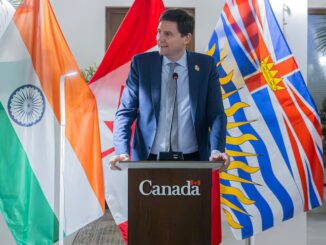
    OTTAWA (TIP): Problems refuse to die down for Prime Minister Mark Carney even after the British Columbian Premier David Eby offered to talk with Alberta and Ottawa about the new pipeline on the condition that the existing ban on tanker traffic off his province’s northern coast remains in place.

    Prime Minister Mark Carney and Alberta Premier Danielle Smith signed a memorandum of understanding (MOU) on November 27 to carry forward their shared missions. While this framework for an agreement will strengthen federal-provincial collaboration in the energy sector to achieve net-zero emissions by 2050, unlock the full potential of Alberta’s energy resources, and create hundreds of thousands of new high-paying careers for Canadians, it has led to dissidence within the ruling Liberal caucus. Career environmentalist and Minister Steven Guilbeault did not waste any time quitting his membership of Carney’s Cabinet by reiterating his position as a key voice on the environment.

    While distancing himself from the Liberal government on the issue of the MOU with the Alberta government, Steven Guilbeault circulated a three-page letter alleging that much of the policy he worked on “is or is about to be dismantled.”

    The BC Premier, David Eby, too, has opposed the Alberta-Ottawa deal throughout.

    Unmindful of the opposition, Prime Minister Mark Carney has gone ahead and named Marc Miller, a former federal minister who represents a Montreal riding, as the new minister of culture and identity, in place of Steven Guilbeault.

    Mark Carney also made a few new appointments, including a couple of changes in his cabinet. Other changes and appointments include Joël Lightbound, currently Minister of Government Transformation, Public Works and Procurement, who will also serve as Québec Lieutenant.

    Also, Julie Aviva Dabrusin retains her portfolio, with the new title of Minister of the Environment, Climate Change, and Nature.

    The Alberta-Ottawa MOU is built on practical solutions: stronger, more effective industrial carbon pricing; major private sector investments in clean technologies; and expanded, responsible energy development for the workers and communities who rely on it.

    Under this partnership, Canada and Alberta will collaborate on multiple projects to build Canada’s economy and meet growing consumer and industrial energy demands. It will advance the construction of Pathways Plus—the world’s largest carbon capture, utilization, and storage project. The project will strengthen Canada’s energy sector, reduce emissions, and deliver substantial economic benefits, including more than $16 billion in GDP and more than 40,000 jobs annually.

  • Mayor of Winnipeg felicitates Hiren Shah for his volunteer work

    Mayor of Winnipeg felicitates Hiren Shah for his volunteer work

    By Prabhjot Singh

    TORONTO (TIP): Volunteering and social service come naturally to him. Born and brought up in Winnipeg, Manitoba, 45-year-old Hiren Shah lived up to the adage “like father, like son.” Emulating his illustrious father, Hemant Shah, a pioneer in promoting Indo-Canadians relations in general and trade partnerships in particular, Hiren has been out to prove that sincerity and loyalty have no substitute in social life.

    Though it is a common saying that the Western world follows a “hire and fire” policy in work workplace, Hiren has been successful in proving the opposite.

    He started working with McDonald’s while he was going to school at the age of 15. Since then, he has continued working with one of the world’s largest fast food enterprises and risen to be its director for franchise owner operators.  For almost 30 years, he has still going strong with his first employer, a rare achievement in the Canadian context. He has done the Indo-Canadian community proud with his commitment and social work.

    Recently, he was felicitated by the Mayor of Winnipeg,  Scott Gillingham, for his volunteer work.

    “I am humbled to share that this year I have been a recipient of the 2025 Mayor’s Volunteer Service award (Winnipeg) through Volunteer Manitoba. Giving back to my community has been an important part of my life for many years. Whether through the Ronald McDonald House, Winnipeg Kinsmen or the St Boniface Hospital Foundation, Natasha Shah (wife) and I are passionate about helping raise funds for causes near and dear to our hearts.

    “The award is in recognition of our passion for people and commitment to making our community a better place every day in any way possible,” adds Hiren Shah.

    You name an activity, and Shahs – Hiren and Natasha – are part of it.

    Hiren serves on the Ronald McDonald House’s golf tournament board, which plans, coordinates and executes an annual fundraiser, and has also supported the Champions for Families program. He is also associated with the Winnipeg Kinsmen in 2018, and through his work with both the Kinsmen and Ronald McDonald House, he has helped direct funds to non-profits like Agape Table Soup Kitchen and Rainbow Resource Centre.

    In the role of the vice-president of service with Winnipeg Kinsmen, he has had the honor to support various other non-profits, such as Special Olympics, Winnipeg Harvest, Toba Centre, Bruce Oake Recovery Centre, and so much more. Hiren approaches every experience with humility, respect, and dignity, leaving a lasting impression that inspires others to pay it forward and embrace the power of community.

    (Prabhjot Singh is a Toronto based senior journalist. He writes on sports, politics and culture. He can be reached at prabhjot416@gmail.com)

  • Former Canadian MP Ruby Dhalla honored with ‘Dhee Punjab Di’ award in Phagwara

    Former Canadian MP Ruby Dhalla honored with ‘Dhee Punjab Di’ award in Phagwara

    She was honored in recognition of her outstanding contributions to the promotion of Punjabi language, culture and global representation of the Punjabi community

    NEW YORK / PHAGWARA (TIP): Former Canadian Member of Parliament Ruby Dhalla was honored with the prestigious ‘Dhee Punjab Di’ Award during a special ceremony held in Phagwara on Sunday, November 30, 2025. The award was presented by the Punjabi Kala and Sahit Centre and Sangeet Darpan in recognition of her outstanding contributions to the promotion of Punjabi language, culture and global representation of the Punjabi community.

    Speaking at the event, Principal Gurmeet Singh Palahi, president of the Punjabi Columnist Journalist Manch (Regd.), said that the Punjabi diaspora across the world has achieved remarkable success through dedication and hard work in various fields. He noted that Ruby stands out as an inspiring example among these achievers, having been elected four times as a Member of Parliament on the ticket of the Liberal Party of Canada. Dr Akshita Gupta, Commissioner of Phagwara Municipal Corporation, congratulated Dhalla on receiving the award and commended her for bringing honor to women at an international level.

    Expressing gratitude, Ruby said she felt proud to have dedicated her life to social service through politics, always prioritizing the welfare of Punjabis as well as the people of Canada. She stated that she has consistently advocated for the rights of the needy, the elderly and all those who face challenges and marginalization in society.

    She was honored with a commemorative memento, a traditional robe of honor (siropa) and a set of books by the Punjabi Kala and Sahit Centre. Members of the Banga Road Market Association also presented her with a special honor.

  • China warns of nuclear conflict risks after Trump orders testing

    China warns of nuclear conflict risks after Trump orders testing

    Beijing (TIP)- China warned the United States that it would “resolutely counter” the proposed Golden Dome missile defense system, saying it undermines its legitimate security interests. The remarks were made on Thursday in a Chinese white paper on arms control, disarmament and nonproliferation, which also discussed the issue of nuclear buildup.

    The U.S. homeland is currently safeguarded by a defense system—comprising radars and interceptors; however, it is neither designed nor capable of countering the large, sophisticated missile threats from Russia and China, the country’s nuclear adversaries.

    As global missile threats continue to evolve, including Chinese nuclear missiles said to have a global range, the Trump administration is advancing the Golden Dome initiative to protect the U.S. homeland, a plan that includes space-based interceptors and sensors.

    While China has previously voiced concerns over the Golden Dome, which it says would weaken strategic balance and stability, the East Asian power unveiled similar systems during a September military parade that form a multilayer defense shield.

    In a white paper released by the State Council Information Office, China accused the U.S. of pursuing “absolute security” by developing the Golden Dome without restraint, saying such a plan would undermine the legitimate security interests of other countries.

    “China will resolutely counter any acts that threaten or undermine its core interests,” the document said, adding that Trump’s anti-missile defense system seeks to deploy weapons in outer space, which it said would severely threaten security in the domain.

    Beijing also criticized Washington over its withdrawal from the Anti-Ballistic Missile Treaty in 2002, a now-defunct arms control agreement with Russia that prohibited the deployment of nationwide defenses against strategic nuclear-armed ballistic missiles.

    “This has severely undermined strategic mutual trust, increased strategic risks, and damaged global and regional security and stability,” China said in the document. However, the white paper justifies China’s development of missile defense capabilities, saying it is motivated solely by self-defense and does not target any country or region.

    Meanwhile, China addressed offensive missiles in the document, protesting the U.S.—without naming it—for promoting the deployment of intermediate-range missiles in the Asia-Pacific region, while saying Chinese missile technologies are used to “deter wars.”

  • France to introduce voluntary military service amid threat from Russia

    France to introduce voluntary military service amid threat from Russia

    Paris (TIP)- France is to introduce voluntary military service of 10 months aimed mainly at young people aged 18 and 19, as concern grows in Europe about the threat from Russia. In a speech to troops in Varces-Allières-et-Risset in the French Alps, the French president, Emmanuel Macron, said the service would begin by mid-2026 and help France respond to “accelerating threats” on the global stage. Almost 30 years after France scrapped conscription, Macron said he would not go back on that decision, but added: “We need mobilisation.”

    “France cannot remain idle,” Macron said. He believed French youth had a “thirst for engagement”, saying there was a young generation “ready to stand up” for their nation.

    Under the new military service, men and women, mostly aged 18 and 19, could volunteer to sign up for 10 months. They would be paid a minimum of €800 (£700) per month and receive food and accommodation, as well as a 75% discount on rail travel. They would be deployed “only on national soil”, Macron said. A minority with specific qualifications, for example in engineering or medical skills, could be aged up to 25.

    There is so far no suggestion that military service in France could again be compulsory, as it was before the then president, Jacques Chirac, abolished conscription in 1997.

    “We cannot return to the time of conscription,” Macron said. “This hybrid army model corresponds to the threats and risks ahead, bringing together national service youth, reservists, and the active army.”

    The plan will cost €2bn, which Macron called “a significant and necessary effort”.

    The scheme aims to bring in 3,000 volunteers in 2026, rising to 10,000 by 2030. “My ambition for France is to reach 50,000 youth by 2036, depending on evolving threats,” Macron said. After the programme, participants could integrate into civilian life, become a reservist, or stay in the armed forces, he said.

    He said the plan was “inspired by practices of our European partners … at a time when all our European allies advance in response to a threat that weighs on us all”.

    The move is part of a broader shift across Europe, where nations who have long enjoyed the decades-long tranquillity of US security guarantees are concerned about Donald Trump’s shifting priorities and Russia’s aggressive posturing.

    Macron’s announcement brings France in line with nearly a dozen other European nations such as Germany and Denmark who have launched similar projects.

    Military service is seen as a way of bolstering armies with recruits, but also of providing a large pool of potential reservists, who could be called up in the case of a future war.

    The French armed forces have approximately 200,000 active military personnel and 47,000 reservists, numbers expected to increase to 210,000 and 80,000 respectively by 2030.

    Macron’s office said polling data suggested high support for the armed forces among 18- to 25-year-olds.

  • Putin says US peace plan could form basis for end to Ukraine war

    Russian President Vladimir Putin on Thursday, Nov 27,  asserted that the US plan for peace in Ukraine could be a starting point for future agreements. However, he warned that Russia would take more territory by force if Ukraine does not withdraw. Putin confirmed that a US delegation led by Special Envoy Steve Witkoff is expected in Moscow next week before peace talks.

    Speaking to reporters in Kyrgyzstan’s Bishkek, Putin emphasised that Kremlin was ready for a “serious discussion”. “Overall, we agree that it could form the basis for future agreements,” he said about the latest peace draft. However, the Russian President reiterated, the conflict can only end after Ukrainian troops withdraw from the territories they occupy. “If they don’t withdraw, we will achieve this through military means,” Putin said.

    CNN reported that Russia controls about 20% of Ukraine, including all of Luhansk and parts of Donetsk, Kherson, and Zaporizhzhia regions, which are recognised as Ukrainian territory under international law. Russia wants Ukraine to give up these four regions, which it has claimed but not fully captured. In recent weeks, Moscow has made gains along the eastern front, especially near the city of Pokrovsk.

    While a swift breakthrough seems difficult with Putin’s demands, United States President Donald Trump has repeatedly touted “tremendous progress” in his efforts to end the four-year-old Russia-Ukraine war.