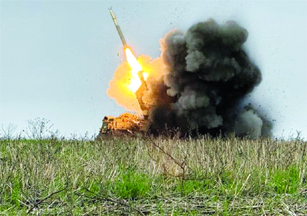
Kyiv (TIP)- Ukrainian drones struck a major oil refinery in Russia’s Volgograd region for the second time in almost three months, Ukraine’s general staff said Thursday. Russian officials did not confirm the attack, although the local governor said drones started a fire at an unspecified industrial facility in the region.
Ukraine’s general staff said in a statement that the attack took place the previous day. The refinery is the largest producer of fuel and lubricants in Russia’s Southern Federal District, processing more than 15 million tonnes of crude annually — about 5.6 per cent of the country’s total refining capacity, according to Ukrainian officials.
Russia and Ukraine have traded almost daily assaults on each other’s energy infrastructure as US-led diplomatic efforts to stop the nearly four-year war make no impact on the battlefield.
Ukraine’s long-range drone strikes on Russian refineries aim to deprive Moscow of the oil export revenue it needs to pursue its full-scale invasion. Russia wants to cripple the Ukrainian power grid, seeking to deny civilians access to heat, light and running water in what Kyiv officials say is an attempt to “weaponize winter.”
Ukrainian President Volodymyr Zelenskyy said foreign countries are helping Kyiv in its efforts to keep the power grid operating amid Russia’s onslaught.
“Practically every day, our power engineers, repair brigades, and the State Emergency Service of Ukraine are carrying out restorations on-site after attacks: hits keep occurring across various points, especially in our communities, and especially near the Russian border and close to the front,” Zelenskyy said late Wednesday.
Also, saboteurs inside Russia burned dozens of locomotives in a bid to hamper the logistics of Russia’s armed forces, Ukraine’s military intelligence said Thursday.
The Freedom of Russia group used Molotov cocktails to set fire to the control and power supply systems of dozens of locomotives that transported military cargo, according to a statement from GUR, as the intelligence agency is known. It was not possible to independently verify the claim, nor did the statement say whether the GUR was involved in the operation. Russian officials offered no immediate comment.
Ukraine, meanwhile, has attempted to strike targets on Russian soil with domestically developed long-range drones.
Ukrainian forces also struck three fuel lubricants facilities in the Russian-occupied Crimean peninsula and a storage and assembly base for Russia’s Shahed drones in an occupied area of Ukraine’s eastern Donetsk region, the general staff statement said.
In the Kostroma region northeast of Moscow, a Ukrainian aerial attack hit unidentified “energy infrastructure facilities,” Gov. Sergei Sitnikov said. There were no casualties and power supplies were not disrupted, he said.
Unconfirmed media reports said the attack targeted a hydroelectric power plant in the Kostroma region, one of the biggest in Russia.
The Russian Defense Ministry said Thursday its air defences shot down 75 drones overnight over multiple Russian regions and annexed Crimea. Russia, meantime, attacked the city of Kamianske in Ukraine’s eastern Dnipropetrovsk region with drones overnight, killing one person and injuring eight others, the head of the regional military administration, Vladyslav Haivanenko, said on his official Telegram channel.
Tag: World News
-

Ukraine says it has hit Russian oil refinery with long-range drones
-

Philippine death toll tops 140 as typhoon Kalmaegi heads towards Vietnam
Hanoi (TIP)- Typhoon Kalmaegi has killed at least 142 people and left another 127 missing after unleashing devastating flooding across the central Philippines, official figures showed Thursday, Nov 6, as the storm headed towards Vietnam. The typhoon is so far the globe’s deadliest of 2025, according to disaster database EM-DAT. Trami, also in the Philippines, was last year’s third-deadliest typhoon with 191 fatalities.
Floodwaters described as unprecedented rushed through Cebu province’s towns and cities this week, sweeping away cars, riverside shanties and even massive shipping containers.
The national civil defence office on Thursday confirmed 114 deaths, though that tally did not include an additional 28 recorded by Cebu provincial authorities. More than 500,000 Filipinos remain displaced.
In Liloan, a town near Cebu City where 35 bodies have been recovered, AFP reporters saw cars piled atop each other by floodwaters and roofs torn off buildings as residents attempted to dig out of the mud. Christine Aton’s sister Michelle, who has a disability, was among Liloan’s victims, trapped in her bedroom as the floodwaters rose inside their house.
“We tried to pry open (her bedroom door) with a kitchen knife and a crowbar but it wouldn’t budge…. Then the refrigerator started to float,” Aton, 29, said.
“I opened a window and my father and I swam out. We were crying because we wanted to save my older sister.
“But my father told me we couldn’t do anything for her, that all three of us might end up dead.”
Chyros Roa, a 42-year-old father of two, said his family was saved by his dog’s barking when water rushed into their home in the early hours, giving them just enough time to reach their roof.
“The current was really strong. We tried to call for rescue, but no one came. We were told the rescuers were swept away by the current,” he said.
On Thursday, Nov 6, President Ferdinand Marcos declared a “state of national calamity”, a move allowing the government to release funding for aid and impose price ceilings on basic necessities.
“Unfortunately, there’s another (typhoon) coming with the potential to become an even stronger one,” he said at an afternoon press briefing.
Still more than 1,500 kilometres to the country’s east, tropical storm Fung-wong is slowly building strength as it heads towards the Philippines’ main island of Luzon.
It could reach super typhoon status before it makes landfall on Monday, Nov 10. -
Israel declares Egypt border area closed military zone due to weapon-smuggling drones
Israeli Defense Minister Israel Katz on Thursday said he instructed the army to turn the area at the border with Egypt into a closed military zone to combat weapons smuggling via drones. “I instructed the IDF (military) to turn the area adjacent to the Israel-Egypt border into a closed military zone and to amend the rules of engagement accordingly in order to combat the drone threat that endangers the country’s security,” Katz said in a statement.
“Weapon smuggling via drones is part of the war in Gaza and is intended to arm our enemies, and all possible measures must be taken to stop it,” he added. Israel and Egypt share a border that spans approximately 200 kilometers (124 miles).
On Sunday, the Israeli military said it identified a drone that “crossed from the west into Israeli territory in an attempt to smuggle weapons.”
It said troops intercepted the drone, which was carrying eight guns.
On Tuesday, it said it thwarted another smuggling attempt after intercepting a drone carrying 10 pistols which had “crossed from the eastern border” into Israeli territory.
Israel is bordered by Jordan to the east. “Today we declare war on those involved in the smuggling — and anyone who breaches the forbidden area will be targeted,” Katz said Thursday. In a post on X, Israel’s far-right National Security Minister Itamar Ben Gvir praised Katz for taking the decision and for “recognizing that the trafficking that takes place there serves terrorist objectives.” -

Pope meets Palestinian Prez; discuss urgent need for Gaza aid, 2-state solution
VATICAN CITY (TIP)- Pope Leo XIV met Palestinian President Mahmoud Abbas for the first time on Thursday, Nov 6, and the two men discussed the urgent need to provide assistance to civilians in Gaza and to pursue a two-state solution to end the conflict in the region.
The meeting, which lasted about an hour and was described as “cordial” in a brief Vatican statement, comes nearly a month after the U.S.-brokered ceasefire agreement came into effect in the Gaza Strip.
The pope and Abbas had not met in person previously. They had spoken over the phone in July to talk about developments in the conflict in Gaza and violence in the West Bank.
“During the cordial talks, it was recognized that there is an urgent need to provide assistance to the civilian population in Gaza and to end the conflict by pursuing a two-State solution,” the Holy See said.
In September, Pope Leo and his top diplomats told Israel’s president that a two-state solution was the “only way out of the war,” as the Vatican called for a permanent ceasefire in Gaza.
Abbas was visiting the Vatican to mark the 10th anniversary of the signing of the “Comprehensive Agreement between the Holy See and the State of Palestine.”
He arrived in Rome on Wednesday afternoon, and visited the Basilica of St. Mary Major to pay his respects to late Pope Francis’ tomb. Over the years, Abbas had met the late Pope Francis several times, maintaining frequent phone contacts after Hamas’ attacks on Oct. 7, 2023, and Israel’s strikes on Gaza. -

Israel strikes Hezbollah targets across southern Lebanon after evacuation orders
Beirut (TIP)- Israeli jets struck several towns in southern Lebanon on Thursday, Nov 6, after urging residents to leave, marking an escalation in their near-daily strikes on the country. The airstrikes came hours after militant group Hezbollah urged the Lebanese government not to enter negotiations with Israel.
Israeli Arabic spokesperson Avichay Adraee warned residents in Tayba near the border, Teir Debba located just east of the coastal city of Tyre, and Aita al-Jabal in southern Lebanon, to flee 500 meters (about 1,600 feet) away from residential buildings they are targeting, which they say have been used by Hezbollah. It later issued more warnings for the towns of Zawtar al-Sharqiyah and Kfar Dounin.
The Israeli military said it targeted military infrastructure for Hezbollah in those areas, including “weapons storage facilities… constructed in the center of civilian-populated areas.”
It accused the group of rebuilding its capabilities almost a year after a US-brokered ceasefire went into effect that ended a monthslong war. While most residents evacuated the threatened areas ahead of the strikes, Lebanon’s health ministry reported one person wounded.
“We will not allow Hezbollah to rearm themselves, to recover, build back up its strength to threaten the state of Israel,” Israeli government spokesperson Shosh Bedrosian said at a briefing Thursday.
The strikes came as Lebanese Prime Minister Nawaf Salam and his government met in Beirut to follow up on a plan drafted by the Lebanese military to disarm Hezbollah and other non-state armed groups in the country. Information Minister Paul Morcos said, following the meeting, that the cabinet “commended the progress (the army) has made… despite continued obstacles, foremost among which is the continuation of Israeli hostilities.”
Lebanese President Joseph Aoun has been critical of Israel’s strikes and ongoing occupation of five hilltop points on Lebanese territory but has said he is open to negotiations with Israel to end the tensions.
Aoun said in a statement after Thursday’s strikes that “every time Lebanon expresses its openness to peaceful negotiations… Israel intensifies its aggression.”
“Nearly a year has passed since the ceasefire came into effect, and during that time, Israel has spared no effort to demonstrate its rejection of any negotiated settlement between the two countries,” he said. “Your message has been received.”
Israel says its near-daily strikes have targeted Hezbollah officials and military infrastructure, while the Lebanese government that has backed disarming Hezbollah say the strikes have targeted civilians and infrastructure unrelated to the Iran-backed group.
The powerful group’s military capabilities were severely damaged in Israel’s intense air campaign over the tiny country in 2024, but Hezbollah have yet to disarm and its leader Sheikh Naim Kassem has said that the group will be ready to fight no matter how limited their capabilities might be. -

A Boost to Canada-India Relations: S. Jaishankar to participate in G7 Foreign Ministers Conference in Niagara

By Prabhjot Singh OTTAWA (TIP): By taking yet another step, India and Canada are on the threshold of restoring normal cordial diplomatic relations after a gap of a little more than two years.
The first step was taken when the new Canadian Prime Minister, Mark Carney, invited his Indian counterpart, Narendra Modi, as a special guest to the G7 leaders’ summit in Alberta.
A subsequent telephonic conversation between Canadian Foreign Minister Anita Anand and her Indian counterpart, S. Jaishankar, broke the ice for the restoration of bilateral visits.
After meeting S. Jaishankar on the sidelines of the United Nations, she undertook a bilateral visit to India, during which she met Indian Prime Minister Narendra Modi.
After her visit, the new Indian High Commissioner to Canada, Dinesh Patnaik, extended an invitation on behalf of Narendra Modi to Canadian Prime Minister Mark Carney for early next year. India wants Mark Carney to be in New Delhi for an AI international conference in February.
Next week, when Canada, during its presidency of the G7, is holding its second G7 Foreign Ministers conclave on November 11 and 12 at Niagara, Anita Anand has extended a special invitation to S. Jaishankar to participate. The Indian Foreign Minister’s participation has been confirmed.
The G7 is an informal forum of seven countries with advanced economies and the European Union. Its leaders meet annually at the G7 Summit to address global economic and geopolitical issues. Canada and its G7 partners are celebrating 50 years of partnership and cooperation in 2025. Since France hosted the first meeting in 1975, the G7 has been a driving force for international peace, economic prosperity, and sustainable development.
From June 15 to 17, 2025, G7 leaders gathered in Kananaskis, Alberta, for the G7 Summit. As host, Canada led discussions on shared priorities, including international trade, peace and security, and global economic stability. It was here that Narendra Modi was invited to end the thaw in diplomatic relations between India and Canada.
Meanwhile, Anita Anand has confirmed the participants for the upcoming G7 Foreign Ministers’ Meeting, which will take place in Niagara.
Minister Anand will welcome the foreign ministers of the G7 members—France, Germany, Italy, Japan, the United Kingdom, the United States of America, and the European Union.
Canada is also pleased to host ministers from several outreach countries, reflecting shared global priorities and partnerships. These include Australia, Brazil, India, the Kingdom of Saudi Arabia, Mexico, the Republic of Korea, South Africa, and Ukraine. This important gathering will provide an opportunity to advance Canada’s G7 agenda on pressing global economic and security challenges, including maritime security and prosperity, economic resilience, energy security, and critical minerals.
Following the March 2025 G7 Foreign Ministers’ Meeting, hosted by Minister Mélanie Joly in Charlevoix, Quebec, this upcoming meeting marks the second time Canada will host the foreign ministers this year under the G7 Presidency.
This meeting will bring together G7 ministers to discuss global challenges and strengthen international collaboration. The agenda will cover thematic issues, including security and prosperity, as well as important work on economic resilience, following discussions held at the G7 Leaders’ Summit in Kananaskis. Minister Anand and her counterparts will work toward coordinated G7 responses to pressing international challenges, emphasizing cooperation with partners across regions and sectors.
-
Hurricane Melissa leaves 49 dead in Caribbean
Hurricane Melissa’s confirmed death toll climbed to 49 on Thursday, according to official reports, after wreaking destruction across much of the northern Caribbean and picking up speed as it headed past Bermuda in the North Atlantic. Authorities in Haiti, which was not directly hit but nevertheless suffered days of torrential rains from the slow- moving storm, reported at least 30 deaths and 20 more missing. At least 23 people, including 10 children, died in Haiti’s southern town of Petit-Goave when a river burst its banks. Roads, houses and farmlands were also damaged by the rains. Jamaica’s information minister confirmed at least 19 deaths, but said authorities were continuing search and rescue efforts. The storm left hundreds of thousands without power, ripped roofs of buildings and scattered fields with rubble. Jamaica’s military has called on reserve personnel to report for duty to help with relief and rescue operations. Melissa made landfall in southwestern Jamaica on Tuesday as a powerful Category 5 hurricane, the Caribbean nation’s strongest-ever storm to directly hit its shores, and the first major hurricane to do so since 1988. Windspeeds were well above the minimum level for the strongest hurricane classification. Forecasters at AccuWeather said it tied in second place for strongest-ever Atlantic hurricane on record in terms of windspeed when in struck land. The forecaster estimated $48 billion to $52 billion in damage and economic loss across the western Caribbean.
-

Xi promises to protect free trade at APEC as Trump snubs major summit
Gyeongju (TIP)- Chinese leader Xi Jinping told Asia-Pacific leaders on Friday that his country would help to defend global free trade at an annual economic regional forum snubbed by U.S. President Donald Trump. Xi took center stage at the Asia-Pacific Economic Cooperation summit that began Friday in the South Korean city of Gyeongju, as Trump left the country a day earlier after reaching deals with Xi meant to ease their escalating trade war. This year’s two-day APEC summit has been heavily overshadowed by the Trump-Xi meeting that was arranged on the sidelines.
Trump described his Thursday, Oct 30, meeting with Xi as a roaring success, saying he would cut tariffs on China, while Beijing had agreed to allow the export of rare earth elements and start buying American soybeans. Their deals were a relief to a world economy rattled by trade tensions between the world’s two largest economies.
Trump’s decision to skip APEC fits with his well-known disdain for big, multi-nation forums that have been traditionally used to address huge global problems, but his blunt dismissal of APEC risks worsening America’s reputation at a forum that represents nearly 40% of the world’s population and more than half of global goods trade.
Xi defends multilateralism
“The more turbulent the times, the more we must work together,” Xi said during APEC’s opening session. “The world is undergoing a period of rapid change, with the international situation becoming increasingly complex and volatile.” Xi called for maintaining supply chain stability, in a riposte to U.S. efforts to decouple its supply chains from China.
Xi also expressed hopes to work with other countries to expand cooperation in green industries and clean energy. Chinese exports of its solar panels, electric vehicles and other green tech have been criticized for creating oversupplies and undercutting the domestic industries of countries it exports to.
It’s Xi’s first visit to South Korea in 11 years, and he’s scheduled to meet new Japanese Prime Minister new Japanese Prime Minister Sanae Takaichi on Friday and South Korean President Lee Jae Myung on Saturday. South Korean officials said a Lee-Xi meeting would focus on dealing with North Korea’s nuclear program.
Secretary of the Treasury Scott Bessent, who attended the summit on Trump’s behalf, said a U.S. move to rebalance its trade relationships would ensure that “each country operates on fair and reciprocal terms.” He added that the U.S. is “investing with its trading partners to build resilient production networks that reduce dependence on vulnerable sectors.” -

Yemen’s Houthis say arrested UN staff will be tried over Israeli links
Sanaa (TIP)- Yemen’s Houthi-run government will put dozens of detained United Nations staff on trial, alleging that they have spied for Israel or had links to an Israeli air strike that killed the prime minister, according to officials.
Abdulwahid Abu Ras, Yemen’s acting foreign minister, told the Reuters news agency on Friday that a cell within the UN’s World Food Programme was involved in directly targeting the government.
The Houthi prime minister and nine other ministers were killed in an Israeli strike on the capital Sanaa in August, the first such attack to kill senior officials.
The UN, which has repeatedly rejected Houthi accusations, said on Friday that a total of 36 UN employees were arrested after Israel’s attack. It says that at least 59 UN personnel are being held by the group.
Abu Ras told Reuters that security agencies were acting “under full judicial supervision” and that public prosecutors were being kept informed “step by step”. It was certain, he said, that the process would lead “to trials and the issuance of judicial rulings”.
Separately, Nasruddin Amer, a senior Houthi official, told the dpa news agency on Friday that the detained UN workers would be tried on charges of spying for Israel.
“The judiciary will determine the penalty for those accused of spying for Israel in accordance with Yemeni law,” Amer said. “This is not a law we enacted. It is a law that has been in effect and applied in the country by previous regimes.”
The UN defendants are Yemenis and could face the death penalty under the nation’s laws.
Trial ‘not against the organisations’
Hundreds of UN personnel, including a small number of international staff, remain in parts of Houthi-controlled Yemen, according to Farhan Haq, deputy spokesperson for the UN secretary general.
Houthi security forces entered several UN offices in Sanaa on Sunday. The UN says it is operating under increasingly difficult conditions, hindering its ability to provide assistance to those in need in Yemen.
Amer told dpa: “The trial is not against the organisations, but against those who exploited humanitarian work to carry out espionage against our country and our people.”
Abu Ras claimed that the Houthis are supporting humanitarian provision, and will “assist organisations committed to the principles of humanitarian work, facilitating their activities and work”.
There was no immediate comment from the World Food Programme.
Since Israel launched its war on Gaza in October 2023, the Houthis have targeted vessels in the Red Sea and carried out drone and missile attacks against Israel, saying that they are acting in solidarity with Palestinians under fire in Gaza.
Israel has regularly struck the war-torn country, targeting civilian infrastructure, including residential buildings and the main international airport, while killing dozens at a time. -
Israel returns 30 bodies of slain Palestinians as new strikes hit Gaza
Thirty more bodies of Palestinians who were detained by Israel have been returned to the besieged Gaza Strip, some showing signs of torture. The return of the Palestinian remains, via the International Committee of the Red Cross, came as Israeli forces continued air strikes across the Strip despite a shaky ceasefire, killing at least three people on Friday, Oct 31.
One Palestinian was killed and his brother wounded by Israeli gunfire in the Shujayea neighbourhood of eastern Gaza City, while another was killed by Israeli shelling in the Jabalia refugee camp, Wafa news agency reported. A third Palestinian died of wounds sustained from previous Israeli shelling, it added.
Separately, civil defence workers in central Gaza said they had recovered the body of a Palestinian from the rubble of the Abu Medein family home in the az-Zahra neighbourhood.
Israeli warplanes also struck buildings in Khan Younis in southern Gaza on Friday. The return of slain Palestinian detainees comes as part of the prisoner-captive exchange deal agreed in early October. The latest handover brings the total number of bodies received to 225, the Palestinian Health Ministry said in a statement. It said medical teams are identifying the bodies under standard protocols before documenting them and notifying families. In the previous handovers, bodies of prisoners had exhibited signs of torture, including being blindfolded and handcuffed, medical sources said. Many had appeared decomposed or burned, while others were missing limbs or teeth. -

King Charles III strips Prince Andrew of titles, evicts him from royal home
London (TIP)- King Charles III has stripped his brother Prince Andrew of his remaining titles and evicted him from his royal residence after weeks of pressure to act over his relationship with sex offender Jeffrey Epstein.
Buckingham Palace said on Thursday, Oct 30, the king “initiated a formal process to remove the Style, Titles and Honours of Prince Andrew”.
After the king’s rare move, Andrew will be known as Andrew Mountbatten Windsor and not as a prince, and he will move from his Royal Lodge residence into “private accommodation”.
It is almost unprecedented for a British prince or princess to be stripped of that title. It last happened in 1919, when Prince Ernest Augustus, who was a UK royal and also a prince of Hanover, had his British title removed for siding with Germany during World War I.
Demand had been growing on the palace to remove the prince from Royal Lodge after he surrendered his use of the title duke of York earlier this month over new revelations about his friendship with Epstein and renewed sexual abuse allegations by one of Epstein’s victims, Virginia Roberts Giuffre, whose posthumous memoir hit bookstores last week.
But the king went even further to punish him for serious lapses of judgement by removing the title of prince that he had held since birth as a child of a monarch, the late Queen Elizabeth II.
“These censures are deemed necessary, notwithstanding the fact that he continues to deny the allegations against him,” the palace said. “Their Majesties wish to make clear that their thoughts and utmost sympathies have been, and will remain with, the victims and survivors of any and all forms of abuse.”
Giuffre’s brother declared victory for his sister, who died in April at the age of 41.
“Today, an ordinary American girl from an ordinary American family, brought down a British prince with her truth and extraordinary courage,” her brother Skye Roberts said in a statement.
Andrew faced a new round of public opprobrium after emails emerged earlier this month showing he had remained in contact with Epstein longer than he previously admitted.
That news was followed by the publication of, Nobody’s Girl, by Giuffre, who alleged she had sex with Andrew when she was 17. The book detailed three alleged sexual encounters with Andrew, who she said acted as if he believed “having sex with me was his birthright”.
Andrew, 65, has long denied Giuffre’s claims, but stepped down from royal duties after a disastrous November 2019 BBC interview in which he attempted to rebut her allegations. -
Canada to issue a special commemorative stamp on World War I and the Quebec connections to the Canadian Sikh Soldiers
The country has earlier issued two stamps in the honor of Sikhs — one on the 300th anniversary of Baisakhi in 1999 and another to mark the 100th anniversary of the Komagata Maru incident

By Prabhjot Singh Now when Canada is holding Remembrance Day events that coincide with the two World Wars, Montreal-based businessman-cum-historian Baljit Singh Chadha has recalled the contribution of two of the 10 known Sikhs who served Canada in World War I. To commemorate the occasion, Canada Post has decided to come out with a special theme stamp honoring Sikh Canadian soldiers.
The special stamp will be unveiled to the general public at the 18th annual Sikh Remembrance Day ceremony hosted by the Sikh community on November 2.
This stamp is to commemorate and honor Sikh soldiers who have remained part of the Canadian military for over 100 years, including 10 Sikh soldiers who were enlisted for the World War I.

It has been for more than a century that Sikhs have remained associated with the Canadian defense forces. (Photo credit/ GhaintPunjab) “Of the 10 known Sikhs who enlisted in the Canadian army and served Canada in World War I,’ says Baljit Singh Chadha by quoting from his book “History of the Sikhs in Quebec”, that there are significant connections to Quebec for at least two of them, Sunta Gouger Singh and Waryam Singh.
“Most of the others would also have likely undergone training at Camp Valcartier in Quebec.
“Sunta Gouger Singh, born in Lahore, Punjab, in 1881, enlisted at the Peel Street Barracks in Montreal on January 6, 1915, at the age of 32. His father and wife lived in Phillaur, Punjab, India. He had served for three years in the 32nd Punjab Rifles of the Indian Army. He joined the 24th Battalion (the Quebec Regiment) and sailed from Montreal to England on the S.S. Cameronia in May 1915. The battalion arrived in Boulogne, France in September 1915.
“Sunta Gouger Singh was killed in action early in the war, on October 19, 1915, in the trenches near Kemmel, Belgium, just south of Ypres. At the time of his death, the battalion working parties were in the front-line trenches day and night, under heavy artillery bombardment. Gouger Singh’s gravestone is in the La Laterite Military Cemetery, near Kemmel. His grave is among those of 197 other Canadians, all from three infantry battalions, all buried together.
“Strangely, Gouger Singh’s gravestone does not have the expected Canadian Maple Leaf, though his Canadian Battalion number is noted. The inscription is very unusual for a Canadian gravestone. The script is in the Gurmukhi language and reads: “God is one” and “Victory is to God.” There is no cross on the stone.
While talking about second Sikh soldier Waryam Singh, Baljit Singh Chadha writes in his book that “the Quebec Chronicle of December 31, 1917, records that the first passengers to use the new Quebec Bridge were some three hundred returned soldiers who had disembarked at St. John. Among them was Waryam Singh.
“The Gazette reported that they “were brought directly through to the local discharge depot by special train which passed over the recently completed structure.” (The Gazette, January 1, 1918).
“Along with 54 other wounded Canadians, Singh travelled across Canada by train, on the Imperial Limited, arriving in Vancouver on January 6, 1918. The Vancouver Daily World (7 January 1918) describes the “Royal Reception” these men were given across Canada: “The men enjoyed a most lavish welcome from the citizens all along the route from the east. At Quebec, Kenora, Calgary, Field and other places the patriotic and appreciative people turned out in crowds and showered the wounded and crippled men with gifts of all kinds.” (So far, no further reference to the reception at Quebec has been found.) Waryam was discharged in Vancouver in March 1918, still with impaired functioning of his shoulder (Gray 2014).
“Waryam Singh enlisted in Barriesfield, Ontario in May 1915 and served in the 59th and 38th Battalions (Eastern Ontario Regiment). He served in Canada for 5 months, in Bermuda for 10 months, and England for 2 months before arriving in France in August 1916.
He wrote letters home from France to India in 1916, describing both military action and more personal aspects of the war. Two letters describe events during the Battle of the Somme. In one of the letters to his father Wazir Singh in Kapurthala, India, in November 1916, Waryam wrote:
“On the 4th of November there was a big fight, and much hand-to-hand fighting took place and many prisoners were taken… When we took the trenches some of the enemy escaped and some were taken. The dead were countless. The bravery which we showed that day was the admiration of the British soldiers. After the fight they asked me how it was that I was so utterly regardless of danger.”
His battalion later moved north to take part in the capture of Vimy Ridge. There, in late April 1917, Waryam Singh was wounded in the shoulder. He remained on duty despite his wound, but then he also got “trench fever” and pneumonia and spent almost eight months in hospitals in France and England. He also underwent an operation on his shoulder because the wound had not healed, and a piece of shrapnel had to be removed. Waryam Singh was invalided to Canada and travelled on the hospital ship Braemar Castle to St. John, New Brunswick, in late December 1917, adds Baljit Singh Chadha.
(Toronto based Prabhjot Singh is an award-winning journalist recognized for investigative journalism, environment and business reporting, sports and feature writing. A Media Consultant, he has remained associated with various news agencies, including Reuters, and media houses like PTC News (India/Canada), Parvasi Media (Canada) the Liberal World (India), and The Indian Panorama, New York. He is interested in Indian Diaspora and the Sikh Diaspora in particular. His work has appeared in various international and national newspapers, magazines and journals.)
-

Built in the shadows and launched at night, Ukraine’s long-range drones are rattling Russia
KYIV (TIP)- At a secret location in rural Ukraine, columns of attack drones are assembled at night and in near silence to strike deep inside Russia.
Their targets are strategic: oil refineries, fuel depots, and military logistics hubs. Since the summer, Ukraine’s long-range drone campaign has ramped up dramatically, pounding energy infrastructure across Russia and stretching Moscow’s air defenses thin.
Built from parts made in a scattered network of workshops, these drones now fly much further than at any point in the war. Officers in body armor move with quick precision; headlamps glow red to stay hidden. Engines sputter like old motorcycles as exhaust fumes drift into the moonless night. Minutes later, one after another, the drones lift from a makeshift runway and head east. The strikes have caused gasoline shortages in Russia, even forcing rationing in some regions and underscoring a growing vulnerability in the country’s infrastructure. Lt. Gen. Vasyl Maliuk, head of the Ukrainian Security Service, said Friday that more than 160 successful strikes had been carried out against Russia’s oil extraction and refining facilities so far this year.
Drones hammer refineries
Western analysts say the attacks on energy infrastructure so far have had a serious – but not crippling – effect. Ukrainian drones have repeatedly hit 16 major Russian refineries, representing about 38% of the country’s nominal refining capacity, according to a recent review by the Carnegie Endowment, a U.S.-based think tank.
But it argues the actual impact has been considerably more limited: most plants resumed operations within weeks, and Russia’s refining output has been cushioned by idle capacity and existing fuel surpluses.
The deep strikes have, however, given Kyiv the initiative at an important moment. The United States and Europe are ramping up sanctions on Russia’s oil industry even as Kyiv’s request for U.S. long-range Tomahawk missiles has stalled. President Volodymyr Zelenskyy says Ukraine’s improved long-range strike capability is causing real damage – forcing the Kremlin to import fuel and curb exports. “We believe they’ve lost up to 20% of their gasoline supply – directly as a result of our strikes,” he told reporters at a briefing in Kyiv.
At the secret launch site, the commander overseeing the operation – a broad-shouldered man identified by his call sign, “Fidel,” in accordance with Ukrainian military regulations – watches through night-vision goggles as the drones climb into the star-filled sky.
“Drones are evolving,” Fidel told The Associated Press. “Instead of flying 500 kilometers (310 miles), now they fly 1,000 … Three factors go into a successful operation: the drones, the people and the planning. We want to deliver the best result. For us, this is a holy mission.”
Ukraine thrives on no-frills weapons
Much of Ukraine’s fleet is homegrown. The Liutyi, a workhorse of the nightly attacks, is a waist-high craft with a sausage-shaped body, a propeller at the back, and a distinctive triangular tail.
It looks neither sleek nor intimidating – more Home Depot than Lockheed Martin – but the ease of assembly means it can be kept hidden and constantly tweaked: optimized to slip through heavily monitored frontline airspace.
Typical of Ukraine’s no-frills war production philosophy, the Liutyi – whose name means “fierce” in Ukrainian – has become a symbol of national pride and recently featured on a local postage stamp. The reach of these drones – with some models doubling in range over the past year to routinely strike targets within a 1,000-kilometer radius of the border – marks a shift in the geography of the conflict. Attacks a year ago damaged refineries in a much narrower range, mostly in western Russian border regions. Costs have also come down, further testing expensive air defense systems, with long-range drones now being produced in Ukraine for as little as $55,000. -

Canada introduces sweeping reforms to make bail laws stricter and toughen sentencing laws
“A strong Canada means strong protections for our communities and a Criminal Code that responds to emerging threats, protects victims of crime, and keeps our kids safe. This is the latest in a series of reforms to strengthen community safety and Canada’s justice system. In the coming months, the Government of Canada will bring forward further changes to address court delays, strengthen victims’ rights, better protect people facing sexual and intimate partner violence, and keep children safe from horrific crimes”: Sean Fraser, Minister of Justice and Attorney General of Canada.

By Prabhjot Singh OTTAWA (TIP): Bowing before unabated criticism from the Opposition for laxity in bail laws and massive increase in crime by repeated offenders, the Liberal Government led by Mark Carney introduced sweeping reforms to make bail laws stricter, besides toughening sentencing laws.
Presenting before the House of Commons, the new laws, the Liberals have proposed 80 clauses of targeted changes to bail and sentencing laws after extensive consultations.
Also read: https://www.justice.gc.ca/eng/csj-sjc/pl/c14/index.html
The Liberal proposals come weeks after a similar Bill, “Jail not Bail”, was rejected by the House of Commons.
Ever since the new House of Commons began its sitting, the deterioration in law and order situation, especially a multiple increase in extortions, crime against children and women, auto thefts, and home invasions, has been the subject of animated discussions.
While the national police-reported crime rate decreased between 1998 and 2014 (-37%), an upward trend (+12%) between 2014 and 2024. While there has been a 4% decrease in 2024 compared to 2023, everyone in Canada, alongside the Government, is deeply concerned with the overall rise in crime over the past decade.
Since 2014, police-reported crime rates have increased, particularly for homicide, sexual assault, extortion, child sexual offending, violent firearm offences and various other property crimes. Canada’s Violent Crime Severity Index was 41% higher in 2024 than it was in 2014.
Recidivism (i.e., reoffending) rates have generally declined over the past 10 years. However, offenders with 10 or more prior convictions were much more likely to be reconvicted within 3 years than those with 9 or fewer prior convictions.
Those released from custody are more likely to reoffend as compared to those who were subject to some form of community supervision. Reoffending frequently involves a breach of conditions associated with previous criminal justice system involvement.
Canada’s criminal justice system is a shared responsibility of the provinces, territories and the federal government. The federal government is responsible for enacting criminal law, while provincial and territorial governments are responsible for the administration of justice. Provinces are responsible for conducting most bail hearings and enforcing bail conditions, as well as operating most remand facilities. Several provinces have recently taken steps to address the issue of repeat violent offenders.
Sean Fraser, Minister of Justice and Attorney General of Canada and Minister responsible for the Atlantic Canada Opportunities Agency, before introducing the Bill, said: “Canada’s new government is moving ahead with sweeping reforms to keep Canadians safe. We’re proposing over 80 clauses of targeted changes that will make bail harder to get while also toughening sentencing laws for repeat and violent offenders. We are supporting police on the front lines, and we are investing in long-term prevention, like housing, mental health, and youth programs, so communities are safer over time. In the coming months, we will also bring forward additional measures to better protect people facing sexual and intimate partner violence, and to keep children safe from horrific crimes.”
As the criticism of the Government refused to die down, Canada’s new Liberal government, led by Mark Carney, introduced sweeping reforms to make bail laws stricter and sentencing laws tougher for repeat and violent offending, to support the front lines, and to invest in long-term prevention.
The Minister of Justice and Attorney General of Canada announced on Thursday the introduction of the Bail and Sentencing Reform Act. The reforms would introduce over 80 clauses of targeted changes to the bail and sentencing framework in the Criminal Code, informed by extensive consultations. They would also make amendments to improve the youth justice system.
The Act would make bail stricter and harder to get, including in cases of repeat and violent offending. It would create new reverse onuses, meaning the starting point is detention and the accused would have to prove why they should be released on bail.
When considering whether to grant bail, the amendments would direct police not to release an accused when it is against the public interest or when detention is needed to protect victims or witnesses. Courts would be required to consider specific factors, including whether the allegations involved random or unprovoked violence and if the accused has any outstanding charges, and to set stricter conditions, including weapons bans. Changes would make clear that in reverse onus cases, courts must closely scrutinize the bail plan of the accused, who would be required to clearly demonstrate that their plan is reliable and credible, to be released on bail.
The Act would also toughen sentencing laws for repeat and violent crime, including car theft and extortion, meaning those found guilty can spend more time in prison. Proposed amendments would require consecutive sentences for violent auto theft and break, and extortion and arson, and allow them for repeat violent offending. This means serving one sentence after another instead of serving sentences for multiple offences at the same time.
New aggravating factors would apply to crimes against first responders, retail theft, and theft or mischief that harms essential infrastructure. The Act would also end house arrest for certain sexual assault and child sexual offences, restore driving prohibitions for criminal negligence causing bodily harm and death and manslaughter, and strengthen fine enforcement.
These changes to the Criminal Code by the federal government will only be effective if provincial and territorial governments do their part in supporting their implementation. This includes properly managing and resourcing the administration of justice, including police and prosecution services under their jurisdiction, bail courts, bail supervision programs, provincial courts, jails and victim services. The federal government looks forward to continuing to work with provincial and territorial governments to ensure the proper functioning of the criminal justice system.
A strong Canada means strong protections for our communities and a Criminal Code that responds to emerging threats, protects victims of crime, and keeps our kids safe. This is the latest in a series of reforms to strengthen community safety and Canada’s justice system. In the coming months, the Government of Canada will bring forward further changes to address court delays, strengthen victims’ rights, better protect people facing sexual and intimate partner violence, and keep children safe from horrific crimes, the Minister said.
(Toronto based Prabhjot Singh is an award-winning journalist recognized for investigative journalism, environment and business reporting, sports and feature writing. A Media Consultant, he has remained associated with various news agencies, including Reuters, and media houses like PTC News (India/Canada), Parvasi Media (Canada) the Liberal World (India), and The Indian Panorama, New York. He is interested in Indian Diaspora and the Sikh Diaspora in particular. His work has appeared in various international and national newspapers, magazines and journals.)
-

China’s new five-year plan sharpens industry, tech focus as US tensions mount
BEIJING (TIP)- China’s Communist Party elite vowed on Thursday, Oct 23, to build a modern industrial system and make more efforts to achieve technological self-reliance, moves it sees as key to bolstering its position in its intensifying rivalry with the United States. As expected, the Party’s Central Committee also promised more efforts to expand domestic demand and improve people’s livelihoods – long-standing goals that in recent years have been little more than an afterthought as China prioritised manufacturing and investment – without giving many details.
In addition to mapping out economic and other policy objectives for the next five years, Party leaders during the four-day closed door meeting also replaced 11 members – the highest personnel turnover since 2017 amid an ongoing military corruption purge.
The Chinese economy’s overreliance on exports at a time of heightened trade tensions with Washington might push Beijing to find a better policy balance in coming years, although analysts expect efforts to be slow.
A communique reported by state news agency Xinhua after the meeting, known as a plenum, outlined China’s priorities in its next five-year development plan. Details and an annual growth target, which will be closely watched by global investors, will only be released at a parliamentary meeting in March.
Building “a modern industrial system with advanced manufacturing as the backbone” and accelerating “high-level scientific and technological self-reliance” were listed ahead of the development of “a strong domestic market,” the communique showed.
“The thinking is still focusing on the supply-side,” said Tianchen Xu, senior economist at the Economist Intelligence Unit, referring to Beijing’s traditional playbook of channeling resources to investment and manufacturing, bypassing households.
China’s economic growth slowed to its weakest pace in a year in the third quarter and investment posted its first non-Covid decline as fragile domestic demand left it heavily reliant on the unexpected humming of its export factories despite U.S. tariffs, stoking concerns about government efforts to address long-standing and deepening structural imbalances.
The communique said Beijing will strive to improve people’s welfare and the social security system, but did not provide details on how Beijing intends to achieve that or where the funds would come from.
Uncertainty over the timing, funding and size of such medium and longer-term policies are adding to economists’ and investors’ worries over the government’s ability to rebalance an economy in which household consumption lags global averages by about 20 percentage points of GDP.
One spotlight is they vowed to “invest in people”, Xu said, expecting measures to better protect people’s rights and interests and improve the social insurance system.
“Policymakers may increase the medical insurance and pension for the elderly in rural areas, but they may not have a clear idea on how to do that for now.”
China’s forceful industrial policies have built sophisticated supply chains in many manufacturing sectors but have also led to rampant overcapacity, feeding deflationary pressures as companies cut costs and jobs to stay afloat. -

In a first after 5 centuries, King Charles, Pope Leo pray together in Vatican
Vatican City (TIP)- Britain’s King Charles and Pope Leo prayed together in the Vatican’s Sistine Chapel on Thursday Oct 23, in the first joint worship including an English monarch and a Catholic pontiff since King Henry VIII broke away from Rome in 1534.
Latin chants and English prayers echoed through the chapel, where Leo was elected the first US pope by the world’s Catholic cardinals six months ago in front of frescoes by Michelangelo depicting Christ delivering the Last Judgment.
Charles, supreme governor of the Church of England, was seated at the pope’s left near the altar of the chapel as Leo and Anglican Archbishop Stephen Cottrell led a service that featured the Sistine Chapel Choir and two royal choirs.
Although Charles has met the last three popes, and Popes John Paul II and Benedict XVI travelled to Britain, their previous encounters never included joint prayers.
The King and Queen Camilla are on a state visit to the Vatican marking the closening ties between the Catholic Church and Anglican Communion, five centuries after their turbulent separation.
“There is a strong sense that this moment in the extraordinary setting of the Sistine Chapel offers a kind of healing of history,” Anglican Rev. James Hawkey, canon theologian of Westminster Abbey, told Reuters.
“This would have been impossible just a generation ago,” he said. “It represents how far our churches have come over the last 60 years of dialogue.”
Cottrell, the Anglican Archbishop of York, stood in at the Sistine Chapel service for Sarah Mullally. She was recently announced as the first woman to serve as Archbishop of Canterbury, the spiritual head of the Anglican Communion, but will not take the role until next year.
The split between the Catholic Church and the Church of England was formalised in 1534, after Pope Clement VII refused to annul King Henry VIII’s marriage to Catherine of Aragon.
Henry’s desire for a male heir – and a new wife who might provide one – was the immediate catalyst, but other factors were also at play, involving the English crown’s seizure of church assets and the growth of Protestant ideas in England.
As England swung between Catholicism and Protestantism during the reigns of Henry’s daughters Mary I and Elizabeth I, hundreds of Catholics and Protestants were executed for their faith, often burned at the stake.
Charles and Camilla, who visited the Vatican earlier this year to see Pope Francis, also had a private meeting with Leo on Thursday morning. At home in Britain, Charles’ disgraced brother Prince Andrew is engulfed in a deepening crisis over abuse allegations and his ties with sex offender Jeffrey Epstein. -
France poised to define rape as lack of consent
France’s lower house of parliament on Thursday approved a bill to define rape as any non-consensual sexual act, paving the way for its final adoption by the Senate next week.
The move comes after the shocking case of Frenchwoman Gisele Pelicot, drugged by her then-husband who invited dozens of strangers to rape her, reignited a debate over consent in the country.
“This text sends a signal… We are collectively moving from a culture of rape to a culture of consent,” said centrist lawmaker Veronique Riotton, who co-sponsored the bill.
Parliament members in France’s National Assembly voted 155 to 31 in favour of the measure, with only far-right lawmakers voting against it.
The bill defines rape as any “non-consensual act”, bringing France in line with other European nations — including Germany, the Netherlands, Spain and Sweden — that have enacted consent-based rape legislation.
Consent, it says, must be “free and informed, specific, prior and revocable”, and evaluated in light of the circumstances, noting that it cannot be inferred from “silence or lack of reaction”.
“There is no consent if the sexual act is committed through violence, coercion, threat or surprise, whatever their nature,” the text states, incorporating wording already used in France’s current legal definition of rape.
The bill was opposed by far-right lawmakers, who criticised the changing definition of consent as “subjective, shifting and difficult to grasp”. -

Two killed as 16 Israeli strikes hit eastern Lebanon
BEIRUT (TIP)- Israel intensified its aerial assault on Lebanon’s eastern regions on Thursday, Oct 23, striking what it claimed were Hezbollah military targets amid growing fears that cross-border hostilities could spiral into another full-scale war.
The Israeli army said its warplanes targeted “a camp and a precision missile production site belonging to Hezbollah” in the Jurd Baalbek-Hermel region — a rugged, mountainous area near the Syrian border long believed to be the site of Hezbollah infrastructure.
Lebanon’s Health Ministry confirmed that two people were killed and several others wounded in the wave of strikes, which hit the outskirts of the towns of Taraya, Shmustar, Bednayel, and Nabi Sheet, as well as rural areas in Janta, Al-Gharbieh, and Sherbin.
The attacks caused panic at secondary schools in Shmustar and Taraya, where shattered glass injured students and teachers. Several pupils reportedly fainted amid the chaos.
The latest escalation comes as Israel continues to strike deeper into Lebanese territory, while tensions mount over Hezbollah’s refusal to disarm — a longstanding demand by domestic and international actors seeking to bolster state sovereignty.
Despite Lebanon’s efforts to enforce disarmament measures and assert control over southern regions, Hezbollah maintains a parallel military presence, defying UN Security Council Resolution 1701.
In a statement, Minister of Education and Higher Education Rima Karami appealed to “the major and influential countries of the world to exert pressure to halt the ongoing aggression that targets schools and civilians.”
Israeli media reported that five fighter jets carried out strikes on 16 targets in eastern Lebanon, while army spokesman Avichay Adraee said the air force raided “several Hezbollah targets in the Bekaa region, including a camp used to train Hezbollah members, where members of the party were seen inside.”
Adraee claimed that “Hezbollah used the camp to train and prepare its members to plan and oversee the execution of operations against Israel.”
He said that “the Israeli army targeted military infrastructure within a Hezbollah precision missile production site, as well as infrastructure located at a military site belonging to the party in Sherbin.”
Adraee added that “the storage of weapons and the presence of this infrastructure, along with Hezbollah members conducting military training, constitute a blatant violation of agreements between Israel and Lebanon and a threat to Israel that must be eliminated.”
Lebanese President Joseph Aoun described the Israeli attacks as “unjustified and unacceptable.” -
Zelensky hails ‘strong’ message’ of US sanctions on Russia
Ukrainian President Volodymyr Zelensky on Thursday, Oct 23, hailed the “strong and much-needed” message sent by US sanctions on Russia’s energy sector, after President Donald Trump moved to ratchet up pressure on Moscow in step with the EU.
“We waited for this. God bless it will work and this is very important,” Zelensky told journalists at an EU summit in Brussels, saying Washington had sent “a good signal to other countries in the world to join the sanctions.”
Trump slapped sanctions on Russia’s two largest oil companies Rosneft and Lukoil on Wednesday, complaining that his talks with Vladimir Putin to end the Ukraine war “don’t go anywhere.”
Posting on X as he arrived in Brussels, Zelensky thanked Trump for a “resolute and well-targeted decision.”
He said the US sanctions were a “clear signal that prolonging the war and spreading terror come at a cost.”
“It is a strong and much-needed message that aggression will not go unanswered,” he said.
Meanwhile, Russia said that new US sanctions on its oil industry risked hurting diplomatic efforts to end the Ukraine war, and that it had developed a “strong immunity” to them.
“We view this step as being entirely counterproductive, including in terms of signalling the need to achieve meaningful negotiated solutions to the Ukrainian conflict,” Russian foreign ministry spokeswoman Maria Zakharova told a weekly briefing.
“Our country has developed a strong immunity to Western restrictions and will continue to confidently develop its economic potential, including its energy potential,” she added. -

Russian drones attack Kyiv for second night, officials say
KYIV (TIP)- Russian drones attacked the Ukrainian capital for the second night, injuring four people, officials said early on Thursday, Oct 23. Tymur Tkachenko, head of Kyiv’s military administration, said drones had damaged several dwellings and other buildings, including a kindergarten.
City officials warned residents of a possible missile attack on the capital. On Wednesday, Oct 22, missile and drone assaults throughout the country killed six people, including two children, and forced nationwide power outages.
“At 7:20 a.m. there was an explosion, and within a moment, I started to feel pain on my face. I immediately started screaming. When I swiped my face, I thought I felt tears on my hand, but I was bleeding,” Nadiia Zinchuk, a 24-year-old shop employee, told Reuters near a building hit in Kyiv.
Officials described the assault as an attempt to destroy the country’s energy system as winter approached in the more than 3-1/2-year-old war.
“Most regions of Ukraine were targeted,” Energy Minister Svitlana Hrynchuk said. “This is the second such attack in a month, indicating a methodical campaign by the enemy to destroy Ukraine’s energy sector ahead of winter.”
Hrynchuk said Russia was also targeting repair teams working at energy facilities.
Russia’s Defence Ministry said it had struck Ukrainian energy infrastructure in response to Ukrainian attacks on Russian civilian targets.
Ukraine’s Energy Ministry said Hrynchuk spoke during the day to her U.S. counterpart Chris Wright, describing the aftermath of the attack and the country’s need for additional equipment.
The ministry said the U.S. Energy Secretary offered Hrynchuk support to ensure Ukraine would get through the winter.
Russia launched 405 drones and 28 missiles during Tuesday night’s attacks, the Ukrainian Air Force said. Air defence units shot down 333 drones and 16 missiles.
Ten people were rescued from a fire in a high-rise building in Kyiv’s district of Dniprovskyi, said Mayor Vitali Klitschko, with a child among the five people admitted to hospital on Tuesday.
Officials said fires broke out in the districts of Desnianskyi, Darnytskyi and Pecherskyi, the last home to the Kyiv Pechersk Lavra monastery, a symbol of Ukrainian spiritual and cultural history.
Most regions of Ukraine experienced power outages as a result of the Russian attacks.
In the central region of Poltava, Russian attacks damaged oil and gas facilities in the Myrhorod district, the regional governor said.
In the frontline Southeastern region of Zaporizhzhia, which has been subjected to continued strikes and shelling by Russian forces, 13 people were wounded in overnight attacks, regional governor Ivan Fedorov said on Wednesday.
City and regional officials have again started to roll out help stations, called “points of invincibility”, where residents facing outages of power, heating and water can warm up, charge their phones and get food and hot drinks.
Russia has consistently attacked Ukrainian energy facilities since launching a full-scale invasion of the country in 2022, maintaining they are a legitimate military target in the war. -

Canada-India for renewing momentum towards a stronger partnership

By Prabhjot Singh NEW DELHI / OTTAWA (TIP): The first official visit by any Canadian Minister under Mark Carney’s government to India appears to have accelerated the dialogue for renewing bilateral relations between two time – tested trade partners.
A joint communique issued by Anita Anand, Minister of Foreign Affairs, and India’s Minister of External Affairs, Subrahmanyam Jaishankar, has painted a rosy pictures of the future of bilateral relations that remains mired in controversies for the past couple of years.
The joint communique said:
“At the invitation of the Minister for External Affairs, Dr. S. Jaishankar, the Minister of Foreign Affairs of Canada, Ms. Anita Anand, undertook, an official visit to India from October 12 to 14, 2025.
“The meeting in New Delhi is a follow up to the guidance provided by the Prime Ministers of the 2 countries during their meeting on the sidelines of the G7 Summit in Kananaskis, Canada, to take calibrated measures to restore stability in the relationship and to pursue a constructive and balanced partnership grounded in respect for each other’s concerns and sensitivities, strong people-to-people ties, and growing economic complementarities.
“Pursuant to this guidance, both sides initiated several steps, including the joint announcement of reinstatement of High Commissioners on August 28, 2025, meeting between the National Security Advisers of the 2 countries on advancing India-Canada security cooperation in New Delhi on September 18, 2025, and the agreement to continue senior official-level discussions on security and law enforcement cooperation, pre-Foreign Office Consultations between Secretary (East) and Canada’s Deputy Minister of Foreign Affairs in New Delhi on September 19,2025, and a meeting between the 2 Foreign Ministers on the sidelines of the UN General Assembly high-level week in New York on September 29, 2025.
“In keeping with the priorities that the Prime Ministers of India and Canada had set out for bringing momentum to the relationship, both sides, based on mutual respect for shared democratic values, the rule of law, and a commitment to upholding the principles of sovereignty and territorial integrity, reached consensus on a New Roadmap for India-Canada relations.
“The Ministers recognized that in the context of ongoing global economic uncertainty and rising geopolitical tensions, a strong and resilient India-Canada bilateral relationship is essential. Reviving this partnership will not only create opportunities for enhanced economic cooperation but also help mitigate vulnerabilities arising from shifting global alliances, ensure more reliable supply chains, and reinforce strategic stability in an increasingly complex international environment.
“The Ministers noted with satisfaction the substantial increase in bilateral trade, which reached $23.66 billion in 2024; and the expanding presence of Indian and Canadian enterprises in each other’s markets, generating jobs with significant potential for future growth. They also acknowledged the important role played by Canadian provinces, six of which maintain representation in India, and by Indian states in advancing mutually beneficial economic cooperation. The Ministers agreed to work closely together and instructed their respective teams to initiate necessary steps to implement the agreed roadmap.
“Affirming trade as a cornerstone of bilateral economic growth and resilience, and acknowledging the growing opportunities in goods, services, and investment, both sides agreed that early initiatives in trade cooperation will include:
Commencing, at an early date, ministerial-level discussions on bilateral trade and investment informed by today’s economic realities and each country’s strategic priorities.
Resuming the Canada–India CEO Forum, which will bring together leading business executives from both countries to identify concrete, actionable recommendations for both governments to facilitate increased bilateral trade and investment, with a focus on priority sectors such as clean technology, infrastructure, agri-food, and digital innovation. The Forum will convene on the margins of a senior-level trade mission in early 2026.
“Recognizing their shared vision of a sustainable future and underscoring the importance of collective action in addressing climate change, biodiversity loss, and pollution, both sides agreed to:
- Increase bilateral cooperation on climate action, environmental protection and conservation.
- Collaborate, exchange information and expertise and support respective climate ambitions in a wide range of areas, including renewable energy capacity, decarbonizing heavy industries, reducing plastic pollution, supporting the sound management of chemicals, and ensuring sustainable consumption.
- Support joint climate and environmental goals by finding effective, long-term solutions that will also provide opportunities to advance economic growth and job creation.
“Acknowledging the pivotal role of energy transformation in meeting climate goals, enhancing energy security, and supporting sustainable economic development, the 2 sides reaffirmed their intention to support sector activities and deepen cooperation in advancing clean, secure, and equitable energy collaboration through the following activities:
- Re-establish the Canada-India Ministerial Energy Dialogue, including the related Action Plan at the earliest.
- Promote two-way trade for LNG & LPG and investment in oil and gas Exploration & Production sector, including clean technologies.
- Collaborate on sustainable low-carbon fuels and technologies, such as green hydrogen, biofuels, Carbon Capture Utilization and Storage and electric mobility—as well as strengthen supply chains, policy frameworks, and market access.
- Exchange best practices on electricity system management to enhance grid safety, stability, and renewable integration.
- Work together on emission reduction, environmental management, power sector digitalization, and disaster resilience.
- Advance global energy efficiency process, including through multilateral fora such as the G20.
- Promote dialogue among government, industry, and thinktanks to identify how Canada’s mining expertise can provide India with critical minerals needed for energy security.
- Welcome and appreciate ongoing discussions in civil nuclear cooperation in support of clean energy transitions.
- Welcome discussions between India’s Department of Atomic Energy and Canadian uranium suppliers, from the standpoint of existing and proposed new mines.
- Hold the first Critical Minerals Annual Dialogue on the margins of the Prospectors and Developers Association Conference in Toronto in March 2026.
“Appreciating the role of innovation and technology in driving inclusive growth and global competitiveness, both sides agreed to deepen collaboration to unlock new frontiers in S&T including AI and digital infrastructure. Early initiatives will include:
- Relaunch the Joint Science and Technology Cooperation Committee.
- Foster mutually beneficial partnerships to expand access to AI for everyone.
- Encourage Canadian AI companies and researchers to participate in India’s forthcoming AI Impact Summit from February 19 to 20, 2026.
- Explore opportunities for cooperation in digital public infrastructure.
“Recognizing the importance of deepening collaboration in the agricultural sector to promote food security, enhance trade and productivity, increase farmers’ incomes, and support the long-term sustainability of the sector, both sides agreed to focus on:
Developing stable and sustainable supply chains, improving agri-value chains through the exchange of best practices and technological cooperation, enhancing nutritional security, promoting recycling of agri-waste into energy and organic fertilizers, and advancing innovation in climate-resilient agriculture and food systems
“Noting with satisfaction that people-to-people linkages are central to fostering mutual understanding and building long-term collaboration, both sides agreed to strengthen cooperation in education, tourism, cultural exchange, and professional mobility. Early initiatives in this regard will include:
- Refreshed collaboration in higher education and research to reflect the increasingly deep talent pools and cutting-edge research in each country.
- Emphasis on research partnerships in emerging technologies (such as AI, cybersecurity, and fintech), and to expand Canadian academic presence in India through overseas campuses.
Revitalized Joint Working Group on Higher Education as a means to further expand Canada–India academic networks and institutional ties.
“To this end, the Ministers agreed that their High Commissions and Consulates will strengthen institutional capacity by progressively deploying expertise in the economic, political, defense, and technology domains to deliver on the shared ambitious agenda. These efforts will contribute to rebuilding trust and deepening cooperation between the 2 countries.
“As the bilateral relationship intensifies and deepens, both Ministers pledged to expand collaboration on global issues, including working to ensure more effective, and inclusive ways.
(Toronto based Prabhjot Singh is an award-winning journalist recognized for investigative journalism, environment and business reporting, sports and feature writing. A Media Consultant, he has remained associated with various news agencies, including Reuters, and media houses like PTC News (India/Canada), Parvasi Media (Canada) the Liberal World (India), and The Indian Panorama, New York. He is interested in Indian Diaspora and the Sikh Diaspora in particular. His work has appeared in various international and national newspapers, magazines and journals.)
-

EU chief welcomes agreement on EUR1.5 billion for European Defence Industry Programme
Brussels (TIP)- European Union Commission President Ursula von der Leyen has welcomed the agreement on European Defence Industry Programme (EDIP), which will see EUR1.5 billion towards strengthening European defence industry and supporting Ukraine.
The presidency of the Council and negotiators from the European Parliament (EP) reached a provisional agreement on the EDIP- which is a dedicated financing programme for defence worth EUR1.5 billion for the period 2025-2027, the official website of the Council of the EU and the European Council noted.
EDIP is set to boost the EU’s defence readiness by enhancing the competitiveness and also aims to support defence industrial cooperation with Ukraine and Ukrainian companies via dedicated Ukraine Support Instrument, with a view to its future integration into the EDTIB.
In a post on X, Ursula von der Leyen said, “I welcome the agreement on the European Defence Industry Programme. EUR1.5 billion to strengthen Europe’s defence industry. Support Ukraine. And ensure we are defence-ready by 2030, in line with our ‘Preserving Peace’ roadmap. Because when we invest in readiness, we invest in peace. Congratulations to @eu2025dk for seeing this crucial programme through.”
Notably, of the total budget, the provisional agreement earmarks EUR300 million for the Ukraine Support Instrument.
The Council and the European Parliament agreed that the cost of components originating outside the EU and associated countries (EEA states) should not exceed 35 per cent of the estimated cost of the components of the end product, thereby striking a balance between the European preference principle and cooperation with partner countries to the benefit of European industry.
Signficantly, the provisional agreement becomes the first ever EU security of supply regime in the area of defence, designed to ensure timely and reliable access to defence products and components during crises, the website noted.
Through the EDIP, the EU is establishing a European military sales mechanism that will offer, among several other features– a centralised catalogue of defence products and will facilitate the delivery of defence products, amplifying demand at EU level and increasing the competitiveness of the European defence industry on the international market. It also provides the possibility to establish ‘pools’ of defence products to allow for a swift delivery of equipment.
The development comes on the heels of the proposal tabled in March 2024 for a regulation establishing the EDIP. -

One dead, dozens injured in Peru anti-crime protests
Lima (TIP)- At least one man was killed in violence at a rally in Peru’s capital on Wednesday, said President Jose Jeri, whose accession days ago has failed to stamp out angry protests against the country’s political class.
The Ombudsman’s Office said 102 people were injured, including 24 civilians and 78 police, updating earlier tolls.
Youth-led demonstrations brought thousands of Peruvians, frustrated by the authorities’ failure to resolve a worsening crime crisis, onto the streets in Lima and several other cities.
Some protesters tried to breach the security barrier around Congress as night fell, an AFP correspondent said. Others in the crowd also hurled stones and lit fireworks.
Police in riot gear responded with tear gas.
“I regret the death of 32-year-old citizen Eduardo Ruiz Sanz,” Jeri said on social media platform X, without elaborating on the circumstances.
The National Human Rights Coordinator, an NGO, said the man may have been shot by a plainclothes police officer.
AFP images showed the blood-covered face of a police officer who had been hit by a stone.
Jeri also said the “peaceful demonstration” had been infiltrated by criminals seeking to “cause chaos.”
The South American country has been rocked by protests for weeks, and lawmakers voted on Friday to impeach then-president Dina Boluarte, who critics blamed for a surge in crime and accused of corruption.
“I think there is general discontent because nothing has been done,” 49-year-old freelancer Amanda Meza told AFP while marching toward Congress.
“There’s no security from the state,” she said, adding that cases of extortion and contract killings “have grown massively in Peru.”
Jeri, a right-wing politician who had served as leader of Congress, became interim president until elections in April.
Oct 15 protests were called by a youth-led collective, artists’ groups and labor unions.
Feminist groups also joined the calls to rally against the new president over sexual assault accusations.
A complaint was lodged against Jeri last year, but prosecutors closed the case in August due to a lack of evidence.
Boluarte’s impeachment last week followed protests by bus companies, merchants and students over shakedowns by criminal gangs and attacks on those who refuse to pay protection money.
Extortion and contract killings have been a feature of daily life across Peru.
Gangs such as Los Pulpos and Venezuela’s Tren de Aragua, which operates across Latin America, hold people from all walks of life for ransom.
Jeri has vowed to “declare war” on organized crime in an attempt to take the heat out of the protests. -

French PM survives no-confidence votes after making pension concession
Paris (TIP)- French Prime Minister Sebastien Lecornu survived two no-confidence votes in parliament on Thursday, Oct 16, winning crucial backing from the Socialist Party thanks to his pledge to suspend President Emmanuel Macron’s contested pension reform.
The two motions presented by the hard-left France Unbowed and the far-right National Rally (RN) secured just 271 and 144 votes respectively – well short of the 289 votes needed to bring down Lecornu’s days-old government.
Lecornu’s offer to mothball the pension reform until after the 2027 presidential election helped sway the Socialists, giving the government a lifeline in the deeply fragmented National Assembly.
Despite the reprieve, the motions underscored the fragility of Macron’s administration midway through his final term.
“A majority cobbled together through horse-trading managed today to save their positions, at the expense of the national interest,” RN party president Jordan Bardella wrote on X.
The French bond market remained steady after the back-to-back votes, with the government victory widely expected by investors.
By putting the pension reform on the chopping block, Lecornu threatens to kill off one of Macron’s main economic legacies at a time when France’s public finances are in a perilous state, leaving the president with little in the way of domestic achievements after eight years in office.
There are 265 lawmakers in parliament from parties that said they would vote to topple Lecornu, and only a handful of rebels from other groups joined their cause.
If Lecornu had lost either vote, he and his ministers would have had to immediately resign, and Macron would have come under huge pressure to call a snap parliamentary election, plunging France deeper into crisis.
But despite the outcome of Thursday’s votes, Lecornu still faces weeks of arduous negotiations in parliament over passing a slimmed-down 2026 budget during which he could be toppled at any point.
“The French need to know that we are doing all this work… to give them a budget, because it is fundamental for the future of our country,” said Yael Braun-Pivet, the president of the National Assembly and an ally of Macron.
“I am pleased to see that today there is a majority in the National Assembly that is operating in this spirit: work, the search for compromise, the best possible effort,” she added.
After winning the pension concession, the Socialists on Wednesday set their sights on including a tax on billionaires in the 2026 budget, underlining just how weak Lecornu’s hand is in the negotiations. -
UN condemns military takeover in Madagascar as coup leader to be quickly sworn in as president
The United Nations chief on Thursday, Oct 16, condemned the military takeover in Madagascar as an army colonel who led the coup was set to be quickly sworn in as president just three days after announcing soldiers had taken charge.
U.N. Secretary-General António Guterres “condemns the unconstitutional change of government in Madagascar and calls for the return to constitutional order and the rule of law,” his spokesperson, Stéphane Dujarric, said. Col. Michael Randrianirina is due to be sworn in as Madagascar’s leader at a ceremony at the High Constitutional Court on Friday, according to a statement by the colonel, which he signed as the president of the “refounded” republic of Madagascar.
Ousted President Andry Rajoelina fled the Indian Ocean nation off the east coast of Africa following the military rebellion, claiming his life was in danger. His whereabouts are unknown.
Madagascar has been suspended from the African Union, which said it “totally rejects” the takeover.
Randrianirina announced Tuesday that the armed forces were taking control after three weeks of deadly anti-government protests led mainly by disaffected young people, who have railed against government service failures, poverty and a lack of opportunities while accusing the elite of corruption and nepotism.