Tag: World News

  • Japan’s trade negotiator cancels US trip over tariff deal differences

    Tokyo (TIP)- Japan’s top trade negotiator cancelled a visit to the United States at the last minute on Thursday, Aug 28, further delaying talks designed to finalise a $550 billion investment package offered by Tokyo in exchange for relief on punishing tariffs.
    Ryosei Akazawa was due to fly to Washington to craft a written confirmation of the terms of the package, such as the split of investment returns between the US and Japan, a government source previously told Reuters.
    US Commerce Secretary Howard Lutnick has also said there would be an announcement this week on Japan’s investment. “It was found that there are points that need to be discussed at the administrative level during coordination with the American side. Therefore, the trip has been cancelled,” Japan’s government spokesperson Yoshimasa Hayashi told reporters on Thursday.
    Washington and Tokyo agreed in July to set a reduced 15% tariff on imports from Japan in exchange for the package of US-bound investment through government-backed loans and guarantees, but details of its contents remain unclear.
    While Trump has touted the package as “our money to invest” and said the US would retain 90% of the profits earned, Japanese officials have stressed that the investments will be determined based on whether they will also benefit Japan.
    Japanese officials have repeatedly said they would rather have an amended presidential executive order first to remove overlapping tariffs on Japanese goods before releasing a joint document on the investment details. The United States has agreed to amend the July 31 presidential order to ensure that a 15% levy agreed last month on Japanese imports was not stacked on goods, such as beef, that are subject to higher tariffs.
    US officials have also said Trump would issue another order to lower tariffs on Japanese cars to 15% from 27.5%, but did not specify when.
    “We are strongly requesting that measures be taken to amend the presidential order concerning mutual tariffs as soon as possible, and to issue a presidential order to reduce tariffs on auto parts,” Hayashi added. Japan’s exports posted the biggest monthly drop in four years in July, driven by a slump in shipments to the United States.

  • Putin, Kim Jong Un to attend military parade in Beijing next week: China

    Putin, Kim Jong Un to attend military parade in Beijing next week: China

    Beijing (TIP)- North Korean leader Kim Jong Un and Russian President Vladimir Putin will be among more than two dozen foreign leaders to attend China’s massive military parade next week, the Chinese Foreign Ministry announced Thursday.
    The parade, to be held in Beijing’s Tiananmen Square on September 3, is part of China’s commemorations to mark the 80th anniversary of the end of World War II following Japan’s formal surrender.
    The announcement, which places Putin and Kim at the top of Xi’s guest list, sets the stage for an extraordinary photo-op with the three autocratic leaders standing side by side atop the Gate of Heavenly Peace in Beijing, in an unequivocal show of unity.
    North Korean state news agency KCNA confirmed Kim’s attendance, in what would be the North Korean leader’s first trip to China since 2019. Kim, who has only embarked on 10 foreign trips since assuming power in 2011, last left his isolated country in 2023 to meet Putin at a remote spaceport in Russia’s far east.
    The parade offers the reclusive head of the world’s most heavily sanctioned regime a rare opportunity to appear alongside other world leaders who are gravitating toward an alternative world order Xi and Putin have pushed to create.
    Confirmation of Kim’s attendance at the parade comes just days after US President Donald Trump said he would like to meet the North Korean leader this year.
    Beijing is projecting military strength at a time of heightened geopolitical uncertainty as Trump upends American alliances and partnerships. It also comes amid China’s increasingly assertive posture toward Taiwan and its territorial disputes with neighboring countries.
    A total of 26 foreign heads of state and government will attend the parade, including Pakistan’s Prime Minister Shehbaz Sharif, Assistant Foreign Minister Hong Lei told a news conference in Beijing.
    Narendra Modi, the prime minister of Pakistan’s arch-rival India, who will be in the Chinese city of Tianjin for a summit of the Shanghai Cooperation Organization this weekend, is not among the list of leaders attending the parade.
    Myanmar’s junta chief Min Aung Hlaing, who is serving as that country’s acting president after a military coup toppled an elected government in 2021 and plunged the country into a devastating civil war, will also attend.
    Other guests include Russia-friendly European leaders Aleksandar Vucic of Serbia and Slovakia’s Robert Fico.
    Notably absent are leaders from major Western capitals, even though China was a crucial partner of the Allied powers in the Pacific Theater of World War II. The country’s fight against Japan’s full-scale invasion became a major front of the war in Asia, ending only in 1945 with Japan’s surrender.
    Conflict continued in China between communist and nationalist forces until the former eventually came out on top in 1949 leading to the creation of the People’s Republic of China that Xi now helms.
    The 70-minute parade will feature more than 10,000 troops, over 100 aircraft and hundreds of pieces of ground equipment, showcasing China’s growing military power under Xi, who has made the modernization of the People’s Liberation Army (PLA) a central mission of his rule.

  • Iran to hold call with European nations over nuclear program as sanctions deadline draws closer

    DUBAI (TIP)- Just days away from a European deadline, Iran said Friday, Aug 22, its foreign minister would hold a telephone conference call with his French, German and British counterparts to avoid the reimposition of United Nations sanctions over Tehran’s nuclear program.
    According to Iran’s state-run IRNA news agency, the call, planned for Friday by Foreign Minister Abbas Araghchi, comes as the three parties to Tehran’s 2015 nuclear deal threaten to reimpose those sanctions under a mechanism known as “snapback” in the accord. The European Union’s chief diplomat will also join the call, IRNA said.
    The Europeans’ concern over the Iranian program, which had been enriching uranium to near weapons-grade levels before the 12-day Iran-Israel war in June, saw its atomic sites bombed, and has only grown since Tehran cut off all cooperation with the International Atomic Energy Agency (IAEA) in the conflict’s wake. That has left the international community further blinded to Iran’s program — as well as the status of its stockpile of uranium enriched to 60 per cent purity, a short, technical step to weapons-grade levels of 90 per cent.
    Iran has long insisted its program is peaceful, though it is the only non-nuclear-armed nation enriching uranium at that level. The US, the IAEA and others assess Iran had a nuclear weapons program up until 2003.
    In a letter dated August 8, the three European nations warned Iran it would proceed with “snapback” if Tehran didn’t reach a “satisfactory solution” to the nuclear issues. That deadline would be Augsut 31, in nine days, leaving little time for Iran to likely reach any agreement with the Europeans, who have grown increasingly sceptical of Iran over years of inconclusive negotiations over its nuclear program. Restoring the IAEA’s access is a key part of the talks. Iran has blamed the war with Israel in part on the IAEA, the UN’s nuclear watchdog, without offering any evidence.
    The IAEA issues quarterly reports on Iran’s program and the 2015 deal gave it greater access to keep track of it. Iran has also threatened its director-general, Rafael Mariano Grossi, with arrest if he comes to Iran, further complicating talks. Grossi is considering running to become the UN’s secretary-general, something Tehran has seized on as well in its criticisms of the Argentine diplomat.

  • 5 out of 6 Palestinians killed by Israeli forces in Gaza were civilians: Report

    5 out of 6 Palestinians killed by Israeli forces in Gaza were civilians: Report

    Ramallah (TIP)- Even as the United Nations on Friday officially declared a famine in Gaza, a joint investigation by the Guardian, the Israeli-Palestinian publication +972 Magazine and the Hebrew-language outlet Local Call has revealed that five out of six Palestinians killed by Israeli forces in Gaza have been civilians.
    The figures are from a classified Israeli military intelligence database. The database is reportedly managed by the Military Intelligence Directorate known by the Hebrew acronym “Aman.”
    According to +972 Magazine, multiple intelligence sources familiar with the database said the army views it as the only authoritative tally of militant casualty figures. In the words of one of them: “There’s no other place to check.”
    The apparent ratio of civilians to combatants among the dead is extremely high for modern warfare, even compared with conflicts notorious for indiscriminate killing, including the Syrian and Sudanese civil wars, the investigation revealed.
    As of May, 19 months into the war, Israeli intelligence officials listed 8,900 named fighters from Hamas and Palestinian Islamic Jihad as dead or “probably dead.” At that time 53,000 Palestinians had been killed by Israeli attacks, according to health authorities in Gaza, a toll that included combatants and civilians. Fighters named in the Israeli military intelligence database accounted for just 17% of the total, which indicates that 83% of the dead were civilians, the Guardian report said.
    In global conflicts tracked by UCDP since 1989, civilians made up a greater proportion of the dead only in Srebenica – although not the Bosnian war overall – in the Rwandan genocide, and during the Russian siege of Mariupol in 2022, Therése Pettersson from the Uppsala Conflict Data Program has been quoted as saying by the Guardian.
    Many genocide scholars, lawyers and human rights activists, including Israeli academics and campaign groups, say Israel is committing genocide in Gaza, citing the mass killing of civilians and imposed starvation.
    Israeli politicians and generals have variously put the number of militants killed as high as 20,000, or claimed a civilian-to-combatant ratio as low as 1:1.
    Israeli forces have killed hundreds of people trying to get food from distribution centres in military exclusion zones.
    Now starving survivors, already forced into just 20% of the territory, have been ordered to leave the north as Israel prepares for another ground operation that is likely to have catastrophic consequences for civilians.
    Many Israeli soldiers have testified that all Palestinians are treated as targets in Gaza. One stationed in Rafah this year said his unit had created an “imaginary line” in the sand and fired at anyone who crossed it, including twice at children and once at a woman. They shot to kill, not to warn, he said. “Nobody aimed for their legs”.
    Neta Crawford, a professor of international relations at Oxford University and co-founder of the Costs of War project, has been quoted as saying by the Guardian that Israeli tactics marked a “worrisome” abandonment of decades of practices developed to protect civilians.

  • Fiji Prime Minister Sitiveni Rabuka to visit India from August 24-27: MEA

    Fiji Prime Minister Sitiveni Rabuka to visit India from August 24-27: MEA

    Prime Minister of the Republic of Fiji Sitiveni Ligamamada Rabuka, accompanied by his spouse, Suluweti Rabuka, will visit India from August 24 to 27, the Ministry of External Affairs said. The visit will begin in New Delhi, where the Prime Minister Rabuka will be received at IGI Airport, after which he will have a meeting with a Cabinet Minister. On August 25, Rabuka will lay a wreath at Rajghat before meeting Prime Minister Narendra Modi at Hyderabad House, which will be followed by an exchange of MoUs and press statements. He will then call on President Droupadi Murmu at Rashtrapati Bhavan.
    Continuing his engagements, on August 26, the Fijian leader will deliver a lecture at Sapru House, organised by the Indian Council of World Affairs. The visit will conclude with his departure from Delhi on August 27.The upcoming engagement also followed recent high-level exchanges between the two countries.
    In May, Union Minister of State of External Affairs and Textiles, Pabitra Margherita, had called on Prime Minister Rabuka after attending the 146th Girmit Day celebrations in Fiji as the Guest of Honour. The two leaders had held discussions on the deepening of ties and cooperation across key sectors.
    In a post on X, the MoS had said, “Honoured to call on H.E. @slrabuka, Prime Minister of Fiji, in Labasa following the Girmit Day celebrations. Had meaningful discussions on deepening India-Fiji bilateral cooperation across key sectors.” He had also shared several engagements he was a part of during his visit to Fiji.
    In his address at the celebrations, MoS Margherita had paid tribute to the enduring legacy of the ‘Girmitiyas’–whose resilience, sacrifice, and spirit laid the foundation for a vibrant and inclusive Fiji. “Honoured to join the 146th Girmit Day celebrations in Fiji as Guest of Honour, alongside Chief Guest H.E. @slrabuka, Hon. @FijianPM. In my address, I paid tribute to the enduring legacy of the Girmitiyas — whose resilience, sacrifice, and spirit laid the foundation for a vibrant and inclusive Fiji.” (agreement).

  • Iraqi Kurdistan Opposition figure Lahur Sheikh Jangi arrested following clashes

    Iraqi Kurdistan Opposition figure Lahur Sheikh Jangi arrested following clashes

    SULAIMANIYAH (TIP)- Security forces in the autonomous Iraqi Kurdistan region arrested opposition figure Lahur Sheikh Jangi on Friday, Aug 22, after several hours of armed clashes, a security official told AFP. Jangi, a member of the influential Talabani family, which is one of two ruling clans in the autonomous region, “surrendered” while “his brother Bolad was injured in the leg and was arrested”, the official said, requesting anonymity due to the sensitivity of the subject. It is the second arrest of an opposition figure in Sulaimaniyah in less than two weeks, following the detention of New Generation leader Shaswar Abdulwahid on August 12.
    Jangi was formerly a senior leader in the Patriotic Union of Kurdistan, one of two historic parties in the Kurdistan region, and held several top security posts. The party controls Sulaimaniyah, the region’s second-largest city.
    He was sidelined in 2021 amid tensions within the family.
    Shortly before dawn, as security forces launched the arrest operation, clashes erupted with dozens of armed men protecting Jangi and his brother with gunfire heard in the area.
    Sulaimaniyah court spokesman, judge Salah Hassan, told AFP that an arrest warrant was issued on Thursday for Jangi and several others “for conspiracy aimed at destabilising security and stability”. Iraqi Kurdistan portrays itself as a haven of stability, but activists and opponents frequently denounce corruption, arbitrary arrests, and violations of press freedom and the right to protest.

  • Israel minister hints at destroying Gaza City as UN declares famine

    Israel minister hints at destroying Gaza City as UN declares famine

    Gaza City (TIP)- Israel’s defence minister warned on Friday, August 22, that Gaza’s largest city would be destroyed unless Hamas yields to Israel’s terms, as the world’s leading authority on food crises said the city was gripped by famine from fighting and blockade.
    A day after Prime Minister Benjamin Netanyahu said he would authorise the military to mount a major operation to seize Gaza City, Defence Minister Israel Katz warned that the enclave’s largest city could “turn into Rafah and Beit Hanoun,” areas reduced to rubble earlier in the war.
    “The gates of hell will soon open on the heads of Hamas’ murderers and rapists in Gaza — until they agree to Israel’s conditions for ending the war,” Katz wrote in a post on X.
    He restated Israel’s cease-fire demands: the release of all hostages and Hamas’s complete disarmament. Hamas has said it would release captives in exchange for ending the war, but rejects disarmament without the creation of a Palestinian state. Netanyahu said he had instructed officials “to begin immediate negotiations” to release hostages and end the war on acceptable terms — Israel’s first public response to the latest ceasefire proposal. With ground troops already active in strategic areas, the wide-scale operation in Gaza City could start within days. The city and surrounding areas are officially suffering from famine, and it will likely spread, a global hunger monitor determined, an assessment that will escalate pressure on Israel to allow more aid into the Palestinian territory.
    The Integrated Food Security Phase Classification (IPC) system said 5,14,000 people — close to a quarter of Palestinians in Gaza — are experiencing famine, with the number due to rise to 6,41,000 by the end of September.
    Some 2,80,000 of those people are in a northern region covering Gaza City — known as Gaza governorate — which the IPC said was in famine following nearly two years of war between Israel and Palestinian militants Hamas.
    It was the first time the IPC has recorded famine outside of Africa, and it predicted that famine conditions would spread to the central and southern areas of Deir al-Balah and Khan Younis by the end of next month.
    Israel returns to normality after drone attack from Yemen
    Flights in and out of Tel Aviv’s Ben Gurion Airport have resumed tonight, having been suspended earlier due to a drone attack from Yemen. According to the IDF, the drone was downed following “several interception attempts”.
    According to Magen David Adom, there have been no casualties except for some minor injuries sustained while people were running to shelters.
    The police later reported that there were some impact sites. A police announcement clarified that there while there were no casualties, the public needs to stay away from those areas and urged people to follow the instructions of police officers on the ground. It added that officers and bomb disposal experts were working to isolate the impact sites.

  • Brazilian president rebukes Trump for ‘meddling’ in internal affairs

    Brazilian president rebukes Trump for ‘meddling’ in internal affairs

    Brazil’s President Luiz Inacio Lula da Silva rebuked US President Donald Trump, saying he “should not meddle” in Brazil’s internal affairs.
    “We need to know how to give people what they need: affection, comfort and treat them with love. That is the difference between governing and caring, because the right word is not governing, but caring,” he said at an event in Sorocaba, a city in the state of Sao Paulo on Thursday, Aug 21, Xinhua News Agency reported. Lula added that he wants to care for Brazil, and Trump should not meddle in the country’s affairs.
    Stressing that the defence of sovereignty goes beyond protecting borders and resources, Lula said, “It is about protecting the people. That is what the sovereignty of a country is all about. That is why we are not afraid of being shouted at. In fact, we are polite. I don’t yell at anyone.”
    Last week, Trump called Brazil a “horrible trading partner,” saying the trial against former Brazilian President Jair Bolsonaro was a “political execution.”
    On July 30, the Trump administration announced plans to impose tariffs of up to 50 per cent on Brazilian exports and sanction Alexandre de Moraes, a justice of Brazil’s Federal Supreme Court. Moraes is currently overseeing the case against Bolsonaro, who is accused of attempting to seize power following his defeat in the 2022 presidential election.
    Earlier on August 14, Brazilian President Luiz Inacio Lula da Silva said Brazil will not bow down to the United States, countering the claim by his US counterpart Donald Trump that Brazil is “a horrible trading partner.”
    “It is a lie when the US President says that Brazil is a bad trading partner. Brazil is good, it just won’t bow down to the US government,” Lula said during an event in the northeast state of Pernambuco. Earlier, Trump said Brazil is a “horrible trading partner,” calling the trial against former Brazilian President Jair Bolsonaro a “political execution.”

  • He denounced studies, but now he funds universities to promote education

    He denounced studies, but now he funds universities to promote education

    • By Prabhjot Singh

    TORONTO (TIP): It is the story of a man who left his home, as he did not want to pursue his post-matriculation studies. Fifty years later, he is now funding universities while promoting quality education. He is an NRI who says he earmarks more than 95 per cent of his income for charities. “Two pepper cent income is enough for me and my family for a decent living,” he says.

    He is none other than Mr. Surinderpal Singh Oberoi, a successful entrepreneur, a philanthropist, and the founder of the “Sarbat da Bhalla” trust that has been funding numerous public welfare activities. He is the man who has worked single-handedly to save nearly 150 youth from the gallows in the Middle East but also made sure of their rehabilitation back home.

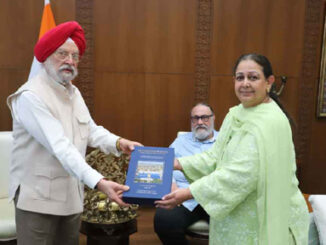
    Mr. Gurbax Singh Malhi, ex-MP, and Dr. Dalbir Singh Kathuria felicitating Mr. Surinderpal Singh Oberoi.

    He was felicitated by the Vishav Punjabi Bhavan in Brampton this weekend in recognition of his “selfless contributions” for the welfare of mankind. Mr. Gurbux Singh Malhi, who incidentally became the first “turbaned” Sikh to sit in a parliament outside India, was the guest of honor at an event that was well attended by members of the Indian diaspora.

    While narrating his story, Surinderpal Singh Oberoi recalled the days when he revolted and refused to pursue his post-matric studies. “My father wanted me to study further, but I had no interest in studies. One day, I told my parents that I have no interest in studies. They were upset. I told them that I want to do something different.

    “When I decided to leave the home and venture out in search of my world, I had 600 rupees in my pocket. My father, a strict disciplinarian, gave me some more and told me that I would show them my face only after I had achieved something.

    “I worked as a laborer on the roadside before I got a chance to work on a construction project in Dubai as a mechanic. After five years, when I returned home, my father made fun of me, saying, “What have I become—a mechanic? It pinched me, and I left home again. This time, I started my work in Dubai and worked hard.

    “The Almighty was kind. My construction business flourished.

    “The turning point in my life came on March 31, 2010, when I read in a newspaper that 17 Indian boys had been given a death sentence for the death of a Pakistani boy. How could 17 people be sent to the gallows for the death or murder of a single person? There were alarm bells in my brain. I was convinced that there must be some innocent boys being prosecuted for a crime they had not committed.

    “Since it was on my mind, I worked with law enforcement agencies, families of the boys facing the death sentences, lawyers, and others. I concluded that only three of the 17 boys were involved in the incident where a boy from Pakistan was killed. I paid the blood money to the family of the slain Pakistani boy and got all those released and deported back to India.

    “See the fate of those released. Those who, in my opinion and in stories narrated by them, were involved in the crime met unnatural ends on their return over a period, while the rest, 14, have settled down well, have families, and are living happily.

    “In all, I have got nearly 150 migrant laborers or workers facing gallows released by paying blood money to the families of the victims. The beneficiaries were not only Punjabi boys but also from other parts of India, Pakistan, Sri Lanka, and other countries as well.

    “I never took up cases where there were serious charges like murder, rape, or illicit smuggling of liquor or narcotics,” says Mr. Surinderpal Singh Oberoi.

    His “Sarbat da Bhalla” organization is now starting universities to provide quality and affordable education to vulnerable youth, besides setting up special centers for special needs. Old age pensions to deserving people, providing free rations to needy people, giving roofs over heads to a select section of people, and running highly subsidized diagnostic centers all over North India are some of the projects he runs with his own money.

    His organization does not accept donations—cash or kind.

    Even in Dubai, his organization provides free rations and food packets to needy migrant laborers. He has a big setup in India that controls and runs various charitable institutions run by the organization.

    Mr Gurbax Singh Malhi

    Mr. Gurbux Singh Malhi, who became the first turbaned Sikh to be elected to the House of Commons in 1993, eulogized the selfless contributions of Mr. Surinderpal Singh Oberoi. He also lauded Vishav Punjabi Bhavan for providing a platform for the organizations promoting Punjabi and Punjabiyat on Canadian soil.

    Dr Dalbir Singh Kathuria 

    Dr. Dalbir Singh Kathuria of Vishav Punjabi Bhavan traced the origin and growth of his organization, saying that it was working dedicatedly for the promotion of the Punjabi language and culture in Canada.

    Husnain, a folk singer from Pakistan, regaled the audience with a song dedicated to the Punjabi language. (Photographs by Prabhjot Singh)
  • Carney announces removal of retaliatory tariffs on US goods compliant with CUSMA

    Carney announces removal of retaliatory tariffs on US goods compliant with CUSMA

    OTTAWA (TIP): Prime Minister Mark Carney said Friday, August 22, that Canada will lift many of its retaliatory tariffs on U.S. goods that fall under free trade rules, after agreeing with U.S. President Donald Trump to “intensify” stalled trade talks. Canadian counter-tariffs on U.S. autos, steel and aluminum will remain for now, Carney said, describing the move as a bid to “match” Trump’s tariffs on Canada. The change will take effect starting next week, the prime minister said. “As we work to address outstanding trade issues with the United States, it’s important — it’s vital — we do everything we can to preserve this unique advantage for Canadian workers, Canadian businesses,” Carney told reporters in Ottawa.

    “In short, the situation we’re in now is that Canada and the United States have re-established free trade for the vast majority of our goods.”

    Carney’s announcement comes a day after he held what he called a “productive” call with Trump, their first known discussion since Trump raised tariffs on Canada to 35 per cent on Aug. 1.

    Those tariffs only to apply to Canadian goods that fall outside the Canada-United States-Mexico Agreement on free trade (CUSMA), continuing an exemption Trump first announced in the spring.

    Canada had kept its counter-tariffs on nearly $30 billion of U.S. goods that fall under the free trade pact, including orange juice and microwaves, despite Trump’s CUSMA carve-out.

    Carney said those tariffs will no longer apply starting Sept. 1. “We welcome this move by Canada, which is long overdue,” a White House official told Global News on background.

    “We look forward to continuing our discussions with Canada on the administration’s trade and national security concerns.”

    Trump called the move “nice” while speaking to reporters in the Oval Office later on Friday, and said he would be speaking again with Carney “soon.”

    “We’re working on something,” he said. “We want to be very good to Canada. I like Carney a lot. I think he’s a good, good person and we had a very good talk yesterday.”

    Asked Friday if he received assurances from Trump that the move will kickstart negotiations toward a new trade and security agreement, Carney replied, “Yes.”

    U.S. Ambassador to Canada Pete Hoekstra had complained about Canada’s counter-tariffs on U.S. goods that fall under CUSMA, also known as the USMCA, in an interview with Global News last week.

    “Canada is the country that has pulled the rug out from USMCA,” Hoekstra said.

    “They also started putting tariffs on CUSMA products … We haven’t done that, but Canada has decided, ‘That’s fair game. We will call into question CUSMA.’”

    Carney says move sets stage for renewed talks with U.S.
    The removal of Canada’s counter-tariffs come after the federal government rescinded its controversial digital services tax following Trump’s threats to end trade talks altogether.

    Canada also hasn’t raised its counter-tariffs on steel and aluminum after Trump raised his global tariffs on those products to 50 per cent, despite promises from Carney to “adjust” them in the near future.

    Asked by Global News if he was appeasing Trump with these moves on Friday, Carney said the goal was to match U.S. tariff policies while setting the stage both for the current trade and security negotiations and next year’s scheduled CUSMA review.

    “The president and I had a long conversation yesterday and we see the opportunity to build on where the relationship already is,” he said.

    “We intend to advance those discussions as rapidly as possible. The foundation is very strong, the opportunity is great and we want to focus on those opportunities.”

    Carney said “I reject your characterization of what I’m saying” when pressed on whether he is asking Canadians to accept the best of a bad deal, after urging Canadians to put their “elbows up” in its dispute with the U.S.

    “We have the best deal with the United States right now,” he said. “We have the best deal. Look at the numbers. Our tariff rate is 5.5 per cent. We have 85 per cent of our goods that are free trade — it’s not what we used to have, (but) nobody has a deal with the United States that they used to have.

    “With this decision, we’re respecting our agreement with the United States and we are matching what they have done. That puts us in a good position for the next phase of these negotiations.”

    Carney added the move doesn’t conflict with his “elbows up” pledge, continuing the analogy by describing the negotiations as a long hockey game.
    “There is a time in a big game, and this is a big game, when you go hard in the corners, the elbow is up, we drop the gloves in the first period and just send a message,” he said. “And we’ve done that pretty uniquely in the world.
    “But there’s also a time in a game where you want the puck, you want to stick handle, you want to pass, you want to put the puck in the net. And we’re moving later into the game, and we’re at that time in the game, and that’s where the engagement is.”

    Conservative Leader Pierre Poilievre has accused Carney of putting his “elbows down” and “bending over backwards” to appease Trump amid the negotiations.

    He called Friday’s announcement “another climb-down and capitulation by Mark Carney,” noting Trump appeared to give no concessions in return.

    “His elbows have mysteriously gone missing,” he told reporters in Ottawa.

    “His signature promise in the last election was that he was going to put elbows up, negotiate to win and match American tariffs. … Now he’s abandoning it. So, either he admits that he was wrong all along or that he knowingly spread falsehoods to get elected. He needs to explain which of those two things it is.”

    Reaction to Carney’s announcement Friday was mixed.

    The Canadian Federation of Independent Businesses (CFIB) and the U.S.-based Consumer Choice Center welcomed the move, saying removing counter-tariffs will provide relief to small business owners and consumers.

    The CFIB released a survey of members Wednesday that suggested nearly 20 per cent of Canadian small businesses are at risk of having to shut down in as little as six months as they struggle with higher costs brought on by the tit-for-tat tariffs.

    “This is a step in the right direction and will take some of the pressure off Canadian small businesses as trade talks continue,” CFIB executive vice-president Corinne Pohlmann said in a statement Friday, while calling on Ottawa to release tariff revenues to those businesses.

    The Business Council of Canada also said removing the counter-tariffs “was a necessary step to preserve and strengthen our preferential trade relationship with our most important trading partner.”

    However, Unifor national president Lana Payne said on social media that Carney’s move “only enables more U.S. aggression” and urged Ottawa to maintain leverage until Trump drops all its tariffs.

    Ontario Premier Doug Ford, who has pushed Ottawa to step up and expand its counter-tariffs, spoke to Carney after Friday’s announcement “to stress the need for an agreement with the United States that provides relief to our tariff-impacted sectors, including steel, auto, forestry and copper.”

    “If the federal government can’t achieve that, they need to hit back hard against U.S. tariffs and provide additional supports for the workers and businesses in these sectors,” Ford said in a statement.

    The Canadian Chamber of Commerce was more reserved, saying in a statement that the focus must remain on securing a good deal between Canada and the U.S. and that tariffed sectors like steel, aluminum and agriculture are bearing the brunt of the trade dispute.

    “At a time of heightened trade tensions, it is essential these adjustments be carefully calibrated in close consultation with Canada’s business community,” senior vice president of international policy Catherine Fortin LeFaivre.

    “Decisions made today will have ripple effects for supply chains, employers and consumers, and must be managed with care to preserve long-term competitiveness.”

    Carney said Thursday that he and Trump “focused on trade challenges, opportunities, building a new economic and security relationship between Canada and the U.S., and supporting long-term peace and security for Ukraine and Europe” in a post on social media that called the discussion “substantive and lengthy.”

    A statement from the Prime Minister’s Office said Trump and Carney “agreed to reconvene shortly.”

    The White House said the duties increased because Ottawa did not do enough to curb the flow of fentanyl and pointed to Canada’s implementation of retaliatory tariffs.

    “There’s two countries that have been relatively harsh against the United States, and that’s China and Canada,” Hoekstra told Global News last week. China has also faced increased U.S. tariffs compared to other countries.

    Data from the U.S. Customs and Border Protection agency shows a minuscule amount of fentanyl is seized at the northern border compared to the border with Mexico, though seizures from Canada spiked this spring.

    Foreign Affairs Minister Anita Anand and U.S. Secretary of State Marco Rubio also held their first official meeting in Washington on Thursday, after Anand took over the portfolio in May.

    The two discussed Ukraine, Gaza, Haiti and China, according to readouts from their offices, which did not mention the ongoing trade war.
    (Source: Global News)

  • ‘Scared to go outside’: Indian student plans to return home after violent attack in Ireland

    Dublin (TIP)- An Indian man in Dublin was reportedly attacked by a group of teenagers over the weekend, in what he says was an unprovoked assault. “One of the youths rode up on an electric scooter and suddenly kicked me in the stomach,” the man told Irish news outlet, The Journal. “Many of my friends are even scared to go outside,” he added.
    The incident marks the fourth racist attack in Dublin within a month and comes after President Michael D Higgins on Tuesday condemned the violence as “despicable” while expressing a “deep sense of gratitude” for the Indian community.
    The victim, speaking on condition of anonymity to The Journal, said around 5:30 pm on Sunday, he was walking home from Fairview Park when the teenager took his metal water bottle and struck him above the eye, causing a deep cut and heavy bleeding that required eight stitches.
    As he tried to walk away, two more joined in, punching and hitting him until he fell, where they continued the attack. He now plans to return to India following the assault.
    Although bystanders did not intervene, two teenagers later called the police. The man was taken to hospital. Police are investigating and have appealed for witnesses.
    His parents, worried after the assault, urged him to return to India. He has since requested an extension from his university to complete his thesis remotely from home.
    The victim as per The Journal also said he felt “let down” by the Indian Embassy. According to him, his brother contacted the Embassy the day after the attack. He was then asked via phone to send an email outlining the incident — but has received no follow-up since.
    The assault is among a spate of violent incidents targeting Indian nationals in recent weeks, including attacks in Tallaght, Waterford, and Dublin.
    Other recent attacks include a man being stripped and beaten after a false accusation in Tallaght, another man assaulted on his way home from a friend’s apartment, and a six-year-old girl attacked in Waterford.
    The Indian Embassy in Dublin has advised citizens to “take reasonable precautions for their personal security and avoid deserted areas, especially in odd hours.”

  • Serbian anti-government protests escalate in third night of clashes

    Serbian anti-government protests escalate in third night of clashes

    Belgrade (TIP)- Thousands of protesters took to the streets across Serbia, smashing windows of the governing party’s headquarters in the northern city of Novi Sad, where the country’s antigovernment revolt started more than nine months ago. The protesters came out in force for a third night on Thursday, following major clashes earlier in the week that saw dozens detained or injured, demanding that President Aleksandar Vucic call an early election.
    In Novi Sad, where a train station canopy collapsed last year, killing 16 people and creating public anger over alleged corruption in infrastructure projects, protesters attacked the offices of the governing Serbian Progressive Party (SNS), carrying away furniture and documents, and splashing paint on the entrance.
    “He is finished,” they shouted, with reference to the president as they demolished the offices. The police and Vucic’s supporters, who have guarded the office in Serbia’s second-largest city for months, were nowhere to be seen.
    In Belgrade, the Serbian capital, hundreds of protesters and SNS supporters threw flares and firecrackers at each other on one of the city’s main boulevards. Police fired tear gas at least two locations to disperse the protesters and keep the opposing camps apart.
    Similar protests were held in towns across the country.
    Vucic told pro-government Informer television that “the state will win” as he announced a crackdown on antigovernment protesters, accusing them of inciting violence and of being “enemies of their own country”.
    “I think it is clear they did not want peace and Gandhian protests. There will be more arrests,” he said during the broadcast.
    He reiterated earlier claims that the protests have been organised from abroad, offering no evidence.
    The previous night, there were gatherings at some 90 locations in the country, according to Interior Minister Ivica Dacic the following day.
    The EU’s Commissioner for Enlargement Marta Kos said on X that the reports of violence were “deeply concerning”.
    “Advancing on the EU path requires citizens can express their views freely and journalists can report without intimidation or attacks,” Kos said on X.
    The Serbian president denies allegations of allowing organised crime and corruption to flourish in the country, which is a candidate for European Union membership.

  • India added to UK’s ‘deport now, appeal later’ list for foreign criminals

    India is among the countries being added to an expanded UK government list of countries where foreign criminals will be deported once they are sentenced before their appeals are heard as part of measures to crack down on rising migration to the country. In an announcement on Sunday, the UK Home Office confirmed that the scope of its “Deport Now Appeal Later” scheme will be nearly trebled from eight countries to 23, with foreign nationals from these countries to be deported to their home countries before they can appeal against that decision. Foreigners who have had their human rights claim refused will have a chance to take part in their UK appeal hearing remotely from overseas using video technology.
    “For far too long, foreign criminals have been exploiting our immigration system, remaining in the UK for months or even years while their appeals drag on. That has to end,” said Home Secretary Yvette Cooper.
    “Those who commit crimes in our country cannot be allowed to manipulate the system, which is why we are restoring control and sending a clear message that our laws must be respected and will be enforced,” she said.
    The list of countries covered under the remote hearing scheme, revived in 2023 by then Conservative home secretary Suella Braverman, included Finland, Nigeria, Estonia, Albania, Belize, Mauritius, Tanzania and Kosovo.
    Now, India will be added along with Angola, Australia, Botswana, Brunei, Bulgaria, Canada, Guyana, Indonesia, Kenya, Latvia, Lebanon, Malaysia, Uganda and Zambia.
    The UK government said it remains in continuous discussions with “a range of other countries about joining the scheme”.
    “We are leading diplomatic efforts to increase the number of countries where foreign criminals can be swiftly returned, and if they want to appeal, they can do so safely from their home country. Under this scheme, we’re investing in international partnerships that uphold our security and make our streets safer,” said Foreign Secretary David Lammy. According to the Home Office, previously offenders from the countries on the expanded list could remain in the UK for months or years while their cases were worked through the appeals system as an “added burden on the British taxpayer” beyond the end of the prison sentences.
    It also released the latest figures to highlight that around 5,200 foreign nationals were deported since July 2024 when the Labour government came into office, an increase of 14%.

  • 4 more Palestinians die from Israel-induced starvation; acute malnutrition reached ‘highest levels,’ says UN

    Gaza Strip (TIP): Four more Palestinians died from starvation on Thursday, amid Israel’s continuous blockade of humanitarian assistance into Gaza. This has raised the total number of hunger-related deaths in Gaza to 197, including 96 children. Meanwhile, the United Nations has on Thursday warned that acute malnutrition in Gaza’s children has reached the “highest levels” recorded to date, with over 12,000 children identified as acutely malnourished in the month of July. “Acute malnutrition among children in Gaza has reached the highest levels recorded to date,” Farhan Haq, deputy spokesman for UN Secretary-General Antonio Guterres said, reported Al Jazeera.
    Haq pointed out that UN partners were able to reach only 8,700 of the 290,000 children under age five who needed feeding and nutrient supplements, due to “constraints on humanitarian access” amid Israel’s blockade and continuous attacks on the enclave.
    “Israel continues to block necessary assistance from entering Gaza… Aid that has entered remains by far insufficient, and our convoys continue to face impediments on their way to delivering aid,” he said.
    Israel’s genocidal war in Gaza has so far killed at least 61,258 Palestinians, more than half of it being women and children. It has also targeted and killed over 200 journalists, more than 1000 healthcare workers and aid workers. (AFP)

  • Pakistan denies reports that Army chief Asim Munir plans to become next President

    Pakistan denies reports that Army chief Asim Munir plans to become next President

    ISLAMABAD (TIP): The Pakistan Army has denied as “baseless” the rumours that Army chief Asim Munir plans to become the next president. The army’s response came following rumours and a wave of disinformation on social media during the previous weeks that Munir plans to replace President Asif Ali Zardari.
    Army spokesperson Lt Gen Ahmed Sharif Chaudhry, in an interview with The Economist, made it clear that the army chief has no interest in the presidency and no such proposal is under consideration, the state-run PTV posted on social media on Wednesday. “Talks about Field Marshal Asim Munir becoming the president of Pakistan are completely baseless,” he said. On July 10, Interior Minister Mohsin Naqvi rejected rumours regarding the possible ouster of President Zardari and termed it a “malicious campaign.”
    He said that President Zardari “enjoys a strong and respectful relationship with the leadership of the armed forces.”
    Naqvi stressed that Munir’s “sole focus” was Pakistan’s strength and stability, and “nothing else.” (PTI)

  • Six-year-old Indian girl beaten, hit in private parts in Ireland racist attack

    Waterford (TIP): A six-year-old girl of Indian origin was brutally assaulted by a group of boys outside her home in Waterford, Ireland, while they shouted racist slurs, including, “Go back to India.” The attackers also struck her in the private parts, marking the first reported racist assault on an Indian child in Ireland.
    The incident occurred on Monday evening, August 4, while the girl was playing outside her home with friends. According to her mother, the attackers included an eight-year-old girl and several boys between the ages of 12 and 14. The mother had been watching her daughter play but briefly went inside to feed her 10-month-old son.
    “I told her I would be back in a second after feeding the baby,” the mother told The Irish Mirror. However, within minutes, her daughter returned home, visibly distressed. “She was very upset, she started crying. She couldn’t even talk, she was so scared,” the mother said.
    One of the girl’s friends later revealed that the older boys had hit her with a bicycle on her private parts and punched her in the face. “She told me five of them punched her in the face. One of the boys pushed the bicycle wheel onto her private parts and it was really sore. They said the F word and ‘Dirty Indian, go back to India,’” the mother said. The girl also reported being punched in the neck and having her hair twisted.
    The mother, a nurse who has lived in Ireland for eight years and recently became an Irish citizen, said her daughter is now too afraid to play outside. “We no longer feel safe here, even right in front of our own home. It doesn’t feel like she can play without fear,” she said.
    Heartbroken, the mother added, “I feel so sad for her. I could not protect her. I never expected such an incident would happen. I thought she would be safe here.”
    Though she reported the attack to the Garda (Irish police), the mother said she does not seek punishment for the boys, but hopes they receive counselling and guidance. “I don’t know how the government will address this. We came here to fill a labour gap, we are professionals, we have all the certificates,” she said.
    The attack is part of a disturbing rise in racist violence against Indians in Ireland. Last month, a 40-year-old Indian man was brutally beaten and stripped in public by a teenage gang in Tallaght, a Dublin suburb. Since July 19, at least three attacks on Indian-origin individuals have been reported in Dublin, raising serious concerns within the Indian community. (NIE)

  • Hiroshima marks 80 years since atomic bombing as aging survivors worry about growing nuke threat

    Hiroshima marks 80 years since atomic bombing as aging survivors worry about growing nuke threat

    HIROSHIMA (TIP): Hiroshima on Wednesday marked the 80th anniversary of the US atomic bombing of the western Japanese city, with many ageing survivors expressing frustration about the growing support of global leaders for nuclear weapons as a deterrence. With the number of survivors rapidly declining and their average age now exceeding 86, the anniversary is considered the last milestone event for many of them. “There will be nobody left to pass on this sad and painful experience in 10 years or 20 years,” Minoru Suzuto, a 94-year-old survivor, said after he kneeled down to pray at the cenotaph.
    “That’s why I want to share (my story) as much as I can.”
    The bombing of Hiroshima on Aug. 6, 1945, destroyed the city and killed 140,000 people. A second bomb dropped three days later on Nagasaki killed 70,000. Japan surrendered on Aug. 15, ending World War II and Japan’s nearly half-century of aggression in Asia.
    Hiroshima Mayor Kazumi Matsui warned against a growing acceptance of military buildups and of using nuclear weapons for national security amid Russia’s war in Ukraine and conflicts in the Mideast, with the United States and Russia possessing most of the world’s nuclear warheads.
    “These developments flagrantly disregard the lessons the international community should have learned from the tragedies of history,” he said. (AP)

  • Sudanese airstrike hits Darfur airport, kills 40 suspected mercenaries, officials say

    Sudanese airstrike hits Darfur airport, kills 40 suspected mercenaries, officials say

    CAIRO (TIP): A Sudanese airstrike hit an airport in the country’s Darfur region controlled by a notorious paramilitary group, destroying a suspected Emirati military aircraft and killing dozens of suspected mercenaries, Sudanese officials and a rebel advisor said Thursday.
    Wednesday’s strike on the Nyala airport killed at least 40 suspected mercenaries from Colombia and destroyed a shipment of arms and equipment that were sent by the United Arab Emirates to the Rapid Support Forces, or RSF, according to two Sudanese military officials and an advisor to a Darfur rebel leader allied with the RSF.
    The officials spoke on condition of anonymity because they were not authorized to brief the media. The advisor also requested anonymity for his safety.
    Sudan plunged into chaos when simmering tensions between the country’s military and the RSF exploded into fighting in April 2023 in the capital, Khartoum, and elsewhere in the country.
    The fighting has turned into a full-fledged civil war that killed tens of thousands of people, displaced over 14 million people and pushed parts of the country into famine.
    State-run Sudan TV reported the aircraft had taken off from a military base in the Arab Gulf region, and that Sudanese fighter jets struck it when it landed at the Nyala airport. It described the strike as a “blatant message” and a “new equation of deterrence” against foreign interference in Sudan’s affairs.
    The Emirati Foreign Ministry didn’t immediately respond to a request for comment. However, it has repeatedly denied involvement in the Sudan war by backing armed groups. There was also no comment from the RSF.
    Responding to the reports, Colombian President Gustavo Petro wrote on X overnight that he ordered an investigation into the mercenaries’ killing.
    The RSF seized Nyala, the capital city of South Darfur province, last year as part of the paramilitary group’s push to control the entire region of Darfur. The Sudanese government has accused the RSF of turning the city’s civilian airport into a military hub to receive weapons shipments and smuggle gold.
    The Sudanese military has repeatedly struck the airport, saying it targeted aircraft delivering military supplies and mercenaries to the RSF.
    U.N. experts confirmed in a report released in April that Colombian mercenaries were present in Darfur and that those mercenaries were hired by a private security firm to support the RSF.
    According to the report, the Colombian Foreign Ministry acknowledged that Colombian mercenaries were in Darfur and announced the establishment of a special immediate response group to ensure the safe return of its nationals.
    Sudan says UAE barred Sudanese planes
    The Sudanese aviation agency, meanwhile, said the UAE barred Sudanese planes Wednesday from landing at its airports, in what it called a “surprise, uncoordinated” measure.
    The Civil Aviation Authority said in a statement that a Sudanese airliner was also barred from taking off at the Abu Dhabi airport, according to a report by the state-run SUNA news agency.
    The UAE’s Foreign Ministry also didn’t respond to a request for comment on the report.
    Relations between the military-allied government in Sudan and the UAE have been frayed over Abu Dhabi’s alleged support to the RSF. The Sudanese government severed ties with the UAE earlier this year over the allegations. (AP)

  • Plastics Treaty: Uproar over fossil fuel lobbyists in delegations

    Plastics Treaty: Uproar over fossil fuel lobbyists in delegations

    Switzerland (TIP): At least 19 fossil fuel and chemical industry lobbyists have secured places in national delegations at the final round of global plastics treaty negotiations in Geneva, triggering outrage from civil society groups and raising serious concerns over the integrity of the talks. The revelation is part of a broader analysis by the Center for International Environmental Law (CIEL), which identified a total of 234 fossil fuel and chemical lobbyists registered to participate in the fifth and final scheduled session of the Intergovernmental Negotiating Committee (INC-5.2). This is the highest industry presence recorded in the treaty process to date — and more than the entire delegation of the European Union and its 27 member states combined (233). The 19 lobbyists have been formally included in the delegations of Egypt (6), Kazakhstan (4), China (3), Iran (3), Chile (2), and the Dominican Republic (1). Their inclusion gives them access to closed-door discussions and potentially even a voice in defining national positions on the treaty —a situation civil society groups say amounts to a direct conflict of interest.
    “The industry is not just observing — it is actively shaping the outcome,” said Rachel Radvany, CIEL’s Environmental Health Campaigner. “We’ve seen them speak in plenary, push their agenda publicly, and align with petrostate interests to weaken ambition.”

    The Plastics Treaty is intended to address plastic pollution across its full life cycle — from production to disposal — and many countries, scientists, and communities are pushing for binding caps on production and use of toxic additives. But with lobbyists embedded inside negotiating delegations, critics argue the process is at risk of being co-opted from within.
    When this reporter asked whether it should not be the responsibility of the United Nations Environment Programme (UNEP) to prevent industry representatives from entering national delegations, David Azoulay, Director of Environmental Health at CIEL, responded by pointing out a critical gap in global environmental governance.
    “The INCs are following rules established for earlier agreements, where it’s up to Member States to define the makeup of their delegations. But UNEP could still play a more proactive role. They could encourage greater transparency and better conflict of interest policies — even if they can’t directly control who gets in.”
    Azoulay contrasted UNEP’s approach with that of other UN bodies that have adopted firm safeguards. “UNDP and WHO both have clear conflict of interest policies. UNEP does not. The WHO’s Framework Convention on Tobacco Control even bars tobacco industry representatives from participating in treaty implementation or attending decision-making meetings. It shows that if the political will exists, it is absolutely possible to prevent undue influence.”
    Meanwhile, civil society organisations face barriers not just in influence, but in physical access. “UNEP has drastically reduced the number of contact group seats from over 200 to just 60,” Bjorn Beeler, Executive Director of the International Pollutants Elimination Network (IPEN) told this newspaper. (AP)

  • Zelensky calls for Putin meeting to end war

    KYIV (TIP): Ukrainian President Volodymyr Zelensky on Thursday called for a face-to-face meeting with Vladimir Putin to end war, after Donald Trump’s special envoy held talks with the Russian leader in Moscow.
    Trump one day earlier hailed talks between his envoy Steve Witkoff and Putin as “highly productive” but US officials still vowed to impose sanctions on Moscow’s trading partners. Zelensky said later that he had spoken by phone with Trump, who said he could meet with Putin “very soon,” and that European leaders had been on the call.
    “We in Ukraine have repeatedly said that finding real solutions can be truly effective at the level of leaders,” Zelensky wrote on social media. “It is necessary to determine the timing for such a format and the range of issues to be addressed,” he added. (AFP)

  • Israeli army will ‘take control’ of Gaza City: PM statement

    Israeli army will ‘take control’ of Gaza City: PM statement

    JERUSALEM (TIP): Israel’s security cabinet has approved a plan proposed by Prime Minister Benjamin Netanyahu for the military to “take control” of Gaza City, his office said in a statement Friday.
    Under the plan to “defeat” Hamas in the Gaza Strip, the Israeli army “will prepare to take control of Gaza City while distributing humanitarian assistance to the civilian population outside combat zones”, the statement said.
    “The security cabinet, by majority vote adopted five principles for concluding the war: the disarming of Hamas; the return of all hostages — living and dead; the demilitarisation of the Gaza Strip; Israeli security control in the Gaza Strip; the establishment of an alternative civil administration that is neither Hamas nor the Palestinian Authority.
    “A decisive majority of security cabinet ministers believed that the alternative plan that had been submitted to the security cabinet would neither achieve the defeat of Hamas nor the return of the hostages,” it added, without giving further details.
    As he convened his security cabinet on Thursday, Netanyahu said Israel planned to take full control of Gaza but did not intend to govern it.
    Nearly two years into the war in Gaza, the Israeli leader faces mounting pressure at home and abroad for a truce deal to pull the Palestinian territory’s more than two million people back from the brink of famine and to spare hostages held by Palestinian militants. (AFP)

  • Come festival season, and cricket lovers will have a rich feast of the  shortest and latest version of instant cricket

    Come festival season, and cricket lovers will have a rich feast of the shortest and latest version of instant cricket

    By Prabhjot Singh

    TORONTO (TIP): Diwali is the time when people of Indian origin go all out for the festivities. Adding to their festivities, Cricket Canada has decided to hold its marquee event, the first-ever T10 Tournament, both for men and women, at BC Place. Holding this premier event from October 8 to 13 will mark a new chapter in Canadian cricket. The Canada Super 60, an exciting ten-over-a-side cricket league featuring some of the world’s top players, is now all set for a launch at BC Place Stadium with the announcement of its dates. It will be the first time that international cricket of this level will be played indoors, under artificial lights, at a top-tier venue on Canada’s West Coast—a truly historic moment for the sport in North America.

    Cricket in North America has been gaining momentum primarily because of its growing population of migrants from South Asia in general and India in particular. Former Test cricket star Yuvraj Singh is the brand ambassador of the Canada Super 60 event.

    Canada Super 60 is a groundbreaking new cricket league launching in 2025, introducing the unique 10-over-a-side format with both men’s and women’s competitions from its inaugural season—a global first. Backed by Cricket Canada, the league aims to elevate Canada’s place on the world cricket map while offering fans a thrilling mix of power and strategy between T20s and ODIs.

    The tournament will be hosted at the iconic BC Place Stadium in Vancouver, making it the first major cricket league to debut on Canada’s West Coast. The Canada Super 60 is more than just a tournament—it’s a celebration of sport, diversity, and opportunity designed to grow the game in North America and give Canadian players global exposure.

    As the largest multipurpose venue of its kind in Western Canada, BC Place provides a spectacular home for international, professional, and amateur sports; entertainment; commerce; cultural experiences; and community gatherings for the benefit of all British Columbians.

    BC Place is a part of BC Pavilion Corporation (PavCo), a provincial crown corporation of the Ministry of Tourism, Arts, Culture, and Sport that owns and operates the Vancouver Convention Centre and BC Place.

    The tournament will showcase men’s and women’s competition as part of its debut season, making it one of the most inclusive and ambitious cricket initiatives in Canadian history.

    With Canada recently qualifying for the ICC T20 World Cup, the timing could not be better, as it would also coincide with the festival season.

    Gurdeep Klair, Treasurer of Cricket Canada and a member of the ICC Executive Committee, believes the Canada Super 60 can be a landmark in the country’s cricket development. “This tournament is a steppingstone for the next generation of Canadian cricketers. It offers them high-quality exposure in a professional setting, right here at home. Playing at a globally recognized venue like BC Place demonstrates the significant progress Canadian cricket has made—taking the sport to this level is historic. And having a women’s competition from Day One sends a strong message to young girls across the country: cricket is for them too, and they can aspire big.”

    Former Scotland captain and now Assistant Tournament Director, Kyle Coetzer, shared his excitement about the venue and its impact. “Canada Super 60 is a truly unique opportunity—a tournament that blends top-tier entertainment with real development potential. It will benefit players not just from Canada but from associate nations across the world, offering them a platform to compete, grow, and learn alongside international stars.

    With player registration now open, the enthusiasm around the tournament is already palpable. It’s a moment for players to challenge themselves and excite fans in one of the most dynamic sporting environments anywhere.”

    Vancouver will witness a cricket event like never before—fast-paced matches under a retractable roof, electrifying fan experiences, and a celebration of sport, community, and culture all in one. With prime-time games scheduled throughout the week, the Canada Super 60 is set to establish Vancouver as a global cricket destination.

    Ticketing details for the Canada Super 60 will be announced soon. With cricket rapidly emerging as one of the fastest-growing sports in North America, the tournament promises not only electrifying matches but also a transformative cultural and sporting experience for Vancouver.

    (Prabhjot Singh is a Toronto-based award-winning independent journalist. He was celebrated by AIPS, the international body of sports journalists, for covering ten Olympics, at its centennial celebrations held at UNESCO Centre in Paris during the 2024 Olympic Games. Besides, he has written extensively about business and the financial markets, the health industry, the public and private sectors, and aviation. He has worked as a political reporter besides covering Sikh and Punjab politics. He is particularly interested in Indian Diaspora and Sikh Diaspora in particular. His work has also appeared in various international and national newspapers, magazines, and journals. He can be reached at prabhjot416@gmail.com)

  • Another big haul of cocaine  comes from the US

    Another big haul of cocaine comes from the US

    By Prabhjot Singh

    TORONTO (TIP): Smuggling of contraband across their international borders has been a concern for both the United States and Canada. While the US is constantly threatening Canada with heavier tariffs for its failure to prevent smuggling of deadly fentanyl across the international borders, Canada has not retaliated even while trade relations between the two great neighbors and longtime trade partners have touched a new low.

    Between January 1 and July 10, 2025, the CBSA seized a total of 1,164 kg of cocaine originating from the United States, alongside 514 kg from other countries combined. Besides cocaine, various other drugs are also being smuggled into Canada from across the US border. Recent seizures indicate that there has been little or no let-up in the smuggling of drugs across the border. Even a former Canadian Olympian is alleged to be a kingpin of one of the gangs involved in the illicit drug trade.

    While Canada has launched a massive program to strengthen its border patrol, the US has expressed little satisfaction over the newer controls introduced to check the movement of fentanyl into the US territories, where it has been allegedly claiming a heavy toll of human life.

    Last month, the Canada Border Services Agency (CBSA) claimed a significant seizure of cocaine at the Blue Water Bridge port of entry in Point Edward, Ontario. On July 23, 2025, a commercial truck arriving from the United States was referred for a secondary examination at the Blue Water Bridge port of entry. During an inspection of the trailer, border services officers found seven bags containing bricks of suspected cocaine. The total weight of the alleged narcotics was 197 kg, with an estimated street value of $24.6 million. The CBSA arrested Onkar Kalsi, 29, of Caledon, Ontario, and transferred him and the suspected narcotics to the custody of the Royal Canadian Mounted Police (RCMP). Kalsi has been charged by the RCMP with smuggling cocaine and possession of cocaine for trafficking under the Controlled Drugs and Substances Act.

    The investigation is ongoing. Between January 1 and July 10, 2025, the CBSA seized a total of 1,164 kg of cocaine originating from the United States, alongside 514 kg from other countries combined.

    “This seizure by our dedicated border services officers demonstrates our commitment to stopping criminal activities and safeguarding our communities. Our message is clear: Canada will not tolerate any attempts to undermine the integrity and security of its borders,” says Minister of Public Safety Gary Anandasangaree.

    While talking about the recent seizure, Michael Prosia, Regional Director General – Southern Ontario Region, Canada Border Services Agency, says, “This significant cocaine seizure highlights the critical role our border services officers play in disrupting the illegal flow of drugs into Canada. This success is a result of their vigilance and dedication, as well as the strength of our ongoing collaboration with the RCMP to protect our communities. “

  • Xi says China and EU must deepen trust but bloc chief urges ‘real solutions’

    BEIJING (TIP): Chinese President Xi Jinping said China and the EU must deepen trust in a turbulent world but the bloc’s chiefs called for “real solutions” to move past an inflection point as they met in Beijing on Thursday. China’s leadership has sought to draw the European Union closer as it positions itself as a more reliable partner than the United States and a bedrock of stability in a troubled world. But the EU has made clear there are deep divisions over trade, fears that cheap, subsidised Chinese goods could overwhelm European markets and Beijing’s tacit support for Russia’s war against Ukraine.
    Though nominally intended to celebrate 50 years of diplomatic ties, the long list of grievances set the stage for a contentious summit.
    Welcoming EU Commission head Ursula von der Leyen and European Council chief Antonio Costa at Beijing’s ornate Great Hall of the People, Xi said “the more severe and complex the international situation is, the more important it is for China and the EU to strengthen communication, increase mutual trust and deepen cooperation.”
    In the context of that turmoil, Xi said, Chinese and European leaders must “make correct strategic choices.” “The challenges facing Europe at present do not come from China. There are no fundamental conflicts of interest or geopolitical contradictions between China and the EU,” the Chinese leader said. In response, von der Leyen said “it is vital for China and Europe to acknowledge our respective concerns and come forward with real solutions.” Ties had reached an “inflection point”, she warned.
    Costa also stressed to the Chinese leader that the bloc wanted to see “concrete progress on issues related to trade and the economy, and we both want our relationship to be… mutually beneficial.”
    In a separate meeting on Thursday, Chinese Premier Li Qiang told the two EU leaders that “close cooperation” was a “natural choice” for the two major economies. “As long as both China and the EU earnestly uphold free trade, the international economy and trade will stay dynamic”, he said.
    Brussels had acknowledged the talks between its top bosses and Chinese leaders would be tense. “We know that we don’t see eye to eye with China on many issues,” a senior EU official told AFP last week.
    “But we believe that it is essential to have this kind of very direct and open and constructive conversation sitting at the table at the highest level.”
    Top of the agenda for the EU is the yawning trade deficit with China that stood at around $360 billion last year and which von der Leyen has described as “unsustainable.” (AFP)

  • Passenger plane crashes in Russia killing all 48 people on board, officials say

    Passenger plane crashes in Russia killing all 48 people on board, officials say

    MOSCOW (TIP): A passenger plane crashed Thursday in Russia’s Far East, killing all 48 passengers and crew on board, officials said. The Angara Airlines flight disappeared from radar, and searchers later found the burning wreckage of the plane on a hillside south of its planned destination in Tynda, more than 7,000 kilometers (4,350 miles) east of Moscow, Russia’s Emergency Situations Ministry said. Regional Gov. Vasily Orlov said in a statement that all 48 people aboard were dead, and announced three days of mourning in the Amur region over what he called a “terrible tragedy.”
    It wasn’t immediately clear what caused the crash.
    Russia’s Interfax news agency said there were adverse weather conditions at the time of the crash, citing unnamed sources in the emergency services. Several Russian news outlets also reported that the aircraft was almost 50 years old, citing data taken from the plane’s tail number.
    The Soviet-designed twin turbo prop plane had initially departed from Khabarovsk before making its way to Blagoveshchensk on the Russian-Chinese border and onwards to Tynda.
    Images of the reported crash site circulated by Russian state media show debris scattered among dense forest, surrounded by plumes of smoke.
    Orlov said rescuers had struggled to reach the site due to its remote location, 15 kilometers (9 miles) south of Tynda.
    An earlier statement from the governor said that 49 people had been onboard the flight, but that number later was updated to 48. The reason for the discrepancy was not immediately clear.
    The transport prosecutor’s office in the Far East said in an online statement that the plane was attempting to land for a second time when it lost contact with air traffic control and disappeared from radars.
    The authorities launched a probe on the charge of flight safety violations that resulted in multiple deaths, a standard procedure in aviation accidents.
    Aviation incidents have been frequent in Russia, especially in recent years as international sanctions have squeezed the country’s aviation sector.