
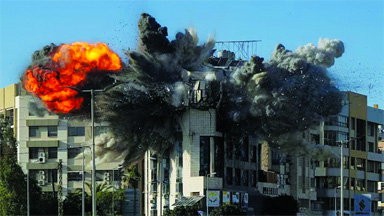

Gaza (TIP): Since February 28, when the United States and Israel began their military campaign against Iran, thousands of strikes have been carried out across the country, hitting not just military-linked locations but also civilian infrastructure such as schools, hospitals, airports, and residential neighborhoods.
Iran has alleged that the scale of damage is vast, claiming over 2,000 deaths linked to US-Israeli strikes across nearly 90,000 civilian locations. The conflict, which began inside Iran, has since spilled into Lebanon, where Israel faces allegations of replicating tactics seen in Gaza.
Tehran has responded with its own strikes. In Israel, at least 19 people have been killed and thousands injured in attacks targeting civilian infrastructure. Gulf nations hosting US bases have also come under fire, with reported fatalities crossing 25.
CIVILIAN TARGETS HIT BY US & ISRAEL
The opening day of the war saw one of the deadliest incidents. On February 28, missiles struck the Shajareh Tayyebeh elementary girls’ school in Minab, southern Iran, killing at least 170 people, most of them young girls aged seven to 12.
President Donald Trump rejected claims that the US was behind the strike. However, multiple reports by international media and rights groups, including Al Jazeera and Amnesty International, indicated the attack was likely intentional and may have involved a US-made Tomahawk missile.
Also on the first day, a newly developed US missile, not previously used in combat, hit civilian structures near a military compound in Lamerd. An elementary school and a sports hall were among the sites struck, leaving 21 people dead, according to expert analysis and visual evidence reviewed by The New York Times.
In another major incident, a cruise missile targeting an IRGC base in southern Iran killed nearly 200 people at a nearby school, most of them children.
Civilian neighborhoods were not spared. On March 9, an Israeli air strike flattened a multi-storey residential building in Tehran’s Resalat district, killing around 50 people and displacing several families.
Financial infrastructure was also hit. An overnight strike on March 11 targeted a Bank Sepah branch in Tehran, with Iranian state media calling it an “illegitimate and unusual act in war” and reporting multiple employee deaths.
Transport hubs came under repeated attack as well. Tehran’s main domestic airport was struck multiple times in mid-March, though Israel said the intended targets were IRGC-linked aircraft stationed there. A recent US air strike hit a highway bridge connecting Tehran and Karaj, killing two people, according to Fars News. Visuals shared by Trump showed the bridge engulfed in flames following the attack.
Academic institutions have also featured among targets. The Iran University of Science and Technology was hit on March 28, though details of casualties remained unclear. A university in Isfahan reported another strike a day later, leaving four staff members injured. Malek Ashtar University and Imam Hossein University were also targeted, with Israel maintaining these facilities were being used for military purposes.
Healthcare infrastructure has taken a significant hit. Iran said that dozens of hospitals and medical centres have been damaged during the sustained bombardment, including a psychiatric hospital in Tehran. The World Health Organization (WHO) confirmed at least 13 attacks on healthcare facilities in the early phase of the conflict.
IRAN’S COUNTER ATTACK IN THE GULF
Iran’s retaliation began almost immediately. On March 1, strikes on the Israeli town of Beit Shemesh killed at least nine people. The same day, Iranian drones targetted critical infrastructure in the Gulf. An Amazon data centre in the UAE was hit, while debris from another drone strike damaged a separate Amazon facility in Bahrain.
Residential areas were also affected. In the early hours of March 12, a drone strike hit a building in Dubai’s Creek Harbour neighbourhood, sparking a fire. Two days later, on March 14, ICD Brookfield Place in Dubai’s financial district — home to offices, restaurants, and retail outlets — was also struck, according to Human Rights Watch.
Disruptions extended to digital infrastructure. On March 24, an apparent drone attack affected Amazon Web Services operations in Bahrain, though it remained unclear whether the facility itself was directly hit.
Airports across the Gulf have faced repeated missile and drone threats. While Iranian drones failed to hit Doha’s airport, Dubai International Airport sustained damage, leading to major delays and cancellations of flights. Qatar Airways was forced to scale back operations and move aircraft to storage in Spain.
Kuwait International Airport was struck, triggering a large fire and damaging radar systems. Earlier, on February 28, a separate drone strike at the same airport injured four Bangladeshi nationals.
Precautionary shutdowns followed elsewhere. New York University’s Abu Dhabi campus suspended operations, citing safety concerns.
According to Human Rights Watch, Iranian strikes have hit a wide range of civilian sites, including residential buildings, hotels, embassies, financial centres, and airports. Investigations have examined attacks involving Fairmont The Palm Hotel, Dubai International Financial Centre, Zayed International Airport, Dubai International Airport, Kuwait International Airport, residential complexes, Crowne Plaza Hotel in Bahrain, the US consulate in Dubai, and the US Embassy in Riyadh.
Source: India Today



Be the first to comment