Tag: wto

  • Is India a ‘Tariff King’? Not Really

    Is India a ‘Tariff King’? Not Really

    “When India is judged on tariffs, there are two parameters which are used. One is simple average tariffs, and the other is trade-weighted tariffs. If you use the former metric, India’s tariff does seem high (15.98 percent). But this is in many ways academic because for most of the goods that come into the Indian market, it is the trade-weighted applied tariff that matters. And the trade-weighted tariff that India maintains is a very respectable 4.6 percent. This level of tariff gives the lie to claims that India is somehow a tariff king.”

    By Mohan Kumar

    There is a widespread but fallacious perception that India’s tariffs are inordinately high. There are subjective factors when it comes to a country like livability, public courtesy, or even how foreigners are welcomed. But tariffs are quantifiable and there should really be no place for subjectivity. So, let us consider the facts in the case.

    Before we do that, however, it might be useful for the average reader to know as to what function tariffs perform in a low-income developing country like India, as opposed to say, a high-income developed country like the United States of America. Traditionally, low-income developing countries use tariffs for two reasons: one, to protect their domestic industry and two, to gain revenue from it. Protection of domestic industry is an accepted argument by economists all over the world, especially if the industry is an infant one and the country needs to develop an industrial base. Then, there is the revenue gaining function, which is illustrative of a country’s duties on alcohol or luxury motorcycles, for instance.

    India’s tariffs, which were high in the 1980s, were brought down significantly since the 1991 reforms were initiated and during the negotiations related to the Uruguay Round, which led to the establishment of the World Trade Organization (WTO). Since then, the secular trend in India has been one of gradual reduction of the applicable tariffs year after year.

    From a technical point of view, there are two kinds of tariffs that countries have. One is applied tariffs, which as the name indicates is the actual tariff (normally ad valorem) imposed at the border when a foreign good enters a country.

    The other one is bound tariffs, which is the maximum tariff that a country can impose on a foreign good from a legal obligation arising from its most-favored-nation (MFN) commitments to the WTO.

    It goes without saying that the tariff war initiated by the U.S. is in violation of its commitments under the WTO agreements. But then, the WTO itself has been moribund for a while. It is also worth noting that tariffs cannot be the same for all countries. It is a truism that low-income developing countries will have higher tariffs (for reasons mentioned above) compared to G7 countries.

    So, where does India figure in all of this? When India is judged on tariffs, there are two parameters which are used. One is simple average tariffs, and the other is trade-weighted tariffs. If you use the former metric, India’s tariff does seem high (15.98 percent). But this is in many ways academic because for most of the goods that come into the Indian market, it is the trade-weighted applied tariff that matters. And the trade-weighted tariff that India maintains is a very respectable 4.6 percent. This level of tariff gives the lie to claims that India is somehow a tariff king. Simple averages distort the picture since they treat all products alike regardless of the trade volumes. So, why is there such a big difference between India’s simple average tariff and its trade-weighted tariff?

    India does maintain relatively high tariffs in agriculture and automobiles. In both these cases, the main purpose of the tariffs is to protect domestic industry. Agriculture in India is sui generis and like no other major country in the world. Around 50 percent of India’s mammoth population directly or indirectly depends on agriculture. Besides, agriculture in India is not mechanized and land holdings are so small that farming is about survival and not about commerce. Asking India to open its farm sector to imports is akin to asking it to commit suicide, which no elected government in India would agree to. This demand is especially egregious since Western farmers are beneficiaries of direct and indirect subsidies.

    Given all of this, India does maintain relatively high tariffs for agriculture products, average rates of around 33 percent on meat, dairy, fruits, and cereals. But this is not surprising if you consider the fact that the European Union’s average rate is 37.5 percent on dairy products going up to 205 percent, and up to 261 percent on fruits and vegetables. Compare this with Japan whose rate is 61.3 percent on dairy products, going up to 298 percent, and up to 258 percent on cereals, and 160 percent on meat and vegetables. Or South Korea, whose average is 54 percent on agricultural goods with 800 percent on vegetables, and 300 percent on fruits. Who is the tariff king in agriculture, you might ask? As for automobiles, this sector creates mass employment and is crucial for that reason.

    Even India’s simple average tariff levels at 15.98 percent is in line with global norms for developing economies. Bangladesh (14.1 percent), Argentina (13.4 percent), and Türkiye (16.2 percent), which are all countries with comparable or higher GDP per capita, maintain similar or higher tariffs.

    On the U.S. saying their exports of non-agricultural products face tariff barriers in India, it is worth noting that U.S. exporters often face equal or lower tariffs in India compared to many Asian peers. In electronics and technology for instance, India has 0 percent tariff on most IT hardware, semiconductors, computers, and associated parts, with average tariffs of 10.9 percent on electronics and 8.3 percent on computing machinery.

    In comparison, Vietnam has a tariff of 8.5 percent on electronic equipment, going up to 35 percent. China has a tariff rate of 5.4 percent going up to 20 percent on electronics, and up to 25 percent on computing machinery. And Indonesia has a tariff rate of 6.3 percent on electronic equipment, going up to 20 percent, and up to 30 percent on computing machinery.

    It is true that India maintains justifiable tariff protection for its agricultural, dairy, and auto markets for valid reasons. But its trade-weighted applied tariff in other sectors does not justify it being called a “tariff king” at all.

    (Dr. Mohan Kumar is a former Indian ambassador and is the director general of the newly established Jadeja Motwani Institute for American Studies at the OP Jindal Global University.)


  • India, US agree to focus on trade, resolving WTO issues

    India, US agree to focus on trade, resolving WTO issues

    Washington (TIP)- Committing themselves to expanding their already growing trade relationship, India and the United States (US) have decided to build on the environment of trust to create resilient supply chains, resolve their existing trade disputes at the World Trade Organisation (WTO) through bilateral mechanisms, work on expanding market access for each other’s products, and intensify their engagement through meetings of specific trade-related working groups on a quarterly basis.

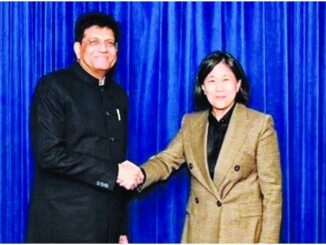
    At the 13th Trade Policy Forum (TPF) ministerial talks held in Washington DC on Wednesday, January 11, Union minister for commerce and industry Piyush Goyal and US Trade Representative Katherine Tai hailed the fact that bilateral trade in goods and services had reached $160 billion in 2021, but also recognised that the full potential of the trade relationship remained “unfulfilled”, according to a joint statement released at the end of the talks.

    Goyal told reporters that the TPF, since its relaunch in November 2021, had evolved into a “robust and outcome-oriented discussion” and was helping create a “smoother, more friendly and trusted environment for businesses to expand their trade and investment between the two countries”.

    US welcomes draft data law

    Goyal said that the US has welcomed India’s draft Digital Personal Data Protection Bill that was released for public consultations at the end of November and appreciated American suggestions in the regard.

    Goyal said, “I must place on record our deep appreciation for the many guidance notes or suggestions we have received from the US from time to time on our digital laws and data protection and privacy laws so that we can align them with the needs of the world and help Indian businesses with their outreach with digital technologies.”

    Pointing out that India is one of the largest suppliers on the information technology services side to the US, and that there is a “shared interest on both sides” to have a greater flow of data, Goyal said, “The new law placed for public consultations by the ministry of electronics and information technology (Meity) was very very much appreciated by the US side and they do see that our effort to align the needs of industry, while maintaining the highest standards of data protection and privacy, has been brought out beautifully in the new law. The US side has expressed their prima facie satisfaction with the new law and will continue to engage with Meity.”

    Besides highlighting the importance of a conducive environment for digital trade, the joint statement said that Goyal highlighted India’s interest in the potential of digital health, “particularly telemedicine services as an element of continuity of care during health emergencies.”

    Trade outcomes

    Wednesday’s talks opened up the prospect of the export of wild caught shrimps from India to the US. The joint statement said that both sides had welcomed the finalisation of the turtle excluder device (TED) design, whose trials will help minimise the impact of fishing on sea-turtle populations. Goyal explained that wild caught shrimp exports had been banned by the US because of the concerns of the impact on turtles. “We hope that these trials in India will complete in the coming few months so that wild caught shrimps can be exported to the US.”

    India and the US have also agreed to create a new working group on resilient trade.

    The group, according to the joint statement, will focus on trade facilitation “which is particularly relevant to the construction of durable and resilient supply chains”; sustainable and inclusive growth “including cooperative engagement to promote labour rights and workforce development”; expanding dialogue on “good regulatory practices”; and the role of trade in contributing to environmental protection, including issues related to “mobilisation of sustainable finance and scaling up of clean technologies”, circular economy, and sustainable lifestyle choices.

    India also highlighted, according to the joint statement, its interest in restoration of its beneficiary status under the US Generalized System of Preferences (GSP), which was revoked by the Donald Trump administration. But Goyal said that while he had placed the demand on record, it was not an issue that ranked high up on Indian priorities.

                   Source: HT

  • WTO agrees deals on fishing subsidies, food security, Covid vaccines

    WTO agrees deals on fishing subsidies, food security, Covid vaccines

    Geneva (TIP)- In a landmark decision, more than 160 member countries of the World Trade Organization on Friday, June 17,  agreed on deals curbing harmful fishing subsidies, waiving COVID-19 vaccine patents temporarily and tackling food insecurity following two nights of hectic negotiations. “Not in a long while has the WTO seen such a significant number of multilateral outcomes,” the global trade body’s director-general Ngozi Okonjo-Iweala said after the package of measures was passed by 164 members at its headquarters in Geneva.

    “The package of agreements you have reached will make a difference to the lives of people around the world,” she said. “The outcomes demonstrate that the WTO is in fact capable of responding to emergencies of our time,” she added. The talks at the global trade body’s Geneva headquarters began Sunday and were due to wrap up on Wednesday. However, the discussions went through into Friday, finally concluding at around 5:00 am (0300 GMT).

    A formal announcement on all these issues is likely to be announced anytime soon. According to reports, for the first time, subsides on overfishing, deep sea fishing and Illegal, Unreported and Unregulated (IUU) fishing has been addressed through the proposed pact.

    Negotiations toward banning subsidies that encourage overfishing and threaten the sustainability of the planet’s fish stocks have been going on at the WTO for more than 20 years.

    Some delegations accused India of being intransigent on every topic under discussion at the WTO — where decisions can only pass with the agreement of every member.

    But Indian Commerce and Industry Minister Piyush Goyal insisted, “India is not a roadblock on anything… People are realising that we were the ones who actually helped create the sole consensus.”

    The second major issue on the table was the plan for a COVID-19 vaccine patents waiver.

    Some countries that host major pharmaceutical companies, like Britain and Switzerland, were finding some of the draft wording problematic, while big pharma feared a deal that would strangle innovation.

    But Britain’s ambassador in Geneva, Simon Manley, told Okonjo-Iweala late Thursday that after clarification and improvements were achieved, London was “now ready to join the consensus”.

    Success for India at WTO ministerial conference: Piyush Goyal

    Commerce and Industry Minister Piyush Goyal on June 17  said that India has achieved spectacular success at World Trade Organization (WTO)’s ministerial conference (MC12) in Geneva, Switzerland. Goyal had led India’s delegation to the four-day global summit which was extended for two additional days after differences among member nations on key issues, led to intense negotiations. “India is 100% satisfied with the outcome of WTO’s MC12 conference. India was successful in ensuring the livelihood of its farmers and fishermen,” Goyal said. He further added that India was successful in convincing all nations to ensure a patent waiver for the manufacturing of Covid vaccines.

    Goyal was speaking to the press after the once-in-two-year mega meeting of trade ministers from all 162 WTO member nations concluded in the early hours of Friday.

    While India had pushed for more comprehensive measures in these areas, as well as for talks on agriculture, the final outcome has been backed by New Delhi as promising.

  • WTO lowers global trade volume growth forecast to 3% for 2022

    New Delhi (TIP)- The world merchandise trade volume is expected to grow by 3 per cent in 2022 against the earlier forecast of 4.7 per cent, mainly due to the ongoing war between Russia and Ukraine, the WTO said on Tuesday. Prospects for the global economy have darkened since the outbreak of war in Ukraine on February 24, prompting WTO economists to reassess their projections for world trade over the next two years, the World Trade Organisation (WTO) said in a statement. “The organisation now expects merchandise trade volume growth of 3 per cent in 2022 — down from its previous forecast of 4.7 per cent — and 3.4 per cent in 2023, but these estimates are less certain than usual due to the fluid nature of the conflict,” it added. The most immediate economic impact of the crisis has been a sharp rise in commodity prices. Despite their small shares in world trade and output, Russia and Ukraine are key suppliers of essential goods, including food, energy, and fertilisers, supplies of which are now threatened by the war, the statement said. Grain shipments through Black Sea ports have already been halted, with potentially dire consequences for food security in poor countries, it noted.           Source: PTI

  • India’s External Affairs Minister meets U.S. officials, lawmakers in Washington

    India’s External Affairs Minister meets U.S. officials, lawmakers in Washington

    “Conveyed appreciation for U.S. solidarity in addressing the Covid challenge”, the Minister says.

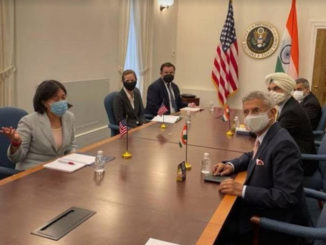
    WASHINGTON (TIP): External Affairs Minister S. Jaishankar has had a hectic day and a half in Washington DC, where he met government officials, including National Security Advisor Jake Sullivan and the U.S. Trade Representative (USTR) ambassador Katherine Tai, lawmakers, and the private sector.

    Mr. Jaishankar, who is on his first visit to the U.S. during the Biden administration, met with Mr. Sullivan on Thursday, May 27. Both sides indicated that there was a discussion on regional (Indo-Pacific) or global issues, with Mr Jaishankar specifying, via a tweet, that Afghanistan came up.

    “Conveyed appreciation for US solidarity in addressing the Covid challenge. India-US vaccine partnership can make a real difference,” the tweet said.

    The U.S. readout said Mr. Jaishankar and Mr. Sullivan “welcomed” cooperation that has resulted in the delivery of over $ 500 million in relief materials (state, federal and private sector sources) from the U.S. to India.

    “They agreed that people-to-people ties, and shared values are the foundation of the U.S.-India strategic partnership that is helping to end the pandemic, supporting a free and open Indo-Pacific, and providing global leadership on climate change,” it said.

    Mr. Jaishankar said he had “good discussions” with Ms. Tai, who recently announced that the Biden administration would support an India-South Africa initiative at the World Trade Organisation (WTO) to waive intellectual property protections for COVID-19 vaccines.

    “Our trade, technology & business cooperation are at the core of our strategic partnership. Enhancing them is vital to post-Covid economic recovery. Welcomed her positive stance on IPR issues & support for efficient & robust supply chains,” Mr. Jaishankar said on Twitter.

    The Hindu had reported that procuring vaccines and sorting out issues around this, such as early Emergency Use Authorization and liability are central to Mr. Jaishankar’s trip agenda, though officials have been keen to stress that this is not the focus of the visit and that discussions would cover a more comprehensive list of topics pertinent to the strategic relationship between the two countries.

    Mr. Jaishankar had breakfast and lunch meetings on Thursday, May 27, organized by advocacy and industry groups, the U.S. India Business Council (USIBC) and the U.S. India Strategic Partnership Forum (USISPF).

    The USIBC meeting included a discussion on how the private sector, working via a consortium of 40 companies called the ‘Global Task Force for Pandemic Response’, could “support India’s health infrastructure and further ways to continue relief efforts,” said Priyanka Sethi, a spokesperson for the group.

    Pfizer and Johnson and Johnson – both companies that manufacture COVID-19 vaccines of interest to India – are part of the Task Force. The group has sent 1,000 ventilators, 4,850 oxygen concentrators to India and convened the chief HR officers of close to 200 companies to help their employees and their families, Ms Sethi said.

    Representatives of pharmaceutical firm Abbot and courier and shipping firm FedEx were among the companies present at the USISPF meeting, industry sources told The Hindu.

    Mr. Jaishankar also spoke on the phone with the (Democratic) Chairman of the House Foreign Affairs Committee, Gregory Meeks and its ranking member (Republican) Michael McCaul. He also had a phone call with House India Co-Chairs Steve Chabot (Republican).

    Brad Sherman, the other co-chair, was among those present at a dinner for Mr. Jaishankar on Wednesday, at the house of Indian Ambassador Taranjit Singh Sandhu. Others present there, according to US official sources, included Virginia Senator Tim Kaine, Senator Michael Bennet from Colorado and Jon Ossoff, the new Senator from Georgia.

    On Friday, May 28, the Minister is scheduled to meet with Defense Secretary Lloyd Austin and Secretary of State Antony Blinken who has been on a trip to Egypt and West Asia since Monday.

    According to sources, the high-level (Minister level) meetings with the Treasury, Commerce and Energy Departments, US Agency for International Aid (USAID) and the National Science Foundation are likely to take place during Mr Jaishankar’s visit to Washington.

    (With inputs from PTI)

  • Indian American Arun Venkataraman Appointed to Key Administration Post

    Indian American Arun Venkataraman Appointed to Key Administration Post

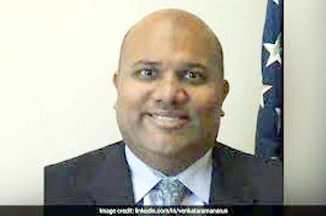
    WASHINGTON (TIP):  US President Joe Biden has announced his intent to nominate Indian-American trade expert Arun Venkataraman to a key position in his administration related to foreign commercial service.

    Arun Venkataraman is the nominee for Director-General of the United States and Foreign Commercial Service and Assistant Secretary for Global Markets, Department of Commerce, the White House said on Wednesday, May 26.

    With over 20 years of experience in advising companies, international organizations, and the US government on international trade issues, Arun Venkataraman is currently the Counselor to the Secretary of Commerce, advising the department on trade and other international economic matters.

    Before joining the Biden-Harris administration, he was a senior director at Visa, leading global government engagement strategy on a range of international policy issues including digital economy, trade, tax, and sanctions.

    Arun Venkataraman previously served as the trade and investment policy advisor at Steptoe & Johnson LLP, where he counselled multinational firms and other organizations on e-commerce, intellectual property rights, and US and foreign trade policies. As the first-ever Director of Policy at the Department of Commerce’s International Trade Administration under President Barack Obama, Arun Venkataraman helped shape the US government’s responses to critical challenges faced by firms in the country and in markets around the world, including China and India, the White House said.

    While at the Office of the US Trade Representative (USTR), he led the development and implementation of the US-India trade policy as the Director for India, for which he received the agency’s Kelly Award for outstanding performance and extraordinary leadership.

    Arun Venkataraman also served as the associate general counsel, representing the United States in litigation before the World Trade Organization (WTO) and in negotiations on international trade agreements.

    Before joining the USTR, Arun Venkataraman was a legal officer at the WTO, advising the organization on a wide range of issues raised in appeals of trade disputes between countries. He began his career as a law clerk for Judge Jane A Restani at the US Court of International Trade. He holds a JD from the Columbia Law School, a Master of Arts in Law and Diplomacy from the Fletcher School of Law and Diplomacy, and a BA from Tufts University.

  • Science has delivered, will the WTO deliver?

    Science has delivered, will the WTO deliver?

    TRIPS waiver proposal from India, South Africa and other members

    By Brajendra Navnit

    “The TRIPS waiver proposal is a targeted and proportionate response to the exceptional public health emergency that the world faces today. Such a Waiver is well-within the provisions of Article IX of the Marrakesh Agreement which established the WTO. It can help in ensuring that human lives are not lost for want of a timely and affordable access to vaccines. The adoption of the Waiver will also re-establish WTO’s credibility and show that multilateral trading system continues to be relevant and can deliver in times of a crisis. Now is the time for WTO members to act and adopt the Waiver to save lives and help in getting the economy back on the revival path quickly.”

    While making the vaccines available was a test of science, making them accessible and affordable is going to be a test of humanity. History should remember us for the “AAA rating” i.e. for Availability, Accessibility and Affordability of Covid19 vaccines and treatments and not for a single “A rating” for Availability only. Our future generations deserve nothing less.

    A proposal by India, South Africa and eight other countries calls on the World Trade Organisation (WTO) to exempt member countries from enforcing some patents, and other Intellectual Property (IP)rights under the organization’s Agreement on Trade-Related Aspects of Intellectual Property Rights, known as TRIPS, for a limited period of time. It is to ensure that IPRs do not restrict the rapid scaling- up of manufacturing of COVID-19 vaccines and treatments. While a few members have raised concerns about the proposal, a large proportion of the WTO membership supports the proposal.It has also received the backing of various international organizations, multilateral agencies and global civil society.Unprecedented times call for unorthodox measures. We saw this in the efficacy of strict lockdowns for a limited period, as a policy intervention, in curtailing the spread of the pandemic.International Monetary Fund (IMF) in its October 2020 edition of World Economic Outlook states “…However, the risk of worse growth outcomes thanprojected remains sizable. If the virus resurges, progresson treatments and vaccines is slower than anticipated,or countries’ access to them remains unequal, economic activity could be lower than expected, withrenewed social distancing and tighter lockdowns”. The situation appears to be grimmer than predicted, we have already lost 7% of economic output from the baseline scenario projected in 2019. It translates to a loss of more than USD 6 trillion of global GDP. Even a 1% improvement in global GDP from the baseline scenario will add more than USD 800 billion in global output, offsetting the loss certainly of a much lower order to a sector of economy on account of the Waiver.

    Merely a signal to ensure timely and affordable access to vaccines and treatments will work as a big confidence booster for demand revival in the economy. With the emergence of successful vaccines, there appears to be some hope on the horizon. But how will these be made accessible and affordable to global population? The fundamental question is whether there will be enough of Covid-19 vaccines to go around. As things stand, even the most optimistic scenarios today cannot assure access to Covid-19 vaccines and therapeutics for the majority of the population, in rich as well as poor countries, by the end of 2021. All the members of the WTO have agreed on one account that there is an urgent need to scale-up the manufacturing capacity for vaccines and therapeutics to meet the massive global needs. The TRIPS Waiver Proposal seeks to fulfil this need by ensuring that IP barriers do not come in the way of such scaling up of manufacturing capacity.

    Why existing flexibilities under the TRIPS Agreement are not enough

    The existing flexibilities under the TRIPS Agreement are not adequate as these were not designed keeping pandemics in mind. Compulsory licenses are issued on a country by country, case by case and product by product basis, where every jurisdiction with an IP regime would have to issue separate compulsory licenses, practically making collaboration among countries extremely onerous. While we encourage the use of TRIPS flexibilities, the same are time-consuming and cumbersome to implement. Hence, only their use cannot ensure the timely access of affordable vaccines and treatments. Similarly, we have not seen a very encouraging progress on WHO’s Covid19-Technology Access Pool or the C-TAP initiative, which encourages voluntary contribution of IP, technology and data to support the global sharing and scale-up of the manufacturing of COVID- 19 medical products. Voluntary Licenses, even where they exist, are shrouded in secrecy. Their terms and conditions are not transparent. Their scope is limited to specific amounts or for a limited subset of countries, thereby encouraging nationalism rather than true international collaboration.

    Why is there a need to go beyond existing global cooperation initiatives?

    Global cooperation initiatives such as the COVAX Mechanism and the ACT-Accelerator are inadequate to meet the massive global needs of 7.8 billion people.The ACT-A initiative aims to procure 2 billion doses of vaccines by the end of next year and distribute them fairly around the world. With a two-dose regime, however, this will only cover 1 billion people. That means that even if ACT-A is fully financed and successful, which is not the case presently, there would not be enough vaccines for the majority of the global population.

    Past experience

    During the initial few months of the current pandemic, we have seen that shelves were emptied by those who had access to masks, PPEs, sanitizers, gloves and other essential Covid-19 items even without their immediate need.The same should not happen to vaccines.Eventually, the world was able to ramp up manufacturing of Covid-19 essentials as there were no IP barriers hindering that. At present, we need the same pooling of IP rights and know-how for scaling up the manufacturing of vaccines and treatments, which unfortunately has not been forthcoming, necessitating the need for the Waiver.

    It is the pandemic – an extraordinary, once in a lifetime event – that has mobilized the collaboration of multiple stakeholders. It is knowledge and skills held by scientists, researchers, public health experts and universities that have enabled the cross-country collaborations and enormous public funding that has facilitated the development of vaccines in record time – and not alone IP!

    Way forward

    The TRIPS waiver proposal is a targeted and proportionate response to the exceptional public health emergency that the world faces today. Such a Waiver is well-within the provisions of Article IX of the Marrakesh Agreement which established the WTO. It can help in ensuring that human lives are not lost for want of a timely and affordable access to vaccines. The adoption of the Waiver will also re-establish WTO’s credibility and show that multilateral trading system continues to be relevant and can deliver in times of a crisis. Now is the time for WTO members to act and adopt the Waiver to save lives and help in getting the economy back on the revival path quickly. While making the vaccinesavailable was a test of science, making them accessible and affordable is going to be a test of humanity. History should remember us for the “AAA rating” i.e., for Availability, Accessibility and Affordability of Covid19 vaccines and treatments and not for a single “A rating” for Availability only.Our future generations deserve nothing less.

    (The author is Ambassador and Permanent Representative of India to WTO)