Tag: Xi Jinping

  • Why India’s rise hasn’t won it friends

    Why India’s rise hasn’t won it friends

    New Delhi does not have deep pockets with surplus funds like China to positively impact policies of other countries.

    “The absence of a power leverage explains the cozying up of Bangladesh with Pakistan despite Dhaka knowing well the pitfalls of neglecting its big neighbor which helped it get independence. We now have another border to tend and it would be interesting to see which party comes to power in the forthcoming national elections.”

    By Air Vice Marshal Manmohan Bahadur retd

    India’s neighborhood has become complex. Setting aside PR rhetoric, to say that New Delhi has no true friends on its borders (barring Bhutan) would not be wrong. By any yardstick, the political power of a nation with a $4-trillion economy (fourth largest in the world) should catalyze relations with its neighbors to its advantage. That it is not exactly so needs a clinical assessment.

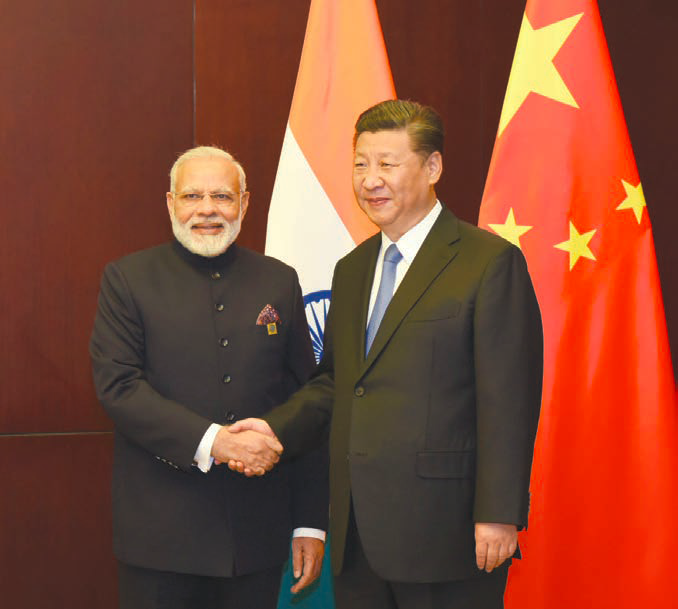
    Pakistan as an adversary is a no-brainer and so too is China — notwithstanding the handshakes in public between PM Narendra Modi and President Xi Jinping during the Shanghai Cooperation Organization meeting in September 2025.

    While Islamabad would be feeling hurt considering the statement made by the Indian Air Force on May 10, last year, with its deadly pan-Pakistan precision strikes on military installations, it would also be planning to get back — not necessarily through a kinetic engagement; one is already seeing some increased terrorist activity in the Valley.

    Relations with China are more complex since we are dependent on it in more ways than one in non-military areas and yet, militarily, have to match them 24×7 — man for man, tank for tank on our northern borders. With Beijing aiming for a multiple aircraft carrier navy, it would not be long before a PLAN carrier group makes a foray in the Indian Ocean, mandating another front for New Delhi to address.

    But what about the others with whom India shares land and maritime contiguity? A color-coded map of India’s neighborhood friends would have more shades of red than blue. The osmotic effects of New Delhi’s economic, military and cultural positioning, that should have translated to positive influence around us, are conspicuous by their absence.

    Writing on what constitutes power, strategist George Friedman has termed it an intangible entity; the ambiguity that real power exudes about the likely future course of action (deterrent or kinetic) is what gives it the coercive quotient. A nation has to reach that standing in the power matrix to enable it to sway sentiment in its favor without going kinetic.

    Have we, instead of nursing relationships with our neighbors, jumped the starter’s gun and started expecting deference that automatically accrues to real power?

    In 2011, cautioning against mistaking influence and weight with power, India’s then NSA Shiv Shankar Menon had said that “For a considerable amount of time, India will be a major power with several poor people. Power is the ability to create and sustain outcomes — weight we have, our influence is growing, but our power remains to grow and should first be used for our domestic transformation.”

    The absence of a power leverage explains the cozying up of Bangladesh with Pakistan despite Dhaka knowing well the pitfalls of neglecting its big neighbor which helped it get independence. We now have another border to tend and it would be interesting to see which party comes to power in the forthcoming national elections.

    In Nepal, the Chinese have already made inroads through infrastructure projects (rail, roads, energy) and digital technology programs. Their tourist inflows have also increased substantially with direct air and road connectivity. Indian media has not helped with its intrusive behavior as the scenes of ‘Indian media go back’ witnessed in the 2015 earthquake were seen again during the Gen-Z uprising.

    The story has been similar in the Maldives and Sri Lanka when new governments took office. Luckily, the downturn seems to be reversing — but there is still a fair distance to cover. Myanmar has to be watched, considering the deep Chinese inroads there and our unsettled and volatile North-East.

    Despite these unhelpful vibes, the Budget allocates developmental assistance to many of these neighbors since we share centuries-old cultural ties and are mindful of social sensitivities of our own border communities as well. So, where lies the problem when India has always been helpful, even ferrying items as basic as water to the Maldives?

    The answer lies in the question posed earlier — “have we jumped the starter’s gun and are confusing influence and weight with power?”

    On the hard power matrix, despite a welcome increase in defense exports, the growth of our military industrial complex has yet to impact India’s unenviable position as the second largest arms importer in the world — this, without factoring in the $3.25-billion Rafale import coming up soon.

    A GDP of $4 trillion is excellent, but the per capita GDP where India is 143rd in world rankings, is the true determinant of a nation’s economic depth. With millions still below the poverty line requiring succor, New Delhi does not have deep pockets with surplus funds like China to positively impact policies of other countries.

    The worldwide upheaval due to Trump’s arm-twisting edicts has shown what real economic power can do — the Venezuela regime change has hardly created any condemnation and the usurping of Greenland, if it happens, would be another validation of the analysis of Thucydides in 404 BCE: “The strong do what they can and the weak suffer what they must.”

    China too is no exception —the use of its monopoly on rare earths to keep the US tariffs at bay is an example.

    So, even as our diplomats burn the midnight oil working their charm, let us continue on the path of an economic surge that has been the vision of all governments since Independence.

    If our endeavors for a Viksit Bharat by 2047 are to remain focused, then amicable relations with neighbors are a sine qua non.

    Till then, to avoid being ‘the ugly Indian’ and frittering away goodwill in our neighborhood, our talk and actions should heed the Margaret Thatcher view that “Being powerful is being like a lady; if you have to say you are, you aren’t.”

    (Air Vice Marshal Manmohan Bahadur Retd is Ex-Addl Director General, Centre for Air Power Studies)

  • The ‘Donroe doctrine’, a broken international order

    The ‘Donroe doctrine’, a broken international order

    It is a mixed bag as far as the global outlook for 2026 is concerned, marked by an updated version of the U.S.’s ‘shock and awe’ tactics

    By M K Narayanan

    The new year began with a stark reminder that the over 200-year-old ‘Monroe Doctrine’ is not merely alive but has been given a fresh dimension, in keeping with the personality of United States President Donald Trump. In a swift operation as 2026 unfolded, U.S. airborne troops abducted Venezuelan President Nicolás Maduro and his wife and incarcerated them in the U.S. on charges of undermining the security of the U.S. This action is being sanctified as the new ‘Donroe Doctrine’.

    Actions under the Trump administration

    Protests worldwide against the U.S.’s action in violating the sovereignty of Venezuela have, however, been rather muted. This seems to convey the belief that the post-1945 international order is dead, and what exists now is a ‘free for all’ in the global commons. Voices are also being heard ‘sotto voce’, that the latest action by the U.S. might well become a prelude for similar actions by nations such as China and Russia to lay claim to countries and regions falling within their zone of influence — China’s claim to Taiwan being one.

    The action carried out has been characterized by Mr Trump himself as a modern version of the (1823) Monroe Doctrine, viz., that the U.S. is the sole guarantor of security in the Western Hemisphere and would not brook any interference by powers outside the Hemisphere. A careful reading of President Trump’s latest U.S. National Security Strategy, or NSS (November 2025) — which unequivocally states that after years of neglect, the U.S. expects to reassert its pre-eminence in the Western Hemisphere, denying non-Hemispheric competitors the ability to position forces or threaten U.S. vital assets in the Hemisphere — would suggest that the Venezuelan operation was a carefully thought through maneuver, and an updated 21st century version of ‘US shock and awe’ tactics. There is even an implicit threat of actions similar to Venezuela against Cuba, Colombia and Mexico. There is again an implicit reference to taking control of Greenland which is viewed by the U.S. as a security necessity.

    From a U.S. perspective, it would seem that 2026 could see significant changes in different regions of the globe. Europe, for instance, which has come in for sharp criticism in the NSS document, has been excoriated on the ground that it had lost most, if not all, its sheen, alongside the suggestion that the U.S. could help Europe regain its former greatness if it backed patriotic European parties and ‘genuine democracy’. The NSS document wants Europe to assume ‘primary responsibility for its own defense’, alongside a veiled reference to achieving strategic stability with Russia.

    Going beyond Mr. Trump’s NSS, realistically speaking, it would seem that the conflict in Ukraine, which appears stalemated at present, could move toward resolution, but which could be unsatisfactory to both sets of antagonists. The alternative, according to U.S. policymakers, appears to be that otherwise, it could lead to further escalation, alongside fears that it would engulf more regions of Europe.

    The situation closer to India

    The situation in West Asia, it would seem, is beginning to resemble the proverbial curate’s egg, good in parts. Israel’s pogrom has come to an end for the present, but peace in the regime remains highly elusive. The situation in Gaza, in particular, remains highly sensitive and violence seems for the most part just round the corner.

    Meantime, the growing violence and unrest that have engulfed Iran and the Khamenei regime is acting as a catalyst for a fresh round of conflict in and across the region. Iran is witnessing widespread internal violence, and the declared that it is “fighting on four fronts, viz., an economic war, a psychological war, a military war against the US and Israel, and ‘a war on terrorism’”. The West has responded with warnings of imposing additional sanctions on Iran. Implicit in all this, is that both Israel and the U.S. see an opportunity to complete the unfinished conflict of 2025, and ensure that it reaches a ‘satisfactory conclusion’ in undermining the Khamenei regime in Iran.

    Northwest Asia, specially Afghanistan, is meanwhile, set to confront more troubles this year. The Tehreek-e-Taliban and other Afghan terrorist groups appear, of late, to have gained a fresh lease of life, and this spells problems for Pakistan as well. The Afghanistan-Pakistan border will, hence, continue to remain troubled during much of this year. So, 2026 is again, not likely to be a good year for democracy in Pakistan, with the military taking firmer control of the country’s affairs and Field Marshal Asim Munir eclipsing the importance of Prime Minister Shehbaz Sharif, striking another blow to the country’s democratic trajectory. However, Pakistan does appear to have gained a fresh lease of life, with the U.S. embracing it as an ally, promising a fresh tranche of state-of-the-art weapons, and in some ways being perceived as ‘the most favored nation of the US’ in this part of the world. Meantime, uncertainty about the future of democracy will continue to prevail in the highly troubled state of Bangladesh, notwithstanding the promise of fresh elections and restoration of an elected government.

    For China, 2025 seemed like a good year. While China-U.S. rivalry appeared to intensify, Beijing successfully withstood the tariff barrage unleashed by Mr. Trump, and even seemed to turn it to its advantage. China raised the value of its manufacturing and also demonstrated its hold over global supply chains.

    China’s restrictions on rare earth exports in the tussle with the U.S., seemed to enhance its ability to not only withstand U.S. pressures but also to convert the situation in its favor. While there were few opportunities for a trial of strength in the Pacific, China’s growing presence in Southeast Asia is adding to China’s importance in Asian and world affairs. It is increasingly becoming apparent as well that the Eastern Pacific is no longer a U.S. bailiwick. China’s presence in the Indian Ocean is also growing and represents not only a major threat to nations bordering the Indian Ocean but, more importantly, also a challenge to U.S. supremacy here.

    Notes for New Delhi

    As 2026 progresses, India appears to stand at the crossroads, unsure as to where it stands. There has been no letup in Mr. Trump’s tirade against India for continuing to import subsidized Russian oil, notwithstanding the fact that India is inclined to side with the U.S. on most matters. An implicit coldness in India-U.S. relations seems to be affecting India’s relations with many other countries, resulting in New Delhi’s relative isolation when it comes to conflict zones such as West Asia. Mr. Trump’s public endorsement of Field Marshal Munir and the lifting of restrictions on arms supplies to Pakistan is also not helping. Despite this, there have been some positive developments with regard to an expansion of India-U.S. cooperation in some areas. Several mini-lateral initiatives, such as the I2U2 (India, Israel, the U.S., the UAE) and the India–Middle East–Europe Economic Corridor appear to be progressing.

    As of now, Washington’s foreign policy calculus and Beijing’s disinterested approach to India are putting India at a disadvantage in political and economic terms, especially the latter. China’s tactical advantage in trade and tariff disputes leaves little room or scope for India to hedge against U.S. threats to further raise tariffs on trade, thus aggravating current anxieties. For India, there is again little room for comfort in the fact that China’s economic growth has not picked up of late, or that its domestic consumption remains stagnant. All this is notwithstanding an improvement in India-China ties following the Tianjin meeting of Prime Minister Modi and President Xi Jinping in 2025. A further stabilization of India-China ties does not, however, appear likely in 2026.

    Overall, 2026 may not have any great prospects for India. It may not, however, face any major terror attack during the year, but terrorism will remain an ever-present reality. West Asia having just undergone a sustained military campaign by Israel may be spared major terror attacks, but the upheaval in Iran and the attempt by Israel and the U.S. to wade into troubled waters could instigate some terror attacks. The Islamic State and al Qaeda seem better positioned in Africa as of now, but this is no reason to let one’s guard down, as, overall, more attacks by insurgent and terrorist entities can be anticipated in Asia, West Asia and Africa. Terrorism could, hence, be regarded as a critical national security threat during 2026.

    (M.K. Narayanan is a former Director, Intelligence Bureau, a former National Security Adviser, and a former Governor of West Bengal)

  • G2 won’t be music to India’s ears

    G2 won’t be music to India’s ears

    The new deal between the US and China is all about give and take

    “One thing is clear: the threatened decoupling of the Western and Chinese economies is not around the corner. The race now is for global leadership amidst some shaky guardrails between the G2. Here, while the US has been seeking ephemeral gains through tariffs, the Chinese are preparing for another future. Their latest five-year plan focuses on quantum technology, bio-manufacturing, hydrogen energy and nuclear fusion. China already leads in some of these fields, but the US remains ahead overall and has placed its current bets on AI.

    By Manoj Joshi

    The economic and geopolitical consequences of competitive US-China relations in these areas are hard to forecast. But they cannot be particularly comforting for countries like India that had counted on the US to maintain geopolitical heft against China. The new deal between the US and China is all about give and take.

    The recent meeting between US President Donald Trump and his Chinese counterpart Xi Jinping in South Korea has been judged as a draw/ceasefire/truce in the long-term competition between the two world powers. From a situation suggesting decoupling, the relationship seems to have taken a 180-degree pivot. This seems to be a consequence of China besting the US in its trade negotiations.

    Trump termed the outcome of the meeting as scoring a hyperbolic 12 out of 10. US Secretary of War Pete Hegseth, who was in Kuala Lumpur for the ASEAN Defense Ministers’ Meeting Plus, tweeted after he met his Chinese counterpart Admiral Dong Jun, “I just spoke to President Trump and we agree — the relationship between the US and China has never been better”.

    Having spoken to Admiral Dong twice in a day to restore ties between the US and Chinese militaries, he declared that the tone had been set by Trump’s “historic G2 meeting” and ended by noting “God bless both China and the USA!”

    He was echoing Trump’s tweet posted hours earlier: “My G2 meeting with President Xi of China was a great one for both our countries. The meeting will lead to everlasting peace and success. God bless both China and the USA!”

    Both sides have pulled back from some of their more dire threats and actions. Effectively, they have kicked the can down the road by making their decisions valid for just the coming year. At another level, they seem to be trying to work out the framework in which G2, or a global US-China condominium, can operate.

    In his official tweet on the Dong Jun meeting, Hegseth noted the importance of maintaining a balance of power in the Indo-Pacific and US concerns about Chinese activities in the South China Sea and Taiwan.

    In the Phase I trade deal that China signed with the US during Trump’s first term in 2020, Beijing was forced to make unilateral commitments to buy American products. But the current deal is all about give and take.

    The US backed off from its new Entity List export restrictions in exchange for China doing so with its rare earths rules. The Entity List rule was unveiled on September 29, barring Chinese firms at least 50 per cent owned by previously sanctioned Chinese companies from receiving restricted US tech exports using subsidiaries. What it did was to effectively increase the number of Chinese firms on the Entity List from 1,400 to a massive 20,000.

    This had led China to use its Brahmastra of rare earths on the eve of the Xi-Trump meeting. Under this rule, export controls would kick in even if 0.1 per cent of the product used Chinese rare earth processing technologies anywhere in the world. This virtually covered almost all smartphones, hard drives, TVs, motors and medical devices in the world.

    The Chinese also agreed to resume soyabean purchase, much to the relief of Trump, whose farmer support base was becoming increasingly restless over the Chinese decision not to buy American soyabean. The US suspended the implementation of measures under its Section 301 investigation targeting China’s maritime logistic and shipbuilding industries for a year.

    The US will now drop its overall tariff rate for China to 47 per cent. This is, in effect, where it was before Liberation Day, April 2. If we take the 20.7 per cent tariff that existed before Trump assumed office and add 10 per cent of the reduced fentanyl tariff, we are left with just 10 per cent additional tariff which was the baseline figure applicable to all.

    Both sides have agreed to cooperate on the fentanyl issue, but there are other matters that need to be resolved, such as Chinese access to Nvidia chips and the ownership of TikTok. The Taiwan issue seems to have been sidestepped for the present.

    A major reason for China’s success has been tactics. While Beijing systematically prepared for a possible clash in the last few years, Trump led Washington to hit out recklessly on the tariff issue. Instead of targeting China alone, as it had done in 2020, the US sharply escalated the fight with China and hit the whole world with its Liberation Day tariffs, alienating friends and allies.

    To an extent, this was also an underestimation of Chinese developments in recent years. There was a belief that the American economy, with the help of artificial intelligence (AI), had gained a decisive edge, while Covid-19 travails, economic slowdown, unemployment and military purges had weakened China.

    The détente, which now seems to be verging on an entente, has brought a sense of relief around the world. A US-China implosion would have had consequences for the entire global economy. But the developments should not generate a false sense of security. Despite Trump’s and Hegseth’s effusive take on the China relationship, the reality is that there have been too many recent ups and downs to predict a stable future.

    One thing is clear: the threatened decoupling of the Western and Chinese economies is not around the corner. The race now is for global leadership amidst some shaky guardrails between the G2. Here, while the US has been seeking ephemeral gains through tariffs, the Chinese are preparing for another future. Their latest five-year plan focuses on quantum technology, bio-manufacturing, hydrogen energy and nuclear fusion. China already leads in some of these fields, but the US remains ahead overall and has placed its current bets on AI.

    The economic and geopolitical consequences of competitive US-China relations in these areas are hard to forecast. But they cannot be particularly comforting for countries like India that had counted on the US to maintain geopolitical heft against China. The new deal between the US and China is all about give and take.

    (Manoj Joshi is an Indian journalist and author specializing in security and international relations)

  • Close ranks to fortify the republic

    Close ranks to fortify the republic

    The collective will of people is needed to safeguard India’s interests

    “A deviation from this basic constitutional proposition will damage India’s capability to successfully navigate the enormous strategic challenges that are growing because of the technological changes underway in a turbulent global environment. The regional situation, too, presents difficulties that can be ignored only at the peril of hurting national interests. And, for India, the key country connecting its regional and global challenges is China.”

    By Vivek Katju

    With the onset of the year in which the Indian republic will celebrate 75 years of its establishment, the fervent hope of the majority of its citizens is for social peace and harmony. This can only be achieved if there is a realization that the path to right the ‘wrongs of history’ lies through cementing a common nationhood that is respectful of the traditions and faiths of all Indians. That acceptance and respect are also the premise and promise of the republic’s foundational principle, so eloquently expressed in the Constitution.

    A deviation from this basic constitutional proposition will damage India’s capability to successfully navigate the enormous strategic challenges that are growing because of the technological changes underway in a turbulent global environment. The regional situation, too, presents difficulties that can be ignored only at the peril of hurting national interests. And, for India, the key country connecting its regional and global challenges is China.

    China’s threat goes far beyond the border issue. A process of ‘normalizing’ the relationship, which was acutely impaired by China’s actions in eastern Ladakh in the summer of 2020, may now have begun. The Ministry of External Affairs’ readout of the Narendra Modi-Xi Jinping meeting on the sidelines of the BRICS summit in October last year noted, “The two leaders affirmed that stable, predictable and amicable bilateral relations between India and China, as two neighbors and the two largest nations on earth, will have a positive impact on regional and global peace and prosperity. It will also contribute to a multipolar Asia and a multipolar world”. However, whatever China may agree to during formal summit-level meetings, it is working for, at least, a bipolar world order and is assiduously seeking a unipolar Asia in which its power and influence prevail. And, the backbone of both these quests lies not only in its economic success and growing military power but also its undoubted and deep advances in the areas of science and high technology.

    In 2018, Tim Cook, CEO of Apple, had said, “The popular conception is that companies come to China because of low labor costs. I’m not sure what part of China they go to, but the truth is that China stopped being the low-labor-cost country years ago. And that is not the reason to come to China from a supply point of view. The reason is because of the skill, and the quantity of skill in one location and the type of skill…” He went on to say that the products that were Apple’s requirement needed advanced tooling capable of working with state-of-the-art material. He added, “That tooling skill is very deep here. In the US, you could have a meeting of tooling engineers and I’m not sure we could fill the room. In China, you could fill multiple football fields…”

    That was over six years ago. China’s drive to develop human capital in the areas of frontier manufacturing continues relentlessly. It is, however, not satisfied with becoming the factory of the world. It is now seeking to reach US and Western European levels in design and innovation in large frontier technology sectors, including artificial intelligence (AI).

    Till recently, it was commonly and correctly believed that in AI, the US excelled in ‘technical innovation’ while Chinese companies were competent at ‘application innovation’. There was generally a gap of one or two years before the application occurred. However, the Chinese are now realizing that there is a fundamental difference between ‘technical innovation’ and thereafter applying it. Hence, Chinese companies like DeepSeek have come up; they are going rapidly ahead in ‘technical innovation’. They do not wish to be followers anymore. This will pose a challenge to US supremacy in AI, which is destined to change the world. The US will pose impediments in China’s path, but will it succeed? It is difficult to predict how deep and extensive will be the transformation of individual lives and international power equations, but it is certain that this will happen, and that too early.

    Where does India stand in all this and other frontier and emerging areas of science and technology (S&T)? The truth is that while India’s economic growth has led it to become the fifth largest global economy, there is a wide and perhaps growing gap in S&T not only with the West but also with China. Jawaharlal Nehru was acutely aware that European domination of the world, beginning with the 18th and 19th centuries that led to all the horrors of colonialism in Asia, Africa and South America, had occurred because of its Industrial Revolution. Hence, his determination that India should catch up in S&T, both in terms of human capital and industrialization. In this context, it is good to become aware of the advances Indians had made in S&T in ancient times and convey that to the world, but is that really the path to becoming a strong and powerful country — a genuine pole in a multipolar world?

    The answer is obvious. All the digging out of glories from our ancient past, which was ravaged by invaders, will not help us meet the challenges of today. They may satisfy emotional urges of certain sections of the people, and their long-standing feelings of hurt and anguish may be addressed too, but they will not address the strategic threat that the country faces from China. In the current year and beyond, China’s involvement in India’s immediate neighborhood will only increase. Its intrusion in India’s western neighborhood, substantial for decades, will continue. The situation in Bangladesh is ripe for its pernicious intervention and it will increase its presence in the Indian Ocean Region.

    In such circumstances, it is the collective will of cohesive people — shedding prejudices, not dwelling on the past but taking India forward to become a leader in S&T innovation and applications and strong in defense — that is needed to safeguard India’s interests.
    (The author is a former Ambassador)

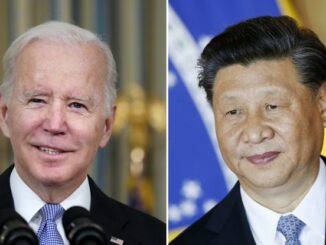
  • Biden and Xi to meet in Peru on Nov 16, to discuss bilateral relations

    Biden and Xi to meet in Peru on Nov 16, to discuss bilateral relations

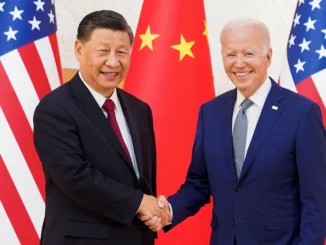
    WASHINGTON, D.C. (TIP): Outgoing US President Joe Biden will meet his Chinese counterpart Xi Jinping in Peru on Saturday, November 16, on the sidelines of an international summit, during which the two leaders expect to review the bilateral relations, the White House said Wednesday.

    “We expect the president will use the opportunity to take stock of efforts to responsibly manage competition over the last four years, how the two countries have advanced areas of shared interest, and, even amidst deep differences and intense competition, have worked to do so,” a senior administration official said.

    The two leaders are scheduled to meet on November 16 at Lima, the capital of Peru, on the sidelines of the Asia-Pacific Economic Cooperation Summit. The meeting would come just over two months before Donald Trump’s return to the White House.

    This will be their third in-person meeting since Biden entered office. They previously met in Bali, in 2022, on the margins of the G20, and at Woodside, California in 2023, on the margins of APEC.

    The two presidents have known each other for more than a decade, dating back to when they were both vice presidents, and have spent many hours in meetings together.

    “We expect this will be their last meeting as presidents,” said the official.

    Throughout his time in office, Biden has emphasized the importance of responsibly managing one of the world’s most consequential relationships.

    “From the very beginning of this administration, four years ago, President Biden made it clear the United States would advance and protect our interests at home and abroad. And the framework of this administration’s China policy — invest, align, and compete — has remained constant over the last four years,” said the official.

    Biden has prioritized investments and sources of US strength at home, strengthened alliances abroad, and taken several measures to protect US technology and national security, the official said.

    “At the same time, the president has demonstrated that our two countries can and must manage our differences and prevent competition from veering into conflict or confrontation by maintaining open lines of communication and advancing cooperation in areas of shared interest,” the official added.

    During the Saturday meeting with Xi, Biden will want to take stock of the progress the two countries have made in a number of areas since the Woodside Summit last year. Such cooperation can be an important stabilizing force in the relationship, the official said.

    “For example, over the last year, the two sides have resumed military-to-military communications at all levels. At the senior level, the Chairman of the Joint Chiefs of Staff, General Brown, Secretary of Defense Austin, and the INDOPACOM commander have met or had telephone calls with their PRC counterparts over the last year,” said the official.

    Noting that the US and China also restarted the Defense Policy Coordination Talks in January, 2024 and have carried out agreed-upon defense engagements since, to include the Military Maritime Consultative Agreement, MMCA, the official said these discussions are important to avoid misunderstanding and miscalculation.

    “For the first time this year, I should add as well, both sides pre-notified their respective ICBM launches. Biden has made clear and will continue to emphasize the importance of maintaining military-to-military communications at all times and especially during times of heightened tension,” said the official.

    In addition to discussing issues related to AI and climate change, President Biden will warn that cyber pre-positioning on civilian critical infrastructure and engaging in reckless attacks against critical networks of the US are “unacceptable”, the official said, adding that such actions could destabilize the current bilateral relationship and lead to an even broader de-risking away from PRC (People’s Republic of China) technology.

    “I expect the President will also underscore the importance of maintaining peace and stability across the Taiwan Strait and express his concerns that the PRC’s increased military activities around Taiwan are destabilizing and eroding the status quo,” the official said.

    Biden is also likely to express concern over Chinese actions in the South China Sea, including China coast guard actions against lawful maritime operations by other South China Sea claimant countries. “And of course, the President will also underscore his longstanding concern with the PRC’s unfair trade policies and non-market economic practices, which have over time created an unlevel playing field for American workers,” said the official.
    (Source: PTI)

  • Committed to managing China ties responsibly: US

    Committed to managing China ties responsibly: US

    WASHINGTON, D.C. (TIP): US President Joe Biden on Monday, January1, assured his Chinese counterpart Xi Jinping that he is committed to managing the bilateral ties “responsibly” as the two leaders exchanged congratulatory messages to mark the 45th anniversary of the diplomatic relations between the two countries.

    The two presidents met on the sidelines of the APEC summit in San Francisco in November and agreed to cool down the raging tensions between the top two economies of the world. In his message to Xi, Biden said that since the establishment of diplomatic relations in 1979, the ties between the US and China have facilitated prosperity and opportunities for both the countries and the world. Biden said he is committed to “managing this important relationship responsibly”, adding that he looks forward to continuing advancing the US-China relationship based on the progress made by the predecessors of the two leaders and through multiple meetings and discussions between the two heads of state, China’s state-run Xinhua news agency reported.

    Their summit took place after a comprehensive round of talks between high-level officials of the two countries. In his letter, Xi urged Biden to earnestly implement the outcomes of the summit, saying history has already proven and will continue to fully prove that mutual respect, peaceful coexistence and win-win cooperation are the right way for China and the US to get along with each other as two major countries. Xi pointed out that he and Biden, during their meeting in San Francisco, laid out a future-oriented “San Francisco Vision,” charting the course for the development of China-US relations.

    Xi Jinping stressed that he was willing to work with Biden to continue to steer the course of China-US relations to benefit the two countries and their people and promote the cause of world peace and development.

    During their summit, Xi and Biden agreed to resume high-level military communications which were severed after then-US House Speaker Nancy Pelosi visited Taiwan in 2022.

  • The Moscow declaration

    The Moscow declaration

    China and Russia agree to stand together on issues involving security interests

    “The declaration is a clear signal from Russia and China that they are prepared to stand together on issues involving each other’s security interests. While India finds mention on some issues of regional cooperation, there is nothing in the declaration to which it could take objection to. What now emerges is that Russia and China have much in common in dealing with the US and its allies. China prefers to keep out any mention of India. This should not surprise anyone with even a cursory understanding of China’s growing hubris, as it moves to attain global recognition of its economic clout and military potential. Moreover, there is considerable focus by China on Sino-Russian cooperation to build a security framework in the oil-rich Gulf region. China and Russia appear more than pleased that thanks to clumsy diplomacy by the Biden administration, they have been able to commence a rapprochement process between Iran and Saudi Arabia. Similar efforts are underway to forge normal ties between Syria and Saudi Arabia. These developments have resulted in a stronger Russian and Chinese presence in the region.”

    By G Parthasarathy

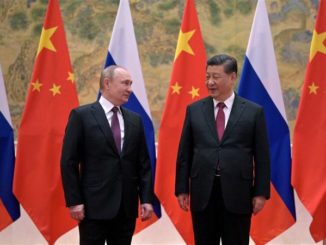
    The US and its Western allies were hoping that the Putin-Xi Jinping summit would turn out to be a damp squib. The recent Moscow summit has, however, produced a comprehensive plan by China and Russia to jointly meet the challenges they face from the US-led global order. The US and its allies have been repeatedly calling for sanctions against Russia, following its conflict with Ukraine. Some hope was also unrealistically expressed that China could follow through on its Ukraine plan by joining them in persuading Russia to pull out of Ukraine on Western terms. That hope now lies shattered. The joint declaration ends any illusion that Western powers may have had about China backing them on how the Ukraine conflict should be ended.

    The joint declaration states that the US and its allies would have to respect the legitimate security concerns of all countries, while adding that confrontation must be avoided. Russia and China have emphasized that ‘responsible dialogue’ is the best way to resolve problems and the international community should support constructive efforts. The declaration, in fact, calls on all parties to stop actions that promote tension to prevent the crisis from further aggravating, and even getting out of control. It concludes that China and Russia are opposed to unilateral sanctions not authorized by the UN Security Council.

    The US has, rather unconvincingly, been denying allegations made by one of its best-known investigative journalists, Seymour Hersh, that Washington had a hand in, and indeed organized, the bomb attack that destroyed the undersea Beixi gas pipeline (known also as Nordstream) carrying gas from Russia to Germany. Russia and China have bluntly noted, ‘The banner of extremism and the use of terrorist and extremist organizations to interfere in the internal affairs of other countries and achieve geopolitical goals.’ They have also demanded ‘an objective, impartial and professional investigation should be conducted on the Beixi pipeline explosion.’ It is going to be difficult for the US, and even Germany, which is reputed for observing high standards of respect for international law, to claim that they do not know who was responsible for blowing up the pipeline.

    Expectations in the international community that Russia may be persuaded by China to be more flexible on the withdrawal from Ukraine have been dashed. Russia and China announced that the ‘legitimate security concerns of all countries must be respected’, and that confrontation between camps, ‘adding fuel to the flames’, must be avoided. China firmly backs Russia’s position on the Ukraine crisis, averring that ‘responsible dialogue is the best way to solve problems steadily’. Most importantly, Russia has been assured of Chinese backing in the UN Security Council to ensure that ‘parties to the conflict stop all actions that promote tension and delay the end of war.’ Putin could not have asked for anything more from his Chinese guest. What remains to be seen is whether China will provide the military supplies that Moscow needs. The countries that would be most concerned by these developments are the US and its NATO allies. The declaration ends any illusion that Western powers, who speak for the so-called international community, have about China backing them on how the Ukraine conflict should be ended. China and Russia have also signaled that they have no regard for sanctions being imposed by Western powers. President Zelenskyy and the US would also have to think afresh on Russia’s concerns about the safety and security of Russians living in south-eastern Ukraine, while facing the reality that Russia intends to stay in Crimea, where it has exercised sovereignty for three centuries now.

    The declaration is a clear signal from Russia and China that they are prepared to stand together on issues involving each other’s security interests. While India finds mention on some issues of regional cooperation, there is nothing in the declaration to which it could take objection to. What now emerges is that Russia and China have much in common in dealing with the US and its allies. China prefers to keep out any mention of India. This should not surprise anyone with even a cursory understanding of China’s growing hubris, as it moves to attain global recognition of its economic clout and military potential. Moreover, there is considerable focus by China on Sino-Russian cooperation to build a security framework in the oil-rich Gulf region. China and Russia appear more than pleased that thanks to clumsy diplomacy by the Biden administration, they have been able to commence a rapprochement process between Iran and Saudi Arabia. Similar efforts are underway to forge normal ties between Syria and Saudi Arabia. These developments have resulted in a stronger Russian and Chinese presence in the region. There have sometimes been concerns about the impact of the growing Sino-Russia cooperation on Russia’s relations with India. Russia has for long been India’s largest supplier of modern weapons systems and has been helpful in India’s production of nuclear submarines. India is also manufacturing Russian-designed BrahMos missiles, which it has provided to friendly countries, with prospects of more buyers. Moreover, purchases of petroleum products at very reasonable prices from Russia have been helpful in managing India’s balance of payments. Russia, in turn, evidently understands that India’s defense cooperation with the US, together with its security links in groupings like Quad and I2U2 across the Indo-Pacific, are set to grow. While Russia is furious with Pakistan for supplying weapons to Ukraine, China would make every effort to get Moscow to assist Pakistan. Strategic autonomy, meanwhile, has been, and should remain, the hallmark of India’s defense and foreign policies.
    (The author is Chancellor, Jammu Central University & former High Commissioner to Pakistan)

  • India is ready, Japan to take a call on expanding defence cooperation

    India is ready, Japan to take a call on expanding defence cooperation

    New Delhi (TIP)- Japan Prime Minister Fumio Kishida will have a full plate in the Capital next Monday with Indo-Pacific, QUAD summit and G7-G20 on the agenda when he meets Prime Minister Narendra Modi.
    The Japanese view on the Indo-Pacific and on expanding ties with India will be revealed when PM Kishida delivers a lecture on bilateral relations at the Sushma Swaraj Institute on March 20. Japan will host the G-7 summit in Kishida’s constituency Hiroshima on May 19-21, which will be attended by PM Modi with the QUAD summit in Sydney taking place the same month.
    New Delhi will be hosting the SCO Summit on July 4 with G-20 Summit scheduled for September this year.
    While the Chinese belligerents in the Indo-Pacific with Beijing having military friction with Tokyo over Senkaku Islands and in East Ladakh with India on top of the agenda, PM Modi and PM Kishida will have a discussion on the G-7, QUAD and G-20 summits later this year. Key to these discussions will be how the two leaders are able to harmonize their positions over the Ukraine war as the impact of G-7 and QUAD summit communique will be felt on the G-20 summit being hosted by India in September this year. Japan is with the Anglo-Saxon powers over Ukraine and wants to punish Russia, India on its part wants the war to end without taking an anti-Russia stand.
    Although India and Japan have a successful economic relationship, New Delhi is looking towards Tokyo to see whether PM Kishida wants to expand the bilateral ties to security and defence sectors. Even though Japan has doubled its capital defence spending in wake of China-Russia aggression in East China Sea and Sea of Japan, the country has still to shed off its pacificist doctrine and is diffident in deepening security ties with India. The situation gets even more complicated as PM Kishida represents Hiroshima, which was nuked and destroyed by the US in World War II, in the House of Representatives.
    Even though Japan is a leader in specific defence technologies and cyber-security, PM Kishida is still mulling over whether to expand the bilateral relationship in these sectors and its impact on adversary China. From the statement emanating from Beijing on Taiwan, it is quite evident that Japan will have to be prepared for a military emergency in Taipei as some Japanese Islands in the Okinawa Prefecture are in close proximity to Taiwan.
    With Chinese President Xi Jinping expected to hold a summit with Russian President Vladimir Putin next week in Moscow, the Japanese situation will get more critical as the two “no limits allies” are already holding military exercises near Japan. While India has made up its mind over its strategic choices in a rapidly changing political world, the bilateral relations with Japan will only grow if Tokyo is clear on where it stands vis-à-vis China and Russia.
    Source: HT

  • Xi Jinping secures historic third term as Chinese president

    Xi Jinping secures historic third term as Chinese president

    BEIJING (TIP): Xi Jinping was handed a third term as Chinese president on March 10, capping a rise that has seen him become the country’s most powerful leader in generations.

    The appointment by China’s rubber-stamp parliament comes after Xi locked in another five years as head of the Chinese Communist Party (CCP) in October. Since then, the 69-year-old Xi has weathered widespread protests over his zero-Covid policy and the deaths of countless people after its abandonment.

    Those issues have been avoided at this week’s National People’s Congress (NPC), a carefully choreographed event that is also set to appoint Xi ally Li Qiang as the new premier.

    On Friday, delegates handed Xi a third term as China’s president and re-elected him as head of the country’s Central Military Commission in a unanimous vote.

    Beijing’s Great Hall of the People, a cavernous state building on the edge of Tiananmen Square, was adorned with crimson carpets and banners for the landmark vote, with a military band providing background music.

    A digital monitor on the edge of the stage proclaimed the final tally — all 2,952 votes had been cast in favour of awarding Xi another term in office. The announcement was followed by fervent declarations of allegiance by delegates to the Chinese constitution in a demonstration of loyalty and unanimity.

    Xi held up his right fist and placed his left hand on a red leather copy of China’s constitution.

    “I swear to be loyal to the constitution of the People’s Republic of China, to uphold the authority of the constitution, to perform my statutory obligations, to be loyal to the motherland, to be loyal to the people,” he said, promising to fulfil his duties with honesty and hard work.

    In the oath — beamed live on state television across the nation — he vowed to “build a prosperous, strong, democratic, civilized, harmonious and great modern socialist country”.

    Remarkable rise

    Xi’s re-election is the culmination of a remarkable rise in which he has gone from a relatively little-known party apparatchik to the leader of a rising global power. His coronation sets him up to become communist China’s longest-serving president, and means Xi could rule well into his seventies — if no challenger emerges. Adrian Geiges, co-author of “Xi Jinping: The Most Powerful Man in the World”, told AFP he did not think Xi was motivated by a desire for personal enrichment, despite international media investigations having revealed his family’s amassed wealth.

    “That’s not his interest,” Geiges said. “He really has a vision about China, he wants to see China as the most powerful country in the world.”

    Tearing up the rulebook

    For decades, China — scarred by the dictatorial reign and cult of personality of founding leader Mao Zedong — eschewed one-man rule in favour of a more consensus-based, but still autocratic, leadership.

    That model imposed term limits on the largely ceremonial role of the presidency, with Xi’s predecessors Jiang Zemin and Hu Jintao relinquishing power after 10 years in office.

    Xi has torn up that rulebook, abolishing term limits in 2018 and allowing a cult of personality to foster his all-powerful leadership.

    But the beginning of his unprecedented third term comes as the world’s second-largest economy faces major headwinds, from slowing growth and a troubled real estate sector to a declining birth rate.

    Relations with the United States are also at a low not seen in decades, with the powers sparring over everything from human rights to trade and technology. “We will see a China more assertive on the global stage, insisting its narrative be accepted,” Steve Tsang, director of the  SOAS China Institute, told AFP.

    “But it is also one that will focus on domestically making it less dependent on the rest of the world, and making the Communist Party the centrepiece of governance, rather than the Chinese government,” he said.

    “It is not a return to the Maoist era, but one that Maoists will feel comfortable in,” Tsang added.

    “Not a direction of travel that is good for the rest of the world.” (AFP)

  • China’s leader Xi Jinping to make state visit to Iran

    China’s leader Xi Jinping to make state visit to Iran

    BEIJING (TIP): Chinese President Xi Jinping will make a state visit to Iran, Beijing’s foreign ministry said February 16, as a three-day trip to China by the Islamic republic’s leader drew to a close.
    Beijing and Tehran reinforced their strong economic ties in 2021 by signing a 25-year “strategic cooperation pact” but have been under pressure from Western nations over their positions on Russia’s invasion of Ukraine. Iran is also under strict US sanctions for its nuclear programme. Xi “gladly accepted” an invitation by President Ebrahim Raisi to make a trip to Iran, both countries said in a joint statement issued on Thursday. No date was given for the visit, which would be Xi’s first to the Middle Eastern nation since 2016.
    Iran agreed with major world powers in 2015 to rein in its nuclear programme in return for the lifting of punishing sanctions. But then-President Donald Trump pulled the United States out of the deal in 2018 and reimposed sanctions, resulting in Tehran rolling back its commitments. Efforts to revive the agreement have stalled for months, and the US and Israel continue to accuse Iran of seeking to build nuclear weapons — a claim it denies.
    Beijing and Tehran on Thursday called for an end to sanctions, blaming current tensions on Washington’s “unilateral withdrawal” from the deal. “Both sides emphasised that lifting sanctions and ensuring Iran’s economic dividends are an important component of the agreement,” they said in the joint communique.
    “All relevant sanctions should be fully abolished in a verifiable manner, promoting the agreement’s full and effective implementation,” they said.
    ‘Solidarity’
    Beijing rolled out the red carpet for Raisi’s arrival on Tuesday, with the Iranian leader trailed by a large trade and finance delegation in the first such visit for over 20 years.
    Xi later hailed China’s “solidarity and cooperation” with Iran “in the face of the current complex changes in the world, times, and history,” Chinese state broadcaster CCTV reported.
    Beijing “supports Iran in safeguarding national sovereignty, independence, territorial integrity and national dignity… and in resisting unilateralism and hegemonism,” Xi said, according to CCTV.
    China “opposes external forces interfering in Iran’s internal affairs and undermining Iran’s security and stability,” he added.
    The two sides signed a number of bilateral cooperation documents in the fields of agriculture, trade, tourism, environmental protection, health, disaster relief, culture and sport, CCTV reported. (AFP)

  • China sanctions US defence firms Lockheed Martin, Raytheon for Taiwan sales

    BEIJING (TIP): China on February 16 imposed trade and investment sanctions on Lockheed Martin and a unit of Raytheon for supplying weapons to Taiwan, stepping up efforts to isolate the island democracy claimed by the ruling Communist Party as part of its territory.
    Lockheed Martin Corp. and Raytheon Technologies Corp.’s Raytheon Missiles and Defense are barred from importing goods into China or making new investments in the country, the Ministry of Commerce announced. It said they were added to the “unreliable entity” list of companies whose activities are restricted because they might endanger national sovereignty, security or development interests.
    It wasn’t clear what impact the penalties might have. The United States bars most sales of weapons-related technology to China, but some military contractors also have civilian businesses in aerospace and other markets.
    Taiwan and China split in 1949 after a civil war. The island of 22 million people never has been part of the People’s Republic of China, but the Communist Party says it is obliged to unite with the mainland, by force if necessary. President Xi Jinping’s government has stepped up efforts to intimidate Taiwan by flying fighter jets and bombers near the island and firing missiles into the sea.
    The United States has no official relations with Taiwan but maintains extensive commercial and informal contacts. Washington is obligated by federal law to make sure the island’s government has the means to defend itself. The United States is Taiwan’s main supplier of military equipment.
    Raytheon Missiles and Defense, part of Raytheon Technologies Corp., was awarded a $412 million contract in September to upgrade Taiwanese military radar as part of a $1.1 billion package of U.S. arms sales to the island. Boeing Defense received a $355 million contract to supply Harpoon missiles. Beijing responded to that sale by announcing sanctions against the CEOs of Raytheon and of Boeing Defense but gave no details of what they were.
    Lockheed Martin has supplied Taiwan’s military with radar, helicopters and air traffic control equipment. It plays a role in the island’s development of its own fighter jet and navy frigates. In China, Lockheed Martin has sold air traffic control equipment for civilian airports and helicopters for commercial use.
    Beijing announced plans for the “unreliable entity” list in 2019 in response to U.S. restrictions imposed on Huawei Technologies Ltd., a Chinese maker of telecom equipment. (AP)

  • China slams Biden’s ‘irresponsible’ remarks on Xi

    BEIJING (TIP): Beijing condemned on February 9 US President Joe Biden’s comments that Xi Jinping faced “enormous problems”, saying the remarks were “extremely irresponsible”.

    The latest rhetorical skirmish between the United States and China came after last week’s downing of a Chinese balloon that Washington said was part of a spy fleet spanning five continents. Following a brief warming after a November G20 meeting between Biden and Xi, US-China relations have once again nosedived, with Secretary of State Antony Blinken last week calling off a visit to Beijing over the balloon fracas.

    The US has alleged the high-altitude device — which crossed directly over at least one sensitive US military site — was intended for espionage.

    China has angrily denied the claims, arguing it was a weather observation craft that blew off course.

    On Thursday, Beijing confirmed it had refused the offer of a call between the two countries’ defence chiefs after Washington shot down the inflatable aircraft.

    “This irresponsible and seriously mistaken approach by the US did not create a proper atmosphere for dialogue and exchanges between the two militaries,” China’s defence ministry said in a statement.

    The previous day, Washington said the balloon was part of a “fleet”, adding they had been spotted around the world for several years and urged allies to step up vigilance.

    In an interview with PBS NewsHour the same day, Biden defended the decision to shoot it down and stressed that the US is not looking for conflict with China.

    He also said Xi had “enormous problems”, including “an economy that is not functioning very well”.

    “Can you think of any other world leader who’d trade places with Xi Jinping? I can’t think of one,” Biden said. China hit back at the remarks Thursday, with foreign ministry spokesperson Mao Ning telling a regular briefing that Beijing was “strongly dissatisfied”.

    “This type of rhetoric from the US is extremely irresponsible and runs counter to basic diplomatic etiquette,” Mao said, adding that Beijing “firmly opposed this”.

    It also doubled down on its position that the balloon shot down last week was for civilian purposes, saying claims it was part of a fleet were part of an “information war” against China.

    “The US disregard for China’s repeated explanations and communications, excessive reaction, and misuse of force are irresponsible,” Mao said.

    (AFP)

  • China may play spoilsport

    China may play spoilsport

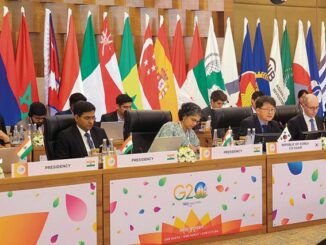
    • India prepares to host G20, SCO summits amidst regional rivalries

     “The G20 Summit will be bringing together leaders of countries which constitute two-thirds of the world’s population, while providing 90% of global GDP and 80% of global trade. The year 2023 is set to become the most complex and busy period in India’s diplomatic history. It is also going to be a period when the country’s logistical and organizational strengths will be tested. The forthcoming summits will test our ability in bringing countries together in a constructive and harmonious cooperation at the highest level. The summits are coming in the wake of tensions arising from the military standoff in Arunachal Pradesh.

    The issue of special interest will be whether Xi Jinping will participate in the forthcoming summits in the background of the current state of Sino-Indian ties.”

    By G Parthasarathy

    India’s foreign policy and national security establishments are going to be deeply tied up this year in meetings with members of the Shanghai Cooperation Organisation (SCO) and the G20 grouping. They will have to meticulously prepare for the summit meetings which India will be hosting later this year. The SCO includes eight members, six ‘Dialogue Partners’, and four ‘Observer States’. The G20 Summit will be bringing together leaders of countries which constitute two-thirds of the world’s population, while providing 90% of global GDP and 80% of global trade. The year 2023 is set to become the most complex and busy period in India’s diplomatic history. It is also going to be a period when the country’s logistical and organizational strengths will be tested. The forthcoming summits will test our ability in bringing countries together in a constructive and harmonious cooperation at the highest level. The summits are coming in the wake of tensions arising from the military standoff in Arunachal Pradesh.

    The issue of special interest will be whether Xi Jinping will participate in the forthcoming summits in the background of the current state of Sino-Indian ties.

    There are a few points that New Delhi should bear in mind. It will enjoy unstinted support in the conferences from virtually all members of the G20 and Quad. Both Pakistan and China will be present in the SCO. Pakistan is now engrossed in dealing with its collapsing economy. It also has serious problems with Taliban-ruled Afghanistan, and its own jihadis, the Tehreek-e-Taliban, across its 2,600 km border with Afghanistan and Iran. Given Afghanistan’s strategic location abutting Central Asia, China is keen to secure access to its mineral resources and keep in touch with its radical Islamist Taliban regime, especially in the light of its own tensions with its disaffected Uighur Muslims.

    Chinese President Xi Jinping has displayed continuing hostility towards India. China is focusing attention on the joint production of its much-touted JF-17 fighter aircraft in Pakistan and in strengthening the Pakistan navy. The Gwadar Port in Balochistan has a growing Chinese presence, but Pakistan has more serious problems to deal with, with its dwindling foreign exchange resources. In the meantime, the IMF is insisting on stringent conditions before international assistance can flow in. Even Saudi Arabia and the UAE, which have always been more than generous in bailing out Pakistan, are now making it clear that they will open their purse strings only after Pakistan fully meets IMF conditionalities. Across the world, many governments are recognizing that the economic mess that Pakistan is now in flows from its own blunders.

    There has, meanwhile, been a growing feeling in India that much of the tensions with China flow from deliberate actions of the Xi Jinping government, despite India having rolled out the red carpet during his India visit. It has been interesting to see a comprehensive assessment of India’s policies by Liu Zongyi of the Shanghai Institute of International Studies. Liu is one of China’s most prominent experts on South Asian studies. He has visited both India and Pakistan. In a recent article, which has received due attention in academic circles in our eastern neighborhood, he has bluntly spelt out what China thinks about India and its policies. Senior scholars in China do not speak out of turn. They are a convenient medium to convey the thinking of the country’s Communist Party and government.

    His study, titled ‘India’s Rising Great Power Strategy’, is multifaceted. On India’s domestic political issues, it alludes to the ascendancy of ‘Hindu nationalism’. On economic issues, he describes the ‘Make in India’ strategy as an effort to take over China’s place in the global supply chain. India’s strategy, according to him, will be to target China by building bases in Indian Ocean states, advancing the integration of India’s armed forces and improving border infrastructure, including in the Andaman and Nicobar Islands. It also includes building military bases by India in small Indian Ocean islands.

    In his conclusion, he notes: ‘Thus, the biggest divide between India and China is no longer related to border issues. In fact, border issues have now been instrumentalized. For the Indians, the biggest issue between India and China is the battle for the regional and global order. It is a geopolitical conflict, because India is a country that places a lot of emphasis on the idea of spheres of influence.’ Regarding India hosting the G20 and Quad summits, he notes: ‘Ultimately, the G20 Summit cannot be a success without China’s active participation. Even though the West lavishes praise on India, and even though India presents itself as the so-called poster child of developing countries, and the leader of the South, it will most certainly not succeed without China’s support.’ One cannot think of this as anything but a warning, bordering on threat.

    Liu betrays an obsession with the growth of India-US relations. He avers that it is India’s strategy to work with the US to undermine and counter China’s Belt and Road Initiative to prevent the emergence of a ‘China led’ regional order. This is accompanied by his strong justification of recent Chinese military intrusions in Ladakh and Arunachal Pradesh. Liu expresses serious concerns about India’s relations with the US and its involvement in groupings like Quad and I2U2. He conveniently forgets how China has been deliberately seeking to undermine India’s relations with neighbors across South Asia, notably with Sri Lanka, Bangladesh, Nepal and the Maldives. He even forgets the impact of China’s continuing and growing military relations with Rawalpindi, including its transfer of nuclear weapons and missile capabilities to Pakistan.

    Under these circumstances, the issue of special interest in the coming months will be whether Xi Jinping will participate in the forthcoming summits in the background of the current state of Sino-Indian relations, and the widespread concerns in India about his assertive policies.

    (The author is Chancellor, Jammu Central University & Former High Commissioner to Pakistan)

  • Strongly oppose unilateral bids to advance territorial claims at LAC: US

    The United States (US) has said it opposes any “unilateral attempts” and incursions across the Line of Actual Control (LAC), days after Chinese President Xi Jinping met People’s Liberation Army (PLA) soldiers stationed at the India-China border to “inspect combat readiness”. In response to a question by HT at a regular State Department press briefing on Friday on Xi’s comments to PLA troops, the Department’s principal deputy press spokesperson Vedant Patel said that the US is closely monitoring the situation.

    “We strongly oppose any unilateral attempts to advance territorial claims by incursions, military or civilian, across the border or the established Line of Actual Control,” said Patel.

    The US encourages India and China to utilise “existing bilateral channels to discuss disputed boundaries”, Patel added.

    Ahead of the first high level dialogue of the initiative on critical and emerging technology between the national security adviser Ajit Doval and his US counterpart Jake Sullivan in Washington DC next week, the State Department also highlighted the importance of the tech cooperation with India. Technology-sharing has been a contentious issue in the past in the relationship.       Source: HT

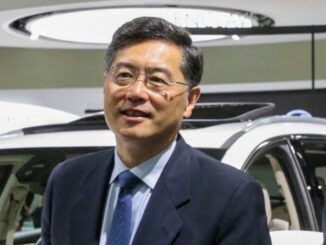
  • China’s US envoy Qin Gang is the country’s new Foreign Minister

    China’s US envoy Qin Gang is the country’s new Foreign Minister

    NEW YORK (TIP): A close associate of President Xi Jinping, has been appointed  as the new Foreign Minister of China,  replacing Wang Yi who had served in the post for 10 years. Chinese president Xi Jinping’s chief protocol officer between 2014 and 2018, Qin Gang  has had high-profile postings, including spokesman at the Foreign Ministry and at the Chinese embassy in Britain, besides a 17-month stint as the US envoy.

    Wang was promoted to the politburo of the Chinese Communist Party in October and will play a bigger role in foreign policy instead of his predecessor Yang Jiechi, who has been dropped. Both Wang and Yang had crossed the retirement age of 68 for all leaders except for Xi.

    In a recent article, he had said the US side must abide by the one-China principle and the provisions of the three Sino-US joint communiqués on the Taiwan issue. The US must oppose and stop “Taiwan independence”, support the peaceful development of cross-Strait relations and China’s peaceful reunification, he had written.

    But Qin has also been reflecting Beijing’s desire to mend fences with the US by stating recently that the China-US ties are not a zero-sum game. Xi held his first in-person summit with US President Joe Biden in Bali last November. — TNS

  • Chinese President Xi Jinping calls for peace talks between Russia, Ukraine

    Beijing (TIP): In a much-scrutinised meeting on November 4 with visiting German Chancellor Olaf Scholz, Chinese President Xi Jinping called for peace talks between Russia and Ukraine and warned against the conflict going nuclear. The German leader is in Beijing for a one-day visit that has drawn criticism over China’s tacit support for Russia, lingering controversies over economic ties and human rights issues. It comes after Xi further cemented his authoritarian rule at a major Communist Party congress last month. Scholz’s visit reflects the importance of Germany’s trade ties with China, the world’s second-largest economy, particularly in the auto and manufacturing sectors. (AP)

  • Joe Biden, Xi Jinping hold  talks  for over two hours

    Joe Biden, Xi Jinping hold talks for over two hours

    WASHINGTON, D.C. (TIP): Chinese President Xi Jinping on Thursday, July 28,  warned US President Joe Biden against “playing with fire” over Taiwan, as Beijing’s concerns mounted over a possible visit to the Chinese-claimed island by US House Speaker Nancy Pelosi. Quoting Chinese state media, Reuter  said Xi told Biden in their fifth call as leaders that the United States should abide by the “one-China principle” and stressed that China firmly opposed Taiwanese independence and interference of external forces. Beijing has issued escalating warnings about repercussions should Pelosi — a Democrat like Biden — visit Taiwan, which says it is facing increasing Chinese military and economic threats. A visit by the House Speaker would be a dramatic, though not unprecedented, show of US support for the island.

    “Those who play with fire will only get burnt,” Chinese state media quoted  Xi as telling Biden. “(We) hope the US side can see this clearly.” China has given few clues to specific responses it might make if Pelosi, a longtime critic of Beijing, particularly on human rights issues, makes the trip. The Presidents’ call lasted over two hours. US officials had said it would have a broad agenda, including discussion of Russia’s invasion of Ukraine, which China has yet to condemn. At its core though, US officials said they saw the exchange as another chance to manage competition between the world’s two largest economies, whose ties have been increasingly clouded by tensions over democratically governed Taiwan, which Xi has vowed to reunite with the mainland, by force if necessary. Washington does not have official relations with Taiwan and follows a “one-China policy” that recognizes Beijing, not Taipei, diplomatically. But it is obliged by US law to provide the island with the means to defend itself.

    (With inputs from agencies)

  • Ready to hold ‘high-level negotiations’ with Ukraine, Putin tells Xi

    Ready to hold ‘high-level negotiations’ with Ukraine, Putin tells Xi

    BEIJING/NEW YORK (TIP): Russian President Vladimir Putin said on Friday, February 25,  that he was ready to hold “high-level negotiations” with Ukraine as he spoke with his Chinese counterpart Xi Jinping who stressed that both Moscow and Kyiv should resolve the raging crisis through talks.

    Xi and Putin, regarded as allies and friends as China and Russia enlarged their strategic ties amid the strident US and EU push against them on a host of issues, held their talks on the phone around the same time as the Russian troops closed in on Kyiv, home to over three million people, with heavy bombardment raising fears of bloodshed.

    The Russian side is ready to hold “high-level negotiations” with the Ukrainian side, the official Chinese media here quoted Putin as telling Xi. Around the same time, Ukrainian President Volodymyr Zelensky on Friday, February 25,  reiterated his call for Russian President Putin to hold talks and stop the conflict.

    “Fighting is going on all over Ukraine. Let’s sit down at the negotiating table,” Zelensky said, the Chinese state-run Xinhua news agency reported, citing a report from Interfax-Ukraine news agency.

    Xi, whose government stonewalled criticism in the last few days for not condemning the Russian “invasion” of Ukraine, sought to play the role of a peacemaker by saying that China supports Russia and Ukraine to solve the issue through negotiation, the state-run CGTN reported. Noting that the recent situation in eastern Ukraine has changed dramatically, causing great concern in the international community, Xi told Putin that China’s position on the Ukraine issue was based on the merits of the matter concerned.

    In an apparent criticism directed against the United States and the European Union, Xi urged all parties to completely abandon the Cold War mindset, respect and attach importance to each other’s legitimate security concerns and strive for a balanced, effective and sustainable European security mechanism through dialogue and negotiation.

    Xi reiterated that China’s position of safeguarding the sovereignty and territorial integrity of all states and abiding by the purposes and principles of the UN Charter has been consistent. China is ready to work with all parties in the international community to promote common, comprehensive, cooperative and sustainable security and firmly uphold the UN-cantered international system and the international order underpinned by international law, he said.

    Putin, for his part, introduced the historical context on the Ukraine issue as well as Russia’s position on launching the special military operation in eastern Ukraine.

    The Russian President stressed that the United States and NATO have long ignored Moscow’s legitimate security concerns, repeatedly reneged on their commitments and kept pushing military deployments eastward, which challenged Russia’s strategic bottom line.

    He also told Xi that the Russian side was ready to conduct “high-level negotiations” with the Ukrainian side.

    During their phone conversation, Xi once again expressed his gratitude to Putin for coming to China to attend the opening ceremony of the 2022 Beijing Winter Olympics, which was boycotted by the leaders and diplomats of the US, the EU and their allies to highlight the allegations of human rights violations against Uygur Muslims in Xinjiang.

    As Xi-Putin held talks, a Xinhua report said the Russian Defense Ministry announced that its airborne forces successfully conducted a landing operation at the Gostomel airfield outside Kiev, blocking the Ukrainian capital city from the west.

    Ever since Putin announced the military operations in Ukraine on Thursday, China has walked a fine line, declining to condemn the military action while remaining silent over Moscow’s move to accord two separatist regions in eastern Ukraine, Donetsk and Luhansk as independent entities.

    In his talks with Russian Foreign Minister Sergei Lavrov on Thursday, Chinese Foreign Minister Wang Yi said there was a complex and special historical context of the Ukraine issue and the Chinese side understands Russia’s legitimate security concerns.

    Earlier, Chinese Foreign Ministry spokesman Wang Wenbin told a media briefing here on Friday that Beijing will make its own effort to push for political settlement of the Ukrainian issue. He said there was a sharp contrast between China’s approach and some other countries’ moves of creating and shifting the crisis, and trying to benefit from it, while responding to questions on White House spokesperson Jan Psaki’s assertion that it’s time for China to pick a side.

    Wang Wenbin said China believed that the Ukraine issue has a complicated history and that the legitimate security concerns of all parties should be respected and the Cold War mentality should be completely abandoned.

    Psaki said at a news briefing on Thursday that “this is really a moment for China, for any country, about what side of history they want to stand on here.”

    The comprehensive settlement of the issue should be sought through dialogue and negotiations so as to form a balanced, effective and sustainable European security mechanism, Wang said, noting that China’s approach formed a sharp contrast with what some countries have been doing in trying to benefit from the crisis.

    Wang said that the door to a peaceful settlement of the Ukraine issue has not been completely closed.

    China hopes that relevant parties remain calm and rational and commit to peacefully resolving relevant issues through negotiations in accordance with the principles of the UN Charter, he said, noting that Beijing will continue to promote peace talks in its own way and welcomes and encourages all efforts for a diplomatic settlement.

    He also played down the impact of the US and EU sanctions against Russia. Europe has imposed financial sanctions against Russia for its military operation against Ukraine.On the question of whether China is worried that not condemning Russia might undermine its relations with the EU, Wang said that he believed everyone was familiar with the results of the sanctions. Unilateral sanctions are never the fundamental and effective approach in solving problems and that they only result in severe difficulties to local economies and livelihoods, he said.

    (Source: PTI)

  • All about Xi Jinping and party

    All about Xi Jinping and party

    The centenary speech an exercise in self aggrandizement and promotion of CCP

    By Jayadeva Ranade

    “Xi Jinping asserting full reunification indicates that he will remain unyielding on issues of sovereignty. It is relevant for those with whom China has unresolved territorial or maritime disputes. While the celebrations allowed the CCP to effectively project its contribution to China’s ‘rise’ and its future relevance, the repeated references in Xi Jinping’s speech to foreign bullying, efforts to separate the party from the people, and call for the people’s support, reveal the worries of the party leadership. He deftly fashioned his speech to take credit for China’s achievements and affirm that the party would guide China towards ‘the second century goals.”

    The Chinese Communist Party (CCP) concluded its centenary celebrations with a grand event and speech by CCP general secretary Xi Jinping on July 1. It provided the CCP and Xi Jinping an opportunity to share their assessment of the journey thus far and give a broad sense of direction for the future. In his speech Xi Jinping mentioned the Belt and Road Initiative and the ‘community of shared destiny’ — his personal projects — hinting that he would continue in office beyond the party congress next year.

    The celebrations confirmed also that the CCP leadership is sensitive to the military’s morale. Contrary to its announcement in March, a carefully vetted crowd watched a military parade and flypast by the latest generation J-20 ‘stealth’ fighter aircraft and ZL-10 transport helicopters over Tiananmen Square. The party was honored with a 100-gun salute.

    The entire CCP politburo was present on the Tiananmen Gate Tower. The state-owned CCTV showed Xi Jinping deferentially walking a step behind his grey-haired predecessor Hu Jintao. Former President Jiang Zemin was absent, possibly because of age. The invitees included many retired veteran cadres, including 104-year-old Song Ping and former Premier Wen Jiabao. Suggesting that Xi Jinping is possibly seeking the support of party ‘elders’ at the next party congress, Jiang Zemin’s long-serving chief of staff and ex-Vice President Zeng Qinghong was present. Particularly interesting was the presence of Bo Xicheng, son of one of China’s ‘Eight Immortals’, Bo Yibo and brother of incarcerated former politburo member Bo Xilai, who tried to push Xi Jinping aside in the run up to the 18th party congress in 2012 and take over China’s top three posts! The CCP’s international liaison department had requested political parties from around the world to send congratulatory letters on the occasion. Of the Indian parties, only the CPI and CPI (M) responded positively.

    Xi Jinping’s nearly hour-long speech was crafted to exude confidence blended with aggression and nationalism. It was calculated as much to concretize the CCP’s monopoly on power in China as to rally nationalist sentiment against anti-China foreign forces and mobilize the people towards achieving the second centenary goal under the CCP’s leadership. It avoided mentioning calamitous disasters like the Great Leap Forward and Cultural Revolution, in which over 80 million people lost lives, were disabled or scarred for life. Surprisingly, neither did it list what material benefits the people could expect in the coming decades.

    Xi Jinping paid the ritual obeisance to veteran Chinese communist revolutionaries, acknowledging them by name. The rest of his speech focused on the party: how it had ushered in ‘socialism with Chinese characteristics’, ‘profoundly changed the course of Chinese history in modern times’, modernized China, and its indispensability for China. Xi Jinping declared ‘we must uphold the firm leadership of the party. China’s success hinges on the party. Without the Chinese Communist Party there will be no new China and no national rejuvenation’. The party was mentioned 133 times.

    It also conveyed a message to foreign powers, whose remarks bore Xi Jinping’s imprimatur. Stressing that China was no longer ‘a semi-colonial, semi-feudal society’ and had ended ‘all the unequal treaties imposed on our country by foreign powers and all the privileges that imperialist powers enjoyed in China’, Xi Jinping was emphatic that ‘any attempt to divide the party from the Chinese people or to set the people against the party is bound to fail’.

    Alluding to increasing US pressure on China, he declared that ‘the Chinese people will not allow any external forces to bully, oppress, or enslave us; anyone who deludes themselves into doing so will suffer a crushing and bloody head-on collision with the great wall of steel (PLA) made of the flesh and blood of 1.4 billion Chinese people’. China’s official news agency Xinhua subsequently released a toned-down version saying ‘anyone who would attempt to do so will find themselves on a collision course with a great wall of steel forged by over 1.4 million people’.

    Xi Jinping subtly directed credit for achievements towards himself. He declared ‘a historic resolution to the problem of absolute poverty in China’, as China marched towards its second centenary goal. The goal of alleviating absolute poverty by 2021 was Xi Jinping’s flagship programme. Xi Jinping also said, ‘in this new era, we have upheld and strengthened the party’s overall leadership’, overcoming many ‘major risks and challenges. Xi Jinping traced these achievements to the 18th party congress. He reinforced this with a call to uphold the core position of the general secretary on the party central committee and in the party as a whole.

    Xi Jinping’s uncompromising remarks on Hong Kong, Macau and Taiwan are revealing. He promised Hong Kong and Macau the rule of law but tempered with greater autonomy. On Taiwan, he specifically mentioned the 1992 consensus and reiterated China and the party’s commitment to the ‘full reunification’ of China.

    Xi Jinping asserting full reunification indicates that he will remain unyielding on issues of sovereignty. It is relevant for those with whom China has unresolved territorial or maritime disputes. While the celebrations allowed the CCP to effectively project its contribution to China’s ‘rise’ and its future relevance, the repeated references in Xi Jinping’s speech to foreign bullying, efforts to separate the party from the people, and call for the people’s support, reveal the worries of the party leadership. He deftly fashioned his speech to take credit for China’s achievements and affirm that the party would guide China towards ‘the second century goals’.

    (The author is President, Centre for China Analysis and Strategy)

  • U.S. will cut emissions by up to 52% by 2030, said Joe Biden at the ‘Leaders Summit on Climate’

    U.S. will cut emissions by up to 52% by 2030, said Joe Biden at the ‘Leaders Summit on Climate’

    NEW YORK (TIP): U.S. President Joe Biden announced that the U.S. would cut its greenhouse gas emissions by 50%-52% by 2030 relative to 2005 levels, in a clean break with the Trump administration policies on climate action. Mr. Biden also announced that the U.S. would double, by 2024, its annual financing commitments to developing countries, including a tripling of its adaptation finance by 2024. The President made the new target announcements at a ‘Leaders Summit on Climate’, which he is hosting on Thursday and Friday, April 22 and 23 — a summit to which 40 heads of state and government are invited — including Prime Minister Narendra Modi of India, President Xi Jinping of China, and President Vladimir Putin of Russia.

    The emissions targets — part of the Paris Agreement on climate — are non-binding and the details of how they will be achieved are not available. However, in announcing the targets, the Biden administration is hoping to encourage other countries to increase their commitments. It is also seeking to bring America back into a leadership role on climate action after Mr. Trump had withdrawn the country from the Paris Agreement.

    Mr. Biden’s financing announcements are part of a $100 billion a year commitment from developed countries to developing countries for the period 2020-25, “an investment that is going to pay significant dividends for all of us”, Mr. Biden said.

    The withdrawal of the U.S. from the Paris Agreement means it has not yet met its financing commitments either. The Obama administration had promised $3 billion to the Green Climate Fund (to help developing countries), only $1 billion has been paid.

    In selling climate action to the American public, which until recently was governed by an administration skeptical of the climate crisis, President Biden and his administration have linked climate action and clean technology to jobs and economic growth. On Thursday, Mr. Biden extended this message to other countries.

    “And meeting this moment is about more than preserving our planet. It’s also about providing a better future for all of us. That’s why, when people talk about climate, I think jobs. Within our climate response lies an extraordinary engine of job creation and economic opportunity ready to be fired up,” he said.

    “By maintaining those investments and putting these people to work, the United States sets out on the road to cut greenhouse gases in half — in half — by the end of this decade,” Mr. Biden said.

    “The signs are unmistakable. The science is undeniable,” he said. The first guests to speak at the summit were UN Secretary-General Antonio Guterres, Mr. Xi, Mr. Modi, Prime Minister Boris Johnson of the U.K. and Prime Minister Yoshihide Suga of Japan.

    (Agencies)

  • China’s lies, damned lies and statistics

    China’s lies, damned lies and statistics

    • By Prabhu Dayal

      China deliberately concealed the extent of the outbreak of the Covid-19 outbreak during the early days

    • China also kept mum about its casualties after the clash with Indian Army in Galwan Valley
    • Now, after eight months have elapsed since the clashes, China has grudgingly acknowledged casualties

    Abraham Lincoln had famously said: “You can fool some of the people all of the time, and all of the people some of the time, but you cannot fool all of the people all of the time.” The Chinese leadership does not seem to realize this and continues to use false figures and statistics to bolster its case. Thus, it weaves one web of lies after another, totally oblivious of its own eroding credibility. For example, CNN reported in December that documents from Wuhan accessed by it reveal how China deliberately concealed the extent of the outbreak of the Covid-19 outbreak during the early days by playing down the actual figures. The ‘Wuhan Files’, as they have come to be called show China’s complete lack of transparency about its poor handling of the coronavirus outbreak in the early days. The health authorities in the province of Hubei, where the virus was first detected listed a total of 5,918 cases on February 10 last year—more than double the number that was made public. False statistics were used by the Chinese authorities to hide their incompetence.

    Experts and persons in positions of authority have continued to accuse Beijing of lying and being opaque about information pertaining to the virus. US Secretary of State Antony Blinken recently said that Beijing has to step up and make sure it is being transparent about the deadly virus. In an interview with MSNBC, Blinken said that the Chinese government’s failure’ in sharing and providing pertinent information regarding the deadly virus is something “we must address”. He added: “There is no doubt that, especially when COVID-19 first hit but even today, China is falling far short of the mark when it comes to providing the information necessary to the international community, making sure that experts have access to China. All of that – that lack of transparency, that lack of being forthcoming, is a profound problem and it’s one that continues.”

    Not surprisingly, such jiggery-pokery also remains a hallmark of the Chinese leadership’s approach to its casualties in the savage June 15 Galwan Valley clashes. Shortly after the clashes, India had confirmed the loss of 20 soldiers. Moreover, these slain soldiers were honored for their bravery with their names installed in memorials. In sharp contrast, China kept mum about its casualties, although not just Indian but international sources too reported that the figure of such casualties was higher than that for India. For example, the Russian news agency TASS reported recently that China suffered 45 casualties during the clash.

    Simply put, Xi Jinping and his henchmen are again lying through their teeth, perhaps oblivious to the act that others can see through their lies and deception. Why are they acknowledging only four casualties when it is widely believed that the figure was much higher? Is it because they want to continue propagating their theory of China’s superiority over India? Now, after eight months have elapsed since the clashes, China has grudgingly acknowledged casualties and named four of its soldiers who were killed–a far smaller number than what is widely believed. Asked why this was being done eight months after the clash, the spokesman of the Chinese Foreign Ministry Hua Chunying said that “The report has been revealed to give the truth to the public because the truth is long-awaited and is necessary for the people to know the true story.” However, in view of the fact that international sources have reported much, much higher casualty figures, the figures now disclosed by the Chinese authorities only highlight their unflinching belief in their own ability to pull the wool over the eyes of not just their own people but everyone else’s too.

    After acknowledging the above casualties, the Chinese Foreign Ministry spokesman went on to say: ” “India is an important neighbor of China and restoring a healthy, stable relationship is the aspiration and also in the interest of the two peoples. I hope the Indian side will work with us towards achieving this shared goal.” Given China’s track record, will anyone believe that there is even an iota of sincerity in these remarks? Will anyone be taken in by China’s lies, damned lies or it’s falsified statistics?

    (The author is a former diplomat)

    (Courtesy OPOYI)

  • Jack Ma emerges for first time since crackdown on Ant and Alibaba

    Jack Ma emerges for first time since crackdown on Ant and Alibaba

    Alibaba and Ant co-founder Jack Ma has resurfaced after months out of public view, quashing intense speculation about the plight of the billionaire grappling with escalating scrutiny over his internet empire. China’s most recognizable entrepreneur addressed scores of teachers on an online conference Wednesday, part of an annual event the billionaire hosts to recognize the achievements of rural educators. His appearance, first reported in a local blog, was confirmed by people familiar with the matter. Ma’s re-emergence may help quell persistent rumors about his fate while Beijing pursues investigations into online finance titan Ant Group Co. and Alibaba Group Holding Ltd. The executive had kept out of public view since early November, when Chinese regulators torpedoed Ant’s $35 billion IPO, tightened fintech regulations, then ordered an overhaul of Ant and launched a separate antitrust probe into Alibaba — all in a span of days. The assault on Ma’s trillion-dollar corporate empire encapsulates a broader campaign to rein in a generation of Chinese tech giants that Beijing now views as wielding too much control over the world’s No. 2 economy. The flurry of actions against his twin companies drove home how Beijing has lost patience with the outsize power of its technology moguls, perceived now as a threat to the political and financial stability President Xi Jinping prizes most.

  • Encouraged by Xi’s remarks but want concrete steps to avert new tariff: WH

    Encouraged by Xi’s remarks but want concrete steps to avert new tariff: WH

    WASHINGTON(TIP): The Trump Administration on Wednesday, April 11, said it was encouraged by the remarks of Chinese President Xi Jinping but ruled out reversing its recent move to impose 25 per cent tariff on import of products from China amounting to USD 150 billion.

    “Certainly, we are encouraged by President Xi’s words, and his kind words. But at the same time, we want to see concrete actions from China, and we’re going to continue moving forward in the process and in the negotiations until those happen,” White House Press Secretary Sarah Sanders told reporters at her daily news conference.

    The White House remarks come after President Donald Trump praised Xi for his remarks.

    “Very thankful for President Xi of China’s kind words on tariffs and automobile barriers…also, his enlightenment on intellectual property and technology transfers. We will make great progress together!” Trump tweeted.

    The US State Department also suggested the same. “We’ve been clear with the Chinese government in areas that are of concern to US workers, US companies, and the overall trade balance. We have had those conversations with them, so I think we’re looking like we’re in a better place,” State Department Spokesperson Heather Nauert told reporters at her daily news conference.

    “What we may be seeing is China coming to terms with some of our concerns about unfair trade practices and the United States saying. We stand by to engage with you, the government of China and President Xi, on that matter,” she said.

    In his keynote address at the Boao Forum for Asia after he began his second five-year term last month with prospects of continuing in power for life, Xi said, “China’s door of opening up will not be closed and will only open wider.” Without mentioning Trump’s concern over the huge trade deficit, Xi said China does not seek trade surplus and have a genuine desire to increase imports and achieve greater balance of international payments under the current account.

    (Source:PTI)

  • SCO SUMMIT- PM Modi meets China’s Xi Jinping to repair ties

    SCO SUMMIT- PM Modi meets China’s Xi Jinping to repair ties

    ASTANA (TIP): Prime Minister Narendra Modi and Chinese President Xi Jinping met here on June 9 on the sidelines of the SCO summit, seen as an effort to repair ties hit by growing differences between the two countries over a host of issues, including the China- Pakistan Economic Corridor and NSG.

    It is the first between the two leaders after India boycotted the high-profile Belt and Road Forum held in Beijing last month in which 29 world leaders took part.

    India abstained from the summit to highlight its concerns over the US$ 50 billion China Pakistan Economic Corridor, which is part of the Belt and Road Initiative (BRI) and passes through Gilgit and Baltistan in Pakistan-occupied Kashmir (PoK).

    Prime Minister Modi and Xi are here to attend the annual summit of the Shanghai Cooperation Organisation (SCO). “PM @narendramodi meets President of China #XiJinping on margins of SCO Summit in Astana,” External Affairs Ministry Spokesperson Gopal Baglay tweeted.

    China is vocal about its stand to block India’s admission into the 48-member Nuclear Suppliers Group (NSG). It had also stalled India’s move to list JeM chief Masood Azhar as a global terrorist by the UN. After Astana, Modi and Xi are also expected to cross paths at the G20 summit to be held next month in Hamburg, Germany followed by Brazil, Russia, India, China, South Africa (BRICS) summit to be held in Xiamen, China in September.

    Modi also met Uzbek President Shavkat Mirziyoyev on the sidelines of the SCO. “Taking forward #IndiaUzbekistan coop’n. PM @narendramodi meets President Shavkat Mirziyoyev of Uzbekistan on the sidelines of SCO Summit,” Baglay tweeted.

    Source: PTI