Tag: Yashwant Sinha

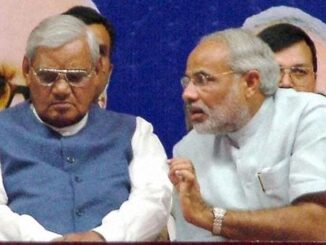
  • Vajpayee’s BJP Vs Modi’s BJP

    Vajpayee’s BJP Vs Modi’s BJP

    By Kaleem Kawaja

    If we look at what BJP was under the long leadership of Atal Behari Vajpayee who was India’s Prime Minister three times and we look at what BJP has become under the leadership of Narendra Modi who is in his second term as Prime Minister, we find a huge contrast.

    Vajpayee was a life-long, humble Hindu nationalist, a learned Hindi poet and a political leader. He first became PM after the May 1996 election for a period of 13 days, but not being able to muster majority in parliament he chose to resign rather than use horse-trading to reach that goal. Then after the May 1998 election he became PM of a coalition headed by BJP for a period of 13 months. In early 1999 the coalition lost its majority due to the defection of a constituent. Again, instead of horse-trading to retain majority, Vajpayee resigned. Another election was called and Vajpayee’s BJP coalition returned with a stable majority that lasted a full term of five years.

    PM Vajpayee governed India and made chief ministers in states where BJP was in power, govern in a principled manner, what he called Raj Dharma – the governing philosophy from ancient days when Hindu kings ruled in India. For his cabinet of the central government Vajpayee choose capable people of integrity e.g., Murli Manohar Joshi, Jaswant Singh, Yashwant Sinha, Arun Shori et al. When in 2002 large scale killings of Muslims occurred in Gujarat, then ruled by Chief Minister Narendra Modi, Vajpayee publicly admonished Mr Modi and asked him to follow Raj Dharma. Vajpayee also wanted to remove Modi as CM but the BJP high command did not agree.

    In contrast PM Modi has little use for principled politics and does not hesitate from horse-trading to govern. His machinations to form BJP governments in states in recent years where BJP did not get majority in election speak for themselves. Also, Mr Modi has little use for humility and asks for adulation from others. Mr Modi is a spell binding orator who has changed the color of Hindu nationalism and BJP from humility to aggressiveness. Both in Gujarat as CM and at the Center as PM, Mr Modi has often made grandiose promises of good times (acche din) without putting a system in place or putting competent leaders in place to implement those promises. Unlike Vajpayee’s competent ministers very few of Modi’s ministers are in that category and then he micro-manages them like a know-all. After five years very few of his promises to the people have been implemented.

    However, to cover his tracks he has blindfolded the media, especially TV media to such an extent that major national problems like the extreme grief of starving farmers, huge unemployment of the youth and rampant corruption are routinely described by the media as conspiracies of the opposition in collusion with India’s enemies.

    Vajpayee proudly glorified Hinduism and Hindu culture but did not allow BJP activists to make the religious minorities feel like they were second class citizens. Mr Modi has made hardly any real effort to control the militant folks from BJP and its allied groups from brutalizing the minorities or has asked chief ministers of BJP ruled states to use law & order forces to control violence against minorities.

    (The author is a social activist)

  • Prez polls: It’s Draupadi Murmu Vs Yashwant Sinha

    Prez polls: It’s Draupadi Murmu Vs Yashwant Sinha

    National Democratic Alliance’s (NDA) presidential candidate Droupadi and joint opposition nominee Yashwant Sinha are the only two contesting candidates left in the race for the election to the Office of the President after the last day for the withdrawal of candidature ended last week. The Returning Officer for the presidential polls, Rajya Sabha Secretary General PC Mody informed that the polling for the Presidential election will take place on July 18 from 10 am to 5 pm in Room Number 63 of the Parliament House and in notified rooms in state assemblies. The Electoral College for election to the Office of the President consists of the elected Members of both Houses of Parliament and the elected Members of the Legislative Assemblies of all states including Delhi and Puducherry. The Members of Parliament normally exercise their vote in Parliament House, New Delhi, and Members of State Legislative Assemblies including the Members of the Legislative Assemblies of the NCT of Delhi and the Union Territory of Puducherry in their respective capitals at the places notified by the Election Commission in this behalf. However, a Member of Parliament may vote in any State Capital and Union Territory Capital if he/she has obtained the prior permission of the Election Commission. Similarly, a Member of any State Legislative Assembly who has obtained the prior permission of the Election Commission, may, vote in Parliament House, New Delhi or at any State capital other than his/her own State. With several regional parties including the BJD, BSP and SAD extending their support to Murmu, the numbers seem to be in the favour of the NDA nominee.

    Draupadi Murmu

    Draupadi Murmu was born on 20 June 1958 in Baidaposi village of Mayurbhanj district in Odisha. Her father’s name is Biranchi Narayan Tudu. She belongs to Santal family, a tribal ethnic group. Murmu was married to Shyam Charan Murmu. The couple had two sons and a daughter. Draupadi Murmu’s life has been marked by personal tragedies and the loss of husband and two sons. During the Bharatiya Janata Party and Biju Janata Dal coalition government in Odisha, she was the Minister of State with independent charge for Commerce and Transport from March 6, 2000 to August 6, 2002 and Fisheries and Animal Resources Development from August 6, 2002 to May 16, 2004. She was former Odisha Minister and an MLA from Rairangpur assembly constituency in the years 2000 and 2004. She is the first woman Governor of Jharkhand. She is the first woman and tribal leader from Odisha to be appointed a governor in an Indian state.

    Achievements

    –        The year 1997 marked the beginning of Draupadi’s political career when she was elected to serve as a councilor for the Rairangpur district in Odisha. During the same year, she was also Rairangpur’s Vice-Chairperson. Her tenure there lasted one year.

    –        Following her victory in the assembly elections held in the Rairangpur seat in 2004, she was subsequently elected to a ministerial position in the BJP. She began working at the department of transport, trade, fisheries, and animal husbandry in 2000, and she remained employed there until 2004.

    –        She was victorious in the assembly elections in 2004, and this time she was chosen to represent the BJP in the Rairangpur seat.

    –        In 2006, she won the election to serve as the State President of the BJP Scheduled Tribe Morcha and the District President of the BJP in Mayurbhanj. Between the years 2006 and 2009, she held the position.

    –        She was chosen to serve as the ninth Governor of Jharkhand in May 2015 and remained in that position until May 2021.

    –        She was nominated by the Bharatiya Janata Party (BJP) to run for the presidency of India in the 2022 elections.

    Yashwant Sinha

    Yashwant Sinha, the form IAS officer who worked for the Janata Party, then the Bharatiya Janata Party, has been named as the the candidate for the post of the president of the nation by the Opposition parties. Sinha, who got sidelined by the BJP, has been a vocal critique of the Narendra Modi-led National Democratic Allliance government. Opposition parties came together and picked him to contest against NDA candidate Draupadi Murmu. While there were several other named being floated for Opposition’s candidate, Sinha’s name came late into discussion and got unanimous nod from all parties.

    From the Indian Administrative Services (IAS) to the Janata Party, then the Bharatiya Janata Party (BJP), and then slipping into oblivion — Yashwant Sinha’s professional career has been a roller-coaster ride. As a long-time member of the BJP, Sinha served in several ministries but finance was known to be his forte.   Before becoming the Union finance minister in the BJP-led National Democratic Alliance’s (NDA’s) first full term government, which took office in 1998, Sinha had held that portfolio in Chandra Shekhar’s Cabinet as well (from November 1990 to June 1991). Later, he was the finance minister in the first three years of the Atal Bihari Vajpayee (1998 to 2002).   Among changes to his credit as finance minister is breaking the colonial-era tradition of presenting Union Budgets in evenings. Sinha’s 1998-99 Budget was the first to have been presented in the morning, a practice that has been followed since. He is also credited with boosting the funding of the National Highway Authority of India (NHAI) through a petroleum cess. That helped push the construction of highways across India, and kick-start the ambitious Golden Quadrilateral project. During his tenure as finance minister, he deregularised the petroleum industry and helped the telecom industry expand. He was written extensively about his stint as the finance ministry in his book Confessions of a Swadeshi Reformer.   An ardent critic of Narendra Modi and his government’s policies, Sinha quit the BJP on April 21, 2018.  Yashwant Sinha had joined active politics as a member of the Janata Party after resigning from the IAS in 1984. He had been appointed the party’s all-India general secretary in 1986 and was elected a member of the Rajya Sabha in 1988. When the Janata Dal was formed in 1989, Sinha, a founding member, was appointed the party’s general secretary. He later joined the BJP and held important portfolios in the Vajpayee government.