Tag: Yogendra Yadav

  • This agitation is not just about farmers now

    This agitation is not just about farmers now

    By Yogendra Yadav

    “The farmers are a force that can shape an alternative path to India’s development. Again, it is not that farmers believe in alternatives more than anyone else. It is just that their livelihood concerns and collective interest push them towards equity and ecological sustainability. The present movement underlines the farmers’ quest for equity, their demand for a dignified minimum price for their produce, and their determination to combat corporate takeover of agriculture. Sooner than later, the challenge of climate change would force the farmers to be the torchbearers of sustainability as well. Poor ecological practices are now beginning to turn into poor economics for the farmers and causing their ruin. Farmers are not some relic of the past. They can be a potent force to shape India’s future.”

    The question now is not what the farmers can secure for themselves. The prime issue is not about if and when the farmers would succeed in their immediate objective of getting the anti-farmer laws repealed and securing legal guarantee of MSP. The real question is what the farmers can secure for the entire country — whether they can lead the larger battle for saving the very idea of India.

     JULY 26 was a special day to ask a big question: can the farmers’ movement be the vanguard we need in rescuing our constitutional democracy and reclaiming the republic?

    On July 26, the historic kisan morcha at the borders of Delhi completed eight months. The Samyukt Kisan Morcha (SKM) marked the day by organizing an all-women Kisan Sansad within earshot of Parliament. Just when the Bharatiya Janata Party (BJP) was hoping to erase the farmers’ movement from the country’s mindscape, it sprang up to occupy the center stage once again. The successful and peaceful conduct of Kisan Sansad addressed some of the real as well as orchestrated anxieties associated with the Republic Day protest this year. The same day, the SKM leadership was in Lucknow to announce ‘Mission UP and Uttarakhand’. The detailed calendar for these two states signaled a move to expand, deepen and intensify the movement.

    It so happened that Rahul Gandhi chose the same day to drive a tractor to Parliament with a banner opposing the three farm laws, leading to a day-long detention of some Congress MPs. Within the House, all Opposition MPs followed the whip issued by the farmers’ movement and continuously raised the issues flagged by the farmers. This rare coincidence of protests inside and outside Parliament may have meant little to the Narendra Modi government, but it did indicate the political clout of the farmers’ movement and its role as the opposition in the country, currently.

    The question now is not what the farmers can secure for themselves. The prime issue is not about if and when the farmers would succeed in their immediate objective of getting the anti-farmer laws repealed and securing legal guarantee of the Minimum Support Price (MSP). The real question is what the farmers can secure for the entire country — whether they can lead the larger battle for saving the very idea of India.

    My answer is in the affirmative. Not because I draw upon ‘insider information’ as a participant, not because I believe in any special virtues of the peasantry. I believe the farmers can play a decisive role in reclaiming our rapidly shrinking republic because their class interest happens to coincide with the project of saving the soul of India. If democracy, diversity and development are the three key pillars of the idea of India, farmers’ movement cannot but provide anchors to all these ideas. In saving themselves, the farmers save the republic of India.

    I am not suggesting that farmers are inherently more democratic than other classes of citizens. They are not. But one thing is clear: in today’s India, farmers need democracy more than other classes. Businessmen can buy their way to achieve what they need. The middle class can access power through bureaucracy and occasionally through judiciary as well. The working class in the organized sector still has some, though fast-dwindling, procedural protections to safeguard their interests. Farmers as a group have no avenue open to them other than street politics, agitations and movements. They need democratic spaces to exercise this option. Their class interest coincides with the project of saving democracy. The ongoing farmers’ movement is acutely aware of this. It is not a coincidence that exactly a month ago, the farmers had marked June 26, the Emergency Day, by organizing ‘Save Agriculture, Save Democracy’ protests outside Raj Bhawans across the country.

    Similarly, the farmers’ movement provides the strongest bulwark against the assault on the idea of a diverse India. Not just because farmers and farming are inherently diverse and protecting farming is about protecting diversity. And not merely because the movement happened to have originated among the Sikh peasantry. Above all, the project of uniting farmers requires the movement to take on the BJP’s politics of divide and rule. In Punjab, Haryana and Uttar Pradesh, the farmers’ movement has already established itself as the most powerful organized force to take on the politics of communal division. As the movement spreads to other regions of the country, this is the true ‘Bharat Jodo Andolan’.

    Finally, the farmers are a force that can shape an alternative path to India’s development. Again, it is not that farmers believe in alternatives more than anyone else. It is just that their livelihood concerns and collective interest push them towards equity and ecological sustainability. The present movement underlines the farmers’ quest for equity, their demand for a dignified minimum price for their produce, and their determination to combat corporate takeover of agriculture. Sooner than later, the challenge of climate change would force the farmers to be the torchbearers of sustainability as well. Poor ecological practices are now beginning to turn into poor economics for the farmers and causing their ruin. Farmers are not some relic of the past. They can be a potent force to shape India’s future.

    First, this is not an argument about the necessity and inevitability of farmers’ role in history. Farmers need not always play the role of a revolutionary vanguard, the role assigned to the working class in the Marxist theory. But there is one commonality with the logic advanced in The Communist Manifesto: like the proletariat, the farmers in today’s India are the only class whose interest happens to be aligned with the forward movement in history.

    Second, this won’t happen by itself. The alignment of interests ensures that the farmers are well placed to play a historic role. But it all depends on how consciously and carefully the farmers’ movement takes up this task. It depends upon how the present movement combines the immediate economic issues of the farmers with the larger political issues involving their long-term interest. It depends on how well the movement succeeds in spreading itself beyond its current geographic epicenter and in uniting all sections of Indian farmers, from big landowners to the landless peasants. That is the historic responsibility of the farmers’ leadership.

    (The author is National President, Swaraj India. He can be reached at Yogendra.yadav@gmail.com)

  • India in need of viable political alternative

    India in need of viable political alternative

    By Yogendra Yadav

    “In the seven years since he took oath, Modi’s government has never looked as shaky as it does today. Its aura of power is melting. For Modi sceptics, the botched-up handling of the second wave of the Covid pandemic — under-testing the patients and under-reporting the dead, lack of preparedness, unavailability of oxygen, and vaccine mismanagement — has confirmed its callousness bordering on cruelty. For many die-hard Modi believers, the absence of the government during this crucial period has punctured the myth of omnipotence built around the Prime Minister. They have begun to entertain a suspicion that the PM is not quite in control of things, and not as powerful as he appears.”

    “Mere Modi-bashing won’t lead to his defeat; the people look for an alternative before they can discard what they have. And let us face it: such an alternative does not exist, at least not on the menu that an ordinary person gets to see. Opposition unity is necessary, but not sufficient. The Opposition needs a glue that holds it together and a glow to radiate hope among the people. The creation of such a positive and viable alternative is the most pressing political task for those who believe in the idea of India, those who respect our constitutional values, those who despair at the erosion of democracy, and those who are committed to reclaiming our Republic.”

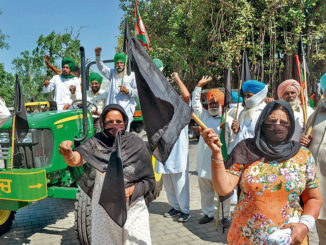
     The black flag protest by the farmers’ movement on the occasion of the seventh anniversary of the Narendra Modi government on Wednesday told us something about the need for political alternatives. It also offered a hint as to how such an alternative might come about. In the seven years since he took oath, Modi’s government has never looked as shaky as it does today. Its aura of power is melting. For Modi sceptics, the botched-up handling of the second wave of the Covid pandemic — under-testing the patients and under-reporting the dead, lack of preparedness, unavailability of oxygen, and vaccine mismanagement — has confirmed its callousness bordering on cruelty. For many die-hard Modi believers, the absence of the government during this crucial period has punctured the myth of omnipotence built around the Prime Minister. They have begun to entertain a suspicion that the PM is not quite in control of things, and not as powerful as he appears. The carefully designed image of the all-powerful PM is coming unstuck in the political arena too. The anti-CAA protests showed that a small but determined group could stand up to this government. The farmers’ movement has already demonstrated that this government can be pushed on the back foot. West Bengal has called the bluff of the electoral prowess of the PM and his party. After seven years of untrammeled exercise of power, the Modi government has to contend with a truth that troubles all authoritarian rulers: power corrodes, absolute power corrodes absolutely.

    Momentarily, the Modi government resembles the second innings of the Manmohan Singh government, whose countdown had begun in 2012. It might seem that the PM has lost his charm, that the government would collapse under the weight of the mountain of lies that it has spun to cover up its misgovernance and misdeeds. The Opposition has to just wait and watch, and possibly unite.

    Here lies the danger. The danger is in assuming that the Modi government’s countdown has begun, in believing that democracy’s self-correcting mechanisms will control the excesses of this government, that history will do the job for us.

    Nothing can be farther from the truth. At this moment, we are liable to over-read popular anger with the Modi government and under-estimate its reserve of popular support. There is certainly widespread discontent, disappointment and disaffection with the Modi government today, but it need not result in its popular rejection. There is a fairly large section that might back the incumbent irrespective of its governance record. For the rest, disappointment may not turn into disgust that leads voters to throw out the incumbent at all costs. In any case, the sight of all Opposition leaders holding hands together may not enthuse the voters; it might only reinforce the impression of one man against a gang.

    Besides, the Modi government is bound to come up with a counter-offensive. At this moment, we are liable to underestimate the sheer power of propaganda at the command of the ruling establishment. Its spin-doctors are waiting for the storm to blow over before they launch the usual games of deflecting the blame, distracting the public and delaying the encounter with the public. They are waiting for an opportune moment to launch a vicious attack on the challengers. Its stories would be amplified with the help of money, media and organizational machinery. One thing is for sure: Unlike Dr Manmohan Singh, PM Modi will not fade away without fighting to the finish, without exhausting all the vast means at his command, fair and foul.

    Let us be clear: Despite all his blunders, mere Modi-bashing won’t lead to his defeat; the people look for an alternative before they can discard what they have. And let us face it: such an alternative does not exist, at least not on the menu that an ordinary person gets to see. This is not to discount the existing Opposition parties, nor to dismiss the need for their unity. Opposition unity is necessary, but not sufficient. The Opposition needs a glue that holds it together and a glow to radiate hope among the people. As of now, it doesn’t seem to have either. This is why we need an alternative to supplement the existing Opposition. Such an alternative to Modi would need, first of all, a positive and believable message about India’s future. Beyond a point, people do not want to hear what has gone wrong in the past; they want to know how things can get better in the future. This time it cannot be fake dreams and jumlas. Having fallen for it once, the people now need something solid, something believable. The message must be universal, simple and inspire confidence. That message does not exist in the public domain today. It cannot be conjured up from the ideologies of the 20th century. The language of the old ideologies of the bygone era does not work with today’s India. A fresh message must involve a coming together of fresh ideas, a fresh combination of policies and positions.

    Once we have a positive and believable message, we need credible messengers. Their words must carry more weight than run-of-the-mill politicians. The Opposition is deficient in this respect too. We do not have a Jayaprakash Narayan with us today. At the same time, Indian public life is not bereft of leaders with proven track record of selfless public service, integrity and intelligence. Some of them must step forward to respond to this historic need.

    Finally, we need a powerful machine to carry this message across the country. This machine needs two parts: Organization and communication. Today, there is nothing in the oppositional space that can match the BJP on both these counts. Many of the Opposition parties have their cadre, no doubt. Therefore, bringing the existing Opposition parties on board is necessary for building an alternative. But it is not sufficient. A new alternative must involve a large-scale mobilization of citizens, mainly younger citizens, who have hitherto remained outside the political domain. Bringing this fresh energy into political life is a must to meet the current challenge. A powerful communication machine, with an IT team to match the BJP’s, must supplement the organization on the ground. India needs a Truth Army to take on the troll army of RSS-BJP.

    The creation of such a positive and viable alternative is the most pressing political task for those who believe in the idea of India, those who respect our constitutional values, those who despair at the erosion of democracy, and those who are committed to reclaiming our Republic.

    Would someone respond to this call of our times? If yes, how would this process unfold? We do not have answers. But Wednesday’s protest offers us a clue: the farmers’ movement took the lead, followed by trade unions and other organizations, before the political parties extended their support. Is that a model for the future?

    (The author is National president, Swaraj India)

  • No Roadmap to Double Farmers’ Income

    No Roadmap to Double Farmers’ Income

    By Yogendra Yadav

    At the halfway mark of this historic mission, the Modi govt did not even have a plan on paper on how the farmers’ income was to be doubled. None of the budgets has made any separate allocation for this publicised programme. The most generous reading would be that the DFI is not a separate plan or programme, but a vision to be realised through all the agrarian policies put together.

     Finally, the bluff of doubling farmers’ income has been called. Not by any critic of the government, but by Dr Ramesh Chand, Member (Agriculture) of the Niti Aayog. No, it was not a confession. You don’t expect that from functionaries in the Narendra Modi government. Rather, the truth tumbled out in the course of a casual and disingenuous plea for the three farm laws. This is what the PTI copy of Chand’s interview reads: “I will say that if these three farm laws are not adopted immediately, then I don’t see that goal (of doubling farmers’ income by 2022) getting fulfilled.”

    Just chew on this one. The grand mission of doubling the income of farmers was announced in February 2016. The deadline for meeting this target is 2022. We are already in the fifth year. Now, the Modi government’s top expert on agriculture admits that the target may not be realised, neither because it was unrealistic to begin with, nor because of any failure on the part of this government, but because of non-adoption of the three laws that were introduced in course of the fifth year that have been stalled for the last three months. Weird logic? Well, you have not followed the story of the mirage called DFI — Doubling of Farmers’ Income.

    No homework

    Prime Minister Narendra Modi had made this announcement at Bareilly on February 28, 2016, a day before the Union Budget. This was not one of the manifesto promises of the BJP. So, you would imagine that some homework had gone into such a major declaration. Presumably, the government would know, first of all, what the farmers’ income was in 2016. It must have done some basic arithmetic on what it would take to double that income within six years. You hope that the government would have at least a rough roadmap of policies that help achieve that target. Finally, you would expect that regular monitoring and review of the farmers’ income follows such a major declaration. You are wrong on every single count!

    As soon as Finance Minister Arun Jaitley repeated the PM’s announcement in his budget speech, questions were asked about what was the farmers’ income at that time and what it would take to double it. No one had any answer. It took the government a few months to answer an elementary arithmetic question: was the calculation going to happen at constant price or current price? In other words, was the target of doubling going to discount inflation? Thankfully, the government finally acknowledged that the target was to double the real income of the farmers, controlling for inflation, and not just their nominal income.

    So, what would it amount to in rupee terms? Well, the government appointed a committee, six weeks after making the announcement to the country, to find this out. The Doubling of Farmers’Income Committee (DFIC), headed by a sensible and knowledgeable civil servant, presented the basic arithmetic of doubling income in August 2017. The committee had to extrapolate from an old survey carried out by the National Sample Survey in 2011-12, as there was no other reliable source of data to benchmark the starting point. It estimated the annual income of a farm family in 2015-16 at Rs 96,703. That works out to about Rs 8,000 per month for a family of five or more. Mind you, this income included earning from non-farm activities like service, business or dairy. Doubling of farm income by 2022 would mean an annual family income of Rs 1,72,694 at the prices of 2015-16 (doubling of farm income, but not that of non-farm income of the farmer household), or about Rs 2.5 lakh at the expected prices in 2022. This would require income to grow at an annual rate of 10.4 per cent in real terms — something Indian farmers had never experienced before. We were already one and half years into a six-year mission by the time its starting point and the target was clearly identified.

    No policy roadmap

    What, then, should be the policies to achieve this unprecedented growth? It took the DFIC another year to submit its substantive report in September 2018. The 14-volume report 0is undoubtedly a comprehensive document on agriculture policies. By the time the report arrived, two and half years had passed and India was already in election mode. The government had no time to consider the report. The only major step that the BJP government took then, following its defeat in assembly elections, was something the DFIC had not recommended: a handout of Rs 6,000 a year to every farm family.

    So, at the halfway mark of this historic mission, the Modi government did not even have a plan on paper on how the farmers’ income was going to be doubled. None of the budgets of this government has made any separate allocation for this publicised programme. Indeed, we do not know, if this is a “vision” or a “mission” or a “scheme”. No one has ever clarified its official status. Yet, no BJP leader or spokesperson can speak for a minute on agriculture without mentioning the DFI. The most generous reading of the party’s claims would be that the DFI is not a separate plan or programme, but a vision to be realised through all the agrarian policies put together.

    No monitoring, no data

    In that case, what about monitoring and review? So far, there is none. In the last five years, the Modi government has not gathered or released a single piece of information about the increase in farmers’income ever since the announcement of DFI. It has not commissioned any ground survey to check the progress of this national mission. In 2020, it announced an ‘empowered body’ to ‘review and monitor the progress’. It is yet to put out any document in the public domain.

    The closest, though not strictly comparable, survey carried out by the NSS in 2018 was junked by this government, apparently because it showed a decline in the real income in rural India. It is fair to assume that we don’t have data on farmers’income because the government is not interested in bad news.

    The closest proxy for trends in farmers’ income during this period is the official data on Gross Value Addition (GVA) in agriculture and allied sectors. The latest official data in the Economic Survey of 2021 (https://www.indiabudget.gov.in/economicsurvey/doc/vol2chapter/echap07_vol2.pdf) shows that the average rate of annual growth of agri GVA during the seven years of the Modi government has been 3.3 per cent, compared to the average of 4.6 per cent during UPA-I and UPA-II. In the last five years, the agri GVA grew by a total of 24.5 per cent. Ramesh Chand expects a growth of 3.5 per cent in the coming year.

    So, the six years of grand national mission for raising the farmers’real income by 100 per cent are likely to end with less than 30 per cent actual increase. That works out to about 4 per cent per annum against the target of 10.4 per cent. This is no different from the real increase in farmers’ income between 2002 and 2012.

    What, then, has the DFI achieved? Nothing for the farmers. Not to put too fine a point, it was a cynical propaganda devised to create positive vibes about the BJP government. Its success is to be measured not by cold agricultural statistics, but by air-time, TRPs and votes for the BJP. If there ever was a contest for super jumla of the century, doubling of farmers’ income would be among the top contenders.

    (The author is National President, Swaraj India)


  • Farmers deserve assured minimum price

    By Kiran Kumar Vissa and Yogendra Yadav

    “If the govt were to bear the entire cost of price deficit suffered by farmers for 13 crops (out of the 23 for which MSP is declared) in 2017-18, the bill would be Rs47,764 crore. If you add 10 minor crops, the bill would have been about Rs50,000 crore. This is less than the MGNREGA budget that year. The actual budget would be smaller since market intervention and legal provisions would raise the market price and reduce the amount to be paid by the govt.”

    Well, it depends on what you think this country is and what is the worth of annadata. This is a question of political will. This is the question crores of farmers are asking today.

    In a bind: The current crisis calls for a prudent approach.

    Can the farmers be offered a guaranteed remunerative price for their produce? The government, some economists and the media would have you believe that this is impossible, both logistically and financially. They are wrong. They either do not understand what the farmers demand, or have not calculated the costs; or they mislead, deliberately. If there was one moment to bust this myth, it is now, when lakhs of farmers are preparing to march to the Capital on Republic Day. Fortunately, we don’t have to start from scratch. The Central government declares minimum support price (MSP) for 23 crops every year. So, in principle, the government does recognize that the farmers need and deserve a minimum price for their produce. It has a mechanism, however faulty and disputed, for computing and announcing this price. And it acknowledges, though not in legal terms, its responsibility to “support” the farmers in terms of their price.

    The problem is that it does not do much to actually offer this support. In reality, less than one-fifth of the farmers get this support, as the government steps in only for two or three crops and that too in a few regions. For most farmers, this MSP remains a maximum securable price, almost a dream price. In the current season, the MSP of maize is Rs 1,850 per quintal, but farmers had to sell it in the past three months between Rs 1,100 and Rs 1,350. Bajra fetched an average price of Rs 1,340 this January in Rajasthan, its largest producer, against the official MSP of Rs 2,150. Growers of pulses like urad, moong and tur face a similar situation. The farmers want and demand that the government must ensure that they get what the government itself admits to be minimum. They demand a law that would place an obligation on the government to make necessary interventions to ensure MSP.

    Is this possible? Let us first get rid of the faulty notion of what such a support might mean. Guaranteed MSP doesn’t mean that the government should purchase every quintal of every crop. That would be impossible, unaffordable and unnecessary. Government procurement at MSP can and should be expanded beyond current levels, but it is only one of several mechanisms that can be used to support the farmers. Procurement for the public distribution system should be expanded to include millets, pulses and oilseeds. That would also help meet the nutrition needs of crores of families. Providing 1 kg of pulses to each of the 750 million PDS beneficiaries would generate a demand for about 13 million tons of pulse crops, giving a boost to pulse production that currently stands at about 25 million tons.

    The second mechanism could be a robust and timely market intervention whenever the market prices fall below MSP. This would mean expanding the operations of existing agencies like Markfed and Nafed with better funding, storage and marketing capacities. They need to purchase only a part of the crop, say 10-20%, and this would shore up the prices for the farmers in the rest of the market too. Such a scheme does exist, but its funds need a quantum jump. If this fails, the government can use a third mechanism by way of deficit payment. The government can compensate the farmers for the difference between the MSP and the price they actually secured. This was tried in Madhya Pradesh, as the Bhavantar scheme, but the experiment failed due to poor designing. It should be designed afresh and sufficient funds allocated for this purpose. The fourth and the last resort mechanism is to make it illegal to trade below MSP. This is not a silver bullet solution and can boomerang if not supported by the first three. Used sparingly, penal provisions for the violators would act as a deterrent to ensure that the market officials implement the provisions. A prudent mix of these four methods can indeed ensure that no farmer receives a price lower than the official MSP. Finally, is this affordable? Government spokespersons have pooh-poohed this demand by claiming that it would cost Rs 17 lakh crore, more than half the Union Budget. This is a mischievous figure. This is what it would cost the government if the entire produce of all crops is purchased by the government at MSP and then destroyed or dumped in the Indian Ocean. This calculation assigns zero value to the purchased crop. To get a realistic estimate, we have calculated the difference between the MSP and the average actual market price of the crop, using the official data for 2017-18. This is what it would cost the government if it procures the crops at higher than the market price or makes deficit payment to the farmers. The average market price is derived from the average (modal) daily prices in markets across the country reported by AgMarknet during the entire season, weighting the modal prices with the quantum of sales for each day. For instance, the MSP of maize that year was Rs 1,425 but the weighted average market price was only Rs 1,159. Using the estimated marketed surplus production that year of 25.29 million tons, the total price deficit suffered by the maize farmers is calculated to be Rs 6,727 crore. In 10 out of the 13 crops (paddy, maize, wheat, bajra, tur, urad, moong, chana, masur, soybean, groundnut, mustard and cotton), the average market price is significantly lower than the MSP. So, if the government were to bear the entire cost of the price deficit suffered by the farmers for 13 crops (out of the 23 for which MSP is declared) in 2017-18, the bill would have been Rs 47,764 crore. If you add the remaining 10 minor crops, the bill would have been about Rs 50,000 crore. This is less than the MGNREGA budget that year. The actual government expenditure would be smaller since market intervention and legal provisions would raise the market price and reduce the amount to be paid by the government. A higher cost is presented if the government raises the MSP itself at 50% above the Comprehensive Cost (C2), as recommended by the MS Swaminathan Commission. In that case, the maximum cost to government would have gone up to Rs 2,28,000 crore. That is about 1.3% of the GDP, about 8% of the Union Budget. This is stiff, but not impossible. The cost could be shared between the Central and the state governments.

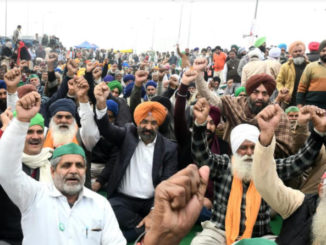
    A section of protesting farmers.

    Can the country afford this? Well, it depends on what you think this country is and what is the worth of annadata. This is a question of political will. This is the question crores of farmers are asking today.

    (Kiran Kumar Vissa is an Agriculture activist, andYogendra Yadav is president, Swaraj India)

  • Supreme Court order has confirmed farmers’ fears

    Supreme Court order has confirmed farmers’ fears

    ON GUARD: The farmers have been suspicious of being pushed into mediation that they never asked for or consented to.

    By Yogendra Yadav

    A committee is only as good as its members. It is no secret that the farmers’ organisations were apprehensive about the composition of a committee appointed by the court. The process by which the court arrived at these four names left a lot to be desired, to put it mildly. The same court that chided the government for passing the farm laws without consulting the farmers adopted an even less transparent process to decide upon this committee.

    In rejecting the Supreme Court-appointed expert committee to mediate between farmers and the Narendra Modi government, the farmers’ organisations have not only wisely sidestepped a possible trap, but have also reaffirmed a basic principle of democratic accountability and responsible governance.

    Let there be no confusion about it. The expert committee appointed by the SC is not meant to advise the court on technical matters of agricultural marketing or on the implications of the disputed agricultural laws. The order of the Supreme Court makes it clear that the committee is to facilitate negotiations between the government and farmers’ organizations: “The negotiations between the farmers’ bodies and the government have not yielded any result so far. Therefore, we are of the view that the constitution of a committee of experts in the field of agriculture to negotiate between the farmers’ bodies and the government of India may create a congenial atmosphere and improve the trust and confidence of the farmers.”

    The court goes on to specify that the committee has been “constituted for the purpose of listening to the grievances of the farmers relating to the farm laws and the views of the government and to make recommendations.” Presumably, the committee will try to find a middle ground and advise the government on how the laws should be tweaked in a way so as to satisfy both the government and the protesting farmers. That is precisely why the farmers’ organizations had resisted, right from the beginning, the idea of any such committee. They have objected to being forced into binding mediation, questioned the instrument of a committee and suspected the composition of such a committee. On all three counts, their assessment has been proven right.

    First of all, the farmers have been suspicious of being pushed into mediation that they never asked for or consented to. They have never said no to negotiations with the government. Sure, the talks with the government have been frustrating. The Modi government has been intransigent. Yet, that is the only site for negotiations in a democracy. In the last instance, elected representatives are there to speak to the people. They are accountable to the people and to the farmers. The courts are there to adjudicate between right and wrong, legal and illegal. The courts are not there to engage in give and take, which is part of any negotiation. That is why the courts are responsible to the Constitution and not accountable to the people. That is the logic of democratic governance. Any attempt to shift the site of negotiation from the government to the judiciary amounts to overturning this basic democratic logic. The government’s keenness to shift this ‘headache’ and the Supreme Court’s alacrity to take over have strengthened the resistance of the farmers. It needs to be underlined that the protesting farmers did not approach the court. Nor did the government, at least not on paper. The initial petitioners were third parties who wanted the court to evict the farmers from their protest site. The other set of petitioners questioned the constitutionality of the three laws and wanted these scrapped. None of the petitioners prayed for mediation from the court. Yet, from day one, that is what the court was interested in. The court dismissed, and rightly so, the pleas asking for eviction of the protesting farmers. It recognized, again rightly so, the democratic rights of the farmers to engage in a peaceful protest. As for the pleas, regarding the constitutional validity of the three laws, the court put this on the back burner, saying that it will consider these at an appropriate time.

    The Supreme Court could have expedited this process by setting a time frame within which it will decide upon the constitutional validity of these three laws. That would have been most appropriate. But it chose not to do so. Instead, the court chose to focus on a third issue beyond what was asked for by any party and beyond its legal remit. Farmers’ organizations were smart enough to resist this move from the beginning.

    The second objection of the farmers’ organizations was to the very mechanism of a technical committee of experts. This idea was proposed by the Modi government in the very first round of negotiations held on December 1, and the farmers rejected it there and then. Such a committee would be very useful to clarify a point of law or to work out policy or fiscal implications of the proposed laws. Such a committee could also help work out the details of a compromise formula, once the basic framework is agreed to. But a technical committee cannot possibly work out the basic framework itself. Mediation is not done by technocrats. It is done by non-specialists who have some familiarity with the subject, but more importantly, who enjoy the trust and confidence of both parties. The Supreme Court-appointed committee of experts was never going to be that mechanism.

    Dushyant Dave and the other three lawyers representing just eight out of 400-plus farmers’ organizations involved in this protest were wise to keep away from the court’s deliberations on this issue.

    Finally, a committee is only as good as its members. It is no secret that the farmers’ organizations were apprehensive about the composition of a committee appointed by the court. The court’s order confirmed their worst fears. The process by which the court arrived at these four names left a lot to be desired, to put it mildly. The same court that chided the government for passing the farm laws without consulting the farmers adopted an even less transparent process to decide upon this committee. Names like P Sainath and ex-CJIs were thrown around and quietly dispensed with. No one knows who suggested the four names that the court came up with. Little surprise then that the four names have invited disappointment and ridicule. Not because the four members are not respectable, but because these are arguably the four best advocates for the government’s position and the laws. That the court chose such a partisan committee to mediate between the farmers and the government has cast a shadow on itself.

    Someone might ask: Forget the technicalities, but what’s wrong in the top court stepping in to resolve a deadlock? Well, that is possible, provided the Supreme Court were to enjoy moral authority over and above its legal and constitutional powers. Such moral authority is commanded, not demanded.

    (The author is President, Swaraj India)