Month: May 2013

  • Transition in Afghanistan: A War of Perceptions

    Transition in Afghanistan: A War of Perceptions

    CONTD FROM PREVIOUS ISSUEAbstract
    A decade after the military intervention that dislodged the Taliban-Al Qaeda combine, peace and stability continues to elude Afghanistan. There is still no consensus in Western capitals on what constitutes the ‘end-state’ in Afghanistan. The Western public’s frustration with a long-drawn war has coalesced with the global economic slowdown, the Euro crisis and the pressures of electoral campaign politics in the United States – thereby complicating the efforts for the long-term stabilization of Afghanistan. Premature announcements of exit and dwindling financial assistance have added to the Afghan anxieties of being ‘abandoned’ once again. This paper brings to light the divergent perceptions among the key stakeholders in Afghanistan and in the international community (IC) on the trajectory of the ‘inteqal’ (transition) process. The paper argues that the war in Afghanistan is essentially a war of perceptions on progress made thus far. This widening gap in perceptions is bound to complicate the transition and long term stabilization process.

    The negotiations with the Taliban constitute one such source of anxiety. As Americans claim that they have established contacts with the insurgents for peace talks in Qatar, various segments of the insurgency and power brokers are aiming to outbid each other in order to secure a larger portion of the pie. Not surprisingly, most of the violence has taken place in areas dominated by the Hizbe- Islami. Its leader Gulbuddin Hekmatyar, is eyeing a major share of the peace deal. Aid, Economic Development and Regional Cooperation Most of the discourse on transition has focused on the numerical strength of the troops that would be adequate to maintain the country’s security.

    Civilian capacity building, economic opportunities, trade, transit and investment that would change the narrative of Afghanistan from being an aid-dependent ‘rentier state’ to a selfsustaining economy, thereby bringing in long-term stability, have received comparatively less attention. The intrinsic nature of aid-giving and execution of development projects through contracts and sub-contracting, has done little to build on state capacities or local ownership.

    Afghanistan’s problem essentially lies in the lack of ‘unity of effort’ (UoE) on the part of the international community in developing a well-coordinated and longterm strategy to build and strengthen the institutions and ‘bring the state back’ into the development process. In rebuilding conflict-ridden states like Afghanistan, aiddelivery through ‘alternate delivery mechanisms’ like the IOs and INGOs or direct delivery through embassies, and community-based groups plays a crucial role in providing immediate humanitarian relief and assistance but in the long term have not been helpful in building state institutions of delivery and implementation. At a time of dwindling international financial assistance to Afghanistan, concerns abound on sustaining its economy and revenue beyond 2014.

    Contrary to the Afghan government’s November 2011 estimate, it requires US$120 billion (at the rate of US$10 billion per year) in aid in the post-2014 period, through 2025. At the Tokyo summit in July 2012, international community promised to give US$16 billion through 2015 to build its economy and make necessary reforms. Such dwindling financial aid is construed as a natural corollary of the declining interest of the West in Afghanistan. Development aid from US, the largest aid donor, has dropped from US$3.5 billion in 2010 to about US$2 billion in 2011. Aid to support democracy, governance and civil society dropped by more than 50 per cent and from US$231 million to US$93 million in the same period. Amidst such a drop in aid-giving, exploring avenues for revenue generation, trade, foreign investment and development of indigenous economic base remains critical.

    Over the coming years, Afghanistan will have to compensate for such shrinkage of external support. The full impact of the shrinkage on Afghanistan’s economic growth, fiscal sustainability and service delivery will probably not be felt until after 2014. The huge international spending in Afghanistan over the past decade has dramatically raised domestic prices (particularly of skilled workers and residential/commercial properties) that the country is no longer export-competitive vis-a-vis other South Asian countries. At least in this respect, the gradual scaling down of foreign spending might help lower prices closer to ‘South Asian levels’, which may help Afghanistan in increasing its exports although ‘transit’ issues will still remain a challenge. The transition process also assumes that Afghanistan will remain an aid-dependent state, in need of assistance to its economy and development for at least another decade.

    While the second Bonn conference on ‘Afghanistan and the International Community: From Transition to the Transformation Decade’ held in December 2011 has set an extended period of international assistance: 2014-24 and has termed it the ‘transformational decade’, the contours of international assistance and engagement remain highly unclear.

    A series of international conferences seems to miss the crucial point that stabilizing Afghanistan by devising quick-fix solutions and setting arbitrary timelines that do not meet the needs on the ground. A successful transition is contingent on the continued, albeit slow, growth in the administrative capacity of government ministries, and on improvements in local governance, civil service, development and employment opportunities at the district level. Afghanistan’s tragedy lies in the fact that time and again its internal contradictions have got trapped in the external power agenda. With the intensification of the search for the ‘end-game’, a regional consensus by forging greater cooperation is seen as a way out of the imbroglio. One way of building a cooperative regional architecture is through greater trade and transit, investment opportunities, including energy pipelines.

    The Istanbul Conference for Afghanistan: Security and Cooperation in the Heart of Asia, held on 2 November 2011, provided a new agenda for regional cooperation, by placing Afghanistan at its centre and engaging the ‘Heart of Asia’ countries in sincere and result-oriented cooperation for a peaceful and stable Afghanistan, as well as a secure and prosperous region as a whole. The emphasis for the first time on a regionally owned process led by Afghanistan, with support and collaboration from its near and extended neighbors, would make this effort ‘sustainable and irreversible’ in the long term.[50] As the first follow-up ministerial meeting of the Istanbul Process, the ‘Heart of Asia’ Ministerial Conference, convened on 14 June 2012 in Kabul, re-affirmed the commitments enshrined in the 2002 Kabul Declaration of Good Neighborly Relations and in the document on principles stipulated in the Istanbul Process on Regional Security and Cooperation for a Secure and Stable Afghanistan.

    The narrative has thus been gradually shifting to regional confidence-building, development, governance, and most lately, trade, transit and investment, aiming to use the country’s resource- and transitpotential to build its economic viability, sustainability and self- reliance. To a large extent, the genesis of this thinking is based on the inadequacies of the securitydominated approach of the last decade. The discovery of huge reserves of minerals and natural gas has raised hopes of possibility of revenue generation, foreign investment and employment opportunities. To what extent these strategies can overcome the need to bring in security remains to be seen.

    The Afghanistan International Investment Conference of 30 November 2010 held in Dubai and the Brussels Euro Mines Conference of 26 October 2011, aimed at promoting economic investment in Afghanistan, made valuable recommendations, but they essentially put the onus for investment on actions to be initiated by Afghanistan. The 28 June 2012 Delhi Summit, taking into consideration the realities and needs on the ground, explored near-term and long-term possibilities in the current environment and at the same time, sought a mechanism to address the needs of foreign and private sector investors and the government of Afghanistan. This is reflective in the efforts geared to catalyze investment decisions and forge cross-country and international partnerships to promote cooperation and greater collective confidence.

    A collective view of security for foreign investors would emerge from the reality of venturing together, rather than individual investors risking an uncertain environment all by themselves. The long term economic benefits, revenue and employment opportunities arising out of investment, trade and transit would help build ‘constituencies of peace’. The Turkmenistan-Afghanistan-Pakistan- India (TAPI) pipeline is another regional collaborative venture that has enormous potential of bringing in economic dividends through mutually beneficial regional cooperation.

    By forging a greater stake and regional commitment to rebuilding Afghanistan through alternate economic opportunities, , foreign investment and local development strategies, capitalizing on Afghanistan’s location, energy and mineral resources in a mutually interdependent regional framework, could pave the way out of the stability-instability paradox. Not all is lost in Afghanistan.

    As Afghanistan traverses a difficult course of transition, there is an immediate need to bridge the perception gap between the Afghans and the international community to build on the gains and address the immediate areas of concern. In the decadelong international involvement, an unified vision and effort of putting Afghans in the lead for rebuilding their state and society remains the missing link in the stabilization efforts. It is critical to rectify this trajectory and set realistic timetables on drawdown based on conditions on the ground. The gains made thus far are substantial but remain fragile.

    Unless critical efforts are made to shore up the state’s institutions and capacities before the drawdown date of 2014 and unless longterm international commitment, a unified strategic communications strategy and regional cooperation is guaranteed, stability in Afghanistan would remain a distant dream.

  • Pakistan votes for Change

    Pakistan votes for Change

    People of Pakistan have spoken out loud and clear. They have voted for change. Whether it is for Nawaz Sharif’s The Pakistan Muslim League (N) or Imran Khan’s Pakistan-Tehreek-e-Insaf, the electorate’s intentions are clearly known. They want change.

    For the first time in the history of Islamic Republic of Pakistan, a civilian government has completed a full five year term. And, more appreciably, it is the first time again, that transition of power from one civilian government to another is taking place peacefully in Pakistan. Another appreciable aspect of the recent elections in Pakistan is the people’s resolute disapproval and disregard for violence perpetrated by the Taliban to disrupt the elections.

    Despite a number of violent incidents, the people of Pakistan bravely came out in large numbers to vote and be counted. People of Pakistan have conveyed in unequivocal terms their preference for a democratic change. They have thrown out the Pakistan Peoples Party whose government failed to govern the nation. People now expect the new government of Nawaz Sharif to deal with the nation’s problems effectively and govern the nation well. Nawaz Sharif will not find it easy to grapple with an enormity of problems facing Pakistan. He has to provide stability to a country reeling under multiple challenges.

    First and foremost is putting a check on violence perpetrated by fundamentalists. Pakistan has to have peace before it can tackle the problems of economy at home and having better relations with the world, more importantly, with India. Nawaz Sharif is aware of the challenges facing him. In fact, he referred to the problems of unemployment and poverty in his first victory speech.

    He knows he has to turn around the economy. He will need a lot of investment in the country that lacks the very basic infrastructure. There are patriotic people of Pakistani origin abroad who would love to invest in Pakistan but for that Sharif will have to create conditions in the country that will attract investors. Again, peace is the first requisite. Sharif will do well to build confidence of non-resident Pakistanis before any investment could flow in. The youth are restless. They want education and employment.

    A resurging economy can provide jobs and the youth can provide productivity and the combination can work wonders for Pakistan Nawaz Sharif will have to go an extra mile to have cordial working relationship with Military in Pakistan.With gun in hand, Pakistan military is in a position to dictate terms, as it has done in the past.

    Ten years have gone by since Sharif’s last confrontation with General Parvez Musharaf and he certainly would have worked out some plans to have the Military on his side which, however, does not mean bending backwards all the way. India will be keenly watching Nawaz Sharif’s steps and will expect India- Pakistan relations to improve in times to come. India of course will wish him all success in his third stint as Prime Minister of Pakistan.

  • Democracy wins, federation loses

    Democracy wins, federation loses

    While Nawaz Sharif has won the election decisively, he faces the challenge of reaching out beyond his main base in Punjab to the rest of Pakistan
    Pakistan achieved a historic landmark with the completion of its five-year term by the civilian coalition government led by the Pakistan Peoples Party (PPP) and the successful completion of elections resulting in the clear victory for Nawaz Sharif’s Pakistan Muslim League (PML-N). The election results, surprising for many, point to the challenges ahead for the country. Although the PML won enough seats to be able to form the government without having to bargain too much with too many factions, its success comes entirely through the support of one ethnic group – the Punjabis. Every Pakistani province appears to have chosen a different party to represent it. The overall high turnout nationwide masks the harsh reality that very few people voted in Balochistan, where alienation from the centre has been growing.

    Ethnicity
    There is no doubt that people voted out the incumbents amid questions about their performance. But the virtual wiping out of the PPP in Punjab means that each Pakistani political party now reflects the dominant sentiment of a particular ethnic group. The PPP was the only party that had representation from all four provinces of Pakistan in the outgoing Parliament. The election result may be a step forward for Pakistani democracy. It is a step backward for the Pakistani federation. Given the history of complaints about Punjabi domination, Nawaz Sharif will have to reach out to the leaders of other provinces. Authoritarian rule has undermined national unity in the past because of Punjab’s overwhelming supremacy in the armed forces, judiciary and civil services.

    Democracy should not breed similar resentment among smaller ethnic groups through virtual exclusion from power at the centre. In addition to bringing the provinces other than Punjab on board, Sharif’s other major headache would be to evolve a functioning relationship with Pakistan’s military establishment. Although he rose to prominence as General Zia-ul Haq’s protégé, Sharif clashed with General Pervez Musharraf over civilian control of the military. He might be tempted to settle that issue once and for all, partly because of the sentiment generated by his overthrow and imprisonment by Musharraf. Changing the civil-military balance in favor of the civilians would be a good thing. But if it is done without forethought and caution, it could end up risking the democratic gains of the last several years. The PML-N’s view of Pakistani national identity being rooted in Islam and the two-nation theory does not differ much from that of the Pakistani establishment. His real difference with the establishment is over his belief that he, as the elected leader, and not the military must run the country.

    Foreign policy
    Sharif has publicly stated his intention to pick up the threads of the peace process he initiated with Atal Behari Vajpayee in 1999. That process was undermined by the Kargil war, which Sharif now says was initiated by Musharraf without his authority. There can be no assurance that the establishment will let Sharif move forward over changing Pakistan’s posture towards Afghanistan and India, something it did not allow the PPP-led coalition to pursue. Moreover, having been elected with the support of hardline conservative Punjabis, how far can Sharif go against the wishes of his base? During the election campaign, Sharif said little about Afghanistan. In his previous two terms he maintained close ties with the United States but did nothing against the jihadi groups.

    It was under Sharif’s rule that Pakistan officially recognized the Taliban regime and established diplomatic relations. This time, he has spoken of good relations with the West but his voters are overwhelmingly anti-American. The best he might be able to do on foreign policy would be to say the right things publicly without making tough policy decisions. The Punjab electorate, in particular, and some parts of Khyber-Pukhtunkhwa were clearly swayed by a hypernationalist tide, with tinges of Islamist grandiloquence.

    Sharif’s PML-N and Imran Khan’s PTI used similar hypernationalist, anti-American language about Pakistan no longer asking the West for aid. Both parties courted Islamist extremists to bolster their respective vote banks. It might be difficult for them to get off that tiger any time soon. The National Assembly seat break-up is skewed in favor of one province, the largest province of Punjab. Punjab sends 148 general and 35 women’s seats or a total of 183 out of 342 seats which is more than half the seats in the lower house of Parliament.With deep ethnic, linguistic and economic diversity among the provinces, with trust between the provinces being at an all-time low and with the challenge of terrorism facing the country, there is a need for Mr. Sharif to show statesmanship and to appeal beyond his urban Punjabi base.

    Other players
    Sharif is not the only one facing challenges. The PPP has suffered a national setback but has held onto its base in Sindh. It is now time for the party to look inwards and understand that the country has changed. It is growing more urban and Sindh is also doing so. The party is down but not out. It will have to reinvigorate itself by asserting its liberal, social democratic roots. Like the Congress in India, it can continue to seek unity in leadership from the family of Zulfikar Ali Bhutto and Benazir Bhutto. But it has to be a party that is not dismissed as a family enterprise. As for Imran Khan, he achieved a breakthrough by mobilizing disenchanted, apolitical youth. But if he seeks to remain relevant he must realize that there is more to politics than slogans and catch-all phrases. Railing against corrupt and patronage-based politicians is one thing, offering a viable democratic alternative is quite another.

  • Dharmendra, Sunny, Bobby visit NYC to Promote Yamla Pagla Deewana 2

    Dharmendra, Sunny, Bobby visit NYC to Promote Yamla Pagla Deewana 2

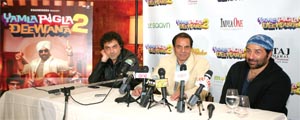
    NEW YORK (TIP): The Deols, Dharmendra, Sunny and Bobby were in New York on May 16 in connection with the promotion of their upcoming film YAMLA PAGLA DEEWANA 2, which releases worldwide on June 7. The Deols addressed a well-attended press conference at Junoon in New York May 16. “We’re very excited to have 3 legends of Bollywood in New York today,” said Paramdeep Singh, co-founder of Saavn, one of the event hosts. “The presence of the Deol family shows the emerging importance of the U.S. in Bollywood’s global equation, and we’re proud that Saavn has been chosen as the premiere music streaming partner for Yamla Pagla Deewana 2.” ‘YAMLA PAGLA DEEWANA 2’ once again brings together the three Deols – Dharmendra, Sunny Deol & Bobby Deol and two lead actresses in a film genre comprising comedy, action and romance. The twisted trios are back with a bang, except they are funnier, crazier and make tigers look like whimpering cats. The film opens in Scotland, travels to Banaras and eventually makes its way to UK.

    The story revolves around Paramveer Singh Dhillon (Sunny Deol), a dashing, honest and righteous loan recovery agent with a unique working style. He initially greets defaulters with flowers, if otherwise needed, the “dhai kilo ka haath.” In another universe called Banaras, much to Paramveer’s oblivion his folks Dharam (Dharmendra) and Gajodhar (Bobby Deol) have failed to mend their ways and continue deceiving people. This time though they have a greater con up their sleeves.

    Their latest fish is, Yograj Khanna, a rich Night Club owner from England. Shrewdly Dharam intends to hook up Gajodhar with Yograj’s strikingly beautiful daughter, Suman, posing as a billionaire himself. Dharam and Gajodhar land in UK and to their surprise find that Paramveer is Yograj’s new night club manager. Thus unfold series of hard core conning by the father-son duo with Paramveer hell-bent on ruining every last one of it, the entry of Reet, an attractive woman who runs an art gallery also Paramveer’s love interest, and a mysterious character named ‘Q’ which adds to the comedy of errors, comprising of mistaken identities, weddings, kidnappings and Mafia wars. Answering a question , Dharmendra said “the movie is an entertainment movie and is meant to make the viewers laugh to their heart’s content.” The Film releases 7th June 2013 worldwide.

  • India’s Motivational Speaker Jaya Row honored

    India’s Motivational Speaker Jaya Row honored

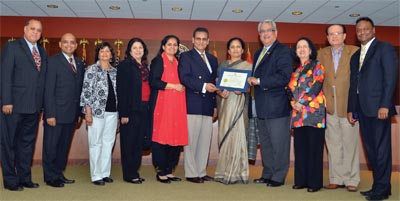
    LONG ISLAND, NY (TIP): People in large numbers thronged the Nassau County Legislative Chamber in Mineola, May 1, to listen to Jaya Row, one of India’s most renowned and internationally acclaimed motivational speakers. She spoke on How to live life full of success, happiness and objectivity, based on India’s ancient Vedas and Upanishads.

    Row, who renounced a distinguished management career to devote herself full time to the interpretation of Vedanta for the modern generation, was profusely applauded for her study and research of the ancient scriptures of India. Special Citations were issued by Nassau County Executive Ed Mangano, Presiding Officer of the Nassau County Legislature, Norma Gonsalves and Senior Councilman of the Town of Hempstead, Tony Santino, to honor the legendary speaker. Mangano, who could not attend because of a prior engagement, deputed Deputy County Executive Phillip Elliott to represent Nassau County. Also recognized as part of the Nari Shakti theme of the event were Raji Kuncham, Nirmala Rametra, Urmilesh Arya, Nimmi Mehta, Anupam Goenka, and Sonia Bhatija, the women behind some of the most successful Indian Americans on Long Island.

    Varinder Bhalla paid tributes to the public officials for their support of the Indian community. “Over the past three and a half years, Ed Mangano has hosted and supported countless Indian cultural events in Nassau County”, said Bhalla. “Mangano has also appointed more Indian Americans to high level positions in his administration than any other County Executive in the entire state of New York.” “Councilman Santino, who helped AWB Food Bank to organize the first Dussehra festival in the United States, later joined hands with Supervisor Kate Murray to start the annual celebration of the Republic Day of India in the Town Hall.” Bhalla also commended the support of Legislator Gonsalves and Deputy County Executive Elliott. The event was organized by Ratna Bhalla and Varinder Bhalla, founders of the AWB Food Bank, and Rakesh Bhargava. Established in 1991, AWB Food Bank has distributed over ten million meals to hungry people in India

  • Two Young Plucky Ladies keep CORD USA Flag flying high

    Two Young Plucky Ladies keep CORD USA Flag flying high

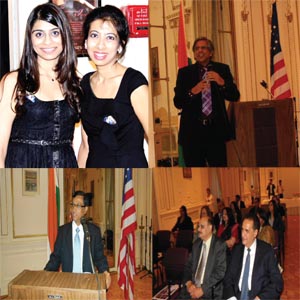
    NEW YORK, NY (TIP): Chinmaya Organization for Rural Development (CORD USA) is a secular not for profit organization that focuses on grass-roots development and uplifts the villages via programs in improving literacy, income generation, health and sanitation and women’s empowerment by reaching out to the poorest of the poor in India. The leader of CORD, Dr. Kshama Metre, a pediatrician by profession left her flourishing practice in Delhi to serve in the rural villages. She was awarded the Padma Shri – one of India’s highest civilian awards. CORD New York is a chapter under CORD USA and was started by two young individuals Chandni Trivedi and Gayathri Narayan after being inspired by Dr.Kshma Metre’s work. Both are the co-chair of the New York region and head the enthusiastic young team in NY. Gayathri is a Certified Accountant from India and MBA from Columbia Business School.

    Chandni is an Engineer (Gold Medalist) and an MBA from India. She will also be pursuing her Master’s in the field of nonprofit administration from Columbia University. Both are highly dedicated and passionate towards the cause of CORD. Their combined vision is to not only raise awareness and support for CORD but help the local community in NYC through various monthly community events. CORD hosts various events through out the year. Recently CORD hosted an event for the celebrity bestselling author Mukul Deva at the Indian Consulate NY. The event was a workshop based on Leadership. The Consul General of India in New York Dnyaneshwar Mulay presided. He praised CORD for the community service projects being undertaken by the organization and said the Consulate will be happy to “collaborate” with organizations doing community service .

    CORD had earlier last month held their Fundraiser “Salsa meets Bhangra” – a fun event for young professionals in NY.

    To know more about CORD NY please visit the website: www.cordneyork.org

  • Indian-American poised to join U.S. Appeals Court

    Indian-American poised to join U.S. Appeals Court

    WASHINGTON (TIP): Chandigarh-born Indian- American legal luminary Srikanth ‘Sri’ Srinivasan has moved a step closer to making history as the first South Asian judge on the U.S. Court of Appeals for the American capital. Mr. Srinivasan (46) who in August last year was named Principal Deputy Solicitor- General – succeeding another Indian-American, Neal Kumar Katyal – won unanimous approval from the Senate Judiciary Committee on Thursday, May 16 . If confirmed by the full Senate, which appears all but certain with all the Republicans on the Democratcontrolled panel joining in the 18-0 vote, Mr. Srinivasan would also become the first new judge on the powerful Appeals Court, often called the nation’s second-highest court, since 2006.

    Some court-watchers are already touting him as the next likely Supreme Court nominee as the Appeals Court has served as a stepping-stone for four justices on the top court. The White House, which has fought hard for his confirmation, soliciting letters of support from former Solicitors-General and Supreme Court law clerks from both parties, applauded the vote for Mr. Srinivasan. Srinivasan was born in Chandigarh and grew up in Lawrence, Kansas. He received his BA with honors and distinction in 1989 from Stanford University and his JD with distinction in 1995 from Stanford Law School, where he was elected to Order of the Coif and served as an editor of the Stanford Law Review.

  • Indian American Vivek Ranadive buys US basketball team

    Indian American Vivek Ranadive buys US basketball team

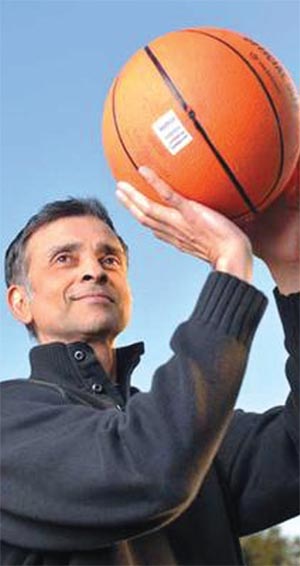
    WASHINGTON (TIP): Indian American software magnate Vivek Ranadive, who has become the first person of Indian descent to become the owner of a major US basketball team, plans to build the Sacramento Kings into a global brand. “It’s going to be exciting,” he told the USA Today after securing an agreement to buy 65 percent of the Kings from the Maloof family for a National Basketball Association (NBA) league-record valuation of $535 million. “We’re going to build a global brand with the Kings. We’re going to give the fans the product that they deserve,” the minority owner of Golden State Warriors said on achieving his longtime goal.

    The development came just a day after NBA owners officially rejected a bid by the Maloofs, who have owned the team since 1998, to relocate the Kings from Sacramento, California, to Seattle, Washington. “It’s a little bittersweet, obviously because I’m a huge Warriors fan and I have a lot of friends here,” Ranadive told USA Today Sports. “I’m very, very excited to start the new (challenge).” Ranadive, who left India as a 17-year-old to attend MIT and later founded his $4 billion company in Silicon Valley, Tibco, has the sort of competitiveness and deep pockets that could lead one of the league’s most poorly run franchises back to respectability, the USA Today said.NBA Commissioner David Stern has made a concerted effort of late to grow the game in Ranadive’s native India, where “basketball is but a blip on their sporting radar,” the newspaper said. “I’m going to do what I do in my business, which is surround myself with people that are way smarter than me,” Ranadive said.

    “But I am a huge fan. I’m going to be there at all the games, be there to support the team in every way.” “It’s one step at a time,” Ranadive said. “I’m one of these guys who doesn’t like to get ahead of the game. “We still have a lot of work to do. I’ve learned a lot, but there’s a lot more to learn. And it’s going to be a process. It’s not going to be an overnight miracle there, so it’s going to take some work,” he was quoted as saying.

  • Karnataka will regain pre-eminent position as IT superpower: Moily

    Karnataka will regain pre-eminent position as IT superpower: Moily

    NEW YORK (TIP): Union Petroleum Minister Veerappa Moily assured the Non- Resident Indians that the Congress government headed by Chief Minister K Siddaramiah in Karnataka will put the state back again on the global map in Information and bio technology. It will become IT superpower again and make India proud. Moily was addressing Indian-Americans over live audio conference by telephone from New Delhi at a victory celebration organized by Dr. Dayanand Naik, Karnataka chapter President of Indian National Overseas Congress (INOC) here on May 13 night.

    Moily told NRIs that the previous Bharatiya Janata Party government had done irreparable damage to the image of Karnataka abroad which was the most favored investment destination when the Congress Party ruled the State. “We will respond to the aspirations of Kannadigas not only in India but all over the world by providing a stable, corrupt-free, transparent and accountable government.” Terming the recently-held election as “liberation movement,” the Union Minister thanked Dr. Naik and his team from the Indian National Overseas Congress for their support and campaign using social media and mass email to their friends and relatives back home to bring back Congress to power. Moily said due to anarchy and misrule, Karnataka reached its lowest ebb in education and knowledge sectors. “They have destroyed the education system by sanctioning universities and educational institutions that had neither infrastructure nor any faculty. “The State built by statesmen like by Sir M. Vishweswarayya was in shambles and the people have made a good choice to retrieve Karnataka from the clutches of corrupt BJP,” he said.

    The election results in Karnataka indicate the shape of things to come and Congress will form the government for the third consecutive term in the center, he said. George Abraham, president of Indian National Overseas Congress (INOC) in his presidential address, said the people of Karnataka had spoken loud and clear disproving all negativities and fake poll predictions of a hung assembly.

    He appealed to the Congress High Command to reserve seats for Non-Resident Indian members of the INOC who are Indian citizens to contest Parliament and State Assembly elections. “There are some NRIs among MPs now and we need more to raise the issue of overseas Indians in Parliament,” he said. He mentioned Juned Qazi, President of Madhya Pradesh Chapter who is aspiring for a ticket to contest Aligarh Lok Sabha seat and said INOC (I) fully endorsed him.

    Shudh Parkash Singh, INOC Senior Vice President said Karnataka has proved that stable government is a must for development. Dr. Naik, a leading physician and former president of American Association of Physicians of Indian Origin (AAPI) said over 100 volunteers from the US will go to India to campaign for Congress candidates in the Lok Sabha and Assembly elections. He said plans are afoot to rope in and seek the advice of Indian-Americans who campaigned for President Obama on how to use social media and online campaigns to ensure victory of Congress Party.

  • CRY America celebrates a decade of ensuring happy childhood for 422,878 underprivileged children

    CRY America celebrates a decade of ensuring happy childhood for 422,878 underprivileged children

    Credits its 18,944 donors, 2,000 volunteers and 64 project partners for this success
    NEW YORK, NY (TIP): CRY – Child Rights and You America Inc, a 501c3 non-profit organization that works to restore the rights of underprivileged children, especially in India, celebrated 10 years of ensuring happy childhoods by hosting two benefit dinners in New York and Seattle.

    ‘Uphaar 2013’ was held on May 4th, at Seattle’s Westin, Bellevue and ‘Pledge 2013’ was held on May 10th, at New York’s Taj, The Pierre. Speaking at Pledge 2013, Shefali Sunderlal, President of CRY America said, “As we reminisced about our childhoods at the events, we also thought of the 422, 878 children living across 2,395 villages and slums in India, whose lives have been irreversible transformed through our collective efforts.

    We thank our 18,944 generous donors, 2,000 committed volunteers and 64 dedicated project partners and the media, without whom this change would not have been possible.” Pledge 2013 was attended by over 100 guests from New York and New Jersey, while Uphaar 2013 was attended by 275 guests from the western Washington community, who came together to partner CRY America’s work to benefit underprivileged children. $220,000 was raised across both dinner events, valuable resources that will be directed towards funding several Projects which will ensure lasting change for children.

    The events were attended by prominent personalities, Professor Padma Desai from Columbia University, Ruchir Sharma from Morgan Stanley, Natvar and Janet Bhavsar, Scarlett Pildes, Suneeta Dewan, Anu and Naveen Jain, Gurdeep and Seema Pal,Swati and Raj Angolkar, Sangeeta and Jigar Thakkar, Murali and Mithali Narayanan. Event sponsors include Inome, Apple Core Hotels, State Bank of India New York,Mayuri Restaurants and Star TV.Paintings donated by famous Indian artists Ram Kumar, Seema Kohli, Kiyomi Talaulicar, Prakash Deshmukh, Anand Panchal; autographed guitars by Rolling Stones; autographed Record Albums by the Beatles and Pink Floyd; along with other autographed memorabilia were auctioned by Sotheby’s Priyanka Mathew at the New York dinner.

    In over 10 years, CRY America’s work with 64 Projects has resulted in 156,848 children being immunized, 76,821 children provided with regular health checkups, 364 public health care centers activated, 1,111 public schools activated and 501 villages in India are free from child labor today. Professor Padma Desai, Director of the Center for Transition Economies at Columbia University reminisced that she loves seeing the sight of little girls going to school during her trips to India. She strongly felt that girls and women must be enabled to go beyond their roles as daughter, mother, sister and wife to become independent individuals and realize their potential and dreams.

    She further stressed that education plays a key role in this process. Ruchir Sharma, Head of Emerging Market Equities and Global Macro at Morgan Stanley Investment Management and the author of the bestselling Breakout Nations said, “We should encourage children to build on their interests and talents from an early age, which at times is stifled by teachers and parents who push careers on them that appear popular and hot at that moment. My passion for writing started at the age of 16 and remains a significant part of my career today”.

    “It’s important that we leave a better world for our children, but it’s even more important that we leave better children for the world,” said Anu Jain, Vice President, Community Relations, Inome. Since its inception a decade ago, CRY America has provided a platform for people to take responsibility for the situation of underprivileged children. Sunderlal concluded, “If we all come together and address children’s issues with a sense of urgency, then no child will remain illiterate, malnourished or exploited.” She appealed for people to join CRY America as donors, volunteers and supporters and visit www.america.cry.org for more information.

    About CRY America:
    CRY – Child Rights and You America Inc. (CRY America) is a 501c3 non-profit organization that is driven by its vision of a just world in which all children have equal opportunities to develop to their full potential and realize their dreams. With the support of over 18,944 donors and 2000 volunteers, CRY America has impacted the lives of over 422,878 children living across 2,395 urban, rural and tribal communities in India and the USA through support to 64 Projects. For more information: visit http://america.cry.org or write to support@cryamerica.org To know more about CRY’s work, contact Steshia Monserrate at steshia.monserrate@crymail.org or 617-959-1273.

  • Renowned Indian American health expert Mukesh Hariawala to address India Leadership Conclave 2013

    Renowned Indian American health expert Mukesh Hariawala to address India Leadership Conclave 2013

    WASHINGTON (TIP): Renowned Indian American health expert Mukesh Hariawala will address the fourth edition of the India Leadership Conclave 2013 in Mumbai in June, 2013. Harvard trained and internationally acclaimed Indian American healthcare economist and cardiac surgeon Dr Mukesh Hariawala will deliver the keynote address with the theme ” President Barack Obama 2nd Term – Business Implications on Indian Healthcare “.

    This highly anticipated lecture is expected to attract an elite audience and will dispel negative myths that surround the hotly debated “Obamacare” – President Barack Obama’s Affordable Care Act (ACA), its implementation milestones, changing ecosystems in the US, but importantly its positive impact on the Indian healthcare industry. Dr.Hariawala spoke of the 100-billion dollar medical tourism revenue opportunity, increased IT contracts, generic drug company revenues and overseas insurance company investments in Indian healthcare sector facilitated by soft FDI policies of incumbent Prime Minister Manmohan Singh. The cumulative effect would accelerate the GDP trajectory from a limping five percent close to the earlier projected eight percent rate.

    This undoubtedly will help multiple industry augmented employment and improvement in living standards for a good portion of the Indian population with an overall tangential impact on the national BPL. Expectantly, this will be refreshing news for the Planning Commission of India and a boost in its implementation of the ambitious 12th – 5 year plan. Dr.Hariawala further added that ” Obamacare ” will also necessitate revamping of all the computing systems handling U.S. healthcare which would open a wide door of business opportunity for Indian IT companies. Purely for financial reasons, this will in all likelihood compel the U.S. Government to continue large outsourcing of software contracts. The key economic driver of “Obamacare” is to reduce the debt ridden trillion dollar healthcare burden on the U.S. exchequer.

    Global experts have suggested that Dr Hariawala’s lecture will shed new light and open up a wider debate, considering his deep-rooted intellectual insight of Indo-American business cultures. Over 300 iconic leaders, including Reliance Industries owner Mukesh Ambani and Tata Group ex-chairman Ratan Tata, will take part in the event, which has been organized by the Network 7 Media Group and the Ministry of Corporate Affairs.

    Top politicians, bureaucrats, other business tycoons, social reformers, media barons, diplomats and global dignitaries will attend one of Asia’s largest events to be held in Mumbai on June 21 at the Majestic Hall in the Lalit Intercontinental Hotel. The theme will be “New India – Agenda for Change”. Dr.Hariawala is widely regarded as an influential policy thinker, and is expected to elaborate on his popular concepts of ” Universal Patient Care ” and ” Womb to Tomb ” economical insurance models for all Indians across the entire spectrum of socio – economic classes.

  • Immigration Deal moves forward

    Immigration Deal moves forward

    NEW YORK (TIP): According to a report published in New York Times, a bipartisan group in the House working on an overhaul of the nation’s immigration laws reached a deal in principle Thursday, May 16 evening, aides said. The group plans to introduce its bill in June. Details of the compromise were not released, but, much like a bill introduced in the Senate, the House legislation will include a path to legalization for the 11 million undocumented workers already in the country, as well as increased border security measures.

    The House version, though, is expected to be more conservative in its approach to granting illegal immigrants a path to citizenship, among a number of central issues. It will most likely include a 15-year path to citizenship, rather than the 13-year path offered in the Senate proposal, as well as requiring illegal immigrants to sign an admission that they had violated United States immigration laws, aides said. The House group had been meeting and working on a nearly parallel track with a similar bipartisan group in the Senate, which has already introduced legislation that is now before the Senate Judiciary Committee.

    But until Thursday, the House group had yet to reach an agreement, and earlier this week the Republican members had threatened to walk away and introduce legislation of their own if a compromise could not be reached. The two-hour meeting Thursday evening, a last-ditch effort to save the legislation, finally produced the agreement in principle. Speaker John A. Boehner had talked to the Republican members of the group last week and urged them to produce a bill. “I am concerned that the bipartisan group has been unable to wrap up their work,” he said at a news conference Thursday. “And I know that there are some very difficult issues that have come up. But I continue to believe that the House needs to deal with this and the House needs to work its will.” One final issue that was resolved Thursday night, aides said, was how immigrants, who are not initially eligible for federal benefits, would pay for their health insurance costs – something Democrats and Republicans agreed would be a requirement for legal status.

    Exactly how the compromise resolved this issue was unclear. “The politics of health care had gotten into the bipartisanship of immigration,” said an aide who spoke on condition of anonymity. Republicans had wanted an electronic employment verification system fully operational and mandatory within five years as a condition for unauthorized immigrants continuing to move toward legal status.

    If the verification system wasn’t up and running by the end of five years, the legalization program would end, throwing into question the status of many of the immigrants. Democrats in the group had argued that such a trigger could harm immigrants through no fault of their own. But they ultimately agreed to the Republican plan after gaining concessions that reassured them the five-year deadline would be achievable.

    The bipartisan group’s talks had also stalled over the question of a guest worker program, known as a W-Visa program, for low-skilled, year-round temporary workers. Democrats had expected to use the agreement reached by the nation’s leading business and labor organizations – the same deal that the Senate bill adopted. But Republicans in the group felt the Senate deal was too favorable to labor and tried to raise the number of available W-Visas for temporary workers, which is capped at 200,000 a year in the current Senate version. On Thursday night, the group agreed to disagree. They will leave room in their legislation for a guest worker program, but Democrats and Republicans will introduce their own, competing versions. However, some aides and lawmakers said they remained optimistic that they might reach a bipartisan solution, though they didn’t want to delay the entire agreement. Mr. Boehner and members of the House group were especially eager to produce legislation.

    But as the negotiations dragged on, some Senate Democrats and immigration advocates began to press the Democratic House members privately to slow down their efforts, arguing that introducing something more conservative than the Senate bill would simply drag the final legislation to the right. However, by early this week, the Senate Democrats and the pro-immigration groups had largely reconciled themselves to the fact that, unless talks totally deteriorated in the House, the bipartisan group would most likely introduce a proposal of its own before the Senate had completed its work. Some advocates even said they welcomed any progress on the House side as good news. “If the takeaway is that you’ve got a bipartisan process in the House of Representatives that legalizes 11 million people, that’s a huge momentum-giver,” said Angela Kelley, the vice president of immigration policy at the Center for American Progress. “It adds more than it takes away. That’s what people will remember.”

  • Mumbai Indians look to preserve dominance

    Mumbai Indians look to preserve dominance

    Sitting comfortably at the top of the table, Mumbai Indians have done enough to cement their place in the playoffs. In their last match of the league round against Kings XI Punjab, they would want to carry their winning momentum before meeting Chennai Super Kings in the first qualifier. As formidable as they appear, their opponents would have made note of how the Mumbai batsmen managed just 34 runs in the last five overs against Royals.

    Prior to that match, against Sunrisers Hyderabad, Mumbai’s batting was struggling until Kieron Pollard came in and thwarted Sunrisers with a blistering innings. Sachin Tendulkar, who missed the previous game, has been declared fit* but could still sit out the game. “The games are coming thick and fast and it has been just three days since he sprained his wrist,” Anil Kumble, the Mumbai Indians mentor, said. “Though he has recovered, he will probably give the match here a miss.” Local boy Rishi Dhawan might also find a place in the side.

    Sunrisers’ victory over Rajasthan Royals put Kings XI out of the reckoning for the playoffs spot. With their tournament drawing to a close, Kings XI would like to register one last win and beating a highprofile team like Mumbai would certainly please their fans. In the spotlight Adam Gilchrist’s announcement of his retirement from the IPL at the end of the season evoked a sense of déjà vu, just like his batting over the last couple of games. Having scratched around for form in the early part of the tournament, his innings have been crucial to the side’s wins in the last two games. Will Glenn Maxwell get an extended run? Or will he make way for Dwayne Smith? IPL 2013’s most expensive player didn’t last for too long in his first outing as an opener for Mumbai this season.

    He dominated the bowlers for as long as he was at the crease, but his wicket came after he had gotten off to a good start. For all the hype that surrounds his selection, the team will be expecting more runs from him. Stats and trivia Among Kings XI batsmen, Shaun Marsh has scored the most runs against Mumbai Indians, scoring 337 in 7 matches.

    Adam Gilchrist is the most successful wicket-keeper in the IPL with 66 dismissals in 79 matches.Kings XI’s lowest total in IPL – 87 – came against Mumbai in 2011.

    TEAMS MAT WON LOST TIED N/R PTS
    Mumbai Indians 15 11 4 0 0 22
    Chennai Super Kings 16 11 4 0 0 22
    Rajasthan Royals 15 10 6 0 0 20
    Sunrisers Hyderabad 15 9 6 0 0 18
    Royal Challengers Bangalore 15 8 7 0 0 16
    Kings XI Punjab 15 7 8 0 0 14
    Kolkata Knight Riders 15 6 9 0 0 12
    Delhi Daredevils 15 3 12 0 0 6
    Pune Warriors 15 3 12 0 0 6
  • Congress, SAD supporters die in clash

    Congress, SAD supporters die in clash

    AMRITSAR (TIP): A day after one person was killed at a poll rally in Bathinda district, two more — a SAD and a Congress supporter — were gunned down on May 17 at Chakk Mishri Khan village in Amritsar during a clash between two groups. Zila parishad and block samiti polls will be held in Punjab on May 19. Tension was brewing between two groups in the village over a consensus to elect the village sarpanch.

    Though police said the clash was a result of an old rivalry between two families and the immediate trigger was a dispute related to two kanals and 13 marlas of land, the prime accused in the case is Jagir Singh — SAD sarpanch of the village. The father of a member of the rival group, Manjit Singh, is likely to run for polls to the sarpanch’s post. Following the incident,along with Jagir Singh, two others — Mangat Singh and Major Singh — who allegedly accompanied him, were arrested.

    Eleven others were booked in the case. The deceased have been identified as Gurjinder Singh (45), a Congress supporter, and Balkar Singh (in his early 20s), a SAD supporter. “The accused used a .12 bore weapon to kill Gurjinder. He was shot in the chest and died on the spot. We have recovered the weapon,” Border Range IG Ishwar Chander said. Balkar, on the other hand, died of a bullet injury in his left ribs. Chander added that in 1966, Jagir, his brother and some others had murdered Gurjinder’s uncle Dalip Singh. “The immediate trigger was a land dispute. Jagir Singh, accompanied by a number of persons, had headed towards the house of Manjit Singh. When Gurjinder tried to intervene, he was shot dead…

    The murders had nothing to do with the block samiti and zila parishad polls. The block samiti candidate has already been elected unanimously,” he said. Denying Congress’ allegations that police were being selective in getting weapons deposited ahead of the upcoming polls, Chander said: “All three weapons belonging to Jagir Singh had already been deposited. We are investigating whether the weapon used was licensed.

    People from places like Amritsar also accompanied Jagir Singh when he went towards Manjit Singh’s house.” The Congress, meanwhile, alleged that Balkar was murdered by the Akalis themselves to get a cross-case registered. “Manjit Singh’s father Sawinder Singh was to contest the panchayat polls. This is one of the reasons why Jagir Singh and his men attacked them. They were armed and when Gurjinder Singh went to intervene, he was shot dead. None of the Congressmen had any weapon. After Gurjinder was shot dead, SAD leaders shot their own man Balkar Singh to get a cross-case registered,” said Congress supporter Nirvail Singh.

    Jagir’s supporter Narinder Singh, however, denied the allegations. “Manjit Singh’s group first opened fire in order to kill Jagir Singh, but the bullet hit Balkar Singh. Even the Congressmen could have later shot Gurjinder to get a cross-case registered.” The IG, meanwhile, said as of now, no cross case had been registered. “We are investigating how Balkar Singh was killed,” he said, adding that 15 police parties had been formed to arrest the remaining accused. Congress leader from the area, Sukhbinder Singh Sarkaria, described Gurjidner’s killing as a “cold blooded murder”. Asked about Balkar’s death, he said: “I have been told by Congressmen that Akalis themselves shot him dead. I will look into it after visiting the village.”

  • Sanjay Dutt surrenders, goes back to jail

    Sanjay Dutt surrenders, goes back to jail

    MUMBAI (TIP): Sanjay Dutt on May 16 went back to jail to serve 42 months sentence in the 1993 Bombay blasts case, several hours after he surrendered before a TADA court, abiding by the deadline set by the Supreme Court. The court allowed the actor access to medicines, homefood, fan and take his mattress and pillow during his stay in the jail. The 53-year-old actor was also allowed to take with him copies of Bhagwad Gita, Ramayan and Hanuman Chalisa besides his toiletries including toothpaste, shampoo, slippers, kurta, pyjama and mosquito repellants. However, TADA Judge G A Sanap rejected Dutt’s request for an electronic cigarette (Dutt is a chain smoker). Instead, the judge advised him to quit smoking.

    Capping another phase in the Bollywood actor’s chequered life, Dutt drove to the court in South Mumbai in the afternoon accompanied by his wife Manyata, sister and Congress MP Priya and brother-in-law Owen Roncon. He was sent to the Arthur Road Central Prison by court after completion of formalities, which took several hours.He may be shifted soon to the Yerwada jail in Pune. Filmmaker Mahesh Bhatt also came along with the Dutt family in their car but did not come up to the court. Besides Dutt, four other convicts – Essa Memon, Kersi Adjania, Yusuf Nulwala and Altaf Shaikh – also surrendered to serve their remaining jail term.

    Police kept a tight vigil outside Dutt’s residence at Pali Hill in upscale suburban Bandra, where fans in large numbers had gathered since morning, and also in the court premises in the wake of threats to his life. While Dutt had told the court earlier that he faced threats to his life from fundamental forces, Arthur Road jail in Central Mumbai had received an anonymous letter stating the popular actor would be harmed if he was lodged there. A large group of people, that also comprised media persons and photographers, surrounded the car in which the actor arrived, not allowing him to get down. Bhatt emerged from the vehicle and appealed to the media with folded hands to move away so that Dutt could go to the court.

    Finally, the way was cleared. A visibly shaken Dutt, sporting a red ‘tikka’ on his forehead, entered the court at 2.50 pm with his family members. He was wearing a white crisp ‘kurta’ and blue jeans. The actor bowed down before the judge who asked him to mention his name, to which he replied “Sanjay Sunil Dutt”. He was then asked about the sentence undergone by him (after his arrest in 1993) and he replied promptly “551 days in jail, Sir”. The judge then asked him to go to the dock in the back row of the Court and take his seat. Manyata, Priya and Roncon followed Dutt and sat with him on the same bench. Manyata held Dutt’s hand and both seemed to console each other. Dutt’s lawyer also urged the court to allow the visits of the family members on a regular basis. He also requested that the actor may not be given harsh jobs in the prison.

    Advocate Merchant later said the actor was planning to file a curative petition in the Supreme Court. Earlier, Dutt’s Bollywood friends visited him at his residence. These included actors Salman Khan, Abhishek Bachchan, Ajay Devgun; directors David Dhavan, Sanjay Gupta and Apporva Lakhia, Rajkumar Hirani and Milan Luthria and film makers Vashu Bhagnani, Bhushan Kumar and Rahul Agarwal. Dutt had earlier urged the special judge to allow him to surrender at Yerwada jail in Pune instead of the court here.

    However, he withdrew his plea abruptly yesterday. The Supreme Court, on March 21 this year, upheld Dutt’s conviction in the 1993 Mumbai serial blasts case. However, the apex court had reduced to five years the six-year jail term awarded by TADA court, and ruled out release on probation, saying the “nature” of his offence was “serious”. Dutt has already spent 18 months in jail, so he has another three and half years to serve.

    The actor was convicted by the TADA court for illegally possessing a 9 mm pistol and an AK-56 rifle, a part of the consignment of weapons and explosives brought to India for coordinated serial blasts that killed 257 people and injured over 700 in March 1993. The apex court had on May 14 refused to grant him more time to surrender. On May 10, the Supreme Court had also dismissed Dutt’s plea seeking review of its judgement. Tonight, at about 9.45 pm, Dutt stepped into Arthur Road Jail in Central Mumbai where he is likely to spend at least two days, before being possibly shifted to the Pune jail.

  • Sreesanth confesses to spot-fixing

    Sreesanth confesses to spot-fixing

    NEW DELHI (TIP): Rajasthan Royals pacer S Sreesanth on May 17 confessed to spot-fixing in the domestic T20 league. “Sreesanth has confessed to spot-fixing. He was teary eyed during interrogation,” a Delhi Police official said. Cricketer Ankit Chavan was the first to accept his role in spot-fixing during questioning by the Delhi Police which secured the five-day custody of the players and 11 bookies arrested from various locations on May 16. The third player, Ajit Chandila, is yet to accept the charges. Chandila is also learnt to have approached two more domestic T20 league players to be part of the spot fixing. At a club in Manesar, he had named two players who could be roped in for the betting deal. The bookies had asked him to bring them to a party where the deal could be discussed. And when the two cricketers refused to attend the party, he contacted Ankit Chavan who agreed to be part of the deal.

    The arrest of more players in the spot-fixing racket can’t be ruled out, joint commissioner of Mumbai Police Himanshu Roy told a news channel. He said the involvement of the Dawood Ibrahim network was possible and the investigations will be heading in that direction. Tamil Nadu police meanwhile arrested six more bookies during raids on Thursday night and Friday morning, taking the total number of arrested bookies to 17. Country’s premier cricketing body, the Board of Control for Cricket in India, suspended Gujarat pacer Amit Singh who, during his stint with Rajasthan Royals, had been allegedly used by the bookies to fix deals with cricketers. BCCI secretary Sanjay Jagdale said its working committee will discuss the arrest of the three cricketers at an emergency meeting on Sunday.

  • Sunrisers take lead in playoff race, Royals miss out on top two

    Sunrisers take lead in playoff race, Royals miss out on top two

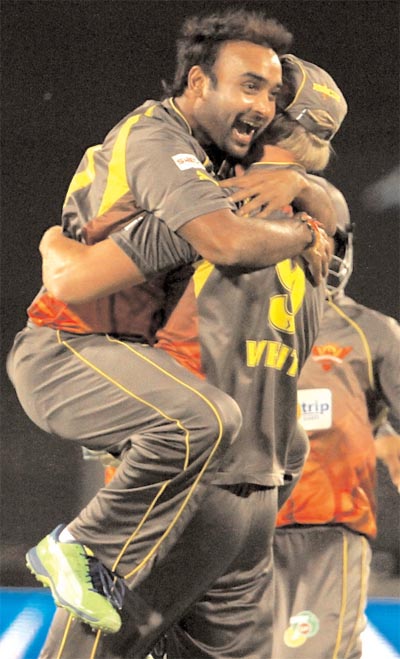
    Sunrisers Hyderabad gave themselves a lead over Royal Challengers Bangalore in the race for the final spot in the IPL playoffs, with a comprehensive win over the troubled Rajasthan Royals, their sixth win out of seven home games. Both Sunrisers and Royal Challengers have a game left, but Sunrisers play the easier opposition in Kolkata Knight Riders. Royal Challengers go up against Chennai Super Kings in their last match. Royals, who have qualified for the playoffs but have also been rocked by an alleged spotfixing scandal, began the game needing a big win to give themselves a chance of finishing in the top two. For a long time they looked like they could do so, thanks largely to James Faulkner’s second five-for of the season – both against Sunrisers – but they let Sunrisers back in followed by an indifferent batting display in the chase of 137.

    Royals will rue a seemingly innocuous moment in the sixth over. Sunrisers had gone against their winning formula of chasing at home and were in deep trouble when Biplab Samantray took two instinctive steps down the wicket and went back a little lazily. The ball had gone towards point, Ajinkya Rahane swooped in, and had actually run Samantray out. Except that nobody appealed. Had Rahane appealed, Sunrisers would have been reduced to 21 for 4. Instead Samantray – 8 off 12 then – went on to score his first IPL fifty, which took Sunrisers to a fighting total. With Darren Sammy, Samantray added 56 runs in 5.5 overs. Sammy scored 23 off 19. Sunrisers didn’t even manage a big push towards the end, because Faulkner came back to undo the rebuilding work, but Sunrisers’ bowlers have defended worse than 136. Their two big bowlers – Dale Steyn and Amit Mishra – set the tone of the defence. Steyn bowled fast, accurate and with swing, and conceded just four runs in his first two overs.

    Royals had surprisingly still opened with Rahul Dravid and Ajinkya Rahane because they needed a huge-win-or-nothing approach: they couldn’t have missed out on the playoffs but needed a win and a big netrun- rate boost to compete for the top two slots. The pressure exerted by Steyn was too much on the openers, and Mishra didn’t let up at all. He returned the joint-most economical figures of this season: 4-0-8-2. In between, Rahane and Shane Watson holed out, effectively ending the chase. Mumbai and Super Kings now finish in the top two, and Royals await either Sunrisers or Royal Challengers in the eliminator.

  • CONG WINS KARNATAKA, BJP DECIMATED; JD(S) GAINS

    CONG WINS KARNATAKA, BJP DECIMATED; JD(S) GAINS

    BANGALORE (TIP): The Congress on May 8 prepared to take power in Karnataka with an absolute majority, leaving the ruling BJP far behind with less than 40 seats in the 224- member assembly. As votes were counted, the Bharatiya Janata Party appeared set for a humiliating rout in the state where it took power five years ago — relegated to the third spot. In contrast, the Congress headed for triumph.

    Congress workers celebrated wildly in Bangalore, bursting firecrackers. Congress strongman in Karnataka Siddharamiah was sanguine in victory. “It was only expected,” said the man who could be the next chief minister. Added BJP leader and former chief minister Sadanand Gowda soberly: “We have not been able to rise to the occasion. We could not reach out to the voter with whatever development work we did in Karnataka.”

    According to the latest trends available, the Congress could win 118 seats, comfortably over the halfway mark of 113. The BJP, which has seen three chief ministers in five years and found itself split right down the middle with BS Yeddyurappa forming his own party, was way behind with 36 seats. Even the Janata Dal-S (JDS) was ahead with 41 seats. And Yeddyurappa’s Karnataka Janata Party (KJP), who left the BJP amid allegations of corruption, made its political debut with an estimated 14 seats.

    It was a reversal of fortunes of sorts for the two main parties — the Congress, readying for power in Bangalore, is on the backfoot in New Delhi as the BJP demands the resignations of Prime Minister Manmohan Singh as well as union ministers Pawan Kumar Bansal and Ashwani Kumar. For the Congress, battling an opposition offensive over graft charges in New Delhi, the victory was just what it needed to get a morale boost ahead of the general elections in 2014. Said Congress spokesperson Abhishek Singhvi:

    “We are winning because people have seen through and rejected the BJP.” For the BJP, the election result was a sharp fall from five years ago when it won 110 seats and formed its first government in the south with the help of five independents. The rout saw deputy chief minister KS Eshwarappa, trailing in his home constituency in Shimoga along with law minister S Suresh Kumar in Rajajinagar in Bangalore and Muruegesh Nirani in Bilagi in north Karnataka. The party lost badly both in rural and urban areas.

    A sorry scenario because it had hoped to make Karnataka the base to make a major breakthrough into south India. “We have lost the election. And it is time for introspection,” BJP leadeer Rajiv Pratap Rudy said. JD(S) leader HD Kumaraswamy, who had hoped perhaps to be the kingmaker, said he was happy to be the main opposition. “We will be happy to be the main opposition in Karnataka.We will play our role well.

    The Congress is not going to come to us seeking our help, we know that,” the former chief minister said.assembly has 224 elected and one nominated members. The election took place on May 5 for 223 seats as election was cancelled in one constituency after the BJP candidate died.

  • CBI IS A CAGED BIRD, CHANGED HEART OF COAL SCAM PROBE, SAYS SC

    CBI IS A CAGED BIRD, CHANGED HEART OF COAL SCAM PROBE, SAYS SC

    NEW DELHI (TIP): On a day when the Congress decimated the BJP in Karnataka, the UPA-2 government, particularly the Prime Minister’s Office and the law and coal ministries, came under heavy fire from the Supreme Court over the government’s meddling in the CBI’s Coalgate draft report.

    Its observations have made the position of law minister Ashwani Kumar extremely vulnerable and the Congress leadership now finds it difficult to rally behind him. “After the Supreme Court observations, it has become extremely difficult to defend the law minister,” a senior Congress leader said. The court, in a scathing attack on the government and the CBI for colluding over the agency’s status report on its coal block allocation scam probe, said on Wednesday that the CBI was a ‘caged parrot’ which changed the ‘heart’ of the investigation on the suggestions of the law minister and joint secretaries of the PMO and the coal ministry.

    “How can you share the report with officials whose departments are under the scanner? Changes made (in the report) on the suggestions of government officials seem to have changed the heart of the investigation,” a bench headed by Justice R.M. Lodha told the CBI counsel.

    CBI should interrogate, not interact: SC
    Expressing dissatisfaction with the affidavit filed on Monday by CBI director Ranjit Sinha, which had stated the ‘heart’ of the status report was unch-anged despite changes by government officials, the Supreme Court bench said, “How on earth did joint secretaries hold a meeting and see the report? What business did they have in visiting the CBI office and perusing the report?” Disapproving of the CBI director’s clarifications SC bench said, “How can you give justification instead of accepting your mistake? Are you an investigator or collaborator? How can the CBI have regular interaction with government officials (as stated in the affidavit)? Your job is to investigate, not interact with the government,” the court told CBI counsel U.U. Lalit, adding, “The CBI must know how to stand against the government’s pulls and pressures.”

    Ruing that the CBI was a ‘caged parrot that speaks in the voice of its many masters’, the bench warned that any intrusion into investigations being carried out by the CBI would not be tolerated. Holding that the Centre’s interference in CBI investigations was ‘worrying’, the bench said the Centre must pass a law in the near future to ensure the agency’s autonomy. “The government will have to legislate to free the CBI from its clutches.

    If the CBI is not made independent, we will have to step in. A law to ensure the CBI’s autonomy has to be in the offing,” the bench said, directing the Centre to file an affidavit in this regard by July 3. The court also ordered that DIG Ravi Kant, who was earlier the investigating officer in the probe, be immediately reinstated. The bench also ruled that no one, except the CBI dire-ctor and the probe team, be allowed to see any report concerning the case without the court’s permission.

  • SC’s remark is correct, says CBI chief

    SC’s remark is correct, says CBI chief

    NEW DELHI: Criticised by the Supreme Court as a “caged parrot” of its masters, CBI Director Ranjit Sinha on May 9 said whatever the apex court stated was correct. Asked about the scathing remarks of the Supreme Court which had said that CBI was a “caged parrot” that “speaks in its master’s voice”, Sinha told reporters here, “Whatever the Supreme Court said is correct.” The court had come down heavily on CBI yesterday for sharing the status report on coal allocation scam probe with Law Minister Ashwani Kumar and officials of PMO and Coal Ministry.

    CBI had then issued a statement, saying, “CBI assures the Supreme Court of thorough and qualitative investigation into Coalgate. It will follow directions of Supreme Court in letter and spirit.” However, Congress leader Digvijaya Singh said that the court had just made a comment and it was not an order. Moreover, the government had done nothing wrong, he added. “It is a comment by the court and not an order.

    If it was a written order, then we would have reacted to it. The government has done nothing wrong… The investigation has not been affected and there was no intervention in the investigation,” Digvijaya Singh told reporters. The court made the observation on Wednesday on Sinha’s second affidavit filed on Monday which stated that law minister Ashwani Kumar and senior officials of the Prime Minister’s Office and the coal ministry had made certain changes in the report on the allocation of coal blocks.

    The bench also asked the government whether it was contemplating a law to make the working of the CBI independent and insulate it from extraneous intrusion and interferences. It also made it clear that choice was with the government and in case government dithered, the court would step in.

  • ‘Never went to Manmohan Singh’, claims Law minister Ashwini Kumar

    ‘Never went to Manmohan Singh’, claims Law minister Ashwini Kumar

    NEW DELHI (TIP): Law Minister Ashwani Kumar, who is under attack over vetting of CBI probe report on coal blocks allocation scam, on May 9 went to the Prime Minister’s Office, triggering speculation that he met Manmohan Singh but he denied it. Meanwhile, Attorney General G E Vahanvati met the Prime Minister and briefed him on yesterday’s proceedings of the Supreme Court in the coal issue.

    Kumar was inside South Block, the office of the Prime Minister, for about 30 minutes. This led to speculation that he had met Singh to discuss the critical observations made by the Supreme Court over the vetting of CBI report on coal block allocation. However, when confronted later, Kumar said, “I did not meet the Prime Minister today.” It was later known that the Prime Minister was then at Rashtrapati Bhawan for a meeting with President Pranab Mukherjee.

    Sources said Kumar met officials in the PMO to discuss the situation arising out of the Supreme Court’s observations. The apex court had made a reference to the Law Minister’s role in vetting the probe report and asked, “does it not subvert the integrity of the investigation if changes are brought in status report on the suggestion of Law Minister and government officers.”

    However, this apart, there were no strong observations against Kumar, who is struggling to retain his position in the Cabinet, with the opposition demanding that he resign for vetting the CBI report. The apex court had yesterday pulled up the CBI, PMO and Coal Ministry officials for changing the “heart” of the coal scam probe report.

  • Coalgate: CVC seeks report from CBI on govt interference in probe

    Coalgate: CVC seeks report from CBI on govt interference in probe

    NEW DELHI (TIP): The Central Vigilance Commission (CVC) has sought a detailed report from the CBI over the Centre’s interference in its investigation into the coal blocks allocation scam. The CBI has also been asked to submit its latest status report on the case to the commission, official sources said on May 9 adding the CVC has taken cognizance of reports citing interference in CBI’s probe in the coal blocks allocation case.

    The move came after it came to light that certain changes were made in the agency’s draft status report on the case submitted to the Supreme Court. CBI is probing irregularities in allocation of coal mine blocks on the direction of the CVC. The apex court had on Wednesday rapped the CBI, Prime Minister’s office and coal ministry officials for changing the “heart” of the coal scam probe report.

    The CVC, which exercises superintendence over the CBI in matters related to corruption, has expressed unhappiness over the whole issue of interference by a political functionary and government officials in vetting of the agency’s draft status report, the sources said. “The commission will soon hold a meeting with CBI director Ranjit Sinha to take stock of the agency’s probe in the matter,” the sources added.

    The CBI director has admitted before the SC that its status report on the coal blocks probe was shared with law minister Ashwani Kumar and two joint secretaries, Shatrughna Singh and A K Bhalla, in the PMO and coal ministry respectively. Taking a stern view over the vetting of its draft report, the apex court had on Wednesday said the CBI has become a “caged parrot” speaking in its master’s voice. CBI has so far registered 11 FIRs in the case.

  • Pakistani prisoner Sanaullah Ranjay loses battle for life, body sent back to Pakistan

    Pakistani prisoner Sanaullah Ranjay loses battle for life, body sent back to Pakistan

    CHANDIGARH (TIP): Six days after he was attacked by a fellow inmate in a Jammu jail, Pakistani prisoner Sanaullah Ranjay, 52, died at the PGIMER hospital in Chandigarh on Thursday morning. Doctors said he died at 6:56 am due to “multiple organ failure”. The body was handed over to officials of the Pakistan High Commission after completion of post-mortem and various other formalities.

    By evening, the body was flown back to Pakistan by a special PIA plane. His two relatives, brother-in-law Mohammed Shehzaad and nephew Mohammed Asif, who arrived in India on Tuesday, also left by the same plane. “Kehne ko kuch raha nahi, sab khatam ho gaya,” said Shehzad. Sanaullah suffered serious head injuries when he was attacked by a fellow prisoner on May 3, a day after Indian prisoner Sarabjit Singh died in Pakistan.

    “The brutal manner in which Sanaullah was attacked in jail is most unfortunate and a matter of deep concern for the government of Pakistan,” said Pakistan’s foreign office spokesman Aizaz Ahmad Chaudhry. “We have conveyed our concern to the government of India in this regard and demanded that an investigation into the incident be held and perpetrators of this heinous crime be brought to justice,” he said.

    In Delhi, MEA spokesperson Syed Akbaruddin said “there is an urgent need to examine the recommendations that have been submitted by the India-Pakistan joint judicial committee that visited Pakistani jails from April 26 to May 1, 2013.” He said “both sides also need to take stock of the measures currently in place for ensuring safety, security and humane treatment of prisoners in each other’s jails.

    We would like to reiterate the offer made by us on May 3, calling for a meeting with the relevant Pakistani authorities to take immediate steps to enhance the safety, security and humane treatment of Indian prisoners in Pakistani jails.” Sanaullah was serving a life term after being convicted of involvement in terrorist activities in 1999.

  • Review plea rejected, Sanjay Dutt must surrender

    Review plea rejected, Sanjay Dutt must surrender

    NEW DELHI (TIP) Actor Sanjay Dutt will have to surrender by May 16 to serve his remaining 42 months jail term in the 1993 Mumbai blasts case as the Supreme Court on Friday rejected his review petition. Dutt’s hope of getting relief were dashed after an SC bench declined to review its March 21 verdict holding the star guilty under the Arms Act and sentencing him to five years.

    The only option left for the 53-year-old actor is to file a curative petition before the top court. The bench also dismissed similar pleas by six other convicts — Yusuf Mohsin Nulwalla, Khalil Ahmed Sayed Ali Nazir, Mohamed Dawood Yusuf Khan, Shaikh Asif Yusuf, Muzammil Umar Kadri and Mohd Ahmed Shaikh— in the case.

  • India sets ball rolling for Rs 13,000 cr Air Force deal

    India sets ball rolling for Rs 13,000 cr Air Force deal

    NEW DELHI (TIP): India has set the ball rolling for another mega defence deal by floating the global tender for over Rs 13,000-crore acquisition of 56 transport aircraft to replace the ageing Avro fleet of the Indian Air Force. The tender, or request for proposal (RFP), was issued to eight aviation majors, including Embraer, Lockheed Martin and Airbus, In the first such move to get Indian private companies to enter the military aviation sector, the RFP specifies that while 16 aircraft will be bought off-the-shelf from the foreign vendor, the remaining 40 will be manufactured in India by a private Indian Production Agency (IPA).

    The foreign aviation company will select the IPA based on qualification criteria for the IPA stipulated in the RFP. Defence PSU Hindustan Aeronautics Ltd, which dominates the Indian military aviation sector and is overburdened with fighter, helicopter and other projects, is being kept out of the project.

    IAF chief Air Chief Marshal Norman Anil Kumar Browne had earlier held that IAF was keen to exploit the Indian private industry for the programme to replace ageing Avro aircraft. A defence ministry official said, “The project ensures inflow of production technology to the IPA in phases wherein the value addition in the manufacture by the IPA will gradually increase from 30% to 60%.”

    “The IPA will also obtain the transfer of technology for maintenance, which will allow it to provide life time product support and maintenance up to the depot level. The project is aimed to provide the Indian private sector a unique opportunity to enter and enhance their traction in the Aerospace sector,” he added.