Month: August 2013

  • Republican Party to field 10 Indian-Americans in 2014 elections

    Republican Party to field 10 Indian-Americans in 2014 elections

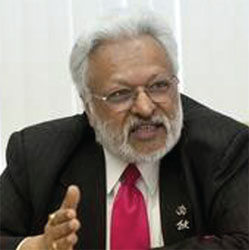
    WASHINGTON (TIP): Indian Americans have been finally noticed by the Republican Party which has decided to field at least 10 Indian Americans in 2014 elections. As part of its effort to change the face of the party, diversify its base and gain the support of this cash rich community, the Republican Party is working to field 10 Indian-Americans in the 2014 Congressional elections.

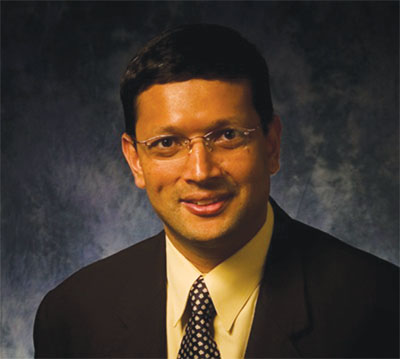
    Around half a dozen Indian-Americans – from various field and States – have been identified and currently undergoing training, before their names could be announced and made public, said Shalabh Kumar, who has been closely associated with such an effort initiated by the Republican Party

  • Indian-American doctors to hold Global Healthcare Summit in January

    Indian-American doctors to hold Global Healthcare Summit in January

    WASHINGTON (TIP): The influential Indian American doctor’s community on Tuesday, July 30th, announced to hold their “Global Healthcare Summit” in Ahmedabad next January for bringing affordable world class healthcare for Indians. “The Association of American Physicians of Indian Origin (AAPI) would like to make a positive and meaningful impact on the healthcare in India,” said the AAPI president, Dr Jayesh Shah, on his return from India along with other members of the organization.

    Shah, who is from Gujarat, as are most members of AAPI, said Global Healthcare Summit 2014 which will be held in Ahmedabad from January 3-5 next year and is aimed at advancing the accessibility, affordability and quality of world-class healthcare to the Indian people. Among other areas, the Summit will focus on prevention, diagnosis, treatment options and share ways to truly improve healthcare transcending global boundaries, he said.

    Nothing that healthcare in India is one of the largest sectors in terms of revenue and employment, Shah said, “AAPI has been engaged in harnessing the power of Indian Diasporas to bring the most innovative, efficient, cost effective healthcare solutions to India.” So far AAPI has organized seven Indo-US Global Healthcare Summits and has developed strategic alliances with various organizations.

  • Morsi Backers Plan Fresh Rallies, Defying Egypt’s Police

    Morsi Backers Plan Fresh Rallies, Defying Egypt’s Police

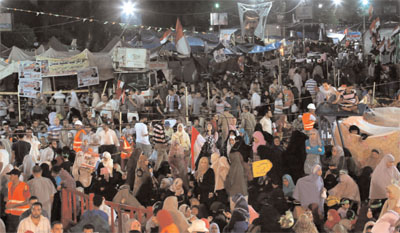
    CAIRO (TIP): Supporters of Egypt’s ousted president Mohamed Morsi urged fresh rallies on August 2, raising fears of renewed violence as police prepared to disperse them amid international appeals for restraint. The call came as US secretary of state John Kerry said the military’s removal in July of Morsi — Egypt’s first democratically elected president — had been requested by millions. In comments that will be seen in Egypt as supportive of the interim rulers, Kerry told Pakistan’s Geo television: “The military was asked to intervene by millions and millions of people, all of whom were afraid of a descendance into chaos, into violence.”

    “And the military did not take over, to the best of our judgement — so far. To run the country, there’s a civilian government. In effect, they were restoring democracy,” he added. Allaa Mostafa, a spokeswoman for the pro-Morsi Anti Coup Alliance, told AFP that demonstrators would “continue our sit-ins and our peaceful protests” against what she termed a “coup d’Etat”. Morsi backers rejected an earlier offer from Egypt’s interior ministry of a “safe exit” if they quickly left their Cairo protest camps, as police discussed how to carry out their orders from the military-installed interim government to end the protests.

    In a statement, the ministry called on those in Rabaa al-Adawiya and Nahda squares “to let reason and the national interest prevail, and to quickly leave”. The ministry pledged “a safe exit and full protection to whomever responds to this appeal”. Authorities had already warned that the demonstrations would be dispersed “soon”, but without saying when or how. The stand-off raised fears of new violence, less than a week after 82 people were killed in clashes at a pro- Morsi rally in Cairo.

    More than 250 people have been killed since the president’s ouster following nationwide protests against his single year in power. Meanwhile, diplomatic efforts to avoid further bloodshed gathered pace, with the European Union’s Middle East envoy Bernardino Leon and German foreign minister Guido Westerwelle both arriving in Cairo to urge the rival camps to find common ground. A senior member of the Freedom and Justice Party, the political arm of Morsi’s Muslim Brotherhood, said the European envoys asked them to end their sit-ins.

    “All the European delegates have the same message; they are pressuring the anti-coup protesters to disperse the sit-ins,” said the official. Following a meeting with Muslim Brotherhood representatives, Westerwelle warned that the situation was “very explosive”. “We have seriously and adamantly pressured for a peaceful solution. I hope that those concerned have gotten the message,” he said in a statement. “The international community has to keep up its diplomatic efforts, even though we don’t know today whether these will prove successful.”

    Kerry also warned against further violence, saying the US was “very, very concerned” about the killing of dozens of pro-Morsi protesters in clashes with security forces and warning such loss of life was “absolutely unacceptable”. British counterpart William Hague also called for “an urgent end to the current bloodshed” and Morsi’s release, in a phone call to interim vice-president Mohamed ElBaradei, the foreign office in London said.

    Amnesty International condemned the cabinet order as a “recipe for further bloodshed” but the mood was calm in Rabaa al-Adawiya square, where thousands of protesters have been camping out in a tent city, despite warnings from the authorities. Foreign trade minister Munir Fakhry Abdel Nur said Wednesday’s statement did not “give room for interpretation”. Accusing Morsi supporters of bearing arms, he told AFP, “It is clear the interior ministry has been given the green light to take the necessary measures within legal bounds.”

    Egypt’s interim government also faces an increase in militant attacks in the restive Sinai peninsula, where gunmen on Thursday shot dead a policeman in the northern town of El- Arish, security officials said. Much of the Egyptian media expressed support for the government’s decision, with some saying the interim administration had received “the people’s mandate” in demonstrations last Friday backing Morsi’s overthrow. Further raising tensions on Wednesday, judicial sources said three top Brotherhood leaders, including Supreme Guide Mohamed Badie, would be referred to trial for incitement to murder.

    Morsi himself has been formally remanded in custody on suspicion of offences when he broke out of prison during the 2011 revolt that toppled former president Hosni Mubarak. He was detained hours after the coup and is being held at an undisclosed location, where EU foreign policy chief Catherine Ashton met him on August 30, later telling reporters he was “well”.

  • Anup Jalota Performs For Uttarakhand

    Anup Jalota Performs For Uttarakhand

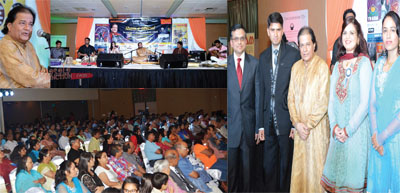
    EDISON, NJ (TIP): Ghazal singer Anup Jalota recently performed at Edison Hotel in Edison, NJ to help raise funds for the benefit of the victims of Uttarakhand Floods. An amount of $7,500 was raised during the show which was organized by Indian Events International in Association with Uttaranchal Association of North America and a number of New Jersey based businesses. Pritam Dimri and Bhupender Bohra briefed the audience about the tragedy in Uttarakhand hills through a video presentation.

    They along with Anup Uniyal & Nitin Bhatt represented UANA and received the service award presented to UANA by Indian Events LLC. They thanked Kajol Bishnoi and Mukul Bishnoi for coordinating the show with support from Surinder Kumar and Anu Kumari of Suhag Jewelers. Jalota mesmerized the audience with rendition of Ghazals and Bhajans, such as, ‘Chand Angadiyan le raha hai’ & ‘Tere shahar ka mausam’ and Bhajans like ‘Aisi Lagi Lagan’. The audience burst into laughter when Jalota diverted from singing to cracking a few jokes during the show.

    According to Kajol Bishnoi of Indian Events, the largest amount of contribution-$2500.00 came from B. B. Joshi, Chief Executive of Bank of India. Jalota presented a special recognition plaque to Joshi on the occasion. He also presented special achievement awards to Mukul Bishnoi of Rudraksham International and Surinder Kumar and Anu Kumari, owners of Suhag Jewelers. Rudraksham Intl specializes in authentic Rudraksha, Astrological Gems and Sphatik (Natural Crystal). Suhag Jewelers is well known for their 22K Gold Jewelry and Diamonds located on Oak Tree Road, Iselin, NJ.

    A member of the audience said, “Anup Jalota is a renowned singer and a very generous person. We are so happy to associate him with our fund raising effort.” Anup Jalota has been honored as the “Bhajan Samrat” of India and has wowed audiences in over 5,000 shows. He is known for his versatility and artistic talent. Very talented musicians, such as Bashir Khan playing Bulbul Tarang, Amjad Ali Kawa on Tabla, Bobby Rozario on Guitar and female vocalist Preeti Seth, accompanied him.

    The organizers and promoters of the show thanked Sanjiv Pandya of Radio Zindagi for anchoring the show along with sponsors Aman Tel, Mausam Restaurant for providing food at the show, Fern ‘N’ Décor for decorating the stage, MoneyDart, HAB, Volga, Apna Bazar, B4U Music, TV Asia and Rhythm Asia. 1. Ms. Kajol Bishnoi & Anup Uniyal presented the Checks to UANA President Ajay Adhikari during the annual Convention of UANA in Maryland (July 26th, 27th) in the presence of 350 people.

    As per Adhikari, funds collected will be utilized for a number of services in flood ravaged Uttarakhand. The UANA will distribute medicines and provide medical help, provide drinking water to remote and affected areas, buy and send blankets, send tents to the area where all the houses are destroyed, help re-build schools and local buildings, and send solar lanterns where electricity is not available.

    All this will be done with the help of direct contacts, local panchayats, school principals and local NGO’s. UANA team will also visit sites and affected areas from time to time to see the progress in the affected areas. UANA will not send cash or any form of money. It will buy whatever is required and pay for the materials.

  • ‘Progress Now, Environment Later’ Won’t Do

    ‘Progress Now, Environment Later’ Won’t Do

    With its disproportionate economic gains, the US model is not for India. Industrialization at the cost of environment is not sustainable. Inclusive social growth will be elusive if natural resources are viewed from the prism of short-term gain, opines the author.
    What must be done
    ● Enforce environmental laws to control pollution.
    ● Facilitate freedom of expression and assembly of people drawing attention to issues of environmental degradation.
    ● Empower local bodies to take decisions on environmental issues.
    ● Put in place biodiversity management committees (BMCs) in all local bodies, fully empowered under the Biological Diversity Act, to regulate the use of local biodiversity resources; to charge collection fee and receive appropriate incentives.
    ● Register crop cultivars as called for by the Protection of Plant Varieties and Farmers’ Rights Act, and give grants to panchayats to build capacity for conservation of crop genetic resources.
    ● Implement the Forest Rights Act; encourage empowered communities to adopt practices of sustainable resource use and to set apart areas dedicated to biodiversity conservation.
    ● Enhance the scope of regional development plans to include key environmental concerns and make mandatory the involvement of BMCs.
    ● Promote access to environmental information by making available the currently suppressed Zoning Atlases for Siting of Industries (ZASI), and opening up forest and wildlife areas to scientific data collection.
    ● Organize a biodiversity information system in line with proposals before the National Biodiversity Authority since 2004.
    ● Organize a transparent, participatory database on environment by drawing on student environmental education projects as recommended by the Curriculum Framework Review, 2005, of the NCERT.
    ● Carry out a radical reform of environmental clearance process by assigning the preparation of environmental impact assessment (EIA) statements to a body that does not depend on payment by project proponents; involving BMCs; and taking on board all information submitted and suggestions made during public hearings.

    Today’s environment-development debate is cast in inappropriate terms of just two choices. This is a false contradiction; the real issue is not whether India can afford the socalled luxury of worrying about environment, but whether it can afford to slide into a lawless, tyrannical society that abuses the liberating spirit of science. Economics, properly interpreted, tells us that any country should aim at ensuring a harmonious development of the sum total of a nation’s capital stocks of natural, manmade, human and social capitals.

    This calls for focusing on creating a law-abiding, genuinely democratic society that imbibes the scientific spirit. A well-informed citizenry able to exercise its democratic rights will automatically ensure that environment is cared for, as has happened in the highly industrialized Germany and Scandinavian countries. What we must do is concentrate on implementing what by all rights should be implemented: the many well-designed provisions of various Acts and schemes for protecting the environment, and for devolution of democratic powers, provisions that are being systematically sabotaged.

    False gods
    We live in a world in flux, a world that has been changing rapidly. Prior to the industrial revolution, the Indian society had possibly developed a relatively prosperous agrarian civilization with extensive handicraft-based industrial production and a rather stable social regime, albeit grounded in a highly inequitable caste society. But with the emergence of modern science and sciencebased technologies, Europeans came to dominate the world.

    The British systematically dismantled traditional Indian systems of resource management and destroyed the handicraft-based industrial production, draining away India’s resources and impoverishing it. Naturally Indians came to regard assimilation of European science and technology as critical to India’s progress. Mahatma Gandhi disagreed and advocated rejection of European science and technology, and revival of fully self-sufficient Indian villages as the basis of progress.

    While he successfully led the struggle for Independence, his many actions, such as his support of the Tatas in the context of peasant agitation against unjust takeover of their lands for setting up a hydel project, were quite inconsistent with this philosophy. So after Independence, his model was set aside, and India launched itself on a pursuit of industrialization on the western model. Meanwhile, the Marxist philosophy had emerged as a significant rival to the capitalist model.India adopted a curious mixture of the two, accepting Soviet ‘statism’ without the accompanying pursuit of economic equality through measures like land reform.

    Not ideal
    India soon came under a very strong influence of the US, and began to dream the American Dream with a large number of influential middle class families having many of their members settled in that country, and others educated in American universities. This has had serious negative implications that are perhaps best illustrated by Larry Summers’ notorious toxic memorandum.

    Summers is an influential economist, onetime Secretary for Treasury in the Clinton Administration and president of Harvard University. Perhaps ruminating on India’s weak-kneed response to the Bhopal gas disaster, Summers, then Chief Economist at the World Bank, wrote in 1991 a memorandum stating: “The measurement of the costs of health impairing pollution depends on the foregone earnings from increased morbidity and mortality. A given amount of health impairing pollution should be done in the country with the lowest cost, which will be the country with the lowest wages.

    I think the economic logic behind dumping a load of toxic waste in the lowest wage country is impeccable and we should face up to that.” India was the foremost among the low-wage countries he had in mind, and today, India is a favored destination of many of the world’s worst polluting enterprises that are no longer allowed to function in their own country. By 1990, the Marxist models were losing their sheen.

    The prescription of social ownership of production has not proven to be successful; the resulting dictatorships have concentrated power in the hands of a few and abused it roundly. These abuses have not only included abuses of rights, but those of environment as well, as happened in East Germany. Indians have come to view the US as the only model, even after the current economic difficulties. However, what drives the US economy today is “rent seeking”, such that economic gains of many agents are often excessive.

    Because of these disproportionately large economic gains, a small proportion of the US society has cornered the bulk of the wealth and political power. Its democracy has been perverted from a one person-one vote to a $1- one vote system, in which the powerful are engaged in distorting the economy to enhance unjustifiable gains. Joseph Stiglitz, the Nobel Prize winning economist who has pursued issues of inequality, says the resultant consequences include exhaustive use of natural resources, unacceptable pollution loads, failure to build human capital because of declining investments in education, science and technology, poor healthcare and high levels of unemployment, and erosion of social capital with increasing levels of social strife.

    Yet influential and learned Indians continue to argue that the US model should be our ideal, and we should ignore the endemic problems of social injustice, environmental degradation and large-scale corruption. The argument goes: The US once had high levels of pollution and got over those problems, what does it matter if we have high levels of pollution now? The wheels of history will turn, and we too will come to live in the paradise that the more fortunate US citizens inhabit today. There are several problems with this contention.

    We do not have the freedom and luxury of exploiting the resources of much of the rest of the world that the US has had for centuries and continues to enjoy today. Its bankers have robbed people in many ways and swallowed public funds to keep banks from sinking. A large proportion of US citizens are today wondering if they are indeed living in a paradise, and have been coming out on streets against the government of 1 per cent, by 1 per cent and for 1 per cent.

    Alternative models
    But there is another western model that accepts industrialization and is far more democratically oriented and caring of environment than the US.Germany has a strong environmental movement, with the Green Party constituting a significant political force. It is a state with major commitments to environmental protection, and its entrepreneurs are notable for restrained behavior and willingness to accept relatively low levels of returns, in stark contrast to the US bankers. Germany is also economically better than the US. Democracy, with all its shortcomings, is the best political system, as is capitalism the best economic system.

    But the market forces must be socially moderated to ensure environmental costs are borne by entrepreneurs, that common property is protected and concentration of wealth not allowed to pervert the democratic principle. This calls for citizen participation.

    Nurturing social capital
    Democratic values are at the heart of our Constitution, and we have progressively enacted a series of well-thought out laws for empowering people.We have also passed a series of well-thought out laws for protecting the environment. We have embraced the spirit of science, and continue to invest substantial resources in nurturing science and technology. The real issue is not inadequate laws, but deficit in governance.

    The laws protecting the environment are not implemented. The constitutional provisions for empowering the people are kept in suspension. Scientific activity that would contribute to protecting the environment and could engage the barefoot ecologists as partners in the scientific enterprise is discouraged, even suppressed.

    Since the political establishment and the bureaucracy malfunction, people see no recourse other than protests and court cases. This is an erosion of our social capital and goes against our social nature, for societies have evolved treasuring fair exchanges. Yet,we have done well to keep our democracy alive, and strengthen it through measures like the Right to Information Act. The currently prevalent rule has deteriorated into a government of contractors, by contractors and for contractors.

    We must focus on building our democracy bottom-up from the grass-roots level, an Endeavour in tune with the spirit of the Constitution. Hence, the ongoing protests and court cases must be complemented by organizing people down to the grass-roots level to exercise their democratic rights. This is the only way in which we can fashion a lawabiding, genuinely democratic society that imbibes the scientific spirit.

  • Indian Journalism At Ground Zero

    Indian Journalism At Ground Zero

    Those opposing Justice Katju’s suggestion of minimum qualifications for journalists are out of touch with reality, argues the author.
    Some years ago, the journalism entrance test at a career development institute in Mumbai had this objective-type question: Kofi Annan is (a) a Nigerian footballer(b) lead singer of a Sierra Leone pop group (c) a Sri Lankan delicacy (d)Secretary-General of the United Nations. The 100-odd candidates who appeared for the test were graduates with a sprinkling of post graduates. For nearly 25 of them, Kofi Annan was a Sri Lankan delicacy.

    At a TV Bachelor of Mass Media (BMM) university examination, where students were asked to identify and comment on a recent war which had divided the United States of America, more than a dozen students, obviously from the same college, elaborated on the “Vitamin War.” Another TV BMM class was learning the basics of book reviews. The teacher was shocked when the 40 plus students admitted that none of them had ever read a book outside their prescribed course of studies.

    The BMM course, where students could opt for journalism or advertising in their final year, had proved to be extremely popular. For 11 years I taught almost all subjects at many of Mumbai’s best colleges. Earlier, I taught journalism at some of the best institutions offering PG diploma courses in the subject. It was an exhilarating but often despairing experience. I was still an active journalist and often wrote on the need to improve standards at the BMM level.

    Now, the irrepressible Press Council of India (PCI) Chairman Markandey Katju, has spoken clearly on the same issue. It is shocking that his comments are being attacked fiercely by (of all people) senior journalists. The PCI Chairman also appointed a committee to suggest qualifications for those who wanted to be journalists. He pointed out that though journalism schools operated in India, many of them were of poor quality.

    Then and now

    A senior journalist like Vinod Mehta admitted he had a poor academic record but that did not prevent him from becoming what he is today. Mr. Mehta dabbled in advertising before becoming a journalist. That was decades ago. Today, a non-graduate would not be accepted in any journalism school nor get a job except perhaps in shady, third-rate publications. More important, journalism has become a highly skilled profession needing not only education but also expertise. Yes, in the “good, old days,” young men, mostly from the South, landed in Bombay with copies of their SSC examination and shorthand and typewriting diplomas.

    They quickly got jobs as stenographers, clerks and, if nothing else was available, joined the Free Press Journal daily because of their “superior” knowledge of English. Many of them learnt on their jobs and became outstanding journalists but nothing much was expected from the profession. Life was simple, journalism was not asked to handle the myriad problems of life. Mr. Katju argued that if other professions like medicine, law and management required adequate training, why not journalism.

    Dickens created two immortal medical students in The Pickwick Papers, Bob Sawyer and Benjamin Allen (Sam Weller called them “Junior Sawbones”), who relied on “bleeding” to cure all ailments and relished talking about it. Could they have functioned in the modern era? That was why it was shocking that professionals like Vinod Mehta and Barkha Dutt dismissed Mr. Katju’s comments with such contempt. Yes, learning on the job is fine, but how? A cub reporter assigned to cover a major event would not know how and where to begin or end.

    On the desk, can an untrained sub-editor cut a long story to its required length, provide subheads and give a suitable, catchy heading? Will the journalists who made snide comments on the Katju remarks appoint young people without previous experience in their publications or channels? How proud is Ms Dutt of the interview techniques of the modern TV reporters who thrust a microphone near the mouth of a woman who has just been assaulted and exclaim breathlessly, “Aap ko kaise lagta tha?” Or the ones assembled at Mumbai’s Lilavati Hospital when Amitabh Bachchan was admitted for some illness who came out with brilliant “Breaking News”: “Amitabh Bachchan ate khichdi” or “Amitabh Bachchan had orange juice”? Didn’t our TV editors find all this embarrassing?

    Live on TV
    There was a time in print journalism when editors prided themselves on their “intellectual superiority” and cared only for their weekly edit page pontification which they believed changed the world. For them, the rest of the paper did not exist. The same is happening in today’s TV journalism, where anchors seem to care only about their daily shouting matches, gift-wrapped as “discussions,” where they seldom allow panelists to speak or bother about how the rest of the news is presented.

    I would argue that formal training should be given not only to newcomers but also to senior editors and anchors on how to speak calmly, eliminate their bias, treat panelists with less contempt and perhaps go back to school to learn basic courtesy and good manners. Their present attitude does not reflect their public school education or Oxbridge/Columbia School of Journalism background. Once this is done, they could think of educating and training their juniors.

    In the classroom
    Meanwhile, journalism schools must improve. Mumbai University granted affiliation to dozens upon dozens of BMM and BMS departments without caring to examine whether they had any kind of infrastructure, like library facilities, classrooms and qualified teachers. After a couple of years, the university, in its wisdom, abolished entrance tests and decided that applicants to these courses should be admitted on the strength of their standard 12 marks, completely ignoring the fact that the cramming habits of and inflated marks awarded by junior colleges are not enough to judge the different needs of a journalism course.

    Teaching was another farce. With trained senior journalists unwilling to devote their time, teachers with no background or interest in journalism were roped in. Of course, some of them took pains to study topics like regional journalism and managed. But others were disasters. One such faculty member asked me how I taught reporting. “How many times did you put on disguises?” he asked in all earnestness! The ultimate depressive moment came with the fact that most students were least bothered with current affairs; not even to the extent of reading at least one newspaper regularly.

    Nor did they watch TV news shows. “Projects” were cut and paste jobs from the net. Students who found financial journalism “difficult” and who could not even differentiate between surplus and deficit, turned in immaculate 3,000 word projects with quotes from leading economists. The net was the source. The college authorities often pressurized the teachers including the visiting faculty to give high marks to project work so that their students would figure in the university merit list.

    Our stars in elite journalism who blamed Mr. Katju for speaking out of turn hardly know what is going on in most journalism schools. How can they? The average student who is keen to learn journalism is left in the lurch. If the media world refuses to listen to men like Mr. Katju, the deterioration in existing standards will continue.

  • The Murky Business Of India Day Parades In NY & NJ

    The Murky Business Of India Day Parades In NY & NJ

    Every year the number of India Day Parades being organized in NY & NJ is increasing. The oldest organizer is FIA followed by IBA and then OTIBA. The latest entrant to this Band wagon is IDPUSA of Hicksville founded by 3 controversial characters; one gave money from a non profit organization meant for medicines for poor to this organization for the parade; one is a County employee and publisher of an English weekly with murky financial dealings, and the third one is running a chain of restaurants on County properties.

    If we take a quick look the only purpose of these Parades is to make a quick name recognition as well as quick money or monetary favors for the organizers or to dispense monetary favors to the favorite vendors; with least amount of efforts as well as a chance for them to be close to Bollywood celebrities, local officials and politicians. In nutshell none of these organizations has any thing to do with rich culture and traditions of India or its 30 states or its religious diversity.

    All they do is parade themselves, their families, friends, vendors, Bollywood star, local officials and US politicians in these Insult India Parades. Some of them being paraded have taken Political Asylum in USA by labeling India as a tormentor state, some are criminals, like a former FIA President and the chair of FIA 2013 Parade Reception Committee, and some are of Pakistani origin And now the worst. Crusaders against corruption, like Anna Hazare, are there to keep company with all kinds of dubious characters.

  • INDIA ON HOLD

    INDIA ON HOLD

    Keep economy above politics
    Prime Minister Manmohan Singh has emphasized the need for a political consensus on reforms. “Reforms”, he says, “don’t happen just because there is a professional consensus. They happen when the political leadership of the time decides to back these initiatives”. Finance Minister P. Chidambaram too had earlier felt the need for “political space” to implement the reforms.

    If the economy has faltered and growth has plunged in the past two years despite a team of competent economists being at the helm, political opposition to reforms is partly to blame. The UPA itself is divided on what needs to be done. Its concerns for electoral politics prevail over measures needed to put the economy back on track. During much of the UPA’s second term, there was a policy paralysis. Things started moving when Chidambaram took charge a year ago. The Prime Minister talked of “unleashing animal spirits” in the economy.

    Though foreign investors’ fears about sudden tax changes were allayed, high inflation did not let the RBI bring down interest rates. As the US economic recovery picked up momentum, the Federal Reserve talked of withdrawing the stimulus, which drove foreign capital from the emerging markets back to the US. As a result, the rupee and other currencies depreciated. The trend has not reversed despite some RBI and government initiatives.

    When things go wrong, politicians normally should think of the larger national interest and sink their differences to work out an economic rescue plan. Instead, they play the blame game, stall Parliament, delay crucial legislation and reforms like the goods and services tax (GST). The Congress and the BJP have almost similar economic policies. Yet petty politics divides them even as the growth rate plunges, jobs shrink and the plight of the poor worsens.

    The Amartya Sen- Jagdish Bhagwati debate has thrown up a wider consensus among experts: focus first on growth, then on distribution. This means cut down food and fuel subsidies, and other freebies, bring down interest rates, clear projects, lift the ban on mining and settle land disputes.Will the mainstream political class rise to the occasion?

  • Indian- Americans Celebrate 100 Years Of Gadar Movement In US

    Indian- Americans Celebrate 100 Years Of Gadar Movement In US

    California-based Inder Singh, chairman of the Global Organization of People of Indian Origin (GOPIO) considers the Gadar movement as an important milestone in the history of India’s struggle for freedom

    WASHINGTON (TIP): Hailing the contribution of leaders of the Gadar movement in India’s freedom struggle, Indian-Americans from across the US have called for remembering their sacrifices annually on Memorial Day. “The Indian-American community, at least on Memorial Day (the last Monday of May), should remember the sacrifices of Gadarites,” said California-based Inder Singh, chairman of the Global Organization of People of Indian Origin (GOPIO).

  • Immigration Reform Will Bring In Economic Benefits: Report

    Immigration Reform Will Bring In Economic Benefits: Report

    Reform is Vital for American Agriculture, says U.S. Secretary of Agriculture Vilsack
    WASHINGTON, DC (TIP): After new study confirms economic benefits of Immigration Reform, Representative Garamendi has again called for the House of Representatives to take action. Representative John Garamendi (DFairfield, CA) August 1, highlighted a new report demonstrating the economic benefits of comprehensive immigration reform to families and businesses in California.

    The study demonstrates that comprehensive immigration reform will create jobs, expand the economy, and strengthen the economic security of hardworking Americans. Earlier this week, a study focused on the benefits for agriculture and rural America. This was reiterated by USDA Secretary Tom Vilsack in his remarks at a conference on BioMass where both he and Rep. Garamendi spoke this morning. “We are a nation of immigrants and a state of pioneers.

    As this study shows, comprehensive immigration reform will strengthen California’s economy, create jobs, and help establish needed normalcy for our vital agricultural sector,” said Congressman Garamendi. “When we come back from the August recess, I hope the leadership in the House is ready to let us vote on a bipartisan compromise similar to what passed the Senate.” According to the White House report, comprehensive immigration reform will spur California’s economy and create approximately 70,070 new jobs in 2014.

    This legislation would foster innovation and business growth, raise workers’ income, and increase state and local tax revenue. 36.6 percent of business owners in California are immigrants, and 38.3 percent of science, technology, engineering, and mathematics (STEM) graduates at California’s best universities are immigrants. A separate White House report noted that in California, 73 percent of farm workers are noncitizens, and many of them are working in the shadows.

    The report found that California especially suffers from agricultural labor shortfalls in the production of fruit and vegetables and in support activities such as farm labor contractors and crew leaders, soil preparation, and planting and cultivating. Under existing laws, if farms in California were suddenly denied access to all unauthorized workers, they would lose $1.7 billion to $3.1 billion in revenues due to lost production. “If comprehensive immigration reform is derailed, it will continue to put California’s farms in a lose-lose situation.

    Too many farmers are stuck with the unenviable choice of hiring undocumented workers or seeing some of their fields go fallow. When Alabama passed a draconian anti-immigration bill, we saw the result: undocumented immigrants fled the state, prison labor began to be used, and crops withered on the vine. There’s a better path forward, and that path is comprehensive immigration reform,” Garamendi added.

    These details come on the heels of another recent study that found immigration reform would be a boon to our nation’s GDP and economy as a whole, while expanding the country’s labor force, producing higher productivity and higher wages, reducing the deficit, and strengthening Social Security. In June, a broad bipartisan coalition in the Senate passed comprehensive immigration reform by a vote of 68 to 32. It’s time for the House to take up this or a similar bill and act to fix our broken immigration system.

  • Face Of Political Corruption

    Face Of Political Corruption

    NEW YORK (TIP): She owes the city more than $265,000, but City Councilwoman Inez Dickens need not be too worried about an investigation by the council’s Ethics Committee – she chairs the panel. Council Speaker Christine Quinn, a leading mayoral candidate whom Dickens endorsed recently for mayor, ducked questions about Dickens’ debts. “I have not yet gotten to speak to council member Dickens about the reports in the paper,” Quinn said.

    Critics weren’t as circumspect. One of the properties Dickens’ family company owns at 187 Lenox Ave. has enough violations to qualify for Public Advocate Bill de Blasio’s “Worst Landlords Watch List.” The building has 19 violations for six units, including ones for missing carbon dioxide detectors, broken bathroom outlets and vermin in the apartments. “Tenants shouldn’t face this kind of neglect from any landlord, let alone one who’s also an elected official,” said de Blasio, one of Quinn’s Democratic mayoral rivals.

    Dickens’ primary election challenger, Vince Morgan, slammed her debts for code violations, taxes and water bills on four buildings she and her sister own in Harlem. The allegations reflect “a chronic pattern of code violations,” Morgan said. “As a chairperson of the Standards and Ethics Committee and a high-ranking elected official, she is held to a higher standard.”

  • Kannada Koota’s 40th Anniversary: Hamsalekha Enthralls

    Kannada Koota’s 40th Anniversary: Hamsalekha Enthralls

    NEW YORK (TIP): Kannada Koota’s 40th anniversary celebration – considered a landmark in the history of Kannada Koota in New York – was held for the first time in Long Island, New York at the newly built Madison Theater, Molloy College. This was a unique event held in the multicultural and financial capital of the world, New York. For the very first time, many of the local U.S. dignitaries were invited and honored. The inauguration program was started after a combination of Indian and Continental breakfast.

    The Indian Consul General in New York Dnyaneshwar M. Mulay was the chief guest of the occasion. George Margos, Comptroller of Nassau County, Judge Peter Skelos, Judge New York Supreme Court Appellate Division, Tom Suozzi former Executive of Nassau County, Prakash M. Swamy, president of American Tamil Association, Dr. Kishore Kuncham, President of Indian Association of Long Island, Bobby Kumar and Kamlesh C. Metha – community leaders, George Abraham, chairman of Indian National Overseas Congress, Amarnath Gowda, Dr. S. Rajoor – Kannada leaders; Syed Zahid, Nassau County Human Rights Commissioner and Dr. Yelleshpur Jayaram were among the guests present on the occasion.

    Many past presidents of KKNY were also honored. The inaugural program began with a welcome by Sanketha Geete -KKNY’s anthem – and U.S. National Anthem. President Dr. B. R. Surendra gave an introduction on the past four glorious decades of Kannada Koota and welcomed all the guests. The program was traditionally inaugurated by all the honorary guests by lighting the sacred lamp.

    While this happened, Committee Members sang Kannada Geethe, highlighting the lighting and praying for world peace. Mulay commenced his speech in Kannada and praised the richness of the Kannada language, culture and emphasized the culture of India as a whole. He praised the contributions and dedication of Kannada leaders to this land of opportunity. All the guests were honored traditionally with Mysore Peta (hat) and shawl. The chief guest George Margos spoke about his experience with Indians and his visit to Bengaluru, and appreciated KKNY’s contributions.

    Judge Peter Skelos addressed the audience by appreciating Kannada community for bringing a splendor of culture to Molloy. The Afternoon session of cultural extravaganza began with a presentation of Kannada Koota by Dr. Surendra, followed by Bharatnatyam and group dance by KKNY children. A cultural ambassador from India H. S. Murali presented a documentary – tribute to one of the greatest singers of Karnataka, Dr. P. B. Srinivos. Lunch was greeted with an authentic South Indian cuisine followed by a program to felicitate all who gave a hand in preparing the event.

    The highlight of the day was the sensational music concert by Nadabramha Hamsalekha and associates, who came from Bengaluru. The group presented a special program exclusively designed for KKNY: “Shanti Nudi Kannada, Clear Nuclear.” Kannada Koota honored Hamsalekha with the title of “Sahitya Sangeetha Sambhrat.” A wonderful program designed by Kannada Koota “Karnataka Express,” a dance-drama highlighting the unique cultures of the different regions of Karnataka, which was seen by passengers traveling in a train all over Karnataka.

    A hilarious drama from Connecticut members made everyone laugh until their stomachs hurt. Dinner was served with North Indian style cuisine. During the breakout sessions at the projection hall, a few presentations and a few award winning short-films were shown. The grand-finale of the day was by sensational Raghu Dixit and band that enthralled the audience.

  • Historic Mayoral Town Hall on August 6

    Historic Mayoral Town Hall on August 6

    AARP, Hispanic Federation, Asian American Federation NAACP, & NALEO Join Forces to bring Voting Powerhouses’ Issues to Center Stage In partnership with WXTV Univision 41, WABC, Amsterdam News, and SinoTV/1380 AM, Town Hall will focus on Issues Critical to Most Powerful Voting Groups in NYC
    NEW YORK, NY (TIP): New York City powerhouse voting groups announced July 31 that they are holding a historic Mayoral Town Hall. AARP, Hispanic Federation, Asian America Federation, NAACAP, and NALEO will team up with WXTV Univision 41, WABC, Amsterdam News, and SinoTV/1380 AM to host a New York City Mayoral Town Hall on Tuesday, August 6th at Hunter College, from 10 a.m. to noon.

    The town hall will be the first time the groups have combined their voter engagement muscle to hold an event. To date, Mayoral hopefuls Sal Albanese, Aldofo Carrion, John A. Catsimatidis, Joe Lhota, John Liu, George McDonald, Erick Salgado, Bill Thompson, have all confirmed their participation. Hispanic, Asian, and African American/Black/Caribbean voters 50+ in New York City will account for about 47 percent of ballots cast in the upcoming election and according to a recent AARP analysis, roughly half of all voters in the elections will be AARP members.

    WXTV Univision 41, the leading Spanish-language television station in the New York area, will moderate and broadcast the town hall. A media panel including journalists from WABC, Amsterdam News and SinoTV will ask the Mayoral candidates a series of questions with several additional questions coming from the expected crowd of over 1,000. Together, the groups have key issues they are looking for the candidates to address including: jobs and the economy, housing affordability, sandwich generation issues such as caring for aging parents and older children, as well as how to make NYC a better place to live, work and age.

    “There’s a lot of noise in this election, our goal is to bring together some of the most powerful voting groups to help cut through it, and give the candidates the opportunity to tell where they stand on New York City voters’ kitchen table issues,” said Beth Finkel, State Director for AARP in New York State. “The multicultural communities are no longer a minority, and are on the way to becoming a majority of the vote in NYC – we want to be sure their issues are front and center for the candidates.”

    While AARP does not endorse candidates, have a PAC, or give money to campaigns or political parties, the non-partisan membership organization does provide straight-forward information on the issues to 50-plus voters, the media and the general public. Follow us on Twitter: @AARPNY and Facebook: AARP New York AARP is a nonprofit, nonpartisan organization, with a membership of more than 37 million, that helps people turn their goals and dreams into real possibilities, strengthens communities and fights for the issues that matter most to families such as healthcare, employment and income security, retirement planning, affordable utilities and protection from financial abuse.

    We advocate for individuals in the marketplace by selecting products and services of high quality and value to carry the AARP name as well as help our members obtain discounts on a wide range of products, travel, and services. A trusted source for lifestyle tips, news and educational information, AARP produces AARP The Magazine, the world’s largest circulation magazine; AARP Bulletin; www.aarp.org; AARP TV & Radio; AARP Books; and AARP en Español, a Spanish-language website addressing the interests and needs of Hispanics.

    AARP does not endorse candidates for public office or make contributions to political campaigns or candidates. AARP Foundation is an affiliated charity of AARP that is working to win back opportunity for struggling Americans 50+ by being a force for change on the most serious issues they face today: housing, hunger, income and isolation. AARP has staffed offices in all 50 states, the District of Columbia, Puerto Rico, and the U.S. Virgin Islands.

  • What Will BJP Do To Jumpstart The Stalled Indian Economy If It Is Elected To Power

    What Will BJP Do To Jumpstart The Stalled Indian Economy If It Is Elected To Power

    Bharatiya Janata Party (BJP) President Rajnath Singh, National General Secretary, Anant Kumar and National Spokesperson, Dr. Sudhanshu Trivedi addressed India-America Chamber of Commerce in an in-depth analysis of “What will BJP do to Jumpstart the Stalled Indian Economy if it is Elected to Power” at a reception hosted by India-America Chamber of Commerce on July 25.

  • UK Denies Visa To Salman Khan?

    UK Denies Visa To Salman Khan?

    NEW DELHI (TIP): Salman Khan’s alleged involvement in a hit-andrun case seems to be taking toll on his professional front. The 47-year -old star was reportedly unable to leave for London for the shooting of his upcoming movie, as the UK has rejected his visa application. According to a tabloid, Salman Khan was supposed to commence shooting for Sajid Nadiadwala’s ‘Kick’ – which is already running behind its schedule – from last week onwards.

    But the superstar’s ongoing case has affected his travel plans, as his visa application for London was rejected without giving any reason. Sources have revealed that this rejection has something to do with his hit-and-run case trial. “Salman had appeared in court on July 24 but the final verdict was not taken. On July 19, the hearing was postponed and charges were framed against him on July 24. The court then framed the charges and adjourned the case till August 19. The rules pertaining to securing a UK visa has become stringent these days.

    It has definitely affected Salman’s travel plans,” a source said. “We can however reapply for the visa. We will wait till next week before restarting the procedure. Hopefully, by then he will get his visa and will be able to join the rest of the cast in London. There already has been a lot of delay in the shoot due to this,” a source close to film’s unit said.

  • Telangana: Congress Makes A Poll Statement

    Telangana: Congress Makes A Poll Statement

    NEW DELHI (TIP): The timing is near-perfect. After dragging its feet on the issue for years, the Congress’ highest decisionmaking body, Congress working committee (CWC) on Tuesday approved the carving out of Telangana from Andhra Pradesh to shore up the party’s political fortunes in the region. The Congress is expected to capitalise on this to get the Telangana Rashtra Samiti (TRS), the main driving force behind the demand for a separate statehood, to merge with it ahead of the general elections next year.

    “It has been resolved to request the Central government to take steps in accordance with the Constitution to form a separate state of Telangana…within a definite time frame,” stated a resolution adopted at the meeting. Ajay Maken, chief party spokesperson, said the Congress has also recommended making Hyderabad a joint capital of the newly-proposed state and the other regions — Rayalaseema and coastal Andhra — for a period of 10 years. But don’t bring out the bubbly as yet.

    The process of setting up a new state will take four to five months. Digvijay Singh, Congress general secretary and Andhra Pradesh in-charge, said the decision was made keeping in mind the long-standing demand of the people of Telangana. “Security, water issues and liabilities will be considered while drafting of the bill. Modalities will be worked out.” As per the scheme of things, 10 districts — Adilabad, Karimnagar, Warangal, Khammam, Nalgonda, Hyderabad, Mahbubnagar, Rangareddy, Medak and Nizamabad — will be part of Telangana.

    It will get 17 of 42 Lok Sabha seats and 119 of 294 assembly seats. The decision to carve out the 29th state came after hectic consultations over the past week, with many ministers and MPs trying to persuade leaders to abandon the idea of a divided Andhra. Congress president Sonia Gandhi had conveyed her decision to back Telangana last Friday at the party’s core group meeting. Tuesday’s meetings of the UPA coordination committee and the CWC were, therefore, a mere formality.

    “At the UPA coordination meeting, we unanimously decided to support the formation of the new state,” said Ajit Singh, Rashtriya Lok Dal leader, who attended the meet with Nationalist Congress Party chief Sharad Pawar and National Conference president Dr Farooq Abdullah, besides other allies. Congress sources, however, didn’t agree with the claim of unanimity.

    They said some leaders asked home minister Sushilkumar Shinde about issues pertaining to law and order as well as the effect the decision will have on other separate statehood demands. The day had its share of last-ditch efforts by several Union ministers from Andhra to prevent the bifurcation.

  • PM Manmohan Singh To Visit US In September, To Strengthen Ties

    PM Manmohan Singh To Visit US In September, To Strengthen Ties

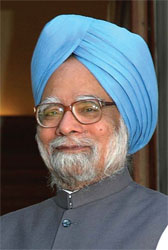
    NEW DELHI (TIP): Prime Minister Manmohan Singh will participate in the United Nations General Assembly(UNGA) in New York in the month of September but the highlight of his visit will be his bilateral meeting with President Barack Obama in Washington DC. The US has finally confirmed the dates for PM Manmohan Singh’s visit from September 25 to 30, government sources said.

    The confirmation of the dates has come as a huge relief for the Indian side as south block wanted the bilateral meeting to take place during Singh’s visit for United Nations General Assembly. This is what Indian officials had conveyed to US after Obama invited Singh for what is going to be their second bilateral meeting in US capital. The meeting in September, they said, would spare PM the trouble of traveling to the US for the second time in quick succession as his participation in UNGA was certain.

    As secretary of state John Kerry said during his visit to India in June, India and U.S. are looking to finalize a commercial agreement between NPCIL and Westinghouse for a nuclear reactor in Gujarat. If the 2 countries can circumvent India’s contentious nuclear liability law and conclude negotiations by then, it would be the main takeaway from Singh’s meeting with Obama.

    Both sides are trying hard to fight the gloom enveloping the ties between them and realize that one way of doing this is by encashing the civil nuclear agreement. Talking about the significance of Obama’s invite to Singh, foreign minister Salman Khurshid had said earlier that it is only befitting Singh’s reputation as having nurtured the India-US relations that he visit the US in the final year of UPA II.

  • NSA Spy Edward Snowden Granted Temporary Asylum In Russia

    NSA Spy Edward Snowden Granted Temporary Asylum In Russia

    MOSCOW (TIP): A long wait for US intelligence leaker Edward Snowden at Moscow’s Sheremetyevo Airport’s transit zone ended with Russia granting him temporary asylum, July 31. Snowden has been staying in the transit zone of the airport since June 23 after having arrived from Hong Kong. Snowden’s lawyer said Snowden had left the airport’s transit zone after receiving the papers he needed to enter Russian territory. The US has charged Snowden with leaking details of its electronic surveillance programs. Russia’s decision is likely to further strain its ties with the US.

    Snowden later issued a statement via the website of the whistleblowing organization Wikileaks thanking Russia for granting him asylum and accusing the US government of showing “no respect” for international law. “Over the past eight weeks we have seen the Obama administration show no respect for international or domestic law, but in the end the law is winning,” he said. US Senator Robert Menendez, chairman of the powerful Senate Foreign Relations Committee, described Thursday’s development as “a setback to US-Russia relations”.

    “Edward Snowden is a fugitive who belongs in a United States courtroom, not a free man deserving of asylum in Russia,” he said. Republican Senator John McCain also issued a stinging rebuke, saying Russia’s actions were “a disgrace and a deliberate effort to embarrass the United States”. “It is a slap in the face of all Americans. Now is the time to fundamentally rethink our relationship with [President] Putin’s Russia. We need to deal with the Russia that is, not the Russia we might wish for,” he said.

    Snowden arrived in Moscow on 23 June from Hong Kong, after making his revelations. The affair has caused diplomatic ructions around the world. His lawyer, Anatoly Kucherena, said: “His location is not being made public for security reasons, since he is the most pursued man on the planet. “He himself will decide where he will go.” Wikileaks, which has been helping him since he made his revelations, said in a tweet that he had been given asylum.

    “Edward Snowden was granted temporary asylum in Russia for a year and has now left Moscow airport under the care of Wikileaks’ Sarah Harrison,” it said. Ms Harrison is a member of the Wikileaks legal team and has been helping Snowden. Kucherena also said he had been awarded temporary asylum and showed a photocopy of the document issued to his client. The document, which resembles a Russian ID card and features a fingerprint, shows an issue date of 31 July and expiry date of 31 July 2014.

    US Attorney General Eric Holder has given Moscow an assurance that Snowden will not face the death penalty if extradited. But the Russians say they do not intend to hand him over. Russian President Vladimir Putin said previously that Snowden could receive asylum in Russia on condition he stopped leaking US secrets. Putin’s foreign policy adviser Yury Ushakov said the situation was “rather insignificant” and should not influence relations with the US.

    “We know what sort of noise surrounds this [situation] in America, but we have not received any signals from the United States,” he said. US President Barack Obama is due to visit Moscow next month. Among the information leaked by Snowden, which first surfaced in the UK’s Guardian newspaper in early June, was the revelation that the NSA was collecting the telephone records of tens of millions of Americans.

    The systems analyst also disclosed that the NSA had tapped directly into the servers of nine internet firms including Facebook, Google, Microsoft and Yahoo to track online communication in a surveillance program known as Prism. Prism was allegedly also used by Britain’s electronic eavesdropping agency, GCHQ. The agency was further accused of sharing vast amounts of data with the NSA. Allegations that the NSA had spied on its EU allies caused indignation in Europe.

    Snowden leaks timeline
    ● 5 June: First leak published in the Guardian saying the NSA is collecting the telephone records of millions of Americans
    ● 6 June: Details of the published by Guardian and Washington Post
    ● 9 June: Guardian identifies Edward Snowden as source of the leaks, at his own request
    ● 14 June: US files criminal charges against Snowden
    ● 23 June: Snowden leaves Hong Kong for Moscow, applies for asylum in Ecuador
    ● 2 July: Bolivian leader Evo Morales’ plane apparently searched for Snowden
    ● 6 July: Bolivia, Venezuela and Nicaragua say they would offer Snowden asylum
    ● 12 July Snowden gives news conference saying he is seeking asylum in Russia

  • Cabinet nod to protect parties from RTI Act

    Cabinet nod to protect parties from RTI Act

    NEW DELHI (TIP): Ignoring concerns raised by civil rights activists the Union Cabinet on August 1 gave its nod for amending the Right to Information (RTI) Act to exclude political parties from its purview. The bill will be placed before the monsoon session starting August 5.

    The amendments have been necessitated by a Central Information Commission (CIC) order on June 3 that ruled that 6 national parties— Congress, BJP, BSP, CPI, CPM and NCP—were public authorities on the grounds that they were substantially funded by the government. The CIC also directed the parties to appoint public information officers by July 15, an order that was ignored by all 6. The cabinet gave its nod to amend the RTI Act to keep political parties out of the ambit of transparency law.

    The department of personnel and training (DoPT), which acts as nodal department for the implementation of the RTI Act, in consultation with law ministry moved the proposal to amend the RTI Act. The government seeks to change the definition of public authorities mentioned under Section 2 of the RTI Act to keep all political parties out of the jurisdiction of RTI, the sources said. Government sources said that there was unanimous support from all political parties on the issue.

    The CIC order argued that political parties received income tax exemptions and doles from government including land, electoral rolls and airtime on public broadcaster at nominal rates on the grounds that they were doing social service. The CIC order said that since the parties’ professed to be working for the public, they should be open to scrutiny from the public on the finances and decisions. Political parties across the board have opposed the order. They have argued that political parties are a voluntary association of people and in fact a very small part of their funds come from the government.

    The parties also said that they were under scrutiny of the Election Commission and the Income Tax authorities. Both parties and candidates are expected to furnish their sources offunding and details of assets owned to both authorities. Prominent activists including Aruna Roy, Shailesh Gandhi, Jayati Ghosh, Kamini Jaiswal,Nandita Das, Prashant Bhushan and Soli Sorabjee have written to the PM. Petitions have also been sent to parliamentarians to oppose the act which is unlikely since the bill has near unanimous political support.