Month: May 2014

  • Sonia Gandhi, Rahul Gandhi take responsibility for Congress’ worst defeat

    Sonia Gandhi, Rahul Gandhi take responsibility for Congress’ worst defeat

    NEW DELHI (TIP): Congress president Sonia Gandhi and her son and party vice president Rahul Gandhi Friday, May 16 took responsibility for the party’s worst drubbing in the national election, but did not give credit to Narendra Modi for the BJP victory. Making a short statement to the media – without entertaining any questions – at the party headquarters after it became clear that party would be relegated to around 50 seats, Sonia Gandhi said: “The Congress faced its rivals in the elections on the basis of policies and principles.

    Despite that we failed to get the majority we had thought we would get.” “We believe that in a democracy winning and losing is part of the game. This time the mandate is clearly against us. I accept the mandate with humility. I hope that the incoming government will not compromise with the interests of society.”

    “I want to congratulate the new government,” she said, but did not name the Bharatiya Janata Party or its leader Narendra Modi, who is set to become India’s next prime minister. “The Congress will always fight and never compromise with the interests of people. “I want to thank the people for their votes, and as president of the party I accept responsibility for its defeat,” she said Rahul Gandhi, who appeared to have a fixed smile on his face, said he wanted to congratulate the new government, but he too did not mention either the BJP or Modi.

    “They have been given the mandate by the people, I want to wish them the best.” “The Congress has done pretty badly, and there is a lot to think about. As vice president I take the responsibility for the party’s defeat in the Lok Sabha polls,” Rahul said, almost a repeat of what he said after the party’s defeat in the November asssembly election. Mother and son then quickly left, declining to take any questions from the thronging media.

  • India Delivers Clear Mandate to Bhartiya Janta Party

    India Delivers Clear Mandate to Bhartiya Janta Party

    Narendra Modi to be sworn in as Prime Minister on May 21
    Manmohan resigns bringing to an end his 10-year tenure

    NEW DELHI (TIP): Addressing a euphoric crowd Friday, May 16 afternoon, Narendra Modi rallied the public to join him in taking on challenges of a vast scale. He has floated the idea of building “a hundred new cities,” of extending a high-speed rail network across the subcontinent and undertaking the herculean task of cleaning the Ganges River. He has been inspired by China’s model of high-growth, topdown development.

    But the country he will govern is India: messy, diffuse, and democratic. Modi’s Hindu nationalist Bharatiya Janata Party won a historic mandate in the country’s general election Friday, emerging with 282 of 543 parliamentary seats, more than enough to form a government without having to broker a postelection coalition.

    For months, Modi’s advisers had focused on crossing such a threshold, which they regarded as a signal that the country was behind an agenda of radical change. The nature of that change has never been clear, though. Voters are seeking immediate economic opportunities.

    The party has proposed pro-business legislation like the easing of labor or landacquisition laws. Modi, 63, is drawn to largescale building and infrastructure projects, which he pursues with a single-minded – critics say dictatorial – style. “He has a fairly clear idea of what he wants to accomplish, and he does not look for ratification from the market,” said Eswar S. Prasad, a Cornell University economist who has consulted informally with Modi’s economic team.

    “One could argue that in a country where there are far more words than actions thrown around, that this is far more preferable: a man who acts.” Modi’s planned economic reforms are certain to encounter obstacles once he takes power, among them a federal system that puts essential functions like land acquisition in the hands of state leaders. Entrenched national-level functionaries will resist efforts to strip their authority by eliminating red tape, a goal that was central to Modi’s plan to attract investors to the state of Gujarat.

    Changing tax policy or labor and land laws would require the support of the upper house of Parliament, which the Bharatiya Janata Party does not control. Meanwhile, voters’ expectations of immediate economic improvement are perilously high, setting the stage for rapid disappointment if Modi is seen as not delivering. But Friday’s enormous victory will give Modi “a much freer hand than the typical leader of such a large democracy,” Prasad said.

    The reasons Modi’s party succeeded in defeating the Indian National Congress, which has controlled India’s government for nearly all of its postcolonial history, will be studied for years. But they clearly reflect a rapid change in Indian society as urbanization and economic growth break down old voting patterns. For decades, the Congress party’s trademark initiatives have been redistributive, and the party introduced a package of major subsidies for the poor before the election.

    Voters, however, proved to be more captivated by Modi’s promise to create manufacturing jobs, which he has done quite successfully in Gujarat, the state he has governed since 2001. Modi, the son of a provincial tea-seller, prides himself on being an outsider amid New Delhi’s elite, and he recently promised in an interview with Open magazine that he would “break the status quo.”

    He was profoundly imprinted by his years as a full-time activist for the Rashtriya Swayamsevak Sangh, a right-wing Hindu organization, and his earliest and most frequent trips as an elected official were to other countries in Asia, which shaped his vision of India as a manufacturing power. A cultural conservative, he is no admirer of the liberal intellectuals who traditionally support the Congress party.

    Swapan Dasgupta, a journalist who supports Modi, said Delhi elites were worried – justifiably – that the space for their work would shrink when the new government settles in. cannot say what the contours of the future political elite or political class will look like,” he said. “He has brought in lots of people who have risen from local politics, less of those people who are traditional dynasts. A new sort of people, perhaps a little technocratic. People not from the Anglophone elite, maybe.”

    The mood at the Congress party’s headquarters on Friday was funereal. Top officials had prepared for a loss, but not for the crushing defeat they faced; according to final results from the Election Commission, the party had secured only 44 seats, a surprisingly low number for the party that was integral to India’s founding narrative. The president of the Congress party, Sonia Gandhi, and her son, Rahul, made a brief appearance at the headquarters late in the afternoon, when celebratory firecrackers could be heard from BJP headquarters nearby.

    Rahul Gandhi, who has never appeared comfortable in his role as the party’s standard-bearer, kept an odd, fixed smile on his face, acknowledging that the party had “done pretty badly.” His mother, who reinvigorated the party after her husband, Rajiv, was killed by a suicide bomber in 1991, conceded defeat without mentioning Modi or the BJP. “We believe that in a democracy winning and losing is part of the game,” Sonia Gandhi said.

    “This time the mandate is clearly against us. I accept the mandate with humility. I hope that the incoming government will not compromise with the interests of society.” A Congress-led coalition won a solid majority of seats in 2009 parliamentary elections, but the term was tarnished by corruption scandals and a slowing economy. Party workers, dully flipping through television news channels in a room with portraits of four generations of Nehru- Gandhi politicians on Friday, complained that the party’s grass-roots workers no longer had contact with Rahul Gandhi and his advisers, and had failed to identify shifts among young voters.

    Rajendra Pal Singh, a clerk with the party for more than 30 years, sadly recalled a time when the party faithful streamed in and out of the party’s bungalow as if it were “a place of worship.” “Gone are the days of the Gandhis,” Singh said. “We have not seen people coming here to hug Rahul for the past decade on any of those festivals. That culture is dead and long gone, like the Congress party now.”

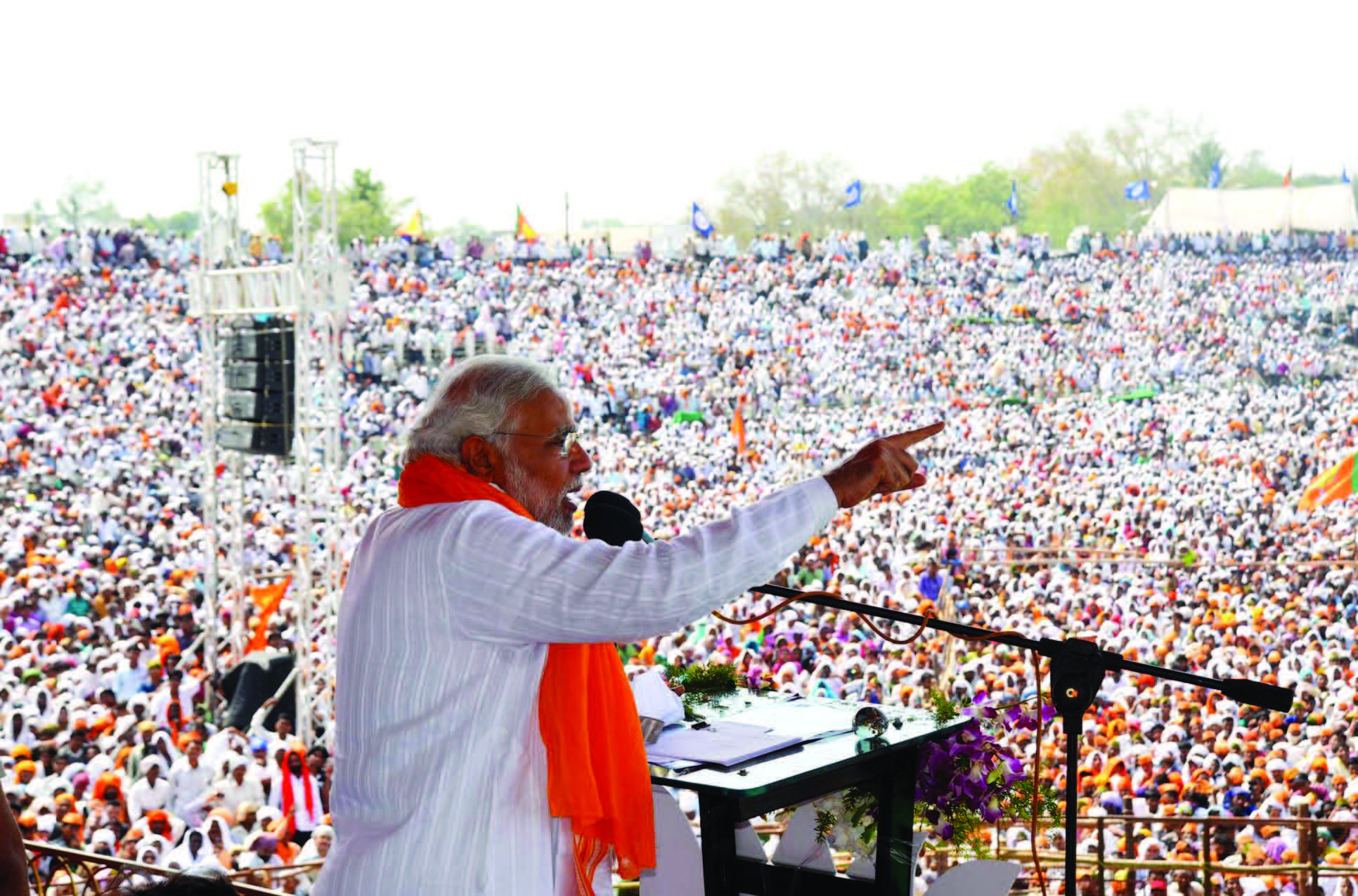
    Addressing a euphoric throng in the city of Vadodara after votes were counted Friday, Modi was forced to pause repeatedly as he waited for the audience to stop chanting his name. Modi, normally an intensely solitary man, draws visible pleasure from his interactions with crowds, and he seemed Friday to enlist their support for vast undertakings. “Brothers and sisters, you have faith in me, and I have faith in you,” Modi said. “This is the strength of our confidence – that we have the capacity to fulfill the common man’s aspirations.

    The citizens of this country have done three centuries of work today.” His supporters celebrated. Drummers, stilt-walkers and women in colorful saris converged at BJP headquarters in New Delhi, where party workers had laid out 100,000 laddoos, the ball-shaped sweets that are ubiquitous at Indian celebrations. Among the revelers was Surinder Singh Tiwana, 40, a lawyer. “I can equate my jubilation today, probably, to my mother’s on the day I was born,” Tiwana said. “This is a huge change for our country, a change of guard. A billion plus people have announced their mandate in no uncertain terms.”

  • Moderate 5.1 magnitude earthquake hits Pakistan

    Moderate 5.1 magnitude earthquake hits Pakistan

    QUETTA, PAKISTAN (TIP): A 5.1- magnitude earthquake struck southwestern Pakistan on Friday, but officials said there were no immediate reports of damage or casualties.

    The epicentre was close to the city of Sibi, in Baluchistan province, at a depth of 71 kilometres (44 miles), a meteorological official, Mahwish Ahmad told AFP. The quake, measured by the US geological survey at a 4.9 magnitude, comes a week after one person was killed and 30 injured in a series of small tremors in southern Pakistan.

    Pakistan straddles part of the boundary where the Indian and Eurasian tectonic plates meet, making the country susceptible to quakes. The country was hit by a 7.6- magnitude earthquake on October 8, 2005 that killed more than 73,000 people and left about 3.5 million homeless, mainly in Pakistancontrolled Kashmir.

    A 7.7-magnitude earthquake devastated several areas in southwestern Baluchistan province, in September last year. It killed at least 376 people and left some 100,000 others homeless.

  • 40 dead as Bangladesh ferry search called off

    40 dead as Bangladesh ferry search called off

    MUNSHIGANJ, BANGLADESH (TIP): Rescuers called off the search for missing passengers of a sunken ferry in central Bangladesh on Saturday after retrieving 40 bodies, causing anger among relatives of those still unaccounted for..

    The chief of Bangladesh’s water transport authority, Shamsuddoha Khandaker, said that divers would leave the River Meghna site where the ferry MV Miraz-4 sank in a storm on Thursday. There was confusion over how many passengers were onboard, and authorities would not provide any complete list. “We are calling off the search as the ferry has been towed to the bank and we found no more bodies. In total, our rescuers found 40 bodies,” he said.

    Ferry operators in Bangladesh usually do not maintain a list of passengers, and none was available in the latest disaster, said local administrator Saiful Hasan. “I haven’t got my brother, where is he? Why do authorities stop searching?” asked Mohammad Moniruzzaman. Before 11 more bodies were recovered on Saturday, police had estimated that at least 100 were still missing. Rescue diver Masudul Haque said on Friday evening he had recovered nine of the bodies but many were still trapped in cabin rooms.

    “We have recovered the bodies mainly from the lower deck and other open spaces, but could not open the doors of the cabin rooms where many passengers took shelter after the storm had hit,” Haque said. “I tried to open those doors but could not as huge volumes of sand have buried many of the doors,” he said.

    Relatives of the missing and the dead gathered on the banks the Meghna River, near where the boat capsized. Several bodies, covered in cloth, were laid out on the ground. “I came here yesterday for my brother but I don’t have any trace yet. Nobody can assure me of anything,” said a sobbing relative, Lokman Hossain.Sabuj, a passenger who jumped overboard when the ship began to sink, said he was among some 25 survivors who swam to shore.

    He said the captain of the double-decker ferry ignored the passengers’ calls to stay close to the shore as the storm started brewing.

  • 10 militants killed in US drone attack in Pakistan

    10 militants killed in US drone attack in Pakistan

    PESHAWAR(TIP) At least 10 militants were reportedly killed and 14 others injured on Wednesday in a US drone strike at a militant compound along the Pakistan-Afghanistan border, the first such strike after a five-month lull. The unmanned aerial vehicle targeted a militant hideout and also destroyed some of their vehicles in the restive Khyber tribal district, the Dawn news reported.

    The US drones fired three missiles on the compound, it said. Media persons and journalists have no access to the area attacked and the death-toll could not be independently verified. The last drone attack occurred in the last week of December, 2013, killing three suspected insurgents. Reports in the US media have suggested the drone strikes had been temporarily halted to allow the Pakistani government a chance to hold talks with the Taliban aimed at ending their seven-year insurgency.

  • Afghan presidential election goes to 2nd round

    Afghan presidential election goes to 2nd round

    KABUL (TIP): Afghanistan’s election commission announced on Thursday that the country’s presidential election is going into second round, with the two top vote getters to face off on June 14. The race will likely be tight between the two contenders, former foreign minister Abdullah Abdullah and ex-finance minister Ashraf Ghani Ahmadzai.

    The second round will coincide with the height of the Taliban spring offensive that was launched earlier this week. The insurgency has renewed its campaign of attacks on the Afghan police and military — increasing fears over security when voters head to the polls. The Taliban have pledged to disrupt the vote with bombings and other attacks, although the first round on April 5 was relatively free of violence.

    Abdullah garnered 45% of votes in the first round while Ahmadzai came in second with 31.6%, Independent Election Commission chairman Ahmad Yousuf Nouristan said. The final results announced by Nouristan were almost exactly the same as the preliminary results released late last month. The runoff will take place June 14, Nouristan said. Earlier this week, Abdullah picked up a potential election-tipping endorsement in Zalmai Rassoul, an exforeign minister who took 11.5% in the first round.

    But it’s unclear whether Rassoul can deliver the votes of his supporters, who are largely Pashtuns, the country’s largest ethnic group. International attention is also focused on whether the new president will sign a deal already negotiated by outgoing President Hamid Karzai to allow some US forces to stay in Afghanistan after the end of the year.

  • Obama invites Modi to US

    Obama invites Modi to US

    WASHINGTON (TIP): US President Barack Obama on Friday, May 17, called Narendra Modi to congratulate him on the Bharatiya Janata Party’s electoral success. Obama invited Modi to visit Washington “at a mutually agreeable time to further strengthen our bilateral relationship”, the White House said in its readout of the phone call. Obama “noted he looks forward to working closely with Modi to fulfill the extraordinary promise of the US-India strategic partnership, and they agreed to continue expanding and deepening the wide-ranging cooperation between our two democracies,” the White House said.

    The George W Bush administration had barred Modi from receiving a US visa in 2005 following the 2002 Gujarat riot accusations, which Modi denies. With Modi’s election the visa issue has become a nonissue. State Department spokeswoman Jen Psaki said Modi, as head of government, would be eligible for an A-1 US visa. On Friday, White House spokesman Jay Carney referred to the State Department a question about the wisdom of the decision to deny Modi a US visa. “Once the government is formed, we look forward to working closely with the prime minister and the Cabinet to advance our strong bilateral relationship based on shared democratic values,” he added.

  • Bomb in Kabul kills 1 Afghan soldier

    Bomb in Kabul kills 1 Afghan soldier

    KABUL, AFGHANISTAN (TIP): An Afghan official says a bomb stuck onto a military vehicle exploded in the capital, Kabul, killing one soldier and wounding two civilians. The city’s police chief, Gen. Mohammad Zahir Zahir, says the explosion took place in the eastern part of the Afghan capital early on Wednesday. A woman and one child were wounded in the attack. Taliban spokesman Zabihullah Mujahid claimed responsibility for the attack in a message to reporters.

  • Taliban suicide car bomber kills 5 in southern Afghanistan

    Taliban suicide car bomber kills 5 in southern Afghanistan

    KABUL (TIP): A suicide car bomber attacked an Afghan army vehicle Sunday in southern Afghanistan, killing five civilians and wounding 36, authorities said. The blast also wounded four Afghan army soldiers in the Maywand district of Kandahar province, local government spokesman Dawkhan Menapal said.

    Taliban spokesman Qari Yousef Ahmadi claimed responsibility for the attack. Afghan security forces are frequently targeted by insurgents. Violence has intensified in the country as most international troops prepare to withdraw at the end of the year. Separately Sunday, Nato said one of its service members died as a result of a non-battle related injury in the country’s north. The NATO force said the death occurred Sunday but gave no other details. Coalition policy is for home countries to identify their military dead.

  • Over 400 rallies, personal appeal, hope: How a tireless Narendra Modi got it right

    Over 400 rallies, personal appeal, hope: How a tireless Narendra Modi got it right

    NEW DELHI (TIP): It was in September last year that the Bharatiya Janata Party declared Gujarat Chief Minister Narendra Modi as its Prime Ministerial candidate despite internal differences and objections from senior party leaders LK Advani and Sushma Swaraj. Seven months later, the Modi-led BJP has got majority on its own and Modi will soon take oath as the next Prime Minister of the country.

    Throughout his campaign, many questions were raised on the way the BJP was a oneman party. While the Opposition kept attacking Modi’s dominance of the party, the BJP didn’t get deterred and maintained the ‘Ab Ki Baar, Modi Sarkaar’ and the ‘Modi wave’ campaign till the end of the elections.


    2

    All speeches were tailored according to the constituency where he was addressing rallies. During his entire campaign, Modi made special appeal to the youngsters and have them hope of a better future by highlighting the development work carried out by his administration in Gujarat.

    ‘Chai pe charcha’, ‘Mission 272’, holograms and similar other aggressive campaign ideas added to Modi’s appeal and not only made headlines but also brought him closer to the voters. Let’s look at what Modi did just right to hit the 272 target and become the Prime Minister of India: Over 400 rallies Modi addressed over 400 rallies after being made the Prime Ministerial candidate in September 2013. Modi was never seen in one particular state for more than 2 days especially when the campaigning for the Lok Sabha elections began in March this year.

    He covered North, South, East and West India and each rally of his had huge crowds roaring. Many questions were raised on the media as to whether it was exaggerating the number of crowds at his rallies. The results, however, say it all. Cashing in on the anti-Congress mood At each one of his rallies, Narendra Modi had something to say about the Congress. From ‘Shehzada’ to ‘Damaadji’, he left no chance whatsoever to gauge the anti- Congress mood and attack Congress President Sonia Gandhi and Vice President Rahul Gandhi.

    This seems to have worked in his favour this election. Chai pe charcha One sarcastic comment by Congress’s Mani Shankar Aiyar on Modi’s ‘chai walah’ (tea seller) status came as a shot in the arm for the BJP grandman’s marketing team and they quickly devised an entire campaign around it. Right after Mani Shankar Aiyar took a jibe at Modi saying a tea seller can never become the Prime Minister, Modi’s campaign met ‘Chai pe charcha’ turn. Modi met people at public meetings over tea and time and again raised the issue of the way he was written off as a ‘chai walah’.

    Twitter The chai walah has been the most popular and one of the most active users on Twitter this election season. Not just statements, Modi was even seen tweeting out selfies of himself. And he continues to do so. Right after winning on May 16 too, he tweeted ‘India has won’, which soon became the most retweeted tweet. Soon after he even tweeted a selfie with his mother. He certainly know how to catch the trend. It is indeed ‘Ab ki baar, Modi sarkaar’.

    Holograms and TV interviews Being one of the coolest political campaigners, towards the end of his campaigning, Modi started 3D campaigns, He was present where he was not present. The man started using the hologram technology to address rallies at places he couldn’t visit. He basically was omnipresent. He shut the critics who raised questions on him not giving television interviews. In the past one month, Modi’s campaign was filled with a flurry of interviews to the media.

    After a hectic season of campaign, Narendra Modi is all set to take the oath as the Prime Minister on May 21. Whether this campaign becomes more hectic is for us to see in the coming days as the new NDA government takes over.

  • RADHU BATHIJA BEREAVED

    RADHU BATHIJA BEREAVED

    LONG ISLAND, NY (TIP): Prominent leader of Afghan Hindu community and real estate salesperson Radhu Bathija lost his sister in law, Shrimati Sakshi Bathija, wife of his younger brother Rajesh Bathija on May 7th, 2014 in New York.

    Mrs. Bhatija was suffering from cancer for the last many years. Her funeral ceremony and cremation were held on Friday, May 9th.

    The Choutha Bethak will be held on Saturday May 10th, 2014 from 7.00 PM to 9.00 PM at the Asa Mai Hindu Temple & Community Center – 80 East Barclay St Hicksville, NY 11801.

  • Butting heads in Varanasi: Modi roadshow meets AAP’s jansabha

    Butting heads in Varanasi: Modi roadshow meets AAP’s jansabha

    VARANASI (TIP): The Aam Aadmi Party volunteer grins as he says that but the CRPF men standing on the divider on the road at the Ravidass Gate in Varanasi are not smiling. The Aam Aadmi Party is setting up stage at the corner for a Kumar Vishwas jansabha.

    And the BJP supporters are amassing at the same corner to cheer and wave at Narendra Modi’s thumb-my-nose-at-EC roadshow. Elections 2014 is coming to a frenzied finale in Varanasi theatrical, melodramatic and utterly filmi and just a slogan away from conflagration. The collision between a river of saffron and white caps in front of the red brick gate as the sun went down could have been easily the brainchild of some Bollywood scriptwriter with a cast of hundreds of extras.

    The atmosphere is electric – both charged and oddly festive with orange BJP parasols and Modi masks and Aam Aadmi jhadoos and tambourines. Each side daring the other, goading each other on, sounding like rival poets at some kavi sammelan as they tried to out-slogan each other.

    Abhi toh Sheila haari hain. Ab Modi ka baari hain. UP bhi Gujarat banega. Kashi se shuruwat karega. Modi kaisa neta hain Kejriwal se darta hain. Bhagoda bhagoda bhagoda. While kamal-wallas stayed largely on the VIP luggage store side of the road and the jhadoowalas stayed on Samsung showroom side, the twain do meet –sometimes in heated debate. Your Modi is afraid of losing . That’s why he’s fighting from two seats. Arre, your Kejriwal will be crushed in Modiji’s chakki.

    You don’t know what you are getting into, you Sonia’s tattu. Ok, not exactly debate. But in a political season where the main candidates never actually have to debate each other, this is as good as it gets. “Badhiya mahaul hain, (First class atmosphere)” yells a man with a lotus cap into his phone to someone. “Come here soon.” “This is a very exciting election,” says bespectacled ninth-grader Vandita Singh gesturing at the crowds around her. “India has many colours. There is white and there is also orange.” Singh does not have a vote but she’s already planning ahead. “Next time I can vote.

    And Modi-ji will still be there.” As the Modi motorcade finally reaches, preceded by scores of BJP supporters on motorbikes pumping their fists in the air, the crowd gets completely frenzied. The CRPF swing into action pushing people off the divider and yanking errant saffron-ites straying into the white side and vice versa. The sloganshouting gathers pitch. Tempers fray. Collars are seized. Even though at this corner the two sides seem evenly matched, at least in decibel level, BJP supporter Dr. Arun Pandey says the AAP supporters are just out-of-towners. “None of them have a vote,” he says dismissively. “They are just doing suicide.” “But they are very trained campaigners,” he concedes as AAP volunteers in matching brick red kurtas jump on the stage together raising slogans as Modi passes by.

    BJP officebearer Vishwanath Srivastav, his car stuck in the melee, shrugs and says, “It’s democracy. Let them shout.” “They will regret later,” opines Bhishmadev Trivedi who says he is putting heart and soul into the Modi campaign. But the shouting match turns ugly as well. A window is shattered in an Aam Aadmi Party car. AAP media coordinator Prerna Prasad is struck on the head and injured. AAP worker Ravi Kumar Chaudhry says three AAP volunteers were injured but they are not fazed. “Why should we fear? There is no fear, no shikawat. This is about violence versus ahimsa.

    They are doing what they have learned. We are doing what we have learned.” That’s the narrative AAP is trying to play in Varanasi. Outnumbered and outresourced, they want to piously claim the higher moral ground in this passion play in the old temple city. Elements of the BJP, high on electoral adrenaline, are in fact louder and rowdier at this particular junction.

    The AAP hold hands in a human chain and while some of them give as good as they get screaming across the CRP divide, others look on with an air of mild reproof as if considering breaking into Raghupati Raghava Raja Ram at any moment. “We are Gandhiwadis. We oppose by ahimsa,” says Jagdish Buniya. “What is these people’s sanskriti? Throwing stones!” “The BJP is not showing good conduct,” says Kumar Bahadur Singh.

  • To Whom Do We Actually Belong?

    To Whom Do We Actually Belong?

    Who are you?” “I belong to the Gandhi family.” Although this particular Gandhi family is not the ruling family of India but a merchant family but the confident young Gandhi claims its prestige and status because of this name. It will take more questions for this truth to be revealed.

    We are always very eager at every occasion to declare our sense of belonging. This is a very common human habit. To start with, we wish to let everyone know that we belong to some well- known family. Then we are very keen to declare that we belong to an upper caste or class. On never fails to announce in a tone bordering on arrogance that he/she belongs to the Brahmana class.

    In the ancient times, a warrior always claimed with pride that he belonged to the Kshatriya class or a particular dynasty. We are always fond of identifying ourselves with a famous lineage. Even today, our national pride is very clear when we declare that we belong to a particular country. Leave alone the common people, even educated and cultured people who believe in one world cannot contain themselves when they start cheering their national teams or players in international contests.

    This is when their basic human nature comes to the surface. To top it all, especially these days, one becomes extremely passionate in revealing his sense of belonging to a particular religion or a particular religious sect. Sometimes, this religion or the sect adopts violent means to promote its aims and beliefs. The idea that ‘I am this body’ is the basis for this and similar human behaviour. Due to this misunderstanding and ignorance of our actual spiritual identity, today the entire humanity is suffering from hatred and violence.

    Generally, we see that people sacrifice their personal interests for the sake of advancement of their community to which they belong. They appear to work relentlessly for the society in which they live. After the death of both the parents, the eldest son mostly spends all his time and his earnings in bringing up his brothers and sisters with a profound sense of duty and responsibility. Somebody gives up all wealth in charity. Many patriots even give up their lives for the sake of their country. All these appear to be acts of great sacrifice based on selfless love. But the reality is otherwise.

    All these so-called actions of affection, benevolence, charity, duty, generosity and love are, truly speaking, based on selfishness. By performing such actions, they gratify actually their proud sense of false ego. They derive happiness from doing these actions. They have perverted minds influenced by a selfish motive incapable of the correct reading of circumstances. We interpret in our own way the reasons for our every action due to our biased or prejudiced mind always influenced by a selfish motive. The correct judgment is possible only by one who is totally liberated, the one who completely free from worldly desires, good or bad. Because of the misconception of body as self, we operate from the plane of ignorance and thus led to wrong conclusion.

    We assess and evaluate every thing from the stand point of personal interest. One cannot do any real good to others because of this tainted mindset. The attachment to everything – wife, children, and wealth – is due only to the attachment to the physical self. There are two kinds of selfishness: concentrated and extended. Concentrated selfishness is seen in animal society and extended selfishness in human society. Humans see their family, society, community and country as their expansions. A person apparently loves his wife, children and possessions because their association gives him happiness and this is what is important to him.


    27

    In other words, a person does everything with a selfish motive even with great pain and trouble if it ultimately results in giving happiness desired. Then he/she is not bothered about how the others with whom he interacts feel about it. If, for any reason, a person does not get happiness, then he/she is ready to end the relationship. An embodied soul of this material world is actually self-centered and is more attached to one’s own body and self than to his/her immediate relations like wife, husband and children. In India, it is common knowledge that a mother is ready to kill her girl child in her womb because the society prefers boys.

    Similarly, young adults want to send their elderly parents to senior citizen care centres because their presence at home is a burden and inconvenient for them. In a nutshell, for persons who think the body is the self, those things whose importance lies only in their relationship to the body, are never as dear as their body itself. In this connection Srimad Bhagavatam (10.10.11) poses the following pertinent question: dehah kim anna-dathu svam nisektur mutur eva ca matuh pitur va balinah kretur agneh suno ‘pi va While alive, does this body belong to its employer, to the self, to the father, the mother, or the mother’s father? Does it belong to the person who takes it away by force, to the slave master who purchases it, or to the sons who burn it in the fire? Or, if the body is not burned, does it not belong to the dogs that eat it? Among the many possible claimants, who is the rightful claimant? Not to ascertain this but instead to maintain the body by sinful activities is not good.

    The question is: to who does our body actually belongs while alive? According to the Vedas, a living entity, the atman, takes shelter of the semen of the father and then gets injected into the womb of the mother where this atman, the spirit soul acquires the body and gradually develops. In that case, does the body belong to the father or the mother? Or does it belong to the mother’s father (grandfather) because he brought her into the world? Or does the body belong to one who kidnaps it? Can the body be said to belong to one who purchases it in human trafficking? Can the son who cremates the body after death as in Hindu custom, claim its ownership? If one dies in a remote jungle, a dead body is generally eaten by dogs and jackals.

    Can we say the body belongs to them? Who is the legitimate claimant? This is the question. The undeniable fact is that body is not the property of any one because actually it is created in this world by five material elements, pancha mahabhut, namely, earth, water, fire, air and ether. When the body disintegrates, whether burnt or buried, it merges again into these natural elements. Thus, in the beginning, the body comes into existence by a combination of matter and it disappears when the combination is dismantled. A person is truly intelligent if he/she understands it. While living, one may be very proud of one’s body thinking as very beautiful, handsome or muscular, but after death, the body will be reduced to ashes, if cremated.

    If buried, it will be eaten by worms. If it remains unclaimed, the vultures and the dogs will eat it and will be turned into their stool. A person is truly intelligent if he or she understands this stark reality. Foolish persons, ignorant of this fact, indulge in many sinful activities to maintain their bodies. No matter how well one may try to maintain the body, it is subjected to old age, disease and death. Ignoring this fact, they commit all sorts of sins. Every thing one does, is to cater to the enjoyment of the body, but the body is temporary and, ultimately, perishable. One who is slightly advanced in knowledge can understand this. This man knows that he is not the body but it is his. The one who understands his spiritual existence is not only indifferent to his close relatives but also has no attachment even to his own body.

    The hero of the Mahabharata, Arjuna initially hesitated to fight the war of Kurukshetra. This reluctance can also be attributed to a subtle selfishness and not due to apparent compassion that he exhibited. At that juncture, he could realize that even if he won the war, all his close relatives on both the sides, would be completely wiped out. No one would be left alive with whom he could share the joy of his victory and celebrate it. This subtle thought was haunting him but did not occur to him earlier. When ready on the battle front, even contemplation of the prospect or the possibility of the loss of close relatives was very terrifying for him.

    In other words, for ignorant karmi or a fruitive worker, his own body is more dear than that of his relatives as parents, siblings, wife and children. For a jnani, who has basic understanding of spiritual existence, his atman or the soul, is more dear than his own body. An ignorant karmi thinks he is the physical body and a partially enlightened jnani thinks the body is his and he is not the body. He believes the body belongs to him. A bhakta, devotee of God, truly understands his position. Neither he presumes like the karmi believing that he is the body nor does he misunderstand like jnani that the body is his. He is completely convinced that both his body and his actual self, the spirit soul, belong to the Supreme Lord Krishna.

    The devotee is fully aware of the fact that a conditioned soul in the material world has two coverings namely; gross external body consisting of limbs and organs like hands legs and stomach and the subtle body composing of mind, intelligence and false ego. Both these are material and they are the products of physical energy of the Supreme Lord Krishna as per His own declaration in the Gita (7.4) as follows. bhumir apo nalo vayuh kham mano budhir eva ca ahankara itiyam me bhinna prakrtir astadha Earth, water, fire, air, ether, mind, intelligence and false ego – all together these eight constitute My separated material energies.

    The devotee is also fully aware that all the living beings of the world, the jivatmas, are eternal parts of the Supreme Lord Krishna, as conveyed to Arjuna in the Gita (15.7) mamaivamso jiva-Ioke jiva-bhutah sanatanah manah-sasthanindriyani prakrti-sthani karsati The living entities in this conditional world are My eternal fragmental parts. Due to conditioned life, they are struggling very hard with the six senses, which include the mind. In this verse, the identity of the jiva or the soul is clearly given. The living entity is eternally a fragmental part of the Supreme Lord Krishna. It is not that he assumes individuality in his conditional life in the mundane realm and merges with the Supreme Lord when liberated. The jiva soul is eternally a part as clearly denoted by the Supreme Lord’s use of the word sanatana, in this verse.

    The Supreme Lord Krishna is like a blazing fire, we are like minute sparks that emanate from Him. The Supreme Lord is like the sun and we are like minute molecular particles of its rays. To conclude all beings of this universe are parts of the Supreme Lord Krishna and hence we belong to the Supreme Lord Krishna, and to no one else is clarified by Him in the Gita (7.5) apareyam itas tu anyam prakrtim viddhi me param jiva-bhutam maha-baho yayadam dharyate jagat Besides these, O mighty-armed Arjuna, there is another, superior energy of Mine, which comprises the living entities who are exploiting the resources of the material, inferior nature.

    Our gross, physical body consisting of our limbs and organs as well as our subtle body consisting our mind, intelligence and emotions are both made of the Supreme Lord’s material energy. Our actual self, the spirit souls of all the embodied beings, has its origin in the Supreme Lord Krishna’s spiritual energy. Therefore, the devotee’s perspective is perfect when he says his spirit soul as well his physical body belong to the Supreme Lord Krishna.

  • NYC Bhangra brings Holi colors to the Dag Hammarskjöld Park

    NYC Bhangra brings Holi colors to the Dag Hammarskjöld Park

    NEW YORK CITY, NY (TIP): Colorful hands did ‘Bale Bale’ when 10,000 New Yorkers came together to celebrate Holi at the Dag Hammarskjöld Park (at United Nations) on May 3rd 2014. In its 5th Annual year, Holi Hai organized by NYC Bhangra Dance Company was sponsored and supported by India.com. “Holi is a fun festival, and Bhangra is a fun dance, we simply bring the two together” said Megha Kalia, Founder NYC Bhangra and director of the festival. ” It is a festival of love and celebration. We wanted people from various backgrounds, and ethnicities to come together to forge their bonds of harmony and friendship”.

    The cultural extravaganza of dances included Bollywood, Bhangra, Salsa and Classical Kathak dances. ” We want to make this a credible platform for upcoming young talents!” said Megha Kalia. Sumona Dey, a student of the Suresh Wadekar music institute sang ‘ Dumma Dum Mast Kalander ‘. Wyland band showcased alternative rock music from New Jersey. Punjabi artists got the audiences moving to ‘Mirza ‘ a popular Punjabi folk song.

    The multiple interactive Bhangra dance lessons were the highlight, which the audiences lapped up instantly. ” There has been huge interest from non-Indian communities in our weekly dance classes. Majority of our company members are of American origin” said Dolly Kamalpreet, who is a senior choreographer & Instructor of NYC Bhangra Company. The junior students ranging 4yrs- 10 yrs of NYC Bhangra gave a special performance entertaining audiences that stole the hearts of all.


    36
    The joyful moments

    In addition to dance, music and colors the crowd enjoyed authentic Indian cuisine. Indian handicrafts, Henna artists made the event a holistic experience. ” The event has grown in scale and experience every year since its inception. It is something I eagerly wait for every year. The energy is unprecedented. I would love to come back to again ” said a local resident, who has been witnessing the vent for the past four years and wishes that it continues to grow.


    37
    Young performers at the Holi festivities

  • Thai protesters rally to ‘sweep’ away Thaksin regime

    Thai protesters rally to ‘sweep’ away Thaksin regime

    BANGKOK (TIP): Thousands of royalist protesters fanned out across Thailand’s capital on May 9 to try to bring down a caretaker government after a court threw Prime Minister Yingluck Shinawatra out of office and an anti-graft agency indicted her for negligence. The interim government is hoping to organise a July 20 election that it would probably win, but the protesters want the government out, the election postponed and reforms to end the influence of Yingluck’s brother, former premier Thaksin Shinawatra. Protest leader Suthep Thaugsuban, speaking to supporters in a city park, urged them to rally outside parliament, the prime minister’s offices and five television stations to prevent them being used by the government.

    “We will sweep the debris of the Thaksin regime out of the country,” said Suthep, a former deputy premier in a government run by the proestablishment Democrat party. Thaksin is vilified by his enemies as a corrupt crony capitalist. But he won the unswerving loyalty of legions of rural and urban poor with populist polices when he was prime minister from 2001 until he was ousted in a 2006 coup. He lives in exile to avoid a 2008 jail sentence for abuse of power but has been the guiding hand behind his sister’s government.

    Tens of thousands of his “red shirt” supporters, angered by Yingluck’s ousting, are also on their way to Bangkok for a rally on Saturday. They are clinging to the hope that the interim government will win the July election and bring the Shinawatras’ party back to power.

    The prospect of rival protesters in the capital over the weekend has raised fears of trouble. Both sides have armed activists in their ranks. Twenty-five people have been killed since the anti-government protests began in November and more turmoil could further unsettle Southeast Asia’s second-largest economy.

    POPULIST POLICIES

    Thailand is already teetering on the brink of recession amid weak exports, a year-long slump in industrial output and a drop in tourism, presided over by a caretaker government with curtailed powers. Consumer confidence fell to its lowest level in more than 12 years in April as the crisis took its toll. The anti-graft agency indicted Yingluck for negligence on Thursday – a day after the Constitutional Court threw her out of office – in connection with a rice-subsidy scheme under which the state paid farmers way above market prices for their crops.

    The scheme, a flagship policy of Yingluck’s administration, was aimed at helping her rural supporters. But the government could not sell much of the rice it quickly stockpiled and was unable to pay many farmers. “Thaksin’s lackeys have exploited populist policies to win over voters before betraying them,” Suthep told his supporters late on Thursday. “The rice scheme is a clear example of this.”

    If Yingluck is found guilty of negligence by the Senate, she could be banned from politics for five years. Several other members of the family and about 150 of Thaksin’s other political allies have been banned for five-year terms since 2007. Yingluck dissolved parliament in December and called a snap election but the main opposition party boycotted it and antigovernment activists disrupted it so much it was declared void.

    Yingluck and the Election Commission agreed last week a new ballot should be held on July 20, but the date has not been formally approved. Thaksin or his loyalists have won every election since 2001. The anti-government protesters say Thaksin buys elections. They want to change the electoral rules before new polls to try to stop his party winning again.

  • Silvio Berlusconi to begin community service

    Silvio Berlusconi to begin community service

    CESANO BOSCONE (TIP): Italy’s Silvio Berlusconi began community service for tax fraud on Friday in a spectacular fall from grace for the flamboyant expremier, who will likely seek political gain from the punishment. The billionaire tycoon, who was convicted last year and has been expelled from parliament, has been ordered to work once a week for up to a year as a volunteer in a hospice for Alzheimer’s patients just outside Milan.

    The Catholic hospice in Cesano Boscone has stressed that it will not allow Berlusconi to use his stint for political grandstanding in front of the world’s media and will treat him like any other assistant. The disgraced politico, who has dominated Italian politics for two decades and is leading a campaign for European Parliament elections despite being barred from running, is expected to arrive at the hospice at 0745 GMT.

    Massimo Restelli, head of the hospice’s care services, told the La Repubblica daily that Berlusconi’s introduction would be “gradual” so that he and the elderly patients can get used to each other. “It will be small steps so as not to make any mistakes. And then he could do all sorts of things. He could help with meals, which are tricky because sometimes you have to ‘remind’ the patient that they are eating,” he said.

    “We ask everyone including Berlusconi to observe, to listen and not to get performance anxiety,” he said, adding that Berlusconi would be accompanied at all times by a medical worker specialized in Alzheimer’s. “We’ll see if Berlusconi’s presence creates some kind of close bond, if he is a reference for anyone. The guests do remember things, even if that seems absurd to people who do not know the illness,” he said.

    Berlusconi himself has said in interviews that he has a “big surprise” in store and has hinted that this could involve a deeper commitment to Alzheimer’s sufferers. “I think in the end I will stay a lot longer than I have to. I have a big surprise prepared. It took me just 10 days to learn the different cure methods that can be used,” the 77-year-old told a radio show.

    Emilio Fede, a former television anchor who has been convicted of procuring prostitutes for Berlusconi, has said his friend is unperturbed by the community service. “Berlusconi is preparing carefully and is studying everything on Alzheimer’s. He will do it well and with humanity,” Fede said, adding that the service would be a tribute to Berlusconi’s late mother, Rosa.

  • Russell Brand wins damages from UK tabloid over cheating report

    Russell Brand wins damages from UK tabloid over cheating report

    LONDON (TIP): Russell Brand has accepted a “substantial” but undisclosed sum of damages at the High Court in London from the Sun On Sunday, after the newspaper ran a story claiming that he had been unfaithful to his girlfriend Jemima Khan. The 38-year-old comedian sued the publication in January after it ran the article across pages one, four and five on November 17, 2013.

    The paper initially refused to remove the article from its website, withdraw the allegations or publish an apology, the court heard. Newspapers Limited, the publisher of the Sun on Sunday, accepted that the claims that Brand had deliberately deceived the general public, as well as his girlfriend Jemima Khan, by cheating on her were totally untrue and defamatory and admitted that the article, headlined ‘Russell Cheated On Jemima With Me’, should not have been published.

    News Group agreed never to republish the allegations and has apologised to Brand and Khan for the distress and embarrassment the article caused them. The publishing house have also agreed to publish an apology, alongside paying Brand a substantial amount in damages, as well as covering his legal costs. Following the publication of the article in November, Brand wrote an article for the Guardian about the “pain, disruption and distress that the Sun inflicted” on himself and Khan.

    “Some friends of mine thought it dubious that the Sun’s deceitful story appeared just days after I’d spoken out against the media, corporations and the government,” he wrote. “It could be a coincidence. Or it could be that the Sun loves me when I’m a prattling, giggling, Essex boy ‘Shagger of the Year’, when I’m in my proper place, beneath vacuous headlines, herding their flock towards dumb lingo and crap bingo, when I’m being cheeky on MTV or even unwisely invading answerphones, in a way that many would argue, is less offensive than the manner that they are alleged to have done.

    “In my place I’m fine, but if I use my glistening podium, to talk to the people I grew up with, or signed on with or used drugs with, vulnerable overlooked, underserved, ordinary people, people that can’t sue them as I am, then out come the fangs.”

    He went on to claim that tabloid publications are not to be trusted, and said it was a big “lie” to suggest that the famous were the only targets Pointing out The Sun’s now infamous coverage of the Hillsborough disaster, he wrote: “We all remember the worst lies, the ones where the red tops are caught redhanded, like Hillsborough, where the Sun enthusiastically heaped more pain on the grieving people of Liverpool by claiming that innocent fans had pissed on police and rifled through the possessions of their dead fellows under the front-page headline ‘The Truth’.” Brand previously declared that he would be donating the amount to the Hillsborough Justice Campaign.

  • London arms its policemen with video cameras

    London arms its policemen with video cameras

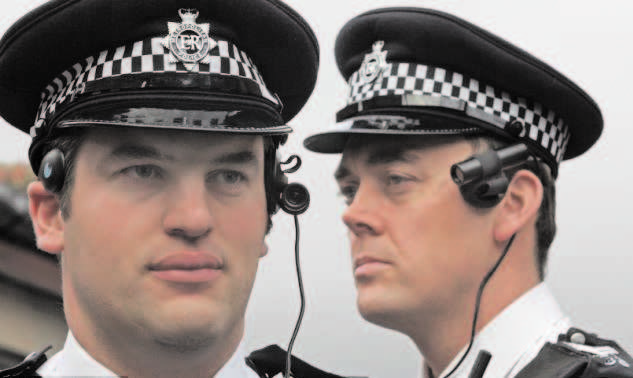
    LONDON (TIP): Police officers across London will wear video cameras when responding to emergency calls as part of a year-long pilot project launched on May 8. A total of 500 cameras will routinely collect evidence from public order and domestic abuse incidents in 10 of London’s 32 boroughs, as well as potentially contentious “stop and searches”, Scotland Yard said.

    The force has been testing body-worn cameras for several years but was given new impetus following the police shooting of suspected gang member Mark Duggan in 2011, which sparked days of rioting in the capital and cities across England. An inquest jury in January found the killing was lawful but the coroner noted the “stark problem” posed by contradictions between the notes from officers at the scene and mobile phone video evidence taken by witnesses.

    Scotland Yard Commissioner Hogan- Howe said at the time that armed police would in future wear video cameras to ensure a more accurate record was made of their actions. The police chief said Thursday that the cameras, being trialled by unarmed officers, could also deter people from becoming violent towards police and speed up justice by providing a compelling reason for criminals to plead guilty.

    “I believe it will also show our officers at their best, dealing with difficult and dangerous situations every day but it will also provide clearer evidence when it’s been alleged that we got things wrong,” he said. “That has to be in both our own and the public’s interest.”The data from the cameras will be uploaded at the end of every officer’s shift and kept on file for a month before being deleted, unless it is required as evidence.

    The cameras will not be permanently switched on and officers, who will wear them on their stab vests, have been told to alert members of the public “as soon as practical” that they are being recorded. Failure to switch on the cameras as directed in police guidance will be treated as a disciplinary offence, Hogan- Howe said.

  • China’s air force creates a battalion of monkeys

    China’s air force creates a battalion of monkeys

    BEIJING (TIP): The air force of the People’s Liberation Army (PLA) of China has trained a group of macaques to help protect an air base close to Beijing. These monkeys have been put here to take care of the huge flocks of birds that pose a threat to flights.

    According to China’s air force news website, the macaques have been taught to destroy nests in nearby trees and chase away the birds that have become a nuisance during the take-offs and landings of fighter planes in the base whose exact location was not revealed.

    The base has used practically every means of tackling the problems of the birds, from firecrackers to scarecrows or even firearms but nothing proved to be as effective as the monkeys which are jokingly referred in military circles as “the Chinese army’s new secret weapon”.

    The macaques respond with the obedience of a recruit to the whistles that their trainers use to give them orders and are capable of destroying more than 180 nests close to the base at a rate of around six nests per monkey. It is certainly not the first army to use domestic animals in the elite forces: The Washington Post daily recalled that the US uses dolphins to detect, locate and mark mines.

    However, dogs are the most used animals in armies around the world.One of the most delicate operations in history that led to the death of Osama bin Laden, the al-Qaida leader, also featured a dog, a Belgian shepherd called Cairo.

  • China detains, shames 70- year old ex-editor for leaking state secrets

    China detains, shames 70- year old ex-editor for leaking state secrets

    BEIJING (TIP): China has detained a 70-year old former editor who has won international awards for journalism on charges of leaking state secrets. The journalist, Gao Yu, was “criminally detained on suspicion of providing state secrets to sources outside China”, the Beijing public security department said.

    State run China Central Television ran a video on Thursday showing Gao in orange prison smocks with her face blurred admitting to “seriously harming the national interest”. It also showed her being escorted down a hallway and interrogated by two uniformed police officers.

    Gao is a former deputy editor-in-chief of the magazine Economics Weekly and is an outspoken journalist who was named as one of the 50 “world press freedom heroes” in 2000 by the International Press Institute. She was sentenced to six years in prison on a similar “state secrets” charge in 1993. In a delayed report, Xinhua news agency said Gao was detained on April 24 on suspicion of having sent a copy of a “highly confidential” document to an overseas website last June.

    It did not mention what the document was about. The detention comes ahead of the 25th anniversary of the Tiananmen Square crackdown. “I believe what I have done has touched on legal issues and has endangered the country’s interests,” said Gao in the television confession. “What I have done was a big mistake. I earnestly and sincerely have learned a lesson from this experience and admit my guilt,” she said in the video with her face obscured.

    Police seized “substantial evidence” from her home and Gao has “expressed deep remorse about what she did”, Xinhua said, adding that she was “willing to accept punishment from the law”. In another case, a court in the southern city of Shenzhen this week sentenced Hong Kong-based publisher Yu Man-tin to 10 years in jail on charges of smuggling.

  • Boko Haram should learn Islam: Malala over girls’ abduction

    Boko Haram should learn Islam: Malala over girls’ abduction

    LONDON (TIP): Pakistani teenage rights’ activist Malala Yousafzai, who survived being shot in the head by the Taliban, has advised Nigeria’s Boko Haram to “go and learn Islam”, saying the dreaded extremist outfit is “misusing the name of the religion” by kidnapping over 200 schoolgirls.

    “I think they haven’t studied Islam yet, they haven’t studied Quran yet, and they should go and they should learn Islam,” the 16-year-old told the CNN. “I think that they should think of these girls as their own sisters. How can one imprison his own sisters and treat them in such a bad way?” she said, referring to Boko Haram’s threats to sell the girls into slavery.

    “They are actually misusing the name of Islam because they have forgotten that the word islam means ‘peace,’” Malala said. She added: “When I heard about the girls in Nigeria being abducted I felt very sad and I thought that my sisters are in prison and I thought that I should speak up for them.” In another interview to the BBC, Malala called upon the world not to “stay silent” over the abduction.

    “The international community has to do more to help the girls kidnapped over three weeks ago by Islamist Boko Haram militants in Nigeria. When such things happen we cannot keep quiet,” she said. “If we remain silent then this will spread, this will happen more and more and more,” said the girls’ education campaigner, who was the youngest nominee for the Nobel Peace Prize last year.

    The abduction, that occurred on April 15, has sparked international outrage and mounting demands for Nigeria to spare no effort to find and free the girls before they can be sold into slavery or otherwise harmed. Nigeria police have said more than 300 girls were abducted from their secondary school in the country’s remote northeast. Of them, 276 remain in captivity while 53 managed to escape. Malala was shot at by the Taliban in her native Swat in northwest Pakistan in 2012 after she spoke publicly about girls’ rights to education.

  • Cargo ship sinks, 11 missing near Hong Kong: Officials

    Cargo ship sinks, 11 missing near Hong Kong: Officials

    HONG KONG (TIP): Authorities launched an air and sea rescue operation on May 5 to find 11 crew members from a Chinese cargo ship after it collided with another vessel and sank just outside Hong Kong’s teeming waters.

    Four helicopters and more than 20 ships from China and Hong Kong were deploying to the waters near Po Toi, an island lying at the edge of Hong Kong’s territory where the ship sank in the early hours of the morning, officials said.

    “Two cargo ships collided and one of them sank,” a police spokeswoman told AFP. Aerial footage of the scene shown on Hong Kong television showed an oil slick on the surface of the sea where the ship is believed to have gone down. A fire department spokesman said there were 12 people in total on board, with police confirming that one male was later rescued and sent to hospital.

    The survivor, who was plucked from the sea by a passing fishing boat, suffered minor injuries to his hands and feet, she said. China said it was sending three helicopters and more than a dozen ships to the scene, according to the official Xinhua news agency, while Hong Kong sent a helicopter and eight rescue vessels.

    A fire department spokesman said the collision took place three miles (nearly five kilometres) south of Po Toi, just outside Hong Kong maritime territory. The 97-metre long Chinese cargo ship, the Zhong Xing 2, was carrying cement from the Northern Chinese province of Hebei to the city of Haikou in the nation’s southern island of Hainan, the city’s Marine Department told AFP.

  • Kya Dilli Kya Lahore

    Kya Dilli Kya Lahore

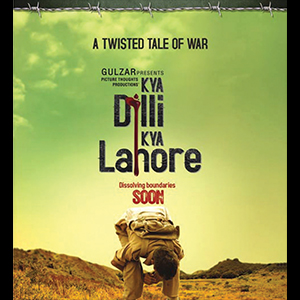
    STORY: An Indian and a Pakistani soldier stationed at the border battle, bicker and bond over their twisted fate caused by India’s bitter and bloody partition. REVIEW: Kya Dilli? Kya Lahore? Kya ‘baat’! Yes, battlebanter over cross-border firing and a bombardment of dialogues forms the crux of this film, set at a time (1948) when the border lines between India and Pakistan reeked of fresh blood.

    In today’s context, those very boundaries have dulled, the battle-lines have hardened and the banter has changed. To a more contemporary barrage of dialogues. ‘KDKL’ deals out languid laughter and a dark humour-in-uniform. Yet, all of it stems from scarred memories and open wounds of partition that’ve painfully throbbed over generations. Narrated and presented by maestro writer/lyricist Gulzar, the story unfolds when a Pakistani soldier, Rehmat (Raaz); born in Delhi and now ‘displaced’ in newly-formed Pakistan, is confronted by an Indian soldier, Samarth (Rishi), who’s grown up in Lahore, now migrated to Delhi.

    The satirical conversations, candour, ‘crossness’, form a large part of the dialogue between two lost souls. What starts as a spiteful fury of words, punctuated with blood and bullets, warms up into a heart-rending tale. And somewhere, the inbred bhaichara and binding nostalgia ties the two uprooted souls like an undeniable umbilical cord. Debutant director Vijay Raaz’s story stays firmly focused on his two subjects (Rehmat, Samarth), in the same location throughout; with brief inclusion of only two other characters.

    The plot, (reminiscent of Oscarwinning Bosnian film, ‘No Man’s Land’), is a rare attempt in Indian cinema. The essence of the story rests in its dialogues (Manu Rishi) – like rich, evocative poetry – which carries the emotional weight of the film. In that also lies the problem, the shuddh Urdu-Punjabi- Hindi is often difficult to grasp amidst raging emotions. Hence, it might not appeal to all.

    Also, the film feels a tad long. Performances by Raaz and Rishi are brilliant and the background score (Sandesh Shandilya) adds tear-jerking heaviness. One of the finest things about ‘KDKL’ is Gulzar’s poetic prologue. Without the usual trappings of filmi fanfare, this story has its heart in the right place – pure and undivided. Like pre-partition brotherhood.

  • RANVEER SINGH GIFTS LOVE TO DEEPIKA

    RANVEER SINGH GIFTS LOVE TO DEEPIKA

    First it was the RK tattoo,which she still wears on the nape of her neck, and now the actress seems to be announcing that she has found love again. Deepika who is dating fellow actor Ranveer Singh, has been wearing a golden pendant with the word LOVE emblazoned on it, since retutning from an awards show in the US. Buzz is, that it’s a gift from her current flame.

    Though the twosome is yet to publicly acknowledge the relationship, they have been spotted out and about dressed in his and hers ensembles.The pendant seems another sartorial declaration of romance. We asked Deepika and Ranveer about the story behind the piece of bling but both chose not to respond.

  • YAMI GAUTAM OPPOSITE VARUN DHAWAN IN A REVENGE DRAMA

    YAMI GAUTAM OPPOSITE VARUN DHAWAN IN A REVENGE DRAMA

    Yami Gautam has been signed as Varun Dhawan’s love interest in Sriram Raghavan’s revenge drama which rolls by the month end and also features Huma Qureshi, Nawazuddin Siddiqui and Vinay Pathak. When contacted, Sriram who was location hunting in Nashik, responded to our text message by saying, “Yes, Yami is part of the film.”