Month: July 2014

  • JAPAN’S DECISION ON MILITARY WILL EXPAND ITS GLOBAL ROLE: US

    JAPAN’S DECISION ON MILITARY WILL EXPAND ITS GLOBAL ROLE: US

    WASHINGTON (TIP): Hailing the Japanese government’s step to ease restrictions on its military as “historic”, the US has said the decision will enable the Asian country to significantly increase its contribution to regional and global security and expand its role on the world stage. “The Obama Administration strongly supports the decision made by Prime Minister Abe and his cabinet,” Defense Secretary Chuck Hagel told reporters. “When Japan’s Diet passes appropriate implementing legislation, this bold, historic, landmark decision will enable Japan to significantly increase its contribution to regional and global security and expand its role on the world stage,” Hagel told reporters at a joint news conference with the visiting Japanese counterpart Itsunori Onodera.

    The Japanese government’s decision, he said, will also enable historic revisions to the US-Japan defence guidelines. “Together, Japan’s collective selfdefence decision and the revised defence guidelines will allow Japan to participate more actively in areas such as ballistic missile defence, counterproliferation, counter-piracy, peacekeeping, and a wide range of military exercises,” Hagel said.

    “The US and Japan will also be able to work more closely together on maritime security, humanitarian assistance and disaster relief, and other areas. We can raise our alliance to a new level, and we intend to do that,” he said. Onodera said Hagel supports enhanced Japan’s role in the US-Japan alliance and its contribution to regional peace and stability. “Based on the decision, Hagel and I agreed progress on the revision of the 1997 guidelines for Japan-US defence cooperation and that an interim report on the revision will be released at an appropriate timing, so that we can provide transparency for related countries,” he said.

    “We also agreed to further deepen specific bilateral co-operation on equipment and technology in accordance, and we would like to deepen our co-operation in accordance,” the Japanese Defense Minister said. In addition to bilateral relationship the two leaders discussed regional and global situation. “The guidelines is to ensure stability and peace in the region, but this is not for putting scenarios of certain responses.

    We would like to consider that Japan and the US to co-operate swiftly and seamlessly from peacetime to contingencies, including gray zones,” he said. “So we would like to achieve regional peace and stability. So I would like you to understand that guidelines are not for specific scenarios, but for ensuring security and safety in the region,” Onodera said.

  • Charlie Haden, Grammy Award-winning jazz bassist, dies at 76

    Charlie Haden, Grammy Award-winning jazz bassist, dies at 76

    LOS ANGELES (TIP): Grammy Award-winning Charlie Haden, a legendary jazz bassist who played with artists including John Coltrane and Chet Baker, has died in Los Angeles. He was 76. Haden also joined pianist Keith Jarrett’s ensemble in the 1960s and was considered as revolutionizing double bass playing in jazz music. He won three Grammy Awards, the most recent in 2004, and best Latin Jazz Album for Land of the Sun.

    “It is with deep sorrow that we announce that Charlie Haden, born August 6, 1937 in Shenandoah, Iowa, passed away today (Friday) at 10.11 Pacific time in Los Angeles after a prolonged illness,” said ECM Records spokeswoman Tina Pelikan. “Ruth Cameron, his wife of 30 years, and his children Josh Haden, Tanya Haden, Rachel Haden and Petra Haden were all by his side.” Haden was an original member of the Ornette Coleman Quartet, and collaborated with artists also including Don Cherry, Alice Coltrane and Billy Higgins, according to Billboard magazine.

    In 1967 he joined Jarrett’s band, before forming the group Old and New Dreams with Cherry, and the politically tinged Liberation Music Orchestra with composer Carla Bley, the journal said. Over the years he also worked with figures including Dizzy Gillespie, Lee Konitz and Joe Henderson, as well as pop stars like Yoko Ono, Ringo Starr, Rickie Lee Jones and Beck, according to Variety.

  • US House of Representatives backs resolution supporting Israel

    US House of Representatives backs resolution supporting Israel

    WASHINGTON (TIP): The US House of Representatives has backed a resolution expressing support for Israel and its right to self-defence. Lawmakers endorsed the non-binding measure by a voice vote on Friday. It condemns Hamas for unprovoked rocket attacks on Israel. The bipartisan resolution is sponsored by Democratic congressman Steve Israel and Republican congressman Tom Cole. Israel has intensified its broad military offensive in the Gaza Strip to stop rocket fire from Palestinian militants targeting Israel.

    The death toll from the 4-day-old conflict has exceeded 100, and President Barack Obama has told Israel the United States is willing to negotiate a cease-fire between Israel and Hamas. The measure includes a provision by Republican congressman Ed Royce highlighting Iran’s role in supporting Hamas.

  • When US President Barack Obama jumped the queue

    When US President Barack Obama jumped the queue

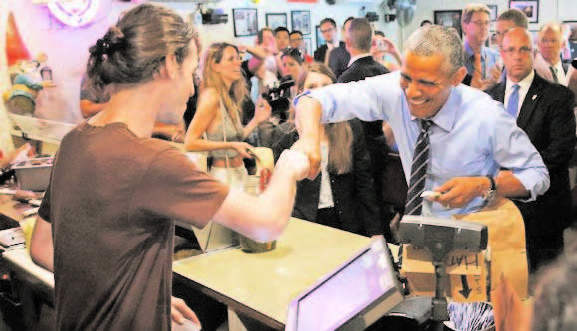
    HOUSTON (TIP): US President Barack Obama apologetically jumped the queue at a famous barbecue joint in Austin, where no one cuts the line, so he could order takeout for his official travel party and paid for the two people he jumped ahead of. After a campaign-style speech in Austin on Thursday to raise money for the Democratic Party, Obama made a stop by Franklin Barbecue and was quickly ushered to the front of the line. It’s common practice to let a president cut to the front of the line at a dining establishment.

    After all, the president arguably has the busiest schedule on the planet. Owner of this ten-year-old joint, Aaron Franklin said no one is allowed to cut the line at his restaurant, but he made an exception for the President. Franklin and his daughter took a picture with the President. Apologizing to two people at the front of the line for cutting in front of them, Obama offered to buy them lunch, along with a big order of takeout to take on Air Force One. The total order came to over $300.

    “I feel real bad, but, I’m gonna cut,” Obama said. “Because these folks were in front of me, I’m buying for them,” he told the workers behind the counter. The President ordered around 8 pounds of meat, 6 pounds of which went for Bruce Finstad of Houston and his daughter Faith Finstad of Austin, the lucky pair at the front of the line, and their two seated companions.

  • US anthrax probe reveals new bird flu mishap, widespread safety lapses

    US anthrax probe reveals new bird flu mishap, widespread safety lapses

    WASHINGTON (TIP): Federal health officials on July 12 disclosed a new safety breach at a high-security US government laboratory involving dangerous avian flu, a lapse that came to light as they investigated the potential exposure of researchers to live anthrax bacteria. The US Centers for Disease Control and Prevention said an internal probe found multiple failures by individual scientists and a lack of agency-wide safety policies led to the potential exposure of more than 80 lab workers to live anthrax at its Atlanta campus last month. Researchers in a high-security bioterror lab sent samples of what they thought were inactivated bacteria to colleagues in a lower-security lab, with fewer protections.

    Investigators also discovered a previously unreported incident: Workers at a separate high-security CDC influenza lab sent samples containing a dangerous strain of bird flu to counterparts at the US department of agriculture in March. Mishandling avian flu could have far graver consequences than anthrax does, though no one has been found to have been infected in either case. The two incidents represent the latest in a series of breaches at the CDC in the last decade that are drawing fresh scrutiny from Congress, including questions about the agency’s ability to oversee potentially dangerous research.

    The CDC said its findings provide a “wake-up call” to overhaul the standards governing experiments with deadly pathogens nationwide. Biosecurity has focused on “how to keep bad guys out of the lab,” Michael Osterholm of the University of Minnesota and a member of the National Science Advisory Board for Biosecurity, which advises the federal government, said in a telephone interview. “One of the critical issues we need to focus on is the good guys who just forget to do it safely.”

    The CDC’s director, Dr Thomas Frieden, called the bird flu incident “the most distressing,” in part because it occurred six weeks ago but was not reported to senior agency leadership. “I learned about it less than 48 hours ago,” he told reporters in a teleconference, adding that the events likely “have people questioning government.” “We need to look at our culture of safety throughout all of our laboratories,” Frieden said. “I’m upset, I’m angry. I’ve lost sleep over it and I’m doing everything I can to make sure it doesn’t happen again.” Frieden also pointed to the discovery this month of six vials of smallpox in an unused room at the National Institutes of Health campus in Bethesda, Maryland, near Washington.

    Frieden disclosed on Friday that two of the vials dated from 1954 contained live smallpox virus, a global scourge for centuries. The CDC’s anthrax report does not name any of the responsible individuals. Frieden said the CDC would discipline any staff who knowingly violated research procedures or failed to report a lab breach. “These repeated safety failures raise grave concerns about the CDC’s ability to ensure strict procedures, protocols and training are followed,” said representative Tim Murphy, chairman of a House Energy and Commerce subcommittee that has called Frieden to testify on July 10.

    The Senate Health, Education, Labor and Pensions Committee is also pressing US department of health and human services, which oversees the CDC, for answers, according to a letter to HHS secretary Sylvia Burwell. An HHS spokesman said the CDC has outlined “corrective actions” to prevent future mishaps at its laboratories. “Dr Frieden is leading those efforts,” the spokesman said. CDC is suspending any transfers inside or outside the agency of biological materials, including infectious agents and even inactivated specimens, from high-biosecurity labs. Both the CDC bioterror lab that handled the anthrax bacteria and the agency’s influenza lab are closed pending further study of what happened.

    Bird flu concerns
    Outside experts agreed that shipping what CDC scientists believed were samples of a fairly benign form of influenza but which were mixed with the highly pathogenic H5N1 bird flu was even more alarming than the anthrax incident. “The last place you want to be mixing up samples is in influenza,” said Osterholm. “The ability for that to jump from the lab bench to the community is substantially greater.” H5N1, although highly lethal, is not easily transmitted from one infected person to another, which would limit its spread in case of a lab-acquired infection or an escape from a lab.

    Other scientists raised alarm over the CDC disclosure that the same lab responsible for the anthrax incident had a similar lapse in 2006, when researchers transferred what they thought was inactivated bacteria to another facility. “That the same kind of incident can recur shows that the CDC does not learn from its own mistakes,” molecular biologist Richard Ebright of Rutgers University and an expert on biosafety said in a telephone interview. Just a year earlier, the CDC published recommendations on how to prevent shipments of what scientists believe to be inactivated anthrax but which are in fact viable.

    The anthrax probe
    In the anthrax case, investigators found that the scientists failed to follow an approved study plan that met safety requirements and lacked standard procedures to document when microbes are properly inactivated. The researchers were not aware of the most recent scientific literature on how best to inactivate the bacteria. Once CDC officials were alerted to the breach, their response also fell short. For instance, CDC scientists in other labs first learned of the event not through official communication but “by witnessing CDC closing and/or decontaminating laboratories,” the report said.

    deficiencies noted in the report included inconsistent decontamination procedures in the affected labs and a lack of clear command for handling the incident in the first week after it occurred. To prevent future mishaps, CDC is creating a “lead laboratory science” position to be accountable for safety and setting up an external advisory committee on biosafety. Rutgers’ Ebright suggested that an outside agency should oversee CDC’s work with dangerous pathogens. “Without removing the responsibility for oversight from the very organization that carries out the work, it’s hard to think that the recommendations will really be implemented,” he said.

  • California man sentenced to 15 years for espionage

    California man sentenced to 15 years for espionage

    OAKLAND (US) (TIP): A federal judge has sentenced a California chemical engineer to 15 years in prison and fined him USD 28.3 million for a rare economicespionage conviction for selling China a secret recipe to a widely used white pigment. US District Court Judge Jeffrey White in Oakland said Liew, a naturalised US citizen, had “turned against his adopted country over greed.” A jury previously convicted the 56-yearold Liew of receiving USD 28 million from companies controlled by the Chinese government in exchange for DuPont Co’s pigment technology for making cars, paper and a long list of everyday items whiter.

    Along with the USD 28.3 million Liew was ordered to forfeit and pay to DuPont, the engineering company launched by him and his wife was fined $18.9 million. White expressed doubt yesterday that Liew would pay back much of his debt. White noted that US authorities had managed to trace USD 22 million of the $28 million received by Liew to various Singapore and Chinese companies controlled by Liew’s in-laws before losing the trail. “We’ll never get it,” White said. “It has been spirited out of the country.” Liew and his wife, Christina Liew, launched a small California company in the 1990s aimed at exploiting China’s desire to build a DuPont-like factory to manufacture the white pigment known as titanium dioxide.

    The Liews hired retired DuPont engineers and, according to the FBI, paid them thousands of dollars for sensitive company documents laying out a process to make the pigment. Two former DuPont engineers have also been convicted of economic espionage. Another engineer committed suicide in early 2012 on the day he was to sign a plea bargain acknowledging his role in the conspiracy. Except for a few months of release on bail, Liew has been in jail since his arrest in 2011. Wearing yellow jail garb and with his wife and family looking on from the gallery, Liew apologised for his actions. “There are many things I would have liked to have done differently,” Liew told the judge. “I regret my actions.” Liew was born on a farm in Malaysia to Chinese parents and went on to earn advanced degrees in chemical engineering.

  • JAITLEY PUTS MONEY IN THE HANDS OF TAXPAYERS

    JAITLEY PUTS MONEY IN THE HANDS OF TAXPAYERS

    NEW DELHI (TIP): The salaried class has reason to cheer the NDA government’s first Budget. Finance Minister Arun Jaitley has reduced the income tax burden, albeit in a minor way, and put some extra money in the hands of the salaried taxpayer. First, he has increased the basic exemption limit by Rs. 50,000 to Rs. 2.5 lakhs for taxpayers less than 60 years of age. The limit will increase by a like amount for senior citizens from Rs. 2.5 lakh to Rs. 3 lakh. Second, he has increased the tax-free savings limit under Section 80C of the Income Tax Act from Rs. 1 lakh to Rs.1.5 lakh. Those who have bought a new house and are paying an EMI have additional cause to cheer.

    The limit for deduction of interest paid on housing loan in the case of self-occupied property has been hiked to Rs. 2 lakh from Rs.1.5 lakh. For taxpayers in the Rs. 5-lakh annual income slab, the savings in tax will be Rs. 10,300 while for someone in the Rs. 10-lakh slab, the tax outgo will be lower by Rs. 21,579, as per calculations by accounting firm EY. The increase in basic exemption limits and under Section 80C have been long-standing demands of taxpayers given that inflation has eroded the value of the current limits.


    36

    Analysts, while commending the overdue concessions, point out that Jaitley could have been a little more generous. The Section 80C limit could have been hiked by Rs.1 lakh (as opposed to Rs. 50,000 now) given that the government is keen to divert household savings to financial instruments from physical assets. For those who travel abroad, the Finance Minister has added an additional incentive in the form of a higher baggage allowance which goes up from Rs. 35,000 to Rs. 45,000.

  • BUDGET IS ‘SANJEEVANI’ FOR MORIBUND ECONOMY, SAYS MODI

    BUDGET IS ‘SANJEEVANI’ FOR MORIBUND ECONOMY, SAYS MODI

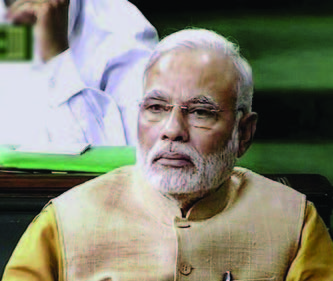
    NEW DELHI (TIP): Describing the general Budget as a ‘sanjeevani’ (new life) to the “moribund economy”, Prime Minister Narendra Modi on July 10 said it converts hopes and aspirations of the people into trust and is in line with his government’s endeavour to bring India out of crisis. “This Budget is a new ray of hope for the poor and downtrodden sections of society,” he said commenting on the maiden budget of his government presented in Parliament on July 10.

    The Prime Minister stated that despite the “testing times”, his government is committed to extend every possible help to the poor, the neo-middle class and the middle class, inspired by the mantra of ‘Sabka Saath, Sabka Vikas’. Assuring the people that the government is leaving no stone unturned in developing India and rid the nation from the challenges it faces, he said for the “moribund economy”, this budget has come as “a sanjeevani and an arunoday (sunrise) for the last man in the line”. He said his government is committed to and confident of bringing India out of crisis, which is due to the capabilities and strength of 125 crore Indians. “This strength would be channelled towards taking the country to new heights.”

    He said the Budget is in line with making India skilled and digital, guided by the usage of the latest technology. Congratulating Union Finance Minister Arun Jaitley, he said, “The Budget will give an impetus to Jan Bhagidari (people’s participation) and Jan Shakti (people’s power).” Modi said development should be all-encompassing (“samaveshak, sarvadeshak, sarvasparshi”) and should also reach those parts of the country which have so far remained underdeveloped.

    The Prime Minister said the Budget will give a ray of hope to the housewife who is being burdened by rising prices and place utmost importance to women empowerment and girl’s education. Recalling that the entire world had immense expectations from India, he said, however, that the way the entire economic system crubled in the last decade, not only India but the entire world lost hope and there was an atmosphere of pessimism. “Since we formed the government, there were discussions about whether this government can free the nation from crisis but the Railway Budget and Thursday’s General Budget show that we are moving in the right direction,” Modi said.

    He referred to the innovative provisions in the Budget for the development of tribal communities and schemes for giving an impetus to skill development for youth. “The Budget is in line with the government’s vision to create a skilled and digital India,” he said. He talked about the measures proposed for the farmers such as ‘Krishi Sinchai Yojana’ that would benefit farmers and achieve the guiding principle of ‘per drop, more crop’ He also mentioned the provisions in the Budget for the cleaning of the Ganga. He reaffirmed the government’s commitment to make India self-reliant in the defence sector.

  • RS 7,060 CRORE FOR 100 SMART CITIES

    RS 7,060 CRORE FOR 100 SMART CITIES

    NEW DELHI (TIP): Finance Minister Arun Jaitley’s big push for smart cities in Thursday’s Union Budget will finally provide fresh direction and a sense of legitimacy to a concept that has long been popular but not enthusiastically implemented. Jaitley set aside a sum of Rs. 7,060 crore for the development of 100 smart cities, which was originally promised in the Bharatiya Janata Party’s election manifesto.

    “As the fruits of development reach an increasingly large number of people, the pace of migration from the rural areas to the cities is increasing. Unless new cities are developed to accommodate the burgeoning number of people, the existing cities would soon become unliveable,” Jaitley said. The cities will be developed as satellite towns of larger cities and by modernising existing mid-sized cities. The basic premise of any small city is making infrastructure network and delivery of services more efficient.

    This is done across verticals such as telecommunications, logistics, water and gas supply through methods such as smart meters, sensors and global positioning systems. In India, setting up smart technology in established cities takes a much longer gestation period as most of these cities were not built keeping technology advancement in mind. On the other hand, greenfield smart cities that are coming up in and around metros — the ones in the Delhi-Mumbai industrial corridor or the Lodha Group’s Palava city in Mumbai — come with greater potential and turnaround time.

    “I’d say the amount that is allocated is very reasonable and will help in slowly making the smart city concept popular. There are close to 50 smart grid pilot projects being conducted in mid-sized cities around India, but the municipal corporations move slowly as funds for technology-aided development are scarce,” said a top executive at an American conglomerate that is currently participating in a number of Indian smart city projects.

  • Rs. 5,000 cr hike for Defence, 49 per cent FDI allowed

    Rs. 5,000 cr hike for Defence, 49 per cent FDI allowed

    NEW DELHI (TIP): Finance and Defence Minister Arun Jaitley in his budget speech on July 10 announced that foreign companies would now be allowed 49 per cent stake in companies involved in manufacturing military equipment — a clear signal of the Modi Government’s aspiration to infuse foreign capital to modernise the domestic defence industry. The fresh policy direction from the government is accompanied with the Rs. 5,000 crore hike in defence allocation over the previous interim budget. However, the pattern of the modest increase reveals the government’s intent to step up modernisation of the Army, along with a renewed focus on indigenously developed weaponry.

    Jaitley also announced that Rs. 1,000 crore were being earmarked for strategic railway projects in border areas, a decision that resonates with bouts of tension that are yet to abate along India’s borders with Pakistan and China. A similar amount was allocated to fine-tune the “one rank one pension” scheme for the armed forces. Out of the total allocation of Rs.2,29,000 crore, the Army has got Rs. 1,18,867.23 crore, which is 51.91 per cent of the total defence kitty. But significantly, a sum of Rs. 25,197.91 crore — much more than the allocation in the interim budget — are to be spent on the capital head, signalling a fresh thrust on inducting new equipment in the Army, which is in the process of raising a mountain strike corps, equipped with a “Quick Reaction Force,”armed with credible aviation assets.

    Significantly, the budget allocates Rs. 2,127.99 crore for aircraft and aero-engines, marking a nearly 80 per cent increase over the previous budget under this head. The capital intensive Air Force gets Rs.53,817.02 crore — a 23.50 per cent of the total. The navy, which is going ahead with its new submarine and aircraft carrier projects, has been allocated 15.36 per cent of the total budget, with Rs.21,190.93 crore being channeled under the capital head. With the government focusing on indigenously developed weaponry, the Defence Research and Development Organisation (DRDO) has got Rs. 15,282.92 crore, amounting to 6.67 per cent of the total. But when combined with Rs.2,481.99 crore allocated to ordnance factories, the combined figure jumps to 7.75 per cent of the total.

  • BUDGET A VALIDATION OF UPA POLICIES: CHIDAMBARAM

    BUDGET A VALIDATION OF UPA POLICIES: CHIDAMBARAM

    NEW DELHI (TIP): Former finance minister P Chidambaram, who presented the interim budget ahead of the Lok Sabha polls, has said he is happy to find the BJP government’s first Budget validating the figures presented by him. “The imprint of the UPA government’s policies can be found throughout the Budget speech and in the budget documents,” Chidambaram said in a statement. He said it’s not possible to come out with a “Congress- Mukt Budget”.

    “Welcome to the real world… BJP sought a mandate for Congress-Mukt Bharat.My friend, Arun Jaitley, would have realised that it is not possible to have even a Congress- Mukt Budget,” the former finance minister said. He said Arun Jaitley’s Budget has the imprint of UPA policies on fiscal consolidation, GST, FDI cap in insurance and social sector schemes. “I am glad that Arun Jaitley has acknowledged the basic validity of the numbers presented in the Interim Budget for 2014-15 and has stuck to them…He has also maintained the tax revenue estimates for Corporation Tax, Customs and Service Tax,” he said. Chidambaram referred to the numbers with regard to the fiscal deficit at 4.1% and revenue deficit of 2.9% (marginally lower than 3%).

    Mamata: Budget visionless
    KOLKATA: Chief minister Mamata Banerjee came down heavily on the NDA for what she called a ‘visionless, missionless and actionless’ budget as far as the common man is concerned. According to her, the first Union Budget tabled by the Narendra Modi government can’t stimulate growth or lead to development of the poor. “We heard about a strong and vibrant India before the government came to power.

    We thought that it will be delivered to provide good governance. But from the beginning, we are getting disappointed. Only one positive sign of the new government is established in two budgets that they have become a government of the FDI, by the FDI and for the FDI. Already, there is FDI in the retail. Now FDI is increased to 49% in Defence, and Insurance Sectors. In addition, disinvestment in banking sector is up to 49%.

  • What goes up

    What goes up

    Cigarettes, Cigars, Tobacco products, Gutkha and pan masala, Jarda scented tobacco, Aerated drinks containing added sugar, Some telecom products, Radio Taxi, Imported electronic products, Portable X-ray machines, Half cut/broken diamonds

  • What goes down

    What goes down

    Mobile phones, Imported computers, components, Smart cards, Footwear, Colour picture tubes, Small LCD TV, Precious & semi-precious colour stones, Diamond, Readymade garments, Flat copper wires, Soaps, Oil, Sports Gloves, Branded petrol, Matchbox, Life micro insurance policies, HIV/AIDS drugs and diagnostic kits, DDT insecticides, RO based water purifiers, LED Lights, fixtures and lamps, E-book readers, Machinery and equipment of solar energy powers, Machinery and equipment of food processing and packaging, Machinery and equipment of compressed biogas plants

  • BUDGET LACKS ROADMAPS: MANMOHAN SINGH

    BUDGET LACKS ROADMAPS: MANMOHAN SINGH

    NEW DELHI (TIP): The Modi government’s first budget is short on that one big idea, or, indeed, a clear road map on how to achieve its objectives — that was the consensus view in the Congress. Much of Finance Minister Arun Jaitley’s budget proposals, the party stressed, were devoted to providing additional allocations for programmes launched by the Manmohan Singh-led UPA government. “This is a budget which could have well been presented by the UPA itself and I am happy the Finance Minister is keeping to the fiscal deficit target, and hope he achieves it,” former Prime Minister Manmohan Singh said on July 10.

    Asked whether the NDA government’s budget will kick-start growth, he said, “There is no road map, … nothing on specifics; like the rail budget, there is nothing to show.” While Congress spokesperson Abhishek Manu Singhvi said the budget lacked any new idea, he acknowledged there was an emphasis on the defence sector – substantial allocations on border management, increase in capital expenditure as well as the proposal for increase in FDI in defence.

    The former Union Minister Jairam Ramesh, like his party colleagues, stressed that Jaitley’s budget did not show any signs of a directional change. He, however, said that Mr Jaitley was constrained by the fact that he just had 45 days in which to prepare his budget, a limitation that only one Finance Minister – in his memory – had overcome: Dr Manmohan Singh’s epochal budget in 1991, a budget that irrevocably changed the direction of the Indian economy.

  • Housing for all by 2022

    Housing for all by 2022

    NEW DELHI (TIP): Union Finance Minister Arun Jaitley announced a big boost for urban areas through 100 smart cities, which will be enabled with the latest technology and infrastructure and will have concepts such as sustainability, walking spaces and specialised domains. The smart cities will have Wi-Fi connectivity, GIS-based mapping and scientific and strategic town planning and integrated public transport systems.

    Mr. Jaitley said the concept of smart cities was in keeping with the times since a “neo middle class is emerging” which aspires for better living standards. He also announced that the government would focus on providing infrastructure, including public transport, solid waste disposal, sewerage treatment and drinking water, in the urban areas. The budgetary provision for the Pooled Municipal Debt Obligation Facility has been enhanced from Rs. 5,000 crore to Rs. 50,000 crore with extension of the facility by five years to March 31, 2019.

    Jaitley said this facility was set up in 2006 with participation of several banks to promote and finance infrastructure projects in urban areas on shared risk basis. It is the vision of the government to create at least 500 habitations with provisions for safe drinking water and sewerage management, use of recycled water for growing organic fruits and vegetables, solid waste management and digital connectivity through publicprivate partnerships (PPPs), he said.

  • UK fights for Britons killed in Gujarat riots

    UK fights for Britons killed in Gujarat riots

    LONDON (TIP): Britain has asked India to speed up action against the killers of three Britons murdered during the 2002 anti-Muslim riots in Gujarat. Foreign secretary William Hague made the request while raising British concerns about the delay in justice for the three during his recently-concluded India visit. “The Foreign Secretary raised this case during his call on Foreign Minister Sushma Swaraj, the appropriate person to raise consular issues with,” said a foreign office spokesperson. “The foreign secretary raised our concern about the delays in taking forward these cases and undertook to follow up with more detail in writing. Mrs Swaraj took note of our concerns.” British brothers Saeed and Shakil Dawood were killed along with their friend, Mohammed Aswat. They were among over 1,000 people, mostly Muslims, killed in the riots.

    The three men of Gujarati origin were visiting the state as tourists when they were killed. The remains of the three are yet to be returned even after 12 years. Six men were initially charged with the murders. But they were released on bail and a number of key witnesses turned hostile. The Dawood family is running a campaign to get justice for them. “Whilst returning from an excursion trip to see the Taj Mahal, their (the trio’s) adventure turned into a nightmare. Within hours of crossing the Gujarat border, a roadblock, manned by a well-organized mob fuelled by religious hatred, stopped the British tourists,” the family said in a statement.

    The mob circled the jeep and asked the occupants their religious identity. “The tourists answered they were British citizens and were Muslims. The hired driver was then dragged out of the jeep and attacked with sticks and killed on the spot,” the statement said. “His body was then thrown back into the vehicle and set alight. In the meantime, the British tourists were chased to a nearby farm. Mohammed Aswat and Imran were stabbed and left to dead.

    Imran miraculously survived and he recalls Saeed and Shakil pleading with the mob to spare all their lives.” The family said it has endured this terrible tragedy and their grief is compounded by the lack of serious Indian police investigation. “The family has had to visit the crime scene themselves, find vital clues and collate forensic evidence including the charred remains of bodies,” the statement said.

  • PROSTITUTE LEFT GOOGLE EXECUTIVE TO DIE ON BOAT: POLICE

    PROSTITUTE LEFT GOOGLE EXECUTIVE TO DIE ON BOAT: POLICE

    SANTA CRUZ, CALIFORNIA (TIP): As a Google executive lay dying on his yacht, an upscale prostitute casually walks over him, picks up her clothes and heroin and swallows the last of a glass of wine before lowering the boat’s blinds and walking back on the dock to shore, police say surveillance footage shows. Authorities charged Alix Tichelman, 26, with manslaughter on Wednesday for her role in the death of Forrest Hayes, who was found dead by the captain of his 50-foot (15-meter) yacht last November.

    Police said the surveillance video from the yacht shows everything that happened from the time Tichelman came aboard to when she left. Santa Cruz Deputy Police Chief Steve Clark told the Associated Press on Wednesday that Hayes, 51, had hired Tichelman before, and that their November 23 encounter “was a mutually consensual encounter including the introduction of the heroin.” Clark said it appears this might not have been the first time she left someone in trouble without calling police or trying to help. Without elaborating, he said his agency is cooperating with police in a different state on a similar case.

    “There’s a pattern of behavior here where she doesn’t seek help when someone is in trouble,” he said. News vans gathered outside Hayes hilltop estate overlooking the glittering Monterey Bay, where the five-bedroom home is on the market for $4.2 million. Hayes’ widow has not spoken publicly and a blog created in his memory was deleted. On the website, friends and coworkers were seemingly unaware of how he died. They fondly described their time together, Christmas parties on his boat, engineering teams at Sun Microsystems, traveling to China for Apple and most recently at Google, where they said he was involved in the Glass eyewear projects.

    Clark said it’s not clear if Hayes was a frequent drug user, and that in the video, it appears he needed Tichelman to help him shoot up. Clark described Tichelman as a high-end prostitute, who charged $1,000 and lived three hours away in the Sacramento suburb of Folsom. He said she had other clients from Silicon Valley, home to about 50 billionaires and tens of thousands of millionaires. “There’s no question that Silicon Valley feels different than it felt 28 years ago when I moved here,” said Russell Hancock, president of Joint Venture Silicon Valley, an organization focused on the local economy and quality of life.

    “Something has happened. We used to be a Valley full of techies living middle class lives, and now we’re a Valley of the uber-rich carrying toy poodles around with them.” Tichelman was arrested on July 4 after police said a detective lured her back to the Santa Cruz area by posing as a potential client at an upscale resort. Clark said they didn’t just arrest her because they didn’t know exactly where she lived, and they were concerned she would flee. Police said Tichelman boasted she had more than 200 clients and met them through a website that purports to connect wealthy men and women with attractive companions.

    Her clients included other Silicon Valley executives, Clark said. Tichelman’s father has ties to the tech industry. Folsom software firm SynapSense announced hiring her father, Bart Tichelman in 2012. Neither the firm nor her father responded to immediate requests for comment. She is being held on $1.5 million bail after appearing in court Wednesday wearing red jail scrubs. Santa Cruz Superior Court Judge Timothy Volkmann approved a request from Tichelman’s court appointed attorney, Diana August, to continue the arraignment until July 16. August did not immediately return a call seeking comment.

    Assistant District Attorney Rafael Vazquez said authorities are still investigating and may file more serious charges. Santa Clara University Finance professor Robert Hendershott said financial windfalls like those seen in the Silicon Valley often bring problems as people have trouble managing their newfound wealth. But he said there’s no obvious hedonistic culture in the Silicon Valley. “There’s no Great Gatsby type of parties famous in the Silicon Valley,” he said.

  • Bobby Jasoos

    Bobby Jasoos

    Story: Bobby desperately wants to be a proper jasoos – what happens when a mysterious stranger hires her to track young girls? Review: So, Bobby Jasoos is a Hyderabadi pearl of a movie, worn with terrific aplomb by its star Vidya Balan. Playing the 30-year-old Bilquis or Bobby, who has no detective course but fearless passion, Vidya dazzles as Bobby Jasoos, tracking mysteries as a buck-toothed palmist, a dreadlocked sadhu, a hobbling fakir – suddenly distilled into a tongue-tied girl who discovers love. Bobby lives in Mughalpura’s tight, twisting lanes, supported by her adoring mother Zebo (Pathak), censured by her stern father, criticized by her marriagearranger aunt.

    Bobby’s determined to crack cases and make her family proud – but what happens when a rich stranger Anees Khan (Kumar) hires her to track young girls? And when she finds herself engaged to cocky TV star Tasavvur (Ali) – who wants her to reject him? Vidya runs away with Bobby Jasoos. She is both the film’s hero and heroine, performing with deft innocence, presenting Bobby like a breeze. But her leading man Tasavvur is also nailed by Ali Fazal, who captures the ‘Alert India!’ star’s urge for ‘lifestyle banana’ with the comedy of getting hooked to madcap Bobby – and the sudden, delicate power of discovering love.

    Ali impresses with his acting while Arjan Bajwa, as local goonda Lala, impresses with his smouldering looks, soorma and stubble making Bajwa steamier than ever before. Alongside, supporting actors lend colour to the canvas, Tanvi Azmi standing out in a small, sharp role as Bobby’s tart-tongued khaala, Rajendra Gupta credible as Bobby’s disgruntled dad, the jasoos’ merry men, Shetty, Munna and Suhail, leaving a fine imprint upon the tale. The cinematography delights – with the steam from chai escaping into an afternoon of green-leafed rain, Bobby Jasoos clearly boasts a cinematographer (Vishal Sinha) who thinks. With a music director (Shantanu Moitra) who feels, his score unobtrusive, yet pleasing, ‘Arziyaan de raha dil’ specially exquisite. There are slight drawbacks – the acting sometimes slips into sit-com mode while the second half relaxes where it could’ve been more taut. But quibbles aside, Bobby Jasoos is a clever and joyful film.

  • NARGIS FAKHRI: NOT JEALOUS OF JACQUELINE

    NARGIS FAKHRI: NOT JEALOUS OF JACQUELINE

    It’s Nargis Fakhri’s dream to do a movie with Salman Khan but right now she has to be content with an item song with him in “Kick”. But this does not make her jealous of the film’s leading lady Jacqueline Fernandez. “I am not jealous of Jacqueline because even I am getting an opportunity to be part of an item song. Of course, in future I would love to work with Salman in a film…that would be a dream and I hope it comes true,” the “Rockstar” fame actress said. “Kick” marks producer Sajid Nadiadwala’s directorial debut.

    Talking about her dance number with Salman, she said: “It’s very underground, edgy and sexy dance number. I was a little worried what if I missed out on steps, but he ended up being the best person ever and I had so much fun. “He has great energy and great sense of humour and I think his energy was making me feel very comfortable and happy. Overall it’s an amazing experience.”

  • ANUSHKA SHARMA GAINS 35 KG FOR BOMBAY VELVET

    ANUSHKA SHARMA GAINS 35 KG FOR BOMBAY VELVET

    No, the waif-like actress did not pile on the pounds but was weighed down by an elaborate gown which she dons for the role of a jazz singer in Bombay Velvet. Anushka Sharma wears the green and gold number, designed by costume designer Niharika Bhasin Khan, for her opening song in the period drama. The sequined gown, with a long train, is covered in applique flames and Anushka needed plenty of help to carry off the heavy-duty number, literally. “The scene sees her behind the mic in a club.

    It took her two-and-half hours to dress and two assistants had to carry the train for her. Thankfully she did not have to dance in it,” says Niharika. The National Award-winning designer (The Dirty Picture), who collaborated with Anushka on her 2010 film Band Baaja Baarat, says that weight was not the only challenge they faced. “The prep was on for a year but the dress was damaged in transit. The upper half was ruined in the Sri Lanka rains. We had to re-do the damaged part,” says Niharika who designed a total of 144 outfits for Anushka’s turn in the film.

  • SCARLETT JOHANSSON’S ALL SET TO THRILL YOU

    SCARLETT JOHANSSON’S ALL SET TO THRILL YOU

    An action packed thriller, Lucy, starring Scarlett Johansson and Morgan Freeman is the story of a woman accidentally caught in a dark deal. She turns the tables on her captors and transforms into a merciless warrior evolved beyond human logic. Written and directed by Luc Besson, Lucy will release in cinemas across India in August 1, 2014. Based on the hypothesis that humans use only a small portion of their brains at any given time, this is the story of Lucy (Johansson), a carefree young student living in Taiwan who is tricked by her boyfriend and held hostage by the merciless Mr. Jang (CHOI MIN SIK),whose thugs surgically implant in Lucy a package loaded with a powerful synthetic substanceone that would likely kill her if it were to leak.

    When the chemical is accidentally unleashed in and absorbed by Lucy’s system, her body begins the unimaginable: her cerebral capacity is unlocked to startling, and previously hypothetical, levels. As she attempts to comprehend and incorporate the incredible changes in her mind and body, Lucy begins to feel everything around her-space, air, vibrations, people, even gravity-and develop superhuman traits including telepathy, telekinesis, expanded knowledge and breathtaking control over matter.

  • EMMA WATSON NAMED UN GOODWILL AMBASSADOR

    EMMA WATSON NAMED UN GOODWILL AMBASSADOR

    British Actress Emma Watson, best known for her role as Hermione Granger in the ‘Harry Potter movie series, has been appointed as the Goodwill Ambassador for UN Women. The UN Women is dedicated to issues of gender equality and empowerment of women. Watson, a humanitarian and recent graduate of the Ivy League Brown University, will dedicate her efforts as UN Women Goodwill Ambassador towards the empowerment of young women and will serve as an advocate for the body’s ‘HeForShe’ campaign in promoting gender equality, the organisation said. Watson described her appointment as Goodwill Ambassador as “truly humbling” and said she will take up her new responsibility with all seriousness since not everyone gets a “chance to make a real difference”.

    “Women’s rights are something so inextricably linked with who I am, so deeply personal and rooted in my life that I can’t imagine an opportunity more exciting. I still have so much to learn, but as I progress I hope to bring more of my individual knowledge, experience and awareness to this role,” the 24- year-old actress said. Under-Secretary-General and Executive Director UN Women Phumzile Mlambo-Ngcuka said Watson “embodies” the values of UN Women.

    “The engagement of young people is critical for the advancement of gender equality in the 21st century, and I am convinced that Emma’s intellect and passion will enable UN Women’s messages to reach the hearts and minds of young people globally,” Mlambo- Ngcuka said. Watson has been involved in the promotion of girls’ education for several years and previously visited Bangladesh and Zambia as part of her humanitarian efforts. Watson is the first Goodwill Ambassador appointment under Mlambo-Ngcuka’s leadership.

  • The Fault in Our Stars

    The Fault in Our Stars

    Story: The film adaptation of John Green’s bestselling novel centers around two cancer-stricken teens, Hazel and Gus, who fall in love knowing theirs won’t be a ‘happy ending’. Review: Most love stories end with ‘and they lived happily ever after’. But what happens when you may not live another day? Will you still fall in love, knowing your time is limited? The Fault in our stars Stays faithful to the book. What you see is what you get. When a practical Hazel (Shailene Woodley) meets the charming and cheerful Augustus Waters (Ansel Elgort) at a cancer support group, sparks fly. He fears oblivion, while she believes it’s inevitable.

    In his company, she discovers there’s a world beyond hospitals, medication, pain and cancer. Their shared passion for books, common fears, and heartfelt talks make the two inseparable, until death comes knocking… If you like feel-good, escapist films, this one’s not for you. The Fault in Our Stars is one of the most unpretentious tragic love stories told in a heart-warming manner. ‘Don’t cry because it’s over, smile because it happened’ pretty much sums up the story. Earnest performances lend depth to the characters, making them come alive.

    Shailene Woodley is brilliantly melancholic while Ansel Elgort displays the complexities of his character with great maturity. The film is not about crying over what you may lose, but learning to live with what you do. After all, it’s not the fear of death that makes you bitter, lack of love does.

  • GAZA DEATH TOLL NEARS 100, ISRAEL DOES NOT RULE OUT GROUND OFFENSIVE

    GAZA DEATH TOLL NEARS 100, ISRAEL DOES NOT RULE OUT GROUND OFFENSIVE

    GAZA/JERUSALEM (TIP): Israel said on July 12 it would not bow to international pressure to end air strikes in Gaza that officials there said had killed almost 100 Palestinians, despite an offer by US President Barack Obama to help negotiate a ceasefire with militants. Asked if Israel might move from the mostly aerial attacks of the past four days into a ground war in Gaza to stop militant rocket fire, Prime Minister Benjamin Netanyahu replied, “we are weighing all possibilities and preparing for all possibilities.” “No international pressure will prevent us from acting with all power,” he told reporters in Tel Aviv a day after a telephone conversation with Obama about the worst flare-up in Israeli- Palestinian violence in almost two years.

    On Friday Washington affirmed Israel’s right to defend itself in a statement from the Pentagon. But defence secretary Chuck Hagel told Israeli defence minister Moshe Ya’alon he was concerned “about the risk of further escalation and emphasized the need for all sides to do everything they can to protect civilian lives and restore calm.” A rocket caused the first serious Israeli casualty — one of eight people hurt when a fuel tanker was hit at a service station in Ashdod, 30 km (20 miles) north of Gaza, and Palestinian militants warned international airlines they would fire rockets at Tel Aviv’s main airport.

    Medical officials in Gaza said at least 75 civilians, including 23 children, were among at least 99 people killed in the aerial bombardments which Israel began on Tuesday. They included 12 killed on July 12. Palestinian President Mahmoud Abbas urged the United Nations security council to order an immediate truce. But Israel said it was determined to end cross-border rocket attacks that intensified last month after its forces arrested hundreds of activists from the Islamist Hamas movement in the occupied West Bank following the abduction there of three Jewish teenagers who were later found killed.

    A Palestinian youth was killed in Jerusalem in a suspected Israeli revenge attack. Israel’s campaign “will continue until we are certain that quiet returns to Israeli citizens”, Netanyahu said. Israel had attacked more than 1,000 targets in Gaza and there were “more to go.” Israel’s military commander, Lieutenant-General Benny Gantz, said his forces were ready to act as needed — an indication of a readiness to send in tanks and other ground troops, as Israel last did for two weeks in early 2009.

    “We are in the midst of an assault and we are prepared to expand it as much as is required, to wherever is required, with whatever force will be required and for as long as will be required,” Gantz told reporters. Western-backed Abbas, who is based in the West Bank and agreed a powersharing deal with Gaza’s dominant Hamas in April after years of feuding, called for international help: “The Palestinian leadership urges the security council to quickly issue a clear condemnation of this Israeli aggression and impose a commitment of a mutual ceasefire immediately,” he said.

    Race for shelter
    After the failure of the latest USbrokered peace talks with Israel, Abbas’s accord with Hamas angered Israel. The rocket salvoes by the hardline movement and its allies, some striking more than 100 km (60 miles) from Gaza, have killed no one so far, due in part to interception by Israel’s partly-US funded Iron Dome aerial defence system. But racing for shelter had become a routine for hundreds of thousands of Israelis and their leaders have hinted they could order troops into the Gaza Strip, a 40-km sliver of coastline that is home to nearly two million people. Some 20,000 reservists have already been mobilized, the army says.

    Hamas’s armed wing said it would fire rockets at Tel Aviv’s Ben-Gurion international airport and warned airlines not to fly to Israel’s main gateway to the world. The airport has been fully operational since the Israeli offensive began and international airlines have continued to fly in, with no reports of rockets from Gaza — largely inaccurate projectiles — landing anywhere near the facility, inland of the coastal metropolis. It is within an area covered by Iron Dome. The Israeli military said it launched fresh naval and air strikes early on Friday on Gaza, giving no further details.

    An air strike on a house in the city of Gaza killed a man described by Palestinian officials as a doctor and pharmacist. Medics and residents said an aircraft also bombed a three-storey house in the southern town of Rafah, killing five people. Later a four-year-old boy killed when a neighbour’s house was targeted by an Israeli raid, a Palestinian hospital official said. Two other people aged 70 and 80 were killed in a missile strike elsewhere in Gaza, the Palestinian Heath Ministry said.

    Homes, many belonging to militants, have been targeted frequently in attacks that have sent Palestinian families living nearby running into the streets in panic. Explosions echo constantly across the densely populated territory. The Palestinian interior ministry in Gaza said an Israeli strike targeted the home of a senior Islamic Jihad leader after darkness fell, at a moment when Israel reported heavy rocket barrages on its southern cities. There were no reports of any casualties in these raids. White streaks arcing into a blue sky, ending abruptly in flashes and dark puffs of smoke marked what the military said was the interception of three rockets over Tel Aviv.

    Lebanese rockets
    Fire was also exchanged across Israel’s northern border. Lebanese security sources said two rockets were fired into northern Israel on Friday but they did not know who had fired them. Israel responded with artillery fire. Palestinian groups in Lebanon have often fired rockets into Israel in the past.

  • Pot clubs: Is Barcelona the new Amsterdam?

    Pot clubs: Is Barcelona the new Amsterdam?

    BARCELONA (TIP): On a recent evening, two vacationing German college students, armed with addresses they had gotten off the internet, were trying to get into one of Barcelona’s new marijuana clubs. They were not members. But no matter. They quickly found a club near the city’s central boulevard, La Rambla, that was willing to ignore the rules, helping them choose from a dozen strains of marijuana for sale in plastic bins before letting them settle into the cushy lounge area to light up. Forty-five minutes later, they were back on the street, smiling.

    “It was very nice,” said one of the students, who had researched cannabis clubs before choosing Barcelona as a holiday destination. “We will go back tomorrow.” The number of cannabis clubs that have opened in Barcelona recently has some experts saying this city will soon challenge Amsterdam as the go-to destination for vacationers who want to get high in peace. Even as Amsterdam has wrestled with drug tourism in recent years, reducing the number of coffee shops where it is legal to buy and smoke marijuana and hashish, about 300 new cannabis clubs have opened in Barcelona and the surrounding Catalan region, a result, at least in part, of enterprising Spaniards looking for new ways to earn a living, experts say.

    It is not that Barcelona officials have given their blessing to this new phenomenon. The clubs are operating under decades-old Spanish laws that allow anyone to grow and smoke marijuana in private or to band together with others to form a cannabis club, as long as it is a nonprofit organization for members only, something like a chess or a cooking club. But in the last three years, new clubs have opened, maily in tourist areas like La Rambla, in many cases circumventing the spirit, if not the letter, of the law. While some clubs refuse walk-in customers like the German students, many of them offer membership (about 20) over the internet or by phone.