Month: July 2017

  • After globalization’s promise

    After globalization’s promise

    By Pulapre Balakrishnan

    Recognizing the diminished tempo of globalization, India’s economic policymakers must address the growth of the home market, which is the demand for goods and services emanating from within the country. The immediate points of action and the appropriate instruments can be identified without much strain on our ingenuity. In the short run or the present, when the global economy is sluggish, only domestic investment can move demand, says the author.


    ‘Hyperglobalist’ has been used to describe the dramatic increase in international trade witnessed for about a decade and a half from the early 1990s up to the global financial crisis of 2008. The imagery intended is one of an increasing connectedness among nations leading to a virtuous cycle of economic expansion.

    By a trait common to every generation, we tend to assume that ours is somehow unique, in this case with respect to globalization. However, if we are to take the long view, we would find that this is no more than a conceit. Starting sometime in the last quarter of the 19th century, for close to 50 years, the world saw an expansion in trade that was actually as great or even greater than during the recently concluded phase. Then had also occurred an unprecedented movement of capital and of people. British capital flowed into building the railways across the world, immigrants moved from Europe to the United States and Asian labor was moved to the sites of deployment of western capital.

    End of a phase

    So, the facts are that the world has seen the waxing and waning of global traffic in goods, capital and people. To be precise, the phase of high trade starting 1870 came to an end with the First World War and was to revive, slowly, only after the Second. Then, following the collapse of East European communism in the early 1990s, there was a resurgence in global trade. Now even this phase has somewhat abruptly ended with the global financial crisis.

    Economists who study trade flows have gone to the extent of claiming that hyperglobalisation was a one-time event unlikely to be repeated. Though some may hold that we ought to shun economists offering predictions with as much diligence as we should beware of enemies bearing gifts, it may pay us to heed their prognosis, for were it to be true, it has implications for economic possibilities in India. Note that even if vigor were to return to the global economy 25 years from now, that would still account for a significant chunk of the working life of an Indian, for which period alternative economic opportunities would have to be found.

    Role of technology

    What underlies the skepticism expressed regarding a revival of global trade? The view is based on the observation that especially 19th century globalization was underpinned by technological advances that facilitated trade. The advent of the telegraph is alluded to along with the invention of the internal combustion engine. The former enabled the communications infrastructure intrinsic to trade and the latter enabled the fast, reliable and cheap transportation of goods across seas. These advances, we are told, dwarf anything since, including the Internet, in terms of their capacity to expand trade. And, none is foreseen in the immediate future.

    This account of how advances in technology fueled trade is of undoubted relevance but remains partial in that it leaves out the role of the growth in demand for these technologies. It was, after all, the growing market for British goods as Indian manufacturing was dislodged following military conquest and as British capital flowed into the laying of a rail network in parts of Latin America and Africa that provided the demand for development of cheaper communication and transportation technology. Therefore, it may as well be said that trade expanded as the demand for goods grew. However, it is yet true that when global demand expands, countries can exploit the trade route to grow their economies. This was the great promise of globalization held out to the developing countries in the 1990s. Now, what does all this have to do with us in India today? A great deal, actually.

    The slowdown and India

    If the world economy is set to grow slowly for the foreseeable future, a premise of much of the economic policy in India since 1991 would have to be replaced. It had been assumed then that globalization was here to stay and India had only to hitch onto its current to ride to prosperity. This India has even successfully done in phases since. Now, however, we need to recognize that the game may have changed substantially — even if not irrevocably, as the experts claim. The shift that has taken place is visible most in the IT industry. Quarterly growth only inches forward there and insecurity grips its particularly young workforce. In retrospect, we can see the hollowness of the boast that had made the rounds a decade ago that India need not bother with manufacturing when it could leapfrog into a service economy led by IT exports. Now, “bricks and mortar” is no longer something to be spurned and soiling our hands may be part of the business of earning our living for some time to come.

    Recognizing the diminished tempo of globalization, India’s economic policymakers must address the growth of the home market, which is the demand for goods and services emanating from within the country. The immediate points of action and the appropriate instruments can be identified without much strain on our ingenuity. In the short run or the present, when the global economy is sluggish, only domestic investment can move demand.

    In India, we have been witnessing slowing or depressed private investment for close to five years by now. There is a view that this has to do with tight monetary policy. It is true that the real lending rate for firms has been rising as inflation is falling. Such a policy stance can be justified only by resorting to the claim that the Reserve Bank of India knows something about future inflation that we don’t, in particular that inflation is set to rise again soon. Barring this possibility, there is a case for cutting the repo rate now, and there is a clamor for this. But there are reasons to doubt the potency of such an action, one each from the supply and the demand sides. Given that they hold non-performing assets, the banks are extremely wary of lending. Any significant resumption of lending by banks may be hostage to their first resolving the bad loans problem. Ditto with the firms, which are themselves debt-laden. Are they likely to take on more of it, just because it is offered at a lower rate, before cleaning up their balance sheets?

    On public investment

    Independently of the ‘twin balance sheet problem’, Keynesian economics has long recognized that lowering the rate of interest may not do much for private investment if the expected rate of return is depressed. The slowing of both global trade and domestic manufacturing may have had precisely this effect by lowering the long-term expectations held by private investors. We do, however, know how to buoy up flagging demand. You do this through public investment. In response to the argument heard at the highest level of policymaking that there are no viable projects to be had, one need only refer to a recent news report on the state of our roads and bridges. It is reported that 23 bridges and tunnels on India’s national highways are over 100 years old, of which 17 require rehabilitation or major maintenance. As many as 123 other bridges in the country require immediate attention and 6,000 are “structurally distressed”. Infrastructure is unique in that spending on it raises aggregate demand and when it actually comes on stream, it raises the productivity of investment elsewhere in the economy. ‘Roads and bridges’ are a metaphor for the public infrastructure that the Indian economy can fruitfully absorb today. For the country’s political leadership, the task is no longer to find trading partners to hug but to buckle down to the heavy lifting of expanding physical infrastructure.

    (The author is Professor of Economics, Ashoka University and Senior Fellow, Indian Institute of Management, Kozhikode)


  • An Unfazed Jeff Sessions decides to stay on despite Trump’s annoyance with him

    An Unfazed Jeff Sessions decides to stay on despite Trump’s annoyance with him

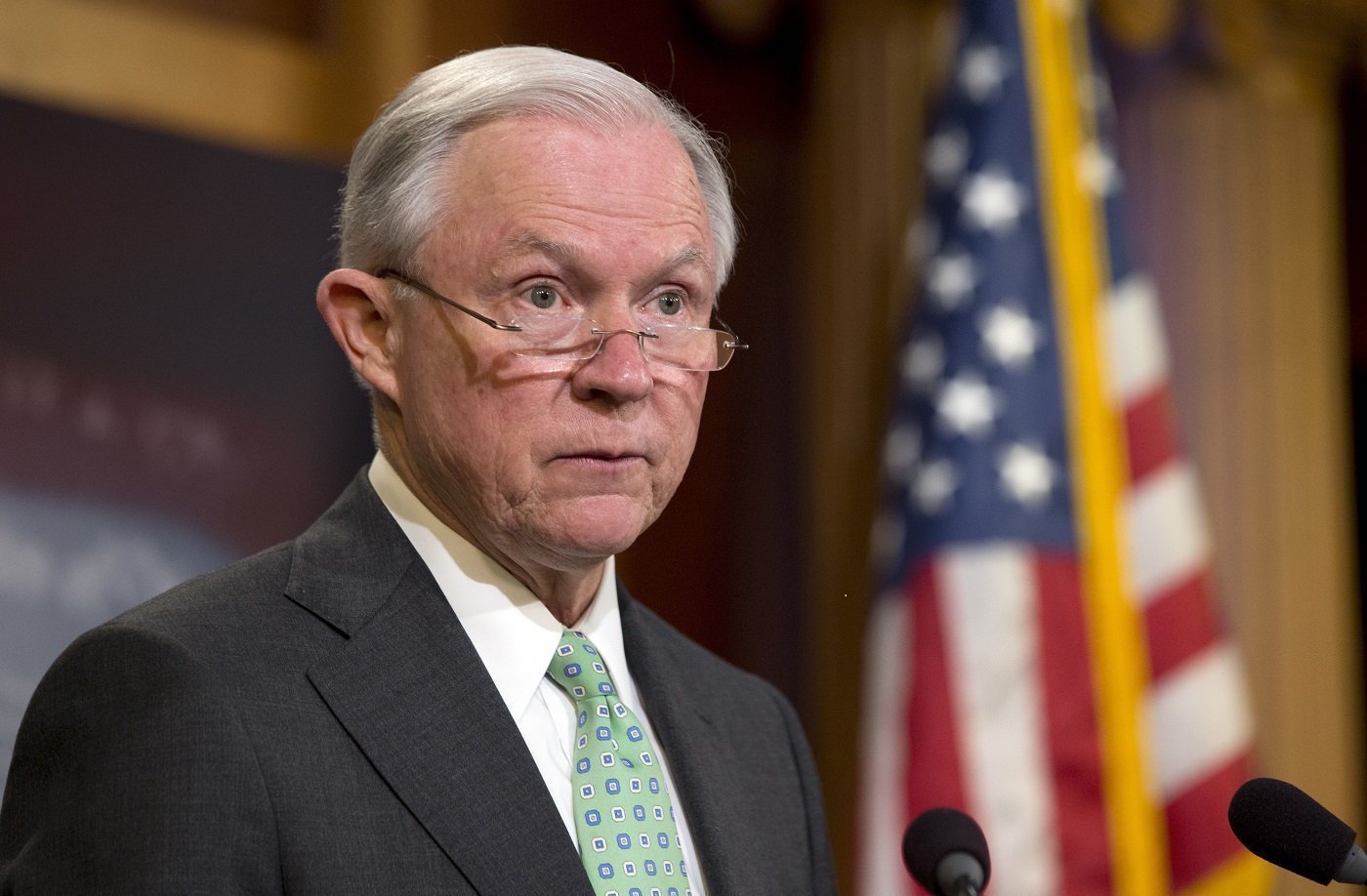
    WASHINGTON (TIP): Attorney General Jeff Sessions says he plans to stay on the job. That wouldn’t be news except that in an interview with The New York Times, July 19, President Trump openly criticized Sessions for recusing himself from Russia investigation.  Trump said that if he knew then what he knows now, he wouldn’t have nominated Sessions to be the attorney general. “Sessions should have never recused himself, and if he would – if he was going to recuse himself, he should have told me before he took the job, and I would have picked somebody else”, Trump said in the interview.

    Sessions said that he had the “honor of serving as attorney general,” and that he plans “to continue to do so as long as that is appropriate.” Asked whether he could keep running the Justice Department given Trump’s comments, he responded: “I’m totally confident that we can continue to run this office in an effective way.”

    Meanwhile, President Trump has no plans to fire Jeff Sessions, his spokesperson said Thursday, July 20, even after his extraordinary attacks cast doubt on the fate of the attorney general and Robert Mueller, the special counsel leading the Russia investigation.

    While Trump still disagrees with Sessions’ decision to recuse himself from the Russia investigation, White House spokeswoman Sarah Sanders said, “clearly, he has confidence in him, or he would not be attorney general.”

  • OJ Simpson Granted Parole

    OJ Simpson Granted Parole

    Early release from Prison in early October likely

    NEVADA (TIP): A Nevada parole board, on July 20, unanimously granted O.J. Simpson early release from the Lovelock Correctional Center. The former football star could be free as soon as October 1.

    Simpson, 70, has served nine years of a nine-to-33-year prison sentence for the 2007 armed robbery and kidnapping in Las Vegas.

    “Are you humbled by this incarceration?” Simpson was asked by a member of the parole board.

    “I wish this never would have happened,” he replied, adding later: “I am sorry that things turned out the way they did.”

    The board told Simpson  his 1995 acquittal wouldn’t be a factor in its decision.

    On Thursday, he told the parole board: “I’ve done my time. I’ve done it as well and as respectfully as I think anybody can … I want to get back to my kids.”

  • Dream Hotel Group Signs New Delhi Location

    Dream Hotel Group Signs New Delhi Location

    Dream New Delhi to Feature 187 Keys and Food Hall Concept by Renowned Chef Todd English

    NEW YORK CITY, NY (TIP):  Renowned hotel brand and management company Dream Hotel Group, on July 17, signed a hotel management agreement with chairman of Viiking Ventures, Sachiin J. Joshi to open Dream New Delhi in 2019.  Joining to celebrate the signing were Dream Hotel Group chairman Sant Singh Chatwal, Dream Hotel Group CEO Jay Stein, Sachiin J. Joshi, Chairman of Viiking Ventures; Rabinder Pal Singh, CFO of Dream Hotel Group; and Todd English, celebrity chef and restaurateur. The event also featured actress Rashmi Nigam as master of ceremonies.

    “I am thrilled to expand our global footprint to India and bring the Dream Hotel brand back to my home country,” remarked Dream Hotel Group chairman Sant Singh Chatwal. “With Dream Hotel Group’s unprecedented growth and high-velocity expansion, we are well positioned to triple our existing portfolio in less than five-years.”

    The signings come on the heels of the company’s largest international expansion news to date with nine new hotel signings across all four brands – Dream Hotels, Time Hotels, The Chatwal and Unscripted Hotels. Dream Hotel Group now boasts its strongest portfolio and its largest/most active pipeline ever.  With 16 hotels open today and an additional 26 properties in the pipeline, Dream Hotel Group is on track to increase its global footprint by 230 percent over the next four years; tripling its existing portfolio by 2022.

    “We are delighted to be partnering with Dream Hotel Group and its dynamic team,” said Sachiin J. Joshi, Chairman of Viiking Ventures. “India is among the fastest growing economies and we are excited to take the hospitality industry in this country to new heights with Mr. Chatwal himself, who is an inspiration to us all in India.”

    “We recently reached an exciting milestone by signing most new hotel deals in the company’s history,” said Dream Hotel Group CEO Jay Stein. “I’m incredibly proud to continue our unprecedented growth momentum with the signing of Dream New Delhi.”

    Todd English, celebrity chef and restaurateur, joined in the festivities to celebrate the signing of Dream New Delhi and the extension of his food and beverage partnership with Dream Hotel Group.

    “I couldn’t be more pleased to extend my partnership with the Dream Hotel Group, this time, on a new venture to create an unforgettable dining experience at Dream New Delhi,” said Chef Todd English. “I’ve always dreamt of bringing my restaurant to India and I can’t think of a more exciting place to establish it.”

    Set to open in the Central Business District of West Delhi, Dream New Delhi features 187 guest rooms and suites and five highly activated dining and nightlife venues including a Food Hall concept by renowned chef Todd English.

  • FIA hosts farewell reception for Ambassador Riva Ganguly Das

    FIA hosts farewell reception for Ambassador Riva Ganguly Das

    FORDS, NJ (TIP):  The Federation of Indian Associations (FIA) of New York, New Jersey and Connecticut in collaboration with the Indian American community, hosted a farewell reception July 18 for Riva Ganguly Das, India’s Consul General in New York, at the Royal Albert’s Palace in Fords, NJ.

    Ambassador Das, who assumed charge in New York in March 2016, was recently named Director General of Indian Council for Cultural Relations by the Government of India, and is scheduled to leave for New Delhi later this week.

    The event, attended by more than 250 members of the Indian American community in New York and New Jersey, was hosted by FIA and sponsored by H R Shah, Dr Sudhir Parikh, Albert Jasani, AAPI (American Association of Physicians of Indian Origin), Drs Sanjay and Kavita Gupta, TV9, Anil Bansal, The Indian Panorama, Malini Shah and FOKANA (Federation of Kerala Associations in North America).

    Presenting a plaque to India’s Consul General in New York, Riva Ganguly Das (center left)

    Many speakers, including FIA chairman Ramesh Patel and president Andy Bhatia, H R Shah, chairman of TV Asia, Anil Bansal, chairman of Indus American Bank, and Prof. Indrajit S Saluja, President of Indo-American Press Club recounted how Ambassador Das had steadfastly interacted with the Indian American community. Speakers also pointed out that Ambassador Das was instrumental in co-sponsoring the International Yoga Day celebrations this year with the New York City Public Advocate’s Office and the Parks Department. Despite her short stint in New York, Ambassador Das was also credited with engaging several US Congressmen and Senators as well as New York city elected officials.

    “When we had a welcome dinner for you over a year ago, there were more than 500 people and at your farewell dinner today we have much less,” said Andy Bhatia. “It is because many are sad to see you leave so soon and have decided not to be here and have you see them in tears.”

    FIA chairman Ramesh Patel was exuberant yet emotional while introducing Ambassador Das at the event. “

    “You have been very helpful and gracious to the cause of FIA and India Day Parade and we wish you all the best,” said Patel.

    Ambassador Das joined the Indian Foreign Service in 1986. A post-graduate in political science from Delhi University, Das was a lecturer at Delhi University before joining the Indian Foreign Service. Following her first foreign posting in Spain, Das has had stints in Nepal, Bangladesh, China, The Hague and Romania.

    Ambassador Riva Ganguly Das speaking at the farewell reception, hosted by FIA, July 18

    In her remarks, Ambassador Das lauded the FIA in “showcasing Indian culture to mainstream communities in New York, aiding in better understanding of Indian immigrants.” She pointed out that it was imperative a direct channel of communication always existed between the Indian Diaspora and the Indian Consulate in New York. “I have always tried to encourage fortnightly meetings between the Indian Consulate and Indian organizations, both cultural and corporate, to be able to understand the concerns of the Diaspora.”

    Among FIA partner organizations represented at the event included, FOKANA (Federation of Kerala Associations in North America), TANA (Telugu Association of North America), Haryana Global Chamber of Commerce, Asian Indian Chamber of Commerce and AAPI (American Association of Physicians of Indian Origin), BAJANA (Bihar-Jharkhand Association of North America).

    The FIA of NY-NJ-CT was formed in 1970 and is among the largest umbrella organization representing over 500,000 Indian Americans in the tristate region. The centerpiece of its efforts culminates in the India Day Parade in New York each year.

    The 37th India Day Parade in New York this year is scheduled for Sunday, Aug 20. The gala banquet is set for Aug 21 at the Royal Albert’s Palace in Fords, NJ.

  • Trump’s son, son-in-law, former campaign manager to appear before US Senate Committee

    Trump’s son, son-in-law, former campaign manager to appear before US Senate Committee

    To answer Lawmakers’ questions about the Trump campaign’s Russian connection in 2016 Elections

    WASHINGTON (TIP): President Donald Trump’s son Donald Trump Jr, son-in-law Jared Kushner and former campaign manager Paul Manafort have been asked to appear before US Senate committee on July 26 to answer questions about the campaign’s alleged connections to Russia, officials said on Wednesday, July 19.

    The three men are the closest associates of the President to be called to speak to lawmakers involved in probing Russian meddling in the 2016 US presidential election and possible collusion with the Trump campaign.

    Trump, who came into office in January, has been dogged by allegations that his campaign officials were connected to Russia, which US intelligence agencies have accused of interfering in last year’s election. Trump has denied any collusion. The US Senate Judiciary Committee said on Wednesday that it had called Trump’s eldest son, Donald Trump Jr, and Manafort to testify on July 26 at a hearing.

    The president’s son released emails earlier this month that showed him eagerly agreeing to meet last year with a woman he was told was a Russian government lawyer who might have damaging information about Democratic presidential candidate Hillary Clinton.

    The meeting was also attended by Manafort and Kushner, who is now a senior adviser at the White House. Kushner is scheduled to be interviewed by the Senate Intelligence Committee on Monday, July 24, behind closed doors. A special counsel, Robert Mueller, is also conducting an investigation of Russian meddling in the US election and any collusion between Moscow and Trump’s campaign.

    The Senate Intelligence Committee is conducting one of the main investigations of Russia’s meddling in the 2016 US election and possible collusion by Trump associates, but the Judiciary committee has been looking into related issues.

    The public Judiciary hearing will look into rules governing the registration of agents working for foreign governments in the United States and foreign attempts to influence US elections. — Reuters

    About one in eight persons who voted for President Donald Trump said they would not do so again after witnessing Trump’s tumultuous first six months in office, according to a Reuters/Ipsos poll of 2016 voters.

    While most of the people who voted for Trump on November 8 said they would back him again, the erosion of support within his winning coalition of older, disaffected, mostly white voters poses a potential challenge for the president.

  • Amazon sells Hanuman leggings despite past Hindu protests on trivializing Hindu gods

    NEVADA (TIP): Upset Hindus are seeking apology and urging online retailer Amazon.com for the immediate withdrawal of leggings carrying images of Hindu deity Lord Hanuman; calling it highly inappropriate.

    “Hanuman the Great” Women’s Leggings are selling at Amazon.com for $48.00 – $58.00 and are described as: “ultimate fashion statement to express your style”.

    Hindus have protested and contacted Amazon.com many times in the past over what they felt was trivialization of Hindu deities on various products sold on its website and had been mostly successful in persuading the company to remove those.

    Hindu statesman Rajan Zed, in a statement in Nevada, said that Lord Hanuman was greatly revered in Hinduism and was meant to be worshipped in temples or home shrines and not to adorn one’s legs. Inappropriate usage of Hindu deities or concepts for commercial or other agenda was not okay as it hurt the faithful.

    Zed, who is President of Universal Society of Hinduism, also urged Amazon.com President Jeffrey P. Bezos to offer a formal apology, besides withdrawing Lord Hanuman leggings, as this was not the first time for the company to offer such products which were deemed offensive by Hindu devotees.

    Zed further said that such trivialization of Hindu deities was disturbing to the Hindus world over. Hindus were for free artistic expression and speech as much as anybody else if not more. But faith was something sacred and attempts at trivializing it hurt the devotees, Zed added.

    Rajan Zed suggested that Amazon.com and other companies should send their senior executives for training in religious and cultural sensitivity so that they had an understanding of the feelings of customers and communities when introducing new products or launching advertising campaigns.

  • Zee making the world a better place says FCC’s Ajit Pai

    Zee making the world a better place says FCC’s Ajit Pai

    WASHINGTON D.C. (TIP): Zee entertainment launched an annual program to identify and honor individuals and organizations who have demonstrated outstanding leadership in the media & entertainment sector.

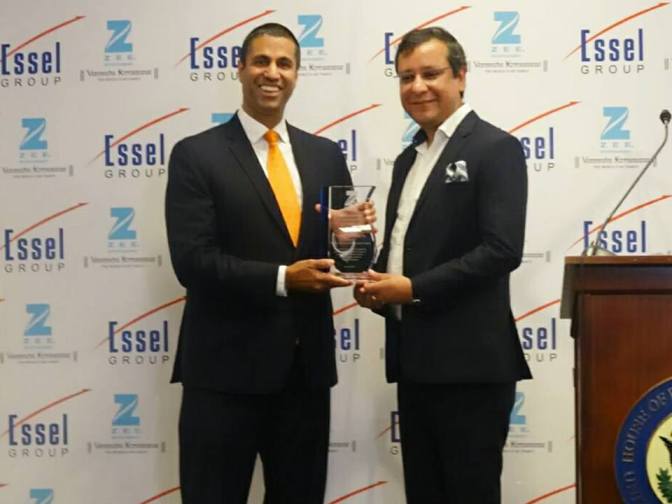
    Chairman Ajit Pai, was conferred with the inaugural “Zee Entertainment National Leadership Awards” at a special event on Capitol Hill this past week. He is the first Indian American to lead the Federal Communications Commission (FCC) in the US. Zee Entertainment is the biggest multicultural programmer in the United States with 35 networks in 14 languages.

    Amit Goenka, CEO International Broadcast Business said, “The selection of our inaugural honoree was not a difficult choice as he demonstrated a great commitment to promoting and protecting consumer interests particularly in our case in the areas of healthy living, wellness, news and entertainment.”

    The exclusive, by invite-only event saw more than 200 people in attendance from Washington DC’s power corridors which included nearly 25 congressmen and other very notable dignitaries. The 44-year old Republican attorney, Ajit Pai came across as very affable, conscious of his humble beginnings and deeply appreciative of his meteoric rise to the top of the federal agency. At the event, Pai acknowledged Dr. Subhash Chandra’s incredible achievement in creating a company like Zee, quite literally from nothing into the multimedia conglomerate that entertains about a billion people worldwide, despite the many roadblocks. Where people did not have the option to watch Bollywood movies at home in the US, Zee pioneered and changed the way people had access to content from India accessible to the Indian diaspora across the world 20 years ago.

    In continuation with Zee’s ethos; “Vasudhaiya Kutumbakam” (The World is my Family), Zee speaks not only to the Indians here but also to millions of Americans via Z Living which is a Health & Wellness network. It is America’s fastest growing network and stands firm behind its mantra “Prevention is better than cure”. Zee also speaks to the millions of Latino audiences in the country through its unique Bollywood in Spanish channel; Zee Mundo.

    An extension to this core belief in Health and Wellness, Zee has a one of its kind Natural Wellness Center, YO1 which stands for Yoga and Oneness. The idea behind this Wellness Center which is spread over 1300 acres in upstate NY is to focus on bringing our mind, body and soul as one.

    Along with Entertainment, Zee strongly believes in giving back to the community with its initiatives like Sarthi, ZEE is Green, Ekal Vidyalaya and the DSC foundation which just donated 1 Billion dollars for social entrepreneurship causes. The Zee is Green initiative was conferred a special Excellence award at IAA Olive Crown Awards 2016 for its leadership in various environmental projects. Also, Ekal Vidyalaya popularly known as A People’s Movement has been educating 1.5 million students across 54,000 free schools in India.

    Since Zee Entertainment has become synonymous with the Indian culture and Indians globally, it was a natural choice for the republican party to engage and partner with Zee Network to engage the Indian diaspora during the Trump Presidential campaign, Zee not only effectively planned and executed a 360 degree campaign, but it also coined the winning phrase; Ab ki Baar Trump Sarkar (This time, A Trump Government). The Republicans were smart enough to understand Indian Americans influence on the larger canvas, said Sameer Targe. Efforts included a Bollywood gala in NJ which had Donald Trump as the keynote speaker and Zee’s own SRGMP singers who were the real crowd pullers.

    (Press Release)

  • Indian American Congresswoman Jayapal, Congressman Cicilline Introduce Resolution of Inquiry for Release of Documents Pertaining to Possible Obstruction of Justice

    Indian American Congresswoman Jayapal, Congressman Cicilline Introduce Resolution of Inquiry for Release of Documents Pertaining to Possible Obstruction of Justice

    WASHINGTON (TIP): After the Department of Justice released a heavily redacted, single-page document confirming that Attorney General Jeff Sessions lied to the FBI about his contacts with the Russian government, House Judiciary Committee members, Representatives Pramila Jayapal (WA-07) and David Cicilline (RI-01) introduced a resolution of inquiry requesting the Trump administration release any and all information pertaining to Attorney General Sessions’ involvement in the firing of FBI director James Comey in violation of his recusal and related matters.

    “For six months, we have watched the Trump administration make a mockery of our laws and the highest office in our land while our Republican colleagues refuse to allow hearings on obstruction of justice and collusion with Russia,” said Rep. Jayapal. “Our resolution of inquiry will force the House Committee on the Judiciary to consider allegations of obstruction of justice involving the Justice Department. The Senate Judiciary Committee is taking action on the matter. We need the Republicans on our committee to wake up and take these issues seriously. We have a duty as members of Congress and the Judiciary Committee to exercise oversight over the administration and the Justice Department.”

    “We’ve known for a while now that Paul Ryan and the Republicans don’t want to work with us on just about anything. That’s true for jobs, tax fairness, infrastructure, workforce training, and health care,” said Rep. Cicilline. “But what’s most outrageous is that they don’t even want to work with us to make sure the American people know the truth about allegations of obstruction of justice involving the Justice Department. There is no more serious responsibility than protecting our democracy and the American people deserve members of Congress who take this responsibility seriously.”

    The two representatives demanded that House Republicans wake up and conduct oversight of the Trump administration. Attorney General Sessions has failed to disclose his meetings with the Russian government, largely ignored his recusal from the Russia investigation and helped to fire the FBI Director under false pretext. On July 13, the Department of Justice released a document that suggests the Attorney General failed to disclose any contacts with foreign governments on his security clearance application.

    The Jayapal-Cicilline Resolution is designed to obtain information about these and other systemic problems at the highest levels of the Trump administration. The Majority has refused to conduct even basic oversight of the Department of Justice. This resolution will force the issue, and leave each member to choose whether the House Judiciary Committee will begin to address these urgent problems or continue to be complicit in the administration’s undermining of justice.

    Jayapal and Cicilline will closely follow ongoing developments specifically pertaining to the role of Donald Trump Jr. and Jared Kushner in potential collusion between the Trump campaign and Russia. If the administration fails to be more forthcoming about these troubling developments, Jayapal and Cicilline plan to amend the resolution to demand more transparency and accountability to the American people.


  • Indian American Congressman’s Amendment to Review Integrity of White House Security Clearances passed unanimously

    Indian American Congressman’s Amendment to Review Integrity of White House Security Clearances passed unanimously

    WASHINGTON (TIP): Indian American Congressman Raja Krishnamoorthi of the House Oversight Committee on July 19 successfully introduced an amendment ordering a review of White House security clearance procedures by requiring the National Background Investigations Bureau to report to Congress on the process for conducting and adjudicating security clearance requests for the Executive Office of the President.

    The Krishnamoorthi amendment comes in the wake of Senior Advisors to the President Jared Kushner and Ivanka Trump, former National Security Advisor Mike Flynn, and Attorney General Jeff Sessions all omitting significant information about foreign contacts from their applications for security clearances. The measure passed the Oversight Committee by a unanimous voice vote and amended H.R.3210, a resolution regarding the national backlog of security clearance investigations.

    Congressman Krishnamoorthi released the following statement on the passage of his amendment:

    “It seems every day we learn of more undisclosed foreign contacts with senior Trump administration officials. In just the last two weeks, we have learned that Senior White House Advisor Jared Kushner failed to disclose his participation in a meeting with a Kremlin-connected Russian lawyer and her associates, including a former Soviet intelligence officer and an individual linked to a federal money laundering investigation. This is just one example of a foreign contact Mr. Kushner failed to disclose when he reportedly omitted more than one hundred from his SF-86 security clearance application.

    My amendment would require the Director of the National Background Investigations Bureau to report to Congress on the processes by which senior administration officials apply for and receive security clearances. Access to our nation’s secrets should demand the highest levels of scrutiny and the strictest adherence to security procedure to protect against compromise by hostile foreign powers.

    Mr. Kushner and other senior administration officials repeatedly failed to disclose their foreign contacts, including those with hostile powers. It is essential that we determine whether this failure puts them or our nation at risk.”

    Krishnamoorthi represents the 8th District of Illinois and serves on Government Reform and Education and Workforce panels and also as the ranking member on the subcommittee on Health Care, Benefits, and Administrative Rules.

  • Indian pharma companies with their plants in the US make it big

    Indian pharma companies with their plants in the US make it big

    NEW YORK (TIP): An Economic Times report says the US markets account for over 40 percent of the total revenue of the top four Indian drug makers. Many members of the Indian Pharmaceutical Association (IPA) have their own plants in the US, even though their main revenue comes from Indian imports.

    Here’s the list of top five Indian companies which have plants in the US.

    Sun Pharma

    The Sun Pharmaceutical Industries Ltd is the largest Indian pharma company in the US, which is also functioning in more than 150 countries all over the world. The company was established by Dilip Shangvi in 1983 and was acquired by another pharmaceutical giant Ranbaxy in 2014.

    Sun Pharma has two plants in New Jersey and has one each in Philadelphia, Detroit, Wilmington, and Chicago. The company markets a large basket of generics in the US, with a strong pipeline awaiting approval from the US Food and Drug Administration (USFDA). The USFDA sent a warning notice to Sun in December 2016 about nine violations at its manufacturing plant in Halol, Gujarat.

    The company requested the USFDA to withdraw approval for 28 Abbreviated New Drug Applications (ANDAs) belonging to its wholly owned subsidiary Ranbaxy Laboratories.

    Lupin

    Lupin Ltd is a transactional pharmaceutical company based in Mumbai founded by Desh Bandhu Gupta. It entered the US generic pharmaceutical market in 2003 as Lupin Pharmaceuticals Inc with the ANDA approval for Cefuroxime Axetil Tablets. It is the fifth-largest generic pharmaceutical company in the US by prescription-led market share and is one of the fastest growing pharmaceutical companies in the US. Headquartered in Baltimore, Maryland, the company has plants in Somerset and New Jersey.

    Lupin received more than 75 FDA approvals till now and it’s US brand business contributed 9% of total US sales whereas the generics business contributed 91 percent during the financial year 2014-15.

    Dr. Reddy’s Laboratories

    Dr. Reddy’s Laboratories was founded by Dr K Anji Reddy in 1984 and is based in Hyderabad, Telangana. The company manufactures and markets a wide range of pharmaceuticals in India and overseas. It began as a supplier to Indian drug manufacturers and later focused on getting approval from drug regulators such as the USFDA.

    Dr Reddy’s have plants in Shreveport and New England, and it is the first Indian company to launch the generic drug, fluoxetine with 180-market exclusivity in the US. In 2001, Reddy’s completed its US initial public offering of $132.8 million, secured by American Depositary Receipts and the company is also listed on the New York Stock Exchange.

    The FDA issues a Form 483 letter to Dr Reddy’s in December 2014 over concerns discovered during an inspection of its Srikakulam facility. No specific violations were mentioned in the letter.

    Cipla

    Cipla is one of the largest pharma companies in India headquartered in Mumbai. In the US, Cipla is headquartered in Miami and has a plant in Long Island.

    The company primarily develops medicines to treat cardiovascular disease, arthritis, diabetes, weight control and depression and other medical conditions. Founded by Dr. Khwaja Abdul Hamied as The Chemical, Industrial & Pharmaceutical Laboratories in 1935, the company changed shorted its name to Cipla Ltd in 1984.

    USFDA approved Cipla’s bulk drug manufacturing facilities in 1985 and under the leadership of founder’s son Yusuf Hamied, the company became a global icon for its role in defying Western multinational pharmaceutical companies in order to provide generic drugs for AIDS and other diseases to treat poor people in the developing world.

    Aurobindo Pharma

    Aurobindo Pharma Limited was founded in 1986 and commenced operations in 1988-89 with single unit manufacturing semi-synthetic penicillin in Puducherry. The company is now headquartered in HITEC City, Hyderabad, and manufactures generic pharmaceuticals and active pharmaceutical ingredients.

    The company makes tablets in its plant in New Jersey and is now gearing up for a second plant in the US after Trump called on to increase local manufacturing.

  • Ram Nath Kovind elected as the 14th President of India

    Ram Nath Kovind elected as the 14th President of India

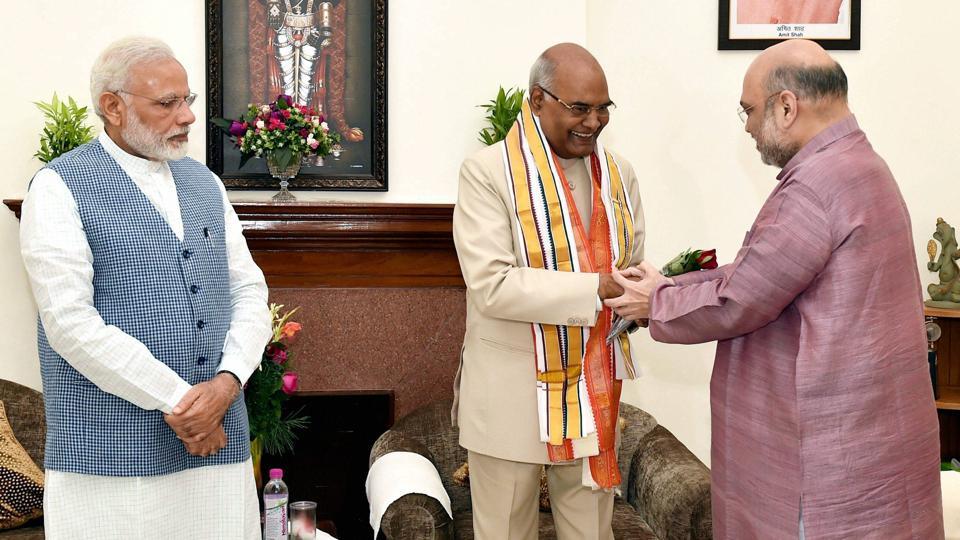
    NEW DELHI (TIP): Ram Nath Kovind has won the presidential election after securing over two-thirds of the total electoral college votes. Mr Kovind will be sworn-in as the 14th President of India on July 25. Prime Minister Narendra Modi congratulated Ram Nath Kovind for winning the presidential election. PM Modi tweeted: “Congratulations to Shri Ram Nath Kovind Ji on being elected the President of India! Best wishes for a fruitful & inspiring tenure.” Flowers and extra security had arrived at the former Bihar governor’s home in Delhi long before the official announcement and sweets were passed around at his hometown in Uttar Pradesh. The counting of votes for the presidential election began at 11 am today. The contest, between the ruling NDA’s Ram Nath Kovind and the Opposition’s Meira Kumar, both Dalits, had seen nearly 99 per cent lawmakers and legislators cast their vote – the highest ever. Voting had taken place on July 17.

    Speaking after his victory, President-elect Ram Nath Kovind said, “Me being elected President is a message for a person who has walked on an honest path. Thoughts of serving my nation have brought me this far”. He went on to say that “My job will be to uphold and protect the Constitution of India”.

    “I salute all the people of India,” Mr Kovind said as he narrated that “I never thought that I will become president one day. It was never my goal. But for the country, for society, my hard work has brought me till here”.

    “I congratulate and thank opposition candidate Meira Kumar,” he said. Speaking about his responsibility as India’s first citizen, Mr Kovind said, “It is a great responsibility to be elected to the post that has been graced by great men like Dr Rajendra Prasad, Dr Sarvapalli Radhakrishnan, Dr APJ Abdul Kalam and Shri Pranab Mukherjee”.

    On his victory, he said “Personally this is an emotional moment for me.”

    Speaking about his humble background as a farmer’s son, Mr Kovind said, “It has been raining in Delhi since the morning. Rains remind me of my village, of our kachcha home with walls of mud and a roof that could not repel water during the monsoon. My siblings and I used to stand and wait for the rains to end. Today there are many Ram Nath Kovinds who are getting wet in the rain, working hard, toiling in the fields for one square meal in the evening. Today I want to tell them that I will be their representative in the Rashtrapati Bhavan.”

    Meanwhile, Meira Kumar who lost to Kovind, congratulated President- elect, saying her fight for secularism and the oppressed will continue.

    “I congratulate Sh. Ram Nath Kovindji for becoming the President of India.

    “My best wishes are with Sh. Kovindji as it has fallen upon him to uphold the Constitution in letter & spirit in these challenging times,” she tweeted.

  • Indian Origin Man Sentenced for Citizenship Fraud

    Indian Origin Man Sentenced for Citizenship Fraud

    NEW YORK (TIP): An Indian American Gurpreet Singh (37) of Watertown, New York, was sentenced on July 14 in federal court in Syracuse to three months in prison to be followed by three years of supervised release, following a jury trial in January where he was convicted of knowingly obtaining U.S. citizenship through unlawful naturalization, announced Acting United States Attorney Grant C. Jaquith and James C. Spero, Special Agent in Charge, Homeland Security Investigations (HSI), Buffalo, New York.

    Because of this conviction, Singh’s U.S. citizenship will be revoked by law.

    The trial evidence showed that Singh, who is originally from India, repeatedly affirmed to United States Citizenship and Immigration (USCIS) authorities that he had not committed any crimes for which he was not arrested. Immigration authorities later learned that the defendant sexually abused a 9-year-old child during the same time-period he was applying for U.S. citizenship. Evidence presented at trial demonstrated that Singh deliberately failed to report his criminal activity to USCIS because he knew that USCIS would not have approved his naturalization application if the agency had known about his crimes. Singh pled guilty in New York state court to a single count of sexual abuse of a minor child, after he had become a naturalized U.S. citizen. Singh was arrested by the City of Watertown (New York) Police Department the day after his naturalization ceremony in April 2012.

    While on supervised release following his prison term, Singh will be required to register as a sex offender and will be prohibited from having direct contact with children under the age of 18 (other than his own) and from going to places where children under 18 are likely to congregate, such as parks, libraries, and schools, without prior permission of a probation officer.

  • Indian American Golfer Sahith Theegala wins Sahalee Players Championship

    Indian American Golfer Sahith Theegala wins Sahalee Players Championship

    SAN JOSE (TIP): Indian American Golfer Sahith Theegala of Chino Hills, Calif. birdied the first playoff hole to win the 23rd Sahalee Players Championship (SPC), outlasting Min Woo Lee of Australia.

    The elite amateur championship was held at Sahalee Country Club in Sammamish, Wash.

    After 72 holes, the two players were tied at 3-under par, and went back to play the par-5 18th hole again. Theegala hit his second shot to the back edge of the green, hole high. Lee flared his second shot into the trees on the right, and after a free drop from an embedded lie punched a remarkable 150-yard shot through the trees to 45 feet from the hole. Lee then two-putted for par, and Theegala dropped a 5-footer for birdie and the win.

    Theegala started final round with a five-shot lead, but with the swirling winds adding to already difficult final-round playing conditions, the day quickly became a game of survival. The scoring average for the final round was 77.27.

    Theegala is a rising junior at Pepperdine, finishing his sophomore year as WCC Co-Player of the Year and selected as semifinalist for the Jack Nicklaus Award. He qualified for this year’s U.S. Open at Erin Hills, and in two weeks will compete in the 51st Pacific Coast Amateur Championship, being held at Chambers Bay in University Place, Wash.

    The SPC was rated an “A” event in the World Amateur Golf Rankings (WAGR) before taking a hiatus last year while the club hosted the KPMG Women’s PGA Championship, and each year the event draws an international field of the finest amateur players.

    Five of the previous 13 SPC champions have gone on to win the Ben Hogan Award, given to the nation’s top collegiate golfer and the list of previous SPC participants now playing on the PGA Tour continues to grow each year.

    Past champions of this prestigious amateur championship include Kyle Stanley, Casey Martin, Peter Uihlein, Nick Taylor, Daniel Summerhays, Ryan Moore, Chris Williams, Arron Oberholser and Jason Gore, among others, all of whom would go on to win on the PGA or European tours. The SPC scoring record at Sahalee is the 16-under 272 (68-69-68-67) shot in 2004 by Moore, a native of Puyallup, Wash.

    Sahalee Country Club has been the site of the SPC since 1992, and has hosted numerous top-level events in golf, including the 1974 PNGA Men’s Amateur, 1978 Pacific Coast Amateur, 1998 PGA Championship, 2002 WGC-NEC Invitational, 2010 U.S. Senior Open, and 2016 KPMG Women’s PGA Championship.

  • Indian origin Barot and Pandya plead guilty in India-Based Multimillion Dollar Call Center Scam Targeting US Victims

    Indian origin Barot and Pandya plead guilty in India-Based Multimillion Dollar Call Center Scam Targeting US Victims

    AUSTIN (TIP): On July 19, An Indian national and a Texas man each pleaded guilty to conspiracy charges for their respective roles in liquidating and laundering victim payments generated through a massive telephone impersonation fraud and money laundering scheme perpetrated by India-based call centers.

    Montu Barot, 30, an Indian national most recently residing in Glendale Heights, Illinois, and Nilesh Pandya, 54, of Stafford, Texas, each pleaded guilty to one count of conspiracy to commit fraud and money laundering offenses, in violation of Title 18, U.S. Code, Section 371.  The pleas were entered before U.S. District Court Judge David Hittner of the Southern District of Texas. Barot agreed to deportation following his sentence. Sentencing dates are pending.

    According to admissions made in connection with their respective pleas, Montu Barot, Nilesh Pandya, and their co-conspirators perpetrated a complex scheme in which individuals from call centers located in Ahmedabad, India, impersonated officials from the IRS and U.S. Citizenship and Immigration Services (USCIS), and engaged in other telephone call scams, in a ruse designed to defraud victims located throughout the U.S.  Using information obtained from data brokers and other sources, call center operators targeted U.S. victims who were threatened with arrest, imprisonment, fines or deportation if they did not pay alleged monies owed to the government.  Victims who agreed to pay the scammers were instructed how to provide payment, including by purchasing stored value cards or wiring money.  Upon payment, the call centers would immediately turn to a network of “runners” based in the U.S. to liquidate and launder the fraudulently-obtained funds.

    According to Barot’s guilty plea, beginning in or around June 2012, Barot served as a runner and coordinated the liquidation of victim scam funds by other runners per the instructions of conspirators from both India-based call centers and within the United States.  Barot communicated via phone, text and email in furtherance of the criminal scheme with both domestic and India-based associates, and he and his conspirators used reloadable cards containing funds derived from victims by scam callers to purchase money orders and deposit them into various bank accounts as directed, in return for cash payments or commissions.  Barot also admitted to sending financial ledgers to his conspirators detailing the movement of scam victim funds.

    Based on admissions in Nilesh Pandya’s guilty plea, beginning in or around March 2014, Pandya served as a runner liquidating victim scam funds within the Southern District of Texas.  At the direction of two of his co-defendants, Pandya used stored value cards that had been loaded with victim funds to buy money orders and then deposit them into various bank accounts.

    To date, Montu Barot, Nilesh Pandya, 54 other individuals and five India-based call centers have been charged for their roles in the fraud and money laundering scheme in an indictment returned by a federal grand jury in the Southern District of Texas on Oct. 19, 2016. Including this week’s pleas, a total of thirteen defendants have pleaded guilty thus far in this case. Co-defendants Bharatkumar Patel, Ashvinbhai Chaudhari, Harsh Patel, Nilam Parikh, Hardik Patel, Rajubhai Patel, Viraj Patel, Dilipkumar A. Patel, Fahad Ali, Bhavesh Patel and Asmitaben Patel previously pleaded guilty on various dates between April and July 2017.

  • Indian American Organization HAF Helps Serve Pakistani Refugees with Medical Services

    Indian American Organization HAF Helps Serve Pakistani Refugees with Medical Services

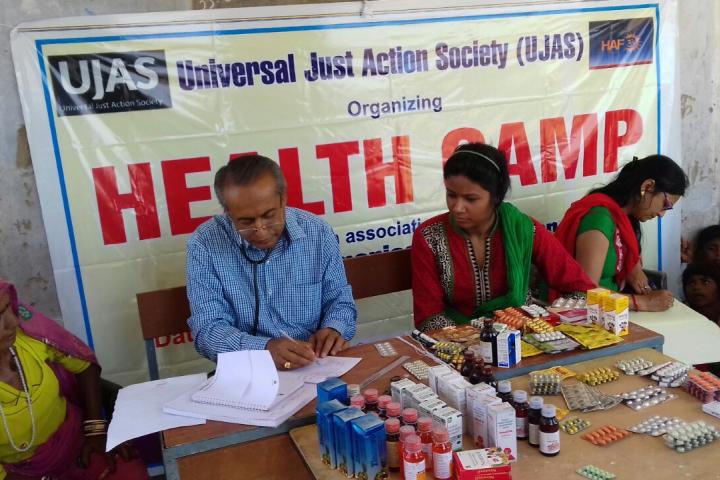
    WASHINGTON (TIP): The Hindu America Foundation (HAF) in partnership with the Sindhi Alliance, recently provide critical medical services to Pakistani Hindu refugees living in makeshift settlements and camps in Jodhpur, India. HAF raised $17,600, which is being disbursed as an ongoing grant to the Universal Just Action Society (UJAS), the primary non-governmental organization working with Pakistani Hindu refugees in Jodhpur.

    So far, $8,533 has been used to help the refugees through the following initiatives:

    • Engaged with government stakeholders and assisted 900 refugees complete registration for migrant health cards to facilitate admission into health facilities that provide services beyond the scope of the health clinic
    • Established and staffed a health clinic in Jodhpur; hosted several medical camps in settlements; and provided medical consultations, medicinal support, and vaccinations
    • Held hygiene awareness and health education seminars and distributed health/hygiene education materials
    • Created community health and hygiene committees in three refugee settlements to empower refugees to take initiatives to improve community health

    The refugees suffer from a wide range of physical and mental health conditions, such as situational depression, anxiety, psychosomatic disorders, high incidence of respiratory disease, hypertension, malnutrition and lifestyle disorders, and infectious diseases. Women, children, and elderly refugees, in particular, remain vulnerable to various health risks and face psycho-social trauma from their experience of suffering religious persecution and fleeing their homes. Many of the refugees avoid going to healthcare facilities due to their illiteracy and lack of health awareness, as well as an absence of civil and legal documents required to access basic facilities. They also fear harassment if they disclose that they are Pakistani nationals.

    Ms. Kaalu, a 67-year old woman that fled Pakistan and is now living in a refugee settlement in Aaganwa village in Jodhpur, for instance, is one of many refugees that has received assistance through this project.

    Ms. Kaalu and her family, including her husband, son, daughter-in-law, grandson, and granddaughter, are struggling to survive economically and are dealing with several health issues. She had been experiencing chest pain for at least a month, but due to a lack of health education and awareness and an inability to access a medical facility, she was unable to receive adequate care for her condition. She indicated that she avoided going to government hospitals out of fear that she would be turned away as a refugee without proper identity documents and because of her poor family economic conditions.

    When UJAS organized a health camp at her settlement, she was identified as a priority patient in critical health condition and was seen by a first aid doctor and the UJAS team helped facilitate her access to Mahatma Gandhi Hospital, Jodhpur. Ms. Kaalu is now hopeful that she will able to receive proper treatment to alleviate her critical health conditions and live a happy and healthy life again.


  • Indian Americans among top investors in residential property in US

    Indian Americans among top investors in residential property in US

    MUMBAI (TIP): A Times of India report published July 21 says that the pall of gloom owing to protectionist policies has not kept Indians residing in the US from investing in real estate. By purchasing residential property worth $7.8 billion during the 12-month period ending March 2017, Indians emerged as the fifth largest investors in real estate in the US. Backed by mortgage finance, these properties were largely acquired for use as primary residence or for use by a child studying in the US.

    Chinese nationals were the biggest buyers, purchasing residential property worth $31.7 billion in the same period. They were followed by the Canadians, British, Mexicans and, lastly, Indians.

    Between April 2015 and March 2016, Indians had invested $6.1 billion and occupied third place on the list of biggest buyers. However, a surge of investments from other nationalities resulted in Indians slipping to fifth position in 2016-17.

    The bulk of buyers from China, India, and Mexico were working and residing in the US, while most buyers from Canada and the UK were non-resident buyers, adds the report, “2017- Profile of international activity in US residential real estate” released recently by the National Association of Realtors (NAR).

    More than a third of the Chinese buyers purchased residential property in California. Compared to the other major foreign buyers, Indians were not as concentrated in any state in the US and the location of their jobs largely determined their purchase. While California, New Jersey, Texas, Massachusetts, and Kentucky were top destinations, more than two in five Indian buyers purchased in another state.

    In aggregate, foreign buyers purchased $153 billion of residential property in US between April 2016 and March 2017, which is a 49% jump from the figure of the corresponding previous period of $102.6 billion. In terms of number of units, foreign buyers purchased 2.84 lakh residential properties in US in April 2016-March 2017, up 32% from the previous period’s figure of 2.14 lakh properties.

    On an average, foreign buyers paid $536,852 for their properties, 12% more than the average price during the previous 12-month period. The average purchase price of properties bought by Indians was $522,440.

    “The political and economic uncertainty both here and abroad did not deter foreigners from exponentially ramping up their purchases of US property over the past year,” said Lawrence Yun, NAR’s chief economist. “While the strengthening of the US dollar in relation to other currencies and steadfast home-price growth made buying a home more expensive in many areas, foreigners increasingly acted on their beliefs that the US is a safe and secure place to live, work and invest,” he added.

    While a stronger dollar makes it more expensive to purchase US property, fears of a further weakening of a local currency against the dollar prompts some foreign buyers to accelerate their purchase.

    Referring to the value of the Indian rupee, the report says it depreciated modestly (by 2%) relative to the dollar over the entire survey period. However, post-demonetization in November 2016, which caused a severe liquidity squeeze, the rupee reversed course and began to appreciate.

    From November 2016 to March 2017 (the end of the survey period), the rupee had appreciated nearly 3% against the dollar. Data from June 2017 shows that the rupee had strengthened nearly 5% against the dollar from November 2016, suggesting that terms could improve for Indian buyers of US real estate next year.

    (Source: TOI)

  • Fourteen Indian Americans to receive M&A Emerging Leaders Awards

    Fourteen Indian Americans to receive M&A Emerging Leaders Awards

    NEW YORK (TIP): Fourteen Indian Americans will receive this year’s M&A Advisor Emerging Leaders Awards. They are – Weil Goshal & Manager LLP. Partner Sachin Kohli, Deloitte Consulting LLP Senior Manager Karthik Krishnamoorthy, Kaley Jessen PC LLD Shareholder Anshu Pasricha, Raymond James Managing Director Sanjay Patel, Berkery Noyes Managing Director Vineet Asthana, Simanor LLC. Senior Director Sri Geedipali, SSG Capital Advisors Director Neil Gupta, Ernst & Young LLP partner Raghav Rao, PJT Partners Managing Director Ketan Shah, Deloitte Consulting Senior Manager Simon Singh and Kramer, Levin Naftalis & Frankel Special Counsel Anupama Yerramali. Ballard Spahr Senior Associate Amit Kakkar, Ernst & Young LLP. Partner Sid Khosla.

    The M&A Advisor, renowned globally for its recognition and presentation of leading M&A, financing and turnaround professionals, created this recognition awards program to promote mentorship and professional development amongst the emerging leaders of the industry.

    “The Annual M&A Advisor Emerging Leaders Awards was born as the 40 Under 40 Awards in the United States in 2010 to recognize and celebrate the achievements of young M&A, Financing and turnaround professionals who had reached a significant level of success and made a notable contribution to their industry and community. With the expansion of the Emerging Leaders program to the United Kingdom, and Europe in 2016, the 2017 US award winners join a truly global network of outstanding young professionals”, said David Fergusson, President and Co CEO of The M&A Advisor.

    The 2017 Award Winners have been chosen from a pool of prominent nominees for their notable accomplishments in business and in service to the community. Evaluation and selection of the nominees was completed by an independent judging panel, Added Fergusson.

    “It is our belief that the Emerging Leader Award winners will continue to have a significant effect on the advancement of our industry.

    Through the support of business, philanthropic, academic and personal development experts, we are establishing a connected “leadership community” with the mandate to empower these successful young professionals to improve the life experiences of others through their career.”

    On Tuesday, September 19th, The M&A Advisor will host a black tie Awards Gala at the New York Athletic Club in Manhattan to introduce the Emerging Leaders Award Winners to the business community and celebrate their achievements.


  • Debate Why Hinduwadis are obsessed with Cow?

    Debate Why Hinduwadis are obsessed with Cow?

    Cow is not sacred and beef is not forbidden to Hindus, according to Vedas 

    By Dave Makkar

    The author finds no mention in Hindu scriptures about cow being referred to as “mother” or as “holy”. He finds no evidence that cow slaughter was ever prohibited, that beef eating was forbidden. He wonders why Hinduwadis are so obsessed with cow. The Indian Panorama, with this article, is initiating a debate on an issue which has fiercely divided the Indian nation. The views expressed here are the author’s own.

    The current atmosphere in India on the issue of cow defies all sane logic, Hindu religious Texts, thousands of years old sacred history, historians and scholars.  On one hand the current Modi government talks of making India the biggest economic power in the world surpassing America and China. On the other hand, his own party and his Hindu affiliate’s members talk of what people can eat or cannot eat, how many children the Hindu couples should produce, what the women should wear, adult girls cannot be seen in the company of opposite sex friends, Hindu girl cannot marry a non-Hindu and any criticism of government policies make you anti-national that includes refusing to say Bharat Mata ki Jai or Cow is our mother.

     Modi himself and his team members are biggest hypocrites on the issue of cow or meat. As CM of Gujarat under Modi meat production 10,600 tons in 2001-2 went up to 35,286 tons in 2011-12. Still Modi accused UPA government for cow slaughter for their support to meat exporters “Pink Revolution” during the run up to the 2014 elections that brought him to power. Ironically under Modi’s watch bovine/cow meat export has gone up by 70% according to the Commerce Ministry website. Now India is number 1 exporter of bovine/cow meat in the world.

     Modi’s confidante Amit Shah during the 2014 campaign made several speeches that cow slaughter will not be banned in north eastern states of India. As BJP’s party president on May 28, 2015 in Goa; Amit Shah ruled out a nation-wide beef-ban or cow slaughter.  Union Government and Goa Government both under BJP are jointly running a slaughterhouse in Goa.

     Sangeet Som, the Hindutva poster boy & one of the main accused in 2013 Muzzafarnagar communal riots, UP Assembly Member and now Minister in Adityanath Yogi’s government had been personally associated with two meat processing and export companies, Al-Dua and Al-Anam. Al-Dua is one of the India’s leading halal meat export companies which exports meat to Arab countries.

     BJP candidate Sreeprakash on April 2, 2017 in the run up to the Mallapuram Lok Sabha by election in Kerala said, “I will ensure quality beef and standard abattoirs in my constituency.”

     Modi’s Minister of State for Home Affairs Kiren Rijiju in Aizwal on May 27, 2017 said that, “I eat beef, I’m from Arunachal Pradesh and can anybody stop me? So let us not be touchy about somebody’s practices. This is a Democratic country. Sometime some statements are made which are not palatable.” Kiren Rijiju also described as “unpalatable” his colleague Mukhtar Abbas Naqvi’s remarks that those who eat beef should go to Pakistan, and questioned whether anyone could stop him from eating beef. The BJP leaders in Arunachal, Meghalaya, Sikkim, Mizoram, Nagaland have been making statements to their constituents, sale of beef at subsidized rates is their commitment to them. After the new Cattle Trade Rules announced by the Modi government they went to the extent of saying “No Beef No Support to BJP”

     BJP’s Karnataka spokesperson Vaman Acharya on May 28, 2017 while participating in a panel discussion on Suvarna News opposed the beef ban. He said that people from all communities including the Brahmin community, consumed beef. Before India became an agrarian nation, beef had been a staple diet. Even today, several people, including indigenous tribes in the North Eastern States consumed beef as a staple. Acharya had also said that as chairman of the Karnataka Pollution Control Board, he gave permission for the setting up of 16 abattoirs in the State.  Lastly, he had said that he didn’t subscribe to the religious sentimentality attached to the cattle. He retracted his statements on June 6, 2017 under party pressure.

     Modi’s Home Minister Rajnath Singh in Aizwal on June 12, 2017, said that people are free to choose what they want to eat.  When asked about protests against the government’s ban on sale of cattle for slaughter, Singh clarified that the Centre will not impose any restrictions on one’s choice of food. However, even as Singh spoke, scores of people in the Mizoram capital participated in a “beef ban bashing banquet” organized by a local organization. (PTI)

    Kerala BJP and RSS have joined hands to start a co-operative society to sell meat which includes bovine meat as well as fish, a Malayalam daily Deshabhimani reported on July 5, 2017.

    July 17, 2017 Goa’s BJP CM Manohar Parikar who also holds the animal husbandry portfolio in the assembly session replied to BJP assembly members concern over the poor quality of Beef imported from Congress ruled neighboring state Karnataka; “Approximately 2,000 kg beef is produced per day at the state abattoir of the Goa Meat Complex Limited, while rest of beef is brought in from Karnataka. Parrikar said he would issue directions to the department concerned to carry proper inspection of beef imported from Karnataka. Parrikar further added that “The Goa Meat Complex Ltd has no problem in slaughtering more animals if they are brought there by traders,”

    Modi’s New Cattle Trade Rules that have been stayed by the SC on July 12, 2017 violates Right of a Person to Freedom of Choice regarding Food as enshrined in Indian Constitution and it is also violating the rights of the farmers to trade. Under this law farmers cannot sell the cattle in the market for slaughter but slaughter houses can come to the farmer and buy cattle for slaughter. Then majority of the farmers are not educated how they can comply with filling out numerous forms about the origin & ownership of the animal in question? First, the farmers/dairy operators will be exploited by the bureaucracy and then by Slaughterhouses that can make a cartel to give them less price for their cattle.

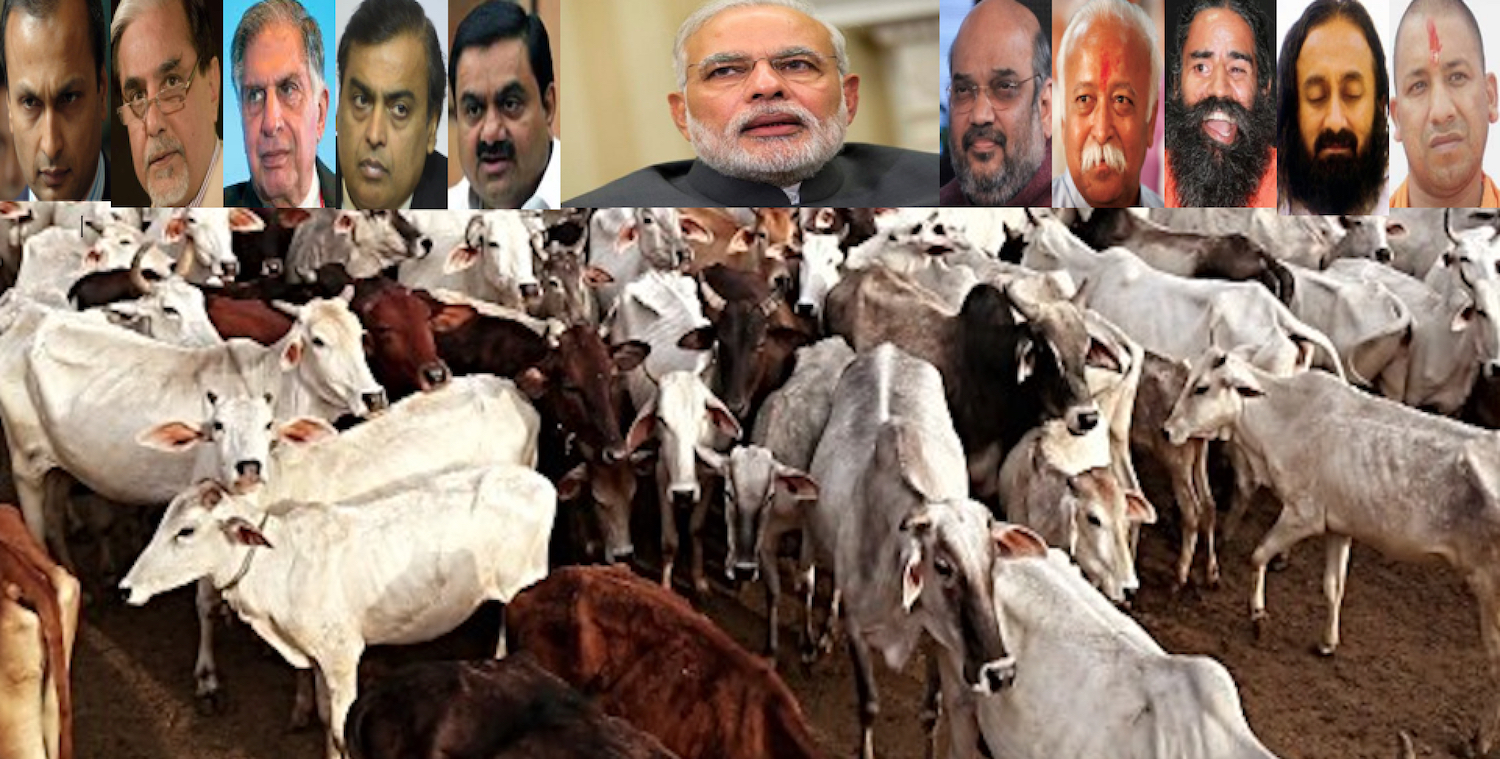
     Modi aka BJP is paving the way for its handlers like Adani, Ambani, Tata and other foreign MNC’s to control the meat and animal hide trade that is worth Billions of Dollars. UP slaughterhouses alone employ 25 lac people with a turnover of Rs. 15,000.00 crore, the highest producer of meat in India. The meat industry is likely to grow at a compound growth rate of 8.4% over the next five years. The processed meat industry is growing even much faster, at about 20%. The meat export from India is about $4.5 billion and raw hide to leather goods is another $5.5 billion. About 22 million people are in the workforce and the meat export industry is expected to grow 50% in 5 years. Beside that 70% of Indians are non-vegetarians. Domestic per capita meat consumption in India is very low — around 5 kg as compared to the world average of 47 kg. With rising incomes between 2003 and 2012, their meat consumption rose by 6.3% a year. It is expected to rise by another 3.5% a year between 2013 and 2022.

     Apart from 73.7 lakh tons of meat in 2016-17, India also produced 108 lakh tons of fisheries in 2015-16 ranking 2nd after China. India is the number One the and largest exporter of shrimp fish in the world. This industry is growing at a robust pace of 8% per annum. The business is valued at Rs. 1 Lakh Crore and employs about 150 lakh people. Andhra Pradesh occupies the first place, West Bengal 2nd and Modi’s Gujarat at 3rd place in fish production in India.

     The demonetization was also done for these very influential people so that they can control food business worth billions that is traditionally run on cash basis by the informal sector. On top of that to pave the way for billions of dollars that can be made in transaction fees in the guise of digital money from the less fortunate and financially most vulnerable people of Indian society. Rich have credit cards; they don’t pay any fees to use it; rather they are rewarded with points and cash back for its use; it is the merchant that pays the fees for accepting it. The poor has to get a “Pre-Paid Debit Card” for a fee with a monthly maintenance fee and fee for loading money; one of the biggest Ponzi schemes ever invented by the American Financial Industry to loot the poor.

     Coming to Team Modi & Hinduwadi’s understanding of Hinduism, its history, its writing on eating meat and views of various learned scholars, all of them are a very big disappointment. Team Modi should do some soul searching why Atal Behari Bajpai avoided the trap of cow laid by the bogus Hindutva supporters that has no love for their own 50 crore (500 million) extremely poor Hindus living a miserable life.

     According to Sanskrit Scholar Rajani K Dixit, “there is no such thing as Holy Cow in the Vedas”. The Vedas consider bovines important for milk, beef, agriculture and transport but not divine or holy. The word ‘Aghnyaa’ applies only to a milch cow because it is not economical to kill it. A Vaisha cow is meant for beef, and especially reserved to an extent for Brahmins only. Atharva 12.4(13) tells us that in case a Brahmin begs for a cow from a non-Brahmin, “even if that person has a beef-dinner at his house, he has to select another cow to slaughter for his own dinner, than the one that is asked for”. The word ‘Aghnyaa’ (not to be killed) coined by Rigveda for young milch cows was the main cause of the Hindu misunderstanding that cows or bovines are not to be slaughtered.

     The Rigveda has never used the word ‘mother’ for a cow. There is no punishment recommended for a cow slaughterer even if someone kills a young milch cow. Beef-eating is also not taboo. Beef parties are not only allowed but highly appreciated, and a person who cooks beef for his guests is praised by the term ‘Atithi-gva’ ‘one who offers beef to guests’.           

     Ritual sacrifice of a bull is a must in worship to God Indra. Beef parties also seem a regular affair in weddings (RV 10.85). Cows are not sacred and beef is not forbidden to Hindus. Here is a line from a verse ascribed to god Savita, the presiding deity of the Gayatri Mantra, describing a dinner party he is hosting: “At night we are going to kill cows” (RV.10.85(19). RV 10.89 (14) mentions “cows for food, laying scattered on the grounds of a slaughter house”. Mark that the author does not use the word ‘animals’ but ‘cows’, showing that beef was the most popular item, and the cow the most slaughtered animal. RV 10.95(6) says that “old cows which do not give milk” are “only fit to be cooked”. It further states that “useless cows ….are taken to be cooked, but never milch cows”. It is clear that slaughter houses are not banned, beef is allowed and useless bovines are allowed to be slaughtered in Hinduism.

     Aadi Shankaracharya born in 788 CE in Kerala: in his commentary on Brahadaranyako Upanishad 6/4/18 says: ’Odaan’ rice mixed with meat is called ‘maansodan’ on being asked whose meat it should be, he answers ‘Uksha’ is used for an ox, which is capable to produce semen. Currently 72 communities including some upper caste Hindus in Kerala prefer beef to the mutton and some prefer it because it is cheaper than mutton.

     Hinduisms great propagator Swami Vivekaanand said: “You will be surprised to know that according to ancient Hindu rite and rituals, a man cannot be a good Hindu who does not eat beef “. (The complete works of Swami Vivekanand vol :3/5/36)

     Vinayak Damodar Savarkar, the Hindutva Icon and Icon of Hindu religious & political parties including BJP, espoused his views in Vidnyan Nishta Nibandh, that the cow, like the peepal tree, should be cared for, as something useful to humans, which meant eating it as well if need be. He insisted that a superstitious mindset towards cows would ruin India’s intellect and that cows should be protected for their economic use to man, and not because of their ‘divinity’. Attributing religious qualities to it gives it a godly status. Such a superstitious mindset destroys the nation’s intellect. “When humanitarian interests are not served and in fact harmed by the cow and when humanism is shamed, self-defeating extreme cow protection should be rejected.”              

    Every now and then, an admirer of Savarkar raises the topic. “Can anyone imagine that the ‘Father of Hindutva’ advocated beef-eating (in special circumstances), rejected the divinity of the Vedas, denounced the sanctity of the caste system and launched a virulent attack on the hypocrisy of the priests?” wrote Ved Pratap Vaidik, a journalist close to several Hindutva figures. “Incidentally, Savarkar was a beef-eater,” wrote Varsha Bhonsle on Savarkar’s birth anniversary, February 26, in 1998. “For he was, above all else, a rationalist – a true Hindu – and eons ahead of contemporary Hindutvawadis.” (“Why is the Cow a Political Animal?” S. Joshi)

    Mahatma Gandhi was approached for total ban on Cow Slaughter in India. His reply was, “I have been long pledged to serve the cow but how can my religion also be the religion of the rest of the Indians? It will mean coercion against those Indians who are not Hindus. The assumption of the Hindus that India now has become the land of the Hindus is erroneous. India belongs to all who live here. Earlier on 25th July 1947 he also said that “The Hindu religion prohibited cow slaughter for the Hindus, not for the world. The religious prohibition came from within. Any imposition from without meant compulsion. Such compulsion was repugnant to religion.”

     A Brahmin’s Cow Tales by D. N. Jha, a high cast Brahmin himself. The cow as a sacred animal, Jha believes, did not really gain currency until Dayanand Saraswati’s cow protection movement in the 19th century”. The cow became a tool of mass political mobilization with the organized cow-protection movement,” the historian points out. “The killing of cows stopped gradually with the agrarian society and caste rigidity. The Brahmins found it convenient to say that those who ate beef were untouchable. But they themselves continued to consume it, recommending it for occasions such as shraadh. The beef-eating habits of Indians which existed in Rig Vedic times and continued till the 19th century and after, despite repeated Brahminical injunctions against cow-killing. That ancient Hindus, including Brahmins, were beef-eaters, willing to incur the minor penalty that an agrarian society began imposing on cow-killers, and that this fondness for cattle meat had nothing to do with Islam or Christianity.       

     For those who blame Muslims for the practice of Cow slaughter in India.  Babar’s first act after conquering Delhi was to forbid the killing of cows. They must read Babar’s Directives (Wasiyyat namd-i-majchfi) a secret testament to his son Humayun and his future generations. For the stability of the Empire, O my son!, “The realm of Hindustan is full of diverse creeds. Praise be to God, the Righteous, the Glorious, the Highest, that He hath granted unto thee the Empire of it. It is but proper that thou, with heart cleansed of all religious bigotry, should dispense justice according to the tenets of each community.’ “And in particular refrain from the sacrifice of cow, for that way lies the conquest of the hearts of the people of Hindustan; and the subjects of the realm will, through royal favour, be devoted to thee. And the temples and abodes of worship of every community under Imperial sway, you should not damage. Dispense justice so that the sovereign may be happy with the subjects and likewise the subjects with their sovereign. The progress of Islam is better by the sword of kindness, not by the sword of oppression.” (Abstracted from the 1936 book The Mughal Empire From Babar To Aurangzeb, by SM Jaffar of Peshawar. It mentions that “the original document is in Persian and is treasured in the Hamida Library at Bhopal as one of its heirlooms.”)

    The British Origin of Cow-Slaughter in India (published 2002) by Gandhian historian Dharampal. His book draws from official documents to show that the riots of 1880-1894 were not the obvious Hindu-Muslim conflagration they were made out to be. The book cites accounts of how “many prominent Muslims as well as the Parsis and Sikhs actively participated in the (cow protection) movement.” Dharampal wrote that large-scale cow slaughter was not the handiwork of Muslims who came to India from central and western Asia. “The question of the sacrifice of a cow did not arise as the land where Islam arose did not have many cows.”

    Mughals were habituated to the meat of goats and mutton, sacrificing camels on the occasion of festivals like Eid or for large feasts, the book says. Dharampal rues the lack of research on cow killing between 1200 and 1700, when a series of Muslim kings ruled over a large part of India. But he goes on to show that systematic slaughter of cattle began in India with the East India Company establishing itself. The British, unlike the central and west Asians, were habituated to beef.  The first slaughterhouse in India was built in Calcutta (now Kolkata) in 1760 by Robert Clive, then Governor of Bengal. It could kill 30,000 animals per day. Several more slaughterhouses were set up in various parts of the country by the Commissariat Wing of the three British armies of Bengal, Madras and Bombay Presidencies. A total of 350 slaughterhouses were constructed by 1910.

     Nitya Sambamurti Ghotge, a veterinary surgeon who heads Anthra, a group in Pune that has worked with rural livestock rearers since 1992. Laws against cow slaughter and Trade Rules will only criminalize the livestock trade, not protect the animals, said Ghotge. Only the smugglers and the law enforcement officials will benefit from the ban on cow slaughter, not the poor farmers or the livestock. Like the agriculture scientist Ramanjaneyulu, Ghotge holds that the cow protection laws are unjust; it is about powerful urban people outsourcing the burden of cow protection on the rural poor, she said.

    As for the BJP’s claim that “cow is the only divine animal that exhales oxygen”, no living being other than plants exhale oxygen is also a myth. Animals, however, exhale unused oxygen, as lungs cannot process all the oxygen that is inhaled. According to the 2006 FAO report, the livestock sector accounts for 9 per cent of carbon dioxide derived from human-related activities, but produces a much larger share of even more harmful greenhouse gases.

     Team Modi is least concerned about the millions of Indians- Hindus as well as non-Hindus employed directly and indirectly in the cattle trade. The millions especially children and elderly that depend on bovine meat as the cheapest source of protein. In the name of misguided Hindutva they are imposing their personal believes on the cattle breeders, traders, farmers and bovine meat eaters without considering the economic realities. There was a time when the owner could get Rs 12,000.00 to Rs. 15,000.00 for the unproductive animal from a slaughterhouse, now that has been reduced to Zero by the Gau Rakshaks/cow vigilantes. Rs 2,500.00-3,000.0 per month is the cost just to keep the animal alive for 8-10 years after the end of its economic utility. If the 10 million or so cattle that possibly end up at the abattoir every year are not culled, farmers will simply stop caring for them and let them loose in towns and cities. It will cost upward of Rs 22,000 crore to take care of them. And since the 10 million-plus will keep adding each year, till they die in their natural course, these costs would only keep on mounting up every year.  Just in the 4th year the cost could be more than Rs. 88,000.00 crore. In BJP ruled state Rajasthan the state government is providing Rs 70.00/day for cow and Rs 35/day for calf and at the same time it is providing Rs. 25.63/person on welfare schemes in the state. Under Modi, India has become an international joke where cow is more valuable than human beings.

    (The author is a New Jersey based community activist and a regular commentator on burning issues. He can be reached at davemakkar@yahoo.com)


                                (The Indian Panorama invites comments on the article)


  • Google Earth to let users post stories and photos

    Google Earth to let users post stories and photos

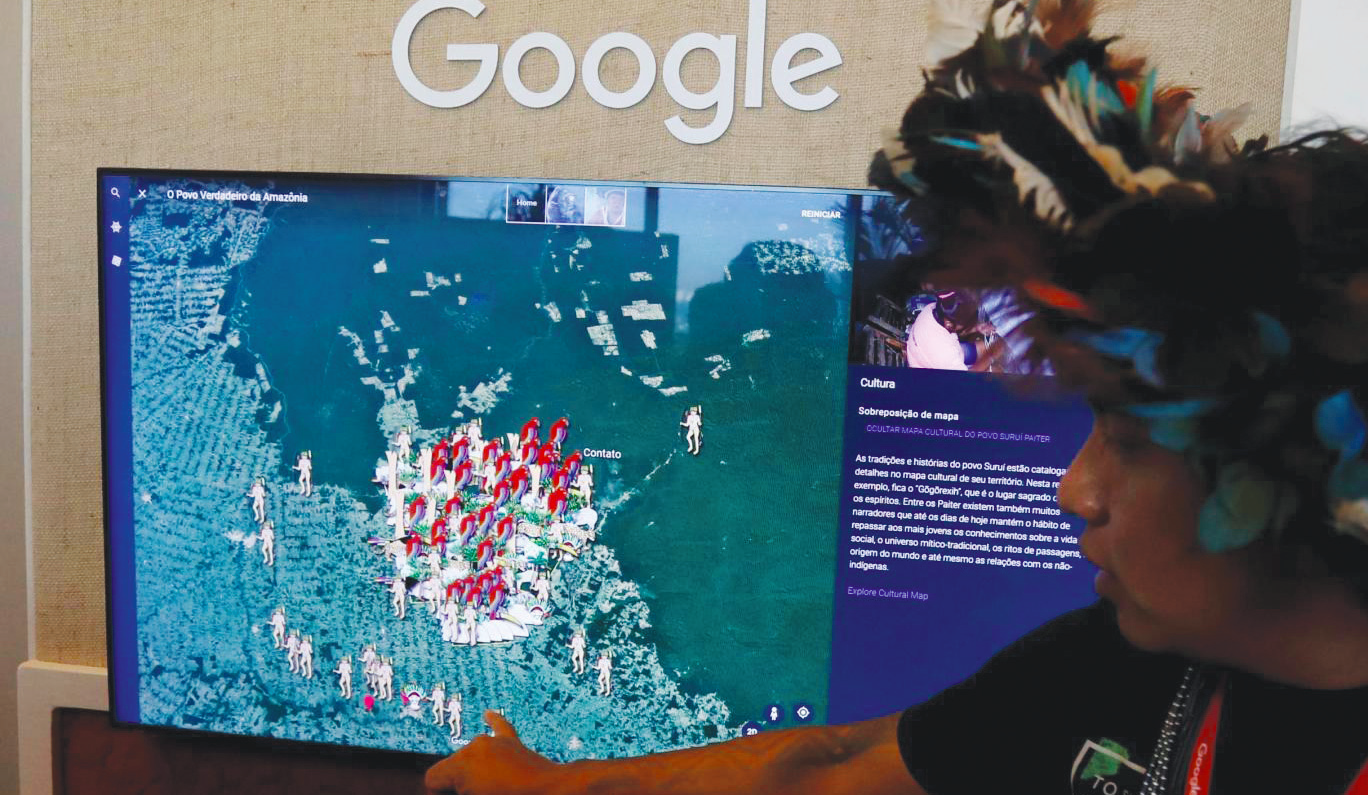
    RIO DE JANEIRO (TIP): Alphabet Inc wants users to post millions of stories, video and photos on its Google Earth platform in the next few years, the programme chief said at a launch event in Brazil for content focused on showcasing the Amazon rainforest.

    The “Voyager” tool allows internet surfers to take interactive tours of exotic destinations on Google Earth led by the likes of primatologist Jane Goodall, with photos, information and maps.

    However, regular users will be able to create their own unedited content for private or public use within two to three years, Google Earth Director Rebecca Moore told Reuters.

    “The story of your family history, the story of your favorite hiking trip – it could be anything. It doesn’t have to be profound,” she said at the event in Sao Paulo.

    Moore took the stage at an event in Sao Paulo to unveil the “I am the Amazon” project, which has mapped 11 sites to document the relationship between the rainforest and its people, touching on topics like food, water and cultural origins.

    To tell the stories of communities such as the Yanomami people, Cinta Larga and the Boa Vista Quilombola, Google and partners used tools like 3D cameras to accompany satellite images with videos and text.

    Moore did not reveal the budget for the project but she ruled out the idea of advertising on the platform and said it is not Google’s intention to turn a profit from the venture.

    “Google Earth is our gift to the world,” she said. “In terms of budget, Google has nice revenue from advertising, and not everything Google does has to make money.”

    Source: Reuters

  • SECURITY AGENCIES’ ALERT CALL ON 100% FDI IN DOMESTIC AIRLINES

    SECURITY AGENCIES’ ALERT CALL ON 100% FDI IN DOMESTIC AIRLINES

    NEW DELHI (TIP): The security agencies, including the Intelligence Bureau (IB), have raised concerns over the Centre’s decision to allow 100% foreign direct investment (FDI) in domestic airlines’ operations.

    Recently, Union Home Secretary Rajiv Mehrishi chaired a meeting to discuss the matter, where sources said, the IB and other agencies expressed concerns over the government’s decision on allowing 100% FDI for running domestic airlines.

    Sources said, the meeting, which was attended by senior officials from the Civil Aviation Ministry and the Ministry of Home Affairs (MHA), including the IB, was called to discuss issues related to proposed amendments to the Aircraft Rules, 1937.

    It is learnt that the amendments are required to operationalise the framework for allowing foreign non airline players to own up to 100% stake in domestic carriers. “As the government had decided to put in place liberal FDI policy last year only, this can become reality only once the relevant rules are put in place,” a senior MHA official said.

    Noting that aviation is a “highly sensitive sector”, the IB, during the meeting, suggested that it would be prudent to allow 100% FDI in the sector. To justify its claim, the IB also contended that even developed countries such as the US and Canada have permitted foreign entities to have only up to 25% stake in their respective domestic carriers.

    Source: The Tribune

  • FLIPKART COULD OFFER $900 to 950 MILLION FOR SNAPDEAL

    FLIPKART COULD OFFER $900 to 950 MILLION FOR SNAPDEAL

    NEW DELHI (TIP): E-commerce major Flipkart is expected to make a revised offer of USD 900-950 million for buying rival Snapdeal, according to sources.

    The new offer almost matches the initial asking price of USD 1 billion for acquisition of the beleaguered e-commerce marketplace, sources privy to the development said.

    They did not wish to be identified as discussions are still on and the deal has not been signed yet.

    One of the sources said a new offer of USD 900-950 million is likely to be made by early next week.

    When contacted, Snapdeal, SoftBank and Flipkart declined to comment. Snapdeal’s board has already rejected a takeover offer of USD 800-850 million (around Rs 5,500 crore) from Flipkart as it felt the amount undervalued the company given that the due diligence report was clean.

    SoftBank, Snapdeal’s largest investor, has been proactively mediating the sale for the past few months. The board of Snapdeal also has representation from its founders (Kunal Bahl and Rohit Bansal), Nexus Venture Partners and Kalaari Capital.

    Snapdeal is also engaged in separate discussions for selling Freecharge (mobile wallet operations) and Vulcan Express (logistics arm).

    These deals are also likely to be closed over the next few weeks. The deal between Snapdeal and Flipkart, if completed, would mark the biggest acquisition in the Indian e-commerce space.

    One of the leading contenders in the Indian e-tailing segment, Snapdeal has seen its fortunes failing amid strong competition from Amazon and Flipkart.

    Snapdeal’s valuations have also plummeted from about USD 6.5 billion in February 2016. SoftBank has already written off over USD 1 billion on valuation of its investment in Snapdeal.

  • SENSEX PAST 32K NIFTY AT NEW PEAK

    SENSEX PAST 32K NIFTY AT NEW PEAK

    ‘First-time-ever’ records continue to tumble as rally continues on BSE and NSE

    Mumbai, July 13: The Sensex today went past the 32,000- mark for the first time ever, soaring over 232 points, and the Nifty closed at a new peak of 9,892 as inflation hit a record low, offering the RBI leeway for a lower policy rate.

    The 30-share BSE index took 33 sessions to rise 1,000 points before it finally went beyond the psychologically significant 32,000.

    Higher Asian and European stocks provided fodder after the US Fed chief, in a House testimony, signalled that the approach to higher rates would be steady, prompting investors here to buy more.

    Retail inflation for June hit a historically low 1.54 per cent and industrial output growth for May slumped to 1.7 per cent, boosting chances of a rate reduction by the Reserve Bank at its upcoming August policy meet. The macro numbers were released after market hours yesterday.

    The BSE Sensex settled at a new peak of 32,037.38, up 232.56 points, or 0.73 per cent. It surpassed its previous record of 31,804.82 touched yesterday. In the past four days, the index has gained 676.75 points.

    The broader 50-issue NSE Nifty spurted 75.60 points, or 0.77 per cent, to close at a fresh lifetime high of 9,891.70, bettering its earlier record 9,816.10 hit yesterday.

    Both indices rose for the fourth consecutive session.

    Traders said ample liquidity in the market was driving the current phase of the rally amid optimism over earnings from blue-chip companies. Consumer goods and banking stocks had a good day. The FMCG index rose the most by surging 1.58 per cent, followed by capital goods and banking.

    Foreign investors have been pumping in sizeable money into domestic markets. Foreign portfolio investors bought shares worth a net Rs 361.25 crore yesterday. Source: PTI

  • Top CEOs vote to take US India Business Council out of US chamber

    Top CEOs vote to take US India Business Council out of US chamber

    WASHINGTON (TIP): The board of the US-India Business Council comprising CEOs of some top American companies has voted to sever ties with the powerful US Chamber of Commerce, laying bare years of simmering tensions, including over clashing policy priorities.

    The rupture has left the fate of the USIBC and its staff uncertain for the time being since the US Chamber of Commerce has no intention of letting go of it, as was stated by its president and CEO Tom Donahue in a letter on Tuesday.

    “The USIBC is a part of the Chamber, and the Chamber does not plan to transition it anywhere,” Donahue wrote in the strongly worded letter. He added sternly: “The USIBC has no separate existence and its board has no legal authority.” If reconciliation efforts slated for next week don’t succeed, members of the USIBC appear prepared to start a separate body. “We are ready to form an alternate entity, with far more independence and autonomy,” said a source.

    Donahue went on to announce that USIBC president Mukesh Aghi had left last month and that the chamber had launched a search for his successor. Khush Choksy, a senior vice president at the chamber, will serve as interim president until then. Aghi quit late last month, the day 29 members of the USIBC board voted to split with the chamber. They included Indra Nooyi of Pepsi, John T Chambers of Cisco, Ajay Banga of MasterCard and Warburg Pincus co-chief executive Charles R “Chip” Kaye.

    Started in 1975, the USIBC has emerged as a leading advocacy body on India-US trade, and is acknowledged so by the private sectors and the governments of the two countries. It has hosted Prime Minister Narendra Modi twice during his US visits, and US vice presidents Joe Biden and Mike Pence.

    Hosting Pence at its annual leadership summit on June 27, the day after Modi met President Donald Trump, is understood to have provided the flashpoint that triggered the rupture.

    The chamber was also keen to host Pence but at a separate event and the USIBC beat the chamber to it. Tensions simmering between the two bodies “reached boiling point” with differences over the dispute, according to a source.

    The chamber and the council had serious differences over some policy issues, going back several years — especially on market access, free trade issues and intellectual property rights, according to several past and present affiliates of the USIBC.

    The chamber joined a group of business bodies that called on the new Trump administration and Congress in February to “use all available channels to ensure fair play for businesses, investors and entrepreneurs across the United States, and to support Indian efforts that align with these goals”.

    Several past and present USIBC officials have said they felt “uncomfortable” by the chamber’s aggressive position on these issues, which has included asking the US trade representative to designate India for punitive trade measures.

    Differences between the chamber and the USIBC go back many years, and attempts were made to come to an understanding that would allow each other independence on policy issues and operational autonomy. That had become frayed lately.

    The chamber did not respond to request for comment on these questions, and pointed to Donahue’s letter for all those and other issues. Source: HT

  • VENUS ECLIPSES HOME FAVOURITE KONTA, TO MEET MUGURUZA IN FINAL

    VENUS ECLIPSES HOME FAVOURITE KONTA, TO MEET MUGURUZA IN FINAL

    LONDON (TIP): Five-time champion Venus Williams rolled back the years to reach her first Wimbledon final since 2009 with a clinically executed 6-4 6-2 victory over British hope Johanna Konta on July 13 (Thursday).

    Konta was looking to become the first woman on home soil to reach the Wimbledon final since Virginia Wade in 1977, but she was picked off at crucial times by the 37- year-old Williams, who will face Garbine Muguruza in Saturday’s final.

    Williams, who claimed the last of her Wimbledon titles nine years ago, was too strong for her opponent from the baseline and was able to produce booming serves whenever the Briton threatened.

    After initially going toe-to-toe with the seven-time Grand Slam winner, Konta was unable to put Williams under sustained pressure and ended the contest a clear second best, losing eight of the final 10 games.

    Konta saved two match points before Williams finally ended her resistance, smashing a forehand that flew past the Briton and left the American to twirl in celebration on Centre Court. “I’ve played a lot of finals here. One more win will be amazing. It won’t be a given but I’ll give it my all,” Williams said. “The crowd were very nice to me. The crowd were so fair, I know they love Jo.”