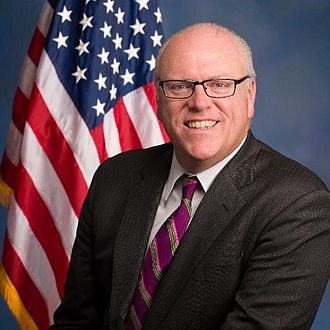
NEW YORK (TIP) House Democratic Caucus Chairman Joe Crowley (D-NY) introduced a series of amendments to the government funding bill that would defend middle class families against Republican attempts to undermine vital health care and immigration priorities. The Crowley amendments would, among other provisions, secure critical provisions of the Affordable Care Act and prohibit government funds from being spent on efforts to deport individuals eligible for the Deferred Action for Parents of Americans (DAPA) or the expanded Deferred Action for Child Arrivals (DACA) programs.
As part of the government funding process, members of Congress are able to submit amendments to ensure federal funds are allocated in commonsense manners that protect constituents. Crowley introduced or co-sponsored eight amendments – all aimed at improving the lives of individuals living in Queens, the Bronx, and across the country, such as ensuring they continue to have access to quality health care and do not see their tax dollars wasted on President Trump’s detestable immigration policies.
“It’s unconscionable that federal dollars would be used to advance the political agenda of congressional Republicans and President Trump. They didn’t think we’d pay attention but we are, and I won’t stand for it,” said Crowley. “Unable to push forward their disastrous Trumpcare plan to strip millions of access to health care, Republicans are trying to sneak a repeal past the American people. House Republicans are also giving President Trump a blank check for his despicable mass deportation efforts.”
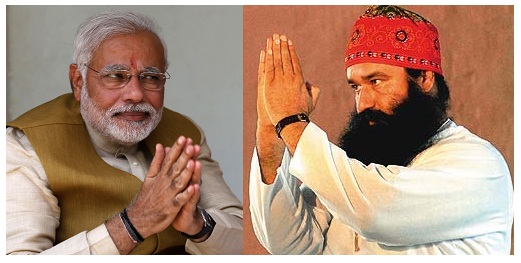
The BJP has been courting the Babas because it embodies the concept of religious men leading the country rather than its politicians. After the Gurmeet ‘Ram Rahim’ episode, the RSS is in a dilemma and is simply playing along.
The RSS is still feeling its way to translate its concept of Ram Rajya into reality as it takes time to completely change the narrative.
Beyond the conviction of Baba Gurmeet Ram Raheem Singh leading to mayhem and deaths in Haryana in particular lies a preview of the RSS-inspired BJP scheme of things for a future India.
The Baba, with his cult following, was a figure of considerable importance and politicians of all hues humored him for the votes he could deliver. But there was a deeper purpose for the BJP and its Haryana unit to court the Baba because it embodied the concept of religious men leading the country, rather than its politicians. Putting it another way, politicians would rule the country in concert with religious leaders. This is true despite the homilies of Prime Minister Narendra Modi in radio broadcasts and otherwise.
It is no secret that the Baba endorsed the BJP in the Haryana assembly elections which tipped the scales in its favor. In gratitude, the entire state cabinet went to the Baba’s headquarters to pay obeisance. Besides, photographs of the Baba with Chief Minister M.L. Khattar sweeping the floor and the Sports minister, Mr Anil Vij, with folded hands in his presence after plying him with a check for lakhs of rupees have become iconic images. Prime Minister Modi himself lauded the Baba for his “Clean India” campaign.
Where does this glimpse of religious leaders at the forefront take India? The RSS itself is confused and seems to be playing the game as it goes along. It is, of course, for a Hindu India or Hindutva as it defines it. Many of the myths it has created about the blissful days of ancient India are common knowledge. We know about planes flying, of heads transposed and plastic surgery as common features of the good old days.
In building a new India of their dreams, RSS leaders and their BJP followers needed an inventive narrative. The Mahatma was, of course, immediately appropriated. And the BJP raided the Congress repository of heroes on a mass scale. The Congress, after all, was the leader of the independence movement, with the RSS often ambivalent, if not complicit with the British rulers.
Thus, in addition to the Mahatma, felled by an RSS sympathizer, the BJP appropriated Sardar Vallabhbhai Patel and many others, as the need arose. Its main target was the maker of modern democratic India, Jawaharlal Nehru. He was too cosmopolitan, too influenced by the West for the BJP’s liking, vociferous as it was in striking the nationalist and native pose. The BJP is now in the process of writing a new narrative of modern India in which the towering personality who shaped the country is to be dismissed as one of many former prime ministers, his memorial to be shared by all.
By all indications, the RSS is still feeling its way to translate its concept of Ram Rajya into reality. The Constitution is one impediment, the judiciary another, and above all the very diversity – in religious, ethnic and other terms – in governing the country. The last task falls into the lap of the Prime Minister, himself brought up in the cradle of the RSS but conscious of the pitfalls of running the country on narrow nationalist and religious lines.
With the general election of 2019 already looming on the horizon, the contest between the RSS, the legitimizing authority of the Sangh Parivar, and a practicing politician of Mr Modi’s stature is likely to increase. In the end, there must be a compromise between these two poles of power while the larger ideological issue is sorted out.
What to do with babas and their transgressions is another matter. There are swamis and great religious leaders who lead exemplary lives and do good. But the field has become crowded with charlatans and conmen of various kinds who trade on the gullibility of the poor and their superstitious beliefs to live well and exercise influence on politicians in search of votes. The BJP is particularly susceptible to their wiles because of its own myths and the status it accords to its own concept of a Hindu rashtra.
Sober thinkers in the Sangh Parivar must realize that it takes time to change the narrative of nearly a century of the independence movement and the glorious decades of Congress rule after India won independence. We still live in a country shaped by the giants of the independence movement, almost all of them belonging to the Congress. Yes, textbooks are being revised to rewrite history to obliterate the long decades of Muslim rule. The beautiful Taj Mahal stands uneasily in the Uttar Pradesh of Yogi Avidyanath.
The Sangh Parivar is not the first conglomerate to rewrite history. The Communists in Russia and elsewhere were quite proficient in demolishing old heroes – in Moscow lodged in a park of old curiosities – while Ukraine has also archived its Communist past and the United States is seeking to demolish statues of Confederate greats in the shape of statues of slave owners after they lost the civil war. The Parivar is repeating history with a twist by making Jawaharlal a non-person.
Future developments in a changing India will depend upon the Parivar leaders in bringing about their revolution of a Hindu India. Like all ideologues, they are men in a hurry – women never play a leading role in their scheme of things – but here again the conflict is between ideology and governance.
Two people above all will influence the outcome: RSS chief Mohan Bhagwat and Mr Modi, the latter in his political garb. They are unified in their ideology but divided in their responsibilities. We shall not have to wait for long to find out.
The affinities between Trump and Modi are striking, but none of them bodes well for democracy.
By A.G. Noorani
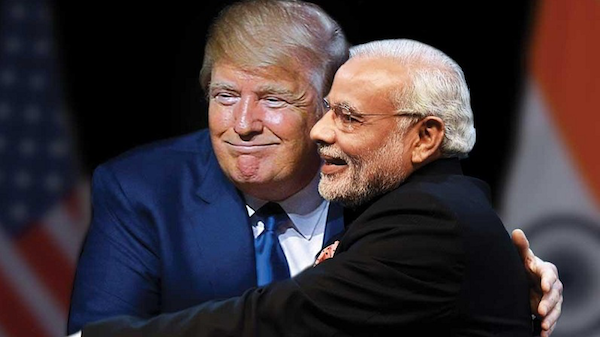
NO two persons are exactly alike. But Narendra Modi and Donald Trump resemble each other to such a degree that one might as well call them Donald Modi and Narendra Trump. The affinities are striking in their range and depth; and they are disturbing in their potentiality for harm to the national good. This comes out in sharp relief as one lists their traits one by one.
A monumental ego is the most conspicuous quality which Narendrabhai shares with Donaldbhai. From it follow most others.
Demand of loyalty. Trump was clumsy enough to sack the Federal Bureau of Investigation’s (FBI) Director James Comey because he failed to extract from him a pledge of loyalty; itself a highly improper demand. Modi, unable to fire heads of statutory bodies, hand-picked loyalists in advance for sensitive posts. He planted his man Friday Amit Shah as party chief and set up a cabal of fawning Ministers. Never before was the country treated to a daily dose of Ministers praising their chief. Sushma Swaraj stooped so low as to proclaim that Jawaharlal Nehru merely promoted his own image while Modi raised the prestige of the nation. To think that this is the man who sits on the chair on which Jawaharlal Nehru once sat. Not to be outdone by Sushma Swaraj, Rajnath Singh rushed to praise Modi’s Independence Day speech the very next day (“patterns emerging from his address, which reflect his concept of governance almost like mantras”); Ravi Shankar Prasad’s tributes to his master are as regular as they are sickeningly fulsome. As with Trump’s men, Modi’s stooges suffer from acute insecurity.
Both revel in demagogy, laced with fierce personal attacks on opponents and critics. They believe in Balfour’s dictum—speak often and speak for long; and you will acquire the contempt for his audience which every bore has.
Both are coarse and crassly vulgar, in their strict dictionary meaning. They do not care for censure. Modi set the tone with his speeches in Gujarat.
Both spread group hate with abandon.
Both are exclusivist ideologues owning a narrow world view and a narrow concept of nationalism. They regard themselves as the very personifications of their visions.
Insecure as they themselves are, Trump and Modi conduct their pantomimes with obedient advisers. Professionalism is scorned. Uneducated, except in the formal sense, the duo is also uneducable as well. They will not grow.
Egotism breeds ambition. Each, in his own style, seeks to recast the polity anew.
But neither cares to be specific about his program. If reading brings pain to the lips, reflection gives a headache.
Flamboyance in style and escapist vagueness on substance. Slogans pass for policy statements: America First and Sab ka Saath, Sab ka Vikas; Modi fears parliamentary debates and press conferences. He dislikes questions and abhors precision. So does Trump.Such persons find institutions stifling. Trump attacks the United States Congress; Modi plants favorites as heads of cultural and educational bodies in order to bend them to his will.
To be sure, the two adore business and will go all out to make life easier for Big Business, for favorites.
You know the club bore or the dinner party pest who tells any who gives him an ear, “I may not have studied economies; but my first principles are sound. I can fix the system.” Trump and Modi belong to this class.
These “experts” in economies are experts also in foreign policy. Modi and Trump believe in highly personalized diplomacy based on one assumption and one calculation. The assumption simply is that they know better and can manage men and matters. Within weeks of being sworn in as Prime Minister, Modi hosted President Xi Jinping, with results that are there for all to see. Trump went to Saudi Arabia to egg it on in its wild schemes—isolation of Iran and humiliation of Qatar. The calculation is a crafty one. Excursions abroad will impress sceptics at home.
Most remarkably, our arrogant partners in daring enterprises share a love and also a hate. They love Israel. They hate China. In 2013, when he was Chief Minister of Gujarat, Modi denounced China as “expansionist”. Simplistic to the core, they believe that the world would join them in their attempts to isolate the chosen victim, be it Iran or Pakistan. But states follow the national interest; policies of isolation have a short shelf life.
Both are ruthless. Modi lost no time in putting veterans like L.K. Advani and Murli Manohar Joshi in their place though they had run out of steam and posed no danger. Trump has shattered all records of presidential sackings of officials; Stephen K. Bannon, the “Chief Strategist”, being the latest.
A leader’s egotism, dangerous always, becomes a real menace when it is married to a narrow and exclusivist nationalism. Modi never conceals his brand. It is Hindutva “cultural nationalism”. He told the Press Trust of India (PTI) “I am a Hindu nationalist”, frankly and bluntly. Trump flaunts his brand of nationalism, which Charlottesville revealed.
Since the hard core of the constituency is what it is, neither Trump nor Modi can afford to be anything but selective in their censures of wrongs, no matter how grave. Trump’s infamous remarks of August 15 on the outrage at Charlottesville will outlive his Presidency: “You also had people that were very fine people on both sides.” The best comment came from Britain’s Prime Minister Theresa May on August 16: “I see no equivalence between those who propound fascist views and those who oppose them. I think it is important for all those in positions of responsibility to condemn far-right views wherever we hear them.”
Modi practices his brand of moral equivalence as his speeches during the election campaigns to the Lok Sabha in 2014, in Bihar and in Uttar Pradesh, revealed. Not once has he censured attacks on Muslims specifically, nor has Trump attacked the Klu Klux Klan. Modi dare not censure the Rashtriya Swayamsewak Sangh (RSS).
If the polity is to be recast, it is essential that history is rewritten and national heroes are replaced with votaries of the ideology of hate. The Bharatiya Janata Party (BJP) takes pot-shots at Nehru. Trump plays the same game on George Washington and Thomas Jefferson, as if there was nothing else to them besides ownership of slaves. Modi has sought to rewrite history systematically to exclude Nehru’s role in nation-building, very much as Stalin had history rewritten to wipe out Trotsky’s record. A nation is known by the men it lauds as its heroes. Modi and his BJP-RSS mentors prefer to laud S.P. Mookerjee, Deem Dayal Upadhyaya and V.D. Savarkar.
The top leadership of the state has it in its power to promote its ideology and to create an atmosphere. In every democracy, the media has sympathizers of both, the ruling party and the opposition. Modi’s regime has created a new class of active supporters in the media on whom it lavishes its largesse. These are noted columnists who never deviate from the party line and have prospered in Modi Raj. TV is as faithful, bar exceptions. They mould a climate. On August 15, the National Public Service announced that the Lincoln Memorial in Washington, D.C., had been defaced by obscene writings drawn with spray paint. A Smithsonian Museum map on Constitution Avenue had received the same treatment.
Besides these dozen and odd affinities lies one which bodes ill for the political system. It is the leader’s belief that he stands apart and above the party. The party derives strength from him; not him from the party. Trump’s recent attacks on the Republicans will soon pass. The party system is strong though the divides are not as sharp and Trump cannot last long. His ratings are abysmally low.
The RSS is disturbed by Modi’s antics but shrewdly reckons that it has more to gain by him being Prime Minister than by ousting him. Modi’s ratings have suffered, but they remain encouraging enough for him. The opposition has not crafted an alternative and attractive program, nor acquired an inspiring leadership. Modi developed an image of himself as one who will deliver and laced it with Hindutva. Any alternative must meet him on both.
It saddens one to note that two of the world’s great democracies are led by men intolerant of dissent; driven by a tunnel vision; and made of poor quality fiber, coarse and outmoded.
“Ye gods, it doth amaze me, /A man of such a feeble temper should/So get the start of the majestic world, / And bear the palm alone.”
Shakespeare had a conspirator say this of Julius Caesar. What a scornful portrait he would have drawn of sawdust Caesars Trump and Modi.
(A.G. Noorani, author of a number of books, is a leading constitutional expert and political commentator and contributes regularly to various publications the world over)
With 2.47 lakh applications, Indians are top H-1B visa applicants till July 2017
NEW YORK (TIP): Heretofore, thousands every year transited to US Green Card through their work visa in the US.. H1 B route was found to be quite convenient to obtain a green card. But it appears it is not going to be the same “easy and convenient” route anymore.
As reported in The Indian Panorama earlier, from October 1, the United States Citizenship and Immigration Service (USCIS) has made an in-person interview mandatory in such cases. In technical parlance, it refers to an I-485 adjustment of status interview. This announcement was made on August 28 and was reported immediately by The Indian Panorama
On another front, US immigration attorneys are seeing an uptick in number of ‘Requests For Evidence’ (RFEs) being issued by the USCIS. These RFEs relate to petitions (applications) filed on or about April 2017 for H-1B visas that will be valid from October 1, 2017.
As regards the amendment made for adjustment of status to that of a green card, NPZ Law Group managing attorney David H Nachman explains, “USCIS currently requires interviews for family-based green card and naturalization (obtaining citizenship) processes. But most of the time, it waives the interview requirement for the above category of applicants. While interviews for those transitioning from employment-based visa status to green cards were standard a decade ago, waivers have been regularly granted since then. Under the new policy, there will be no further waivers. Thus, the new process will lengthen the waiting time for green card applicants.”
A vast majority of those to whom green cards are allotted comprise those who are already working in the US on temporary visas.
During the four-year period up to 2014, over 2 lakh green cards were allotted to H-1B visa holders, according to a report by the Bipartisan Policy Centre.
Latest available data released by the USCIS shows that during 2015, as many as 34,843 Indians adjusted their temporary visa status and obtained green cards. Of this, 25,179 were holding jobs in the US (primarily under the H1-B category).
Immigration.com managing attorney Rajiv S Khanna says, “A new wrinkle in the inquiries is that, as USCIS had warned, they will not accept level-1 wages to be given in H-1B cases easily. They are questioning level-1 wages almost uniformly.”
He explains the various levels and illustrates the wages. Level-1 category relates to entry-level jobs and, at the other end, is the level-4 category which calls for a more technical and leadership role.
The prescribed wage at level 1 for a software developer in San Jose is $88,733 a year, which rises to $155,147 annually at level 4. Khanna adds, “It is the USCIS position that level-1 salary indicates a non-professional position that does not require a specific college degree and is a job that would be inappropriate for an H-1B visa.
There are often situations where level 1 is indeed the appropriate level — even the largest consulting firms in the US do send out entry-level professionals for assignments.”
NPZ Law Group has seen a sharp hike in the RFEs — by 55% to 65% as compared to the past numbers.
Nachman explains, “The question that continues to arise in the RFEs is to prove that the position that the H-IB applicant will be taking is in a specialty occupation. The new set of questions that we are seeing has to do with why the level-1 wage has been chosen if the position is a ‘specialty position’ calling for a complex set of duties. As you can see, the US government is requiring us to argue that the position is ‘complex’ and then, on the other side, asking that if it is so complex why is a lower salary being assigned?”
The increase in inquiries is an administrative cost for all, and is especially challenging for those employers (mid-tier companies) that had designated level 1 even for more experienced visa applicants.
“It’s been the most satisfying thing I’ve ever done”
“History is written by the victors”
“My intention is to examine how someone like me can look at new historical evidence and explore an alternative historical narrative to what I’d been taught as a girl.”
Gurinder Chadha
Gurinder Chadha, the British-raised director of “Bend It Like Beckham” confesses that “Viceroy’s House” is the story of a Punjabi-British mother who learns about the 1947 partition of India from her 91-year-old mother. She closes the film, “Viceroy’s House” with an ode to her grandmother, who sought refuge from Pakistan in India.
The story is based on the books “Freedom at Midnight” by Larry Collins and Dominique Lapierre and “The Shadow Of The Great Game – The Untold Story Of Partition” by Narendra Singh Sarila.
_Manish Dayal as Jeet and Huma Qureshi as Alia in “Viceroy’s House.”
The film’s narrative is fairly evenly split between the political wrangling of the real historical figures upstairs (the British players); and the emotional downstairs (the Indian players) scenes, centered on the fictional romance between Jeet (a Hindu personal valet to Mountbatten played by Manish Dayal), and Aalia (a Muslim translator for Mountbatten’s daughter Pamela played by Huma Qureshi) who is betrothed to someone else (another Muslim, chauffeur to the Viceroy) and may end up on the opposite side of a new border.
Famous figures — including Mohandas K. Gandhi (Neeraj Kabi), Jawaharlal Nehru (Tanveer Ghani) and Muhammad Ali Jinnah (Denzil Smith) — are supporting but pivotal players. Impeccable production design and some fine performances, including Gillian Anderson as Mountbatten’s wife, hold this film together.
Director – Gurinder Chadha
Writers – Paul Mayeda Berges, Moira Buffini, Gurinder Chadha
Actors – Gillian Anderson, Michael Gambon, Hugh Bonneville,Manish Dayal, Simon Callow
Music – A.R. Rahman
Running Time – 1h 46m
Genres – Biography, Drama, History
At a pre-release screening Q&A in New York city, Chadha emphasizes that her mother, 91, when she was growing up in Rawalpindi (now Pakistan) recalls that everyone (Hindu, Muslim, Sikh, Christian) lived side by side very happily with a lot of respect for one another. Chadha articulates her mother’s words in Punjabi at the Q&A. In the words of Chadha’s mother, in 1947, the British suddenly did black magic and whatever happened all she knows….. there was a lot of destruction. Most Indians knew that there was something quite fishy about how partition came about, but no one could quite put their finger on it.
Gillian Anderson as Edwina, Hugh Bonneville as Mountbatten and Lily Travers as Pamela in “Viceroy’s House.”
“I decided I wanted to make a film about what I call The People’s Partition,” she explains. “I didn’t just want to explore why Partition happened and focus on the political wrangles between public figures, I also wanted to make sure the audience understood the impact of Partition on ordinary people.”
Chadha’s ancestors lived in the foothills of the Himalayas, now on the Pakistani side of the border. Her grandparents lived through the tumultuous events which saw sectarian violence between India’s minority population of Muslims (many of whom craved their own homeland) and the Hindu and Sikh majority, bring about the greatest refugee crisis the world has ever seen; in a vast diaspora, an estimated 14 million people were displaced during Partition and up to a million died.
To make a purely political film, Chadha quips she might just as well have made a documentary. But to reach a broader audience, she needed to entertain as well as educate. “That’s why I chose to interweave these political events with a love story – after all, even when the world is falling apart around our ears, life goes on – people’s hearts endure pain but also have huge capacity for love!”
As Chadha’s conception of how to tell the story developed, she approached Cameron McCracken (Executive Producer and Managing Director of Pathe in the UK, co-executive producer of Slum Dog Millionaire) to help progress the project. The combination of British and Indian backers gave Chadha the opportunity to make the kind of film she grew up loving.
Whilst bowing down to their genius, Chadha sees her movie as being in the same tradition as David Lean’s A Passage To India (1984) and Richard Attenborough’s Gandhi (1982).
As a writer-director, Chadha has repeatedly translated her personal experience as a Punjabi-British woman into uplifting, crowd-pleasing movies, from her ground-breaking 1993 debut Bhaji On The Beach to her box-office smash Bend It Like Beckham.
Hugh Bonneville as Mountbatten and Gillian Anderson as Edwina in a scene from “Viceroy’s House.”
Asked for whom she made the movie, Chadha says that it’s hard to strike those balances between an Indian audience and a western audience. “In the end, you have to do what feels right for you and I did what I felt was right for me. And I so wanted to make the film (to coincide with) 70 years after partition.”
In any event, what happened in 1947 has been pored over for the last 70 years and Chadha believes her interpretation is not the first and it will not be the last. But at least it will stimulate debate!
(Mabel Pais is a freelance writer. She writes on the arts and entertainment, health and wellness, social issues and spirituality)
WASHINGTON (TIP): Faced with the very real possibility of a potential immediate shutdown of the entire DACA program by a federal court, President Trump took the responsible and constitutional step of announcing that the administration will be phasing out the program over the next two years.
September 5th deadline was set by the plaintiffs presenting the administration with two, and only two, real options to choose from: the likely sudden cancellation of the program by a judge or an orderly wind-down that preserves the rule of law and returns the question to the legislative branch where it belongs. The President chose the latter of the two options.
The President made the best decision in light of the fact that the system was set up by the Obama administration, in clear violation of federal law. President Obama even admitted this himself when announcing the program, calling it a “temporary stopgap measure” and calling on Congress to act.
DACA was initiated after Congress explicitly rejected the same proposal in legislative form. In other words, President Obama didn’t just suspend federal law, but implemented a policy Congress had explicitly rejected.
There is a misconception that DACA primarily serves as a shield from deportation. This is misleading. DACA grants work authorization to nearly 800,000 individuals who are not legally authorized to work. DACA recipients, whose average age is in their 20s, were not an enforcement priority before, and they certainly won’t become a priority now. The priorities remain the same: criminals, security threats, and those who repeatedly violate our immigration laws.
The main effect of today’s announcement is that work permits and other government benefits are being gradually phased out. But rather than leave DACA recipients and men and women of immigration enforcement in confusing limbo, while the DACA program was challenged by states in the same court that struck down another of the previous administration’s unlawful immigration orders earlier this year, President Obama [sic] is laying out a responsible 24-month phase-out — sorry, President Trump.
No permits will be expiring for another six months, and permits will remain active for up to two full years. The President was elected partly on his promise to deliver meaningful immigration reform that puts the jobs, wages, and security of the American people first. He is delivering on that promise every day, and he has put forward serious proposals to Congress that would responsibly end illegal immigration, prevent visa overstays, remove dangerous criminals, protect American jobs and wages, and create a merit-based system that grows our middle class.
These are not just President Trump’s priorities; they are the American people’s priorities. For decades now, the American people, immigrant and U.S.-born, have asked Congress to establish a lawful immigration system that protects our country. They’ve asked for strong, secure borders, they’ve asked us to protect American security and American jobs, and they’ve asked us to have compassion, not only for those who are here illegally, but for unemployed American citizens, including millions of unemployed African American and Hispanic citizens who continue to suffer under a broken system.
The President’s DACA decision today brings us closer to a safer, fairer, and legal immigration system. Now that he has ended this unsustainable and unconstitutional program imposed by the previous administration, the President is calling on the men and women in Congress to fulfill their duty to the American people by truly reforming our immigration system for the good of all people.
NEW YORK (TIP): South Asian Americans Leading Together (SAALT), a national civil rights and racial justice organization, slammed President Trump’s decision to terminate the Deferred Action for Childhood Arrivals (DACA) program, the latest in a litany of this administration’s anti-immigrant policies.
“America’s values are founded on the ideal that all people are created equal and deserve justice. The President’s decision to terminate DACA puts 800,000 individuals at risk of deportation from the only country they’ve ever called home. Ending DACA is the latest evidence of this administration’s utter lack of commitment to our nation’s founding values of equality and fairness,” stated Suman Raghunathan, Executive Director of SAALT. “Our current patchwork of immigration policies and programs is broken, and we demand Congress does its job to craft a commonsense immigration process that creates a roadmap to citizenship for aspiring new Americans. This is the only way to align our immigration laws with the values Americans hold dear.”
The Trump administration will phase out DACA after a six-month delay, punting responsibility to Congress to craft legislation to protect Dreamers. Passing the DREAM Act 2017 is an important first step, but what the nation needs is a comprehensive immigration reform.
Over 27,000 Asian Americans, including 5,500 Indians and Pakistanis, have already received DACA. An additional estimated 17,000 individuals from India and 6,000 from Pakistan respectively are eligible for DACA, placing India in the top ten countries for DACA eligibility. With the termination of DACA, these individuals could face deportation at the discretion of the administration.
The CEOs of Apple, Google and Facebook and many other business leaders have all staunchly supported DACA and opposed its termination, citing their need for talented workers in a direct rebuttal to claims that DACA has hurt the American economy.
WASHINGTON (TIP): Leaders of the Hindu American Foundation called upon Congress for the swift passage of compassionate and comprehensive immigration reform, and called the termination of the Deferred Action for Childhood Arrivals (DACA) program by President Donald Trump unnecessarily punitive.
“The termination highlights the need for Congress to stop delaying immigration reforms that serve our country’s needs, and better reflect our country’s values as a nation of immigrants,” said Suhag Shukla, the Foundation’s Executive Director. “A sign of a broken system can’t get more obvious than when an order must serve as a last resort to deliver a dream or when it’s used to jeopardize the immigration status of hundreds of thousands of young people, including thousands of Indian, South Asian, and diaspora Hindus, who have grown up, studied, and worked here.”
In particular, the Foundation called for a congressionally mandated pathway to citizenship for previously undocumented children. There are approximately 800,000 undocumented individuals who were provided legal protections under DACA after they were brought to the US by their parents when they were children.
“Participants of DACA trusted the federal government to register and have since been extensively vetted. They’re contributing members of American society — many of them taxpayers, many students — all brought here as children,” Shukla stated. “No one should be penalized for the actions of their parents through no fault of their own.”
Earlier this year, the Foundation outlined its key immigration policy priorities for the Hindu American community, focusing on family unification, streamlining the employment immigration system, permanent reauthorization of the Special Immigrant Non-Minister provision in the Religious Worker Visa Program, and revamping the refugee and asylum application process.
NEW YORK (TP): Microsoft co-founder Bill Gates expressed his disappointment on Donald Trump’s decision to end the DACA program and expressed hope that Congress will quickly pass a permanent fix so that hundreds of people do not get separated from their families, friends, and communities.
“I’m very disappointed with today’s decision to end DACA. Hundreds of thousands of young people who have been educated in the United States and have played by the rules their whole lives will be forced to live under the threat that they will be separated from their families, friends, and communities”, Gates wrote on a Facebook post.
“Melinda and I have been incredibly impressed by the Dreamers we have come across in our work with Microsoft, the foundation, and other programs we have supported over the years. They have been raised as Americans and have taken that responsibility seriously. Dreamers represent the best instincts of this country and the tradition that the great experiment of the United States is made better by people from other places coming here to dedicate their talents and commitment to continuing to move our country forward”, he further added.
“I hope that Congress will quickly pass a permanent fix to allow these young people to stay in the country without the destructive fear of deportation”, he wrote.
Deferred Action for Childhood Arrivals (DACA) is an American immigration policy established by the Obama administration in June 2012. DACA allows certain illegal immigrants who entered the country as minors to receive a renewable two-year period of deferred action from deportation and eligibility for a work permit.
The USICS has announced that they are no longer accepting initial requests for DACA, but will adjudicate initial requests for DACA accepted by Sept. 5, 2017. They will no longer approve advance parole requests associated with DACA. They are only adjudicating DACA renewal requests received by Oct. 5, 2017, from current beneficiaries whose benefits will expire between Sept. 5, 2017 and March 5, 2018.
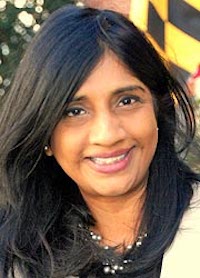
MARYLAND (TIP): Aruna Miller, an Indian-American politician and a member of the Maryland House of Delegates representing District 15 in Montgomery County, Maryland, picked up the endorsement of the women’s political group Emily’s List in the race for Maryland’s 6th District congressional seat.
Miller, a former Montgomery County transportation engineer, is the only woman running in the race to replace Rep. John Delaney, who is running for president.
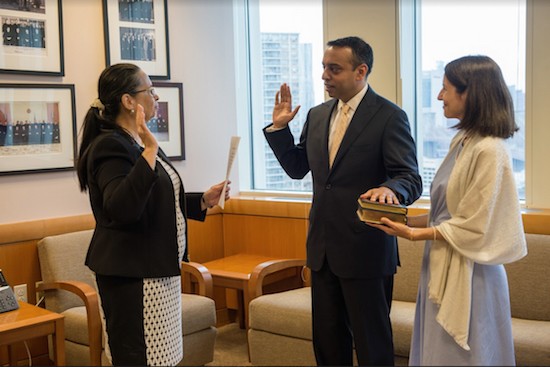
Miller was sworn in as a member of House of Delegates on January 12, 2011 and appointed to the Ways and Means Committee (revenue, transportation & education subcommittees). She is a member of the Land Use and Transportation Committee of the Montgomery County Delegation and a member of the Women Legislators of Maryland where she serves on the executive board.
After re-election in 2014, Miller was appointed to serve on the Appropriations Committee where she is Chair of the Oversight of Personnel Subcommittee and vice-Chair of the Transportation & Environment Subcommittee and in 2016 was appointed as vice-Chair of the Capital Budget. In the 2017 Miller was elected to Chair of the Women’s Legislative Caucus.
In 2011, while serving as a Delegate, Miller encouraged strengthening economic and cultural development between Maryland and India and accompanied Governor Martin O’Malley on six-day trade mission to India, which resulted in nearly $60 million in business deals for the state of Maryland. Delegate Miller took a lead role in working with the Office of the Secretary of State and the Department of Economic Development to coordinate the Governor’s arrangements for his first stop to Hyderabad.
In 2013 Delegate Miller was one of ten Maryland lawmakers named to the Maryland Business Climate Workgroup designed to make recommendations and develop long-term plans to streamline business regulations, encourage business innovation, and develop public-private partnerships to finance infrastructure.
In 2013 Governor Martin O’Malley appointed Delegate Miller as a Commissioner to the Interstate Commission on the Potomac River Basin (ICPRB). The ICPRB’s mission is to enhance, protect, and conserve the water and associated land resources of the Potomac River and its tributaries through regional and interstate cooperation.
Miller maintains her activism in community organizations, including serving on the boards of the Black Rock Center for the Arts, the Montgomery County Public Schools Educational Foundation, & the Indian Biomedical Association. She is a graduate of Leadership Montgomery (class of 2013) and in 2012, Miller served as an at large Delegate to the 2012 Democratic National Convention.
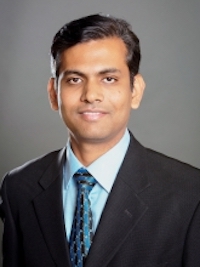
BOSTON (TIP): New Chemical Engineering Professor Ashish Kulkarni of University of Massachusetts at Amherst recently has been included among the so-called “Talented 12”, an international “dream team” of rising all-stars in chemistry, as chosen by Chemical & Engineering News. Dr. Kulkarni’s baseball-card-style photo on the lively Talented 12 webpage nicknamed him the “Cancer Crusher.” He comes to UMass Amherst after serving as an instructor of medicine at Harvard Medical School and an associate bioengineer at Brigham and Women’s Hospital. Kulkarni’s research efforts have been focused on the development of pioneering, structure-activity, relationship-inspired nanomedicine for cancer therapy.
“Disease develops in our body if there is an imbalance in the immune system,” Kulkarni said in his Chemical & Engineering News profile. “I’m developing dual-function nanoparticles that can allow us not only to create a balance in the immune system but also to monitor whether the drug is working in real time.”
As Chemical & Engineering News explained its Talented 12: “This team of up-and-comers has big ideas for using chemistry to solve global problems. Welcome to the third annual Talented 12 issue. It took us months of scouring the globe to collect all 12 of the rising stars in chemistry featured here.”
As a postdoc at Harvard, he designed nanoparticles that could act as cancer immunotherapies; meaning drugs that prompt the immune system to find and attack cancer cells. But, although cancer immunotherapies known as “checkpoint inhibitors” dissipate tumors in many people with cancer, they don’t work for all. Researchers have been searching to find a good diagnostic or biomarker to predict and track people’s responses to the treatments.
The 36-year-old academic, who completed his undergraduate work at the Institute of Chemical Technology in India before earning his doctorate at the University of Cincinnati, grew up loving cricket. Kulkarni can include his addition to the Talented 12 super team on his list of distinguished awards. Among other honors, he is the recipient of the Hearst Foundation Young Investigator Award, Dana-Farber/Harvard Cancer Center Career Development Award, American Association of Cancer Research Scholar-in-training Award, American Society of Pharmacology and Experimental Therapeutics Young Scientist Award, and the Melanoma Research Alliance Young Investigator Award.
BUFFALO, NY (TIP): Ravinder K. Bansal, a retired entrepreneur of Indian origin, who embarked on a solo flight around the world to raise money for a hospital in Haryana, has completed a six-week tour after raising $160,000. He will donate the money to the Rotary Ambala Cancer Hospital in Haryana, India, to purchase an urgently needed MRI machine.
On July 4, Bansal, a resident of Buffalo, New York, embarked on a solo flight around the world in a single-engine Cessna 400 and returned on August 21. During the 19,878-mile trip he flew across England, France, Italy, Greece, Jordan, the UAE, and Oman and ended in India. He also had stopovers in Thailand, Malaysia, Philippines, Japan, Russia, and Canada during his return trip to the United States. He planned the mission after his daughter-in-law was diagnosed with life-threatening cancer. “This mission for me is very personal as it not only is an adventure that I have been dreaming about for a while, but will also help bring awareness about cancer in the rural community around Ambala and get the hospital a needed MRI machine now. Above all, it will generate publicity for the hospital that will hopefully continue to bring donations/support from the local and international community and Rotarians to keep the hospital operating and growing in future”, he wrote.
“It has been a dream of mine for years to do this Round the World trip. I am finding it hard to believe that I have done it and come back home safely. I have lots of people to thank for helping me fulfill my dream. First and foremost is the unflinching support of my family, my wife Pratibha, my sons Rohan and Nitin, my brothers, sister and their families. My logistics team Eddie Gold and Ahmed Hassan of GASE, my friends in Buffalo, the new ones I made along the way and most of all God Almighty who watched over me through this entire journey. Thank you, Thank you, and Thank you all for helping make my dream come true”, he wrote in his blog.
Bansal is a Ph.D. holder in mechanical engineering from the Georgia Institute of Engineering, is a retired entrepreneur with a passion for flying and a wannabe Drummer.
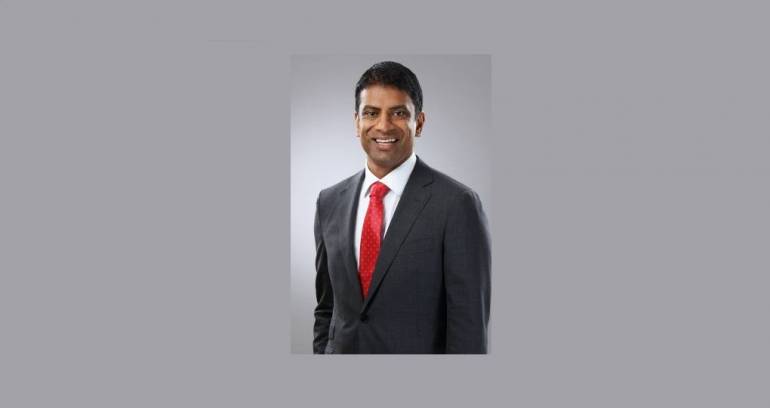
BASEL, SWITZERLAND (TIP): The Board of Directors of Novartis has appointed Indian American Vasant (Vas) Narasimhan, M.D., Global Head of Drug Development and Chief Medical Officer, as CEO of Novartis, effective February 1, 2018.
Dr. Narasimhan is a member of the Executive Committee and joined Novartis in 2005. He will replace Joseph Jimenez who has been CEO since 2010. The 41-year old Narasimhan who heads the Drug Discovery division runs one of the industry’s largest drug development programs—overseeing 9,600 employees, 143 projects, 500 ongoing clinical trials and a nine billion dollar budget.
Dr. Narasimhan said, “I would like to congratulate Joe and express my gratitude to Joe, Joerg, and the Board of Directors. I feel honored and humbled to be asked to lead Novartis. We will continue our legacy of bringing leading innovation to patients around the world. With our recent launches, our strong pipeline, broad capabilities, world-class leadership team, and committed people, I am very confident about our future.”
Dr. Narasimhan has held numerous leadership positions across Novartis in commercial, drug development and strategy roles. Prior to his current role he served as Head of Development for Novartis Pharmaceuticals. Before joining Novartis in 2005, he worked at McKinsey & Company. He received his medical degree from Harvard Medical School in the US and obtained a master’s degree in public policy from Harvard’s John F. Kennedy School of Government. In addition, he holds a bachelor’s degree in biological sciences from the University of Chicago, also in the US. During and after his medical studies, he worked extensively on a range of health issues in developing countries. Dr. Narasimhan is an elected member of the US National Academy of Medicine. He is a US citizen born in 1976, married with 2 children, and lives in Basel, Switzerland. Among the string of US FDA approvals under his watch this year there is a potential blockbuster heart-failure drug Entresto. Narasimhan brought a new dynamic to drug discovery by using big data and technology extensively by partnering with tech companies like Microsoft, Google and Qualcomm.
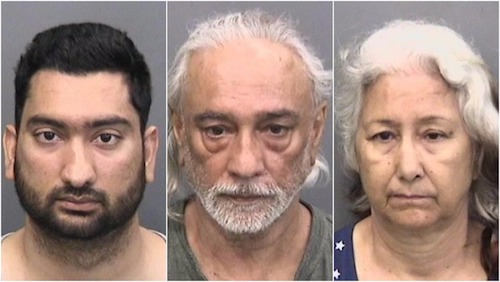
TAMPA, FL (TIP): An Indian woman in Florida was rescued on Sept 2 after the authorities received a call from India that she was beaten and held against her will by her husband and his parents. According to reports, 33-year-old Silky Gaind, was found “badly beaten and bruised over her entire body” from beatings by her husband Devbir Kalsi and his parents. Police has arrested Devbir, his father, Jasbir Kalsi, 67, and mother, Bhupinder Kalsi, 61. Gaind and her 1-year-old child, who was found unharmed, have been moved to a safe place, according to the Sheriff’s Office.
According to investigation report, the parents had traveled from India to “counsel and discipline” Gaind at their son’s request. Devbir Kalsi had told his parents that his wife was being disobedient. While beatings by her husband continued, Gaind was held against her will by his parents. The Hillsborough County Sheriff’s office said Gaind called her parents in India on Saturday, Sept 2 to tell them of the abuse. They then called authorities.
According to an arrest report, Devbir Kalsi and his wife got into an argument on Friday night, during which he struck her “repeatedly and forcefully.” When the woman tried to defend herself, Devbir Kalsi’s parents began hitting her, too, causing bruises on her face, neck and torso before Jasbir Kalsi threatened to stab her with a kitchen knife, the report said.
Deputies arrived about 6:30 a.m. Saturday at their home but nobody opened the door after repeated knocks. Gaind tried to open the door and “screamed for the deputy to save her and her child,” the Sheriff’s Office said. A deputy then forced the door open to find Devbir. When Devbir tried to push the door closed, the deputy began arresting him before being confronted by his parents.
Both Devbir and Jasbir Kalsi face charges of false imprisonment, child abuse and denying access to 911. Devbir Kalsi faces an additional charge of felony battery, and Jasbir Kalsi is accused of aggravated battery with a deadly weapon. Bhupinder Kalsi faces charges of battery domestic violence and failure to report child abuse.
NEW YORK (TIP): Indian American lawyer Sanket Bulsara, who recently served as acting general counsel to the U.S. Securities and Exchange Commission, has been appointed as a magistrate judge in the Eastern District of New York and is the first South Asian American to serve on the bench in the Second Circuit.
“We are thrilled to welcome Judge Bulsara into the Eastern District family,” Chief Judge Dora Irizarry said. “Judge Bulsara was chosen by the Board of Judges from among five highly qualified and stellar candidates recommended by the Magistrate Judge Merit Selection Committee composed of members of the bar and citizens of the Eastern District.”
Judge Bulsara received an A.B. degree magna cum laude in 1998 from Harvard College and a J.D. degree cum laude from Harvard Law School in 2002. He is a graduate of Edgemont High School.
Upon graduating from law school, Judge Bulsara was a law clerk to Judge John G. Koeltl of the Southern District of New York. Thereafter, he was an associate at Munger Tolles & Olson in Los Angeles and Wilmer Cutler Pickering Hale and Dorr in New York, where he worked from 2005 to 2015, including as a partner of the firm. In 2015, he became the Deputy General Counsel for Appellate Litigation, Adjudication, and Enforcement at the Securities and Exchange Commission in Washington, DC.
As the Acting General Counsel of the SEC, he served as the agency’s chief legal officer. He also oversaw the agency’s appellate, adjudication and enforcement related legal policy functions. Bulsara also served as Special Kings County Assistant District Attorney while he was at Wilmer Hale and successfully tried felony and misdemeanor cases.
Bulsara received several awards related to his numerous pro bono matters that have included working on prisoner rights cases and a Hague Convention child abduction matter.
HOUSTON (TIP): Shalini Singh, a 25-year-old Indian student died on Sept 3, days after she was rescued along with another Indian student Nikhil Bhatia from a swollen lake in Hurricane Harvey hit Texas on Aug 26. Bhatia was rescued from the Lake Bryan along with Shalini Singh on Saturday, Aug 26. Bhatia succumbed to his injuries on Wednesday, Aug 30. Shalini, who continued to be in a critical condition, was declared dead late Sunday night.
Bhatia, a PhD student at the Texas A&M University, completed his schooling from Jaipur’s St. Anslem’s Pink City Senior Secondary School in 2011 and did his B. Tech in Vellore, had recently graduated from Texas A&M University in Water Management and Hydrological Science. Shalini was pursuing master’s degree in public health from the same university. She came to the US only last month to pursue the two years Masters program after her degree in Dental Surgery from I T S Dental College in Greater Noida.
Bhatia, originally from Jaipur, along with Shalini from New Delhi, were swimming in the lake when a sudden current of water pushed them deeper. The friends accompanying them noticed that the duo were in distress and flagged down nearby police officers. Bryan Police officers were able to rescue and provide cardiopulmonary resuscitation to the victims until medics arrived, according to Bryan Mayor Andrew Nelson. Both were admitted to a hospital in a critical condition. Dr Anupam Ray, the Consul General of India in Houston, was attending to their medical needs.
At least 100,000 Indian-Americans living in and around Houston area have been severely affected by the tropical storm.
The life-threatening storm has affected around 13 million people, with rains turning streets into rivers. At least 50 flood-related deaths have been confirmed by local officials.
FORDS, NJ (TIP): Sanjay Gupta, an Indian American resident of Fords, New Jersey, was sentenced for illegally hiring twelve unauthorized aliens to work at his company, Doon Technologies located in Iselin, New Jersey. U.S. District Judge J. Garvan Murtha sentenced Gupta to a six-month term of incarceration and a $10,000 fine. Judge Murtha also ordered that Gupta pay restitution totaling $14,200 to foreign workers from whom Gupta obtained illegal fees and payments.
According to Court documents, Gupta, 51, admitted to recruiting 12 foreign workers with information technology expertise to work in the United States at his company Doon Technologies. Gupta then submitted forms and documentation to United States Citizenship and Immigration Services (USCIS) to obtain H1-B visas for the foreign workers with the stated purpose of working for Doon Technologies. USCIS has a visa processing center in St. Albans, Vermont which processed some of the applications submitted by Gupta. The applications Gupta submitted claimed that Doon Technologies would employ the foreign workers in the State of New Jersey, and that the foreign workers would be paid within 30 days of admission to the United States, as required. However, Gupta had no intent to follow these assurances, and instead placed the foreign workers at worksites outside the State of New Jersey, and paid the foreign workers only when work was available. Gupta’s misrepresentations to USCIS were material, in that H1-B visa allocations are designed to allow the employment of foreign workers in specialty occupations only when there are insufficient U.S. Citizens and Lawful Permanent Residents to work in those positions.
In addition, Court documents reflect that Gupta submitted fraudulent documentation to USCIS to obtain H1-B visas, specifically by forging fictitious contracts with purported customers in an effort to demonstrate that work would be available for foreign workers when they began work for Doon Technologies. Further, court documents reflect that Gupta demanded prospective H1-B visa beneficiaries pay Gupta an illegal fee for submitting the H1-B visa applications to USCIS. Gupta also demanded that H1-B visa beneficiaries pay him hundreds of dollars to retain their visas, or risk deportation.
WASHINGTON DC (TIP): Political consultant Ravneet Singh, former CEO of ElectionMall Technologies, was sentenced Aug 31 to 15 months in prison and ordered to pay a $10,000 fine for his role in funneling more than $600,000 in illegal foreign campaign contributions from Mexican citizen Jose Susumo Azano Matsura to candidates in the 2012 San Diego mayoral election.
U.S. District Court Judge Michael M. Anello ordered the defendant to report to prison on October 12, 2017, to begin serving his sentence.
In September 2016, after six weeks of trial and five days of deliberations, a federal jury in San Diego returned guilty verdicts against Singh, Azano and Azano’s son, Edward Susumo, who were convicted of felony counts associated with a series of illegal campaign contributions by Azano to the campaigns of Bonnie Dumanis and Bob Filner.
“American elections are not for sale,” said Executive U.S. Attorney Blair Perez. “We will not allow our sacred electoral process to be compromised. This prison sentence underscores an important message: Anyone who tries to manipulate the American electorate will pay a high price.”
According to evidence presented at trial, Azano, Singh, and others conspired to inject hundreds of thousands of dollars in cash and in-kind consulting services to the Bonnie Dumanis and Bob Filner campaigns, despite the fact that Azano’s foreign national status made such contributions illegal. To conceal his connection to these contributions, Azano arranged with his son Edward Hester and others to funnel this illegal foreign money through corporate and third person “straw donor” contributions. The conspirators, moreover, arranged for at least $267,000 worth of Singh’s in-kind consulting services to be secretly funneled to the campaigns.
In return for his political contributions, Azano sought to buy political influence. For example, he wanted support for his vision of Miami West – a San Diego waterfront development project with a yacht marina, a branded five-star hotel, and luxury bayside condominiums that promised Azano millions in profit. In other instances, Azano wanted access, like the ability to call on influential political figures or obtain letters of reference to secure his son’s admission to the University of San Diego.
Ultimately, with Azano’s help, Filner won the election, though he was forced to resign shortly thereafter.
For his part, Singh used his specialized skills and knowledge to facilitate the crimes. Evidence at trial demonstrated that Singh used code names for the Dumanis and Filner work that Azano paid for but never for any other domestic candidate for office; harshly reprimanded employees for using those code names in emails; and on one particularly candid occasion, referenced the “legal ramifications” of discussing these topics. Singh further concealed the payments from Azano by structuring the wires from a Mexican company, Broadlink, controlled by Azano, which had nothing to do with electoral politics, to company Singh controlled, not Election Mall, but eSolutions, which primarily developed software from India.
Ambassador Hardeep S Puri, now Minister of State with Independent Charge of Housing and Urban Affairs in the rejigged Cabinet of Prime Minister Narendra Modi, was India’s Permanent Representative to the United Nations from 4 May 2009 – 27 February 2013. His four years at the United Nations were eventful for Indian diplomacy when India pushed for a permanent seat on Security Council, and contributed hugely to furtherance of UN agenda. Outside the UN, Ambassador Puri was an admired and much-loved person for his qualities of head and heart, and an affable and winsome nature.
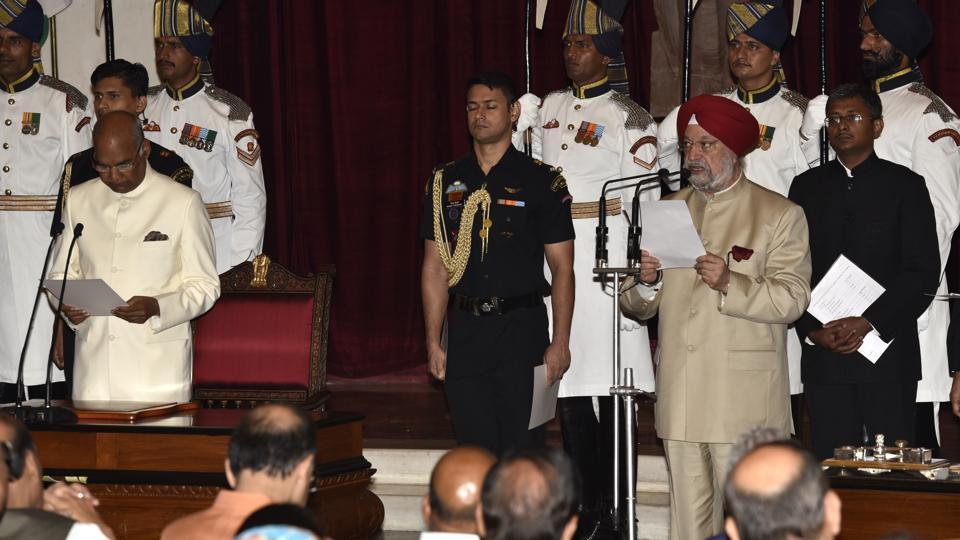
The news of Mr. Puri’s induction in Modi cabinet immensely pleased his friends and admirers in New York. One of his closest friends, attorney Ravi Batra, sent in his comment to The Indian Panorama which we are hugely pleased to publish here. Mr. Puri assumed office on September 3.
The Indian Panorama has had a long association with Mr. Puri who the newspaper featured a couple of times while he was stationed in New York. We are glad to see him in the select group guiding the destiny of a great democratic nation of 1.3 billion people. We wish him all success and happiness. We also congratulate his wife Ambassador Lakshmi Puri. –EDITOR
PM Narendra Modi has tapped H. E. Hardeep Singh Puri as the Minister of State for Housing and Urban Development – directly answerable to him. It’s a deeply happy and proud moment for all of us who know and love Hardeep, and who wish India well always (especially, to be America’s indispensable ally). This most difficult of assignments has been given to a man who was born to serve and has much to contribute to humanity – now, at least to 1.3 billion Indians who are impatient to realize their version of the American Dream.
Like Ian Flemings’ 007 James Bond, Hardeep is India’s, to achieve the difficult goal and do it beyond expectations. My wife, Ranju and I were with him and Lakshmi in 2010 in the UNGA hall for the Security Council vote and witnessed that even as the Ballots were being given out, as India’s Permanent Representative, Hardeep (and DPR Manjeev Puri) was walking up and down the aisle to give that last “warm touch” of friendship to each nation’s PR. The result was that India won on the first ballot – with a near-unanimous support of 189 countries entrusting India with global peace and security – because of Hardeep Singh Puri. Our joy and love was palpable and overflowing. We saw nation after nation coming over to greet and celebrate him. The SC seat he won, he worked hard and earned a reputation for uncommon maturity in policymaking and a healthy distaste for regime change – even if it came camouflaged as Responsibility to Protect.
Everybody knows of Hardeep’s service to India – from Sri Lanka, to Ambassador in London and Brasilia, and as Permanent Representative to the United Nations in Geneva and New York. Now, India has entrusted an intractable portfolio to a man who, like Bond, always rise to the challenge to succeed handsomely. His innate ability to first harness the challenges, develop an action plan, and then effectuate it with sufficient perseverance, and sometimes with needed flexibility, to reach the goal beyond expectations. Knowing Hardeep, from friend to family, and more, PM Modi just harnessed the personal and professional relationships of a global superlative fiduciary of India to provide affordable housing and develop urban centers that comport to the Paris Accord and latest technology.
Unlike the telephone sector success, when India escaped the landline telephone shortage and misery to 21st century digital mobile phones, in Housing & Urban Development there is no way to succeed by going 100% digital – as land will remain analogue, even if we embed it with digital upgrades.
Yet, every Indian has the right to a roof over their head, clean water to drink, clean air to breathe and a waste management system worthy of a nation on a hasty march to enjoy her destiny with youthful vigor of an educated citizenry.
To all who have played the game of obstruction of this Portfolio, beware as Hardeep-the-diplomat will overcome you – in his unique authoritative style. Perhaps, India noticed that the very evening of his Oath-taking, he held his first meeting with his top subordinates to harness the landscape and obstacles. The rest, as they say, will soon enough be history-making success for India – as entrusted to Hardeep by PM Modi.
(Ravi Batra is a Lawyer; Chairman, National Advisory Council South Asian Affairs, and Greenstar Global Energy Corp.; and Pro Bono Advisor to the Ukraine Mission to the UN in New York. He can be reached at ravibatralaw@aol.com)
With 2.47 lakh applications, Indians are top H-1B visa applicants till July 2017
NEW YORK (TIP): Heretofore, thousands every year transited to US Green Card through their work visa in the country. H1 B route was found to be quite convenient to obtain a green card. But it appears it is not going to be the same “easy and convenient” route anymore.
As reported in The Indian Panorama earlier, from October 1, the United States Citizenship and Immigration Service (USCIS) has made an in-person interview mandatory in such cases. In technical parlance, it refers to an I-485 adjustment of status interview. This announcement was made on August 28 and was reported immediately by The Indian Panorama
On another front, US immigration attorneys are seeing an uptick in number of ‘Requests For Evidence’ (RFEs) being issued by the USCIS. These RFEs relate to petitions (applications) filed on or about April 2017 for H-1B visas that will be valid from October 1, 2017.
As regards the amendment made for adjustment of status to that of a green card, NPZ Law Group managing attorney David H Nachman explains, “USCIS currently requires interviews for family-based green card and naturalization (obtaining citizenship) processes. But most of the time, it waives the interview requirement for the above category of applicants. While interviews for those transitioning from employment-based visa status to green cards were standard a decade ago, waivers have been regularly granted since then. Under the new policy, there will be no further waivers. Thus, the new process will lengthen the waiting time for green card applicants.”
A vast majority of those to whom green cards are allotted comprise those who are already working in the US on temporary visas.
During the four-year period up to 2014, over 2 lakh green cards were allotted to H-1B visa holders, according to a report by the Bipartisan Policy Centre.
Latest available data released by the USCIS shows that during 2015, as many as 34,843 Indians adjusted their temporary visa status and obtained green cards. Of this, 25,179 were holding jobs in the US (primarily under the H1-B category).
Immigration.com managing attorney Rajiv S Khanna says, “A new wrinkle in the inquiries is that, as USCIS had warned, they will not accept level-1 wages to be given in H-1B cases easily. They are questioning level-1 wages almost uniformly.”
He explains the various levels and illustrates the wages. Level-1 category relates to entry-level jobs and, at the other end, is the level-4 category which calls for a more technical and leadership role.
The prescribed wage at level 1 for a software developer in San Jose is $88,733 a year, which rises to $155,147 annually at level 4. Khanna adds, “It is the USCIS position that level-1 salary indicates a non-professional position that does not require a specific college degree and is a job that would be inappropriate for an H-1B visa.
There are often situations where level 1 is indeed the appropriate level — even the largest consulting firms in the US do send out entry-level professionals for assignments.”
NPZ Law Group has seen a sharp hike in the RFEs — by 55% to 65% as compared to the past numbers.
Nachman explains, “The question that continues to arise in the RFEs is to prove that the position that the H-IB applicant will be taking is in a specialty occupation. The new set of questions that we are seeing has to do with why the level-1 wage has been chosen if the position is a ‘specialty position’ calling for a complex set of duties. As you can see, the US government is requiring us to argue that the position is ‘complex’ and then, on the other side, asking that if it is so complex why is a lower salary being assigned?”
The increase in inquiries is an administrative cost for all, and is especially challenging for those employers (mid-tier companies) that had designated level 1 even for more experienced visa applicants.
New York kid Jake (Tom Taylor) is gifted. He sees visions that revolve around a mysterious ‘man in black’ Walter (Matthew McConaughey) and his attack on the Dark Tower by using the power siphoned from telepathic children. As Jake’s nightmarish visions come to life, he comes across Roland (Idris Elba), the Gunslinger, who is immune to Walter’s psychic powers and has the ability to safeguard the tower that holds the universe together. The two must protect the world from Walter’s destructive plans.
REVIEW
Based on Stephen King’s The Dark Tower book series, the film is about the eternal fight between good and evil. Those who protect versus those who destroy. Can life (Roland and Jake) win over death (Walter) or is death the ultimate conqueror? The metaphors are aplenty.
Though the film is a fantasy, what essentially works for it is the father-son bond between Jake and Roland. Idris Alba’s charisma and effortless screen presence lends gravitas to the script and salvages the otherwise predictable plot. Matthew McConaughey makes bad look sexy. Sadly, his contrived and vague character fails to make an impression and ends up as a weak link.
About the story, you don’t have to read the books to understand this one, which works. On the flip side, despite being gripping, it’s quite underwhelming. While The Matrix like action and slowmo bullet battles keep you hooked, the story fails to work on a deeper level as motives remain unexplained (perhaps for sequels to follow).
The Dark Tower keeps you engaged but fails to go beyond offering you some generic escapism.
Actress Brie Larson said being successful makes an individual’s life easier, especially in terms of monetary benefits.
The 27-year-old Oscar-winning Actress , however, said success has not altered her expenditure patterns but she is glad that she does not have to worry about paying the bills.
“It makes you life much easier on a practical level. Not that I’ve changed my spending habits dramatically or live differently now from the way I used to, but at least I don’t have to worry about money any more.
It’s not pleasant having to live under that pressure when you’re trying to find good roles and wanting to prove yourself,” Larson said.
Reese Witherspoon has finally found her next Television skit. The Emmy-nominated actress is all set to guest star on the final season of ‘The Mindy Project’. The series creator and star Mindy Kaling announced the news on her Instagram profile.
She posted a photo and captioned it as, “Our latest The Mindy Project guest star is the only woman I would want to be trapped in a cave with. (This is weirdly the second cave we have acted in together!)” In the photo, Kaling is holding a cell phone and wearing a puffy vest, while Witherspoon is wearing an off-the-shoulder red dress. Both stars appear to be in a cave.
The first cave Kaling is referring to is likely from ‘A Wrinkle In Time,’ where she and Witherspoon play Mrs. Who and Mrs. Whats it, respectively.
The show has been known to attract A-listers throughout its six-season run. Other guest stars included Seth Rogen, James Franco, Shonda Rhimes, Freida Pinto, Stephen Colbert, Greta Gerwig and Joseph Gordon-Levitt.
‘The Mindy Project’ will mark Witherspoon’s latest television appearance since her Emmy-nominated role as Madeline Mackenzie in HBO’s ‘Big Little Lies’.
National Award winning actress Kangana Ranaut, who was earlier slammed by writer Apurva Asrani for taking the co-writer credit in ‘Simran’, said she didn’t take part in the direction of the film and would have proudly said it openly if she had done it.
Kangana was slammed by Asrani after the poster of Hansal Mehta’s ‘Simran’ released, showing Kangana’s name as co-writer. Apurva took to Facebook to raise objections to it and slammed the actress for taking undue credit.
Kangana said: “I have not done anything to do with direction in ‘Simran’. I have acted in it and written it. If I had directed the film, I would have proudly said it, but I have not done it.”
Kangana, who comes from a non-filmy background and hails from Mandi district of Himachal Pradesh, also spoke about her background.
“Big cities are money-oriented, small towns are more concerned about what people — buaji, mausiji — will say? I come from an extreme environment, a conservative background. I felt stifled and just wanted to be free,” said the National Award winner.
Kangana, who has been appreciated for films like ‘Fashion’, ‘Queen’ and ‘Tanu Weds Manu Returns’, said she tries to be away from award shows.
“There is a lot of manipulation in our award shows. Like they will tell you in advance that you will get this award, but will ask to perform for them. I try to stay away from all this.”
Source: IANS
Signup to our Newsletter!
Don’t miss out on all the happenings around the world