
I remember a beautiful inspiring conversation from some 12 years ago, I was one of the few men who volunteered at a women’s conference in Dallas. We had 5000 women coming from all around the world. I was the registrar and had about 10 booths to manage. I walked in at 7 AM, we did not have the registration papers – 4 or 5 senior ladies in their 80’s said they are in the basement of a Church. So, we rode in few suburbans to bring the papers – in the basement, there were about 30 boxes to load…. I was debating how I am going to do this. Before I could do anything, the senior ladies jumped in and started picking two boxes at a time… I could not bear, my culture did not allow me for my seniors to carry that load, and I had to do it. I believe it was Sandra, wife of Judge Barefootsanders who questioned me, young man, I am healthy and active because I do the work and will remain active…. She was awesome! They would not listen and the suburbans were loaded in no time.
As we were driving back to the hotel, what I heard was an incredible conversation. The ladies were talking about how many hours they served in a Church, Hospital or a School…. I will never forget that conversation and made the determination that I will always be a volunteer till my last breath.
I read a new piece on Asma Jahangir today (http://centerforpluralism.com/asma-jahangir-human-rights/) the human rights activist. What made her stand up against powers to protect the rights of people who were not related to her? Then I started thinking about Martin Luther King, Gandhi, Mother Teresa and others, why did they not enjoy their lives and were hell-bent on repairing the world? You may be one too constantly serving others for no gain. Then I ask myself, why do I volunteer? Why do I stand up for others? I have gotten threats against my life, screamed at, attacked but never was I discouraged.
I don’t get a penny either, rather I lose it. My late wife Najma used to say, if you spend half your time working your business, we can live a great life with that money…. There is no answer to it, each one of us is driven by our calling. Different things are important to different people. Money drives some and other things drive others. Those who are driven by money will never understand volunteerism.
So, I salute the volunteer you, it is a great feeling to serve others, particularly those whom you don’t know and will never see again and never get paid to serve.
If you are one, share a note.
(The author is an Indian-American committed to building cohesive societies and offers pluralistic solutions on issues of the day. As we learn to respect the “otherness” of others and accept the God-given uniqueness of each one of us, conflicts will fade, and solutions emerge. He is the president of the Center for Pluralism in Washington, DC.)
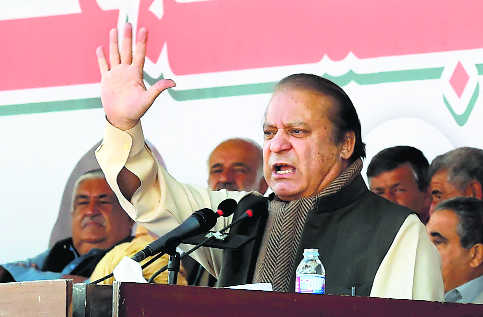
The run-up to the 2018 election bears an eerie similarity to the events preceding the 2013 poll. The actors seeking to destroy Nawaz Sharif’s political future are the same, with the addition of the SC and Hafiz Saeed.
Disqualified from holding the office of Prime Minister last year by the Supreme Court, Nawaz Sharif has now been barred by the same court from being the head of his party, PML (N). Ostensibly a matter of corruption in high places, his disqualification has a strong subtext of civil-military tussle in Pakistan.
As the 2013 Pakistan election approached, the security establishment was concerned at the prospect of a Nawaz victory because of his popularity in Punjab that carries more than 50 per cent seats in the National Assembly. The anxiety stemmed from Nawaz’s tense relationship with his army chiefs during two tenures as Prime Minister, his bitterness against the army at his treatment after the 1999 coup and repeatedly professed desire to promote better relations with India. In 2011, Imran Khan, whose Pakistan Tehreek-e-Insaf had failed to make a mark since its founding in 1996, appeared on the scene out of nowhere to relaunch his political career by opposing American drone strikes in Pakistani territory and corruption in the ruling parties. The then DG, ISI, was reported to be the architect of his sudden rise, a move that subsequent events would prove to be farsighted in filling the gap left by the reluctance of the two major parties — PPP and PML (N) — wiser with the experience of the past, to collaborate with the army against each other. Closer to the election, Tahir ul Qadri, a Canada based cleric of Pakistan origin, landed up to push for its postponement. However, these machinations failed, and Nawaz won a third term with a comfortable majority in the election held in May, 2013.
In this backdrop, the civil-military equation under Nawaz was expected to be anything but smooth. Differences emerged quickly on Musharraf’s trial, policy on terrorism and relations with India. The army managed to secure Musharraf’s exit from Pakistan, prevailed against Nawaz’s misplaced policy of dialogue with the anti-Pak terror groups and systematically undermined his agenda to improve relations with India.
Imran’s agitation against the alleged rigging of the 2013 election, which kept Nawaz on the back foot vis a vis the army, came a cropper when a judicial commission ruled against him in July 2015. However, the linkage of some offshore companies to the Prime Minister’s family, revealed in the Panama papers, gave Imran and his mentors another opportunity to target Nawaz. In July 2017, the Supreme Court disqualified Nawaz from holding public office. Significantly, the decision was based on the report of a six-member joint investigation team, constituted by the court that included a representative each of the ISI and Military Intelligence. Since these highly disciplined individuals would not have approved the report without a nod from the army leadership, the damning report, combined with the track record of the Pakistan judiciary kowtowing to military dictators, had left little doubt about the fate of the Prime Minister and was an indicator of provenance of the decision to oust him.
The run-up to the 2018 election bears an eerie similarity to the events preceding the 2013 election. The actors seeking to destroy Nawaz’s political future are the same, with the addition of the Supreme Court and Pakistan’s terror brand ambassador, Hafiz Saeed. The army would be loath to see his return to power. The PPP has sought to exploit Nawaz’s misfortunes for political gains in Punjab, but being an experienced party, would not go the extent of playing the security establishment’s game. That is not true of Imran. Egged on by his ambition, he is blind to the army’s design. Tahir ul Qadri is again around. The security establishment aims to deprive Nawaz of another victory by undermining him in Punjab. Hafiz Saeed’s services have also been enlisted for good measure by releasing him from preventive detention. Though the Election Commission has not recognized his party, Milli Muslim League, because of opposition of the PML (N) government, he could be expected to put up independent candidates to erode Nawaz’s vote.
Nawaz and his children face charges in an accountability court, with the sword of conviction and imprisonment hanging over their head. Besides depriving him of the presidency of his party, all decisions taken by him in that capacity since July 2017 have also been declared null and void. However, counting on his popularity in Punjab, which he hopes to boost by playing the victim card, Nawaz refuses to desert the field. Attempts to cause any major fissures in his party and wean away his brother, Shahbaz Sharif, have failed so far. Nawaz, being the vote getter, is indispensable to the party. An efficient technocrat, Shahbaz complements Nawaz, but cannot replace him. Deprived of the presidency of PML (N), Nawaz threatens to lead it in the election in his individual capacity in the hope of ruling through a proxy, as he is doing now. If jailed, his loyalists could fight in his name. He thus dares the army to either go the whole hog and stage a coup, inviting international opprobrium, or face the prospect of seeing him rule, even if by proxy.
The selective accountability that has claimed Nawaz’s head not only implies the departure of an individual from office, but can also target every politician, capable of winning popular mandate and consequently inclined to chart out a course independent of the worldview of the army. Nawaz, after all, was disqualified as per a Zia era constitutional amendment requiring elected representatives to be ‘sadiq’ (truthful) and ‘ameen’ (righteous), subjective criteria that can be used by the Deep State to throw out anyone not in agreement with them. The civil-military imbalance and the resulting dysfunctionality of the state that have become a curse for Pakistan and the region will get redressed essentially by opposition within Pakistan to the stranglehold of their army, with external pressure at best playing a supportive role. Therefore, though a matter internal to Pakistan, the ongoing tussle and its outcome should be of interest to us.
(The author is India’s former High Commissioner to Pakistan)
It is already a matter of considerable dismay that otherwise decent officials, educated aides and learned advisers have acquiesced in the organized worship of a man who grandiloquently pretends to know profoundly about everything, from gaming the examinations to disrupting the economy, even without the benefit of a Harvard education, and making a virtue of “hard work”. From senior most ministers to junior joint secretary, all find themselves subscribing to this “daddy knows best” syndrome, very much reminiscent of the Narayan Datt Tiwari hymns to Sanjay Gandhi during the Emergency days.
History of the last hundred years has taught us one simple lesson: personality cults do introduce undesirable imbalances in the body politic. Personality cult produces very little democratic good; it always ends up badly, even disastrously.
The greatest danger we face is Narendra Modi is using all the accruements of democracy to de-legitimize democracy’s good practices and values, and, to turn all its bad habits to make democratic arrangements look inadequate and unequal to the task of restoration of our national glory.
The top Congress leaders are due to gather, in a fortnight from now, for their party’s plenary session. Apart from consecrating Rahul Gandhi’s election as the party president, the gathering will need to undertake far more serious a task: they will have to perform a duty to start a conversation with the nation and to take the citizens into confidence on how the entire political system is groaning under the weight of one man — his whims, his fancies, his attitudes and his limitations. The Congress and its leaders need to make a case before the nation as to why the current state of affairs is neither desirable nor acceptable. At the end of this three-day gathering, the Congress should have given the country a good enough reason to look beyond Narendra Modi, as and when the Lok Sabha elections get organized.
Since it will be a political gathering, there will be plenty of partisanship and mouthfuls of philippics against Narendra Modi, the BJP and the Sangh Parivar. But it would be a waste of time and resources if the Congressmen confine themselves to abuses; it will be an even greater farce and greater shame if the Congressmen were to engage in their familiar weakness for sycophancy. Instead, they have to behave and speak as responsible and reasonable keepers of the best of the constitutional values. As those who claim to be committed to the Idea of India and who subscribe to the Nehruvian virtues, the Congressmen have a sober and serious task at their hands: a democratic obligation to talk to fellow-citizens as to how we are all mindlessly getting sucked into the small-time viciousness of a small-time man; how as a nation and as a society we are getting infected with pettiness and small-mindedness. More than that, the Congressmen need to convince the nation that they have the legacy, the leadership, and the experience to rescue us all from this quagmire of petty vindictiveness being palmed off as a new normal.
We remain — for now — a constitutional democracy; but, all our constitutional arrangements stand diluted and all-out constitutional functionaries — be it the President of India or the Union Home Minister or External Affairs Minister —have been made to feel diminished. The Cabinet system of government has been reduced to a joke that no longer invokes a laugh. The country needs to be told that the fine architecture of checks and balances is in serious jeopardy.
It is for the Congressmen to enlighten the citizens how all the key relationships in our national scheme of things are being revised and reduced: first, the majority-minority equation has been systematically reshaped and the secular commitments stand eroded; second, the Centre-States federal equation has tipped dangerously in favor of New Delhi and the state governments are being reduced to whining tots; third, the State-Citizen balance has changed drastically, an all-intrusive Aadhaar arrangement is demanding compliance and surrender of privacy, and, we are beginning to look like a misshapen authoritarian setup; then, we have the creeping distortions in the Civil-Army relationship, with the Army in danger of losing its institutional rectitude; and, lastly, the virtual governmental takeover of the electronic media. All these key equations are off the keel. And, our citizens need to be told how these institutional distortions are unknowingly putting the nation on a road to a totalitarian-lite experiment.
When the Opposition fails to impart a democratic vibrancy to the polity, all other institutions of restraint — like the judiciary, the Election Commission — too feel discouraged; and, independent regulatory authorities like the Reserve Bank of India feel inclined to give in to the government’s unreasonable demands. The Congress, as the principal opposition party, has an obligation to create conditions for robust counterpoises.
If nothing else, the country needs to be repeatedly educated about the whimsicality that has dictated the (mis) management of the economy, and how all the great projects — like Make in India — stand in tatters; and, more importantly, whether the Congress has an answer to jobless growth and whether the Congressmen can help the country find its way out of a deepening agrarian crisis.
Notwithstanding the loud chanting of deshbhakti, and balidaan mantras, it is the Opposition’s task to inform the country that we stand isolated in our own backyard because we have needlessly and arrogantly alienated all our South Asian neighbors; and, the nation needs to be educated that India today is less safe than it was five years ago. The Congress has to introduce the citizens to a new narrative that takes us away from this excessive preoccupation with national security and an unwarranted and unworkable flexing of muscles at home and abroad. We are losing our national self-assurance without making smaller nations in the neighborhood respect us.
Then, there is a personality overload. A personality cult may have been “normalized” in New Delhi but it remains a personality cult, with all its unhealthy demands on men and institutions. It is already a matter of considerable dismay that otherwise decent officials, educated aides and learned advisers have acquiesced in the organized worship of a man who grandiloquently pretends to know profoundly about everything, from gaming the examinations to disrupting the economy, even without the benefit of a Harvard education, and making a virtue of “hard work”. From senior most ministers to junior joint secretary, all find themselves subscribing to this “daddy knows best” syndrome, very much reminiscent of the Narayan Datt Tiwari hymns to Sanjay Gandhi during the Emergency days.
History of the last hundred years has taught us one simple lesson: personality cults do introduce undesirable imbalances in the body politic. Personality cult produces very little democratic good; it always ends up badly, even disastrously.
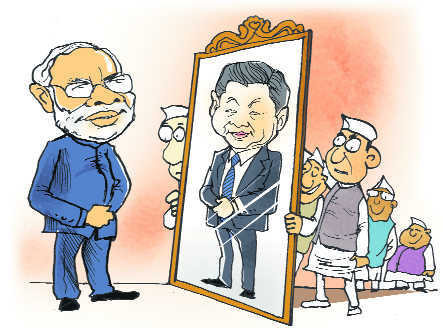
The greatest danger we face is Narendra Modi is using all the accruements of democracy to de-legitimize democracy’s good practices and values, and, to turn all its bad habits to make democratic arrangements look inadequate and unequal to the task of restoration of our national glory. Those associated with national security are already muttering that there-is-too-much-democracy claptrap. The next pit-stop in this journey would be to look temptingly at the Xi Jinping kind of authoritarian option.
(The author is editor-in- chief of Tribune group of newspapers)
NEW DELHI (TIP): Stung by a spate of cases of financial plundering of Indian Financial institutions by unscrupulous people like Vijay Mallya and more recently, Nirav Modi, government of India has decided to tighten noose around fugitive economic offenders. The Cabinet on Thursday, March 1, approved the Fugitive Economic Offenders Bill that provides for confiscating all assets of absconding fraudsters and loan defaulters to recover dues.
The Union Cabinet meet chaired by Prime Minister Narendra Modi also approved setting up of a National Financial Reporting Authority (NFRA) as an independent regulator for the auditors.
The proposed fugitive law aims to impound and sell assets of Nirav Modi-type escapees with a view to quickly recover dues. It also will apply to defaulters who have an outstanding of Rs 100 crore or more and have escaped from the country.
Finance Minister Arun Jaitley said the Bill, which will be taken to Parliament for approval in the second half of the Budget session beginning March 5, defines a fugitive offender as someone against whom a court has issued an arrest warrant for a scheduled offence and who leaves or has left India so as to avoid criminal prosecution, or refuses to return to India to face trial.
The new law is different from the Prevention of Money Laundering Act, which also provides for confiscation of assets of economic offenders, he said.
Under PMLA, only profit of crime is confiscated and that too upon conviction. The new law extends to all assets irrespective of whether it is acquired as a result of crime or not, he said. “This is triggered by the offender being a fugitive.”
“A trial of fugitive will never be complete,” he said, reasoning why confiscation of assets has been provided for. The new law will apply “the moment warrant is issued (and) the court decides the man is not submitting,” he added.
It provides for an application being made before a special court for a declaration that an individual is a fugitive economic offender, attach and confiscate his properties in India and abroad, including benami property, and disposing them off to recover dues. It provides for disentitlement of the fugitive economic offender from defending any civil claim.
“If at any point of time in the course of the proceeding prior to the declaration, however, the alleged Fugitive Economic Offender returns to India and submits to the appropriate jurisdictional Court, proceedings under the proposed Act would cease by law,” an official statement issued after the Cabinet meeting said.
The Bill has been proposed to address the lacunae in the present laws and lay down measures to deter economic offenders from evading the process of Indian law by remaining outside the jurisdiction of Indian courts.
The Bill makes provisions for a Court (‘Special Court’ under the Prevention of Money-laundering Act, 2002) to declare a person as a Fugitive Economic Offender.
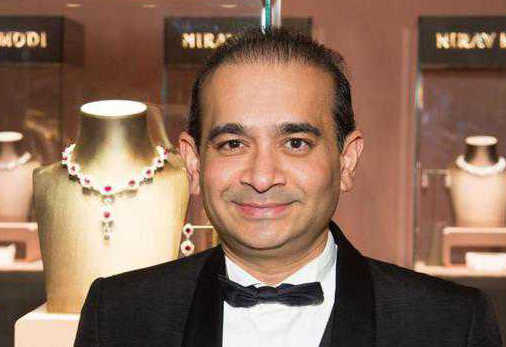
The law, though it was announced in the Budget for 2017-18, has been hastened after Nirav Modi and his uncle Mehul Choksi allegedly defrauded state-owned Punjab National Bank (PNB) of Rs 12,700 crore and left the country and are refusing to cooperate with law enforcement agencies.
The new law will allow quicker recovery of dues through a special court from such absconding offenders.
“In the last Budget, there was an announcement that the government bring law to confiscate assets of fugitives under economic offences. That has been approved by (the) cabinet today,” Jaitley said.
He said the law will apply to new and old cases of persons who have fled the country to avoid prosecution.
All assets, not just proceeds of crime, will be confiscated of an offender fleeing the country, he said, adding that offender cannot pursue any civil case in the country.
“There have been several instances of economic offenders fleeing the jurisdiction of Indian courts, anticipating the commencement, or during the pendency, of criminal proceedings. The absence of such offenders from Indian courts has several deleterious consequences — first, it hampers investigation in criminal cases; second, it wastes precious time of courts of law, third, it undermines the rule of law in India,” the statement said.
Most such cases of economic offences involve non-repayment of bank loans thereby worsening the financial health of the banking sector in India. The existing civil and criminal provisions in law are not entirely adequate to deal with the severity of the problem and so the new law provide an effective, expeditious and constitutionally permissible deterrent to ensure that such actions are curbed.
The jurisdiction of NFRA for investigation of Chartered Accountants and their firms would extend to listed companies and large unlisted public companies, the thresholds for which shall be prescribed in the Rules. The Central Government can also refer such other entities for investigation where public interest would be involved.
Hope Hicks’s first association with the Trump family was working with President Trump’s eldest daughter, Ivanka, on her personal apparel and licensing brand about six years ago.
Hicks had no political experience when she joined Trump’s tumultuous campaign for the White House. She initially served as a press secretary within the White House, before taking on the role of communications director
Hicks led strategic messaging for administration priorities such as the historic passage of tax reform and worked with Press Secretary Sarah Sanders to stabilize the press and communications teams after initial phases of transition
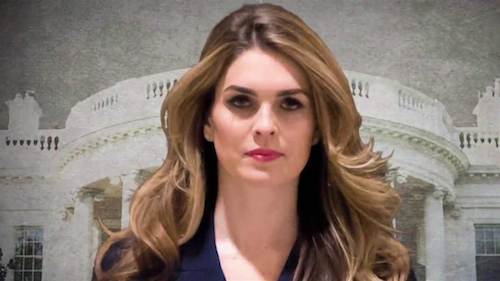
WASHINGTON (TIP): Hope Hicks, one of Donald Trump’s longest-serving and trusted aides, on March 1, announced her resignation as the powerful communications director, in a major blow to the US President and the embattled White House amidst the intensifying inquiry into alleged Russian meddling in the 2016 election.
The 29-year-old former model, though considered a political novice, was known as one of the few aides of Trump who understood his style and could influence his views. Her surprise resignation came a day after she testified before the House Intelligence Committee she testified for eight hours on allegations related to the Russian interference during the presidential campaign.
During her testimony, Hicks told the panel that in her job, she had occasionally been required to tell white lies but had never lied about anything connected to the investigation into Russia’s interference in the election, US media reported.
Although Hicks maintained an unusually low profile over the past three years, she recently attracted scrutiny after Special Counsel Robert Mueller escalated his probe into potential collusion between the Trump campaign and Russia.
She is leaving the White House after serving Trump for three years in various capacities. This included being his campaign spokesperson and Director of Strategic Communication when Trump was sworn in as the President.
“There are no words to adequately express my gratitude to President Trump,” Hicks said in a statement. President Trump praised Hicks for her outstanding work. The White House did not announce the exact day of her departure but said it could be sometime in the next few weeks.
In a little over 13 months of the Trump administration, Hicks is the fourth individual to resign as the White House Director of Communications. The other three being Sean Spicer, Mike Dubke and Anthony Scaramucci.
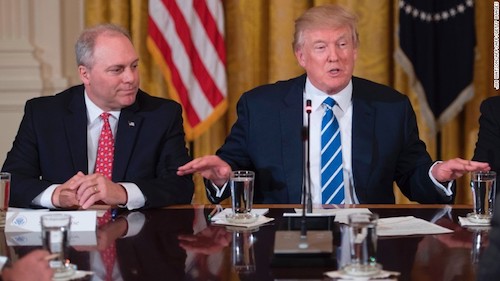
WASHINGTON (TIP): President Donald Trump called for speedy and substantial changes to the nation’s gun laws, criticizing lawmakers in a White House meeting for being too fearful of the National Rifle Association to take action.
In a freewheeling, televised session on Wednesday, February 28, that stretched for an hour, Trump rejected both his party’s incremental approach and its legislative strategy that has stalled action in Congress. Giving hope to Democrats, he said he favored a “comprehensive” approach to addressing violence like the shooting at Florida school earlier this month, although he offered no specific details.
Instead, Trump appeared to support expanded background checks. He endorsed increased school security and mental health resources, and he reaffirmed his support for raising the age to 21 for purchasing some firearms.
Trump also mentioned arming teachers, and said his administration, not Congress, would ban bump-stock devices that enable guns to fire like automatic weapons.
“We can’t wait and play games, and nothing gets done,” Trump said as he opened the session with 17 House and Senate lawmakers.
“We want to stop the problems.”
The president has previously backed ideas popular with Democrats, only to back away when faced with opposition from his conservative base and his GOP (Grand Old Party) allies in Congress. It was not clear whether he would continue to push for swift and significant changes to gun laws, when confronted with the inevitable resistance from his party.
Still, the televised discussion allowed Trump to play the role of potential dealmaker, a favorite for the president. Democratic lawmakers made a point of appealing to the president to use his political power to persuade his party to take action.
“It is going to have to be you,” Senator Chris Murphy told Trump.
Trump’s call for stronger background checks, which are popular among Americans, has been resisted by Republicans in Congress and the NRA.
Republicans have instead been leaning toward modest legislation designed to improve the background system already in place. Trump made clear he was looking for more and accused lawmakers of being “petrified” of the gun lobby.
“Hey, I’m the biggest fan of the Second Amendment,” Trump said, adding that he told NRA officials it’s time to act.
“We have to stop this nonsense.”
The White House meeting came amid fresh public debate over gun laws, fueled by student survivors of the massacre at Florida’s Marjory Stoneman Douglas High School, who have been meeting with lawmakers on Capitol Hill. The school reopened yesterday for the first time since a Valentine’s Day assault killed 17.
Gun legislation has lost momentum in Congress as Republican leaders showed little interest in pursuing stricter gun control laws.
Democrats said they were concerned Trump’s interest may fade quickly. After the meeting, Murphy, D-Conn., told reporters: “I’m worried that this was the beginning and the end of the president’s advocacy on this issue. The White House has to put some meat on the bones. The White House has to send a proposal to Congress.” The White House is expected to reveal more on the president’s plans for school safety this week, though it has not announced any plans.
That announcement will likely include goals for background checks and bump stocks, though whether age restrictions will be specifically addressed remains unclear, according to an administration official who sought anonymity to discuss private conversations.
Trump rejected the way Republican leaders in Congress have framed the debate, saying the House-backed bill linking a background check measure with a bill to expand gun rights by allowing gun owners to carry concealed weapons across state lines was not the right approach.
The concealed carry measure is the gun lobby’s top legislative priority. But “you’ll never get it passed,” Trump told lawmakers, reminding them that Democratic senators, including some in the room, strongly oppose it.
Instead, he suggested Republicans should focus on the background check bill, then load it up with other gun control and safety measures.
Ever the marketer, Trump suggested that the leading bill adjusting the National Instant Criminal Background Check System—now known as “Fix NICS”—could use a new name. “Maybe you change the title, all right? The US Background Check Bill, or whatever,” Trump said.
The hour-long meeting with lawmakers was reminiscent of one in January on immigration, when he told lawmakers to come up with a good bill and he would take the “heat” from critics.
That effort, however, ended in failure in Congress amid Trump’s shifting views and priorities in the debate.
Among those at the White House yesterday were Sens. Pat Toomey, R-Pa., and Joe Manchin, D-W.Va., who are pushing their bill—which failed twice in the Senate after the 2012 Sandy Hook Elementary School shooting—to broaden background checks to include pre-purchase reviews at online and gun show sales.
Trump asked Toomey if his plan to expand background checks included raising the minimum age for young people to buy an assault weapon. Toomey told the president it did not.
“You know why,” Trump scoffed.
“Because you’re afraid of the NRA.”
The meeting came after one major retailer, Dick’s Sporting Goods, announced it was halting sales of assault-style rifles and high-capacity magazines at all of its stores and banning the sale.
Meanwhile, US retail giant Walmart announced on Thursday that it was raising to 21 its minimum age to buy firearms and ammunition, the latest US company to recalibrate its stance on weapons after a deadly Florida school shooting.
“In light of recent events, we’ve taken an opportunity to review our policy on firearm sales. Going forward, we are raising the age restriction for purchase of firearms and ammunition to 21 years of age,” it said in a statement.
It is tax season. It is time to pay taxes. And I hope all are serious about the tax paying business. There are some who are more active than a conscientious tax payer. It is the IRS impersonators. Come tax season, and they become active. Their modus operandi is to call and create an impression that the callers are genuine IRS officials. They introduce themselves as any professional IRS official will, giving their ID, which, of course, is not a real one. They will tell the person called that he has committed a fraud on IRS and that there are warrants of arrest. Many are filled with fear and visions of their being arrested and thrown behind bars. Something which they never ever dreamed of. Also, the impersonator will instill greater fear by saying that because of the offence committed, the called person will face deportation. Again, many will shudder at the thought of losing career and being banished from the country to face an uncertain future back in the country he had come from. The impersonating IRS officials are experts at their job. It requires nerves of steel not to be filled with fear over their threats, which believe me, sound quite real.
However, once they know they have succeeded in frightening a guy they will ask for amount due to be paid straightaway. And they have elaborate schemes to get the money from frightened guys. They do not give any time to the called person to think or consult somebody. Every year during the tax period we hear stories of people having been cheated.
IRS has been at pains to warn people of these impersonators and cheats. They keep telling that IRS will send notice if at all there is something amiss with an income tax return or if the department wants a tax payer to make a payment. Yet, many fall a prey to the wiles of these impersonators.
I will advice readers of The Indian Panorama not to panic when such a call is received. A little caution and you will save your hard-earned dollars.
CWEIC is organiser of Commonwealth Business Forum, April 2018, London
LONDON (TIP): Award winning London-based global strategist, director and CEO Natasha Mudhar has officially been appointed to the Advisory Board for Commonwealth Enterprise and Investment Council (CWEIC), an organisation facilitating trade and investment throughout the 53 states of the Commonwealth and supporting private sector companies and governments to promote economic activity.
India is the Commonwealth’s most populous member and has been a key member since Independence in 1947. As the world’s largest democracy, India plays an increasingly important role on the world stage and is set to play a key role in the upcoming Commonwealth Heads of Government Meeting (CHOGM), taking place in in London for the first time in 20 years.
The CWEIC will run the Commonwealth Business Forum, to be held on 16th-18th April in London. The event forms a unique platform for dialogue, bringing together a range of industries and economies and will be organised alongside CHOGM. With the government supporting enterprise and business in the country, Indian business will also be an essential part of the Commonwealth Business Forum.
With offices in India and UK, Natasha is also the CEO & MD of the awarding multi-disciplinary, international business and communications consultancy Sterling Media, which has also announced a partnership with the Commonwealth Enterprise and Investment Council, as the official global communications partner for on-going activities.
Sterling and Natasha are renowned for its work in being the first international communications consultancy to take Bollywood global. Some of the hero campaigns she has spearheaded include Pad Man, Toilet Ek Prem Katha, Dangal, the IIFAs in the UK to name but a few.
Natasha is also the India Director of the UN’s Global Goals campaign, launched by filmmaker Richard Curtis to popularise the Sustainable Development Goals globally to end poverty, reduce inequalities and tackle climate change. She was also part of the team to launch one of India’s largest public health campaigns to eliminate filaria in India by 2020.
The Commonwealth announcement is the latest addition to a long-standing commitment of Natasha to work on some of the most relevant campaigns. Whether it’s taking Bollywood global, be breaking the Internet with over 100 million views for the explosive release of the remake of Spice Girls Wannabe video for the UN’s Global Goals to empower females or lobbying governments to end world hunger to launching iconic British brands internationally, Natasha is recognised across continents as a global campaign expert and entrepreneur in her sectors.
Ivanka Trump was cynosure of all eyes at the closing ceremony
Special Report by Prabhjot Singh in PyeongChang
PYEONGCHANG, SOUTH KOREA (TIP): The curtains were finally rung down on the 23rd Olympic Winter Games at PyeongChang on Sunday, February 25, after a glittering and impressive ceremony that saw athletes from all participating nations dancing their hearts out to the beats of music.
Norway’s gold medalists Ingvild Flugstad Oestberg, Astrid Uhrenholdt Jacobsen, Ragnhild Haga and Marit Bjeorgen pose on the podium after the cross-country women’s 4x5km relay at the PyeongChang. Photo / Courtesy CNN
The Olympic flag was ceremoniously handed over to Mayor of Beijing for holding the 2022 Olympic Winter Games there. After Sochi (2014), Olympic Winter Games continue to be confined to Eurasia. Not only that, next summer Olympic Games will also be in Asia, in Tokyo, Japan, in 2020.
The 2018 Olympic Games had many highs and lows as politics took the center stage at the start with the North Korea joining South Korea in fielding a unified Women’s Ice Hockey team besides sending a strong contingent, including cheer leaders, besides a high-powered political delegation.
While many participating nations, including Norway, Canada and the hosts Korea had every reason to cheer about, it was not so sweet for the US, both on sports and political fronts. Its athletes could not perform that well as was expected and politically, the North Korean presence in the Games at every forum was perhaps a thorn in its flesh.
President of the International Olympic Committee Thomas Bach, President of South Korea Moon Jae-in, North Korea’s delegation leader Kim Yong Chol and Ivanka Trump, senior White House adviser, attend the closing ceremony. Photo /courtesy Reuters
While the Vice-President of the United States, Governor-General of Canada, Prime Ministers of Japan, Norway and the Netherlands witnessed the opening ceremony, it was Ivanka Trump, daughter of the US President, who was cynosure of all eyes at the closing ceremony.
Participation of North Korea may have stalled the threats of a global nuclear confrontation emanating from the war of words between the US and North Korea, the situation threatened to relapse into pre-Olympic times as the US insisted on imposing strong sanctions against the North Koreans.
There was, however, a bright spot when North Korea offered to have a dialogue with the United States. How the Trump Administration reacts to the offer will be known in coming days.
Whatever be the political outcome of the barbs of the World leaders, the PyeongChang 2018 Winter Olympic Games were not without controversies. Starting with suspension of the Russian Olympic Committee and imposition of ban on 50-odd Russian athletes for being part of a concerted campaign to evade Doping control violations during the 2014 Olympic Winter Games at Sochi, two Russian athletes, including a bronze medalist in mixed Curling, were banned after testing positive for banned substances.
The Anti-Doping Agency (WADA), that has its headquarters in Montreal, Canada, had set up two special Commissions in PyeongChang that heard appeals of 50-odd banned Russian athletes and rejected all upholding the right of the International Olympic Committee to decide the eligibility criteria for participation in the Games.
Exquisite Fireworks Photo/ Courtesy CNN
The Games were perhaps the coldest after Lillehammer. The last two editions – Sochi (2014) and Vancouver (2010) were held in a little warmer weather than freezing cold and windy PyeongChang.
Norway finished at the top of the medals tally.
The 39 medals won by it is an all-time Winter Games record by any country. With 14 gold medals, they matched Germany’s first place totals, and by virtue of another 14 silver and 11 bronze, the Games of PyeongChang 2018 belonged to Norway.
Unsurprisingly, the Norwegians were most prolific in cross-country skiing – the nation’s top medal contributor with 14 – led by Marit Bjoergen. She took five in Korea (two gold, a silver, and two bronze) for 15 overall in her career. The 37-year-old is the most decorated winter Olympian of all-time, and rightly it was her win in the very last event at PyeongChang that lifted Norway over Germany.
The official Olympic medal table ranks countries in order of most gold acquired. To that end, Germany had top spot in its grasp but for conceding a shorthanded goal to Olympic Athletes from Russia in the men’s hockey final with less than a minute to go. The Russian team went on to win the hockey final, leaving Germany second in the medal standings.
With 14, Germany tied Norway, and Canada’s record from Vancouver 2010 for most gold medals won by a country at a single Winter Games. They added 10 silver and seven bronze medals for 31 overall. Massive contribution to the German cause came from Francesco Friedrich (bobsleigh) and Natalie Geisenberger (luge), each winning two gold medals.
Canada has every reason to be pleased with its performance here as it also has a record haul of medals. Tessa Virtue and Scott Moir team were the darlings of the Canadian contingent with their golds both in Team Figure Skating and Ice Dancing. Kim Boutin with three medals became the only Canadian athlete in PyeongChang to end with three medals, a silver and two bronze medals.
The Netherlands won all its 20 medals (eight gold, six silver and bronze) in speed skating (16 on the big oval, and four in short track). Of note, Jorien ter Mors made the podium in both disciplines, winning gold in the women’s 1000m on the oval, and joining her short track teammates to take the 3000m relay bronze.
The South Koreans had their best-ever medal haul at the Olympic Winter Games with 16 (five gold, seven silver, four bronze). As expected, Korean speed skaters were most effective winning 13 of the medals, seven long track, six in short. In the latter Choi Minjeong was a double gold medalist.
As mentioned earlier, Japan, the host of the next Olympic summer Games in 2020, did well to win 13 medals (four gold, five silver, four bronze). It is perhaps the best-ever show by Nippon as it was helped by Yuzuru Hanyu becoming the first back-to-back Olympic men’s figure skating champion since American Dick Button did it in 1948 and 1952.
Athletes from the United States may not like to remember these Games for their laurels. Though they dethroned their neighbors and arch rivals Canada in women’s Ice Hockey final in a shoot out, their medal count down from 28 four years ago to 23 in Korea. Nonetheless, nine gold medals cannot be discounted, including two Olympic titles that Canada held since Turin 2006: men’s curling and women’s hockey.
Though the Russians remained in spate of controversies throughout the Games, they had something to cheer about too.
Bye, Bye 2018 Winter Olympic Games at PyeongChang
At these Games their biggest highlight by far was the women’s figure skating showdown between Alina Zagitova and Evgenia Medvedeva. The two teens finished first and second, respectively, with Zagitova becoming the second youngest Olympic women’s figure skating champion at 15 years and 281 days, just 26 days older than Tara Lipinksi of the United States who still holds that record. The Olympic Athletes from Russia leave Korea with 17 medals.
They had requested the IOC for permission to participate in the closing ceremony with Russian flag. The Russians were allowed to compete here as a neutral team and the IOC flag under the banner of Olympic Athlete Russia. Their request to participate in closing ceremony with Russian flag was, however, turned down and the IOC reiterated with the suspension.
Arguably the most impressive individual performance of PyeongChang belonged to Ester Ledecka. The Czech Olympian shocked the winter sports world by winning the women’s super-G on skis reportedly borrowed from American Mikaela Shiffrin (herself a gold medalist in the giant slalom). Primarily a snowboarder, Ledecka doubled her golden tally taking the women’s parallel giant slalom, becoming the first woman to win gold in two different sports at one Olympic Games. Hers were the only two gold medals for the Czechs.
Some non-traditional winter sports countries often manage to find one athlete who can dominate a particular discipline. For the Brits, that’s Lizzy Yarnold. The skeleton racer repeated as Olympic champion, in the process becoming the nation’s first winter athlete to win two Olympic gold. Britain also saw its first-ever winter double podium with Laura Deas delivering skeleton bronze.
Martin Fourcade won a hat-trick of gold medals in biathlon. The most impressive athlete on the planet in this discipline, the Frenchman has been on top of the podium five times (a French Olympic record) counting a double gold at Sochi 2014. He’s now up to seven Olympic biathlon medals at the age of 29.
Other notable national achievements included New Zealand and Spain ending winter medal droughts dating back to 1992, while Hungary ended an even longer wait going back to 1980 by taking the 5000m short track relay gold.
Staying with short track, Italy’s Arianna Fontana became the most decorated Olympic speed skater in her discipline with three more podiums taking her to eight, and Belarus’ Darya Domracheva added to her illustrious career becoming the first woman to win four Olympic gold medals in biathlon.
India’s two-member contingent returned home without a medal. Shiva Keshawan finished 34th in Luge while Jagdish Singh in cross country skiing was placed 103rd in a field of 119.
Will meet again in 2022 in Beijing Photo / courtesy Olympic
In all six new nations, including Malaysia, made their debut in Olympic Winter Games here. Besides, there were at least half a dozen athletes who earned the distinction of representing their countries both in summer and winter editions of Olympic Games.
DUBAI (TIP): Sun Mark held its annual Celebration & Awards Dinner in Dubai during the Gulfood exhibition at the lavish Shangri-La Hotel on 19th February 2018. It was, as always, a glittering affair with esteemed guests from the Middle East and South Asian region but with many also flying in from as far away as Canada, Cameroon and South Africa; with the array of guests resembling a gathering of the United Nations. Sun Mark is the only British company to have been awarded the Queens Award for Enterprise in International Trade for an unprecedented 5 consecutive years and exports to over 130 countries. Sun Mark’s achievements are seen as the gold standard and recognized as an Ambassador for UK Business. The Chief Guest from the British Government was the Rt. Hon. Richard Harrington MP, Under-Secretary of State for the Department for Business, Energy and Industrial Strategy. The Guest of Honor was Her Majesty’s Consul General to the U.A.E, Mr Paul Fox.
The cricket legend Mr Muttiah Muralitharan at the event
The evening was also attended by the cricket legend Mr Muttiah Muralitharan and the Honorable Mr Maalaine Salama, Head of Media Relations at Dubai Municipality. H.E Mirza Al Sayegh, Representative of HH Sheikh Hamdan bin Rashid Al Maktoum, Deputy Ruler of Dubai and Finance Minister of the UAE, could not attend the gala dinner, but conveyed his best wishes to Sun Mark for the event.
Mr Harmeet Ahuja, Director of Sun Mark, welcoming the guests
The evening began with Mr. Harmeet (Sunny) Ahuja, Director and CEO of Sun Mark, welcoming the guests. He informed them that 2017 had been a monumental year in the history of the company as it was the year of the 70th birthday of the company’s founder and chairman, Dr Rami Ranger CBE. He then proceeded to show a special video outlining Dr Ranger’s story and milestones through his life.
Dr Rami Ranger CBE, Chairman of Sun Mark, addressing the guests
Dr. Ranger, in his speech, paid tribute to all those who worked closely with him and how the success of Sun Mark was a result of a combination of customers, and suppliers and other service providers coming together to help each other to progress. He thanked his team from Sun Mark for all of their efforts. He reminded his guests that with the right values anyone can succeed and told his own story and how it can inspire anyone to do the best they can.
Mr Paul Fox, Her Majesty’s Consul General to the UAE delivering his speechThe Rt. Hon. Richard Harrington MP, Under-Secretary for the department for Business, Energy and Industrial Strategy delivering his speech
The guests were then addressed by Her Majesty’s Consul General to the UAE, Mr Paul Fox, who spoke of the importance of trade and reiterated its importance in forging improved relations across the world. He also acknowledged Dr. Ranger’s philanthropic efforts and achievements. He spoke of the British food industry being a major employer and is the largest sector of UK manufacturing and an unsung hero of the British economy. He encouraged British companies to work in the UAE and to use it as a base to grow their business further. The Chief Guest, Mr Richard Harrington MP, spoke of Dr Ranger and his team’s achievements and lauded him for acknowledging the efforts of all those who worked for him and also of his wife’s great contribution to the company’s success.
Mr Sunny Kulathakal, Global President of GOPIO (Global Organisation of People of Indian Origin) delivering his speech
Mr Sunny Kulathakal, Global President of GOPIO (Global Organisation of People of Indian Origin) addressed the guests and acknowledged the contribution of Dr Ranger in social and cultural arenas and encouraged others to join them in their efforts.
Award presented to: Sir Prince Oji Okisisi of company Prince Oji, NigeriaAward presented to Mr Izzat Ullah Khan of Naveed Trading, Pakistan.Award presented to Mr Vijay Aswani of Al Vihag Enterprises, GambiaSpecial award for outstanding lifetime achievement presented to Sheikh Khalid Mahmood and his son, Sheikh Omer Khalid of Bismillah Stores, Pakistan.
Sun Mark then recognized some of its regional partners and distributors in the region who had made a significant contribution to the growth and development of business. They were Sir Prince Oji Okisisi of company Prince Oji in Nigeria. Mr Izzat Ullah Khan of Naveed Trading, Pakistan, Mr Vijay Aswani of Al Vihag Enterprises, Gambia and there was a special award for outstanding lifetime achievement for Sheikh Khalid Mahmood of Bismillah Stores of Pakistan who collected his award with his son, Sheikh Omer Khalid.
The Vote of Thanks was given by Mr. Harmeet Ahuja, who thanked Dr. Rami Ranger and Sun Mark UK and UAE team for making the evening possible and for bringing together such a myriad of people from all over the world.
The formal part of the evening was then concluded, and dinner was served.
Aries: Ganesha says with your restored and enhanced perception of life you will take it easy, be relaxed, a bit laid – back too. You are happy and optimistic and take time away from work with your lover / social outings with friends, children and parents. You find joy in building and maintaining valuable partnerships and have a gentle loving attitude which helps foster intimate bonds. It is not all as rosy as it sounds and you could face hurdles, setbacks and delays coupled with sluggish funds and unexpected expenses.
Taurus: There has been a steadily increasing awareness of the importance of relationships in your life for the past period. So, a further strengthening and bonding, at work and at home, can be achieved through mutual care and respect. Strife and friction, when they occur, should be tactfully and diplomatically handled. As we all know, peaceful solutions will lead to greater growth and progress. Control your ego and allow wiser counsel to prevail.
Gemini: You are determined to sustain the growth you have achieved and even build further on it. This is an action-packed period as you find your hands full at work, much more than you can handle. The rewards are immediate and, buoyed, you push ahead frenetically. This could lead to a burnout, causing more harm than good. So, use available resources judiciously to avoid such an eventuality. Spending time in the company of small children / pets and on hobbies / leisure pursuits could energize you.
Cancer: The hectic work situation slows down to some extent in this period. You are satisfied with the way your projects have turned out and now you feel relaxed enough to spend time with your loved ones. Home matters occupy your mind and you may even delve deep into the history of your family. Family trees, older relatives, extended family, visits to the ancestral home, even taking shock of ancestral property are some of the ways the current trend may manifest in your life.
Leo: You now allow yourself to become more relaxed and enjoy a “chilled out” time, as they say, with your loved ones. The married may want to renew their marriage vows or go on a second honeymoon. This intensely passionate time also affects your money angle. So, get your account books out and keep track of expenses. You do have to pay for all your indulgences and so a tab on expenses will be prudent. It may be a good idea to avoid any new undertakings at this time.
Virgo: Having all aspects of your life running smoothly like the well-oiled wheels of an engine, you feel content as acknowledgement and appreciation pour in for your brilliant performances at work. You now enjoy an enhanced stature in society, and this is very gratifying, especially if you look back at the hard work and sacrifices you have made to get there. But now there is a complete contrast, a veritable volte-face, as you move away from the absolute grind of the past period to the present mood of pure elation.
Libra: Your confidence as well as the caring side of your nature will be at an all-time high as you give and get love and affection in equal measure from your family and loved ones. The past period has given you some exceptionally special moments, heart-warming and thoroughly enjoyable, with your spouse / lover and children / parents. The temptation of going overboard and showering them with the most precious gift of all – your time – will fill you with pure joy and happiness.
Scorpio: Happiness and contentment come into your personal life through the blessings of Ganesha. There is closeness and warmth in all your relationships leading to greater pleasure and cheer. Your spouse / lover showers you will love and you reciprocate. It is a lucky period in which unexpected profits flow in and allow you to enjoy the fruits of your labor. There is exultation and exuberance in your life as material success pale in front of the ecstasy of soul-stirring relationships.
Sagittarius: Professional pursuits hold your interests. You set gargantuan goals and expect to achieve them. Each and every aspect of your life is at its peak and fills you with a heightened sense of self-worth. There are monetary gains too. Your accomplishments fill you with pride and you are on a roll but the tendency to neglect intimate relationships, children and health issues could gain cause roadblocks in your progress.
Capricorn: You will experience true inner peace and contentment this period. You have worked hard, conscientiously and consistently, and the results have been superlative; you were absolutely deserving of the awards and rewards that come your way. Your performance at the work place has been stellar, to say the least, but now you look at issues far removed from the workplace. You are less fiery and ambitious and are more complacent and calm in your interactions.
Aquarius: You will be closer to people now and enjoying the new bonds you have forged in the past period. You look forward eagerly to widen your personal horizons and the scope of your interactions and relationships. All kinds of gains have come to you but now a completely different dimension of connections, communications and collaborations opens up. Geographical / physical boundaries and limitations are no longer a hindrance as a fresh universe virtually opens up before you as you make full use of the latest networking tools.
Pisces: Ganesha gives you just about everything that you wish for. But your focus will continue to remain on your work. A strong network of friends / relatives, in-laws is your lifeline as you immerse yourself completely into professional commitments. Your efforts are scintillating, sparkling and truly divine. You plumb the depths of your inner being to bring forth creations of supreme innovation, novelty and originality. This is an excellent time for those in artistic professions.
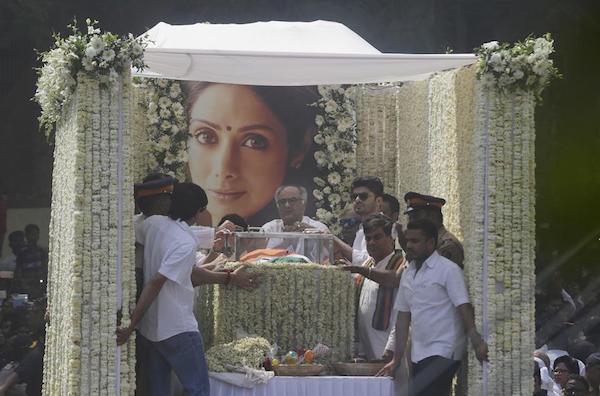
MUMBAI (TIP): Bollywood diva Sridevi was on February 28 cremated with full state honors, mourned by millions of fans, at the Vile Parle crematorium.
Sridevi’s filmmaker husband Boney Kapoor performed the last rites at the ceremony. The couple’s daughters, Jahnvi and Khushi, were by his side, said sources close to the family.
Sridevi, who gave hit Bollywood movies, including Sadma (1983), Nagina (1986), Mr. India (1987), Chaalbaaz (1989), Chandni (1989), Lamhe (1991), English Vinglish (2012) to name a few, died following accidental drowning in the bathtub in her hotel room in Dubai around 11 pm on Saturday, February 24 night, plunging millions of Indians and her fans all over the world in gloom as the news emerged the next morning.
The actor’s body was brought to the crematorium in an open, flower-bedecked hearse.
The state honors for the actress, who was conferred Padma Shri in 2013, included draping her body in the Tricolor, elaborate arrangements by the Mumbai police, and a gun salute before the cremation.
According to a statement issued on behalf of the Kapoor and Ayyappan families, Sridevi’s body was kept for three hours at the Celebrations Sports Club to enable people to pay their last respects.
The final journey commenced around 2 pm to the Vile Parle Seva Samaj Crematorium and Hindu Cemetery at SV Road in Vile Parle west, where it reached around 3.30 pm.
Meanwhile, several thousands of mourners, including celebrities, Bollywood personalities, politicians and business persons, grieved for the queen of the silver screen.
Since dawn of February 27, thousands of teary-eyed fans and admirers of the late actress, many carrying flowers, had started queuing up outside the Celebration Sports Club at Lokhandwala Complex for a final ‘darshan’ of their idol.
After the flower-bedecked body was brought to the club premises, a steady stream of celebrities started alighting from their vehicles and were whisked inside to pay their last respects.
Among the early callers were Rekha, Aishwarya Rai-Bachchan, Arbaaz Khan, Madhuri Dixit-Nene, Akshaye Khanna, Tabu, Farah Khan, Nitin Mukesh, Neil Nitin Mukesh, Vidya Balan, Sushmita Sen, Shabana Azmi, Javed Akhtar, Madhur Bhandarkar, Deepika Padukone, Sanjay Leela Bhansali, Jackie Shroff, Farhan Akhtar, Hema Malini, Jaya Bachchan, John Abraham, Sulabha Arya, Ajay Devgn and Kajol, among many others.
Earlier, in the past four days since her demise, the Kapoor household had witnessed a steady stream of visitors, including Rajinikanth, Kamal Haasan, Shah Rukh Khan, Salman Khan and Krishna Raj Kapoor, among others.
Most visitors on February 27 were sporting dark sunglasses to ward off the harsh early-summer glare, and carrying flowers or small bouquets. They embraced and consoled the bereaved family members, fleeting in from the main entrance and out from the other side as fans tried to catch a glimpse.
Sridevi’s body was flown to Mumbai from Dubai, and from the airport was taken to the Kapoor residence in Green Acres at the posh Lokhandwala Complex.
Despite the late hour, several hundreds of fans kept vigil outside the residence when a motorcade, including an ambulance, reached there late on Tuesday.
For three days, the Dubai police authorities completed various legal and medical formalities before the body was finally handed over to the Kapoor family on Tuesday afternoon.
(Source: IANS)
Signup to our Newsletter!
Don’t miss out on all the happenings around the world