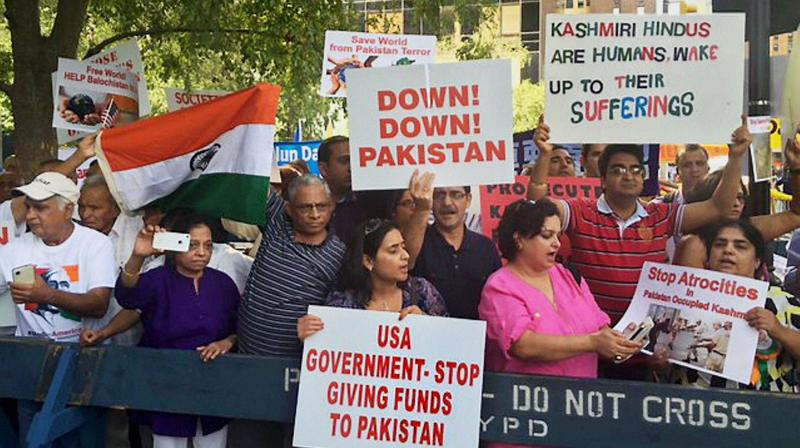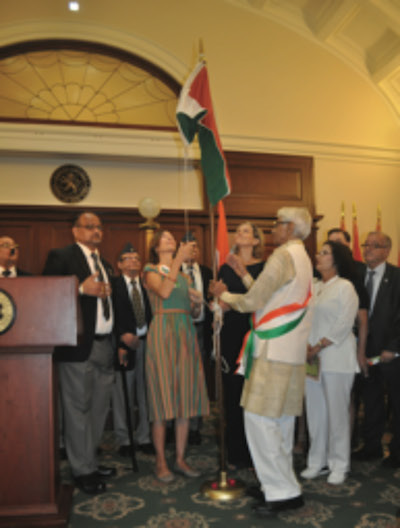
MINEOLA, N.Y.(TIP): Nassau County Legislator Ellen W. Birnbaum (D – Great Neck), County Executive Laura Curran and Indian-American community leaders celebrated the anniversary of India’s independence during a flag-raising ceremony in the County Executive’s Ceremonial Chambers on Wednesday, August 15.
During the event, Legislator Birnbaum presented the Indian American Forum with a Community Recognition Award in celebration of their commitment to enhancing socio-cultural interactions and highlighting the rich traditions of Indian culture in the district. The award was presented to Jyoti Gupta, a member of the organization’s board.
“It was a privilege to welcome this accomplished group of Indian-American community leaders from my district to join us at the Nassau County Legislature for a joyous celebration of independence,” Legislator Birnbaum said. “I thank everyone who took time out of their morning to participate in this ceremony and salute the Indian American Forum for their ongoing efforts to promote the culture, heritage and values embraced by Indians around the world.”
In addition to Legislator Birnbaum’s welcoming remarks, Wednesday morning’s program included speeches by County Executive Curran, Indian-American Forum Chairperson Indu Jaiswal; Nassau County Human Rights Commission Chairman Bobby Kalotee and Dr. Ajay Lohda, Chairman of the American Association of Physicians of Indian Origin.
Community member Eesha Butani led the gathering in the American National Anthem, while Hema Sardana performed the Indian National Anthem. In addition, Jyoti Gupta led aperformance of patriotic Indian songs.
NEW YORK CITY(TIP): With a view to reaching out to the world the message of the Sikh Gurus, an ambitious international center being built in the heart of New Delhi, the Indian capital, aims to impart knowledge and awareness about the origin and values of the Sikh faith to students and other communities around the world.
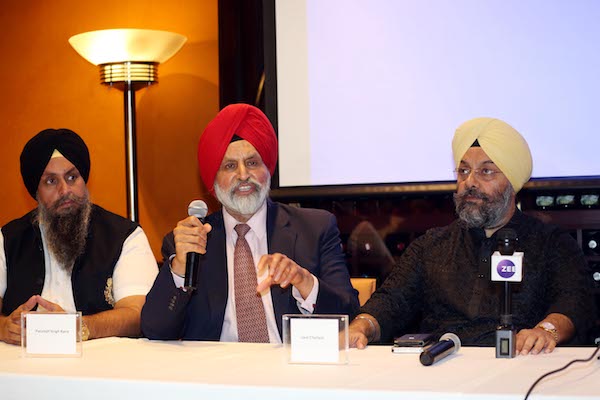
The sprawling International Centre for Sikh Studies is being built at the Gurdwara Rakab Ganj Sahib Complex, Opposite to Parliament of India at New Delhi and will be inaugurated on the occasion of Vaisakhi in April 2019. The Centre is an initiative of the Delhi Sikh Gurdwara Management Committee under the leadership of its President Manjit Singh GK, and for which Indian-American hotelier Sant Singh Chatwal has made a contribution of one million dollars.
Addressing reporters here on August 24, Chatwal said that amid an increase in hate crimes against Sikhs around the world, the Centre will play a pivotal role in explaining the Sikh religion and its universal message of humanity and equality.
Chatwal said the project is about the universal message of Guru Granth Sahib and the journey of the Sikhism. He said Sikhs around the world are facing hate crimes and are misidentified because of their articles of faith. The Centre, through its high-quality and easy to access digital content will take the message of the Sikh community around the world. He added that the Centre will also collaborate with research institutes and universities around the world to bring scholars and students to the Centre to facilitate their research and studies.
The Centre is expected to be inaugurated by global ambassadors and diplomats stationed in New Delhi, emphasizing the massage of unity in diversity.
The Center will house a hi-tech auditorium, art exhibits, digital research library and a museum that will have the Guru Granth Sahib that was handwritten 400 years ago. It will showcase the history of the Sikhs and the presence of essential core values in Sikhism’s sacred texts. This will be done by presenting stories from the history of Sikhism and other relevant sacred texts using state of the art communication technologies so that it is accessed by people anywhere in the world. The content will be in English and Punjabi as well as in other global languages to ensure it is reached a wider audience.
Describing the initiative as “unique,” Chatwal said the young generation of Sikhs living in India as well as abroad sometimes lacks better understanding of the Holy Scripture- The Guru Granth Sahib – and the project will help spread the message of Sikhism to both Sikhs and non-Sikhs.
“The Guru Granth Sahib is not just for Sikhs. The project will help convey the message of the Guru Granth Sahib to everybody,” Chatwal said.
DSGMC officials had visited the city in the summer of 2015 to spread the message about the project among diaspora living in the US and Canada.
Representatives of Sikh organizations with DSGMC delegation and Sant Chatwal
Giving details about the project, DSGMC said the Centre aims to engage with young Sikhs all over the world and familiarize them with the core values and contemporary relevance of Sikhism.
“The message of Guru Granth Sahib is universal. The Sikh Holy Book provides answers to all the problems the world is facing today, including gender inequality, environment challenges, economic inequality and climate change,” Singh said adding that the project will help spread the Sikh message of “selfless service to humanity.”
He added that the project also aims to acquaint the international community with the history of Sikhism and will incorporate audio-visual communication technologies to spread the information in an engaging manner.
The work at the Center being built at a cost of INR 20 Crore is in full swing. Already Rs. 10 crore have been spent, GK said.
A video on the ongoing construction of the Center was shown. Several journalists and community members asked questions or made suggestions.
Present on the occasion, besides Indian American media, were representatives of various gurdwaras and Sikh organizations. There was a visible excitement among the Sikh community representatives about the Center.
To quote the great basketball player Michael Jordan, “I’m back.” Avid video game player and former #1 World Ranked player of the famous Call of Duty video game franchise, Vincent Famularo, has recently made his comeback in his own right. Mr. Famularo, aka VinnyFAMS, is getting back into the gaming scene. Turning his hobby into a career, Mr. Famularo regularly broadcasts videogames which he plays on the popular video streaming platform: Twitch. Providing both entertaining commentary with skilled gameplay, Mr. Famularo currently plays primarily “Call of Duty: Black Ops 4” and “Fortnite.”
Follow Mr. Famularo’s Twitch at: https://www.twitch.tv/vinnyfams
NEW YORK(TIP): Ashrita Furman holder of the most Guinness Records at the same time (currently over 200) and a team of friends created the world’s largest tennis ball logo within 7 days. The ball composition shows the logo of the Sri Chinmoy Oneness-Home Peace Run, the world’s longest and largest relay run for peace, and has a width of 10.08 metre and a height of 5.30 metre. The sixty-three-year-old health food store manager of New York set this Guinness World Record to honour the 87th birth anniversary of Sri Chinmoy an Indian spiritual master, founder of the Peace Run and an avid tennis player. The 53.42 square metre ball logo consists of 12,393 tennis balls in the colours white, blue, green, orange and red.
The content is a factually accurate rendering of what it depicts and has not been modified or augmented except for standard cropping and toning.
Distribution, printing, publishing and archiving of photos and text are free without any rights. Photos taken in New York City by Jowan Gauthier
The tennis balls were fixed on boards and the other day carried from a backyard down the hill to the birthday anniversary function, where over 900 guests from all over the world celebrated.
Ashrita Furman states: “This tennis ball logo expresses our sincere wish for world peace and is our modest offering of joy to the world. With thousands of tennis balls, we want to honour the memory of Sri Chinmoy, who was the founder of the Peace Run and an avid tennis player. After the record we will give the tennis balls to people in the neighbourhood.”
Ashrita Furman has been breaking Guinness World Records since 1979. His first entry in the Guinness Book he achieved by completing 27,000 jumping jacks. Since then he has broken more than 700 records on all seven continents, including building the world’s largest tennis racket, balancing a pool cue on finger for the longest continuous distance (7 miles 220 feet) in front of the pyramids in Egypt, racing against a Yak in Mongolia to set the one-mile sack-racing record and underwater Aqua Pogo for 3 hours 40 minutes in the Amazon River in Peru.
As a teenager Furman became inspired by Sri Chinmoy’s philosophy of self-transcendence. Indian born Sri Chinmoy also set many records, such as writing 1,301 poems in 24 hours and composing 22,000 songs during his lifetime. Furman attributes his success at breaking records to meditation, which he has practised daily for over 40 years. Meditation helps him to keep his childlike spirit and the mental and physical power which is needed to continuously set new world records. Ashrita Furman started setting Guinness World Records 39 years ago and hasn’t stopped yet. “Going beyond your everyday capacity is such a fulfilling feeling. The day I break a record I’m just happy the whole day,” he says. “I’m trying to show others that our human capacity is unlimited, if we can truly believe in ourselves.” After every record Furman wants to express his gratitude to his Guru Sri Chinmoy.
For more information please go to www.ashrita.comand srichinmoy.org
NEW YORK(TIP): August, named after Augustus Caesar in 8 BC brings every year on the 15thof the month ripples of joy to Indians in India and abroad, as it is the day when in 1947 India became a free and independent country. The struggle for freedom was long ang grim. 15thAugust is a day of fulfillment of a dream for which hundreds of thousands of Indians lost their precious lives.
In India, it is the 1.3 billion Indians who celebrate the day with fervor across the length and breadth of the country. Indians abroad are much more enthusiastic about celebrating independence of India. It is evident from the number of events and the number of people participating in them. Wherever there are a few Indians, there will be festivities on the occasion.
In the Tri-State area of New York, New Jersey and Connecticut where one finds a high concentration of Indians, there is a multiplicity of celebrations. In order that most people find it convenient to attend as many events as they possibly can, Independence Day celebrations are planned by various organizations, avoiding conflicts of date. Thus, the celebrations are spread over almost the whole month of August. By the way, so it is with Dussehra, Diwali and Vaisakhi. These festivals are also celebrated all through the month they fall in.
Kailash Kher regaling the audience with his tit bits and snatches from his popular songs
Besides the official Independence Day celebrations at the Consulate General of India in New York and the Permanent Mission of India to the United Nations, Independence Day celebrations are organized by various organizations in the Tr-State area.
The most popular and the largest event in the Tri-State area is the India Day Parade which is taken out in New York City. It is organized by the Federation of Indian Associations (FIA of NY/NJ/CT). The parade this year was taken out on August 19. Despite of threatened rain, there was a huge turnout. With 40 floats and a 50 marching groups/ bands, and a huge participation of people, the parade indeed was impressive. As usual, there were film stars to lend attraction and grace to the parade. Legendary actors Kamal Hassan and Anupam Kher, great singer Kailash Kher, and the Cineworld heartthrob Shruti Hassan added to the joy of the crowds. Sir Vivian Richards, the legendary cricketer also graced the event, as did the upcoming singer Shibani Kashyap.
Shruti Hassan, Kamal Hassan, Sir Vivian Richards and Kailash Kher at the Reviewing Stand
The motto of the India Day Parade was “Vasudhaiv Kutumbakam” (the world is a family). The spirit of this Vedic Sanskrit philosophy was seen throughout the parade. Madison Avenue became fusion of different cultures who chanted “Vandey Maatarm”, “Bharat Mata Ki Jay”, and “Jay Hind” along with folk songs as well as folk dance performances. Street was painted rainbow with different colored outfits from different parts of India.
Rajan Gangahar packs his film on PTSD with emotion and drama
A film on the life and experiences of EMS workers is shot in and around New York
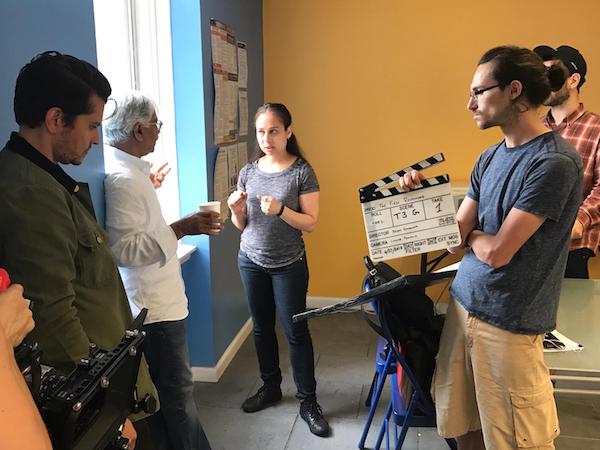
Essentially a loner and a voracious reader, US-based director-writer Rajan Gangahar, has just finished filming “The First Responder”, a short film in New York. Says Rajan,” When the Producer approached me to make a film on the life of EMS members’ life and experiences, I was not excited. To me, a film is about emotions not just visuals. I liked the perspective, but I wanted to add the most important dimension for a good film. Make it a human story, of a traumatic experience of the EMS worker”. Rajan has earlier written and made a feature film, “Khushiyan” in Punjabi, one of the most popular languages in India and won the Best Writer award for the film at PIFA in Toronto, a global film award mega event. “The film was about human relations and founded on emotions,” says Rajan.
Gangahar trained as an actor and worked in theater circuit in India for several years. “Stage performances offered a direct connect with the audience and helped me learn the value of touching the audience’s heart. It was instant,” he says while talking about his stage experience. Gangahar traveled with a theater group all across Canada and USA for his play. And the response was universal. It connected with the audience everywhere. “I was clear. Any form of creative work will connect and be successful if we can touch the heart”.
Whether it is a debate on India or the USA, Gangahar always tends to lean on the freedom of expression. Political or intellectual or creative or even religious subjects are deliberated with same zeal keeping the backdrop of human behavior. The Post Traumatic Stress Disorder (PTSD) in any profession, including EMS, is essentially due to some or the other form of guilt, which may be haunting the sufferer. And then the patient enters the state of denial. Whether it is the guilt or fear of facing it again or inability to confess, the person keeps running away from reality.
Whether it is a play or story-screenplay-dialogues or directing, Gangahar has never tried to rush into anything in a quest to do a lot. It’s not about lust of fame but the satisfaction of doing good quality creative work that drives the Gangahar. It’s not about telling the family and world of friends about making a film but “telling” the story in the right manner on screen or stage or television that stimulates Gangahar.
“When the producer of “The First Responder” shared the subject of the film which he had conceived as a documentary on the life of EMS workers, I was clear, it is a universal subject. Most amongst us have dealt with EMS as volunteers or when we sought their service or when one or other member in our family worked with EMS. We all know the essence of the EMS duty. But what interested me was to adapt it for a fiction short film yet depicting the life and trauma of an EMS staffer,” says Gangahar. And a short documentary was transformed into a docu-drama and then to a short film based on fiction, yet close to a real-life story.
“The hero or protagonist of my film has similar trauma. He is suffering every day as his experience haunts him. Days and nights. But he denies and even refuses to take professional help. It reaches an extreme when he can’t even take assignment lest he fail again. He wants to pretend and show off machoism yet all around him observe his suffering. He even contemplates suicide,” says Gangahar.
“A compassionate boss and a caring wife help him to take professional help. Finally, barriers are broken, and he hugs his wife in elevator while going back home after he completes the treatment,” he adds.
“I have been studying cinema for quite some time. Learning from the West, I believe in doing complete homework. It is not about the scale of the subject or canvass. A detailed and thorough pre-production work helps,” says Gangahar. With about 16 persons in crew and 10 actors, the unit was small. The creative team could focus on meaningful output especially keeping in mind the limited resources.
The filming has been completed in less than ten days while shooting all around in New York city. Gangahar expects to finish post-production work by end of August and then submit the film for festivals around the world.
Interview with RAJAN GANGAHAR
“Any story that deals with human emotions interests me”- Rajan
Director Rajan Gangahar
What attracted you to take on this project as a director?
I would say it was the subject. It is a story of EMT workers and their exposure to traumatic circumstances. We see EMT workers all the time and expect them to be first responders. In worst of the circumstances, constant exposure to these traumatic situations can lead to PTSD (Post-Traumatic Stress Disorder). This medical condition effects everyone around you, the family, friends, colleagues. Unfortunately, there is a macho culture and one considers a weakness to seek medical help. It is a story of When Helping Hurts.
Who wrote the story?
Ron Basci, a friend of mine, has written the script about an EMT worker and silently suffered from PTSD.
How did you select the cast and the crew?
Casting was a complicated process. The original casting call attracted more than 600 actors. The team brought it down to 30. Final auditioning went on for a week. All the hard work paid off and we were able to ensemble a cast of 9 — probably the best from theater and films.
How was the experience of working with an American unit including an American Producer?
It was an enriching experience since I was able to share my experience and also adopt to local technical crew. At the end of the day we have been able to create a believable human story.
How is it different from making an Indian film?
Internet has created a flat world for every field including in the field of film making. Though some ground realities will always influence working environment like availability of low-cost labor in Indian film industry. And that translates to multiple resources always available on call. On the contrary, the crew in America is comparatively smaller but better trained in latest technologies, though the gap is diminishing.
You have been an actor yourself. Why did you not act in the film?
It is always tempting but I avoid the temptation, especially when as a director the performance of the whole cast needs your undivided attention.
How is a short film different from making a feature length film?
Any film less than 50 minutes is considered a short film. The difference is less time to establish characters and still engaging the audience from conflict to resolution. The future of entertainment as predicted by experts would be shorter films because of shorter attention span of the younger generation.
What is most important to you in making a film?
Film making is a field of director, DOP Editor Maintaining a single, clear vision through communication before the shoot is the key. Since they all are telling same story in different languages with their respective tools. It is imperative for all of them to have single clear vision. Artistically, I am of the opinion in creating believable characters is the key and I am fascinated by the process of characterization. Acting is doing consciously what we do unconsciously in real life. Recreating that behavior is what creates a great performance.
What kind of cinema do you like as a film maker?
Any story that deals with human emotions interests me.
Where do you see Indian cinema today and five years from now, especially with Netflix and Amazon redefining boundaries?
With the availability of internet, we human are no longer confined by physical and imaginary boundaries. We are more aware of other cultures, there history, there struggles and sufferings and curious to listen to stories beyond barriers of language and culture. Corporates like Amazon, Netflix, Apple are trying to ride that wave by creating single international platform for everything from screening films to making films.
Indian films have recently created history by making almost $300 million in China? What is the reason? Do you see similar possibilities for Indian cinema in USA?
The present times are probably the best of times for the Indian film industry. India is producing realistic and sensitive cinema and global audience including in US, China, UK is accepting it. An era of films with universal issues that strike a chord with both foreign and domestic audience has commenced. Rest is a numbers game.
Why are Indian Directors not making films in Hollywood? Even top Indian actors rarely do films in Hollywood. Why? Do you see this changing in near future?
No one can live in isolation. There is so much to learn from experiences of each other. Both industries were catering to their own kind of audience, but it is changing. Hollywood studios are experimenting with adding in Indian actors in significant roles. Initially to get wider audience but with time they would be doing it for talent. Future is, both industries working with each other or for each other and launching joint ventures.
In your view, is human interest story a universal subject? Can a film appeal to all or majority of audiences across the world?
Yes, there is no doubt in that. Perfect example would be the play “Death of a Salesman” by Arthur Miller — a story of a middle-class family struggle in 1950. This play was translated and performed in every country and almost every language. So, yes emotions and feelings are universal, dressed in local cultures.
What is next for your short film? Do you see it appealing to all audiences across the world?
Yes, I am positive it will, emotions like music are universal.
What would you like to do next and in what capacity?
There are stories to be explored and told. I would love to remain a storyteller in any format — a film, a Play or a book… as a director, an actor or a writer.
FLUSHING (TIP): “Fantastic, incredible, dynamic, outstanding, awesome, record-breaking, actually just beyond words.” The applaud of the standing ovation grew louder and louder each time these words were uttered by the Master of Ceremony Mr. Harbachan Singh to describe the performance of the Kathak dancers at the end of their show by the Kathak group of dancers in Flushing New York at a crowded hall full of people including some from the Chinese community and the White Americans. The audience was totally mesmerized.
Ms. Malini Shah, President of the Indo-American Arts and Culture Forum, in her welcome speech, informed that this world-renounced team had flown to New York in connection with the 72ndAnniversary of the India’s independence day celebrations under the auspices of the Indian Council on Cultural Relations and that she was able to get the authorities to give an additional performance on in Queens, New York where there was a heavy concentration of the Indian Diaspora.
At the behest of Mr. Devendra Vora, INOC, USA Chapter President of Maharashtra and Mr. Piyush Patel, a community leader, astute lovers of the Kathak dance flocked to this rare treat event to watch this ancient fine art performance by such great artists.
Awesome Kathak presentation
In his opening remarks, Mr. Harbachan Singh explained thatKathak is one of the eight major forms of Indian classical dance. The origin of Kathak is traditionally attributed to the traveling bards of ancient northern India known as Kathakars or storytellers. The term Kathak is derived from the Vedic Sanskrit word Katha which means “story”, and Kathaka which means “the one who tells a story”.
He further explained that wandering Kathakars communicated stories from the great epics and ancient mythology through dance, songs and music. Kathak dancers tell various stories through their hand movements and footwork, but most importantly through their facial expressions.”
Ms. Promela Suri, President of the United Nations SPICE Indian Club observed that for the novice followers of classical dances the introductory instruction served to better understand each movement and realize the sentiments expounded so skillfully and artistically by each dancer.
Awesome Kathak presentation
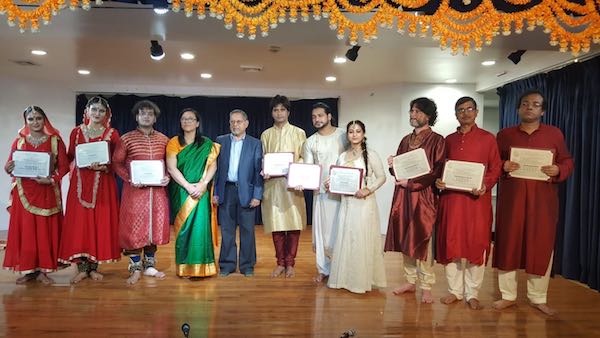
At the conclusion, a major section of the audience stayed back and comingled with the performers and took pictures with them and complimented them personally. All nine artists including the renounced musicians were presented with awards. Mr. Devendra Vorah and Mr. Piyush Patel presented each artist a bouquet of flowers. The Consul General of India was represented by his Head of Chancery, Mr. Jaideep.
NEW YORK(TIP): Registration for the Jaahnavi Residential Camp ended earlier this week and the three-day event is ready to take off, according one of the organizers.
“We have 250 registrants this year,” said Suresh Shanmughom, the New York coordinator for the Samskrita Bharati USA-organized event in New Jersey. “They can start arriving at the venue from around 4pm on Friday (August 31).”
The camp will be formally inaugurated on Saturday morning.
The number of participants is limited to around that figure so that the organizers can focus more effectively on the quality of Sanskrit education to be imparted at the camp, pointed out Deepa Nair, a longtime volunteer for the sponsoring organization.
Other segments at the camp include skits, lectures and games – all in Sanskrit.
The camp, which will be held at the Radisson Hotel, Piscataway, N.J., is scheduled to end shortly before noon on Monday, September 3.
Shanmughom, on the eve of the Labor Day weekend event, expressed optimism about its success. It is a Sanskrit-immersion camp. Though there is no bar on using other languages by individual participants, spoken Sanskrit is encouraged by one and all.
“All arrangements such as transportation of participants from across the East Coast to the event and food—breakfast, lunch and dinner, aside from beverages like coffee and tea—have been made,” he said. “A book fair, comprising Samskrita Bharati publications, with a souvenir shop will also be available.”
Such camps have been held for nearly 20 years in the US with a view to promoting the Sanskrit language and culture. The New York coordinator estimated there are nearly 15,000 US speakers of the language, who use it as their primary tongue.
The first such camp – named Alakananda — was held in California in July 2000.
“For the last five years, Jaahnavi has taken place at the Radisson,” she noted. “For years we have closed earlier-than-the-publicized time as participants use early-bird discounts.”
Experienced teachers from India and the US will teach the language to all participants at levels such as beginners, intermediates and advanced. One such expert is attending Jaahnavi from the Indian Institute of Technology, Bombay, to deliver a lecture on mathematics.
Though many participants have South Asian origins, others have also taken part in such camps in smaller numbers.
Shanmughom and other organizers have made it clear that there is no need to have prior knowledge of Sanskrit to attend the camp. Separate classes are held for young children.
Based in India, Samskrita Bharati is a nonprofit body dedicated to propagating the language, particularly the spoken variety. The US branch, established in 1998, has spread to more than 20 centers in the country, according to its website.
The organization conducts an online education program, known as SAFL (Sanskrit As a Foreign Language), for grades from eighth through 12th. Some states and counties in America have recognized the program. “It started in 2009 with just 17 students and has now expanded to more than 300 students this year in about half the US states,” said SAFL coordinator Giri Bharatan.
All ancient Indian texts in subjects such as medicine, mathematics, science and arts, as well as holy books the Ramayana and the Mahabharata are widely respected in the world. “The key to unlocking the knowledge of those works in its original form lies with Sanskrit,” she said.
For further information, please log on to samskrutabharatiusa.org
WASHINGTON(TIP): South Asia Minorities Alliance Foundation (SAMAF) is hosting ‘ Day on The Hill ‘ at Capitol Hill on September 5.
Members of the U.S. Senate and House of Representatives, members of think tanks and
South Asia experts will attend this historic event at Capitol Hill.
This event is aimed at highlighting the issue of religious freedom and minority rights in
Pakistan as well as to show solidarity with the Afghan people and US troops and their
families. The event will also recognize and honor Congressman Tom Garrett’s role in
promoting minority rights.
SAMAF, an IRS 501(c)(3) public charity foundation1 based in the USA, is striving to bring
global attention to the injustices, persecution, and ethnic and religious cleansing that
minorities are facing in South Asia. SAMAF provides these oppressed minorities a
platform to speak as one voice on Human rights & religious freedom; Economic uplifting and security of minorities; Eradicating terrorism and ensuring stability in South Asia; Promotion of democracy and freedom of press.
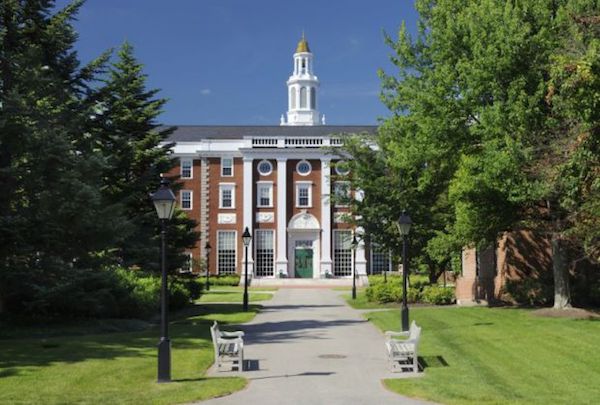
“Harvard has failed to show that it does not unlawfully discriminate against Asian-Americans,” the Justice Department said.
WASHINGTON(TIP): The Justice Department lent its support on Thursday, August 30, to students who are suing Harvard University over affirmative action policies that they claim discriminate against Asian-American applicants, in a case that could have far-reaching consequences for the use of affirmative action in college admissions.
In a so-called statement of interest, the department supported the claims of the plaintiffs, a group of Asian-Americans rejected by Harvard. They contend that Harvard has systematically discriminated against them by artificially capping the number of qualified Asian-Americans from attending the school in order to advance less-qualified students of other races.
In its filing, the Justice Department argued that the court should deny Harvard’s request to dismiss the case before trial.
The government said that Supreme Court rulings require that universities considering race in admissions meet several standards. They must define their diversity-related goals and show that they cannot meet those goals without using race as a factor in admissions decisions.
The department argued that Harvard does not adequately explain how race factors into its admissions decisions, leaving open the possibility that the university is going beyond what the law allows.
“Harvard has failed to show that it does not unlawfully discriminate against Asian-Americans,” the Justice Department said in a statement Thursday.
The Harvard case, which was brought by an anti-affirmative-action group called Students for Fair Admissions, is seen as a test of whether a decades-long effort by conservative politicians and advocates to roll back affirmative action policies will ultimately succeed.
That push has broad support from President Trump. The Department of Education and Justice Department said in July that the administration was abandoning Obama-era policies that asked universities to consider race as a factor in diversifying their campuses and would favor race-blind admissions instead.
CHICAGO, IL(TIP): Temple is a divine and majestic place of pilgrimage, where life unites with ‘Jagadish’ – the divine ruler of this world. It is a place, where devotees unify with their daitee, where soul fades into the ultimate divinity, where our next generation gets a dose of our true Samskara (sacrament) and culture.
It’s a place where a mere stone transfigures itself to become a divine idol. This is a place, where our material being, and physical existence convert into a divine temple. It is a place, from where the message of brotherhood, profoundness, unity and intimacy spreads door-to-door.
With such benedictory purpose and a soulful resolve for welfare and well-being of the people, the erection of the temple in Chicago city of Illinois State of the United States began on May 12 with Mahapuja under total Vedic practice.
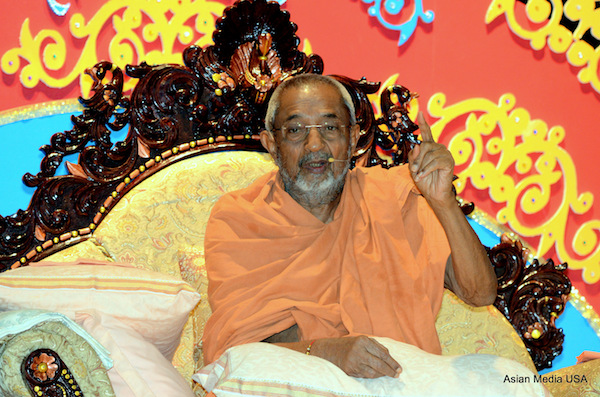
Along with the celebrations marking the beginning of construction work for the new Temple, the auspicious occasion of Rakshabandhan was also jointly celebrated in the august presence of HH Swamishri.
On this occasion, young members of Chicago Mandal performed mellifluous music including some of the marvelous kirtana and bhajans, which enthralled the listeners.
Shree Himanshubhai narrated the significance the occasion of Rakshabandhan in a poetic way and stated that Guru Hari Swamishri has committed to protect us from all evils from with-in and outside. He recounted a variety of incidents to explain his philosophy.
HH Swamiji deliberated upon the importance of Rakshabandhan and said, “We celebrate the festival of Rakshabandhan to pray to God so that he continues to protect us in all situations. Five Pandavas conquered the 100 Kauravas, because they had Lord Shri Krishna on their side to protect them. Likewise, if we surrender ourselves to the God of Godly Saint, we will remain protected in all situations. As much faith we put in God, that much we shall be protected.”
On the occasion, the Chicago Youth Mandal performed a divine dance on the theme of ‘Yuva Mahotsav ka Bugle Baje’.
The representatives of different organizations and guests participated the event so as to celebrate the occasion as well as seek the blessings from HH Swamishri.
Democrat Party’s Congressman, Raja Krishnamoorthi graced the occasion, in his address to the audience, he recognized and praised the social work being done by Yogi Divine Society. Also, thanked the community to erect first Hindu Temple in the Shamburg area.
On behalf of the American Government, he handed over a letter of appreciation to HH Swamishri.
The elderly devotees from Chicago Mandal garlanded HH Swamishri as a mark of respect and sought his blessings. On behalf of YDS, Dr CM Patel honored the invited guest, MP Raja Krushnamurti with a bouquet of flowers. The women members of the Chicago Youth Mandal had prepared a special garland for the occasion.
Other guests and members of Chicago Youth Mandal paid their floral respects to HH Swamishri and garlanded him to seek his blessings.
Addressing the gathering, Hon Dinkarbhai beautifully articulated the significance of Sainthood to suit the occasion. “Today, with just a holy sight of HH Swamishri, we can say our Rakshabandhan is celebrated. When we instill our complete faith in Swamishri with our efforts, our words and with our mind, then we can stay undeterred in Akshardham.”
In the end, Guru Hari HH Swamishri showered his blessings on the devotees with his holy words by saying,
– “Our Guru Yogiji Maharaj is an epitome of courteousness, affection, surrender and devotion. He is such an innocent and detached personality that HME is nowhere to be found. Not an iota of HME, nor slightest of KKL’s steam. Even our HME is removed by merely sitting in the lap of such a motherly saint.
– HME keeps us attached with the life-death cycle. Sitting in the lap of such motherly saint will eradicate HME, which ultimately cures the disease of life-death.
– We have to surrender and sit in the lap of such motherly saint to purify our eyes, ears and tongue so as to make it acceptable to the divine.
– I have come here to invite all of you to the Yuva Mahotsav that we are going to celebrate in the first week of January.
– This disease of life-death can’t be cured without a saint.
– Jesus Christ created 110 saints and pronounced the first commandment that no liquor and no meat.
– Lord Shri Swaminarayan advised us in the Shikshapatri not to consume onion-garlic.
– I know, they are good medically. But it increases the desires within us.
– Lord Krishna termed the Kama (desires), Krodh (anger) and Lobh (greed) as the gateway to hell.
– And Gunatitanand Swami termed obduracy (hatha), pride and envy as the gateway to hell.
– Atman (soul) is diseased with life-birth phenomenon. To cure it, we need satsang and sant.
– Without coming in contact with Saint, it is impossible to bring holy thoughts to our minds. We become obedient and courteous once come in contact with such a saint. It brings humility in our behavior. We get to hear and read Bhagwat, Gita or Ramayana.
– The filth within can’t be cured and cleared without coming in contact with Saints. The Saint is the doctor and bailor for this.
– If you ask an auto-rickshaw guy or a taxi driver to take you to the temple – Haridham, he will drop you at the doorstep of it.
– The biggest advantage that will be there is that you would get to know about the great saints of India.
– The pictures that teach you roaming around, linger, and get naughty, there is no need to watch such movies.
– Remember one thing always. To become one a human being, there is a need of a Saint. A human means- the eyes watch what is right, ears listen that is right, and tongue speaks that is right.
– The way Arjuna got Krishna as his Sarthi, Shivaji had Ramdas, Ashoka had Batuk, likewise, we too need a Sarthi like Krishna in our life to live a meaningful life.
– Abandon things that lead us towards desires. Dinkarbhai is a saint.
– Our Prem Swamiji is an engineer but he is a Saint. He has nothing else in his life other than devotion and affection.
– If you come to Haridham, our kids will get engaged in your service. More than that, you will get the benefit of knowing Great Saints of India.
– We pray for such a Buddhiyoga, which will help us get in the lap of a motherly saint and eradicate the ills such as obduracy (hatha), pride and envy from within us and make us a holy saint like Janak. That’s what we pray for.
About 750 devotees, who participated in the event enjoyed the deliberations and were privileged to have Prasad at the end of the event,
(Photographs and Press release by Asian Media USA)
“A true strategic partnership offers tremendous benefits to both nations. India gains an opportunity to become a real global power, and the US gains a mammoth regional ally and counterweight to China, with the potential for greater cooperation on issues of global security. Establishing a lasting US-India partnership would be a game-changing success for President Trump and Prime Minister Modi.”
Trump administration’s decision in July to grant India Tier 1 Strategic Trade Authorization status, a designation given only to close allies has created a golden opportunity for India and the US to become close allies. Will the US be bolder and seek to transform the US-India relationship into a robust strategic partnership?
TWO PLUS TWO MEETING IN NEW DELHI
Secretary of State Pompeo and Secretary of Defense Mattis can begin executing an ambitious strategic partnership with India when they meet with Prime Minister Modi in New Delhi in September for the Two plus Two meeting. Will the Government of India and the Indian media discuss this seriously before September?
President Trump has started creating a new world order. Make America Great and America First call for revolutionary changes in US foreign policy and trade relations. Trade deficit is the largest with China. Trump seems to be ready to do serious business with India. India has a comparative advantage over China because the wages are substantially lower in India. If India is able to replace China as the source of American imports of consumer and industrial goods, the US will gain.
Will India be prepared to liberalize its economy and embark on using capitalistic tools as China did with America’s help? Will India be prepared to privatize all its public sector corporations and release the assets for building a modern India? Will India adopt new policies to attract large scale foreign private investments?
INDIA’S RELIANCE ON RUSSIA FOR MILITARY HARDWARE
Modern wars are won by using sophisticated technology. Though Russia has been a reliable supplier of military hardware, we know no country can compete with the US and Israel on latest technology and sophisticated weapons systems. While India has purchased weapons systems from the US to the tune of $15 billion since 2008, its use of Russian equipment poses interoperability problems and raises concerns about compromising sensitive technology.
India’s decision to procure S-400 Russian air-defense systems is particularly troubling, since those typically involve substantial service and training components. The presence of Russian personnel at the heart of India’s air defenses, even if only temporary, could hold up future US-India defense deals. If the S-400 sale cannot be canceled, the best scenario would be to persuade India to limit the scope of Russian support services and turn to another country with a strong record of using and improving Russian defense equipment—namely Israel.
JOINT MILITARY EXERCISES
Meanwhile, the Trump administration can broaden US-India defense cooperation by increasing the number of joint military exercises and expanding the annual Malabar war games. The members of the Quadrilateral Security Dialogue, an informal dialogue initiated in 2007 by Japan’s Prime Minister Shinzo Abe among the US., Japan, Australia and India, should also be formalized and meet more regularly.
MODI CALLED THE U.S.A. AN INDISPENSABLE PARTNER DURING HIS 2017 VISIT
Close alliance with India would provide the US with a valuable, democratically committed to thwarting China’s intensifying efforts to dominate the region. Already India has been keen to enhance its relationship with America. Prime Minister Narendra Modi called the USA an “indispensable partner” during his 2017 visit to Washington. As India scholar Ashley Telis put it, Modi’s “daring decision to collaborate wholeheartedly” with America shows he recognizes that the “the US holds the most important keys for India’s long-term success.” Greatly concerned about China’s economic and diplomatic expansionism in the Indo-Pacific, India has turned to the USA for support. Pakistan’s increasingly anti-American and pro-Chinese policies have also brought the USA and India into a closer embrace.
INDIA’S DEPENDENCE ON IRAN FOR OIL
The resumption of US sanctions on Iranian oil exports Nov.4 will pose a challenge. India has no affection for the Islamic Republic, but after China it is the second-largest importer of Iranian oil, bought at a substantial discount. As the US rightly seeks to block Iranian oil exports, it must be adroit in persuading India to join. Washington needs to grant India a temporary waiver from the sanctions and help New Delhi find acceptable alternative energy sources, perhaps by persuading Gulf allies to sell oil to India at prices comparable to Iran’s.
TRADE TENSIONS NEED TO BE RESOLVED
India has made a formal complaint with the WTO over US tariffs on steel and aluminum, and it is preparing to impose retaliatory tariffs up to 70% on key agricultural exports. Additional rounds of tariffs are reportedly under consideration. Given that India sells $48.6 billion in goods and services to the US, its largest export market, a good way to proceed would be to grant India a waiver on the newly imposed tariffs and work on negotiating a comprehensive bilateral trade deal.
CHALLENGES TO CLOSE PARTNERSHIP
India’s reliance on Russia, India’s dependency on Iran for oil, and US-India trade tensions are challenges that will require policy makers to negotiate hard and make difficult compromises. A true strategic partnership offers tremendous benefits to both nations. India gains an opportunity to become a real global power, and the US gains a mammoth regional ally and counterweight to China, with the potential for greater cooperation on issues of global security. Establishing a lasting US-India partnership would be a game-changing success for President Trump and Prime Minister Modi. I must recall the warm hug and embrace between Trump and Modi at the White House in 2017 and its far-reaching consequences.
(The author, a 64-year resident in the USA, is Chairman, Asian American Republican Committee (30thanniversary). Email: vpwaren@gmail.com)
The Modi government’s biggest policy decision to flush out black money has officially turned out to be a colossal failure. In November 2016, the government had taken the entire nation by surprise when it scrapped bank notes of Rs 1,000 and Rs 500 denomination worth Rs 15.41 lakh crore. The expectation to unearth black money amounting to around Rs 3 lakh crore now stands belied. After wading through the mountains of scrapped notes, the verdict is that about 99.3 per cent of the demonetized notes have returned to RBI’s vaults. It could add up to almost 100 per cent if we include the demonetized notes held by NRIs and in neighboring countries such as Nepal and Bhutan.
The RBI’s data, thus, lands us in a quandary — either the country never had any black money at all, or the entire black money has been laundered. The first explanation is hard to believe and the second one hard to prove. It is difficult for any government to admit its mistakes, but no one can defend the indefensible. Rightly, the government has abandoned the alibi of unearthing black money. The other justifications — a boost to digital economy, curb on terror-financing and an attempt to weed out fake currency — have also lost appeal in the absence of corroborating data.
The RBI data suggests that post-demonetization, Indian households have quickly rebuilt their cash reserves, contradicting claims of increased digital transactions. It is also evident that terrorism continues unabated despite demonetization while the National Crime Records Bureau concedes the continued circulation of fake banknotes. The benefits of demonetization are elusive, but its adverse impact on the economy is evident, slowing the country’s growth rate by almost 1.5 per cent (a notional loss of Rs 2.25 lakh crore). The worst sufferers have been the poor, whose informal economy was shattered due to a cash crunch after November 2016. The government should assess the damage done to this section of society and help it recover.
“Whichever way one plays it, New Delhi’s unwillingness to accept foreign aid reflects poor judgment, is bad optics, and goes against the spirit of cooperative federalism. Moreover, this decision, when read with the National Democratic Alliance government’s adversarial attitude towards foreign-funded NGO activism in the country, suggests a sense of insecurity and paranoia that hardly befits a rising power”.
By Happymon Jacob
“New Delhi’s unilateral decision to not let humanitarian assistance reach a needy State also does not befit the federal character of the country as the spirit of federalism demands that such crucial decisions be taken after consultations with the stakeholders. The Union government should consult the affected federating units, which have large populations to care for, before crucial decisions of this nature are taken”, says the author.
The Central government’s decision to decline offers of humanitarian aid from the United Arab Emirates and other concerned countries for Kerala, in the aftermath of the worst flood in the State in close to a century, is unfortunate. Whichever way one plays it, New Delhi’s unwillingness to accept foreign aid reflects poor judgment, is bad optics, and goes against the spirit of cooperative federalism. Moreover, this decision, when read with the National Democratic Alliance government’s adversarial attitude towards foreign-funded NGO activism in the country, suggests a sense of insecurity and paranoia that hardly befits a rising power.
While the government itself has been very cryptic in its response to the recent foreign aid offers, those in support of the government’s informal decision have essentially made five sets of arguments to justify the government’s decision. Let’s examine their merit.
Policy precedent
The strongest argument by far for refusing foreign aid flows from past policy and practice. It is argued that there is a policy in place since 2004, enunciated by the then Prime Minister, Manmohan Singh, to not accept foreign aid in times of natural disasters. Dr. Singh had stated in the wake of the tsunami in December that year, “We feel that we can cope with the situation on our own and we will take their help if needed.” The practice thereafter has been to shun foreign aid during natural calamities because the government has been confident of “coping with the situation” using internal sources.
However, it is important to note that the 2004 statement by Dr. Singh was a political articulation, not a legal directive or policy document. In any case, his statement did not close the door to external aid (“we will take their help if needed”). Does Kerala need help? Yes, it desperately does. Former National Security Adviser Shivshankar Menon, in a recent tweet, explained the 2004 decision in the following words: “If memory serves, the 2004 decision was to not accept foreign participation in relief but accept it for long term rehabilitation case by case.”
In any case, since 2004, various policy documents have explicitly and implicitly suggested that the government may accept foreign aid during emergencies. The 2016 National Disaster Management Plan states: “…if the national government of another country voluntarily offers assistance as a goodwill gesture in solidarity with the disaster victims, the Central Government may accept the offer.” Similarly, the National Policy on Disaster Management of 2009 and the Disaster Management Act of 2005 are both positively inclined to coordinating with external agencies and institutions for disaster relief. The 2009 document even argues — thoughtfully so — that “disasters do not recognize geographical boundaries.”
In short, while the 2004 policy says that foreign aid can be accepted if need be, the 2016 policy document states that the government “may” accept foreign aid. The question is whether the situation in Kerala can persuade the Centre to operationalize the word “may” in a generous manner.
National pride
The second argument against accepting foreign aid seems to flow from a sense of national pride: that India is a not a poor country any longer and hence it doesn’t need anyone’s charity. There was a time we were forced to go abroad with a begging bowl, but those days are over, and we can look after ourselves, goes the argument. Despite its powerful emotional appeal, this argument is misplaced at several levels. For one, it is misleading to say that only poor states accept foreign aid in times of natural disasters. For instance, India’s offer of aid was accepted by the U.S. in the wake of Hurricane Katrina in 2005, and by China after the 2008 Sichuan earthquake. The reality is that countries reeling under natural calamities routinely accept emergency aid from other countries irrespective of how rich or poor they are.
Self-sufficiency
The third argument is that India is self-sufficient and hence does not need relief material to deal with natural disasters. Here, it is important to make a distinction between foreign aid during normal periods and emergency humanitarian and reconstruction assistance. Besides, in the case of Kerala, by providing only a fraction of the emergency and reconstruction assistance requested by the State government despite repeated appeals, the Central government seems to have implicitly indicated that there aren’t sufficient funds available. Although New Delhi has taken the line that “in line with the existing policy, the government is committed to meeting the requirements for relief and rehabilitation through domestic efforts,” its actions so far fly in the face of this tall claim. So, if New Delhi is unable to heed Thiruvananthapuram’s urgent requests, shouldn’t it let Kerala take help from outside?
Aid with strings
Then there is the argument that foreign aid comes with strings attached. Yes, it has in the past, especially developmental assistance from Western nations or the World Bank. Aid and loans often came with demands of economic restructuring or resetting governance priorities, and an occasional sermon on human rights. But there is again a fundamental difference between such funding and humanitarian assistance. Hence the argument that UAE’s disaster relief to Kerala would come with strings attached is ludicrous. Abu Dhabi’s rationale for offering aid to Kerala is straightforward: the Malayali population in UAE has been crucial in its development, and the aid offer is a recognition of that bond.
A related issue is the paranoia displayed by successive governments in New Delhi about the ‘foreign hand/s’ constantly trying to undermine the Indian state. This has increased over the years, particularly under the current regime: consider the manner in which it cancelled the Foreign Contribution (Regulation) Act (FCRA) licenses of thousands of NGOs, including Greenpeace and Amnesty, depriving them of foreign funding.
Ironically, even as New Delhi vows to continue the policy of not allowing foreign humanitarian aid, and of restricting the activities of foreign-funded NGOs, it recently amended the FCRA to allow foreign funding of Indian political parties.
Money won’t bring relief
The fifth argument is that airdropping monetary aid doesn’t help in the absence of pre-existing administrative capacity for proper distribution, reconstruction and governance. In fact, some would argue that monetary aid without a focus on governance capacity building is useless or could even make the situation worse. While there is some merit in such an argument, this holds little relevance to the case of Kerala which happens to be one of India’s best governed States. What Kerala requires at the moment is monetary assistance, not lessons in governance.
New Delhi’s unilateral decision to not let humanitarian assistance reach a needy State also does not befit the federal character of the country as the spirit of federalism demands that such crucial decisions be taken after consultations with the stakeholders. The Union government should consult the affected federating units, which have large populations to care for, before crucial decisions of this nature are taken.
The argument here is not that India should seek/ receive regular foreign aid, but that it should accept foreign aid in times of humanitarian emergency, as do several countries, including the U.S., China and Japan. Moreover, there is an urgent need to evolve sensible, practical and empathetic guidelines on receiving emergency aid for the federal units in times of dire need.
(The author teaches Disarmament and National Security at the School of International Studies, JNU, New Delhi)
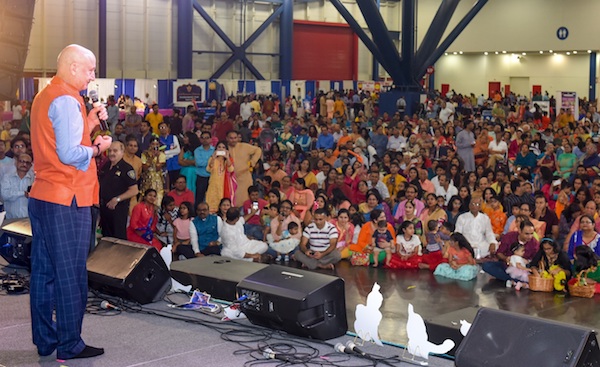
HOUSTON(TIP): Bollywood actor Anupam Kher treated Houstonians to the entire array of his onscreen avatars – serious, comic, patriotic, profound, candid, strong and yet vulnerable in his address at the 28thJanmashtami celebrations held at George Brown Convention Center on 25 April Considered one of the finest actors in Bollywood with a soon-to-be-seen debut in Hollywood, the actor who was the Chief Guest of the evening, lived up to every bit of his reputation and spoke for a full hour only broken by applause and appreciative laughter.
The well attended event which brings all the communities of Houston under one roof to celebrate Lord Krishna’s birth, honors outstanding achievements by members of the community and has a lively session of dandiya to round up the evening is organized by the Hindus of Greater Houston.
Kher, who arrived on the dot, took seconds to connect with the gathering. With self- deprecating humor, he explained why he came to the event in a formal suit and tie. The kurta he had ordered was three sizes too big! After taking off his jacket and tie and looking visibly more comfortable, he launched into a one hour “conversation” with the gathering using his brilliant storytelling skills, snippets of poetry, anecdotes and rich wit to deliver his serious message – that “failure is an event, not a person.”
This invaluable lesson was driven home when his parents and grandfather celebrated his academic failures instead of putting him down. Raised in a family that was poor in monetary terms but rich in affection and encouragement, he stated that life’s experiences are the best teachers and his many “encounters with failure” took away the fear of failure.
He advised the parents in the gathering to teach their children to be strong, to have the “hunger” to succeed, and challenge them without overprotecting them from the realities of life. He added that India’s Prime Minister Narendra Modi has the same “hunger” to take the country forward which is why he has always espoused the Prime Minister’s cause.
Participants in costume competition
While dispensing some inspirational advice for the youth he said “Mera gyan meri zindagi keanubhavo se juda hai.(My wisdom comes from life’s experiences). Judging from the audience’s reaction to his speech, the message of learning from our failures and “living life” clearly touched a chord.
When the applause died down, prominent industrialist Jugal Malani draped a shawl around Anupam Kher while Sushma Pallod tied a rakhi to him to mark Raksha Bandhan. In a gesture that was touching, Anupam Kher reciprocated by giving her the traditional offering of money a brother gives his sister.
Sanjay Jajoo served as a lively Emcee while HGH President Partha Krishnaswamy appealed for funds for Kerala flood relief. Sewa International has collected $250,000 from generous Houstonians for relief work.
Two Houstonians were recognized with the Lifetime Achievement Award – CEO of Star Pipes Ramesh Bhutada and Beth Kulkarni. Well-known philanthropist, Ramesh Bhutada who has served the community unstintingly with his time, effort and resources stated that he was humbled to receive the award and reiterated Anupam Kher’s words on encouraging and “recognizing our children for trying.” In her acceptance speech, Beth, who has served many area organizations in leadership and advisory roles, hoped that the award would inspire other Hindus to serve the community in any way they can. The Akhil Chopra Unsung Heroes Award was presented to Richa Dixit, Manish Khatri and Nisha Bhatia.
Other highlights of the celebrations included the children’s costume contest where little children dressed as little Krishnas and Radhas, a cultural dance segment, food, apparel and organization booths. A 25 feet in diameter vibrant Rangoli by Sangita Bhutada with the theme of “makhan chor” welcomed visitors to the center.
First time attendee and IMAGH Secretary Saeed Pathan said that the Janmashtami celebrations and the atmosphere brought back wonderful childhood memories of the festival in India.
Members of the Young Hindus of Greater Houston (YHGH) also contributed substantially to the smooth execution of the event. YHGH President Raj Salhotra stated “The 2018 Janmashtami celebration showcased Houston’s wonderful tradition of diversity. It was wonderful to witness the outpouring of support from Houston’s youth. We are excited to work with youth from across the city to build an organization that represents Hindus from all backgrounds.”
UNITED NATIONS(TIP): Pakistan’s new government must not indulge in “polemics” but work to build a South Asian region free of terror and violence, India said after Pakistan raked up the Kashmir issue at the United Nations Security Council (UNSC).
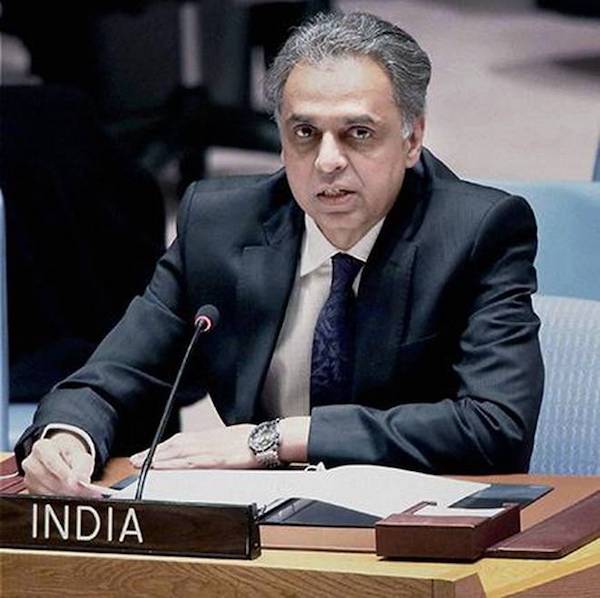
Permanent Representative of India to the United Nations Syed Akbaruddin’s remarks came during the UNSC debate on Mediation and Settlement of Disputes.
“I take this opportunity to remind — Pakistan — the one isolated delegation that made unwarranted references to an integral part of India, that pacific settlement requires pacific intent in thinking and pacific content in action,” Mr. Akbaruddin said at the debate on Wednesday.
Pakistan’s Ambassador Maleeha Lodhi raked up the Kashmir issue during the debate, drawing a sharp reaction from Mr. Akbaruddin. He said Pakistan was “regurgitating a failed approach, which has long been rejected, is neither reflective of pacific intent nor a display of pacific content”.
In a reference to the government in Pakistan under newly-elected Prime Minister Imran Khan, he said, “We hope that the new government of Pakistan will, rather than indulge in polemics, work constructively to build a safe, stable, secure and developed South Asian region, free of terror and violence.”
‘Resolutions remain unimplemented’
In her remarks, Ms. Lodhi said the “Jammu and Kashmir dispute remains a long-standing issue” on the agenda of the Council. She said through its various resolutions, the Security Council has provided that the final disposition of the State of Jammu and Kashmir will be made in accordance with the will of the people “expressed through the democratic method of a free and impartial plebiscite” conducted under the auspices of the United Nations.
She said the Security Council also instituted several mechanisms, including the U.N. Commission on India and Pakistan (UNCIP), the deployment of the U.N. Military Observer Group in India and Pakistan (UNMOGIP) and the appointment of U.N. representatives.
“Sadly, these resolutions remain unimplemented to date. The international community cannot succeed in its efforts to strengthen conflict prevention and promote pacific dispute settlement if the Security Council’s own resolutions are held in abeyance, by some. What is, at stake is both the Council’s credibility as well as the objective of durable peace in our region. We must not fail these tests,” she said.
U.N. and other actors concerned
Mr. Akbaruddin said as recognized by the U.N. Charter, pacific settlement of disputes could be through a variety of mechanisms, and today, there were numerous actors and many forms of pacific settlement that may be better suited to address different issues.
“Instead of putting the United Nations at the center of mediation efforts and exhorting States to support them, perhaps, the international community should lend encouragement to those most motivated and having the capacity to do so to settle these, as appropriate,” he said.
“Of course, there could be many forms of division of tasks of pacific settlement of disputes between the United Nations and other actors concerned that can undoubtedly be devised. It is important, however, not to charge the United Nations with responsibilities that it maybe ill-suited to perform. Mediation, in every circumstance, is one such task, it is not geared to fulfil,” he said.
Mediation, on the face of it, was based on the interest, consent and commitment by all parties for a peaceful settlement. He stressed that the issue was not whether mediation was a useful tool for peaceful settlement. “Where acceptable to all parties, it is, in a manner of speaking, settled international law,” he said.
Mediation issue
Mr. Akbaruddin said the questions to be addressed were whether the apparatus of the United Nations, as currently constituted, could perform many of the basic functions required for effective mediation and were the mechanisms at the disposal of the United Nations coherent and flexible to guide dynamic negotiations with an effective strategy.
He pointed out that the United Nations, and in particular the Security Council, did not come to mediation unencumbered. The problems of the United Nations apparatus as a mediator were ingrained in the nature of inter-governmental organizations.
“Inter-governmental organizations are hindered by complex decision-making procedures. Add to it the specificities of the U.N. Charter, that is premised on cooperation amongst the permanent members. That cooperation is clearly not evident. Where it does manifest, it invariably takes the form of the lowest common denominator,” he said.
Further, policy-making within an international organization added another layer of bargaining and trade-offs, he said, adding that it required a time-consuming and uncertain process of consultation and coordination among a multiplicity of actors.
“Such tortuous decision-making process, imbued with political trade-offs, saps the United Nations of necessary dynamism and flexibility in pursuing mediation. Once the U.N. authorized entities agree on a mediating proposal or framework, it cannot easily be modified in response to changing circumstances. Modification requires renegotiation,” he said.
7 Gurugram ETOs charge sheeted for bogus tax refunds
GURUGRAM, HARYANA, INDIA(TIP): Seven Excise and Taxation Officers (ETOs) posted in Gurugram helped nine firms siphon off funds worth over Rs 100 crore from the state exchequer via bogus tax refund claims. A FIR in this regard was filed in July. Subsequently, ETOs Narendra Dhanda and Shobhini Mala were placed under suspension after a preliminary probe.
Now the government has also suspended ETOs SK Singh, Vijender Dhull, Vikas Prashar, Sanjeev Saluja and Suneela Singh. All seven have been charge sheeted under Rule 7 of the Haryana Civil Services (Punishment and Appeal) Rules, 2016, which can lead to their dismissal and demotion.
As the scam unfolded, investigations into the role of two Gurugram firms further revealed the involvement of 15 firms in Panipat district and two in Kaithal. These firms too submitted bogus claims for tax refund during transition from VAT to GST.
In view of the inter-state ramifications of the scam, CM Manohar Lal Khattar has ordered that the case be handed over to the State Vigilance Bureau (SVB) as recommended by the Additional Chief Secretary, Excise and Taxation, Sanjeev Kaushal.
Modus operandi
Unscrupulous dealers would float a fake firm, procure bills of a commodity, such as cigarettes taxed heavily (21 per cent during VAT regime and 28 per cent under GST now), from within the state. They would show the sale on paper to a firm in another state (also fake) with 2 per cent central sales tax (CST), using Form C. Having thus ‘paid’ 21 per cent VAT and ‘charged’ 2 per cent CST, the trader would fraudulently claim 19 per cent refund from the government. For example, on a sale of Rs 10 crore, a dealer would claim a refund of Rs 1.9 crore.
The ETOs’ role
Form C was issued to bogus firms by ETOs even when they were not entitled to do business for which they were issued the form. Without the form, the firms could not have shown fake sales. “It was found that two Gurugram firms, Vipin Enterprises and Uma Traders, had created a web of seven more bogus firms — 15 in Panipat and two in Kaithal — and duped the government of nearly Rs 50 crore each by fake claims.
“The role of the Excise and Taxation Officers came under the scanner because they helped the bogus firms commit the fraud by issuing Form C. In some cases, even the address mentioned in their registration certificates were non-existent,” Additional Chief Secretary Kaushal explained.
Praising Additional Excise and Taxation Commissioner Vijay Singh, Joint RTC Rajiv Chaudhary and DETC Ashok Panchal, he said that the government had decided to issue commendation certificates to them for unearthing the scam.
REFUND ON FAKE BILLS
1 A fake firm would procure bills of a commodity like cigarettes taxed heavily
2 It would show sales outside state and claim refund for VAT paid & CST charged
3 It would procure bills from distributors, who generally sell stocks to retailers without bill, charging 1% of the bill amount
4 A firm with bills worth Rs 1 cr was presumed to have paid Rs 21 lakh VAT though all it had paid was a mere 1 per cent
5 The bogus firm would show sales to another bogus dealer outside Haryana against Form C and charge 2 per cent CST
6 Sale on CST is permissible only against Form C. The erring ETOs would issue the form knowing well the firm did not exist
7 The firm would then fraudulently claim Rs 19 lakh as refund.
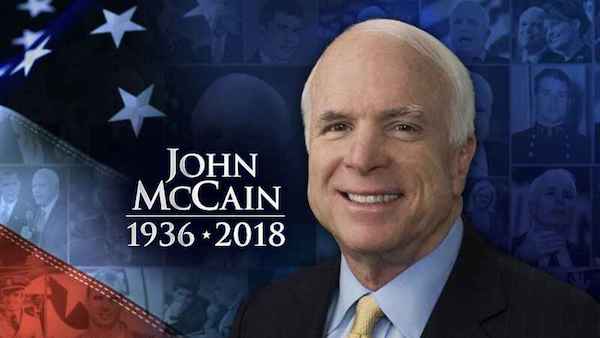
PHOENIX, AZ(TIP): Hundreds of people paid their respects to US Senator John McCain on Wednesday, standing for hours in the broiling Arizona sun before filing past the flag-draped casket that his tearful wife, Cindy, lovingly pressed her face against after a ceremony for the former North Vietnam prisoner of war who represented Arizona for decades.
Former military members in shorts and T-shirts stopped and saluted the closed casket flanked by National Guard members at the Arizona Capitol. Families will small children came by, and several people placed their hand over their heart or bowed, including Vietnamese residents who traveled from Southern California.
The private service held earlier marked the first appearance of McCain’s family since the Republican senator died Saturday of brain cancer. It also began two days of official mourning in Arizona before his body is taken to Washington for a viewing at the US Capitol, followed by burial at the US Naval Academy in Annapolis, Maryland.
At the emotional private ceremony in Arizona, Gov. Doug Ducey remembered McCain as an internationally known figure and “Arizona’s favorite adopted son” on what would have been his 82nd birthday. He was born in the Panama Canal Zone while his father, who went on to become an admiral, served in the military.
“Imagining an Arizona without John McCain is like picturing Arizona without the Grand Canyon,” Ducey said.
Former Arizona Sen. Jon Kyl said he had been with McCain across the world and he had better instincts on when to assert US power than anyone else he knew.
“I will miss him as a friend, and a strong force for America, and the world,” Kyl said.
Sen. Jeff Flake offered the benediction, expressing gratitude “for his life and for his sacrifice” and “that John made Arizona his home.” By the time the service ended, crowds had gathered to wait for the public viewing of McCain’s closed casket, seeking shelter from Phoenix’s summer heat under tents with coolers filled with ice and water bottles.
The line snaked down streets even as a continuous flow of people flowed past the casket. The visitation was to continue as long as people waited in line, said Rick Davis, McCain’s former presidential campaign manager.
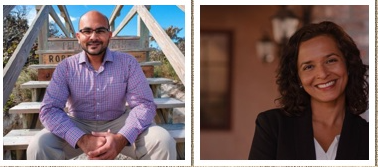
NEW YORK(TIP): Indian Americans appear to be doing well in politics. In the latest political bouts, Hiral Tipirneni and Sanjay Patel ran and won unopposed on August 28 Democratic primaries in Arizona and Florida.
On Tuesday , another Indian American Democrat, tech executive Anita Malik, is leading by 383 votes against her nearest rival in Arizona’s 6th congressional district. Malik’s race is too close to call.
Tipirneni, who lost a close special election to Rep. Debbie Lesko in April, will now face the same rival in the midterm elections on November 6 in Arizona’s 8thcongressional district.
In the highly competitive special election, which was warranted because the incumbent GOP Rep. Trent Franks resigned last December after he was embroiled in a sexual misconduct scandal, Tipirneni received more than 82,300 votes (47.4 percent), roughly 9,000 fewer than Lesko.
However, despite the competitive nature of their last race, Cook Political Report rates the district as a solidly Republican seat in November.
Patel will run against face incumbent Bill Posey, who similarly ran unopposed in the Republican primary in Florida’s 8th congressional district.
Patel, a first-generation immigrant and small business owner, also starts as an underdog. Cook Political report rates the district as a solidly Republicanseat, with GOP having a 11-percentage point advantage. Sabato’s Crystal Ball also rates the district as a “safe” Republican seat.
Patel is also behind in the money race, having raised only $231,000, less than half of the nearly $600,000 collected by Posey, according to the Center for Responsive Politics.
The Indian American is running on a number of issues such as healthcare, economy and jobs, environment and education.
On healthcare, he has vowed to work “to make healthcare a right for every American by supporting Medicare for All.”
With the primary victories of Patel and Tipirneni, the number of Indian Americans on the midterm congressional ballots has reached double digits.
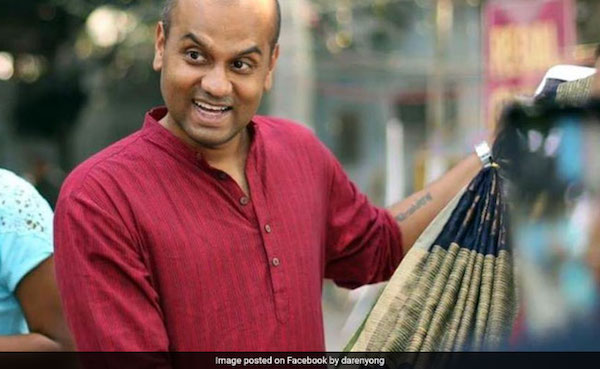
SINGAPORE (TIP): Indian-origin Avijit Das Patnaik, employee of Singapore’s DBS Bank, has lost his job after he posted on Facebook an image of the country’s torn flag to reveal the Indian flag underneath on the eve of India’s Independence Day. Patnaik had on August 14 posted a picture on the Facebook page of the Singapore Indians & Expats group, showing the Singapore flag on a T-shirt being ripped up to reveal the Indian flag underneath.
Avijit Patnaik, who had been living in Singapore for a decade, had posted the image along with the caption — Phir Bhi dil hai (Still my heart is Indian) which alludes to a popular Bollywood song.
The post had caused outrage in the city-state, with many terming it “offensive” and “insulting to Singapore”. The post has since been taken down.
Singapore-headquartered DBS Bank, in a comment to complaints on its Facebook page on August 19, had said that Avijit Patnaik had posted the image because he “wanted to show that even as he is in Singapore, he remains Indian at heart”.
“Upon realizing the graphic was offensive, he took it down immediately,” DBS said, adding that it had counselled Avijit Patnaik.
The Bank released a statement on its Facebook page on August 24, saying that Avijit Patnaik was no longer its employee.
“Since the incident, a disciplinary committee has been convened and as of August 24, he (Patnaik) is no longer with the bank,” the DBS Bank said in the post.
“DBS strongly disapproves of such actions by our employees. At the same time, it is fair and right that all employees are given the benefit of due process,” it said.
When asked about the circumstances surrounding Avijit Patnaik’s departure, including whether he resigned or was sacked, a DBS spokesman declined to elaborate, according to the report.
“We have nothing further to share beyond the post,” it said quoting the bank as saying.
According to the Singapore Arms and Flag National Anthem Act, any person that treats the flag with disrespect may be fined a maximum of 1,000 Singapore dollar.
Meanwhile, according to the media report, police have confirmed that a report has been made and investigations are underway.
LONDON(TIP): Indian-origin pathologist, Khalid Ahmed, has been accused of mis handling some post-mortems at a UK hospital and is under police investigation to establish if any criminal charges need to be brought against him. Ahmed, who worked as a consultant pathologist at the Royal Oldham Hospital in Manchester, carried out an undisclosed number of post-mortem tests for the north Manchester coroner’s office.
An investigation revealed that he repeatedly recorded the wrong cause of death for patients, misidentified organs and potentially mixed up bodies, The Daily Telegraph reported.
In May last year, the senior coroner at the north Manchester coroner’s office raised concerns about Khalid Ahmed’s examinations and a recent review found “significant concerns” with his “inadequate” said reports.
Professor Simon Kim Suvarna, a consultant histopathologist at Sheffield Teaching Hospitals, carried out the review into Ahmed, who qualified as a medic in Bengaluru in 1989, and found some reports to have an “incorrect” cause of death given.
Suvarna is also reported to have noted that Khalid Ahmed’s tests “do not even meet the standards that are expected for pathology students to pass the autopsy component of the final exam”, the reports said.
A subsequent police referral was made by the coroner and that the police investigation is still underway.
A spokesperson for Greater Manchester Police (GMP) said: “GMP is assessing what, if any, criminal offences may have been committed in relation to findings presented to the coroner.”
Khalid Ahmed joined Pennine Acute NHS Trust in January 2007, but no longer works there.
In a statement, the trust said after they were told of the coroner’s concerns, an “in-depth internal review” into Khalid Ahmed’s practice was carried out, which concluded in February this year.
The trust added that a “thorough and extensive investigation” of Ahmed’s work for the UK’s state-funded National Health Service (NHS) work “provided assurance” his practice was “within the range of a reasonable pathologist”.
The UK’s General Medical Council said he is still licensed to practice as a histopathologist.
LONDON(TIP): An Indian-origin man serving a jail term in a UK jail for killing his wife over eight years ago is to be deported to India to serve the remainder of his murder sentence in Punjab.
Harpreet Aulakh was sentenced to a minimum of 28 years in London in December 2010 for plotting the murder of his wife, Geeta Aulakh, after she asked for a divorce. The 40-year-old will be deported under the India-UK Repatriation of Prisoners Act, the BBC reported today.
“All arrangements are in place. According to the plan, the UK authorities will bring him to Delhi from where a team of Punjab police officers will bring him to Amritsar,” IPS Sahota, a top prison official in Punjab, was quoted as saying.
Inspector general of prisons Roop Kumar said Harpreet Aulakh, who is from Punjab, had told UK authorities that he wanted to serve his remaining term in India.
Geeta Aulakh, 28, was brutally attacked with a machete during the attack in Greenford, west London, in November 2009. She worked for local Indian community radio station, Sunrise Radio, and her murder had hit headlines around the world at the time of the attack.
In November 2009, the victim, who was the mother of Harpreet Aulakh’s two sons, was hacked to death with a sword, which her husband of 10 years had chosen from a selection of swords at a store days before the murder.
The attack took place when Geeta Aulakh went to pick up her sons after leaving work at the radio station where she worked as a receptionist.
She was found with head injuries and her right hand severed, and died a few hours later in hospital.
Harpreet Aulakh, also known as Sunny, and two others, Sher Singh, 19, and Jaswant Dhillon, 30, were also found guilty of Geeta Aulakh’s murder in 2010. Sher Singh, who actually wielded the sword, and Jaswant Dhillon, who acted as the lookout for the group, were sentenced to 22 years behind bars. During the trial, the court was told that British-born Indian-origin Geeta Aulakh wanted to divorce her husband over his involvement in violent crimes, leading him to plot her murder.
UNITED NATIONS(TIP): Indian-origin UN official Satya S Tripathi joined the long list of Indians with the United Nations. He has been appointed as Assistant Secretary-General and Head of the New York Office of the United Nations Environment Programme (UNEP) by UN Secretary General Antonio Guterres.
Tripathi, who will succeed Elliott Harris of Trinidad and Tobago, has since 2017 served as senior adviser on the 2030 Agenda for Sustainable Development at UNEP.
A development economist and lawyer with over 35 years of experience, Tripathi has worked for the United Nations since 1998 in Europe, Asia and Africa on strategic assignments in sustainable development, human rights, democratic governance and legal affairs, spokesman for the Secretary-General Stephane Dujarric told reporters at United Nations.
Tripathi was previously the Director and Executive Head of the United Nations Office for Reducing Emissions from Deforestation and Forest Degradation in Developing Countries Coordination in Indonesia, as well as for the United Nations Recovery Coordinator for the $7 billion post-tsunami and post-conflict recovery efforts in Aceh and Nias.
He participated as Chair of the Committees on Laws and Treaties for the United Nations-mediated Cyprus unification talks in 2004.
Earlier in his career he acted as a Senior Distinguished Fellow on Natural Resources Governance with the World Agro-forestry Centre and on the World Economic Forum’s Global Advisory Council on Forests.
Tripathi holds honors in bachelor’s and master’s degrees in commerce; and bachelor’s and master’s degrees in law from Berhampur University, India.
WASHINGTON(TIP): Never before has there been such a crop of Indian Americans in politics in the US. The Indian American community has come of age in respect of their involvement in politics. Four Indian American members of Congress — Reps Ami Bera, D-CA; Ro Khanna, D-CA; Pramila Jayapal, D-WA; and Raja Krishnamoorthi, D-IL — are running for re-election.
Additionally, the following Indian Americans will be on ballot in November:
Aftab Pureval, Ohio’s 1st congressional district: Pureval, son of an Indian father and a Tibetan mother, is one of the rising stars in Ohio’s Democratic party. He won the May primary unopposed and is running against Republican Rep. Steve Chabot.
Sri Preston Kulkarni, Texas’ 22nd congressional district:
A former diplomat, Kulkarni won a contested primary to earn the right to face Republican Pete Olson in the Houston area district.
Chintan Desai, Arkansas’ first district: Desai, a teacher, won the Democratic primary in June and will take on three-term incumbent Republican Rick Crawford in November.
Jitendra ‘J.D.’ Diganvker, Illinois’ 6th congressional district: Diganvker, who immigrated to the United States in 1995, is the only Indian American Republican congressional candidate who will be on the ballot in November. He will face the incumbent Indian American Rep. Krishnamoorthi.
Signup to our Newsletter!
Don’t miss out on all the happenings around the world