Year: 2018

  • Indian American Elected Harvard Student Body President

    Indian American Elected Harvard Student Body President

    BOSTON(TIP): Indian American Sruthi Palaniappan has been elected  president of the powerful student’s body of the prestigious Harvard University.

     Palaniappan, 20, whose parents migrated to the US from Chennai in 1992, was elected as president of the Harvard University Undergraduate Council.

    Her running mate Julia Huesa, 20, was elected as vice president, according to an announcement by the Undergraduate Council Election Commission.

    Ms Palaniappan said that Ms Huesa and her planned to work on improving the Council’s communication with the student body in their initial days in office.

    “I think from the onset, better structuring the way we communicate with students is something that we need to already set the tone and plan for,” she said.

    “I think we’re going to work on it before we even leave for break and just get off the ground running,” she said.

    Ms Palaniappan was the youngest delegate at the Democratic National Convention in Philadelphia in July 2016.

    According to the report, Ms Palaniappan and Ms Huesa garnered nearly 41.5 per cent of the votes as against their nearest opponent Nadine M Khoury and Arnav Agrawal, who received 26.6 per cent of the votes.

    They ran their campaign under the slogan “Make Harvard Home”.

    The duo, a long-time member of the Undergraduate Council, are scheduled to take over from the outgoing president Catherine L Zhang ’19 and vice president Nicholas D Boucher ’19.

    Ms Palaniappan is currently the council’s education committee chair.


  • Indian-Origin Scotland Yard Cop Fired after Homeless Man Kicked Out of Station Dies

    Indian-Origin Scotland Yard Cop Fired after Homeless Man Kicked Out of Station Dies

    LONDON(TIP): An Indian-origin Scotland Yard police constable (PC) has been fired from her job without notice for failing to exercise reasonable care in her treatment and monitoring of a homeless man after ejecting him from a police station in west London.

    PC Bhupinder Kalsi was fired following a Metropolitan Police Unsatisfactory Police Performance meeting which found that her performance was grossly incompetent, and she was guilty of unsatisfactory performance.

    Pericles Malagardis, a Greek national who was sleeping at Heathrow Airport, had gone to Uxbridge police station to collect his dog on a cold day in March 2016. The 63-year-old died of hypothermia after he was made to leave the police station for smoking inside the station.

    The Independent Office for Police Conduct (IOPC), the independent police watchdog, had referred the case to the Crown Prosecution Service (CPS) to consider charges of gross negligence manslaughter.

    “We found there was not enough evidence to prosecute for any offences and took no further action,” the CPS said.

    However, an internal disciplinary panel found that Kalsi “did not provide information requested by the London Ambulance Service regarding actions taken to support Mr. Malagardis and failed to follow instruction and training when dealing with unresponsive casualties”, after he was found unconscious on the pavement.

    The panel also concluded that Kalsi was viewing a DVD whilst on duty, following Malagardis’ ejection from the front office area of the police station.

    Another police station staff member is facing a separate disciplinary hearing over the same incident.

    Once the internal Metropolitan Police reviews are completed, an inquest into the death of Malagardis is expected to take place.

  • Indian-Origin Professor at University of Kansas City Accused of Using Students as Servants

    Indian-Origin Professor at University of Kansas City Accused of Using Students as Servants

    WASHINGTON(TIP): An Indian-origin professor in the US has been accused of exploiting his students and compelling them to do his personal work, media reported.

    Ashim Mitra, a pharmacy professor at the University of Missouri-Kansas City, made his students tend his lawn, look after his dog and water the house plants, sometimes for weeks at a time when he and his wife were away, the local media reported.

    They hauled equipment and bused tables at his social events, the newspaper said quoting nearly 12 of Professor Mitra’s former students.

    Kamesh Kuchimanchi, a former student, told the daily that he considered his life at UMKC “nothing more than modern slavery.”

    He alleged that Professor Mitra exploited cultural kinship with students from India. When Mr Kuchimanchi once told him that wouldn’t be a servant, “he threatened to kick me out of the university and force me to lose my visa and lose everything.”

    One of Professor Mitra’s colleague is suing him and university officials. Miridu Mukherji filed two related lawsuits in Jackson County Circuit Court – one in 2016 and one in 2018, the report said.

    According to allegations in pending litigation, the university not only knew about Professor Mitra’s behavior but also overlooked complaints for years.

    Court documents obtained by the daily show that after one colleague filed a formal complaint, the university investigated, but the probe involved talking to only one student.

    In a statement to the daily through his attorney, Professor Mitra said, “Over the years, I have invited graduate students to my home where they have done work related to their courses of study, and at times eaten meals prepared by my wife. I have not required anyone to perform chores unrelated to their studies.”

    “I do not understand the suggestion that anyone was concerned with their visas being at risk. I have worked with over 60 graduate students attending UMKC on F1 (study) visas, and I am not aware of any of those students having their visa status challenged or revoked,” he said.

     “Because he had the prestige, he could influence people. He could make things happen. For that reason, they were reluctant to come forward. So were most of Mitra’s pharmacy school colleagues,” another student was quoted as saying.

  • Eight Indian-American women honored

    Eight Indian-American women honored

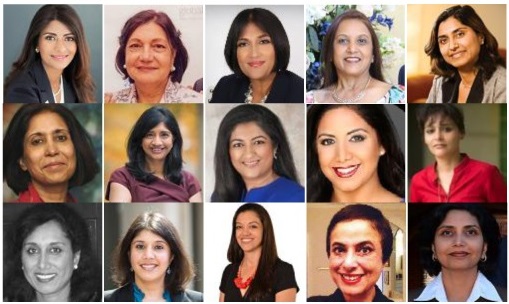
    WASHINGTON(TIP): Eight Indian-American women have been honored in recognition of their achievements in diverse fields ranging from politics and business to civil rights activism and astrophysics.

    Immigration lawyer Sheela Murthy, vice chairwoman of the Asian American Hotel Owners Association (AAHOA) Jagruti Panwala and NASA astrophysicist Madhulika Guhathakurta were among the awardees.

    Other honorees were Maryland Delegate Aruna Miller, Manisha Gaekwad from Florida; Ann Ramakumaran, founder and CEO of a tech company Ampcus, Inc; and Suman Raghunathan, executive director of the racial justice and civil rights group South Asian Americans Leading Together (SAALT).

    They were honored at the inaugural American Bazaar Women Entrepreneurs and Leaders Gala.

    Tak, a trailblazer for Indian-American women in many fields, was honored for her contributions in the areas of politics, art and culture. One of the first Indian American women to serve in the United States military, she is also among the first Indian-American women fundraisers to make a mark nationally.

    Astrophysicist Guhathakurta, who was born in Kolkata, is one of the most prominent Indian-Americans in NASA (the National Aeronautics and Space Administration).

    Dozens of prominent women entrepreneurs from across the country, executives of Fortune 500 companies, political and thought leaders, and leaders from the nonprofit world attended the Women Entrepreneurs Forum and Leaders Gala.

    (Source:  PTI)

  • Indian-origin man arrested in US for sexual enticement of 11 year old girl

    Indian-origin man arrested in US for sexual enticement of 11 year old girl

    NEW YORK(TIP): A 22-year-old Indian-origin man in the US has been arrested and charged with sexual enticement of a minor girl through social media, authorities have said.

    Sachin Aji Bhaskar, a resident of New York’s Buffalo city, faces a minimum penalty of 10 years in prison, maximum of life in prison and a USD 250,000 fine.

    Assistant US Attorney Wei Xiang said on Tuesday that Bhaskar, using a social media application in August, contacted the 11-year-old girl in Buffalo claiming to be 15.

    He picked her up by car and returned her home approximately three hours later after having sex with her.

    He made an initial appearance before US Magistrate Judge Kenneth Schroder and is being held pending a detention hearing.

    The criminal complaint is the result of an investigation by the Federal Bureau of Investigation’s Child Exploitation Task Force.

    (Source: PTI)

  • Jamal Khashoggi Murder-CIA has tape of Saudi prince saying ‘silence Khashoggi’

    Jamal Khashoggi Murder-CIA has tape of Saudi prince saying ‘silence Khashoggi’

    ISTANBUL(TIP): A Turkish newspaper reported on Thursday, November 22,  that CIA director Gina Haspel signaled to Turkish officials last month that the agency had a recording of a call in which Saudi Arabia’s crown prince gave instructions to “silence” Saudi journalist Jamal Khashoggi.

    Asked about the report, a Turkish official said he had no information about such a recording. Saudi Arabia has said Crown Prince Mohammed bin Salman had no prior knowledge of Khashoggi’s killing at the Saudi consulate in Istanbul six weeks ago.

    “There is talk of another recording,” Hurriyet newspaper journalist Abdulkadir Selvi wrote in a column, saying the purported call took place between Prince Mohammed and his brother, Saudi Arabia’s ambassador to Washington. “It is being said that CIA chief Gina Haspel indicated this during her visit to Turkey,”” he wrote, adding that they had discussed Khashoggi, a critic of the kingdom’s de facto ruler. “It is being said the crown prince gave orders to ‘silence Jamal Khashoggi as soon as possible’,” in a call which was monitored by the US agency, he said.

    Khashoggi was killed at the Saudi consulate in Istanbul on October 2 in an operation that Turkey’s President Tayyip Erdogan has said was ordered by the highest level of Saudi leadership.

    After offering numerous contradictory explanations, Riyadh said last week Khashoggi had been killed and his body dismembered when negotiations to persuade him to return to Saudi Arabia failed.

    (Source: Agencies)

     CIA did not blame Saudi crown prince, says Trump

    WASHINGTON(TIP): “They didn’t conclude,” Mr. Trump said on Thursday, November 22,  when asked about the CIA’s evaluation by reporters at Mar-a-Lago in Florida, BBC reported.

    U.S. President Donald Trump has said that the CIA did not blame Saudi Crown Prince Mohammed bin Salman for ordering the murder of journalist Jamal Khashoggi.

    Khashoggi was murdered on October 2 in the Saudi consulate in Istanbul.

    Officials told U.S. media such an operation would have needed the prince’s approval.

    “They didn’t conclude,” Mr. Trump said on Thursday when asked about the CIA’s evaluation by reporters at Mar—a—Lago in Florida, BBC reported.

    “They have feelings certain ways. I have the report, they have not concluded, I don’t know if anyone’s going to be able to conclude the crown prince did it,” he said.

    The President has repeatedly stressed the importance of Saudi Arabia to the U.S. following the killing.

    Earlier this week, Mr. Trump released a statement suggesting that the crown prince “could very well” have known about the incident.

    His statement said: “[It] could very well be that the crown prince had knowledge of this tragic event — maybe he did and maybe he didn’t!”

    On November 17, White House Press Secretary Sarah Sanders told reporters that Mr. Trump had confidence in the CIA following conversations with Director Gina Haspel and Secretary of State Mike Pompeo about the Khashoggi murder.

    Sources quoted in the U.S. media at the time stressed that there was no single piece of evidence linking the crown prince directly to the murder, but officials believed the killing would have required his endorsement.

    Saudi Arabia called the claim false and insisted that the crown prince knew nothing about plans for the killing.

    The Gulf kingdom’s public prosecutor says Khashoggi was killed as a result of a “rogue operation”.

    However, the Hurriyet newspaper reported on Thursday that Ms. Haspel told Turkish officials last month the CIA had a recording in which the crown prince gave instructions to “silence” the Saudi writer as soon as possible.

    When asked about the claims by reporters, Mr. Trump said: “I don’t want to talk about it. You’ll have to ask them.”

    The Saudi crown prince left on a visit to “brotherly Arab states” on Thursday, Saudi state media reported, beginning a regional tour with the United Arab Emirates.

    It will be his first official trip abroad since Khashoggi was killed.

    The crown prince is also expected to participate in a G20 meeting of world leaders in Buenos Aires, Argentina, at the end of the month that will be attended by leaders from the US, Turkey and a number of European countries.

    Meanwhile, France has announced that it is imposing sanctions on 18 Saudi nationals —— the same individuals targeted with sanctions by the U.S., UK and Germany — allegedly linked to the Khashoggi murder.

    Their list of individuals does not include the crown prince, a spokesperson for the French ministry of foreign affairs said.

    (Source: IANS)


  • Spiritual Science:  Get Permanent Bliss

    Spiritual Science: Get Permanent Bliss

    CHICAGO, IL(TIP):  Dada Bhagwan, known as AM Patel in his former life before renunciation, found and then shared a part for eternal bliss and peace through Akram Vignan, A spiritual science.

    Each and every living being is in constant pursuit of happiness; no one likes suffering. This search only ends when the source of eternal happiness is found. Eternal happiness can only be attained through realizing your true Self. A path to eternal happiness was discovered by Dada Bhagwan who propounded Akram Vignan  that is based on the foundation of Self Realization. This unique science provides practical day-to-day solutions that lead to harmony and happiness in life.

    What is Akram Vignan?

    • It is PROFOUND, POWERFUL and PRACTICAL
    • Knowledge-based approach without rituals or strict routines
    • Holistic science that integrates spirituality into daily life
    • An accelerated path to Self-Realization & permanent happiness

    Akram Vignan moment is ran under Dada Bhagwan Vignan Institute (DBVI), spiritual non-profit organization in North America.  The organization’s primary objective is to spread peace, harmony and everlasting bliss to the people of this world through the teachings of a spiritual science.

    This institute is committed to achieving its objectives through various volunteering programs, community outreach programs & focused workshops. Every year, an international spiritual convention is organized in North America, presided by our Spiritual Teacher, and consists of topic specific discourses and Q&A (open format).

    It is entirely managed and run by volunteers spread across several chapters (“centers”) in North America, Latin America and Europe.  Our charity work spans international boundaries. One of the chapters are based in Chicago-land. Local chapter meets on weekly basis where we have spiritual discourses on various topics such as Adjust Everywhere, Life without conflict, Harmony in life, Positive parenting, etc.

    The Institute programs are for all age groups. It conducts various FREE workshops for all age groups. A life-transforming workshop that has touched thousands of lives across the globe. Discover the path of infinite happiness through right understanding.

    Every year it has Self Realization Seminar in Chicago, presided by the Spiritual Teacher from the Institute. Self Realization is attained effortlessly in a two-hour ceremony (Gnan Vidhi) by the grace of the Gnani (spiritual master). Many have experienced this eternal happiness!

    For more information on our local events visit: http://us.dadabhagwan.org/chicago/

    Visit https://www.dadabhagwan.org/ to learn about Akaram Vignan.

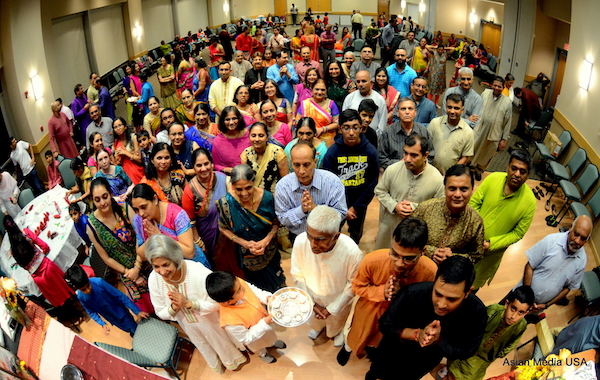
    (Photographs and Press release by Asian Media USA)

  • Manduka halts production of Lord Ganesh yoga towels after Hindu protest

    Manduka halts production of Lord Ganesh yoga towels after Hindu protest

    NEVADA(TIP): Global yoga gear company Manduka, headquartered in El Segundo (California), has announced not to produce yoga towels carrying reimagined images of Hindu deity Lord Ganesh, which Hindus objected calling these “highly inappropriate”.

    Taylor of Manduka Customer Care, in an email today to Universal Society of Hinduism (USOH), which spearheaded the protest, wrote: “Out of respect for our global community, we will no longer produce new versions of the products in question.”

    Hindu statesman Rajan Zed, who is President of USOH, in a statement in Nevada, November 22,  thanked Manduka for understanding the concerns of Hindu community which thought image of Lord Ganesh on such a product was highly insensitive.

    Zed, however, pointed out that a formal apology from Manduka CEO to the upset Hindu community was still due, as it had sold Ganesh yoga towel in the past also. He also urged Manduka to withdraw its yoga towels depicting reimagined images of Lord Ganesh selling on its website or other online retailers or shops.

    Rajan Zed suggested that Manduka and other companies should send their senior executives for training in religious and cultural sensitivity so that they had an understanding of the feelings of customers and communities when introducing new products or launching advertising campaigns.

    Zed had said that Lord Ganesh was highly revered in Hinduism and was meant to be worshipped in temples or home shrines and not to sit/stand on or put feet/buttocks/legs/body on or to absorb/wipe one’s sweat. Inappropriate usage of Hindu deities or concepts for commercial or other agenda was not okay as it hurts the devotees.

    Hinduism was the oldest and third largest religion of the world with about 1.1 billion adherents and a rich philosophical thought and it should not be taken frivolously. Symbols of any faith, larger or smaller, should not be mishandled, Rajan Zed had noted.

    Zed had stated that such trivialization of Hindu deity was disturbing to the Hindus world over. Hindus were for free artistic expression and speech as much as anybody else if not more. But faith was something sacred and attempts at trivializing it hurt the followers, Zed added.

    Taylor wrote to USOH: Thank you for bringing your organization’s concern to our attention. We consider our community in all that we do and work diligently to ensure we never compromise our products, community or each other… Our reputation, as the world’s most respected yoga brand, was built by operating at the highest level of integrity.

    These objectionable “yogitoes yoga towel – enlightened” and “yogitoes yoga towel – opportunity” were priced at $51 and $43.50 respectively and help “prevent slipping”. These are to be placed “on top of your yoga mat or directly on the floor”. Though “enlightened towel” shows up as “out of stock” on Manduka’s main website, it is still available from Manduka Singapore, etc., sites.

    In Hinduism, Lord Ganesh is worshipped as god of wisdom and remover of obstacles and is invoked before the beginning of any major undertaking. There are about three million Hindus in USA.

    Manduka, whose tagline is “Made for you, made for yoga.” and whose history goes to 1997, claims to make “the world’s finest athletic performance products, including yoga mats, towels, bags, props and men’s & women’s fitness apparel”. It runs “project:OM”, whose tagline is “Creating a Better World”. Manduka claims that its quality is “still unmatched in the marketplace”.

  • Amazon’s Recent New York Campaign Contributions Mostly to Members of Congress

    Amazon’s Recent New York Campaign Contributions Mostly to Members of Congress

    NEW YORK(TIP): Gotham Gazette reports that before Amazon announced the placement of one of its next satellite “headquarters” in Queens, drawing mixed reactions from local lawmakers and significant overall pushback, the company’s campaign finance footprint in New York shows it was spreading its money around to many New York politicians, mostly those at the federal level.

    Eight members of the U.S. House of Representatives from New York City, all Democrats, who signed a now infamous letter last year to compel Amazon to consider the city, received more than $26,000 in total campaign contributions from Amazon from the beginning of 2017 to October 2018, according to Federal Election Commission (FEC) filings, with four of the members receiving $7,500 of that total before signing the letter.

    Rep. Hakeem Jeffries, whose district includes part of Queens, received $8,000 total from Amazon in four separate contributions to his campaign since 2017, including $1,500 before he had signed the letter and $6,500 afterward, a time period that coincided with Jeffries’ recent reelection to the House, though he did not face serious opposition. Jeffries’ office did not respond to a request for comment for this story, but he said in a statement to Cheddar that the deal “will supercharge New York City’s reputation as the single best place to do business in America.”

    Brooklyn Rep. Yvette Clarke received $5,000 from Amazon, half before signing the letter and half since — Clarke did face a tough primary challenge this year, narrowly defeating Adem Bunkeddeko before cruising to victory in the general. In a statement for the city’s Economic Development Corporation (EDC) that was sent to members of the media upon the Amazon announcement, Clarke said, “Amazon’s decision to locate a headquarters in New York City is a testament to the strength of our technology sector.”

    Other letter signees who received Amazon contributions include Rep. Eliot Engel, Rep. Carolyn Maloney (whose district includes Long Island City), Rep. Gregory Meeks, Rep. Nydia Velazquez, and Rep. Adriano Espaillat, all of the five boroughs. Maloney called for a fair “public review” of the deal in a statement to Politico, arguing that “[a] beneficial deal will withstand public scrutiny.”

    Upon the announcement of the deal to bring Amazon to New York City, Espaillat issued a statement of praise, saying in a tweet, “Welcome to New York City, @Amazon. We have the best & brightest technologically skilled workforce that is ready & willing to work & invest in our community & help our economy continue to grow,” while Velazquez issued a statement criticizing the process and outcome, saying, “Many New Yorkers, myself included, are concerned by the enormous incentives this package extends to Amazon.”

    Rep. Joe Crowley of the Bronx and Queens received $2,500 from Amazon before he signed the letter, according to FEC filings. He lost his seat in an upset to now Congressional Representative-elect Alexandria Ocasio-Cortez, who has been a strident critic of the Amazon deal. The democratic-socialist tweeted that she finds the deal “extremely concerning,” arguing that the money for tax breaks for Amazon could be better spent on the “crumbling” subway and disenfranchised communities.

    It’s unclear if any of the members of Congress played a role in the negotiation process, which was apparently led by Cuomo, along with de Blasio and members of their two teams — those involved apparently signed non-disclosure agreements at Amazon’s insistence. Members of Congress’ support or opposition, however, can play a crucial role in the overall atmosphere around such a deal and the public perception thereof. For the most part, Amazon is more concerned with federal regulations and nationwide tax policy, evident from its campaign funding patterns. Data from OpenSecrets.org shows that Amazon gave about $1.17 million to federal candidate campaigns in 2018 alone, 52% of which went to Republicans and 48% to Democrats.

    Amazon has also given some campaign contributions at the local level, including $1,000 to Assembly Speaker Carl Heastie’s campaign committee in January of this year, according to state election records. Heastie did not respond to a request for comment, but the Bronx Democrat told the New York Times in a statement that “this deal has the potential to more than pay for itself.” He added that, “Of course we take our role in approving aspects of this deal very seriously and we will be closely reviewing it.”

    The only other local lawmaker whose campaign funds Amazon added to was Republican state Senate Majority Leader John Flanagan, who received $1,000 in January, according to state election records.

    New York City and State have agreed to roughly $3 billion in financial incentives to Amazon to settle in Long Island City, including tax breaks and rebates mostly from existing economic development programs that would be applicable to other companies, as well as a roughly $500 million capital grant from the state that is discretionary. The deal is based on a pledge by Amazon to create 25,000 new jobs in the city over 10 years, at an average salary of $150,000 per year. Some of the incentives are directly tied to those jobs coming to fruition. The company may also qualify for new federal tax savings.

    Critics have cried foul about a secretive process with virtually no public input before a deal was struck (there will be some before everything is finalized) and that there are billions of dollars of incentives going to one of the wealthiest companies in the world. A number of elected officials did praise the deal, including U.S. Senator Charles Schumer of New York, the Democratic Senate minority leader. Schumer received a total of $10,000 from Amazon in three separate contributions to his campaign committee in 2015 ahead of his reelection the following year, according to FEC filings. He has not received any funds from Amazon since his 2016 reelection.

    Some of the criticism towards the Amazon deal is tied more broadly to Cuomo’s economic development programs and their incentives for companies to relocate or create jobs. Flanagan, whose 2018 campaign got the relatively minor boost from Amazon, criticized Cuomo for giving handouts rather than working to improve New York’s overall economic climate. Flanagan’s majority conference, which is handing over the reins next year to Democrats who flipped the chamber on Election Day, has signed off on budgets that have included Cuomo’s programs.

    Amazon, a trillion dollar-company, spent $110,000 lobbying the state Assembly, Senate, and executive branch on bills related to taxation and regulation of internet companies from the beginning of 2017 to October of 2018, according to state lobbying records. JCOPE (the Joint Commission on Public Ethics) lists Amazon lobbying activities as only related to “internet/online sales & related issues,” but specific bills lobbied on include the establishment of a task force to study an internet marketplace tax and bills that propose to regulate voice-recognition technology.

    The company also spent over $120,000 lobbying New York City government in the last two years for participation in their cloud computing services, according to city lobbying records.

    The records do not show lobbying related to the new headquarters in Queens. That process appears to have been removed from official lobbying and instead part of the competition Amazon announced, wherein it received hundreds of pitches from governments and coalitions around the country. There are no records of Amazon donating to the campaigns of either Cuomo or de Blasio.

    Jeff Bezos, Amazon CEO and one of the wealthiest people in the world, said in a statement on the day of the announcement that the new “headquarters” split between New York and Virginia “will allow us to attract world-class talent that will help us to continue inventing for customers for years to come. The team did a great job selecting these sites, and we look forward to becoming an even bigger part of these communities.”

    Hiring for the new offices is scheduled to begin in 2019, according to Amazon. Governor Cuomo has said that the new office campus and related employment will generate more than $27 billion in tax revenue over the next 25 years.

  • 550 Saal Guru Nanak de Naal:  Celebration, reaffirmation

    550 Saal Guru Nanak de Naal: Celebration, reaffirmation

    As Guru Nanak’s teachings stand out for their relevance in the present times of divisive turmoil even 550 years after his birth, one’s head bows with humility to the Guru’s deep insight into the right way of living. And, astonishingly, the right path turns out to be quite simple. It is we who have made our lives complicated. With superstitions, rituals, idolatry, barriers of caste and creed, all dressed up with the cloak of religiosity to garner acceptance. In his endeavor to open the minds of fellow humans to the society’s blots and blemishes, the Guru freely dug into the preachings of his times — from those of the Hindus, the Muslims, babas, pirs, fakirs — to evolve his philosophy, that eventually became the Sikh way of life.

    Also, equally astonishingly, it turns out that treading on that simple way of life is not quite so easy. One is easily led by ego, anger, lust, greed towards diversions, blind to the potholes that mark such digressions. After all, why is it so tough to consider all fellow beings as equal; that there is one nameless God, who constitutes the eternal truth and he resides in his creations? Why is truthfulness so hard to come by? Yet, that is the only way for a peaceful and fulfilling life. Be good, work hard, share fortunes. Vand khao, khand khao. Each one of us needs to learn and abide by this credo. The planet would then be a paradise.

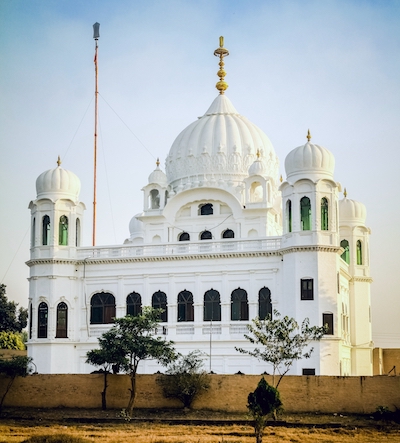
    It is in this context that the year-round global festivities around the 550th anniversary of Gurpurab assume importance. Whether it is the announcement of the Kartarpur corridor from Dera Baba Nanak in Gurdaspur to the International Border for further connection with Gurdwara Darbar Sahib at Kartarpur, Pakistan, or the development of Sultanpur Lodhi as a spiritual center, the activities hold value only if they underscore the Guru’s message of overcoming divisiveness. He denounced the dogmas of the caste system, and taught that everyone is equal. Through the spiritual pursuits of love, equality, fraternity and virtue, one can be purged of falsehood.

    (Tribune, India)

  • The Usurpation of Free Speech

    The Usurpation of Free Speech

    By Vidya Ram

    The notion that the far right is being muzzled despite the inordinate media attention it has garnered — from print, television, radio and digital — is one that it has managed to project with great success, feeding into the wider image the far right has attempted to propagate of it being an anti-establishment, revolutionary force

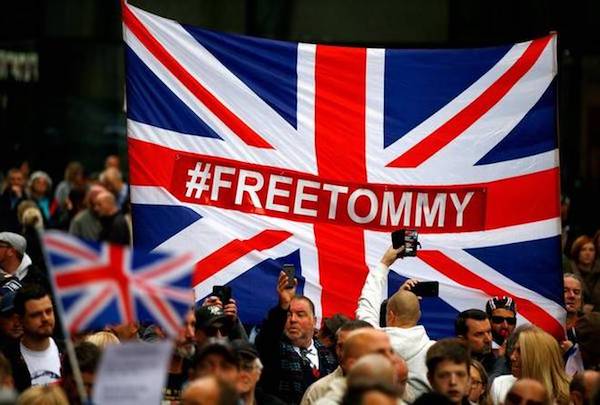
    Last month, ‘Newsnight’, a weekday BBC current affairs program, faced much criticism online over a segment due to be aired that evening on 35-year-old Stephen Christopher Yaxley-Lennon, better known to the world as Tommy Robinson, co-founder of the English Defence League and a cause célèbre of the far right globally. Alongside the provision of yet another platform to him, it was the way the story was promoted that troubled observers the most. Ahead of the program, ‘Newsnight’ ran images of Mr. Robinson staring determinedly into the camera, his mouth covered with duct tape. “Is Tommy Robinson a man raising concerns that others ignore, or a far-right figure exploiting the victims of sexual abuse for his own ends?” asked the program on its social media promotional.

    This image of Mr. Robinson muzzled was the very one that he and his supporters had been seeking to project, despite the fact that as Miqdaad Versi, a spokesperson for the Muslim Council of Britain, noted on Twitter that in the last three months he has been mentioned on broadcast over 100 times. Far from him being shunned by the media, he has been interviewed on prominent news shows in recent years, as well as being an invitee at the Oxford Union. “Is Tommy Robinson being ignored and silenced by the media asks the media who won’t stop reporting on him,” tweeted Amna Saleem, a Scottish-Pakistani writer rather fittingly. The preposterousness of the suggestion that he is being silenced is also evidenced by his social media profile: clips of him speaking, often looking furtively into the camera as if to emphasize the supposed silencing, attract millions of viewers.

    Image Management

    The notion that the far right is being muzzled despite the inordinate media attention it has garnered — from print, television, radio and digital — is one that it has managed to project with great success, feeding into the wider image the far right has attempted to propagate of it being an anti-establishment, revolutionary force. It also appears to be something that many of its proponents ardently believe. “We are being gagged,” a supporter of Mr. Robinson, wearing a t-shirt with the logo “#Free Speech #Free Tommy”, told the Canadian media website The Rebel Media outside a court recently. Hundreds of his supporters gathered outside the Old Bailey last month for a hearing over allegations of contempt of court that Mr. Robinson is facing over his filming of suspects in a criminal trial involving “grooming gangs”. While his supporters have insisted he is a “martyr” to the British cause, and the only one to speak out, others have rightly pointed out that he has simply exploited the case of grooming gangs to further his toxic, Islamophobic world view, exacerbating the situation and taking the attention away from the victims and the debate on real practicable ways in which grooming gangs could be prevented from harming more people in the future.

    He is far from the only figure on the right in Britain to present himself as a “brave soldier” of free speech, and the “oppressed” — as among the only ones willing to take on the “dangerous liberals” supposedly trying to clamp down on free speech and impose their world view to the determinant of the marginalized majority. Katie Hopkins, an ultra-right campaigner, proclaimed herself the “Jesus of the outspoken”. In May, a “Day for Freedom” protest took place on London’s Parliament Square that attracted leading figures on the right. In April, Mark Meechan, a right-wing comedian, sought to portray a fine of £800 by a court in the U.K. for teaching a dog to do a Nazi salute for a YouTube video in terms of the curtailment of free speech.

    In academia

    The same contention has also been propagated by sections of the right more broadly. In an article last year, Niall Ferguson, the right-wing British historian of empire, insisted that the “biggest threat to free speech” came from the left. Last year, when academics and students protested against Oxford University’s support for the “ethics and empire” project that sought to create a list of the rights and wrongs of the empire, publications such as the Daily Mail accused them of bullying and attempting to silence Nigel Biggar, the professor behind the initiative. Last year, the Daily Telegraph ran an incendiary story accusing a young black student of “forcing” the University of Cambridge to replace white authors with black authors and only retracted the factually incorrect story after huge public outrage and a torrent of abuse directed at the student herself.

    It has also manifested itself in other ways. Last year Britain’s Universities Minister gave priority to a requirement that universities be required to guarantee free speech or face fines and potential de-registration in a consultation that was set to take place, pointing to “examples of censorship”. This again appeared to be an acknowledgement of an argument propagated by those on the right that “snowflake” students — too easy to take offence — were somehow stifling voices on the right through no-platforming initiatives that sought to protest the space given to them to voice offensive perspectives. There have been a handful of cases where students have pushed for particularly controversial speakers not to be allowed to speak on campus, yet the right managed to put the issue at the top of the government’s agenda, despite the many challenges facing Britain’s university sector.

    The mainstreaming of this perspective has been toxic and debilitating on public life in the U.K. and beyond. A fear of being perceived to be closed to the perspectives of the right — which has been labelled “balance” — has led to a willingness by media outlets to offer voices even on issues where scientific consensus leaves little doubt. Earlier this year, the BBC faced much criticism over the space it provided to climate change deniers, until a briefing note sent to the staff in September pointed to the danger of a “false balance”. “You do not need a ‘denier’ to balance the debate,” the organization was forced to clarify to its staff in a reference to man-made climate change.

    Meanwhile, the far right has continued to rise steadily, spurred on by burgeoning acceptance of the issues raised by them that would once have been unthinkable, including by the media. There are over 100 live terror investigations related to the far-right as of October, while it emerged that MI5 is to take the lead in dealing with right-wing terrorism amid rising concern about its reach. Last week at least five men were arrested in connection with a video that showed the burning of an effigy of London’s Grenfell Tower. The blaze at the tower, home to largely ethnic minority residents, in June 2017 killed 72 people.

    Beyond Britain

    The usurpation of the free speech debate by the far right is, of course, not confined to Britain. It has become an essential part of the playbook of the movement across the world, while Mr. Robinson himself is held up by right-wing figures across the world as a poster-boy. The unwillingness of the media in Britain and beyond to call out those efforts for what they are will only continue to bolster that effort. The ability of the media to confront the far right, without unconsciously or otherwise adopting its rules of engagement, and its positioning of debates, is likely to be one of its biggest challenges going forward.

    (Source: The Hindu. The author can be reached at vidya.ram@thehindu.co.in)


  • How Modi and Jaitley Gamed  World Bank’s Doing Business Rankings

    How Modi and Jaitley Gamed World Bank’s Doing Business Rankings

    BJP government adopted a competitive-exam strategy to improve India’s rankings, meeting minutes and official correspondence show.

    By Akshay Deshmane

    “The elaborate filing requirements of the Goods and Services Tax had hurt medium and small enterprises while demonetization had hamstrung their cash flows, Hazari said and added, “I would think it is surprising if the MSMEs have said that their ease of doing business has improved.”

    Yet, Modi and his government have been quick to market this improvement in India’s rank on an index prepared for mid-size firms operating in two of the most prosperous cities of India as evidence of an actual improvement of economic conditions across the country.

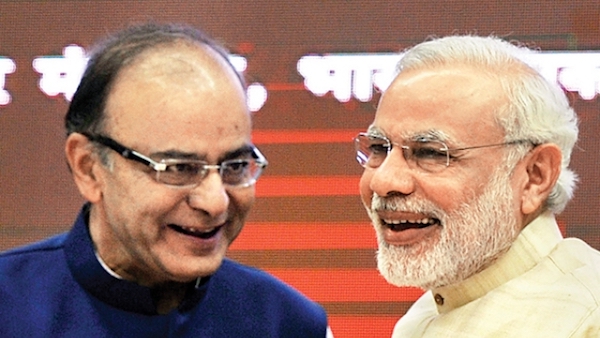
    Prime Minister Narendra Modi’s unhealthy obsession with the World Bank’s Doing Business ranking hijacked India’s reform agenda over the course of the Bharatiya Janata Party (BJP) government’s four-year tenure, according to hundreds of pages of meeting minutes, interviews with key players and official correspondence reviewed by HuffPost India.

    The documents reveal how the Modi government first sought to lobby the World Bank into changing its methodology to reflect a better rank for India. When that didn’t achieve any significant success, the government prioritized minor institutional and procedural tweaks to game the ranking system, rather than embark on a bold agenda of economic reform as promised.

    This monomaniacal focus on putting India among the top 50 countries in the ranking, economists said, gave the World Bank disproportionate influence in India’s economic reform process. It has also revived a persistent concern that the Modi government preferred to focus its energies on optics instead of actual governance and reform.

    This monomaniacal focus on putting India among the top 50 countries in the ranking, economists said, gave the World Bank disproportionate influence in India’s economic reform process

    “If you keep on finding the easiest things to change, then you are effectively letting the World Bank’s ratings decide what kind of changes you want, rather than deciding what is your own sense of priorities,” said Laveesh Bhandari, an economist and director of the Indicus Foundation, who had written a column for The Indian Express outlining these concerns.

    Reports published immediately after India’s dramatic rise up the rankings— from 142 to 77 over four years— have surmised as much. But this is the first comprehensive account that relies on previously unreported documents—accessed through the Right To Information—to provide a blow-by-blow account of how Finance Minister Arun Jaitley and officials in the Prime Minister’s Office adopted the “competitive exam”, tuition-center approach familiar to most Indians eager to improve their rank in a competitive setting.

    “You have literally to crack the code,” Jaitley said, at a self-congratulatory press conference on 31 October, the day when the latest ranking showed India rising up to the 77th position from 100 last year.

    Yet cracking the code, former bureaucrats involved in the process said, wasn’t necessarily good for the economy, much like cracking the board exams isn’t a good indicator of actual learning.

    “If we are improving our position, why are we not getting more investment?” said Arvind Mayaram, who served as Finance Secretary for the first few months of the Modi government’s tenure before he was shunted out to the Tourism Ministry.

    “I would only say that the proof of pudding is in the eating. If the investment rate was around 38% of the GDP in 2011, obviously ease of doing business must have been much superior then than it is in 2018, when it is around 27%,” Mayaram said.

    Cracking the code, former bureaucrats involved in the process said, wasn’t necessarily good for the economy, much like cracking the board exams isn’t a good indicator of actual learning.

    Amitabh Kant, a Modi favorite and former secretary of the Department of Industrial Policy and Promotion (DIPP), pushed back at this characterization of his government’s performance.

    “A lot of work has happened in the past four years on business reforms and the rankings are a reflection of that,” said Kant, now CEO of the NITI Aayog.

    Yet much of this work, HuffPost India found, was akin to rearranging the procedural deck chairs on the listing ship of India’s faltering economy.

    Preparing to crack the code

    On 26 December 2017, Jaitley held an important meeting at his ministry’s office in North Block with the Modi government’s most senior bureaucrats—revenue secretary Hasmukh Adhia, DIPP secretary Ramesh Abhishek, economic affairs secretary and former World Bank Executive Director Subhash Chandra Garg, among others—to address a pressing problem.

    The World Bank had moved the “cut-off date” for finalizing the Ease of Doing Business Report 2019 by a whole month. As a consequence, “the time available to introduce reforms is shorter by a month”, said DIPP secretary Abhishek, according to meeting minutes reviewed by HuffPost India.

    Abhishek could not be reached for comments on this story.

    The timeline and sequencing of the so-called reforms being discussed in the meeting, the minutes make clear, were not dictated by political considerations, discussions with coalition partners or, heaven forbid, an overarching economic vision or strategy. Rather, the reform process was treated like a World Bank-provided syllabus to be completed on time.

    The World Bank would send out its questionnaires to respondents by February 2018, said Abhishek, and “it is therefore important that these reforms are implemented at the earliest”. The questionnaires Abhishek referred to are sent to select businessmen, analysts and other private parties to corroborate claims of reforms made by governments.

    There are 10 quantitative indicators which the bank considers, including the ease of starting a business, getting construction permits and trading across borders, among others, for a mid-size firm, and each indicator is scored and ranked separately. These scores are then aggregated into an overall score for each country. Across the world, the Bank measures performance on the 10 indicators in two cities in the case of all large economies—in India, these cities are Mumbai and Delhi.

    The agenda of Jaitley’s meeting was to ram through as many quick changes as possible.

    To be sure, many of the changes sought in the meeting could have real benefits for a few. But while the government’s attempts to reduce red tape were laudable, analysts said, they were not a substitute for macro-economic reform.

    At Jaitley’s meeting, for instance, proposed “reforms” included eliminating the need for a company seal or rubber stamp to open a bank account, and eliminating the need to submit a cancelled cheque as part of the employee provident fund application process.

    His bureaucrats quickly identified streamlining cross-border trading as an easy way to improve rankings. Thus the department of revenue eliminated the need for traders to submit hard documents, and tried to improve the capacity of the online customs payment gateway.

    According to the minutes, Gopal Krishna, Secretary of the Shipping Ministry, said the Jawaharlal Nehru Port Trust, which handles about 40% of India’s oceanic trade, would digitize import and export related documentation. Interestingly, the port had made the same claim in 2015 for exactly the same reason .

    The focus on cross-border trade would pay off handsomely for the government, as India’s rankings in this specific indicator jumped to 80 in the Doing Business Report 2019 that was released on 31 October. A similar improvement of construction permit procedures saw India’s ranking jump from 181 to 52.

    Another area of focus was the time and paperwork needed to start a new business.

    At the meeting, Abhishek said India needed to reduce the number of official procedures to start a business to six, and the number of days to complete these procedures down to five, to rank amongst the top 50 economies.

    At the time, it took 30 days to start a new business, and required 11 procedures in Mumbai and 12 in Delhi.

    The latest report shows the government managed to eliminate one step by reducing procedures to 10, and also seemingly reduced the time required to 16 days for Delhi and 17 days for Mumbai. The rank for this indicator also jumped up by 21 ranks to 137 in the latest report for the preparation of which this was a key meeting of top officials.

    On that afternoon, the meeting concluded with Jaitley telling the senior officials to submit an action-taken report on the points discussed by 31 January 2018.

    Bhandari, the economist, said that allowing minor procedural changes to disproportionately influence the rankings in a significant way was not the government’s fault, but a flaw in the way the rankings were designed.

    This flaw, Bhandari said, could skew reform priorities away from comprehensive measures that could help the economy as a whole—like improving contract enforcement, skilling and employability or internal trade—towards quick fixes that result in an inordinate rise in the rankings but narrowly affect particular sectors like construction, for instance. Thus he cautioned against resorting to this approach repeatedly.

    How the efforts began

    Jaitley’s 26 December 2017 meeting was one of the most recent instances of an approach adopted immediately in the aftermath of the 2014 general elections which installed a new bunch of decision makers on the Raisina Hill.

    On 16 July 2014, two months after Modi swept to power on the promise of bringing jobs, investment and prosperity, his Principal Secretary Nripendra Misra held a meeting in the PMO to discuss a “concrete strategy for moving up India’s rank” on the EODB index with the secretaries of the corporate affairs ministry, department of economic affairs, DIPP and the ministry of commerce, according to meeting minutes reviewed by HuffPost India.

    “The meeting focused on the more immediate and quickly doable process improvements.” Dr KP Krishnan, an official representing the department of economic affairs in the PMO meeting, subsequently summed up in an internal noting.

    Interestingly, one of the tasks discussed at this meeting involved the streamlining and digitization of customs documents within one month, a “reform” measure that was also discussed in the December 2017 meeting with Jaitley.

    In what would become a familiar pattern for the Modi government, the Information and Broadcasting Ministry was tasked with “Preparation of literature and preparatory activities for global campaign to be taken up on to priority”.

    Crucially, all attendees were told to keep the World Bank abreast of all the good work they were doing.

    “It was emphasized that all these measures should be brought to the notice of the World Bank. All concerned should engage with the World Bank in this regard,” the minutes read.

    Two weeks later, on 29 July 2014, though they were not discussed in the meeting, the government announced changes to three central labor laws. The Indian press immediately hailed the changes as transformative; yet the government was sorely disappointed to learn that the World Bank was only planning to consider reforms made before 1 June 2014.

    Mayaram, the then Finance Secretary and Kant, the then DIPP secretary, were tasked with writing to the World Bank to plead for the deadline to be extended, and the new reforms to be taken into account, so the government could show an immediate improvement in India’s business environment in the Doing Business Report 2015, which was scheduled to be released a few months later. The PMO kept a close track of this.

    “It is learnt that the DBR, 2015 is at the stage of drafting and consolidation,” Mayaram, the then Finance secretary wrote to  MN Prasad, Executive Director of the World Bank for Bangladesh, Bhutan, India and Sri Lanka, on 21 August 2014. “In this regard, it is important that the reference period for documenting reforms in the report is extended to the middle of August, 2014 (instead of 1st June, 2014) to cover the recent reform measures also.”

    Kant, for his part, lobbied Kaushik Basu, then senior vice president and Chief Economist at the World Bank.

    “The new Indian government is deeply concerned about India’s low ranking on the ease of doing business as reflected in the “Doing Business 2014″ report published by the World Bank Group,” Kant wrote in a letter dated September 10, 2014 and reviewed by HuffPost India. “I would like to emphasize that the methodology adopted to arrive at the rankings needs to be further refined so as to paint the correct picture. Drawing conclusions based on the studies conducted in only two cities, namely, Mumbai and Delhi, overdependence on the regulations in place for small and medium enterprises and responses received from a narrow set of services users such as lawyers, accountants and brokers, inadequate appreciation of factors impinging on general business climate such as conservation of environment & ecology may lead to skewed conclusions, especially for a country like India with a huge geographical canvas dotted by varying shades of regulatory mechanisms.”

    Incidentally, this is one of the most persistent critiques made by independent experts about the ranking to this day.

    Despite these letters, the World Bank refused to extend the deadline or change its methodology as per India’s demands and in October 2014, when the Doing Business Report 2015 came out, India’s EODB ranking actually fell from 134 to 142.

    Methodology issues

    The Modi government, in its initial years, also sought to lobby the Bank into changing its methodology while seeking to rise up the ranking at the same time. In its official communications, it also compared the World Bank methodology with the World Economic Forum’s Global Competitive Index and was favorably inclined towards the latter as it showed a better rank for India.

    In his 21 August 2014 letter to the Bank’s Executive Director, Mayaram requested for a meeting with the “senior management” of the Bank with a delegation of Indian bureaucrats led by Kant to impress upon them India’s urgent concerns.

    “We must effectively engage with the World Bank to convince them about the need to change the methodology so that the DBR reflects India’s position more correctly,” Mayaram wrote, referring to the Doing Business Report by its initials. Official correspondence, released under the RTI, shows while Kant did not go for a meeting with the Bank’s Chief Economist Basu, he wrote the above quoted letter lobbying for a change in the methodology.

    When India’s rank improved marginally from 142 to 131 in October 2015 but still remained far from the ambitious target of top 50 countries set by Modi, senior government officials took to writing petulant letters to World Bank officials and to each other, questioning the basis of the rankings.

    On 1 April 2016, for instance, Revenue Secretary Adhia wrote to the then World Bank Executive Director for India and other South Asian countries, Subhash Chandra Garg, saying, “Whether we look at the Doing Business Report in relative terms or absolute terms, the findings seem seriously skewed.”

    (In July 2017, Garg would be repatriated from the Bank to the Indian government, where he was appointed as economic affairs secretary in the Finance Ministry.)

    In September 2016, anticipating a lackluster ranking for India on the index, DIPP Secretary Abhishek wrote to then economic affairs secretary Shaktikanta Das, expressing his disappointment with the World Bank team for relying on the opinions of chosen respondents on the reforms process, rather than on government data.

    “It was evident from the discussion that the Doing Business team is giving more credence to unsubstantiated averments of a few dozen respondents over the actual system log and individual case-wise database running in thousands of sheets” Abhishek wrote to Das following a video conference with the World Bank team to discuss the points of contention about reform claims made by the government for the then upcoming 2017 report, according to his letter dated 26 September 2016, reviewed by HuffPost India.

    So, on 25 October 2016, when much to the government’s embarrassment, India’s rank improved by one spot from 131 to 130 despite hectic lobbying, Modi went on the warpath.

    An official statement released by the PMO on 26 October 2016 about Modi’s sixteenth interaction through PRAGATI, a platform for the PM’s direct review meetings with officials, said, “Mentioning the World Bank’s latest Report on Ease of Doing Business, the Prime Minister asked all Chief Secretaries and all Secretaries of the Government of India to study the report, and analyze the potential areas where there is scope for improvement in their respective departments and states. He asked for a report from all concerned in this regard, within a month, and asked the Cabinet Secretary to review the same thereafter.”

    In November 2016, Modi would announce demonetization—now almost universally acknowledged as a terrible idea. Meanwhile, the government lobbied relentlessly with the Bank, according to a senior government official with knowledge of the matter.

    “Fact is, this government pleaded with the World Bank quite vehemently and initially, Amitabh Kant was at the vanguard of it. Indian government’s persuasion has worked,” this official said. He explained why he felt that Indian government’s “persuasion” (he chuckled at the word “lobbying” while saying this) worked with the Bank, “We are one of the largest borrowers which means that the interest we pay to the bank greases its salaries. So obviously there is a lot of clout that India also has over the bank.”

    “If the Prime Minister also tells the President that look, this is not right, India should be better than what you are showing,” the official continued. “They also oblige.”

    Whether we look at the Doing Business Report in relative terms or absolute terms, the findings seem seriously skewed: Revenue Secretary Hasmukh Adhia

    Over the next two years, the government’s efforts bore fruit. From 2014 to the most recent report that came out early this month, as India’s rank jumped from 142 to 77, the government changed its views on the Bank’s methodology.

    In late 2014, Jaitley told Parliament in a written reply to a question from a parliamentarian that the “government has indicated its concerns about the indicators used, methodology, sample size, use of ranking, neglect of qualitative and country specific business environment, etc. to the World Bank.”

    This November, as the government’s five-year effort at lobbying the bank paid off, Jaitley hailed the ranking as the product of “independent research” based on “objective criteria”.

    “Only a focused and a purpose oriented Government could have achieved this,” Jaitley concluded.

    Small and medium sized businesses feel demonetization and GST have adversely affected their prospects.

    An undesirable dream?

    As the Modi government continues to invest efforts into improving India’s Doing Business rankings keeping in mind the target of joining the top 50, some question if the government should really care so much about what is ultimately an arbitrary index produced by a multilateral lending agency.

    “They should be able to tell the investors which is a good country to invest in, right?” the former finance secretary Mayaram said about the ranking. “But if your methodology is flawed then it has no value. That’s what I said then and I still hold it today that there is not much value because the methodology is flawed.”

    The 2019 ranking for instance, put China—arguably the one place where the world has done the most business in the past decade—at 46, while Rwanda is ranked 29th.

    “If you consider yourself as the six largest economy or, by PPP, third largest economy in the world, then for you to get very upset or excited about what ranking the World Bank or World Economic Forum, or anyone else does, it only shows a little lack of confidence,” Mayaram concluded.

    Mumbai-based independent analyst Hemindra Hazari said he was struck by India’s improved rankings in context of a difficult time for small and medium size Indian companies.

    “If it is in terms of the large corporates, then it is perhaps possible that they have seen an improvement in the business,” Hazari said. “But when you talk about MSMEs, in the last two years, our dear government has given two mortal wounds in the form of demonetization and implementation of the GST.”

    The elaborate filing requirements of the Goods and Services Tax had hurt medium and small enterprises while demonetization had hamstrung their cash flows, Hazari said and added, “I would think it is surprising if the MSMEs have said that their ease of doing business has improved.”

    Yet, Modi and his government have been quick to market this improvement in India’s rank on an index prepared for mid-size firms operating in two of the most prosperous cities of India as evidence of an actual improvement of economic conditions across the country.

    On 3 November, for instance, Modi said, the rankings are an “indicator of India’s strengthening economy and quick progress”. He said this while answering a question posed by a BJP volunteer from Korba, Chhattisgarh, who wanted to know the relevance of the rankings in the life of the ‘common man’. Modi further said that the improvement in rankings over four years by almost half —going from 142 in 2014 to 77 in 2018—shows the Indian economy had improved twice over ever since his government was sworn in, and this marked a definitive change from the previous government. He also told party volunteers from election-bound Chhattisgarh, Madhya Pradesh and Rajasthan during the online interaction that he wants the BJP volunteers to keep track of good news about the country and ensure that they repeatedly speak about it among people, presumably voters.

    (Source: Huffington Post 11/20/ 2018)


  • Brigadier Kuldip Singh Chandpuri, hero of 1971 Battle of Longewala, dies at 78

    Brigadier Kuldip Singh Chandpuri, hero of 1971 Battle of Longewala, dies at 78

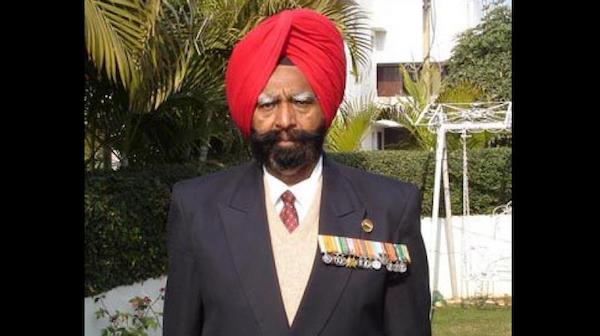
    CHANDIGARH(TIP): Brigadier Kuldip Singh Chandpuri (retd), who is known as the hero of the historic 1971 Battle of Longewala, died on Saturday, November 17,  in a private hospital in Mohali, his family said. He was 78.

    Brig Chandpuri was suffering from cancer, his family said.

    He is survived by his wife and three sons.

    Kuldip Singh Chandpuri was a major in 23 Punjab when the Pakistan Army attacked the Longewala post in Rajasthan, India, early in the Indo-Pakistani War of 1971. Chandpuri and his company of 120 soldiers defended the post, in spite of considerable odds, against the 2000-3000 strong assault force of the Pakistani 51st Infantry Brigade, backed by the 22nd Armored Regiment. Chandpuri and his company held the Pakistanis at bay for a full night until the Indian Air Force arrived to provide air support in the morning.

    Chandpuri inspired his men, moving from bunker to bunker, encouraging them to beat back the enemy until reinforcements arrived. Chandpuri and his men inflicted heavy casualties on the enemy and forced them to retreat, leaving behind twelve tanks. For his conspicuous gallantry and leadership, Chandpuri was awarded the Maha Vir Chakra (MVC) by the government of India.

    A Bollywood film on the Battle of Longewala, made in 1997, with Sunny Deol playing Major Kuldip Singh Chandpuri, has immortalized the real hero in celluloid.


  • 550 Years of Shri Guru Nanak Dev Ji, the Founder of Sikhism

    550 Years of Shri Guru Nanak Dev Ji, the Founder of Sikhism

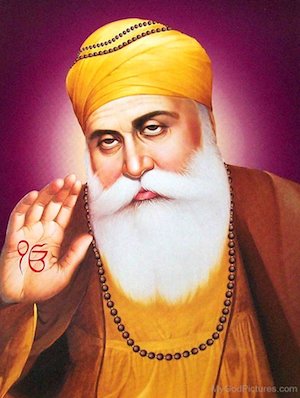
    Guru Nanak Dev Ji(1469-1539),is the Founder of Sikhism, the youngest and the fifth largest religion of the world, with a following of around 25  million worldwide. It is  a monotheistic faith founded in the Punjab region of India more than  500 years ago. Most of the world’s 25 million Sikhs live in India, but more than 500,000 have made  the U.S. their home.

    Guru Nanak was a precursor to modern world of democratic values. His teachings, universal in nature, include equality, brotherhood, compassion, charity- the values the civilized world cherishes.

    The Indian Panorama, with this issue , begins year- long celebration of the Great Master until His 550th  birth anniversary in November 2019.

    Readers may please contribute articles for publication. E mail to salujaindra@gmail.com

    ‘Guru Nanak’s message of inter-faith dialogue is the best solution to contain terrorism, radicalism: Dr. Manmohan Singh

    Dr Manmohan Singh, Former Prime Minister of India
    Photo / Courtesy Mukesh Aggarwal

    NEW DELHI(TIP): Dr.  Manmohan Singh, former Prime Minister of India  said, November 22,  that Guru Nanak Dev’s message of inter-faith dialogue was the best solution to terrorism and fundamentalism and should be followed to promote harmony in the country, which is witnessing social strife, religious acrimonies  and caste rivalries.

    “Guru Nanak’s message that all religions have merit and it is necessary to learn from each other is as relevant today as it was when He lived in our midst,” the former PM said in an exclusive interview to The Tribune on the eve of the 550th birth anniversary celebrations of the founder of Sikh religion.

    He stressed the urgency of mobilizing all institutions — political, religious and social — to end the scourge of terrorism. In reference to the recent terror act on the Nirankari congregation in Amritsar, he said that Punjab had suffered enough, and it would be sad  if terrorism were to again take root in the state.

    The Congress veteran called upon all segments of the Sikh society, the Hindus and Muslims and all others, to unite on the occasion of Parkash Utsav to promote the cult of good and honest living preached and practiced by Guru Nanak.

    A practicing Sikh and India’s first Sikh PM, Dr Singh quoted poet Allama Iqbal, who best described the “Master’s” advent: “Phir uthi aakhir sada tauheed hi Punjab se…Hind ko ek mard-e-kaamil ne jagaaya khwaab se…”

    (With Inputs from  The Tribune, India)

  • J&K polls to be held before May: CEC Rawat

    J&K polls to be held before May: CEC Rawat

    NEW DELHI (TIP): The Election Commission on Thursday, November 22,  said fresh elections in Jammu and Kashmir would be held within the next six months even as it did not rule out the possibility of holding polls there before the Lok Sabha polls due next year.

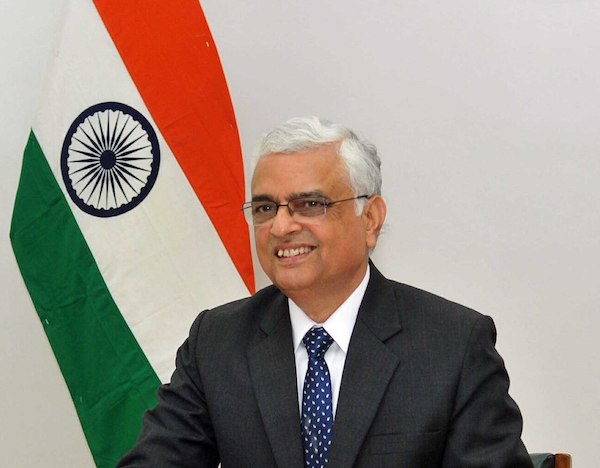
    “The Jammu and Kashmir assembly polls must be held on the first occasion before May … it could be held before parliament elections also,” Chief Election Commissioner O P Rawat said.

    He said as per the Supreme Court, the outer limit for holding fresh polls after dissolution of a house is six months, that is May 2019.

    At the same time, he made it clear that the Commission will decide on poll dates after “considering all aspects.”

    He said, SC verdict, an outcome of Presidential reference, also said polls will have to be held on the first occasion which means even before six months.

    He said the same principle was applied in Telangana where the assembly was dissolved prematurely.

    The state Governor Satya Pal Malik dissolved the assembly on Wednesday evening, after People’s Democratic Party leader Mehbooba Mufti staked claim to form government along with her arch-rival Omar Abdullah’s National Conference (NC) and the Congress. They claimed the support of 56 lawmakers in the 87-member state assembly.

    Shortly after, People’s Conference leader Sajad Lone also staked claims to form the government. Lone, who has two lawmakers, said he had the support of the BJP’s 25 legislators and “more than 18” others.

    (Source:  PTI)

  • India, Pak to develop Kartarpur corridor on respective sides

    India, Pak to develop Kartarpur corridor on respective sides

    No clarity yet on bilateral consensus to make corridor functional

    NEW DELHI(TIP): After a long wait, and much dithering, India and Pakistan, on the eve of Guru Nanak birth anniversary, Thursday, Nov 22,  claimed moving  forward on opening of the Kartarpur Sahib corridor.

    Addressing the long-standing sentiments of Sikh community, a Union Cabinet meeting chaired by Prime Minister Narendra Modi on Thursday, Nov 22,  approved building and development of the Kartarpur corridor from Dera Nanak in Gurdaspur district in Punjab to the International Border with Pakistan.

    The cabinet resolution includes a detailed plan to celebrate across India and globally the 550th birth anniversary of Guru Nanak Dev, who spent 18 years at Gurdwara Kartarpur Sahib on the banks of Ravi river, across Dera Baba Nanak,  in Pakistan.

    “The Kartarpur Sahib corridor will be implemented as an integrated development project with Government of India’s  funding, to provide smooth and easy passage, with all modern amenities,” Finance Minister Arun Jaitley said. A note verbalecommunicating the same has been sent to Pakistan High Commission from MEA (Ministry of External Affairs) whose spokesperson Raveesh Kumar added that India has “approached and urged the Pakistan government to recognize the sentiments of Sikh community and build a corridor with suitable facilities in their territory to facilitate easy and smooth visits of pilgrims from India”.

    The Cabinet announcement came a day after Pakistan media reported that Islamabad has decided to lay foundation for the corridor. Foreign Minister Shah Mehmood Qureshi wrote in a tweet, “Pakistan has already conveyed to India its decision to open Kartarpur Corridor for Baba Guru Nanak’s 550th birth anniversary. PM Imran Khan will do break the  ground (ground breaking ceremony) at Kartarpur facilities on 28th November. We welcome the Sikh community to Pakistan for this auspicious occasion.”

    However, Indian sources claimed that Cabinet passed its resolution after many weeks of internal consultations and preparation within the government. “Any suggestion that the corridor or the celebrations are being planned as a response to a Pakistani proposal is not only preposterous, but hurtful to the sentiments of the Sikh community”, said an official.

    India’s intention is that the corridor must be a full-fledged one with no restriction on pilgrims and should be open not just on special occasions but 365 days and 24 hours, said sources. “There must be free and readily available consular access for Indian citizens on the Pakistani side,” added an Indian official.

    However, what remains unclear is bilateral consensus to operationalize the corridor with immigration check points at the International Border aside of development of the road by both countries on their respective sides. The matter was to be discussed if External Affairs Minister Sushma Swaraj had met with her counterpart SM Qureshi along sidelines of UNGA (United Nations General Assembly) in New York. But India called off the meeting within 24 hours of accepting the Pakistani offer of talks .

    “The modalities will need to be worked out to finalize logistical and procedural aspects, which will require some kind of a meeting,” said a Pakistani official.

    Meanwhile, political leaders welcomed the move and also rushed to claim credit for movement forward after stalemate on the issue. Punjab Chief Minister Captain Amarinder Singh welcomed the resolution “in response to the various letters and submissions he had made to the Prime Minister on this issue”.

    Shiromani Akali Dal(SAD) president and former Punjab deputy CM Sukhbir Singh Badal hailed the Modi government for its decision and announced that SAD and SGPC will take a delegation to Kartarpur Sahib in near future. Asked if Punjab minister and Congress leader Navjot Singh Sidhu’s  visit to Pakistan and controversial hugging of the country’s Army chief catalyzed the Government of India’s decision on the corridor, he quipped: “I do not know,” adding, “May be the recent grenade attack at religious place in Amritsar was because of it.”

    Sidhu had claimed that the Pakistan government has decided to open the corridor following his Islamabad visit for oath-taking ceremony of Prime Minister Imran Khan. ‘It will act like a soothing balm for two neighboring countries’ wrote Sidhu in a tweet.

    “Heartily welcome Kartarpur initiative , it will ease the situation between the two neighbors. J&K has been waiting for similar large heartedness since last 70 years. Need to carry forward Vajpayee ji initiative and open all the routes across LOC and IB in J&K,” PDP president and former J&K CM Mehbooba Mufti tweeted.

    President Ram Nath Kovind and Punjab Chief Minister Amarinder Singh will lay the foundation stone of the Kartarpur corridor at Dera Baba Nanak in Gurdaspur on November 26, Punjab Government announced. Union Home Secretary Rajiv Gauba has asked the state government to make preparations for the ceremony.

    (Source: TNS)


  • Sikhs in Queens Take out an Impressive Parade to Mark the 549th Birth Anniversary of Guru Nanak

    Sikhs in Queens Take out an Impressive Parade to Mark the 549th Birth Anniversary of Guru Nanak

    By I S Saluja
    I.S. Saluja

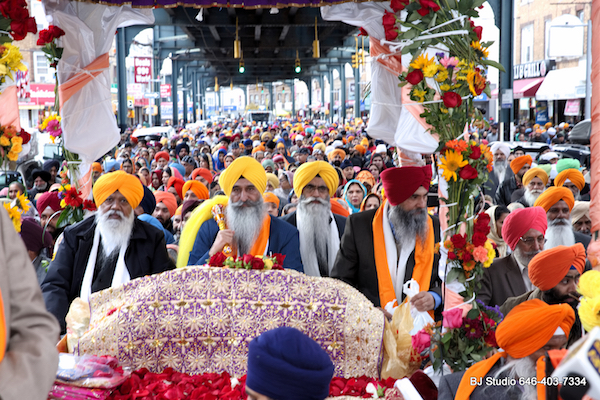
    RICHMOND HILL(TIP): Dedicated to the 549th birth anniversary of Shri Guru Nanak Dev Ji, the Founder of Sikhism, world’s youngest and the fifth largest religion, Sikhs of New York took out an impressive  parade through Richmond Hill in Queens, New York, Saturday, November 17.

    Organized by Gurdwara  Baba Makhan Shah Lubana, located in Richmond Hill, the colorful parade was a treat to watch. There was a  gorgeously decorated float  to carry the Living Guru of the Sikhs, Shri Guru Granth Sahib. This float was at the head of the parade. The Panj Piaras (the five beloveds of the Tenth Master Shri Guru Gobind Singh Ji) marched ahead of the float carrying Shri Guru Granth Sahib , with ragis singing devotional hymns  and the priests attending on Guru Granth Sahib.

    Behind the  float of Shri Guru Granth Sahib was a float of Sikh Martial  Art. Behind this float young and the old displayed  the traditional Sikh martial  art,  known as Gatka.

    The large number of the Sikhs as also their friends from other communities joined the parade, which marched through the Liberty Avenue and then moved on to Atlantic Avenue,  from where it headed towards Gurdwara Sikh Cultural Society on 118thStreet . It finally terminated at the starting point- Gurdwara Makhan Shah Lubana on 114thStreet and 101 Avenue.

    All along the route of the parade,  participants and onlookers were served with snacks and food (langar). Sikhs follow a rich tradition of serving free food to all at all their shrines and at all celebrations.

    Community leaders  paid rich tributes to Shri Guru Nanak Dev Ji. They were joined by politicians and leaders from other communities who spoke highly of  Guru Nanak, Sikhism,  and the Sikh community.

    Sikhs will be celebrating the 550thbirth anniversary of Shri Guru Nanak Dev Ji in November 2019.

    Government of India has announced yearlong celebrations in all Indian missions abroad, in preparation for the grand 550thbirth anniversary celebration  of Shri Guru Nanak Dev Ji.

    Government of Pakistan has extended invitation to Sikhs all over the world to visit Nanakana Sahib, the birth place of Shri Guru Nanak Dev Ji, on the occasion of the Master’s birth anniversary

    Shiromani Gurdwara Prabandhak Committee, the apex religious body of the Sikhs, with headquarters in Harmandir Sahib (Golden Temple) Amritsar, as also Delhi Sikh Gurdwara Managing Committee (DSGMC) have announced ambitious plans to  have year long celebrations of Guru Nanak Dev Ji’s 550thbirth anniversary.

    The Indian Panorama has launched with this edition year long celebration of the 550thbirth anniversary of Shri Guru Nanak Dev Ji. We will carry scholarly articles on Shri Guru Nanak Dev Ji and His faith to educate Sikh youth, as also non-Sikh readers of The Indian Panorama about the universal message of Guru Nanak who preached equality, brotherhood and charity- values which make life beautiful and the world a happier place to live in.

  • James Comey Responds to Subpoena from Republicans: ‘Let’s Invite Everyone to See’

    James Comey Responds to Subpoena from Republicans: ‘Let’s Invite Everyone to See’

    The former FBI director and Loretta Lynch received subpoenas before Thanksgiving to testify on Capitol Hill.

    WASHINGTON(TIP): Former FBI Director James Comey and former Attorney General Loretta Lynch received subpoenas on Wednesday from House Republicans investigating the role of the FBI in the 2016 presidential election, and Comey responded to his with a Thanksgiving tweet.

    “Happy Thanksgiving. Got a subpoena from House Republicans. I’m still happy to sit in the light and answer all questions. But I will resist a ‘closed door’ thing because I’ve seen enough of their selective leaking and distortion. Let’s have a hearing and invite everyone to see,” Comey wrote.

    ————————————————————————————————

    James Comey

    @Comey

     Happy Thanksgiving. Got a subpoena from House Republicans. I’m still happy to sit in the light and answer all questions. But I will resist a “closed door” thing because I’ve seen enough of their selective leaking and distortion.  Let’s have a hearing and invite everyone to see.

    225K

    10:21 AM – Nov 22, 2018

    ————————————————————————————————–

    Lynch hasn’t publicly responded to hers.

    Outgoing House Judiciary Committee Chairman Bob Goodlatte (R-Va.) is requesting that Comey and Lynch testify at depositions held Dec. 3 and 4, respectively, according to documents shared by Politico reporter Kyle Cheney.

    House Republicans’ probe into the FBI’s actions in 2016 will come to an end when Democrats take over the House in January. Republicans have alleged FBI bias against President Donald Trump has led to the bureau focusing on whether there were any Trump campaign ties to Russia instead of investigating Hillary Clinton’s use of a private email server for official business while she was secretary of state.

    Democrats say that it’s all a distraction from special counsel Robert Mueller’s Russia probe, which Trump has repeatedly described as a “witch hunt.”

    Comey’s attorney David Kelley said his client would fight the subpoena in court.

    “While the authority for congressional subpoenas is broad, it does not cover the right to misuse closed hearings as a political stunt to promote political as opposed to legislative agendas,” Kelley said.

    (Source: Huffington Post)

  • November 23 New York & Dallas Print Editions

    November 23 New York & Dallas Print Editions

    [vc_row][vc_column][vc_column_text]

    Print Replica ~ Digitally

    E-Editions

    [/vc_column_text][/vc_column][/vc_row][vc_row][vc_column width=”1/3″][vc_custom_heading text=”New York Edition” font_container=”tag:h2|text_align:center” google_fonts=”font_family:Istok%20Web%3Aregular%2Citalic%2C700%2C700italic|font_style:700%20bold%20regular%3A700%3Anormal” link=”url:https%3A%2F%2Fwww.theindianpanorama.news%2Fwp-content%2Fuploads%2F2018%2F11%2FTIP-November-23-NYC.pdf|||”][vc_single_image image=”95412″ img_size=”full” add_caption=”yes” alignment=”center” onclick=”custom_link” link=”https://www.theindianpanorama.news/wp-content/uploads/2018/11/TIP-November-23-NYC.pdf”][/vc_column][vc_column width=”1/3″][vc_custom_heading text=”Dallas, Texas Edition” font_container=”tag:h2|text_align:center” google_fonts=”font_family:Istok%20Web%3Aregular%2Citalic%2C700%2C700italic|font_style:700%20bold%20regular%3A700%3Anormal” link=”url:https%3A%2F%2Fwww.theindianpanorama.news%2Fwp-content%2Fuploads%2F2018%2F11%2FTIP-November-23-Dallas-TX.pdf|||”][vc_single_image image=”95413″ img_size=”full” add_caption=”yes” alignment=”center” onclick=”custom_link” link=”https://www.theindianpanorama.news/wp-content/uploads/2018/11/TIP-November-23-Dallas-TX.pdf”][/vc_column][vc_column width=”1/3″][vc_single_image image=”82828″ img_size=”medium” alignment=”center” onclick=”custom_link” link=”https://www.theindianpanorama.news/advertising-media-kit-portal-indian-panorama/”][vc_single_image image=”82829″ img_size=”medium” alignment=”center” onclick=”custom_link” link=”https://www.theindianpanorama.news/advertising-media-kit-portal-indian-panorama/”][/vc_column][/vc_row][vc_row][vc_column][td_block_ad_box spot_id=”custom_ad_3″ tdc_css=””][/vc_column][/vc_row][vc_row][vc_column width=”2/3″][vc_custom_heading text=”Lead Stories This Week” font_container=”tag:h2|text_align:center” google_fonts=”font_family:Istok%20Web%3Aregular%2Citalic%2C700%2C700italic|font_style:700%20bold%20regular%3A700%3Anormal” link=”url:https%3A%2F%2Fwww.theindianpanorama.news%2F|||”][td_block_5 separator=”” limit=”12″ tdc_css=””][/vc_column][vc_column width=”1/3″][vc_widget_sidebar sidebar_id=”td-default”][/vc_column][/vc_row]

  • AAPI-QLI Celebrates Culture, Heritage, Achievements & Contributions of Indian American Community at Diwali Gala on Long Island

    AAPI-QLI Celebrates Culture, Heritage, Achievements & Contributions of Indian American Community at Diwali Gala on Long Island

    MELVILLE, NY(TIP): “Tonight, our coming together here as members and supporters of AAPI-QLI, is a way of celebrating the achievements, contributions of our Indian American community, and cherish our ancient and rich cultural heritage,” said Dr. Jagdish K Gupta, President of American Association of Physicians of Indian Origin, Queens and Long Island Chapter (AAPI-QLI) in his welcome address.

    “We are here tonight to celebrate Diwali, the festival of lights, the festival of the celebration of the victory of goodness over evil,” Dr. Gupta, a practicing Gastroenterologist, serving the community for over 40 years, told the audience at the annual Diwali gala at the magnificent Leonard’s Palazzo on Long Island on November 4, 2018.

    The annual Diwali event organized under the leadership of Dr. Gupta, Dr. Ajay Lodha, Chair BOT, Dr. Raj Bhayani, Chairman of function and Executive Committee of AAPI-QLI, attended by over 300 guests, including AAPIQLI members, physicians, sponsors, community leaders and Crème de la crème of Indian Community, was in every sense a celebration of the true spirit of Joy and happiness during the festive season of Diwali.

    Dr. Ajay Lodha, past national President of AAPI, in his address, lauded the many achievements of the Indian Americans. “Tonight, as proud members of the AAPI-QLI, the largest and most active Chapter of national AAPI, we are celebrating the achievements of our community and our many contributions to the diverse society in New York and Long Island area.”

    Dr Naresh Parikh, AAPI President graced the occasion as Guest of Honor and Honorable Ambassador Shree Sandeep Chakravorty, Consul General of New York was the Chief Guest. In his address, Dr. Parikh described AAPI-QLI as the most vibrant, transformative and politically active Chapter among all AAPI chapters in the nation.” Dr. Parikh referred to the fact that Indian American Physicians serve every 7th patient in the nation and contribute enormously the healthcare industry of the United States.

    At the gala, two very dynamic and young physician achievers, Drs. Preeti and Nilesh Mehta, were recognized for their humane, state of the art services to the residents of Queens, Nassau and Suffolk Counties. Also, AAPI-QLI recognized Nargis Dutt Cancer Foundation for its decades long services, relieving and supporting the poorest and needy cancer patients and their families in India for over 37 years. Ramesh Goel, MBA, a simple, down to earth community leader, was recognized for his services to many religious and professional Alumni organizations.

    Earlier, Diwali festival celebrations began with the traditional, Deva Shri Ganesha recital and dance followed by invocation with Shankh-naad and Shlokas by Pandit, Dixit Ji and participation in lamp lighting ceremony by the entire audience. The celebrations came to a close with amazing dance performance followed by extravaganza of delicious food and custom designed Venetian Dessert show.

    AAPIQLI, one of the largest chapters of national AAPI, has been serving 800 member physicians since 1995, providing continuing medical education, charity, and discussing the state of the art topics in healthcare, wealth management and practice management.

    AAPI QLI has grown rapidly in membership and has been well accepted and appreciated by all local and national professional organizations. From the very beginning the leadership put heavy emphasis on transparency and the democratic process, which is the main ingredient for its enormous success.

    The Mission of AAPI Queens and Long Island has been to represent the interests of all physicians of Indian Origin in the area including providing Continuous Medical Education (CME) and engaging in charitable activities for the benefit of the larger community in the New York region.

    (Press Release by Ajay Ghosh)

  • IALI donates generously to the INN for Diwali Food Drive

    IALI donates generously to the INN for Diwali Food Drive

    LONG ISLAND, NY (TIP): The India Association of Long Island (IALI) has been partners with The Interfaith Nutrition Network (INN) in fighting hunger on Long Island for the past 23 years to help those in need across Long Island.

    Mr. Peter Bheddah, started the Diwali Food Drive, all those years ago, and itquickly gained momentum. Mr. Dev Ratnam joined the INN Board, tocontinue the charitable work. IALI presidents over the years and theirExecutive committees and members all pitched in with donations offood, medications, clothes and of course money, to help those in needand want across Long Island. IALI has helped to bring food to 800,000 to hungry and homeless Long Islanders. IALI is close to reaching 1,000,000 meals very soon.

    On Sunday, November 11, 2018, this year, for the Diwali food drive, IALI gave a very generous check of $17000/- to INN to continue this exemplary service. This amount was accumulated by donations by IALI members and Major sponsors  Mr. Peter Beddah, Dr. Kishore Kunchum, Mrs. Indu Chhabra and Friends and Mr. Raj & Jyoti Gandhi.

    The Festive Diwali event took place at the Mary Brennan Inn, Hempstead. The program was admirably Emceed by Dr. Bhavani Srinivasan. A ceremonial lamp was lit by the dignitaries present, Mr. Tony Santino, former Supervisor Town of Hempstead, Councilwoman Dorothy Goosby, Mr and Mrs. Bheddah, Mrs. Indu Chhabra, Mr. Dev Ratnam, IALI President Gunjan Rastogi, IALI Officers and Executive Council members. Mrs. Aruna Saxena was honored for being the Chair of Diwali Food Drive for last six years.

     Young Tara Chaudhary gave a very lovely and lively dance recital and Mrs. Jyoti Gupta and Amita Karwal sang a beautiful song.

    The IALI President, Mrs. Gunjan Rastogi, along with Past Presidents, Mr. Satpal Malhotra, Mrs. Indu Jaiswal, and Dr. Bhavani Srinivasan, members of the executive committee, Mr. Lalit Aery, Mr. Gobind Gupta, Mr. Vimal Goyal and the standing Chairs, Mrs. Amita Karwal, Mrs. Jyoti Gupta, Mr. Rajeev Chaudhary and Mrs. Saroj Aery and Mrs. Jaya Bahadkar were all present. A large number of IALI members were in attendance for the celebration including Mr. Ved Behl, Mr. & Mrs. Sood,  longtime supporters of Diwali Food Drive.

  • IRS provides tax inflation adjustments for tax year 2019

    IRS provides tax inflation adjustments for tax year 2019

    NEW YORK (TIP): The Internal Revenue Service today announced the tax year 2019 annual inflation adjustments for more than 60 tax provisions, including the tax rate schedules and other tax changes. Revenue Procedure 2018-57 provides details about these annual adjustments. The tax year 2019 adjustments generally are used on tax returns filed in 2020.

    The tax items for tax year 2019 of greatest interest to most taxpayers include the following dollar amounts:

    The standard deduction for married filing jointly rises to $24,400 for tax year 2019, up $400 from the prior year. For single taxpayers and married individuals filing separately, the standard deduction rises to $12,200 for 2019, up $200, and for heads of households, the standard deduction will be $18,350 for tax year 2019, up $350.

    The personal exemption for tax year 2019 remains at 0, as it was for 2018, this elimination of the personal exemption was a provision in the Tax Cuts and Jobs Act.

    For tax year 2019, the top rate is 37 percent for individual single taxpayers with incomes greater than $510,300 ($612,350 for married couples filing jointly). The other rates are:

    o 35 percent, for incomes over $204,100 ($408,200 for married couples filing jointly);

    o 32 percent for incomes over $160,725 ($321,450 for married couples filing jointly);

    o 24 percent for incomes over $84,200 ($168,400 for married couples filing jointly);

    o 22 percent for incomes over $39,475 ($78,950 for married couples filing jointly);

    o 12 percent for incomes over $9,700 ($19,400 for married couples filing jointly).

    o The lowest rate is 10 percent for incomes of single individuals with incomes of $9,700 or less ($19,400 for married couples filing jointly).

    For 2019, as in 2018, there is no limitation on itemized deductions, as that limitation was eliminated by the Tax Cuts and Jobs Act.

    The Alternative Minimum Tax exemption amount for tax year 2019 is $71,700 and begins to phase out at $510,300 ($111,700, for married couples filing jointly for whom the exemption begins to phase out at $1,020,600). The 2018 exemption amount was $70,300 and began to phase out at $500,000 ($109,400 for married couples filing jointly and began to phase out at $1 million).

    The tax year 2019 maximum Earned Income Credit amount is $6,557 for taxpayers filing jointly who have three or more qualifying children, up from a total of $6,431 for tax year 2018. The revenue procedure has a table providing maximum credit amounts for other categories, income thresholds and phase-outs.

    For tax year 2019, the monthly limitation for the qualified transportation fringe benefit is $265, as is the monthly limitation for qualified parking, up from $260 for tax year 2018.

    For calendar year 2019, the dollar amount used to determine the penalty for not maintaining minimum essential health coverage is 0, per the Tax Cuts and Jobs act; for 2018 the amount was $695.

    For the taxable years beginning in 2019, the dollar limitation for employee salary reductions for contributions to health flexible spending arrangements is $2,700, up $50 from the limit for 2018.

    For tax year 2019, participants who have self-only coverage in a Medical Savings Account, the plan must have an annual deductible that is not less than $2,350, an increase of $50 from tax year 2018; but not more than $3,500, an increase of $50 from tax year 2018. For self-only coverage, the maximum out-of-pocket expense amount is $4,650, up $100 from 2018. For tax year 2019, participants with family coverage, the floor for the annual deductible is $4,650, up from $4,550 in 2018; however, the deductible cannot be more than $7,000, up $150 from the limit for tax year 2018. For family coverage, the out-of-pocket expense limit is $8,550 for tax year 2019, an increase of $150 from tax year 2018.

    For tax year 2019, the adjusted gross income amount used by joint filers to determine the reduction in the Lifetime Learning Credit is $116,000, up from $114,000 for tax year 2018.

    For tax year 2019, the foreign earned income exclusion is $105,900 up from $103,900 for tax year 2018.

    Estates of decedents who die during 2019 have a basic exclusion amount of $11,400,000, up from a total of $11,180,000 for estates of decedents who died in 2018.

    The annual exclusion for gifts is $15,000 for calendar year 2019, as it was for calendar year 2018.

    The maximum credit allowed for adoptions is the amount of qualified adoption expenses up to $14,080, up from $13,810 for 2018.

  • New tax law allows small businesses to expense more, expands bonus depreciation

    New tax law allows small businesses to expense more, expands bonus depreciation

    NEW YORK  (TIP): The Internal Revenue Service today reminded small business taxpayers that changes to the tax law mean they can immediately expense more of the cost of certain business property. Many are now able to write off most depreciable assets in the year they are placed into service.

    The Tax Cuts and Jobs Act (TCJA), passed in December 2017, made tax law changes that will affect virtually every business and individual in 2018 and the years ahead. Among those for business owners are tax rate changes for pass-through entities, changes to the cash accounting method for some, limits on certain deductions and more.

    Section 179 expensing changes

    A taxpayer may elect to expense all or part of the cost of any Section 179 property and deduct it in the year the property is placed in service. The new law increased the maximum deduction from $500,000 to $1 million. It also increased the phase-out threshold from $2 million to $2.5 million. These changes apply to property placed in service in taxable years beginning after Dec. 31, 2017. For most businesses, this means the 2018 return they file next year.

    Section 179 property includes business equipment and machinery, office equipment, livestock and, if elected, qualified real property. The TCJA also modifies the definition of qualified real property to allow the taxpayer to elect to include certain improvements made to nonresidential real property. See New rules and limitations for depreciation and expensing under the Tax Cuts and Jobs Act for more information.

    New 100 percent, first-year ‘bonus’ depreciation

    The 100 percent depreciation deduction generally applies to depreciable business assets with a recovery period of 20 years or less and certain other property. Machinery, equipment, computers, appliances and furniture generally qualify. The law also allows expensing for certain film, television, and live theatrical productions, and used qualified property with certain restrictions.

    The deduction applies to business property acquired after Sept. 27, 2017, and placed in service after Sept. 27, 2017, and before Jan. 1, 2023. In general, the bonus depreciation percentage is reduced for property placed in service after 2022. See the proposed regulations for more details.

    Taxpayers may elect out of the additional first-year depreciation for the taxable year the property is placed in service. If the election is made, it applies to all qualified property that is in the same class of property and placed in service by the taxpayer in the same taxable year. The instructions for Form 4562, Depreciation and Amortization, provide details.

    Business owners can refer to the Tax Reform Provisions that Affect Businesses page for updates.

  • IDC Honors Indian Soldiers on Armistice Day, 11 November 2018 in France

    IDC Honors Indian Soldiers on Armistice Day, 11 November 2018 in France

    NEW YORK(TIP): On the November 11, 2018, the centennial of the Armistice ending World War 1, members of the Indian Diaspora Council International(IDC) led by IDC president Mr. Ashook Ramsaranof New York, USA, participated in the inauguration of a specially designed monument at Laventi, France, to honour and pay homage to Indian soldiers killed in Europe fighting in World War 1 fighting in Europe. Ramsaran was ably assisted by Mr. Samarassame Taniga, president of IDC France.

    The monument was inaugurated on November 11 at 11 :11 :11 at Laventie, France.

    This ceremony at Laventi was preceded by a wreath laying ceremony at Neuve Chapelle, France where a special monument has been erected to honour of fallen Indian solider were members of the Garhwal Rifles regiment of the Himalayan region. This regiment lost nearly 700 soldiers during World War I.

    IDC collaborated with and supported Interfaith Shaheedi Commémoration Association (IFSCA) headed by Mr. Ramesh Vohra, in the design, construction and dedication of this monument at Levanti.

    Ashook Ramsaran laving the wreath at Lavanti, France – November 11, 2011

    The Mayor of the town of Lavanti, Hon. Jean-Philippe Boonaert, warmly welcomed everyone and presided at the dedication of the monument. The municipality and veterans of France provided a warm welcome with marching band, a special celebratory mass in nearby church of St. Vaast and refereshments.

    IDC collaborated with and supported Interfaith Shaheedi Commémoration Association (IFSCA) in the construction and dedication of this monument at Levanti. IFSCA is headed by Mr. Ramesh Vohra.

    This ceremony at Laventi was preceded by a wreath laying ceremony at Neuve Chapelle, France where a special monument has been erected to honour of fallen Indian solider were members of the Garhwal Rifles regiment of the Himalayan region. This regiment lost nearly 700 soldiers during World War I.

    “The Indian Army during World War I contributed a large number of divisions and independent brigades to the European, Mediterranean and the Middle East theatres of war in World War I. Over one million Indian troops served overseas, of whom 62,000 died and another 67,000 were wounded. In total at least 74,187 Indian soldiers died during the war. Of the 130,000 Indians who served in France and Belgium, almost 9,000 died”– https://en.wikipedia.org/wiki/Indian_Army_during_World_War_I

     World War I (1914-1918) ended at 11 a.m. on 11 November 1918 with the signing of the armistice between the Allies and Germany. It established the reputation of Indian soldiers for their bravery, courage and sacrifice.

    Around 1.3 million soldiers from India participated in World War I (1914-1918). Among them, 140,000 Indian soldiers were sent to France. They were Sikhs, Punjabis and Gurkhas who came to strengthen the British army to defend freedom and liberty in France against invasion.  They were soldiers from different ethnic, linguistic and religious backgrounds. The Indians troops were mobilized on August 8, 1914 at the request of London without even getting any approval from the parliament of New Delhi. At that time, India was under British rule.

    The Indian soldiers left the port of Bombay and landed at Marseille in France on September 26, 1914. They were immediately sent on the North front so as to help the French and Belgian soldiers to fight against the Germans. They were dressed in simple light cottons uniforms, which were far too light to face the extreme winter of North of France. They were having frozen feet, pneumonia and life in the muddy trenches was very hard to bear for the Indians who were not used to this climate. In 1914 and 1915, the Indian soldiers were engaged in the various fights.

    At Neuve Chapelle, Lavantie and Givenchy, they helped in the British offensive against the Germans. The Indian troops suffered a lot and only during that period 4047 Indians were recorded in the British casualty sheet.  This tragedy and sacrifice of these soldiers is well related in a film “Farewell My Indian Soldier“of an Indian filmmaker and novelist based in Paris, Vijay Singh. The soldiers wrote about their experiences in around 600 letters when they were in hospitals, records of which are maintained in the Haryana Academy of Art and Culture. “Soldiers used to send one rupee from their monthly salary to the academy, which went towards education of students,” says the filmmaker.

    As World War I was coming to its end, the Indian soldiers participated in the procession of the Bastille Day on July 14, 1916 in Paris.

    On October 07, 1927, The Memorial of Neuve Chapelle was inaugurated in the presence of Marshal Ferdinand Foch to honor the memory of Indian soldiers who died in France during World War I. On a wall, 4847 names of the soldiers are engraved, in alphabetical order and by combat unit. In the center of the memorial, one can read “In honor of the Indian Army who fought in France and Belgium, 1914-1918, and to perpetuate the memory of the soldiers whose names are engraved here.”

     On April 11, 2015, Indian Prime Minister Shri Narendra Modi was the first and only Indian Prime Minister to have travelled to the memorial of Neuve-Chapelle to pay tribute to the 10 000 brave Indian soldiers who died during the First World War and who never returned back to their home. “I am honoured to pay homage to the Indian soldiers here at the Indian Memorial at Neuve Chappelle. Our soldiers who fought in foreign lands in the Great War, have won the admiration of the world for dedication, loyalty, courage and sacrifice. I salute them. ” said PM Modi.

     For more information contact: Ashook Ramsaran at AshookRamsaran@gmail.com          Mobile (USA) +1 917 519 5783

    Indian Diaspora Council International (IDC), established in 1997, is   an international non-profit organization with global affiliates and membership in 21 countries with the objective to embrace, engage, and enhance the shared heritage, aspirations, and interests of persons of Indian origin with optimum inclusivity.


  • Diwali and Annakut Celebrated at BAPS Shri Swaminarayan Mandirs across North America

    Diwali and Annakut Celebrated at BAPS Shri Swaminarayan Mandirs across North America

    DALLAS, TX(TIP): A  glittering  array of  twinkles  filled the  night  as  traditional candles  were  lit  by  devotees. The  ancient tradition of lighting candles, or divos, during Diwali symbolizes the transition from darkness to light. While the divos lit on Diwali erase physical darkness, the festival’s rich traditions and rituals go deeper –inviting individuals  to make  efforts  in removing  darkness  in the  forms  of anger, envy,  greed,  arrogance, and resentment.  Diwali presents a time to reflect and introspect. The five  days  of Diwali  (including  the Hindu New  Year)  are rich  in  cultural traditions  and  rituals that symbolize  new  beginnings and  a  renewed commitment  to  family. The  bright  colors of Rangoli(intricate designs made  of  colored powder),  the  lighting of divos,  and  the  elaborate  variety of  vegetarian  foods offered to  God  (in a  display  called an Annakut),  all  mark a  renewal  of the  good  within and  the  goodwill towards everything around us. Diwali presents Hindus with an opportunity to connect with and celebrate the traditions of their roots with great fanfare.

    Offering  his  prayers to  Bhagwan  Swaminarayan, His  Holiness Mahant  Swami  Maharaj, guru  and current spiritual  leader of BAPS, prayed  for  devotees around  the  world for continued personal, and professional growth  in  this new  year.  Mahant Swami  Maharaj  took the  occasion  of Diwali  to  remind individuals  and families about the importance of leading spiritually-centric lives, grounded in strong values and increased attachment to God. This year, BAPS Shri Swaminarayan Mandirs across North America marked the auspicious festival of Diwali and its associated five days of celebrations with an elaborate Annakut, lighted divos, fireworks, and even a special children’s Diwali celebration. For many visitors, the most popular attraction and a highlight of the festivities is the Annakut festival on the  fifth  day.  As  practiced by  BAPS  Swaminarayan Mandirs,  the  Annakut is  a  unique and  awe-inspiring sight of devotion where hundreds of different traditional Indian foods and even some fusions with western cuisine are prepared by devotees in the community and arranged in front of the Mandir’s sacred images.

    In the evening, the offered dishes are served at dinner to everyone.  Vandan Shah said, “Diwali is all about good food, family gatherings, crackers, and I love it because of the excitement that fills the air when the festival nears. After coming to the Diwali Celebrations at BAPS Shri Swaminarayan Mandir, Robbinsville, I felt like I was in India. I experienced Indian culture while getting a taste of fine Indian cuisine. I truly felt at home. ”Being away from India, I brought my children to the BAPS Shri Swaminarayan Mandir in Edison, NJ  so they can learn about Diwali and our rich tradition”, said, Dinesh Prajapati. In addition to the Annakut, the BAPS’ Diwali celebrations featured spiritual and cultural themed events, which  engaged both  children  and adults,  in  order to  bring  positive energy  into  the New  Year.

    Furthermore, visitors  and  members learned  about  scriptural events  related  to Diwali and  observed traditions such as rangolis  and other traditional forms of decorations. Finally,  all children  were invited to participate in a children’s fair and Kids Diwali Celebration which included food, games and fun activities.  Attractions included a fireworks display. The celebrations were open to all. Visitors participated in celebration activities, offered prayers for new beginnings and had the opportunity to taste in the delicious offerings of the Annakut.

    About BAPS

    The  BAPS  Swaminarayan Sanstha  (BAPS)  is a  worldwide  spiritual and  humanitarian  organization that  is dedicated to community service, peace, and harmony. Motivated by Hindu principles, BAPS strive to care for the  world  by caring  for  societies, families,  and  individuals. Through  various  spiritual and  humanitarian activities, BAPS endeavors to develop better citizens of tomorrow with high esteem for their roots and culture. Its  3,300  international centers  support  these character-building activities.  Under  the guidance  and  leadership of His Holiness Mahant Swami Maharaj, BAPS aspires to build a community that is free of addictions as well as morally, ethically and spiritually pure. For more details, please visitwww.baps.org.

    About Mahant Swami Maharaj

     His Holiness Mahant Swami Maharaj is the sixth and current spiritual successor of Bhagwan Swaminarayan. He was  ordained a swami  by  Yogiji Maharaj  in  1961 and named  Sadhu Keshavjivandas. As  he was  appointed  the head (Mahant)  of  the Mandir  in  Mumbai, he  became  known as  Mahant  Swami. His  devout,  humble and service-focused  life  earned him  the  innermost blessings  of  Yogiji  Maharaj and  Pramukh  Swami Maharaj. Mahant   Swami   Maharaj travels   throughout  the   world   inspiring  people   through   his  insightful   spiritual discourses  and  disciplined conduct.  His  virtuous lifestyle  and  profound devotion  to  Bhagwan Swaminarayan and gurus are ideals toward which devotees strive. Mahant Swami Maharaj became the guru and President of BAPS upon Pramukh Swami Maharaj’s passing in 2016.About Pramukh Swami Maharaj Pramukh  Swami Maharaj  was  the fifth  spiritual  successor of  Bhagwan  Swaminarayan. Under  his  leadership, BAPS  grew into  an  international spiritual  and  humanitarian organization  with  over 3,300  centers  worldwide. He dedicated  his  life to  the  well-being of  others,  traveling  throughout the  world  to foster  love,  peace, harmony, righteousness, faith in God, and service to humanity. With genuine care and compassion, he reached out  to all  members  of society  irrespective  of class,  color,  or age.  Recognized  and  respected  as one  of  India’s greatest spiritual teachers, he lived by and promoted the principle: “In the joy of others, lies our own.”

    CONTACT:BAPS North American Headquarters  Phone: 732-777-1414Email: media@na.baps.org

    (SOURCE: BAPS)