Month: October 2022

  • Indian Americans seek justice for high tech immigrants, visa delays and cultural recognition

    Indian Americans seek justice for high tech immigrants, visa delays and cultural recognition

    WASHINGTON, D.C. (TIP):  Among the issues flagged by the Foundation for India and Indian Diaspora Studies (FIIDS) are stopping injustice to high tech immigrants, eliminating visa appointment delays, ending campaign of misinformation and hate and cultural recognition.

    Also listed are support for US-India strategic partnership and concern over terror funding/military aid to Pakistan and inflation and recession.

    “As Indian Americans are almost 4.5million in population with a high concentration in critical competitions and swing states, they want their voice be heard on important issues and policy matters,” said FIIDS director Khanderao Kand.

    As a part of a four-weeks long #IndoAmericanVotesMatter campaign, FIIDS had earlier launched, voting registration, candidate analysis, survey of Indian Americans and a campaign for voting.

    FIIDS said its list of issues was based on past surveys, discussions with community leaders, analysts, and own research and analysis.

    As mail-in voting has begun and will continue for the two weeks, this list will be useful for Indian American voters to reflect on and to discuss issues of their importance with candidates and within the community, it said.

    Stop injustice to high tech immigrants: Though Indian immigrants are a ~30% workforce building most advancements in the tech industry that provides an international edge to the USA, the Indian tech professionals, are stagnant like bonded laborers for more than ~50-60 years due to country-wise green card limit of 5000 GC per year for processing hundreds of thousands of backlogs, FIIDS said.

    It urged elected officials and executives to one time clear all the backlog and pass HR 3648 Eagle Act 2022 to prohibit this backup in the future.

    Eliminating visa appointment delays: After the painfully long covid period ended and travel restrictions were lifted, relatives want to visit US to meet family, attend events and heal together from the losses they endured, FIIDS said.

    However, visa appointments in the US consulates in India have almost ~900 days long wait, making everyone suffer. FIIDS requested help in pursuing the department of state to add staff to eliminate the wait period.

    Campaign of misinformation and hate: FIIDS said it “sadly observes that in this land of liberty and freedom, there is a vicious campaign of negative propaganda against India and the Indian diaspora, resulting not only in friction in otherwise smooth US-India relations but also increased incidents of ethnic and religious hate crimes against Indo Americans in general and Hindu-Sikh communities in specific.”

    FIIDS requested investigative agencies’ help as well as legislative help in stopping hateful misinformation campaigns and the entities behind the campaigns.

    Cultural recognition: As a recognition of ~4.5million Indian Americans’ contribution as well as their cultural heritage, FIIDS wanted elected officials to introduce/support resolutions recognizing cultural festivals like Diwali – Holi, Baisakhi, Sewa Diwali, heritage months, honoring personalities like Mahatma Gandhi, Dr. Bhimrao Ambedkar, Swami Vivekananda, as well as contributions of charity organizations like Sewa International, etc.

    Inflation and recession: FIIDS said Indian Americans are concerned about both inflation and recession. As the sudden and high increases in interest rates so far didn’t reduce inflation but pushed the country in a recession, FIIDS suggested that “the focus should be to address root causes like increasing gas supply to reduce high gas price and pressure on production and the supply chain from China.”

    The US-India strategic partnership: FIIDS said it appreciates there is a bi-partisan agreement that India is a global strategic partner and both Democrats and Republicans supported partnerships like the Indo Pacific Quad as well as I2U2.

    It requested continuing support for any initiatives related to the same as well as strengthening joint ventures with India in various areas like energy, startups, military manufacturing, nuclear.

    FIIDS also requested lawmakers help to permanently remove India from CAATSA sanctions. To strengthen the partnership further, it requested to expedite the appointment of an ambassador to India. Terror funding / military aid to Pakistan: FIIDS said it was aware that despite India being a global strategic partner, the Biden administration approved $450 million military F-16 upgrade, which will most likely be used against India.

    Indian Americans, it said “are also more concerned that despite ongoing acts of Pak-sponsored terrorism against India, Pakistan has been removed from the watch list of the Financial Action Task Force (FATF), the watchdog of terrorist funding.”

  • RELIVE THE SUSPENSE OF ‘JAWS’  IN CONCERT WITH NJSO

    RELIVE THE SUSPENSE OF ‘JAWS’  IN CONCERT WITH NJSO

    By Mabel Pais

    Relive the thrilling suspense of ‘Jaws’ as the New Jersey Symphony Orchestra (NJSO) plays the iconic score in sync with the film projected on the big screen. This original summer movie blockbuster, with an Academy Award®-winning score by composer John Williams, becomes an unforgettable film-with-live-orchestra experience! Directed by Academy Award® winner Steven Spielberg, ‘Jaws’ set the standard for edge-of-your-seat suspense, quickly becoming a cultural phenomenon and forever changing the movie industry. When the seaside community of Amity finds itself under attack by a dangerous great white shark, the town’s chief of police, a young marine biologist and a grizzled shark hunter embark on a desperate quest to destroy the beast before it strikes again.

    Featuring an unforgettable score that evokes pure terror, ‘Jaws’ remains one of the most influential and gripping adventures in motion picture history. Now, audiences will have the chance to experience the power of a live symphony orchestra performing the entire score in sync with one of the greatest motion pictures of all time.

    PROGRAM

    ‘Jaws’ in Concert

    Friday, October 28, at 8 pm | Count Basie Center for the Arts in Red Bank

    Saturday, October 29, at 8 pm | New Jersey Performing Arts Center in Newark

    Sunday, October 30, at 3 pm | State Theatre New Jersey in New Brunswick

    Nicholas Hersh conductor

    New Jersey Symphony

    Orchestra performs iconic John Williams score live to the blockbuster film

    Learn more at njsymphony.org/jaws.

    TICKETS

    Tickets are available at njsymphony.org or by phone at 1.800.ALLEGRO (255.3476). For more information, visit njsymphony.org/jaws.

    The New Jersey Symphony Orchestra (NJSO)

    The New Jersey Symphony (NJSO) will redefine what it means to be a nationally leading, relevant orchestra in the 21st century. Through adventurous performances, hands-on educational experiences and robust community programming, NJSO encourages everyone to enjoy the power and creativity of orchestral music in all its forms. Across genres and venues, for audiences of all walks of life, it strives to bring music that’s meaningful to you, to you. As NJSO celebrates its centennial, it is renewing its deeply rooted commitment to diversity, equity and inclusion by championing new, and often local, artists; engaging audiences for whom the inspiring depth and breadth of classical music will be new; and incorporating the broadest possible representation in all aspects of the organization — all to better reflect and serve its vibrant communities.

    NJSO’s expansive educational offerings — including its youth orchestra, masterclasses and virtual learning opportunities — will build the next generation of listeners and musicians and help students grow, both musically and personally. NJSO will continue to seek new ways to connect with all New Jerseyans, through programs that resonate with a variety of cultural and musical backgrounds, as well as digital innovations that make the orchestra accessible to anyone, anywhere, anytime.

    Connect with NJSO:

    njsymphony.org

    @NJSymphony on Facebook, Instagram, Twitter and TikTok

    @NewJerseySymphony on YouTube

    Email: information@njsymphony.org

    SAFETY PROTOCOLS

    The safety of NJSO’s patrons, musicians and staff is of the utmost importance to the New Jersey Symphony. All New Jersey Symphony performances follow safety measures in partnership with the venues and based on the guidance provided by the CDC and the State of New Jersey. For constantly updated details focused on attendees’ well-being at the performances, visit njsymphony.org/jaws.

    (Mabel Pais writes on The Arts and Entertainment, Social Issues, Health & Wellness, Cuisine and Spirituality)

  • NJSO CONCERT FILMS WITH XIAN ZHANG HONORED WITH EMMYS

    NJSO CONCERT FILMS WITH XIAN ZHANG HONORED WITH EMMYS

    By Mabel Pais

    TWO NJSO Concert Films (created during pandemic)  RECEIVE Mid-Atlantic EMMY® AWARDS

    Dream Play Films and 7 Wonders Cinema  Partner with NJSO in Concert Films

    Music Director XIAN ZHANG RECEIVES Mid-Atlantic EMMY® AWARD for  ‘EMERGE: An NJSO Concert Film

    At its Centennial Season Opening Night concert on Friday, October 7, 2022, Gabriel van Aalst, President & CEO of New Jersey Symphony, announced from the stage that two of the New Jersey Symphony Concert Films produced during the pandemic, ‘EMERGE: An NJSO Concert Film’ and ‘Mozart: Piano Concerto No. 21, K. 467 feat. Terrence Wilson,’ received Mid-Atlantic Emmy® Awards. ‘EMERGE: An NJSO Concert Film’ was produced in partnership with DreamPlay Films and received an award for ‘Arts – Long Form Content (single program)’:

    “EMERGE: An NJSO Concert Film”- DreamPlay Films

    • Yuri Alves, Director
    • Igor Alves, Producer
    • Gabriel Kurzlop, Colorist
    • Caroline Sincaruk, Camera Operator
    • Michael Gomes, Camera Operator
    • Victor Buitrago, Editor
    • Xian Zhang, Writer/Musical Arrangement

    ‘Mozart: Piano Concerto No. 21, K. 467 feat. Terrence Wilson,’ was produced in partnership with 7 Wonders Cinema and received an award for ‘Entertainment – Long Form Content (single story or program)’:

    ‘Mozart: Piano Concerto No. 21, K. 467 Feat. Terrence Wilson | New Jersey

    Symphony’- 7 Wonders Cinema

    Stephen Skeel, Executive Producer

    Additionally, Yuri Alves, the DreamPlay Films producer of ‘EMERGE: An NJSO Concert Film’ received an award for his editing work on that film, and for another film he produced named ‘Grind.’

    EDITOR – CONTENT

    Yuri Alves- DreamPlay Films

    New Jersey Symphony Concert Films, and many hours of other New Jersey Symphony virtual content, can be watched on-demand, for free, on the New Jersey Symphony’s YouTube channel (youtube.com/NewJerseySymphony) and on the organization’s website (njsymphony.org/virtual).

  • Initiating the First US India Healthcare Summit 2023

    Initiating the First US India Healthcare Summit 2023

    By H.S. Panaser

    India is presently the world’s third largest manufacturer by value*1 and has the lowest manufacturing costs globally. About one in three pills consumed in the U.S. and one in four in the U.K. are made in India*2. However, India’s $42 billion pharmaceutical sector is heavily dependent on China for key active pharmaceutical ingredients or API – chemicals that are responsible for the therapeutic effect of drugs. As per Government of India report. This may be starting to change. Under a government scheme launched two years ago, 35 Aps, beginning to be produced at 32 plants across India in March. This is expected to reduce dependence on China by up to 35% before the end of the decade, according to an estimate by ratings firm ICRA Limited, the Indian affiliate of Moody’s. Thanks for the initiative taken by the Union Minister Mr. Mansukh Mandaviya, the productivity linked incentive scheme*3 was first launched in mid-2020*3 , when military tensions with China were at a high. The PLI program aims to incentivize companies across all sectors to boost domestic manufacturing by $520 billions by 2025. For the pharma sector, the government has earmarked over $2 billion worth of incentives for both private Indian companies and foreign players to start producing 53 APIs that India relies.

    Global Indian Trade and Cultural Council, (GITCC)USA is proud to spearhead its 1st annual 2023 U.S-India Healthcare & Business Summit. A prominent group of 100 international business leaders and government officials, from India, US and Arab countries, will headline at this program, sharing their perspectives on issues, factors and considerations that shape healthcare relations between these two spheres. Our team comprised of Mr. H S Panaser, Chairman, GITCC, USA, Mr. Anand Krishnamurthy, CEO, Coolsoft , USA and Mr. T.Srinath, Vice President, Epicminds,India.

    We started our campaign to meet the top leaders in academe Industry and bureaucrats of the healthcare verticals covering Pharmaceuticals, Medical devices, IT, Research and Education segments. Our firstvisitwas the National Institute of Pharmaceutical Education and Research (NIPER), S.A.S. Nagar, (Mohali),which  is the topmost pharmaceutical education andresearch institute in India, under India’s Ministry of Chemicals and Fertilizers. It’s important to remember Professor Emeritus Harkishan Singh, Padma Shri awardee who had a dominant role in establishing NIPER. His Vision and farsightedness of this concept has borne fruits. NIPER produces high quality pharmaceutical manpower for fast expanding drug industry and profession. We hadseparate meetings with Director, Prof. Dulal Panada, Prof. Paramal Tiwari and Prof. Anand Sharma of Niper, Board Advisor Dr T R Bhardwaj, Ex.Vice Chancellor, Baddi University, HP, and is a well-known personality in Pharmaceutical education and research, He was also the Dean, University Institute of Pharmaceutical Sciences Pharmaceutical department of Chitkara University, Punjab We shared an updated Pharma Presentation for further discussion including Pharma-IT education including AI and ML prospects. We have talked about their participation to US India Healthcare Summit 2023 and to initiate student exchange programs between US and India.

    with Director, Prof. Dulal Panada, Prof. P. Tiwari and Prof. A. Sharma of Niper.
    Dr T R Bhardwaj, Ex.Vice Chancellor, Baddi University and . Prof Inderbir Singh, Prof and HOD, Chitkara University.

    In Ahmedabad, our team met Dr. H.G. Koshia, Commissioner, FDCA – Gujarat and his team of Experts Drug Inspectors & Senior Drug Inspectors. We discussed about the pharmaceutical industry and its growth in both generic and API segment in Gujarat. We also met Mr. Manoj Agarwal. IAS, Ad. Chief Secretary, Govt of Gujarat about working for initiating AI and ML application for data safety and e-governance and other healthcare innovations and working relationship between US and India.

    H S Panaser with Dr H G Koshia, Commissioner, FDCA, Gujrat.

    We had a very constructive meeting with Mr. Biswajit Mitra, CMO. Mr. Jawed Zia , CEO and Mr. A K Sharma, President, Cadila Pharmaceuticals at their HQ in Ahmedabad. Cadila is presently in all regulated markets of the USA, Europe and Japan and Africa. With strategic collaborations and operations in over 100 countries, Cadila has more than 9000 employees including over two hundred people outside India in Africa, CIS, Japan and USA.

    Mr. B Mitra , CMO, Cadila with Mr Panaser, Mr. Jawed Zia, CEO Cadila with Mr Panaser and Anand.

    We talked about different verticals of US India Pharmaceutical market and the importance of Cyber Security, data protection with AI and ML applications. The increasing competitive manufacturing landscape could mean that we will see not only the well documented strategic partnerships, but also, the pre-booking of reserve capacity in advance of any needs. From a contractual point of view, this means we will see both deeper supply chain partnerships for suppliers, as well as the ability to demand longer contracts and more favorable terms.

    In continuation to promote US India Healthcare relations, the GITCC team including, President, Mr. H S Panaser and Mr. Anand Krishnamurthy visited Alembic Pharmaceuticals Ltd, an Indian multinational pharmaceutical company headquartered in Vadodara and met Mr. Mitanshu Shah Sr VP, Finance and Mr. R. Joshi, Dy. GM. Alembic is involved in manufacture of pharmaceutical products, pharmaceutical substances and intermediates. It is also termed to be a market leader in macrolides segment of anti-infective drugs in India. With about 9000 employees. the company now sells more than 100 products in the United States, representing more than 400+ SKUs under its own label.Alembic intends to launch 15 to 20 products each year over the next 3 years. In addition, Alembic now have fully operational oncology injectable facility. In total, Alembic has 100+ ongoing projects, which include targets in dermatology, injectable, and ophthalmic.

    With Mr. M Shah VP, Finance, Alembic.

    In Ahmedabad,we also visited Indian Pharmaceutical Leading companies top leadership to be the part of this new initiative, Zydus Lifesciences Limited, formerly known as Cadila Healthcare Limited, is an Indian multinational pharmaceutical company, which is primarily engaged in the manufacture of generic drugs. It featured in the Fortune India 500 list in 2020.Cadila was founded in 1952 by Ramanbhai Patel (1925–2001), formerly a lecturer in the L.M. College of Pharmacy, and his business partner Indravadan Modi. It evolved over the next four decades into an established pharmaceutical company. Zydus today is a Leader in Pharmaceuticals manufacturing as a Billion-dollar company. Me along with my advisors on board had meeting with Dr. Keyur Parekh, Sr. VP and Lead Strategist. we had an opportunity to visit their center of science and innovation as well.

    with Dr. Keyur Parekh, Sr. VP, Zydex.

    We are in continuation to our meetings for the 2023, US India Healthcare Summit and understanding the companies visited Vadodara HQ of Sun Pharmaceuticals. Already the world’s third-largest manufacturer of medicines by volume, India has one of the lowest manufacturing costs globally. About one in three pills consumed in the U.S. and one in four in the U.K. are made in India. However, India’s $42 billion pharmaceutical sector is heavily dependent on China for key active pharmaceutical ingredients or API — chemicals that are responsible for the therapeutic effect of drugs.

    The 2014 acquisition of Ranbaxy made Sun Pharma the largest pharma company in India, the largest Indian pharma company in the US, and the 4th largest specialty generic company globally. It’s having a revenue of $5 billon with 37,000 + employees. Me along with Anand Krishnamurthy and team talked about usage of AI and ML in Pharmacovigilance, cyber security, and data protection. We also talked about the applications for sales and marketing, supply chain, manufacturing and its usage in drug development process and its command and control. We met Mr. A.S. Sajam, Head Administration along with others including representation from FDAC.\

    Meeting with Mr. A.S. Sajam, Head, Adm and team at Sun Pharma.

    In continuing our efforts to meet the top Indian Pharmaceutical manufacturers for GITCC USA for US India Healthcare Summit 2023. Mr. H S Panaser and Mr. Anand Krishnamurthy and T. Srinivas visited Hyderabad. We met Mr. T Srinivas CFP, Bharat Biotech, a 700 plus employee company The company has been responsible for developing COVAX whichis a whole inactivated virus-based vaccine 19 developed by Bharat Biotech in collaboration with the Indian Council of Medical Research – National Institute of Virology and a naturally attenuated strain derived Rotavirus vaccine called ROTAVAC.They were one of the first to develop vaccines for viral diseases like Chikungunya and Zika. The company also produces vaccines for Japanese Encephalitis.[13] Bharat Biotech has biosafety level 3 (BSL3) laboratories.

    With Mr. T Srinivas, CFO, Bharat Biotech.

    Hetero Drugs and had a meeting with their Chairman Dr. B P S Reddy, also the Member of Parliament, India and the Managing Director Dr. V K Reddy.Today, Hetero has Asia’s Largest API SEZ manufacturing complex for APIs – with 1,000+ reactors and spread over 500 acres. Hetero has over 36 strategically located, manufacturing facilities catering to diverse market requirements on demand – including India, USA, China, Russia, Egypt, Mexico, Indonesia and Saudi Arabia.

    With Mr. B P S Reddy, MP, Chair Hetro Pharma and with Mr. V K Reddy, MD, Hetro Pharma.

    *1: https://www.ibef.org/exports/pharmaceutical-exports-from-india#:~:text=India%20Pharma%20Exports%20and%20Advantage%20India&text=India%20has%20exported%20US%24%203.89,US%24%201.97%20in%20August%202020.

    *2: https://www.orfonline.org/expert-speak/time-to-end-the-battle-of-indian-pharmaceutical-players-and-chinese-key-ingredients/

    *3: https://www.ibef.org/download/PLI_schemeRevised.pdf

    (H. S. Panaser is a Global Marketing and Business Development Consultant, Speaker and EDP Trainer. He is Chairman, GITCC, USA.

    He can be reached at hspanaser@gmail.com

     US phone 1- 732-266-2027)


  • Sriniketan Foundation organizes International Music Festival 2022

    • Internationally acclaimed artists  participate in an extravaganza of vocal and instrumental music, and dances
    • Jugalbandi of Indian and Western musical instruments captivates the audiences
    • FLUSHING, NY (TIP): Music lovers on Sunday, September 25th, 2022 experienced the  divine influence of vocal and instrumental music,  both Indian and western. The audiences were treated to an engaging performance of vocal renditions , instrumental lilt and exquisite dance performances.Mr. Rohit Pandya, in his speech, termed the music festival as nothing but divine, and congratulated Purnima Desai ji for bringing together the renowned artists from all over the world.  Dr. Dileep and Deepika said that all artists were top class musicians and singers , and the dancers were a class by themselves. They said that people like Purnima Desai ji should be honored with the highest Indian awards for keeping Bharat’s classical music tradition alive. Here is the imposing list of international artists who participated.INSTRUMENTALISTS:
      1. VINAY DESAI -SANTOOR
      2. USTAD KAMAL SABRI – SARANGI
      3. ANJAN SAHA – SITAR & PHILIP SCARFF – SAXAPHONE JUGALBANDI

      VOCALISTS:

      1. ANDREW SHANTZ
      2. SANJOY BANERJEE
      3. SUPRIYO DUTTA

      DANCERS:

      1. OINDRILLA ROY MALLICK
      2. CHANDRA BANERJEE & GROUP
      3. SANJEEB BHATTACHARYA – JAGGANATH LAIRENJAM – JOLLY MONI SINGH- CHAOBI THOI SINGH MANIPURI
      4. DR. KABERI SEN – ODDISI

      HARMONIUM – ANIRBAN CHAKRABORTY

      TABLA – DIBYARKA CHATTERJEE – INDRANIL MALLLICK – PANDIT ARUP CHATTOPADHYAY

  • Sri Lanka’s Shehan Karunatilaka wins Booker Prize for afterlife thriller

    Sri Lanka’s Shehan Karunatilaka wins Booker Prize for afterlife thriller

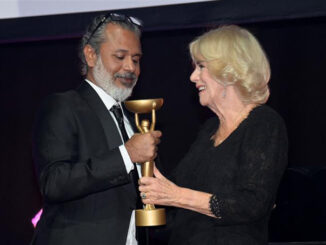
    LONDON (TIP): Sri Lankan author Shehan Karunatilaka has been named the winner of the 2022 Booker Prize for his second novel ‘The Seven Moons of Maali Almeida’, described by judges as a whodunnit and a race against time, full of ghosts, gags and deep humanity. Karunatilaka, 47, became only the second Sri Lankan born to win the prestigious GBP 50,000 literary prize at a ceremony in London on Monday, October 17 night, after Michael Ondaatje who won for ‘The English Patient’ in 1992. ‘The Seven Moons of Maali Almeida’ tells the story of the photographer of its title, who in 1990 wakes up dead in what seems like a celestial visa office. With no idea who killed him, Maali has seven moons to contact the people he loves most and leads them to a hidden cache of photos of civil war atrocities that will rock Sri Lanka. “What the judges particularly admired and enjoyed in ‘The Seven Moons of Maali Almeida’ was the ambition of its scope, and the hilarious audacity of its narrative techniques,” said Neil MacGregor, Chair of the 2022 Booker judges.

    “This is a metaphysical thriller, an afterlife noir that dissolves the boundaries not just of different genres, but of life and death, body and spirit, east and west. It is an entirely serious philosophical romp that takes the reader to ‘the world’s dark heart’ — the murderous horrors of civil war Sri Lanka. And once there, the reader also discovers the tenderness and beauty, the love and loyalty, and the pursuit of an ideal that justifies every human life,” he said.

    Karunatilaka, who was born in Galle in 1975 and grew up in Colombo, says that Sri Lankans specialize in “gallows humor” and make jokes in the face of crises as a coping mechanism. His debut novel from 2011, ‘Chinaman’, won the Commonwealth Prize. ‘The Seven Moons of Maali Almeida’, published by the independent press Sort of Books, explores life after death in a noir investigation set amid the murderous mayhem of a Sri Lanka beset by civil war. In 1990 Colombo, war photographer Maali Almeida is dead, and has no idea who killed him. He has seven moons to try and contact the man and woman he loves most and lead them to a hidden trove of shocking photos.

    Karunatilaka and this year’s other shortlisted authors, NoViolet Bulawayo, Percival Everett, Claire Keegan and Elizabeth Strout, were all in attendance at the Roundhouse in London, with Alan Garner attending virtually.The first fully in-person event since 2019 brought together Booker writers past and present with a diverse range of readers and celebrated talent from across the cultural spectrum. This year’s judging panel included academic and broadcaster Shahidha Bari; historian Helen Castor; novelist and critic M. John Harrison; and novelist, poet and professor Alain Mabanckou. “This year’s Booker judges have formed an incredible team. At their final meeting they were sad to disband, and to be separated from the books that had kept them company,” said Gaby Wood, Director of the Booker Prize Foundation.

    “The 170 novels they read originated in many parts of the globe. ‘We’re going to show that you can find a diamond anywhere in the world,’ said one of the judges.

    Finally, their longlist of 13 undiminished in spirit, they settled on a single gem: a book they were excited to press into the hands of readers everywhere,” she said. Camilla made one of her first public appearances since she became Queen Consort and singer Dua Lipa delivered a rousing speech.

    “I often wonder if authors realize just how many gifts they give us. Touring commitments take me all over the globe and life is often hectic. Sometimes, just to survive, I need to adopt a tough exterior. And at these times, it is books that soften me,” said the pop star. Karunatilaka’s GBP 50,000 prize money and newly designed trophy were presented to him by last year’s winner Damon Galgut, along with a designer-bound edition of his book and the GBP 2,500 given to each shortlisted author. As the winner, the Sri Lankan author can expect instant international recognition and a dramatic increase in global sales.

    (Source: PTI)

  • Conservative Friends of India and the Indian High Commission Joint Reception at the Conservative Party Conference

    Speakers at the reception.
    Guests at the Conservative Friends of India Reception.

    BIRMINGHAM, UK  (TIP): The Conservative Friends of India and the Indian High Commission jointly hosted a Reception at the annual Conservative Party Conference in Birmingham, October 6.The Reception attended by over 400 guests received rave reviews, being complimented as highlight of the Conference. The Reception celebrated the importance of the strong ties between the UK and India and the contribution of the Indian diaspora in Britain. CF India was delighted to welcome the new High Commissioner of India, HE Vikram Doraiswami. The august gathering of special guest speakers who specially attended to welcome H.E Vikram Doraswami, included the Home Secretary The Rt Hon. Suella Braverman MP, Foreign Secretary The Rt Hon James Cleverly MP, International Trade Secretary The Rt Hon Kemi Badenoch MP, Environment, Food and Rural Affairs Secretary The Rt Hon Ranil Jayawardena MP, Lord Chancellor and Justice Secretary The Rt Hon Brandon Lewis MP, Digital, Culture, Media and Sports Secretary The Rt Hon Michelle Donelan MP, CF India Patron Lord Rami Ranger CBE , Mayor of the West Midlands Andy Street, Minister for Skills, Further and Higher Education Andrea Jenkyns MP, Exchequer Secretary Felicity Buchan MP, Minister for London and Small Business Paul Scully MP , The Rt Hon Theresa Villiers MP, Foreign Secretary PPS Gagan Mohindra MP, The Rt Hon Greg Hands MP, Pam Gosal MSP, Dr Sandesh Gulhane MSP, The Bangladesh High Commissioner, HE Saida Muna Tasneem, The Maldives High Commissioner HE Dr Farah Faizal , Heather Wheeler MP, Dean Russell MP with Team CF India, Co-Chair Cllr Reena Ranger OBE, Cllr Ameet Jogia MBE and Director Nayaz Qazi.

    Co-Chair Cllr Reena Ranger paid tribute to Her late Majesty the Queen and delivered the proclamation “ God Save the King”, Reena also highlighted the rich secular values of the Indian community and how CF India is led by British Indians who are Sikh, Hindu and Muslim, all working in harmony and promoting the secular and meritocratic values of India and the Conservative Party. Introducing the Guests was Co-Chair Cllr Ameet Jogia. The host for the Conference, the Conservative Mayor for the West Midlands Andy Street spoke of how proud he was to be Mayor of the Region, which the diaspora has enriched and how he was delighted to meet the New High Commissioner HE Vikram Doraiswami and looked forward to continuing the strong engagement the region has with Indian businesses. In closing Mayor Andy Street paid tribute to Team CF India, Reena Ameet and Nayaz.

    H.E. Vikram Doraswami, the High Commissioner of India, greeted Birmingham and the guests. Welcoming the Lords & Ladies, Secretaries of State, Ministers, Members of Parliament, the Mayor of the West Midlands and members of the Conservative Party present. The High Commissioner paid tribute to Her late Majesty the Queen, who he said would be remembered forever. In celebrating the India and UK friendship, the High Commissioner lauded The United Kingdom, as the oldest partner of India. The people and the living bridge are important to the relationship. The finalizing of the Trade Arrangement, the Defense and the Strategic Partnership, coupled with the mobility of the brightest talent between both countries, will provide many opportunities for both countries.

    The Home Secretary, The Rt Hon. Suella Braverman, MP, welcomed the High Commissioner and members. Stating she would “like to put on record and thank Rami Uncle (Lord Ranger), Reena, Ameet and Nayaz for all the work they do for CF India and the Conservative Party. CF India plays a crucial role in helping to win elections and bring the Indian community closer to the Party”. The Home Secretary in closing said, “The Conservative Party is a Party of meritocracy &talent, which has the most diverse cabinet in history, and we look forward to the start of the Free Trade Agreement between UK and India”. The Foreign Secretary, The Rt Hon James Cleverly MP, spoke of how he enjoyed the Reception, “You can tell it is an Indian event; it is noisy, busy and with so much energy in the room”. The Foreign Secretary also conveyed his special thanks and said, “The British Indian community and the links with India are hugely important to the United Kingdom; India is one of our closest friends in the world. The UK-India relationship has gone from strength to strength. Two countries bound by heritage and family, I could not be more proud to work with Kemi to make the Free Trade Agreement happen quickly. The Foreign Secretary, in closing, thanked Team CF India and the CF India Members for all their hard work”.

    CF India Patron Lord Rami Ranger CBE welcomed the new High Commissioner and guests and acknowledged the great work of Team CF India Reena Ameet and Nayaz. “We are delighted that our new High Commissioner HE Vikram Doraswami is here with us, witnessing the vibration of India outside India. Britain is a vibrant economy because we are both secular democracies, and our respect for the rule of law and women. The free trade agreement between the 5 & 6th largest economies will be the mother of all Free Trade Agreements”.

    The Lord Chancellor and Justice Secretary, The Rt Hon Brandon Lewis MP, spoke of the importance of the British Indian community and how it brings the UK and India closer together and how The Free Trade Agreement will create many new opportunities, including that in legal services. Celebrating our common values, the Lord Chancellor spoke about how the UK and India value democracy and the rule of law. In closing, the Lord Chancellor thanked CF India for what it does for the Party, and work at elections to get more Conservatives elected.

    The Secretary of State for the Department of Environment, Food & Rural Affairs, the Rt Hon Ranil Jayawardena MP, welcomed the New High Commissioner and how proud he was to have worked on building the Enhanced Trade with India and the soon to be announced Free Trade Agreement, which will allow greater trade between both countries in many areas including food, as well as helping to work more closely on the environment strategy.

    The Secretary of State for Culture, Media and Sports the Rt Hon Michelle Donelan MP, spoke of the closeness between both countries and how the soon-to-be-announced Free Trade Agreement will help to bring greater opportunities in I.T. and Digital, which are key technologies for now and the future.

    In closing the Reception, the vote of Thanks was given by Director Nayaz Qazi with Co-Chairs Reena and Ameet, inviting the special guest speakers and members to the upcoming CF India Diwali Reception.

  • NYC Mayor Eric Adams celebrates Diwali in Times Square


    NEW YORK (TIP): NYC Mayor Eric Adams inaugurated Diwali celebrations in Times Square on October 15. The festival of Diwali marks the beginning of the Indian New Year. Deepavali – the Festival of Lights, this year falls on Oct 24 but the celebrations started a week before, in Times Square. Mayor Eric Adams, Senator Charles E. Schumer, India’s Consul General in New York Randhir Jaiswal, NY State Assemblywoman Jennifer Rajkumar – the first Indian American Assemblywoman, and Manhattan Borough President Mark Levine attended the event along with hundreds of Indian American community members.

    “We acknowledge the Diwali, and we need to acknowledge the power of women and the significant role women play in our country, in our city. Let’s continue to lift our women as we lift up our country – our city,” said NYC Mayor Adams.
    On October 20, Mayor announced that Diwali will be a public-school holiday in New York City starting in 2023. This sends a message about the significance of the city’s inclusiveness and the “long overdue” step will encourage children to learn about the festival of lights.
    Consul General of India Randhir Jaiswal said, “Every year, we celebrate Diwali in Times Square but this year, it is somewhat different. It happened to be part of India’s 75th year of Independence.”

    Renowned Oncologist Padma Shri Dr. Dattatreyudu Nori was recognized and honored for his lifetime excellent services to Health and Medicine by Mayor Eric Adam.

    Times Square witnessed huge participation of members of Indian American community, Americans and others dressed up in traditional outfits from different states of India, showcasing India’s rich art, culture, and diversity. The Diwali Bazaar provided a variety of traditional Indian cuisines and sweets and merchandise for Diwali festivities.
    The variety of traditional performances and lively acts by world-renowned artists like Jay Sean, Arjun, Rimi Nique, and Social Media fame artists Kiran + Nivi and Hrishi kept the audience glued for hours. 100s of students of Arya Dance Academy and Shiamak Davar School of Dance, Heeray, DanceX, presented dazzling dance shows at the event.
    “We love our community, our Indian community, and we love that we all come together here in New York with our diversity,” said Senator Charles E. Schumer. He has been celebrating the festival of Diwali with the Indian American community in New York for many years.
    “The Hindu, Sikh, Jain, and Buddhist communities, you are so important to the city, and I wish you a holiday of light, prosperity, of happiness, health, and a wonderful year ahead,” said Manhattan Borough President Mark Levine in his address.

    Jennifer Rajkumar, the first Indian American NY State Assemblywoman was introduced by Mayor Eric Adams on the stage. “On the street, they call him – Mayor Eric Adams – a Hindu Mayor. A plant-based diet, and meditation, he does it all. I am honored to be the first Hindu elected to be in the NYS office. The first Indian woman but defiantly, not the last one,” she said.

    Attendees were encouraged to take the advantage of Bivalent Vaccines at nearby COVID Clinics with the partnership of the “We Can Do This” campaign of Vaccines.gov, a Health & Human Services initiative. T

    “We appreciate the support and cooperation from the authorities of the City of New York, NYPD, FDNY, Heath Department, Times Square Alliance, and other Government organizations to create yet another successful event at Times Square,” AR Helping Hands Foundation Diwali at Times Square organizer, Neeta Bhasin and Naresh Kumar said in a statement.

  • Birthday Horoscope – October 24 to October 30

    October 24
    Ganesha says although you have many natural abilities to make an impression on people and are generally positive, you need to learn to curb your tendency to act irrationally and impatiently at times. Fresh graduates have promising employment prospects ahead of them, and academics, scientists, writers, and athletes are also in for a very good time. Gains in money are a given, but costs will also rise in the long run.
    October 25
    Ganesha says people respect you for your sincerity and determination in carrying out your duties, but you need to curb your occasionally vindictive and envious behavior. Gains in money are guaranteed as long as you surround yourself with smart, talented people. Through social events and leisure pursuits, some people will find new love. Later in the day, you will experience religious impulses that will lead you to seek spiritual blessing.
    October 26
    Ganesha says today you should be extremely cautious, especially while managing your finances. During this time, finding spiritual blessing will give you mental comfort and calm. You’ll be considering long distance trips. For people with chronic conditions, a proper diet is crucial. Sales and marketing positions are likely to be in high demand. Matrimonial union for people looking for a life spouse. Although there will be assistance from others and a generally positive period, rash or careless decisions will only lead to losses.
    October 27
    Ganesha says because the stars are aligning in your favor today, you are likely to experience significant success and notoriety. Some of you will also inherit fortune from your ancestors. You’ll need to be diplomatic and delicate on the home front. Being intransigent will only make things worse. You’ll have no trouble reaching your objectives and exceeding people’s expectations. Children will excel in both athletics and academics. It is not impossible that a distant vacation will take place later in the day.

    October 28
    Ganesha says the key to your success today will be information. During this time, you will feel successful and motivated, and you will make gains. for some later in the day, spiritual growth. In order to ask for favors, raise money, and manage others, you will be in a good position. Gains in money are guaranteed, but don’t spend lavishly. It will be quite thrilling and enlightening to travel.
    October 29
    Ganesha says you need to check your temptation to act rashly, wastefully, and selfishly occasionally. You’ll experience an increase in self-assurance today. You will take part in activities that improve your quality of life and secure your future. At work, you’ll hold a leadership role, and a lot will rest on your shoulders. Making new contacts will give you fantastic commercial and growth opportunities. A person of the opposite sex who has strong romantic feelings for you will provide new spice to your life.
    October 30
    Ganesha says while there will be financial gains today, rising costs will make saving difficult. Your professional advancement should have your whole attention because it will rapidly produce the desired outcomes. Businesspeople will develop useful contacts. Children and spouses will be very demanding but supportive. Minor health issues like a stiff neck, backache, or other body aches will cause issues. If you travel and participate in clubs and social activities, you will succeed socially.

  • Weekly Horoscope -October 24 to October 2022

    Aries
    Ganesha says, all these festivities will bring immense amounts of joy. You will re-establish contact with your inner self and stop paying attention to the external distractions. Due to outside factors, you’ll be rather anxious at business. You shouldn’t make significant judgments at work right now since they might have a bad effect on the business. Keep your focus on the current work at hand and proceed with great prudence. Market investments are highly recommended throughout this week. Your amorous thoughts are warped, but keep in mind that beautiful matters take patience, and that passion will ultimately flourish in your life. You’ll begin to feel and appear healthier.
    Taurus
    Ganesha says, this week, the vibe of Diwali will certainly bring positivity. Your philanthropic ability will deliver you great wealth this week. You have always been helpful to individuals in distress and have rarely let yourself hesitate to do so. You will receive a lot of acclaim for this deed of kindness and gain a lot of esteem from people. You’ll have the opportunity to search for a range of jobs during a casual gathering this week. Your job concepts come out as clumsy, which could make you let your defences down. Your management had high hopes for you, but you won’t live up to them. Don’t ignore any medical issues this week. You have to start looking for oneself.
    Gemini
    Ganesha says, you’ll feel more courageous at employment this week. You’ll be equipped to face any fresh challenges that job presents to you and be able to deal with them coolly. You’ll have a significant impression and set an example for both your co-workers and rivals. This week, you’re in a romantic mood, and you wish to express your partner’s additional devotion. Impress this person with a kind gesture they won’t expect. You need to see a healthcare professional this week for a few wellbeing issues. Ultimately, you could not have had a better week than this one. Overall, this New Year will bring joy and happiness to your household this week.
    Cancer
    Ganesha says, you might have a good time this week, but you’ll probably start to focus on yourself a lot. It’s beyond enough you behaved appropriately and gave your loved ones some consideration. It’s time to stop concentrating on the specifics and start thinking broadly. You must think of others’ needs before your own. You’ll gain from conserving income now later. Jupiter will attempt to attract your interest this week, so cut back on your expenditures and prepare carefully. You probably won’t feel quite well and probably have a bad migraine. This week is very fortunate to buy new assets!
    Leo
    Ganesha says, you must uphold your company’s values and conduct yourself honestly. As this week is going to begin with Diwali, it is certainly going to begin with good luck. In the coming, you’ll have to handle judicial matters. You must make sure that your clients are satisfied with your work. You’ve always been at the top of your profession thanks to your attitude and hard commitment. There’s a chance that you and your partner will argue. You’ll experience a distance with your lover. Try to address the root of your issue so that you can come to a consensus. This week, thanks to Jupiter’ blessings, you’ll have the chance to have a favourable influence on someone’s career. By the conclusion of the week, you ought to feel better if you get some relaxation.
    Virgo
    Ganesha says, wishing you a very Happy Diwali Dear Virgo! You’ll be preoccupied this week juggling your work duties with your urge to be there for your household and loved ones. You are more inclined to receive a great deal on the technological item you have wanted for a while. This week, the melancholy you’ve been experiencing will vanish. You will come across a few larger consumers if you operate in the advertising or multimedia management fields. Owing to your busy schedule, your personal relationships will falter somewhat, but you and your companion will find a different approach to communicate. Mercury is transiting your holiday home of the ecliptic this week, which is likely to be better for your wellness. Generally, it will be a typical eek.
    Libra Ganesha says, ultimately, this is a fa
    vourable week since you will receive your riches that have been delayed by administrative issues. You’ll take a small step back in order to catapult yourself bigger and greater. Expect unexpected wealth since the constellations that control your wealth are in a perfect position to enable the free flow of money in your life. During the week, you will radiate restorative energy and keep up with optimism. This week, your lover will make you feel valued. Your inquiries about your partner’s romantic involvement will receive a response. By going above and beyond, you can make your partner feel especially special. Strive to consume a balanced diet. This week, incorporate legumes in your meal. May this Diwali bring you an abundance of joy and love.
    Scorpio
    Ganesha says, you’ll be operating at the peak of your mental capacity these seven days which will be filled with festivities and joy. This week, you’ll handle a difficult situation with grace. Be calm; you’ll discover the option that is appropriate for your line of work. You will find employment opportunities abroad. This week, you’ll run into some challenging circumstances. It will be challenging to escape this situation. The best way to handle the situation is not to worry about it, therefore move gradually. You shouldn’t worry about your romantic encounter this week since it will be in a lovely setting. The latter half of the week can cause you a little discomfort if you have any back pain or appendix problems.
    Sagittarius
    Ganesha says, your business is doing well economically and strategically. You’re likely to be given a unique position that will make you well-known. The fact that you fought really diligently will spread. The grads from this week may have a great opportunity to find new professions. Venus appears to be on your side this week, which will improve your economic circumstances. If you make snap decisions, you’ll get into trouble. You ought to stand back and think about your alternatives before acting. Spend your research and carefully consider your options before making any judgments that will affect your connection. You’ll be able to concentrate more on your profession if you’re in good condition.
    Capricorn
    Ganesha says, this week, you’ll be further than you think to find the prosperity you’ve been looking for. What you have been searching for a prolonged moment will be found. You’ll ultimately get resolutions to your complex, enduring problems. Your supervisors will be more keen to collaborate with you and your diligent efforts will be acknowledged. This week is an excellent one to invest time with your partner in-depth. You’re prepared to start a new phase in your love life! If you’ve been considering getting married to your partner, this week might be the time to propose at a memorable occasion. You need to force yourself out of bed this week and start a workout routine.
    Aquarius
    Ganesha says, the beginning of the week will be amazing as it will begin with the festival of Deepawali. There will be tremendous energy all around you. This week, there’s a chance you’ll come across a famous person. You will gain understanding of the various decisions that must be made at business and concentrate on them methodically. This week, your household will be your top priority. You’d like to talk about your emotions with the individual you’re attached to this week. You’ll desire to command interest this week. You’ll feel resentful and ungrateful since you’ll be suspicious of people who are getting admiration. You’ve been battling healthcare problems as a consequence of anxiety at employment.
    Pisces
    Ganesha says, this week, you could be thinking about changing your career trajectory and you will be advantaged by the holy and spiritual vibes! Probably, you are tired of your current job and want to engage in anything that will make you happy while you’re doing it. You’ll feel inspired to accomplish your goals. Although the change won’t be easy, the results will unquestionably be good. Those who work in the financial sector, this week is a great time to purchase. Your partner will think highly of you and believe in you about their most private emotions since they perceive you to have a huge compassion. Don’t attempt to imitate a different individual to attract more interest from people. This week is a great one to unwind. Throughout the week, consume a lot of liquid.

  • Here’s how Diwali is celebrated around the world

    Here’s how Diwali is celebrated around the world

    Other than India, Diwali is also celebrated in other parts of the world where Hindus are in prominent numbers. In many countries like Malaysia, Nepal, Singapore, and Sri Lanka, Diwali is an official holiday. These countries celebrate the festival with almost as much enthusiasm as India. Millions of people have flocked to witness firework displays to mark the start of Diwali. Depending on the location, celebrations may include millions of lights in houses, fireworks, gift-giving and spiritual rituals, feasts and more. This year will be different, of course, with more focus on maintaining social distancing and staying indoors.
    Here are some countries which celebrate Diwali with as much enthusiasm as Indians do with a little difference in their celebrations.
    Singapore
    Recognised as Deepavali, the festival is a state holiday in Singapore. With a notable Hindu community, the zeal in Little India is similar to that in any city in India.
    The streets are transformed by multi-coloured flowers, buntings and lights. Storefronts are decorated in shades of red and gold, and the sweet fragrance of flowers and incense fills the air. People are decked in their fineries as prayers are held to praise the divine.
    Mauritius
    Mauritius is an isle in the Indian Ocean which is to the east of Madagascar. This gorgeous landmass is abundant with scenic landscapes and enchanting places. Mauritius estimates 63% of Indian majority, of which 80% follow Hinduism. Therefore, the observance of almost all the Hindu festivals on this island is a tradition.
    In Mauritius, Diwali celebration is an age-old custom. It holds unique importance for the inhabitants. They believe that Diwali has been celebrated long before the coming of Lord Rama from 14 years of exile and his crowning as the king. The festival is regarded by the lighting of earthen lamps in lines, creating pictures out of the lines. Lakshmi is revered as the goddess of wealth and firecrackers are burnt to frighten away evil spirits.
    Malaysia
    Fascinating in its heterogeneity, Malaysia has several mesmerising beauties and attractions. With a population of approximately 20 million, including a harmonious multi-ethnic mix of Malays, Malaysia ensures a vibrant blend of cultural beliefs. The Hindu inhabitants of Malaysia form about eight percent of its entire population.
    The Malaysian people recognise Diwali as Hari Diwali. This festival is observed during the seventh month of the Hindu solar calendar. The South Indian ritual of oil bath precedes the celebrations. The festival involves visits to temples and prayers at home altars. Little lamps moulded from clay and filled with coconut oil and wicks are a familiar sight.
    USA
    Asians rank amongst one of the biggest immigrant population in the USA of which, Indians are a large number. Most cities have a big Indian community and Diwali is a holiday celebrated with a lot of excitement. Be it New Jersey, Illinois, Texas or California, temples across hold a Diwali night that marks priests offering common prayers. After this a vegetarian communal feast is held.
    Larger cities also arrange a Diwali parade in some parts. Like anywhere else in the world, friends and family meet at each other’s homes and give presents as part of the Diwali festivities.
    Australia
    With a significant number of Indians in Australia, cities like Sydney and Melbourne observe Diwali celebrated within various pockets of the community. Most notably, Diwali at Federation Square in Melbourne has risen to become the biggest celebration in Australia.
    Marked with a grand exhibition of fireworks, live performance like traditional dances of India along with art and other cultural shows, Diwali is enjoyed by all.
    Nepal
    Nepal is a landlocked nation nestled in the foothills of the Himalayas. It is a multi-ethnic and multi-lingual community which is the only Hindu Kingdom of the world. Diwali is commemorated here with the typical Hindu festivities and customs. Diwali in Nepal is identified as Tihar. Just like most regions in India, Diwali is celebrated here to honour the goddess of fortune and god of prosperity, Lakshmi and Ganesh respectively. The festival of light comes in October or November on the day of Amavasya – the darkest day of the year.
    The festival here lasts for five days. Every day has its unique importance. The first day is devoted to cows as they prepare rice and feed the cattle believing that goddess Lakshmi appears on cows. The second day is for Dogs as the Vahana of Bhairava. Arrangement of tasty food mainly meant for the dog is a common feature of the day. Lights and lamps are lit to radiate the entire surroundings, and some of the speciality items are cooked to mark the third day of the festival. Fireworks, lamps and crackers are extensively used. The fourth day is devoted to Yama, the Hindu God of Death. He is prayed for long life. The fifth and final day is Bhaiya Dhooj dedicated to the brothers who are wished long life and prosperity by their sisters.
    Leicester
    Bright lights, fireworks and chaotic-celebrations – it can only be Diwali. Millions of Hindus, Jains and Sikhs in India and across the world have been marking the annual five-day festival of light this week with traditional prayers, fireworks and a huge amount of feasting. The festival, which coincides with Hindu New Year, involves lighting traditional earthen diyas (candles), decorating houses with colourful rangoli (floor patterns created with coloured rice or powder), and wearing new clothes, often gifts from relatives. Each faith has its own reasons for celebrating Diwali, but the main theme which runs throughout the festival is the triumph of good over evil and light over darkness, shown with huge fireworks displays and by decorating houses with candles and long strings of lights. In India, traditional holiday traffic saw cities across the country draw to a standstill as firecrackers burst overhead, shops buzzed with customers buying gold – Diwali is an auspicious time for new purchases – and children letting off firecrackers in the streets. Sweets are a major part of the festival, and Indian shop windows have been filled with towering arrays of neon-coloured hand-made Diwali specialties such as sutarfeni (sweet shredded dough topped with pistachio nuts). More than 35,000 people attended a Diwali parade on the streets of Leicester city centre October end, an area which is known for some of the largest Diwali festivities outside of India.

  • Bhai Dooj

    Bhai Dooj

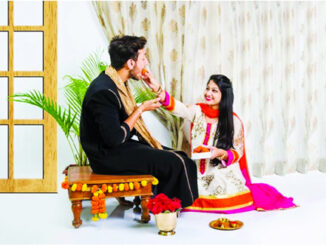
    The last and final day of Diwali celebrations is called the Bhai Dooj or Bhau Beej, which celebrates the special bond of brothers and sisters. Bhaiya Dooj falls on October 26. On this day, the Aparahna time will last from 01:12 pm to 03:26 pm. It is celebrated on the second day of the Shukla Paksha of the lunar calendar and is similar to Rakshabandhan.
    It is one of the auspicious and very popular Indian festivals that are celebrated across India with great excitement. For every brother and sister, the day of Bhai Dooj festival celebration comes as a day of opportunity to celebrate their bond of love and care as well as strengthen it by following the auspicious rituals.
    The most important ritual of the celebration of Bhai Dooj is the aarti and tika ceremony. On the day of Bhai Dooj sister firstly puts does the aarti of her brother with the holy flame and does the tika on her forehead and then she prays to God for his long and healthy life. This is the way of expressing care and love to brother by a sister. In this return, sisters get a token of love from brothers. It’s a Bhai Dooj gift.
    Meaning and Significance
    The majority of Hindu festivals and rituals put stress on the significance of family bonding and relationships. Although every relationship possesses its own value, but the brother-sister relationship is quite unique and unmatched. Hindu culture has manifested the greatness and glory of this relationship in many forms, out of which Bhai Dooj festival is an eminent form. This auspicious occasion also reveals the importance of siblings in someone’s life.
    The golden occasion of Bhai Dooj provides a golden chance to a woman, bound in the clutches of her day to day routine, to go to her native place and meet her parents and siblings. This festival is like a homage to the pious brother-sister relationship and it also strengthens this bond further.
    With the passage of time, this Bhai Dooj festival has no doubt changed its form like use of e-mails, e-greetings, mobile phones, chocolate and beverage hampers, and so. But, the basic significance of Bhau Bij and the feeling and emotion behind celebrating this wonderful festival is still the same, i.e., revealing and rejuvenating the eternal love of brother and sister. In the present context, we can say that Bhai Dooj will remain significant and consequential in the Indian culture as ever, in the years to come.
    The Story Of Bhai Dooj
    For Hindus, the story behind each festival play a very important role in the formation of their culture and have a very deep significance and values. Most of the Indian festivals are attached to specific characters and personalities that helps the masses to understand and know the true significance of the festival. Just like all important Indian Festivals, Bhai dooj also has a story to follow that have carved a niche with its unique presence and strength.
    Through generations, the story of Bhai Dooj has been passed from generation to generation either by word of mouth or through carefully stored scriptures. The narration of the story marks the end of the Bhai dooj puja. Once the various rituals of Bhai dooj such as the sister applying the teeka on the forehead of the brother, giving him the eatables and in return receiving the gifts are over, the women and children sit around, to hear the story behind Bhai Dooj from the elders of the family.
    The story goes that once there was a family living in a village that had only a sister and a brother. The sister was very elder to her brother, thus when she got married, the brother was at a very tender age. The boy did not remembered any thing about his sister’s marriage. After the marriage, the sister never returned to her mother’s home. As the brother grew up, the image of her sister started fading with each passing years. He terribly missed his sister, especially on the Bhai Dooj day, as he used to see his friends with teeka on their forehead and plates full of sweets.
    On one particular Bhai dooj, when the boy had turned up into a handsome young boy, he inquired his mother about the reason as to why his sister never visited her original home after her marriage. The mother replied that she does not come because there is a big forest between this village and the one in which she lives and there is a big river flowing in between. One has to cross the river by boat and then there are wild animals which fill people with so much terror, that many people do not travel through the forest.
    Inspite of knowing the immense difficulty he will have to face, the young brother decided to visit his sister on the next Bhai dooj day. The mother reminded him again of the dangers, but he did not listen, and so it was decided that he would go and visit her. When the time came she told him to tell his sister that she should now come over and choose a suitable bride for him.
    The boy set off and on his way he faced the rising level of river, which made it impossible for him to cross the road. There was also the danger of snakes. The boy requested the river not to drown him and told the snakes that they can bite him on his return journey, after he meets his only sister. The snake agreed, and the boy proceeded. Now, he came to a mountain, which started through big stones on him, and he again pleaded with it to let him go. The mountain also agreed. When the boy was near his sister’s village, a big tiger appeared and decided to eat him up. He also pleaded to the tiger and promised him that the tiger can feed on him on his return journey.
    The poor boy knew now that is days were numbered, still, he eagerly went along to meet his only sister. He entered the house, and saw that she was doing the Bhai Dooj puja. The sister on seeing him after such a long time, welcomed her brother with a smile and embraced him. She at once brought lovely fruits and sweet meats to eat. She set about preparing kheer, puri, kachori, and lots of other tasty items. When her husband came after work, both of them provided a very enjoyable and memorable time to the young lad, so that he was full of joy.
    Days passed, and it was time for the brother to take leave of his sister and brother-in-law. Before returning back, the brother narrated the whole incident to his sister and told her that his days were numbered and that he is soon going to die. The sister was shocked, but she decided to accompany him for the return journey. She secretly packed some meat for the tiger, some milk for the snake, flowers of silver and gold for the mountain and some roli and rice for the river.
    Soon they were on their way and, of course, the tiger came first to eat up the brother. The sister gave him the meat and he went his way. Then came the mountain, which wanted to fall on her brother. She quickly performed puja with the gold and silver flowers and the mountain was very pleased with the offerings and stopped falling. Then it was the turn of the snake, and it was given the milk, and went away satisfied. They now reached the river and as was expected, it started to rise, but the sister subdued it by doing puja with roli and rice, and the river went down.
    Both, brother and sister were very happy to escape the dangers of the forest and were anxious to reach home. The sister was now tired and thirsty. Soon she saw some gypsies working far away. She wanted to ask them for water, so the brother sat down under a tree-happy to be alive-and she went to the gypsies and got some water. Their the gypsies predicted that the danger was not over and her brother will die very soon. She asked them to tell her some way by which this calamity could be averted. One old woman came to her rescue and suggested that until her brother gets married, she should go on cursing him, right from now on and continuous to curse him all through the wedding and also insists on getting all rituals done to her first, only then this boy can be saved.
    As soon as she reached near her brother, she started to curse him and to abuse him. The poor fellow was taken by surprise, but she continued calling him bad names. This thing continued even when they reached home. The mother, along with the villagers were very surprised at the nasty behavior of the sister, but no said anything as she was married and had came to her mother’s place after a long time.
    Soon, the brother’s marriage was fixed to a beautiful girl. Still the sister went on cursing on any pretext. Everyone wanted the wedding to be over as soon as possible and the sister to be sent back to her village. On the wedding day, she insisted that all rituals be performed on her before her brother. The sister insisted that they tie the sehra on her forehead first. She found a small snake in the sehra instead of a string. She pulled out the snake. Next, the sister insisted that the barat (marriage procession) should go from the back door and not from the front door and no decorations be made. When the barat was to start, somehow the sister had fallen asleep. Ignoring her words, the barat started from beautiful front porch. But, no longer had everyone gather, the whole porch fell down, and narrowly missed the groom.
    Now the time for the pheras (going round the fire) arrived and the sister had again gone to sleep. As soon as the first round of the pheras was done, the boy fell down in a dead faint, because of the evil spirits who had come to take him away. The sister woke up on hearing the noise and came cursing in to the courtyard. Hearing the abuses and seeing her blazing eyes, the evil spirits fled. It was now time for the boy and the girl to give kheer to each other. They let the sister have the first morsel from which she took out a hedgehog’s spiked needle and quickly put it in her tiny bag as well.
    The wedding was finally over and every one including the mother and brother were keen to see the sister leave. Before leaving for her husbands place, the sister narrated the prediction of the gypsies and gave the reason for her bad behavior. Everyone had tears in their eyes and they hugged her feet, and all present said with one voice: ‘Let everyone have a sister like this, who is willing to be talked ill of, and will go about looking wild and angry even during a wedding, although it was to be the only wedding in the family – all this just to save her brother and family from disaster.
    Thus, the custom is prevalent that a brother does not go to his sisters house for the teeka; instead the sisters bring or send the teeka to the brother, as danger may lurk on the way.

  • Govardhan Puja

    Govardhan Puja

    The day following Diwali or the fourth day of the Diwali celebrations is known by the names of ‘Padwa’ or ‘Varsha Pratipada’, & ‘Govardhan Puja’.
    These two festivals are celebrated differently in the diverse geographical parts of the country. While the festival of Padwa is celebrated in order to celebrate the coronation of King Vikramaditya, the festival of Govardhan Puja is celebrated for commemorating the incidence of lifting of Mount Govardhan by Lord Krishna.
    Both the festivals ‘Padwa & Govardhan Puja are celebrated with much fervor in different parts of the country. While Padwa is celebrated in parts like Maharashtra and the western states of India, Govardhan Puja is mainly associated with the Northern parts of the country.
    Padwa
    The fourth day of diwali celebrations or the day following the ‘Amavasya’ is ‘Kartik Shuddh Padwa’, which is also the day when the King Bali would come out of the ‘Patal Lok’, the Nether Land and rule the ‘Bhoo Lok’, the world as per the boon given to him by ‘Batu Waman’, Lord Vishnu. Since then this day came to be celebrated as Padwa in order to honor and welcome the King Bali. Therefore this day is also known as ‘Bali Padyami’.
    Gudi Padwa
    The day of Gudi Padwa has special significance for the Hindu families. There is a custom in which on this holy day the wife applies the ‘Tilak’ on the forehead of her husband, garlands him, performs his ‘Aarti’ and also prays for his long life. Then the husband gives her a gift in appreciation of all the tender care that his wife showers on him. Thus the Gudi Padwa is festival of celebrations and respect of love and devotion between the wife and the husband. People invite their newly married daughters with their husbands on this day of Gudi Padwa for special meals and give them gifts.
    Legends of Govardhan Puja
    There are several popular legendary stories to explain the foundation of Govardhan Puja celebration.
    Lord Krishna lifts the Govardhana Hill
    ‘Govardhan’ is a small hillock in Braj, near Mathura and on this day of Diwali people of Punjab, Haryana, Uttar Pradesh and Bihar build cow dung, hillocks, decorate them with flowers and then worship them. This festival is in commemoration of the lifting of Mount Govardhan by Krishna.
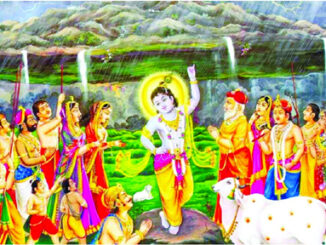
    As per Vishnu Puran the people of Gokul used to worship and offer prayer to Lord Indra for the rains because they believed that it was he who sent rains for their welfare but Lord Krishna told them that it was Mount Govardhan (Govardhan Parvat) and not Lord Indra who caused rains therefore they should worship the former and not the latter. People did the same and it made Lord Indra so furious that the people of Gokul had to face very heavy rains as a result of his anger. People were afraid that the downpour was a result of their neglect of Indra. But Krishna assured them that no harm would befall them. Then Lord Krishna came forward to ensure their security and after performing worship and offering prayers to Mount Govardhan lifted it as an umbrella on the little finger of his right hand so that everyone (men and beasts ) could take shelter under it. After this event Lord Krishna was also known as Giridhari or Govardhandhari. After this, Indra accepted the supremacy of Krishna. Govardhan Puja is also called Anna-Koot.
    Anna-Koot
    This day is also observed as ‘Anna-Koot’, which means mountain of food. Pious people keep awake the whole night and cook 56 or 108 different types of food for the Bhog (the offering of food) to Krishna. In temples especially in Mathura and Nathadwara, the deities are given milkbath, dressed in shining attires with ornaments of dazzling diamonds, pearls, rubies and other precious stones. After the prayers and traditional worship innumerable varieties of delicious sweets are ceremoniously raised in the form of a mountain before the deities as “Bhog” and then the devotees approach the Mountain of Food and take Prasad from it.
    Significance
    This ceremony has great significance in the Hindu religion. On this day, devotees worship the cow, Govardhan Parvat, and Lord Shri Krishna. Govardhan Puja is a festival that honours Lord Krishna and shows respect and adoration for Mother Nature. Worshipers are said to receive Lord Krishna’s blessings on this day if they worship the Govardhan hill and his favoured cows.
    Hindu legend states that on this day, Lord Krishna raised the Govardhan Parvat upon his little finger to avert the wrath of Lord Indra, the Rain God, on the inhabitants of Vrindavan. With tremendous fervour, people started to worship Govardhan Parvat, and Lord Krishna was given the titles “Govardhandhari” and “Girirdhari.”

  • Diwali traditions: How the festival is celebrated in different states of India

    Diwali traditions: How the festival is celebrated in different states of India

    Every Indian welcomes the divine festival of Diwali with open arms. Irrespective of different cultures and backgrounds, the nation comes together on this auspicious day. It is one of the popular Indian festivals of the year that is celebrated with lights, gifts, rangolis, joy, and laughter. Although the essence of the festival stays the same across the country, Diwali traditions and activities vary from state to state.
    Let’s look at these few unique and interesting Diwali traditions followed in various parts of the nation:
    Eastern India
    In Eastern India, many believe that keeping their doors open on the occasion of Diwali will allow the entry of Goddess Lakshmi in their house. So, every individual lights their whole house with diyas and lamps
    Here’s how every state in Eastern India celebrates the festival of lights and joy in their way:
    Bengal
    In Bengal, Diwali is celebrated as Kali Puja. On this day, people offer Goddess Kali with fish, meat, hibiscus flowers, and so on. Usually, Kali Puja takes place overnight in several pandals. It is a grand celebration at Kalighat and Dakshineshwar temple in Kolkata.
    Odisha
    The people of Odisha worship the ancestors in heaven on the auspicious festival of Diwali. They burn jute sticks to seek blessings and receive luck on this day.
    Western India
    Western India celebrates Diwali in a grand way every year. A few days ahead of the festival, the markets in this region are flocked with several diyas, lamps, firecrackers, and so on to kickstart the Diwali celebrations.
    Here’s how each state in Western India celebrates the festival of lights every year:
    Maharashtra
    The festivities last generally last between 4-5 days. The Hindus of the state follow different Diwali traditions for each day. On this day, the traditional Diwali food remains ‘Faral’ popularly called by Maharashtrians.
    Gujarat
    The hub of trade and business, Gujarat celebrates Dhanteras on a grand scale. In many households, women apply kajal made from the flames of the diyas to bring in some fortune and prosperity.
    North India
    North Indians believe the popular legend of the return of Lord Rama from his exile to Ayodhya. To welcome the homecoming of Lord Rama along with his wife, Sita and brother, Laxman, everybody lights the house with rows of diyas.
    Here’s how North Indians celebrate the auspicious Diwali festival:
    Punjab
    The celebrations of the festive season mark the arrival of winters. In Punjab, Sikhs celebrate the festival at gurdwaras, while Punjab Hindus worship Goddess Lakshmi on this day.
    Uttar Pradesh
    Every year, the people of Uttar Pradesh celebrate the festival with great enthusiasm. The celebrations take place at large in Varanasi at the banks of the holy river, Ganga. It is lit with earthen lamps that float over the surface, while the priests chant prayers at the banks.
    South India
    In the southern part of India, people celebrate the festival in the Tamil month of Aipasi (Thula month). It is also known as Naraka Chaturdashi among south Indians. On this day, they bathe in oil and eat sweets to commence the festival. Besides, they also celebrate a unique festival called Thalai Deepavali. During this day, newlyweds spend time at the bride’s parental house.
    Here’s how every south Indian celebrates the festival in this region:
    Karnataka
    In Karnataka, they celebrate two essential days, Ashwija Krishna Chaturdashi and Bali Padyami. On Ashwija Krishna Chaturdashi, people bathe in oil. On Bali Padyami, they narrate the stories of King Bali and create forts made from cow dung.
    Tamil Nadu
    On the auspicious day of Diwali, Tamilians wake up at the crack of dawn to bathe in oil infused with betel leaves, fragrant pepper, and so forth. After their bath, they consume a tonic, Deepavali Lehiyam before their feast.
    Andhra Pradesh
    Every Diwali, people of Andhra Pradesh chant prayers and seek blessings from the clay idol, Satyabhama. Post that, they begin celebrating Diwali with their loved ones with excitement.
    All in all, the festival of lights is undoubtedly India’s religious festival. Mark this day with lots of love and affection. While the traditions are essential, don’t overlook the importance of gifts on Diwali. Whether you’re buying regular or personalised Diwali gifts, choose it with love by keeping their taste in mind. Buy premium Diwali gifts online to reduce the last-minute hassle before the arrival of the festival. Happy Diwali!

  • Bandi Chhor Divas

    Bandi Chhor Divas

    Bandi Chhor Divas,  i.e., “the day of release of detainees” holds a great significance for the Sikhs since it was on this day in 1619 that the sixth Guru of the Sikhs, Guru Hargobind, returned to Amritsar from Gwalior where he had been imprisoned by the Mughals. In Sikh history and culture, it is the second most important day after Baisaikhi.

    The Sikh celebration of the return of the sixth Nanak from detention in the Gwalior Fort coincides with Hindu festival of Diwali. This coincidence has resulted in similarity of celebration amongst Sikhs and Hindus.

    Guru Hargobind had been imprisoned in the Gwalior Fort on orders of the Mughal Emperor Jehangir. The reason for the young Guru’s imprisonment was no more than religious bigotry and apprehension of the Emperor and the Mughals about the popularity of the Sikh religion and its growing military power. The Guru’s father, and fifth Guru of the Sikhs, Guru Arjan Dev, had been martyred for similar reasons of religious bigotry.

    Emperor Jahangir had imprisoned the sixth Nanak because he was afraid of the Guru’s growing following and power. The Sikhs on this day, which generally falls in october-November, hold a one-day celebrations in the Gurdwaras. So in the evening, illuminations are done with Deewé (earthen oil lamps) or candles and fireworks. The celebrations are held both in the Gurdwaras and in homes.

    The story of Diwali for the Sikhs is a story of the Sikh struggle for freedom. From the time of Guru Nanak (1469 – 1539), the founder of Sikhism, popular seasonal or folk festivals like the harvest festival of Vaisakhi, or ancient mythological festivals like Holi and Divali, or worship rituals like Aarti, began to take on a new significance for the Guru’s students, the Sikhs. The Guru used these festivals and special days e.g. first day of each lunar month, as symbols or pegs for his teaching themes. And so the Sikhs were slowly diverted from darkness of superstitious ritualism based on fear and ignorance to an enlightened ideology based on reason and belief in One Creator. The enlightened ideology of Guru Nanak gave new significance to ancient festivals like Divali and Vaisakhi

    So what about Divali, the festival of lights when, according to Indian lore, Lord Rama returned home after destroying the demon god Ravana who had taken away Rama’s wife, Sita? The story, of course, has no significance in the Sikh tradition. However, in the Sikh struggle for freedom from the oppressive Mughal regime, the festival of Divali did become the second most important day after the Vaisakhi festival in April.

    The Sixth Guru Hargobind, was freed from imprisonment in the famous fort of Gwalior by Emperor Jahangir in October, 1619. The reason for the young Guru’s imprisonment was no more than religious bigotry. The Guru’s father, Guru Arjan, had been martyred for the same reason. According to Sikh tradition, the Guru agreed to be freed only if the other Indian chiefs (rajahs) imprisoned with him were freed. Jahangir was under pressure from moderate but influential Muslim religious leaders like Hajrat Mian Mir, a friend of the Guru. So he relented grudgingly and ordained, Let those rajahs be freed who can hold on to the Guru’s coat tails and walk out of prison. He had in mind no more than four or five being freed with the Guru.

    However, the Guru was not to be outmanoeuvred in this way. He asked for a special coat to be made with 52 coat tails – same number as the rajahs in prison with him! And so the rajahs were freed and the Guru became known popularly as the Bandi Chhor (Deliverer from prison). He arrived at Amritsar on the Divali day and the Har Mandar (now known as the Golden Temple) was lit with hundreds of lamps i.e. he was received in the same way as the Lord Rama and the day came to be known as the Bandi Chhor Divas (the day of freedom).

    Guru Hargobind reached Amritsar on the eve of Diwali, after his release from Gwalior fort, during the reign of Jahangir.The People illuminated the Golden Temple and the city splendidly to celebrate the return of their Guru to the city. Thereafter, Diwali is being celebrated at Amritsar with great pump and show, and also with a lot of religious fervour. During the fair, religious congregations are held at Manji Sahib, Akal Takhat and Baba Atal which continue for three days. A large number of poets and singers also participate. Recitation of Granth Sahib is done at Darbar Sahib, Akal Takhat and various gurudwaras in the vicinity of Golden Tample. Early in the morning, pilgrims take a holy dip in the scared tank, while reciting Japji Sahib and thereafter, they go to the Golden Temple for paying their obeisance. They make offerings of various kinds both in cash and kind, such as flowers, candy-drops and parched-rice grains, but mostly the offerings are of karah parshad. which is prepared and sold to the pilgrims by the management. Circumambulation of the tank is considered sacred by the pilgrims.

    Illuminations and pyrotechnic display are the unique features of the Diwali celebrations. A mammoth gathering in the parikarma and on the adjoining buildings witness to their great delight the multicolored lights thrown up in the sky and their reflections in the water of the tank. Chain of the electric lights hang along the causeway and on the Darshani Deorhi. Small earthen lamps lighted and fed with sarson oil are arranged in lines all around the tank. All buildings in the compound are bedecked with coloured lights. Candles and small earthen lamps fed with pure ghee are floated in the tank.

    This fair is attended by people in the large numbers who come from far and near. A large number of visitors take shelter in the verandahs of the various buildings in the premises. All local inns, rest houses and other common places are packed to capacity. The free mess, called Guru Ram Dass Langar, remains open for all. The whole function is organised by Shiromani Gurudwara Parbhandhak Committee. During the fair, qualified doctors render free medical service to the pilgrims.

    Thenceforth, the Sikh struggle for freedom, which intensified in the 18th Century, came to be centred around this day. In addition to the Vaisakhi day (now in April), when Khalsa, the Sikh nation was formally established by the Tenth Guru Gobind Singh, Divali became the second day in the years when the Khalsa met and planned their freedom strategy.

    Celebrations

    On the occassion of Bandi Chhor Divas, Sikhs observe a one-day celebrations in the Gurdwaras. In the evening, illuminations are lighted with Deewé (earthen oil lamps) or candles and fireworks are also bursted. Such celebrations are held both in the Gurdwaras and in homes.

    Sacrifice of Bhai Mani Singh

    Another important Sikh event associated with Divali is the martyrdom in 1734 of the elderly Sikh scholar and strategist Bhai Mani Singh, the Granthi (priest) of Harmandar Sahib (Golden Temple). He had refused to pay a special tax on a religious meeting of the Khalsa on the Divali day. This and other Sikh martyrdoms gave further momentum to the Khalsa struggle for freedom and eventually success in establishing the Khalsa rule north of Delhi

    Bhai Mani Singh was a great scholar and he transcripted the final version of Guru Granth Sahib upon dictation from Guru Govind Singh ji in 1704. He took charge of Harmandir Sahib’s management on 1708. Diwali was not celebrated in Golden Temple at that time. In 1737, he received permission from Mogul emperor of Punjab, Zakaria Khan for celebrating Diwali at Golden Temple for a massive tax of Rs. 5,000 (some authors say it was Rs10,000). Invitations were sent to the Sikhs all over India to join Bandi Chhorh Diwas celebrations at Harmandir Sahib. Bhai Singh thought he would collect the tax-money from the Sikhs as subscriptions who would assemble for the purpose of Diwali Celebrations.

    But Bhai Mani Singh Ji later discovered the secret plan of Zakariya Khan to kill the Sikhs during the gathering. Bhai Mani Singh Ji immediately sent message to all the Sikhs not to turn up for celebrations. Bhai Mani Singh could not manage to arrange the money to be paid for tax. Zakariya Khan was not happy about the situation and he ordered Bhai Mani Singh’s assassination at Lahore by ruthlessly cutting him limb-by-limb to death. Ever since, the great sacrifice & devotion of martyr Bhai Mani Singh Ji is remembered on the Bandi Chhorh Diwas (Diwali) celebration.

  • Diwali celebrations: History, meaning and significance

    Diwali celebrations: History, meaning and significance

    “May the divine light of Diwali drive away all the darkness and bring peace, happiness and prosperity in your life.” This is one of the most common “Happy Diwali” text messages that we love sharing with people in our contact list. The festival of lights is indeed, a celebration like no other. It is celebrated all over the country and is known to bring people together. Also known as Deepawali, Diwali is one of the grandest Hindu festivals and is celebrated over a period of five days. The word deep means light and the word avali means row. Thus, we see people lighting diyas and other fireworks during Diwali.

    Significance of Diwali

    The festival of Diwali is believed to be the ultimate victory of good over evil. The lighting of diyas and lamps is seen as the eradication of darkness, as we move towards a bright and hopeful future. It is an auspicious occasion that people love to celebrate with their family and friends.

    Nowadays, people love to shop online as they eagerly wait for amazing offers and Grand Diwali Sales. Fireworks, diyas, decorations and sweets are all an integral part of our Diwali celebrations. Diwali is indeed one of the major Indian festivals that unites people from every part of the country and fills everyone’s hearts with feelings of joy, happiness and compassion.

    History and Origin

    In ancient India, Diwali was mainly celebrated by farmers as a harvest festival. Since, they would harvest their crops between October and November. the farmers faced a huge threat from insects who destroyed the crops by eating them. So, the farmers started lighting diyas in order to attract the insects and kill them. This proved to be quite successful as their crops remained safe and they were now able to enjoy the benefits of a good harvest.

    Apart from this, the festival of Diwali also holds great importance in Hindu tradition. On this day, Lord Rama returned to Ayodhya with Maa Sita and his brother Laxmana after spending 14 years in exile and defeating the evil King Ravana. It is said that the people of Ayodhya organized a grand ceremony on the occasion of their triumphant return. The whole kingdom was lit up with bright lamps, diyas and fireworks. Lord Rama was welcomed in grand fashion and this is how the festival of Diwali came into existence.

    In some parts of India, the festival of Diwali is celebrated as the victory of Lord Krishna over the wicked demon Narakasura. It is believed that when Narakasura kidnapped more than 16,000 princesses, Lord Krishna defeated him and freed all the princesses.

    Importance of Diwali

    Diwali celebrations have become an integral part of Indian culture. It is celebrated all over the country and is known as the festival that brings people closer together. People also love gifting special items to their loved ones on the ocassion of Diwali. Houses are illuminated by earthern diyas as well as artificial lights. It is also a time where many people donate clothes and other items to the poor and needy. This symbolizes the true meaning of Diwali, as we try to in need and drive away the darkness from their lives as well.

    From Darkness Unto Light

    In each legend, myth, and story of Deepawali lies the significance of the victory of good over evil. It is with each Deepawali and the lights that illuminate our homes and hearts that this simple truth finds new reason and hope.

    From darkness unto light—the light empowers us to commit ourselves to good deeds and brings us closer to divinity. During Diwali, lights illuminate every corner of India, and the scent of incense sticks hangs in the air, mingled with the sounds of firecrackers, joy, togetherness, and hope.

    Diwali is celebrated around the globe. Outside of India, it is more than a Hindu festival; it’s a celebration of South-Asian identities. If you are away from the sights and sounds of Diwali, light a diya, sit quietly, shut your eyes, withdraw the senses, concentrate on this supreme light, and illuminate the soul.

  • Narak Chaturdashi or Choti Diwali

    Narak Chaturdashi or Choti Diwali

    Choti Diwali or Narak Chaturdashi is generally observed a day before Badi Diwali. But this year, Chhoti Diwali and Badi Diwali will be celebrated on the same date (Monday, 24 October 2022) because the solar eclipse will be observed on the next day (25 October 2022). Choti Diwali is recognized to commemorate the triumph of Lord Krishna and his wife Satyabhama over the tyrant King Narakasura.

    Choti Diwali 2022: Date, Time, and Tithi

    –              Choti Diwali date 2022 is Monday, 24 October 2022. According to Drik Panchang, the Choti Diwali or Narak Chaturdashi Tithi is as follows:

    –              Chaturdashi Tithi Starts: Sunday, 23 October 2022 at 6:03 pm.

    –              Chaturdashi Tithi Ends: Monday, 24 October 2022 at 5:27 pm.

    –              Pradosh Kaal: 5:44 pm to 8:17 pm.

    –              Vrishabha Kaal: 6:54 pm to 8:50 pm.

    –              Amavasya Tithi Starts: 24 October 2022 at 5:27 pm.

    –              Amavasya Tithi Ends: 25 October 2022 at 4:18 pm.

    Worship of Shri Krishna

    It is said that on this day Lord Krishna killed a demon named Narakasura and honored sixteen thousand and one hundred girls by freeing them from the prison house of Narakasura.

    Worship of Yamraj

    There is a law to get up before sunrise, after taking a bath and offer three Anjali waters to Yamraj. In the evening, lamp should be donated for Yamraj.

    Choti Diwali Puja

    Before sunrise, take a bath by rubbing the paste of flour, oil, turmeric. Then take a four-faced lamp and 16 small lamps in a plate and light it by putting oil wick in them. Then worship with roli, kheel, jaggery, incense, abir, gulal, flowers etc. First the men of the house then the women should worship. After the worship, keep all the lamps at every place inside the house. Keep the four-faced lamp at the main door. Put a check in front of Lakshmi and light incense.

    Legends behind Choti Diwali

    The story goes that the demon king Narakasur ruler of Pragjyotishpur (a province to the South of Nepal) after defeating Lord Indra had snatched away the magnificent earrings of Aditi, the Mother Goddess (the ruler of Suraloka and a relative of Satyabhama, Lord Krishna’s wife) and imprisoned sixteen thousand daughters of the gods and saints in his harem. On coming to know about this, Satyabhama was enraged by Narakasura’s malevolence towards women, and she appealed to Krishna to give her the golden chance to destroy Narakasura. The legend also says that Narakasura was given a curse that he would be killed by a woman. Krishna granted Satyabhama a boon to fight with Narakasura. With Krishna as the charioteer, Satyabhama entered the battle field. During the war, Krishna swooned for a while, a preordained divinely act adopted to empower Satyabhama to kill the demon. After Narakasura was beheaded, the imprisoned women were released, and Krishna accepted to marry them.

    So on the day previous to Narakachaturdashi, Lord Krishna’s divine intervention led to the killing of the demon, Narakasura and liberation of the imprisoned damsels as well as recovery of the precious earrings of Aditi. As a symbol of that victory Lord Krishna smeared his forehead with the demon king’s blood. Krishna returned home in the very early morning of the Narakachaturdashi day. The womenfolk massaged scented oil to his body and gave him a good bath to wash away the filth from his body. Since then the custom of taking bath before sunrise on this day has become a traditional practice specially in Maharashtra.

    It is interesting to note that Bhudevi, mother of the slain Narakasura, declared that his death should not be a day of mourning but an occasion to celebrate and rejoice. Since then, Deepavali is being celebrated by people every year with joyous celebrations with lot of fun and frolic, and fire works.

    In South India that victory of the divine over the mundane is celebrated in a very peculiar way. People wake up before sunrise prepare a paste by mixing Kumkum in oil, symbolizing blood and after breaking a bitter fruit that represents the head of the demon King that was smashed by Krishna, apply that mixture on their foreheads. Then they have an oil bath using sandalwood paste.

    In Maharashtra also, traditional early baths with oil and “Uptan” (paste) of gram flour and fragrant powders are a `must’. All through the ritual of baths, deafening sounds of crackers and fireworks are there in order that the children enjoy bathing. Afterward steamed vermicelli with milk and sugar or puffed rice with curd is served.

    The Tradition of Lights

    The Diwali illuminations with lighted diyas bring the supernatural brightness and joy with the hope of finding light in darkness, achieving knowledge where there is ignorance, and spreading love amidst hatred. Diwali is also known as the Festival of Lights. Light is significant in Hinduism because it signifies goodness. So, during the Festival of Lights, ‘deeps’, or oil lamps, are burned throughout the day and into the night to ward off darkness and evil.

    Homes are filled with these oil lamps, candles and lights. Some people use decorated light candles, some decorated diya or clay lamps, and other decorative lights and put them in their windows for the festival. Traditionally people use ‘earthen lamps’ with cotton wicks and oil to light up the dark night. As man progresses, tradition gives way to modernity. Similarly, earthen lamps have replaced candles of various colors and forms. Electric lights of different shapes and sizes illuminate the dark, cold nights of Diwali.

    The idea behind the Festival of Lights comes from various versions of an ancient Hindu story. In northern India, the tale tells about the holy Lord Rama’s return from a twelve-year exile and the celebration by the people for their beloved hero. The pious and rejoicing people decorated their city with candles and lights to welcome him back. In southern India, the story talks of the Goddess Durga’s triumph over the evil demon Narakasura. This triumph of good over evil brought back the light of knowledge and truth to mankind.

    In the city, as elsewhere, Diwali celebrations have become contemporary in keeping with the changing times. Until a decade ago, most city households used to illuminate their houses with the warm, sparkling bright lights of earthen lamps. But now, in addition to these diyas, wax candles of various colours and forms and colored electric bulbs of different shapes and sizes are illuminated soon after dusk.

    Those who have a fancy for different types of earthen lamps can opt for handi lamps (earthen lamps shaped as handis or bowls). Some of these handi lamps with the designer touch, with innovative designs glittering and sparkling on them, are sold by a few women from their home boutiques. Then there are also the star-shaped earthen diyas that hold a large quantity of oil and five wick in one lamp and are available at roadside stalls. Corners of rooms and puja rooms can be decorated and lighted up with brass, copper or metal lamps. Candles also offer a wide choice. There are the regular rod-shaped candles available in small, medium and large sizes at all roadside kiosks and shops. For those looking for designer candles, there are the flower-shaped and heart-shaped floating candles in soft hues. These scented candles when placed in glass bowls filled with water will float and burn for about two-and-a-half hours. Besides, the stores also has a collection of glass gel candles that burn for days together and are drip-free.

    Diwali Pooja Thali Decoration Ideas

    –              Take a round shaped thali.

    –              In a little place draw the swastika sign with any colour you like

    –              Take one diya shaped like a goddess. Place in the front side or middle.

    –              Take some flowers of your choice, preferably hibiscus. Place these flowers on the thali.

    –              Take a agarbatti stand and light some agarbati.

    –              Take a small bell.

    –              Than take the sonkha (The big thing like seashell used for praying god). If your thali has some space left fill that with colours.

    Aarti thali with bindi decoratation

    –              Cover ur thali by using any single colored paper.

    –              Stick your wasted bindi on this thali.

    –              Make ur favourite design on the thali by using different styles of bindis.

    –              Put a small dish with diya on it.

    –              Also stick ganpati or laksmiji picture in it. Your arti thali is ready.

  • Dhanteras: The  Festival of wealth

    Dhanteras: The  Festival of wealth

    Dhantrayodashi, which is also known as Dhanteras, is the first day of five days long Diwali festivities. On the day of Dhantrayodashi, Goddess Lakshmi came out of the ocean during the churning of the Milky Sea. Hence, Goddess Lakshmi, along with Lord Kubera who is the God of wealth, is worshipped on the auspicious day of Trayodashi. However, Lakshmi Puja on Amavasya after two days of Dhantrayodashi is considered more significant. Lakshmi Puja on Dhanteras or Dhantrayodashi should be done during Pradosh Kaal which starts after sunset and approximately lasts for 2 hours and 24 minutes.

    We don’t advise to choose Choghadiya Muhurat to perform Dhanteras Puja as those Muhurtas are good only for travelling. The best time for Lakshmi Puja on Dhanteras is during Pradosh Kaal when Sthir Lagna prevails. Sthir means fixed i.e. not moveable. If Dhanteras Puja is done during Sthir Lagna, Lakshmiji will stay in your home; hence this time is the best for Dhanteras Pujan. Vrishabha Lagna is considered as Sthir and mostly overlaps with Pradosh Kaal during Diwali festivity.

    The day of Dhanteras is also observed as Dhanwantari Triodasi or Dhanvantri Jayanti, the birth anniversary of the God of Ayurveda. Yamadeep is another ritual on the same Trayodashi Tithi when the lamp for the God of death is lit outside home to ward off any untimely death of any family members.

    Celebrations

    On Dhanteras, Lakshmi – the Goddess of wealth – is worshiped to provide prosperity and well being. It is also the day for celebrating wealth, as the word ‘Dhan’ literally means wealth and ‘Tera’ comes from the date 13th.

    In the evening, the lamp is lit and Dhan-Lakshmi is welcomed into the house. Alpana or Rangoli designs are drawn on pathways including the goddess’ footprints to mark the arrival of Lakshmi. Aartis or devotional hymns are sung eulogizing Goddess Lakshmi and sweets and fruits are offered to her. Hindus also worship Lord Kuber as the treasurer of wealth and bestower of riches, along with Goddess Lakshmi on Dhanteras. This custom of worshiping Lakshmi and Kuber together is in prospect of doubling the benefits of such prayers. People flock to the jewelers and buy gold or silver jewelry or utensils to venerate the occasion of Dhanteras. Many wear new clothes and wear jewelry as they light the first lamp of Diwali while some engage in a game of gambling.

    Legend

    An ancient legend ascribes the occasion to an interesting story about the 16 year old son of King Hima. His horoscope predicted his death by snake-bite on the fourth day of his marriage. On that particular day, his newly-wed wife did not allow him to sleep. She laid out all her ornaments and lots of gold and silver coins in a heap at the entrance of the sleeping chamber and lit lamps all over the place. Then she narrated stories and sang songs to keep her husband from falling asleep. The next day, when Yama, the god of Death, arrived at the prince’s doorstep in the guise of a Serpent, his eyes were dazzled and blinded by the brilliance of the lamps and the jewelry. Yam could not enter the Prince’s chamber, so he climbed on top of the heap of gold coins and sat there the entire night listening to the stories and songs. In the morning, he silently went away. Thus, the young prince was saved from the clutches of death by the cleverness of his new bride, and the day came to be celebrated as Dhanteras. And the following days came to be called Naraka Chaturdashi (‘Naraka’ means hell and Chaturdashi means 14th). It is also know as ‘Yamadeepdaan’ as the ladies of the house light earthen lamps or ‘deep’ and these are kept burning throughout the night glorifying Yama, the god of Death. Since this is the night before Diwali, it is also called ‘Chhhoti Diwali’ or Diwali minor.

    The Myth of Dhanavantri

    Another legend says, in the cosmic battle between the gods and the demons when both churned the ocean for ‘amrit’ or divine nectar, Dhanavantri – the physician of the gods and an incarnation of Vishnu – emerged carrying a pot of the elixir. So, according to this mythological tale, the word Dhanteras comes from the name Dhanavantri, the divine doctor.

    Kuber: The Lord of Riches

    Kuber (also called Kubera or Kuvera), the lord of riches and treasures, is a demi-god in Hinduism. Kuber does not occupy a very conspicuous position in Hindu mythology except for his frequent mentions in the epic Ramayana as the God of gold and wealth.

    Kuber’s Countenance and Iconography

    The meaning of the name ‘Kuber’ in Sanskrit is ‘ill-shaped’ or ‘deformed’ although some say that his name is derived from ‘kumba,’ which means ‘to conceal.’ The former has bearings in the description of Kuber in later Puranic texts, where he is seen as fat and dwarf wearing a lot of jewelry and carrying a bag of gold coins, a club, and sometimes a pomegranate. His deformities include three legs, eight teeth, and one eye. According to myths, Kuber was Lord Brahma’s ‘mental’ grandson, who deserted his father Vaisravana, and went to his grandfather. Brahma, as a reward made him immortal, and appointed him to be the god of riches, with Lanka for his capital, and the car Pushpak for his vehicle. This car was of immense size, and moved at its owner’s will at a marvelous speed; Ravana took it by force from Kuber, at whose death it was restored by Rama to its original possessor.

    Kuber: The Glutton God

    Kuber is also called the King of the Yakshasas—savage beings who, because the moment they were born said, “Let us eat,” were called Yakshasas. These beings were ever on the watch for prey, and ate those they slew in battle.

    Throughout the Ramayana there are brief references to Kuber as the giver of riches, and also to the beauty of his palace and gardens. Thus Saint Bharadwaj, desirous of giving Rama and Lakshman a fitting reception, said: “Here let Kuvera’s garden rise, / Which far in Northern Kuru lies; / For leaves let cloth and gems entwine, / And let its fruit be nymphs divine.”

    The Mythical Garden of Kuber

    Kuber’s garden is a place “where the inhabitants enjoy a natural perfection, attended with complete happiness, obtained without exertion. There is there no vicissitude, nor decrepitude, nor death, nor fear; no distinction of virtue and vice, none of the inequalities denoted by the words ‘best,’ ‘worst,’ and ‘intermediate,’ nor any change resulting from the succession of the four Yugas. There is neither grief, weariness, anxiety, hunger, nor fear. The people live in perfect health, free from every suffering, for ten or twelve thousand years. We also find that as Sugriva was sending forth his armies to search for Sita, he spoke of this garden to Satabal, the leader of the army of the North in the story of Ramayana.

    Kuber’s Family Tree

    Kuber married Yakshi or Charvi; and two of his sons, through a curse of the sage Narada, became trees, in which condition they remained until Krishna, when an infant, uprooted them. As the story goes, Narada met with them in a forest, bathing with their wives, in a state of intoxication. The wives, ashamed of themselves, fell at Narada’s feet and sought for pardon; but as their husbands, i.e., Kuber’s sons disregarded the presence of the sage, they suffered the full effects of his curse, and remained trees!

    Kuber’s Credit to Vishnu

    As the legend goes, Kuber loaned some money to Lord Venkateshwara – as Lord Vishnu is known in South India – for his marriage with Padmavati. So, devotees making a pilgrimage to Tirupati in Andhra Pradesh often donate money to the ‘hundi’ or donation pot of Lord Venkateshwara to help him repay the money to Kuber.

    Kuber Worship

    Hindus worship Kuber as the treasurer of wealth and bestower of riches, along with Goddess Lakshmi before Diwali on the Dhanteras day. This custom of worshiping Lakshmi and Kuber together is in prospect of doubling the benefits of such prayers.

    The Kuber Gayatri Mantra

    “Om Yaksharaajaya Vidmahay, Vaishravanaya Dhimahi, Tanno Kubera Prachodayat.” This means: “We meditate on Kuber, the king of the Yakshas, and son of Vishravana. May that god of wealth inspire and illumine us.” This mantra is often uttered to gain Kuber’s blessings in the form of prosperity and acquisition of wealth.

  • Diwali: The 5-day festival from Dhanteras to Bhai Dooj

    Diwali: The 5-day festival from Dhanteras to Bhai Dooj

    Every year, Hindus celebrate Diwali to mark the victory of good over evil, light over darkness, and happiness over despair. The festival of lights, also known as Deepavali, is observed with much pomp across the country. People decorate their homes with diyas, rangoli, ornaments and lights, eat delicious sweets and dishes, wear new traditional clothes, observe rituals, perform puja, and more. According to Hindu mythology, Diwali marks the return of Lord Ram to Ayodhya after defeating Ravana and completing 14 years in exile. People commemorate the festival of lights by praying to Goddess Lakshmi, Lord Ganesh and Lord Kubera to bless them with health, wealth and prosperity. Diwali celebrations are spread out over five days, beginning with Dhanteras or Dhan Trayodashi and ending with Bhai Dooj.

    Here’s a list of the five days of Diwali.

    October 22: Dhanteras or Dhan Trayodashi

    The Dhanteras puja muhurat will be observed from 07:00 pm to 08:17 pm on October 22. People worship Lord Kubera and Goddess Lakshmi and buy something new on this day. Considered very auspicious, people purchase gold, silver, clothes, gadgets as a sign of good fortune. This day is purely dedicated to the goddess of wealth

    October 23: Narak Chaturdashi, also known as Choti Diwali

    Naraka Chaturdasi, the second day, also known as Choti Diwali, will begin at 05:05 am and end at 06:27 am on 23 October. According to Hindu tradition and mythology, it is believed that Lord Krishna fought the demon Narakasura and killed him.

    October 24: Diwali

    The Lakshmi puja muhurat will begin at 06:53 pm and end at 08:15 pm on October 24. The main festive day is Diwali, when people perform Lakshmi Pujan. The main celebration of Diwali takes place on this day and Lord Rama returned to Ayodhya after killing Ravana. People welcome Goddess Lakshmi, the goddess of wealth, who is believed to bless people with luck and prosperity.

    October 25: Govardhan Puja

    The Govardhan Puja muhurat is from 06:28 am till 08:43 am. Govardhan Puja is celebrated a day after Diwali and people worship Lord Krishna on this day. People believe that Lord Krishna saved the residents of Mathura from Lord Indra by lifting a mountain named ‘Govardhan’.

    October 26: Bhai Dooj

    The last and final day is called the Bhai Dooj or Bhau Beej, which celebrates the special bond of brothers and sisters. Bhaiya Dooj falls on October 26. On this day, the Aparahna time will last from 01:12 pm to 03:26 pm.  It is celebrated on the second day of the Shukla Paksha of the lunar calendar and is similar to Rakshabandhan.

    Mythical origins of Diwali

    Deepavali or Diwali means “a row of lights”. It falls on the last two days of the dark half of the Hindu month of Kartik. There are various alleged origins attributed to this festival. Some hold that they celebrate the marriage of Lakshmi with Lord Vishnu. In Bengal the festival is dedicated to the worship of Kali. It also commemorates that blessed day on which the triumphant Lord Rama returned to Ayodhya after defeating Ravana. On this day also Sri Krishna killed the demon Narakasura. In South India people take an oil bath in the morning and wear new clothes. They partake of sweetmeats. They light fireworks, which are regarded as the effigies of Narakasura who was killed on this day. They greet one another, asking, “Have you had your Ganges bath?” which actually refers to the oil bath that morning as it is regarded as purifying as a bath in the holy Ganga.

    Give and Forgive

    Everyone forgets and forgives the wrongs done by others. There is an air of freedom, festivity and friendliness everywhere. This festival brings about unity. It instills charity in the hearts of people. Everyone buys new clothes for the family. Employers, too, purchase new clothes for their employees.

    Rise and Shine

    Waking up during the ‘Brahmamuhurta’ (at 4a.m.) is a great blessing from the standpoint of health, ethical discipline, efficiency in work and spiritual advancement. It is on Deepavali that everyone wakes up early in the morning. The sages who instituted this custom must have cherished the hope that their descendents would realise its benefits and make it a regular habit in their lives.

    Unite and Unify

    In a happy mood of great rejoicing village folk move about freely, mixing with one another without any reserve, all enmity being forgotten. People embrace one another with love. Deepavali is a great unifying force. Those with keen inner spiritual ears will clearly hear the voice of the sages, “O Children of God unite, and love all”. The vibrations produced by the greetings of love, which fill the atmosphere, are powerful enough to bring about a change of heart in every man and woman in the world. Alas! That heart has considerably hardened, and only a continuous celebration of Deepavali in our homes can rekindle in us the urgent need of turning away from the ruinous path of hatred.

    Prosper and Progress

    On this day, Hindu merchants in North India open their new account books and pray for success and prosperity during the coming year. The homes are cleaned and decorated by day and illuminated by night with earthen oil-lamps. The best and finest illuminations are to be seen in Bombay and Amritsar. The famous Golden Temple at Amritsar is lit in the evening with thousands of lamps placed all over the steps of the big tank. Vaishnavites celebrate the Govardhan Puja and feed the poor on a large scale.

    Illuminate Your Inner Self

    The light of lights, the selfluminous inner light of the Self is ever shining steadily in the chamber of your heart. Sit quietly. Close your eyes. Withdraw the senses. Fix the mind on this supreme light and enjoy the real Deepavali, by attaining illumination of the soul. He who Himself sees all but whom no one beholds, who illumines the intellect, the sun, the moon and the stars and the whole universe but whom they cannot illumine, He indeed is Brahman, He is the inner Self. Celebrate the real Deepavali by living in Brahman, and enjoy the eternal bliss of the soul. The sun does not shine there, nor do the moon and the stars, nor do lightnings shine and much less fire. All the lights of the world cannot be compared even to a ray of the inner light of the Self. Merge yourself in this light of lights and enjoy the supreme Deepavali.

  • India to tour Bangladesh for three ODIs, two Tests in December

    Dhaka (TIP)- India will tour Bangladesh for the first time since 2015 for three ODIs and two Tests beginning December 4, the country’s cricket board (BCB) announced here on Thursday, October 20. Dhaka’s Mirpur Stadium will host all the three ODIs on December 4, 7 and 10 and the series will then move to Chattogram for the first Test from December 14 to 18. The teams will be back in Dhaka for the second and final Test from December 22 to 26, Bangladesh Cricket Board president Nazmul Hassan said in a statement. “The Bangladesh-India matches in recent history have given us some epic contests and fans from both countries are eagerly waiting for another memorable series,” Hassan said. “I thank the Board of Control for Cricket in India for working closely with the BCB in confirming the schedule. We look forward to welcoming the Indian team to Bangladesh,” he added. The two-match series will have crucial World Test Championship points at stake. Last edition’s runners-up India are currently placed fourth in the standings. A four-Test series against Australia at home in February-March 2023 will be their final assignment in the 2021-23 cycle. India lost the ODI series 1-2, while the one-off Test was a drawn affair in their last multi-format tour of Bangladesh in 2015.                 Source: PTI

  • Bhanwala becomes first Indian wrestler to win medal at U-23 Worlds, takes bronze

    Bhanwala becomes first Indian wrestler to win medal at U-23 Worlds, takes bronze

    Sajan Bhanwala became the first Indian Greco Roman wrestler to win a medal at the Under-23 World Championship when he edged past Ukraine’s Dmytro Vasetskyi on ‘criteria’ to emerge winner in the bronze play-off, here. It was the Ukrainian who pulled off a four-pointer on the edge of the circle for a solid start but Bhanwala bounced back immediately with a strong move that got him into a position from where he could pin his rival.

    Though he could not pin his rival, it was good enough to earn four points. Bhanwala lost two more points and got into defensive mode. For staying passive, Bhanwala put on ‘Par Terre’ position, something Indian wrestlers are very poor at defending and the Ukrainian pulled off another four-pointer from the ground position for a handsome 10-4 lead. Bhanwala scored two points with a take-down move and with 35 seconds left in the bout, managed to push his rival on the back to level the scores. The bout ended at 10-10 but since the Indian had scored the last point he was declared winner on criteria. Bhanwala had begun with a 3-0 win over Lithuania’s Aistis Liaugminas but lost his pre-quarterfinal bout to Moldova’s Alexandrin Gutu. As Gutu made the final, Bhanwala bounced back into medal contention via the repechage route and he made full use of that with a 9-6 win over Kazakhstan’s  Rassul Zhunis. Meanwhile, Vikas will fight for a bronze in the 72kg after losing his semifinal by technical superiority to Croatia’s Pavel Puklavec. He will be up against the winner of repechage contest between Georgios Theodoros Sotiriadis and Jpana’s Daigo Kobayashi.

  • Canada, India Out of FIFA U-17 Women’s World Cup

    Canada, India Out of FIFA U-17 Women’s World Cup

    By Prabhjot Singh

    TORONTO (TIP)- The hosts and debutants India and Canada have made their exit from the FIFA U-17 Women’s World Cup. Columbia, Spain (defending champions), Japan and African debutants Tanzania have qualified for the last eight rounds. In the last round of the pool matches, Spain edged out China by a solitary goal while Columbia got the better of Mexico 2-1 in an all-American encounter. Canada played a 1-1 draw with Tanzania to bow out of the competition while Japan, the only Asian team left in the contest recorded an impressive 2-0 win over  France.

    Led by Ruiqi Qiao, China pushed Spain back in the early stages, though the reigning FIFA U-17 Women’s World Cup champions created better chances as the first half wore on. First, Chen Liu parried Lucia Corrales’s cross-shot, with the rebound falling to Carla Camacho, who fired the ball against the bar. Vicky Lopez then engineered an opportunity from the edge of the box, the keeper again doing well to keep her fierce drive out. The second half began how the first ended, as Spain retained the initiative. The only goal of the game came just after the hour mark, when Marina Artero headed home a corner from the left. China later celebrated an equalizer, only for Video umpire (VAR) to rule it out. The win kept Spain’s hopes of defending its title alive, while China fell once again in the group phase, beyond which it has never advanced.

    With all four sides in the section tied on three points at the start of the day, it was no surprise to see a cagey start to the game between the two American teams. Mexico had more of the ball but failed to create any clear-cut chances. It paid the price when Juana Ortegon’s fine strike from outside the box put the Colombians ahead four minutes from half-time. Linda Caicedo made it 2-0 with another long-range effort after the break, and though Mexico pulled one back when the Colombian star put through her own goal, Mexico could not find an equalizer, despite applying some late pressure.

    The three points took Colombia into the quarterfinals for the first time in its history, while the 2018 runners-up Mexico went out.

    “I’m so happy,” said Caicedo. “Luck didn’t come into it. It was a process and a job really well done. We hope to keep going and do more than make history. We want to fulfil this big dream that we have.” Japan wasted no time showing why it had won their first two matches, creating two excellent chances in the opening minute. The pressure eventually told on the French, as Momoko Tanikawa fired home from outside the box to give the Japanese the lead in the 29th minutes. Fiona Liaigre did her best to unsettle the Asians down the left flank and haul her team level, but the half ended with the French trailing to that Tanikawa strike.

    After missing a succession of chances, Japan was eventually rewarded for its second-half pressure when Sayami Kusunoki scored in injury time to seal top spot for her side and ensure France’s elimination.

    “I think we did well against Japan, but we have a lot of regrets after the games against Canada and Tanzania,” said France midfielder Lucie Calba. “Like our coach said, we should have been playing for first place in the group today, not for qualification. “We’ve experienced other cultures here, other styles of football, and we’ve learned a lot. We’ve learned that when it comes to World Cups you need to play every match with intensity.”

    Having already broken new ground by becoming the first side from their country to contest a FIFA competition in any age category, Tanzania began the game intent on achieving even greater things and struck the bar from a corner. It was the Canadians who opened the scoring with Amanda Allen converting a penalty after 14 minutes.

    Tanzania pulled level thanks to another corner, with Veronica Mapunda popping up inside the box to force home an opportunistic equalizer.

    Canada did all it could after the restart to score the goal that would have taken it into the next round. The pioneering Africans had other ideas and held on to check into the quarterfinals against all odds.

  • Trip to Ladakh, the ‘Moonland’

    Trip to Ladakh, the ‘Moonland’

    Ladakh is a union territory in the Kashmir region of India. Formerly falling in the state of Jammu & Kashmir, Ladakh was administered a union territory on 31st October 2019. Extending from the Siachen Glacier to the main Great Himalayas, Ladakh is a land like no other. Dominated by dramatic landscapes, Ladakh is known as the world’s coldest desert. Stunning Gompas (Tibetan Buddhist monasteries), fluttering prayer flags, whitewashed stupas, Ladakh is a riot of intricate murals and red-robed monks. It is said that only in Ladakh can a man sitting in the sun with his feet in the shade suffer from sunstroke and frostbite at the same time. With a culture similar to Tibetan culture, the people of Ladakh are friendly and welcoming to tourists. Ladakh is an adventure playground for rafting and high-altitude trekking. Note that Leh Ladakh is inaccessible by road outside the summer months. The route passes close altogether from around October to May, and the only way to reach is by air. Chadar trek on frozen Zanskar river takes place in January to the end of February.

    For those of us living in the constant confusion about the difference between these twin locations, Leh-Ladakh, here is something that might help you. Ladakh is divided into two districts: district Leh and district Kargil. The former district has a famous town, “Leh”, and is a great tourist attraction because of its beautiful monasteries nearby, Shanti Stupa, cafes and Leh Bazaar defining the place’s culture.

    While most of the people believe that Ladakh is inaccessible in the winters, this may be the best time to visit Ladakh for the adventurous souls. Winters in Ladakh hardly see any tourists and you can have all of its stunning barrenness to yourself. Visiting Ladakh in winters is a chance to see this magic land as it has existed for centuries.

    Winter in Ladakh is very harsh and temperatures can plummet to lesser than -30 degree Celsius at night. So, be prepared for cold (brrr very cold) days and even colder nights. Everything will be frozen and there will be no running water in the taps. The streets look deserted and yet life goes on as usual. If you are lucky (or unlucky, depending on the severity of the snow), there is a huge possibility of experiencing snowfall while in Ladakh in the winters. While the aim of this winter travel guide to Ladakh is to help prospective travellers prepare, it is best to prepare yourself for thinking practically and trusting the locals when it comes to dicey situations. Follow this winter guide to Ladakh and it is quite possible to have a holiday to remember and boast about!

    A warning—if you are someone who is not fond of the cold or cannot bear cold climates, please give up the idea of visiting Ladakh in winter. The biggest battle will be with the cold, and it is more a mind game than anything else. It is better to be prepared for extreme cold conditions before landing at 3300m above sea level.

    How to reach?

    Travelling by both the road routes, the Manali-Leh Highway and Srinagar-Leh Highway, is not possible since they are not open in the snowy winters of Ladakh. Flying is the only way to reach Ladakh once roads are closed for the winter due to snow at the high passes. The Manali-Leh and Srinagar-Leh highways are generally closed by October-November and November-December respectively.

    There are several airlines that operate regular flights to Leh in the winter. You can get on to one of the early morning flights from Delhi or Jammu and Srinagar; the frequency of flights from Delhi is impressively high. The airfare is quite cheap (if you book in advance) as there only a handful of people come to Ladakh in the winters.

    Tip: It is better to wear 4-5 layers of clothing at the departing airport itself to prepare yourself for the imminent cold of the Leh airport.

    While you are in the flight, there are dazzling endless views of the snowy Himalayas on a clear day. There are chances of flights being cancelled or postponed due to fog and sudden changes in weather, so do remember to keep buffer of a day or two while flying into/out of Leh in winter.

    Transportation in Ladakh

    There are a few buses that ply in the winters in Ladakh and proper information about them can be obtained at the bus station in Leh. Depending on the snowfall at various places, the frequency and routes of the buses is decided. Buses are a great way to travel for budget travellers, also giving a chance to mingle with the locals. Commuting by motorcycle is not advised due to the harsh cold and increased chances of slipping on snow.

    If you are looking for a comfortable way to travel, hired taxis (SUVs) are the best bet for travelling in the winter in Ladakh. Although taxi fares in Ladakh are quite steep, it is the most convenient option and also gives the flexibility to stop as often as you want for photography and sightseeing. Add to it the fact that the drivers, usually, will know someone at the destination to provide for a home stay in the bitter cold. Shared taxis run for some places near the Polo Ground early in the morning, and it is best to make a reservation. The taxi drivers will be reluctant to take direct bookings and will, instead, direct you to a travel agent. The main reason for it lies in the fact that if they get stuck somewhere the travel agents are liable to send another car to take you out safely. Dreamland Tours & Travels is a trusted choice and is a well-known name; remember to bargain when you are making a deal.

    A recommended tip for winter travel within Ladakh, is to make sure that you arrive before dark to arrange for accommodation and food without any hassle.

    Places that can and cannot be visited

    Most of the internal roads in Ladakh are open even in the winter and traffic is sparse. So it is possible to visit most of the places in Ladakh even in the winter. Roads to Nubra Valley, Pangong Tso, Tso Moriri, remnants of the Indus Valley Civilisation, Sham Valley, Lamayuru, Kargil etc are all open and accessible throughout the winter.

    It is important to know that in case of heavy snowfall, there are chances of the road being closed for a day or two and might hamper your plans. It is better to keep a day or two extra as heavy snowfall at Khardung La and Chang La may cause the roads to be shut for vehicular traffic.

    The weather is bitterly cold in Changthang (near Tso Moriri) and the regions of Chushul and Hanle may be out of bounds in the winters. Stay prepared, for the unbearable cold (sometimes -40 degrees Celsius) makes Changthang a difficult place to visit in the winters even if you reach it.

    It is also advisable to make have the vehicle window panes always rolled up so that there is minimal contact with the frigid air. Also remember that it is unbearably cold at Khardung La and Chang La (two of the highest passes in the world) and it makes sense to stay back in the vehicle while the driver makes the entries with the Army at the check post.

  • Worship of Lord Ganesha and Goddess Laxmi together

    Worship of Lord Ganesha and Goddess Laxmi together

    Diwali the festival of lights is celebrated with full of enthusiasm and zeal throughout India and abroad with immense grandeur and exuberance. The festival is all about celebrating the victory of good over evil and light over darkness. This festival marks the homecoming of Lord Rama with Sita. But have you ever wondered if it marks the returning of Lord Rama from exile than why Lord Ganesha and Goddess Lakshmi are worshiped together?  Hence in this article, we are going to share you the unknown fact behind the worship of both of them together.

    Lord Ganesh and Lakshmi are the principal gods who give  wealth and happiness and hence worshiped. Diwali is the festival which marks the beginning of Hindu New Year where people worship to the goddess of wealth, fortune, luxury, and prosperity or do Lakshmi Puja to commemorate the new year and wish for open the year with an even bigger increase of wealth and prosperity. Though the Lakshmi Pujan is not only about pray to goddess Lakshmi it also includes the 5 Hindu deities  Lord Ganesha, 3 forms of Maa Lakshmi which are Mahalakshmi, MahaSaraswati & Mahakali & last but not the least is Lord Kuber, which is known as the treasurer of all Gods.

    On the day of Diwali Lord Ganesha is worshiped with Goddess Lakshmi instead Lord Vishnu. There are many questions arises, why Lord Vishnu is not worshiped with Goddess Lakshmi and what is the relation between Lakshmi and Ganesha? The answers of all these questions can be answered by one mythological story.

    Mythological Story

    Once upon a time Lord Vishnu and Goddess Lakhmi were having conversation in heaven and Goddess Lakshmi was praising herself and telling Lord Vishnu that she is the most worship worthy in the world and by her grace, a person can get all the pleasures of this world and becomes happiest person. By hearing the self praising by Goddess Laksmi, Lord Vishnu said to her for reducing her ego, “You are having all the qualities, still you did not feel the joy of motherhood till now and for a lady, the motherhood joy is the most important thing in this universe.”

    The comment from Lord Vishnu made Goddess Lakhmi become disheartened and in this pain she went to her friend Goddess Parvati. After listing the problem of Goddess Lakhmi, Parvati asked her, “How can I help you?” Goddess Lakshmi said, “You are having two sons and if you could give me your one son you will still have one son and I could get the grace of motherhood. So, in this situation you can help me out.”

    By listing her Goddess Parvati said to her, “I’m having two sons Kartikeya and Ganesha. Kartikeya is having six mouths (Faces) and because of this he needs to eat all the time. My second son Ganesha is very naughty, if I missed to keep eye on him for a bit, he ruined everything. And you cannot stay at one place for a long, so tell me how can you take care of my sons?

    By hearing this Goddess Lakshmi said to her, “I’ll keep your sons close to my heart and will shower my all love on them either Kartikeya or Ganesha. I can take care both of them. All the servants of heaven will serve them day and night so please give me one of them as my adopted child.”

    Maa Parvati knew her both the sons very well so she gave Lord Ganesha to Goddess Lakhmi as her adopted son. Goddess Lakshmi became very happy and said to Goddess Parvati, “From today onwards I’m giving my all accomplishments, luxury and prosperity to my son Ganesha. Also, Riddhi and Siddhi Lord Brahma’s daughters are alike my daughters will be married soon for which I give my word to you.

    I will fulfill all the desires of Ganesha. In all the three loks which person shall not worship Lord Ganesha and do back biting, I will be miles away from him. Whenever my worship will be performed, Lord Ganesha’a worship will be a must. Who will not worship Shri Ganesha along with me, he cannot get Shree or myself. By listening this Maa Parvati become too much happy and handed over her son Ganesh to Laxmi Ji. As such at Deepawali Poojan or Luxmi Poojan, Ganesh Poojan is a must.

    Katha of Diwali

    Take some flower and rice grains in hand after the worship, listen the following story(s) and sprinkle the flowers and rice on the statue of Lakshmi-Ganesha.

    Once upon a time seven brothers was living in a village. All these seven brothers were living in a poverty. One day the youngest son get married to a nice girl and he took his wife to his home. After sometime festival of Diwali was about to come. The youngest daughter in-law called up all the brothers and told them all that from now onward she is there to manage their house hold works but all of them should have go out for work and get at least one thing, what so ever they will get outside.

    By listening this they all went out for work and that Sister-in-law started cleaning the house. At evening all brothers came back and get something with them. One brother get the cow’s dung and sister-in-law asked him to keep it in a courtyard. Second brother get a dead snack sister-in-law asked him to keep it on the roof and other brothers gets some milk, vegetable, broom, paddy grains and wheat grains. The sister-in-law cooked for them and served dinner to them.

    Next day, there was a public proclamation by beat of the drum, that one eagle picked up Queen’s nine lacks necklace when she was bathing in a river so who so ever will find out the Queen’s necklace will get reward from the King of the state. At the same time eagle who picked up the Queen’s necklace was flying above the brothers’ house, dropped necklace on their roof by seeing the dead snake, picked up the dead snake and fly off.

    All the brothers were very happy and they all said that they will go to return Queen’s necklace but sister-in-law said that no one but she herself will go to return the Queen’s necklace. All brothers agreed on it. When Sister-in-law went to the palace to return the necklace, King was very happy and he said to her, “I’m very happy with you and now tell me, what would you like to get in return?” Sister-in-law replied, “I wish that on the day of Diwali whole city should be in dark and should not light a single lamp except in my home.” King granted her wish and on the day of Diwali, Sister-in-law cleaned whole house except one room and made her brothers-in-law clean.

    At night Lakshmi ji came to the city, whole city was in dark and she was looking for the little light; she found light on that Sister’s-in-law home and went there. Her door was closed so Lakshmi ji knocked her door, sister-in-law asked from inside, “who is on the door?” Lakshmi ji replied,”it is me Lakshmi, please let me come into your home, whole city is in dark and I very scared of dark.” Sister-in-law said, “No, I’ll not open my home for you, you are not staying at one place, today you are coming to my home and there is no guarantee that tomorrow you will be staying at my home.” Lakshmi ji was very scared and she promised to her that she will never go away from her home and will stay there forever.

    When Lakshmi ji promised to stay at her place, Sister-in-law opened the door for Lakshmi ji, she offered the best place of home to her with full of lights and worshiped her devotedly. After worshiping the Goddess Lakshmi. Thereafter Sister-in-law went to the dark room of the house and started beating the Daridra/Narak and kicked out him of the house; she also warned him to never return to her house.

    So as Sister-in-law filled her home with prosperity, Goddess Lakshmi must make each and every person to be happy.

  • India’s forex buffers sufficient to cushion risks: Fitch Ratings

    India’s forex buffers sufficient to cushion risks: Fitch Ratings

    New Delhi (TIP)- India’s external buffers are sufficient to cushion risks associated with rapid monetary policy tightening in the US and high global commodity prices, and risk to the sovereign rating from external pressure is limited, Fitch Ratings said on Wednesday, October 19.

    It expects the country’s foreign exchange reserves to remain robust and current-account deficit (CAD) to be contained at a sustainable level and reach 3.4% of GDP this fiscal year, up from 1.2% in last financial year.

    “India’s external buffers appear sufficient to cushion risks associated with rapid monetary policy tightening in the US and high global commodity prices,” Fitch Ratings said, adding risk to India’s sovereign rating from external pressures is limited. It said public finances remain the key driver of the rating and India is relatively insulated from global volatility due to the sovereign’s limited reliance on external financing.

    India’s foreign reserves fell by almost $101 billion in January-September 2022, but are still large at around $533 billion. The decline has reversed much of the reserve accumulation that occurred during the pandemic, and reflects valuation effects, a widening CAD, and some intervention by the Reserve Bank of India (RBI) to support the rupee’s exchange rate.

    “Reserve cover remains strong at about 8.9 months of imports in September. This is higher than during the “taper tantrum” in 2013, when it stood at about 6.5 months, and offers the authorities scope to utilise reserves to smooth periods of external stress,” it said.                 Source: PTI