Month: June 2024

  • Sixteen Indian Americans among Business Insider’s ‘The Seed 100’

    Sixteen Indian Americans among Business Insider’s ‘The Seed 100’

    NEW YORK (TIP): At least 16 Indian Americans are among the Business Insider’s top early-stage investors — ‘The Seed 100’ — this year, who have helped startup founders realize their dreams.

    “Behind most startup founders is an early-stage investor who saw their potential, nurtured their ambition, and backed their ideas,” wrote the New York City-based multinational financial and business news website. “These are not just check-writers but shrewd risk-takers, enthusiastic collaborators, and trend forecasters.”

    “The end of a record bull run in tech rebooted the startup landscape, and now early-stage investors are embracing the change,” it says. “Founders have gone back to basics, staying lean and mean from the start and harnessing tailwinds of the artificial intelligence boom.”

    The fourth edition of “the Seed 100” list celebrates “the kingmakers who provide the vital first push startups need to become industry titans.”

    Indian American early-stage investors on the 2024 ‘Seed 100’ list:

    Avichal Garg, managing partner, Electric Capital, Palo Alto, California
    Despite the long shadow over the broader crypto market caused by the spectacular collapse of crypto exchanges like FTX and Binance, Garg and Electric Capital, “are continuing to bet big on decentralized and blockchain-based technologies,” Business Insider notes.

    In addition to his work with Electric Capital, Garg has been a successful angel investor for at least a decade. He has been an early backer of Cruise, Deel, and Figma. He has also worked at both Facebook and Google and has founded multiple startups of his own before getting into investing.

    Gaurav Jain, co-founder and managing partner, Afore Capital, San Francisco, California
    When Jain joined Android as a product manager, the platform had under one million users, Business Insider noted, adding that it now has over two billion. After working at Google, he worked in venture at Founder Collective, where he invested in companies like Airtable, Firebase, and Cruise.

    In 2016, he launched Afore Capital and has quietly created one of the largest firms focusing on pre-seed investments. In 2022, “the firm closed a third $150 million fund, double the size of its previous fund,” the website said. “Afore’s superpower is to help companies get to product-market fit and unlock a Series A,” he told Business Insider.

    Arjun Sethi, co-founder, Tribe Capital; cofounder, Termina, Menlo Park, California
    As the co-founder of Tribe Capital, Sethi takes a quantitative approach to seed investing, harnessing data to unearth hidden startup gems and work out their pitfalls.

    This approach has led to early investments in Applied Intuition, the self-driving-car software company that landed $250 million in funding in March, and Rippling, the workforce-management software company that’s had explosive growth even as business software spending has stalled.

    The past two years have seen many investors retreat from markets like fintech, healthcare, and business software. Sethi, however, has intensified his focus and led his firm to incubate several companies in these sectors. “Our approach during this downturn was to double down on our strengths,” he told Business Insider.

    Salil Deshpande, general partner, Uncorrelated Ventures, Palo Alto, California
    Although Deshpande invested in about “half a dozen” AI startups at the seed stage, Business Insider notes that Deshpande “won’t jump at every opportunity to write a check.”

    He called AI a “hot mess” and said he’s “waiting for the trough of disillusionment to invest more. He told the website that he “considers AI to be a subset of infrastructure software, which is the investing focus of his firm, Uncorrelated Ventures.” Since starting his firm, he has raised millions, “most recently, he raised $315 million at the beginning of 2024 for a new fund,” Business Insider noted.

    Sheel Mohnot, cofounder and general partner, Better Tomorrow Ventures, San Francisco, California
    Mohnot has been featured on the Seed 100 every year since its inception three years ago. In 2020, he cofounded Better Tomorrow Ventures, a fintech venture firm.

    Before that, he was an angel investor in companies like Flexport and Ironclad. He’s been investing in fintech since 2015 and cofounded the food company Thistle before starting his venture capital career.

    He says his firm “specializes in helping startups with sales, recruiting, business development, community building, and raising money for the next round of funding.” His firm has “introduced founders to their next-round investors over 90% of the time,” he added.

    Shruti Gandhi, founder and general partner, Array Ventures, San Francisco, California
    As a one-time startup founder, Gandhi decided to raise a fund” because she saw a need for more investors who rolled up their sleeves at the seed stage,” according to Business Insider.

    Her fund, Array Ventures, helps technical founders with early sales and develop their go-to-market strategy. It “brings a unique twist to venture capital and supports a community of more than 200 C-level experts from top public and private companies to help founders from day one, providing them with wisdom from experience and access to their ideal customers.”

    Nikhil Basu Trivedi, co-founder and general partner, Footwork, San Francisco, California
    Trivedi began his career as an early hire at Artsy, an online art marketplace. He later spent two years at Insight Partners and nearly eight years at Shasta Ventures.

    He “quickly developed an eye for tech-startup successes,” Business Insider said, noting his investment in the graphic-design app Canva, “which was reportedly valued at $26 billion earlier this year.”

    He co-founded the venture firm Footwork in 2021, “which makes seed and Series A investments out of a $175 million fund,” Business Insider said. Trivedi told the website he’s “focused on finding startups with early signs of product-market fit.”

    Anshu Sharma, co-founder and CEO, Skyflow, Mountain View, California
    Sharma has been writing checks to early-stage startups for over a decade following his investing motto — “always be closest to the smartest people you know,” Business Insider notes. Thanks to his Moto, he scored him an investment in Nutanix, whose “initial public offering was in 2016 and was valued at over $2 billion.”

    Robin Vasan, managing partner, Mango Capital, Los Altos, California
    Vasan founded the early-stage, enterprise-focused Mango Capital in 2018 and was an early investor in startups like the cloud database Couchbase and web-development platform Netifly.

    Before founding his firm, he spent 20 years at Mayfield, one of Silicon Valley’s oldest venture-capitalist firms. He credits his “decades of experience in Silicon Valley” for giving him “a bird’s-eye view into how founders at the enterprise stage can find success.”

    Hemant Taneja, CEO and managing director, General Catalyst, San Francisco, California
    Taneja shook up the healthcare industry in 2023 when he announced the creation of the Health Assurance Transformation Company or HATco. The company was owned by the venture-capitalist firm General Catalyst and “sought to make healthcare more accessible with a focus on preventative care,” Business Insider notes.

    Taneja was “an early investor in the diabetes company Livongo, which sold to Teladoc in 2020 for $13.9 billion,” Business Insider added. In 2017, he founded the healthcare data company Commure, “which was valued at $6 billion last year after merging with Athelas, another General Catalyst portfolio company.”

    Rayyan Islam, co-founder and general partner, 8090 Industries, Dallas, Texas
    Islam cofounded 8090 Industries in 2020 to back founders building in “the new industrial revolution,” Business Insider notes. The firm invests in partnership with more than two dozen energy and industry-focused family offices.

    Islam told Business Insider that “repurposing carbon dioxide is “especially critical, as AI takes off. We can’t have abundant AI without abundant energy. He also co-founded the clean hydrogen company Gold Hydrogen in 2022.

    Nitesh Banta, co-founder and CEO, B12, New York City
    B12, the professional services firm that Banta cofounded in 2016, is his third venture as a serial entrepreneur. He previously co-founded the car-sharing app Getaround, and the student-focused venture firm Rough Draft Ventures, which is backed by General Catalyst.

    As an angel investor, Banta said he’s energized by the emergence of new tools and smaller startup teams boosted by AI. “There has never been a more exciting to be in technology,” he told Business Insider. “The rapid rise of AI intersecting with new technologies and markets makes today a special time to build.”

    Ankur Jain, founder and partner, Emergent Ventures, San Francisco, California
    Jain, the founder of Emergent Ventures, owes a string of successful investments to his own tech chops. The longtime Cisco engineer and product manager has been scouring the world for promising startups in artificial intelligence long before the category took to the stratosphere.

    He founded Emergent in 2016. Since then, Jain has enjoyed several exits, with portfolio companies selling to enterprise giants like Databricks, Nutanix, SailPoint, and VMWare.

    Abhishek Sharma, managing director, Nexus Venture Partners, Menlo Park, California:
    An engineer by training who studied at the Indian Institute of Technology, Sharma cofounded the startup HelloIntern.com. He earlier did a stint at eBay and worked as an associate at the consulting firm Booz & Company. Since 2015, he’s been with the VC firm Nexus Venture Partners, which focuses on enterprise SaaS startups in the US and digital companies in India. He has led some of the firm’s deals with companies like Clover Health, and the sales intelligence platform Apollo.io.

    Vivek Garipalli, investor, Wormhole Capital, New York City
    Garipalli, a newcomer to the Seed 100, makes the majority of his investments in healthcare. He previously cofounded and led the health-insurance-tech company Clover Health, which went public in a 2020 SPAC deal that valued the company at $3.7 billion.

    He’s currently the executive chair of Clover Health’s board of directors and remains its largest shareholder. Before that, he co-founded the health system CarePoint Health and the revenue-services company Ensemble Health. Garipalli said, “Making startup bets through Wormhole Capital, the investment arm of his family office, allows him to focus on working with standout founders.”

    Ajay Agarwal, partner, Bain Capital Ventures, Boston, Massachusetts
    Agarwal puts money and support behind founders solving hard problems in the physical world or for old-line industries. Over two decades at Bain, he led investments in companies like Kiva Systems and ShipBob.

    He founded his first startup as a sophomore at Stanford and worked at Trilogy Software, where he ran products and sales for eight years until it reached $300 million in annual recurring revenue.

  • A US Congressional delegation calls on Prime Minister Narendra Modi

    A US Congressional delegation calls on Prime Minister Narendra Modi

    The US Delegation appreciates the scale, fairness and transparency of elections and democratic processes in India

    NEW DELHI (TIP): A seven-member US Congressional delegation led by Rep. Michael McCaul, Chairman of the House Foreign Affairs Committee, called on Prime Minister Shri Narendra Modi on June 20. The other members of the delegation included Rep. Nancy Pelosi, Rep. Gregory Meeks, Rep. Mariannette Miller-Meeks, Rep. Nicole Malliotakis, Rep. Amerish Babulal “Ami Bera” and Rep. Jim McGovern.

    The delegation members congratulated Prime Minister on his election for the historic third consecutive term.

    They expressed deep appreciation for the scale, fairness and transparency of the recently concluded world’s largest democratic electoral exercise in India.

    The delegation described India- US relations as the most consequential one and expressed their strong support for further deepening Comprehensive Strategic Global Partnership in all areas, including trade, new and emerging technology, defense, people to people exchanges.

    Prime Minister highlighted the significant role played by the consistent and bipartisan support of the US Congress in advancing India-US ties, which are based on shared democratic values, respect for rule of law and strong people-to-people ties. He reiterated commitment to further strengthen bilateral relations for the global good.

    Prime Minister recalled his State Visit to the US in June last year during which he had an opportunity to address a Joint Session of the US Congress for a historic second time.
    (Source: PIB)

  • President Biden offers legal status to 500K immigrants

    President Biden offers legal status to 500K immigrants

    WASHINGTON, D.C. (TIP): President Joe Biden has offered to provide a pathway to citizenship for undocumented immigrants married to US citizens and living in the United States for at least 10 years, a move the White House estimates is likely to benefit more than 5,00,000 people. In his address to the nation from the East Room of the White House on Tuesday, June 18, Biden also announced a plan to ease the process for Deferred Action for Childhood Arrivals (DACA) beneficiaries (and potentially other Dreamers) to access high-skilled employment visas.

    This will allow employers to keep their critical employees while providing DACA recipients an opportunity to continue to invest in their communities.

    “It’s the right thing to do. I want those who’ve been educated at US colleges and universities to put their skills and knowledge to work here in America. I want to keep building the strongest economy in the world with the best workforce in the world. We’ve already created 15 million new jobs, a record,” Biden said.

    Family, he said, is about the beginning, middle, and the end, about keeping married couples together where one spouse is a US citizen and the other is undocumented, and they’ve been living in the United States for at least 10 years.

    “These couples have been raising families, sending their kids to church and school, paying taxes, contributing to our country for 10 years or more,” he added.

    Biden further said, “Matter of fact, the average time they’ve spent here is 23 years, people who are affected today, but living in the United States all this time with fear and uncertainty. We can fix that. And that’s what I’m going to do today, fix it. It doesn’t require any fundamental change in our immigration law.”

    Major national immigrant and Latino advocacy groups, including UnidosUS and The Immigration Hub, Democratic leaders, and others praised President Biden for working to keep families together after his predecessor Donald Trump “ripped them apart”.

    “Through his actions, President Biden is helping half a million non-citizen spouses and step-children of Americans to remain with their families, including many from Asia and the Pacific Islands who have lived here for years.

    “Easing visa processes for Dreamers will cut red tape and allow young people to secure a job of their choice and contribute to our communities and economy,” said Congresswoman Judy Chu.

    UnidosUS president and CEO Janet Murguía said the announcement by Biden is a godsend for 5,00,000 American families and will provide a considerable boost to the US economy and community stability across the country.

    “Today’s announcement will transform the lives of thousands of immigrants and families across the US who’ve lived in fear and uncertainty for far too long,” said Jorge Loweree, managing director of American Immigration Council.

    “While much work remains to (be done to) address the needs of the thousands of other mixed-status families across the US, today’s announcement is historic, and one that benefits immigrant families, our communities, and our economy alike,” he said.

    Vice President Kamala Harris said while these actions are a significant step forward, there is more work to be done to fix the broken immigration system.

    “That includes the need for a pathway to citizenship for Dreamers. President Biden and I continue to call on the United States Congress to join us in acting by passing permanent protections for Dreamers,” she said.

    Secretary of Homeland Security Alejandro N. Mayorkas said the Department of Homeland Security is taking action to keep American families together and end the fear and uncertainty these families face when one spouse is a US citizen and the other is undocumented, he said.

    “Our department will implement a process that will allow those qualified undocumented spouses who are married to a United States citizen and have lived in the United States for at least 10 years to pursue a path to become lawful permanent residents without first having to leave our country for an indefinite period of time.

    “This process will achieve family unity, one of our immigration system’s fundamental goals. It will also boost our economy, advance our labor interests, strengthen our foreign relations with key partners in the region, further our public safety interests, and more,” he said.

    “Further, we will work with our partners at the State Department in implementing changes to the inadmissibility waiver process that will enable certain noncitizens who were educated in the United States, including DACA recipients, to access high-skilled labor visas for which they are qualified,” Mayorkas said.
    (Source: PTI)

  • French journalist forced to leave India as MHA refuses to renew his work permit

    French journalist forced to leave India as MHA refuses to renew his work permit

    NEW DELHI (TIP): French journalist Sebastien Farcis, working in India since 2011, said he has been forced to leave the country after being denied the renewal of his work permit without providing any reason.

    Sebastien Farcis, who is married to an Indian and has the Overseas Citizen of India (OCI) status since 2021, said he was deeply attached to India, which had become his second homeland. “But with no more work nor income, my family has been pushed out of India without explanation, and uprooted overnight for no apparent reason,” Mr. Farcis said in a post on social media platform X.

    When asked to comment on the matter, there was no response from the MHA.

    Earlier this year, French journalist Vanessa Dougnac, who had been living in India for 22 years, left the country after the MHA sent a notice citing “malicious reportage” and visa violations, asking why her OCI card should not be cancelled.

    Mr. Farcis was the South Asia correspondent and bureau chief of Radio France, a national public broadcaster, and its world service, Radio France Internationale, a government-funded, independent broadcast organization.

    He had earlier received permits from the MHA to visit restricted areas, had reported from Sikkim on organic farming, and attended a G20 meeting in Jammu and Kashmir.

    He had previously been granted a journalist permit on September 1, 2022 for a period of one year. Upon applying for its renewal on August 9, 2023, he was informed on March 7, days before the recently concluded General Election was announced, that his application had been denied. No reasons were cited. His appeal against the decision in April did not elicit a response from the MHA.

    “On 17th June, I was forced to leave India, a country where I had lived and worked as a journalist for 13 years. Three months ago, on March 7, MHA denied the renewal of my journalist permit, preventing me from practicing my profession and depriving me of all my income. No reason has been provided to justify this work ban, despite formal and repeated requests made to the MHA. I have tried to appeal also, but to no avail so far,” Mr. Farcis said in a statement on X.

    He added that he had been working as a journalist in India since 2011 and obtained all the necessary visas and accreditations. “I have respected the regulations imposed in India for foreign journalists and never worked in restricted or protected areas without a permit. On several occasions, the MHA even granted me permits to report from border areas. Therefore, this work ban comes as a big shock: it was communicated to me on the eve of the Indian general elections, the largest democratic elections in the world, which I was hence forbidden to cover. This appeared to me as an incomprehensible censorship,” he stated.

    “This denial comes in a worrying context of increasing restrictions on the work of foreign journalists: after Vanessa Dougnac, I am the second French journalist in four months having to leave India under these conditions. At least five OCI foreign correspondents have been banned from working as journalists in less than two years. I have now applied for a new work permit and hope it will be accepted. In the meantime, as I am not able to work, I am forced to return to France,” Mr. Farcis said.

    Meanwhile, the New York based Journalists Beyond Borders has deplored that journalists are being harassed in India. The organization’s President Prof. Indrajit S Saluja has called upon the media fraternity to convey its displeasure to government of India.

  • Delhi HC puts Kejriwal’s bail on hold, commences hearing on ED’s plea

    Delhi HC puts Kejriwal’s bail on hold, commences hearing on ED’s plea

    NEW DELHI (TIP): The Delhi High Court on June 21 commenced hearing on the Enforcement Directorate’s (ED) plea challenging the trial court order granting bail to Chief Minister Arvind Kejriwal in the money laundering case linked to the alleged excise scam.

    A Vacation Bench of Justice Sudhir Kumar Jain is hearing the arguments advanced by Additional Solicitor General S.V. Raju on behalf of the ED. Thereafter, the court will hear arguments on behalf of Mr. Kejriwal’s lawyers.

    The ED’s counsel sought a stay of the bail order, granted by a trial court on June 20, saying he was denied full opportunity to complete his argument by the trial court.

    Commencing his arguments, the ASG argued that the trial court’s order, which has been made available today, is “perverse”.

    The High Court on Friday said the trial court order shall not be given effect to till it hears the ED’s plea challenging the relief granted in the money laundering case.

    The ED mentioned its plea for an urgent hearing before a Bench of Justices Sudhir Kumar Jain and Ravinder Dudeja, which said the case file will come before it soon and till then the trial court order shall not be acted upon.

    Additional Solicitor General S.V. Raju, representing the ED, sought a stay on the trial court order contending that the agency was not given a proper opportunity to argue its case.

    He said the trial court pronounced the order around 8 p.m. on June 20 and the order is not yet made available to them. Even after passing of the order when the ED lawyers urged the trial court to keep its order in abeyance for 48 hours to enable them to approach superior courts, the prayer was not considered, the ASG contended.

    “I was not allowed to argue fully. I was not given proper time of 2-3 days to file written submissions. This is not done. On merits, I have an excellent case. The trial court said finish of in half an hour as it wanted to deliver the judgment. It did not give us full opportunity to argue the case,” the ASG contended, “I am making the allegations with full seriousness,” he added.

    “Let the order be stayed and the plea be heard as early as possible. That order cannot be allowed to stand even for a day,” the law officer said.

    Allegations made by the ED counsel ‘incorrect’: Kejriwal’s lawyers

    The plea was opposed by senior advocates Abhishek Singhvi and Vikram Chaudhari, representing Mr. Kejriwal, submitting that the allegations made by the ED counsel were patently incorrect and it was astonishing that they cannot accept anything with grace.

    “The noise and heat is not going to solve this problem,” Mr. Singhvi said.

    He said there are 10 judgements of the Supreme Court which say cancellation or reversal of bail is radically different from grant of bail.

    Advocate Chaudhari said, “This person (Kejriwal) was released by the Supreme Court. The Supreme Court granted him liberty. This would be a travesty of justice. We are on caveat here and we should be given opportunity to be heard. We would address arguments. An ex-parte order of such a nature…”

    To this, Justice Jain said, “File is coming to me in 10-15 minutes after proper numbering, thereafter, you can start your arguments. You can argue for as much time as you want to argue”.

    The ED had arrested Mr. Kejriwal on March 21, shortly after the Delhi High Court refused to grant him protection from arrest on his petition challenging summonses issued to him.

    While pronouncing the order on Thursday, the trial court ordered Mr. Kejriwal’s release on a personal bond of ₹1 lakh and imposed certain conditions, including that he will not try to hamper the investigation or influence the witnesses.

    On May 10, the Supreme Court had granted interim bail to the AAP supremo till June 1 to campaign in the Lok Sabha elections, saying he will have to surrender and go back to jail on June 2. Kejriwal had surrendered before Tihar jail authorities on June 2 and has been there since then.

    Dictatorship has crossed all limits: Delhi CM’s wife

    Responding to the development, the Delhi CM’s wife Sunita Kejriwal said, “Even before Kejriwal’s bail order was uploaded, the ED reached HC. They are behaving as if he is a terrorist.”

    AAP leader Sanjay Singh accused Prime Minister Narendra Modi of making a mockery of the justice system after the Delhi High Court put on hold the trial court order granting bail to Arvind Kejriwal.

    Taking to X, Mr. Singh said in a post in Hindi, “Look at the hooliganism of the Modi government, the trial court’s order has not yet come, even a copy of the order has not been received, so Modi’s ED reached the High Court to challenge which order? What is happening in this country? Modi ji, why are you making a mockery of the justice system? The whole country is watching you?” the AAP MP said.

    (With inputs from PTI)


  • National debt will exceed $50 trillion by 2034, budget watchdog estimates

    National debt will exceed $50 trillion by 2034, budget watchdog estimates

    The Congressional Budget Office says this year’s federal deficit will hit $1.9 trillion, as defense and social safety net costs rise

    • By Jacob Bogage

    WASHINGTON, D.C. (TIP): As lawmakers grapple with increasing defense demands and spending on social safety net programs, the Congressional Budget Office projected Tuesday that the federal debt will equal 122 percent of the United States’ annual economic output by 2034, far surpassing the high set in the aftermath of World War II.
    The deficit will swell to $1.9 trillion this fiscal year and keep growing until the overall national debt hits $50.7 trillion a decade from now, Congress’s nonpartisan bookkeeper said in its latest report. The group revised its forecast from four months ago, when it projected that the debt would reach $48.3 trillion in 2034, and 116 percent of economic output.

    The new figures add to the urgency facing policymakers in 2025 — and on the campaign trail — to tackle the nation’s financial health. Next year, vast portions of the tax code are set to expire, potentially forcing a steep tax hike on individuals and families. Congress suspended the debt limit in 2023, but that, too, will expire next year, setting up a showdown between the two parties over federal spending.

    And Medicare and Social Security are running low on funds, which could force a benefit cut for tens of millions of Americans just as the national debt crescendos.

    The debt is a bipartisan problem: Spending shot up under both President Biden and then-President Donald Trump. And Trump’s 2017 tax cuts, the ones that are set to expire next year, added nearly $2 trillion to the existing debt, according to a nonpartisan estimate. Trump has proposed extending all of those cuts, which could add trillions more to the debt, and Biden also wants to keep the lower rates for people who earn less than $400,000, as well as new social spending paid for by allowing some of the tax cuts to expire.

    “At a moment we should be looking at what spending to reduce and how to increase revenue, the national agenda is full of conversation about huge new tax cuts and major spending initiatives,” Maya MacGuineas, president of the nonpartisan Committee for a Responsible Federal Budget, told The Washington Post. “The risks that we run from this growing mountain of debt run the gamut from slower economic growth to lower incomes, an inability to respond to emergencies and a weaker role in the world. Nothing could be more urgent, but none of our leaders have a plan to address this glaring problem.”

    The debt burden could present risks in bond markets as creditors look increasingly skeptically at the government’s ability to make good on its ballooning borrowing, experts say. A high debt balance would probably also keep federal interest rates high, forcing Congress to divert a significant amount of tax revenue to debt service.

    The U.S. has $34.7 trillion of debt, according to the Treasury, the vast majority of which is held by the public through bonds and other borrowing instruments. The cost of that debt keeps climbing as the federal government spends more — and must borrow to afford it. The rest of the debt is held by other government programs, such as Social Security and Medicare, that have taken in more money than they’ve paid out.

    Already in the 2024 fiscal year, which ends Sept. 30, interest payments are set to eclipse the size of the United States’ massive defense spending. Rates shot up over the past several years as the Federal Reserve has tried to wrestle inflation under control.

    “The harmful effects of higher interest rates fueling higher interest costs on a huge existing debt load are continuing, and leading to additional borrowing. It’s the definition of unsustainable,” Michael A. Peterson, CEO of the nonpartisan Peter G. Peterson Foundation, a budget-focused think tank, said in a statement.

    The expected deficit grew 27 percent from CBO’s last projection in February, mostly because of new spending laws passed after that report came out. Since then, lawmakers have enacted $1.7 trillion of annual spending legislation, averting an automatic trigger that would have forced a 1 percent cut across all federal spending if Congress hadn’t passed full-year appropriations laws.

    The CBO factored that 1 percent cut into its February projections, because the full-year spending laws weren’t yet adopted.

    But since then, Congress and Biden have been on a spending spree. Besides the annual appropriations, lawmakers approved a $95 billion foreign aid bill to support Ukraine, Israel and Taiwan and make investments in the U.S. industrial base, and Biden announced plans to forgive billions of dollars in student loans.

    Other technical spending and revenue measures played a part in the debt increase. Federal banking regulators have been slow to recover payments from recently failed institutions. And projected Medicare outlays increased by $50 billion, according to the CBO, as the aging U.S. population continues to draw down social safety net trust funds.

    Much of the recent debt spike is tied to pandemic emergency spending and Trump’s 2017 tax cuts. Early pandemic stimulus legislation and executive orders added $3.6 trillion to the debt, according to the nonpartisan Committee for a Responsible Federal Budget.

    The Tax Cuts and Jobs Act, Trump’s 2017 law, lowered rates for individuals of almost all income levels, though it cut taxes most for the highest earners, and slashed the maximum corporate tax rate from 35 percent to 21 percent. It added $1.9 trillion to the debt, according to the group.

    Many of those cuts are set to expire next year, and extending them could add almost $5 trillion more to the long-term debt total, the CBO projected last month. Trump and some congressional Republicans are discussing lowering the corporate tax rate further if the GOP wins control of Washington, which could add $1 trillion to the debt.

    The CBO report did include a small silver lining for the country’s financial well-being. A surge in immigration exceeding federal projections will increase economic output by $8.9 trillion, or 2.4 percent, in the next decade, according to the forecast, and will lower the deficit by $900 billion. That’s because noncitizens contribute payroll taxes that fund Social Security and Medicare and other social safety net programs, but they’re ineligible to receive benefits.
    (Source: The Washington Post)

  • The 9/11 Notice Act Seeks to Inform the Forgotten Victims about Federal Support

    The 9/11 Notice Act Seeks to Inform the Forgotten Victims about Federal Support

    When the four airplanes hijacked by Al Qaeda’s terrorists crashed into the World Trade Center, the Pentagon, and in rural Pennsylvania on the morning of September 11, 2001, the world changed. While geopolitical developments affect the lives of millions indirectly, 9/11 changed the lives of hundreds of thousands drastically. Nearly 3,000 people died on that day. Those who were in the disaster areas in the days, weeks, and months to follow now live with devastating long-term physical and psychological health effects caused by toxic exposure, injuries, and the stress and trauma they experienced. Many of these people were overlooked for years and still need support. The 9/11 Notice Act addresses the neglect.
    Around 400.000 people were exposed to toxic pollutants following the attacks, mainly in the New York City Disaster Area, including parts of Lower Manhattan and parts of Brooklyn within a 1.5-mile radius from the World Trade Center site. The collapse of the Twin Towers left the densely populated blocks of Lower Manhattan covered in dust, ash, and hundreds of thousands of tons of debris containing toxic contaminants and carcinogens like asbestos, silica, metals, concrete, and glass. The administration of the World Trade Center Health Program released an inventory of more than 350 chemicals and other biological, physical, and psychological hazards, so-called 9/11 agents, linked to the disaster. Fires burned for days, releasing carcinogenic gases, smoke, and combustion.
    More than 91.000 first responders, firefighters, police officers, cleanup and construction workers, and voluntary rescue teams worked tirelessly, risking their lives to save others and to clean up the debris. Many got injured during the rescue, and many started reporting adverse health conditions in the years following 9/11. While funds were set up to treat the growing number of first responders getting sick, the effects of exposure to 9/11 agents on the thousands of civilians who lived, worked, and studied in the disaster area were initially overlooked. These survivors were encouraged to return to their jobs, schools, or residences only days after the attack, and most of them now suffer from similar conditions as responders do. The 9/11 Notice Act aims to reach out to these people and let them know there is Federal support they might be eligible to receive.

    Federal Programs to help the victims
    It took almost seven years and the tireless advocacy of public health workers until Congress finally expanded its 9/11 funding to provide free medical care and financial support for survivors, too, in 2008. The James Zadroga 9/11 Health and Compensation Act, passed in 2010, established two Federal programs to provide aid to responders and survivors of 9/11 until 2090.
    The World Trade Center (WTC) Health Program pays for the medical monitoring and treatment of 9/11-related health conditions for responders and survivors who were present in the NYC Disaster Area on September 11, 2001, and who worked, resided, or attended school in the NYC Disaster Area between September 11, 2001 – July 31, 2002.
    The September 11th Victim Compensation Fund (VCF) gives financial compensation to 9/11 responders and survivors who were present at the crash sites and the NYC Disaster Area at any point between September 11, 2001 – May 30, 2002, and whose health was affected as a result of the exposure. The fund also provides financial compensation to the families of deceased individuals. Only those individuals can register to receive the VCF whose physical condition was previously certified for treatment by the WTC Health Program. In some circumstances, previous treatments by private physicians are accepted if they are verified as 9/11-related illnesses.
    The 9/11 Notice Act seeks to reach out to survivors who might need medical treatment and financial support, but they are not aware of the programs. The Act requires employers from businesses and institutions to notify former or actual employees who worked in the NYC Disaster Zone between September 11, 2001, and the end of May 2002 of their potential eligibility for the VCF or the WTC Health Program.

    Why is the 9/11 Notice Act still relevant today?
    Twenty-two and a half years later, aerodigestive conditions, various types of cancers, and mental health conditions are still being discovered among 9/11 victims. In the first years after the attacks, resources were primarily directed towards helping first responders struggling with debilitating illnesses. Until today, over 80% of the first responders have registered with the health and compensation programs. This is a horrific number pointing to the severe and widespread effects of 9/11 toxins. At the same time, it is a positive sign showing that the programs worked reasonably well. Undoubtedly, everyone who showed up and sacrificed so much on that day and after deserves all the possible support.
    9/11 survivors breathed in tiny particles of the World Trade Center for months after the attacks. Many have been diagnosed with cancer, PTSD, aerodigestive conditions, and other illnesses. Still, only a small percentage of those with qualifying medical conditions have registered for the two programs, as the numbers illustrate. In December 2023, 42,620 survivors were registered with the WTC Health Program, and 39,917 were registered with the September 11th VCF. The numbers are staggering because hundreds of thousands of civilians were in and returned to the NYC Exposure Zone.
    According to the statistics of the WTC Health Program, cancer is the third most common condition among responders and the first most common among survivors registered into the program. It is expected, though, that more people will be diagnosed in the future, as some conditions, such as lung cancer caused by asbestos, develop decades after the impact. More than 5.890 people have died already since the attacks due to the toxins in the air. This is more than the number of those who lost their lives on that tragic day. Spreading the information about the 9/11 Notice Act and the two Federal programs is vital. Most medical treatment, especially for cancer, is expensive. PTSD is linked to 9/11 and should be treated. Encouraging people we suspect might be eligible to receive help could save lives in the years to come.
    About the author
    Jonathan Sharp is a Chief Financial Officer at Environmental Litigation Group, P.C. The law firm, headquartered in Birmingham, Alabama, assists toxic exposure victims. Sharp is responsible for case evaluation, financial analysis, and asset management.

  • Eye Foundation of America Launches in Delhi A Collaborative Effort to Combat Childhood Blindness

    Eye Foundation of America Launches in Delhi A Collaborative Effort to Combat Childhood Blindness

    NEW YORK (TIP): The Tribe4Ideas & Blitz India Media, on June 8, hosted a significant event at the India Habitat Centre titled “World Without Childhood Blindness,” supported by Rotary International District 3011, the Eye Foundation of America (EFA), Goutami Eye Institute (GEI) along with Young Ophthalmologists Society Of India and Grant Thornton . The event marked a collaborative effort to combat childhood blindness and promote awareness and action towards this critical issue.
    The event commenced with a warm welcome address by Richa Jain Kalra, EFA Ambassador, setting the tone for a day dedicated to impactful discussions and collaborations. Grant Thornton Bharat released the “Impact Snapshot,” a comprehensive report highlighting the substantial work done by GEI and EFA over the years. Partner GT Abhishek Tripathi shared key highlights from the report, underscoring the achievements and future goals of Goutami Eye Institute and Eye Foundation of America.

    A special address was delivered by Dr. Bhaskar Chatterjee, Former Secretary to the Government of India and currently leading the Anil Agarwal Foundation. Renowned as the father of CSR in India for his pivotal role in drafting the CSR Act, Dr. Chatterjee emphasized the critical role of corporate social responsibility in addressing childhood blindness.
    Dr. VK Raju, Founder President of EFA and Chairman of GEI, spoke passionately about the mission to create a world without childhood blindness. In a significant moment, he announced the Robert Murphy Award on behalf of the EFA board to Padma Bhushan Dr. Varaprasad Reddy, Former Chairman of Shantha Biotechnics, recognizing his outstanding contributions to the field.
    District Governor 2024-25, Dr. Mahesh Trikha, took the stage to sign a Memorandum of Understanding (MoU) with EFA and GEI, launching the Retinopathy of Prematurity (ROP) Program in Delhi. Dr. Trikha emphasized the necessity of the ROP program and reaffirmed Rotary District 3011’s commitment to support this crucial initiative.

    Two additional MoUs were signed on this occasion with Chiranjiv Medical Foundation led by Dr Vivek Sama to jointly set up Vision & ROP centre and LensBus “OPD Eye Care On Wheels” led by Mr Akshay Shastri to jointly run eye screen camps in Delhi NCR region.
    The event also featured two insightful panel discussions. The first panel included senior ophthalmologists from AIIMS and the Young Ophthalmologists Society of India, who discussed the latest advancements and strategies in pediatric eye care. The second panel involved corporate CSR heads from large organizations, deliberating on the importance of engaging, supporting, and running awareness programs on ROP.

    The program concluded with closing remarks by PDG Kishore from Rotary International District 3020, summarizing the day’s discussions and reinforcing the commitment to eradicating childhood blindness. The entire event curation was led by Rtn Sandeepp Saxena, Country Director of EFA, and mentored by Rtn Deepak Dwivedi, whose guidance was instrumental in its success. The event was well attended by over 40 leaders from the stakeholders community large corporates, Rotary district leadership and leading ophthalmologists.
    This event not only highlighted the critical need to address childhood blindness but also showcased the power of collaboration among various stakeholders, including medical professionals, corporate entities, and dedicated organizations.

  • Inequality, joblessness a drag on India’s economic growth

    Inequality, joblessness a drag on India’s economic growth

    It is the right time to recognize the gravity of problems such as unemployment, inequality of income and wealth, and environmental degradation

    “Unfortunately, the country has no employment policy in place. The youth unemployment is alarming at 22.84 per cent at the country level, but in certain states like Punjab and Kerala, it was nearing 30 per cent in 2022. This is why the youth of this country are racing to immigrate, even to conflict zones like eastern Europe and West Asia. Without providing employment to youth, the country cannot take advantage of the demographic dividend of the young population.”

    By Sucha Singh Gill

    Constraints on India’s growth trajectory are not allowing its economic potential to be fully realized. Consequently, the economy has been recording growth rates much below the potential rate for a period spanning more than a decade since 2011-12, excluding the Covid years (2020-21 and 2021-22).

    In the first half of the 20th century, the gross domestic product (GDP) of India grew at a rate of around 1 per cent, which was matched by the growth rate of the population, keeping the per capita income constant and very low. For three decades (1950-51 to 1980-81), the GDP grew at an average annual rate of 3.5 per cent, while the population grew at an annual rate of 2 per cent or more, marking slow growth in the per capita income. But the 1980s observed a jump in the annual GDP growth rate from 3.5 per cent to 5.5 per cent, recording a period of accelerated growth rate. The 1990s brought a breakthrough in the form of economic reforms that unlocked the growth potential. The economy recorded a growth rate of 8 per cent or above for nearly eight years between 2003-04 and 2010-11.

    The high growth trajectory prompted several economists to work out the potential growth rate of the economy. Dani Rodrik and Arvind Subramanian (2004) projected a potential growth rate of above 7 per cent up to 2025. Tushar Poddar and Eva Yi (2007) predicted a potential growth rate of above 8 per cent until 2020. C Rangarajan and DK Srivastava (2017) estimated it to be 8 per cent to 8.1 per cent up to 2029-30. These estimates indicate that the Indian economy has the potential to grow by around 8 per cent for the medium and the long period. But this potential growth rate could be achieved for only eight years between 2003 and 2010-11.

    Although the government claims that India can become a $25-trillion economy by 2047, it seems to ignore the fact that the economy continues to perform below its potential level. This is why efforts have not been made to identify the reasons behind the trend. This needs to be understood so that India is able to march towards becoming a developed country.

    The post-2010-11 period has thrown enough statistical evidence about the constraints that the economy is facing in achieving the potential growth rate. The most formidable challenge is created by the burgeoning unemployment in the country. The recent periodic labor force surveys have brought out that the country had the highest unemployment rate in the last 40 years in 2022 at 6.4 per cent, excluding the Covid years. This is due to the fact that country had jobless growth during 2003-04 and job-loss growth after 2012-13. The workforce being released from agriculture because of mechanization is not being absorbed in industrial or service sectors. The quality of employment has also deteriorated with the replacement of regular jobs with contractual ones.

    This has contributed to making the agrarian crisis serious, and, consequently, rural unrest in India has grown. Agriculture, which employs more than 44 per cent of the total workforce, is facing a crisis of survival for 84 per cent of the peasants. Unfortunately, the country has no employment policy in place. The youth unemployment is alarming at 22.84 per cent at the country level, but in certain states like Punjab and Kerala, it was nearing 30 per cent in 2022. This is why the youth of this country are racing to immigrate, even to conflict zones like eastern Europe and West Asia. Without providing employment to youth, the country cannot take advantage of the demographic dividend of the young population.

    Another constraint has been created by the fast-widening income and wealth inequality. Less than 1 per cent of the individuals are able to corner more than 40 per cent of the national income while 50 per cent of the population has just 13.1 per cent of income. The wealth distribution is even more skewed than income distribution. The 50 per cent low-income population has only 5.9 per cent share in the national wealth, while the top 1 per cent of the population has a 40.5 per cent share. The middle class, which expanded very fast in the initial years of post-reforms period, has been facing a squeeze now under the fast-rising cost of private education and healthcare at corporate hospitals. The working poor are in a dire situation and deprived of quality education and affordable healthcare. The government’s commitment to providing free food to 80 crore people is indicative of the alarming state of economic affairs. This is going to create a crisis of underconsumption and inadequacy of demand that may push the economy towards a slowdown.

    The fiscal and monetary policy has contributed to widening gaps in income and wealth distribution. The major burden of taxation falls on common people via the GST, while corporate income taxes have been lowered from 35 per cent to 25 per cent. Business companies have been given huge subsidies in the name of incentives. When corporates are not willing to share their prosperity even with their employees, how can one expect them to share it with common people, as borne out by a lack of adherence to the corporate social responsibility norms? A crude depiction of this was observed in the Covid period when companies refused to pay their workers during the lockdown. And they were forced to trek hundreds of kilometers to their villages in UP and Bihar. Several among them died on the way back home.

    Along with burgeoning unemployment and widening income and wealth inequality, the problems related to climate change have been fast emerging on the scene. Unseasonal rainfalls and floods have been common. This is accompanied by a rise in the temperature amid a heatwave with an acute shortage of water, both for drinking and irrigation. No one is serious enough to prepare a roadmap to deal with pollution and water scarcity. This can create a crisis with ramifications for agriculture production activities in the severely affected areas.

    It is the right time to recognize the gravity of problems such as unemployment (especially among the youth), inequality of income and wealth, and environmental degradation. The lack of proper attention to these issues would result in major constraints on the growth of the economy, and the projected targets would prove to be a mere mirage for the country.

    (The author is a former Director General, CRRID, Chandigarh)

  • This political relationship is just one-way traffic

    This political relationship is just one-way traffic

    In its political alignments, the Bharatiya Janata Party reaps a political fortune while its alliance partners stare at losses
    “The SAD had been a member of the BJP-led National Democratic Alliance since 1996. The alliance came to power in Punjab in 2007. It created history in the State in 2012 when the combine could buck anti-incumbency, to get a consecutive term. But the SAD which prides itself as the spokesperson of farmers was not consulted by the BJP before the introduction of the controversial farm laws. The alliance broke in 2020, and in the 2022 State Assembly elections, the SAD got just three seats in a legislature of 117 seats, paving the way for the Aam Aadmi Party (AAP) to form the government. In order to revive its fortunes, the SAD decided to fight on its own in the 2024 Lok Sabha elections, and has won one seat. The SAD, due to its ill-fated alliance with the BJP, was forced to concede political space to new entrant AAP, and also help the Congress in a revival of its political fortunes.”

    By A S Panneerselvan

    There has been a constant erosion in the political fortunes of the parties that have aligned with the Bharatiya Janata Party (BJP) over the last three decades. There has been a discernible transfer of dividends to the BJP and losses for those which have provided support.

    A historical look documents the inherent one-way traffic in this political relationship. Let us look at the status of the two of the earliest alliance partners of the BJP, i.e., the Shiv Sena (SS) in Maharashtra and the Shiromani Akali Dal (SAD) in Punjab. The Sena with 15 Lok Sabha seats, and the SAD with eight were the only partners to back the BJP when it staked claim to form the government under the leadership of Atal Bihari Vajpayee in 1996. Despite ruling for 13 days the BJP could not attract any new political alliances, which led to the formation of the United Front government, led by H.D. Deve Gowda. The Sena and the BJP came together in the 1984 Lok Sabha election. The alliance was cemented on the Hindutva fulcrum in 1989.

    In Maharashtra, Punjab and Assam
    The demolition of the Babri Masjid in 1992 and the ruinous Mumbai riots in 1992-93 paved the way for the first Sena-BJP government in Maharashtra in 1995, with Manohar Joshi of the Sena as Chief Minister. The accepted formula was that the Sena would call the shots in Maharashtra and that the BJP could determine the political trajectory on the national turf. But soon, the BJP grew ambitious. It jettisoned the equation and demanded more seats for itself in the 2014 Assembly elections.

    It was the BJP that broke alliance in 2014, says Shiv Sena (UBT)

    When the Sena refused to concede primacy in the State, the alliance broke. The BJP formed the government in Maharashtra, with Devendra Fadnavis as Chief Minister, which accelerated the downward slide. When the Sena managed to gain power by forming a post-poll alliance with the Nationalist Congress Party (NCP) and the Indian National Congress in 2019, the BJP ensured a split in both the regional parties, namely the NCP and the Sena, and had their symbols frozen. The popular term ‘Operation Lotus’ used by television channels, really meant the one way shift of strengths from other parties to the BJP.

    The SAD had been a member of the BJP-led National Democratic Alliance since 1996. The alliance came to power in Punjab in 2007. It created history in the State in 2012 when the combine could buck anti-incumbency, to get a consecutive term. But the SAD which prides itself as the spokesperson of farmers was not consulted by the BJP before the introduction of the controversial farm laws. The alliance broke in 2020, and in the 2022 State Assembly elections, the SAD got just three seats in a legislature of 117 seats, paving the way for the Aam Aadmi Party (AAP) to form the government. In order to revive its fortunes, the SAD decided to fight on its own in the 2024 Lok Sabha elections, and has won one seat. The SAD, due to its ill-fated alliance with the BJP, was forced to concede political space to new entrant AAP, and also help the Congress in a revival of its political fortunes.

    The story of the Asom Gana Parishad (AGP) is illustrative as the Assam party has been in on-alliance-off-alliance mode with the BJP since 2001. The AGP was forced to witness one of its important leaders, Sarbananda Sonowal, being absorbed into the BJP and being anointed as the Chief Minister. He is now a part of the BJP-led NDA’s Union Cabinet. The AGP was the dominant player when the alliance was established, but within two decades, the BJP has become the key player. In the just concluded Lok Sabha election, the BJP has won nine seats while the AGP won just one, out of the 14 seats in Assam.

    The case of other regional parties
    This story has regional variations when it comes to the fortune of four other regional political parties: the Biju Janata Dal (BJD), YSR Congress Party (YSRCP), the Bharat Rashtra Samithi (BRS), and the All India Anna Dravida Munnetra Kazagam (AIADMK). These parties extended vital numerical support to the BJP in its push to implement several laws that were widely perceived as partisan in character. Most of these Bills undermined the federal balance. It is vital to remember the BJP was able to pass many Bills in Lok Sabha on account of its own majority. However, in the Rajya Sabha, these regional parties played the key role to pass the Bills as the BJP did not have adequate numbers.

    What is the status of these parties now? How did the BJP treat them? Barring the Janata Dal (United), or JD(U), which has mastered the trapeze act with aplomb, all the others are now non-entities.

    In Odisha, out of the 21 seats, the BJP has won 20 seats while the BJD has no representation.

    In Telangana, out of the 17 seats, the BJP has eight seats and the BRS has zero. In Andhra Pradesh, out of the 25 seats, the BJP-led NDA (the Telugu Desam Party 16, BJP 3 and the Janasena Party, 2) has won 21 while the YSRCP has been reduced to four seats.

    In Tamil Nadu, the AIADMK is splintered into three factions. While the Edappadi K. Palaniswami faction has the official recognition and the poll symbol, the other two factions led by O. Panneerselvam and T.T.V. Dhinakaran are posing a stiff challenge to the official faction of the AIADMK in southern Tamil Nadu. The reality is that all these three factions have drawn a blank despite their blind support to the BJP’s centralization spree undertaken through hurried legislative moves in Parliament. The BJD, the BRS, the YSRCP and the AIADMK have lost their respective States in the bargain.

    And, the fate of Jammu and Kashmir Peoples Democratic Party (PDP) is a poignant story. It shared power with the BJP a few months before the dramatic watering down of Article 370. Now it is without representation in Parliament.

    It is evident that the BJP takes over the strengths of the parties it allies with and transfers its own weakness onto them. Its embrace is often seen as a fatal embrace. One is only left with a question. Can the JD(U) and the TDP now escape the deadly embrace?

    (The author is a fellow of the Roja Muthiah Research Library, Chennai)

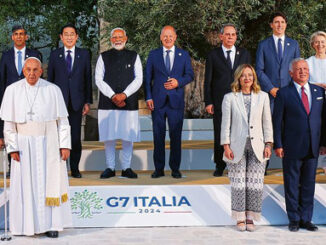
  • Why G7 needs allies like India

    Why G7 needs allies like India

    New Delhi occupies a unique place as an oasis of political and economic stability

    The G7 meeting has brought out just how fragile the world order is these days. India occupies a unique position here as an oasis of political and economic stability, but it cannot but take into account the turbulent waters that are washing its shores.

    By Manoj Joshi

    Prime Minister Narendra Modi’s presence as an outreach guest at the G7 summit in Italy is a useful backdrop for the launch of the new government’s foreign and security policy.

    India is not yet the world power it wants to be. What we need to guard against are hubris and overreach. The G7 meeting has brought out just how fragile the world order is these days. India occupies a unique position here as an oasis of political and economic stability, but it cannot but take into account the turbulent waters that are washing its shores.

    The political situation in four of the G7 nations appears brittle — the US and the UK are going to the polls amid uncertainty, while Germany and France are witnessing the rise of right-wing forces. Two of the big world powers are, of course, entirely out of the G7 process, which purports to promote democracy. But those two, China and Russia, are making major efforts separately and collectively to challenge the G7’s purported global hegemony.

    The presence of India, Turkey, Brazil and some other countries is an acknowledgement that the G7 needs allies to manage issues relating to migration, climate change, economic competition with China and the wars in Ukraine and Gaza. In turn, these countries are seeking to persuade the G7 nations, which are increasingly economically and demographically challenged, on the need for more equity and balance in global decision-making.

    In all this, Modi’s central challenge and opportunities are in India’s neighborhoods and beyond. While continuity has been the central message that the BJP-led NDA government has sent out, there will be inevitable changes arising from the very fact that the General Election has shifted the national political paradigm.

    The presence of leaders from Bangladesh, Bhutan, Nepal, Sri Lanka, Maldives, Mauritius and Seychelles at the swearing-in of the new government speaks for itself, as does the fact that the leaders of Myanmar, Pakistan and Afghanistan were not invited. India’s relations with those invited are fairly even, even though we face challenges in Nepal, Sri Lanka and the Maldives. The participation of Maldives President Mohamed Muizzu was significant because of our strained relations with the island republic.

    The Indian strategy of riding out the Chinese challenge in the neighborhood was most visible last year when Sri Lanka faced a financial crisis. China played hard to get, but New Delhi immediately provided humanitarian and financial assistance of $4 billion, surpassing even the International Monetary Fund’s (IMF’s) 48-month bailout package of $3 billion. By providing financial assurances, New Delhi also shored up Sri Lanka’s IMF process.

    The absence of Pakistan, whose then Prime Minister Nawaz Sharif had attended PM Modi’s 2014 swearing-in, has its own story of just how sharply India-Pakistan relations have deteriorated, even though the government in power is that of the Pakistan Muslim League (Nawaz), albeit in a coalition.

    India says it emphasizes its Neighborhood First policy as well as SAGAR (Security and Growth for all in the Region) for the Indian Ocean Region (IOR). It has China very much on its mind. Whatever may be the military challenge India confronts along the disputed border, the one it faces from China in South Asia and the IOR is equally significant and has implications for the geopolitical future of the region.

    China, too, is a neighbor and, it too, was not present. In an interview to Newsweek on the eve of the General Election, Prime Minister Modi had noted that there was a need to “urgently address the prolonged situation on our borders so that the abnormality in our bilateral interactions can be put behind us.” Last week, speaking in Mumbai after taking charge of the Ministry of External Affairs for a second term, S Jaishankar said India would focus on finding solutions to the border issues that had bedeviled their relationship.

    American ties with New Delhi are on a high after Modi’s Washington visit last June. While US elections could disrupt some of the bonhomie, they are unlikely to lead to any major change. But managing ties in a potential Trump presidency will definitely be a strain, though the Gurpatwant Singh Pannun issue is unlikely to create major problems. The American focus, regardless of who wins, is likely to be China, though there is a danger that another US-China tariff war could affect us in the form of collateral damage.

    India’s ties with Russia are definitely being tested by the Ukraine war. India may be gaining from its oil purchases, but it is alienating its Western allies. As the situation in Ukraine remains serious, pressure on the West to step up its support to Ukraine brings pressure on India indirectly. Having told Putin that this was not the era of war in 2022, Modi is now hard put to come up with some initiative which will lend credibility to India’s proposition that the issue could be settled through dialogue and diplomacy. In the meantime, New Delhi continues to walk a tightrope — it attended the Swiss peace conference, but not at the Prime Ministerial level.

    Another area which may require attention is West Asia, where Modi deserves credit for building solid ties with the UAE, Israel, Saudi Arabia, Qatar and Egypt. These were not just about the nine million-strong diaspora or energy security but also aimed at tapping the region for investment and buying into their plans for a post-oil future. At present, however, new initiatives like the Israel-India-US-UAE grouping and the India-Middle East-Europe Economic Corridor (IMEC) have sought to link Indian ports to Europe via the Israeli port of Haifa. Significantly, the G-7 communique pledged support to the IMEC.

    India is not yet the world power it wants to be. As a leading power, however, there are opportunities for taking initiatives and shaping policies both in the neighborhood and beyond. What we need to guard against are hubris and overreach.

    (The author is a Distinguished Fellow, Observer Research Foundation, New Delhi)

  • Devesh Chandra Thakur, MP-elect  needs to be disciplined for his discriminatory statement

    Prof. Indrajit Saluja
    By Prof. Indrajit S. Saluja

    The oath of office taken by a new Member of Parliament (MP) in India is not merely a procedural formality but a solemn commitment to uphold the highest standards of democratic principles, equality, and justice. When an individual assumes office as an MP, they pledge to serve their constituents without any discrimination and to uphold the Constitution of India, which is the bedrock of our nation’s democratic framework.

    The oath, mandated by the Third Schedule of the Constitution of India, emphasizes the MP’s duty to bear true faith and allegiance to the Constitution, to faithfully discharge their duties, and to do right to all manner of people in accordance with the Constitution and the law. It is a clear directive that MPs are duty-bound to represent and serve all constituents irrespective of caste, creed, religion, or socio-economic status.

    However, recent remarks made by Devesh Chandra Thakur, MP-elect from the Sitamarhi Lok Sabha seat, have brought into question his commitment to this oath. His statement openly declaring that Muslims and Yadavs did not vote for him and that he will not attend to their “personal work” is not just a political faux pas but a violation of the core principles enshrined in the Constitution. Such statements undermine the very essence of democratic representation and equality before the law.

    The Constitution of India guarantees every citizen the right to vote freely and without fear of discrimination or reprisal. By suggesting that certain groups of voters are not deserving of his attention or support based on their demographic characteristics, Thakur has not only betrayed the trust of those who voted for him but also violated the principles of equality and non-discrimination that MPs are sworn to uphold.

    In response to such egregious violations of the oath of office, there is a legitimate call for parliamentary action. Parliament has the responsibility to uphold the integrity of its members and the sanctity of the oath they take. This includes considering measures such as suspension or censure for MPs who fail to adhere to the principles outlined in their oath. The judiciary, too, plays a crucial role in ensuring that such violations are addressed in accordance with the law and the Constitution.

    The  condemnation of Thakur’s statements should be unanimous and unequivocal. Leaders across party lines, civil society, and the public at large must speak out against any attempt to undermine the foundational values of our democracy. The freedom to choose representatives without coercion or discrimination is a fundamental right that must be safeguarded at all costs.

    It is imperative that actions speak louder than words in upholding the sanctity of the oath of office. The repercussions of allowing such statements to go unchecked are profound. They erode public trust in democratic institutions and perpetuate divisions within society based on identity politics rather than merit and governance.

    As custodians of democracy, we must ensure that such violations are not tolerated and that the rule of law prevails for the collective benefit of all citizens.

  • New dynamics: On the G-7, its identity, its purpose

    G-7 must review its own purpose in a rapidly changing world

    Welcoming leaders of 10 countries including Prime Minister Narendra Modi to the “G-7 Outreach” Summit, Italy’s Prime Minister Giorgia Meloni said it was important to step away from the old trope of the “West vs the Rest”. That sentiment explained Italy’s decision to invite mainly the Global South countries including BRICS notables such as Brazil, India, and the UAE, to hold an outreach with seven African countries on energy issues, and to host the summit in the Mediterranean Apulia region. The G-7 was once hailed as a dynamic group of the world’s most developed democracies where heads of state would roll up their sleeves once a year to effect real solutions to global financial and development issues. However, with manufacturing slowdowns, the COVID-19 pandemic, and the impact of the Russia-Ukraine conflict and western sanctions, the grouping has appeared more tired, and its meetings less effective. The shaky electoral fortunes of most of the G-7 leadership did not enhance that image at the summit. The joint communiqué read more like a laundry list of the world’s problems than it did as a strong call to action on resolving them. Most salient was the G-7’s continued “military, budget, humanitarian, and reconstruction support” for Ukraine, but with no constructive plan on how to end the war. A Gaza ceasefire appeal has also not been accepted by Israel. The G-7’s focus on China in the Indo-Pacific and on “industrial targeting” and unfair practices was particularly sharp, but it remains to be seen whether any member-country will reduce its own considerable trade ties with Beijing. A line in the communiqué that recommitted to about eight infrastructure corridors, including the India-Middle East-Europe Corridor, reinforced the lack of focus on executing (as distinct from discussing) projects.

    Given the G-7’s current situation, India, in attendance for the eleventh time, could well take stock of the engagement’s utility. While the event was an opportune moment for Mr. Modi, now in his third term, to meet with some of the world’s top leadership, the meetings themselves did not yield many outcomes. Formal bilaterals with the leaders of important partner the U.S., and fractious relationship-ridden Canada, did not materialize. Mr. Modi focused on India’s elections as a “victory for the democratic world”, on the importance of harnessing technology and artificial intelligence to bridge global inequalities, and on the value of the Global South, especially Africa. It would seem most of those issues would be better addressed in a larger and more representational format such as the G-20, while the G-7 may wish to review its own identity and purpose amidst a rapidly changing global power dynamic.

    (The Hindu)

  • Priyanka’s poll debut: Congress takes right call to field her from Wayanad

    The Congress’ encouraging performance in the recent Lok Sabha elections has prompted former party president Rahul Gandhi to retain the Raebareli Lok Sabha seat in Uttar Pradesh and vacate the one in Wayanad, Kerala. His sister, Priyanka Gandhi Vadra, who was appointed Congress general secretary in 2019, will make her electoral debut in the Wayanad bypoll. The grand old party, which had been reduced to a nonentity in UP, made a comeback in the 2024 parliamentary polls in alliance with the Samajwadi Party (SP). The Congress bagged six seats, including the Gandhi family bastions of Raebareli and Amethi. Priyanka is believed to have played a key role in helping the party win the two prestigious seats, especially Amethi, where Rahul had suffered a shock defeat in 2019.

    It is obvious that the Congress wants to build on the gains made in UP and actively assist the Akhilesh Yadav-led SP in dislodging the ruling BJP in the 2027 Assembly elections. Rahul’s long-term presence in the state is a must to energize the party rank and file. For the record, the Congress had hit a new low in the 2022 Assembly polls, winning just two seats in the state with the highest political stakes.

    Having made major inroads into the South in recent years, the Congress has chosen a presumably easy seat for Priyanka. The Congress-led United Democratic Front swept the Lok Sabha polls in Kerala, winning 18 of the 20 seats, even as the BJP managed to open its account. Both the BJP and the CPI have trained their guns on Rahul, alleging that he did not inform voters of Wayanad beforehand about his plan to contest from two constituencies. Nevertheless, the Congress is confident that the electorate of this constituency will send another Gandhi to Parliament, that too a first-timer, thus strengthening the resurgent Opposition.

    (Tribune, India)

  • ‘EVENING OF ROSES’ HONORS PIONEER OF INTERFAITH BRIDGE-BUILDING

    Sr. Rose Thering (Credit: Courtesy shu.edu)
    • By Mabel Pais

    “I know the power of teachers. It is my deepest wish that teachers in our public and parochial schools, with scholarship assistance, will be able to enroll in Jewish-Christian Studies at Seton Hall University to stem the tide of ignorance in our schools and in society.” — Sister Rose Thering, O.P., Ph.D.

    In honor of Sr. Rose Thering, Catholic nun-pioneer of promoting understanding and tolerance of Jewish-Christian faiths, Seton Hall University celebrates the 30th anniversary of the fundraising event in memory of her. The Annual Gala ‘Evening of Roses’ takes place on June 18, 2024 at 6 pm at the Seton Hall University’s Bethany Hall, 400 South Orange Avenue, South Orange, New Jersey 07079.

    HONOREES

    This year, Seton Hall University honors

    Daniel Mendelsohn, author of the international bestseller ‘The Lost: A Search for Six of Six Million,’ with the Sister Rose Thering Fund Award in the Humanities and Holocaust Literature;

    Cantor Perry Fine of Temple Beth Shalom in Livingston, NJ for his work in interfaith outreach with the inaugural Sister Rose Thering Fund Clergy Award, and

    Twenty Sister Rose Thering Fund Founding Supporters, women and men who worked closely and personally with Sister Rose to establish Seton Hall’s Fund. Get the complete list  at events.shu.edu/event/33510-evening-of-roses-gala-30th-anniversary.

    Sr. Rose with Theodore Bikel (past honoree). (Credit: Courtesy shu.edu)

    ‘The Evening of Roses’ is the major fundraising vehicle for the Sister Rose Thering Fund for Jewish-Christian Studies. Its aim is to promote the Fund’s work by honoring outstanding scholars in the field of Jewish-Christian relations and conferring honorary Doctor of Humane Letters as well as Humanitarian of the Year awards upon individuals who have demonstrated outstanding compassion, altruism, and courage in various endeavors. In past years, honorary degrees have been bestowed upon Professor Elie Wiesel, Cynthia Ozick, Sister Rose Thering, Judith H. Banki and Sir Martin Gilbert, Nechama Tec, Theodore Bikel and Dr. Eugene Fisher. 

    Each ’Evening of Roses’ event has attracted between 300-500 attendees whose participation and financial support have been rewarded by an outstanding program followed by a reception. Honored guests offer to sign copies of their most recent publications or serenade all with a song, such as Seton Hall’s friend Theodore Bikel has done.

    Sister Rose Thering

    “Children, our young people, are our future. A major challenge of our times is to face resolutely the responsibility to future generations.” 

    Sister Rose Thering (1920-2006), a nun of the Dominican Order, was a lifelong activist who fought anti-Semitism within the Catholic Church.

    Sister Rose Thering, in her doctoral research (1957-1961), did the pioneer investigation/examination of the most widely used Catholic religion teaching materials to see how we taught about other faith, ethnic, and racial groups.  It was a self-study that dealt primarily with our teachings about Jews and Judaism.

    A basic summary was taken to Vatican II (the Second Ecumenical Council of the Catholic Church) during the deliberations before the issuance of the Vatican document Nostra Aetate: Declaration on the Relation of the Church to Non-Christian Religions in 1965.  The document caused considerable debate at Vatican II but was finally passed on the last day of deliberations.  The 15 Latin lines of text have had a deep and lasting effect on how Jews are viewed by the Catholic Church and remain strongly fixed in church teachings to this day.

    Sister Rose was very active in building bridges between Jews and Christians.  When asked why she did this, her immediate response was: “Because an understanding and an appreciation of Jews and Judaism and the State of Israel helps me personally.  I hope and pray to become a better person, a better Christian.”

    ‘Sister Rose’s Passion,’ a 39-minute documentary film on her life, won an award at the Tribeca Film Festival in 2004 and was nominated for an Academy Award in 2005.

    Sr. Rose spent more than 40 years at Seton Hall University – teaching, speaking, developing programs, shepherding groups of religious and lay people to the Holy Land where she traveled more than 54 times.

    Sister Rose Thering passed away at her convent, The Siena Center of the Racine Dominicans in Wisconsin, on May 6, 2006.

    The Sister Rose Endowment for Holocaust and Jewish-Christian Studies honors her for her belief in the power of teachers to impart knowledge and understanding to young people.

    Learn more at shu.edu/sister-rose and shu.edu/sister-rose/evening-of-roses

    ——————————————————————-

    NJPAC COMMEMORATES JUNETEENTH

    HBCU graduates (Credit: njpac.org)
    • By Mabel Pais

    The New Jersey Performing Arts Center (NJPAC – njpac.org) hosts an in-person Standing in Solidarity event on Monday, June 17, 2024, at 6PM in honor of the Juneteenth holiday. This program marks the conclusion of the ‘Standing in Solidarity’ season, a series of Social Justice conversations often paired with a ‘PSEG True Diversity Film Series’ screening.

    Juneteenth, or Juneteenth National Independence Day, is a federal holiday in the United States. It is celebrated annually on June 19 to commemorate the official ending of slavery in the United States.

    “NJPAC is committed to bringing our community together to talk about the issues that are genuinely important to all of us,” says NJPAC President and CEO John Schreiber. “Both as virtual gatherings and, now, as really meaningful in-person events, the Arts Center’s ‘Standing in Solidarity’ conversations have been a unique opportunity for so many of us to learn, listen deeply and find common ground.”

    The documentary ‘Tell Them We Are Rising: The Story of Black Colleges and Universities’ (Firelight Films, 2018) is the ‘PSEG True Diversity Film’ and will be screened in NJPAC’s Chase Room at 6PM. Following the screening, a panel of prominent leaders — all graduates of historically Black colleges and universities (HBCUs) — will discuss the cultural, economic and social impact of HBCUs.

    PANELISTS

    The panel will be moderated by Calvin Ledford Jr., president of the PSEG Foundation and director of PSEG Corporate Social Responsibility.

    “In the heart of our nation’s story lies the profound legacy of historically Black colleges and universities. HBCUs exemplify hope, progress and opportunity,” says Ledford.  “As a proud alum of Hampton University, I am honored to moderate a panel discussion alongside fellow HBCU graduates. I look forward to exploring the impactful legacy of these institutions on American history, culture and identity. Together, let us celebrate Juneteenth and embrace the pivotal role HBCUs play in shaping generations and our nation.”

    Members of the panel include Brielle Lewis, director of Sponsorship Strategy & Activation at Prudential Financial, Dr. Karma Brown Warren, medical leader and phlebologist at Metro Vein Centers, Inc., and Mayor of the City of Newark, The Honorable Ras J. Baraka.

    “It is in relationships with both people and ideas that we define ourselves, and from there hone our dreams, and shape our world. That is why the educational, social and cultural dynamics of higher education institutions, and in particular, HBCUs, are so critical to America’s sound and solid foundation in peace and prosperity,” says Mayor Baraka. “Just as Juneteenth broke the last chain in the bond of slavery, HBCUs release the free expression of African American students as they claim their identities and forge their path forward.”

    Following the panel conversation, the Juneteenth festivities will move to the Hahne Building (54 Halsey St.) for an afterparty, starting at 8:45PM, hosted by Heritage Hall. Heritage Hall is the site of the pop-up photography exhibit “HBCU Experience” produced by students from MENTOR Newark. The interactive exhibit is designed to share the culture of the schools and show off HBCU pride.

    RSVP

    To RSVP and for more information visit njpac.org/event/celebrating-historically-black-colleges-and-universities-pseg-true-diversity-film-series.

     (Mabel Pais writes on Social Issues, The Arts and Entertainment, Spirituality, Cuisine, Health & Wellness, Business, and Education)

  • HOW DOES THE US PROMOTE HINDI TEACHING THROUGH FULBRIGHT-HAYAS PROJECT

    HOW DOES THE US PROMOTE HINDI TEACHING THROUGH FULBRIGHT-HAYAS PROJECT

    • By ASHOK OJHA

    When the US Department of Education awarded the collaborative projects of Yuva Hindi Sansthan and New York University Hindi language program for theme-based curriculum development with ‘Fulbright-Hays’ award, it made it clear that the United States was interested in promoting the teaching of heritage language of Hindi through authentic materials prepared on rich cultural topics of India. These awards were first granted to YHS-NYU for the first time in 2022 and then in 2023. Subsequently, program participants developed teaching materials on ‘Climate Change’ in 2022. The project required us to select a dozen teachers from the US and take them on a study tour to India so they could experience and explore firsthand the theme of ‘Climate Change and Sustainability’ and return to USA with authentic cultural knowledge and skills for teaching Hindi to the next generation of language learners. In 2022 we organized our participants a month-long tour to India with focus on marginalized communities and their traditional holistic interrelation with nature, on their reciprocal bond with nature and on local ecological traditional wisdom that deals with the extremes of climate change. Participants collected  area studies information, met and spoke with local people and recorded their real life experiences.

    At Sarnath

    Collaboration between YHS and New York University

    The collaboration between YHS and New York University Hindi language program led to 2023 YHS-NYU FULBRIGHT-HAYS award that required us to conduct a cultural study tour to India. Accordingly, we recruited participants from a diverse group of teachers and students from US school districts and colleges. The team of participants was led on the tour to India by myself, as the program director, and Prof Gabriela Nik Ilieva, NYU, as the academic director. The theme of the 2023 program was, ‘Living with Contentment in a Material World: Mindful living or wellness traditions in India’. The scope of the project was to explore how members of various Indian communities think or talk about mindful living, on one hand, and on the other exercise mindful living, ideas and behaviors rooted in ancient traditions and textual sources. The concepts of mindfulness and wellness have gradually emerged as dominant lifestyle constructs which are believed to have derived from Indian philosophical traditions and practices, more specifically Buddhist, Jain and Upanishadic thought, rituals and practices. The West, especially the U.S. has embraced yoga and meditation practices which have also originated in India. Yet, although the Indian philosophical traditions about mindful living and their practical implications leading to well-being are recognized and valued globally, both in the Western and the Eastern world, they are not consistently studied and explored throughout the Hindi curricula. The purpose of the tour was to provide opportunities for participants to engage in collecting authentic, cultural products, realia, workshops under the guidance of Academic Director Prof. Gabriela Nik Ilieva. Traveling from one location to another the group studied the traditions and cultural contexts of common folks who are living a contented life within their limited resources for generations.

    At Tibetan Institute in Sarnath.

    The participants engaged themselves in critically examining environmental and related socio-cultural issues and observed and learned the culture of various communities. The end goal of the project is to create an instructional platform that will support the teaching of traditional mindful practices and perspectives more consistently and more cohesively in the Hindi and South Asian Studies classrooms in the U.S., based on focused information and well-designed instructional materials. Our daily activities began with a Hindi session to discuss usage of Hindi by local people and a reflection session to review day’s activities and take aways from previous day’s field trip. 

    The Study Tour

    When the group arrived in India, the group members took advantage of the opportunity to interact with students of the Kendriya Hindi Sansthan,  a Government of India, Ministry of Education  institution solely designed to teach Hindi to non—Indian students whose mother tongue was not Hindi. Sansthan’s students travelled from Agra to Delhi to meet with our group members. Both sides interacted on topics of mutual interests. Next day we left for Rishikesh where our host was   ‘Arsh Vidya Gurukulum’, an Ashram that offers a structured institutional environment. It was established by late Swami Dayananda Saraswati for promoting Vedanta and Sanskrit learning. . The Ashram is located on the bank of the holy river Ganga, which offered an ideal backdrop for relaxation and wellness. Swami Sakshartananda, Chairperson of the AVG, delivered an introductory lecture on ‘Mindfulness’ and ‘Santosha’ as defined in ancient Vedic scriptures. The Vedic scholars at AVG taught text-based Indian traditions, including the idea of Atman-Brahman relationship and the concept of detachment as explained in Hindu scriptures. Participants also interviewed local folks about their experiences related to the mindful traditions-mental balance, contentment, and wellness. A rich library  with hundreds of books on Vedic philosophy, culture, meditation and various healing methods, was available for reference at the Ashram.  We understood the traditional meaning of mindfulness and wellness during our four days stay at Arach Vidya Gurukulum in Rishikesh. We met a sadhu named Pipaleshwar Maharaj, a devotee of Lord Shiva, who lives under a Peepal tree, has built a temple there for the sake of protecting an age-old tree, while he preached locals about living a simple and contented life.

    Happy Thinking Lab

    Our second destination was Lucknow, the capital city of the largest state of India, Uttar Pradesh, where our host was Lucknow University, that has established a ‘Happy Thinking Lab’, whose goal is to discover indigenous Indian practices and perspectives to achieve happiness, because “many western concepts lack experiential validity in Indian Culture”. The Vice Chancellor of Lucknow University, Alok Kumar, briefed us about the ‘Happy Thinking Lab’, set up in the Psychology department of the university. Participants took advantage of the archives, libraries and lectures by faculty members of Lucknow University. They interacted, interviewed them and collected new authentic curricular materials in audio, video and script-based format in Hindi. The university also organized interesting cultural activities including Kathak performances, traditional story telling session  and  one act play depicting the social challenges female students face in the campuses of Indian universities.

    In Kolkata

    Varanasi and Sarnath

    Our third destination was Varanasi and its twin city Sarnath, the place known as the site of Buddha’s first sermon after he got enlightenment in Bodh Gaya. In Varanasi, the group’s first visit was the Hindi Department of Banaras Hindu University, our local host. The department organized a meaningful seminar on traditional practices observed in the Indian society, many of which are changing, thanks to the modern ways of city living. The seminar turned into an interactive session with students/faculty BHU on the topic of local varieties and styles of Hindi, narratives about contentment and wellness; lectures/demonstrations by experts and speeches on  mindful living, contentment and detachment. Some of the faculty members delivered lectures on Hindi as it is spoken locally. The next morning we visited a village named ‘Lamahi’, where the most respected Hindi author of 20th century, Premchand, was born and lived. Premchand’s literary works are narratives of social structures and their impacts on modern lives.  One of his stories, ‘Eidgah’ was subject of analysis at a workshop organized by the Women’s College of BHU where a discussion session on the merits o ‘Eidgah’, was held and a theatrical version of the story was staged for our group. BHU faculty members shared their research and insights on the social comments in Premchand’s literature. Our local coordinators conducted walking tour of narrow lanes of Varanasi that offered new light on the traditions of India. We visited the homes of legendary people, such as, Bharatendu Harishchandra, the doyen of Hindi language, who lived here. Participants experienced the juxtaposition of ancient ways and modernity as they went on a boat trip over the Ganga River and witnessed the expression of faith as people bathed in the holy water and walked to temples for a ‘Darshan’ of Lord Shiva on the festival day of ‘Mahashivaratri’. The visit to the ghats of Ganga river was also useful for the exploration of rituals related to perspectives on life and mortality. On way to Varanasi from Lamahi, our group visited homes of pot makers and their family members to learn their perspective of wellness and mindfulness and understand their concepts of contentment. We visited women handicraft workers at the Assi ghat where participants interacted with craftswomen about how they balanced their lies between household chores and making wooden dolls.  Their observation truly reflected points of intersection of modernity and family responsibilities. We felt the fresh, unpolluted air blowing from the river to the ghats  that rejuvenated the lives of people who bathed in the water of the Ganga for purity and freshness. The concept of purity and freshness is part of mental and physical wellbeing that is an important part of daily living in Indian traditional settings. The connection with nature constitutes life values that support wellbeing more than any medicine. No wonder Indians worship the river Ganga as their mother.

    We visited Sarnath where thousands of years old Stupa narrate stories of ancient times when Emperor Ashoka, left his throne to become a Buddhist monk and wondered in search of happiness (sukh). In order to propagate the teachings of Buddha for helping the mankind, he built 84 thousand stupas, only a handful of those remained intact today- one of which is in Sarnath. The stupas reflect Buddha’s first insights about human life, the ideas of impermanence and the Middle Path offering the right steps to avoid extremes. We witnessed the Ashoka pillar, the national emblem of India, safely preserved in the museum of Sarnath.  Next morning we visited the Central Institute of Higher Tibetan Studies, established at the behest of the Dalai Lama after he made India his home, where we listened to Buddhist monks and learned  the true sense of mindfulness and wellness as defined in the Tibetan traditions. Our participants had a chance to practice meditation guided by experts of Tibetan Schools and discuss with them the mental and physical effects of meditation. Several outdoor learning sessions were arranged for participants to collect local artifacts and audio-visual materials around the archeological excavation sites, museums, monuments, etc. Our participants took advantage of Benares Hindu University Department of Hindi library (Hindi Bhavan). 

    At Shantiniketan

    Visiting Shanti Niketan

    Next stop-Kolkata. During our weeklong stay in Kolkata, we explored several socio-cultural factors which helped unpack mindful living.  Unlike the Western society, which predominantly puts impetus on ‘individualism’, the Indian society is mostly ‘collectivistic’ in that it promotes interdependence and cooperation, with the family and the community forming the focal point of this social structure and identity formation. A closer examination of the understanding and exercising of the two dynamic and multidimensional concepts – mindfulness and wellness – among various social groups in India deepened our understanding of the Indian society and its cultural traditions.  We first visited Belur Math, where monks follow the path of happiness shown by Ramkrishna Paramhans and Swami Vivekananda. We understood the concept of wellness through mindfulness through programs developed by monks. Soon after that we were exploring the literary traditions of the Nobel Laureate Rabindra Nath Tagore at Thakur Bari, the birthplace of Rabindranath Tagore,. We were treated with cultural performances by the students of Tagore University that dealt with the issues of modern times. We learned Tagore’s ideas of global vs. national harmony while interacting with the Hindi speaking migrant workers, the legendary hand rickshaw pullers and taxi drivers. Field trips to college street, India’s largest and biggest open book market was organized for the group that reflected on the social and cultural life of the youth of Kolkata. We visited the campus of Shantiniketan, also known as ‘Vishwa Bharati’, that implements the vision of Tagore as there are no exams only learning through practice of art and culture. Students explored relationship between art and society and are groomed as adults with creative minds. The university organized varieties of cultural performances based on Rabindra Sangeet for us.

    With Rabindra Sangeet artists

    The land of great artists

    Our final destination was Madhubani, Bihar, where we experienced Art as an expression of the understanding of the laws of the universe and human life. Here the artistic expressions by women were displayed through artistic paintings with vivid colors. From the walls of Madhubani Railway Station to people’s homes, paintings are integral part of the lives of people. Art made a daily ritual for local people. We were immersed in cultural activities at Madhubani and later at Rajnagar ruins that provided backdrops of local culture including ‘celebration of joy’ (khushi manaanaa). Madhubani art, also called Mithila art is recognized for its unique representation of local ideas of the balance between the universe and human life on a mythological and ecological level. The township of Madhubani is also homes of half a dozen women artistes who have been honored with India’s greatest civilian award, the Padma awards, for their artistic expressions in paintings. These paintings  adorn national organizations of Art, such as, the Indira Gandhi National Center of the Arts. We met Buwa Devi and Dulari Devi, both awardees of Padma Shri,  at their homes. They conducted workshops for us. These local artists use local organic materials to create their paintings: plants to mix colors, cow dung to treat the paper and bamboo sticks to serve as brushes. The abundance of nature and visually presented creation mythological narratives is an essential feature of Madhubani paintings. Some of the most popular images are the sun, the moon, birds and animals, the sacred Tulsi plant and Banyan tree. The art is an expression of local understanding of how the universe was created and exists in balance and harmony. Mithila artists have made paintings on independence, peace, marriage, etc. Examining these paintings and discussing their topics with the local artists shed light on their understanding of wellness and mindfulness.

    On way to Rishikesh

     Promotional Activities

    On our return to USA, participants got busy transforming their experiences, gained during the Study Tour, into teaching materials. Working in teams they shared their feedback on location specific topics. They organized, reviewed and evaluated each other’s work. All participant products were evaluated to ensure backward design, can-do statements and performance assessment descriptions as well as compliance with the linguistic functions, context and content, accuracy and text type. Final products reflect standards-driven, theme-based instructional materials integrating language, culture and content, transparent and systematic use of educational technological tools, curricular materials enabling differentiated instruction for heritage and non-heritage secondary and post-secondary language learners, project-based learning approaches and KWL model. Participants met online to present the material they developed, to make and receive peer review and feedback. They have documented and explored their experience of Indian traditions of wellness and mindfulness among rural, urban, immigrant, institutional or religious communities. The final materials  prepared by our participants will be shared at various fora. Each participant will teach their final products to learners in their respective home institutions to test their quality and potential issues in the process of implementation. They will present final documents in their respective school district classrooms, in faculty meetings and brown-bag meetings. They will also familiarize local communities with their accomplishments and experiences during the program. These are the practical ways of teaching and learning a heritage language.

    (Ashok Ojha, program director, 2023 YHS-NYU FULBRIGHT-HAYS GPA PROJECT, and president of Yuva Hindi Sansthan, a 401-C-3 non-profit institution may be reached at aojha2008@gmail.com)

    In Indian apparel


  • Sriniketan Foundation  celebrates Buddha Purnima with music and dance

    Sriniketan Foundation celebrates Buddha Purnima with music and dance

    Award-winning and internationally acclaimed Manipur and contemporary dancer Sanjib Bhattacharya with his disciples Jeslin Jacob, Jolly Lairenjam, Chaobithoi Lairenjam Devi, and Jessi Leirenjam.

    FLUHING, NY (TIP): Sriniketan Foundation headed by Purnima Desai, a dedicated practitioner and  promoter of Sanskrit language and Indian music and dance forms organized a music and dance  evening with international artists in celebration of the Buddha Purnima. The “performance was inspired by the Buddha’s last words: “Be a lamp unto thyself”, said  Mrs. Desai.

    It was  a  rare, soulful cultural program at which  renowned artists created ripples of pleasure for the audience who watched and listened to the performances with rapt attention.

    The program on May 25 started with devotional songs rendered by Mrs. Purnima A. Desai, who founded Sriniketan as a nonprofit in 2015. Captivating instrumental and vocal music recitals, as well as dance performances, mesmerized the appreciative  audience of over 200 people.

    (Photo S 2 here)

    The highlight of the evening program at the Ganesh Temple community center in Flushing, NY, was “Nalanda—The Lotus Flower Givers,” choreographed by the award-winning, internationally acclaimed Manipur and contemporary dancer Sanjib Bhattacharya. Featuring his disciples Jeslin Jacob, Jolly Lairenjam, Chaobithoi Lairenjam Devi, and Jessi Leirenjam, it delved into the profound teachings of Lord Buddha.

    Inspired by Buddha’s last words, “Appo deepo bhava” (Be your own lamp), the performance replete with graceful movements invited all to reflect on their own journey towards self-discovery and enlightenment. Chants of “Om Mani Padme Hum” and “Buddham Sharanam Gachami” resonated in the hall.

    Other artists who performed included:

    Minakshi Majumdar –Classically trained Vocalist accompanied by Anirban Chakrabarty on Harmonium and Amit Kavthekar on Tabla

    Minakshi Majumdar –Classically trained Vocalist

    Anirban Chakrabarty – Harmonium Player

    Chief guest Prof. Indrajit S Saluja honored Oindrila Roy Mallick who gave a scintillating performance of Bharatanatyam, an Indian Classical dance form. In the picture, from L to R: Mrs. Purnima A Desai, Oindrila Roy Mallick, Prof. Indrajit s Saluja

    Oindrila Roy Mallick – Bharatanatyam, an Indian Classical dance form

    Pandit Partha Bose – World renowned Sitarist- with Indranil Mallick on Tabla

    Pandit Partha Bose – World renowned Sitarist

    Suddhashil Chatterjee on Santoor, accompanied by Amit Kavthekar on Tabla

    Suddhashil Chatterjee –Santoor

    Volunteers who gave their best to organize a truly enjoyable evening of dance and music.

    Run selflessly by Mrs Desai, a Reiki Grandmaster and promoter of Indian culture and arts, the Sriniketan Foundation has been serving the community for many years. It educates the younger generation by holding cultural events such as the annual “Shyama Shyam Shashtriya Sugam Sangeet Sammelan”, as well as training them in Indian classical music and dance forms. The organization also offers natural healing therapies, yoga, music therapy, meditation, reiki, and more.

    For information visit, www.sriniketanfoundation2015.org


  • The Rotary Club of North Shore celebrated the “Rotary Day of Service” on May 18,2024 with “Blood Donation”

    The Rotary Club of North Shore celebrated the “Rotary Day of Service” on May 18,2024 with “Blood Donation”

    LONG ISLAND, NY (TIP): May 18,2024 was celebrated as “Rotary Day of Service” by several Rotary Clubs around the nation and internationally. The celebration is by doing different humanitarian projects.
    “Blood Donation” is a unique project where every human being can help save a life without spending a single penny. One person donating blood saves three human lives. The impact of “Blood Donation” is three-fold.
    The Rotary Club of North Shore is only 7 months young, but they aim high and have a great team.
    The President of the club Dr. Mamta Shaha expressed her vision of making May 18, as a “World Rotary day of Blood Donation” in future. She did reach out to Rotary Clubs around District 7255, 3132 and 3030.
    The project chair Mona Gohil, P R chair Gunjan Rastogi and President Mamta Shaha donated blood along with other volunteers at the NY Blood Center in New Hyde Park, NY
    The total blood donations on May 18,2024 at this center as given by the NY Blood Center in New Hyde Park, NY
    Whole Blood Donations: 28
    Double Red Cell Donations: 8 units from 2 donors
    Platelet donations: 20 units from 9 donors
    Double Red Cell and Platelet combined donations: 3 units from 1 donor
    Total lives saved-177 just in one day!!
    You can see the impact of this project just at one center!!
    There cannot be any project as powerful and impactful in saving human lives as donating blood.

  • GOPIO Manhattan and  Happy Life Yoga Celebrate International Yoga Day 2024

    GOPIO Manhattan and Happy Life Yoga Celebrate International Yoga Day 2024

    NEW YORK (TIP): On the occasion of International Yoga Day 2024, GOPIO, and Emmy-nominated filmmaker & Happy Life Yoga speaker Tirlok Malik along with the Indian Panorama & Indian American Forum will be hosting a highly interactive and informative Yoga event featuring experts and speakers from various walks of life.  The theme for this year addresses the basic question: “There are challenges and hardships in life, but how you let them go and laugh at life?”
    Ambassador Binaya Srikanta Pradhan, Consul General of India in New York will be the chief guest. Other speakers will include Dr. Thomas Abraham, Professor Indrajit Saluja, Indu Jaiswal, Anil Narang, Lal Motwani (GOPIO International President), Neeta Bhasin, Dr. Renee Mehra, Deborah Fishman, Neha Lohia, Priti Dhariwal, Dr. Tara Shajan, and Dr. Bhuvan Lall.

    The Zoom session will be held on Sunday, June 22nd from 11:00am – 12:30pm (East) (US and Canada). Interested participants can join the session using the meeting ID: 709 536 8686 and passcode: gopio.

    The event promises to be energetic, knowledgeable, inspiring, and celebratory in nature. Malik will interact with all the prominent speakers on the panel to discover their own personal mantras for happiness. While emphasizing the growing importance of Yoga in today’s times, session host Malik explains his vision behind Happy Life Yoga and its underlying philosophy as “a way of living inspired by the wisdom of Ayurveda, Yoga and Indian Philosophy.” Malik created the Happy Life Yoga workshop (No mats needed!) inspired by Ayurveda yoga and Indian philosophy as a practical way to live a happier and healthier life in today’s time. This interactive workshop emphasizes “love yourself,” and if you love yourself, it’s your responsibility to take care of your happiness and health, using the tools shared by Malik in this workshop. It’s the gift of ancient India, tested by science & time! The event is supported by many New York media outlets. Malik and the whole team look forward to the celebration of International Yoga Day 2024 and invite everybody to join!

  • “Mr. SALT” Tom Suozzi Returns as SALT Caucus Co-Chair

    “Mr. SALT” Tom Suozzi Returns as SALT Caucus Co-Chair

    NEW YORK / WASHINGTON, D.C. (TIP): Congressman Tom Suozzi (D – Long Island, Queens), who was nicknamed “Mr. Salt” by Crain’s New York Business for “his single-minded devotion to the issue,” has again been named a Co-Chair of the House SALT Caucus. SALT stands for the state and local tax deduction. The group is dedicated to relief from the $10,000 limit on the federal deduction for state and local taxes that was passed in 2017.

    “I have four priorities in Congress: 1) bring ‘order to the border,’ 2) bring money back to the district, 3) try and heal some of the partisan divides, and 4) restore the SALT deduction,” said Suozzi.
    The Congressman warned that the biggest battle for SALT restoration is yet to come. The 2017 bill that capped the SALT deduction at $10,000 is set to expire next year, in 2025.

    Suozzi warned that President Trump and the Republican majority threaten to eliminate the SALT deduction entirely if they take control. We must start preparing now to reinstate the entire SALT deduction.

    The cap on SALT deduction was “a punch in the gut” and “double taxation” for Long Island and Queens residents. Suozzi reminded us that SALT has been a staple of the federal tax code for more than 100 years.

    “It was one of the original federal tax deductions when the income tax was first established in 1913. Congress realized that it was inherently unfair to penalize Americans by requiring them to pay taxes on taxes they had already paid,” Suozzi explained.

    Since the summer of 2017, when Republicans first floated the idea that their new tax reform bill would cap the SALT deduction, Tom Suozzi has taken the lead in protecting and preserving it in the House of Representatives.

    During the last several years, because of his persistence, the House passed, with bipartisan support, three separate Suozzi bills to restore the SALT deduction. Unfortunately, the bills were always blocked by Republicans in the Senate.

    Suozzi returns to Co-Chair the caucus he first formed in April 2021 with Democrat Josh Gottheimer (NJ-5), Republican Michele Steel (CA-48), Republican Andrew Garbarino (NY-2), and 29 other bipartisan members.

    Suozzi left Congress at the end of the last session, 2022, and returned after winning last February’s special election to replace the expelled George Santos in the 3rd congressional district.

    “I will not rest until this unfair burden on New Yorkers is removed and the SALT deduction is restored,” he said.

  • AIA-NY honors 5 extraordinary individuals at its annual gala

    AIA-NY honors 5 extraordinary individuals at its annual gala

    (From left) Mrs. Meena Gupta, Dr. Gupta, Senator Chuck Schumer, Honorees Mr. Naveen Shah, Dr. Raman Sharma, Prof. S.N. Sridhar, Dr. Vishal Kapur and Dr. Rekha Bhandari.

    US Senate Majority Leader Hon. Chuck Schumer was the Chief Guest of Honor

    GREAT NECK, NY (TIP): The Association of Indians in America (AIA) NY chapter held on June 3, its Annual Gala under the leadership of Dr. Jagdish K. Gupta to raise funds for the 37th Deepavali Fest slated for October 6, 2024, and for the ‘AIA-Educational Project,’ to empower Indian-American students in need to achieve their educational potential and dreams.

    The Gala was attended by 200 distinguished members of the community, including past presidents and members of the Advisory Board of Trustees of AIA. It was held on June 2, 2024, at the redesigned Crystal Ballroom of Leonard’s Palazzo Exquisite Banquet Hall in Great Neck.

    Dr. Sumita Sengupta (Gala Co-chair), Assemblyman David Weprin, Dr. Raman Sharma, President Dr. Jagdish Gupta, and Chairman of Board Dr. Samin Sharma.

    Honorable Senate Majority Leader Chuck Schumer was the Chief Guest of Honor. In his remarks, he highlighted his visit to India, the importance of strong India-US ties, and praised Indian leaders, culture, traditions, and the community’s contributions to education and healthcare. He emphasized the strong maritime defense ties between the two countries in the Indian Ocean. He also applauded Indian physicians and parents for their commitment to education, drawing parallels with the Jewish community. His remarks received multiple rounds of applause and ended with a standing ovation.

    New York State Assemblyman David Weprin from District 24 was an honored guest. He has been a staunch supporter of the AIA-NY, helping to secure Alternate Day Parking suspension on Diwali each year and advocating for Diwali as a school holiday in New York City. He expressed his pride in supporting the Indian community and emphasized the importance of cultural recognition in fostering a diverse and inclusive society.

    Vote of Thanks from the Executive Committee group actively involved with Gala Celebrations.

    In keeping with the theme of Women’s Empowerment, Dr. Rekha Bhandari, Chief Medical Officer for the MedElite Group/Allure Group/Vis-à-vis Health, was honored with the ‘Excellence in Healthcare Award’ for her innovative contributions to healthcare. In her acceptance speech, she expressed her hope to inspire women in healthcare. She stated, “I am humbled and honored to receive this award from one of the oldest ethnic organizations. I hope my journey serves as a trailblazer for other women to follow and get inspired in the healthcare field.”

    Mr. Naveen C. Shah, CEO of Navika Group of Companies and Blue-Sky Hospitality Solutions, received the ‘Entrepreneur Par Excellence Award’ for his success in building a multibillion-dollar conglomerate and his philanthropic efforts supporting numerous nonprofit organizations. In his speech, Mr. Shah paid tribute to all the AIA founders, past presidents, Board of Trustees, advisors, and current officers for their dedication and relentless efforts in supporting Indians in America. He remarked, “Our unity and support has been pivotal in promoting Indian culture and heritage in the USA.”

    Dr. S.N. Sridhar, Distinguished Professor of Linguistics and India Studies at Stony Brook University, was recognized for ‘Excellence in Literature, Linguistics & founding India Studies at Stony Brook University.’ His significant contributions to bilingualism and multilingualism studies and co-editing the book ‘Ananya: A Portrait of India’ were highlighted. He shared insights into his research and its impact on promoting cultural understanding.

    Senator Schumer and Honorees – Dr. Vishal Kapur with his family, Dr. Raman Sharma & Mrs. Clara Sharma, Mr. Naveen Shah & Mrs. Rajshree Shah.

    Dr. Vishal Kapur and Dr. Raman Sharma from Mount Sinai Health System were also honored. Dr. Kapur received the ‘Excellence in Cardiology-Vascular & Endovascular Medicine’ award, while Dr. Sharma was presented with the ‘Special Young Physician Award for Excellence in Endovascular Intervention’. Dr. Kapur spoke about the advancements in endovascular treatments at Mount Sinai and the importance of innovation in patient care. Dr. Sharma highlighted the significance of his work in saving limbs from ischemia in diabetics and preventing strokes in patients with carotid artery blockages.

    The evening began with a social networking hour featuring cocktails and Indian hors d’oeuvres, followed by entertainment including live performances by Ms. Tanmayee Mohapatra and Ms. Jagabattula Maheshwari. Mrs. Beena Kothari, Vice President and Gala Chair, welcomed guests and introduced Dr. Jagdish Gupta, who spoke about the significance of Deepavali Celebrations and the importance of supporting educational excellence in the Indian-American community.

    Dr. Samin Sharma, Chairman of the AIA Board of Trustees, highlighted the achievements of Indian Americans in healthcare and corporate America.

    Citations for AIA-NY and the honorees were received from various dignitaries, including the Indian Consulate, Congressman Tom Suozzi, Nassau County Executive Bruce Blakeman, and New York State Senator Kevin Thomas.

    Dr. Gupta thanked all the sponsors and partners, including Fareportal – CheapOair, Mount Sinai Hospital, Northwell Health System, Mattoo Center for India Studies, Brooklyn Hospital Center, Navika Group of Companies, Blue-Sky Hospitality Solutions, Parker Jewish Institute, CenterLight Healthcare, and media partners. The event concluded with a sumptuous dinner, dancing, and entertainment.

    AIA is one of the oldest ethnic organizations representing the Indian community in America. It aims to promote cultural understanding, assimilation, and recognition of Indian traditions and heritage in the United States.

    Contact: Dr. Jagdish K Gupta, email: Jagdishkgupta@gmail.com

    (from left) Mrs. Meena Gupta greeting Senator Schumer, Beena Kothari – Gala Chair, AIA-NY President Dr. Jagdish Gupta, and Mr. Naveen Shah-Honoree. (Photos Credit : AIA-NY)
  • Hill stations in West India for an exhilarating journey

    Hill stations in West India for an exhilarating journey

    For a traveler with an insatiable thirst to discover new places, no other place offers choices as better as India, a land where different cultures, languages, and religions thrive together. It’s a country with vast geographical diversity, the very trait every seasoned traveler looks for while choosing a destination. If you are in search of a region where you get to view all kinds of landscapes India is known for, then head to its Western shores. The Western part of India is studded with many distinct geographical features that pose a wonderful contrast against each other, bringing out their real worth.
    So if you get a sight of a hillock while hitting a desert or view mammoth cliff tops near the beaches, it’s perfectly fine to stop and ponder over the amazing spectacle. To fully absorb the geographical details of western India, taking a trip to its hill stations is the best thing you can do. The location of these green hillocks is ideal to scan the variegated landscapes situated at their base. Take a look at this Hill Stations in West India to unearth the hidden treasures that deserve every bit of your attention in West India Tours.
    Mahabaleshwar
    Mahabaleshwar is a vivacious town that takes everyone by surprise with its enchanting greenery and serene views. Situated in Maharashtra this beautiful hill station is enveloped by the Sahyadri mountain range offering a host of natural vistas that are a treat for the eyes. Mahabaleshwar is bestowed with multiple beautiful waterfalls and lakes and every inch of this mesmerizing hill station is drenched in purity and calmness that has a wonderful effect on your soul. The town has earned a significant position in Indian history as it was ruled by many Hindu and Muslim kings who built several ancient structures including a 500 years old temple and a scenic fort situated at the edge of a cliff.
    Panchgani
    This pretty hill refuge located within the five mountains in Sahyadri Mountain range proposes many delightful prospects for seekers of nature and peace. Its short distance from Mahabaleshwar makes it a must-visit destination for travelers who plan a trip to Mahabaleshwar. This place has lots of scenic spots to spend your time in tranquility. The dense patches of greenery you come across on your way to Panchgani put you in a relaxed state and prepare you to be ready for other strikingly beautiful natural treasures hidden in its different locations.
    Mount Abu
    This charming hill station has been rightfully named ‘An oasis in the desert’ as it’s the only hill station in Rajasthan. Throughout its history, this place has remained the preferred escape from the sweltering heat of Rajasthan for many Rajput rulers who built their beautiful summer palaces here. The climate of this hilly resort is quite unlike the climate in deserts; hence it makes for an ideal refuge to escape the sweltering heat of deserts in Rajasthan Tour India. The forests of Mount Abu host fledgling wildlife worth observing.
    Khandala
    A revered holiday spot for a majority of folks residing in Mumbai and Pune, Khandala holds a veritable existence as one of the best hill stations in India because of its pleasant weather. It is home to a great number of hillside forts, waterfalls and cliff tops giving a distinct feel to its hilly landscape. The trails and terrains leading up to the cliffs and valleys nearby introduce you to the massive variety of plant and wildflower species growing in the region. This is one place that lets you enjoy every season in the best way as the weather here does not get harsh.
    Saputara
    Being one of the few hill stations in the state of Gujarat, Saputara is a popular tourist getaway that sees a great influx of tourists from in and around Gujarat for an up-close experience with nature. Venturing into this gorgeous piece of land is a breathtaking experience for those who have spent some days touring the salt deserts of Gujarat. The cascading waterfalls, lush forests and gardens create a beautiful harmony enough to compel the visitors to prolong their stay in India Tours.
    Lonavala
    For decades, Lonavala has remained a favored holiday destination for city dwellers as well as for those on a lookout for a peaceful place away from the noise and traffic of cities. Inspite of the modernization that took place in all these years, this place still carries a natural charm that appeals to visitors of all kinds. You can find many cafes in Lonavala surrounded by a thick green patch to sip coffee and read your favorite book.
    Chorla Ghats
    Chorla Ghats in Goa is no less than a paradise for travelers who wish to escape the beach atmosphere for a while to wallow in the beauty of nature’s treasures that are found in a hill station Tours. The soothing sights of waterfalls, Dams, and forests located near Chorla Ghats have a positive influence on your mind. The forests here own great biodiversity which includes many species of wild animals and birds and its worth it to visit the Wildlife sanctuary to take stock of different animal species and their natural habitats.
    Kamshet
    This hill station in Maharashtra is mostly thronged by adventure lovers as it happens to be a popular site for paragliding. You can find many flying academies in Kamshet owing to this reason. But if you are the one who just wants a peaceful escape, then this place is a treasure in its own right as it houses many enchanting sites to make your stay a dream one. Source: State Express

  • Nirjala Ekadashi

    Nirjala Ekadashi

    Nirjala Ekadashi falls on the eleventh day (Ekadashi) of the waxing fortnight in Jyestha month. The Ekadashi derives its name from the water-less (Nir-jala) fast observed on this day. It is considered most sacred Ekadashi. It is the most rewarding Ekadashi. Nirjala Ekadashi Vrat is one of the toughest fasts of Ekadashi that is observed by the devotees as the intake of both, food and water is strictly prohibited. Nirjala Ekadashi is dedicated to Lord Vishnu. It is also known as ‘Jyestha Shukla Ekadashi,’ Pandava Nirjala Ekadashi’ or ‘Pandava Bhima Ekadashi.’ Nirjala Ekadashi washes all the sins and connects the devotees to the supreme creator. The fasting is observed without drinking water and eating food. Nirjala Ekadashi is the toughest and significant Ekadashi that is undertaken by staunch Vishnu devotees.
    Nirjala Ekadashi will be celebrated on June 18 this year.
    Observing fast on this Ekadashi give the results equivalent to observing 24 Ekadashi of an year. After observing this fast, a person should wake up early in the morning on Dwadashi (a day after Ekadasi), take bath, make donation and offer food to Brahmans. The devotee must chant “Om Namo Bhagwate Vasudevay” and donate cow, clothes, fruits etc. on this day.
    LEGEND
    Nirjala Ekadashi is also known as Pandava Bhima Ekadashi, or Pandava Nirjala Ekadashi. This name is derived from Bhima, the second and strongest of the five Pandava brothers, heroes of the Hindu epic Mahabharata. The Brahma Vaivarta Purana narrates the story behind the Nirjala Ekadashi vrata vow. Bhima, a lover of food, wanted to observe all ekadashi fasts, but could not control his hunger. He approached the sage Vyasa, author of the Mahabharata and grandfather of the Pandavas for a solution. The sage advised him to observe Nirjala Ekadashi, when for one day in the year, he should observe an absolute fast. Bhima attained the virtue of all 24 ekadashis, by observing Nirjala Ekadashi.
    PRACTICES
    While on other ekadashis abstinence of food is observed,on Nirjala Ekadashi, an absolute fast is observed, without partaking even water. The water-less fast is considered extremely difficult to follow as the day falls in the hot Indian summer and thus, it is deemed as very pious austerity. The fast is observed 24 hours from sunrise on Nirjala Ekadashi to sunrise the next day. Some observe it from sunrise to sunset. On the day before Nirjala Ekadashi, the devotee performs the evening prayer (Sandhyavandanam) and takes only one meal, without rice – as rice eating is prohibited. The devotee is however permitted to have a single tiny drop of water as part of the Achamana purification ritual. Water more than that equals breaking the vow.
    Like other ekadashis, puja is offered to the god Vishnu, for whom ekadashis are sacred, to seek his grace. An image of Vishnu or a Saligrama stone (an iconic fossil stone in the form of Vishnu) is bathed (abhisheka) with Panchamrita, a mixture of five foods: milk, curd, ghee (clarified butter), honey and sugar. It is then washed with water and then dressed in royal finery. A hand-fan is also offered. Flowers, incense, water and arati (lamps) are also offered. Devotees meditate on the image of the god. In the evening, they worship Vishnu with durva grass in their hands. Devotees remain awake the whole night and sing praises of Vishnu or meditate on his image. Another characteristic of ekadashis is charity to Brahmins (the priest class). Clothes, food grains, umbrellas, hand-fans, pitchers filled with water, gold etc. are prescribed to be donated on Nirjala Ekadashi.
    MERITS
    According to the Markandeya Purana and the Vishnu Purana, the day of Ekadashi is itself a form of Vishnu. The vrata observed on this day is said to wash away all sin.[5]One who completes the vrata of Nirjala Ekadashi is mentioned to gain the favour of Vishnu, who grants him happiness, prosperity and forgiveness for sins. The devotee is described to receive the merit gained by the observance of all 24 ekadshis in the year. It is most popular and strictly observed by the Vaishnavas, in particular The observer gains longevity and moksha (salvation). Usually, the messengers of the god of death Yama are described to fetch the person’s soul after death. Yama then judges the person’s deeds and sends him to Svarga (heaven) or Naraka (Hell). However, one who observes the Nirjala Ekadashi rituals is believed to be excused Yama’s judgement and taken by messengers of Vishnu to Vaikuntha, the abode of Vishnu, after death.
    HOW TO OBSERVE NIRJALA EKADASHI VRAT
    Nirjala means without water. Hence, fast is observed without water and food. It is considered as the most strict and hence, most sacred of all Ekadashis. This fast is extremely difficult to follow as it falls in the hot Indian summer. The 24 hours long fast begins from sunrise on Nirjala Ekadashi to sunrise the next day. People fast and offer puja to Lord Vishnu on this day.
    The fast begins with Sandhyavandanam – a prayer. This prayer is performed in the evening before Nirjala Ekadashi, i.e. on 10th lunar day. After prayer devotee takes only one meal, without rice (as rice eating is prohibited). The strict fast continuous throughout Ekadashi. It gets over on next morning. Devotees offer prayer, tulsi, fruits, and sweets to Lord Vishnu and then finish their fast.
    RITUALS AND CELEBRATIONS OF NIRJALA EKADASI
    – Offer Puja to Lord Vishnu and seek his grace.
    – Bath the idol of Lord Vishnu with Panchamrit.
    – Wash with clean water and then dressed in new clothes.
    – Offer flowers, incense, water, lamps and a hand fan.
    – In evening, worship Vishnu with Durva grass.
    – Visit nearby Vishnu temple and observe Jagran at night.
    – Chant bhajans, Vishnu Sahasranama and other slokas dedicated to Lord Vishnu
    – Donate clothes, food grains, umbrellas, hand-fans, pitchers filled with water, gold etc.

  • India’s industrial production growth slips to three-month low in April

    India’s industrial production growth slips to three-month low in April

    Mumbai (TIP)- India’s factory output based on the Index of Industrial Production (IIP) moderated to a three-month low of 5 per cent in April due to slower manufacturing growth, data released by the National Statistical Office (NSO) on Wednesday, June 12, showed.
    Manufacturing, which accounts for 77.6 per cent of the weight of the IIP, grew 3.9 per cent in April, down from 5.5 per cent in the year-ago period and 5.8 per cent a month ago.
    Factory output growth was 5.4 per cent in March and 5.6 per cent in February 2024. The previous low of IIP was recorded at 4.2 per cent in January, 2024. For the financial year 2023-24, industrial growth was 5.9 per cent against 5.2 per cent in the preceding financial year.
    As per the latest data, the mining output growth accelerated to 6.7 per cent in April against a 5.1 per cent expansion in the year-ago month. Electricity output increased by 10.2 per cent in April against a contraction of 1.1 per cent in the corresponding period in the previous year. As per use-base classification, the capital goods segment growth fell to 3.1 per cent in April from 4.4 per cent in the year-ago period. In April this year, consumer durables output expanded 9.8 per cent on a low base effect. It had contracted by 2.3 per cent in April 2023.
    Consumer non-durable goods output contracted by 2.4 per cent during April 2024 as against a growth of 11.4 per cent in April 2023. Infrastructure/construction goods reported a growth of 8 per cent in April 2024 against a 13.4 per cent expansion in the year-ago period.
    Output of primary goods logged a 7 per cent growth in April this year, up from 1.9 per cent a year earlier. The expansion in the intermediate goods segment was 3.2 per cent in April, higher than 1.7 per cent recorded in the same period a year ago.
    “This divergence in the two components of consumer demand is reflective of the ongoing consumer pattern, which is skewed in favour of households belonging to the upper 50% of the income bracket… this is worrisome, as such a consumption pattern would not allow the overall consumption demand to become broad-based,” India Ratings’ Paras Jasrai and Sunil K Sinha said in a note.

  • Fed holds rates steady, sees just one cut in 2024 despite inflation progress

    Fed holds rates steady, sees just one cut in 2024 despite inflation progress

    Washington (TIP)- The Federal Reserve held interest rates steady on Wednesday, June 12, and pushed out the start of rate cuts to perhaps as late as December, with officials projecting only a single quarter-percentage-point reduction for the year amid rising estimates for what it will take to keep inflation in check. The markdown in the outlook for rate cuts, from three quarter-percentage-point reductions seen in the Fed’s March projections, was made despite the central bank’s acknowledgement in its new policy statement of “modest further progress” towards its 2% inflation target – an upgrade from its May 1 statement.
    It coincided with an increase to 2.8% in the estimated long-run, or “neutral,” rate of interest, from 2.6%, which indicates policymakers have concluded the economy needs more restraint in order to finish the battle against rising prices.
    Recent progress has been slow, and Fed officials now project a slightly higher end-of-year inflation rate of 2.6% versus the 2.4% anticipated as of March.
    While rate cuts are now seen getting a likely later start and a slower pace this year than investors have anticipated, the Fed’s policy rate is seen falling fast next year, with reductions of a full percentage point in both 2025 and 2026.
    The statement and new Summary of Economic Projections show a central bank wrestling over how to respond to data that many read as pointing to slower inflation – consumer prices in fact did not rise at all in May on a month-over-month basis, according to data released on Wednesday – but also to steady growth and job creation.
    Higher Neutral Rate
    The new projections show the economy still expected to grow at a slightly above-trend 2.1% this year despite a sluggish first quarter, and the unemployment rate remaining at its current 4% through the year.
    “Recent indicators suggest that economic activity has continued to expand at a solid pace. Job gains have remained strong, and the unemployment rate has remained low,” the Fed said in its statement.
    Following little progress on inflation over the first months of the year, the result was a “dot plot” of projected policymaker interest rate forecasts that involved a near across-the-board shift higher in the rates considered needed to finish the battle against inflation.
    Summed with a previous increase in the March projection, that neutral rate is now estimated at more than a quarter of a percentage point above where it ended 2023.
    Coupled with recent debate over the possibility that the “neutral” rate of interest was higher than estimated, the new dot plot suggested Fed officials have concluded higher rates are needed over a longer period of time to keep inflation in check. Source: Reuters