
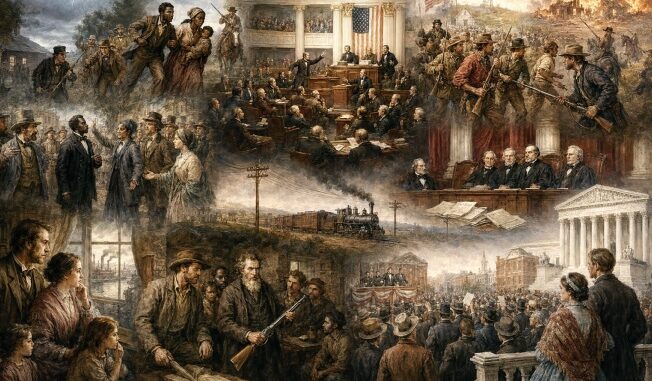

COMPROMISE FAILS AND THE UNION COMES APART
“The Union did not collapse because Americans stopped compromising. It collapsed because compromise could no longer reconcile freedom with human bondage.”
THE COMPROMISE OF 1850
he territory acquired from Mexico forced Congress to decide whether slavery would expand westward. California sought admission as a free state. Texas claimed a vast boundary and carried debt. Southerners demanded protection for slavery and stronger recovery of fugitives. With sectional anger rising, Henry Clay proposed a package of measures, while Daniel Webster urged concession for the Union and John C. Calhoun warned that the South required constitutional security. After the package initially failed, Senator Stephen A. Douglas divided it into separate bills. California entered free. Utah and New Mexico were organized without an immediate congressional ban on slavery, leaving their status to future decision. Texas accepted a reduced boundary and federal debt relief. The slave trade-but not slavery-ended in Washington, D.C. Congress also enacted a powerful Fugitive Slave Act.
A TRUCE, NOT A SETTLEMENT
Many Americans celebrated compromise as rescue. Yet it redistributed conflict rather than resolving it. “Popular sovereignty” postponed the territorial decision. The Fugitive Slave Act nationalized enforcement. Northern resistance convinced slaveholders that constitutional guarantees were being defied; federal enforcement convinced many northerners that distant slavery had entered their own streets.
“Compromise saved the Union for a decade. It also carried the conflict into every section.”
WHEN SLAVERY ENTERED THE NORTH
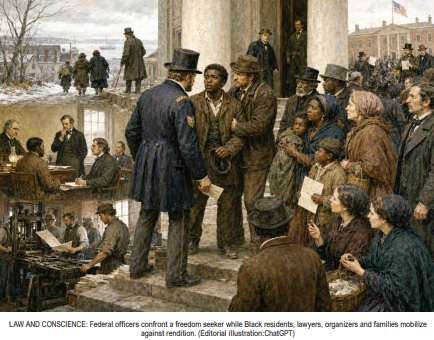 The Fugitive Slave Act of 1850 required federal cooperation in the capture and return of alleged fugitives. Commissioners could issue certificates of removal; accused people could not testify on their own behalf before a jury. Citizens could be compelled to assist. Officials who obstructed enforcement faced penalties, and commissioners received a larger fee when ordering removal than when releasing the accused. The law endangered both fugitives and free-born Black people vulnerable to kidnapping or false claims. Black vigilance committees raised money, found counsel, warned communities and sometimes organized rescues. Cases involving Shadrach Minkins, Thomas Sims, Anthony Burns and others transformed courthouses and streets into national theaters of conflict. Some fugitives moved onward to Canada. Northern states enacted personal-liberty laws intended to protect due process or restrict state participation. Southerners regarded such measures as unconstitutional nullification. Resistance also widened antislavery sympathy: citizens who might never have joined abolitionist societies were forced to witness federal power returning human beings to bondage.
“The law demanded obedience. Conscience asked what obedience had become.”
UNCLE TOM, THE PRESS AND THE POLITICS OF FEELING
Harriet Beecher Stowe’s Uncle Tom’s Cabin appeared in book form in 1852 after serialization. Its enormous popularity made family separation, flight and the cruelty of slavery emotionally immediate to millions of readers. Plays and illustrations extended its reach across the Atlantic world. The novel changed public feeling, but it did not speak for every Black experience and carried stereotypes that later acquired harmful lives of their own. Black writers and formerly enslaved witnesses-including Frederick Douglass, Harriet Jacobs and William Wells Brownoffered testimony grounded in lived experience and political analysis. Their books, speeches and newspapers insisted that Black Americans were authors of the struggle for freedom, not simply objects of sympathy.
A NATIONAL ARGUMENT IN PRINT
Cheap newspapers, partisan editors, telegraph reports and expanding railroads made local confrontations national news. Competing accounts hardened identities. Antislavery publications exposed kidnapping and violence; proslavery writers defended bondage as constitutional, biblical and beneficial. The same communication revolution that joined markets also synchronized outrage.
THE PARTY SYSTEM WEAKENS
The Whig Party fractured because its northern and southern wings could no longer contain the slavery question. Democrats retained a national organization but divided internally. The short-lived Know-Nothing movement channeled anti-immigrant and anti-Catholic fear. Political loyalties were being reorganized along sectional lines.
“The nation read the same news-and learned to inhabit opposing realities.”
KANSAS-NEBRASKA: REPEALING THE BOUNDARY
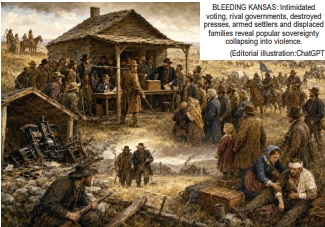 I n 1854 Stephen Douglas proposed organizing Kansas and Nebraska, in part to facilitate western settlement and a transcontinental railroad. His Kansas-Nebraska Act left slavery to popular sovereignty and effectively repealed the Missouri Compromise restriction north of latitude 36°30?. What had been treated as a durable boundary now appeared revocable. The act shattered political coalitions. Antislavery Whigs, Free Soilers, former Democrats and others began forming the Republican Party around opposition to slavery’s expansion. The party did not initially demand immediate abolition where slavery already existed, and many members did not support racial equality. Yet its rise convinced slaveholders that a sectional northern majority might control the federal government. Proslavery Missourians crossed into Kansas to influence elections. Free-State settlers organized rival institutions. Competing constitutions claimed legitimacy. The sack of Lawrence and the killing of proslavery settlers at Pottawatomie by John Brown and followers accelerated retaliation. Hundreds died in years of irregular violence.
“Kansas was asked to vote slavery up or down. First, armed power tried to decide who could vote.”
VIOLENCE REACHES CONGRESS Kansas violence entered the United States Senate symbolically and physically. In May 1856, Senator Charles Sumner of Massachusetts delivered a fierce antislavery speech that personally insulted Senator Andrew Butler of South Carolina. Representative Preston Brooks, Butler’s relative, then beat Sumner with a cane at his Senate desk, leaving him seriously injured. Reactions exposed sectional estrangement. Many northerners treated Sumner as a martyr to free speech and Brooks as proof of slaveholding violence. Admirers in the South sent Brooks replacement canes and praised him for defending honor. The assault mattered not simply because one legislator attacked another, but because each section increasingly interpreted violence through incompatible moral codes.
THE ELECTION OF 1856
The new Republican Party nominated explorer John C. Frémont on a platform opposing slavery’s expansion. Democrat James Buchanan won the presidency by carrying the South and several northern states; former president Millard Fillmore ran for the American Party. Republicans lost, but their strong northern showing demonstrated that a sectional antislavery-expansion party could plausibly capture the presidency.
THE LECOMPTON CONSTITUTION
A proslavery convention drafted the Lecompton Constitution under disputed conditions. President Buchanan supported admission of Kansas under it, while Douglas opposed the process as a betrayal of genuine popular sovereignty. Congress rejected the effort, and Kansas eventually entered free in 1861. The episode divided Democrats and discredited the mechanism that was supposed to remove slavery from national politics.
The caning of Sumner made visible what politics could no longer contain.
DRED SCOTT AND THE COURT’S FAILED SETTLEMENT
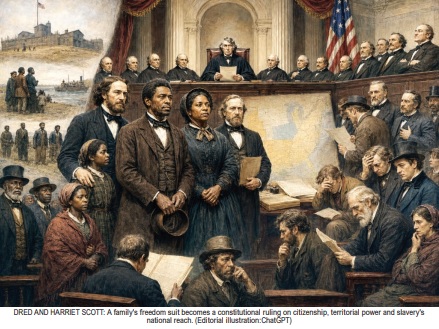 Dred Scott had lived with his wife Harriet and their enslaver in free Illinois and in Wisconsin Territory, where slavery had been prohibited. The Scotts sued for freedom, pursuing a legal strategy with support from allies. Their case ultimately reached the United States Supreme Court. In 1857 Chief Justice Roger B. Taney’s majority opinion declared that people of African descent, whether enslaved or free, were not citizens of the United States within the Constitution’s meaning and therefore could not sue in federal court. The Court further held that residence on free soil had not made Scott free and that Congress lacked power to prohibit slavery in the territories, rendering the Missouri Compromise unconstitutional. The ruling sought finality and produced greater instability. Republicans rejected its sweeping logic and warned that slavery could become national. Slaveholders demanded respect for the decision. Scott and his family were later manumitted by a subsequent owner, but Dred Scott died in 1858. Their personal struggle survived the Court’s attempt to reduce it to doctrine.
The Court answered a freedom claim by narrowing citizenship and enlarging slavery’s reach.”
LINCOLN, DOUGLAS AND THE HOUSE DIVIDED
Abraham Lincoln emerged as a leading Republican critic of slavery’s expansion. In his 1858 “House Divided” speech, he argued that the nation could not endure permanently half slave and half free. He did not predict immediate dissolution, but warned that recent laws and decisions appeared to prepare slavery for national protection. In seven Illinois debates, Lincoln challenged Democratic senator Stephen Douglas. Douglas defended popular sovereignty; at Freeport he argued that settlers could effectively exclude slavery by refusing protective local laws, even after Dred Scott. That position helped him retain his Senate seat but alienated proslavery Democrats who demanded affirmative federal protection.
RACE, UNION AND POLITICAL LIMITS
Lincoln opposed slavery as wrong and rejected its expansion, yet he made statements denying full social and political equality in response to the racism of his time and electorate. Black abolitionists pressed beyond those limits. Frederick Douglass recognized Lincoln’s political importance while insisting that freedom required Black citizenship and equality, not merely containment of bondage.
A NEW POLITICAL GEOGRAPHY
Republicans were becoming dominant across much of the North while barely competing in the South. Democrats remained national but fractured over whether territorial settlers or the federal government must protect slavery. Elections increasingly measured sectional strength rather than mediated it.
“The debate was no longer only about where slavery could go. It was about what nation could survive.”
JOHN BROWN AT HARPERS FERRY
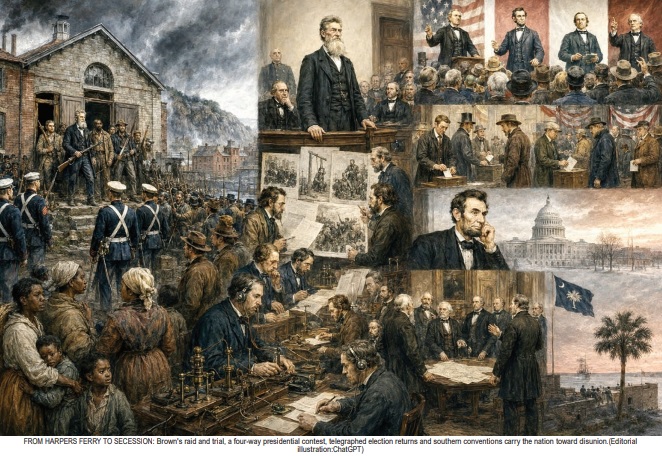 On October 16, 1859, John Brown led twenty-one men-Black and white-in seizing the federal armory at Harpers Ferry, Virginia. He intended to spark and supply an uprising of enslaved people. The plan failed. Local militia and U.S. Marines under Colonel Robert E. Lee surrounded the raiders; ten were killed, and Brown was captured. At trial, Brown was convicted of treason against Virginia, murder and inciting slave insurrection. His calm statements before execution deepened his meaning as a symbol. Some northerners rejected his violence while admiring his moral seriousness; some abolitionists hailed him as a martyr. White southerners saw the raid as confirmation that antislavery politics concealed a program of invasion and racial war. The raid’s military importance was small; its psychological importance was immense. Rumor and fear encouraged southern militia organization. The sections no longer merely doubted one another’s policies-they doubted one another’s intentions and safety
“Harpers Ferry failed as an uprising. It succeeded as an omen.”
THE ELECTION THAT BROKE THE POLITICAL UNION
The Democratic Party split in 1860. Northern Democrats nominated Douglas and defended popular sovereignty; southern Democrats nominated John C. Breckinridge and demanded federal protection for slavery in the territories. The Constitutional Union Party nominated John Bell and appealed vaguely to Constitution, Union and law. Republicans nominated Lincoln on a platform opposing slavery’s expansion while protecting it where the Constitution already recognized state authority. Lincoln won less than forty percent of the national popular vote but a decisive electoral majority by carrying nearly every free state. He received virtually no support in most of the Deep South and did not appear on the ballot in several slave states. His victory was constitutional. It was also unmistakably sectional.
SECESSION
South Carolina seceded on December 20, 1860. Six other Deep South states followed before Lincoln’s inauguration and formed the Confederate States of America. Their declarations, ordinances and commissioners repeatedly identified slavery, slave property and perceived threats to the institution as central causes. Arguments about states’ rights operated within that explicit defense of slavery. Many white southerners opposed immediate secession; enslaved people were excluded from the decision that would determine their lives. In the Upper South, loyalty remained unsettled until war began. Last-minute compromises failed because Republicans would not abandon the principle that slavery must not expand, while secessionists demanded guarantees that would secure its future.
“The ballot selected a president. The sections treated the result as a judgment upon their future.”

Be the first to comment